


Abstract
Oxidative stress is involved in the pathogenesis of several chronic diseases and may be attenuated through the intake of dietary antioxidants. Fruits of Opuntia dillenii (prickly pear) have demonstrated antioxidant properties in preclinical studies; however, evidence in humans remains scarce. This pilot study aimed to assess the short-term effects of O. dillenii fruit-derived products on plasma antioxidant capacity in healthy adults. Six participants were randomly allocated into three groups (n = 2 per group) and consumed for 30 days either dehydrated fruit powder (15 or 30 g/day) or fruit juice (250 mL/day). Plasma antioxidant capacity was evaluated before and after the intervention using TEAC and ORAC assays. Additionally, total phenolic content, total betalain content, and antioxidant capacity (TEAC and ORAC) were determined in the tested products. Post-intervention, plasma TEAC values increased significantly in the groups consuming 15 g/day of fruit powder (+16.9%) and juice (+14.2%), whereas the 30 g/day fruit powder group showed a non-significant increase (+7.1%). Interestingly, only the juice group exhibited a significant increase in ORAC values (+51.1%). Based on the estimated daily intake, the juice provided a higher antioxidant load than the powder formulation, supplying higher amounts of phenolic compounds (178 vs. 57.1–114.2 mg/day) and antioxidant capacity, as determined by TEAC (592.5 vs. 81.8–163.5 µmol Trolox equivalents/day) and ORAC assays (6330 vs. 1608.5–3216.9 µmol Trolox equivalents/day). This higher antioxidant load may partly explain the stronger response observed following juice consumption, whereas the lack of response in the 30 g/day powder group may be attributable to individual participant characteristics. These preliminary findings suggest that short-term consumption of O. dillenii fruit-derived products may enhance plasma antioxidant capacity, with fruit juice showing the most pronounced effects. Further studies in larger populations are required to confirm these results.
1. Introduction
Non-communicable diseases (NCDs) have increased steadily in recent years and are currently the leading cause of mortality worldwide, accounting for approximately 75% of all deaths [1]. Their development is associated with modifiable risk factors such as smoking, alcohol consumption, physical inactivity, an unhealthy diet, and population ageing. Oxidative stress plays an important role in the development and progression of NCDs. It occurs when the production of reactive oxygen and nitrogen species exceeds endogenous antioxidant capacity, resulting in oxidative damage to lipids, proteins, and DNA [2]. Therefore, dietary strategies based on bioactive compounds, including polyphenols, carotenoids, and phytosterols, have received increasing attention due to their antioxidant and other potentially beneficial properties [3].
Among plants with recognized nutritional and bioactive values, Opuntia dillenii, commonly known as prickly pear, has received increasing attention [4]. This species belongs to the Cactaceae family and originates from arid and semi-arid regions of America and the southern United States. In the Canary Islands, O. dillenii is widely distributed and naturalized, particularly in coastal and arid areas. Its fruits are traditionally consumed fresh or in artisanal preparations, while different parts of the plant have also been used in traditional Canarian medicine. This traditional use may be related to the nutritional and functional properties of the species, which vary according to the plant part [4]. In particular, the fruit contains dietary fiber and several bioactive compounds, including flavonoids, phenolic acids, and betalains. Consistent with this composition, preclinical studies using in vitro, cellular, animal, and in silico models have demonstrated its antioxidant potential [5]. However, evidence in humans remains limited, supporting further investigation into the effects of O. dillenii consumption on antioxidant capacity.
Accordingly, this pilot study aimed to evaluate the effect of daily consumption of O. dillenii fruit in different formats (powder and juice) on plasma antioxidant capacity in healthy adults. The study also aimed to quantify the betalain and total polyphenol contents and the in vitro antioxidant capacity of the products, as well as to assess the potential influence of dose and food matrix on the antioxidant response in vivo.
2. Materials and Methods
2.1. Study Design and Participants
A pilot intervention study was conducted in six healthy adults. Participants were non-smokers, maintained their usual dietary and physical-activity habits, and provided written informed consent. In order to avoid potential confounding factors, pregnant women and individuals with diagnosed medical conditions, including arterial hypertension, diabetes mellitus, hyperthyroidism or hypothyroidism, renal or hepatic disease, as well as any other condition that could be incompatible with the study, were excluded. Participants were randomly assigned to three intervention groups (n = 2 per group): participants A and B received 15 g/day of Opuntia dillenii powder; participants C and D received 30 g/day of powder; and participants E and F received 250 mL/day of O. dillenii juice. The intervention lasted 30 days. Participants A and B consumed 15 g/day of O. dillenii powder suspended in 250 mL of water before breakfast. Participants C and D consumed 30 g/day of powder, divided into two 15 g doses (each suspended in 250 mL of water), one before breakfast and the other in the afternoon. Participants E and F consumed 250 mL/day of O. dillenii juice before breakfast. Participants received standardized instructions regarding product consumption and recorded any adverse events during the intervention.
2.2. Anthropometric Assessment
Baseline height, weight, body composition, waist circumference, and hip circumference were assessed in all participants (A–F). Body composition was determined by bioelectrical impedance analysis (Tanita DC 430 MA, Bio-Lógica®, Barcelona, Spain), and body mass index (BMI) and waist-to-hip ratio (WHR) were calculated. Baseline anthropometric characteristics of participants A–F are presented in Table 1.
Table 1.
Baseline characteristics of participants.
2.3. Blood Collection and Preparation of Product Extracts
Blood samples were collected before and after the 30-day intervention. Blood was collected into EDTA-containing tubes and centrifuged at 2000× g for 10 min at 4 °C to separate the plasma. Plasma aliquots were stored at −80 °C until the TEAC and ORAC analyses.
Powder and juice extracts were prepared separately according to the procedure described by Gómez-López et al. [6]. Briefly, 0.25 g of powder or 0.50 g of juice was mixed with 5 mL of 50% methanol, vortexed for 1 min, and subsequently shaken at 750 rpm for 60 min. After centrifugation at 3030× g for 10 min at 4 °C, the supernatant was collected. The remaining pellet was sequentially re-extracted with 3 mL of 50% (v/v) methanol and 3 mL of pure methanol. The supernatants obtained from all extraction steps were combined, filtered through a 0.45 μm PTFE membrane, and stored at −80 °C until the analysis of antioxidant capacity and bioactive compounds.
2.4. Antioxidant Capacity
The antioxidant capacity of plasma and product extracts was determined using the Trolox equivalent antioxidant capacity (TEAC) and oxygen radical absorbance capacity (ORAC) assays. The TEAC assay evaluated the ability of the samples to scavenge the ABTS•+ radical cation. Trolox solutions ranging from 50 to 350 μmol/L were used to construct the calibration curve, and absorbance was measured at 734 nm after 3 min of reaction [7]. The ORAC assay evaluated the ability of the samples to inhibit the oxidation of fluorescein induced by AAPH-generated peroxyl radicals. Trolox solutions ranging from 5 to 350 μmol/L were used as standards. Fluorescence was recorded every 1 min for 90 min at 37 °C, using excitation and emission wavelengths of 485 and 535 nm, respectively. Antioxidant capacity was calculated from the area under the fluorescence decay curve [8]. All measurements were performed in triplicate. Results were expressed as μmol Trolox equivalents (TE)/L for plasma and μmol TE/g for the powder and juice.
2.5. Betalains and Total Polyphenols
Betacyanin and betaxanthin contents in the product extracts were determined spectrophotometrically. Absorbance was measured at 538 nm for betacyanins and 480 nm for betaxanthins, with correction for impurities at 600 nm. The concentrations were calculated using the corresponding molecular weights and molar extinction coefficients and expressed as mg/100 g of product [9]. Total polyphenol content was determined using the Folin–Ciocalteu method [10]. Gallic acid solutions ranging from 1 to 10 μg/mL were used to construct the calibration curve, and absorbance was measured at 765 nm. Results were expressed as mg gallic acid equivalents (GAE)/100 g of product. All measurements were performed in triplicate.
2.6. Statistical Analysis
Statistical analyses were performed using GraphPad Prism 9.4.2. Results are presented as mean ± standard deviation. Pre- and post-intervention values were compared using paired Student’s t-tests, whereas differences between powder and juice were assessed using unpaired Student’s t-tests. Normality and homoscedasticity were evaluated using the Shapiro–Wilk and Levene’s tests, respectively. Statistical significance was set at p < 0.05.
3. Results
3.1. Plasma Antioxidant Capacity
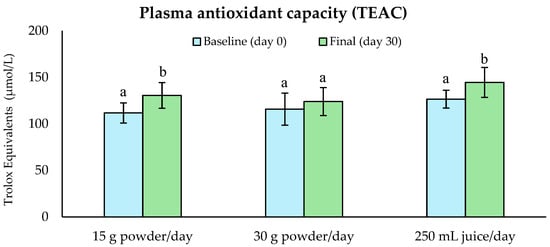
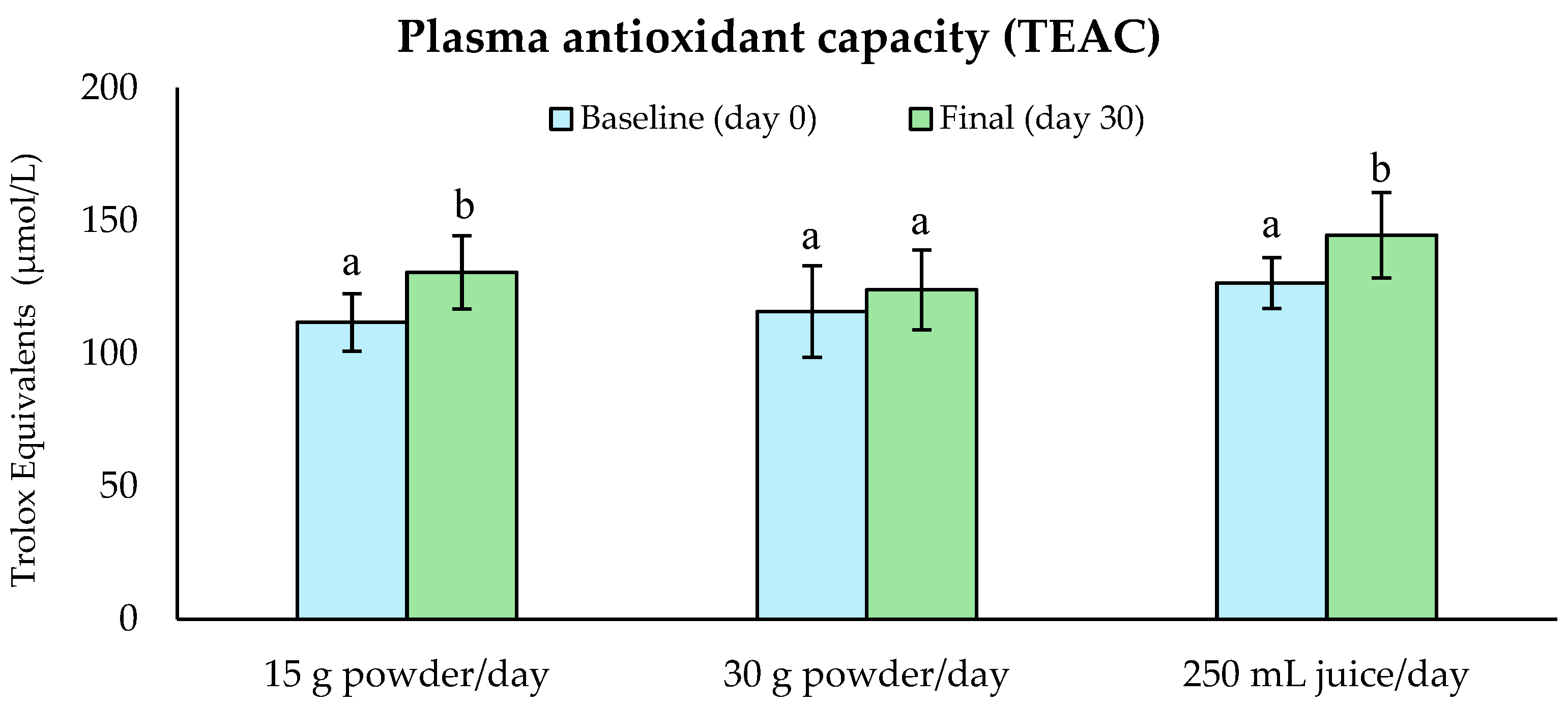
After the 30-day intervention, plasma TEAC increased significantly in the 15 g/day powder group, from 111.68 ± 10.83 to 130.57 ± 13.86 μmol TE/L, representing a 16.9% increase (p = 0.0103) (Figure 1). A significant increase was also observed in the 250 mL/day juice group, from 126.56 ± 9.58 to 144.52 ± 16.04 μmol TE/L (+14.2%; p = 0.0296). In contrast, the increase observed in the 30 g/day powder group, from 115.78 ± 17.27 to 123.96 ± 14.97 μmol TE/L (+7.1%), was not statistically significant (p = 0.3485).
Figure 1.
Plasma antioxidant capacity expressed as Trolox equivalents (TEAC assay). Data are presented as mean ± standard deviation (n = 2 per group). Different letters indicate significant differences between baseline and post-intervention values (p < 0.05).
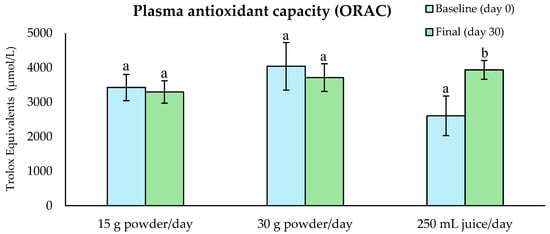
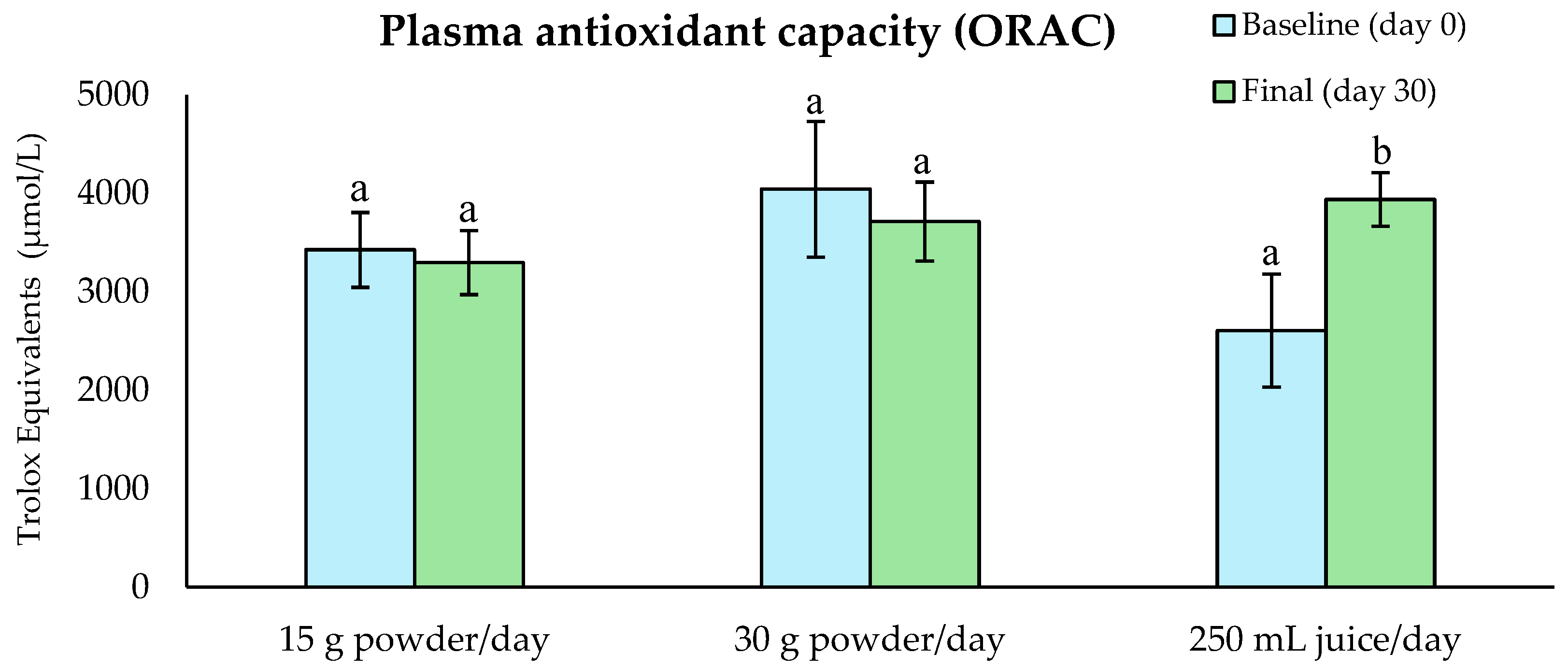
Plasma ORAC remained unchanged in both powder groups (Figure 2). Values decreased slightly from 3426.72 ± 381.01 to 3297.19 ± 325.56 μmol TE/L in the 15 g/day group (−3.8%; p = 0.4768) and from 4042.28 ± 689.14 to 3714.56 ± 400.64 μmol TE/L in the 30 g/day group (−8.1%; p = 0.2643). By contrast, the 250 mL/day juice group showed a marked 51.1% increase, from 2606.50 ± 573.71 to 3938.47 ± 270.78 μmol TE/L (p < 0.0001).
Figure 2.
Plasma antioxidant capacity expressed as Trolox equivalents (ORAC assay). Data are presented as mean ± standard deviation (n = 2 per group). Different letters indicate significant differences between baseline and post-intervention values (p < 0.05).
3.2. In Vitro Antioxidant Capacity and Bioactive Compounds of Opuntia dillenii Powder and Juice
The powder showed greater in vitro antioxidant capacity than the juice in both assays (Table 2). TEAC values were 5.45 ± 0.29 μmol TE/g for the powder and 2.37 ± 0.19 μmol TE/g for the juice (p < 0.0001). A similar difference was observed for ORAC, with values of 107.23 ± 11.10 and 25.32 ± 2.38 μmol TE/g for the powder and juice, respectively (p < 0.0001).
Table 2.
In vitro antioxidant capacity of Opuntia dillenii powder and juice.
Regarding bioactive compounds, the powder contained significantly higher levels of betacyanins, betaxanthins, and total polyphenols than the juice (p < 0.0001 for all comparisons; Table 3). This difference may be attributed to the lower water content of the dehydrated product, which results in a greater concentration of these compounds per gram.
Table 3.
Bioactive compound content of Opuntia dillenii powder and juice.
3.3. Estimated Daily Intake of Bioactive Compounds and Antioxidant Capacity
To examine whether the changes in plasma antioxidant capacity could be associated with the amount of bioactive compounds and antioxidant capacity provided by each intervention, daily intake was estimated from the composition of the products and the administered doses (Table 4).
Table 4.
Estimated daily intake of bioactive compounds and antioxidant capacity by intervention group.
Despite the higher concentrations of bioactive compounds and antioxidant capacity per gram observed in the powder, the administered dose of juice provided the highest estimated daily intake of total polyphenols and the greatest antioxidant capacity according to both TEAC and ORAC. This greater daily contribution may partly explain why the juice group showed increases in both plasma TEAC and ORAC.
4. Discussion
The results of this pilot study suggest that daily consumption of O. dillenii may influence plasma antioxidant capacity in healthy adults, although the response varied according to the product and analytical method. Plasma TEAC increased significantly after the consumption of 15 g/day of powder and 250 mL/day of juice, whereas a significant increase in ORAC was observed only in the juice group. These findings are broadly consistent with previous human studies of Opuntia ficus-indica, in which fruit consumption was associated with improvements in antioxidant status and total antioxidant capacity [11]. Nevertheless, the scarcity of human studies on O. dillenii and the exploratory design of the present investigation require cautious interpretation.
The powder contained significantly higher concentrations of betacyanins, betaxanthins, and total polyphenols than the juice and showed greater in vitro antioxidant capacity in both the TEAC and ORAC assays. The higher concentrations detected in the powder may partly result from water removal during dehydration, which produces a more concentrated food matrix. Despite its higher concentration of bioactive compounds and antioxidant capacity per gram, the powder did not elicit a more consistent plasma response than the juice. This finding may partly reflect differences in the amounts consumed. The 250 mL/day juice intervention provided the highest estimated daily polyphenol intake and antioxidant capacity, reaching 592.50 μmol TE/day according to TEAC and 6330.00 μmol TE/day according to ORAC. This greater daily contribution may help explain the simultaneous increases in plasma TEAC and ORAC observed in the juice group. However, the 15 g/day powder group also showed a significant increase in plasma TEAC despite receiving a lower estimated antioxidant intake. Furthermore, doubling the powder dose did not produce a greater response. Therefore, the plasma effects cannot be explained solely by the estimated intake of bioactive compounds or antioxidant capacity.
Differences in the food matrix could also influence the observed response. The liquid matrix may facilitate the release of bioactive compounds during digestion, whereas interactions with dietary fiber and other constituents of the powder could affect their bioaccessibility and subsequent absorption. However, this study did not directly assess bioaccessibility, bioavailability, or circulating metabolites. Consequently, the influence of the food matrix remains a plausible hypothesis rather than a demonstrated mechanism.
The absence of significant changes in the 30 g/day powder group, despite receiving twice the powder dose, does not support a straightforward dose–response relationship. Participants in this group were older and had a higher mean BMI and body fat percentage than those in the other groups. These baseline differences may have contributed to the variability in the antioxidant response. Nevertheless, because each intervention group included only two participants, their influence cannot be determined or interpreted causally.
The principal limitation of this study was its very small sample size (n = 6), which substantially restricted statistical power and precluded generalization of the findings. The absence of a placebo or control group, limited control of dietary antioxidant intake, short 30-day intervention period, and heterogeneity in baseline participant characteristics further limited the attribution of the observed changes specifically to O. dillenii. In addition, the estimation of daily antioxidant intake based on chemical assays does not necessarily reflect the bioaccessible or bioavailable fraction of the compounds.
Overall, the findings provide preliminary evidence that O. dillenii consumption may modify plasma antioxidant capacity. Juice produced the most consistent response across the two plasma assays, whereas the powder provided higher concentrations of bioactive compounds and greater in vitro antioxidant capacity per gram. This apparent difference highlights the potential importance of the administered dose, food matrix, bioavailability, and individual characteristics. Larger randomized controlled studies are required to confirm these preliminary findings and to identify the factors determining the response to O. dillenii consumption.
5. Conclusions
Thirty days of O. dillenii consumption was associated with changes in plasma antioxidant capacity in some intervention groups. The powder contained higher concentrations of betacyanins, betaxanthins, and total polyphenols and showed greater in vitro antioxidant capacity than the juice. However, the juice group showed the most consistent plasma response, with significant increases in both TEAC and ORAC, whereas the 15 g/day powder group showed a significant increase only in TEAC. Given the small sample size, absence of a control group, and baseline differences between participants, these results should be considered preliminary. Larger controlled studies are needed to confirm these findings and to clarify the influence of dose, food matrix, bioavailability, and individual characteristics.
Author Contributions
Conceptualization, R.S.-F., N.B.-R., and M.M.; methodology, R.S.-F., N.B.-R., and M.M.; formal analysis, Y.D.-R.; investigation, Y.D.-R.; data curation, Y.D.-R.; writing—original draft preparation, Y.D.-R.; writing—review and editing, R.S.-F., N.B.-R., and M.M.; supervision, R.S.-F., N.B.-R., and M.M.; project administration, R.S.-F., N.B.-R., and M.M.; funding acquisition, R.S.-F., N.B.-R., and M.M. All authors have read and agreed to the published version of the manuscript.
Funding
This research was supported by the Internal Research Grant Program of the Universidad Fernando Pessoa Canarias (project code 025-2025).
Institutional Review Board Statement
The study was conducted in accordance with the Declaration of Helsinki, and approved by the Ethics Committee of Universidad Fernando Pessoa-Canarias (protocol code 025-2025) on 21 May 2025.
Informed Consent Statement
Informed consent was obtained from all subjects involved in the study.
Data Availability Statement
The original contributions presented in this study are included in the article. Further inquiries can be directed to the corresponding author.
Conflicts of Interest
The authors declare no conflicts of interest.
Abbreviations
The following abbreviations are used in this manuscript:
| ABTS | 2,2′-azinobis-(3-ethylbenzothiazoline-6-sulfonic acid) |
| AAPH | 2,2′-Azobis(2-amidinopropane) dihydrochloride |
| BMI | Body mass index |
| EDTA | Ethylenediaminetetraacetic acid |
| NCDs | Non-communicable diseases |
| ORAC | Oxygen radical absorbance capacity |
| TEAC | Trolox equivalent antioxidant capacity |
| WHR | Waist-to-hip ratio |
References
- World Health Organization. Noncommunicable Diseases. Available online: https://www.who.int/news-room/fact-sheets/detail/noncommunicable-diseases (accessed on 11 September 2026).
- Aleksandrova, K.; Koelman, L.; Rodrigues, C.E. Dietary patterns and biomarkers of oxidative stress and inflammation: A systematic review of observational and intervention studies. Redox Biol. 2021, 42, 101869. [Google Scholar] [CrossRef] [Scilit] [PubMed]
- Gupta, S.; Chauhan, D.; Mehla, K.; Sood, P.; Nair, A. An overview of nutraceuticals: Current scenario. J. Basic Clin. Pharm. 2010, 1, 55–62. [Google Scholar] [PubMed]
- Bouhrim, M.; Bouknana, S.; Ouassou, H.; Boutahiri, S.; Daoudi, N.E.; Bnouham, M. Phytochemistry and biological activities of Opuntia seed oils: Opuntia dillenii (Ker Gawl.) Haw. and Opuntia ficus-indica (L.) Mill. A review. Herba Pol. 2021, 67, 49–64. [Google Scholar] [CrossRef] [Scilit]
- Santana-Farré, R.; Buset-Ríos, N.; Makran, M. Antioxidant potential of Opuntia dillenii: A systematic review of influencing factors and biological efficacy. Nutraceuticals 2025, 5, 22. [Google Scholar] [CrossRef] [Scilit]
- Gómez-López, I.; Lobo-Rodrigo, G.; Portillo, M.P.; Cano, M.P. Ultrasound-assisted “green” extraction of antioxidant compounds (betalains and phenolics) from Opuntia stricta var. dillenii fruits: Optimization and biological activities. Antioxidants 2021, 10, 1786. [Google Scholar] [CrossRef] [Scilit] [PubMed]
- Indracanti, M.; ChV, S.; Sisay, T. A 96-well microtiter plate ABTS-based assay for estimation of antioxidant activity in green leafy vegetables. Biotechnol. Int. 2019, 12, 22–29. [Google Scholar]
- Girish, Y.; Sharathkumar, K.; Prashantha, K.; Rangappa, S.; Sudhanva, M. Significance of antioxidants and methods to evaluate their potency. Mater. Chem. Horiz. 2023, 2, 93–112. [Google Scholar]
- Kumar, R.; Methven, L.; Oruna-Concha, M.J. A comparative study of ethanol and citric acid solutions for extracting betalains and total phenolic content from freeze-dried beetroot powder. Molecules 2023, 28, 6405. [Google Scholar] [CrossRef] [Scilit] [PubMed]
- Betancourt, C.; Cejudo-Bastante, M.J.; Heredia, F.J.; Hurtado, N. Pigment composition and antioxidant capacity of betacyanin and betaxanthin fractions of Opuntia dillenii (Ker Gawl.) Haw. cactus fruit. Food Res. Int. 2017, 101, 173–179. [Google Scholar] [CrossRef] [Scilit] [PubMed]
- Attanzio, A.; Tesoriere, L.; Vasto, S.; Pintaudi, A.M.; Livrea, M.A.; Allegra, M. Short-term cactus pear [Opuntia ficus-indica (L.) Mill.] fruit supplementation ameliorates the inflammatory profile and is associated with improved antioxidant status among healthy humans. Food Nutr. Res. 2018, 62, 1262. [Google Scholar] [CrossRef] [Scilit] [PubMed]

Disclaimer/Publisher’s Note: The statements, opinions and data contained in all publications are solely those of the individual author(s) and contributor(s) and not of MDPI and/or the editor(s). MDPI and/or the editor(s) disclaim responsibility for any injury to people or property resulting from any ideas, methods, instructions or products referred to in the content. |
© 2026 by the authors. Licensee MDPI, Basel, Switzerland. This article is an open access article distributed under the terms and conditions of the Creative Commons Attribution (CC BY) license.