


Abstract
The prevalence of antimicrobial resistance has drawn the public’s attention worldwide. The presence of ESBL E. coli in fresh produce and other food represents a growing problem involving food safety and has become a global food safety issue. This study was aimed to determine the prevalence of ESBL-producing E. coli in raw vegetables (lettuce and bean sprouts) from hypermarkets and wet markets and to establish the antibiogram of the isolates. In this study, a total of 180 samples (95 samples of lettuce and 85 samples of bean sprouts) were collected from hypermarkets and wet markets. The most-probable-number analysis and multiplex polymerase chain reaction (MPN–PCR) was used to detect and quantify the ESBL-producing E. coli in raw vegetable samples. The prevalence rates of ESBL-producing E. coli in lettuce and bean sprouts were 62.11% (59/95) and 63.53% (54/85), respectively, with a microbial load range of <3 to >1100 MPN/g. A total of 15 isolates of ESBL-producing E. coli recovered from the samples were tested with an antibiotic susceptibility test (AST) with different antibiotic classes. All isolates were found to be susceptible to cefepime, piperacillin/tazobactam, and meropenem. A total of nine ESBL-producing E. coli strains showed multidrug resistance. In conclusion, the high prevalence rate of ESBL-producing E. coli in raw vegetables showed that raw vegetables could act as a potential vehicle to transmit ESBL-producing E. coli to the human population.
1. Introduction
The prevalence of extended-spectrum beta-lactamase (ESBL) bacteria in food chain has become a global food safety issue. The infections caused by ESBL-producing E. coli include intra-abdominal abscesses, peritonitis, urinary tract infection (UTI), and in more severe cases may lead to blood poisoning. Nowadays, vegetables are served as convenient meals, and they have begun to take the center-stage of main meals. However, raw vegetables were identified as the commodity group of the greatest concern from a microbiology safety perspective [1]. This study was aimed to determine the prevalence rate of ESBL-producing E. coli in raw vegetables and the antibiogram of the ESBL-producing E. coli isolates.
2. Materials and Methods
2.1. Sample Collection
A total of 180 samples of raw vegetables (lettuces, n = 95; bean sprout, n = 85) from the wet market and hypermarket were purchased randomly in the Serdang area, Malaysia. All the samples were placed into a sterile plastics bag and analysed immediately upon arrival at the lab.
2.2. Most Probable Number and Polymerase Chain Reaction (MPN-PCR)
A 10 g sample was placed in a sterile stomacher bag with 90 mL of Tryptic Soy Broth and homogenized for 1 min. The suspensions were then diluted 10-fold serially to 1000-fold. The three-tube MPN method was carried out by transferring each dilution (1 mL) into triplicate MPN tubes containing 10 mL of MacConkey broth. All the tubes were incubated at 37 °C 24 h. After incubation, the positive tubes were examined before genomic DNA extraction. Four sets of primers were used to detect the presence of ESBL-producing E. coli including 16S rRNA gene of E. coli, blaTEM, blaSHV, and blaCTX-M.
2.3. Antibiotic Susceptibility Test (AST)
A total of 15 ESBL-producing E. coli strains were isolated from raw vegetables by using Chromogenic Brilliance ESBL agar and further confirmed by PCR analysis. All the isolates were tested against different antibiotics including piperacillin/tazobactam (TZP, 110 µg), meropenem (MEM, 10 µg), aztreonam (ATM, 30 µg), ciprofloxacin (CIP, 5 µg), cefotaxime (CTX, 30 µg), ceftazidime (CAZ, 30 µg), ceftriaxone (CRO, 30 µg), cefepime (FEP, 30 µg), ampicillin (AMP, 10 µg), amoxicillin/clavulanic acid (AMC, 30 µg). The susceptibility range of the selected antibiotic was based on CLSI (2017) [2]. The diameter of the inhibition zone was measured and recorded to determine the susceptibility level of each antibiotic. Isolates with resistance to more than three classes of antibiotics are considered multidrug-resistant bacteria.
3. Results and Discussion
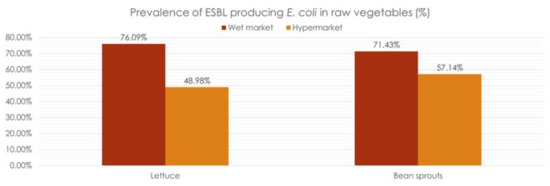
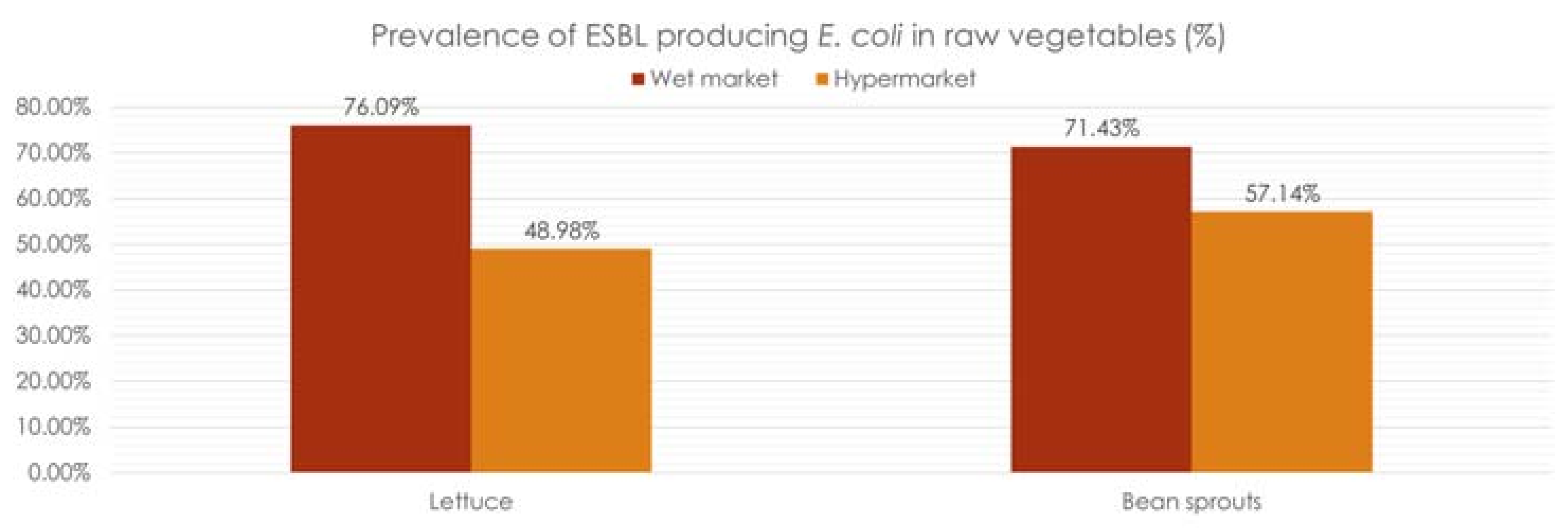
Of the 180 vegetable samples (lettuce, n = 95; bean sprouts, n = 85) tested, 113 (63.12%) yielded ESBL-producing E. coli. The contamination rates were 62.11% (59/95) in lettuce and 63.53% (54/85) in sprouts. Based on Figure 1, the prevalence of rate ESBL producing E. coli in lettuce and bean sprouts from wet market is higher compare to hypermarket. The ESBL-producing E. coli detected in vegetable samples from the wet market (73.86%) were significantly (p < 0.05) higher than the vegetable samples from the hypermarket (52.74%). The contamination of raw vegetables can happen via different pathways including pre-harvest (fertilizer, irrigation water and soil) and post-harvest process (improper handling and storage) [3]. The different prevalence rates of ESBL-producing E. coli in raw vegetables from hypermarket and wet market may be due to the display and storage methods, as well as improper handling by the food handlers.
Figure 1.
Prevalence rate of ESBL-producing E. coli in raw vegetables from wet markets and hypermarkets.
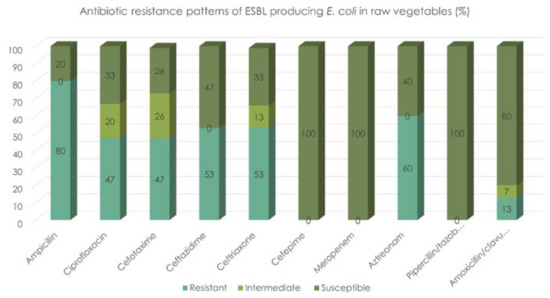
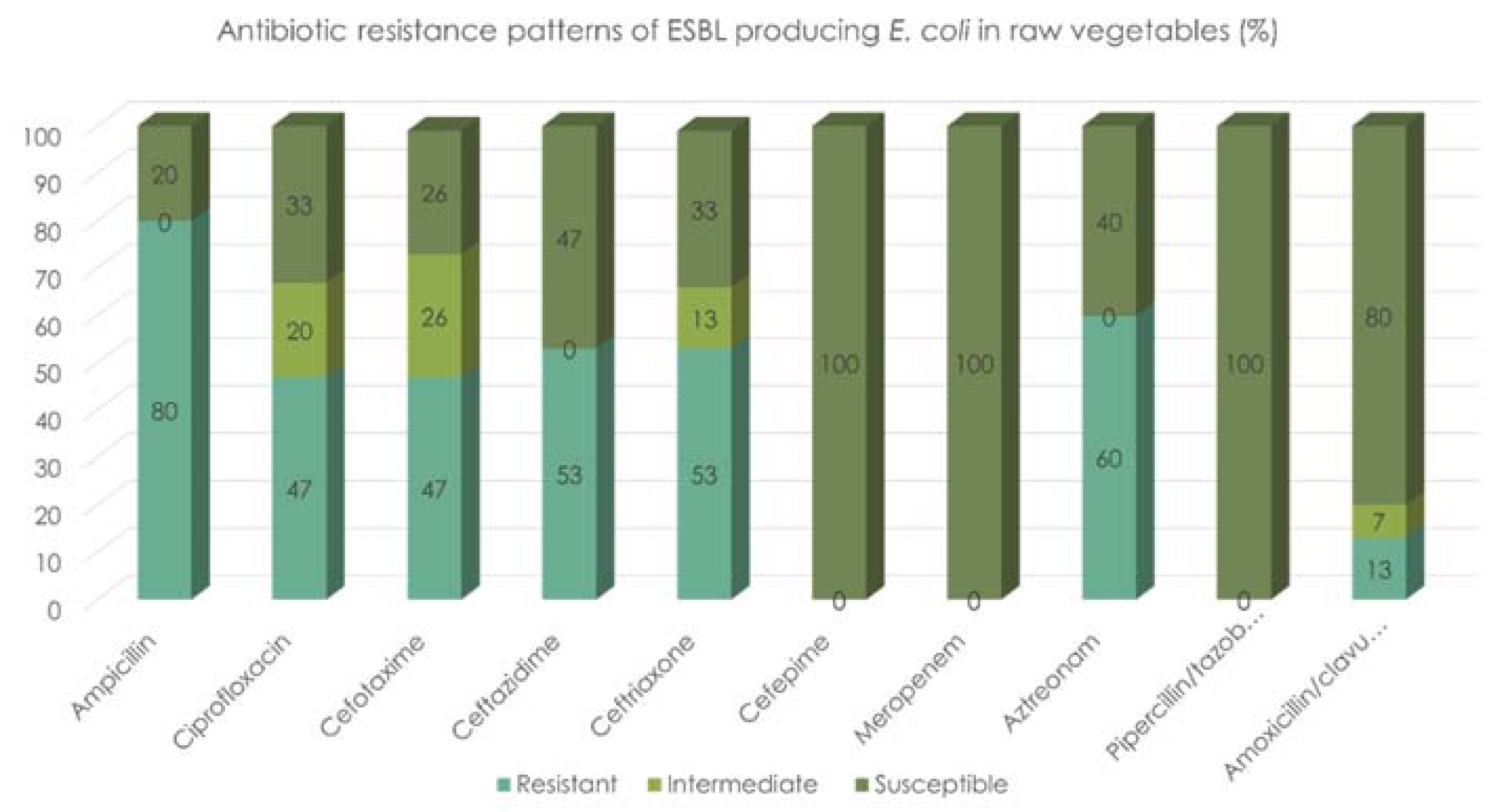
In AST, a total of nine isolates (60%) showed multidrug resistance. The antibiotic resistance pattern of ESBL-producing E. coli strains were showed in Figure 2.
Figure 2.
The antibiotic resistance patterns of ESBL-producing E. coli in raw vegetables.
Ampicillin is known as one of the regular traditional antibiotic treatments; however, 80% of the ESBL-producing E. coli strains in this study showed resistance to ampicillin. The antibiotic resistance patterns may vary across geographical location as the guidelines of antibiotics usage vary from country to country [4,5].
4. Conclusions
The high prevalence rate of ESBL-producing E. coli in raw vegetables indicated that raw vegetables may act as a potential vehicle to transmit ESBL-producing E. coli and ESBL genes to humans. The prevalence rate of ESBL-producing E. coli in lettuce from wet markets was significantly higher than the lettuce in hypermarket. However, there is no significant difference between the contamination rate of ESBL-producing E. coli in bean sprouts from hypermarkets and wet markets. The antibiotic resistance pattern of isolated ESBL-producing E. coli showed 60% of the ESBL-producing E. coli are multidrug resistant.
Author Contributions
E.L. writing original draft and preparation; S.R., N.N.J. and N.A.A.-M. are supervisory committee members. All authors have read and agreed to the published version of the manuscript.
Funding
This research was funded by Universiti Putra Malaysia through Putra Grant (GP-IPS 9668000).
Institutional Review Board Statement
Not applicable.
Informed Consent Statement
Not applicable.
Data Availability Statement
Not applicable.
Conflicts of Interest
The authors declare no conflict of interest.
References
- Mritunjay, S.K.; Kumar, V. Fresh Farm Produce as a Source of Pathogens: A Review. Res. J. Environ. Toxicol. 2015, 9, 59–75. [Google Scholar] [CrossRef]
- CLSI (2017); CLSI M100 Performance Standards for Antimicrobial Susceptibility Testing. 27th ed. Clinical and Laboratory Standard Institute: Pittsburgh, PA, USA, 2017.
- Reuland, E.A.; Al Naiemi, N.; Raadsen, S.A.; Savelkoul, P.H.M.; Kluytmans, J.A.J.W.; Vandenbroucke-Grauls, C.M.J.E. Prevalence of ESBL-producing Enterobacteriaceae in raw vegetables. Eur. J. Clin. Microbiol. Infect. Dis. 2014, 33, 1843–1846. [Google Scholar] [CrossRef] [Scilit] [PubMed]
- Reuland, E.A.; Al Naiemi, N.; Raadsen, S.A.; Savelkoul, P.H.M.; Kluytmans, J.A.J.W.; Vandenbroucke-Grauls, C.M.J.E. Geographic mapping of Enterobacteriaceae with extended-spectrum β-lactamase (ESBL) phenotype in Pereira, Colombia. BMC Infect. Dis. 2020, 20, 540. [Google Scholar]
- Loh, M.C.; Mamphweli, S.; Meyer, E.; Okoh, A. Antibiotic use in agriculture and its consequential resistance in environmental sources: Potential public health implications. Molecules 2018, 23, 795. [Google Scholar]
Disclaimer/Publisher’s Note: The statements, opinions and data contained in all publications are solely those of the individual author(s) and contributor(s) and not of MDPI and/or the editor(s). MDPI and/or the editor(s) disclaim responsibility for any injury to people or property resulting from any ideas, methods, instructions or products referred to in the content. |
© 2021 by the authors. Licensee MDPI, Basel, Switzerland. This article is an open access article distributed under the terms and conditions of the Creative Commons Attribution (CC BY) license (https://creativecommons.org/licenses/by/4.0/).