


Abstract
Salt and seasoning application plays a critical role in flavor and product consistency in industrial food manufacturing; however, manual recovery of excess salt limits both hygiene and process efficiency. In this study, a closed-loop salt dispensing machine capable of operating between 120–700 kg/h was developed to automatically recover salt that does not adhere to the product surface during processing. The required motor power and torque for achieving the maximum discharge rate of 700 kg/h were analytically calculated and experimentally validated. Homogeneity tests performed on a 1.2-m conveyor indicated maximum and minimum deviations of 5.3% and 7%, respectively. Overall, the system eliminates material waste, enhances hygiene, and provides more controlled salt distribution compared to conventional manual methods.
1. Introduction
The controlled application of micro-particles such as salt and spices plays a critical role in flavor development, food safety, and product uniformity in industrial food manufacturing [1,2]. Salt additionally contributes to water activity reduction, texture modification, and microbial stability, making precise dosing essential for product quality [3]. In current production lines, particle losses occurring during surface application are typically recovered manually, a process that poses hygiene risks and leads to significant efficiency losses. Most existing systems rely on manual collection and re-feeding of excess particles, introducing further drawbacks such as contamination risks, operator-dependent variability, and delays in the production cycle [4]. Meanwhile, advances in automation and Industry 4.0 technologies have emphasized the importance of data-driven control, sensor-integrated systems, and closed-loop recovery mechanisms in modern processing environments [4]. In addition, granular flow behavior studies highlight that micro-particle handling—especially for fine powders such as salt, seasoning and flour—is highly sensitive to segregation, caking, and flow variability, further increasing the need for automated and standardized dispensing solutions [5,6]. Previous studies have investigated powder dosing and conveying mechanisms in food and process engineering applications. For instance, screw feeders and vibratory dosing systems have been widely used for controlled powder delivery in food and pharmaceutical production lines. These studies primarily focus on flow stability, feeder design, and dosing accuracy under different material properties and operating conditions. However, most existing approaches address particle transport or dosing independently and rarely integrate real-time recovery of excess particles generated during surface application processes. Despite increasing interest in sustainability, waste reduction, and higher automation levels within the food industry, closed-loop systems capable of real-time recovery of micro-particle materials (e.g., salt, spices, flour) remain extremely limited in the literature [7].
This study presents the design and experimental performance evaluation of an automated salt dispensing system capable of instantly collecting excess particles that do not adhere to the product and returning them to the feeding line. The proposed system eliminates direct human contact, enhances hygiene, and practically reduces material waste to zero, while maintaining controlled dosing performance and distribution homogeneity under different conveyor speeds. In addition, the required motor power and torque for maximum salt throughput were analytically calculated and experimentally validated.
Overall, this work addresses a significant gap in the field of micro-particle recovery systems and introduces a hygienic, sustainable, and industrially scalable automation approach suitable for continuous food production environments.
2. Materials and Methods
Design of an Automated Salt Dispenser with Integrated Recovery Mechanism
In large-scale industrial food production lines—particularly in biscuit and cracker manufacturing—the process begins with dough preparation in industrial mixers. Once the desired consistency is achieved, the dough is transferred to the production line, reduced to the target thickness through a lamination unit, and shaped in a rotary molding station. Following these stages, products are conveyed directly to the micro-particle application station. The system developed in this study is an automated machine integrated into the production line to ensure homogeneous application of micro-scale materials such as salt or spices onto the product surface. Beyond salt and spices, the system is also designed to operate in applications requiring continuous flour dosing, such as croissant production, providing a versatile and feedback-controlled structure. This modularity enables the system to be reconfigured for controlled dosing and recovery of various fine-particle materials including flour, sugar, and seasonings. Depending on the product type, a typical industrial belt may carry up to 30 rows of items simultaneously. Variations in molding geometry and dough volume influence the product density across rows, making it essential that each row receives the same amount of seasoning under identical hygienic conditions. This uniformity is critical for consistent baking performance and overall product standardization. In conventional industrial setups, recovery of unused salt particles that do not adhere to the product is often carried out manually. This approach increases labor demand, introduces hygiene risks, and may result in significant material losses. In systems where no recovery mechanism exists, wasted material accumulates, conflicting with modern sustainability targets and reducing production efficiency. The system developed in this study minimizes human intervention through a fully automated feedback mechanism, allowing the operator to perform only supervisory tasks. Eliminating direct human contact during the dosing process enhances hygiene and product quality, while contributing to “zero-waste” production goals by recovering unused particles in real time.
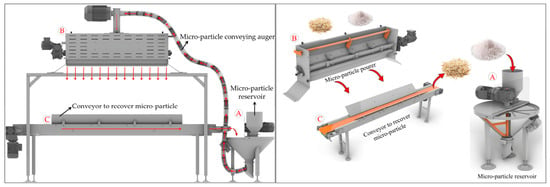
To meet these requirements, the micro-particle dispensing system was designed using SolidWorks 2024 and is presented in Figure 1 as three main modules:
Figure 1.
Automation-assisted recovery dispensing of the micro-particle machine (left) and important components (right).
- (A)
- Micro-particle reservoir;
- (B)
- Micro-particle pourer;
- (C)
- Micro-particle recovery conveyor.
This modular architecture allows rapid adaptation to different product families while simultaneously reducing waste, improving production efficiency, and supporting hygienic manufacturing standards.
The overall operating principle of the developed system is presented in Figure 1. Fine salt particles, first separated by passing through a 2 × 2 mm stainless-steel (AISI 304) mesh, are stored in the micro-particle reservoir shown in A in Figure 1. From this reservoir, the particles are conveyed to the micro-particle pourer unit (B in Figure 1) via a spring type conveyor that provides a continuous and stable feed rate. Stability of granular flow in screw and spring-type conveying systems is strongly influenced by fill ratio, pitch, and rotational speed, which dictate conveying efficiency and torque requirements [8]. This conveying mechanism maintains a consistent particle supply to the dispensing zone, preventing fluctuations in the flow entering the distribution unit. During dispensing, salt particles that do not contact the product surface and fall into the empty gaps on the conveyor are directed onto a recovery conveyor positioned beneath the main belt (C in Figure 1). The collected particles are then automatically returned to the reservoir, creating a closed-loop feedback cycle that minimizes material loss while preserving hygienic operating conditions. This feedback-oriented design stabilizes particle flow in real time, ensuring continuity and homogeneity in surface coating, while simultaneously reducing operator intervention and enabling an automated and traceable production process. Such an approach aligns closely with Industry 4.0–based smart manufacturing principles that are increasingly adopted in modern food processing environments.
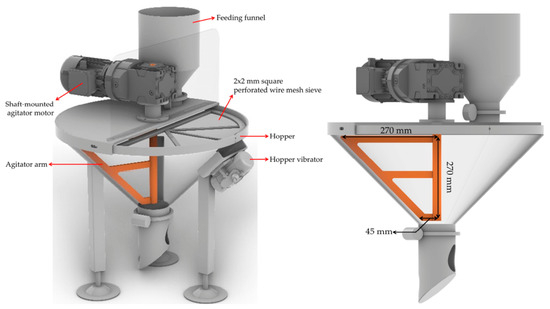
The critical components of the salt recovery hopper are detailed Figure 2 (left). Salt is first introduced into the system through the feeding funnel and subsequently fills the hopper unit, which is manufactured from AISI 304 stainless steel and designed with a conical geometry. To prevent moisture accumulation, adhesion, and agglomeration of salt within the hopper, a hollow single-arm agitator—whose technical specifications are provided in Figure 2 (right)—was designed and positioned to provide continuous mixing along the conical surface. The agitator arm has a mass of 2.5 kg and circulates approximately 50 kg of salt during operation. The arm is driven directly by a shaft-mounted agitator motor aligned parallel to the hopper axis.
Figure 2.
Detail description of the reservoir (left) and technical detail of the agitator arm (right).
The moment of inertia of the conical frustum was calculated using Equation (1), yielding (. When the motor output speed was set to , the angular velocity and angular acceleration were obtained using Equation (2) as and , respectively. The total torque requirement was computed as the sum of the acceleration torque (τ_acc), given by Equation (3), and the drag/resistive torque (τ_f), defined in Equation (4), as expressed in Equation (5). The required shaft power and corresponding motor power were subsequently determined using Equations (6) and (7), resulting in and [9,10]. To satisfy these requirements with an adequate safety margin, a gearmotor with a nominal power of 180 W and a starting torque capacity of 80 Nm was selected. This ensured sufficient torque reserves for both continuous 24-h operation and short-term load peaks.
In this study, a vertical-axis screw conveyor [5,11] was incorporated into the system to transport micro-particle food materials, such as fine salt, from the micro-particle reservoir (A) to the micro-particle pourer (B) and to supply them in a controlled manner to the production line. The micro-particle conveying auger ensures a stable feeding rate while maintaining a continuous and homogeneous flow toward the dispensing unit. The overall configuration and design parameters of the developed spring-type vertical conveying auger are presented in Figure 3. Operating under a top-feeding principle, the conveyor is capable of vertically transporting material over a 1500 mm height with a nominal capacity of 700 kg/h, ensuring consistent and uniform upward conveying performance. The geometric characteristics and design inputs of the auger are summarized in Table 1.
Figure 3.
Spring-type auger.
Table 1.
Design parameters of the spring-type auger.
For the specified design conditions, namely , filling ratio , and gravitational acceleration g = 9.81, the required helical conveying speed was calculated as . To meet this requirement, a motor–gearbox unit with a nominal output speed of 945 rpm and a rated power of 1.5 kW was selected. According to Equation (11), the torque requirement was calculated as 15.8 Nm, which is closely matched by the motor’s rated torque capacity of 15.2 Nm [12].
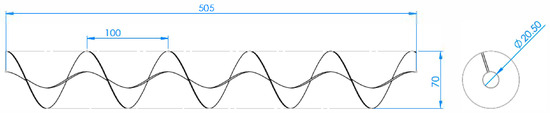
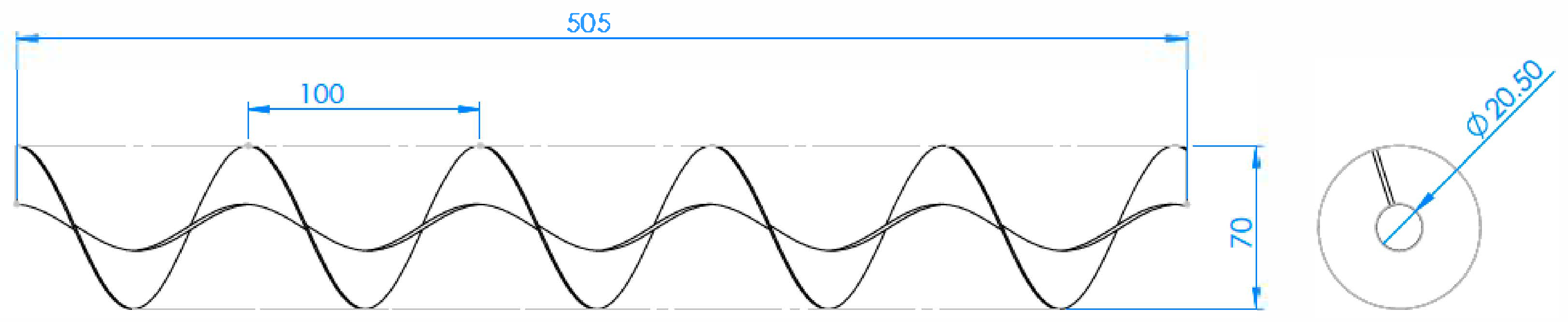
In the developed system, two counter-rotating screw-type augers, shown in Figure 4, are employed to ensure the uniform distribution of salt—transported to the micro-particle pourer via the spring-type vertical auger (1500 mm)—across the full conveyor width. Each screw has a length of 535 mm, an outer diameter of 70 mm, and is mounted on a 20.5 mm shaft with a 100 mm pitch. Counter-rotating screw systems are widely used in particulate processing to suppress segregation, eliminate channeling, and increase cross-sectional mixing efficiency [13]. This configuration effectively minimizes segregation, channel formation, and other undesirable flow behaviors typically observed in single-screw systems.
Figure 4.
Screw-type auger.
The twin-screw arrangement provides a high surface renewal rate within a relatively short geometric length (535 mm), enabling continuous particle agitation and stabilizing the mass flow. Consequently, the system achieves improved cross-sectional homogeneity and ensures repeatable, uniform dosing performance on the product surface.
3. Results
The performance of the proposed closed-loop salt dispensing system was evaluated through comprehensive mass-flow verification tests and transverse distribution uniformity analyses. The experimental findings demonstrate that the system operates stably across a wide flow range while maintaining high repeatability in the dosing of micro-particle materials. As presented in Table 2, the system was tested under two operating conditions: a maximum flow rate of 700 kg/h and a minimum rate of 120 kg/h. In both cases, the salt transfer remained steady, and flow fluctuations at the outlet were limited to ±5%, indicating that the spring-type vertical auger and the continuous feeding mechanism provide a consistent and reliable supply to the dosing unit.
Table 2.
Mass flow rate at the maximum and minimum rates.
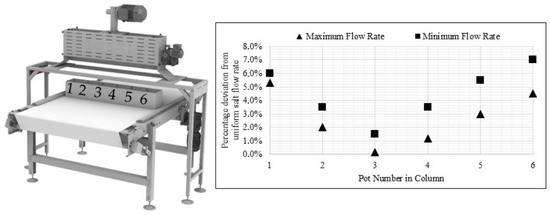
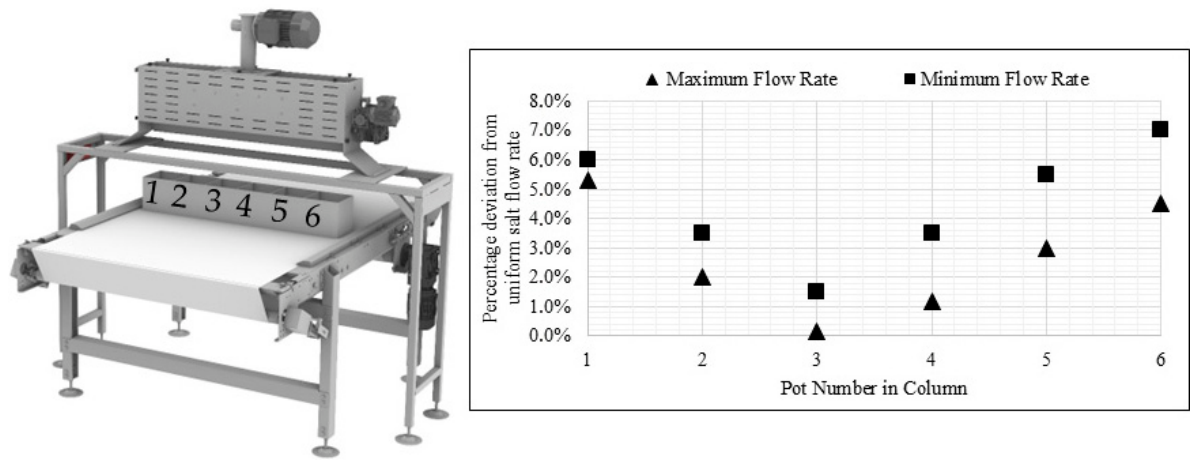
To assess dosing homogeneity, the 1.2 m-wide conveyor surface was divided into six equal sections (Pots 1–6), and the mass collected in each section was quantified. As illustrated in Figure 5, the percentage deviation from the mean was found to be 5.3% at the maximum flow rate and 7.0% at the minimum rate.
Figure 5.
Percentage deviation of the maximum and minimum flow speeds.
A more detailed statistical analysis revealed the following:
- -
- The standard deviation (SD) remained low under both flow conditions;
- -
- The Coefficient of Variation (CV = SD/mean) was 4.1% at maximum flow and 6.5% at minimum flow;
- -
- Relative Standard Deviation (RSD) values ranged between 4–5% (maximum) and 6–7% (minimum).
These values fall well within the acceptable range for industrial micro-particle dispensing systems (typically 5–10%), confirming that the counter-rotating twin-screw mechanism effectively suppresses segregation, channeling, and central accumulation—common issues in single-screw feeders.
The recovery conveyor positioned below the main belt successfully captured all particles that did not land on the product surface, redirecting them back to the micro-particle reservoir. Observations and mass-balance evaluations confirmed:
- -
- Near-100% recovery efficiency;
- -
- Elimination of operator-dependent losses;
- -
- A significant increase in hygienic handling due to the absence of manual contact with salt.
This closed-loop design, therefore, not only minimizes waste but also enhances sanitation and aligns with sustainable manufacturing principles.
Theoretical power and torque requirements for both the vertical and horizontal screws were computed and compared with experimental observations. For the nominal flow of 700 kg/h, the required torque was determined as 15.8 Nm, closely matching the rated torque of the selected motor (15.2 Nm). No stalling, clogging, or feed interruptions were observed during long-duration tests, confirming the adequacy of the selected motor–gearbox pair and validating the analytical design framework.
4. Conclusions
This study presents the development and experimental evaluation of an automation-assisted, closed-loop salt dispensing and recovery system designed for industrial food production lines. Experimental results demonstrated that the system operates stably over a wide mass-flow range (120–700 kg/h) while maintaining high transverse distribution uniformity across the conveyor width. The obtained low coefficients of variation and deviation levels within ±5–7% confirm that the proposed system satisfies industrial requirements for micro-particle dosing applications. Through the implementation of a fully automated recovery conveyor, salt particles that did not adhere to the product surface were instantaneously collected and recirculated to the feeding reservoir, resulting in near-zero material loss. Compared with conventional manual surface application practices—where operator-dependent losses and hygiene risks are common—the developed system eliminates direct human contact and significantly improves process repeatability, hygiene, and material efficiency. This closed-loop approach is therefore well aligned with sustainability objectives and modern food safety standards. From a maintenance and cleaning perspective, the system was designed using AISI 304 stainless steel components with smooth internal surfaces and a modular architecture. This configuration facilitates disassembly and supports standard dry-cleaning or clean-in-place (CIP) procedures widely adopted in industrial food processing environments. The use of low rotational speeds and corrosion-resistant materials is expected to limit abrasive wear when handling salt-based micro-particles. Although long-term wear behavior was not experimentally assessed within the scope of this study, the selected design parameters indicate suitability for continuous industrial operation. The experimental evaluation primarily focused on short-term operational performance. During extended test runs, no clogging, flow interruption, or performance degradation was observed. Nevertheless, long-term operational stability, component lifetime, and maintenance intervals were not addressed and remain important topics for future investigation. Extended endurance testing under real industrial conditions will further strengthen the assessment of system robustness and large-scale applicability. In conclusion, the proposed system offers a reliable, hygienic, and scalable solution for automated micro-particle dispensing and recovery in continuous food production lines. Its high dosing uniformity, near-zero waste capability, and analytically validated mechanical design make it a strong candidate for integration into Industry 4.0-oriented smart manufacturing environments.
Author Contributions
Conceptualization, F.T. and S.F.K.; methodology, F.T. and S.F.K.; software, F.T.; validation, F.T. and S.F.K.; resources, S.F.K.; writing—original draft preparation, S.F.K.; writing—review and editing, F.T. and S.F.K.; visualization, S.F.K.; supervision, S.F.K. All authors have read and agreed to the published version of the manuscript.
Funding
This research was funded by PEK Makina Sanayi and Ticaret A.Ş.
Institutional Review Board Statement
Not applicable.
Informed Consent Statement
Not applicable.
Data Availability Statement
The data supporting the findings of this study are available from the corresponding author upon reasonable request. Due to company confidentiality, the raw data are not publicly available.
Acknowledgments
The authors would like to express their sincere gratitude to PEK Makina Sanayi ve Ticaret A.Ş. for providing administrative, technical, and experimental support throughout this study. The authors also thank the R&D team for their contributions during prototype development, data collection, and system optimization. Special thanks are extended to the PEK Makina family for their continuous encouragement and collaborative spirit. During the preparation of this manuscript, the authors used ChatGPT (OpenAI, GPT-5.1 model) to support language refinement, structural editing, and clarity improvement. The authors have reviewed and edited all generated content and take full responsibility for the final version of this publication.
Conflicts of Interest
Authors Furkan Tığ and Süleyman Fatih Kırmızıgöl was employed by PEK Makina Sanayi and Ticaret A.Ş. The authors declare that the research was conducted in the absence of any commercial or financial relationships that could be construed as a potential conflict of interest. The funder was not involved in the study design, collection, analysis, interpretation of data, the writing of this article or the decision to submit it for publication.
Abbreviations
The following abbreviations are used in this manuscript:
| Moment of inertia | |
| Weight | |
| Radius | |
| Angular velocity | |
| Motor rotational speed | |
| Angular acceleration | |
| τ | Torque |
| Viscosity | |
| Power | |
| Gearbox efficiency | |
| Mechanical transmission efficiency | |
| Rotational efficiency per second | |
| Density | |
| Spring pitch | |
| Fill factor | |
| Mass flow rate | |
| Gravitational acceleration | |
| Conveying height | |
| Subscripts and superscripts | |
| agitator arm | |
| maximum | |
| minimum | |
| friction | |
| acceleration | |
| total | |
| lifting | |
References
- Albarracin, W.; Sanchez, I.C.; Grau, R.; Barat, J.M. Salt in food processing; usage and reduction. Int. J. Food Sci. Technol. 2011, 46, 1329–1336. [Google Scholar] [CrossRef] [Scilit]
- Kim, T.K.; Yong, H.I.; Jung, S.; Kim, H.W.; Choi, Y.S. Effect of reducing sodium chloride based on the sensory properties of meat products and the improvement strategies employed: A review. J. Anim. Sci. Technol. 2021, 63, 725–739. [Google Scholar] [CrossRef] [Scilit] [PubMed]
- Porcina, T. Physical Properties, Processing, and Functionality. In Food Powders; Kluwer Academic/Plenum Publisher: New York, NY, USA, 2005. [Google Scholar]
- Chandrasiri, G.S.M.; Wijenayake, K.I.A.; Arachchige, U.S.P.R. Development of automated systems for the implementation of food processing. J. Res. Technol. Eng. 2022, 3, 8–18. [Google Scholar]
- Minglani, D.; Sharma, A.; Pandey, H.; Dayal, R. A review of granular flow in screw feeders and conveyors. Powder Technol. 2020, 366, 369–381. [Google Scholar] [CrossRef] [Scilit]
- Shenoy, P.; Viau, M.; Tammel, K.; Innings, F. Effect of powder densities, particle size and shape on mixture quality of binary food powder mixtures. Powder Technol. 2015, 272, 165–172. [Google Scholar] [CrossRef] [Scilit]
- Barlas, O.C.; Martin, W.; Fonseca, A. Food loss and waste reduction interventions: A scoping review. J. Agric. Food Syst. Community Dev. 2025, 14, 1–20. [Google Scholar] [CrossRef] [Scilit]
- Pezo, M.; Pezo, L.; Lončar, B.; Kojić, P.; Ilić, M.; Jovanović, A. Granular flow in screw conveyors: A review of experiments and discrete element method (DEM) studies. Powder Technol. 2025, 459, 121040. [Google Scholar] [CrossRef] [Scilit]
- Meriam, J.L.; Kraige, L.G. Engineering Mechanics Dynamics; John Wiley Sons, Inc.: Hoboken, NJ, USA, 2012; Volume 2. [Google Scholar]
- Budynas, R.G.; Nisbett, J.K. Mechanical Engineering Design; McGraw-Hill Education: New York, NY, USA, 2015. [Google Scholar]
- Chongchitpaisan, P.; Sudsawat, S. A Review on Screw Conveyors for Bulk Materials in Various Applications. Eng. Technol. Horiz. 2022, 39, 1–12. [Google Scholar]
- Buezo, E. Screw Conveyors for Bulk Materials; Conveyor Equipment Manufacturers Association: Naples, FL, USA, 2009. [Google Scholar]
- Delvar, E.; Oliveira, I.; Brito, M.S.; Santamaria-Echart, A.; Barreiro, F.M.; Santos, R.J. Literature Review on Single and Twin-Screw Extruders Design for Polymerization Using CFD Simulation. Fluids 2025, 10, 9. [Google Scholar] [CrossRef] [Scilit]



Disclaimer/Publisher’s Note: The statements, opinions and data contained in all publications are solely those of the individual author(s) and contributor(s) and not of MDPI and/or the editor(s). MDPI and/or the editor(s) disclaim responsibility for any injury to people or property resulting from any ideas, methods, instructions or products referred to in the content. |
© 2026 by the authors. Licensee MDPI, Basel, Switzerland. This article is an open access article distributed under the terms and conditions of the Creative Commons Attribution (CC BY) license.