


Proceeding Paper

Screening of Fungicides for the Management of Early Blight of Tomato Caused by Alternaria solani  †

by
Muhammad Sanwal Bakhsh
1,*,
Hurmain Aslam
1,
Muhammad Usman
2,
Abeer Idrees
1,
Auon Raza
1,
Abdul Shafi
1,
Tooba Khalid
3,
Muhammad Ali
3,
Muhammad Ahmad Murtaza
1,
Sehar Tabassum
1 and
Arooj Akhlaq
1
1
Department of Plant Pathology, PMAS-Arid Agriculture University, Rawalpindi 46000, Pakistan
2
Department of Plant Breeding and Genetics, PMAS-Arid Agriculture University, Rawalpindi 46000, Pakistan
3
Department of Environmental Science, PMAS-Arid Agriculture University, Rawalpindi 46000, Pakistan
*
Author to whom correspondence should be addressed.
Presented at the 9th International Conference on Horticulture & Expo 2025, Rawalpindi, Pakistan, 15–16 April 2025.
Biol. Life Sci. Forum 2025, 51(1), 17; https://doi.org/10.3390/blsf2025051017
Published: 25 April 2026
(This article belongs to the Proceedings of The 9th International Horticulture Conference & Expo)

Abstract

The yield loss of tomatoes grown in Punjab is 30–60% due to early blight caused by Alternaria solani during humid monsoons. Five fungicides, namely, Score 250 EC (difenoconazole), Antracol 70 WP (propineb), Topsin-M 70 WP (thiophanate-methyl), Dithane M-45 80 WP (mancozeb), and Kavach 75 WP (chlorothalonil), were evaluated in this laboratory experiment using the poisoned food technique at concentrations of 0.1, 0.2, and 0.3. Score 250 EC showed the highest antifungal activity, resulting in the lowest mean mycelial growth (26.44 mm) and maximum inhibition. All interventions were significantly better than controls (p < 0.01), and the effect became concentration-dependent. Intensive alternation of difenoconazole and Antracol at the IPM levels is an effective way of reducing selection pressure on resistance.

1. Introduction

Tomato (Solanum lycopersicum L.) is one of the most important vegetable crops in Pakistan, occupying approximately 62,000 hectares and yielding approximately 680,000 tons per year. However, the average yield is only 11 tons per hectare, which is much lower than it could be as a result of diseases and pests [1]. Among these, early blight caused by Alternaria solani causes the greatest damage in Punjab province. The disease causes characteristic dark spots in the form of concentric rings, commonly referred to as bull’s-eye spots, on the leaves, stems, and fruits. These spots cause yellowing, defoliation, and rotting of fruits, reducing yields by as much as 70 percent in warm and wet climates, such as 25–30 °C and/or above 90 percent relative humidity [2].
In districts such as Sargodha, Rawalpindi, and Faisalabad, early blight disease incidence has been reported to range from 75 to 92% during the monsoon season. Rain increases humidity, and dense planting and a lack of airflow in the fields contribute to a high rate of spread [3]. Farmers are highly dependent on fungicides because local varieties of pathogens are not effectively controlled by crop rotation or resistant varieties. Over time, A. solani has demonstrated variation in the sensitivity, with indications of decreased sensitivity in older protectants such as mancozeb in Sindh and Punjab [2].
Recent systemic fungicides, such as triazoles (e.g., difenoconazole) and dithiocarbamates (e.g., propineb), are promising since they work against fungal cell walls or sterol production. Nevertheless, there are not many studies that offer information under Punjab conditions, where isolates might vary because of the local climate and excessive use of chemicals [4]. In this study, the researcher evaluated five commercial fungicides using the poisoned food technique at Pir Mehr Ali Shah Arid Agriculture University in Rawalpindi during 2025–2026. We aimed to find the most efficient alternatives at a practical level, which would inform tomato farmers in Pakistan.

2. Materials and Methods

2.1. Isolation and Purification of Pathogen

A. solani was isolated from tomato leaves with early symptoms of blight in the Nagina cultivar. The experiment was conducted under a Completely Randomized Design (CRD). Samples were collected at the university research farms in Rawalpindi in August 2025, when the pressure of the disease was at its highest point. We used leaf segments (1.5–2 cm) from the edges of the lesions, sterilized them with 0.1% sodium hypochlorite for 1 min, rinsed them three times in sterile distilled water, and then blotted them onto potato dextrose agar (PDA). PDA contained 200 g boiled potatoes, 20 g dextrose, and 20 g agar per liter of distilled water, with the pH adjusted to 5.6. Plates were incubated at 26 ± 1 °C because this is known to stimulate sporulation.
Pure cultures were obtained through single-spore isolation using dilution streaking on PDA. Morphological characteristics are shown in Figure 1, We identified the colony characteristics (dark olive-green on the surface, dark brown on the underside) and microscopic characteristics. Conidia were beaked, muriform, had 3–10 transverse and 1–6 longitudinal septa, and measured 40–120 × 12–18 µm at 40× magnification. These characterizations were consistent with conventional mycology descriptions [5,6].

2.2. Preparation of Fungicides and Bioassay

Five fungicides were purchased from local agro-shops in Rawalpindi (Table 1). They were tested at 0.1, 0.2, and 0.3 (w/v) concentrations, with three plates per treatment. Using the poisoned food technique, the fungicide was added to molten PDA (45 °C) at the required rate, then mixed thoroughly to give it a uniform distribution, and 15 mL of the mixture was poured into 90 mm sterile Petri dishes. Upon solidification, we used a cork borer to cut 5 mm diameter discs from the rims of 7-day-old A. solani cultures and put one disc in the center of each plate. Unamended PDA plates were used as controls. The plates were arranged in a completely randomized design, covered with parafilm, and incubated at 26 ± 1 °C under a 12 h photoperiod for 7 days.
Measurements of the colony diameters, in two perpendicular directions, were taken on a daily basis, starting on day 1, after inoculation, and the means of the radial growth (mm) were recorded. Percent inhibition of mycelial growth calculated as:

3. Data Analysis

We compared the growth data (mm) and growth inhibition (%) on the 3rd, 5th, and 7th days using one-way analysis of variance (ANOVA) in R software version 4.4.1 (R Core Team, 2025). Tests of normality and homogeneity were met (Shapiro–Wilk and Levene tests, p > 0.05). Treatment means differed at p < 0.01 as tested by Fisher’s least significant difference (LSD) test. Graphs showing trends of inhibition were plotted using the ggplot2 package [7].

4. Results

The mycelial growth of Alternaria solani was considerably inhibited by all five fungicides compared with the untreated control at all concentrations and on all days of observation (one-way ANOVA: F = 45.2 to 89.6, df = 5,12, p < 0.01 per day). Relationships between fungicide concentration and growth inhibition were also clear, showing dose–response relationships. On day 7, the control group showed tissue expansion to 78.00 ± 1.15 mm (SE, n = 3) without restriction, whereas the treated plates had significantly fewer colonies, ranging from 11.00 ± 0.58 mm to 48.67 ± 1.53 mm for Score 250 EC and Kavach, respectively. The mean percent inhibition of the total concentrations reached a peak of 91.28% for Score, demonstrating its best performance with concentration and time.
On day 3, colonies in the control were 27.33 ± 0.58 mm. Score at 0.3% inhibited growth to 1.33 ± 0.58 mm (95.13% inhibition), which was significantly superior to the others (LSD = 2.1 mm, p < 0.01). Antracol and Kavach followed at 2.67 ± 0.58 mm (90.23%) and 8.33 ± 0.58 mm (69.52%; Table 2), respectively. The same tendencies occurred until day 5, with the growth of the control reaching 51.67 ± 1.15 mm, and Antracol reaching 5.33 ± 0.58 mm (89.68%; Table 3).
The data on day 7 indicated persistent differences: the mean growth of Score across concentrations (26.44 ± 2.08 mm, 91.28% inhibited) was the lowest, followed by Antracol (32.00 ± 2.65 mm, 84.73%), Topsin-M (36.67 ± 2.52 mm, 80.14%), and Dithane M-45 (42.00 ± 2.00 mm, 78. Inhibition was greater than 85% at the highest rate of 0.3 percent for Score and Antracol, and less than 70 percent for Kavach. After day 5, no increase was observed in inoculated discs in Score 0.3% treatments, which suggests almost complete fungistasis. The coefficient of variability was also low (CV < 8% between treatments), supporting strong replication. These patterns, highlighted in Table 2, Table 3 and Table 4, identify Score 250 EC as the strongest inhibitor, with effectiveness increasing in a predictable manner between 0.1 and 0.3%.

5. Discussion

The excellent efficacy (91.28% mean inhibition) of Score 250 EC is directly attributed to difenoconazole, a sterol demethylation inhibitor (DMI) of the triazole family. It interferes with the production of ergosterol, which weakens fungal membranes and ceases growth [8]. This is equivalent to 91–95% inhibition at 0.3 percent reported by Chohan et al. [9] against South Indian isolates and local studies by Zafar et al. [10], which reported 90 percent (dose-dependent) inhibition in Punjab. Antracol, a contact dithiocarbamate (propineb), inhibited multi-site enzymes such as succinate dehydrogenase by 84.73%, which is similar to 87.40% reported in [11], although slight differences may be due to isolate genetics or minor differences in media.
Dithane M-45 (mancozeb), with 78.92% inhibition, was found to be suboptimal compared with historical averages of 89.83 percent [12], which is an indicator of a potentially lower sensitivity of Rawalpindi strains. This is in line with findings in Sindh, where mancozeb efficacy was reduced to 65–75 percent against vascular wilt pathogens, which were associated with frequent sprays leading to resistant mutants [13]. Kavach (chlorothalonil) and Topsin-M (thiophanate-methyl) followed, with 72.15% and 80.14% inhibition, respectively, consistent with reports of benzimidazole resistance in Pakistan [4,10,14]. Microscopic examinations showed that the treatments with Score caused distorted hyphae, which reinforced mode-of-action studies [15].
Following sigmoidal dose–response curves, concentration effects showed thresholds of 0.3 percent and negative label rates of 0.2–0.4 percent. However, excessive dependence is dangerous because it causes selection pressure, as observed in Alternaria populations globally [14]. The epidemiology of early blight in Punjab is related to monsoon cycles: July–August rains increase RH to >90, promoting sporulation and splash dispersal, leading to 80–92% disease incidence in vulnerable cultivars, such as Nagina or Rio Grande [13]. This is amplified on Rawalpindi farms, where clay–loam soils and irrigation increase leaf wetness duration to >12 h. Our data are consistent with comparative data from other neighboring areas, such as 85% inhibition rates reported in Indian studies for difenoconazole [16], although Punjab isolates might have quantitative trait loci conferring partial resistance [17].
The in vitro concentration is also a limitation; field conditions, such as UV degradation or wash-off by rain, may reduce efficacy by 10–20% [17]. However, poisoned food tests are predictive of spray efficacy, with over 80% agreement in pot trials in tomato–patho systems [18].
In Punjab, early blight outbreaks are strongly associated with humid monsoon conditions and reach their peak when they attack non-resistant varieties such as Nagina [19]. Combining effective fungicides, such as Score, with IPM strategies, such as staking plants to enhance airflow, mulching to reduce splash dispersion, eliminating infected debris, and scheduling sprays based on the RH forecasts, could reduce losses to less than 20 percent and reduce resistance [20]. Growers are advised to alternate Score (0.3%) with Antracol every 2–3 applications and to monitor local isolates annually using a basic PDA assay. These approaches should be validated under field conditions and monitored for minimum inhibitory concentrations as pathogen populations evolve.

6. Conclusions

Score 250 EC provides the best in vitro control of Alternaria solani in Punjab tomatoes, with Antracol being a good substitute. A 0.3% rate is suggested for use in IPM: fungicides should be rotated, fields should be scouted weekly at 10 percent incidence, and resistant hybrids and sanitation should be used to manage the disease. Urgent field tests are needed to ascertain efficacy under local conditions. Further field-based evaluations are required to confirm these findings under natural disease pressure.

Author Contributions

Conceptualization, M.S.B. and M.A.M.; methodology, M.S.B.; software, A.I.; validation, M.U., A.R., and A.S.; formal analysis, M.S.B.; investigation, M.S.B., S.T., A.A., T.K., and M.A.; resources, H.A.; data curation, M.S.B.; writing—original draft preparation, M.S.B.; writing—review and editing, H.A. and M.U.; visualization, A.I.; supervision, M.A.M.; project administration, A.R.; funding acquisition, A.S. All authors have read and agreed to the published version of the manuscript.

Funding

This research received no external funding.

Institutional Review Board Statement

Not applicable.

Informed Consent Statement

Not applicable.

Data Availability Statement

The data presented in this study are available on request from the corresponding author.

Acknowledgments

The authors acknowledge the technical support provided by Pmas Arid Agriculture University, Rawalpindi, and express gratitude to the field research staff for their assistance throughout the experimental period.

Conflicts of Interest

The authors declare no conflicts of interest.

Abbreviations

The following abbreviations are used in this manuscript:
ANOVAAnalysis of Variance
CRDCompletely Randomized Design
DMIDemethylation Inhibitor
ECEmulsifiable Concentrate
IPMIntegrated Pest Management
LSDLeast Significant Difference
PDAPotato Dextrose Agar
RHRelative Humidity
SEStandard Error
WPWettable Powder

References

  1. Economic Wing, Ministry of National Food Security & Research. Agricultural Statistics of Pakistan 2023-24; Government of Pakistan: Islamabad, Pakistan, 2024.
  2. Batool, R.; Farzand, M.; Ali, H.; Ashraf, A.; Awais, M.; Khalid, F. Effect of foliar by applied moringa leaf extract on tomato growth performance under drought stress. Indus J. Biosci. Res. 2025, 3, 256–268. [Google Scholar] [CrossRef] [Scilit]
  3. Anjum, S.; Hamid, A.; Ghafoor, A.; Naz, R.M.M.; Khaqan, K.; Aqeel, M.; Khan, M.I. Genetic divergence for seedling and qualitative traits of tomato (Solanum lycopersicum) germplasm. Pure Appl. Biol. 2020, 9, 776–789. [Google Scholar] [CrossRef] [Scilit]
  4. Riaz, H.M.; Chohan, S.; Abid, M. Occurrence of tomato early blight disease and associated Alternaria species in Punjab, Pakistan. J. Anim. Plant Sci. 2021, 31, 1352–1365. [Google Scholar] [CrossRef] [Scilit]
  5. Ellis, M.B. Dematiaceous Hyphomycetes; Commonwealth Mycological Institute: Kew, UK, 1971; p. 271. [Google Scholar]
  6. Ahmad, M.; Shah, S.A.; Ali, S. Allocative efficiency of tomato growers in district Mardan, Khyber Pakhtunkhwa province of Pakistan. Sarhad J. Agric. 2019, 35, 675–685. [Google Scholar] [CrossRef] [Scilit]
  7. Akhtar, K.P.; Ullah, N.; Saleem, M.Y.; Iqbal, Q.; Asghar, M.; Khan, A.R. Evaluation of tomato genotypes for early blight disease resistance caused by Alternaria solani in Pakistan. J. Plant Pathol. 2019, 1, 1159–1170. [Google Scholar] [CrossRef] [Scilit]
  8. Bashir, U.; Mushtaq, S.; Akhtar, N. First report of Alternaria metachromatica from Pakistan causing leaf spot of tomato. Pak. J. Agric. Sci. 2014, 51, 315–318. [Google Scholar]
  9. Chohan, S.; Perveen, R.; Abid, M.; Naz, M.S.; Akram, N. Morpho-physiological studies, management and screening of tomato germplasm against Alternaria solani, the causal agent of tomato early blight. J. Agric. Biol. 2015, 17, 111–118. [Google Scholar]
  10. Zafar, H.; Shaukat, S.S. Evaluation of some fungicides for the control of early blight disease (Alternaria solani) of tomato. Int. J. Biol. Biotechnol. 2018, 15, 129–140. [Google Scholar]
  11. Hiremath, P.C.; Kulkarni, M.S.; Lokesh, M.S. An epiphytotic of Alternaria blight of sunflower in Karnataka. Karnataka J. Agric. Sci. 1990, 3, 277–278. [Google Scholar]
  12. Mphahlele, G.H.; Kena, M.A.; Manyevere, A. Evaluation of aggressiveness of Alternaria solani isolates to commercial tomato cultivars. Arch. Phytopathol. Plant Prot. 2020, 53, 570–580. [Google Scholar] [CrossRef] [Scilit]
  13. Shoaib, A.; Iqbal, J.; Khan, K.A. Evaluation of phenotypic, physiological and biochemical attributes connected with resistance in tomato against Alternaria solani. Acta Physiol. Plant. 2020, 42, 88. [Google Scholar] [CrossRef] [Scilit]
  14. Shamurailatpam, D.; Kumar, A. A review on recent methods to control early blight of tomato (Solanum lycopersicum L.). Plant Cell Biotechnol. Mol. Biol. 2020, 21, 136–148. [Google Scholar]
  15. Pavon, M.Á.; Luna, A.; de la Cruz, S.; González, I.; Martín, R.; García, T. PCR-based assay for the detection of Alternaria species and correlation with HPLC determination of altenuene, alternariol and alternariol monomethyl ether production in tomato products. Food Control 2012, 25, 45–52. [Google Scholar] [CrossRef] [Scilit]
  16. Verma, N.; Verma, S. Alternaria disease of vegetable crops and new approach for its control. Asian J. Exp. Biol. Sci. 2010, 1, 681–692. [Google Scholar]
  17. Benicio, V.; Araujo, E.; Souto, F.M.D.; Benicio, M.J.; Felismino, D.C. Identification and cultural characteristics of Aspergillus species isolated in common bean seeds from Paraíba State, Brazil. Fitopatol. Bras. 2003, 28, 180–183. [Google Scholar] [CrossRef] [Scilit]
  18. Yadav, O.P.; Dabbas, M.R. Efficacy of fungicides in the management of early blight of tomato (Alternaria solani). Int. J. Plant Prot. 2012, 5, 413–416. [Google Scholar]
  19. Islam, M.R.; Sadik, S.R.; Basher, F.; Khan, M.B. Assessment of farmers’ health risk due to pesticide uses in winter vegetables at selected areas of Bogura District, Bangladesh. J. Agrofor. Environ. 2022, 15, 24–29. [Google Scholar] [CrossRef] [Scilit] [PubMed]
  20. Horsfield, A.; Wicks, T.; Davies, K.; Wilson, D.; Paton, S. Effect of fungicide use strategies on the control of early blight (Alternaria solani) and potato yield. Australas. Plant Pathol. 2010, 39, 368–375. [Google Scholar] [CrossRef] [Scilit]
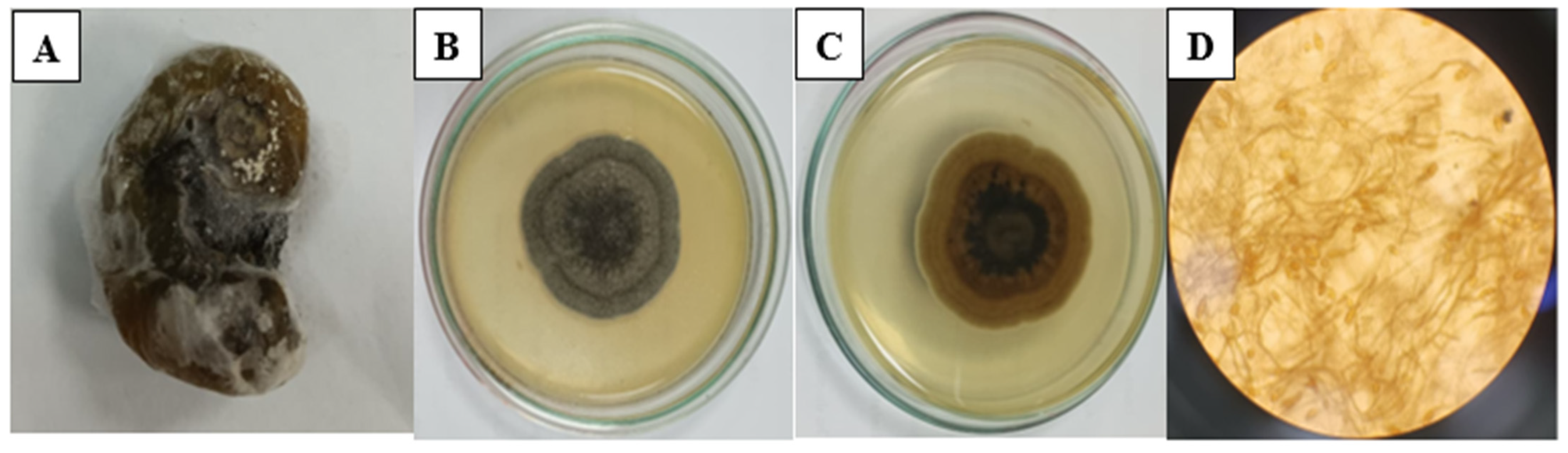
Figure 1. (A) Alternaria solani and tomato early blight. Symptoms: Concentric bull’s-eye lesions on tomato; (B) colony growth from frontside (olive-green mycelium); (C) colony growth from backside (dark brown pigmentation) on PDA after 7 days; (D) microconidium: at 40× (beaked, muriform).
Blsf 51 00017 g001
Table 1. Fungicides, manufacturers, and formulations.
Trade NameActive IngredientFormulation
ScoreDifenoconazole250 EC
AntracolPropineb70 WP
Topsin-MThiophanate-methyl70 WP
Dithane M-45Mancozeb80 WP
KavachChlorothalonil75 WP
Table 2. Colony radial growth (mm) and percent inhibition on day 3.
FungicideControl0.10%0.20%0.30%Mean GrowthMean % Inhibition
Score27.33a7.33b (73.17)3.67c (86.57)1.33d (95.13)4.1184.96
Antracol27.33a9.33b (65.86)5.33c (80.49)2.67d (90.23)5.7878.86
Topsin-M27.33a11.00b (59.75)7.33c (73.17)4.00d (85.36)7.4472.76
Dithane M-4527.33a13.33b (51.23)9.67c (64.60)6.00d (78.05)9.6764.63
Kavach27.33a15.67b (42.68)11.33c (58.54)8.33d (69.52)11.7856.91
Mean values that exhibit various letters within a group are significantly different at p ≥ 0.05.
Table 3. Colony radial growth (mm) and percent inhibition on day 5.
FungicideControl0.10%0.20%0.30%Mean GrowthMean % Inhibition
Score51.67a12.00b (76.78)6.67c (87.09)3.33d (93.55)7.3385.81
Antracol51.67a16.00b (69.03)10.00c (80.65)5.33d (89.68)10.4479.79
Topsin-M51.67a20.33b (60.65)14.00c (71.92)8.00d (84.52)14.1172.36
Dithane M-4551.67a24.67b (52.25)18.33c (64.54)12.00d (76.78)18.3364.52
Kavach51.67a28.00b (45.81)22.00c (57.45)16.33d (68.39)22.1157.22
Mean values that exhibit various letters within a group are significantly different at p ≥ 0.05.
Table 4. Colony radial growth (mm) and percent inhibition on day 9.
FungicideControl0.10%0.20%0.30%Mean GrowthMean % Inhibition
Score78.00a28.67b (63.24)19.33c (75.22)11.00d (85.90)26.4491.28
Antracol78.00a32.00b (58.97)24.67c (68.37)15.33d (80.35)3284.73
Topsin-M78.00a36.33b (53.42)28.00c (64.10)20.67d (73.50)36.6780.14
Dithane M-4578.00a42.00b (46.15)34.00c (56.41)26.00d (66.67)4278.92
Kavach78.00a48.67b (37.60)40.33c (48.30)32.67d (58.12)48.6772.15
Mean values that exhibit various letters within a group are significantly different at p ≥ 0.05.
Disclaimer/Publisher’s Note: The statements, opinions and data contained in all publications are solely those of the individual author(s) and contributor(s) and not of MDPI and/or the editor(s). MDPI and/or the editor(s) disclaim responsibility for any injury to people or property resulting from any ideas, methods, instructions or products referred to in the content.



