


Abstract
Background: Suicide is a leading cause of death among Asian American youth and is linked to adverse childhood experiences (ACEs). Although ACEs predict suicidal behaviors, less is known about how structural and contextual factors shape this risk. District-level social vulnerability reflects structural disadvantage, while school connectedness may protect against poor mental health. This study tested whether district-level social vulnerability and school connectedness modify the ACEs–attempted suicide association among Asian American youth. Methods: Data were obtained from the district component of CDC’s 2023 YRBS National, State, and District Combined Datasets; the analysis included eligible Asian American students from the 2021 and 2023 survey waves. The outcome was past-year attempted suicide, and the primary exposure was ACEs. District-level social vulnerability was measured using the Social Vulnerability Index (SVI), and school connectedness was examined as a protective correlate. Survey-weighted main-effects models adjusted for survey year, sex, and grade. The multilevel interaction models used the model-specific covariates reported in the corresponding model descriptions. Multilevel logistic regression estimated interaction effects between ACEs and each contextual variable. Results: Among 1414 Asian American students, 132 reported a past-year suicide attempt (weighted prevalence = 10.7%). Students reporting ≥4 ACEs had higher adjusted odds than those reporting no ACEs (AOR = 4.10, 95% CI [1.92, 8.74]). School connectedness was associated with lower odds (AOR = 0.57, 95% CI [0.35, 0.92]), whereas district-level SVI was not independently associated with attempted suicide (AOR = 1.41, 95% CI [0.27, 7.23]). Neither the ACEs × SVI interaction, F(4, 1399) = 2.06, p = 0.083, nor the ACEs × school connectedness interaction, F(4, 1399) = 1.50, p = 0.200, was statistically significant. Conclusions: ACE exposure and school connectedness were associated with attempted suicide, but there was insufficient evidence of an independent SVI association or moderation by SVI or school connectedness. These cross-sectional findings identify individual and contextual correlates but do not establish causal effects.
1. Introduction
Suicide attempts among Asian Americans are a pressing public health concern. Suicide is the leading cause of death for Asian Americans aged 15–24 in the United States (Office of Minority Health U.S. Department of Health and Human Services, 2024). From 1999 to 2021, suicide rates among Asian American and Pacific Islander (AAPI) youth doubled from 3.6 to 7.1 per 100,000, with 4747 AAPI youth deaths during that period (Reyes et al., 2024). Beyond deaths, in 2022, 2.6% of Asian American adolescents (aged 12–17) reported a suicide attempt in the past year (Substance Abuse and Mental Health Services Administration (SAMHSA), 2023). Female and LGBTQ+ Asian American youth report higher levels of suicidal thoughts and behaviors than their peers (Office of Minority Health U.S. Department of Health and Human Services, 2024; Verlenden, 2024). Established correlates among Asian American adolescents include adverse childhood experiences (ACEs), acculturative stress, family conflict, and racial/ethnic discrimination (Gomez et al., 2011; Polanco-Roman et al., 2023). These factors are consistently linked with suicidal ideation and attempts in this population (Gomez et al., 2011; Polanco-Roman et al., 2023). At the same time, structural and contextual factors shape suicide risk and protection among Asian Americans. Higher district-level social vulnerability, reflecting socioeconomic disadvantage, language isolation, and limited community resources, may heighten mental health risk, whereas greater school connectedness has been linked with lower odds of suicidal thoughts and behaviors by promoting a sense of belonging and support (Flanagan et al., 2011; Resnick et al., 1997; Zheng et al., 2022).
Despite growing recognition of suicide risk among Asian American youth, limited research has examined how individual adversity, structural conditions, and school-based resources jointly shape attempted suicide in this population. Evidence linking ACEs with suicide attempts has largely been drawn from broad U.S. populations, while Asian American youth remain underrepresented in research on suicide-related risk (Dube et al., 2001; Polanco-Roman et al., 2023). Although social vulnerability has been associated with suicide rates among U.S. adults, its association with attempted suicide among Asian American adolescents remains unclear (S. Liu et al., 2023). Similarly, school connectedness is an established protective factor in general adolescent populations, but its potential to modify the association between ACEs and attempted suicide among Asian American youth has received limited attention (Resnick et al., 1997; Whitlock et al., 2014). These gaps support examining individual, structural, and school-level factors within an integrated analytical model.
The stress-diathesis, ecosocial, social control, and resilience perspectives were integrated in this study into a multilevel vulnerability-resource model. At the individual level, the stress-diathesis model proposes that ACEs increase vulnerability to suicidal behavior through cumulative psychological strain and maladaptive coping responses (Mann et al., 1999). At the structural level, ecosocial theory explains how this individual vulnerability may be shaped by social and environmental conditions that influence exposure to stressors and access to health-promoting resources (Krieger, 2012). District-level social vulnerability may therefore have a direct association with attempted suicide and may strengthen the association between ACEs and attempted suicide by increasing chronic stress while limiting access to health care, social services, and other supportive resources (Flanagan et al., 2011; S. Liu et al., 2023). In contrast, social control and resilience theories identify school connectedness as a contextual resource that may directly reduce suicide risk by strengthening social bonds, belonging, and access to supportive adults (Hirschi, 1969; Masten, 2025; Resnick et al., 1997). School connectedness may also weaken the association between ACEs and attempted suicide by providing relational and coping resources that help students manage the psychological effects of adversity (Whitlock et al., 2014). Thus, social vulnerability and school connectedness were examined as both independent predictors and potential moderators because each may be directly associated with suicide risk while also changing the strength of the association between ACEs and attempted suicide.
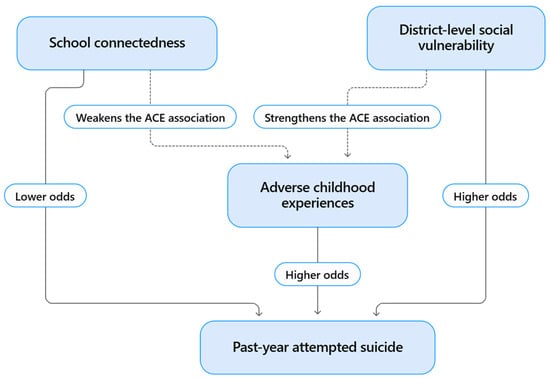
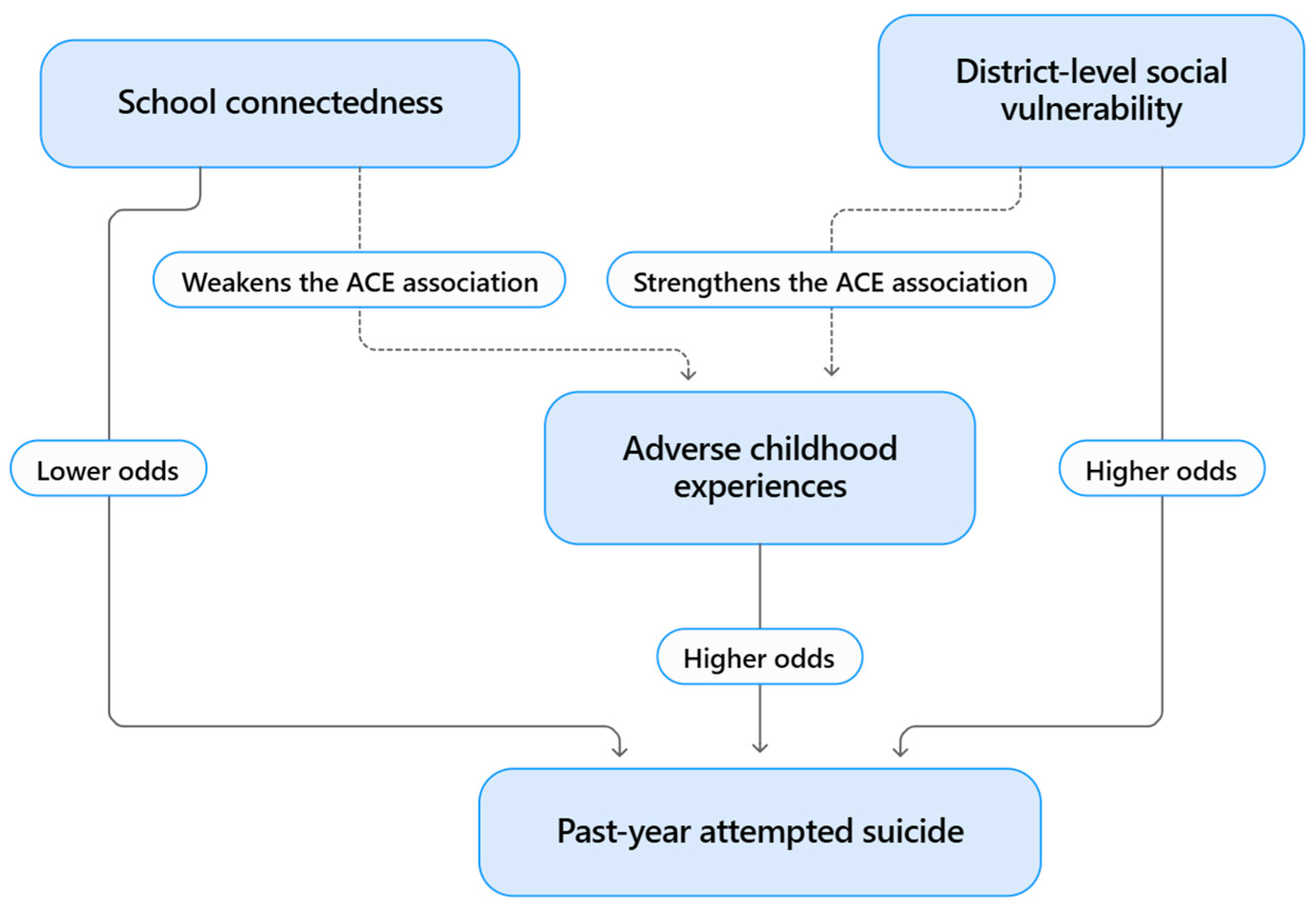
Guided by this integrated model, this study examined the independent associations of ACE exposure, district-level social vulnerability, and school connectedness with past-year attempted suicide among Asian American youth. It also tested whether social vulnerability and school connectedness moderated the association between ACE exposure and attempted suicide. I hypothesized that (1) greater ACE exposure would be associated with higher odds of attempted suicide; (2) higher district-level social vulnerability would be associated with higher odds of attempted suicide; (3) school connectedness would be associated with lower odds of attempted suicide; (4) district-level social vulnerability would strengthen the positive association between ACE exposure and attempted suicide; and (5) school connectedness would weaken this association. Figure 1 presents the proposed analytical model.
Figure 1.
Integrated conceptual model of adverse childhood experiences, district-level social vulnerability, school connectedness, and past-year attempted suicide. Solid arrows represent the hypothesized main associations. Dashed arrows represent the hypothesized moderating effects of social vulnerability and school connectedness on the association between ACEs and attempted suicide. The figure represents the hypotheses tested rather than the observed results.
2. Methods
2.1. Sampling
The YRBS includes separate national, state, tribal, territorial, and local school-based surveys. Unlike the national YRBS, district YRBS surveys are designed to produce representative estimates for students attending grades 9–12 within the participating jurisdictions rather than for high school students throughout the United States (Centers for Disease Control and Prevention, 2024). Participating districts used school- and classroom-based cluster sampling procedures, and students in selected classes completed anonymous, self-administered questionnaires.
This study used the district component of CDC’s 2023 YRBS National, State, and District Combined Datasets, which contains harmonized survey records collected through 2023 (Centers for Disease Control and Prevention, 2024). The analysis was restricted to records from the 2021 and 2023 survey waves because these waves contained the variables required to measure ACE exposure, past-year attempted suicide, school connectedness, and the study covariates and could be linked to survey-year-specific district SVI values. The pooled data included 29 district sites: Albuquerque, New Mexico; Borough of Bronx, New York; Borough of Brooklyn, New York; Borough of Manhattan, New York; Borough of Queens, New York; Borough of Staten Island, New York; Broward County, Florida; Charlotte-Mecklenburg County, North Carolina; Chicago, Illinois; Clark County, Nevada; Dallas, Texas; Duval County, Florida; Fort Worth, Texas; Hillsborough County, Florida; Los Angeles, California; Miami-Dade County, Florida; Milwaukee, Wisconsin; New Orleans, Louisiana; New York City, New York; Oakland, California; Orange County, Florida; Palm Beach County, Florida; Pasco County, Florida; Philadelphia, Pennsylvania; Portland, Oregon; San Bernardino, California; San Diego, California; Seattle, Washington; and Spartanburg County, South Carolina.
At the district level, inclusion in the analytic sample required that a site-year survey contain every variable used in the study and permit linkage to a survey-year-specific SVI value. Local YRBS questionnaires can include jurisdiction-selected optional items; therefore, the required ACE and school-connectedness items were not administered consistently across all 29 source sites (Centers for Disease Control and Prevention, 2024). After restricting the data to Asian American students younger than 18 years, only four districts—Chicago, Illinois; Philadelphia, Pennsylvania; Portland, Oregon; and San Diego, California—contributed complete records for the common analytic variable set. Of 4434 eligible students across the 29 source sites, 3020 records were excluded because at least one required variable was unavailable for the site-year or missing for the respondent, leaving a complete-case analytic sample of 1414 students. Districts were not selected on the basis of suicide-attempt prevalence or model results. Applying a common variable set was necessary to preserve identical variable definitions across site-years and to avoid treating questionnaire non-administration as individual-level non-exposure.
Because the analysis used district rather than national YRBS data, the findings are not nationally representative. They apply to Asian American students represented by the four retained district surveys and should not be generalized to all Asian American high school students in the United States. Parental consent and student assent or consent, depending on age and local requirements, were obtained during YRBS data collection in accordance with applicable institutional and ethical requirements. The present secondary analysis used de-identified, publicly available YRBS data and involved no direct interaction with participants; therefore, institutional review board review was not required. The data are available through the Centers for Disease Control and Prevention’s YRBS data portal. All reported statistical results were verified against the original SAS output.
2.2. Dependent Variable
The dependent variable was past-year attempted suicide. The YRBS combined dataset did not include a variable assessing nonsuicidal self-injury; therefore, nonsuicidal self-injury was not examined. Past-year attempted suicide was measured using the standard YRBS item asking whether the respondent had attempted suicide one or more times during the previous 12 months (Casey, 2024). Responses were coded as binary (1 = at least one suicide attempt; 0 = no suicide attempt), consistent with CDC surveillance methods and prior adolescent suicide research (Ivey-Stephenson, 2020; Lindsey et al., 2019). This approach has been widely used to monitor suicidal behaviors in youth and demonstrates acceptable reliability in population-based samples (May & Klonsky, 2016).
2.3. Independent Variable
ACEs capture exposure to harmful or stressful events before age 18 and are linked to increased risk of suicidal thoughts and behaviors in adolescents (Centers for Disease Control and Prevention, 2019; K. Hughes et al., 2017). ACE exposure was operationalized using eight indicators: emotional abuse, physical abuse, sexual abuse, unmet basic needs, household intimate partner violence, living with a parent or guardian with a substance-use problem, living with a parent or guardian with mental illness or suicidality, and separation from a parent or guardian because of incarceration. Each indicator was dichotomized as 0 = no exposure or 1 = exposure. The indicators were summed and categorized as 0, 1, 2, 3, or ≥4 ACEs, consistent with the cumulative-risk approach used in prior research (Brown et al., 2009; Cheah et al., 2020; K. Hughes et al., 2017). The same eight standardized indicators and coding procedures were used for all retained 2021 and 2023 records; records missing any required ACE indicator were excluded (Centers for Disease Control and Prevention, 2024).
2.4. Risk Moderator
Social vulnerability was measured using the CDC/ATSDR Social Vulnerability Index (SVI), which summarizes contextual vulnerability across socioeconomic status, household characteristics, racial and ethnic minority status, housing type, and transportation domains (Agency for Toxic Substances and Disease Registry (ATSDR), 2024). Each student record was linked to an SVI value using the YRBS site code and survey year. Students surveyed in 2021 were assigned the 2021 SVI value, and students surveyed in 2023 were assigned the 2023 SVI value for the geographic jurisdiction corresponding to their district survey site. Consequently, all students within the same site and survey year received the same contextual SVI value. The measure represents the district survey-site jurisdiction—which may correspond to a county, city, borough, or school-district area depending on the site—rather than the student’s residential address, neighborhood, or individual socioeconomic circumstances (Centers for Disease Control and Prevention, 2024). Higher scores indicate greater vulnerability and have been associated with elevated risk of poor mental health outcomes among adolescents, including higher levels of depressive symptoms and emotional distress (Goldstein et al., 2019; Visser et al., 2021).
2.5. Protective Moderator
School connectedness was measured using the single YRBS item, ‘Do you agree or disagree that you feel close to people at your school?’ Response options were strongly agree, agree, not sure, disagree, and strongly disagree. Consistent with CDC coding, strongly agree and agree were classified as connected, whereas not sure, disagree, and strongly disagree were classified as not connected (Centers for Disease Control and Prevention, 2024; Mpofu, 2023; Wilkins, 2023). No composite score was calculated. The standardized qclose2people variable and the same coding procedure were used for all retained 2021 and 2023 records; records without this item or with a missing response were excluded (Centers for Disease Control and Prevention, 2024; Mpofu, 2023; Wilkins, 2023). Because school connectedness was measured with one item, internal-consistency statistics were not applicable. Previous research shows that greater school connectedness (or belonging) is associated with lower levels of depressive and anxiety symptoms, fewer suicidal thoughts and behaviors, and generally better mental health among adolescents (Raniti et al., 2022; Rose et al., 2024).
2.6. Covariates
Covariates were selected based on the prior literature identifying key demographic factors associated with suicidal behaviors among adolescents. These included sex, grade level, and survey year, all of which are standard control variables in YRBS research (Ivey-Stephenson, 2020; Lindsey et al., 2019). Sex differences in suicide attempts have been widely documented, with female adolescents reporting higher rates of nonfatal suicidal behaviors (Lindsey et al., 2019). Grade level was included to account for developmental differences in stress exposure and help-seeking behavior across high school years (Resnick et al., 1997). Survey year was included to adjust for temporal variation in adolescent mental health linked to the COVID-19 pandemic and broader social changes affecting youth behaviors (Jones, 2022).
2.7. Statistical Analysis
Descriptive statistics were calculated using PROC SURVEYFREQ and PROC SURVEYMEANS, and survey-adjusted logistic regression models were estimated using PROC SURVEYLOGISTIC in SAS 9.4. These analyses applied the CDC-provided student weights and accounted for the original stratum and primary sampling unit variables; no additional weight rescaling was conducted. Multilevel interaction models were estimated separately using PROC GLIMMIX with Laplace estimation, a binomial distribution, and a logit link (SAS Institute Inc., 2016). The same complete-case analytic sample of 1414 students from four district sites (Chicago, Illinois; Philadelphia, Pennsylvania; Portland, Oregon; and San Diego, California) was used for descriptive, survey-weighted, and multilevel analyses. The multilevel models included a random intercept for district site; survey weight, stratum, and primary sampling unit specifications were not applied in PROC GLIMMIX. Separate models examined the ACEs × district-level social vulnerability and ACEs × school connectedness interactions. The survey-weighted main-effects model adjusted for survey year, sex, grade, ACE category, school connectedness, and SVI. The ACEs × SVI multilevel model adjusted for school connectedness and sex, whereas the ACEs × school-connectedness multilevel model adjusted for SVI and sex, consistent with the model-specific covariates reported in the corresponding result tables. For the ACEs × SVI model, SVI was centered at the analytic-sample mean (0.7595) and divided by 0.10; thus, one unit represented a 0.10-point increase in SVI. The covariate sets were kept parsimonious given the limited number of suicide attempts. Other factors, including bullying, sexual identity, racial discrimination, socioeconomic conditions, and mental health status, were not included because their temporal order relative to the exposures and outcome could not be established and some may represent mediators rather than confounders (VanderWeele, 2019). Results are presented as unstandardized logit coefficients (B), standard errors (SEs), exponentiated coefficients with 95% confidence intervals (CIs), and p values. Overall interaction effects were evaluated using Type III tests of fixed effects. Model fit was described using the −2 log likelihood, Akaike information criterion (AIC), Bayesian information criterion (BIC), and Pearson chi-square divided by degrees of freedom.
3. Results
The analytic sample included 1414 Asian American high school students from four district sites, including 645 from the 2021 district YRBS and 769 from the 2023 district YRBS. Overall, 132 students reported at least one suicide attempt during the previous year (unweighted percentage = 9.34%; weighted prevalence = 10.69%). Female students reported a higher prevalence of attempted suicide than male students. The weighted prevalence was highest among students reporting four or more ACEs. Based on the weighted estimates in Table 1, the within-category prevalence of past-year suicide attempts was approximately 7.7% among students with no ACEs and 21.8% among those with four or more ACEs. Students without school connectedness also reported a higher prevalence of attempted suicide than connected students (Table 1).
Table 1.
Characteristics of Asian American youth by past-year attempted suicide, 2021 and 2023 district YRBS data.
In adjusted survey-weighted models, female students had greater odds of attempted suicide than male students (AOR = 1.67, 95% CI [1.10, 2.53], p = 0.017). Grade level was not statistically associated with attempted suicide. Compared with students reporting no ACEs, those reporting four or more ACEs had higher adjusted odds of attempted suicide (AOR = 4.10, 95% CI [1.92, 8.74], p < 0.001). School connectedness was associated with lower odds (AOR = 0.57, 95% CI [0.35, 0.92], p = 0.022), whereas district-level SVI was not statistically significant (AOR = 1.41, 95% CI [0.27, 7.23], p = 0.679) (Table 2).
Table 2.
Survey-weighted logistic regression estimates for past-year attempted suicide among Asian American youth, 2021 and 2023 district YRBS data.
Multilevel logistic regression models did not provide sufficient evidence that district-level social vulnerability modified the association between ACE exposure and attempted suicide. The omnibus Type III test for the ACEs × SVI interaction was not statistically significant, F(4, 1399) = 2.06, p = 0.083. Although the interaction estimate for two versus no ACEs reached nominal statistical significance, the overall interaction test was not significant. In the centered model, ACE coefficients compare each ACE category with no ACEs at the mean SVI, while the exponentiated interaction coefficients indicate how each ACE-related odds ratio changes per 0.10-point increase in SVI. They should not be interpreted as combined odds associated with ACE exposure and district-level SVI (Table 3).
Table 3.
Multilevel logistic regression estimates for past-year attempted suicide with the ACEs × SVI interaction.
Similarly, the omnibus Type III test for the ACEs × school connectedness interaction was not statistically significant, F(4, 1399) = 1.50, p = 0.200. School connectedness was associated with lower odds of attempted suicide in the main-effects model, but the interaction model did not establish that this association differed across ACE categories. Accordingly, the category-specific interaction coefficients in Table 4 should not be interpreted as combined effects or as evidence that school connectedness buffered the association between ACE exposure and attempted suicide.
Table 4.
Multilevel logistic regression estimates for past-year attempted suicide with the ACEs × school connectedness interaction.
4. Discussion
This study examined the associations of ACE exposure, district-level social vulnerability, and school connectedness with past-year attempted suicide among Asian American youth. Three main findings emerged. First, students reporting four or more ACEs had higher adjusted odds of attempted suicide than students reporting no ACEs. Second, school connectedness was associated with lower odds of attempted suicide. Third, district-level SVI was not independently associated with attempted suicide, and the omnibus interaction tests did not provide sufficient evidence that either SVI or school connectedness modified the association between ACE exposure and attempted suicide. Thus, the findings support associations involving individual adversity and school connectedness but do not support an independent SVI association or the hypothesized moderation effects.
An important contribution of this study is the simultaneous consideration of individual adversity, district-level conditions, and school connectedness within a population that remains underrepresented in adolescent suicide research. Prior reviews have noted limited evidence on suicide-related risk and contextual factors among Asian American subgroups (Wyatt et al., 2015). Linking district YRBS records with district-level SVI data allowed structural context to be examined alongside student-reported experiences, while the inclusion of school connectedness added a school-based social dimension. The analysis also demonstrates why an independent contextual association should be distinguished from statistical moderation: a factor may be associated with attempted suicide without changing the association between ACE exposure and the outcome. This distinction supports more precise theory development and helps prevent unsupported conclusions about how contextual factors operate.
Consistent with extensive research in adolescent mental health, higher exposure to ACEs was strongly associated with suicide attempts (K. Hughes et al., 2017; Merrick et al., 2018). The higher odds among students reporting four or more ACEs are consistent with the stress-diathesis model, which suggests that early adversity can create vulnerability through chronic stress load and changes in emotional regulation, increasing susceptibility to suicidal behavior when additional stressors arise (Mann et al., 1999). Prior research suggests that mental health stigma, academic pressure, and racialized experiences may affect some Asian American adolescents, although these experiences vary across subgroups (J. L. Liu et al., 2022; Wyatt et al., 2015). Because these factors were not measured in the present study, they should be considered possible contextual explanations rather than tested mechanisms underlying the observed ACE–suicide association. The descriptive pattern and elevated adjusted odds among students reporting four or more ACEs are consistent with previous evidence linking cumulative adversity to suicide risk in diverse populations. However, the adjusted estimates for one, two, and three ACEs were not statistically significant.
District-level social vulnerability was not independently associated with attempted suicide, and the omnibus interaction between SVI and ACEs was not statistically significant. Although ecosocial theory describes how structural conditions may influence health through the distribution of social stressors and health-supporting resources, the present estimates did not provide evidence of an SVI association or moderation effect (Krieger, 2012). Prior research suggests that socioeconomic disadvantage, limited healthcare access, and other structural conditions may contribute to differences in mental health across populations (Gee & Ford, 2011). However, the pathways linking district-level vulnerability to individual suicide attempts were not measured, and the wide confidence intervals indicate substantial uncertainty.
School connectedness was associated with lower odds of attempted suicide in the main-effects model. However, the omnibus interaction between school connectedness and ACE exposure was not statistically significant. The observed main association is consistent with social control and resilience perspectives, which identify institutional bonds, belonging, supportive relationships, and access to trusted adults as potential resources for adolescents (Masten, 2025; Resnick et al., 1997). School connectedness may therefore represent an important school-related correlate of attempted suicide among Asian American youth. However, the findings do not demonstrate that school connectedness buffered the ACE–suicide association or that its association with attempted suicide was consistent across ACE categories. Furthermore, the proposed relational, coping, and cultural mechanisms were not measured and should be viewed as possible explanations to be examined in future longitudinal research rather than as mechanisms established by the present study.
The findings support attention to childhood adversity and school context but do not establish that changing school connectedness or district-level social vulnerability would reduce attempted suicide. Routine universal ACE screening is not recommended based on these findings. If adversity is assessed, procedures should be voluntary, culturally responsive, and trauma-informed; protect students’ privacy; include clear procedures for responding to disclosures; and be implemented only when trained personnel, culturally responsive referral pathways, and follow-up services are available. Cumulative ACE scores describe population-level risk but do not capture the type, timing, severity, or context of adversity and have limited accuracy for predicting individual outcomes (Baldwin et al., 2021; Finkelhor, 2018). The association between school connectedness and lower odds of attempted suicide supports further study and evaluation of supportive school-climate approaches, including teacher training, mentorship systems, anti-bullying initiatives, and access to culturally responsive mental health staff (Borowsky et al., 2009; Resnick et al., 1997). Future research should also evaluate whether district-level structural conditions are associated with attempted suicide in larger, geographically detailed samples. Cross-sector coordination among school systems, local health departments, and community organizations may help align trauma-informed school practices with broader family and community supports (Krieger, 2012).
This study has several limitations. First, the cross-sectional design prevents causal and temporal interpretation of the associations among ACEs, district-level social vulnerability, school connectedness, and attempted suicide. Reverse associations are possible; for example, students experiencing psychological distress may perceive their school relationships and available support less positively. Therefore, the findings do not show that increasing school connectedness or reducing district-level social vulnerability would reduce suicide attempts or alter the effects of ACEs. Second, the student-level measures were self-reported and may be subject to recall or social desirability bias, particularly for sensitive topics such as ACEs and suicide attempts. In addition, the single YRBS item may not capture the multidimensional nature of school connectedness, including relationships with peers, teachers, and the broader school environment (Wilkins, 2023). Third, although both interaction models converged and included approximately 12 suicide-attempt events per non-intercept fixed-effect coefficient, the 132 outcome events provided limited information for estimating numerous main and interaction terms. Events-per-parameter thresholds are only general guidance, and sparse data within some combinations of ACE exposure and school connectedness may have produced unstable category-specific estimates or wide confidence intervals (Vittinghoff & McCulloch, 2007). The interaction findings should therefore be interpreted cautiously and confirmed in larger samples. Fourth, the YRBS does not capture the full range of adversities or contextual stressors experienced by Asian American youth. Moreover, the aggregated ‘Asian American’ category combines populations that differ substantially in ethnic origin, migration history, socioeconomic circumstances, language, culture, and access to support. This aggregation may obscure subgroup differences in ACE exposure, district-level social vulnerability, school connectedness, and attempted suicide; therefore, the findings should not be assumed to apply uniformly across Asian American subgroups (Holland & Palaniappan, 2012; Kauh et al., 2021). Future studies should use disaggregated ethnic data and examine migration- and language-related characteristics when such information is available. Fifth, social vulnerability was assigned at the school-district level and may not represent students’ residential neighborhoods or individual living conditions. This geographic misclassification creates a risk of ecological fallacy; therefore, district-level associations should not be interpreted as individual-level neighborhood effects (Robinson, 2009). Sixth, reducing the 29 source districts to the four districts with a common complete variable set, together with excluding 3020 records, may have introduced site-selection and complete-case selection bias (R. A. Hughes et al., 2019). The four retained districts were not randomly selected and may differ from excluded districts in questionnaire content, student composition, and contextual conditions. With only four district clusters, between-district heterogeneity and the district random-intercept variance were estimated imprecisely. The restricted site coverage and limited between-district variation may also have reduced the precision and generalizability of the interaction estimates. Accordingly, the nonsignificant ACEs × SVI and ACEs × school-connectedness interactions describe the four retained districts and should not be interpreted as evidence that moderation is absent in other district contexts. School-based sampling may also exclude adolescents who were not enrolled in school or were absent during data collection. These restrictions substantially limit geographic generalizability; the findings apply only to students represented by the four analytic district surveys and should not be generalized to all Asian American adolescents in the United States. Finally, residual confounding is possible. Bullying, sexual identity, racial discrimination, individual socioeconomic conditions, mental health status, immigration-related stress, family dynamics, and access to culturally competent mental health care may influence the observed associations. These factors were not included because they were unavailable consistently, their temporal order could not be established, or they could function as mediators rather than confounders in the proposed model (VanderWeele, 2019).
In conclusion, greater ACE exposure was associated with higher odds of attempted suicide, whereas school connectedness was associated with lower odds among Asian American adolescents. District-level SVI was not independently associated with attempted suicide, and neither omnibus interaction test was statistically significant. By examining individual adversity, district-level context, and school connectedness within one analytical model, this study contributes to a multilevel understanding of factors associated with attempted suicide in this population while distinguishing independent associations from statistically supported moderation. Because the data were cross-sectional, the temporal direction and mechanisms underlying these associations could not be determined. Future longitudinal studies using disaggregated Asian American subgroup data and more detailed measures of structural and school contexts are needed to assess temporal relationships and possible moderation.
Funding
This work was partially supported by the National Institute on Aging through a P30 Research Center Grant (P30AG066615) awarded to the University of North Carolina at Chapel Hill. Additional support was provided by the University of North Carolina at Greensboro School of Health and Human Sciences through its Top-Off Grant and Faculty Research Grant programs. The APC was waived by the publisher.
Institutional Review Board Statement
Institutional Review Board review was not required for this study because it used de-identified, publicly available YRBS data and involved no direct interaction with participants.
Informed Consent Statement
Parental consent and student assent or consent, depending on age and local requirements, were obtained during the original YRBS data collection. No additional consent was required for this secondary analysis.
Data Availability Statement
The data analyzed in this study are publicly available from the CDC YRBS data portal at https://www.cdc.gov/yrbs/data/index.html (accessed on 19 November 2026). The SAS code is available from the corresponding author upon reasonable request.
Conflicts of Interest
The author declares no conflicts of interest.
References
- Agency for Toxic Substances and Disease Registry (ATSDR). (2024). Social vulnerability index. Available online: https://www.atsdr.cdc.gov/place-health/php/svi/ (accessed on 4 September 2026).
- Baldwin, J. R., Caspi, A., Meehan, A. J., Ambler, A., Arseneault, L., Fisher, H. L., Harrington, H., Matthews, T., Odgers, C. L., & Poulton, R. (2021). Population vs. individual prediction of poor health from results of adverse childhood experiences screening. JAMA Pediatrics, 175(4), 385–393. [Google Scholar] [CrossRef] [Scilit] [PubMed]
- Borowsky, I. W., Ireland, M., & Resnick, M. D. (2009). Health status and behavioral outcomes for youth who anticipate a high likelihood of early death. Pediatrics, 124(1), e81–e88. [Google Scholar] [CrossRef] [Scilit] [PubMed]
- Brown, D. W., Anda, R. F., Tiemeier, H., Felitti, V. J., Edwards, V. J., Croft, J. B., & Giles, W. H. (2009). Adverse childhood experiences and the risk of premature mortality. American Journal of Preventive Medicine, 37(5), 389–396. [Google Scholar] [CrossRef] [Scilit] [PubMed]
- Casey, C. G. (2024). Youth risk behavior surveillance—United States, 2023. In Morbidity and mortality weekly report (MMWR) (Vol. 73, No. 4). Centers for Disease Control and Prevention. [Google Scholar]
- Centers for Disease Control and Prevention. (2019). Preventing adverse childhood experiences: Leveraging the best available evidence. National Center for Injury Prevention and Control. [Google Scholar]
- Centers for Disease Control and Prevention. (2024). Youth risk behavior survey (YRBS): 2023 YRBS national, state, and district combined datasets user’s guide. Available online: https://stacks.cdc.gov/view/cdc/252285 (accessed on 2 September 2026).
- Cheah, C. S., Wang, C., Ren, H., Zong, X., Cho, H. S., & Xue, X. (2020). COVID-19 racism and mental health in Chinese American families. Pediatrics, 146(5), e2020021816. [Google Scholar] [CrossRef] [Scilit] [PubMed]
- Dube, S. R., Anda, R. F., Felitti, V. J., Chapman, D. P., Williamson, D. F., & Giles, W. H. (2001). Childhood abuse, household dysfunction, and the risk of attempted suicide throughout the life span: Findings from the adverse childhood experiences study. JAMA, 286(24), 3089–3096. [Google Scholar] [PubMed]
- Finkelhor, D. (2018). Screening for adverse childhood experiences (ACEs): Cautions and suggestions. Child Abuse & Neglect, 85, 174–179. [Google Scholar] [CrossRef] [Scilit] [PubMed]
- Flanagan, B. E., Gregory, E. W., Hallisey, E. J., Heitgerd, J. L., & Lewis, B. (2011). A social vulnerability index for disaster management. Journal of Homeland Security and Emergency Management, 8(1), 3. [Google Scholar] [CrossRef] [Scilit]
- Gee, G. C., & Ford, C. L. (2011). Structural racism and health inequities: Old issues, new directions. Du Bois Review: Social Science Research on Race, 8(1), 115–132. [Google Scholar] [PubMed]
- Goldstein, R. B., Lee, A. K., Haynie, D. L., Luk, J. W., Fairman, B. J., Liu, D., Jeffers, J. S., Simons-Morton, B. G., & Gilman, S. E. (2019). Neighbourhood disadvantage and depressive symptoms among adolescents followed into emerging adulthood. Journal of Epidemiology and Community Health, 73(7), 590–597. [Google Scholar] [CrossRef] [Scilit] [PubMed]
- Gomez, J., Miranda, R., & Polanco, L. (2011). Acculturative stress, perceived discrimination, and vulnerability to suicide attempts among emerging adults. Journal of Youth and Adolescence, 40(11), 1465–1476. [Google Scholar] [CrossRef] [Scilit] [PubMed]
- Hirschi, T. (1969). Causes of delinquency. University of California Press Berkeley. [Google Scholar]
- Holland, A. T., & Palaniappan, L. P. (2012). Problems with the collection and interpretation of Asian-American health data: Omission, aggregation, and extrapolation. Annals of Epidemiology, 22(6), 397–405. [Google Scholar] [CrossRef] [Scilit] [PubMed]
- Hughes, K., Bellis, M. A., Hardcastle, K. A., Sethi, D., Butchart, A., Mikton, C., Jones, L., & Dunne, M. P. (2017). The effect of multiple adverse childhood experiences on health: A systematic review and meta-analysis. The Lancet Public Health, 2(8), e356–e366. [Google Scholar] [CrossRef] [Scilit] [PubMed]
- Hughes, R. A., Heron, J., Sterne, J. A., & Tilling, K. (2019). Accounting for missing data in statistical analyses: Multiple imputation is not always the answer. International Journal of Epidemiology, 48(4), 1294–1304. [Google Scholar] [CrossRef] [Scilit] [PubMed]
- Ivey-Stephenson, A. Z. (2020). Suicidal ideation and behaviors among high school students—Youth risk behavior survey, United States, 2019. MMWR Supplements, 69, 47–55. [Google Scholar] [CrossRef] [Scilit] [PubMed]
- Jones, S. E. (2022). Mental health, suicidality, and connectedness among high school students during the COVID-19 pandemic—Adolescent behaviors and experiences survey, United States, January–June 2021. MMWR Supplements, 71, 16–21. [Google Scholar] [CrossRef] [Scilit] [PubMed]
- Kauh, T. J., Read, J. G., & Scheitler, A. (2021). The critical role of racial/ethnic data disaggregation for health equity. Population Research and Policy Review, 40(1), 1–7. [Google Scholar] [CrossRef] [Scilit] [PubMed]
- Krieger, N. (2012). Methods for the scientific study of discrimination and health: An ecosocial approach. American Journal of Public Health, 102(5), 936–944. [Google Scholar] [CrossRef] [Scilit] [PubMed]
- Lindsey, M. A., Sheftall, A. H., Xiao, Y., & Joe, S. (2019). Trends of suicidal behaviors among high school students in the United States: 1991–2017. Pediatrics, 144(5), e20191187. [Google Scholar] [CrossRef] [Scilit] [PubMed]
- Liu, J. L., Wang, C., Do, K. A., & Bali, D. (2022). Asian American adolescents’ mental health literacy and beliefs about helpful strategies to address mental health challenges at school. Psychology in the Schools, 59(10), 2062–2084. [Google Scholar] [CrossRef] [Scilit]
- Liu, S., Morin, S. B., Bourand, N. M., DeClue, I. L., Delgado, G. E., Fan, J., Foster, S. K., Imam, M. S., Johnston, C. B., & Joseph, F. B. (2023). Social vulnerability and risk of suicide in US adults, 2016–2020. JAMA Network Open, 6(4), e239995. [Google Scholar] [CrossRef] [Scilit] [PubMed]
- Mann, J. J., Waternaux, C., Haas, G. L., & Malone, K. M. (1999). Toward a clinical model of suicidal behavior in psychiatric patients. American Journal of Psychiatry, 156(2), 181–189. [Google Scholar] [CrossRef] [Scilit] [PubMed]
- Masten, A. S. (2025). Ordinary magic: Resilience in development. GUILFORD. [Google Scholar]
- May, A. M., & Klonsky, E. D. (2016). What distinguishes suicide attempters from suicide ideators? A meta-analysis of potential factors. Clinical Psychology: Science and Practice, 23(1), 5. [Google Scholar] [CrossRef] [Scilit]
- Merrick, M. T., Ford, D. C., Ports, K. A., & Guinn, A. S. (2018). Prevalence of adverse childhood experiences from the 2011–2014 behavioral risk factor surveillance system in 23 states. JAMA Pediatrics, 172(11), 1038–1044. [Google Scholar] [CrossRef] [Scilit] [PubMed]
- Mpofu, J. J. (2023). Overview and methods for the Youth Risk Behavior Surveillance system—United States, 2021. MMWR Supplements, 72, 1–12. [Google Scholar] [CrossRef] [Scilit] [PubMed]
- Office of Minority Health U.S. Department of Health and Human Services. (2024). Mental and behavioral health—Asian Americans. Available online: https://minorityhealth.hhs.gov/mental-and-behavioral-health-asian-americans? (accessed on 28 October 2026).
- Polanco-Roman, L., Ebrahimi, C. T., Mafnas, K. S., Hausmann-Stabile, C., Meca, A., Mazzula, S. L., Duarte, C. S., & Lewis-Fernández, R. (2023). Acculturation and suicide-related risk in ethnoracially minoritized youth in the US: A scoping review and content analysis of the empirical evidence. Social Psychiatry and Psychiatric Epidemiology, 58(8), 1121–1137. [Google Scholar] [CrossRef] [Scilit] [PubMed]
- Raniti, M., Rakesh, D., Patton, G. C., & Sawyer, S. M. (2022). The role of school connectedness in the prevention of youth depression and anxiety: A systematic review with youth consultation. BMC Public Health, 22(1), 2152. [Google Scholar] [CrossRef] [Scilit] [PubMed]
- Resnick, M. D., Bearman, P. S., Blum, R. W., Bauman, K. E., Harris, K. M., Jones, J., Tabor, J., Beuhring, T., Sieving, R. E., & Shew, M. (1997). Protecting adolescents from harm: Findings from the national longitudinal study on adolescent health. JAMA, 278(10), 823–832. [Google Scholar] [CrossRef] [Scilit] [PubMed]
- Reyes, M. P., Song, I., & Bhatt, A. (2024). Breaking the silence: An epidemiological report on Asian American and Pacific Islander youth mental health and suicide (1999–2021). Child and Adolescent Mental Health, 29(2), 136–144. [Google Scholar] [CrossRef] [Scilit] [PubMed]
- Robinson, W. S. (2009). Ecological correlations and the behavior of individuals. International Journal of Epidemiology, 38(2), 337–341. [Google Scholar] [CrossRef] [Scilit] [PubMed]
- Rose, I. D., Lesesne, C. A., Sun, J., Johns, M. M., Zhang, X., & Hertz, M. (2024). The relationship of school connectedness to adolescents’ engagement in co-occurring health risks: A meta-analytic review. The Journal of School Nursing, 40(1), 58–73. [Google Scholar] [CrossRef] [Scilit] [PubMed]
- SAS Institute Inc. (2016). SAS/STAT 14.2 user’s guide. SAS Institute Inc. Available online: https://documentation.sas.com/api/collections/statcdc/14.2/docsets/statug/content/chap0.pdf?locale=en (accessed on 19 November 2026).
- Substance Abuse and Mental Health Services Administration (SAMHSA). (2023). Among the Asian population aged 12 or older: 2023 NSDUH data findings. Available online: https://www.samhsa.gov/data/data-we-collect/nsduh-national-survey-drug-use-and-health/national-releases/2023 (accessed on 19 November 2026).
- VanderWeele, T. J. (2019). Principles of confounder selection. European Journal of Epidemiology, 34(3), 211–219. [Google Scholar] [CrossRef] [Scilit] [PubMed]
- Verlenden, J. V. (2024). Mental health and suicide risk among high school students and protective factors—Youth risk behavior survey, United States, 2023. MMWR Supplements, 73, 79–86. [Google Scholar] [CrossRef] [Scilit] [PubMed]
- Visser, K., Bolt, G., Finkenauer, C., Jonker, M., Weinberg, D., & Stevens, G. W. (2021). Neighbourhood deprivation effects on young people’s mental health and well-being: A systematic review of the literature. Social Science & Medicine, 270, 113542. [Google Scholar] [CrossRef] [Scilit] [PubMed]
- Vittinghoff, E., & McCulloch, C. E. (2007). Relaxing the rule of ten events per variable in logistic and Cox regression. American Journal of Epidemiology, 165(6), 710–718. [Google Scholar] [CrossRef] [Scilit] [PubMed]
- Whitlock, J., Wyman, P. A., & Moore, S. R. (2014). Connectedness and suicide prevention in adolescents: Pathways and implications. Suicide and Life-Threatening Behavior, 44(3), 246–272. [Google Scholar] [CrossRef] [Scilit] [PubMed]
- Wilkins, N. J. (2023). School connectedness and risk behaviors and experiences among high school students—Youth risk behavior survey, United States, 2021. MMWR Supplements, 72, 13–21. [Google Scholar] [CrossRef] [Scilit] [PubMed]
- Wyatt, L. C., Ung, T., Park, R., Kwon, S. C., & Trinh-Shevrin, C. (2015). Risk factors of suicide and depression among Asian American, Native Hawaiian, and Pacific Islander youth: A systematic literature review. Journal of Health Care for the Poor and Underserved, 26(2), 191–237. [Google Scholar] [CrossRef] [Scilit] [PubMed]
- Zheng, K., Roehlkepartain, E. C., Santelli, J. S., Smaldone, A., & Bruzzese, J. M. (2022). Associations between developmental assets and adolescent health status: Findings from the 2016 national survey of children’s health. Journal of School Health, 92(3), 300–308. [Google Scholar] [CrossRef] [Scilit] [PubMed]

Disclaimer/Publisher’s Note: The statements, opinions and data contained in all publications are solely those of the individual author(s) and contributor(s) and not of MDPI and/or the editor(s). MDPI and/or the editor(s) disclaim responsibility for any injury to people or property resulting from any ideas, methods, instructions or products referred to in the content. |
© 2026 by the author. Licensee MDPI, Basel, Switzerland. This article is an open access article distributed under the terms and conditions of the Creative Commons Attribution (CC BY) license.