


Abstract
Early detection of suicidal risk in adolescents requires valid tools adapted to the clinical and educational context. However, there are currently no observational scales developed specifically for use by significant people in the adolescent’s environment. Therefore, the aim of the present study was to design, validate and apply to a pilot sample an observational scale to identify behavioural and emotional signs of suicidal risk in adolescents, from the perspective of adolescents, parents and teachers. Validation study of an Observational Adolescent Suicide Risk Scale (EORSA) based on a theoretical review and expert consensus. Content validity was evaluated through expert judgement by professionals with recognised experience in mental health, psychometrics, and suicide prevention. The scale was subsequently applied to a sample of adolescents, parents and teachers, analysing the mean scores per item in each group. The final scale included 19 items with a high level of agreement among experts (content validity index > 0.80). When applied to the pilot sample, significant differences were observed in the items considered most frequent by each group. The EORSA is a valid and potentially useful tool for identifying signs of suicidal risk in adolescents from an observational perspective. Its design and application allow for a contextualised and multidimensional assessment, favouring preventive interventions adapted to each setting.
1. Introduction
According to the World Health Organization (World Health Organization, 2025), suicide causes more than 700,000 deaths worldwide each year and remains one of the leading causes of death among adolescents and young adults, ranking as the second leading cause of death in individuals aged 15–29 years.
Epidemiological data indicate that suicide mortality rates are higher among males, whereas suicidal ideation and non-fatal suicide attempts are more frequently reported among females, a phenomenon widely described as the “suicide paradox” (Canetto & Sakinofsky, 1998; World Health Organization, 2025).
Suicide is a complex and multifactorial phenomenon resulting from the interaction of psychological, social, environmental, and biological factors, including genetic vulnerability. This complexity highlights the need for comprehensive prevention strategies and reinforces the importance of identifying reliable tools that support early detection and timely intervention, particularly in adolescent populations.
In this context, suicidal ideation represents an initial and fundamental phase of the suicidal process, the early identification of which is crucial for preventing self-injurious behaviour and reducing fatal outcomes.
Numerous studies indicate that people who have suicidal thoughts often exhibit warning signs before an attempt (Adler et al., 2016; Tsai & Klonsky, 2023). These may include verbal threats, references to death in writing, and non-verbal expressions such as anxious or despairing body language (Suherman et al., 2018). However, these signals are not always perceived by the individual themselves as a risk or are not expressed directly, making the environment—family, friends, health professionals and educators—a key agent for their detection (Carey et al., 2024; Ronningstam et al., 2024; Mascret et al., 2011).
The assessment of suicidal ideation has predominantly relied on self-report behavioural health tools, often including only a single item on passive suicidal thoughts, for example, the Patient Health Questionnaire-9 (PHQ-9). However, the capacity of these tools to evaluate suicide risk is limited, as it fails to address critical aspects such as planning, intent, or lethality (Na et al., 2018), and some individuals find the phrasing of their items difficult to interpret (Thompson et al., 2004). Although several of these instruments have been validated and adapted to the Spanish context, their validity and sensitivity for detecting suicide risk specifically in adolescents remain insufficiently established. These include the Beck Suicide Ideation Scale (BSI), the Paykel Suicide Scale (PSS) and the Mini-International Neuropsychiatric Interview (MINI), among others.
Moreover, tools specifically designed to assess suicidal risk, such as the Columbia Suicide Severity Rating Scale (C-SSRS; Posner et al., 2011) and the Ask Suicide-Screening Questions Toolkit (ASQ; Aguinaldo et al., 2021), are widely used—particularly in clinical settings. However, these instruments are intended to be administered by healthcare professionals, which limits their practicality for self-assessment or large-scale screening in adolescent populations.
Scientific evidence indicates that, while these self-assessment tools are essential for assessing suicidal ideation, they may not fully encompass the complexity inherent in such experience because many of them are designed for rapid screening, not for full diagnosis or in-depth risk assessment. Moreover, despite the significant benefits of these tools, they often overlook critical aspects of suicidal thoughts, in particular the sensory and emotional dimensions associated with suicidal mental imagery (Carey et al., 2024; Erford et al., 2018).
Finally, and relevantly, it should be noted that many assessment instruments have inherent self-report biases, which compromise their validity in terms of the adolescent’s willingness, understanding and honesty in responding. In this sense, the incorporation of more comprehensive and objective approaches—combining self-reported data with observational or physiological measures could significantly improve the accuracy of suicide risk identification and optimise the effectiveness of clinical interventions.
It is crucial to incorporate instruments aimed at external observers, such as family members, teachers or health professionals, as the few instruments available in this field are often presented as non-standardised clinical guidelines or use dichotomous response systems, which may limit their diagnostic sensitivity and specificity. Given the crucial role that observers can play in identifying suicidal behaviour, there is a need for valid, reliable and adapted tools that allow third parties to detect signs of suicidal ideation in adolescents in a structured and informed manner. Effective assessment of suicidal ideation in Spain requires a careful and informed approach, using validated instruments and being fully aware of their specific limitations and the unique context of each individual.
It is important to emphasise that observational indicators of suicidal risk are not diagnostic or determinative on their own. Observable cues must always be interpreted within their broader psychosocial context and in conjunction with direct communication and professional assessment, particularly considering that suicide is the second leading cause of death among adolescents. For this reason, observational instruments should not aim to predict individual suicidal outcomes (Baston, 2024), but rather to support early identification, promote communication, and guide timely referral to specialised services when warning signs arise.
Therefore, the main aim of the present work is to develop and validate an Observational Scale of Suicide Risk in Adolescents (OSSRA) in order to improve the processes of early detection and clinical response to risk situations by third parties (counsellors, psychologists, teachers, family members, and peers).
2. Materials and Methods
The present study was designed as a multi-phase methodological investigation following established methodological guidelines for scale development (Polit et al., 2007), and aimed at the development and preliminary validation of an observational instrument for the identification of suicidal risk in adolescents. These phases were as follows:
- Phase 1. Review of the literature related to instruments for the detection of suicidal risk in adolescents;
- Phase 2. Focus groups with professionals;
- Phase 3. Content validation by a panel of experts; and
- Phase 4. Pilot study conducted with a sample of teachers, parents, and peers.
2.1. Phase 1: Review of the Literature Related to Instruments for Measuring the Detection of Suicidal Risk in Adolescents
2.1.1. Search Strategy and Objective
The literature review in this article was focused on identifying reliable and valid instruments for the detection of suicidal risk in adolescents, a demographic group disproportionately affected by suicidal ideation.
This study aimed to rigorously adapt a previously established literature review methodology, initially designed to explore self-report instruments for adolescent suicide prevention, to a new objective: the identification of suicide risk in adolescents through third-party screening tools. The new approach focuses on instruments specifically designed for third parties (counsellors, psychologists, teachers, family members, and peers) to detect suicide risk in adolescents. This review was conducted in accordance with the PRISMA (Preferred Reporting Items for Systematic Reviews and Meta-Analyses) guidelines (Page et al., 2021). The literature search was carried out between June and September 2025 by two independent researchers, who conducted the database searches and the initial screening of titles and abstracts. Full-text assessments were performed independently, and any discrepancies were resolved through discussion and consensus, with the involvement of a third reviewer when necessary.
2.1.2. Databases Consulted
The literature review was conducted using a robust selection of electronic databases: PubMed, SCOPUS and Web of Science. While these platforms are effective for broad health and social science research, the specific focus on adolescent suicide screening tools required a more strategic and targeted search approach. The development and validation of psychological and health assessment tools are often indexed in specialised repositories beyond general biomedical or social science databases. For this reason, specific tools were consulted to search for instruments and their psychometric characteristics, such as BiblioPRO, PROQOLID and PsycTESTS.
2.1.3. Search Terms and Indexing Strategy
For those databases that do not have an indexing system using MeSH headings, such as Scopus and Web of Science, a broad search strategy based on free keywords was used. This search strategy combined terms related to the target population (adolescents), the phenomenon of interest (suicide and self-harm), and the type of study (instrument development and validation).
In contrast, for controlled indexing databases such as PubMed, strategies were designed using a combination of MeSH (Medical Subject Headings) terms and free-text keywords. These were mainly applied in the title and abstract fields, with the aim of maximising both sensitivity and specificity in retrieving relevant records.
The key concepts defined for all bases were:
- -
- Target population: adolescent*, teen*, youth, young adult*, juvenile*, child*, paediatric*.
- -
- Suicide/self-injurious behaviour: suicide, suicidal, self-harm, self-injury*, suicidal ideation, suicide risk
- -
- Assessment/detection: detect*, screen*, assess*, identif*, predict*, risk assessment, early detection
- -
- Instruments and psychometric properties: instrument*, scale*, questionnaire*, tool*, psychometric*, reliability, validity, internal consistency, test–retest, sensitivity, specificity, predictive value
2.1.4. Search Limits and Strategy Optimisation
Search strategies were adapted to the technical characteristics of each database using Boolean operators (AND, OR), truncation symbols (*), and thematic filters. No time limits were applied. Publications were restricted to English, Spanish, and Italian.
The following table (Table 1) summarises the construction of search strings and provides representative examples of keywords, MeSH terms, and Boolean operators used across databases.
Table 1.
Proposed search terms for adolescent suicide screening instruments.
2.1.5. Inclusion and Exclusion Criteria
The strategy was designed following the PECOS model:
Population: adolescents or young adults
Exposure: suicidal ideation or suicide risk
Comparator: not applicable
Outcome: psychometric assessment instruments (questionnaires, scales, interviews)
Study design: original studies with partial or complete psychometric validation
Inclusion criteria:
Original studies published in peer-reviewed journals.
Studies written in English or Spanish or Italian.
Explicit assessment of suicidal ideation or risk using instruments.
Availability of full text.
Exclusion criteria:
Reviews, qualitative studies, protocols or editorials.
Instruments not applied in the adolescent population or without psychometric analysis.
2.1.6. Selection Process and Search Results
The search for studies using tools to assess suicide risk in adolescents initially identified 3258 articles in the PubMed and PsycInfo databases.
All articles were processed using a two-stage screening procedure. First, titles and abstracts were evaluated to rule out irrelevant and/or duplicate papers. Then, the full texts of potentially eligible articles were reviewed. The process was carried out by two independent researchers, resolving discrepancies by consensus or with the support of a third reviewer.
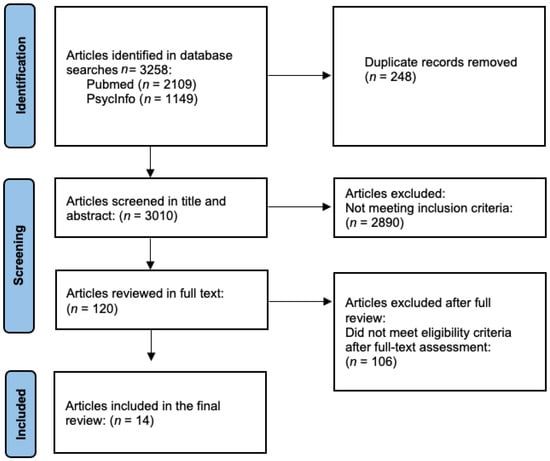
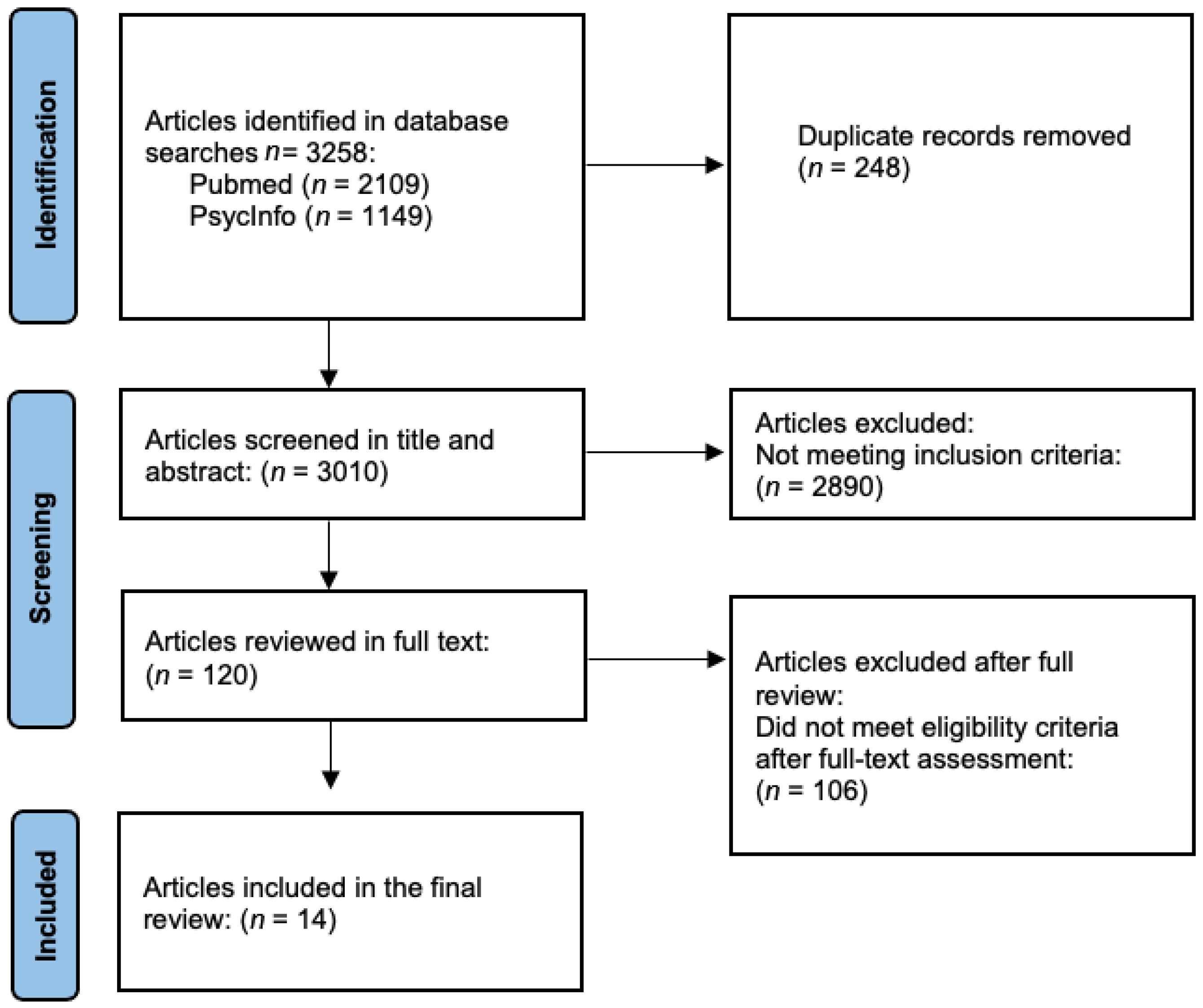
As shown in the PRISMA diagram (Figure 1), a total of 3258 records were identified through searches in PubMed (n = 2109) and PsycINFO (n = 1149). After removing 248 duplicates, 3010 records remained for title and abstract screening. Of these, 2890 were excluded for not meeting the inclusion criteria. The remaining 120 full-text articles were assessed for eligibility, resulting in the exclusion of 106 studies. Ultimately, 14 studies met the inclusion criteria and were incorporated into the final review, identifying a total of 14 psychometric instruments for assessing suicide risk in adolescents.
Figure 1.
PRISMA flow chart of the article selection process.
It should be noted that most of the studies reviewed and then excluded from the final list did not meet the inclusion criteria, as they used a single item to assess suicide risk. Many of these items came from tools that assess or detect general behavioural and/or related types of disorders such as PHQ9 (Martin et al., 2006), the Kiddie Schedule for Affective Disorders and Schizophrenia for School-Age Children (K-SADS; Kaufman et al., 1997), the Child Behaviour Checklist (CBCL; Achenbach, 1991), the Mini International Neuropsychiatric Interview for Children and Adolescents (MINI-KID; Sheehan et al., 2010), etc., and [Children’s Depression Inventory (CDI; Kovacs, 2010)]. In addition, other instruments were used to measure self-injurious thoughts and behaviours, e.g., SITBI-R (Gratch et al., 2022).
Following a criterion similar to that used in previous studies (Wigham & McConachie, 2014), these items were excluded in order to focus on measures that reflect broader conceptualisations of suicidality, which cannot be captured by a single item or subscale (e.g., severity and frequency of suicidal thoughts and behaviours, suicidal risk, etc.).
2.1.7. Methodological Quality Assessment
Properties such as reliability, internal consistency, structure, convergent validity and temporal stability (test–retest) of the selected articles were the central elements of the analysis. This distinction was key, as it directly affects the design of the search strategy and the approach to data extraction and synthesis. Consequently, the quality of the included studies was assessed using the COSMIN (Consensus-based Standards for the selection of health Measurement Instruments) specific to instrument validation studies. The methodology is designed to prioritise studies that rigorously assess these psychometric characteristics, and not only describe the use of instruments in clinical settings.
2.2. Phase 2: Focus Groups
After the first exploratory phase, which consisted of a systematic review of the scientific literature to delimit the construct of suicidal risk in adolescents and gather information on previously validated instruments, focus groups were held with two different samples: a group of mental health experts (psychologist, psychiatrist, etc.) and another group of professionals with direct experience in accompanying adolescents at risk (counsellors, teachers, etc.).
A purposive sampling method was used to select participants, who were contacted via professional and/or social networks (Facebook, Twitter, Instagram) and invited to participate. The final group consisted of 15 individuals (8 psychologists and 7 teachers), including both men and women (10 women and 5 men).
Participation was voluntary, and all contributions were treated with strict confidentiality following participants’ informed consent.
The sessions were conducted by two members of the research team trained in qualitative methodology. They were conducted in appropriate and private spaces to ensure fluid communication while respecting the confidentiality of the participants at all times. During the sessions, participants were provided with an operational definition of the adolescent suicide risk construct, were informed of the objectives of the study, and were encouraged to share their experiences, perceptions and observations of relevant risk behaviours and signs, particularly in the adolescent population. The sessions were audio-recorded and then transcribed verbatim for analysis using NotebookLM AI software.
A notebook was also used to record non-verbal aspects (expressions, gestures, postures) in order to enrich the interpretation of the discourse. (based on the Gemini 2.5 Flash model).
Analysis of Focus Group Data
The data analysis was carried out following the phases of the phenomenological approach described by Giorgi (2017): (1) data collection and description; (2) comprehensive reading of the textual corpus; (3) segmentation into meaning units; (4) transformation of the meaning units; (5) identification of the essential structure of the phenomenon; and (6) integration of its constitutive features. The meaning units were coded and grouped into subcategories and thematic categories. The data derived from each group (experts and professionals in contact with adolescents at risk) were analysed separately and subjected to a process of triangulation and consensus among researchers.
The information collected made it possible to identify observable and verbal behaviours potentially relevant for the detection of suicidal risk by third parties, information that was used as a basis for the preliminary drafting of the questionnaire items.
2.3. Phase 3: Validation of the Content of the Instrument
The content validity of the instrument was examined by a panel of experts, in accordance with the methodological standards established in the specialised literature (Polit et al., 2007, Polit & Beck, 2010). This type of validity refers to the extent to which the items accurately represent the construct to be measured. Experts were asked to assess each item based on three main criteria: clarity, coherence, and relevance. The evaluation was conducted using a Likert-type scale, following the procedure proposed by Angleitner et al. (1986).
2.3.1. Selection of the Panel of Experts
To carry out this assessment, a group of 32 professionals was selected through purposive sampling. Their participation was arranged via contacts with the Official College of Psychology and through personal and professional networks involving colleagues and specialists in mental health.
Each expert rated the items using the same three criteria—clarity, coherence and relevance—as outlined previously. Clarity was measured using a four-point ordinal scale (1 = not at all clear, 2 = somewhat clear, 3 = fairly clear, 4 = very clear), and the same scale format was used for coherence and relevance. Furthermore, an open-ended section was included for each item, allowing suggestions or reformulations where necessary, particularly for items perceived as unclear.
2.3.2. Validation Process
The evaluation was carried out using a Google Forms form, which included an introduction with a description of the general objective of the instrument, as well as clear instructions on the assessment procedure. Socio-demographic data—gender, age, professional training and work environment—were also collected in order to characterise the profile of the evaluation panel.
2.3.3. Data Analysis
The statistical analysis of the data obtained from the expert focus group included a descriptive analysis of the socio-demographic variables, as well as the calculation of the item content validity index (I-CVI) and the scale content validity index (S-CVI). The I-CVI represents the proportion of experts who consider each item as relevant or pertinent, and is considered excellent when it reaches a value above 0.78 (Polit & Beck, 2010). To assess the overall content validity of the instrument, the S-CVI was calculated by averaging the individual I-CVI values. According to methodological standards, the S-CVI is considered to reflect excellent content validity when it exceeds the threshold of 0.90.
2.3.4. Gathering Feedback
The inclusion of an open-ended question with the aim of collecting qualitative observations, comments or suggestions for improvement was not answered by the experts, no additional feedback was provided and no modifications to the content of the questionnaire were proposed.
2.3.5. Review of the Questionnaire
Once the results of the preliminary version of the questionnaire were obtained from the experts, the research team proceeded to the elaboration of the second version of the questionnaire.
2.4. Phase 4: Pilot Test
After making the relevant adjustments to the questionnaire based on the recommendations derived from the expert evaluation phase, a pilot study was carried out with a total of 61 participants: 21 adolescent students, 20 parents or legal guardians and 20 teachers. The purpose of this phase was to assess the clarity, feasibility and applicability of the instrument, as well as to detect possible comprehension difficulties and estimate the time required to complete it. Participants were selected by non-probabilistic convenience sampling. The questionnaire was administered in digital format through Google Forms, which facilitated access to different profiles of the target population and efficient data collection.
The pilot study also allowed for modifications in the language and order of some items to improve their comprehension, particularly among adolescents, who were one of the main target populations of the study.
Data Analysis
The data obtained in the pilot sample were analysed using descriptive statistics. Qualitative variables (gender, educational level, type of relationship with the person assessed) were expressed as absolute frequencies and percentages, while quantitative variables (age, time spent completing the questionnaire, item scores) were presented as mean and standard deviation (±SD).
The reliability of the questionnaire was assessed using Cronbach’s alpha coefficient to estimate its internal consistency. A value of α ≥ 0.70 was considered acceptable, while values ≥ 0.90 were deemed excellent for this exploratory phase.
Means and standard deviations were also calculated for each of the items that make up the scale, which made it possible to identify the behaviours most frequently observed among the adolescents surveyed.
All analyses were conducted using IBM SPSS Statistics software (version 26).
3. Results
3.1. Study Selection
The present review has identified and analysed 14 psychometric instruments used to assess suicidal ideation or suicide risk in the adolescent population. Through an assessment based on COSMIN standard criteria, the quality of the psychometric properties reported in each of the studies was compared. Table 2 provides an overview of the measures of reliability, internal consistency, structure, convergent validity and temporal stability (test–retest) of the selected items.
Table 2.
COSMIN-Based Evaluation of Psychometric Instruments for Suicidal Ideation in Adolescents.
Content validity, internal consistency, structural validity, convergent validity, and test–retest reliability were evaluated according to COSMIN standards when such information was available in the original studies.
Among all the instruments reviewed, the Columbia-Suicide Severity Rating Scale (C-SSRS, Posner et al., 2011) and the Suicidal Ideation Questionnaire-Junior (SIQ-Jr, Núñez et al., 2024) stand out as the most robust. Both have high internal consistency, confirmed structural validity, convergent validity with other established measures and adequate test–retest reliability. These qualities position them as reference tools in clinical and research settings, with the C-SSRS being widely regarded as the gold standard for the detection of suicidal risk.
The MSSI-SR-R (Lopez et al., 2025) and the CHRT-SR9 (Nandy et al., 2023) also demonstrated good psychometric properties, including clear factor structures and adequate Cronbach’s α values, supporting their applicability in clinical settings. However, the absence of test–retest data for these instruments partially limits the longitudinal interpretation of their results.
On the other hand, the Suicide Risk Rapid Survey (Basova et al., 2025) showed promising properties, especially in terms of sensitivity and convergent validity with other scales such as the C-SSRS (Posner et al., 2011) or the BHS (Balsamo et al., 2020), but its internal consistency is moderate (α ≈ 0.7) and no analyses of structural validity or temporal reliability are reported. This instrument could be useful as an initial screening tool, but it requires further and more extensive validations.
The Open-Source Suicidality Scale (Harris et al., 2023), although not yet widely adopted, represents a promising tool due to its accessible, free, and adaptable design. Its structural and convergent validity have been reported favourably; however, test–retest reliability has been limited, indicating that the scale is still in an early phase of validation.
Finally, the Suicidal Ideation Scale (SIS, Beck et al., 1979) is presented as a brief and functional option, particularly in community or non-clinical settings. However, its structural validity and test–retest reliability have not been sufficiently documented, which limits its recommendation for in-depth assessments.
Information on the reliability (inter-rater reliability, internal consistency and test–retest reliability) and validity (concurrent and predictive validity) of these measures was most frequently available for instruments focusing specifically on Suicidal Thoughts and Suicidality (STS) (e.g., SIS, SSI, SSI, C-SSRS), followed by items on suicidal ideation from questionnaires assessing severity of depressive symptoms (e.g., BDI, MADRS, HAM-D). No measures of reliability or validity were identified for suicide questions from diagnostic interviews (e.g., CIDI, SCID). The lowest concurrent validity measure identified was between the SIS and C-SSRS scales. Overall, mostly moderate to high correlation or concurrent validity scores (kappa range: 0.15–0.97; r-range: 0.21–0.94) were identified between the instruments (Table 2). When examining concurrent validity between self-report measures, the correlation ranged from 0.41 to 0.69, and the kappa ranged from 0.15 to 0.45, while for clinician-administered measures, the correlation ranged from 0.21 to 0.94 and the kappa ranged from 0.42 to 0.97.
3.2. Focus Groups
The results of the focus groups conducted with mental health professionals and secondary school teachers are presented below. The session lasted approximately 50 min and was moderated by two people from the research team, guaranteeing the collection of all the necessary information until thematic saturation. The information was organised into five large thematic blocks.
A. Difficulties in detecting indirect cues
Participants expressed concern about the difficulty of recognising signs of suicidal risk in adolescents, especially when such signs are unclear or overt, and even more so if the behaviours are non-verbal.
Examples from the transcripts are reflected below:
P2 (psychologist): “Many times kids don’t say “I want to die”, but they talk to you about feeling lonely, useless or tired of everything…and that sometimes goes unnoticed”.
P7 (teacher): “One pupil changed radically, before she was sociable and then…something changed…closed in on herself and quiet, sad…but nobody noticed until it was too late”.
B. The importance of the school environment as a space for detection
Both psychologists and teachers agreed on the crucial role played by the school environment in detecting risky behaviour or signs of suicidal ideation, but they also pointed out the lack of specific training and even disinterest on the part of some of their colleagues.
P3 (teacher):
“We are the ones who see the children every day. If we don’t notice them, it’s often because we’re not looking closely enough. Sometimes, we’re unsure of how to respond or which signs truly warrant our attention”.
P9 (psychologist):
“There are many students in vulnerable situations. The challenge is that we don’t always have the necessary tools to support them effectively”.
C. Need for instruments adapted to heteroassessment.
All of the participants positively valued the creation of a structured observational instrument that would make it possible to identify behaviours or warning signs in adolescents.
P5 (psychologist):
“A tool like this would help us to identify and organize what we perceive, and it often provides justification when we need to make a referral.”
P11 (teacher):
“Sometimes you sense that something isn’t right, but you need something concrete to show you—something that tells you: this is a cause for concern.”
D Difficulties and fear to intervene
Barriers related to work overload, lack of institutional support and fear of acting incorrectly in the face of a possible case of risk were identified.
P10 (teacher): “It is a taboo subject, it is not easy to deal with it…there is uncertainty…fear. If you ask the wrong questions or do the wrong thing, you think you might make the situation worse. Nobody wants to take responsibility…sometimes people think it’s better to do nothing”.
P6 (psychologist): “What if the family denies the situation? What should we do? There is a big emotional burden, especially if the school or the family does not respond”.
E. Recommendations for the design of the instrument
The participants suggested that the instrument should be brief, with clear language, with concrete examples and adaptable to different contexts (school, family, clinical).
P1 (psychologist): ‘It is important to have a scale, but it has to be understandable, easy to use, without the need to be a clinician to interpret it’.
P13 (teacher): ‘It would be useful to include good previous information so that you know what kind of relationship you have with the person in question’.
After the first two phases, a preliminary version of the instrument was prepared for content validation by the experts.
The preliminary questionnaire consisted of 19 items on suicide risk and 4 sociodemographic variables.
3.3. Content Validation
The content validity analysis was performed with the participation of the 32 expert judges. The sociodemographic characteristics of the selected experts are shown in Table 3.
Table 3.
Sociodemographic characteristics of the experts.
The results of the questionnaire validation process are presented in Table 4, where the Content Validity Index per item (I-CVI) is presented in relation to clarity, coherence and relevance. In terms of clarity, most of the items reached values above 0.78, with items 5, 9, 15, 16, 17 and 18 standing out in particular, with high levels of consensus. In relation to coherence, generally high values were also observed, with several items above 0.80, such as items 13 to 18. In terms of relevance, although most items exceeded the acceptable threshold of 0.75, some items (e.g., item 3) had lower values. The overall content validity index of the scale (S-CVI/Ave) was 0.799, indicating an acceptable level of agreement among the experts in terms of clarity, coherence and relevance of the items assessed.
Table 4.
Content validity index (I-CVI).
3.4. Pilot Test
The pilot study was carried out with a total of 61 people (21 pupils, 20 parents and 20 teachers).
Regarding the adolescent sample, the results showed a mean age of 16.38 years (SD = 2.44). With respect to gender, 52.4% were male (n = 11) and 47.6% were female (n = 10). The educational level indicated that 47.6% were in Compulsory Secondary Education (CSE), 47.6% in Baccalaureate and 4.8% in Intermediate Vocational Training. The relationship with the person evaluated was mainly friendly (47.6%), followed by fellow students (42.9%) and family (9.5%).
The average time taken to complete the questionnaire was 5.14 min, with a range of 2 to 15 min.
For the sample of parents, the mean age was 48.0 years (SD = 6.52), with 60% females (n = 12) and 40% males (n = 8). For teachers, the mean age was 44.45 years (SD = 8.78), with a majority of women (80%, n = 16) compared to 20% men (n = 4). The relationship established with the person evaluated was, in the case of parents, that of mother or father with respect to their children, while in the case of teachers, the relationship corresponded to the role of teacher with respect to their students. In both samples, the average time taken to complete the questionnaire was 4.95 min for parents (range: 1–15 min) and 5.33 min for teachers (range: 2–15 min). Regarding the internal reliability of the instrument, the scale demonstrated high internal consistency, with a Cronbach’s alpha coefficient of 0.932 in the adolescent sample, 0.899 in the parent sample, and 0.947 in the teacher sample. The overall reliability of the total sample was also high, with a Cronbach’s alpha of 0.928.
The results corresponding to the mean scores per item are presented in Table 5.
Table 5.
Descriptive answers for each item of the Observational Scale of Suicide Risk in Adolescents, Teachers and fathers.
With respect to the adolescent sample, moderately low scores were observed for most of the items assessed, on a Likert scale from 1 (never) to 5 (very much). The means ranged from 1.62 to 2.76, indicating a low frequency or intensity in the experiences or perceptions rated.
The items with the lowest mean scores were item 13 (1.62 ± 0.87) and items 3 (1.71 ± 0.90) and 18 (1.71 ± 1.10), suggesting that most adolescents selected the lowest categories (“never” or “a little”) in these cases. Similarly, items 1, 4, 5, and 6 also had means below 2.00, reinforcing the general trend towards infrequent or low intensity responses.
On the other hand, the items with the highest mean scores were item 8 (2.76 ± 1.09) and item 14 (2.76 ± 1.30), followed by item 9 (2.67 ± 1.39) and item 16 (2.67 ± 1.35). These results indicate greater variability in responses, with a considerable proportion of participants selecting intermediate or high categories on the scale.
Overall, the data reflect a heterogeneous distribution in adolescents’ perceptions, with some dispersion, as indicated by standard deviations ranging from 0.87 to 1.39.
With respect to parents, low to moderate scores were observed for most of the items assessed, on a Likert-type scale from 1 (never) to 5 (always). The means ranged from 1.68 to 3.42, indicating a generally low frequency or intensity in the experiences or perceptions rated.
The items with the lowest mean scores were items 18 (1.68 ± 0.82), items 3 (1.84 ± 1.26), items 4 (1.84 ± 1.12) and items 5 (1.84 ± 1.21), suggesting that most parents selected the lowest categories (“never” or “little”) in these cases. Similarly, item 11 also had a mean below 2.00, reinforcing the general trend towards low frequency or low intensity responses.
In contrast, the items with the highest mean scores were item 8 (3.42 ± 1.26) and item 16 (3.37 ± 1.12), followed by item 9 (3.21 ± 1.08) and item 17 (3.00 ± 1.37). These results reflect greater variability in responses, with a considerable proportion of participants selecting intermediate or high categories on the scale.
Overall, the data reflect a heterogeneous distribution in parents’ perceptions, with some dispersion, as indicated by standard deviations ranging from 0.82 to 1.51.
In the teachers’ sample, overall low to moderate scores were also recorded for the items analysed, using the same Likert scale from 1 (never) to 5 (always). The means ranged from 1.45 to 3.30.
The items with the lowest mean scores were item 18 (1.45 ± 0.69) and item 5 (1.85 ± 1.14), indicating a low perceived frequency by teachers. Likewise, items 2, 3, 4, and 6 also had means below 2.0, which points to a tendency to value these behaviours as uncommon.
In contrast, the items with the highest mean scores were item 8 (3.30 ± 1.17), item 7 (3.20 ± 1.24), and item 16 (3.10 ± 1.21), followed by item 9 (2.90 ± 1.38) and item 14 (2.85 ± 1.42) and item 19 (2.85 ± 1.35). These values show a higher perceived frequency in relation to certain emotional and behavioural indicators.
In general, the scores reflect an uneven perception in the group of teachers, with a range in the responses and standard deviations between 0.69 and 1.50.
4. Discussion
The most relevant findings of the study are discussed below:
- 1.
- Literature review:
The systematic literature review identified the most relevant tools for the detection of suicidal risk in adolescents, showing a wide heterogeneity in their psychometric quality. This variability emphasises the importance of a careful selection of measurement instruments, taking into account both the context of application as well as the specific objectives of the study or intervention.
It is important to highlight that, despite the exhaustive review, no specifically designed and validated tool was found that met the criteria for heteroassessment, i.e., to be used by observers in the detection of suicidal risk in adolescents. The instruments identified were mainly aimed at self-reporting by adolescents or direct clinical assessment by a professional specialist. This absence undoubtedly indicates a significant gap in the literature, as the external perspective of key observers such as parents, teachers, or classmates could offer valuable complementary information for early and effective detection of suicidal risk. The ability of an observer to identify subtle changes in behaviour or mood could be a differentiating factor in settings where self-assessment is not possible or unreliable.
In summary, the current results, relative to this first phase of the study, identify the need for future research to incorporate more rigorous methodological designs, including, among other criteria, analyses of temporal stability, sensitivity to change and cultural adaptation for existing instruments. However, beyond the improvement of current tools, this review emphasises the importance of developing and validating a specific instrument for observers in order to allow a more comprehensive approach to the detection of suicidal risk in adolescents, taking advantage of multiple perspectives for a more accurate and appropriate identification.
- 2.
- Focus groups:
The results of the focus groups identified further barriers in the early detection of suicidal risk in adolescents and an undeniable need for heteroassessment tools.
The main difficulty reported by the participants was the complexity related to the identification of non-verbal signs of suicidal risk. This difficulty implies that most subtle behavioural changes in adolescents often go unnoticed. This finding is congruent with other studies (Suherman et al., 2018; Jaramillo et al., 2024), indicating that non-verbal signs, such as cognitive, attitudinal/affective, physiological, behavioural and social changes, can often go unnoticed, complicating the identification of suicidal risks in adolescents.
In line with other research (Erbacher & Singer, 2018; Petersen, 2019; Jaramillo et al., 2024), another noteworthy finding was that, despite the school setting being configured as an ideal context for screening, due to daily interactions with adolescents, this opportunity is hindered by insufficient specialised training and a lack of adequate resources for educators. This could suggest a significant gap between the potential of the school setting and the actual capacity of its professionals to identify red flags (Singer et al., 2019). Despite the different barriers perceived by different professionals, there seems to be a unanimous demand for a reliable, valid, understandable and usable observational instrument for non-clinicians that is easy to apply. This would not only help them to validate their perceptions but also justify their concerns to third parties by facilitating the necessary referrals.
However, as evidenced in other studies, factors such as work overload, uncertainty of getting it right and, in some cases, lack of institutional support limit the ability to identify warning signs in adolescents (Cooper & Travers, 2016; Lagawid, 2024; Pandey & Sayed, 2024).
- 3.
- Content analysis by experts:
The composition of the panel of experts, with a high average of professional experience and a predominance of profiles from the psychological field, provided solidity to the content validation process. Most of the items presented adequate levels of clarity, coherence and relevance, indicating a good fit of the questionnaire with the construct assessed.
The high level of consensus reached on most of the items of the questionnaire is noteworthy, which could indicate a good conceptual concreteness of the construct to be assessed.
The overall content validity index (S-CVI = 0.799) is at an acceptable level, which indicates a good structural basis for the instrument. However, it must be considered that this is the preliminary phase of the development of the scale, which is why the opportunity to optimise certain items in order to reinforce its validity in future applications should also be highlighted.
- 4.
- Pilot study:
Cronbach’s alpha indicated high levels of reliability for the samples, reaching in the case of adolescents and teachers, an excellent level according to methodological standards for pilot studies (α > 0.90). For a pilot study, achieving such high reliability is particularly promising, as it indicates that the internal structure of the questionnaire is robust even at this early stage, laying a solid foundation for future validations and applications in other contexts.
The completion time, which ranged from 2 to 15 min, indicates an adequate applicability of the questionnaire, as well as a good level of understanding by the participants. This time range might indicate that the instrument is sufficiently concise and clear to be completed efficiently and in a short period of time, which is essential for its implementation in various settings, especially in educational settings, as already reflected in the focus groups; time is sometimes scarce due to work overload. The results of the pilot phase with regard to the mean responses to the questionnaire items reveal a general trend towards moderately low scores on the Observational Scale of Suicide Risk in Adolescents. It is crucial to remember that this questionnaire was designed for observers, which implies that low scores suggest that these observers may not frequently identify the experiences or situations assessed. This initial interpretation is critical to contextualise the level of response observed.
A striking feature in the analysis of the responses is the heterogeneity and dispersion in certain items, such as item 9 or 14, where the standard deviation was considerably wide. The amplitude of the standard deviation in these cases suggests the presence of variability among observers or the existence of subgroups with different identification capacities within the sample. This dispersion could indicate the coexistence of observers who do identify or recognise the experiences assessed, versus those who do not, which may need further exploration through cluster analysis or segmentation by socio-demographic variables in future research.
Scores below 2.0 were considered to indicate a low frequency of observation. This threshold was established following a conservative criterion with respect to the midpoint of the scale (3), seeking to robustly identify those situations with a clear tendency towards non-identification by observers. The presence of items below this threshold reinforces the idea of a low prevalence of identification of the situations assessed by observers in the sample. Overall, however, the results suggest that the instrument can discriminate between different levels of perceived risk, capturing both clear behavioural signs and more subtle emotional signals. These findings confirm its preliminary usefulness for screening suicidal risk in the adolescent population from a third-person perspective.
Although all three groups agreed in identifying item 8 (mood swings) as particularly relevant, there were notable differences in the perception of other signs, which may reflect the type of indicators to which each group is more exposed or sensitised, depending on their role and relational context with the adolescents. For example, adolescents themselves gave the highest scores to items 14 (emotional blunting), 8 (mood swings) and 12 (use of alcohol, tobacco, or drugs), highlighting symptoms related to internal emotional experiences or maladaptive coping strategies. Parents, on the other hand, most frequently reported items 8, 16 (sleep disturbances) and 9, suggesting a greater focus on symptoms observable in the home environment. Teachers, on the other hand, coincided in scoring items 8, 16 and 7 (social isolation) higher, which could be related to their regular contact with externalised behaviours in the school context.
As for the least perceived indicators, adolescents scored item 13 (bidding farewell behaviour) lowest, while both parents and teachers assigned the lowest scores to item 18 (seeking methods to commit suicide), possibly due to the lower visibility of this type of behaviour in both the family and school environments.
These results may reflect the complexity of suicidal risk, which, according to Berardelli et al. (2024), should be understood as the result of multiple interrelated factors, including personality dimensions, psychosocial variables and demographic characteristics. These factors may manifest themselves in different ways depending on the context, the particularities of the individual and the perception of the observer.
It is important to note that the present research corresponds to a pilot study, the main objective of which was to evaluate the comprehensibility of the items, the time taken to complete the questionnaire and to gather suggestions for future adaptations of the questionnaire. Given the nature of the sample and its small size, the response frequencies observed should not be considered generalisable to a wider population of observers or adolescents. In fact, the low scores assigned to some of the items of the questionnaire could reflect a difficulty in the accurate identification of risk behaviours and/or conduct.
Despite the encouraging results, several important limitations of this study must be acknowledged, particularly given the preliminary nature of the validation and the clinical and ethical relevance of suicide prevention research.
First, this study is based on a small pilot sample recruited through non-probabilistic convenience sampling. As a result, the sample is not representative of the broader adolescent population or of all potential observers, which limits the generalizability of the findings. Accordingly, the observed frequencies and mean scores of the items should not be interpreted as indicators of prevalence or population-level suicide risk, but rather as exploratory data obtained during the initial testing phase of the instrument.
Second, the present manuscript reports only the first phase of the scale development process, focused on item generation, content validation, and preliminary application. At this stage, a comprehensive psychometric evaluation has not yet been completed. Future studies are required to examine the internal structure of the scale through exploratory and confirmatory factor analyses, as well as to assess temporal stability, concurrent validity with established suicide risk measures, and predictive validity. These steps are essential before any scoring algorithms or cut-off points can be meaningfully established.
Third, although focus groups with mental health professionals and educators provided a valuable qualitative foundation for item development, the information obtained remains subjective and context-dependent. The perspectives included may not fully capture the diversity of lived experiences, institutional settings, or cultural contexts in which suicidal distress manifests in adolescents. Notably, adolescents with lived experience of suicidality and their caregivers were not directly involved in the item development process, which may have limited the inclusion of certain experiential or relational dimensions of suicidal risk. Their systematic inclusion through participatory or co-design approaches is a key objective for future research phases.
Fourth, observational tools are inherently vulnerable to observer bias. Differences in emotional proximity, professional role, training, personal beliefs, and familiarity with the adolescent may influence how behaviours are perceived and reported by parents, teachers, or peers. Such variability may contribute to inconsistencies in item ratings and should be carefully considered when interpreting the results.
Finally, observational screening instruments applied in real-world contexts with low base rates of suicidal behaviour are exposed to the risk of false positives and false negatives. The presence of a specific observable cue does not imply elevated suicide risk in isolation, nor should individual items be interpreted deterministically. For this reason, the scale is not intended as a diagnostic or predictive tool, but as a supportive instrument designed to prompt empathetic dialogue, encourage disclosure, and facilitate timely referral to appropriate professional support when concerns arise.
This perspective aligns with recent approaches that advocate moving beyond prediction models to centre the lived difficulties and contextual experiences of individuals in suicidal distress.
5. Conclusions
The present research represents a significant step in response to the priority need for heteroassessment tools to support the early identification of suicidal distress in adolescents, an area that remains critically underexplored in the scientific literature. By providing a structured and accessible resource for observers, the proposed tool aims to facilitate early supportive interactions, improve communication, and promote timely connection with appropriate sources of help in educational and social contexts. Rather than functioning as a diagnostic or surveillance instrument, this resource is intended to support third parties in recognising concerning changes and opening spaces for dialogue, thereby strengthening coordination between educational, family, and support teams and fostering safer and healthier school and community environments for adolescents.
The findings of this research may contribute to the design and strengthening of public policies on adolescent mental health and suicide prevention, a field that continues to be marked by stigma and social taboo. In this context, the scale may inform the development of evidence-based prevention programmes in schools, contribute to the sensitisation and training of professionals who interact daily with young people, and promote collaborative, relationship-centred strategies between school, family, and health services aimed at supporting the comprehensive wellbeing of adolescents.
Author Contributions
Conceptualization, E.G., and A.B.; methodology, J.L.P.-F.; validation, A.B. and J.L.P.-F., E.M.C.-C., and A.C.-B.; formal analysis, J.L.P.-F., and I.L.-D.; investigation, E.M.C.-C., A.C.-B., and E.G.; writing—original draft preparation, A.B., and J.L.P.-F.; writing—review and editing, A.B., and J.L.P.-F.; supervision, A.B., and J.L.P.-F. All authors have read and agreed to the published version of the manuscript.
Funding
This research received no external funding.
Institutional Review Board Statement
The study was conducted in accordance with the Declaration of Helsinki of 2013 and the Spanish Organic Law 3/2018, 5 December, on the Protection of Personal Data and Guarantee of Digital Rights in Spain. The present study did not involve clinical interventions, drug trials, or the collection of sensitive personal data, and all data were anonymized prior to analysis. In accordance with Royal Decree 1090/2015, which regulates clinical trials and Research Ethics Committees for Medicinal Products (CEIm), and Law 14/2007 on Biomedical Research, only research involving clinical interventions or the use of medical devices is required to undergo ethics committee review. Furthermore, the Regulation (EU) 2016/679 (GDPR) and Organic Law 3/2018 (LOPDGDD) establish that anonymized data are exempt from these regulations. Therefore, considering that this study posed no significant risks to participants and adhered to fundamental ethical principles, it was determined that formal review by an ethics committee was not required. The Centro Universitario Salus Infirmorum de Cádiz has approved the waiver of the Institutional Review Board Statement for this research.
Informed Consent Statement
Informed consent was obtained from all subjects involved in the study.
Data Availability Statement
The data presented in this study are available on request from the corresponding author. The data are not publicly available due to privacy.
Acknowledgments
We deeply appreciate all participants and experts for their invaluable contributions to this study.
Conflicts of Interest
The authors declare no conflicts of interest.
References
- Achenbach, T. M. (1991). Manual for the child behavior checklist/4–18 and 1991 profile. University of Vermont, Department of Psychiatry. [Google Scholar]
- Adler, A., Bush, A., Barg, F. K., Weissinger, G., Beck, A. T., & Brown, G. K. (2016). A Mixed Methods Approach to Identify Cognitive Warning Signs for Suicide Attempts. Archives of Suicide Research, 20(4), 528–538. [Google Scholar] [CrossRef] [Scilit]
- Aguinaldo, L. D., Sullivant, S., Lanzillo, E. C., Ross, A., He, J. P., Bradley-Ewing, A., & Wharff, E. A. (2021). Validation of the ask suicide-screening questions (ASQ) with youth in outpatient specialty and primary care clinics. General Hospital Psychiatry, 68, 52–58. [Google Scholar] [CrossRef] [Scilit]
- Angleitner, A., John, O. P., & Löhr, F. J. (1986). It’s what you ask and how you ask it: An itemmetric analysis of personality questionnaires. In Personality assessment via questionnaires: Current issues in theory and measurement (pp. 61–108). Springer. [Google Scholar] [CrossRef] [Scilit]
- Balsamo, M., Carlucci, L., Innamorati, M., Lester, D., & Pompili, M. (2020). Further insights into the beck hopelessness scale (BHS): Unidimensionality among psychiatric inpatients. Frontiers in Psychiatry, 11, 727. [Google Scholar] [CrossRef] [Scilit] [PubMed]
- Basova, A. Y., Polskaya, N. A., Bezmenov, P. V., & Razvaliaeva, A. Y. (2025). Adolescent suicide risk assessment using the Suicide Risk Rapid Survey. Zhurnal Nevrologii i Psikhiatrii Imeni SS Korsakova, 125(3), 86–93. [Google Scholar] [CrossRef] [Scilit] [PubMed]
- Baston, R. (2024). Beyond prediction: A new paradigm for understanding suicide risk. Synthese, 204(1), 35. [Google Scholar] [CrossRef] [Scilit]
- Beck, A. T., Kovacs, M., & Weissman, A. (1979). Assessment of suicidal intention: The Scale for Suicide Ideation. Journal of Consulting and Clinical Psychology, 47(2), 343–352. [Google Scholar] [CrossRef] [PubMed]
- Berardelli, I., Rogante, E., Lamis, D. A., & Pompili, M. (2024). Suicide and psychiatric disorders. In Suicide across cultures: Understanding the variation and complexity of the suicidal process across ethnicities and cultures (pp. 365–404). Oxford University Press. [Google Scholar] [CrossRef] [Scilit]
- Canetto, S. S., & Sakinofsky, I. (1998). The gender paradox in suicide. Suicide and Life-Threatening Behavior, 28(1), 1–23. [Google Scholar] [CrossRef] [Scilit]
- Carey, M., Keogh, B., & Doyle, L. (2024). Why are we not asking about suicidal mental imagery? International Journal of Mental Health Nursing, 33(6), 1609–1614. [Google Scholar] [CrossRef] [Scilit]
- Cooper, C. L., & Travers, C. (2016). Teachers under pressure: Stress in the teaching profession. Routledge. Available online: https://www.taylorfrancis.com/books/mono/10.4324/9780203059975/teachers-pressure-cary-cooper-cary-cooper-cheryl-travers (accessed on 1 July 2025).
- Erbacher, T. A., & Singer, J. B. (2018). Suicide risk monitoring: The missing piece in suicide risk assessment. Contemporary School Psychology, 22(2), 186–194. [Google Scholar] [CrossRef] [Scilit]
- Erford, B. T., Jackson, J., Bardhoshi, G., Duncan, K., & Atalay, Z. (2018). Selecting suicide ideation assessment instruments: A meta-analytic review. Measurement and Evaluation in Counseling and Development, 51(1), 42–59. [Google Scholar] [CrossRef] [Scilit]
- Flamarique, I., Santosh, P., Zuddas, A., Arango, C., Purper-Ouakil, D., Hoekstra, P. J., Coghill, D., Schulze, U., Dittmann, R. W., Buitelaar, J. K., Lievesley, K., Frongia, R., Llorente, C., Méndez, I., Sala, R., Fiori, F., Castro-Fornieles, J., & STOP Consortium. (2016). Development and psychometric properties of the Suicidality: Treatment Occurring in Paediatrics (STOP) Suicidality Assessment Scale (STOP-SAS) in children and adolescents. BMC Pediatrics, 16(1), 213. [Google Scholar] [CrossRef] [Scilit] [PubMed]
- Fremouw, W. J., Strunk, J. M., Tyner, E. A., & Musick, R. (2006). Adolescent suicide assessment protocol-20. Innovations in clinical practice. Professional Resource Exchange. Available online: https://preventsuicidewv.com/wp-content/uploads/2021/04/ADOLESCENT-SUICIDE-ASSESSMENT-PROTOCOL.pdf (accessed on 7 July 2025).
- Giorgi, A. (2017). A response to the attempted critique of the scientific phenomenological method. Journal of Phenomenological Psychology, 48(1), 83–144. [Google Scholar] [CrossRef] [Scilit]
- Gratch, I., Fernandes, S. N., Bell, K. A., Pollak, O. H., Fox, K. R., Tezanos, K., Ebo, T., & Cha, C. B. (2022). Self-injurious thoughts and behaviors interview–revised (SITBI-R): Reliability, validity, and inter-informant agreement in an adolescent sample. Journal of Clinical Child & Adolescent Psychology, 51(4), 484–494. [Google Scholar] [CrossRef] [Scilit]
- Harris, K. M., Wang, L., Mu, G. M., Lu, Y., So, C., Zhang, W., Ma, J., Liu, K., Wang, W., Zhang, M. W.-B., & Ho, R. C. (2023). Measuring the suicidal mind: The ‘open source’ Suicidality Scale, for adolescents and adults. PLoS ONE, 18(2), e0282009. [Google Scholar] [CrossRef] [Scilit]
- Jaramillo, N. S., Maldonado, C. E. S., & Villavicencio-Aguilar, C. E. (2024). Identificación temprana de las señales de alerta del riesgo suicida en adolescentes. Fides et Ratio, 27(27), 95–113. [Google Scholar] [CrossRef] [Scilit]
- Kaufman, J., Birmaher, B., Brent, D., Rao, U., Flynn, C., Moreci, P., Williamson, D., & Ryan, N. (1997). Schedule for Affective Disorders and Schizophrenia for School-Age Children–Present and Lifetime Version (K-SADS-PL): Initial reliability and validity data. Journal of the American Academy of Child & Adolescent Psychiatry, 36(7), 980–988. [Google Scholar] [CrossRef] [Scilit]
- Kovacs, M. (2010). Children’s depression inventory (CDI) manual. Multi-Health Systems. [Google Scholar]
- Lagawid, E. L. (2024). Overloading in elementary school teachers: A review. Cognizance Journal, 4(11), 289–299. [Google Scholar] [CrossRef] [Scilit]
- Larzelere, R. E., Smith, G. L., Batenhorst, L. M., & Kelly, D. B. (1996). Predictive validity of the Suicide Probability Scale among adolescents in group home treatment. Journal of the American Academy of Child & Adolescent Psychiatry, 35(2), 166–172. [Google Scholar] [CrossRef] [Scilit]
- Lopez, R., Jr., Esposito-Smythers, C., Lee, P., Leichtweis, R. N., & Miller, I. W. (2025). Psychometric properties of the modified scale for suicidal ideation-self-report–revised with high-risk adolescents. Behavior Therapy, 56(2), 409–421. [Google Scholar] [CrossRef] [Scilit]
- Martin, A., Rief, W., Klaiberg, A., & Braehler, E. (2006). Validity of the brief patient health questionnaire mood scale (PHQ-9) in the general population. General Hospital Psychiatry, 28(1), 71–77. [Google Scholar] [CrossRef] [Scilit]
- Mascret, R., Le Galudec, M., Stephan, F., Bleton, L., & Walter, M. (2011). Detecting the alarm signs of the suicidal crisis. La Revue du Praticien, 61(2), 189–190. [Google Scholar]
- Na, P. J., Yaramala, S. R., Kim, J. A., Kim, H., Goes, F. S., Zandi, P. P., Vande Voort, J. L., Sutor, B., Croarkin, P., & Bobo, W. V. (2018). The PHQ-9 item 9 based screening for suicide risk: A validation study of the patient health questionnaire (PHQ)-9 item 9 with the Columbia suicide severity rating scale (C-SSRS). Journal of Affective Disorders, 232, 34–40. [Google Scholar] [CrossRef] [Scilit] [PubMed]
- Nandy, K., Rush, A. J., Slater, H., Mayes, T. L., Minhajuddin, A., Jha, M., Blader, J. C., Brown, R., Emslie, G., Fuselier, M. N., Garza, C., Gushanas, K., Kennard, B., Storch, E. A., Wakefield, S. M., & Trivedi, M. H. (2023). Psychometric evaluation of the 9-item Concise Health Risk Tracking-Self-Report (CHRT-SR9) (a measure of suicidal risk) in adolescent psychiatric outpatients in the Texas Youth Depression and Suicide Research Network (TX-YDSRN). Journal of Affective Disorders, 329, 548–556. [Google Scholar] [CrossRef] [Scilit]
- Núñez, D., Villacura-Herrera, C., Gaete, J., Meza, D., Andaur, J., & Robinson, J. (2024). Psychometric assessment of the suicidal ideation Questionnaire Junior: A two-study validation in spanish-speaking adolescents. Current Psychology, 43(16), 14411–14424. [Google Scholar] [CrossRef] [Scilit]
- O’Connor, M., Dooley, B., & Fitzgerald, A. (2015). Constructing the Suicide Risk Index (SRI): Does it work in predicting suicidal behavior in young adults mediated by proximal factors? Archives of Suicide Research, 19(1), 1–16. [Google Scholar] [CrossRef] [Scilit] [PubMed]
- Osman, A., Gutierrez, P. M., Kopper, B. A., Barrios, F. X., & Chiros, C. E. (1998). The Positive and Negative Suicide Ideation (PANSI) Inventory: Development and validation. Psychological Reports, 82(3), 783–793. [Google Scholar] [CrossRef]
- Page, M. J., McKenzie, J. E., Bossuyt, P. M., Boutron, I., Hoffmann, T. C., Mulrow, C. D., Shamseer, L., Tetzlaff, J. M., Akl, E. A., Brennan, S. E., Chou, R., Glanville, J., Grimshaw, J. M., Hróbjartsson, A., Lalu, M. M., Li, T., Loder, E. W., Mayo-Wilson, E., McDonald, S., … Moher, D. (2021). The PRISMA 2020 statement: An updated guideline for reporting systematic reviews. BMJ, 372, n71. [Google Scholar] [CrossRef] [Scilit]
- Pandey, S., & Sayed, S. (2024). Burnout among school teachers in India: A review of the literature. Shodh Sari, 3(4), 308–320. [Google Scholar] [CrossRef] [Scilit]
- Petersen, P. M. (2019). Suicide prevention in schools. Intuition: The BYU Undergraduate Journal of Psychology, 14(1), 10. [Google Scholar]
- Polit, D. F., & Beck, C. T. (2010). Essentials of nursing research: Appraising evidence for nursing practice. Lippincott Williams & Wilkins. Available online: https://books.google.com.mx/books?hl=es&lr=&id=7GtP8VCw4BYC&oi=fnd&pg=PA219&dq=Polit,+D.F.;+Beck,+C.T.+Essentials+of+Nursing+Research:+Appraising+Evidence+for+Nursing+Practice,+8th+ed.;+Wolters+Kluwer+Health/Lippincott+Williams+&+Wilkins:+Philadelphia,+PA,+USA,+2014.&ots#v=onepage&q&f=false (accessed on 1 July 2025).
- Polit, D. F., Beck, C. T., & Owen, S. V. (2007). Is the CVI an acceptable indicator of content validity? Appraisal and recommendations. Research in Nursing & Health, 30(4), 459–467. [Google Scholar] [CrossRef] [Scilit]
- Posner, K., Brown, G. K., Stanley, B., Brent, D. A., Yershova, K. V., Oquendo, M. A., Currier, G. W., Melvin, G. A., Greenhill, L., Shen, S., & Mann, J. J. (2011). The Columbia-suicide severity rating scale: Initial validity and internal consistency findings from three multisite studies with adolescents and adults. American Journal of Psychiatry, 168(12), 1266–1277. [Google Scholar] [CrossRef] [Scilit] [PubMed]
- Ramos-Vera, C., Quispe Callo, G., Basauri Delgado, M., Vallejos Saldarriaga, J., & Saintila, J. (2023). Factorial and network structure of the Reynolds Adolescent Depression Scale (RADS-2) in Peruvian adolescents. PLoS ONE, 18(5), e0286081. [Google Scholar] [CrossRef] [Scilit] [PubMed]
- Ronningstam, E., Schechter, M., Herbstman, B., & Goldbalatt, M. (2024). Chronic suicidal ideations: A risk or a protection. Research in Psychotherapy: Psychopathology, Process, and Outcome, 27(3), 764. [Google Scholar] [CrossRef] [Scilit] [PubMed]
- Sheehan, D. V., Sheehan, K. H., Shytle, R. D., Janavs, J., Bannon, Y., Rogers, J. E., Milo, K. M., Stock, S. L., & Wilkinson, B. (2010). Reliability and validity of the Mini International Neuropsychiatric Interview for Children and Adolescents (MINI-KID). Journal of Clinical Psychiatry, 71(3), 313–326. [Google Scholar] [CrossRef] [Scilit]
- Singer, J. B., Erbacher, T. A., & Rosen, P. (2019). School-based suicide prevention: A framework for evidence-based practice. School Mental Health, 11(1), 54–71. [Google Scholar] [CrossRef] [Scilit]
- Suherman, S., Malini, H., & Renidayati, R. (2018). Identification early warning signs of suicidal behavior among adolescents. Elevate, 1(2), 145–150. [Google Scholar]
- Thompson, R., Henkel, V., & Coyne, J. C. (2004). Suicidal ideation in primary care: Ask a vague question, get a confusing answer. Psychosomatic Medicine, 66(3), 455–456. [Google Scholar] [CrossRef] [Scilit]
- Tsai, M., & Klonsky, E. D. (2023). Warning signs for suicide attempts in psychiatric inpatients: Patient and informant perspectives. General Hospital Psychiatry, 85, 207–212. [Google Scholar] [CrossRef] [Scilit]
- Wigham, S., & McConachie, H. (2014). Systematic review of the properties of tools used to measure outcomes in anxiety intervention studies for children with autism spectrum disorders. Clinical Psychology Review, 34(8), 795–817. [Google Scholar] [CrossRef] [Scilit]
- World Health Organization. (2025, March 25). Suicidio. Available online: https://www.who.int/es/news-room/fact-sheets/detail/suicide (accessed on 1 July 2025).

Disclaimer/Publisher’s Note: The statements, opinions and data contained in all publications are solely those of the individual author(s) and contributor(s) and not of MDPI and/or the editor(s). MDPI and/or the editor(s) disclaim responsibility for any injury to people or property resulting from any ideas, methods, instructions or products referred to in the content. |
© 2026 by the authors. Licensee MDPI, Basel, Switzerland. This article is an open access article distributed under the terms and conditions of the Creative Commons Attribution (CC BY) license.