


Abstract
This conceptual paper examines how dominant frameworks of college access and equity in U.S. higher education marginalize undocumented and international students by anchoring inclusion to citizenship, legal eligibility, and institutional risk management. In the context of intensified anti-DEI and anti-immigrant politics, legally precarious students face overlapping yet distinct legal, financial, emotional, and symbolic forms of exclusion that conventional access and equity models do not fully capture. Institutional retreat, anticipatory obedience, and the re-coding of equity work can further make supports for these students harder to locate, defend, and sustain. Synthesizing scholarship on college access, undocumented and international student experiences, critical citizenship studies, legal status stratification, border theory, anticipatory obedience, and coalitional politics, the paper argues for moving “beyond legality” as the organizing framework of access. It advances a conceptual model of College Access Beyond Legality centered on four interlocking structures: emotional safety and trust, informal resource networks, campus and community organizing, and identity-based and status-conscious advocacy. The model conceptualizes cross-status coalition-building among students, institutional stakeholders, faculty, and community partners as both a survival strategy and a practice of institutional accountability. It also emphasizes that access beyond legality must begin before matriculation and extend through persistence, belonging, and post-graduation transitions. The model aims to reduce harm, strengthen belonging, expand access to material supports, support persistence, and deepen institutional accountability. The paper concludes with implications for institutional policy, equity practice, basic-needs and community-connection infrastructures, and future research aimed at expanding access for marginalized students in legally and politically hostile contexts.
1. Introduction
This paper examines how rising anti-DEI (diversity, equity, and inclusion) and anti-immigrant politics shape institutional access and equity experiences of undocumented and international students in US higher education. National socio-political shifts influence institutional policy, practice, and campus climates (American Council on Education, 2026), with consequences that impact recruitment, financial aid, student support, and post-graduation pathways (Morales Hernandez & Enriquez, 2021; Shie et al., 2026). Recent federal actions and political rhetoric have intensified precariousness for non-citizen students, producing legal, financial, and affective barriers that traditional equity frameworks fail to capture.
Since January 2025, federal enforcement priorities and immigration directives have increased removals and detentions of non-citizens, including some individuals with previously protected statuses (Lind, 2025; Ramos, 2025; Refugees International, 2025). Policy shifts have included expanded vetting for student visas, increased fees for H-1B filings, and other administrative changes (U.S. Department of State, 2025, 2026), widespread SEVIS record cancellations that disrupted thousands of students (Alonso, 2025), and legal challenges to in-state tuition policies for undocumented students that forced reversals in some jurisdictions (Modan, 2025). Concurrently, executive actions and Department of Justice (DOJ) memos targeting DEI initiatives have recast campus equity work as legally and politically risky, constraining institutional capacity to respond to marginalized students’ needs (The White House, 2025). Together, these developments have compounded the marginalization of international and undocumented students, two groups that are often treated separately in policy and institutional discourse, but whose exclusion is reinforced by overlapping legal and institutional logics.
Traditional conceptions of access and equity in U.S. higher education emphasize citizenship-centered criteria: federal financial aid eligibility, in-state tuition rules, admissions metrics, and employment authorization. These criteria systematically render non-citizen students invisible or ineligible (Buckner et al., 2021; Hernandez-Reyes et al., 2023). Empirical studies of policy impacts show how “universal” access initiatives can become hollow promises when eligibility rules exclude undocumented learners (Monaghan & Michaels, 2025) or when institutional internationalization appears to prioritize revenue and recruitment over legal vulnerability and student support (Yao & Viggiano, 2019). The result is a persistent gap between equity promises and the lived realities of students whose legal status challenges access to resources, protections, and belonging.
I argue that current college access frameworks remain insufficient because they continue to organize inclusion around legality. To move “beyond legality” is to recognize legal status as a central source of inequality while refusing to let legal eligibility define the limits of institutional responsibility. This is not a call for status-blindness. Rather, it calls for status-conscious and privacy-protective practices that recognize how undocumented and international students are differently positioned, while also naming the institutional factors that make both groups vulnerable. In the contemporary anti-DEI and anti-immigrant era, these positions have converged through intensified surveillance, restricted access to resources, and heightened uncertainty, even as students’ legal pathways, risks, and institutional responses remain distinct.
I propose a conceptual model grounded in emotional safety and trust, informal resource networks, campus and community organizing, and identity-based and status-conscious advocacy. The model understands coalition-building as both a survival strategy and a way to reimagine equitable access under anti-DEI and anti-immigrant pressure. It is designed to work across the college pathway, beginning before matriculation, when many undocumented students and, more recently, international students first encounter heightened legal exclusion through college search, financial aid, and enrollment decisions, and extending through persistence, belonging, and post-graduation transitions.
Three guiding questions inform this work: (1) How do dominant frameworks of college access and equity in the U.S. exclude or erase international and undocumented students? (2) How can coalition-building across immigration status help reimagine access in more inclusive and politically expansive ways? (3) What does equity look like in institutional contexts where formal DEI protections have been narrowed or re-coded as legally risky? To address these questions, I synthesize three bodies of literature: (a) scholarship on college access and equity that highlights citizenship-centered assumptions; (b) studies of undocumented and international students documenting legal surveillance, financial exclusion, and symbolic marginalization; and (c) theoretical frameworks, including critical citizenship studies, border theory, precarity/legal violence scholarship, and coalitional politics, that support a cross-status, justice-oriented rethinking of access.
Following this review of literature, I present a conceptual model of “access beyond legality” and outline implications for institutional policy, equity practice, and future empirical research on strategies that expand access for legally precarious students. By refocusing access debates on relationships, informal support ecosystems, and collective strategies of resistance, this paper seeks to offer institutional and community pathways for sustaining inclusion when legal protections and DEI infrastructures are under attack.
2. Reflexivity and Commitment: Locating the Scholar in an Anti-DEI and Anti-Immigrant Era
I write from the standpoint of a first-generation American and daughter of immigrants from Haiti. My intersecting ethnic, racial, and national identities inform my attention to how legal status, race, and global hierarchies shape students’ opportunities and experiences. This dual identity situates me as both an insider to immigrant-rooted communities and a critic of structural inequalities, and it motivates my scholarly focus on how higher education policies and institutional practices reproduce or contest exclusion. In an era when DEI and advocacy infrastructures and protections are under political attack, my lived orientation makes the stakes of this conceptual work particularly urgent. From my perspective, institutional policies must account not only for formal legal constraints but for the informal, affective, and collective practices that sustain belonging.
Methodologically and ethically, I approach this conceptual analysis from a constructivist and reflexive stance. Although this paper reports no new human subject data, its arguments are informed by ongoing collaborations with students, community partners, and practitioners, and by my pedagogical practice of co-constructed learning and critical reflexivity. Reflexivity here operates as both analytic method and ethical practice: I foreground how my positional location guides source selection, theoretical commitments, and the values and political aims of the paper. Practically, this yields a dual commitment to rigorous, evidence-informed conceptual work and to producing ideas that are usable by campus stakeholders seeking to sustain access, equity, and solidarity for legally precarious students. My goal is to advance frameworks that support institutional and community strategies for collective care, resource-sharing, and coalition-building to protect marginalized students’ access and wellbeing when formal protections erode. I also emphasize centering student voice and community knowledge in conceptual development, recognizing the moral costs of inaction, and attending to legal and ethical implications when translating theory into institutional practice.
3. Review of Literature
Centering international and undocumented students, this review examines the structural exclusions these student populations face in the current legal landscape and the cross-status coalitions that might reimagine access and equity beyond traditional DEI frameworks. It synthesizes three interrelated bodies of scholarship that ground the conceptual model developed below. First, it reviews college access and equity scholarship, with attention to traditional definitions of access and the limits of equity discourse for non-citizen students. Second, it examines research on undocumented and international students that documents legal surveillance, financial exclusion, symbolic marginalization, and invisibility within DEI frameworks. Third, it brings these conversations into dialogue with theoretical lenses, including critical citizenship studies, legal-status stratification and legal violence, border theory, and coalitional politics. For the purposes of this paper, undocumented students are individuals who reside in the United States without permanent lawful immigration status, including many who entered the country as children and may have received Deferred Action for Childhood Arrivals (DACA) or other forms of temporary relief from removal (Gonzales, 2011; Gonzales et al., 2015). International students are individuals who pursue postsecondary education in the United States under temporary nonimmigrant visa classifications (commonly F-1 student or J-1 exchange visitor visas; U.S. Department of State, n.d.), whose educational participation is shaped by federal immigration regulations, institutional sponsorship requirements, and visa-related policies that influence access to U.S. higher education (Chen et al., 2023). Although these groups occupy distinct legal categories, this study examines them, along with other legally precarious students such as those from mixed-status families, because all experience educational access through immigration-related legal precarity, albeit in different ways.
3.1. College Access, Equity, and the Citizenship Boundaries in Higher Education
This section examines how dominant frameworks of college access and equity are organized around citizenship and legal eligibility, and how that organization creates blind spots for non-citizen students. I first summarize foundational theories and models of college access to show the assumptions that have guided scholarship and policy. I then review empirical evidence and policy analyses that show how those assumptions translate into structural exclusion through financial eligibility rules, admissions practices, and state variation in residency policies. I conclude by considering how institutional responses mediate these effects at the campus level. This section explains why a citizenship-centered access framework is insufficient for understanding the full scope of experiences of undocumented and international students.
3.1.1. Understanding Traditional College Access
Foundational models of college access and choice often describe access as a sequence through which students develop aspirations, prepare academically, gather information, assess affordability, apply, enroll, and persist (Cabrera & La Nasa, 2000; Hossler & Gallagher, 1987; Perna, 2006). These models emphasized academic preparation, financial resources, family and school contexts, institutional fit, and policy environments, but they often assumed that students possessed the legal eligibility needed to convert aspiration into enrollment. Classic frameworks, including Hossler and Gallagher’s (1987) three-phase model, McDonough’s (1997) analysis of social class and institutional sorting, Perna’s (2006) conceptual model, and St. John’s (2002) analysis of access inequality, were developed within a largely domestic policy environment and rarely centered immigration status as a variable.
For many undocumented students, the transition from high school aspiration to college application is a moment of status awareness. Those contending with this new awareness and those who knew their status prior this moment of their educational trajectory, soon come to understand the practical consequences of being undocumented through financial aid ineligibility, residency barriers, scholarship restrictions, and fear of disclosure (M. L. Chavez et al., 2007; Gonzales, 2011). For international students in many country contexts, access is operationalized through immigration and visa regulations, institutional sponsorship, geopolitical relations, and increasingly marketized systems of global student recruitment (Bound et al., 2021; de Wit & Altbach, 2021; Liu-Farrer & Tran, 2019; Marginson & Mollis, 2001; Robertson, 2013). Consequently, traditional college access frameworks in the U.S. largely left immigration status and citizenship as implicit rather than explicit dimensions of educational opportunity, limiting their ability to explain the experiences of undocumented and international students (Olivas, 2012).
3.1.2. Citizenship Logics and the Limits of Equity Discourse
The exclusionary effects of citizenship-centered access are visible in both policy and institutional practice. Citizenship and legal eligibility determine access to federal financial aid (United States Department of Education, 2025), many state benefits, and employment authorization. These criteria determine who is counted in equity metrics and who is understood as institutionally supportable. Buckner et al. (2021) showed how internationalization strategies often celebrate global enrollments while separating these students from DEI discourse, producing a “diversity without race” approach that obscures legal vulnerability. In practice, this separation means that international students may appear in enrollment, revenue, and global engagement strategies while remaining peripheral to campus equity planning, racial climate work, and student basic-needs infrastructure. Policy and advocacy reports also document how in-state tuition, scholarship access, and workforce pathways have been contested or rolled back for undocumented students in many jurisdictions (Flores, 2010; Hernandez-Reyes et al., 2023; Monaghan & Michaels, 2025). These dynamics reveal a citizenship boundary structured by policy exclusions and institutional blind spots.
3.1.3. Demographic Scope and National Policy Context
National demographic trends and policy developments show that citizenship boundaries in higher education are historically produced and continually reproduced through federal and state immigration policies. These policies shape who can access postsecondary education, under what conditions, and at what cost. Recent estimates indicate that approximately 408,000 undocumented students are enrolled in U.S. colleges and universities, representing a small but significant segment of the nation’s postsecondary population despite persistent legal, financial, and institutional barriers to enrollment (Higher Ed Immigration Portal, 2024). International students are also a substantial part of U.S. higher education, although enrollment patterns have shifted in response to immigration policies, visa processing practices, geopolitical tensions, and changes in global student mobility (Batalova, 2025; Bhandari, 2017; Glass & Cruz, 2023; Rumbley et al., 2023; Verbik & Lasanowski, 2007). Together, these patterns show that educational access is shaped by immigration governance as well as by campus policy and practice.
For undocumented students, access to higher education has developed through a fragmented policy landscape shaped by state Dream Acts, residency classifications, tuition equity policies, and federal immigration initiatives. Because states retain significant authority over residency and public tuition benefits, undocumented students encounter substantial geographic variation in college affordability and access (Flores, 2010). Research shows that tuition equity policies can reduce financial barriers and increase postsecondary participation while also signaling institutional recognition and belonging (Bjorklund, 2018; Flores, 2010; Garcia & Tierney, 2011). DACA created an important but limited policy opening by expanding educational, employment, and psychosocial opportunities for eligible undocumented youth (Gonzales et al., 2014). However, efforts to rescind or restrict DACA and the resulting legal uncertainty reinforced conditions of precarity that affect students’ educational planning, psychological well-being, and engagement with institutions (L. Enriquez, 2011; L. E. Enriquez et al., 2019; Gonzales et al., 2013). Colleges and universities can therefore either reproduce or reduce the consequences of immigration-related exclusion (L. E. Enriquez et al., 2019).
International student participation reflects a parallel, though distinct, set of citizenship boundaries shaped by federal immigration governance, global mobility patterns, and institutional priorities. Visa policies, security practices, and geopolitical conditions have long influenced international student flows, while higher education institutions have increasingly incorporated international enrollment into strategies related to institutional prestige, enrollment management, and financial sustainability (Bhandari, 2017; Cantwell, 2015; Glass & Cruz, 2023). Recent federal actions illustrate how international students’ educational access remains contingent upon changing immigration frameworks. In July 2026, the Department of Homeland Security issued a final rule altering the conditions governing F-1 and J-1 student visa holders, replacing the longstanding duration-of-status framework with fixed periods of authorized stay and introducing additional administrative requirements for some students seeking to continue their studies in the United States (U.S. Department of Homeland Security, 2026). Higher education observers have raised concerns that these changes may increase uncertainty for international students, create additional administrative burdens for institutions, and affect the United States’ ability to remain a preferred destination for global student mobility (Alonso, 2026). These concerns reflect broader anxieties within the international education field, where professional organizations have highlighted how contemporary political conditions, immigration policies, and global tensions affect students, scholars, and international research collaborations (Comparative and International Education Society [CIES], 2026).
These policy shifts also affect immigrant students beyond traditional international student categories, including undocumented students, DACA recipients, students from mixed-status families, and international students affected by changing visa and travel policies, including bans. For higher education institutions, evolving immigration rules, enforcement priorities, and shifting protections can create uncertainty that extends beyond formal eligibility requirements, shaping students’ educational continuity, mobility, employment pathways, and ability to fully participate in campus life. Changes to humanitarian protections, travel restrictions, and immigration procedures demonstrate how national policy decisions can influence students’ educational trajectories while requiring institutions to respond to shifting legal and administrative conditions (American Immigration Council, 2025b; American Immigration Lawyers Association, 2026; Higher Ed Immigration Portal, n.d.; Reichlin-Melnick, 2026). Alongside increased immigration enforcement, expanded detention practices, expedited removal policies, and ongoing policy disputes affecting higher education, these developments demonstrate that educational access cannot be understood solely through formal legal eligibility (American Immigration Council, 2025a, 2026; Khan, 2025; Office of the Attorney General, 2025; Presidents’ Alliance on Higher Education and Immigration, 2025a). Rather, access is continually negotiated through intersecting systems of immigration law, state policy, and institutional practice, providing the foundation for examining the processes through which exclusion and inequity are produced in higher education.
3.1.4. Policy and Structural Exclusion
A growing body of research shows that higher education access policies are not universally inclusive but are structured through eligibility criteria, administrative classifications, and political assumptions about citizenship and belonging. Although many contemporary access initiatives are framed as expanding opportunity, their design frequently produces differentiated forms of eligibility that exclude students based on immigration status. For undocumented students, these exclusions operate through state residency classifications, tuition policies, financial aid restrictions, and uneven implementation of public access initiatives. Monaghan and Michaels (2025) demonstrate that community college “free college” promise programs often reproduce citizenship-based boundaries by excluding undocumented students from benefits designed to expand college affordability. Similarly, Mansfield and Hernandez (2024) document how fragmented state policy environments create geographic inequalities in access, making educational opportunity contingent upon students’ locations and state policy regimes. Historical analyses of state DREAM Acts and residency policies further demonstrate that state-level variation has produced enduring differences in the educational opportunities available to undocumented students (Flores, 2010; Flores & Chapa, 2009).
These patterns reveal that exclusion in higher education is produced not only through explicit restrictions but also through the institutionalization of citizenship categories within policy design. Rather than reflecting differences in student preparation or academic potential, unequal access is often the result of policies that determine eligibility for tuition benefits, financial support, and institutional resources. Scholarship on undocumented students demonstrates that immigration status operates as a structural condition shaping educational pathways, creating unequal opportunities for enrollment and degree completion even among academically prepared students (Bjorklund, 2018; Garcia & Tierney, 2011). In this way, access policies can simultaneously advance equity rhetorically while maintaining boundaries around who is recognized as a legitimate participant in publicly supported higher education.
Although undocumented students experience the most explicit citizenship-based exclusions, international students encounter related forms of structural vulnerability through immigration regulations that condition educational participation on continued legal authorization. Visa requirements, enrollment monitoring systems, and shifting federal priorities make international students’ access contingent upon compliance with immigration frameworks that extend beyond ordinary academic expectations (Batalova, 2025). These conditions position international student mobility as both an educational pathway and a form of regulated migration shaped by changing political and institutional contexts (Bhandari, 2017; Glass & Cruz, 2023). Furthermore, institutional reliance on international student enrollment revenue creates tensions between recruitment priorities and students’ vulnerability to policy changes affecting mobility and belonging (Cantwell, 2015). These patterns underscore that citizenship boundaries operate through multiple policy mechanisms, shaping who can access higher education, under what conditions, and with what degree of security.
3.2. Institutional Responses, Anticipatory Obedience, and Campus-Level Support
This section examines how institutions interpret and respond to structural conditions, including moments of support, constraint, and retreat. I begin by describing institutional responses and campus-level supports. I then examine anticipatory obedience as an institutional response mechanism and the reframing of equity work in higher education. I conclude by discussing how the increasingly legalized environment shapes the precariousness and campus experiences of undocumented and international students. This examination underscores that while immigration policies establish the structural boundaries of access, colleges and universities are the places where those boundaries are interpreted, implemented, and sometimes contested. Institutional responses therefore shape whether legal precarity is intensified or mitigated within campus environments.
3.2.1. Institutional Responses and Campus-Level Support
Institutions matter because campus stakeholders interpret and enact state and federal policies, and institutional agents influence whether marginalized students receive support (Nienhusser, 2018; Muñoz et al., 2023). Research on institutional practices and student activism shows that campuses can both mitigate and reproduce exclusion. Cisneros et al. (2022) document how student activism, service programs, and institutional offices can create supports in the absence of inclusive policy. Advocacy scholarship traces how student movements and institutional allies have produced local innovations and policy change (Abrego & Negrón-Gonzales, 2020; Muñoz, 2015; Nicholls, 2013). Yet institutional capacity to act is increasingly strained by political and legal pressures on DEI infrastructures. Some institutions respond by re-coding equity work through student success, privacy, basic needs, legal compliance, or wellbeing; others retreat from public commitments, narrow staff mandates, or leave support to informal actors. This unevenness shows that institutional responses are not automatic outcomes of mission statements. They are contested practices shaped by governance, political pressure, leadership courage, and student organizing.
3.2.2. Anticipatory Obedience, Institutional Retreat, and the Re-Coding of Equity Work
Anticipatory obedience provides a useful analytic for understanding how higher education institutions respond to political threats before legal compulsion is fully settled. The American Association of University Professors (AAUP) defines the present moment as one in which leaders may accommodate or capitulate to external attacks on academic freedom, shared governance, and institutional autonomy in advance of direct enforcement (AAUP, 2025). In higher education, anticipatory obedience can appear as self-censorship, risk-averse compliance, the narrowing of public commitments, or the administrative re-coding of equity work into less politically visible language. This concept is especially relevant for undocumented and international students because their access often depends on discretionary institutional practices: who is named in equity statements, who is protected by privacy protocols, who receives emergency aid, and whose vulnerability is treated as central to institutional responsibility.
Recent institutional responses to anti-DEI pressure illustrate this dynamic. National tracking and reporting show that many colleges and universities have renamed, reorganized, or eliminated DEI offices while shifting equity work into terms such as “belonging,” “student success,” “access,” “community,” “engagement,” “institutional excellence,” or “compliance” (Cutler et al., 2026; Evans, 2025; Kabanny, 2025). These changes are not uniform. Some institutions use rebranding to preserve student support under politically safer language, while others reduce staffing, remove public-facing resources, pause identity-based programming, or relocate equity work into compliance structures. For undocumented and international students, the consequence is not merely semantic. When equity language disappears or becomes compliance-centered, the support infrastructure that signals safety, visibility, and institutional care may become harder to find, harder to defend, and easier to withdraw.
Anticipatory obedience also helps explain institutional caution around internationalization. The 2025 wave of student visa revocations and SEVIS record terminations placed international students in heightened uncertainty, often with limited notice and unclear appeal pathways. Yu (2025a) shows that such uncertainty shapes Chinese international students’ decisions about U.S. study, personal safety, financial feasibility, mobility, and alternative educational or career pathways. International students’ sense of uncertainty intensified on July 16, 2026 when the U.S. Department of Homeland Security finalized a rule ending the long-standing “duration of status” framework for F-1 student and J-1 exchange visitor visas and replacing it with fixed periods of admission. Under the rule, F-1 students and J-1 exchange visitors are admitted for the length of the approved program, capped at four years. Students requiring additional time must apply for an Extension of Stay through U.S. Citizenship and Immigration Services, which includes biometric collection, background checks, and fraud screening. The rule also reduces the F-1 post-completion grace period from 60 to 30 days and restricts some program changes (U.S. Department of Homeland Security, 2026; Federal Register, 2026). Reporting in Inside Higher Ed noted that the change ends the 1978 policy allowing international students to remain in the United States for the duration of their academic program and that international education leaders warned the four-year cap could be insufficient for many undergraduate, doctoral, and Optional Practical Training pathways (Alonso, 2026).
Guidance from the Presidents’ Alliance on Higher Education and Immigration noted that visa and SEVIS actions created a traumatic and destabilizing environment for international students and urged colleges and universities to understand the legal landscape, prepare for enforcement actions, and consider collective advocacy strategies (Presidents’ Alliance on Higher Education and Immigration, 2024, 2025a, 2025b). NAFSA similarly reported that students across institutional types and regions were affected and emphasized the need for coordinated institutional support, mental health resources, legal referrals, and financial assistance for legal consultation (Hartmann, 2025). At the same time, some campus responses were framed primarily through monitoring, risk management, and compliance. Such responses may be necessary, but when they are not paired with public advocacy and care, international students can become administratively managed rather than institutionally protected.
For undocumented students, recent litigation over in-state tuition and state financial aid demonstrates how legal threat can produce rapid institutional and state-level retrenchment. Lawsuits challenging tuition-equity policies have targeted multiple states and explicitly sought to restrict public benefits for undocumented students (Higher Ed Immigration Portal, 2026; U.S. Department of Justice, 2026). Texas offers an explicit example: after the federal government sued to block the state’s long-standing in-state tuition policy for undocumented students, Texas quickly agreed to end the policy, and the benefit was blocked within hours of the lawsuit (Klibanoff & Priest, 2025; Economic Policy Institute, 2025). These examples show how institutional and state actors may retreat before affected students, campuses, and communities have meaningful opportunities to contest the consequences. Anticipatory obedience therefore becomes part of the access structure itself: it shapes not only what institutions are legally required to do, but what they are willing to do, say, fund, and defend.
Interrogating anticipatory obedience in the context of higher education strengthens the argument for “access beyond legality” because it identifies institutional retreat as a mechanism of exclusion. Legally precarious students are harmed not only by formal statutes and federal enforcement but also by institutional decisions made under perceived threat. When universities preemptively narrow equity commitments, separate internationalization from DEI, or remove immigrant-support language from public view, students may lose both material support and symbolic assurance. The College Access Beyond Legality model (discussed further below) responds to this problem by emphasizing emotional safety, informal resource networks, campus and community organizing, and identity-based and status-conscious advocacy as counter-practices to anticipatory obedience and retreat. These practices do not eliminate legal risk, but they can keep institutions accountable to students whose access depends on more than formal legality.
3.3. Undocumented and International Students: Stratified Precarity and Campus Experiences
This section explores how legal regimes, institutional practices, and social dynamics produce surveillance, stratified access, and symbolic invisibility for undocumented and international students. I begin by tracing how immigration enforcement, visa regulations, and institutional reporting obligations create legal precarity and differential access to resources. I then examine the consequences of that precarity, including financial exclusion, work restrictions, and disrupted academic trajectories, before turning to affective and symbolic harms such as surveillance, stigma, and exclusion from DEI frameworks. The subsections below reveal how legal and institutional processes jointly constrain meaningful access and shape everyday campus life for legally precarious students.
3.3.1. Legal Surveillance and Stratified Access
Legal status stratification shapes everyday experiences in higher education. Menjívar’s (2006) concept of liminal legality and Menjívar and Abrego’s (2012) legal violence framework illuminate how immigration law produces persistent uncertainty, constrained mobility, and psychosocial harm. Abrego and Lakhani (2015) show how liminal statuses create incomplete inclusion. Park et al. (2023) and Price and Rojas (2021) document pandemic-era precarity for DACAmented students. Likewise, Vital and Shaw Bonds (2020) and Hou (2023) use the COVID-19 pandemic to highlight international students as a vulnerable student population, with particular attention to how international students of color resisted experiences of (neo)racism.
Recent work at the intersection of race, language, and legal status discusses how hypervisibility and surveillance increase stress and shape academic engagement among international students (Acar, 2025; Chirambo et al., 2025; Wiesel-Brown, 2026). Studies of undocumented youth in U.S. high schools similarly show that immigration-related surveillance and legal violence shape early perceptions of college access by producing fear, mistrust, and strategic concealment or disclosure of status. These dynamics limit students’ access to school-based resources and lead many to constrain or geographically narrow their college aspirations before they transition to higher education (Diaz-Strong, 2025; Patler, 2018; Valdivia et al., 2022). Corral and Luedke (2025) and Luedke and Corral (2024) further link undocumented status to distinct postsecondary pathways and navigation strategies. These studies demonstrate that legal surveillance is not an abstract condition; it is a real factor shaping perceptions of access, persistence, and educational possibility.
3.3.2. Financial Exclusion and Labor Precarity
Financial ineligibility is a central mechanism of exclusion. Undocumented students are frequently ineligible for federal financial aid, many scholarships, and, in some states, in-state tuition, constraining both access and completion (Flores, 2010; Hernandez-Reyes et al., 2023). International students face a different but related form of constraint through visa-linked work restrictions that limit their ability to supplement expenses and gain career experience. Recent visa and SEVIS changes have intensified uncertainty among international students (Fu, 2025; He, 2026). Research on international students also shows how marketization and internationalization approaches often treat students as revenue sources while neglecting welfare and legal vulnerability (Bamberger & Morris, 2026; Yao & Mwangi, 2022). These financial ineligibilities and labor restrictions function not only as administrative barriers but as structuring conditions of inequality that shape who can access higher education and who is systematically excluded from its opportunities.
3.3.3. Symbolic Marginalization and Campus Climate
Symbolic exclusion through discourse, microaggressions, and institutional silence affects belonging and mental health. Studies document microaggressions and racialization among international students of color (Rodriguez et al., 2023; Yao et al., 2023), the emotional labor of supporting undocumented peers (Vega, 2025; Velarde Pierce et al., 2021), and the way campus climates shape students’ intent to persist (Cadenas et al., 2024; Paik & Braxton, 2026). Although undocumented and international students share exposure to legal precarity, their forms of exclusion are not identical. Undocumented students may experience fear of disclosure, family separation, ineligibility for federal aid, and racialized criminalization; international students may experience visa dependency, employment restrictions, geopolitical suspicion, and treatment as revenue-bearing outsiders. Research on Black undocumented and Black immigrant students emphasizes the compounded invisibility and distinct needs of racially minoritized non-citizen students (Mwangi & English, 2017; F. Russell & Cisneros, 2025). Lachica Buenavista (2018) similarly centers Asian Americans in discussions of carcerality and undocumented student discourse. These affective harms amplify structural exclusion and underscore the need for models of access that attend to emotional safety while differentiating how symbolic marginalization operates across status, ethnicity, race, nationality, and institutional location.
3.4. Theoretical Perspectives for Access Beyond Legality
This section introduces the theoretical lenses that frame the paper’s analysis and the model of access beyond legality. I first present critical citizenship studies to unpack how membership, recognition, and belonging are socially produced rather than reducible to legal status. I then review complementary frameworks, including legal-status stratification and legal violence, border theory, precarity, and coalitional politics. Together, these perspectives explain how law, institutional practices, and social hierarchies generate exclusion while also creating openings for collective action. Each subsection connects theory to empirical work on undocumented and international students and illuminates how the lens informs the proposed conceptual model.
3.4.1. Critical Citizenship Studies
Critical citizenship studies reconceptualize citizenship beyond legal status, treating membership as socially constructed, contested, and hierarchical (Adem & Ambriz, 2023; Bosniak, 2006; Turner, 1990). Applied to higher education, this lens highlights how institutions and political discourse operationalize belonging through admissions categories, tuition classification, financial aid eligibility, visa sponsorship, data systems, campus policing, and public narratives about who deserves institutional investment. Deeb-Sossa and Boulware (2022) show how cultural citizenship and transformational resistance operate in campus contexts, while Lê Espiritu and Vang (2024) articulate refugee critiques of humanitarian recognition. Card et al. (2022) empirically demonstrate how political rhetoric shifts public conceptions of membership, with implications for institutional policy and public support. These works enable analysis of how membership categories are produced, reproduced, and contested within higher education systems, shaping policy, pedagogy, and student agency.
3.4.2. Legal Status Stratification, Precarity, and Legal Violence
Legal status stratification scholarship explains how law and policy produce differentiated entitlements and daily insecurity for migrants (Abrego & Lakhani, 2015; Menjívar, 2006; Menjívar & Abrego, 2012). Butler’s (2016) theorization of precarity complements this scholarship by asking whose lives are socially legible as “grievable”. Evidence from higher education scholarship shows how precarity manifests in restricted access, fear of enforcement, and constrained futures (Price & Rojas, 2021; Waldinger et al., 2024). For international students, recent work on temporalities and geopolitical positioning and student self-formation details how policy, global rivalry, and structural constraints shape academic careers, wellbeing, mobility decisions, and coping strategies (Fu, 2025; Shahjahan et al., 2025; Yu, 2025a, 2025b).
3.4.3. Border Theory and the Production of Migrant Illegality
Border theory emphasizes that borders operate legally, socially, and symbolically to produce hierarchies of belonging (Anzaldúa, 1987/2004; L. R. Chavez, 2007). Scholarship on deportation, forced migration, and border imperialism shows how state practices, including deportation and enforcement, produce deportability and everyday precarity (De Genova, 2002; Gahman & Hjalmarson, 2019; Perez Lopez, 2026). These practices interact with the global political economy, including transnational systems of capital, labor markets, trade, migration governance, and state policies that determine who moves, under what conditions, and who gains access to resources such as jobs, education, and social services (Grace et al., 2025; Moinester, 2026). In this context, migrant illegality is produced through law, political economy, and uneven access to rights and resources (Coutin, 2015; García et al., 2024; Gonzales & Chavez, 2012).
Applied to higher education, border theory helps reconceptualize undocumented and immigrant students as borderland subjects whose identities and trajectories are shaped by legal status and intersecting hierarchies of race and class, rather than simply by “adjustment” or access alone. This literature intersects with analyses of racialization, showing that borders are racialized and produce distinct exclusions for students depending on race, nationality, and class (Immigrant Law Center of Minnesota, 2025; Menjívar, 2021; Yu, 2025b). Undocumented students are often racialized through criminalizing narratives of illegality, deservingness, and threat, while international students may be racialized through geopolitical suspicion, linguistic marginalization, model-minority expectations, or marketized stereotypes such as the “cash cow” trope. Research on identity formation among Chinese international students illustrates how they inhabit liminal, in-between positions shaped by host and home social fields (Wang, 2023), and how U.S. institutions simultaneously promise inclusive hospitality yet reproduce racialized marginalization in everyday campus practices (Yu, 2025b).
3.4.4. Coalitional Politics and Cross-Status Solidarity
Coalitional politics provides practical pathways for expanding access beyond legality. Foundational intersectional and feminist solidarity texts (Combahee River Collective, 1977/1983; Mohanty, 2003) and methodological work on organizing (Sandoval, 2013) inform empirical studies of campus coalition formation (Abrego & Negrón-Gonzales, 2020; L. E. Enriquez, 2014; Rosales et al., 2021). National higher education coalition reports demonstrate how coalitions among undocumented students, international students, citizen allies, staff, higher education centered institutions, and community organizations can deploy resource sharing, advocacy, and institutional pressure to generate protections and services (American Council on Education, 2025; American Immigration Council, n.d.; Hartmann, 2025; Higher Ed Immigration Portal, 2025). Yet coalitions are not without friction or uniformly effective. Scholarship highlights that cross-status organizing is shaped by internal power hierarchies rooted in differential legal vulnerability and institutional dependence, as undocumented and international students experience shared but unequal exposure to deportability and status revocation (Abrego, 2018; Lee & Rice, 2007; Menjívar & Abrego, 2012). Recent scholarship extends Lee and Rice’s (2007) analysis by showing how international students’ experiences of exclusion in U.S. higher education are also shaped by contemporary anti-DEI policy environments and legislative interventions that regulate institutional climate, academic expression, and student belonging (Terogo, 2025).
International students must also maintain continuous compliance with strict visa conditions under the U.S. immigration system. Even minor disruptions such as enrollment changes, reduced course loads, or administrative reporting failures can result in loss of status and removal from the country, producing heightened precarity and constrained participation (Hartmann, 2025; U.S. Department of Homeland Security, 2024). International students are therefore not only subject to interpersonal exclusion; they are also increasingly embedded within politicized governance regimes that structure legitimacy, expression, and institutional participation (Jeyaretnam, 2025).
These conditions make coalitions susceptible to co-optation and unequal representation under asymmetrical power relations. They also underscore the need to center the leadership and perspectives of those most marginalized by legal status regimes (Seif, 2014). Ultimately, theorizing coalition-building through a cross-status lens that centers both undocumented and international students reframes solidarity not only as a strategic practice, but also as an analytic for understanding how graduated legal precarity structures belonging, participation, and resistance within higher education in the current anti-DEI and anti-immigrant era.
3.5. Synthesis
The literature review above converges on several propositions that inform a model of “access beyond legality.” First, citizenship-centered access frameworks systematically exclude non-citizen students by making legality a primary criterion for resource distribution and recognition. Second, legal status stratification positions undocumented and international students within differentiated but relational systems of vulnerability, producing material and affective precarity that interacts with institutional practices and shapes educational trajectories. Third, border theory and racialization scholarship remind us that exclusion is not only legal but also symbolic and racialized. Finally, coalitional politics offers a strategic orientation: cross-status alliances can mobilize informal resource networks, create emotional safety, and advocate for institutional change even when formal DEI infrastructures are constrained.
4. Toward a Conceptual Model of College Access Beyond Legality
The literature review above shows that legality alone cannot account for the multi-dimensional exclusion experienced by undocumented and international students. Exclusion is legal, material, symbolic, and affective. The four components of the College Access Beyond Legality model, as reflected in Figure 1 below, emerged through a synthetic reading of this scholarship. Emotional safety and trust draws from work on legal violence, campus climate, mental health, and symbolic marginalization. Informal resource networks grow out of research on financial exclusion, family support, mutual aid, and informal navigation. Campus organizing builds from studies of student activism, institutional agents, and cross-status advocacy. Identity-based advocacy is informed by intersectional, racialization, and critical citizenship scholarship that cautions against flattening difference within coalitions. These four components offer an interlocking framework for expanding belonging and relational support when formal DEI infrastructures and legal protections are limited.
Figure 1.
College Access Beyond Legality.
4.1. Emotional Safety and Trust
Emotional safety and trust refers to the affective conditions that allow students to feel secure, respected, and able to engage fully in learning and campus life without fear of stigma, surveillance, or sanction. This matters because legal violence, symbolic marginalization, and campus climate research show that fear, shame, and hyper-visibility reduce students’ ability to access resources and persist (Menjívar & Abrego, 2012; Cadenas et al., 2024; Vega, 2025). Emotional safety is therefore both an outcome and a determinant of access.
Key higher education practices and processes should include confidential advising and legal navigation support; trauma-informed counseling tailored to immigration-related stress; peer support groups and affinity spaces; campus signaling, such as sanctuary policies and clear public statements protecting student privacy; and staff training in culturally responsive, trauma-informed care. Institutions should also monitor emotional safety through climate surveys and qualitative exit interviews and evaluate whether targeted supports improve retention and wellbeing. Consistent evaluation can help practitioners determine whether emotional-safety interventions, such as funded counseling and protected case management, reduce psychological distress and increase persistence among legally precarious students.
4.2. Informal Resource Networks
Informal resource networks operate through peer-to-peer connections, community partnerships, alumni groups, mutual aid, and other formal or informal relationships that circulate material support (money, housing), practical information (scholarship application tips, legal guidance) and social capital. This matters because studies show that formal programs often exclude non-citizen students; in response, students and communities create informal support systems that partially substitute for formal resources, and these networks shift depending on state policy contexts and the availability of school-based support (Corral & Luedke, 2025; Ruth, 2018; Salazar, 2024; Salazar et al., 2025; Vega, 2025).
Key higher education practices and processes should include peer advising and mentorship programs; community-university partnerships to provide emergency funds and work-around supports; centralized resource directories that are accessible and language-appropriate; and crowdfunding and institutional matched funds for students who legally cannot access federal or state-level financial resources. Institutions can recognize and strengthen informal networks by providing infrastructure (platforms, seed funding, liaison staff) while safeguarding students’ privacy. Consistent and sustained evaluation of network structure (who shares resources with whom) can determine equity of access within networks, and how informal supports interact with institutional policies.
4.3. Campus and Community Organizing
Campus organizing refers to collective student, staff, and faculty action to change institutional practices, create protective policies, and mobilize resources. These may range from student groups and labor actions to coordinated advocacy with community partners.
This matters because coalitional politics research documents how cross-status organizing can produce policy wins and increase institutional accountability even under hostile political climates (Abrego & Negrón-Gonzales, 2020; L. E. Enriquez, 2014; Presidents’ Alliance on Higher Education and Immigration, 2024).
Key higher education practices and processes should include cross-status coalitions among undocumented students, citizen students, international students, and allies; strategic campaigns that combine research, narrative framing, and direct action; partnerships with legal clinics and community organizations; and targeted bargaining with administrators, such as efforts to create local sanctuary policies or scholarship funds. As an illustrative example, the University of Houston’s Community and Connection resource page organizes support around student organizations, international and undocumented students, cultural connections, and community, while directing students toward personalized guidance and resource recommendations through the Center for Student Advocacy and Community (University of Houston, n.d.). This example shows how campus organizing and community connection can function as a bridge between formal student support, cultural belonging, and local networks.
Administrators should treat campus organizing as evidence of unmet needs rather than as a compliance problem. Productive practices include formal channels for student input, rapid response teams for policy shocks, and protections for student organizers. Institutional evaluations that compare coalition strategies across institutional types can help identify which tactics work under different legal and political constraints.
4.4. Identity-Based and Status-Conscious Advocacy
Identity-based and status-conscious advocacy supports the specific experiences, cultures, and claims of student groups, such as DACAmented students or international students from particular regions. Rather than treating legally precarious students as a homogenous population, this approach recognizes that immigrant status intersects with race, nationality, class, gender, language, and geopolitical context to shape students’ experience, vulnerabilities, and support needs (Fu, 2025; Valdez & Golash-Boza, 2020). Effective coalitions acknowledge both the shared concerns and the distinct experiences of legally precarious student groups, creating opportunities for collaboration across identities and legal statues without flattening or obscuring important differences. Attending these differences helps ensure that initiatives do not reproduce inequities and instead recognize the diverse ways legal precarity is experienced within and across undocumented and international student populations (L. E. Enriquez, 2014). Further, coalitions that fail to center racialized voices risk reproducing inequity internally (Mwangi & English, 2017; F. S. Russell, 2024).
Key higher education practices include funding and supporting identity-specific affinity groups; amplifying marginalized narratives in institutional reporting and public storytelling; elevating leadership from within marginalized student groups in policy discussions; and tailoring services to culturally specific needs, such as language access and faith-sensitive counseling. Institutions must ensure that cross-status coalitions do not silence marginalized subgroups. This requires rotating leadership, equity audits, and resources for identity-specific programming. Ongoing assessment can help determine how identity-based advocacy affects coalition durability, policy outcomes, and equity within coalitions.
This model conceptualizes access as a relational and status-conscious process shaped by four mutually reinforcing components: emotional safety and trust, informal resource networks, campus and community organizing, and identity-based and status-conscious advocacy. These dimensions operate across the college pathway, from pre-college access through post-graduation transition, and within an anti-DEI and anti-immigrant policy context shaped by legal precarity, financial exclusion, institutional risk management, anticipatory obedience, and differential surveillance of undocumented and international students. Shared between both populations, the model notes adapted supports with desired outcomes of reduced harm, stronger belonging, expanded access to material supports, sustained persistence, and greater institutional accountability.
4.5. Interwoven Strategies: How the Model Holds Together
The components of the conceptual model as reflected in Figure 1 above are interdependent. Emotional safety and trust enables participation in organizing; informal resource networks can sustain students while campus and community organizing pursue institutional change; and identity-based and status-conscious advocacy helps ensure coalitions are equitable and responsive. Principles to guide practice include (1) centering student voice and leadership; (2) protecting privacy and reducing surveillance risk; (3) resourcing both formal and informal supports; (4) monitoring outcomes with disaggregated data; and (5) adopting iterative and participatory evaluation.
The model suggests an actionable proposition for undocumented and international students in the current political climate. For example, Oakton Community College’s resource guide aggregates emergency funds, legal referral information, mental-health services, and community partner contacts in a single, accessible hub (Oakton Community College Library, n.d.). UC Berkeley’s Basic Needs Center offers campus-wide basic-needs support and includes community-specific resources for undocumented students, including food, housing, financial, health care, and mental wellness supports, while noting that resources are available regardless of immigration status (University of California, Berkeley, n.d.). UC San Diego’s Basic Needs Center provides another public university example of a centralized hub that serves all students while naming undocumented and international students as populations that may need targeted navigation (University of California, San Diego, n.d.). Bunker Hill Community College’s Basic Needs Assistance hub offers a community-college example through food, housing, childcare, transportation, healthcare, scholarship, utility, and financial resources coordinated through its Single Stop office (Bunker Hill Community College, n.d.). Brown University’s Undocumented Student Program provides a private, highly resourced institutional example through holistic advising and leadership development for undocumented students and students navigating immigration-related vulnerability, including undocumented and DACA-status students and students connected to mixed-status families and Temporary Protected Status concerns (Brown University U-FLi Center, n.d.). CUNY’s Office of Undocumented and Immigrant Student Programs offers a system-level example across 25 campuses, explicitly supporting students across varying and changing statuses, including undocumented, DACA, asylum-seeking, TPS, SIJS, U-visa, refugee, parolee, T-visa, VAWA, and mixed-status family contexts (City University of New York, n.d.). These examples are illustrative rather than definitive evidence; they show how institutions can invest in informal resource networks and signal emotional safety to legally precarious students.
Additionally, these examples show that basic-needs, undocumented-student, immigrant-student, and resource-hub models can be adapted across community colleges, public research universities, private institutions, and multi-campus public systems. Because several examples foreground undocumented, TPS, and broader immigrant student support, they should be read alongside parallel infrastructures for international students, including visa-sensitive advising, international student services, emergency aid, legal referral pathways, and coordinated basic-needs and mental-health supports. These practices can support access and reduce disruptions in college persistence.
As a theory of change, the model is mutually reinforcing rather than strictly linear. It reflects ecological views of access as shaped by interacting systems, collective approaches that emphasize coordinated action, and higher education scholarship on shared leadership and distributed institutional change (Bronfenbrenner, 1979; Kania & Kramer, 2011; Kezar & Holcombe, 2017). Grounded also in research on cross-status coalition-building among undocumented and citizen students, the model treats solidarity as a relational practice shaped by shared commitments and unequal vulnerabilities (L. E. Enriquez, 2014). Emotional safety and trust can help students seek information, disclose needs selectively, and participate in organizing. Organizing can, in turn, create new forms of safety by making students’ concerns visible and collectively held. Informal resource networks can reduce the gap between legal exclusion and persistence by circulating resources that formal systems withhold. Identity-based and status-conscious advocacy can keep coalition work accountable by ensuring that the most vulnerable students are not folded into generalized claims of inclusion. The expected outcomes are not only enrollment or persistence, but also reduced harm, stronger belonging, increased access to material supports, and greater institutional accountability. These outcomes may look different across student populations: undocumented students may need status-protective financial support and non-disclosure practices, while international students may need visa-sensitive advising, labor navigation, and protection from geopolitical surveillance. The model is therefore shared but adaptable, with each component requiring attention to group-specific vulnerabilities.
4.6. Operationalizing Access Beyond Legality
The College Access Beyond Legality model moves scholarship and practice beyond a singular focus on law and policy. It offers an actionable framework for institutions and communities seeking to sustain access and belonging amid shrinking DEI infrastructures and heightened anti-immigrant politics. Access beyond legality requires care and courage: higher education systems must intentionally cultivate belonging for legally precarious students and foreground relational, affective, and collective practices. Senior leaders must hold themselves accountable to their stated missions of diversity and inclusion. Ultimately, this commitment demands boldness in words and actions and underscores that equity for all students is a non-negotiable value. Below, I translate this imperative into concrete policy, practice, and research propositions.
Operationalizing the model before college entry requires attention to the moments when students first encounter legality as an access barrier. For undocumented students, this may occur during financial aid completion, residency classification, scholarship searches, or conversations with high school counselors about disclosure. For international students, it may occur through recruiter engagement, admissions documentation, visa sponsorship, proof-of-funding requirements, and institutional communications about risk. Access beyond legality therefore begins with outreach, admissions, and pre-matriculation advising: privacy-protective application language, status-conscious scholarship guidance, partnerships with high schools and community organizations, legal referral pathways, multilingual resource guides, and staff training that helps applicants navigate options without exposing themselves to harm. In this sense, the model is not limited to students already enrolled. It reframes access as a pathway that includes aspiration, application, admission, enrollment, persistence, and transition beyond graduation.
5. Discussion
This Discussion brings the literature review and the College Access Beyond Legality model into conversation. Returning to the three guiding questions that structure this paper, I summarize what the literature and model make visible, then outline implications and recommendations for campus stakeholders, policymakers, institutional practice, and future research.
5.1. Dominant Frameworks of College Access and Equity: How Do Dominant Frameworks of College Access and Equity in the U.S. Exclude or Erase International and Undocumented Students?
Dominant frameworks of college access and equity in the United States are structured around formal markers of membership: citizenship, lawful presence, and eligibility for federal and state benefits. These citizenship-centered frameworks exclude non-citizen students by design. Classic access models emphasize preparedness, financial capacity, and institutional fit, but they often presume legal eligibility for core supports (Hossler & Gallagher, 1987; Perna, 2006). As the review shows, institutionalized metrics such as federal aid receipt, in-state residency, and workforce authorization make legality a gatekeeping reality. When access metrics require or implicitly assume citizenship, legally precarious students are rendered invisible in both assessment and planning (Buckner et al., 2021; Flores, 2010). Internationalization strategies further complicate inclusion: international students may be framed as evidence of global reach or institutional prestige while remaining outside DEI strategies that address inequitable access for underrepresented domestic groups (Buckner et al., 2021; Watson et al., 2024). The combined effect is a twofold erasure: undocumented students are excluded from formal supports that define “access,” and international students are separated into a parallel institutional practice that too often privileges market value over equitable treatment. This erasure is intensified by regional and institutional variation, as some states and campuses expand tuition access, emergency aid, and privacy protections while others narrow eligibility, restrict DEI language, or shift responsibility to community partners and informal networks. The College Access Beyond Legality model responds to this problem by showing that inclusion is not only a matter of formal eligibility. It also depends on whether students can access emotional safety, informal supports, collective advocacy, and status-conscious institutional practices across the college pathway.
The implication is clear: expanding the language of equity without changing eligibility rules will not reach legally precarious students. Institutions should therefore reconfigure equity metrics and resource allocations to decouple support from citizenship status wherever legally feasible while avoiding status-blindness. A status-blind approach can reproduce inequity when general resources are captured by students with fewer barriers. A more responsive approach is status-conscious and privacy-protective. It can include need-based emergency aid that does not require public disclosure, scholarships funded through legally vetted private or institutional sources, confidential case management, disaggregated reporting that captures forms of legal precarity while protecting privacy, and outreach through trusted intermediaries. These measures should be supported by governance commitments, budget lines, staff roles, and evaluation frameworks that treat access as relational rather than strictly legalistic. They do not replace the need for state and federal policy change, but they create institutional points of support that can sustain students when external legal protections are absent or under threat.
5.2. Coalition-Building Across Immigration Status: How Can Coalition-Building Across Immigration Status Help Us Reimagine Access in More Radical, Inclusive, and Legally Expansive Ways?
Coalition-building across immigration status reframes access as a shared institutional and communal responsibility rather than a benefit conditioned on legal membership. Relevant scholarship demonstrates that cross-status coalitions can achieve policy wins, mobilize resources, and create political cover that can shield vulnerable students (L. E. Enriquez, 2014; Abrego & Negrón-Gonzales, 2020). Coalitions that intentionally integrate undocumented students, international students, citizen allies, staff, and community partners can combine legal advocacy, mutual aid, and political education in ways, that neither legal reform nor isolated campus programs can generate alone. The College Access Beyond Legality model builds on these insights by positioning coalition-building as the mechanism that connects emotional safety, informal resource networks, campus and community organizing, and identity-based and status-conscious advocacy into a shared strategy for redistributing support, visibility, and institutional accountability across immigration status. The literature also identifies risks: coalitions that neglect equity within the coalition or fail to center racialized voices can reproduce power imbalances and fall apart under pressure (F. S. Russell, 2024; Mwangi & English, 2017).
To strengthen coalition work, institutions can resource coalition infrastructure while guarding against co-optation. Seed funding, protected meeting spaces, administrative liaisons, rapid-response protocols that connect student organizers with legal counsel and counseling services, rotating leadership models, and equity audits can help ensure that marginalized subgroups—particularly racially minoritized non-citizen students and undocumented students facing heightened disclosure and deportability risks—hold decision-making power. Coalitions should also frame their public work around shared stakes, such as civic contribution, community wellbeing, and institutional mission, rather than relying only on legalistic claims or DEI language. Future research should examine which coalition formats, resources, and leadership practices are associated with policy wins, durable protections, and improved student outcomes. Coalition-building allows access to be understood not as legal entitlement alone, but as a collective commitment grounded in solidarity, institutional resources, and accountable governance.
5.3. Equity Without Institutional Protection: What Does Equity Look Like Without Formal Institutional DEI Protections?
The literature reviewed above suggests that equity without formal DEI protection is not simply a matter of renaming programs; it is a struggle over whether institutions will continue to recognize legally precarious students as part of their educational responsibility. Critical citizenship studies and legal-status stratification scholarship show that membership and access are produced through institutional practices, not only formal law. The discussion of anticipatory obedience further shows how institutions may narrow equity commitments before they are legally required to do so. The College Access Beyond Legality model responds to this problem by treating emotional safety, informal resource networks, campus and community organizing, and identity-based and status-conscious advocacy as counter-practices that can sustain support when public DEI infrastructures are weakened.
Equity without formal DEI protection requires institutions to preserve material support, privacy, and belonging even when public equity language becomes legally or politically contested. In such constrained settings, access beyond legality cannot depend only on offices labeled as DEI. It must be embedded in student success, basic needs, advising, counseling, legal referral, international student services, financial aid, faculty governance, and community partnership structures. This approach does not erase the importance of DEI; rather, it recognizes that legally precarious students need durable support systems that can survive political pressure, institutional retreat, and anticipatory obedience.
In practice, institutions can adopt policies that withstand legal scrutiny, including confidential case management, careful data policies for sensitive demographic indicators, legally vetted scholarship funds, and emergency aid pathways. They can also invest in personnel and training for student affairs staff, counselors, international student advisers, legal liaisons, faculty, and trusted community partners. These actions should be framed as part of institutional educational responsibility: protecting student welfare, supporting persistence, and promoting academic success. Institutions should also monitor student persistence, retention, and wellbeing while using participatory evaluation methods that center student voice. Although these interventions cannot substitute for comprehensive legal reform, they offer practical pathways to reduce harm and maintain educational trajectories when formal DEI and legal protections are narrowed.
Faculty are central to this work because classrooms, advising relationships, research opportunities, and recommendation networks are everyday sites where access is either expanded or constrained. Faculty can support access beyond legality by designing inclusive syllabi, avoiding assignments or participation requirements that require unnecessary status disclosure, connecting students to trusted campus and community resources, mentoring students into research and professional opportunities, and using classroom authority to reduce stigma and misinformation. Faculty also occupy a critical position between students and institutions: they can document patterns of unmet need, advocate for policy change through governance structures, and participate in rapid-response networks while respecting confidentiality. In this sense, faculty roles extend beyond individual care to institutional accountability.
5.4. Policy, Practice, and Further Research
The conceptual model produces recommendations and a research agenda to evaluate and refine the model in practice. Institutional policy and practice recommendations include: (1) establishing confidential intake and case-management protocols that identify student vulnerability without requiring status disclosure; (2) creating emergency funds and institutional scholarship pools accessible regardless of immigration status; (3) formalizing coalition incubators with dedicated staff liaisons and governance rules that center equity; (4) investing in trauma-informed counseling and peer affinity spaces to foster emotional safety; and (5) implementing data governance practices that permit targeted supports while protecting student privacy.
The research agenda should pursue comparative case studies of institutions that invest in informal networks and those that rely primarily on legal protections, analysis of campus and community ecosystems, evaluations of emotional-safety interventions, and participatory action research on coalition dynamics and leadership distribution. Future empirical work should also operationalize the model’s key concepts. Emotional safety and trust might be assessed through climate surveys, interviews, help-seeking patterns, counseling access, and students’ perceptions of surveillance or confidentiality. Coalition-building through informal resource networks and campus and community organizing might be examined through network analysis, leadership distribution, policy outcomes, resource flows, and durability across political shocks. Identity-based and status-conscious advocacy might be evaluated through representation in decision-making, subgroup-specific resource access, narrative visibility, and equity within coalitions. Ethical considerations are critical: research with legally precarious students requires strict confidentiality, do-no-harm protocols, and community partnership so that the work benefits participants. These recommendations offer a roadmap for translating the conceptual model into institutional strategies and for generating the evidence needed to evaluate its usefulness in sustaining access beyond legality.
6. Conclusions
In this paper, I have argued that undocumented and international students, though often treated in separate bodies of literature, face overlapping legal, material, and symbolic vulnerabilities that citizenship-centered access frameworks obscure. By considering these student populations together, the College Access Beyond Legality model reframes access as relational, practice-oriented, and politically situated. It centers emotional safety and trust, informal resource networks, campus and community organizing, and identity-based and status-conscious advocacy as interlocking strategies that can sustain belonging and persistence when formal DEI infrastructures and legal protections are constrained.
Moving beyond legality is both a practical shift and a call to action. It directs attention to the everyday practices institutions can cultivate to protect vulnerable students and to the leadership required to sustain them. Turning this model into lived, action-oriented strategies requires bold, equity-minded leadership (Kezar & Posselt, 2020) willing to take principled risks. Institutional actors must be prepared to allocate resources, protect confidentiality, reject surveillance, seed mutual-support networks, and support cross-status coalitions even when such commitments attract legal scrutiny or political pushback. These are not risk-free choices; they require careful legal vetting, robust privacy protections, and clear ethical commitments. Yet without courageous leadership that prioritizes student welfare over institutional and personal comfort, the relational strategies outlined in this paper will struggle to take root.
Realizing this agenda also requires collaborative research and rigorous evaluation. Comparative case studies, ecosystem analysis (Foster-Fishman et al., 2007; Montgomery & Black, 2025), and participatory research can identify which combinations of policies, institutional practices, and community partnerships reduce disruption and improve persistence for legally precarious students. Such research and evaluation must be conducted with strict ethical safeguards to protect participants from exposure and harm. Enduring change will also depend on sustained institutional commitment: budget lines, staffed roles, and governance structures that embed these practices beyond moments of crisis.
In an era of intensified anti-DEI and anti-immigrant politics, cautious compliance is not enough. If higher education is to live up to its public mission, leaders must act with conviction by adopting relational and equity-centered strategies that accept short-term risk in service of long-term justice. These choices can preserve educational opportunity and collective belonging for students whom law alone leaves precarious.
Funding
This research received no external funding.
Institutional Review Board Statement
Not applicable.
Informed Consent Statement
Not applicable.
Data Availability Statement
No new data were created or analyzed in this study. Data sharing is not applicable to this article.
Conflicts of Interest
The author declares no conflicts of interest.
References
- Abrego, L. J. (2018). Relational legal consciousness of U.S. citizenship: Privilege, responsibility, guilt, and love in Latino mixed-status families. Law & Society Review, 52(3), 641–670. [Google Scholar] [CrossRef] [Scilit]
- Abrego, L. J., & Lakhani, S. M. (2015). Incomplete inclusion: Legal violence and immigrants in liminal legal statuses. Law & Policy, 37(4), 265–293. [Google Scholar] [CrossRef] [Scilit]
- Abrego, L. J., & Negrón-Gonzales, G. (Eds.). (2020). We are not dreamers: Undocumented scholars theorize undocumented life in the United States. Duke University Press. [Google Scholar] [CrossRef] [Scilit]
- Acar, E. (2025). From welcome to surveillance: Intersecting experiences of visibility and vulnerability among international students in the United States. European Journal of Education & Language Review, 1(1), 3. [Google Scholar] [CrossRef] [Scilit] [PubMed]
- Adem, M., & Ambriz, D. (2023). What makes a citizen? Contemporary immigration and the boundaries of citizenry. Social Forces, 102(2), 730–752. [Google Scholar] [CrossRef]
- Alonso, J. (2025, April 24). Inside the lawsuits challenging SEVIS terminations—And succeeding. Inside Higher Ed. Available online: https://www.insidehighered.com/news/global/international-students-us/2025/04/24/international-student-lawsuits-result-restored (accessed on 20 July 2026).
- Alonso, J. (2026, July 16). Homeland security limits how long international students can stay in U.S. Inside Higher Ed. Available online: https://www.insidehighered.com/news/government/2026/07/16/trump-administration-finalizes-limits-student-visas (accessed on 17 July 2026).
- American Association of University Professors. (2025). Against anticipatory obedience. Available online: https://www.aaup.org/reports-publications/aaup-policies-reports/policy-statements/against-anticipatory-obedience (accessed on 20 July 2026).
- American Council on Education. (2025). Immigration and international students. ACE. Available online: https://www.acenet.edu/Policy-Advocacy/Pages/Immigration/Immigration-and-International-Students.aspx (accessed on 20 July 2026).
- American Council on Education. (2026). ACE survey: Federal policy uncertainty weighs heavily on higher education leaders. ACE. Available online: https://www.acenet.edu/News-Room/Pages/Pulse-Point-Survey-Higher-Education-Federal-Policy.aspx (accessed on 20 July 2026).
- American Immigration Council. (n.d.). Initiatives. Available online: https://www.americanimmigrationcouncil.org/our-impact/initiatives/ (accessed on 31 July 2026).
- American Immigration Council. (2025a, July 23). Mass deportation: Analyzing the Trump administration’s attacks on immigrants, democracy, and America. Available online: https://www.americanimmigrationcouncil.org/report/mass-deportation-trump-democracy/ (accessed on 20 July 2026).
- American Immigration Council. (2025b). Trump’s 2025 travel ban: Who is affected and what it could cost the US economy. Available online: https://www.americanimmigrationcouncil.org/report/trump-2025-travel-ban/ (accessed on 31 July 2026).
- American Immigration Council. (2026). Immigration detention expansion in Trump’s second term. Available online: https://www.americanimmigrationcouncil.org/report/immigration-detention/ (accessed on 20 July 2026).
- American Immigration Lawyers Association. (2026, July 31). Practice Alert: TPS and parole status update chart. Available online: https://www.aila.org/library/practice-alert-tps-and-parole-status-updates-chart (accessed on 31 July 2026).
- Anzaldúa, G. (2004). Borderlands/La Frontera: The new mestiza (2nd ed.). Aunt Lute Books. (Original work published 1987). [Google Scholar]
- Bamberger, A., & Morris, P. (2026). Internationalization, global higher education and postcolonial critiques. Comparative Education, 62(1), 18–43. [Google Scholar] [CrossRef] [Scilit]
- Batalova, J. (2025, July 24). International students in the United States. Migration Policy Institute. Available online: https://www.migrationpolicy.org/journal/spotlight/international-students-united-states (accessed on 20 July 2026).
- Bhandari, R. (2017). US student mobility trends in a global context. International Higher Education, (90), 2–3. [Google Scholar] [CrossRef][Green Version]
- Bjorklund, P., Jr. (2018). Undocumented students in higher education: A review of the literature, 2001 to 2016. Review of Educational Research, 88(5), 631–670. [Google Scholar] [CrossRef] [Scilit]
- Bosniak, L. (2006). The citizen and the alien: Dilemmas of contemporary membership. Princeton University Press. [Google Scholar] [CrossRef] [Scilit]
- Bound, J., Braga, B., Khanna, G., & Turner, S. (2021). The globalization of postsecondary education: The role of international students in the U.S. higher education system. Journal of Economic Perspectives, 35(1), 163–184. [Google Scholar] [CrossRef] [Scilit] [PubMed]
- Bronfenbrenner, U. (1979). The ecology of human development: Experiments by nature and design. Harvard University Press. [Google Scholar]
- Brown University U-FLi Center. (n.d.). Undocumented student program. Available online: https://ufli.brown.edu/programs-and-advising/undocumented-student-program (accessed on 18 July 2026).
- Buckner, E., Lumb, P., Jafarova, Z., Kang, P., Marroquin, A., & Zhang, Y. (2021). Diversity without race: How university internationalization strategies discuss international students. Journal of International Students, 11(1), 32–49. [Google Scholar] [CrossRef] [Scilit]
- Bunker Hill Community College. (n.d.). Basic needs assistance. Available online: https://www.bhcc.edu/basicneeds/ (accessed on 18 July 2026).
- Butler, J. (2016). Frames of war: When is life grievable? Verso Books. [Google Scholar]
- Cabrera, A. F., & La Nasa, S. M. (2000). Understanding the college-choice process. New Directions for Institutional Research, 107, 5–22. [Google Scholar] [CrossRef] [Scilit]
- Cadenas, G. A., Nienhusser, K., Sosa, R., & Moreno, O. (2024). Immigrant students’ mental health and intent to persist in college: The role of undocufriendly campus climate. Cultural Diversity and Ethnic Minority Psychology, 30(1), 54–60. [Google Scholar] [CrossRef] [Scilit] [PubMed]
- Cantwell, B. (2015). Are international students cash cows? Examining the relationship between new international undergraduate enrollments and institutional revenue at public colleges and universities in the US. Journal of International Students, 5(4), 512–525. [Google Scholar] [CrossRef] [Scilit]
- Card, D., Chang, S., Becker, C., Mendelsohn, J., Voigt, R., Boustan, L., Abramitzky, R., & Jurafsky, D. (2022). Computational analysis of 140 years of US political speeches reveals more positive but increasingly polarized framing of immigration. Proceedings of the National Academy of Sciences, 119(31), 1–9. [Google Scholar] [CrossRef] [Scilit] [PubMed]
- Chavez, L. R. (2007). Commentary: The condition of illegality. International Migration, 45(3), 192–197. [Google Scholar]
- Chavez, M. L., Soriano, M., & Oliverez, P. (2007). Undocumented students’ access to college: The American dream denied. Latino Studies, 5(2), 254–263. [Google Scholar] [CrossRef] [Scilit]
- Chen, M., Howell, J., & Smith, J. (2023). Best and brightest? The impact of student visa restrictiveness on who attends college in the US. Labour Economics, 84, 102385. [Google Scholar] [CrossRef] [Scilit]
- Chirambo, E. M., Chen, S. J., & Scribner, S. M. P. (2025). Opportunity or outcast? Navigating risks and threats of life as an international student at US universities. Journal of Cases in Educational Leadership, 9(2), 96–110. [Google Scholar] [CrossRef] [Scilit]
- Cisneros, J., Valdivia, D., Reyna Rivarola, A. R., & Russell, F. (2022). “I’m here to fight along with you”: Undocumented student resource centers creating possibilities. Journal of Diversity in Higher Education, 15(5), 607. [Google Scholar] [CrossRef] [Scilit]
- City University of New York. (n.d.). Office of undocumented and immigrant student programs. Available online: https://www.cuny.edu/about/administration/offices/student-affairs/programs-services/cuny-immigrant-student-success/ (accessed on 18 July 2026).
- Combahee River Collective. (1983). The Combahee River Collective statement. In B. Smith (Ed.), Home girls: A black feminist anthology (pp. 264–274). Kitchen Table, Women of Color Press. (Original work published 1977). [Google Scholar]
- Comparative and International Education Society. (2026). CIES Board statement on the current context and its impact on members. Available online: https://cies.us/statement-current-context-impact-members/ (accessed on 21 July 2026).
- Corral, D., & Luedke, C. L. (2025). Postsecondary pathways for undocumented Latina/o students: The different roads to and through bachelor’s degree attainment. Journal of Diversity in Higher Education, 18(3), 341–353. [Google Scholar] [CrossRef] [Scilit]
- Coutin, S. B. (2015). Deportation studies: Origins, themes and directions. Journal of Ethnic and Migration Studies, 41(4), 671–681. [Google Scholar] [CrossRef] [Scilit]
- Cutler, S., Baiocchi, A., Gretzinger, E., Hicks, M., Dutton, C., & Smith, J. (2026). Tracking higher ed’s dismantling of DEI. Chronicle of Higher Education. Available online: https://www.chronicle.com/article/tracking-higher-eds-dismantling-of-dei (accessed on 20 July 2026).
- Deeb-Sossa, N., & Boulware, J. (2022). “We are not a token!”: Cultural citizenship and transformational resistance in higher education. Urban Education, 57(7), 1145–1176. [Google Scholar] [CrossRef] [Scilit]
- De Genova, N. P. (2002). Migrant “illegality” and deportability in everyday life. Annual Review of Anthropology, 31(1), 419–447. [Google Scholar] [CrossRef] [Scilit]
- de Wit, H., & Altbach, P. G. (2021). Internationalization in higher education: Global trends and recommendations for its future. Policy Reviews in Higher Education, 5(1), 28–46. [Google Scholar] [CrossRef] [Scilit]
- Diaz-Strong, D. X. (2025). The contradiction of silence and disclosure: Supporting undocumented students’ transition to college amidst legal violence. Race Ethnicity and Education, 1–21. [Google Scholar] [CrossRef] [Scilit]
- Economic Policy Institute. (2025, September 3). Texas settles with DOJ to end in-state tuition for undocumented college students; more states are targeted. Available online: https://www.epi.org/policywatch/texas-settles-with-doj-to-end-in-state-tuition-for-undocumented-college-students-more-states-are-targeted/ (accessed on 20 July 2026).
- Enriquez, L. (2011). “Because we feel the pressure and we also feel the support”: Examining the educational success of undocumented immigrant Latina/o students. Harvard Educational Review, 81(3), 476–500. [Google Scholar] [CrossRef] [Scilit]
- Enriquez, L. E. (2014). “Undocumented and citizen students unite”: Building a cross-status coalition through shared ideology. Social Problems, 61(2), 155–174. [Google Scholar] [CrossRef] [Scilit]
- Enriquez, L. E., Hernandez, M. M., Millán, D., & Vera, D. V. (2019). Mediating illegality: Federal, state, and institutional policies in the educational experiences of undocumented college students. Law & Social Inquiry, 44(3), 679–703. [Google Scholar] [CrossRef] [Scilit]
- Evans, M. (2025, June 30). How universities are fostering belonging in an anti-DEI world. Insight Into Academia. Available online: https://insightintoacademia.com/belonging-in-an-anti-dei-world/ (accessed on 20 July 2026).
- Federal Register. (2026, July 17). Establishing a fixed time period of admission and an extension of stay procedure for nonimmigrant academic students, exchange visitors, and representatives of foreign information media. Available online: https://www.federalregister.gov/documents/2026/07/17/2026-14439/establishing-a-fixed-time-period-of-admission-and-an-extension-of-stay-procedure-for-nonimmigrant (accessed on 20 July 2026).
- Flores, S. M. (2010). State Dream Acts: The effect of in-state resident tuition policies and undocumented Latino students. The Review of Higher Education, 33(2), 239–283. [Google Scholar] [CrossRef] [Scilit]
- Flores, S. M., & Chapa, J. (2009). Latino immigrant access to higher education in a bipolar context of reception. Journal of Hispanic Higher Education, 8(1), 90–109. [Google Scholar] [CrossRef] [Scilit]
- Foster-Fishman, P. G., Nowell, B., & Yang, H. (2007). Putting the system back into systems change: A framework for understanding and changing organizational and community systems. American Journal of Community Psychology, 39(3), 197–215. [Google Scholar] [CrossRef] [Scilit] [PubMed]
- Fu, S. (2025). Time, space, and precarity: (Geo)political dimensions of international student life. Equity in Education & Society. [Google Scholar] [CrossRef] [Scilit]
- Gahman, L., & Hjalmarson, E. (2019). Border imperialism, racial capitalism, and geographies of deracination. ACME An International Journal for Critical Geographies, 18(1), 107–129. [Google Scholar] [CrossRef]
- Garcia, L. D., & Tierney, W. G. (2011). Undocumented immigrants in higher education: A preliminary analysis. Teachers College Record, 113(12), 2739–2776. [Google Scholar] [CrossRef] [Scilit]
- García, A. S., Diaz-Strong, D. X., & Rodriguez Rodriguez, Y. (2024). A matter of time: The life course implications of deferred action for undocumented Latin American immigrants in the United States. Social Problems, 71(4), 958–974. [Google Scholar] [CrossRef] [Scilit]
- Glass, C. R., & Cruz, N. I. (2023). Moving towards multipolarity: Shifts in the core–periphery structure of international student mobility and world rankings (2000–2019). Higher Education, 85(2), 415–435. [Google Scholar] [CrossRef] [Scilit] [PubMed]
- Gonzales, R. G. (2011). Learning to be illegal: Undocumented youth and shifting legal contexts in the transition to adulthood. American Sociological Review, 76(4), 602–619. [Google Scholar] [CrossRef] [Scilit]
- Gonzales, R. G., & Chavez, L. R. (2012). “Awakening to a nightmare” abjectivity and illegality in the lives of undocumented 1.5-generation Latino immigrants in the United States. Current Anthropology, 53(3), 255–281. [Google Scholar] [CrossRef] [Scilit]
- Gonzales, R. G., Heredia, L. L., & Negrón-Gonzales, G. (2015). Untangling Plyler’s legacy: Undocumented students, schools, and citizenship. Harvard Educational Review, 85(3), 318–341. [Google Scholar] [CrossRef] [Scilit]
- Gonzales, R. G., Suárez-Orozco, C., & Dedios-Sanguineti, M. C. (2013). No place to belong: Contextualizing concepts of mental health among undocumented immigrant youth in the United States. American Behavioral Scientist, 57(8), 1174–1199. [Google Scholar] [CrossRef] [Scilit]
- Gonzales, R. G., Terriquez, V., & Ruszczyk, S. P. (2014). Becoming DACAmented: Assessing the short-term benefits of Deferred Action for Childhood Arrivals (DACA). American Behavioral Scientist, 58(14), 1852–1872. [Google Scholar] [CrossRef] [Scilit]
- Grace, B., Doering-White, J., & Roth, B. (2025). The violence of uncertainty: Theorizing everyday immigrant necropolitics across three cases. Comparative Migration Studies, 13(1), 26. [Google Scholar] [CrossRef] [Scilit]
- Hartmann, J. N. (2025). International students and scholars at risk: What to know right now. NAFSA: Association of International Educators. Available online: https://www.nafsa.org/ie-magazine/students-at-risk (accessed on 20 July 2026).
- He, J. (2026). Caught in citizenship limbo: Lessons from the 2025 international student visa crisis in the US. Critical Internationalization Studies Review, 5(1), 3. [Google Scholar] [CrossRef] [Scilit]
- Hernandez-Reyes, J., Williams, B., & Jackson, V. (2023). Higher education access and success for undocumented students: Start with 9 key criteria. Education Trust, 1–42. Available online: https://eric.ed.gov/?id=ED627996 (accessed on 20 July 2026).
- Higher Ed Immigration Portal. (n.d.). Federal policies: International students and other visa holders. Available online: https://www.higheredimmigrationportal.org/national/federal-policies/international-students-scholars/ (accessed on 31 July 2026).
- Higher Ed Immigration Portal. (2024). Undocumented students in higher education: Facts & figures. Available online: https://www.higheredimmigrationportal.org/research/undocumented-students-in-higher-education-updated-march-2021/ (accessed on 21 July 2026).
- Higher Ed Immigration Portal. (2025). Legal pathways that work resource hub. Available online: https://www.higheredimmigrationportal.org/lptw/ (accessed on 20 July 2026).
- Higher Ed Immigration Portal. (2026). In-state tuition litigation updates. Available online: https://www.higheredimmigrationportal.org/in-state-tuition-litigation-updates/ (accessed on 20 July 2026).
- Hossler, D., & Gallagher, K. S. (1987). Studying student college choice: A three-phase model and the implications for policymakers. College and University, 62(3), 207–221. [Google Scholar]
- Hou, M. (2023). Reimagining the agency of international students of color during the global pandemic and (neo)racism. Journal of International Students, 14(1), 229–247. [Google Scholar] [CrossRef] [Scilit]
- Immigrant Law Center of Minnesota. (2025, June 10). Travel ban expands racist, xenophobic immigration policies. Available online: https://www.ilcm.org/latest-news/travel-ban-expands-racist-xenophobic-immigration-policies (accessed on 20 July 2026).
- Jeyaretnam, M. (2025, April 1). These are the students targeted by Trump’s immigration enforcement over campus activism. Times. Available online: https://time.com/7272060/international-students-targeted-trump-ice-detention-deport-campus-palestinian-activism/ (accessed on 20 July 2026).
- Kabanny, J. (2025, June 13). Nearly 90 universities have rebranded their DEI offices, College Fix survey finds. The College Fix. Available online: https://www.thecollegefix.com/nearly-90-universities-have-rebranded-their-dei-offices-college-fix-survey-finds/ (accessed on 20 July 2026).
- Kania, J., & Kramer, M. (2011). Collective impact. Stanford Social Innovation Review, 9(1), 36–41. [Google Scholar]
- Kezar, A. J., & Holcombe, E. M. (2017). Shared leadership in higher education: Important lessons from research and practice. American Council on Education. [Google Scholar]
- Kezar, A. J., & Posselt, J. R. (2020). Higher education administration for social justice and equity: Critical perspectives for leadership. Routledge. [Google Scholar]
- Khan, L. (2025). ICE courthouse arrests and expedited removal trends. American Immigration Council. Available online: https://www.americanimmigrationcouncil.org/blog/ice-arrests-immigration-courts-expedited-removal/ (accessed on 20 July 2026).
- Klibanoff, E., & Priest, J. (2025, June 4). Texas’ undocumented college students no longer qualify for in-state tuition. The Texas Tribune. Available online: https://www.texastribune.org/2025/06/04/texas-justice-department-lawsuit-undocumented-in-state-tuition/ (accessed on 20 July 2026).
- Lachica Buenavista, T. (2018). Model (undocumented) minorities and “illegal” immigrants: Centering Asian Americans and US carcerality in undocumented student discourse. Race Ethnicity and Education, 21(1), 78–91. [Google Scholar] [CrossRef] [Scilit]
- Lee, J. J., & Rice, C. (2007). Welcome to America? International student perceptions of discrimination. Higher Education, 53(3), 381–409. [Google Scholar] [CrossRef] [Scilit]
- Lê Espiritu, Y., & Vang, M. (2024). “Livability” and “ungratefulness”: A refugee critique of the law and humanitarianism. Social Inclusion, 12(8604), 1–16. [Google Scholar] [CrossRef] [Scilit]
- Lind, D. (2025, May 21). Supreme court “de-documents” 350,000 Venezuelans—And keeps everyone in the dark about what’s next. American Immigration Council. Available online: https://www.americanimmigrationcouncil.org/blog/supreme-court-de-documents-350000-venezuelans/ (accessed on 31 July 2026).
- Liu-Farrer, G., & Tran, A. H. (2019). Bridging the institutional gaps: International education as a migration industry. International Migration, 57(3), 235–249. [Google Scholar] [CrossRef] [Scilit]
- Luedke, C. L., & Corral, D. (2024). “The least I could do is get that four year degree that they sacrificed so much for”: Undocumented Latina/o families and the college navigation process. The Journal of Higher Education, 95(2), 149–171. [Google Scholar] [CrossRef] [Scilit]
- Mansfield, K. C., & Hernandez, P. (2024). Higher education access for undocumented students in the United States: Mapping the policy terrain. International Journal of Multicultural Education, 26(1), 102–132. [Google Scholar] [CrossRef] [Scilit]
- Marginson, S., & Mollis, M. (2001). “The door opens and the tiger leaps”: Theories and reflexivities of comparative education for a global millennium. Comparative Education Review, 45(4), 581–615. [Google Scholar] [CrossRef] [PubMed]
- McDonough, P. M. (1997). Choosing colleges: How social class and schools structure opportunity. SUNY Press. [Google Scholar] [CrossRef] [Scilit]
- Menjívar, C. (2006). Liminal legality: Salvadoran and Guatemalan immigrants’ lives in the United States. American Journal of Sociology, 111(4), 999–1037. [Google Scholar] [CrossRef] [Scilit]
- Menjívar, C. (2021). The racialization of “illegality.”. Daedalus, 150(2), 91–105. [Google Scholar] [CrossRef] [Scilit] [PubMed]
- Menjívar, C., & Abrego, L. (2012). Legal violence: Immigration law and the lives of Central American immigrants. American Journal of Sociology, 117(5), 1551–1586. [Google Scholar] [CrossRef] [Scilit]
- Modan, N. (2025, November 21). DOJ targets college access for undocumented students in 6th lawsuit. K12 Dive. Available online: https://www.k12dive.com/news/doj-sued-6-states-undocumented-students-scholarships-tuition-california/806235/ (accessed on 20 July 2026).
- Mohanty, C. T. (2003). Feminism without borders: Decolonizing theory, practicing solidarity. Duke University Press. [Google Scholar] [CrossRef] [Scilit]
- Moinester, M. (2026). Deportation in an era of devolved discretionary power: State-level variation in US immigration enforcement. Social Problems, 1–22. [Google Scholar] [CrossRef] [Scilit]
- Monaghan, D. B., & Michaels, E. (2025). Empty promises: Why and how community colleges exclude undocumented students from “Free College” promise programs. The Sociological Quarterly, 66(2), 411–432. [Google Scholar] [CrossRef] [Scilit]
- Montgomery, B. L., & Black, S. J. (2025). Ecosystem assessment and translating a groundskeeping framework into practice for promoting systemic change in higher education. Frontiers in Education, 10, 1472703. [Google Scholar] [CrossRef] [Scilit]
- Morales Hernandez, M., & Enriquez, L. E. (2021). Life after college: Liminal legality and political threats as barriers to undocumented students’ career preparation pursuits. Journal of Latinos and Education, 20(3), 318–331. [Google Scholar] [CrossRef] [Scilit]
- Muñoz, S. M. (2015). Identity, social activism, and the pursuit of higher education: The journey stories of undocumented and unafraid community activists. Peter Lang Incorporated. [Google Scholar] [CrossRef] [Scilit]
- Muñoz, S. M., Almeida, J. O., & Fraile, B. J. (2023). Institutional agents’ perspectives of institutional support for undocumented and DACA community college students. New Directions for Higher Education, 2023(203), 29–45. [Google Scholar] [CrossRef] [Scilit]
- Mwangi, C. A. G., & English, S. (2017). Being Black (and) immigrant students: When race, ethnicity, and nativity collide. International Journal of Multicultural Education, 19(2), 100–130. [Google Scholar] [CrossRef] [Scilit]
- Nicholls, W. J. (2013). The DREAMers: How the undocumented youth movement transformed the immigrant rights debate. Stanford University Press. [Google Scholar] [CrossRef] [Scilit]
- Nienhusser, H. K. (2018). Higher education institutional agents as policy implementers: The case of policies that affect undocumented and DACAmented students. The Review of Higher Education, 41(3), 423–453. [Google Scholar] [CrossRef] [Scilit]
- Oakton Community College Library. (n.d.). Emergency and legal resources for students. Oakton Community College. Available online: https://researchguides.oakton.edu/c.php?g=1448189&p=11308470 (accessed on 20 July 2026).
- Office of the Attorney General. (2025, November 3). AG Campbell sues U.S. Department of education to block new restrictions on public service loan forgiveness. Mass.Gov. Available online: https://www.mass.gov/news/ag-campbell-sues-us-department-of-education-to-block-new-restrictions-on-public-service-loan-forgiveness (accessed on 20 July 2026).
- Olivas, M. A. (2012). No undocumented child left behind: Plyler v. Doe and the education of undocumented schoolchildren. NYU Press. [Google Scholar] [CrossRef] [Scilit]
- Paik, E. J., & Braxton, M. (2026). “Belonging is a luxury to us”: International graduate students’ sense of belonging at a predominantly White institution in the U.S. Journal of International Students, 16(3), 191–210. [Google Scholar] [CrossRef] [Scilit]
- Park, C., Shimada, S., & Angelica, P. (2023). The impact of COVID-19 and anti-immigration policy on an undocumented student in the United States: A qualitative case study. Journal of Global Health Reports, 7, e2023016. [Google Scholar] [CrossRef] [Scilit]
- Patler, C. (2018). To reveal or conceal. How diverse undocumented youth navigate legal status disclosure. Sociological Perspectives, 61(6), 857–873. [Google Scholar] [CrossRef] [Scilit]
- Perez Lopez, J. C. (2026). Media engagement and avoidance: How undocumented college students exert agency. Socius, 12, 1–13. [Google Scholar] [CrossRef] [Scilit]
- Perna, L. W. (2006). Studying college access and choice: A proposed conceptual model. In J. C. Smart (Ed.), Higher education: Handbook of theory and research (pp. 99–157). Springer. [Google Scholar] [CrossRef] [Scilit]
- Presidents’ Alliance on Higher Education and Immigration. (2024). Annual impact report: Finding common ground. Available online: https://www.presidentsalliance.org/wp-content/uploads/2025/03/Annual-Impact-Report-2024-1.pdf (accessed on 20 July 2026).
- Presidents’ Alliance on Higher Education and Immigration. (2025a). Annual impact report: Standing strong. Available online: https://www.presidentsalliance.org/wp-content/uploads/2026/03/2025-AIR-Final.pdf (accessed on 20 July 2026).
- Presidents’ Alliance on Higher Education and Immigration. (2025b). Understanding recent international student visa revocations and SEVIS record terminations: Guidance for colleges & universities. Available online: https://www.presidentsalliance.org/understanding-recent-international-student-visa-revocations-and-sevis-terminations/ (accessed on 20 July 2026).
- Price, M., & Rojas, G. (2021). The ordinary lives and uneven precarity of the DACAmented: Visualising migrant precarity in metropolitan Washington. Journal of Ethnic and Migration Studies, 47(20), 4758–4778. [Google Scholar] [CrossRef] [Scilit]
- Ramos, A. (2025, August 14). DACA recipients keep getting detained, despite protections. American Immigration Council. Available online: https://www.americanimmigrationcouncil.org/blog/daca-detained-despite-protections/ (accessed on 31 July 2026).
- Refugees International. (2025). Let them stay. Available online: https://www.refugeesinternational.org/let-them-stay/ (accessed on 20 July 2026).
- Reichlin-Melnick, A. (2026, July 15). Confusion and worry grow as temporary protected status set to expire for hundreds of thousands. American Immigration Council. [Google Scholar]
- Robertson, S. (2013). Transnational student-migrants and the state: The education-migration nexus. Springer. [Google Scholar]
- Rodriguez, M., Mohamed, M., & Barthelemy, R. (2023). Microaggressions faced by international students in the US with a discussion on critical race theory. Journal of International Students, 13(3), 236–253. [Google Scholar] [CrossRef] [Scilit]
- Rosales, W. E., Enriquez, L. E., & Nájera, J. R. (2021). Politically excluded, undocu-engaged: The perceived effect of hostile immigration policies on undocumented student political engagement. Journal of Latinos and Education, 20(3), 260–275. [Google Scholar] [CrossRef] [Scilit]
- Rumbley, L. E., Altbach, P. G., Reisberg, L., & Leask, B. (2023). Trends in global higher education and the future of internationalizetion: Beyond 2020. In The handbook of international higher education (pp. 3–22). Routledge. [Google Scholar] [CrossRef] [Scilit]
- Russell, F., & Cisneros, J. (2025). The (un) embraced: The experiences of Black undocumented students on college campuses. Journal of Diversity in Higher Education, 18(4), 491. [Google Scholar] [CrossRef] [Scilit]
- Russell, F. S. (2024). Amplifying Black undocumented student voices in higher education. Routledge. [Google Scholar] [CrossRef] [Scilit]
- Ruth, A. (2018). Attaining the college dream: The effects of politics on the social capital of first-generation undocumented immigrant students. Human Organization, 77(1), 22–31. [Google Scholar] [CrossRef] [Scilit]
- Salazar, C. (2024). “I knew it was gonna be hard, but I always knew I had support from my parents”: The role of family on undocumented students’ college aspirations and persistence. Journal of College Student Retention: Research, Theory & Practice, 25(4), 703–725. [Google Scholar] [CrossRef] [Scilit]
- Salazar, C., Nader, C., Castillo, C., Morales Rojas, P., & Alderete Puig, P. (2025). Undocumented community college students: Understanding how social support facilitates their college persistence. Community College Review, 53(4), 478–501. [Google Scholar] [CrossRef] [Scilit]
- Sandoval, C. (2013). Methodology of the oppressed. University of Minnesota Press. [Google Scholar] [CrossRef] [Scilit]
- Seif, H. (2014). “Coming out of the shadows” and “undocuqueer”: Undocumented immigrants transforming sexuality discourse and activism. American Quarterly, 66(4), 885–910. [Google Scholar] [CrossRef] [Scilit]
- Shahjahan, R. A., Grimm, A., & Mittelmeier, J. (2025). ‘Time’ and international students. Higher Education Research & Development, 44(4), 1038–1046. [Google Scholar] [CrossRef] [Scilit]
- Shie, G., Bailey, M., & Del Rey, M. L. (2026, February 11). The current immigration reality for academic institutions: Compliance, cost, and continuity. Mayer Brown. Available online: https://www.mayerbrown.com/en/insights/publications/2026/02/the-current-immigration-reality-for-academic-institutions-compliance-cost-and-continuity (accessed on 20 July 2026).
- St. John, E. P. (2002). The access challenge: Rethinking the causes of the new inequality (policy issue report). Education Policy Center, Indiana University Bloomington. Available online: https://eric.ed.gov/?id=ED467615 (accessed on 20 July 2026).
- Terogo, I. J. R. (2025). Examining Ohio SB 1’s impact on international students in US higher education: A critical discourse analysis. Education Sciences, 15(10), 1318. [Google Scholar] [CrossRef] [Scilit]
- The White House. (2025, January 21). Ending illegal discrimination and restoring merit-based opportunity. Available online: https://www.whitehouse.gov/presidential-actions/2025/01/ending-illegal-discrimination-and-restoring-merit-based-opportunity/ (accessed on 20 July 2026).
- Turner, B. S. (1990). Outline of a theory of citizenship. Sociology, 24(2), 189–217. [Google Scholar] [CrossRef] [Scilit]
- United States Department of Education. (2025). Federal student aid handbook 2025–2026. Available online: https://fsapartners.ed.gov/knowledge-center/fsa-handbook/2025-2026/vol1/ch2-us-citizenship-eligible-noncitizens (accessed on 20 July 2026).
- University of California, Berkeley. (n.d.). Basic Needs: For undocumented students. Available online: https://basicneeds.berkeley.edu/community-specific-resources/undocumented-students (accessed on 18 July 2026).
- University of California, San Diego. (n.d.). Basic Needs Center. Available online: https://basicneeds.ucsd.edu/ (accessed on 18 July 2026).
- University of Houston. (n.d.). Community and connection. Center for Student Advocacy and Community. Available online: https://www.uh.edu/csac/ (accessed on 18 July 2026).
- U.S. Department of Homeland Security. (2024). Maintaining status. Available online: https://studyinthestates.dhs.gov/students/maintaining-status (accessed on 20 July 2026).
- U.S. Department of Homeland Security. (2026, July 16). Trump administration issues final rule to end foreign student visa abuse. Available online: https://www.dhs.gov/news/2026/07/16/trump-administration-issues-final-rule-end-foreign-student-visa-abuse (accessed on 18 July 2026).
- U.S. Department of Justice. (2026, July 16). The Department of Justice sues Maryland, challenging its state laws that provide in-state tuition to illegal aliens. Available online: https://www.justice.gov/opa/pr/department-justice-sues-maryland-challenging-its-state-laws-provide-state-tuition-illegal (accessed on 20 July 2026).
- U.S. Department of State. (n.d.). Study & exchange. Available online: https://travel.state.gov/content/travel/en/us-visas/study.html (accessed on 31 July 2026).
- U.S. Department of State. (2025, September 21). H-1B FAQ. Available online: https://www.state.gov/h-1b-faq (accessed on 20 July 2026).
- U.S. Department of State. (2026, March 25). Announcement of expanded screening and vetting for visa applicants. Available online: https://travel.state.gov/content/travel/en/News/visas-news/announcement-of-expanded-screening-and-vetting-for-visa-applicants.html (accessed on 20 July 2026).
- Valdez, Z., & Golash-Boza, T. (2020). Master status or intersectional identity? Undocumented students’ sense of belonging on a college campus. Identities, 27(4), 481–499. [Google Scholar] [CrossRef] [Scilit]
- Valdivia, C., Clark-Ibañez, M., & Carreon, D. (2022). ‘I’ll be risking myself just to get an education’: How local-level immigration enforcement impacts undocumented students’ pathways to college. Journal of Ethnic and Migration Studies, 49(5), 1154–1172. [Google Scholar] [CrossRef] [Scilit]
- Vega, B. E. (2025). Burdened and fatigued: The hidden costs of supporting undocumented students in postsecondary contexts. Frontiers in Public Health, 13, 1644643. [Google Scholar] [CrossRef] [Scilit] [PubMed]
- Velarde Pierce, S., Haro, A. Y., Ayón, C., & Enriquez, L. E. (2021). Evaluating the effect of legal vulnerabilities and social support on the mental health of undocumented college students. Journal of Latinos and Education, 20(3), 246–259. [Google Scholar] [CrossRef] [Scilit]
- Verbik, L., & Lasanowski, V. (2007). International student mobility: Patterns and trends. The Observatory on Borderless Higher Education. [Google Scholar]
- Vital, L. M., & Shaw Bonds, M. (2020, October). Identifying and supporting vulnerable campus populations in times of crisis across the local-global continuum. Diversity Abroad. Available online: https://www.diversityabroad.org (accessed on 26 October 2020).
- Waldinger, R., Hoffmann, N. I., & Lai, T. (2024). Differentiated legality: Understanding the sources of immigrants’ deportation fear. Ethnic and Racial Studies, 47(6), 1085–1108. [Google Scholar] [CrossRef] [Scilit]
- Wang, H. (2023). Scaling and the formation of borderland subjectivities: A study of identity construction among Chinese international students in the United States. Asia Pacific Education Review, 26, 91–102. [Google Scholar] [CrossRef] [Scilit]
- Watson, A., Hernandez, G. L., & Vital, L. M. (2024). Diversity, equity, and inclusion work in education internationalisation: Gaps, insights, and proposed solutions. Practice: Contemporary Issues in Practitioner Education, 7(1), 49–57. [Google Scholar] [CrossRef] [Scilit]
- Wiesel-Brown, A. R. (2026). Navigating borders: How international students experience and respond to institutional, financial, and immigration systems in US higher education [Doctoral dissertation, University of Southern California]. [Google Scholar]
- Yao, C. W., & Mwangi, C. A. G. (2022). Yellow Peril and cash cows: The social positioning of Asian international students in the USA. Higher Education, 84(5), 1027–1044. [Google Scholar] [CrossRef] [Scilit] [PubMed]
- Yao, C. W., Oates, E. Q., Briscoe, K. L., & Buell, K. J. (2023). Re/negotiating race and racialization for international students of color in the U.S. Journal of College Student Development, 64(1), 79–95. [Google Scholar] [CrossRef] [Scilit]
- Yao, C. W., & Viggiano, T. (2019). Interest convergence and the commodification of international students and scholars in the United States. Journal Committed to Social Change on Race and Ethnicity (JCSCORE), 5(1), 82–109. [Google Scholar] [CrossRef] [Scilit]
- Yu, J. (2025a). Navigating uncertainty: Chinese international students’ decision-making and coping strategies in response to Trump’s return. The Journal of Higher Education, 1–23. [Google Scholar] [CrossRef] [Scilit]
- Yu, J. (2025b). #YouAreWelcomeHere? The two faces of American higher education toward Chinese international students. Asia Pacific Education Review, 1–15. [Google Scholar] [CrossRef] [Scilit]
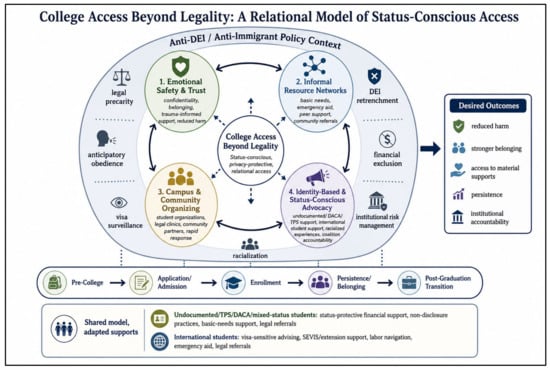
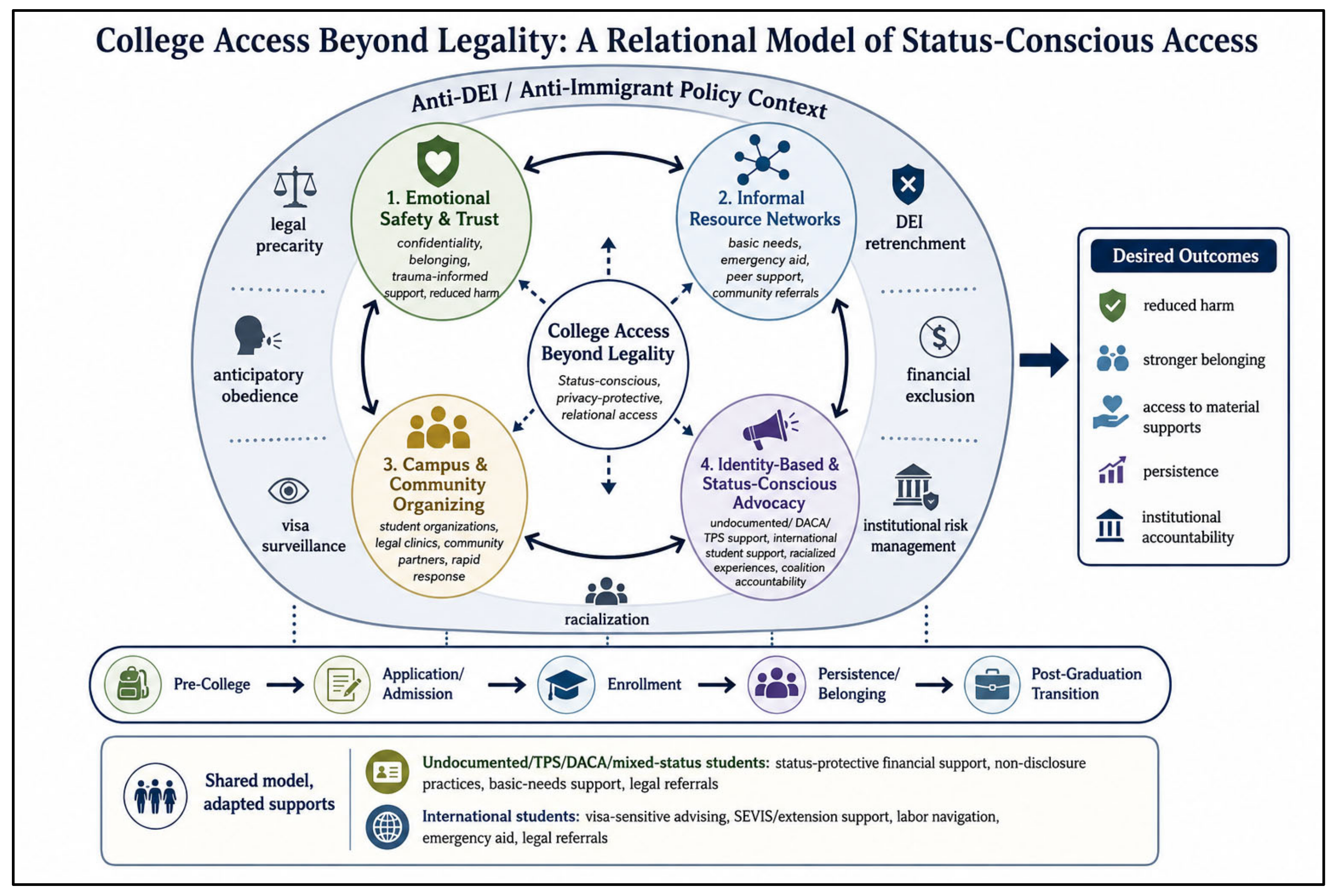
Disclaimer/Publisher’s Note: The statements, opinions and data contained in all publications are solely those of the individual author(s) and contributor(s) and not of MDPI and/or the editor(s). MDPI and/or the editor(s) disclaim responsibility for any injury to people or property resulting from any ideas, methods, instructions or products referred to in the content. |
© 2026 by the author. Licensee MDPI, Basel, Switzerland. This article is an open access article distributed under the terms and conditions of the Creative Commons Attribution (CC BY) license.