


Abstract
Increased attention has been paid in recent years to the study of human flourishing, yet few established tools exist to measure flourishing in marginalized youth populations. The validity of the adolescent version of the Flourishing Index (AFI) was recently substantiated in a sample of youth aging out of foster care. AFI scores are interpreted here as a brief, multidimensional indicator of flourishing among U.S. youth ages 18 to 24 with foster care experience. Building on prior evidence based on internal structure and measurement invariance, this study examines additional validity evidence based on relations with other variables. Convergent and discriminant patterns of association with the PERMA-Profiler, a widely used multidimensional well-being framework, are examined. Incremental prediction of general self-efficacy beyond PERMA was examined using hierarchical regression. These findings provide additional validity evidence for the use of AFI scores in this population. Further evidence is needed before AFI scores are used for individual-level decisions or for program accountability.
1. Flourishing as an Indicator of Positive Mental Health
In recent years, mental health practices have moved toward a paradigm shift, expanding beyond a pathology-focused model toward a broader emphasis on positive mental health. The World Health Organization (2018) defines mental health as a complex state of well-being that encompasses dimensions integral to optimal human functioning, such as social engagement, accomplishment, meaning, and purpose, beyond the mere absence of mental illness. With this holistic perspective, researchers have increasingly explored flourishing as a comprehensive indicator of mental well-being.
Flourishing refers to optimal functioning across personal, relational, and societal domains (Su et al., 2014; Weziak-Bialowolska et al., 2019). Though rooted in philosophy and positive psychology, the concept has been studied through multiple theoretical and disciplinary lenses. For example, Diener et al.’s (2010) Flourishing Scale provides a brief global indicator of psychosocial functioning, capturing domains such as purpose, competence, optimism, and supportive relationships through eight items. VanderWeele’s (2017) Flourishing Index offers a more expansive, philosophically grounded framework that includes physical health, character and virtue, and optional domains assessing financial security. Seligman’s (2011) PERMA model conceptualizes flourishing through five psychological characteristics: positive emotion, engagement, relationships, meaning, and accomplishment, emphasizing subjective experience and personal growth. On the other hand, Keyes’s (2002) Mental Health Continuum operationalizes flourishing as the presence of high emotional, psychological, and social well-being along a spectrum from languishing to flourishing. While models of human flourishing vary, the integrative and multidimensional characterization of flourishing remains consistent across these models, which contributes greatly to its variability across the lifespan and cultural context (Waigel & Lemos, 2023).
Flourishing takes on distinct significance during adolescence (Arnett, 2007), as adolescents acquire social and intellectual capacities, surmount environmental challenges, and navigate a trajectory towards emerging adulthood (Raghavan & Alexandrova, 2015). The ages of 18 to 24 are marked by the formation of one’s identity and significant changes in the social context. That is, transitions into the labor force or higher education, as well as living independently, have distinct effects on social relationships and responsibilities (Nadon et al., 2024). Each corresponds to a dimension of flourishing, indicating that individuals in this age group experience well-being in a manner unique to other points in the lifespan. Thus, understanding how flourishing manifests in adolescence and emerging adulthood can be key to supporting healthy development.
Transitional youth with disadvantaged backgrounds, such as involvement in the child welfare system, experience amplified challenges in reaching adulthood due to trauma history, structural instability, and limited social networks (Hedenstrom, 2021). Studies show that foster care alumni are more likely to experience poverty, homelessness, low educational attainment, and unemployment (Nadon et al., 2024). Findings such as these are prototypical examples of how youth aging out of foster care have been viewed primarily through a deficit-focused lens that emphasizes risk, instability, and poor outcomes. A flourishing lens shifts the focus from examining negative outcomes to understanding the strengths, aspirations, and relational and contextual resources that enable young people to thrive despite hardship. Importantly, examining flourishing among youth aging out of care can illuminate unique pathways to well-being that are often overlooked in deficit-oriented frameworks, helping to identify modifiable protective factors that matter most to them. Thus, further focus on flourishing within this population may help generate contextually grounded, developmentally appropriate interventions and policies that promote long-term well-being.
Previous research on flourishing has largely focused on a general and advantaged population, including validation studies of flourishing measures. While this work has been foundational, it reflects an implicit assumption that only youth in comparatively advantaged contexts flourish, and those whose lives unfold with fewer resources, greater instability, and poorer support systems do not or cannot. As a result, much less is known about how flourishing manifests for youth whose developmental pathways have been shaped by chronic adversity, structural instability, and limited familial and social support. Moreover, existing validation studies of flourishing measures rarely engage disadvantaged youth such as foster care alumni, leaving important questions about the contextual relevance of these measures for this population (Moon & Cruce, 2024; Cruce et al., 2024; Moon et al., 2025). The present study seeks to address this critical gap in the literature by examining additional psychometric dimensions of the adolescent version of the Flourishing Index (AFI) among youth aging out of foster care in the United States.
2. Flourishing Measures
As briefly introduced earlier, flourishing is typically measured using composite metrics that capture broad domains of well-being, encompassing multiple aspects of optimal human functioning (VanderWeele, 2017). That is, it reflects the coexistence of hedonic (positive affect and life satisfaction) and eudaimonic (meaning, purpose, and social contribution) dimensions consistent with the theorization of flourishing (Keyes, 2002). The intrinsic complexity of conceptualizing this multifaceted construct has led to limited consensus on its operationalization, particularly among adolescents (Cruce et al., 2024). A recent scoping review by Rule et al. (2024) identified seven original flourishing measures developed primarily for adults or mixed adolescent–adult populations: the Mental Health Continuum–Short Form (MHC-SF) (Keyes et al., 2008), the European Social Survey (ESS) Flourishing Scale (Huppert & So, 2013), the Flourishing Scale (FS) (Diener et al., 2010), the PERMA-Profiler (Butler & Kern, 2016), the Flourishing-at-Work Scale—Short Form (FWS-SF) (Rautenbach & Rothmann, 2017), the Flourishing Index (FI) (VanderWeele, 2017), and the Digital Flourishing Scale (DFS) (Janicke-Bowles, 2024). These instruments typically comprise 8 to 40 items, are self-reported, and have demonstrated adequate psychometric properties across diverse populations and contexts. For instance, evidence of the validity of the PERMA-Profiler has been collected in over 20 countries (Allen et al., 2020; Carson et al., 2020; Wagner et al., 2020; Waigel & Lemos, 2023).
Youth-specific measures of flourishing have been developed more recently. The EPOCH Measure of Adolescent Well-Being (Kern et al., 2016) operationalizes five core domains (Engagement, Perseverance, Optimism, Connectedness, and Happiness) and has been widely used and substantiated for validity in numerous observational studies across the globe (Setyandari, 2019; Meldrum et al., 2020; Buerger et al., 2023). Similarly, the Flourishing at School Scale (Fanchini et al., 2019) and the Digital Flourishing Scale for Adolescents (DFSA) (Rosič et al., 2022) extend the flourishing construct to educational and digital contexts, respectively. Despite growing psychometric evidence, few flourishing measures have substantiated validity among marginalized youth populations, such as system-involved youth (Moon & Cruce, 2024).
Recently, Moon et al. (2025) examined factor structure and measurement invariance of the Adolescent version of the Flourishing Index (AFI) for youth aging out of foster care in the U.S. AFI offers a strong conceptual and psychometric foundation to advance flourishing research and has gained substantial visibility through the recent Global Flourishing Study, conducted across more than 20 countries (Johnson et al., 2022). However, despite its widespread use in adult samples, the adolescent version has not been widely utilized or tested for validity, particularly among disadvantaged youth. Given its brevity, multidimensional structure, and potential utility for assessing flourishing among system-involved youth, further validation efforts are warranted.
3. Adolescent Flourishing Index
VanderWeele (2017), the developer of the Flourishing Index, defined flourishing as a holistic state in which all aspects of life are good. AFI includes five core domains, including happiness and life satisfaction, physical and mental health, meaning and purpose, social relationships, and two more recently added items to measure character and virtue, reflecting classical virtues such as wisdom, justice, temperance, and courage. Later, two items related to financial stability were added, which the authors distinguished as the Secure Flourishing Index (SFI) (VanderWeele, 2017). Originally developed for adults, AFI was later adapted for youth aged 13 to 17 (Moon & Cruce, 2024). The adaptation focused on rephrasing four items related to happiness, purpose, and close relationships to make them more applicable to adolescents. For example, instead of asking about the frequency of happiness, the revised item asked whether adolescents considered themselves happy, making it easier for youth to interpret. The item measuring purpose was revised to capture deliberate actions that help adolescents achieve their goals, reflecting their developmental stage of exploring life purpose. The item on close relationships was modified to be more concrete and specific, since adolescents tend to respond more readily to tangible questions than to abstract or global ones (Lyubomirsky & Lepper, 1999; Patrick et al., 2002; VanderWeele, 2017). In the present study, the AFI total score and subscale scores were used for analyses. We used the original FI adapted for youth rather than SFI. Table 1 presents the complete list of items included in the AFI.
Table 1.
Flourishing Index—adolescent version.
3.1. Previous Validity Evidence for the AFI
In a previous study, we examined the factor structure of the Adolescent Flourishing Index (AFI) among transitional youth leaving foster care (Moon et al., 2025). The exploratory and confirmatory factor analyses demonstrated a strong factor structure, with item loadings ranging from 0.76 to 0.80 for all items and excellent model fit (CFI = 0.970, TLI = 0.961, RMSEA = 0.079) for a unidimensional construct. Internal consistency was also high (α = 0.94), which suggests that the ten items of AFI reflect a cohesive construct. Additionally, measurement invariance analyses across various subgroups of youth demonstrated full measurement invariance based on sex and sexual orientation, indicating that the scale functioned equivalently across those groups. However, only partial scalar invariance was supported across race due to differential functioning of the delayed gratification item within the character and virtue domain. This result implies that the AFI is consistent across demographic subgroups, while warranting further studies of cultural and contextual variations.
3.2. The Present Study
Building on previous research that established the reliability and structural validity of AFI (Moon et al., 2025), the present study explored additional psychometric qualities, including convergent, divergent, and incremental validity. Establishing these forms of validity is an essential next step for wider empirical application. Each validity test ensures that AFI (1) conceptually aligns with prevailing theories of well-being, so findings are interpretable across studies, (2) captures facets that are not redundant with existing tools, and (3) demonstrates unique associations with theoretically relevant outcomes beyond what existing measures explain.
To that end, we positioned the AFI relative to the PERMA-Profiler (Butler & Kern, 2016), an established multidimensional framework, because both instruments assess core domains of flourishing (e.g., positive emotion, meaning, relationships) yet differ in emphasis: PERMA highlights engagement and accomplishment, whereas the AFI foregrounds health and character. Demonstrating convergence with conceptually aligned domains would confirm theoretical coherence, while divergence would indicate the AFI is not merely duplicative.
In parallel, we examined whether the AFI explains variance in general self-efficacy (Schwarzer & Jerusalem, 1995) beyond PERMA to test incremental utility, a necessary criterion for justifying use of a newer, briefer measure in research and practice with youth in foster care. Theory suggests that flourishing and self-efficacy may operate in a reciprocal cycle, in which flourishing promotes self-efficacy, which in turn further enhances flourishing. The broaden-and-build theory (Fredrickson, 2001) posits that positive emotions, one dimension of flourishing, broaden individuals’ action repertoires and build personal resources. This broadening process promotes exploration and creative engagements, which are the primary sources of self-efficacy (Bandura, 1997). Beyond the emotional dimensions, the meaning and purpose domain also reflects goal-directed, agentic engagement that is central to self-efficacy (Yuen & Datu, 2021). Empirical studies support this link between flourishing and increased self-efficacy (Pignault et al., 2023; Schutte, 2014). Taken together, these findings suggest that flourishing as a multidimensional construct can be positively associated with general self-efficacy, supporting its use as a criterion variable for validating the Flourishing Index among adolescents.
4. Methods
4.1. Study Context and Sample
Data for this study were drawn from the Flourishing After Foster Care (FAFC) Study, a national, cross-sectional survey examining the well-being of 329 transitional youth in the US who are aging out of foster care. The study focused on youth ages 18 to 24, a developmental period representing the transition from adolescence to emerging adulthood (Arnett, 2007), during which the consequences of prior involvement in systems may be particularly salient. This age range was selected to capture the experiences of youth who had recently exited care as well as those who remained in extended foster care, accounting for state-level differences in the age at which services and supports conclude. The study design emphasized inclusivity and accessibility to reach youth from multiple regions and care pathways. The only eligibility criterion was a self-reported history of foster care involvement, with no exclusions based on length of time in care, age at entry, or current care status. This study was supported by Journey to Success, a national youth policy advocacy campaign, and a reinvestment grant from Florida Sunshine Health. De-identified data from the FAFC study are available from the first author upon request.
4.2. Recruitment
Participants were recruited through a broad, one-time national outreach campaign targeting organizations, listservs, and advisory boards that serve youth with foster care experience. Recruitment emails were sent to a diverse array of national networks and state-level youth-serving organizations, including alumni associations and foster parent coalitions. No follow-up messages were sent after the initial outreach.
4.3. Data Collection
Participants completed an online survey hosted on Qualtrics (Qualtrics, Provo, UT, USA), which included demographic questions, items related to their foster care history, and a range of established and exploratory measures assessing individual, relational, and systemic dimensions of flourishing. Survey items covered indicators such as placement history, duration of time in care, reasons for entry, type of support received after age 18, and access to health insurance, as well as participation in leadership or advocacy programs. All study procedures were reviewed and approved by the Institutional Review Board of the University of Pittsburgh. A $15 digital incentive was provided upon completion of the survey.
4.4. Instruments
In addition to the AFI, we collected other well-being indicators using more established youth flourishing measures, including PERMA-Profiler and general self-efficacy. As shown in Table 1, each of the five domains is measured with two items on a 0–10 scale (VanderWeele, 2017). Domain scores are obtained by averaging item responses within each domain. An overall flourishing score is computed by averaging all items, with higher scores indicating greater levels of flourishing.
PERMA-Profiler. The PERMA-Profiler is a 15-item instrument measuring positive emotion, engagement, relationships, meaning, and accomplishment. As shown in Table 2, each was measured with three items on a 0–10 scale (Butler & Kern, 2016). Developed within the framework of positive psychology, the measure captures both affective and cognitive aspects of flourishing, such as joy, absorption in activities, supportive relationships, purpose in life, and progress toward goals (Butler & Kern, 2016; Seligman, 2011). PERMA overall and subscale scores were used in analyses of reliability and relations with other variables.
Table 2.
PERMA-Profiler—15-item version (0–10 scale).
General self-efficacy (GSE). GSE is a 10-item scale measuring youths’ confidence in their ability to handle life challenges and manage demands (Table 3). Each item is rated on a 4-point scale, capturing beliefs about persistence, problem-solving, and coping under stress. The higher scores indicate stronger perceived self-efficacy in dealing with life’s difficulties (Schwarzer & Jerusalem, 1995). The total GSE score was used in the present study, which was calculated by summing responses across all items.
Table 3.
General self-efficacy scale (GSE)—10 items (1–4 scale).
4.5. Data Analysis
Descriptive statistics and reliability. Descriptive analyses were conducted to examine the central tendency and distribution of the study variables. Reliability estimates were calculated using Cronbach’s α to assess the internal consistency of the Adolescent Flourishing Index (AFI) and the PERMA-Profiler. Cronbach’s α values ≥ 0.70 were considered acceptable indicators of internal consistency (Nunnally & Bernstein, 1994).
Relations with PERMA-Profiler scores. Pearson product-moment correlations were computed between AFI total and subscale scores and the corresponding PERMA total and subscale scores. Stronger associations between theoretically aligned domains indicate convergent patterns, while more moderate correlations across non-overlapping domains indicate differentiated (discriminant) patterns (Campbell & Fiske, 1959; Kline, 2023).
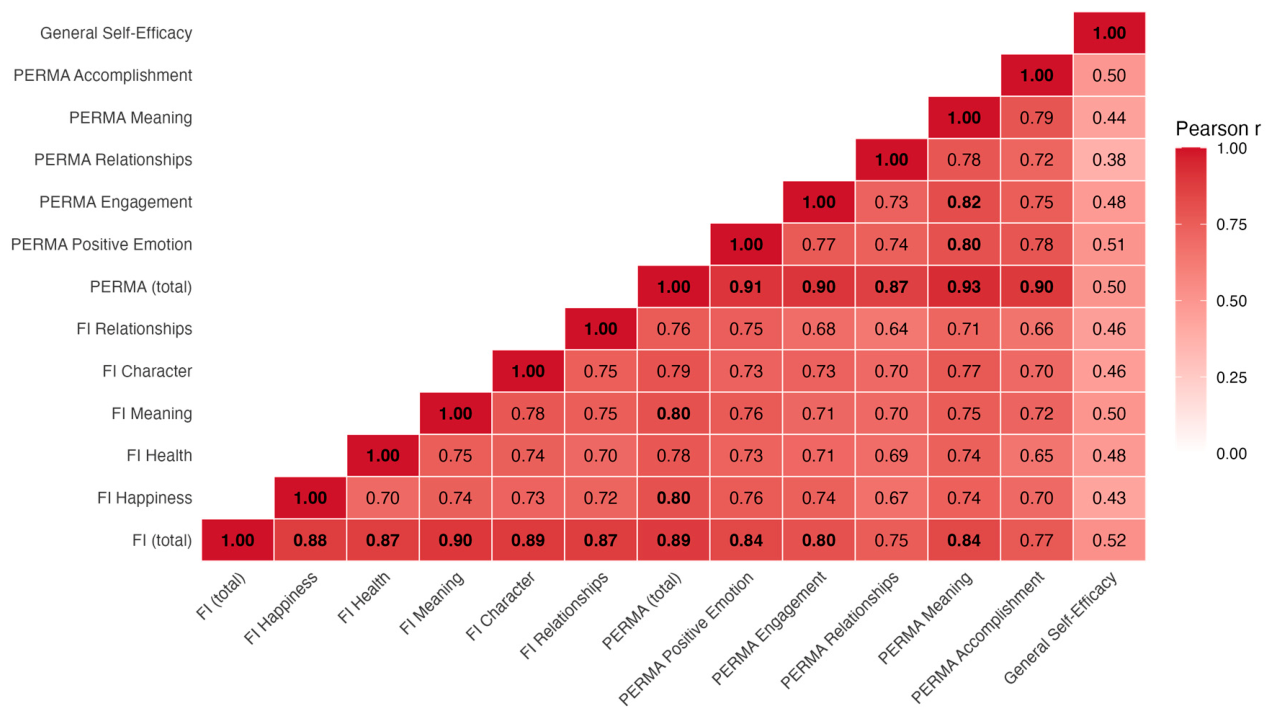
To examine the overall pattern of relationships among the key constructs, we created a correlation heatmap that included the AFI total score, AFI domains, PERMA total and domain scores, and general self-efficacy. All correlations were estimated using pairwise complete data. The heatmap provides a visual summary of how these measures relate to one another and highlights areas of stronger overlap. This figure complements the correlation table and supports the convergent pattern findings reported in the results.
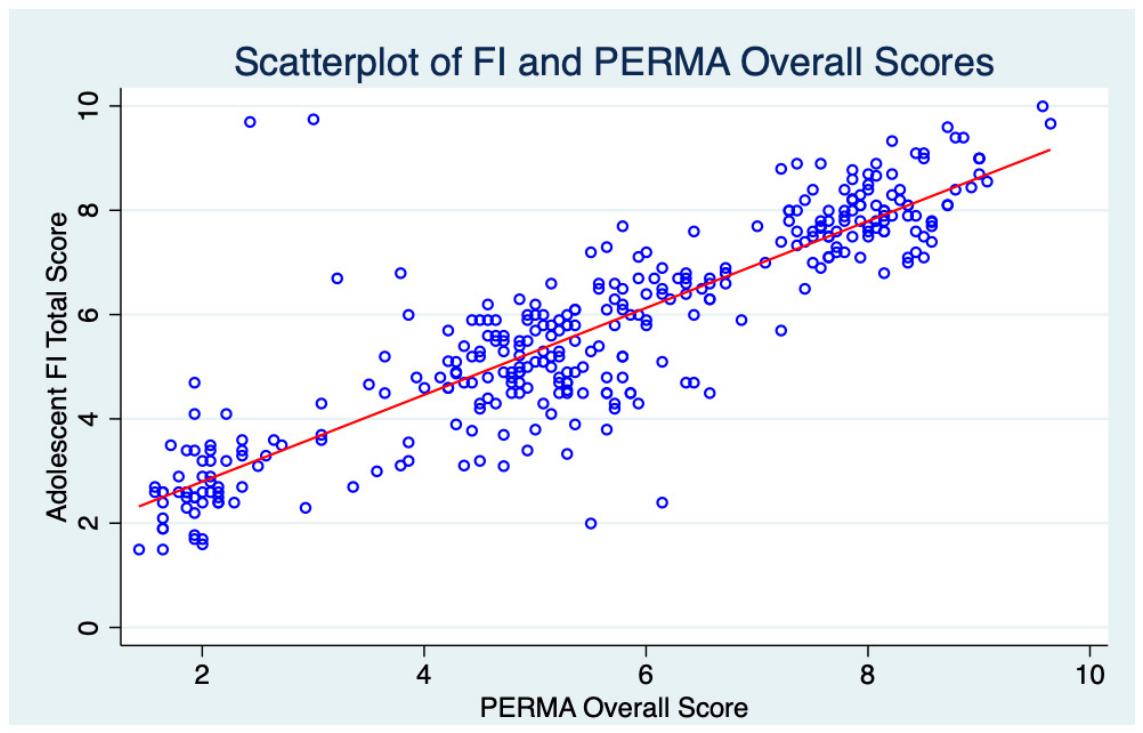
To further examine the predictive relationship between measures, a multiple regression analysis was conducted with the AFI total score as the dependent variable and the PERMA overall flourishing score as the predictor. Because the variance explained in a simple linear regression with one predictor is mathematically equivalent to the squared correlation, this regression is presented to complement the correlation by estimating the slope of the AFI~PERMA association in raw units and examining linearity across the score range, rather than as independent evidence of convergent association. In addition, a scatterplot with a fitted regression line was generated to visually illustrate the relationship between the two measures.
Incremental prediction of GSE. Incremental validity was assessed using hierarchical regression on the outcome of GSE scores. In Step 1, PERMA total scores were entered to predict general self-efficacy, followed by the addition of AFI scores in Step 2. This analysis tested whether AFI explained unique variance in self-efficacy beyond PERMA (Schwarzer & Jerusalem, 1995; Hunsley & Meyer, 2003).
Missing values. Missing data were handled in accordance with the scoring recommendations for both instruments. The AFI includes two items per domain; therefore, domain scores were computed only when both items were completed (VanderWeele, 2017); 14.51% of participants (n = 55) had at least one missing item, and 85.49% (n = 324) provided complete responses. The PERMA-Profiler contains three items per domain, and domain scores were calculated when participants provided responses to at least two of the three items (Butler & Kern, 2016); 10.82% of participants (n = 41) had at least one missing item, and 89.18% (n = 338) completed all items required for domain scoring. Consistent with scoring guidelines, domain scores were calculated only when participants met the minimum item requirements, and total scores were computed only when more than half of the domains contained valid data (VanderWeele, 2017; Butler & Kern, 2016). After applying these scoring criteria, AFI total scores were available for 365 participants, PERMA overall scores for 338 participants, and GSE total scores for 364 participants. No imputation procedures were used, and all analyses relied solely on observed data. After applying these criteria, 304 participants had complete data for all variables required for the main analyses.
5. Results
5.1. Descriptive Statistics Reliability
Both the Adolescent Flourishing Index (AFI) and the PERMA-Profiler were completed by most participants (n = 304). Table 4 presents the sample descriptions. Participants had a mean age of 21.35 years (SD = 1.66), and most identified as cisgender male (67.55%), followed by cisgender female (23.48%), with a small proportion identifying as transgender. In terms of race, over 60% (61.48%) identified as Black, approximately 20% (21.11%) as White, and 12.40% as multiracial or with other racial identities. Additionally, 43.54% of participants reported Hispanic identity.
Table 4.
Participant demographic characteristics (N = 379).
Table 5 presents descriptive statistics and reliability estimates for the study measures’ total scores. Mean scores were 5.65 (SD = 2.07) for the AFI, 5.53 (SD = 2.14) for the PERMA-Profiler, and 25.88 (SD = 5.45) for the GSE. Internal consistency was strong across measures, with Cronbach’s α ranging from 0.82 to 0.95.
Table 5.
Descriptive statistics and reliability estimates for study measures.
5.2. Reliability
Both measures demonstrated strong internal consistency in the current sample. The AFI showed Cronbach’s α of 0.94, while PERMA-Profiler demonstrated Cronbach’s α of 0.95. These coefficients exceed conventional thresholds for good reliability (α ≥ 0.70; Nunnally & Bernstein, 1994), indicating that items within each instrument were highly interrelated and consistently measured their intended constructs. To provide a more robust assessment of reliability for Likert-type items, we additionally calculated ordinal alpha and omega (based on polychoric correlations). For the AFI, ordinal α was 0.95 and ω was 0.94, with polychoric inter-item correlations ranging from 0.53 to 0.67. Confirmatory factor analysis also indicated strong standardized loadings (0.73–0.79) and moderate error variances (0.37–0.46), supporting adequate measurement precision (Jöreskog, 1994). For the PERMA-Profiler, ordinal α was 0.96 and ω was 0.95, with polychoric inter-item correlations ranging from 0.46 to 0.72 and residual variances ranging from 0.30 to 0.56.
5.3. Relations with PERMA-Profiler Scores
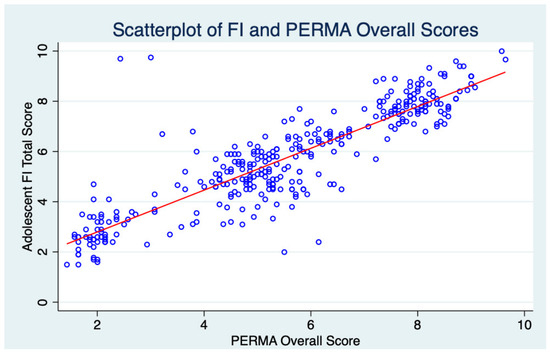
Comparison between total scores. The Pearson correlation result indicated a strong positive association between the Adolescent AFI total score and the PERMA overall score, r (304) = 0.90, 95% CI [0.87, 0.92], p < 0.001. The scatterplot illustrated a clear positive linear relationship between the Adolescent AFI and PERMA overall scores (Figure 1). Higher PERMA overall scores were consistently associated with higher AFI total scores, with data points clustering closely around the fitted regression line. Although some variability was present at lower levels of flourishing, the overall pattern indicated a strong association between the two measures, consistent with the high correlation reported (r = 0.88, p < 0.001). Given that Moon et al. (2025) reported a unidimensional structure for the AFI, subscale-level correlations are presented as descriptive content-level mapping rather than as independent evidence of subscale validity.
Figure 1.
Scatterplot showing the correlation between PERMA overall score and Adolescent Flourishing Index (AFI) total score.
Comparison of Subscale Scores. We report subscale-level correlations descriptively, noting that the AFI’s brief 2-item subscales and unidimensional structure limit their interpretation as separate construct measures. All correlations between AFI and PERMA subscales were statistically significant (p < 0.001), with coefficients ranging from 0.64 to 0.77, suggesting generally moderate to strong associations. More specifically, AFI Happiness was most strongly correlated with PERMA meaning (r = 0.76, 95% CI [0.69, 0.79], p < 0.001) while AFI Character showed the strongest correlation with PERMA meaning (r = 0.77, 95% CI [0.72, 0.81], p < 0.001). Regarding discriminant validity, AFI relationships correlated with PERMA engagement (r = 0.68, 95% CI [0.64, 0.75], p < 0.001) and accomplishment (r = 0.66, 95% CI [0.59, 0.72], p < 0.001). In addition, AFI Health also demonstrated a modest correlation with PERMA accomplishment (r = 0.65, 95% CI [0.56, 0.70], p < 0.001). None of the associations approached perfect unity.
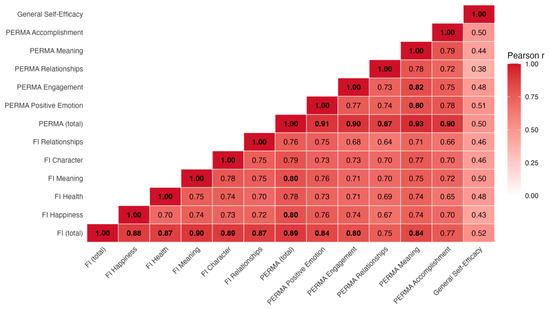
Correlational Heatmap among the AFI, PERMA, and GSE overall and subdomains. Figure 2 presents a correlational heatmap of each subdomain in the AFI and PERMA measures, as well as the total general self-efficacy scores. The AFI row and column display consistently high values across the PERMA domains, indicating strong convergence between the two frameworks in this adolescent sample. Correlations with general self-efficacy were more modest, ranging from 0.38 to 0.52, suggesting that the AFI aligns with broader psychological strengths but is not redundant with perceived efficacy. Together, the heatmap, scatter plot, and the correlation table provide a coherent picture of the FI’s convergent and criterion-related validity. All remaining 95% confidence intervals are reported in Appendix A Table A1.
Figure 2.
Correlation heatmap showing associations among the Adolescent Flourishing Index (FI), PERMA domains, and general self-efficacy. Note. The heatmap displays Pearson correlations using pairwise complete observations. Values range from moderate to strong across measures. AFI total and subdomains showed the strongest associations with PERMA meaning and positive emotion, and moderate associations with engagement, relationships, and accomplishment. General self-efficacy correlated most strongly with AFI total and PERMA meaning and accomplishment.
5.4. Regression Analysis
The linear regression model examining the association between AFI and PERMA total scores was significant; [F (1, 336) = 1155.10, p < 0.001], explaining 77% of the variance in AFI scores (R2 = 0.77). PERMA overall was a significant positive predictor of AFI scores, B = 0.83, SE = 0.03, t = 33.99, p < 0.001, indicating that higher levels of flourishing as measured by the PERMA-Profiler were strongly associated with higher AFI scores. Substantively, this slope indicates that a one-point increase in PERMA scores was associated with a 0.83-point increase in AFI scores in this sample, and the fitted line in Table 6 presents the results from the regression analysis in detail.
Table 6.
Regression model summary predicting AFI total score from PERMA overall score.
5.5. Incremental Prediction of GSE
We conducted a hierarchical regression analysis to examine whether the Adolescent Flourishing Index (AFI) explains additional variance in general self-efficacy (GSE) beyond what is accounted for by the PERMA-Profiler. As shown in Table 7, in Step 1, PERMA overall scores significantly predicted GSE, B = 1.29, SE = 0.12, t (331) = 10.62, p < 0.001, accounting for 25% of the variance (R2 = 0.25). In Step 2, both PERMA and AFI were included in the model, and together they explained 28% of the variance in GSE. The addition of AFI produced a significant increase in explained variance, ΔR2 = 0.02, F(1, 330) = 10.74, p = 0.001. Within this step, AFI emerged as a significant positive predictor of GSE, B = 0.87, SE = 0.26, t (330) = 3.28, p = 0.001, whereas PERMA remained significant but with a smaller coefficient (B = 0.57, SE = 0.25, t = 2.27, p = 0.024). Multicollinearity diagnostics indicated acceptable levels of intercorrelation among predictors (mean VIF = 4.55), suggesting no serious multicollinearity concerns.
Table 7.
Hierarchical regression predicting general self-efficacy.
6. Discussion
The purpose of this study was to examine additional validity evidence for AFI score interpretations in a sample of youth aging out of foster care. This study extends prior work that provided evidence for the internal structure and measurement invariance of AFI scores (Moon et al., 2025). While that earlier study focused on internal structure and invariance across subgroups, the current paper provides additional evidence by examining how AFI scores relate to an established multidimensional measure of well-being (PERMA) and to general self-efficacy. The findings from our study provide additional support for AFI as a psychometrically sound and practically useful instrument for vulnerable adolescent flourishing.
Our analyses revealed strong correlations between AFI and PERMA total scores (r = 0.90) as well as across theoretically aligned domains, providing evidence of convergent patterns of association. Strong associations between measures of related constructs constitute one source of validity evidence based on relations with other variables (Campbell & Fiske, 1959). This consistency is particularly important because it demonstrates that the FI, as a new measure of youth flourishing, does not deviate from the conceptual foundations of existing mainstream frameworks such as Seligman’s (2011) PERMA theory (Butler & Kern, 2016).
Regarding the domain level convergence, AFI meaning was strongly associated with PERMA meaning and also correlated with Positive emotion and accomplishment. This result not only validates the utility of the AFI in measuring sense of meaning but also indicates that adolescents who find life purposeful also tend to experience positive emotions and a sense of achievement. This finding is consistent with the literature that indicates that adolescents in the child welfare system who develop a sense of meaning and purpose demonstrate greater resilience in emotional regulation and academic achievement (Somers et al., 2020; Pinheiro et al., 2024; Auslander et al., 2025). Existing services for child welfare involved youth or transitional youth aging out of foster care rarely target a sense of meaning and purpose as the explicit service outcomes, which is a missed opportunity to promote holistic well-being for these vulnerable populations. Applying AFI within the child welfare context can help identify support opportunities for targeted interventions.
Similarly, AFI relationships correlated with PERMA relationships as well as with positive emotion and meaning, highlighting the centrality of close social ties in promoting emotional well-being and life purpose. Within child welfare populations, the quality of social relationships often serves as an important determinant of the emotional adjustment, resilience, and mental well-being (Williams-Butler et al., 2018) of transitional-age youth. The existing literature indicates that intimate relationships and social support are crucial protective factors promoting mental health, life satisfaction, and other positive outcomes among youth in foster care (Williams-Butler et al., 2018; McGuire et al., 2021; Parmar et al., 2022). Additionally, there is a positive correlation between youth in foster care’s life satisfaction and their outcomes after leaving care (Mabille et al., 2022). The cross-correlation between AFI and PERMA in the relational domain suggests that AFI not only captures the universality of social support but also reveals its central role in fostering emotional well-being and a sense of meaning.
6.1. Patterns of Differentiation and Unique Contribution of the AFI
At the same time, AFI remained distinct from PERMA, as several associations were moderate rather than strong. These moderate correlations (e.g., AFI relationships and PERMA relationships, r = 0.64; AFI Health and PERMA accomplishment, r = 0.65) suggest that some AFI domains are not fully captured by PERMA. The modest correlation between AFI relationships and PERMA relationships is unsurprising, given that AFI elicits the youth’s subjective satisfaction with support, while PERMA asks whether the youth actually receives support when needed or experiences feeling loved. These differentiated patterns are one component of the validity evidence for AFI score interpretations (Campbell & Fiske, 1959); given the very strong total-score association (r = 0.90), however, we do not interpret these patterns as evidence of clear separation between the two measures. For child welfare populations, this implies that AFI can provide dimensions not fully captured by PERMA, such as subjective perceptions of physical and mental health or self-discipline in character development, which are particularly crucial among vulnerable adolescents (Poletto & Koller, 2011; Wen et al., 2022; Matić & Musil, 2023).
This pattern suggests that while the two scales share common ground in assessing youth flourishing, AFI contributes to unique variance not captured by PERMA. At the application level, it can ensure strong comparability between AFI and PERMA when conducting broad data comparisons, while AFI also offers additional perspectives revealing areas of adolescent strengths not fully captured by the PERMA scales.
6.2. Incremental Prediction of Self-Efficacy Beyond PERMA
Findings from the hierarchical regression analysis also provide strong evidence that AFI scores account for variance in general self-efficacy beyond that explained by the PERMA-Profiler. The incremental validity analysis demonstrates that AFI contributes to unique variance in predicting general self-efficacy, a central resource for adolescent resilience and adaptive functioning. Because self-efficacy is strongly associated with persistence, agency, and positive developmental trajectories in adolescence (Nunes et al., 2022; Cherewick et al., 2023; Yaban & Gaschler, 2025), the AFI’s added contribution underscores its relevance for both research and intervention. In applied terms, AFI can serve as a complementary tool for evaluating programs designed to build life skills, promote resilience, and support transitions to adulthood, especially in child welfare populations, where fostering self-efficacy is a critical outcome.
6.3. Implications for Practice and Policy
AFI is shorter than existing measures of youth flourishing, such as PERMA, which makes it easier to administer and particularly suitable for use in schools, community programs, and child welfare settings where administrative burden is a concern. The brevity of the AFI (only 10 items) significantly reduces administrative and survey burdens. Existing research highlights that overly lengthy surveys in schools, foster care settings, and community health programs often lead to lower adolescent participation rates and compromised data quality (Sahlqvist et al., 2011; Murray & Xie, 2024; Castillo Cifuentes et al., 2025). Consequently, the FI’s brevity makes it particularly well-suited for large-scale child welfare surveys, enabling the provision of reliable indicators of well-being within resource-constrained environments. These features make AFI a practical tool for large-scale surveys and applied contexts aiming to monitor adolescent flourishing at the population level. For child welfare policymakers, this means AFI can serve as a complementary tool, alongside established indicators, for assessing how different interventions foster adolescents’ unique developmental trajectories.
The AFI also provides a practical and actionable tool for evaluating the effectiveness of child- and family-serving interventions, including life skills training, relationship-building programs, and mental health promotion services. By incorporating indicators of flourishing, the AFI enables stakeholders to move beyond a deficit-focused lens and assess whether interventions contribute to positive developmental outcomes for adolescents. Policy makers can integrate AFI scores into program performance evaluations, thereby shifting accountability frameworks toward promoting well-being rather than solely reducing risk behaviors. For example, federally supported initiatives such as Title IV-E demonstration projects could adopt the AFI as a core outcome measure alongside established indicators of placement stability, service access, safety, and youth-reported well-being. Doing so would allow these large-scale policy experiments to capture improvements in youth flourishing, such as enhanced health, meaning, and relational supports, alongside traditional metrics like placement stability or service utilization, ultimately broadening the definition of success in child welfare and health policy reform.
6.4. Limitations and Future Directions
Despite its contributions, several limitations warrant consideration. The present study drew on participants from a restricted set of U.S. states, limiting the geographic and contextual diversity of the sample. Consequently, the generalizability of findings to adolescents in other regions or under different policy environments remains uncertain. In addition, the reliance on self-reported data may have introduced social desirability or shared method variance. Also, one item from the PERMA-Profiler (R3: satisfaction with personal relationships) was inadvertently omitted during data collection, which may have slightly reduced the precision of the Relationships subscale and the overall PERMA score. Because the AFI subscales contain only two items each and the prior factor analysis supported a unidimensional structure (Moon et al., 2025), subscale-level findings should be interpreted descriptively rather than as independent psychometric evidence. The cross-sectional design further constrains the ability to infer developmental or causal relationships between flourishing and related constructs. Future research should also aim to validate the Adolescent Flourishing Index across more diverse and representative populations, including youth from varying racial, socioeconomic, and cultural contexts, considering the persistent overrepresentation of youth of color in the child welfare system due to the inequalities related to race, gender, and other salient identities (Williams-Butler, 2023). Longitudinal and multi-level studies would also enable researchers to examine how flourishing and strengths-based approaches evolve over time and how individual flourishing interacts with relational, community, and structural determinants (Williams-Butler et al., 2025). Finally, extending this work within hierarchical or policy frameworks could clarify how flourishing is shaped by institutional support and systemic inequities, thereby informing interventions and policies that promote equitable well-being among adolescents.
7. Conclusions
This study provides additional validity evidence supporting the use of AFI scores among youth transitioning from foster care. The AFI demonstrated strong internal consistency and strong convergence with the PERMA-Profiler, indicating alignment with established multidimensional frameworks of well-being. Domain-level correlations reflected theoretically coherent but not fully redundant relationships, suggesting that the AFI captures aspects of flourishing that overlap with, but are not identical to, PERMA. Hierarchical regression further showed that AFI scores accounted for a small but statistically significant increment in general self-efficacy beyond PERMA, supporting the AFI’s added value in capturing dimensions of flourishing relevant to vulnerable adolescents. Collectively, these findings affirm the AFI as a brief, conceptually grounded measure suitable for research and applied work focused on assessing and promoting adolescent flourishing in high-adversity contexts, while also highlighting the need for continued validation work on sensitivity to change, subgroup fairness, and the consequences of use.
Author Contributions
Conceptualization, D.J.M.; methodology, D.J.M. and B.S.; formal analysis, R.M. and B.S.; writing-original draft preparation, D.J.M., R.M., X.K., A.C., H.L. and J.J.; writing-review and editing, D.J.M., R.R. and A.W.-B.; visualization, B.S., R.M. and S.L.; supervision, D.J.M., B.S. and R.R.; project administration, D.J.M. and A.C.; funding acquisition, A.C. All authors have read and agreed to the published version of the manuscript.
Funding
This research was funded by Journey to Success.
Institutional Review Board Statement
The study was conducted in accordance with the Declaration of Helsinki and approved by the Institutional Review Board of the University of Pittsburgh (protocol code STUDY22110150).
Informed Consent Statement
Informed consent was obtained from all subjects involved in the study.
Data Availability Statement
The dataset contains sensitive participant information and cannot be shared in a manner that ensures participant confidentiality. Requests for additional information regarding the study may be directed to the corresponding author.
Conflicts of Interest
The authors declare no conflict of interest.
Appendix A
Table A1.
Correlations and 95% confidence intervals for AFI and PERMA scores.
References
- Allen, R. E., Carson, J., Merrifield, B., & Bush, S. (2020). Still worlds apart: Flourishing in people with mental health problems. Mental Health and Social Inclusion, 24(3), 163–172. [Google Scholar] [CrossRef] [Scilit]
- Arnett, J. J. (2007). Emerging adulthood: What is it, and what is it good for? Child Development Perspectives, 1(2), 68–73. [Google Scholar] [CrossRef] [Scilit]
- Auslander, W., Cheng, S.-Y., & Edmond, T. E. (2025). Resilience in adolescent girls in child welfare: Reliability and validity of the RS-14. Child and Adolescent Social Work Journal, 42(2), 275–283. [Google Scholar] [CrossRef] [Scilit] [PubMed]
- Bandura, A. (1997). Self efficacy. W.H. Freeman. [Google Scholar]
- Buerger, S., Holzer, J., Yanagida, T., Schober, B., & Spiel, C. (2023). Measuring adolescents’ well-being in schools: The adaptation and translation of the EPOCH measure of adolescent well-being—A validation study. School Mental Health, 15(2), 611–626. [Google Scholar] [CrossRef] [Scilit]
- Butler, J., & Kern, M. L. (2016). The PERMA-profiler: A brief multidimensional measure of flourishing. International Journal of Wellbeing, 6(3), 1–48. [Google Scholar] [CrossRef] [Scilit]
- Campbell, D. T., & Fiske, D. W. (1959). Convergent and discriminant validation by the multitrait-multimethod matrix. Psychological Bulletin, 56(2), 81–105. [Google Scholar] [CrossRef] [Scilit]
- Carson, J., Prescott, J., Allen, R., & McHugh, S. (2020). Winter is coming: Age and early psychological concomitants of the COVID-19 pandemic in England. Journal of Public Mental Health, 19(3), 221–230. [Google Scholar] [CrossRef] [Scilit]
- Castillo Cifuentes, V., Ferrer, A., Ronchka, M., Dougherty, I., Clarke, A., Khaliq, S., Okungbowa, E., Korovinsky, I., & Khurana, M. (2025). Strategies for increasing youth participation in longitudinal survey research: Lessons from a pilot study. World, 6(2), 73. [Google Scholar] [CrossRef] [Scilit]
- Cherewick, M., Hipp, E., Njau, P., & Dahl, R. E. (2023). Growth mindset, persistence, and self-efficacy in early adolescents: Associations with depression, anxiety, and externalising behaviours. Global Public Health, 18(1), 2213300. [Google Scholar] [CrossRef] [Scilit]
- Cruce, A., Sable, P., & Moon, D. J. (2024). Flourishing after foster care: Examining factors affecting flourishing in transition age youth in the United States. ResearchGate. [Google Scholar] [CrossRef] [Scilit]
- Diener, E., Wirtz, D., Tov, W., Kim-Prieto, C., Choi, D., Oishi, S., & Biswas-Diener, R. (2010). New well-being measures: Short scales to assess flourishing and positive and negative feelings. Social Indicators Research, 97(2), 143–156. [Google Scholar] [CrossRef] [Scilit]
- Fanchini, A., Jongbloed, J., & Dirani, A. (2019). Examining the well-being and creativity of schoolchildren in France. Cambridge Journal of Education, 49(4), 391–416. [Google Scholar] [CrossRef] [Scilit]
- Fredrickson, B. L. (2001). The role of positive emotions in positive psychology. The broaden-and-build theory of positive emotions. The American Psychologist, 56(3), 218–226. [Google Scholar] [CrossRef]
- Hedenstrom, M. (2021). Aging out of foster care: The experiences of former foster youth who successfully navigated this transition. Developmental Child Welfare, 3(2), 166–181. [Google Scholar] [CrossRef] [Scilit]
- Hunsley, J., & Meyer, G. J. (2003). The incremental validity of psychological testing and assessment: Conceptual, methodological, and statistical issues. Psychological Assessment, 15(4), 446–455. [Google Scholar] [CrossRef] [Scilit]
- Huppert, F. A., & So, T. T. C. (2013). Flourishing across Europe: Application of a new conceptual framework for defining well-being. Social Indicators Research, 110(3), 837–861. [Google Scholar] [CrossRef] [Scilit]
- Janicke-Bowles, S. (2024). Digital flourishing in the U.S.: Validation of the Digital Flourishing Scale (DFS) and demographic exploration. Communication Studies, 75(3), 322–341. [Google Scholar] [CrossRef] [Scilit]
- Johnson, B., Ritter, Z., Fogleman, A., Markham, L., Stankov, T., Srinivasan, R., Honohan, J., Ripley, A., Phillips, T., & Wang, H. (2022). The global flourishing study. OSF. [Google Scholar] [CrossRef]
- Jöreskog, K. G. (1994). On the estimation of polychoric correlations and their asymptotic covariance matrix. Psychometrika, 59(3), 381–389. [Google Scholar] [CrossRef] [Scilit]
- Kern, M. L., Benson, L., Steinberg, E. A., & Steinberg, L. (2016). The EPOCH measure of adolescent well-being. Psychological Assessment, 28(5), 586–597. [Google Scholar] [CrossRef] [Scilit]
- Keyes, C. L. M. (2002). The mental health continuum: From languishing to flourishing in life. Journal of Health and Social Behavior, 43(2), 207–222. [Google Scholar] [CrossRef] [Scilit]
- Keyes, C. L. M., Wissing, M., Potgieter, J. P., Temane, M., Kruger, A., & van Rooy, S. (2008). Evaluation of the mental health continuum–short form (MHC–SF) in setswana-speaking South Africans. Clinical Psychology & Psychotherapy, 15(3), 181–192. [Google Scholar] [CrossRef] [Scilit]
- Kline, R. B. (2023). Principles and practice of structural equation modeling (5th ed.). Guilford Publications. [Google Scholar]
- Lyubomirsky, S., & Lepper, H. S. (1999). A measure of subjective happiness: Preliminary reliability and construct validation. Social Indicators Research, 46(2), 137–155. [Google Scholar] [CrossRef] [Scilit]
- Mabille, G., Skoglund, J., Thørnblad, R., & Holtan, A. (2022). Placement stability and satisfaction with foster home as predictors of life satisfaction for young adults raised in foster care. Child & Family Social Work, 27(2), 267–277. [Google Scholar] [CrossRef] [Scilit]
- Matić, I., & Musil, V. (2023). Subjective well-being and self-assessed health of adolescents: A longitudinal cohort study. European Journal of Investigation in Health, Psychology and Education, 13(12), 2853–2862. [Google Scholar] [CrossRef] [Scilit]
- McGuire, A., Gabrielli, J., Hambrick, E., Abel, M. R., Guler, J., & Jackson, Y. (2021). Academic functioning of youth in foster care: The influence of unique sources of social support. Children and Youth Services Review, 121, 105867. [Google Scholar] [CrossRef] [Scilit] [PubMed]
- Meldrum, R. C., Campion Young, B., Soor, S., Hay, C., Copp, J. E., Trace, M., Smith-Darden, J. P., & Kernsmith, P. D. (2020). Are adverse childhood experiences associated with deficits in self-control? A test among two independent samples of youth. Criminal Justice and Behavior, 47(2), 166–186. [Google Scholar] [CrossRef] [Scilit]
- Moon, D. J., & Cruce, A. (2024). Child flourishing index: Confirmatory factor analysis and measurement invariance between youth of color and white youth in the United States. Families in Society, 107(2), 715–732. [Google Scholar] [CrossRef] [Scilit]
- Moon, D. J., Jeon, J., Cruce, A., Lee, H., Ma, R., & Case, B. W. (2025). Measuring flourishing for transitional youth aging out of foster care in the united states: Factor structure and invariance of the flourishing index. SSM—Mental Health, 8, 100518. [Google Scholar] [CrossRef] [Scilit]
- Murray, A. L., & Xie, T. (2024). Engaging adolescents in contemporary longitudinal health research: Strategies for promoting participation and retention. Journal of Adolescent Health, 74(1), 9–17. [Google Scholar] [CrossRef] [Scilit]
- Nadon, M. L., Park, S., Feng, H., & Courtney, M. E. (2024). Examining prevalence and predictors of economic hardships for transition-age foster youth. Journal of the Society for Social Work and Research, 15(3), 539–567. [Google Scholar] [CrossRef] [Scilit]
- Nunes, F., Mota, C. P., Schoon, I., Ferreira, T., & Matos, P. M. (2022). Sense of personal agency in adolescence and young adulthood: A preliminary assessment model. Personality and Individual Differences, 196, 111754. [Google Scholar] [CrossRef] [Scilit]
- Nunnally, J. C., & Bernstein, I. H. (1994). Psychometric theory (3rd ed.). McGraw-Hill. [Google Scholar]
- Parmar, D. D., Tabler, J., Okumura, M. J., & Nagata, J. M. (2022). Investigating protective factors associated with mental health outcomes in sexual minority youth. Journal of Adolescent Health, 70(3), 470–477. [Google Scholar] [CrossRef] [Scilit]
- Patrick, D. L., Edwards, T. C., & Topolski, T. D. (2002). Adolescent quality of life, part II: Initial validation of a new instrument. Journal of Adolescence, 25(3), 287–300. [Google Scholar] [CrossRef] [Scilit]
- Pignault, A., Rastoder, M., & Houssemand, C. (2023). The relationship between self-esteem, self-efficacy, and Career Decision-making difficulties: Psychological flourishing as a mediator. European Journal of Investigation in Health Psychology and Education, 13(9), 1553–1568. [Google Scholar] [CrossRef] [Scilit]
- Pinheiro, M., Magalhães, E., & Baptista, J. (2024). Resilience in residential care: A qualitative study based on the voices of adolescents. Children and Youth Services Review, 162, 107694. [Google Scholar] [CrossRef] [Scilit]
- Poletto, M., & Koller, S. H. (2011). Subjective well-being in socially vulnerable children and adolescents. Psicologia: Reflexão e Crítica, 24, 476–484. [Google Scholar] [CrossRef]
- Raghavan, R., & Alexandrova, A. (2015). Toward a theory of child well-being. Social Indicators Research, 121(3), 887–902. [Google Scholar] [CrossRef] [Scilit]
- Rautenbach, C., & Rothmann, S. (2017). Psychometric validation of the Flourishing-at-Work Scale—Short Form (FWS-SF): Results and implications of a South African study. Journal of Psychology in Africa, 27(4), 303–309. [Google Scholar] [CrossRef] [Scilit]
- Rosič, J., Janicke-Bowles, S. H., Carbone, L., Lobe, B., & Vandenbosch, L. (2022). Positive digital communication among youth: The development and validation of the digital flourishing scale for adolescents. Frontiers in Digital Health, 4, 975557. [Google Scholar] [CrossRef] [Scilit] [PubMed]
- Rule, A., Abbey, C., Wang, H., Rozelle, S., & Singh, M. K. (2024). Measurement of flourishing: A scoping review. Frontiers in Psychology, 15, 1293943. [Google Scholar] [CrossRef] [Scilit]
- Sahlqvist, S., Song, Y., Bull, F., Adams, E., Preston, J., Ogilvie, D., & the iConnect Consortium. (2011). Effect of questionnaire length, personalisation and reminder type on response rate to a complex postal survey: Randomised controlled trial. BMC Medical Research Methodology, 11(1), 62. [Google Scholar] [CrossRef] [Scilit]
- Schutte, N. S. (2014). The broaden and build process: Positive affect, ratio of positive to negative affect and general self-efficacy. The Journal of Positive Psychology, 9(1), 66–74. [Google Scholar] [CrossRef] [Scilit]
- Schwarzer, R., & Jerusalem, M. (1995). General self-efficacy scale (GSE) (Database record). APA PsycTests. [Google Scholar] [CrossRef] [Scilit]
- Seligman, M. E. P. (2011). Flourish: A visionary new understanding of happiness and well-being. Simon and Schuster. [Google Scholar]
- Setyandari, A. (2019). Adaptation of EPOCH measure of adolescent well-being into Bahasa Indonesia. In proceedings of the 3rd international conference on current issues in education (ICCIE 2018). Atlantis Press. [Google Scholar] [CrossRef] [Scilit]
- Somers, C. L., Goutman, R. L., Day, A., Enright, O., Crosby, S., & Taussig, H. (2020). Academic achievement among a sample of youth in foster care: The role of school connectedness. Psychology in the Schools, 57(12), 1845–1863. [Google Scholar] [CrossRef] [Scilit] [PubMed]
- Su, R., Tay, L., & Diener, E. (2014). The development and validation of the Comprehensive Inventory of Thriving (CIT) and the Brief Inventory of Thriving (BIT). Applied Psychology: Health and Well-Being, 6(3), 251–279. [Google Scholar] [CrossRef] [Scilit] [PubMed]
- VanderWeele, T. J. (2017). On the promotion of human flourishing. Proceedings of the National Academy of Sciences of the United States of America, 114(31), 8148–8156. [Google Scholar] [CrossRef] [Scilit]
- Wagner, L., Gander, F., Proyer, R. T., & Ruch, W. (2020). Character strengths and PERMA: Investigating the relationships of character strengths with a multidimensional framework of well-being. Applied Research in Quality of Life, 15(2), 307–328. [Google Scholar] [CrossRef] [Scilit]
- Waigel, N. C., & Lemos, V. N. (2023). A systematic review of adolescent flourishing. Europe’s Journal of Psychology, 19(1), 79–99. [Google Scholar] [CrossRef] [Scilit]
- Wen, F., Ye, H., Zuo, B., Han, S., Zhu, J., Ke, W., & He, Y. (2022). The association between insecurity and subjective well-being among youth during the COVID-19 outbreak: A moderated mediation model. Journal of Affective Disorders, 297, 486–494. [Google Scholar] [CrossRef] [Scilit]
- Weziak-Bialowolska, D., McNeely, E., & VanderWeele, T. J. (2019). Flourish index and secure flourish index—Validation in workplace settings. Cogent Psychology, 6(1). [Google Scholar] [CrossRef] [Scilit]
- Williams-Butler, A. (2023). Intersectionality and structural gendered racism: Theoretical considerations for Black women, children, and families impacted by child protective services in the United States. Critical Social Policy, 43(3), 514–535. [Google Scholar] [CrossRef] [Scilit]
- Williams-Butler, A., Ludeke, R., Ghanem, N., Matthews, M., & Kawaii-Bogue, B. (2025). Theoretical considerations for engaging black youth and families in child-serving systems: Strengths-based approaches, intersectionality, and culturally responsive trauma-Informed care. Families in Society: The Journal of Contemporary Social Services, 106(2), 427–446. [Google Scholar] [CrossRef] [Scilit]
- Williams-Butler, A., Ryan, J. P., McLoyd, V. C., Schulenberg, J. E., & Davis-Kean, P. E. (2018). Relational permanence and psychological well-being among African American adolescents in foster care. Journal of Child and Family Studies, 27(10), 3277–3287. [Google Scholar] [CrossRef] [Scilit]
- World Health Organization. (2018). Mental health: Strengthening our response. Mental Health. [Google Scholar]
- Yaban, E. H., & Gaschler, R. (2025). Autonomous motivation, self-efficacy, and developmental regulation processes in distance education across diverse age groups. American Journal of Distance Education, 0(0), 1–21. [Google Scholar] [CrossRef] [Scilit]
- Yuen, M., & Datu, J. A. D. (2021). Meaning in life, connectedness, academic self-efficacy, and personal self-efficacy: A winning combination. School Psychology International, 42(1), 79–99. [Google Scholar] [CrossRef] [Scilit]

Disclaimer/Publisher’s Note: The statements, opinions and data contained in all publications are solely those of the individual author(s) and contributor(s) and not of MDPI and/or the editor(s). MDPI and/or the editor(s) disclaim responsibility for any injury to people or property resulting from any ideas, methods, instructions or products referred to in the content. |
© 2026 by the authors. Licensee MDPI, Basel, Switzerland. This article is an open access article distributed under the terms and conditions of the Creative Commons Attribution (CC BY) license.