


Abstract
This study investigates how Croatian students from the University of Split and Italian students from the University of Salerno perceive and use sex-related taboo language, focusing on differences between their first language (L1), Croatian or Italian, and their second language (L2), English. Data were gathered through an anonymous online survey exploring participants’ perception and use of 15 sex-related taboo expressions in both their L1 and L2. A total of 160 university students participated (N = 160), including 80 Croatian and 80 Italian students. The results indicate that students perceive sex-related words and phrases as more offensive in their L1 than in their L2. However, contrary to expectations, they reported using such language more frequently in their L1, both in oral and written communication. This study contributes to understanding how bilinguals navigate sex-related taboo language across their L1 and L2. Unlike most previous research, which has mainly focused on taboo language in general, this study specifically examines sex-related taboo words. The findings contradict the common notion that speakers choose L2 for swearing due to the emotional distance it provides. Instead, it suggests that participants may intentionally choose their L1 to convey stronger emotional intensity, especially in close or personal situations.
1. Introduction
Sex and sexuality are a fundamental part of human life, yet they remain delicate and often avoided topics in everyday conversation. This sensitivity becomes even more complex in multilingual settings. With English increasingly serving as a global second language, there is a growing need to examine how sex-related taboo expressions are perceived and used across both first and second languages. Research on swearing and taboo language suggests that emotional distancing may affect how such expressions are perceived and employed. However, specific research on sex-related taboo expressions is relatively limited. In particular, little is known about how perceived offensiveness and frequency of use interact with self-assessed L2 proficiency in multilingual speakers.
The present study addresses this gap by examining how Croatian and Italian university students perceive and use sex-related taboo expressions in both their first language and English as their second language. Drawing on self-reported measures of offensiveness, frequency of use, and proficiency, the study investigates whether differences emerge between L1 and L2.
The paper is structured as follows. Section 2 outlines key theoretical perspectives on taboo and offensive language, examines sex-related taboo language, and reviews research on emotionality, offensiveness, and how speakers perceive and use sex-related taboo expressions in L1 and L2. Section 3 describes the methodology and data collection procedures. Section 4 reports the results, which are discussed in Section 5. The final section, Section 6, concludes the paper and outlines implications and directions for future research.
2. Background
The concept of taboo language is rooted in the notion of taboo itself. Jay (2009, p. 153) cites The American Heritage Dictionary, which defines taboo as a “ban or inhibition resulting from social custom or aversion”. Allan (2019, p. 1) similarly notes that any type of behavior can become taboo, including both physical actions and verbal expressions. Multiple authors have explored the theme of taboo language in their work, resulting in several definitions of the term (Allan & Burridge, 2006; Jay et al., 2008; Jay, 2009; O’Driscoll, 2020). Jay (2009, p. 153) describes taboo language as “the lexicon of offensive emotional language,” acquired within society along with its social constraints; violating these norms can lead to discomfort or social disapproval. O’Driscoll (2020, p. 5) sees it as “any (string of) words whose production is transgressive of polite social norms.” These norms usually apply in public situations or between people who are not close friends. O’Driscoll (2020, p. 42) further distinguishes between three types of taboo language: taboo words, whose mere utterance is offensive; taboo reference, which involves mentioning taboo topics; and taboo predications, which occurs when someone expresses an idea or proposition that conflicts strongly with societal norms or widely held beliefs, even if no taboo words are used or sensitive topics are directly mentioned.
Offensive language, by contrast, refers to any linguistic expression perceived as disrespectful, insulting, or hurtful towards individuals or groups (Lewandowska-Tomaszczyk et al., 2023; O’Driscoll, 2020). Although the two categories overlap, they are not interchangeable: a taboo word can be used non-offensively, and an offensive expression may not necessarily be taboo. For O’Driscoll (2020, pp. 4–5), the key distinction concerns potential versus actual offense—taboo language has the potential to offend, whereas an offending utterance, in fact, causes offense in a given context.
However, the offensiveness of taboo language is not uniform; it depends on context, speaker, age, gender, and cultural factors (Jay, 2009). Previous research indicates that younger speakers, men, and those who are less religious are more accepting of such language (Beers Fägersten, 2012; McEnery, 2006; Stenström, 1995; Wright & Mokbel, 2016). The social setting also determines whether euphemisms or direct obscenities are preferred (Cashman, 1980, p. 4).
When it comes to perceiving taboo language in L1 versus L2, research on this topic is still developing. Nonetheless, existing studies suggest emotional and cognitive differences in how taboo expressions are processed across languages. Sulpizio et al. (2019) found that taboo and non-taboo words are processed differently in a first versus a second language. Specifically, they reported that taboo words required more neural effort to process in L2 because their meanings are less ingrained. This processing was also less automatic, requiring additional cognitive resources to interpret their social and emotional implications. These cognitive differences align with behavioral findings on emotional resonance. Harris et al. (2003) found that Turkish–English bilinguals found it easier to use taboo expressions in L2, likely due to reduced emotional resonance. Similarly, Dewaele (2004, p. 213) reported that most bilinguals perceived L1 taboo words as emotionally stronger. He observed that most participants did not experience L2 profanity as intensely as in L1, even though they were aware of the seriousness of those words. These emotional differences have often been attributed to learning contexts: while L1 is acquired in family settings, including emotional connections to certain words, L2 is often learned in neutral academic or work environments (Pavlenko, 1999, 2002, as mentioned in Harris et al., 2003). Moreover, as taboo words are rarely taught formally, L2 speakers may lack a complete understanding of their proper use (Harris et al., 2003). Overall, research supports the view that L1 taboo words carry greater emotional force due to early language acquisition and personal experience. However, this emotional intensity can either encourage or discourage their use, depending on the speaker’s intent (Dewaele, 2004, p. 219). While some avoid using taboo words in L1, others may deliberately use them to enhance emotional expression.
Sexual taboos encompass a wide range of subcategories, including sexual practices, body parts, masturbation, and homosexuality. The language used to discuss these topics varies along a spectrum, from neutral or clinical terminology to dysphemistic, offensive, or obscene forms. Obscenities concern explicit references to sexual acts or organs and are typically considered among the strongest forms of taboo (O’Driscoll, 2020). Euphemisms, by contrast, function as mitigation strategies intended to soften or avoid direct reference to taboo concepts (Crespo-Fernández, 2019). Crespo-Fernández (2019) classifies sexual practices into conventional and unconventional activities. In conversations around them, people often employ euphemisms to avoid offense. The word fuck, one of the most powerful English taboos (Crespo-Fernández, 2019, p. 48), is typically softened by euphemisms such as make love or go to bed. Sexual activity is also metaphorically referred to as a game, with terms such as foreplay. Furthermore, talking about sexual body parts is common, as the English language contains approximately 1200 terms for the vagina, 1000 for the penis, and 800 for copulation (Allan & Burridge, 1991, p. 96). Euphemisms like intimate parts and genitalia are clinical alternatives to explicit terms such as dick, pussy, and cunt, the latter considered one of the most offensive words in English (Wajnryb, 2005, p. 47). Food metaphors also shape discourse, with words such as melon or cherry used instead of breasts or vagina, while weapon metaphors (gun, sword) reinforce dominance when talking about the penis and its usage (Crespo-Fernández, 2019, p. 58).
In the present study, the term sex-related taboo expressions refers to sexually themed lexical items whose usage is culturally restricted or socially sensitive. This category includes both strongly offensive items (e.g., obscenities) and their euphemistic or metaphorical alternatives.
Since taboo language is rarely included in formal education, second-language speakers acquire it informally, typically outside the classroom (Dewaele, 2004, p. 205). This is particularly relevant in the case of sex-related taboo expressions, which are almost universally excluded from instructional contexts due to their sensitive and culturally charged nature. Consequently, L2 speakers often acquire a pragmatically limited comprehension of this taboo vocabulary, understanding the literal meaning but missing the emotional impact or social constraints.
Recent empirical research highlights that L2 proficiency plays an important role in shaping how taboo language is understood and used. Pizarro Pedraza et al. (2024) found that higher L2 proficiency correlates with better comprehension and use of general swear words. Crucially, research by Suñer and De Cock (2023) on sexual taboo expressions revealed that learners who are reticent to discuss sexual topics struggle to interpret metaphorical sexual expressions even when their L2 proficiency is high. Together, these findings indicate that comprehension of sexual taboos depends not only on linguistic skill but also on learners’ sociopragmatic awareness.
Building on this evidence, the present study explores how Croatian and Italian university students (N = 160) perceive and use sex-related taboo expressions in both their L1 and English as their L2. Focusing on self-assessed proficiency and frequency of use, the study aims to answer the following research questions:
- Is there a difference in students’ perception of the offensiveness of sex-related taboo language in their L1 and their L2?
- Is there a difference in students’ use of sex-related taboo language in their L1 and their L2?
- Do students who self-assess as more proficient users of L2 use taboo language in L2 more often?
- Can students who self-assess themselves as more proficient users of L2 name more euphemisms for sex-related taboo words?
Based on these research questions, the following hypotheses have been formulated:
H1.
There is a difference in students’ perception of the offensiveness of sex-related taboo language in L1 and L2. Students will perceive such language as more inappropriate in their L1 than in their L2.
H2.
There is a difference in students’ use of sex-related taboo language in L1 and L2. Students will use such language more often in their L2 than in their L1.
H3.
Students who self-assess as more proficient in L2 will use the taboo language in L2 more frequently.
H4.
Students who self-assess as more proficient in L2 will be able to name more euphemisms for sex-related taboo words.
3. Methods
3.1. Sample
The study included 160 university students, consisting of 80 Croatian students from the University of Split and 80 Italian students from the University of Salerno. In both groups, female participants were overrepresented, with 55 women in the Croatian sample (68.8%) and 60 women in the Italian sample (75%). Ages ranged from 18 to 35, with M = 22.59 (SD = 2.51). This demographic was intentionally targeted because previously conducted research showed that primarily teenagers and young adults use taboo language (McEnery, 2006; Stenström, 1995), more precisely, sex-related taboo language (Cameron, 1969). Participants took part voluntarily, and responses were anonymous and confidential.
3.2. Data Collection Instruments and Procedure
Data for this study were gathered over a span of several months using an online questionnaire containing 43 questions regarding sex-related taboo language. Ethical approval was not required, as participation was voluntary and anonymous. Informed consent was obtained at the start of the questionnaire, and participants agreed that their responses could be used anonymously for research purposes by completing it. The questionnaire was created and administered via Google Forms and distributed both in person and online. Participation occurred primarily outside of class time, during participants’ free time. Croatian students received the questionnaire in Croatian, whereas Italian students received identical questions in Italian. The questionnaire consisted of five parts. The first part included a total of nine biographical questions. Out of those, the first three focused on sex, age, and year of study. Questions 4 to 8 focused on English language acquisition. These questions addressed the age of onset of learning, the duration of learning, exposure to the language, self-assessed proficiency, and the frequency of usage. They aimed to determine a possible connection between participants’ knowledge of their L2 and their use of taboo language, specifically, whether more proficient L2 users perceive sex-related taboo words in that language as more offensive than less proficient L2 users. The last question in the first part of the questionnaire addressed the participants’ level of religiosity, as it may influence attitudes about taboo language.
The second part consisted of three questions with a 5-point Likert scale, addressing participants’ thoughts on taboo language, and a multiple-choice question. There were 15 English words introduced, presented as isolated items, that belong to the vocabulary of sex-related taboo language. Those are sex, fuck, horny, ass, asshole, dick, tits, cunt, masturbation, vibrator, cum, lube, blowjob, handjob, and fetish. After a thorough analysis based on the works of previous authors who dealt with this topic, such as Crespo-Fernández (2019) and Allan and Burridge (2006), these particular words were selected. Participants had to determine how offensive each word was to them, ranging from “not at all” to “completely”. They also evaluated how often they used it, from “never” to “very often” in both oral and written form, and in which contexts they used it. They could choose more than one context, and those were “in conversation with friends”, “in conversation with my partner”, “in conversation with colleagues”, “in conversation with family”, or “I do not use the word”.
The third part consisted of 15 open-ended questions. Next to each of the 15 English words, also presented in isolation, participants were asked to write a more appropriate synonym, that is, a euphemism. This set of questions was not mandatory, so participants could skip answering any or all of them.
The fourth part was constructed exactly as the second one, but this time the 15 words were translated into the participants’ native language. So instead of the 15 English words (sex, fuck, horny, ass, asshole, dick, tits, cunt, masturbation, vibrator, cum, lube, blowjob, handjob, and fetish), Croatian students received 15 Croatian equivalent words (seks, jebati, napaljen, guzica, šupak, kurac, sise, pička, masturbacija, vibrator, svršiti, lubrikant, pušenje, drkanje, fetiš), while Italian students received these exact words in their native language, Italian (sesso, fotterre, eccitato, culo, stronzo, cazzo, tette, fica, masturbazione, vibratore, sborrare, lubrificare, pompino, sega, feticcio). Again, there were three questions with a 5-point Likert scale and one multiple-choice question, dealing with participants’ perception of the mentioned words and the contexts in which they use them.
The fifth part was constructed as the third, with the 15 words offered being those in the participants’ native languages. They were asked to provide euphemisms they might use in place of these taboo words. Similar to the third part, participants could leave the questions unanswered.
3.3. Data Analysis
Data were recorded and analyzed using SPSS v27, a statistical software platform. Exploratory factor analysis (EFA) was performed to reduce the data to a smaller number of factors. with values above 0.70 considered acceptable, above 0.80 good, and above 0.90 excellent (Field, 2018). All subscales showed good to excellent internal consistency (α ranging between 0.83 and 0.94). Paired samples t-tests were used to compare participants’ responses across L1 and L2, and effect sizes were interpreted following Cohen’s (1988) guidelines (small = 0.20, medium = 0.50, large = 0.80). Chi-square tests were employed to analyze a large sample size.
4. Results
4.1. Age of Acquisition, Self-Assessed Proficiency and Exposure to L2 Content
Firstly, results concerning participants’ experience with acquiring L2 are presented. Regarding the age of acquisition and the duration of learning the L2, no significant differences were found between Croatian and Italian students. The mean starting age of acquisition for Croatian students was 6.64 (SD = 1.20), whereas for Italian students, it was 6.83 (SD = 2.75). Additionally, the majority of both Croatian (N = 53, 66.3%) and Italian (N = 47, 58.8%) students reported studying English for 12 years or more.
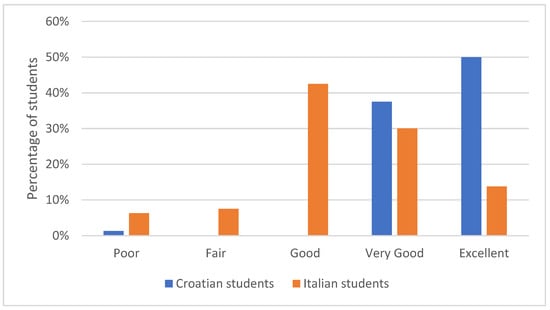
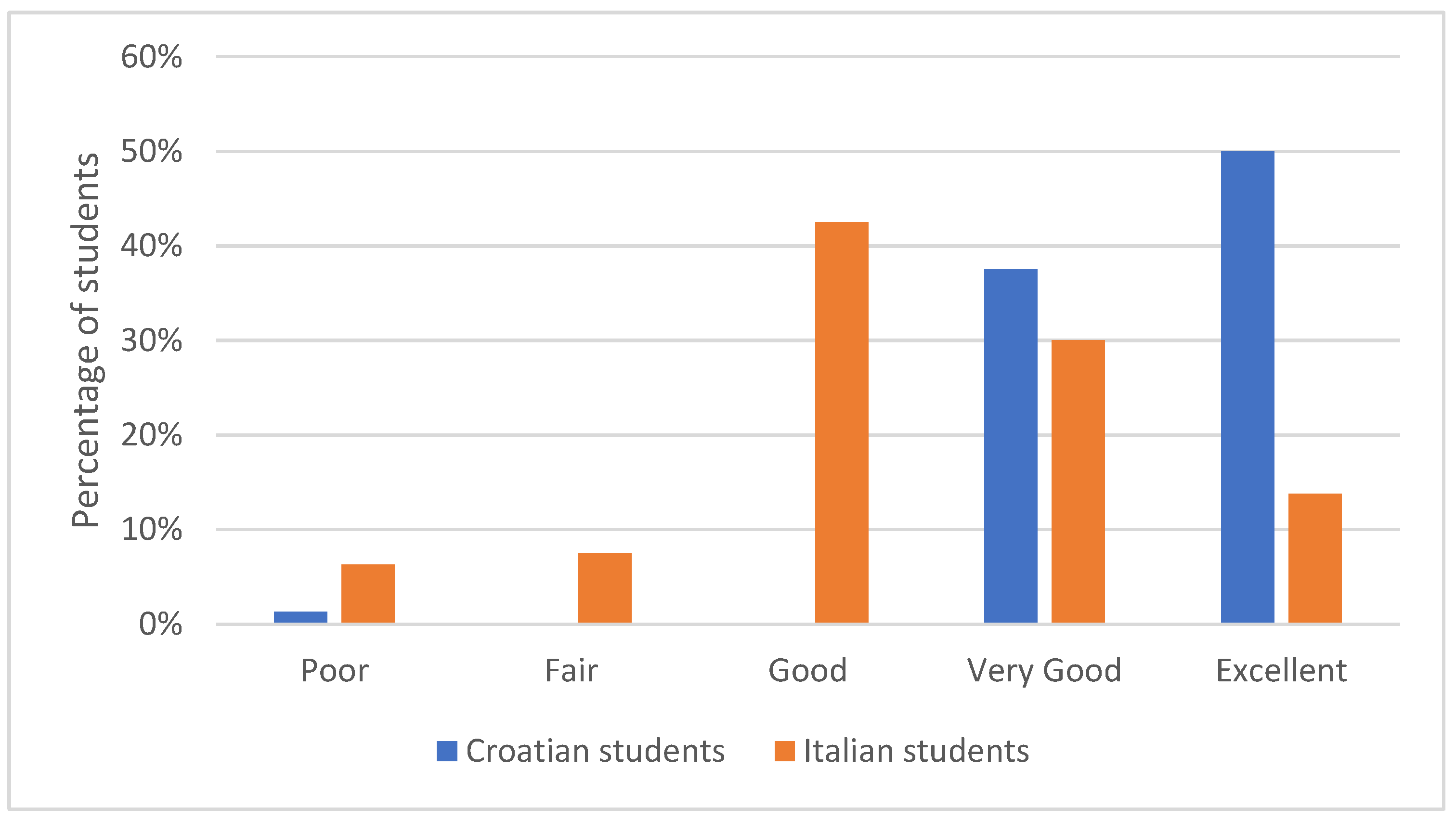
However, there were differences in the students’ self-assessment of L2 proficiency, as well as their exposure to L2 content. Participants rated their English proficiency on a 5-point scale (1 = poor, 2 = fair, 3 = good, 4 = very good, 5 = excellent). The original scale in the Croatian questionnaire was: 1 = loše, 2 = dovoljno, 3 = dobro, 4 = jako dobro, 5 = odlično. The original scale in the Italian questionnaire was: 1 = molto scarso, 2 = scarso, 3 = buono, 4 = molto buono, 5 = eccellente. Most Croatian students rated their L2 knowledge as excellent (N = 40, 50%), while most Italians reported their L2 knowledge was good (N = 34, 42.5%). The results are shown in Figure 1.
Figure 1.
Students’ self-assessed proficiency of L2 (English) knowledge (N = 160).
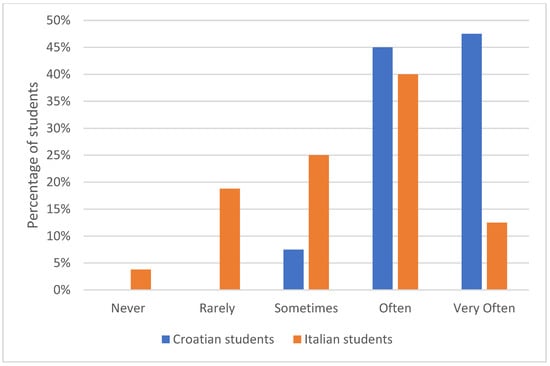
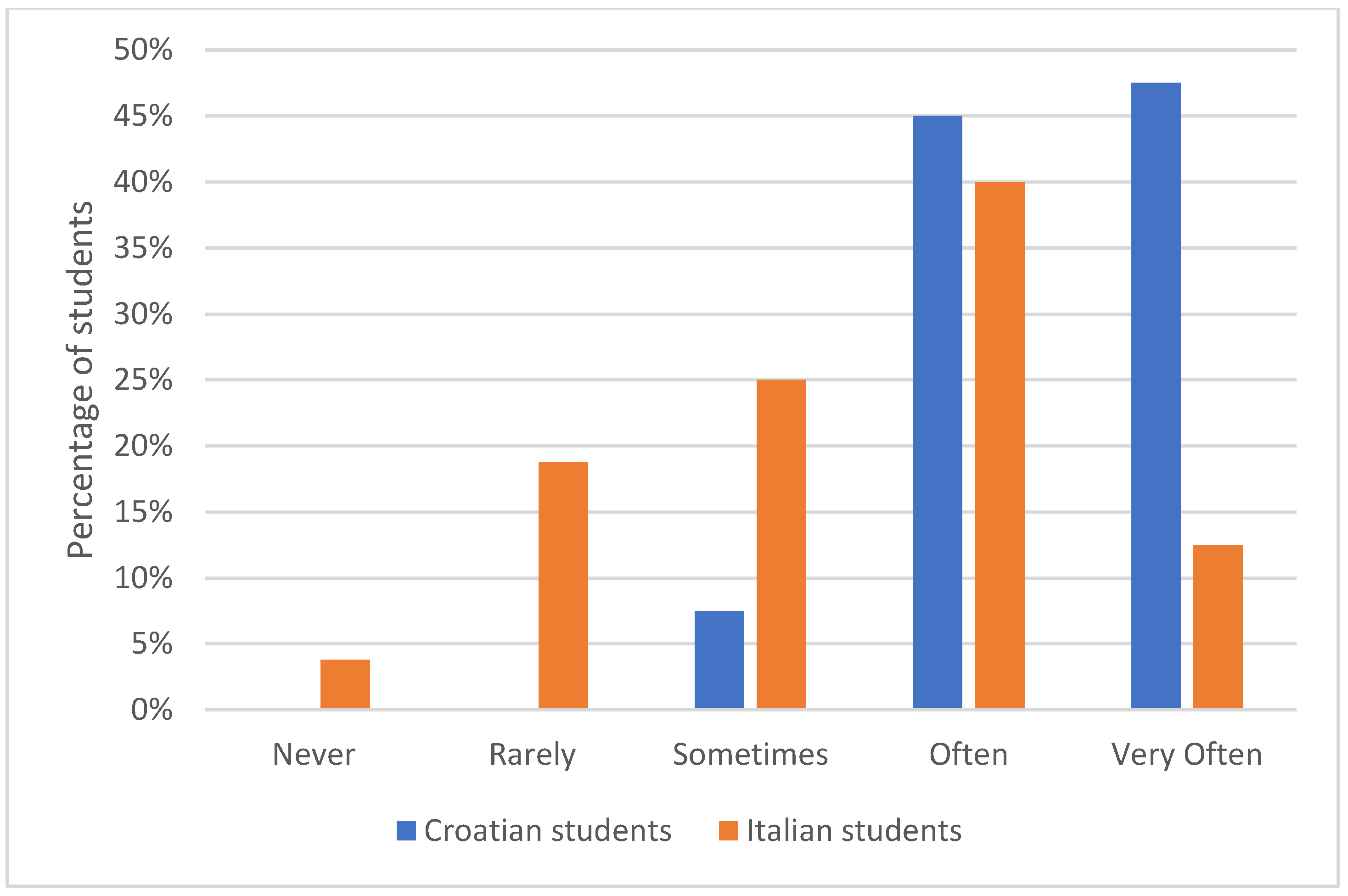
Participants were also asked to indicate, on a scale from 1 to 5 (1 = never, 2 = rarely, 3 = sometimes, 4 = often, 5 = very often), how often they were exposed to English language content. This included all forms of contact with the language, such as reading, listening, watching media, and interacting in English, without specifying each context in the questionnaire. The original scale in the Croatian questionnaire was 1 = nikada, 2 = rijetko, 3 = ponekad, 4 = često, 5 = vrlo često. The original scale in the Italian questionnaire was 1 = mai, 2 = raramente, 3 = a volte, 4 = spesso, 5 = molto spesso. Most Croatian students (47.5%) reported being very often exposed to L2 content, while most Italian students (40%) reported being often exposed to it. Also, 22.6% of Italian students reported never or rarely being exposed to content in L2, whereas none of the Croatian students selected either of these options. More precisely, 3.8% of Italian participants reported never being exposed to L2 content, and 18.8% reported being rarely exposed to it. The results are shown in Figure 2.
Figure 2.
Students’ exposure to content in L2 (English) (N = 160).
These results suggest a possible connection between students’ self-assessed L2 proficiency and their exposure to content in that language. If one is not exposed to a language sufficiently, the chances of becoming more proficient diminish. Although both the highest number of Croatian and Italian students began learning English at a similar age and studied it for a similar amount of time, exposure outside the classroom appears to play a crucial role (Dewaele, 2004). Croatian students reported greater exposure to English language content than Italian students, which seems to correspond with their higher self-assessed knowledge of English.
4.2. Perceived Offensiveness and Frequency of Use of Sex-Related Taboo Language in L1 and L2
As noted earlier, the questionnaire included 15 sex-related taboo words in the participants’ L1 and L2, and they were asked to rate the perceived offensiveness of each in both languages.
To reduce these 15 items to a smaller set of factors, an exploratory factor analysis was performed using the maximum likelihood extraction method with Varimax rotation. The exploratory factor analysis yielded two factors, which were labeled the Sexual Obscenities factor and the Technical Expressions factor. The labeling was inspired by the terminology used in Mabry’s study (Mabry, 1974). In his research, Mabry (1974) also performed a factor analysis and identified five distinct factors. One of these factors was named Technical Expressions. The words belonging to one of the remaining factors he described as “sexual obscenities” (Mabry, 1974, p. 388), hence the name of the second factor used in this study. According to Mabry (1974, p. 388), Sexual Obscenities refer to vulgar representations of sexual organs and activities, while Technical Expressions are seen as neutral expressions of organs or activities. The results of the exploratory factor analysis are presented in Table 1. Values represent factor loadings, which indicate the strength of the relationship between each word and the identified factor. Higher value equals stronger association.
Table 1.
Results of the exploratory factor analysis of the Sex-Related Taboo Language Questionnaire with Varimax rotation (N = 160).
The Sexual Obscenities factor includes ten items and accounts for 34.5% of the variance in perceived offensiveness of sex-related taboo language, while the Technical Expressions factor includes five items and explains an additional 28%. These two factors cumulatively explain 62.5% of the total variance in perceived offensiveness of sex-related taboo language, indicating that the majority of differences in perceived offensiveness can be understood in terms of these two categories.
Having established the factor structure, the primary variables of interest in this study, participants’ perceived offensiveness and frequency of use of sex-related taboo language, were examined. Descriptive statistics for these variables across the entire sample are presented in Table 2.
Table 2.
Descriptive statistics for the factors of the Sex-Related Taboo Language Questionnaire (N = 160).
Sexual obscenities are consistently rated as more offensive than technical expressions, in both L1 and L2. The mean perceived offensiveness of sex-related taboo words classified under the Sexual Obscenities (Factor 1) is slightly above the theoretical mean in both L1 and L2. In contrast, words under Technical Expressions (Factor 2) were rated as less offensive than the theoretical mean in both L1 and L2. Regarding frequency of use, the mean values for both Sexual Obscenities and Technical Expressions in L2 (English) are below the theoretical mean. In L1, the frequency mean value of the Sexual Obscenities in the oral form (M = 2.79) is slightly above the theoretical mean, whereas the frequency of use for Technical Expressions and written forms of taboo words was below the theoretical mean.
4.2.1. L1 vs. L2 Offensiveness
Previous studies examining taboo language mostly showed a difference in students’ perception of the offensiveness of sex-related taboo language in L1 and L2. Students would often perceive such language as more inappropriate in their L1 than in their L2. Dewaele (2004) and MacKay et al. (2002) measured the emotional force that taboo words carry in participants’ first and second languages. In both studies, participants exhibited stronger emotional reactions to taboo words in their L1. These words were perceived as carrying a stronger message, in other words, being more offensive than the same words in their second or other languages. Earlier research showed similar results, as Gonzalez-Reigosa’s (1976) participants experienced higher levels of anxiety when reading taboo words in their L1 than in their L2. To examine the difference in students’ perceived offensiveness of sex-related taboo language in their L1 and L2, paired samples t-tests were conducted on two previously identified factors, Sexual Obscenities and Technical Expressions. The results of these t-tests are shown in Table 3.
Table 3.
Results of the paired samples t-test examining the difference in students’ perceived offensiveness of sex-related taboo language in their L1 and L2 (N = 160).
The results indicate that for the Sexual Obscenities factor, the mean score was higher in L1 than in L2, with the difference being statistically significant (p < 0.05), with a small effect size. In other words, participants perceived the Sexual Obscenities factor of sex-related taboo language as more offensive in L1 than in L2. In contrast, no significant difference was found in the perceived offensiveness of the Technical Expressions factor between L1 and L2. Even though the mean score for Sexual Obscenities in L2 was lower than in L1, it was still above the theoretical mean value. This suggests that participants perceive the words belonging to the Sexual Obscenities factor as offensive in even their L2, although they are not as emotionally connected to it as they are to L1.
After examining the overall differences between L1 and L2, t-tests for independent samples were conducted to examine whether there is any difference in the participants’ perceived offensiveness of sex-related taboo words in L1 and L2 based on their nationality. The results are presented in Table 4.
Table 4.
The results of independent samples t-tests for examining the difference in perceived offensiveness of sex-related taboo language in the first language and second language between Croatian and Italian students (N = 160).
The results showed a difference in the perceived offensiveness of sex-related taboo language between Croatian and Italian students. More specifically, Italian students rated sex-related Technical Expressions in their L1 as more offensive than Croatian students did in their native language; this difference was statistically significant, with a small effect size. There was no statistically significant difference in the perceived offensiveness observed for other sex-related taboo language dimensions. Table 4 also indicates that Italian students perceive Technical Expressions in their L2 as more offensive than Croatian students do, although this difference is not statistically significant. This suggests that Italian students may find this group of words slightly more offensive than Croatian students in both their L1 and L2. The word that Croatian and Italian students rated as the most offensive in their L1 was the equivalent of cunt. In Croatian, that was pička, with a mean value of 3.45 ± 1.36. The Italian equivalent, fica, received a mean rating of 3.02 ± 1.37. This word, meaning its English equivalent, is considered one of the most offensive taboo words (Wajnryb, 2005, p. 66), which is consistent with the participants’ ratings. The results in L2 were somewhat different. The mean value for the word cunt was high for Croatian students (3.33 ± 1.29) but lower for Italian students (2.71 ± 1.25). This difference may be associated with Italian students’ lower proficiency levels in L2. Due to their lower proficiency, they might be less aware of the emotional impact that certain taboo words carry in their L2.
4.2.2. Relationship Between Religiosity and Perceived Offensiveness
When it comes to their religiosity, participants were asked to indicate, on a 1 to 5 scale (1 = I do not agree at all, 2 = I do not agree, 3 = I neither agree nor disagree, 4 = I agree, 5 = I completely agree) to what extent they agree with the following statement: “Religiosity is an important part of my life.” Previous research by Wright and Mokbel (2016, p. 5) demonstrated a positive correlation between participants’ level of religiosity and their perception of the offensiveness of taboo language. Participants who were generally accepting of taboo words tended to place less importance on religion. In contrast, those for whom religion played an important role in life reported the lowest rates of acceptance of taboo words and swearing. This study also examined the relationship between religiosity and the use of taboo language. Pearson correlation coefficients were calculated, and the results are presented in Table 5. Religiosity was measured on a 5-point Likert scale. Original scale in the Croatian questionnaire: 1 = uopće ne se slažem; 2 = ne slažem se; 3 = niti se slažem niti se ne slažem; 4 = slažem se; 5 = u potpunosti se slažem. Original scale in the Italian questionnaire: 1 = per niente d’accordo; 2 = disaccordo; 3 = né d’accordo né in disaccordo; 4 = d’accordo; 5 = molto d’accordo.
Table 5.
Correlation matrix between religiosity and perceived offensiveness of sex-related taboo language in L1 and L2 (N = 160).
Religiosity showed small positive correlations with perceived offensiveness for both Sexual Obscenities (r = 0.185, p < 0.05) and Technical Expressions (r = 0.231, p < 0.01) in L2 (English). However, the correlations between religiosity and the perceived offensiveness of taboo words in L1 were weak and statistically nonsignificant (r = 0.128 for Sexual Obscenities and r = 0.117 for Technical Expressions). These results indicate that more religious participants tended to rate both Sexual Obscenities and Technical Expressions sex-related taboo words in L2 as more offensive, whereas religiosity did not appear to significantly influence L1 ratings. A possible explanation for these findings may be found in the historical relationship between religion and taboo. In many societies, the Church historically played a central role in defining what was considered taboo or unholy (Allan & Burridge, 2006, p. 5). Its influence remains evident in some societies today. For instance, according to Crespo-Fernández (Crespo-Fernández, 2019, p. 41), societies with strong religious traditions tend to criticize and censor sex-related topics. Religious opinions can, therefore, be deeply rooted in an individual and may shape their broader worldview, including attitudes toward sexuality. When evaluating L2 expressions, which carry less emotional resonance than L1, participants may rely more on these moral frameworks, resulting in higher offensiveness ratings. In L1, however, strong emotional and social connotations might dominate perception, reducing the relative influence of religiosity.
4.3. Use of Sex-Related Taboo Language in L1 and L2
Previous studies on the usage of taboo language in L1 versus L2 have given relatively consistent results. For example, Harris et al. (2003) reported that most participants found it easier to say taboo words in their L2. This was due to a more significant emotional distance from those words, resulting in less reactivity to their meaning. Dewaele’s (2004) research supported similar conclusions. He reported that most participants preferred using taboo words in L2 because they felt too embarrassed to use their L1. To examine the difference in students’ use of sex-related taboo language in their L1 and L2, paired samples t-tests were performed. The results are shown in Table 6.
Table 6.
The results of the paired samples t-test for examining the difference in students’ use of sex-related taboo language in their L1 and L2 (N = 160).
The results indicate that sex-related taboo language is used more in students’ L1 than in their L2, both in oral and written communication, with medium effect sizes for both oral and written sexual obscenities and small effect sizes for oral and written technical expressions. Further analysis was done to examine if there are any differences in the use of sex-related taboo language in L1 versus L2 between Croatian and Italian students, in both oral and written form. Independent samples t-tests were conducted, with the results presented in Table 7.
Table 7.
Results of independent samples t-tests for examining the difference in the use of sex-related taboo language in L1 and L2 between Croatian and Italian students, in both oral and written form (N = 160).
The results indicate that Croatian students use sex-related taboo language more frequently than Italian students in both their first and second languages. All aspects were assessed, starting with the oral use of the Sexual Obscenities factor and the Technical Expressions factor. Croatian students’ mean scores for Sexual Obscenities (M = 3.07) were slightly above the theoretical mean value of the 1–5 scale (M = 3), while their score for Technical Expressions (M = 2.58) fell just below it. Italian students’ mean scores were below the theoretical mean value for both Sexual Obscenities (M = 2.50) and Technical Expressions (M = 2.08). Similar patterns were observed across other variables, with Croatian students consistently reporting higher scores than Italian students for both factors. These findings may suggest a greater overall familiarity or comfort among Croatian students with terms related to sex and sexuality compared to their Italian counterparts.
4.3.1. Self-Assessed L2 Proficiency and Sex-Related Taboo Language Use
According to Dewaele (2004), participants who are more proficient in L2 tend to use taboo words in that language more frequently. The present study aimed to test this same hypothesis in the context of sex-related taboo language. Similar to Dewaele’s (2004) methodology, data on participants’ proficiency levels were self-reported through a questionnaire. In this study, participants’ proficiency levels were calculated as an average score derived from two measures: self-assessed English language knowledge and exposure to English-language content. Those whose scores were above the average were categorized as more proficient, while less proficient participants scored below the average. To examine differences in the use of sex-related taboo language between proficiency groups, independent samples t-tests were conducted. The results are presented in Table 8.
Table 8.
Results of independent samples t-tests for examining the difference in the use of sex-related taboo language between students of different proficiency levels in L2 (N = 160).
Students who are more proficient in L2 reported using sex-related taboo language more frequently than less proficient students. This pattern was consistent across all four examined dimensions: the Sexual Obscenities and Technical Expressions factor, in both oral and written forms, with a medium effect size for oral sexual obscenities and small effect sizes for the remaining three dimensions.
4.3.2. Self-Assessed L2 Proficiency and Euphemism Knowledge
Previous research on general taboo language (Dewaele, 2004; Harris et al., 2003) suggests that the more proficient a person is in a language, the more likely they are to use it. Frequent use of a language implies a broader vocabulary. Therefore, this study examined whether more proficient L2 users could name more euphemisms for sex-related taboo words. Participants were asked to list all euphemisms they use in place of the 15 sex-related taboo words provided. Chi-square tests were used to assess whether there were statistically significant differences in the number of euphemisms listed between students of different L2 proficiency levels. The results are presented in Table 9.
Table 9.
The results of chi-square tests for examining the number of euphemisms for sex-related taboo words in L2 listed students of different proficiency levels (N = 160).
There was no difference in the number of euphemisms known for either sex-related taboo words or for the total number of euphemisms proposed by students of different proficiency levels. There was, however, some difference in the total number of euphemisms provided. Out of a total of 883 euphemisms collected, more proficient L2 users produced 219 euphemisms more than their counterparts. Also, they offered more euphemisms for 13 of the 15 taboo words presented. The words that received the highest number of euphemisms among both more and less proficient users of L2 were ass, dick, and tits. More proficient L2 users provided 57 euphemisms for the word ass, 63 euphemisms for the word dick, and 63 euphemisms for the word tits. In comparison, less proficient L2 users offered 30 euphemisms for ass, 33 for dick, and 32 for tits. Interestingly, less proficient L2 users provided more euphemisms for the word handjob, while the word blowjob received an equal number of euphemisms by both groups (see Table 9).
When it comes to euphemisms in the category of sex and sexuality, Crespo-Fernández (2019, p. 43) notes that one of the strongest indications that the topic of sex and sexuality is being talked about is the high number of synonyms and euphemisms for various sex-related terms. Such variety arises from the complexity of the topic. As shown in Table 9, the words that elicited the highest number of euphemisms among both more and less proficient L2 users are ass, dick, and tits. All three terms denote sexual body parts, which is one of the most common topics of conversation concerning sex and sexuality (Crespo-Fernández, 2019, p. 56). A closer examination of the word dick further supports existing findings in the literature. According to Allan and Burridge (1991), this word has around 1000 synonyms. Wajnryb (2005) states that it is often considered a derogatory term, which would imply people turning to other terms to mention it, that is, euphemisms. In this context, Crespo-Fernández (2019, p. 56) lists the word penis as a neutral expression that many individuals find more appropriate in conversation. In the present study, the word penis was the most common euphemism among both Croatian and Italian university students. More precisely, it accounted for 85.2% (N = 42) of the euphemisms presented by Croatian university students and 60.9% (N = 28) of the euphemisms presented by Italian students.
5. Discussion
The findings of this study offer a clearer picture of how bilingual speakers perceive and use sex-related taboo language in their L1 and L2, revealing that participants distinguished between emotionally charged obscenities and more neutral expressions. Words categorized as Sexual Obscenities were rated as more offensive than the theoretical mean in both L1 and L2, supporting the view that highly explicit terms are rated as more offensive across languages. In contrast, words categorized as Technical Expressions were consistently rated below the theoretical mean, reflecting their comparatively weaker emotional impact. Patterns of frequency of use further highlight cross-linguistic differences: in English (L2), both categories were used less frequently than the theoretical mean, which may reflect reduced emotional intensity of taboo words in a non-native language, lower confidence in producing such expressions, or heightened awareness of social appropriateness. In L1, however, oral use of Sexual Obscenities slightly exceeded the theoretical mean, suggesting greater ease and familiarity with using such terms in spontaneous speech. Taken together, these results point to a dual tendency: participants perceive obscenities as more offensive yet still use them in L1, while L2 use remains more restricted across both categories.
With regard to H1, which predicted that students would perceive such sex-related taboo expressions as more inappropriate in their L1 than in their L2, the results provide only partial support. As previously stated, participants rated words from the Sexual Obscenities factor as more offensive in their L1 than in their L2, while no significant differences emerged for the Technical Expressions factor. However, when comparing the words obtained from the exploratory factor analysis, a clear difference is evident between the two factors. The Sexual Obscenities factor includes words such as cunt, asshole, or fuck, which are generally considered some of the most offensive words. In contrast, the Technical Expressions factor includes items such as sex, lube, fetish, masturbation, and vibrator, which could be considered more neutral, descriptive terms. In this sense, the findings suggest a difference in the perception of words considered more neutral in society and those considered inappropriate. When focusing on the Sexual Obscenities factor, the results were consistent with previous research suggesting that the emotional force of words learned in L1 is stronger than that of any other subsequent language (Dewaele, 2004; Gonzalez-Reigosa, 1976; MacKay et al., 2002), and that the perceived offensiveness of taboo words is higher in bilinguals’ L1 compared to their L2 (Mormol, 2018).
The results for H2, which predicted that students would use sex-related taboo language more often in their L2 than in their L1, did not support the hypothesis. In other words, the results are inconsistent with previous research on the use of taboo language in L1 versus other languages. For instance, Harris et al. (2003) found that most participants used general taboo words in their L2 more often than in their L1. This was explained by the reduced emotional intensity that general taboo words may carry in the L2. Since the words in L2 were less emotionally charged, participants may have experienced them as less offensive and used them more comfortably. However, these studies did not focus on sex-related taboo words but on general taboo words or swearing. In fact, research specifically addressing sex-related taboo language remains limited. The sexual nature of these words may explain the observed patterns in this study. Authors such as Allan and Burridge (2006, p. 144) and Crespo-Fernández (2019, p. 44) explain how people engage in so-called sexual language. According to these authors, sex-related words can be used positively depending on the conversational function. It is not uncommon to use them for displaying affection or seducing one’s partner. Therefore, participants in this study may prefer using sex-related words in L1 to convey greater emotional intensity, rather than using the more emotionally distant terms in L2. Earlier research (Cashman, 1980; Wells, 1989) supports this pattern, showing that sex-related terms, especially Sexual Obscenities, were predominantly used in conversations with partners or close friends, while Technical Expressions, that is, medical terms and euphemisms, were reserved for other contexts. Even Dewaele’s (2004) study, although not focused on sex-related words, highlights situations in which speakers may prefer L1 over L2. He notes that participants who wanted the emotional force of certain taboo words to be conveyed clearly to their interlocutor tended to use their native language.
Regarding H3, the data support the prediction that self-assessed more proficient L2 users would use sex-related taboo language more often than less proficient students. These findings align with Dewaele’s (2004) findings on general taboo language. There was a statistically significant difference in all tested aspects, from oral Sexual Obscenities and Technical Expressions to written Sexual Obscenities and Technical Expressions. When comparing Croatian and Italian students, the data indicate that Croatian students use sex-related taboo language more frequently than Italian students in both their L1 and L2. Given that Croatian students reported higher L2 exposure and self-assessed proficiency, it is not unexpected that they frequently use sex-related words in that language. As Harris et al. (2003) and Dewaele (2004, p. 220) explain, individuals whose knowledge of L2 is not sufficient will avoid using it. A lack of understanding of a word’s meaning and emotional force will present the speaker with difficulties in choosing the appropriate contexts for its use. Moreover, since taboo language is typically learned outside the classroom, insufficient exposure to the language can lead to lower proficiency and, consequently, its limited use.
With regard to H4, the claim that students who assess themselves as more proficient in L2 would be able to name more euphemisms for sex-related taboo words was not supported, as the differences observed were not statistically significant. One possible explanation for the lack of significant differences may be the number of taboo words included in the task. It is possible that a smaller set of taboo words might have made the differences more pronounced; however, this remains speculative. Further research would be necessary to test this hypothesis more thoroughly.
Beyond the variables directly tested in this study, other individual differences may also influence how bilinguals perceive and use sex-related taboo language. Recent research on sexual taboo comprehension shows that learners who are reticent to discuss sexual topics have greater difficulty interpreting metaphorical sexual expressions, even when their L2 proficiency is high (Suñer & De Cock, 2023). This suggests that personality traits such as reluctance to use taboo language or discomfort with sexual topics may have influenced participants’ offensiveness ratings or their willingness to use such expressions. Although the present study collected data on religiosity, this variable does not allow strong conclusions about reticence, as religious individuals vary considerably in their openness to taboo usage. Future research should therefore consider incorporating direct measures of reticence or sociopragmatic stance toward taboo expressions to better understand how these factors interact with L1–L2 differences.
Taken together, these findings indicate that sex-related taboo language behaves differently from general taboo words in cross-linguistic contexts. These results, therefore, complicate the widely cited claim that bilinguals prefer their L2 for taboo language because it feels less emotionally charged. It appears that the participants’ greater reliance on their L1 is driven by factors such as L1 emotional closeness and heightened sociopragmatic confidence, which seem to be more important influences on usage than the emotional distance provided by the L2.
6. Conclusions
This study offers new insights into how bilingual individuals navigate the use of sex-related taboo language across their L1 and L2. The results indicate that participants generally perceive sex-related taboo words as more offensive in their L1 than in their L2. Interestingly, despite finding such words more offensive in their L1, participants reported using them more frequently in that language. This contrasts with previous research suggesting that bilingual speakers use their L2 when swearing due to its emotional distance, which makes offensive language feel less intense. However, those studies did not specifically focus on sex-related taboo words. The present findings suggest that participants may be choosing their L1 to emphasize the emotional impact of their message.
While these findings are insightful, the study has several limitations that should be addressed in future research. Firstly, the tests used here addressed only selected dimensions of language proficiency, such as self-perceived proficiency and frequency of use. They did not, however, include measures of production and interaction, meaning actual spoken and interactive language was not directly examined. Secondly, participants’ proficiency levels were self-assessed, relying on subjective judgment and thereby reducing the reliability of the data. Lastly, the specific contexts in which participants choose to discuss these topics should be examined in more detail, as different social and interpersonal contexts may influence language choice and the frequency of use of certain words.
Despite these limitations, this study makes a meaningful contribution and provides a foundation for further investigation into how bilinguals perceive and use sex-related taboo language, an area that has not yet been fully examined.
Author Contributions
Conceptualization, E.M. and I.P.; methodology, I.P.; validation, E.M. and I.P.; formal analysis, E.M.; investigation, E.M.; resources, I.P.; data curation, E.M.; writing—original draft preparation, E.M.; writing—review and editing, I.P.; visualization, I.P.; supervision, I.P. All authors have read and agreed to the published version of the manuscript.
Funding
This research received no external funding.
Institutional Review Board Statement
This study was conducted in accordance with the ethical standards of the institutional research committee at the Faculty of Humanities and Social Sciences, University of Split, and with the 1964 Helsinki Declaration and its later amendments or comparable ethical standards. The Ethics Committee of the Faculty of Humanities and Social Sciences in Split has considered the statements of the applicant’s respect for anonymity and voluntariness and taken the position that the proposed research is conducted by the Ethical Code of the Faculty of Humanities and Social Sciences in Split.
Informed Consent Statement
Informed consent was obtained from all subjects involved in the study.
Data Availability Statement
Dataset available on request from the authors.
Conflicts of Interest
The authors declare no conflicts of interest.
Abbreviations
The following abbreviations are used in this manuscript:
| L1 | First language |
| L2 | Second language |
| EFA | Exploratory factor analysis |
| H1 | Hypothesis 1 |
| H2 | Hypothesis 2 |
| H3 | Hypothesis 3 |
| H4 | Hypothesis 4 |
References
- Allan, K. (Ed.). (2019). Taboo words and language: An overview. In The oxford handbook of taboo words and language (pp. 1–27). Oxford University Press. [Google Scholar]
- Allan, K., & Burridge, K. (1991). Euphemism & dysphemism: Language used as shield and weapon. Oxford University Press. [Google Scholar]
- Allan, K., & Burridge, K. (2006). Forbidden words: Taboo and the censoring of language. Cambridge University Press. [Google Scholar]
- Beers Fägersten, K. (2012). Who’s swearing now? The social aspects of conversational swearing. Cambridge Scholars Publishing. [Google Scholar]
- Cameron, P. (1969). Frequency and kinds of words in various social settings, or what the hell’s going on? Pacific Sociological Review, 12(2), 101–104. [Google Scholar] [CrossRef] [Scilit]
- Cashman, P. (1980). Learning to talk about sex. Siecus Report, 9(1), 18–21. [Google Scholar]
- Cohen, J. (1988). Statistical power analysis for the behavioral sciences (2nd ed.). Lawrence Erlbaum Associates. [Google Scholar]
- Crespo-Fernández, E. (2019). Taboos in speaking of sex and sexuality. In K. Allan (Ed.), Oxford handbook of taboo words and language (pp. 41–60). Oxford University Press. [Google Scholar]
- Dewaele, J.-M. (2004). The emotional force of swearwords and taboo words in the speech of multilinguals. Journal of Multilingual and Multicultural Development, 25(2–3), 204–222. [Google Scholar] [CrossRef] [Scilit]
- Field, A. (2018). Discovering statistics using IBM SPSS statistics (5th ed.). Sage. [Google Scholar]
- Gonzalez-Reigosa, F. (1976). The anxiety-arousing effect of taboo words in bilinguals. In C. D. Spilberger, & R. Diaz-Guerrero (Eds.), Cross-cultural anxiety (pp. 89–105). Hemisphere. [Google Scholar]
- Harris, C. L., Ayçíçeğí, A., & Gleason, J. B. (2003). Taboo words and reprimands elicit greater autonomic reactivity in a first language than in a second language. Applied Psycholinguistics, 24(4), 561–579. [Google Scholar] [CrossRef] [Scilit]
- Jay, T. (2009). The utility and ubiquity of taboo words. Perspectives on Psychological Science, 4(2), 153–161. [Google Scholar] [CrossRef] [Scilit] [PubMed]
- Jay, T., Caldwell-Harris, C., & King, K. (2008). Recalling taboo and nontaboo words. The American Journal of Psychology, 121(1), 83–103. [Google Scholar] [CrossRef] [Scilit] [PubMed]
- Lewandowska-Tomaszczyk, B., Žitnik, S., Liebeskind, C., Valunaite Oleskevicienė, G., Bączkowska, A., Wilson, P. A., Trojszczak, M., Brač, I., Filipić, L., Ostroški Anić, A., Dontcheva-Navratilova, O., Borowiak, A., Despot, K., & Mitrović, J. (2023). Annotation scheme and evaluation: The case of offensive language. Rasprave, 49(1), 155–175. [Google Scholar]
- Mabry, E. A. (1974). Dimensions of profanity. Psychological Reports, 35(1), 387–391. [Google Scholar] [CrossRef] [Scilit]
- MacKay, D., Shafto, M., Taylor, J., Marian, D., Abrams, L., & Dyer, J. (2002, November 21–24). The taboo stroop and related effects of emotion on memory and attention. Annual Meeting of the Psychonomics Society, Kansas City, MO, USA. [Google Scholar]
- McEnery, T. (2006). Swearing in English: Bad language, purity and power from 1586 to the present. Routledge. [Google Scholar]
- Mormol, P. (2018). The perception of the offensiveness of swear words in L1 and L2 among English philology students. In Język i jego wyzwania: Język w kulturze, kultura w języku (pp. 95–107). Wydawnictwo Naukowe Akademii Nauk Stosowanych w Nowym Sączu. [Google Scholar]
- O’Driscoll, J. (2020). Offensive language: Taboo, offence and social control. Bloomsbury Academic. [Google Scholar]
- Pizarro Pedraza, A., Suñer, F., & De Cock, B. (2024). Beyond bleeps and bounds: The role of individual differences in understanding taboo language from TV series in the L2. Languages, 9(3), 74. [Google Scholar] [CrossRef] [Scilit]
- Stenström, A.-B. (1995). Taboos in teenage talk. Stockholm Studies in English, 85, 71–79. [Google Scholar]
- Sulpizio, S., Toti, M., Del Maschio, N., Costa, A., Fedeli, D., Job, R., & Abutalebi, J. (2019). Are you really cursing? Neural processing of taboo words in native and foreign language. Brain and Language, 194, 84–92. [Google Scholar] [CrossRef] [Scilit] [PubMed]
- Suñer, F., & De Cock, B. (2023). The role of reticence in language learners’ comprehension of metaphorical taboo expressions. International Journal of Applied Linguistics, 34, 746–761. [Google Scholar] [CrossRef] [Scilit]
- Wajnryb, R. (2005). Expletive deleted: A good look at bad language. Free Press. [Google Scholar]
- Wells, J. W. (1989). Sexual language usage in different interpersonal contexts: A comparison of gender and sexual orientation. Archives of Sexual Behavior, 18(2), 127–143. [Google Scholar] [CrossRef] [Scilit] [PubMed]
- Wright, C. L., & Mokbel, J. (2016). The media scapegoat and mom’s mouth: Influences on swearing. SAGE Open, 6(2), 2158244016651911. [Google Scholar] [CrossRef] [Scilit]

Disclaimer/Publisher’s Note: The statements, opinions and data contained in all publications are solely those of the individual author(s) and contributor(s) and not of MDPI and/or the editor(s). MDPI and/or the editor(s) disclaim responsibility for any injury to people or property resulting from any ideas, methods, instructions or products referred to in the content. |
© 2026 by the authors. Licensee MDPI, Basel, Switzerland. This article is an open access article distributed under the terms and conditions of the Creative Commons Attribution (CC BY) license.