You are currently viewing a new version of our website. To view the old version click .
  • Tracked forImpact Factor
  • 4.3CiteScore
  • 22 daysTime to First Decision

Solar, Volume 4, Issue 2

June 2024 - 7 articles

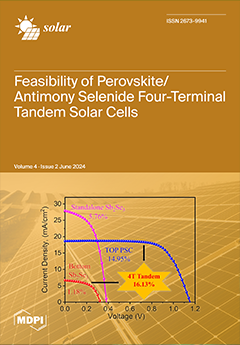
Cover Story: Tandem solar cell architecture by combining Wide Bandgap (WBG) and Narrow Bandgap (NBG) sub cells is an effective approach to overcome the Shockley–Queisser Limit. In this work, we explore the feasibility of a four-terminal (4T) mechanically stacked tandem architecture combining a WBG perovskite top cell and a NBG antimony selenide (Sb2Se3) bottom cell. To demonstrate the proof of concept, we simulated the 4T tandem using SCAPS-1D software with a 4T tandem efficiency of 23.14%. To validate this, we fabricated 4T tandem cells with a 1.6eV WBG PSC and bottom Sb2Se3 cells with a 4T tandem efficiency of 16.13%. The obtained results demonstrate promising device performance, showcasing the potential of combining PSC with Sb2Se3 thin-film solar technology to enhance overall device efficiency.
View this paper
  • Issues are regarded as officially published after their release is announced to the table of contents alert mailing list .
  • You may sign up for email alerts to receive table of contents of newly released issues.
  • PDF is the official format for papers published in both, html and pdf forms. To view the papers in pdf format, click on the "PDF Full-text" link, and use the free Adobe Reader to open them.

Articles (7)

  • Article
  • Open Access
4 Citations
3,780 Views
22 Pages

27 May 2024

As the demand for renewable energy sources continues to increase, solar energy is becoming an increasingly popular option. Therefore, effective training in solar energy systems design and operation is crucial to ensure the successful implementation o...

  • Article
  • Open Access
5 Citations
9,872 Views
22 Pages

21 May 2024

Jordan faces significant, immediate challenges of enhancing energy security while mitigating greenhouse gas emissions. One of the most promising approaches to achieve sustainable development, energy security, and environmental conservation is to incr...

  • Article
  • Open Access
3 Citations
2,037 Views
38 Pages

14 May 2024

This research develops and validates new decomposition models for hourly direct Normal Irradiance (DNI) estimations for Southern African data. Localised models were developed using data collected from the Southern African Universities Radiometric Net...

  • Article
  • Open Access
3 Citations
2,190 Views
23 Pages

28 April 2024

Maryland is actively working towards doubling its Renewable Portfolio Standard (RPS) target, aiming to increase the share of renewable energy from 25% by 2020 to 50% by 2030. Furthermore, Maryland stands out as a state that strongly supports solar in...

  • Article
  • Open Access
1 Citations
10,703 Views
14 Pages

Optimal Design of a Hybrid Solar–Battery–Diesel System: A Case Study of Galapagos Islands

  • Luis E. Garces-Palacios,
  • Carlos D. Rodríguez-Gallegos,
  • Fernando Vaca-Urbano,
  • Manuel S. Alvarez-Alvarado,
  • Oktoviano Gandhi and
  • César A. Rodríguez-Gallegos

6 April 2024

In this study, the sizing problem of hybrid diesel–photovoltaic–battery systems was determined using a particle swarm optimization approach. The goal was to optimize the number of solar panels and batteries that could be installed to redu...

  • Article
  • Open Access
3 Citations
2,708 Views
10 Pages

Exploring the Feasibility and Performance of Perovskite/Antimony Selenide Four-Terminal Tandem Solar Cells

  • Harigovind Menon,
  • Al Amin,
  • Xiaomeng Duan,
  • S. N. Vijayaraghavan,
  • Jacob Wall,
  • Wenjun Xiang,
  • Kausar Ali Khawaja and
  • Feng Yan

3 April 2024

The tandem solar cell presents a potential solution to surpass the Shockley–Queisser limit observed in single-junction solar cells. However, creating a tandem device that is both cost-effective and highly efficient poses a significant challenge...

  • Article
  • Open Access
2 Citations
2,032 Views
13 Pages

26 March 2024

We consider the restrictions on photovoltaic (PV) capacity that are caused by limitations on where panels can be sited and find quantitative evidence for the need for high efficiencies. We define 15% of the UK’s energy consumption as a “s...

Get Alerted

Add your email address to receive forthcoming issues of this journal.

XFacebookLinkedIn
Solar - ISSN 2673-9941