


Abstract
Hypersaline semi-enclosed seas impose physiological constraints on marine bivalves by increasing osmotic regulation costs and limiting somatic growth. This study examined life-history variation in natural populations of the pearl oyster Pinctada radiata across contrasting salinity regimes along the eastern and western coasts of Bahrain in the Arabian Gulf. Environmental conditions, shell morphometrics, growth modeling, oocyte abundance, physiological condition indicators, and the production-to-biomass ratio (P:B) were assessed to determine whether high salinity constrains somatic growth while reproductive persistence is maintained. Monthly surveys were conducted from June 2021 to May 2022 at one pearl oyster bed on each coast, comprising 12 surveys per coast. The two coasts formed a salinity gradient, averaging approximately 42‰ in the east and 55‰ in the west. Oysters from the western coast were smaller, with a mean shell height decreasing from 63.12 ± 6.47 mm in the east to 45.88 ± 3.41 mm in the west. The Gompertz model indicated a lower asymptotic shell height in the more saline population. The population-level P:B ratio was 0.23 yr−1 on the eastern coast and 7.46 yr−1 on the western coast. Despite reduced shell size, western oysters maintained strong seasonal oocyte abundance. The higher biomass turnover in the west partly reflected greater oyster density. This pattern is consistent with osmoregulatory costs and constrained shell biomineralization under chronic hypersalinity. Reproductive activity followed a bimodal pattern on both coasts. These findings are consistent with a life-history trade-off in which pearl oysters exposed to chronic salinity stress maintain reproductive activity despite constrained growth. Overall, this study links environmental forcing, growth limitation, population-level biomass turnover, and reproductive activity, providing field-based evidence that chronic hypersalinity constrains somatic growth while reproductive persistence is maintained in a benthic bivalve inhabiting hypersaline coastal systems under climate-related stress.
1. Introduction
Semi-enclosed coastal seas are environmentally demanding systems, as restricted water exchange, shallow bathymetry, high evaporation, and seasonal thermal variability can amplify salinity and temperature stress. The Arabian Gulf is a natural example of this setting. It is a shallow, semi-enclosed sea connected to the Arabian Sea and the wider Indian Ocean through the Strait of Hormuz and Gulf of Oman, with basin-scale salinity strongly influenced by restricted exchange and evaporative concentration, as described by Reynolds [1] and further examined by Ibrahim et al. [2]. In addition to hypersalinity, the Gulf experiences exceptionally high summer sea surface temperatures, placing resident organisms under chronic thermal and osmotic pressure [3]. These conditions make the Gulf a useful natural system for examining how marine organisms adjust growth, physiological conditions, and reproduction under persistent environmental stress.
Marine bivalves are suitable organisms for assessing biological responses to environmental variability, with their shell growth, tissue condition, and reproductive activity responding directly to local habitat conditions [4]. Bayne [5] emphasized that bivalve physiological performance is governed by energy acquisition and allocation between maintenance, growth, and reproduction. From a bioenergetic perspective, environmental stress can increase maintenance costs and reduce the energy available for fitness-related functions such as growth, biomass production, and reproduction [6]. In bivalves, salinity-driven osmoregulatory demands can, therefore, alter energy allocation between maintenance, somatic growth, and reproductive processes [7]. However, these functions may not be affected equally; growth may be constrained while reproductive activity persists, producing a life-history trade-off rather than uniform biological suppression.
Salinity stress is particularly relevant for pearl oysters, as osmotic regulation requires metabolic energy that could otherwise support shell deposition, tissue growth, storage reserves, or gametogenesis. Experimental work on Pinctada fucata showed that salinity stress alters osmotic pressure, ion regulation, respiratory metabolism, and antioxidant responses, demonstrating that departures from normal seawater salinity impose measurable physiological costs in pearl oysters [8]. These costs may reduce growth potential without necessarily suppressing reproductive function to the same degree. Distinguishing between reproductive suppression and reproductive persistence is essential for understanding how pearl oysters persist in extreme coastal environments.
The pearl oyster Pinctada radiata (Leach, 1814) is a suspension-feeding benthic bivalve inhabiting shallow coastal environments, where it attaches to suitable substrates and contributes to benthic ecosystem functioning [5,9]. It is also culturally significant because of its association with natural pearl formation in Bahrain and the wider Gulf region. Earlier work in Bahrain reported that environmental conditions influence pearl oyster growth and population characteristics, with salinity considered an important factor shaping regional variation in oyster size [9]. Reproductive studies also showed that spawning activity in P. radiata is seasonal and linked to environmental cues, particularly temperature variation [10]. More recently, Khalifa et al. [11] showed that reproductive timing in P. radiata may shift under changing environmental conditions, reinforcing the sensitivity of reproductive activity to environmental conditions in Gulf populations.
Studies outside the Gulf further show that P. radiata growth and reproduction are context-dependent. Yigitkurt [12] linked gonadal development and the condition index in P. imbricata radiata to seasonal environmental variation, while Pafras et al. [13] examined seasonal reproductive development in Mediterranean P. radiata using microscopic and macroscopic gonadal assessment. Seasonal reproductive dynamics and gonad development have similarly been used to interpret bivalve population responses to local environmental conditions [14]. Earlier studies in Bahrain provided important baseline knowledge on P. radiata biology [9,15], while integrated biological assessments under natural salinity gradients remain limited. Although these components are commonly assessed in bivalve ecology, their integration remains limited for P. radiata populations in the region. Fewer studies have integrated these components within a single life-history framework under a natural salinity gradient.
The eastern and western coasts of Bahrain provide a natural field comparison of P. radiata populations under contrasting salinity conditions. The eastern coast represents a lower-salinity habitat within the Arabian Gulf, whereas the western coast is exposed to markedly higher-salinity conditions. The null hypothesis predicted no differences between populations in growth, physiological condition, biomass turnover, or reproductive activity. The alternative hypothesis predicted reduced somatic growth and biomass accumulation in the hypersaline western population, while reproductive activity remained stable. As this study compared natural coastal populations, salinity was not isolated from other site-specific environmental differences and was, therefore, interpreted as a major rather than exclusive driver. If high salinity broadly suppresses biological performance, oysters from the more saline coast should show reduced growth and reduced reproductive activity. Conversely, if reproductive function persists despite reduced shell size and lower biomass accumulation, this will indicate a life-history trade-off in which reproductive persistence is maintained under chronic salinity stress.
This study examined life-history variation in natural populations of P. radiata across contrasting salinity regimes along the eastern and western coasts of Bahrain. Specifically, it assessed environmental salinity and seabed temperature, shell height and shell length, growth modeling, oocyte abundance, physiological condition indicators, and the production-to-biomass ratio. The main objective was to determine whether the more saline western habitat is associated with constrained somatic growth while reproductive activity is maintained. The central hypothesis was that chronic salinity stress is associated with constrained growth and biomass accumulation, while reproductive persistence is maintained through seasonal oocyte abundance and bimodal reproductive activity.
2. Materials and Methods
2.1. Study Area and Sampling Design
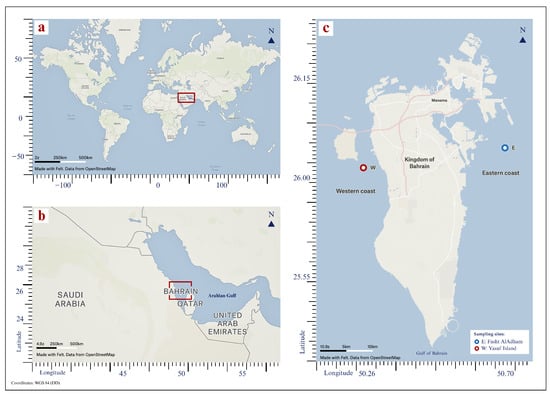
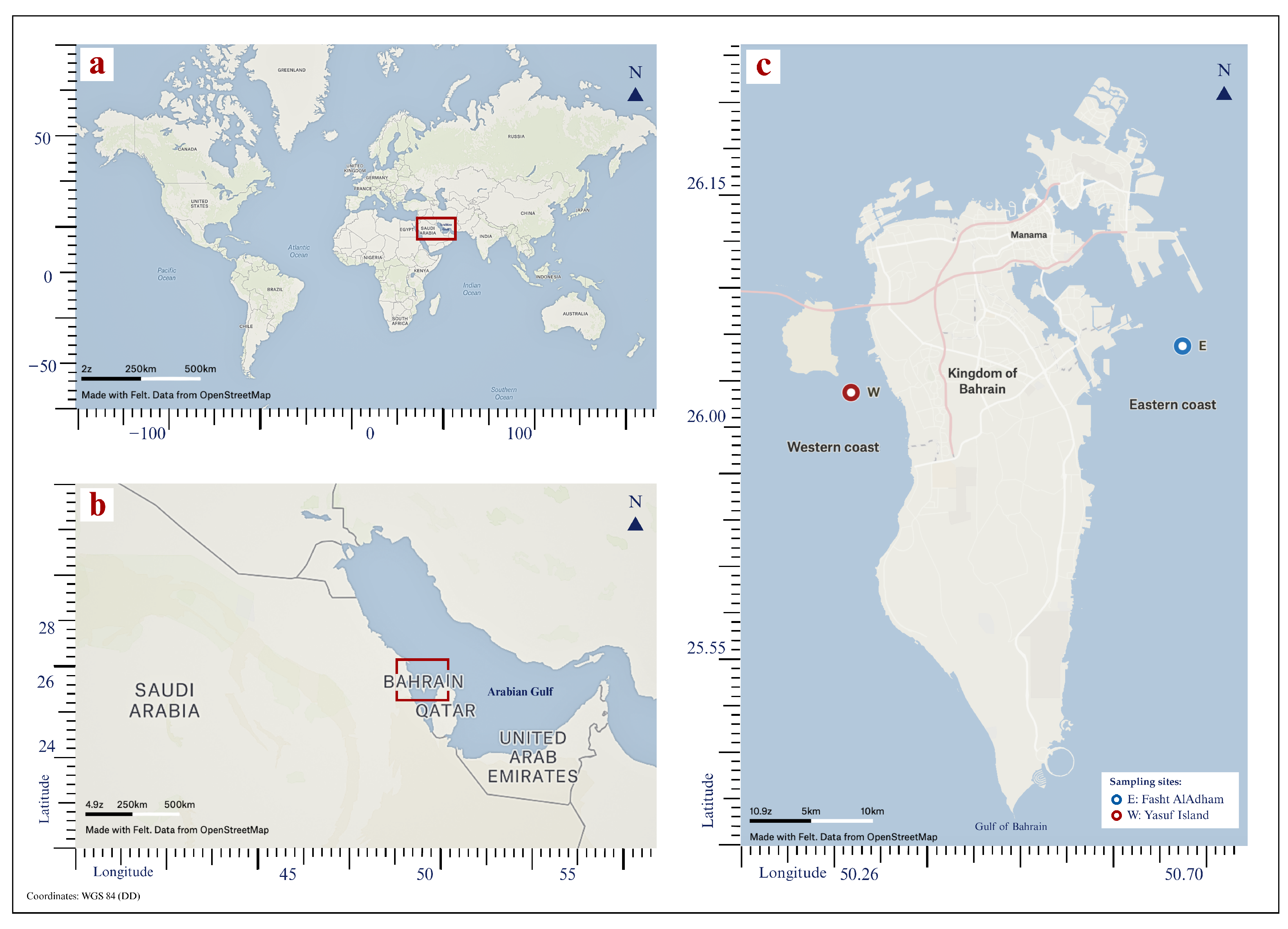
This study was conducted on natural populations of P. radiata along the eastern coast (Fasht AlAdham) and western coast (Yasuf Island) of Bahrain, the Arabian Gulf, from June 2021 to May 2022. The two coasts were selected to represent contrasting salinity regimes within a shallow, semi-enclosed, hypersaline sea. The eastern coast represents a lower-salinity habitat, whereas the western coast is exposed to higher-salinity conditions (Figure 1).
Figure 1.
Location of the study area and sampling sites. (a) Global location, (b) regional location within the Arabian Gulf, and (c) eastern and western coastal sampling sites in Bahrain waters. The two sites represent contrasting salinity conditions used to assess biological responses in natural populations of P. radiata.
The two sites were selected to represent the principal ecological population types identified from previous surveys of P. radiata in Bahrain waters. The eastern site represents the typical open-water population, with shell sizes and environmental conditions broadly consistent with other established pearl-oyster grounds in Bahrain. The western site represents the principal persistent population within the hypersaline western coastal system, where consistently smaller-bodied oysters have been documented. Both sites supported established natural oyster beds suitable for standardized monthly sampling and year-round comparison of population structure, growth, physiological condition, and reproduction.
A total of 24 monthly field surveys were conducted from June 2021 to May 2022, with 12 surveys on each coast. In each survey, oyster density was recorded in situ by SCUBA divers using three randomly placed 1 m2 quadrats and expressed as oysters m−2, following commonly applied quadrat-based approaches for benthic oyster population surveys [16,17,18]. The collected oysters were stored in labeled polythene bags; kept in ice-cooled containers; and transported to the laboratory for morphometric, reproductive, physiological, and growth analyses. The sampling design and site profile are summarized in Table 1, while detailed monthly density data are presented in Table S1.
Table 1.
Sampling design and site profile.
Across the study period, morphometric measurements were obtained from 325 oysters collected from the eastern coast and 320 oysters from the western coast. Monthly reproductive analyses were conducted on samples of 30–50 oysters per coast, from which ten mature females were selected for quantitative oocyte counts. Physiological condition and biomass analyses were performed on the same monthly collections, as described in the corresponding sections below. Sample sizes for individual analyses are also indicated in the relevant sections and tables where applicable.
The two sampling sites represented an east–west salinity gradient along the coast of Bahrain. The eastern coast had a relatively lower annual mean salinity, whereas the western coast had a markedly higher annual mean salinity. This contrast provided the environmental basis for comparing shell growth, physiological condition, biomass turnover, and reproductive activity in natural populations of P. radiata.
2.2. Environmental Measurements
Environmental parameters were recorded monthly at each coast. Salinity was measured using an ATAGO S/Mill refractometer (ATAGO Co., Ltd., Tokyo, Japan). Seabed temperature, pH, and dissolved oxygen were measured using Thermo Scientific ORION STAR meters, models A121 and A223 (Thermo Fisher Scientific, Waltham, MA, USA). In this study, salinity and seabed temperature were retained as the main environmental variables owing to their direct relevance to the growth–reproduction hypothesis.
2.3. Morphometric Measurements
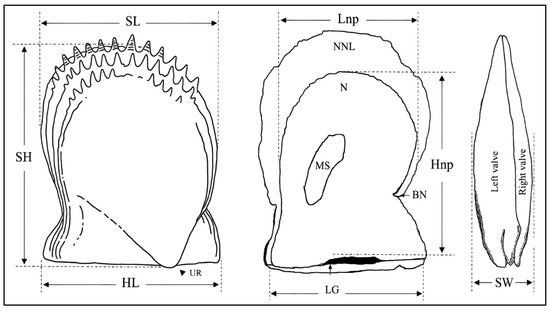
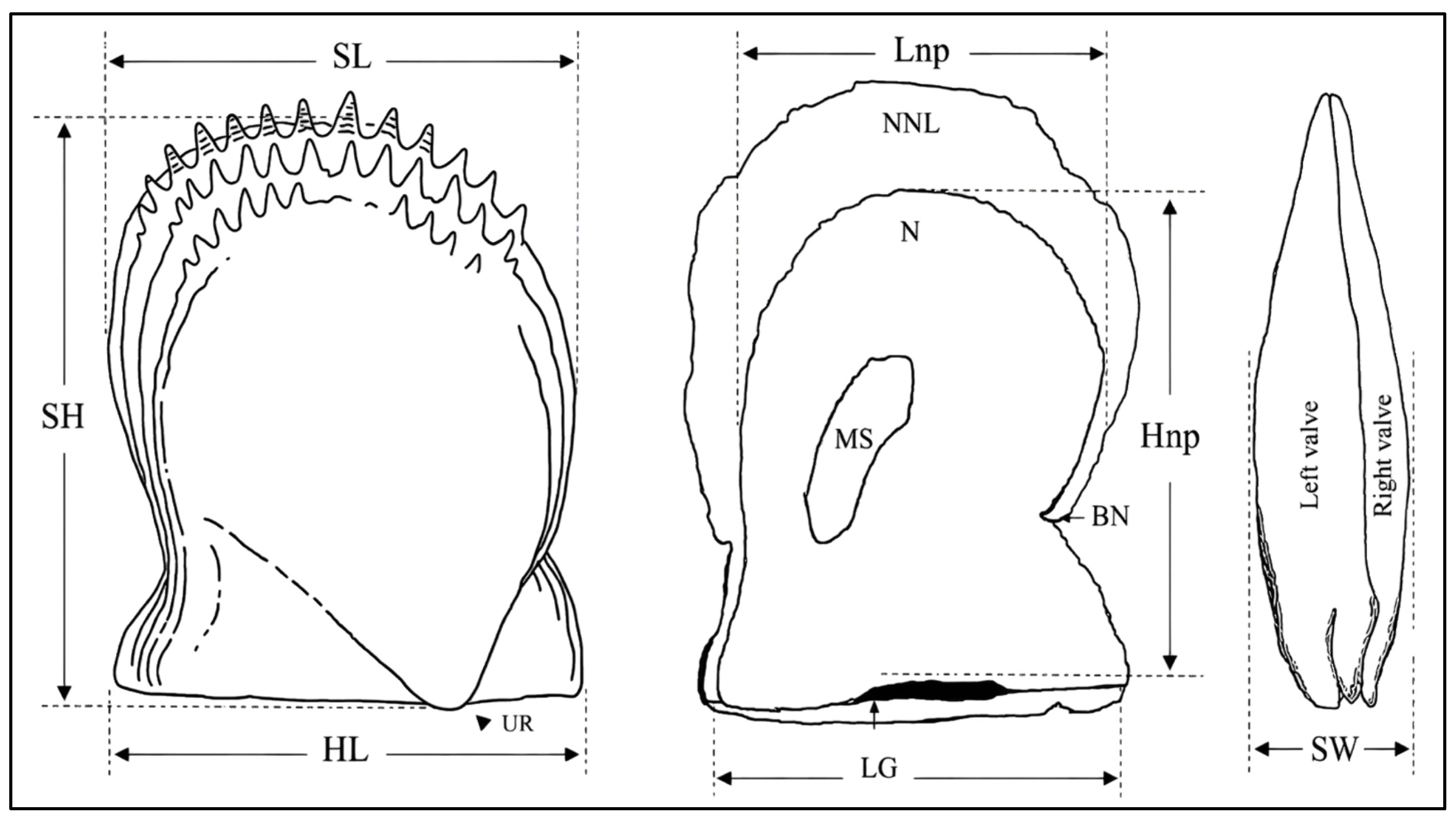
In the laboratory, the oysters were cleaned, numbered, and measured using a Mitutoyo digital caliper with a 0–150 mm measuring range and a 0.01 mm resolution (Mitutoyo Corporation, Kawasaki, Japan). The main morphometric traits recorded were shell height (SH), shell length (SL), hinge length (HL), and shell width (SW), following measurement approaches commonly applied in pearl oyster studies [19,20,21]. SH refers to the dorso-ventral axis, while SL refers to the antero-posterior axis. Nacreous part height (Hnp) and nacreous part length (Lnp) were also recorded and are summarized with the main annual morphometric measurements in Table 2. The measurement scheme is shown in Figure 2.
Table 2.
Annual morphometric comparison.
Figure 2.
Morphometric measurement scheme for P. radiata. The main measurements used in this study were shell height (SH), shell length (SL), hinge length (HL), and shell width (SW). Additional features shown include nacreous part length (Lnp), nacreous part height (Hnp), nacreous layer (N), non-nacreous layer (NNL), muscle scar (MS), byssal notch (BN), ligament groove (LG), and umbonal region (UR).
2.4. Gonad Maturation and Oocyte Counts
Reproductive activity was assessed using a gamete-counting technique previously applied in pearl oyster studies [10,22,23,24,25]. Monthly samples of 30–50 oysters were examined from each coast. For quantitative oocyte analyses, ten mature female oysters were selected from each monthly sample, resulting in a standardized monthly sample size for reproductive comparisons. The oysters were opened by cutting the adductor muscle, and gonad color and distribution were visually observed. Gonad smears were examined under a compound binocular microscope at 10× to 40× magnification to identify oocytes and spermatozoa.
For oocyte counts, the procedure was repeated until ten female oysters were obtained from each monthly sample. Approximately 1–2 mm of gonad tissue was dissected from the area above the foot and below the mantle, weighed using a four-digit electric balance, and homogenized with 10 mL of filtered seawater using a 15 mL glass homogenizer. A 1 mL aliquot was transferred to a Sedgewick–Rafter counting chamber. Intact oocytes were counted in five squares: one at each corner and one in the center. The mean count was used to estimate total oocyte abundance and expressed as oocytes ×105 g−1 gonad wet weight. The counting chamber setup is provided in Figure S1.
Monthly oocyte abundance was used as the primary reproductive metric. Peaks in oocyte abundance were interpreted as advanced gonad maturation, while marked declines after peaks were interpreted as spawning or oocyte release.
2.5. Physiological Condition and Biomass Indicators
Physiological condition and biomass measurements were performed on all 645 oysters collected during the monthly surveys, comprising 325 individuals from the eastern coast and 320 from the western coast. Soft tissues from each specimen were oven-dried and subsequently ashed in a muffle furnace to determine the tissue dry weight (TDW), ash-free dry weight (AFDW), tissue water content (TWC), and condition index (CI). The soft tissues were removed, drained, blotted, and weighed to obtain the wet tissue weight. The samples were dried at 70 °C for 24 h, cooled in a desiccator, and reweighed to determine the TDW. The dried tissues were then ashed in a muffle furnace at 550 °C for 6 h. The AFDW was calculated by subtracting the ash weight from the TDW.
The TWC was calculated as the difference between wet and dry tissue weights relative to the wet tissue weight. The CI was calculated as
where CI is the condition index, TDW is tissue dry weight, and SW is shell weight, following approaches previously used to assess physiological condition and reproductive status in oysters and pearl oysters [10,23,24]. These indicators were used to evaluate tissue condition, biomass accumulation, and their relationship with reproductive activity.
2.6. Biomass Turnover and Production-to-Biomass Ratio
AFDW-based biomass estimates were used to calculate secondary production and the production-to-biomass ratio (P:B). Annual secondary production was estimated using a size–frequency increment–summation approach based on monthly data from each coast. For each month, oysters were assigned to 2 mm shell height classes, and the density (individuals m−2) and mean ash-free dry weight of each class were determined. Monthly class values were combined to derive the annual mean density for each size class. Production within each class was then calculated from this density and the corresponding ash-free dry-weight increment between successive size classes, and class-specific values were summed to obtain the annual secondary production (g AFDW m−2 yr−1) for each coast. Secondary production and the P:B ratio are used to describe biomass production, turnover, and population-level energy flow in benthic organisms [26,27]. The P:B ratio was calculated as
where P:B is the production-to-biomass ratio. In this study, the P:B ratio was interpreted as an indicator of biomass turnover. It was used to assess whether the more saline western population showed lower biomass accumulation and higher turnover while maintaining reproductive activity.
2.7. Growth Modeling
Growth was evaluated using SH data. Three growth models—Gompertz, Logistic, and Monomolecular—were initially tested, following established approaches for bivalve growth assessment [28]. The Gompertz model describes asymmetrical sigmoidal growth in which growth is initially rapid and progressively decreases as size approaches an asymptotic limit [29]. Model fitting included calculating average SH, estimating growth increments, applying regression-based parameter estimation, and comparing observed and predicted growth curves. The Gompertz model was retained as the main model based on its fit to the observed growth pattern and allowed direct comparison of asymptotic shell size between coasts. A concise model comparison summary is provided in Table S2.
The Gompertz growth rate equation was expressed as
where is the shell height at time , is the asymptotic shell height, and is the growth coefficient.
2.8. Statistical Analyses
Descriptive statistics were calculated for environmental, morphometric, reproductive, physiological, biomass, and growth variables. Values are reported as means ± SD in tables, while graphical error bars represent SE where applicable. One-way analysis of variance (ANOVA) was used to test monthly variation, followed by Tukey’s post hoc test when significant differences were detected. Before inferential analyses, the data were assessed for normality using the Anderson–Darling test and for homogeneity of variances using Levene’s test. Because the assumptions of normality and homogeneity of variances were not met for shell height (SH) and shell length (SL), differences between the eastern and western coasts were evaluated using the Mann–Whitney U test. The mean monthly condition index and oocyte abundance were compared separately between the eastern and western coasts using paired-samples t-tests, with corresponding months treated as matched temporal observations. Statistical significance was set at p < 0.05. Size–frequency distributions were prepared using 5 mm SH class intervals. Polynomial regression was used to evaluate relationships between seabed temperature and oocyte abundance, while simple linear regression and Pearson correlation analyses were used to examine relationships between salinity, seabed temperature, shell height, physiological condition indicators, AFDW, and oocyte abundance. Analyses were performed using Minitab Statistical Software (Version 21.1.0) and Microsoft Excel (Version 16.94).
3. Results
3.1. Salinity Gradient as the Environmental Context for Biological Responses
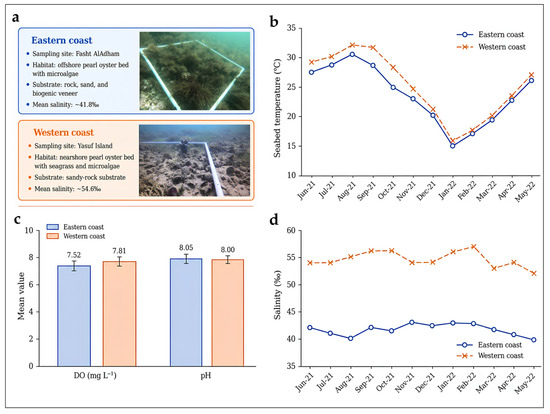
The eastern and western coasts showed a marked environmental contrast, with salinity forming the main gradient between the two populations (Figure 3). The mean salinity was approximately 41.8‰ on the eastern coast and 54.6‰ on the western coast, confirming that the western population was exposed to higher-salinity conditions. Monthly salinity values remained consistently higher on the western coast throughout the study period, while seabed temperature followed a seasonal pattern on both coasts. This environmental contrast underpinned comparisons of growth, physiological condition, biomass turnover, and reproductive activity.
Figure 3.
Habitat profile and environmental contrast between the eastern and western pearl oyster beds in Bahrain. (a) Habitat characteristics, substrate composition, and representative underwater views of the two study sites. (b) Monthly seabed temperature. (c) Mean dissolved oxygen (DO) and pH. (d) Monthly salinity recorded throughout the study period.
3.2. Morphometric Evidence of Growth Limitation
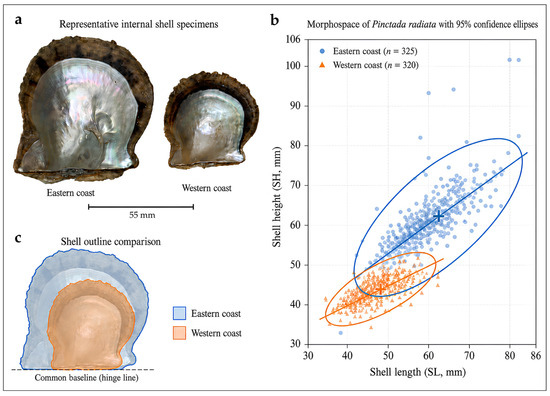
Pearl oysters from the western coast were consistently smaller than those from the eastern coast across all main shell traits. The mean shell height (SH) was 63.12 ± 6.47 mm on the eastern coast and 45.88 ± 3.41 mm on the western coast. Mann–Whitney U tests confirmed that shell height (SH) (U = 144.0; p < 0.001) and shell length (SL) (U = 144.0; p < 0.001) differed significantly between the two coasts. Shell length (SL), hinge length (HL), and shell width (SW) followed the same pattern, with higher values recorded in the eastern population (Table 2). These findings indicate significantly smaller shell dimensions in oysters from the hypersaline western coast. The SH–SL morphospace further supported this pattern by showing a distinct separation between the eastern and western pearl oyster populations (Figure 4). The eastern population occupied a larger morphometric space, with higher SH and SL values and a broader 95% confidence ellipse, whereas the western population formed a compact lower-size cluster. This pattern confirms that western oysters showed reduced shell dimensions and a narrower morphometric range.
Figure 4.
Morphospace and shell morphology comparison of eastern and western pearl oyster populations. (a) Representative internal shell specimens from the eastern and western coasts. (b) SH–SL morphospace based on individual shell measurements, showing fitted regression lines, group centroids, and 95% confidence ellipses for the eastern and western coasts. (c) Shell outline comparison aligned to a common baseline, illustrating the relative differences in shell size and shape between populations.
3.3. Gompertz Growth Modeling
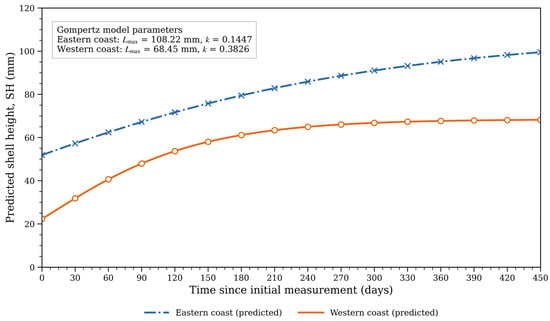
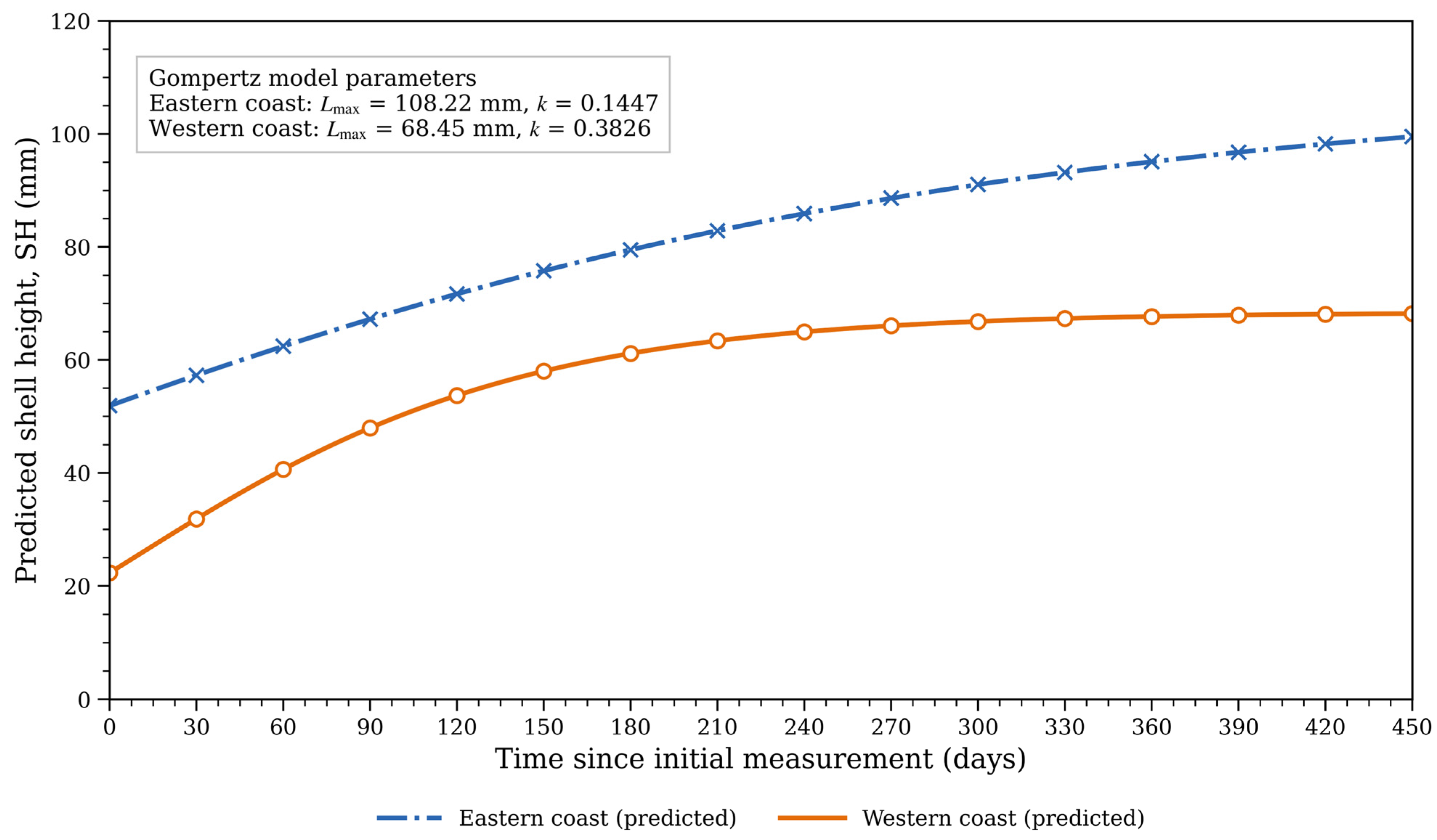
Growth modeling confirmed the morphometric pattern. Among the Gompertz, logistic, and monomolecular models evaluated, the Gompertz model provided the most appropriate fit to the observed growth pattern and was retained for the main east–west comparison (Table S2). The eastern population showed a larger estimated asymptotic shell height, with = 108.22 mm. In contrast, the western population showed a lower estimated asymptotic shell height, with = 68.45 mm (Table 3). This result is consistent with lower growth potential in the more saline western habitat (Figure 5).
Table 3.
Observed and predicted shell height based on the Gompertz growth model.
Figure 5.
Gompertz growth curves for eastern and western populations of P. radiata.
The curves show the model-predicted shell height (SH) over time since the initial measurement, based on the Gompertz growth model. Time is expressed in 30-day intervals, and symbols indicate predicted values at each interval. The eastern population showed a higher predicted asymptotic shell height than the western population, indicating greater growth potential under relatively lower-salinity conditions. A concise comparison with the logistic and monomolecular models is provided in Table S2.
3.4. Seasonal Reproductive Activity and Oocyte Abundance
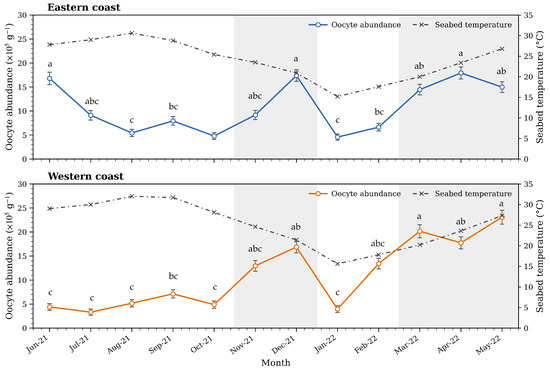
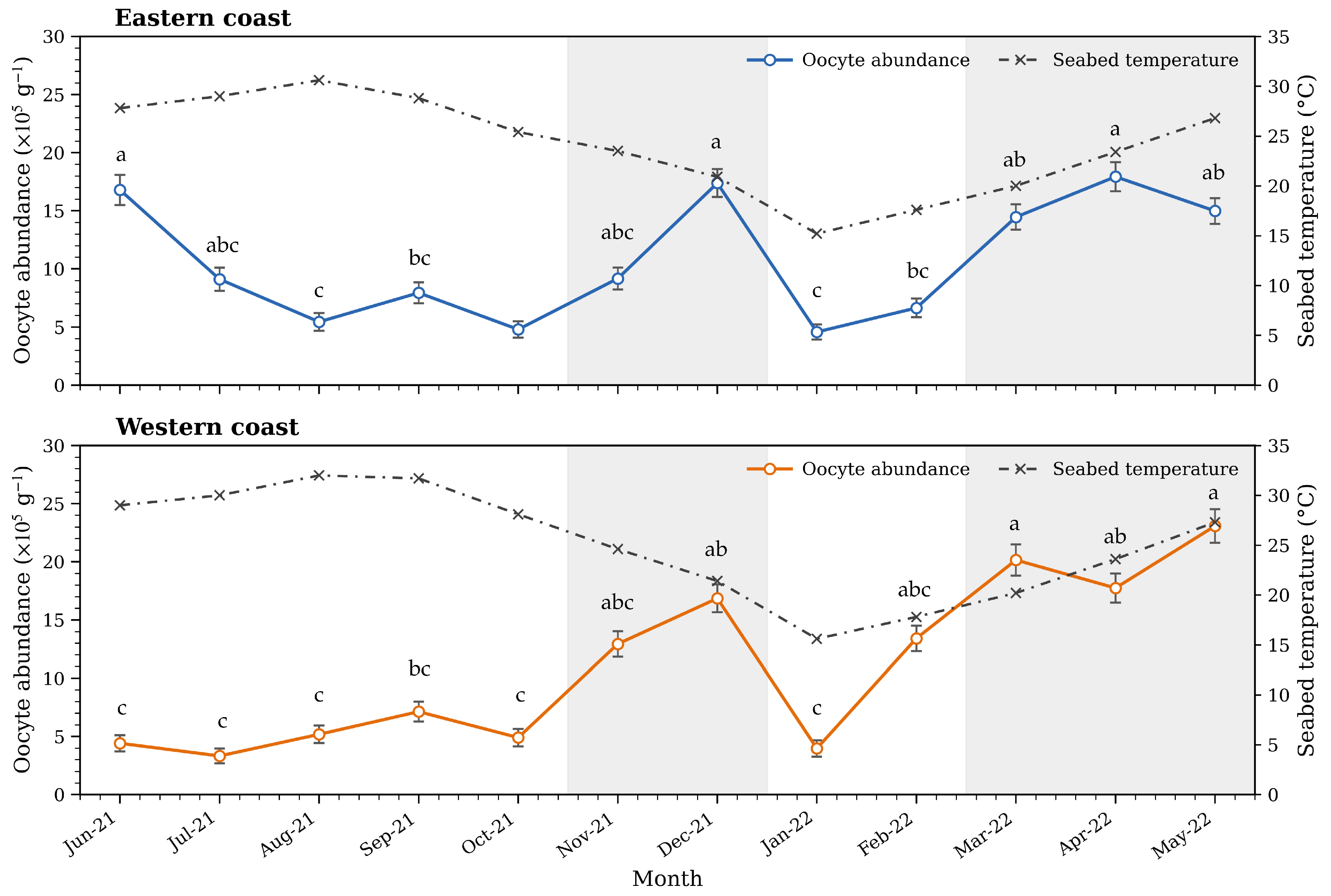
Both populations exhibited a consistent bimodal pattern comprising two periods of elevated oocyte abundance separated by marked declines (Figure 6). On the eastern coast, elevated reproductive activity occurred during November–December and again from March to May, with the second period remaining elevated at the final May observation. Oocyte abundance reached 17.38 ×10⁵ oocytes g−1 gonad wet weight in December and 17.93 ×10⁵ oocytes g−1 gonad wet weight in April. Oocyte abundance was standardized to gonad wet weight; accordingly, the higher western value represents greater oocyte abundance per gram of wet gonad tissue rather than greater total fecundity per individual. On the western coast, elevated reproductive activity occurred during November–December and again from February to May, with a pronounced decline in January separating the two periods. The highest monthly value, 23.08 × 10⁵ oocytes g−1 gonad wet weight, was recorded in May. The overall bimodal pattern was consistent between coasts, although the second period began earlier on the western coast.
Figure 6.
Monthly oocyte abundance in P. radiata from the eastern and western coasts. Oocyte abundance is expressed as monthly mean counts ×105 g−1 gonad wet weight and is shown on the left y-axis, while seabed temperature is shown on the right y-axis. Shaded areas indicate the two broadly shared periods of elevated oocyte abundance defining the common bimodal pattern across both populations. Minor timing differences may reflect site-depth effects on local thermal conditions. The eastern population showed elevated reproductive activity during November–December and March–May, whereas the western population showed an extended period during November–December, followed by a second marked period during February–May. Different letters indicate significant differences between months within each coast (one-way ANOVA followed by Tukey’s HSD test; p < 0.05).
3.5. Physiological Condition, Biomass Turnover, and Reproductive Activity
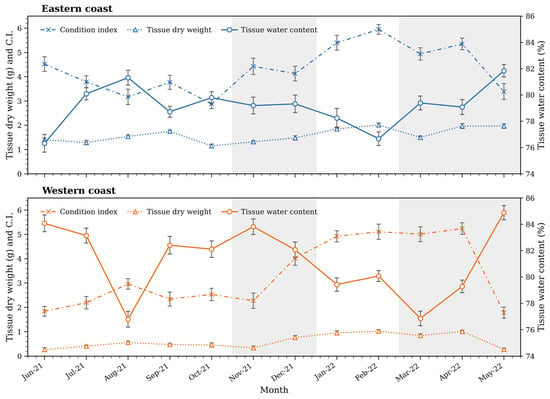
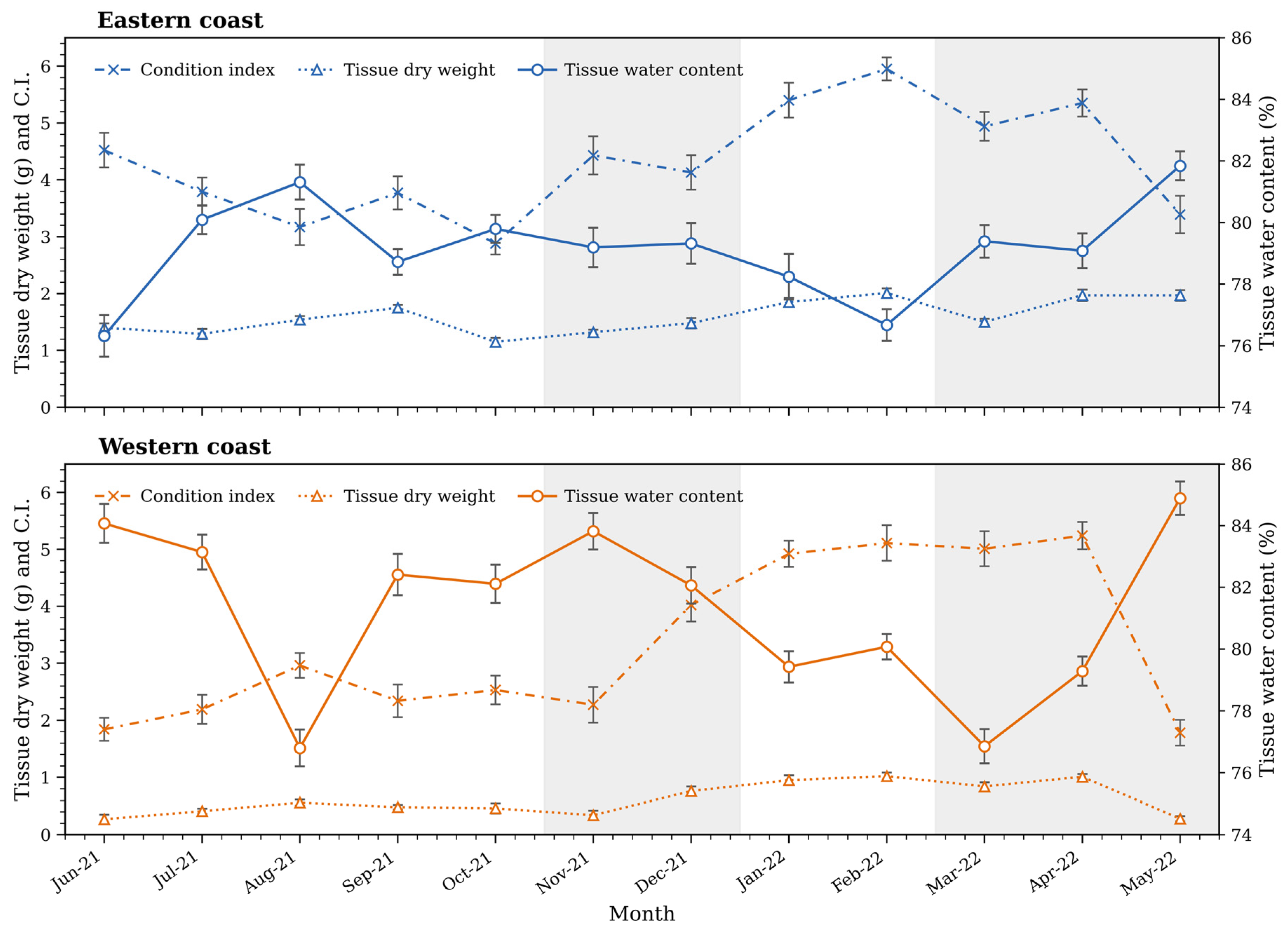
Physiological and biomass indicators differed markedly between the two coasts (Table 4). The eastern population showed higher standing biomass, with a mean AFDW of 11.7242 g AFDW m−2. In contrast, the western population showed a lower standing biomass, with a mean AFDW of 3.2008 g AFDW m−2, showing reduced tissue biomass under higher-salinity conditions. Monthly variation in condition index, tissue dry weight, and tissue water content further supported these physiological differences between the two populations (Figure 7).
Table 4.
Summary of reproductive, physiological, and biomass-turnover indicators.
Figure 7.
Monthly physiological condition indicators in P. radiata from the eastern and western coasts of Bahrain. Condition index, tissue dry weight, and tissue water content are shown across the monthly sampling period. Shaded areas indicate the principal reproductive periods identified from monthly oocyte abundance.
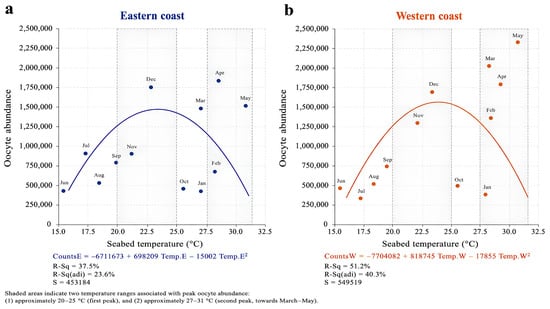
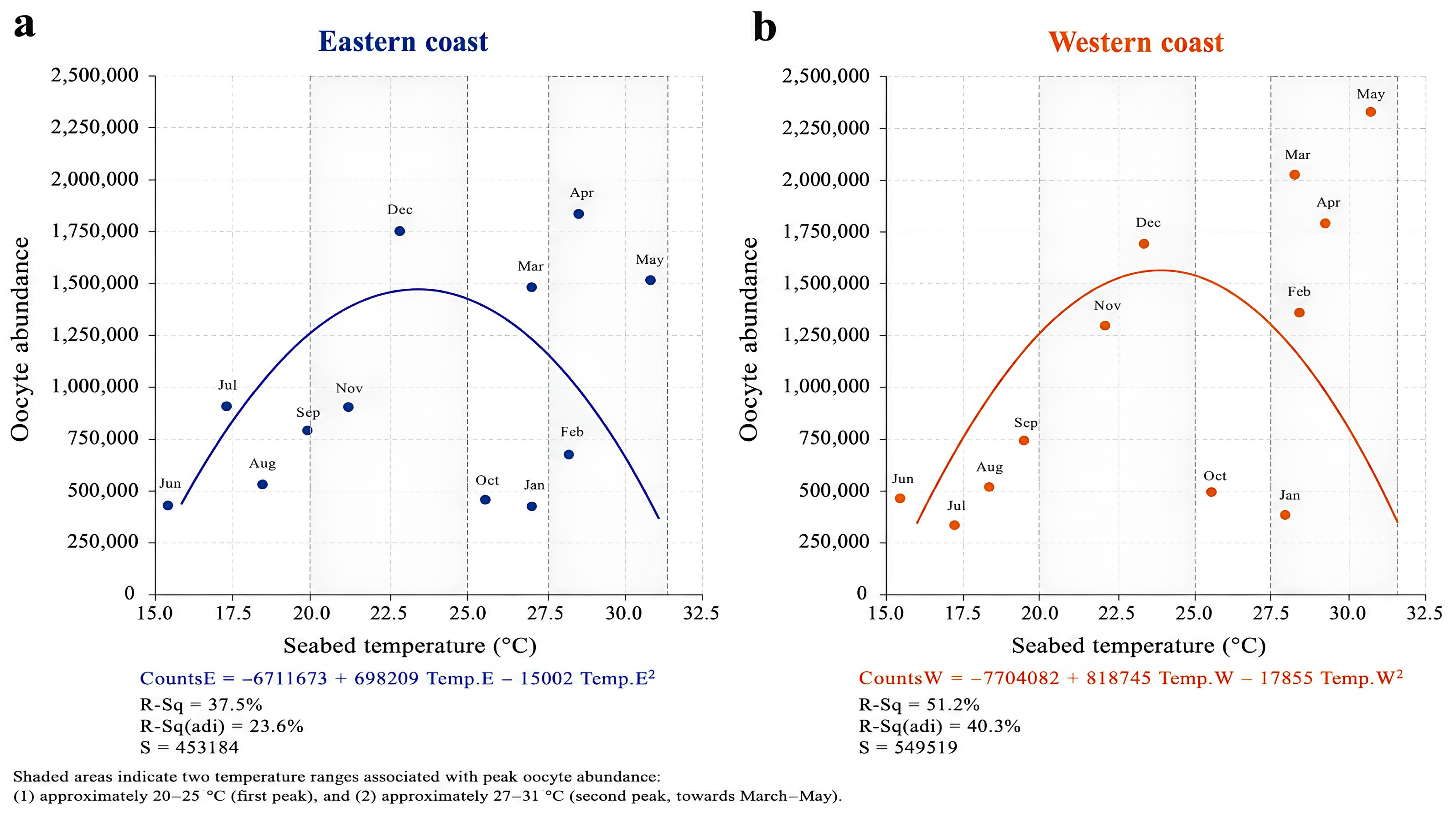
Polynomial regression revealed a quadratic relationship between seabed temperature and oocyte abundance on both coasts (Figure 8). The fitted models explained 51.2% (western coast; adjusted R2 = 40.3%) and 37.5% (eastern coast; adjusted R2 = 23.6%) of the observed variation. Peak reproductive activity was associated with two seasonal thermal windows (approximately 22–24 °C and 27.5–30.5 °C), corresponding to the bimodal reproductive pattern observed in both populations.
Figure 8.
Polynomial relationship between seabed temperature and oocyte abundance in P. radiata from the eastern (a) and western (b) coasts of Bahrain. Shaded areas indicate the principal reproductive periods.
Similarly, monthly physiological indicators were temperature-sensitive, with the condition index showing significant negative linear relationships with seabed temperature on both coasts (eastern: r = −0.761, R2 = 0.579, and p = 0.004; western: r = −0.805, R2 = 0.648, and p = 0.002).
The mean monthly condition index was significantly lower on the western coast than on the eastern coast (3.35 ± 1.40 SD vs. 4.31 ± 0.96 SD; paired-samples t-test: t = 3.65, df = 11, and p = 0.004). In contrast, the mean monthly oocyte abundance was comparable between the western and eastern coasts (11.09 vs. 10.77 × 10⁵ oocytes g−1 gonad wet weight; paired-samples t-test: t = 0.20, df = 11, and p = 0.846).
Despite a lower standing biomass, the western population showed higher annual secondary production and faster biomass turnover (Table 4). The annual secondary production was 23.8650 g AFDW m−2 yr−1 on the western coast, compared with 2.7525 g AFDW m−2 yr−1 on the eastern coast. The resulting production-to-biomass ratio was 7.46 yr−1 in the west and 0.23 yr−1 in the east. This indicates that the western population combined lower standing biomass with higher biomass turnover, while maintaining reproductive activity.
3.6. Integrated Evidence for a Life-History Trade-Off
The combined results indicate a consistent life-history contrast between the two coastal populations. The western coast was more saline and supported oysters with reduced shell dimensions, lower estimated asymptotic shell height, and lower biomass accumulation. In contrast, reproductive activity remained strong, with repeated oocyte peaks and a higher production-to-biomass turnover.
This pattern is consistent with reduced somatic growth and lower biomass accumulation without proportional reproductive suppression. Instead, the western population maintained reproductive abundance under more saline conditions. Simple regression analyses supported the integrated response pattern. Across monthly east–west observations, salinity was strongly and negatively associated with shell height (r = −0.925, R2 = 0.855, and p < 0.001) and AFDW (r = −0.839, R2 = 0.705, and p < 0.001) but showed no proportional relationship with oocyte abundance (r = −0.054, R2 = 0.003, and p = 0.802). This indicates that higher salinity was associated with reduced somatic and biomass indicators, while reproductive activity was not proportionally reduced. Overall, the results are consistent with a life-history trade-off in which higher salinity is associated with constrained growth and biomass accumulation while reproductive persistence is maintained.
4. Discussion
This study investigated whether natural populations of P. radiata exposed to contrasting salinity regimes show evidence of coordinated life-history variation. The findings support the hypothesis that higher salinity is associated with constrained somatic growth and reduced biomass accumulation, while reproductive activity is maintained. Oysters from the western coast had smaller shell dimensions, had a lower estimated asymptotic shell height in the Gompertz model, and had lower standing tissue biomass (Table 2, Table 3 and Table 4). These patterns were not accompanied by reduced seasonal oocyte abundance. Instead, the western population maintained seasonal oocyte abundance and showed higher production-to-biomass turnover (Figure 6; Table 4). Together, these findings indicate a life-history trade-off in which reproductive persistence is maintained despite constrained growth under chronic salinity stress.
4.1. Salinity Stress and Growth Limitation
The salinity gradient between the eastern and western coasts provides the environmental basis for interpreting the observed growth contrast. The western coast was more saline, and oysters from this habitat showed reduced dimensions across all major morphometric traits, including shell height, shell length, hinge length, and shell width. This pattern is consistent with the bioenergetic expectation that osmotic stress increases maintenance costs and reduces the energy available for growth and biomass accumulation [6,7]. Although multiple environmental factors can influence bivalve growth and reproduction, salinity represented the most consistent environmental difference between the two study areas. Other measured environmental variables were broadly comparable between coasts, whereas the western coast consistently exhibited higher salinity. This interpretation is further supported by field observations indicating that other co-occurring bivalve species in the same western habitats also generally attain smaller adult sizes than their eastern counterparts, suggesting that persistent hypersalinity may represent the predominant environmental gradient influencing growth in this coastal system.
The Gompertz growth model further supports this interpretation. The eastern population showed a substantially larger estimated asymptotic shell height, whereas the western population approached a lower predicted growth ceiling. This indicates that the east–west difference reflects not only observed mean shell size but also estimated growth potential. Such a pattern supports the interpretation that the more saline western habitat is associated with a persistent constraint on shell growth.
Experimental evidence from pearl oysters provides a mechanistic basis for this interpretation. Yang et al. [8] showed that salinity stress in P. fucata affects osmotic balance, respiratory metabolism, and antioxidant responses. In the present study, the reduced shell size and tissue biomass observed under higher-salinity conditions are consistent with the expected energetic costs of maintaining osmotic balance.
4.2. Reproductive Persistence Despite Reduced Growth
The western population showed reduced shell size and lower biomass accumulation, yet it maintained strong seasonal oocyte abundance, including a maximum oocyte peak exceeding that recorded on the eastern coast (Table 2 and Table 4). This pattern suggests that reduced shell dimensions should not be interpreted as direct evidence of reproductive failure. Rather, reproductive capacity was maintained under conditions associated with constrained somatic growth.
This finding is consistent with regional evidence that P. radiata reproduction is strongly seasonal and environmentally responsive. Al-Sayed [10] reported seasonal reproductive activity in Bahraini P. radiata, while Khalifa et al. [11] showed that reproductive patterns may shift under changing environmental conditions. These findings further indicate that P. radiata can maintain two seasonal reproductive peaks even where somatic growth is constrained by higher salinity.
The bimodal reproductive pattern observed on both coasts further supports this conclusion (Figure 6). Both populations showed two extended periods of elevated oocyte abundance followed by marked release, with broadly consistent seasonal duration. Minor advances or delays between coasts may reflect local temperature and depth differences, as the western site was shallower (approximately 2.5–3.0 m) than the eastern site (approximately 5.5–6.0 m). However, the present observations do not demonstrate that salinity independently altered the reproductive schedule. This suggests that reproductive abundance in P. radiata cannot be interpreted from shell size alone. Recent studies indicate that reproductive traits and timing in bivalves, including Pinctada maxima, may vary with temperature, salinity, site characteristics, depth, oyster size, and other local environmental conditions [7,11,12,13,14,30]. In the present study, this context dependence is reflected in the persistence of oocyte abundance in the reduced-size western population. Polynomial regression further indicated that reproductive activity was concentrated within seasonal intermediate seabed temperatures (Figure 8), despite the broad annual thermal regime experienced by P. radiata in Bahrain. A potential limitation is that oocyte abundance was standardized to gonad wet weight. As salinity can influence tissue water content, wet-weight-based estimates may partly reflect variation in tissue hydration in addition to biological differences. Nevertheless, both populations were sampled using the same protocol throughout this study, allowing consistent relative comparisons between coasts.
4.3. Biomass Turnover and Energy Allocation
The contrast between the lower standing biomass and higher production-to-biomass ratio in the western population is important for interpreting the life-history response. The eastern population had a higher mean AFDW, indicating greater biomass accumulation. In contrast, the western population had a lower AFDW but higher secondary production and a higher P:B ratio (Table 4). This suggests faster biomass turnover in the western habitat. The significantly lower condition index in western oysters, combined with comparable mean oocyte abundance between coasts, indicates that reproductive activity was maintained under reduced somatic conditions. This pattern supports the proposed somatic–reproductive trade-off under hypersaline conditions. The higher western P:B ratio represents population-level biomass turnover rather than greater individual productivity. It reflects the combination of substantially higher population density, lower standing AFDW biomass, and a population concentrated within smaller size classes. Newly settled spats were not included in the calculation, as the smallest represented shell height class was 35–36.99 mm on both coasts. The eastern population extended to the 101–102.99 mm class, whereas the western population extended only to the 53–54.99 mm class, demonstrating a narrower and smaller size distribution in the west. Therefore, the western population maintained rapid biomass turnover and reproductive activity despite reduced shell size and biomass accumulation.
Secondary production and biomass turnover are informative functional indicators because they link individual growth and tissue mass to population-level energy flow. Wang et al. [31] emphasized that secondary production can provide insight into ecosystem functioning and biological responses to environmental conditions. P:B is not treated as a stand-alone production endpoint, but as supporting evidence for a broader life-history pattern: the western population exhibited reduced somatic growth and lower biomass accumulation, while maintaining reproductive activity and rapid biomass turnover (Table 2 and Table 4; Figure 6).
4.4. Life-History Trade-Offs Under Chronic Salinity Stress
Taken together, the findings support a life-history trade-off rather than a simple decline in biological performance. If higher salinity broadly suppressed biological functions, the western population would be expected to exhibit reduced shell growth, lower biomass accumulation, and weaker reproductive activity. Instead, the data indicate reduced growth and lower standing biomass, whereas oocyte abundance was maintained and biomass turnover was elevated (Table 2 and Table 4; Figure 6). This pattern indicates that biological responses to salinity stress are function-specific.
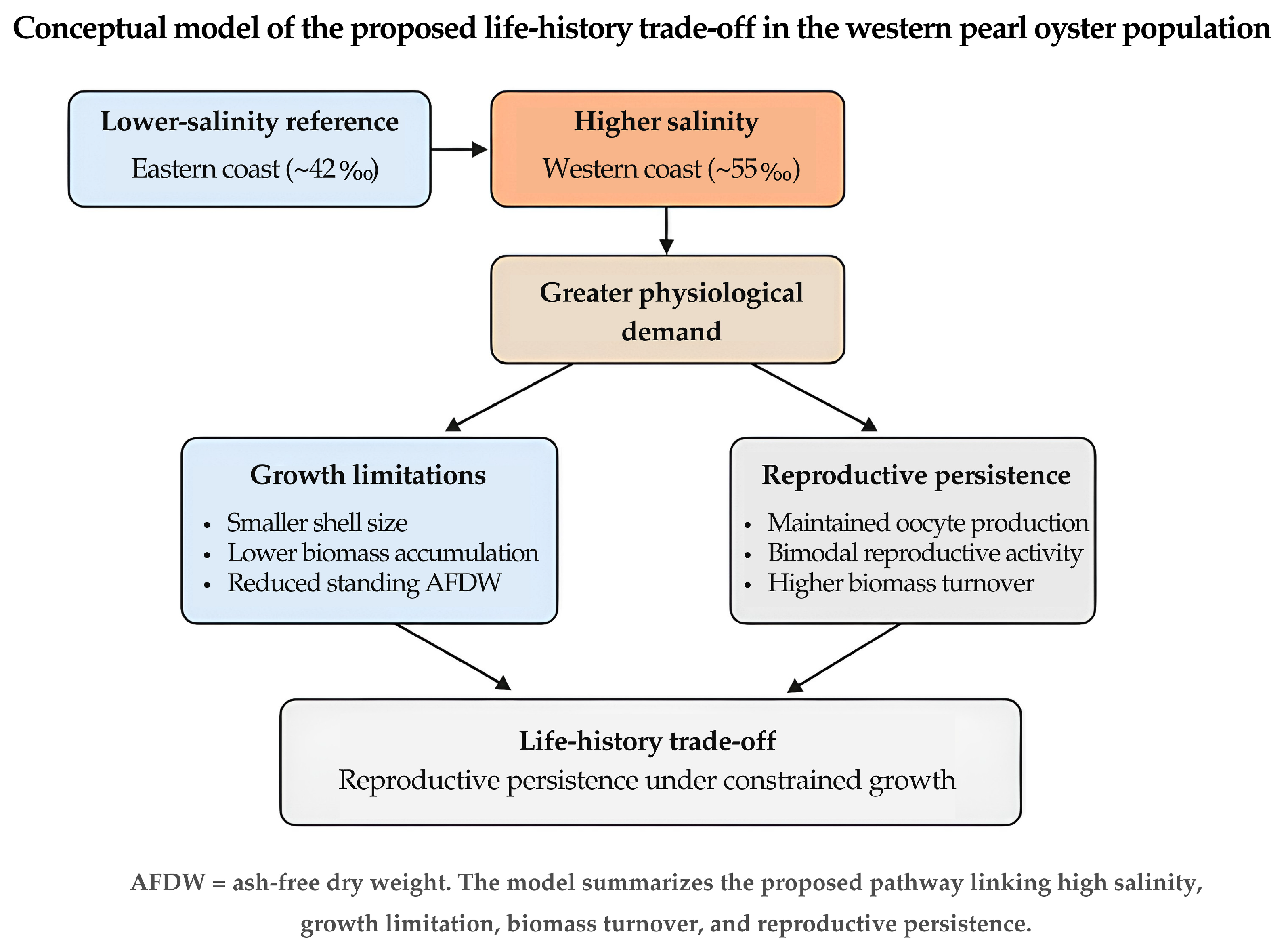
A conceptual synthesis of the proposed life-history trade-off is presented in Figure 9. This interpretation is consistent with life-history and bioenergetic theory. Environmental stress can increase maintenance costs and reduce the energy available for growth and reproduction. In bivalves, salinity stress can alter physiological performance and the energy available for growth, reproduction, and survival [6,32,33,34]. Reproductive persistence may reflect preferential allocation of available energy to gametogenesis at the expense of somatic growth. In this case, the western population appears to show reproductive persistence despite growth limitation. This pattern should not be interpreted as evidence of genetic adaptation. It is more conservatively interpreted as environmentally mediated life-history variation, potentially reflecting physiological plasticity, local habitat effects, or population-level differences in energy allocation.
Figure 9.
Conceptual model of the proposed life-history trade-off in P. radiata.
Higher salinity was associated with constrained somatic growth, while reproductive activity was maintained. Overall, the observed pattern is consistent with a decoupling of growth and reproduction under chronic salinity stress. This integrated response is summarized conceptually in Figure 9.
Beyond its direct physiological effects, hypersalinity may also indirectly influence pearl oyster performance through changes in food availability and quality. Salinity is known to affect phytoplankton abundance, community composition, and nutritional quality, potentially altering energy acquisition and allocation in suspension-feeding bivalves. Although these variables were not examined in the present study, they may represent an additional mechanism contributing to the observed differences in growth and biomass between coasts and warrant further investigation [33,35].
4.5. Relevance to Hypersaline Coastal Systems
The findings are relevant beyond Bahrain, as the Arabian Gulf represents one of the most extreme semi-enclosed marine systems, combining high salinity, high summer temperatures, shallow bathymetry, and restricted water exchange. Reynolds [1] and Ibrahim et al. [2] described the Gulf as a shallow semi-enclosed sea where salinity is strongly shaped by restricted exchange and evaporation. Lachkar et al. [3] further emphasized the severe thermal conditions experienced by Gulf organisms. Independent age determination of a subsample from the same western population, based on internal annual shell growth increments, showed significantly reduced longevity and a lower asymptotic shell size relative to other P. radiata populations [36]. This indicates that the smaller western oysters were not simply younger but attained a smaller adult size under hypersaline conditions. Regional syntheses have described the Gulf as a naturally stressed marine system, where high salinity, thermal variability, and coastal pressures influence marine biodiversity and ecosystem conditions [37]. Across the Gulf, basin-scale conditions are characterized by elevated salinity and extreme summer sea-surface temperatures [2,3]. Coastal waters around Qatar have been reported to range from approximately 35.5 to 44.5‰, while localized western habitats may exceed 60‰ and 35 °C during summer [38]. Accordingly, the eastern Bahrain site (~42‰) represents the upper regional range, whereas the western site (~55‰) represents an extreme, although regionally documented, coastal hypersaline condition. Within this setting, P. radiata represents a relevant field-based bivalve system for examining eco-physiological responses to chronic environmental stress. A key strength of this study is the assessment of wild pearl oyster populations under natural field conditions, allowing growth, physiological condition, biomass turnover, and reproductive activity to be interpreted within the same environmental setting.
The ecological significance of these populations extends beyond their response to salinity alone. Pearl oysters persist in shallow coastal habitats, where extreme temperature and hypersalinity interact with water chemistry, food availability, and phytoplankton dynamics, creating a naturally multi-stressor environment. The persistence of P. radiata, including maintained reproductive activity under these conditions, indicates substantial physiological tolerance and acclimatization capacity and provides a useful natural model for understanding how benthic filter-feeders may respond to intensifying environmental and climate-related stress.
Previous studies on P. radiata have provided important knowledge about growth, reproductive biology, and population structure. Al-Sayed et al. [9] highlighted environmental influences on pearl oyster growth in Bahrain, while Khalifa et al. [11] examined reproductive patterns in P. radiata under changing environmental conditions. Yigitkurt [12] linked gonadal development and condition index in P. imbricata radiata to seasonal environmental variation, and Pafras et al. [13] examined reproductive biology using microscopic and macroscopic gonadal assessment in Mediterranean P. radiata. Recent assessments of Bahrain’s pearl oyster beds have emphasized their ecological, cultural, and economic importance, while also highlighting the need for updated systematic research on oyster bed structure and population condition [39,40]. The western coast represents a naturally hypersaline oyster habitat where oysters may persist at relatively high densities despite limited development of larger shell size classes (Figure 3; Table 2). This pattern indicates a clear contrast between the two surveyed populations: the western coast showed higher oyster density and reduced shell growth, whereas the eastern coast showed lower density, larger shell size, and higher biomass accumulation. This provides a regional context for interpreting the present findings as reflecting a constraint on somatic growth rather than a loss of population persistence. These findings integrate morphometrics, growth modeling, tissue condition, biomass turnover, and oocyte abundance as components of a population-level life-history response.
No single biological metric fully captured the response to hypersalinity. Considered individually, shell size suggested reduced performance, oocyte abundance indicated maintained reproductive function, and P:B reflected rapid biomass turnover. Considered together, these variables revealed a coherent life-history response characterized by salinity-associated growth limitation, reduced biomass accumulation, elevated biomass turnover, and maintained reproductive activity.
4.6. Study Scope and Future Research Directions
The findings of this study should be interpreted within the scope of its field-based design. The interpretation of energy allocation is inferred from patterns in shell growth, tissue condition, biomass turnover, and oocyte abundance, rather than direct physiological measurements. Accordingly, the observed pattern should be interpreted as environmentally mediated life-history variation, rather than as direct evidence of the underlying mechanism. The two populations were selected as ecologically representative contrasts within Bahrain waters, with the eastern population reflecting the typical open-water phenotype of P. radiata and the western population representing the persistent smaller-bodied population characteristic of the hypersaline western coastal system. Other site-specific factors, including depth, hydrodynamics, substrate, and food availability, may also have contributed to the observed differences. However, local long-term monitoring records indicate broadly comparable thermal regimes, with monthly temperatures ranging from 16.54 to 34.04 °C in western waters and from 17.43 to 34.38 °C in eastern coastal waters [41]. In contrast, salinity remained persistently higher in the west (50.92–53.27‰) than in the east (42.46–44.17‰). These ranges are consistent with the environmental observations recorded during this study, particularly the broadly comparable thermal regimes and the persistently higher salinity in western waters. The mean chlorophyll-a level was also lower in the west (0.54 versus 1.06 µg L−1); the dissolved oxygen level was nearly identical (5.86 versus 5.95 mg L−1); and turbidity and suspended solids contents were lower in western waters [41]. These local patterns do not support temperature, oxygen, or particulate loading as stronger alternative explanations. Therefore, hypersalinity remains the principal environmental constraint, potentially interacting with differences in water chemistry, nutrient dynamics, phytoplankton availability, and suspended food resources in the shallow western habitat; however, the independent effects of tidal exposure and sediment composition require further investigation.
Although western coastal oysters have limited current importance to the traditional pearl fishery, this appears to reflect their smaller shell size, lower expected pearl yield, and harvesting preferences rather than an absence of natural pearl production capacity. Dedicated data on pearl occurrence and characteristics have been collected and analyzed and will be reported separately in a specialized study. Irrespective of their current fishery importance, the persistence of dense western populations under chronic hypersalinity gives them clear ecological and potential conservation significance. Their sustained occurrence under these conditions raises the possibility that they represent an important component of Bahrain’s pearl oyster genetic diversity and may potentially function as a genetic reservoir.
Future research should combine long-term field monitoring with experimental salinity trials and direct measurements of physiological performance, energy reserves, and molecular responses. This is particularly relevant given that bivalve responses to climate-related stressors may involve interactions between salinity, temperature, oxygen availability, and energy balance [34,42]. Molecular and transcriptomic approaches could further determine whether the observed east–west variation reflects environmentally mediated physiological plasticity or possible population-level genetic differentiation under chronic hypersaline exposure. Genetic investigations should first confirm species identity and subsequently assess population structure, genetic connectivity, and evidence of local adaptation among Bahrain’s pearl oyster populations. Such analyses would clarify whether the western populations represent a distinct genetic component and may function as a genetic reservoir. This study, together with ongoing ecological and genetic investigations, provides an important scientific basis for evaluating their conservation significance and informing future measures for protecting this population.
Overall, the findings indicate that P. radiata can maintain reproductive activity under naturally hypersaline field conditions. Salinity in the western habitat reached approximately 58‰ (Figure 3), despite constrained somatic growth and lower biomass accumulation (Table 2 and Table 4). These findings advance our understanding of how benthic bivalves persist by adjusting life-history strategies under chronic environmental stress in naturally hypersaline, semi-enclosed marine systems.
4.7. Species-Level Comparative Context
Previous studies of Pinctada spp. have examined growth, physiological condition, reproductive activity, and production under contrasting environmental settings. Table 5 summarizes this evidence by species and study region, providing a concise comparative context for the integrated life-history responses assessed in this study. The genus Pinctada comprises ecologically and commercially important pearl oysters within the family Pteriidae (Bivalvia), with species exhibiting diverse growth, reproductive, and physiological responses across contrasting environmental conditions.
Table 5.
Species-level comparative context for environmental and biological responses in selected Pinctada studies.
Environmental effects on pearl oysters are function-specific rather than uniform. Salinity can alter physiological regulation [8], while temperature influences reproductive timing and condition [11,12,13]. Growth, condition, survival, and lifespan are also influenced by food availability, local habitat characteristics, species, and broader environmental setting [30,36,45,46]. Experimental evidence indicates allocation between gametogenesis and somatic growth [44], while bioenergetic modeling further demonstrates partitioning between shell formation, somatic growth, and reproduction [47]. Natural-population studies show that reproductive activity, growth, mortality, and production remain interconnected [43,48]. This study integrates these responses within wild P. radiata, showing that reduced somatic performance under more hypersaline conditions coexisted with maintained seasonal reproductive activity. Collectively, these patterns highlight the capacity of Pinctada spp. to persist across contrasting environments via flexible adjustments in growth, physiology, reproduction, and energy allocation.
5. Conclusions
This study indicates that natural populations of P. radiata along the eastern and western coasts of Bahrain exhibit contrasting life-history responses under different salinity regimes. The more saline western habitat was associated with reduced shell dimensions, a lower estimated asymptotic shell height, and a lower standing tissue biomass, indicating constrained somatic growth and biomass accumulation. These constraints were not accompanied by reproductive suppression. Western oysters maintained seasonal oocyte abundance, showed a bimodal reproductive pattern, and exhibited higher biomass turnover.
These findings support the hypothesis that chronic hypersalinity is associated with constrained growth and biomass accumulation, while reproductive persistence is maintained. The observed pattern is consistent with a life-history trade-off rather than a uniform decline in biological performance. Under more saline conditions, P. radiata appears to maintain reproductive activity despite reduced growth potential, suggesting that reproductive persistence may contribute to population continuity in hypersaline coastal systems.
By integrating environmental conditions, morphometric variation, growth modelling, physiological condition indicators, biomass turnover, and oocyte abundance, this study provides a population-level eco-physiological interpretation of pearl oyster responses to salinity stress. Beyond its regional relevance to Bahrain and the Arabian Gulf, the findings advance our understanding of how benthic bivalves persist under chronic environmental stress in shallow, semi-enclosed, hypersaline marine systems. Overall, this study provides field-based evidence that chronic hypersalinity is associated with constrained somatic growth, while reproductive persistence is maintained, highlighting the importance of evaluating multiple biological indicators when assessing the responses of marine bivalves to long-term environmental stress.
Supplementary Materials
The following supporting information can be downloaded at: https://www.mdpi.com/article/10.3390/hydrobiology5030025/s1, Figure S1. Oocyte counting using a Sedgewick–Rafter counting chamber; Table S1. Monthly density data of Pinctada radiata from the eastern and western coasts of Bahrain; Table S2. Concise comparison of the Gompertz, logistic, and monomolecular growth models.
Author Contributions
Conceptualization, M.Y., L.H. and H.A.-S.; methodology, M.Y., L.H. and H.A.-S.; software, M.Y.; validation, M.Y., L.H. and H.A.-S.; formal analysis, M.Y.; investigation, M.Y., L.H. and H.A.-S.; resources, M.Y. and H.A.-S.; data curation, M.Y.; writing—original draft preparation, M.Y.; writing—review and editing, M.Y., L.H. and H.A.-S.; visualization, M.Y.; supervision, L.H. and H.A.-S.; project administration, M.Y. All authors have read and agreed to the published version of the manuscript.
Funding
This research received no external funding.
Institutional Review Board Statement
Not applicable.
Informed Consent Statement
Not applicable.
Data Availability Statement
The data presented in this study are available within this article and Supplementary Materials. Additional raw data supporting the findings of this study are available from the corresponding author upon request.
Acknowledgments
The authors acknowledge the University of Bahrain for providing access to laboratory facilities used during this study. The authors also thank the Supreme Council for Environment, the Kingdom of Bahrain, for facilitating the required field permits and providing vessel support during sampling activities. Appreciation is extended to the field and laboratory technicians who assisted with sample collection, laboratory preparation, and technical procedures.
Conflicts of Interest
The authors declare no conflicts of interest.
Abbreviations
The following abbreviations are used in this manuscript:
| AFDW | Ash-free dry weight |
| ANOVA | Analysis of variance |
| CI | Condition index |
| DO | Dissolved oxygen |
| HL | Hinge length |
| P:B | Production-to-biomass ratio |
| SCUBA | Self-contained underwater breathing apparatus |
| SD | Standard deviation |
| SE | Standard error |
| SH | Shell height |
| SL | Shell length |
| SW | Shell width |
| TDW | Tissue dry weight |
| TWC | Tissue water content |
References
- Reynolds, R.M. Physical oceanography of the Gulf, Strait of Hormuz, and the Gulf of Oman—Results from the Mt Mitchell Expedition. Mar. Pollut. Bull. 1993, 27, 35–59. [Google Scholar] [CrossRef] [Scilit]
- Ibrahim, H.D.; Eltahir, E.A.B. Multiple salinity equilibria and resilience of Persian/Arabian Gulf basin salinity to brine discharge. Front. Mar. Sci. 2020, 7, 573. [Google Scholar] [CrossRef] [Scilit]
- Lachkar, Z.; Pauluis, O.; Paparella, F.; Khan, B.; Burt, J.A. Local and remote climatic drivers of extreme summer sea surface temperatures in the Arabian Gulf. Ocean Sci. 2025, 21, 3241–3263. [Google Scholar] [CrossRef] [Scilit]
- Gosling, E. Marine Bivalve Molluscs, 2nd ed.; Wiley-Blackwell: Chichester, UK, 2015. [Google Scholar] [CrossRef] [Scilit]
- Bayne, B.L. Biology of Oysters; Developments in Aquaculture and Fisheries Science, Volume 41; Academic Press: London, UK, 2017; ISBN 978-0-12-803472-9. [Google Scholar]
- Sokolova, I.M. Bioenergetics in environmental adaptation and stress tolerance of aquatic ectotherms: Linking physiology and ecology in a multi-stressor landscape. J. Exp. Biol. 2021, 224, jeb236802. [Google Scholar] [CrossRef] [Scilit] [PubMed]
- Vázquez, E.; Woodin, S.A.; Wethey, D.S.; Peteiro, L.G.; Olabarria, C. Reproduction under stress: Acute effect of low salinities and heat waves on reproductive cycle of four ecologically and commercially important bivalves. Front. Mar. Sci. 2021, 8, 685282. [Google Scholar] [CrossRef] [Scilit]
- Yang, J.; Yang, J.; Chen, M.; Fu, Z.; Sun, J.; Yu, G.; Wang, A.; Ma, Z.; Gu, Z. Physical responses of Pinctada fucata to salinity stress. Front. Mar. Sci. 2021, 8, 792179. [Google Scholar] [CrossRef] [Scilit]
- Al-Sayed, H.; Al-Rumaidh, M.J.; Nayar, K.N. Spat settlement and growth of yearling of the pearl oyster, Pinctada radiata, in Bahrain waters. Arab Gulf J. Sci. Res. 1997, 15, 467–480. [Google Scholar]
- Al-Sayed, H.A. Periodicity of reproduction in pearl oyster Pinctada radiata in Bahrain. J. Fac. Sci. UAE Univ. 1995, 8, 223–233. [Google Scholar]
- Khalifa, R.; Ben Hamadou, R.; Giraldes, B.W.; Joaquim, S.; Hizam, Z.; Hamza, S.; Bassères, A.; Massabuau, J.-C.; Leitão, A. The impact of increasing seawater temperatures over the last 30 years on the reproductive cycle of the pearl oyster Pinctada radiata (Leach, 1814) in the Arabian Gulf. J. Mar. Sci. Eng. 2024, 12, 2180. [Google Scholar] [CrossRef] [Scilit]
- Yigitkurt, S. Reproductive biology of the rayed pearl oyster (Pinctada imbricata radiata, Leach 1814) in Izmir Bay. Oceanol. Hydrobiol. Stud. 2021, 50, 87–97. [Google Scholar] [CrossRef] [Scilit]
- Pafras, D.; Apostologamvrou, C.; Balatsou, A.; Theocharis, A.; Lolas, A.; Hatziioannou, M.; Vafidis, D.; Klaoudatos, D. Reproductive biology of pearl oyster (Pinctada radiata, Leach 1814) based on microscopic and macroscopic assessment of both sexes in the Eastern Mediterranean (South Evia Island). J. Mar. Sci. Eng. 2024, 12, 1259. [Google Scholar] [CrossRef] [Scilit]
- Moura, P.; Carvalho, A.N.; Pereira, F.; Gaspar, M.B. Reproductive dynamics of the razor clam Solen marginatus Pulteney, 1799 (Bivalvia: Solenidae) in Ria Formosa Lagoon. Hydrobiology 2026, 5, 14. [Google Scholar] [CrossRef] [Scilit]
- Nayar, K.N.; Al-Rumaidh, M. Studies on the Pearl Oysters of Bahrain Waters; Bahrain Centre for Studies and Research: Manama, Bahrain, 1993; 333p. [Google Scholar]
- Tlig-Zouari, S.; Rabaoui, L.; Irathni, I.; Ben Hassine, O.K. Distribution, habitat and population densities of the invasive species Pinctada radiata (Mollusca: Bivalvia) along the northern and eastern coasts of Tunisia. Cah. Biol. Mar. 2009, 50, 131–142. [Google Scholar] [CrossRef]
- Baggett, L.P.; Powers, S.P.; Brumbaugh, R.; Coen, L.D.; DeAngelis, B.; Greene, J.; Hancock, B.; Morlock, S. Oyster Habitat Restoration Monitoring and Assessment Handbook; The Nature Conservancy: Arlington, VA, USA, 2014; 96p. [Google Scholar]
- zu Ermgassen, P.S.E.; Bos, O.; Debney, A.; Gamble, C.; Glover, A.; Pogoda, B.; Pouvreau, S.; Sanderson, W.; Smyth, D.; Preston, J. (Eds.) European Native Oyster Habitat Restoration Monitoring Handbook; Native Oyster Network: London, UK, 2021; Available online: https://nativeoysternetwork.org/wp-content/uploads/sites/27/2021/11/European%20Native%20Oyster%20Habitat%20Monitoring%20Handbook_WEB_Final.pdf (accessed on 24 February 2026).
- Al-Sayed, H.A.; Al-Rumaihi, E.M.; Al-Rumaidh, M.J. Some Morphometric Measurements and Population Structure of the Pearl Oyster Pinctada radiata at Two Different Coasts in Bahrain; Bahrain Centre for Studies and Research: Manama, Bahrain, 1993; 17p. [Google Scholar]
- Hwang, J.J. Reproductive cycles of the pearl oysters, Pinctada fucata (Gould) and Pinctada margaritifera (Linnaeus) (Bivalvia: Pteriidae), in southwestern Taiwan waters. J. Mar. Sci. Technol. 2007, 15, 67–75. [Google Scholar] [CrossRef] [Scilit]
- Tlig-Zouari, S.; Rabaoui, L.; Irathni, I.; Diawara, M.; Ben Hassine, O.K. Comparative morphometric study of the invasive pearl oyster Pinctada radiata along the Tunisian coastline. Biologia 2010, 65, 294–300. [Google Scholar] [CrossRef] [Scilit]
- Khamdan, S.A.A. Gulf Encyclopedia in Pearl and Oyster; Bahrain Centre for Studies and Research: Manama, Bahrain, 2004; ISBN 99901-09-21-4. [Google Scholar]
- Al-Sayed, H.A. Review of spawning studies of some commercially important marine organisms in the coastal waters of Bahrain. J. Assoc. Arab Univ. Basic Appl. Sci. 2009, 8, 75–92. [Google Scholar] [CrossRef] [Scilit][Green Version]
- Le Moullac, G.; Tiapari, J.; Teissier, H.; Martinez, E.; Cochard, J.C. Growth and gonad development of the tropical black-lip pearl oyster, Pinctada margaritifera (L.), in the Gambier archipelago (French Polynesia). Aquac. Int. 2012, 20, 305–315. [Google Scholar] [CrossRef] [Scilit]
- Al-Sayed, H.A. Gamete-Counting and Reproductive Assessment of the Pearl Oyster Pinctada radiata in Bahrain Waters; Laboratory Manual; University of Bahrain: Sakhir, Bahrain, 2010. [Google Scholar]
- Burke, M.V.; Mann, K.H. Productivity and production: Biomass ratios of bivalve and gastropod populations in an eastern Canadian estuary. J. Fish. Board Can. 1974, 31, 167–177. [Google Scholar] [CrossRef] [Scilit]
- Dolbeth, M.; Cusson, M.; Sousa, R.; Pardal, M.A. Secondary production as a tool for better understanding of aquatic ecosystems. Can. J. Fish. Aquat. Sci. 2012, 69, 1230–1253. [Google Scholar] [CrossRef] [Scilit]
- Vakily, J.M. Determination and Comparison of Bivalve Growth, with Emphasis on Thailand and Other Tropical Areas; ICLARM Technical Report No. 36; International Center for Living Aquatic Resources Management (ICLARM): Manila, Philippines, 1992; 125p. [Google Scholar]
- Tjørve, K.M.C.; Tjørve, E. The use of Gompertz models in growth analyses, and new Gompertz-model approach: An addition to the Unified-Richards family. PLoS ONE 2017, 12, e0178691. [Google Scholar] [CrossRef] [Scilit] [PubMed]
- Lee, A.M.; Lal, M.M.; Southgate, P.C. Factors affecting gender and gonad development in the silver-lip pearl oyster Pinctada maxima cultured at two sites and two depths in Indonesia. J. Shellfish Res. 2026, 44, 513–526. [Google Scholar] [CrossRef] [Scilit]
- Wang, Z.; Zhou, L.; Liu, X. Functional diversity and secondary production of macrofaunal assemblages can provide insights of biodiversity–ecosystem function relationships. Environ. Sci. Eur. 2024, 36, 62. [Google Scholar] [CrossRef] [Scilit]
- Peteiro, L.G.; Woodin, S.A.; Wethey, D.S.; Costas-Costas, D.; Martínez-Casal, A.; Olabarria, C.; Vázquez, E. Responses to salinity stress in bivalves: Evidence of ontogenetic changes in energetic physiology on Cerastoderma edule. Sci. Rep. 2018, 8, 8329. [Google Scholar] [CrossRef] [Scilit] [PubMed]
- Pourmozaffar, S.; Tamadoni Jahromi, S.; Rameshi, H.; Sadeghi, A.; Bagheri, T.; Behzadi, S.; Gozari, M.; Zahedi, M.R.; Abrari Lazarjani, S. The role of salinity in physiological responses of bivalves. Rev. Aquac. 2020, 12, 1548–1566. [Google Scholar] [CrossRef] [Scilit]
- Kruft Welton, R.A.; Hoppit, G.; Schmidt, D.N.; Witts, J.D.; Moon, B.C. Reviews and syntheses: The clam before the storm—A meta-analysis showing the effect of combined climate change stressors on bivalves. Biogeosciences 2024, 21, 223–239. [Google Scholar] [CrossRef] [Scilit]
- Wu, J.; Li, F.; Guo, F.; Fry, B.; Ouyang, X.; Gao, X.; Gao, W.; Zhang, Y. Nutritional quality of phytoplankton shapes estuarine food webs under salinity and nutrient stress. ACS ES T Water 2025, 5, 3066–3077. [Google Scholar] [CrossRef] [Scilit]
- Yusuf, M.; Al-Sayed, H.; Hazeem, L. Age structure and growth responses of the pearl oyster (Pinctada radiata) under contrasting salinity regimes in Bahrain waters, Arabian Gulf. J. Mar. Sci. Eng. 2026, 14, 1186. [Google Scholar] [CrossRef] [Scilit]
- Naser, H.A. Marine ecosystem diversity in the Arabian Gulf: Threats and conservation. In Biodiversity—The Dynamic Balance of the Planet; Grillo, O., Ed.; InTech: Rijeka, Croatia, 2014; pp. 297–328. [Google Scholar] [CrossRef] [Scilit] [PubMed]
- Smyth, D.; Al-Maslamani, I.; Giraldes, B.W.; Chatting, M.; Al-Ansari, E.; Le Vay, L. Anthropogenic related variations in the epibiotic biodiversity and age structure of the pearl oyster Pinctada radiata within the eulittoral zone of Qatar. Reg. Stud. Mar. Sci. 2016, 5, 87–96. [Google Scholar] [CrossRef] [Scilit]
- Hazeem, L.J.; Yusuf, M.; Al-Sayed, H. Pearl oysters in Bahrain. In Coral Reefs and Associated Marine Fauna around the Arabian Peninsula; Rasul, N.M.A., Stewart, I.C.F., Eds.; Taylor & Francis Group: Abingdon, UK, 2024; pp. 145–152. [Google Scholar] [CrossRef] [Scilit]
- AlMealla, R.K.; Edullantes, B.; Ali, M.; Mardhi, Z.; Khan, M.; Sharif, M.; Tyabji, A.; AlMousa, N.; Omran, F.; Hasan, M.; et al. Comprehensive associations between pearl oyster beds and coral, seagrass and algal habitats in the hottest sea on the planet. Front. Mar. Sci. 2025, 12, 1667575. [Google Scholar] [CrossRef] [Scilit]
- Painting, S.J.; Smith, A.J.; Khamis, A.S.; Abdulla, K.H.; Le Quesne, W.J.F.; Lyons, B.P.; Devlin, M.J.; Garcia, L. Development of standards for assessing water quality in marine coastal waters of Bahrain. Mar. Pollut. Bull. 2023, 196, 115560. [Google Scholar] [CrossRef] [Scilit] [PubMed]
- Liu, C.; Shang, Y.; Gul, S.; Hu, M.; Wang, Y. Energetic adaptations of bivalves under environmental stress: A comprehensive review on bioenergetics and aquaculture sustainability. Rev. Aquac. 2025, 17, e70052. [Google Scholar] [CrossRef] [Scilit]
- Wada, K.T.; Komaru, A.; Ichimura, Y.; Kurosaki, H. Spawning peak occurs during winter in the Japanese subtropical population of the pearl oyster, Pinctada fucata (Gould, 1850). Aquaculture 1995, 133, 207–214. [Google Scholar] [CrossRef] [Scilit]
- Komaru, A.; Wada, K.T. Gametogenesis and growth of induced triploid Japanese pearl oyster, Pinctada fucata martensii. Aquacult. Sci. 1994, 42, 541–546. [Google Scholar] [CrossRef]
- Yukihira, H.; Lucas, J.S.; Klumpp, D.W. The pearl oysters, Pinctada maxima and P. margaritifera, respond in different ways to culture in dissimilar environments. Aquaculture 2006, 252, 208–224. [Google Scholar] [CrossRef] [Scilit]
- Le Moullac, G.; Soyez, C.; Latchere, O.; Vidal-Dupiol, J.; Fremery, J.; Saulnier, D.; Lo Yat, A.; Belliard, C.; Mazouni-Gaertner, N.; Gueguen, Y. Pinctada margaritifera responses to temperature and pH: Acclimation capabilities and physiological limits. Estuar. Coast. Shelf Sci. 2016, 182, 261–269. [Google Scholar] [CrossRef] [Scilit]
- Pouvreau, S.; Bacher, C.; Héral, M. Ecophysiological model of growth and reproduction of the black pearl oyster, Pinctada margaritifera: Potential applications for pearl farming in French Polynesia. Aquaculture 2000, 186, 117–144. [Google Scholar] [CrossRef] [Scilit]
- Urban, H.-J. Culture potential of the pearl oyster (Pinctada imbricata) from the Caribbean. I. Gametogenic activity, growth, mortality and production of a natural population. Aquaculture 2000, 189, 361–373. [Google Scholar] [CrossRef] [Scilit]

Disclaimer/Publisher’s Note: The statements, opinions and data contained in all publications are solely those of the individual author(s) and contributor(s) and not of MDPI and/or the editor(s). MDPI and/or the editor(s) disclaim responsibility for any injury to people or property resulting from any ideas, methods, instructions or products referred to in the content. |
© 2026 by the authors. Licensee MDPI, Basel, Switzerland. This article is an open access article distributed under the terms and conditions of the Creative Commons Attribution (CC BY) license.