


Abstract
Given the low efficiency of current actions regarding the restoration of a critically endangered species, the Sevan trout, there is an urgent need for the evaluation of ongoing strategies and prioritization of the most efficient ones. Thus, the aim of this study was the scientific justification of the effectiveness of various restoration strategies for Sevan trout wild stocks. For this, we developed an experimental design to estimate the efficiency of stocking the main spawning rivers with fingerlings. Sevan trout subspecies were released and re-captured to measure their growth rates and biological features. Also, we conducted assessments of the abiotic conditions and ecological status of rivers. Because Sevan trout fingerlings have also been used to directly stock Lake Sevan by the Foundation for “Restoration of Sevan trout stocks and development of aquaculture” in recent years, we set gill nets to capture and study Sevan trout from the lake. The results showed that releasing summer trout less than 1 g in weight into the inlets of Lake Sevan is ineffective. Although larger gegharkuni had higher survival rates, the current state of the rivers will hardly ensure the sustainability of stocks. Current investigations have also shown the viability of stocking into the lake, as supported by both 2+- and 3+-year-old specimens being reported. However, further studies of the spatial dispersion and survival of stocked juvenile trout and the state of spawning grounds in the lake would help improve restoration strategies.
1. Introduction
The Republic of Armenia (RA) geographically relates to a Caucasus biodiversity hotspot [1]. However, many species are threatened due to ongoing changes in land use [2] and climate [3], as well as increasing rates of anthropogenic pressures [4]. Freshwater fish exhibit high levels of endemism because of habitat isolation and fragmentation.
The largest lake in Armenia, Sevan, dates back to the Pleistocene and Holocene [5]. It is home to Sevan trout (Salmo ischchan Kessler, 1877), noted in the Red Book of Animals of RA as a critically endangered species [6,7] (corresponding to the International Union for Conservation of Nature (IUCN) category CR A2cd) [8]. Little is known about the origin of Sevan trout [9]. Once the main fishery product of Lake Sevan [10,11], the stocks of Sevan trout were significantly decreased in the 20th century due to multiple stresses caused by man-made activities [12,13,14]. Although warnings were given at the end of the 1960s following the exposure of lacustrine spawning grounds and harmful algae blooms due to significant water level drops [15,16], the conservation of Sevan trout remained inefficient in the 1970s [17,18]. As a result, only the subspecies that migrate to rivers for breeding, summer trout (S. ischchan aestivalis Fortunatov, 1926) and gegharkuni (S. ischchan gegarkuni Kessler, 1877), have survived [19,20], while the other subspecies are extinct. However, poaching in river mouths and the degradation of river ecosystems [21] has significantly reduced the populations of summer trout and gegharkuni. Considering that Sevan trout is the most valuable local fish in Armenia, its conservation and restoration is of a high priority [22,23].
Thus, the development of a scientifically proven strategy for the conservation and restoration of the wild population of Sevan trout has become urgent. Such a strategy requires investigations in several directions, such as
- Revealing the current state of Sevan trout reproduction;
- Evaluation of the opportunities for restocking Sevan trout using the trout population of Lake Issyk Kul, as this is the only lake where Sevan trout was successfully introduced;
- Estimations of the potential of rivers to support the natural reproduction of Sevan trout;
- Testing various restocking methods;
- Identification of optimal size of restocking fingerlings and the best places for restocking, also considering the issues of homing reflexes, etc.
The aim of the current study is to address the gaps in overall knowledge to develop a comprehensive strategy for the restoration of Sevan trout stocks. We hypothesized that lake release is more effective than river release.
While a proper strategy has not been established, restocking farm-raised fingerlings and smolts has been considered a priority, but with little success [24]. Despite several years of stocking, we still find no spawning shoals of fish in the rivers.
After morpho-ecological studies into Sevan trout [24] and rejecting restocking using the population of Lake Issyk Kul because of discrepancies between the molecular analyses conducted by [20] and morphometric analyses conducted by [25], efforts were directed towards investigating inlets [19,23,26,27] to reveal their potential to support the natural reproduction and survival of Sevan trout. Both theoretical assessments and experimental methods such as incubating eggs directly in the river [28] have significantly contributed to filling gaps in knowledge but have not completely solved the problem. In particular, it was shown that the rivers are heavily fragmented and rather polluted by both solid waste and wastewater, in addition to being strongly affected by water abstraction in the irrigation season, which drops water levels and significantly influences physical and chemical composition [23,24,26,28].
Thus, within the framework of these recent studies, we explore the viability of Sevan trout fingerlings in various inlets of Lake Sevan depending on the size of the released individuals, the ecological state of the rivers, and the main abiotic components influencing fingerlings.
Since, during 2023–2025, the Foundation for “Restoration of Sevan trout stocks and development of aquaculture” (STF) released 1,457,681 fingerlings of Sevan trout into the lake and the monitoring data has shown that in 2025 the stock of Sevan trout in the lake was 138 t, we compared the success rates from releasing fish both into rivers and directly into the lake as alternative restocking strategies, hypothesizing that the use of homing reflexes will allow us to avoid restocking in rivers due to their low capacity to maintain Sevan trout fingerlings.
2. Materials and Methods
Research design. Given the aim and main objectives of the study, we split the investigations into the following actions:
- Releasing, capturing and re-releasing farm-grown fingerlings of gegharkuni and summer trout into the tributaries of Lake Sevan.
- Examining the growth rates and feeding characteristics of the individuals released into the rivers.
- Monitoring of ecological and abiotic conditions in rivers during the experiment.
- Capturing and releasing individuals recently restocked into Lake Sevan.
- Examining the biological and morphological characteristics of individuals caught from Lake Sevan.
- A justification of the most optimal ways of restocking Sevan trout in recent conditions.
General assumptions. Because the intense monitoring of Lake Sevan inlets in the last decade has found no presence of spawning shoals of Sevan trout there [19,28], we assume that no naturally reproduced generations of Sevan trout will be found in the rivers, but only farm-grown fingerlings. Also, to avoid poaching, we conducted most of the experiments in the territory of Sevan National Park or private lands, where we assume the survival of fish depends more on environmental conditions. Also, considering the ban on the use of electrofishing in Armenia, we had a limited choice of fishing gear and nets. However, considering the shallowness of rivers and the transparency of water, and based on our previous experiences, we assumed that the fishing gear and methods used would allow us to detect fish if present in the area. Thus, considering the behavioral features of Sevan trout fingerlings [29,30], we assumed a lack of re-captured fingerlings in the reaches of release as evidence that the fish did not survive. We made an exception for the fish released into the unnamed spring because they could easily migrate to the lake, which was only 200 m away.
Study sites. Lake Sevan is in the eastern part of Armenia and covers about 1280 km2, which makes it the largest reservoir of freshwater in the Caucasus [31]. Currently, 28 permanent and intermittent rivers and two large springs discharge water into Lake Sevan [32]. Among the inlets, only a few can support the spawning of Sevan trout due to their substratum, temperature regime, and hydrological features [29,31,33]. Most of the rivers are also heavily fragmented and, due to a lack of wastewater treatment plants, also polluted, so can support Sevan trout only in limited areas of the lower courses where no other tributaries confluence. Also, the lower courses of these rivers are rather shallow and transparent, making it possible to notice the movement of fish. Sevan trout is the major predator fish species in the basin, while in the lower courses, eastern spirlin and the Sevan barbel are more common species.
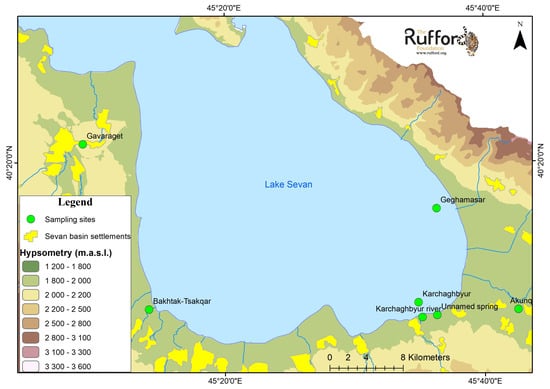
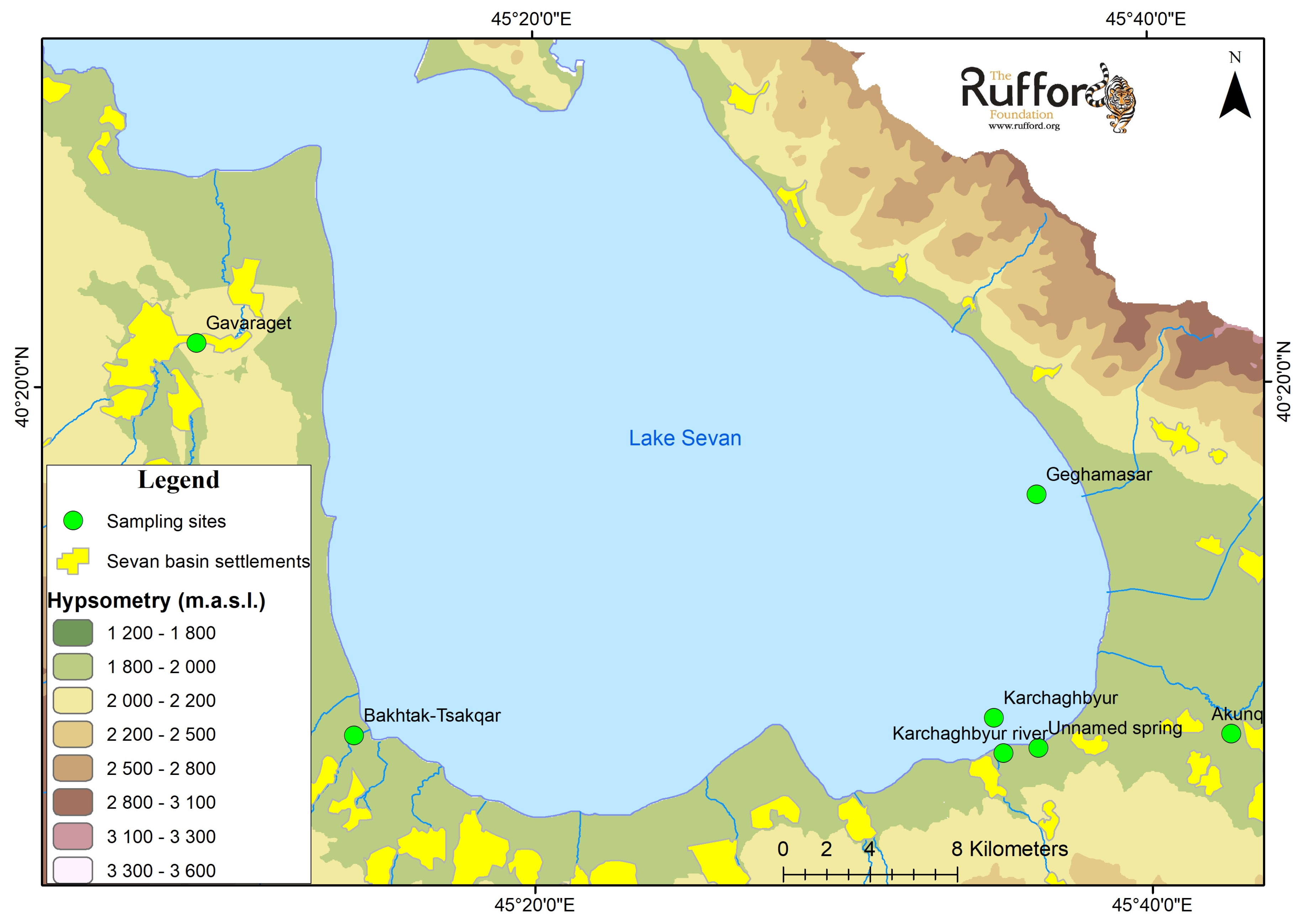
Investigations in rivers were conducted in the Akunq tributary of the Masrik River (40.187186° N; 45.709484° E; 1926 m a.s.l.), in the unnamed spring near the Karchaghbyur fish farm (40.181888° N; 45.605358° E; 1908 m a.s.l.), in the lower course of the Karchaghbyur River (40.179787° N; 45.586524° E; 1916 m a.s.l.), downstream of the confluence zone of the Bakhtak and Tsakqar rivers (40.188441° N; 45.235678° E; 1912 m a.s.l.) and in the Gavaraget River (40.351407° N; 45.150921° E; 1935 m a.s.l.) (Figure 1). In the lake, we sampled two areas—700 m from the shoreline of the Karchaghbyur community (40.194517° N; 45.581504° E) and near the shoreline of the Geghamasar community (40.287073° N; 45605347° E). We selected the sampling sites either based on the results of the background investigations [19,26,27] or following the reports of fishermen that encountered trout individuals in the lake.
Figure 1.
The distribution of study areas across Lake Sevan.
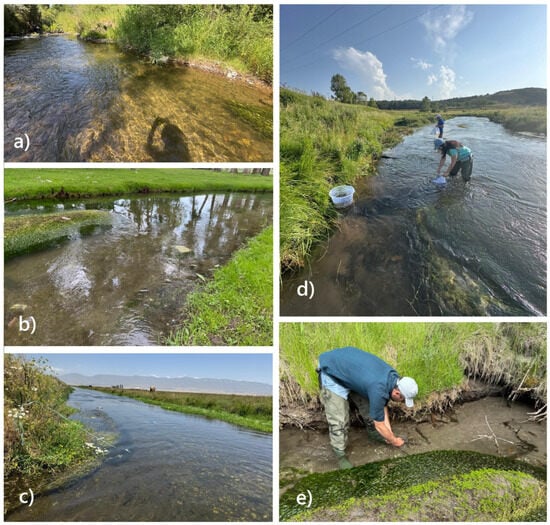
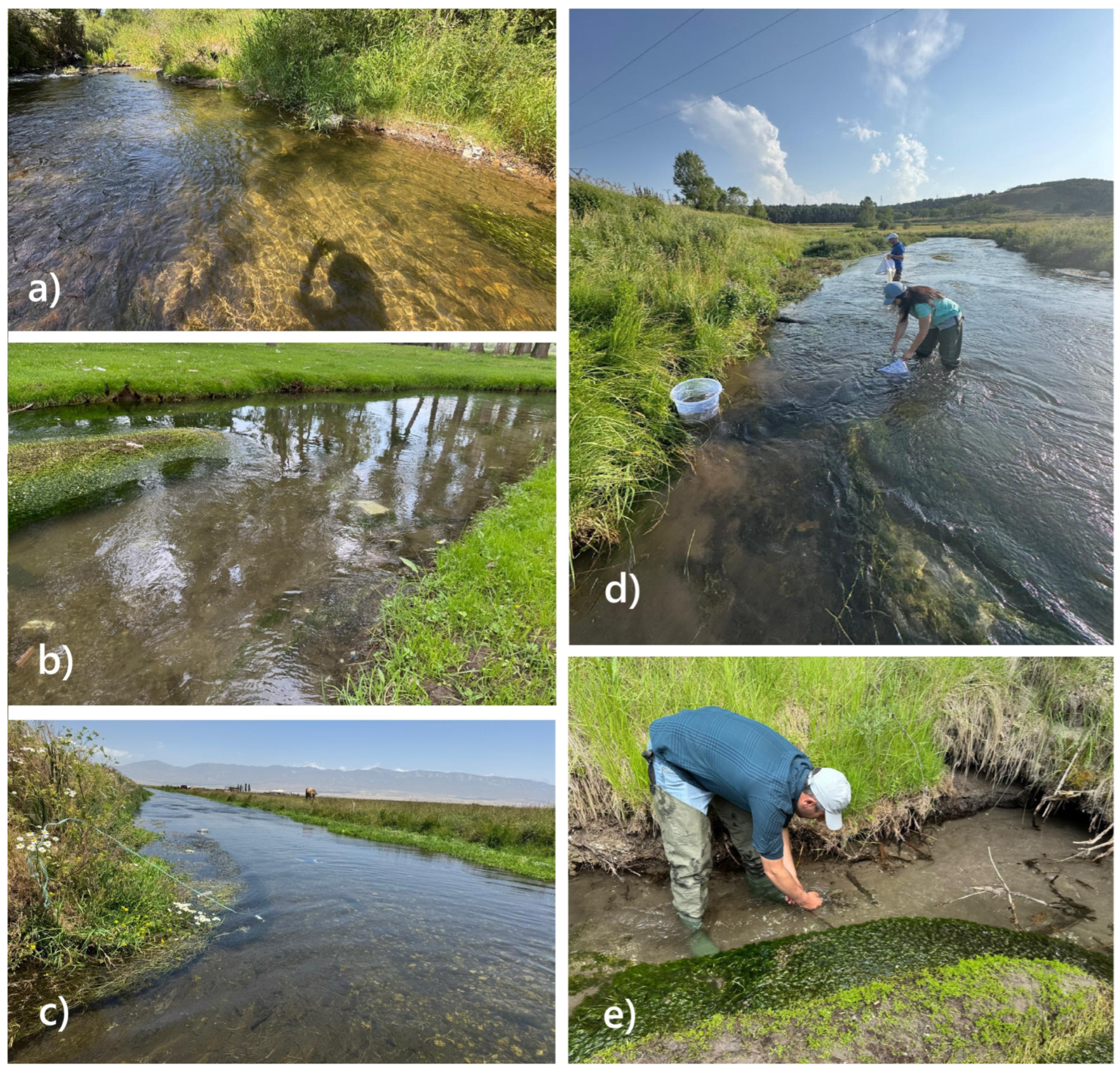
Release and capture of Sevan trout fingerlings. Based on the availability of fingerlings in the Karchaghbyur farm and the thermal conditions of the rivers, we released various sizes of fingerlings of both summer trout and gegharkuni in June of 2025. In total, we released 740 gegharkuni fingerlings into the Karchagbyur, Bakhtak–Tsakqar, and Gavaraget rivers and the unnamed spring in June and July of 2025, as well as 200 summer trout individuals into the Bakhtak–Tsakqar and Akunq rivers in July and September of 2025 (Table 1). We stocked fish into runs but not into riffles (Figure 2).
Table 1.
Release schedule and description for released fingerlings of Sevan trout in 2025.
Figure 2.
River stretches where we stocked fish: (a) Bakhtak–Tsakqar, (b) Karchaghbyur, (c) Akunq, (d) Gavaraget, (e) unnamed source.
Because the two subspecies differ in terms of breeding period, the sizes and ages of individuals at the moment of release were different. We used only cast and lift nets to catch fingerlings in rivers. Cast nets have a 7.64 m2 area and 15 mm × 15 mm mesh size, with pockets of 10 mm × 10 mm mesh size. We set minimum sampling lengths of 10–20 × river width following [34]. Thus, we sampled fish with nets for about 100 m distance upstream and 100 m downstream from the point of stocking. Besides net sampling, we empirically observed the areas between the impermeable barriers upstream and the lake downstream when fish were stocked close to the lake. The impermeable obstacle (bridge with an elevated platform) in the Bakhtak–Tsakqar River is 800 m upstream from the stocking area and in the Karchaghbyur River it is 500 m upstream, while in the unnamed source the overall length of the stream is 1 km, which we completely covered. In the Akunq River, our empirical observations covered 900 m between the bridge upstream and the confluence with the Masrik River downstream. The combination of our empirical observations with the net sampling allowed us to cover a significant zone where fish are assumed to stay.
In Lake Sevan, we used gill nets set at 7 and 10 m depths near Karchagbyur in May and at 25 m depths near the coast of Geghamasar in July following information on catches provided by experienced local commercial fishermen, the behavioral patterns of Sevan trout and the morphology of the lake at particular sites. Gill nets were 100 m long and 6 m high, with mesh sizes of 22 × 22 mm, 38 × 38 mm, and 42 × 42 mm, and arranged one after another. Gill nets were placed in the lake from 6:00 am until 6:00 pm.
Measurements of captured fish. We analyzed each captured fish morphologically and released them back to the rivers. The growth rate and condition factor (CF) of fingerlings were assessed for the periods of release and re-capture. At the end of the experiments, in autumn, some individuals were caught and preserved with 70% ethanol solution, then transported to the laboratory for further biological research (Table 2).
Table 2.
The number of Sevan trout individuals captured for laboratory processing.
To describe the size structure of Sevan trout, we measured fork length (L) and total weight (W) [35,36]. The age structure of fish caught from the lake was determined by counting annual rings on the front part of the scales taken from the center of the fish body, above the lateral line [35,36]. We took 5–10 scales from each fish. The sex structure (juvenile, male, and female) of the fish was determined by examining the gonads under a Bresser Science ETD-301 microscope, Germany, at low magnification. To assess the level of gonad development in fish, we used a maturity scale—from stage I to stage VI [37]. Alos, we analyzed the quantitative and qualitative composition of the stomach content. Stomach fullness index (SFI) was estimated according to the following formula: ingested food weight/total fish weight × 100 [38]. The condition factor (Fulton’s condition index) was calculated according to the following formula: total fish weight/(fork length)3 × 100 [35].
Monitoring of abiotic conditions and ecological state. We began monitoring abiotic parameters prior to releasing fingerlings in June 2025 and continued until the end of the experiments. Temperature and oxygen conditions such as dissolved oxygen (DO) and oxygen saturation (DO%) were measured by the USB MiniDOT loggers (Precision Measurement Engineering, Vista, CA, USA) left in the sampling sites which recorded data each minute. Then, we calculated the mean values for the days of each visit.
Ecological status monitoring following fish release identified the biomass of benthic macroinvertebrates as the main food component of the Sevan trout. Sampling was conducted in the 50–100 m long sections of the river channels using a Surber sampler with a 0.1 m2 frame area and a 500 µm mesh size following the [39,40] standards. Further processing and determination were conducted according to the AQEM project methodology [41] using the identification keys [e.g., [42,43,44,45]]. To assess the ecological state, we used the Biological Monitoring Working Party (BMWP) index [41]
where Ti is the tolerance score and n is the total number of benthic macroinvertebrate individuals in the sample.
Scores in the range of 0–25 represent the worst situation, where the river cannot support the diversity of benthic macroinvertebrates; scores of 26–50 represent a low ecological status, usually the result of nutrient enrichment; scores of 50–100 represent an already good status, satisfactory for fish in the river. Two further categories, very good and excellent, show that the needs of salmonid fish species are fully met in a river.
Statistical processing of data. Descriptive statistics for biological, morphometric, and abiotic data were conducted using the IBM SPSS 17 software (Armonk, NY, USA). Mean and range data was expressed for fish fork length and weight data while mean and standard deviation (SD) were calculated for the abiotic parameters.
Ethics statement. All fingerlings for the experiments were supplied by the STF through the frameworks of their restocking and breeding action plans; all the experiments were agreed on by the STF and Scientific Center of Zoology and Hydroecology of National Academy of Sciences (NAS) of Armenia based on the Memorandum of Understanding signed between the Scientific Center of Zoology and Hydroecology of NAS and STF on 5 January 2025.
3. Results
Abiotic factors. Lake Sevan’s catchment is above 1900 m, which significantly influences the temperature regime (Table 3) of the rivers, and temperature fluctuations play a key role in adaptation to the environment after the release of fingerlings.
Table 3.
The variance of mean values for temperature (°C), dissolved oxygen (DO, mg/L), and oxygen saturation (DO%) in sampling sites. All values are represented along with standard deviations.
The highest fluctuations were recorded for the Bakhtak–Tsakqar River, where the mean temperature in July increased by 7.55 °C in comparison with June and then decreased by 3 °C in September. It is likely that this fluctuation was the main reason that no summer trout individuals were re-captured soon after release. The most stable temperatures were recorded in the Akunq River. The Karchaghbyur River and the unnamed spring had almost similar patterns of temperature change.
Dissolved oxygen content was high in all sampling sites during the overall observation period and exhibited low variations. However, oxygen saturation varied in a wider range. Both the highest and the lowest average concentrations of the DO and oxygen saturation parameters were recorded in the Bakhtak–Tsakqar River while the least changes occurred in the unnamed spring. The most significant changes in DO (mg/L) and DO (%)were recorded between June and July.
Released fish growth monitoring. Monitoring for fish growth began about one week after the first release, but during the first month we made only empirical observations to check the survival/availability of fish in the area of release. The results showed that soon after the release, there were no summer trout individuals at the Bakhtak–Tsakqar station. The same occurred with gegharkuni in the Gavaraget River and in the unnamed spring. All other releases were successful, and we regularly measured fork length, total mass, and condition factor (Table 4).
Table 4.
Changes in the mean values of fork length (cm), weight (g) and condition factor (CF) of released and re-captured individuals of Sevan trout. The number of re-captured fish for measurements (n) is shown under the fork length parameter. Fork and weight data are supplemented with range values.
When comparing with the weight at the point of release, the highest growth in the first 45–48 days after release was detected in the Karchaghbyur River, followed by the unnamed spring. However, in the latter area, we suspended the experiment two months later because no individuals were found during the next two visits. Overall, the highest growth for the overall period of observations was recorded in the Bakhtak–Tsakqar River. If we compare the increase in weight between the rivers, in the Bakhtak–Tsakqar River it was about twice as high as in the Karchaghbyur River. Similarly, the average condition factor was always higher in the Bakhtak–Tsakqar River. Measurements of summer trout in the Akunq River have shown that the fish actively feed, but we did not investigate intestines content because of their migration to the lake at the end of November. Thus, the stomach contents of summer trout in the Akunq River were not investigated.
Parallel to the investigations conducted in the rivers, we also conducted some investigations of Sevan trout in Lake Sevan. Since, during 2023–2025, the Foundation for “Restoration of Sevan trout stocks and development of aquaculture” released 1,457,681 Sevan trout fingerlings into Lake Sevan, we captured fish and measured the same parameters as for the individuals released into rivers, but also determined their age. In total, we captured ten individuals near Karchaghbyur in May and three individuals from the Geghamasar part in June (Table 5).
Table 5.
The fork length (cm), weight (g), sex and gonad development level, age (years old) and condition factor (CF) of Sevan trout captured from Lake Sevan in May and June.
In May, we captured eight 2+-year-old and two 3+-year-old individuals from Lake Sevan. The 2+-year-old individuals ranged from 18.6 to 23.3 cm in length and from 63 to 120 g in weight, while the 3+-year-old individuals ranged from 31.0 to 32.8 cm in length and from 257 to 285 g in weight. In June, two 2- year-old and one immature individual were subjected to biological analysis. The lengths of the fish ranged from 18.0 to 27.0 cm, and their weight from 60 to 160 g. Overall, the condition factor in June was higher than in May.
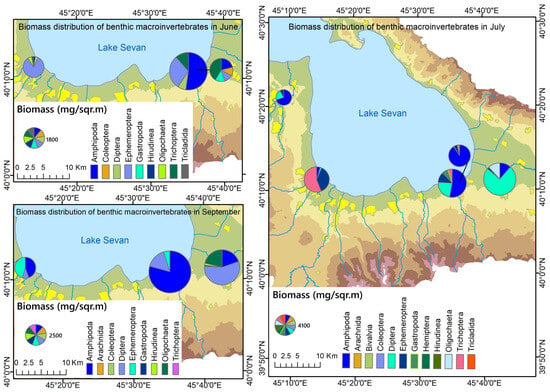
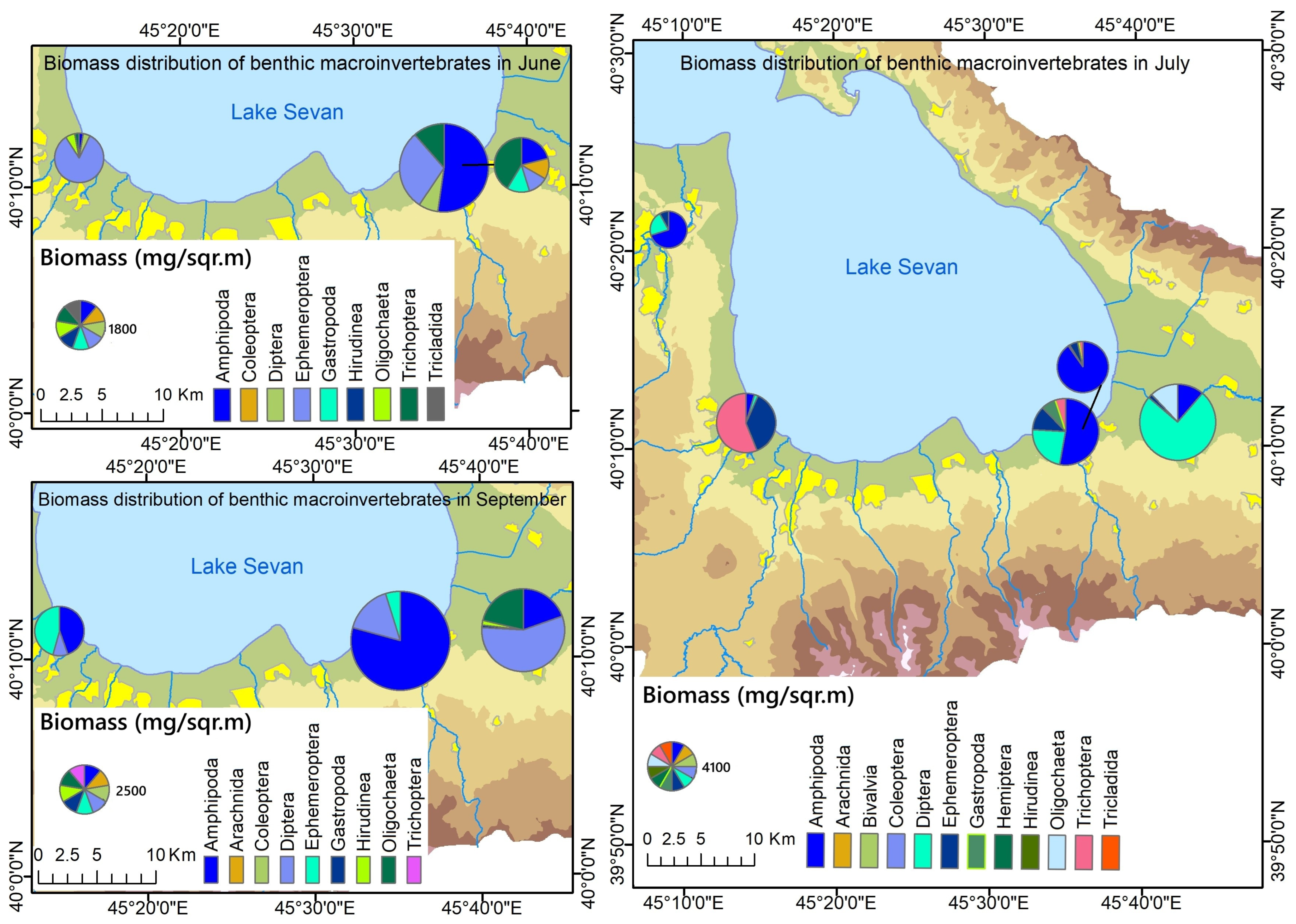
Study of feeding base and fish diet. Considering that the benthivore species Sevan trout mostly eats benthic macroinvertebrates, we investigated their quantitative and qualitative composition in the sampling sites (Figure 3) and in the stomachs of the captured fish.
Figure 3.
Variance of benthic macroinvertebrate biomass (mg/sqr.m) at sampling sites throughout the experimental period. Biomass is proportional to the radius of the circles in the diagram map. Data for the unnamed spring for September were skipped because only 6 mg of benthic macroinvertebrates was found.
A seasonal variance in benthic macroinvertebrate biomass was observed in all sampling sites following the traits of their life cycles and fluctuations in abiotic conditions. In June, high discharge and lower temperatures influenced the diversity and abundance of benthic macroinvertebrates (Supplementary Table S1). In July, both parameters were the highest, while in September they decreased again.
The results indicate the prevalence of mostly mayflies (Ephemeroptera), caddisflies (Trichoptera), flies (Diptera), and amphipods (Amphipoda) in terms of abundance and biomass in all seasons. In the Karchaghbyur River, the fraction of amphipods in the total benthic macroinvertebrate biomass in June and July was 52%, while in September it was 78% (7.97 g/m2), which indicates a stable and energy-rich food base for Sevan trout. Dipterans and mayflies were subdominant across all seasons. In the Bakhtak–Tsakqar River, mayflies dominated both in terms of abundance and biomass in June (84%) and September (41%), while caddisflies dominated in July (56%), followed by mayflies (37%), suggesting high potential for Sevan trout drift-feeding. In the unnamed spring, amphipods dominated in June (29%) and July (89%), followed by either caddisflies or snails (Gastropoda).
Relatively low taxonomic diversity was recorded in the Gavaraget River, where amphipods (70%) and dipterans (22%) dominated by number and by biomass. In the stretch of the Akunq River, a distinct dominance of midges (Chironomidae, Diptera) was recorded in all seasons, accompanied by Oligochaeta and amphipods. The fraction of midges ranged from 75% in June to 55% in September. The subdominant groups were amphipods (1.389 g/m2, 20%), followed by Oligochaeta (1.507 g/m2, 22%).
An extremely low level (≤0.003 g/m2) of living macroinvertebrate biomass was recorded in the unnamed spring in September, mainly represented by flies and gastropods.
An investigation of re-captured fingerlings’ stomach content showed that the mean stomach fullness of the fish in Karchaghbyur was 1.53% (range 0.20–2.74%), while in the Bakhtak–Tsakqar River it was 0.69% (range 0.29–0.93%) and in the unnamed spring it was 2.80% (range 2.08–3.51%). The fish mainly fed on dominant and subdominant groups of benthic macroinvertebrates such as dipterans, amphipods, and mayflies, as well as terrestrial insects. In the Karchaghbyur River, the prevalence of black flies (Simuliidae) was 43%, while in the Bakhtak–Tsakqar River, fish fed mainly on mayflies (40%) followed by black flies, midges, beetle larvae, and caddisflies. In the unnamed spring, the diet was dominated by the representatives of Diptera, which made up 36% of the total, followed by amphipods and midges. Although in the unnamed spring, the stomach fullness of fish was higher than in the Karchaghbyur River, the condition factor was lower, meaning the fish were thinner.
The gill net investigations conducted in the lake showed that the stomachs of eight out of ten individuals were empty in June, while the other two fed exclusively on mollusks. The stomachs of all three fishes captured in July were empty.
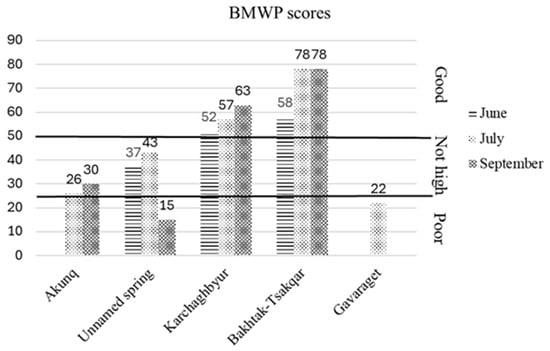
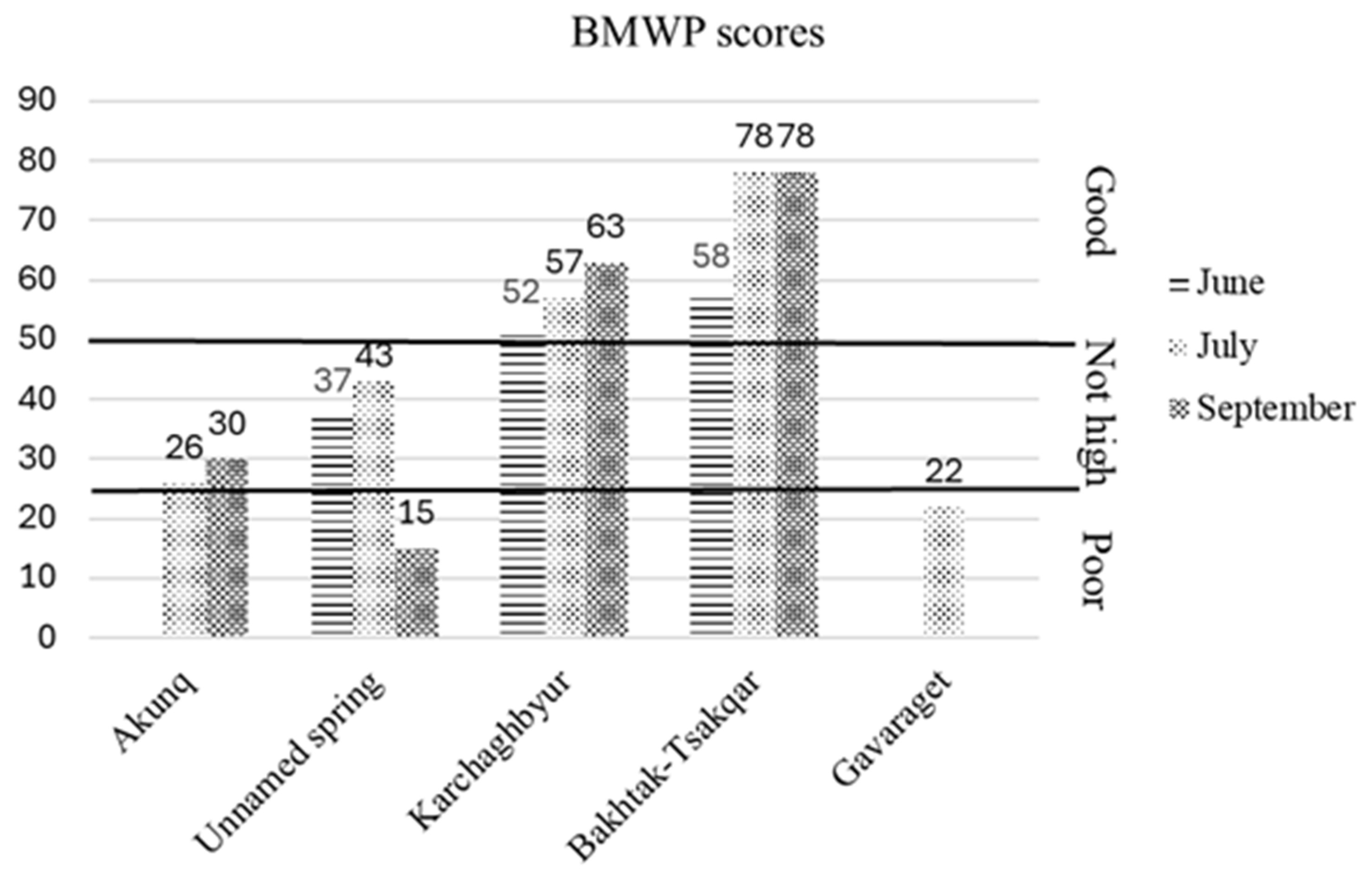
Ecological status. The ecological status assessment using the BMWP index corresponded to patterns of fluctuation in abiotic parameters. Particularly, due to low temperatures at the beginning of the studies, most benthic macroinvertebrates had not yet appeared in the rivers and the BMWP score was rather low. It slightly increased in July, but good status was still only recorded for the Karchaghbyur and Bakhtak–Tsakqar Rivers (Figure 4).
Figure 4.
Variance of the BMWP index values indicating the ecological status of water bodies.
Because the ecological status of the Gavaraget River was poor in July, we did not consider this area appropriate for Sevan trout. The Akunq River and the unnamed spring exhibited low ecological status, which can to some extent support the survival of Sevan trout; however, the vulnerability is rather high. The unnamed spring exhibited the highest variation in ecological status, demonstrating its unsustainable state and a high dependence on the water level in Lake Sevan.
4. Discussion
Environmental conditions. In search of the best opportunities for restocking the endemic Sevan trout population, we investigated general patterns of abiotic and biotic conditions in the major inlets of Lake Sevan. The findings of the investigation on diet components exhibit the general availability of food for fingerlings. The dominant groups of benthic macroinvertebrates such as amphipods, mayflies, caddisflies, and flies are well recognized as key prey components for trout [46]. They have high nutritional value, widespread occurrence, and are easy to capture [47]. Consequently, the investigated habitats demonstrate trophic suitability for trout. The composition and abundance of benthic macroinvertebrates indicate suitable and potentially abundant food resources for trout from the beginning of the summer period [23,27]. The abundance declines slightly in autumn due to hydrological and ecological variations in drainage basins [19,26,31]. The only exceptions were the Gavaraget River and the unnamed spring. The latter is hydrologically closely tied with Lake Sevan. The fact that gammarids were found here in abundance in June and then disappeared in September demonstrates their migration from the lake to spring under certain conditions. The species structure of mollusks, more typical of the lacustrine ecosystem [48], also supports the idea of the unnamed spring functioning more as an ecotone zone; thus, not an appropriate riverine ecosystem for fingerlings. The low BMWP values of the unnamed spring in September were more the result of the emergence of flies and the decrease in water level in Lake Sevan rather than the worsening of its ecological status, but the sandy substratum here will not support the natural reproduction of Sevan trout. A limited diversity of benthic macroinvertebrates in the Gavaraget River exhibits reduced food diversity and pollution; therefore, the suitability of the river for salmonids in its current state is considered low.
Although flies are less nutritious than mayflies and caddisflies, their abundance provides a significant food source for trout. Thus, although feeding potential in the Akunq River is high, the prevalence of flies indicates potentially altered habitat conditions, also supported by previous investigations [23,26]. The Akunq River showed a “low” ecological status during July and September, which is not sufficient to support the long-term survival of Sevan trout. However, the abundance of springs supplying freshwater to the Akunq River along its course let us conclude that Sevan trout can survive here near those springs. Investigations by [49] show that both trout subspecies have similar diets consisting of macroinvertebrates (Gammaridae, Mollusca, Odonata), zooplankton, and fish fry. The presence of empty stomachs recorded during our studies in the lake is explained by the fact that the nets remained in the lake for 12 h and most of the fish were caught in the net before feeding.
The results of abiotic factor analysis show that the temperature conditions generally remained the main constraining factors for the success of restocking summer trout in the rivers of Lake Sevan, particularly in the Bakhtak–Tsakqar River where the smallest fish were stocked. Because we found no summer trout individuals in the Bakhtak–Tsakqar River soon after the launch of an experiment, while gegharkuni survived, we connected this with the range of variations in temperatures [27,31]. Similarly, no experiments were conducted to check whether gegharkuni weighing more than 1 g will survive in the Bakhtak–Tsakqar River in June or not, but our previous investigations demonstrated a higher overall survival of gegharkuni of that weight [27].
Because rivers are quite shallow and rather transparent, fingerlings in the rivers are easy targets for birds and other predators, which can influence survival. We therefore cannot neglect the fact that predation makes stocking in rivers less effective. Predation also significantly influences the success of restocking in the lake, considering the abundance of Armenian gulls and great cormorants; however, the higher depths of the lake make fish less exposed but still vulnerable. Considering the holistic approaches taken in the study and the goal of our project, we have not discussed all possible factors influencing fish survival, only the results regarding the efficiency of the current approaches.
The effectiveness of the proposed method for restocking Sevan trout. The low survival rate of summer trout individuals weighing less than 1 g within a few days of their release exhibits their higher vulnerability to the abiotic conditions of the rivers in the Lake Sevan basin. Thus, considering their low adaptability, we draw the conclusion that releasing summer trout fingerlings directly into the rivers right after emergence is ineffective [11]. Because the hatching of their eggs in rivers was also found to be ineffective [23], a possible restocking strategy can be further considered: advancing them on a farm until the next spring and then stocking them directly, because at this age summer trout will be migrating to the lake anyway. This strategy can also ensure better protection from predators.
Studies have shown the highest viability in rivers for gegharkuni fingerlings weighing between 1 and 3 g. However, the abiotic and ecological status of rivers and their higher exposure to predation set general limitations for the success of such a strategy, which lead us to conclude on the necessity of releasing fingerlings either into the lake or close to the river mouths, considering their homing reflex [29].
However, to support riverine populations, restocking into the rivers is possible. It can be concluded that the Karchaghbyur and Bakhtak–Tsakqar Rivers are the most suitable for Sevan trout in recent conditions; however, their potential for supporting long-term survival is low. Among the other reasons for their low sustainability is water abstraction for irrigation, which significantly affects rivers in summer and autumn [23,26,27].
A comparison between the survival of fingerlings weighing less than 1 g and their success of hatching in the wild [23,28] demonstrated the higher efficiency of restocking through the release of fingerlings only in the Akunq tributary, but the time of this experiment was very limited. Although fingerlings released from fish farms experience higher stress due to the abrupt change in their living conditions, they are more resilient than green and eyed eggs. Further experiments can also focus on finding the most optimal ways of implementing restocking practices in the rivers to minimize such stress.
Overall, given the poor conditions and many obstacles disrupting the natural reproduction of Sevan trout in the rivers [13,23,24,26,50], including their higher exposure to predators because of shallowness and transparency, we assume it is less effective to restock Sevan trout in rivers rather than in the lake. This can also be supported by the finding that the homing reflex of Sevan trout leads to further reproduction of subspecies in the lake if fingerlings are released there [29]. Although there are no further studies in this regard using Sevan trout, lake spawning is typical for some salmonids [51,52]. Thus, additional research is required to determine whether recent Sevan trout stocks can be recovered by mostly stocking the fish in the lake. Also, from a conservation perspective, in recent conditions it would be more practical and effective to release fingerlings directly into the lake, as this would prevent the fish from unsuccessfully spawning in the rivers. Further investigations are necessary to identify the availability of spawning grounds in the lake.
General limitations and perspectives. Considering that gegharkuni yolk sac larvae emerge in January and summer trout yolk sac larvae emerge in June [29,30], the size of the released fingerlings varied between subspecies. Although it should be considered a limitation of this study, we were driven by the fact that fingerlings have low adaptation capacity to environmental conditions and their viability heavily depends on the similarity of temperature conditions in farm basins and rivers [50]. Thus, we had limited time for testing the release of farm-grown individuals into different inlets.
Also, the experiment was limited by the availability of summer trout fingerlings on the Karchaghbyur farm, established for restocking Sevan trout by the Government of Armenia. Summer trout is more rare than gegharkuni, and from an ethical perspective, the release of more fish will lead to higher potential losses of these valuable subspecies considering its lower weight at the moment of release. However, the general pattern of survival proves that the release of more fish will hardly lead to higher survival rates.
The homing reflex of salmonids is well-developed [53], and there is evidence [29] that Sevan trout fingerlings, unlike other subspecies, return to spawn in the areas where they were released. Thus, additional migration and survival studies are required to estimate the efficiency of this approach. In particular, the focus should be on lacustrine spawning grounds, as for summer trout this is currently the only feasible variant. Our recent study was limited by the nets used, which were not highly effective for salmonids. Unfortunately, due to the high pressure caused by illegal fishing, electrofishing is so strictly forbidden in Armenia that we could not use this method for sampling. Therefore, there is also room for future improvements in the efficiency of stream release by gaining permits for using proper sampling gear.
5. Conclusions
Given the current findings on abiotic conditions in the inlets of Lake Sevan and the overall success of restocking actions, we find that further actions taken to restore the Sevan trout population, utilizing fingerling stocking in the rivers, showed a low efficiency. This was particularly evident for summer trout, because it emerges in June and weighs less than 1 g during the remainder of the year before migration to the lake. Alternatively, the recent strategy of releasing fingerlings into the lake directly may lead to higher efficiency. However, there are still some gaps in our knowledge about the dispersion of released fish and on lacustrine habitats’ ability to support the natural reproduction of this endemic fish species. We are also uncertain about the homing reflex of fish released into the lake directly, which can be further elaborated during further amendments to established restoration strategies.
Supplementary Materials
The following supporting information can be downloaded at https://www.mdpi.com/article/10.3390/hydrobiology5020009/s1. Supplementary Table S1. Abundance of benthic macroinvertebrates (ind./m2).
Author Contributions
Conceptualization: N.B., T.V., M.D. and V.A. All authors contributed to the study design. Material preparation and data collection and analysis were performed by N.B., T.V., M.D., L.P., S.G., R.B. and V.A. The first draft of the manuscript was written by N.B. and V.A. All authors have read and agreed to the published version of the manuscript.
Funding
This work was made possible by a Rufford small grant (ID 43444-B).
Institutional Review Board Statement
All fingerlings for the experiments were supplied by the Foundation for “Restoration of Sevan trout stocks and development of aquaculture” (STF) in the frameworks relating to their restocking and breeding action plans; all the experiments were agreed upon by the STF and Scientific Center of Zoology and Hydroecology of National Academy of Sciences (NAS) of Armenia with reference to the Memorandum of Understanding signed between the Scientific Center of Zoology and Hydroecology of NAS and STF on 5 January 2025.
Informed Consent Statement
Not applicable.
Data Availability Statement
All primary data are available either in the manuscript or Supplementary Table S1.
Acknowledgments
We would like to express our sincere gratitude to all staff of the Foundation for “Restoration of Sevan trout stocks and development of aquaculture” for their support and active participation. Also, we would like to thank the two anonymous reviewers who put great effort into significantly improving the quality of the current manuscript through their valuable comments and many suggestions.
Conflicts of Interest
The authors declare no conflicts of interest.
References
- Myers, N.; Mittermeier, R.A.; Mittermeier, C.G.; Da Fonseca, G.A.; Kent, J. Biodiversity hotspots for conservation priorities. Nature 2000, 403, 853–858. [Google Scholar] [CrossRef] [Scilit]
- Kong, X.; Zhou, Z.; Jiao, L. Hotspots of land-use change in global biodiversity hotspots. Resour. Conserv. Recycl. 2021, 174, 105770. [Google Scholar] [CrossRef] [Scilit]
- Nimma, D.; Devi, O.R.; Laishram, B.; Ramesh, J.V.N.; Boddupalli, S.; Ayyasamy, R.; Tirth, V.; Arabi, A. Implications of climate change on freshwater ecosystems and their biodiversity. Desalination Water Treat. 2025, 321, 100889. [Google Scholar] [CrossRef] [Scilit]
- Dudgeon, D.; Arthington, A.H.; Gessner, M.O.; Kawabata, Z.; Knowler, D.J.; Lévêque, C.; Naiman, R.J.; Prieur-Richard, A.H.; Soto, D.; Stiassny, M.L.J.; et al. Freshwater Biodiversity: Importance, Threats, Status and Conservation Challenges. Biol. Rev. Camb. Philos. Soc. 2006, 81, 163–182. [Google Scholar] [CrossRef] [Scilit]
- Wilkinson, I.P. Lake Sevan: Evolution, Biotic Variability and Ecological Degradation. In Large Asian Lakes in the Changing World; Mischke, S., Ed.; Springer Water; Springer: Cham, Switzerland, 2020; pp. 35–63. [Google Scholar] [CrossRef] [Scilit]
- Gabrielyan, B.K. An annotated checklist of freshwater fishes of Armenia. Naga ICLARM Q. 2001, 24, 23–29. [Google Scholar]
- Kalashian, M.; Aghababyan, K.; Zarikian, N.; Gabrielyan, B.; Arakelyan, M.; Ghazaryan, A. Fauna of Armenia. In Biodiversity of Armenia; Fayvush, G., Ed.; Springer: Cham, Switzerland, 2023; pp. 165–282. [Google Scholar] [CrossRef] [Scilit]
- Aghasyan, A.; Kalashyan, M. (Eds.) The Red Book of Animals of the Republic of Armenia; Zangak: Yerevan, Armenia, 2010; 368p. [Google Scholar]
- Levin, B.; Simonov, E.; Gabrielyan, B.; Mayden, R.; Rastorguev, S.; Roubenyan, H.; Sharko, F.; Nedoluzhko, A. Caucasian treasure: Genomics sheds light on the evolution of half-extinct Sevan trout, Salmo ischchan, species flock. Mol. Phylogenetics Evol. 2021, 167, 107346. [Google Scholar] [CrossRef] [Scilit]
- Fortunatov, M.A. Fishery in Lake Sevan. Ann. Sevan Stn. 1927, 1, 131. (In Russian) [Google Scholar]
- Gabrielyan, B.K. Fish of Lake Sevan; Gitutyun: Yerevan, Armenia, 2010; 252p. (In Russian) [Google Scholar]
- Ghukasyan, E.; Asatryan, V.; Melkonyan, H.; Badalyan, N.; Shahnazaryan, G.; Gabrielyan, B. The state of the population of narrow-clawed crayfish in Lake Sevan (Armenia) under multiple stress conditions. Environ. Monit. Assess. 2023, 195, 1278. [Google Scholar] [CrossRef] [Scilit]
- Gabrielyan, B.; Khosrovyan, A.; Schultze, M. A review of anthropogenic stressors on Lake Sevan, Armenia. J. Limnol. 2022, 81, 2061. [Google Scholar] [CrossRef] [Scilit]
- Shahnazaryan, G.; Schultze, M.; Karsten, R.; Gabrielyan, B. Lake Sevan. Past, Present, and Future State of a Unique Alpine Lake. J. Limnol. 2023, 81, 2168. [Google Scholar] [CrossRef] [Scilit]
- Asatryan, V.; Stepanyan, L.; Hovsepyan, A.; Khachikyan, T.; Mamyan, A.; Hambaryan, L. The dynamics of phytoplankton seasonal development and its horizontal distribution in Lake Sevan (Armenia). Environ. Monit. Assess. 2022, 194, 757. [Google Scholar] [CrossRef] [Scilit]
- Hovhanissian, R.O. Lake Sevan Yesterday, Today, Tomorrow; Gitutyun: Yerevan, Armenia, 1994. (In Russian) [Google Scholar]
- Gerasimov, Y.V.; Gabrielyan, B.K.; Malin, M.I.; Rubenyan, A.R. Long-term dynamics of fish reserves in Lake Sevan and their current state. In Ecology of Lake Sevan During the Period of Water Level Rise. The Results of Joint Russian-Armenian Biological Expe-Dition on Hydroecological Observation of Lake Sevan (Armenia); Krylov, A., Ed.; Nauka DNC: Makhachkala, Russia, 2010; pp. 249–278. (In Russian) [Google Scholar]
- Pavlov, D.S.; Savvaitova, K.S.; Markaryan, V.G. Ecological monitoring and the potential for saving trout Salmo ischchan (Kessler, 1877) in Lake Sevan. Vestn. Mosk. Univ. Ser. Biol. 1989, 1, 73–78. (In Russian) [Google Scholar]
- Asatryan, V.; Vardanyan, T.; Barseghyan, N.; Dallakyan, M.; Gabrielyan, B. Experimental validation of suitability of a river for natural reproduction of trout of Lake Sevan using egg incubation. Water 2023, 15, 3993. [Google Scholar] [CrossRef] [Scilit]
- Bogdanowicz, W.; Rutkowski, R.; Gabrielyan, B.K.; Ryspaev, A.; Asatryan, A.N.; Mkrtchyan, J.; Bujalska, B.M. Fish in-troductions in the former Soviet Union: The Sevan trout (Salmo ischchan)—80 years later. PLoS ONE 2017, 12, e0180605. [Google Scholar] [CrossRef] [Scilit]
- Fayvush, G.; Aghababyan, K.; Aleksanyan, A.; Arakelyan, M.; Gasparyan, A.; Kalashian, M.; Margaryan, L.; Nanagulyan, S. Biodiversity Conservation Problems. In Biodiversity of Armenia; Fayvush, G., Ed.; Springer: Cham, Switzerland, 2023; pp. 283–321. [Google Scholar] [CrossRef] [Scilit]
- Aghababyan, K.; Akopian, J.; Hakobyan, S.; Kalashian, M.; Ghazaryan, A.; Aghasyan, L.; Pipoyan, S.; Zarikian, N.; Jenderedjian, K. Wetlands of Armenia. In Wetlands of Mountainous Regions; Pullaiah, T., Ed.; Wiley: Hoboken, NJ, USA, 2025; pp. 103–128. [Google Scholar] [CrossRef] [Scilit]
- Asatryan, V.L.; Dallakyan, M.R. Assessment of seasonal differences of ecological state of lotic ecosystems and applicability of some biotic indices in the Basin of Lake Sevan (Armenia): Case study of Masrik River. Water Sci. Technol. Water Supply 2018, 19, 1238–1245. [Google Scholar] [CrossRef] [Scilit]
- Vardanyan, T.V.; Barseghyan, N.E. Reasons for the changes in morphoecological parameters of Sevan trout. Biol. J. Armen. 2015, 67, 80–84. (In Russian) [Google Scholar]
- Vardanyan, T.V.; Barseghyan, N.E.; Aghasyan, A.L. Comparative analysis of some morph-metric and plastic parameters of Sevan trout from the lakes Issyk-Kul and Sevan. Biol. J. Armen. 2019, 71, 37–42. (In Russian) [Google Scholar]
- Asatryan, V.L.; Barseghyan, N.E.; Dallakyan, M.R.; Vardanyan, T.V. Prompt assessment for the potential spawning areas of Sevan Trout, South-West part of Lake Sevan. Water Sci. Technol. Water Supply J. 2018, 18, 222–232. [Google Scholar] [CrossRef] [Scilit]
- Asatryan, V.; Dallakyan, M.; Vardanyan, T.; Barseghyan, N.; Gabrielyan, B. An integrative evaluation of suitability of a river for natural reproduction of trout of Lake Sevan (Armenia). Environ. Sci. Pollut. Res. 2020, 27, 6352–6361. [Google Scholar] [CrossRef] [Scilit]
- Barseghyan, N.; Vardanyan, T.; Asatryan, V.; Dallakyan, M.; Arakelyan, A.; Mamikonyan, V. Application of new method of artificial incubation of Sevan trout (salmo ischchan, Kessler) eggs in natural condition of tributaries of lake Sevan. Vestn. Astrakhan State Tech. Univ. Ser. Fish. Ind. 2020, 1, 103–110. [Google Scholar] [CrossRef] [Scilit]
- Vladimirov, V.I. The study of biology of fingerlinks and breeding of gegharkuni trout (Salmo ischchan gegarkuni, Kessl. Biotypus α fort.). Ann. Sevan Hydrobiol. Stn. 1940, 8, 87–118. (In Russian) [Google Scholar]
- Savvaitova, K.; Dorofeeva, E.; Markaryan, V.; Smoley, A. Trout of Lake Sevan. Ann. Zool. Inst. 1989, 204, 180. (In Russian) [Google Scholar]
- Mnatsakanyan, B.P. Lake Sevan Basin (Nature, Climate and Water); Asoghik: Yerevan, Armenia, 2007; 190p. (In Armenian) [Google Scholar]
- Heblinski, J.; Schmieder, K.; Heege, T.; Kwaku Agyemang, T.; Sayadyan, H.; Vardanyan, L. Mapping of water constituents in high mountainous Lake Sevan (Armenia). SIL Proc. 1922–2010 2010, 30, 1453–1455. [Google Scholar] [CrossRef] [Scilit]
- Dadikyan, M.G. Fishes of Armenia; AS of ArmSSR: Yerevan, Armenia, 1986; 245p. (In Russian) [Google Scholar]
- Fish protocolos. In Rapid Bioassessment Protocols for Use in Streams and Wadeable Rivers: Periphyton, Benthic Macroinvertebrates and Fish, 2nd ed.; Barbour, M.T., Gerritsen, J., Snyder, B.D., Stribling, J.B., Eds.; EPA 841-B-99-002; U.S. Environmental Protection Agency, Office of Water: Washington, DC, USA, 1999. Available online: https://archive.epa.gov/water/archive/web/html/ch08main.html (accessed on 29 January 2026).
- Moiseev, P.A.; Azizova, N.A.; Kuranova, I.I. Ichthology; Legkaya I Pishchevaya Promishlennost: Moscow, Russia, 1981; 384p. (In Russian) [Google Scholar]
- Usov, M.M. (Ed.) Morphology and Physiology of Fish. Laboratory Practice: Learning Material; BSAA: Gorki, Belarus, 2017; 114p. (In Russian) [Google Scholar]
- Pravdin, I.F. Sex and level of development of gonads. In Fish Study Guide; Publishing “Pishevaya Promishlennost”: Moscow, Russian, 1966; pp. 96–110. [Google Scholar]
- Vinberg, G.G.; Lavrentiev, G.M. (Eds.) Guidelines for Collecting and Processing Material in Hydrobiological Studies of Freshwater Bodies; (Tasks and Methods for Studying the Use of Food Resources by Fish); Zoological Institute of AS USSR: Leningrad, Russia, 1984; 19p. [Google Scholar]
- EN ISO 10870:2012; Water Quality―Guidelines for the Selection of Sampling Methods and Devices for Benthic Macroinvertebrates in Fresh Waters. European Standard: Brussels, Belgium, 2012; pp. 1–36.
- EN 16150:2012; Water Quality—Guidance on Pro-Rata Multi-Habitat Sampling of Benthic Macro-Invertebrates from Wadeable Rivers. European Standard: Brussels, Belgium, 2012; pp. 1–16.
- AQEM Consortium. Manual for the Application of the AQEM System. A Comprehensive Method to Assess European Streams Using Benthic Macro Invertebrates, Developed for the Purpose of the Water Framework Directive. Version 1.0. 2002. 202p. Available online: http://www.aqem.de (accessed on 29 January 2026).
- Kutikova, L.A.; Starobogatov, Y.I. Key to Freshwater Invertebrates of European Part of USSR; Gidrometeoizdat: Leningrad, Russia, 1977. (In Russian) [Google Scholar]
- Bestimmungshilfen-Makrozoobenthos (1) 2010. LANUV Arbeitsblatt 14, Landesamt fur Natur, Umwelt und Verbraucherschutz Nordrhein-Westfalen. Available online: https://www.lanuk.nrw.de/fileadmin/lanuvpubl/4_arbeitsblaetter/40014.pdf (accessed on 29 January 2026). (In German)
- Ivanov, V.D.; Grigorenko, V.N.; Arefina, T.I. Trichoptera. In Key for Freshwater Invertebrates of Russia and Adjacent Territories; Tsalolokhina, S.Y., Ed.; Nauka: St. Petersbourg, Russia, 2001; pp. 1–825. (In Russian) [Google Scholar]
- Waringer, J.; Graf, W. Atlas of Central European Trichoptera Larvae; Eric Mauch Verlag: Dinkelscherben, Germany, 2011; 468p. [Google Scholar]
- Cox, T.L.; Lance, M.J.; Albertson, L.K.; Briggs, M.A.; Dutton, A.J.; Zale, A.V. Diet composition and resource overlap of sympatric native and introduced salmonids across neighboring streams during a peak discharge event. PLoS ONE 2023, 18, e0280833. [Google Scholar] [CrossRef] [Scilit]
- Vesterinen, J.; Keva, O.; Kahilainen, K.K.; Strandberg, U.; Hiltunen, M.; Kankaala, P.; Taipale, S.J. Nutritional quality of littoral macroinvertebrates and pelagic zooplankton in subarctic lakes. Limnol. Oceanogr. 2021, 66, S81–S97. [Google Scholar] [CrossRef] [Scilit]
- Mashkova, I.; Krupnova, T.; Kostryukova, A.; Harutyunova, L.; Hovhannisyan, V.; Vlasov, N. Mollusks biodiversity of Lake Sevan, Armenia. Biodiversitas 2018, 19, 1509–1513. [Google Scholar] [CrossRef] [Scilit]
- Gabrielyan, B.; Vardanyan, T.; Barseghyan, N.; Khosrovyan, A. Estimation of the Potential Wild Fish Stock Biomass to be Supported by Available Food Base in a Lake. Inland Water Biol. 2022, 15, 331–340. [Google Scholar] [CrossRef] [Scilit]
- Zinchenko, T.D.; Golovatyuk, L.V.; Harutyunova, L.D.; Kachvoryan, E.A. Composition, structure of bottom-dwelling communities and water quality assessment of the small rivers of lake Sevan (the Masrik and Argichi rivers). Izv. Samara Sci. Cent. Russ. Acad. Sci. 2013, 15, 203–212. [Google Scholar]
- Burger, C.V.; Finn, J.E.; Holland-Bartels, L. Pattern of shoreline spawning by sockeye salmon (Oncorhynchus nerka) in a glacially turbid lake. Trans. Am. Fish. Soc. 1995, 124, 1–6. [Google Scholar] [CrossRef] [Scilit]
- Woody, C.A.; Quinn, T.P. Influence of spawning habitat on the reproductive success of sockeye salmon (Oncorhynchus nerka). Can. J. Fish. Aquat. Sci. 1995, 52, 1951–1959. [Google Scholar]
- Salmenkova, E.A. Mechanisms of homing in salmonids. Biol. Bull. Rev. 2017, 7, 287–298. [Google Scholar] [CrossRef] [Scilit]

Disclaimer/Publisher’s Note: The statements, opinions and data contained in all publications are solely those of the individual author(s) and contributor(s) and not of MDPI and/or the editor(s). MDPI and/or the editor(s) disclaim responsibility for any injury to people or property resulting from any ideas, methods, instructions or products referred to in the content. |
© 2026 by the authors. Licensee MDPI, Basel, Switzerland. This article is an open access article distributed under the terms and conditions of the Creative Commons Attribution (CC BY) license.