


Abstract
Fast, reliable detection methods are paramount in the fight against the spread of aquatic invasive species (AIS), and eDNA techniques provide many benefits over traditional sampling methods. AIS are spreading rapidly around the world, reshaping ecosystems, outcompeting native species, and experiencing explosive population growth. Some sources cite the Laurentian Great Lakes as the most heavily invaded freshwater system in the world. The advantages of using eDNA technology for AIS detection include: (1) it is often more sensitive, (2) it can cover much more area, (3) it is less destructive, (4) it does not require trapping of threatened species, and (5) it can be done with considerably less taxonomic training. This study was implemented to test the utility of a commercially available metabarcoding assay against a targeted, qPCR approach for the detection of four AIS in Lake Erie. We sampled eight localities monthly throughout the summer of 2024 using both techniques. Our target AIS were the bloody red shrimp Hemimysis anomala, the fishhook waterflea Cercopagis pengoi, the water flea Daphnia lumholtzi, and the gammarid scud Echinogammarus ishnus. We found that the targeted, qPCR approach was more successful at AIS detection for our four target organisms than the specific, commercially available metabarcoding assay that was used.
1. Introduction
One of the most significant threats to the Laurentian Great Lakes (LGL) ecosystems is the presence of aquatic invasive species (AIS) [1,2], which cause an estimated USD 130 million annually in damages [3]. Some sources cite the LGL as the most heavily invaded freshwater system in the world [1,4,5], with 65% of AIS release in the LGL taking place through transoceanic ballast water release [5]. Current estimates state that ~190 AIS have become established in the LGL, of which 30% have negative ecological or economic impacts [6], and 10% have moderate to highly significant impacts [5,7,8,9]. Ecological issues caused by AIS include: (1) competition for resources with native organisms [10], (2) AIS becoming environmental engineers that reshape ecosystems [11], and (3) explosive population growth through a lack of natural predators [10]. These factors result in serious changes to ecosystem functions, fisheries and biodiversity [5] and estimates place the invasion rate of the LGL at 1.71 species a year, the highest recorded in any freshwater system [5]. The alarming rate of AIS establishment demonstrates the need for early detection of invasive species, making eDNA a necessary tool for AIS detection and prevention of their spread through the LGL [1].
eDNA is a game-changing technology for rapid assessment of AIS in aquatic ecosystems [12,13,14]. A meta-analysis comparing traditional survey methods to eDNA survey methods found the eDNA methods to be less expensive, more accurate and more successful with more species [14]. The use of eDNA allows researchers to systematically sample for the presence of AIS in enormous bodies of water, such as the LGL, which would be impossible through traditional sampling methods alone [13,15,16]. When compared to eDNA techniques, some of the difficulties with traditional sampling methods include: (1) traditional methods require an advanced level of taxonomic expertise meaning that eDNA methods can provide more species-specific accuracy with less training [17], (2) traditional methods are often less sensitive than eDNA methods [18,19], (3) traditional sampling can be intrusive to the locality being studied [15,17], (4) traditional sampling can require trapping, which is particularly problematic when the target species is endangered or threatened [20], (5) eDNA can detect larval or juvenile stages that cannot be distinguished morphologically [21], (6) eDNA methods can more easily cover a greater geographic area [22] and discover more species, especially when using metabarcoding [23] and (7) traditional sampling is often more expensive [19]. DNA-based detection is treated as a reliable indicator because the eDNA signal is known to decay rapidly in bio-active water [24,25,26] and biophysical models demonstrate that passive transport reaches a maximum of a few hundred meters to 20 km [27,28].
Generally speaking, the methodologies for using eDNA to detect AIS include targeted or passive eDNA detection approaches. Targeted, also known as active, approaches include techniques such as conventional PCR, quantitative PCR (qPCR), digital droplet PCR (ddPCR) or nested PCR (nPCR) [13,29]. Passive approaches include techniques such as metabarcoding via Illumina sequencing or ON-MinION field-based sequencing [13,17,24,29,30]. Both targeted and passive approaches have specific advantages and disadvantages [13,17].
Targeted eDNA sampling of AIS started in 2008 with the detection of the American bullfrog [31], and by 2018, such methods had been applied to over 100 AIS [12]. Targeted approaches are used in studies that focus on one or a few important species in which a significant amount of molecular research has already been completed [12,16,24,32]. The most time-consuming, prerequisite step is the availability of reliable, species-specific primers for the target organisms. This means that reliable taxonomic identification and DNA sequencing of the target species have already been completed, and reliable primers have been field and lab tested because in silico tests do not always translate to specificity in PCR and qPCR applications [33]. Targeted approaches began with PCR, but now mostly focus on qPCR and ddPCR approaches, as these provide additional information such as DNA copy number and lower contamination risk [26,30] even though they are more expensive and often less accessible than PCR [13]. qPCR and ddPCR have also been used to estimate species abundance [22]. Other approaches have successfully utilized nPCR to increase accuracy and signal for AIS detection [24,34].
Passive eDNA detection approaches focus on metabarcoding, which employs universal primers to amplify all present organisms in a taxonomic group such as fish [35] or zooplankton [36], followed by next-generation sequencing and bioinformatic analysis to determine the presence or absence of AIS [13]. These techniques were first used in a pair of marine ecosystem studies in 2015 and have increased greatly since then [21]. Much like targeted approaches, metabarcoding is known to outperform traditional sampling measures [23]. Advantages to passive eDNA detection over targeted approaches include the unexpected detection of important AIS [29,36,37], the ability to obtain large amounts of data which can be used to identify many species, across multiple trophic levels from a single run [38] and the reduction in labor-intensive sampling, lab work and taxonomic expertise [21]. Metabarcoding has been shown to be sensitive and able to detect AIS when their concentrations are below 0.5% of the total biomass being analyzed [21]. When the metabarcoding data from different sites is viewed as a whole, it could potentially provide insight into the impact that the target AIS is having on the native ecosystem and community [38]. Some critiques of passive eDNA detection methods include: (1) lack of specificity, (2) eDNA being overwhelmed by more numerous species leading to potential false negatives [19,39], (3) lowered sensitivity compared to targeted approaches [22] as seen in bighead carp [29], and (4) incomplete or inaccurate databases which can cause misidentified species [38]. Metabarcoding also falls short of qPCR and ddPCR in the accuracy of species abundance estimation [22].
Our lab recently developed primers and qPCR protocols for four AIS known to be established in Lake Erie and transferred by ballast water through the Laker shipping routes in the LGL [16]. Three of those are part of this study: the water flea Daphnia lumholtzi, the spiney water flea, Cercopagis pengoi, and the gammarid Echinogammarus ishnus. We have also included the problematic bloody red shrimp, Hemimysis anomala, which had previously been designed protocols and primers [18,40]. All four species are small arthropods that are known from the LGL [16,18], but their distributions have not been fully evaluated. Due to their small size (especially D. lumhotlzi and C. pengoi being 3–7 mm), they can be difficult to detect using traditional survey methods, and they release minimal DNA compared to larger aquatic organisms such as fish [16].
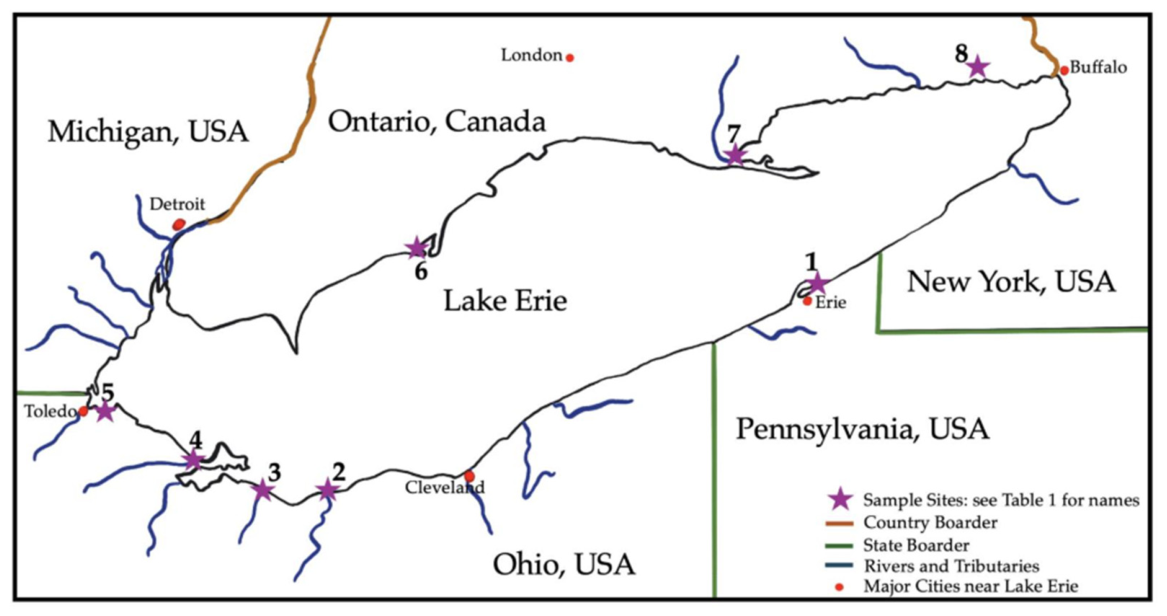
The first purpose of this project was to use targeted eDNA protocols to better understand the temporal and spatial distribution of the above four AIS in Lake Erie by monthly sampling of multiple sites around Lake Erie during the summer months of 2024 (Table 1). Before data collection started, a second objective was added, which was to include metabarcoding data in order to compare passive vs. active approaches to AIS detection using eDNA. We chose to utilize a commercially available metabarcoding assay that completes each step of the lab work and analysis after water collection and filtration by the investigator. This assay was used because labs with limited resources or private companies may wish to use a similar approach toward AIS detection if they lack the equipment or bioinformatics background to complete the work themselves. Using a commercial assay for this project had significant drawbacks, which are discussed below. However, the assay provided the opportunity to determine the feasibility of using commercial assays for AIS detection. Metabarcoding for profit will potentially become a niche industry, and policy or management choices may be determined by data collected from commercial companies. When comparing both methods, we found that the targeted qPCR approach was more reliable for the detection of these four species (Table 2) than the specific commercial assay we used. In addition, we report new detection locality information for each of the target species.
Table 1.
Locality Information with details about where the samples were taken, GPS data and the months sample for both types of analysis. Red letters indicate a sample was taken but failed to produce data.
Table 2.
Column 1—locations; columns 2–13—qPCR success rate data for each species, broken up by total monthly samples, total trials and triplicates for each locality; codes in the table: XX—AIS not detected; Q—positive for qPCR results at that location; M—positive metabarcoding result at that location; blue letter (M or Q)—AIS was previously found at that location; red letter—new detection record of the AIS at that location.
2. Materials and Methods
2.1. Water Collection and Filtering Protocol
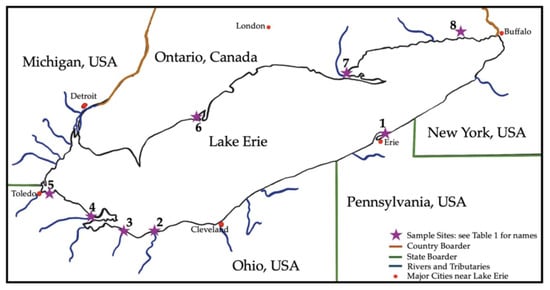
At each location (Figure 1, Table 1), a gloved team member waded into the lake and filled two sterile two-liter bottles with lake water. The bottles were labeled and placed immediately on ice until filtration took place (always by the end of the day). Between collection sites, all gear was thoroughly cleaned and rinsed with 10% bleach solution and dried. Most sites were sampled monthly from May to September, and exceptions are noted in Table 1. Each water sample was used for qPCR and metabarcoding analysis; however, metabarcoding assays failed to provide any data for those samples.
Each water sample to be used in qPCR was filtered through a 0.45 µm Sterivex filter (MF-Millipore, Burlington, MA, USA). Filter housings were attached to a length of silicon tubing with a female luer lock, which passed through a Masterflex peristaltic pump per manufacturer’s directions (Avantor, Randor, PA, USA). The pump was set to a flow rate of 150 mL/m and one of the 2 L lake water samples was pumped through each Sterivex filter until complete, or the flow rate diminished to a slow drip due to a clogged filter. Once the lake water was filtered through each Sterivex filter, 1.8 mL of Longmire’s buffer was pipetted into each filter. Filters were then sealed, labeled, and placed on ice continuously until they were returned to the laboratory. Tubing was then sterilized with 10% bleach and thoroughly rinsed and dried prior to the next filtration following decontamination protocols that have been successful in other experiments [16,26]. For each water sample to be used for metabarcoding with Nature Metrics, the companies’ written protocols were directly followed. These filters were also treated with a DNA preservative and kept cold until they were shipped to Nature Metrics for processing.
2.2. DNA Extraction for qPCR Assays, Inhibition Removal and Serial Dilution
DNA extraction for the eDNA samples and the genomic DNA (gDNA) used for positive controls of C. pengoi, E. ishnus, D. lumholtzi, and H. anomala utilized the salting out DNA extraction protocol developed by Somervile et al. [41]. The protocol provided two eDNA samples from each Sterivex filter used, so the two eDNA samples from each location were designated as A and B.
Day one: An amount of 180 µL of Proteinase K was pipetted into each Sterivex filter (already containing 1.8 mL of Longmire’s buffer) and the samples were incubated at 56 °C for 24 h. Day Two: Solution from each Sterivex filter was carefully transferred to a labeled 15 mL Falcon tube. An amount of 800 µL of the DNA solution from the Falcon tube was added to each of two labeled 2 mL microcentrifuge tubes. Under a fume hood, 800 µL of 24:1 chloroform: isoamyl alcohol was added to the DNA solution in each centrifuge tube. Samples were capped and vortexed in the fume hood for ten seconds and centrifuged at 15,000 g for 5 min. An amount of 600 µL of each tube’s supernatant was removed with a micropipette (avoiding the interface) and transferred to a clean, labeled microcentrifuge tube. An amount of 600 µL of isopropanol and 200 µL of 5M NaCl was added to each sample, the samples were vortexed, and then stored at −20 °C for at least one hour. After freezing, samples were centrifuged at 15,000 g for 15 min to pellet the DNA. The liquid was poured out from the tubes and into a labeled waste container. An amount of 300 µL of 70% ethanol was added to each sample as a wash step and then carefully poured into the waste container. The 70% ethanol wash was repeated, after which samples were left in a tray to air dry overnight. Day Three: Each pellet was resuspended in 100 µL of 60 °C low EDTA TE buffer. Samples were heated for 10 min at 55 °C before being stored at 4 °C overnight, then permanently stored at −20 °C. After DNA extraction, each sample was subsequently subjected to nanodrop analysis to determine if the extraction was successful.
Following extraction, each DNA sample was further cleaned to remove inhibitors using the Zymo One Step PCR Inhibitor Removal Kit for all DNA samples (Zymo Research, Irvine, CA, USA) following the manufacturer’s instructions. After that treatment, one eDNA sample from each location was diluted three times to make a 125 µL dilution at 1:50, 1:100, and 1:200 dilutions. The dilution series was created so that each location could be tested at no dilution and at each dilution listed to further reduce the possibility of inhibitors from potentially polluted water, following protocols from McKee et al. [42] and Gruwell and O’Brien [43].
2.3. qPCR Detection Protocol and Analysis
qPCR testing for eDNA in the Lake Erie water samples was conducted on the CFX96 qPCR machine (BioRad, Hercules, CA, USA). Each site was tested via qPCR using an undiluted sample and the three dilutions discussed above, for a total of four dilutions per site, and each dilution sample was run in triplicate. In total, each monthly sample from each location sampled was tested with 12 qPCR reactions for each targeted AIS.
The generic components for each individual qPCR reaction consisted of 10 µL AmpliTaq Gold 360 (Thermo Fisher Scientific, Waltham, MA, USA), 2 µL sterile H2O, 1 µL each primer, 1 µL EvaGreen dye (Biotium, Fremont, CA, USA) and 5 µL of eDNA. Depending on the number of reactions run at any given time, that amount was multiplied to make enough mastermix for each reaction, plus enough extra for three negative and three positive controls.
The thermocycler protocol for H. anomala was 94 °C for 10 min, followed by 41 cycles of denaturing at 95 °C for 30 s, annealing at 54 °C for 1 min and 30 s, and extension at 72 °C for 1 min, then followed by an extension for 5 min at 72 °C. The sample was then heated to 50 °C and increased at a rate of 0.5 °C every 5 s until the sample reached 95 °C for the melt curve analysis. Fluorescent data collection occurred during the annealing step and during each step of the melt curve analysis. Reactions for C. pengoi, E. ishnus and D. lumholtzi followed the same general protocol as H. anomala, and any differences are published in Gruwell et al. [16].
A positive species identification was made through the presence of a Cq value, and a melt curve shape consistent with and within ±0.5 °C of the temperatures identified in Gruwell et al. [16] and Sheehan et al. [26] for all four AIS. Positive results were not counted unless negative controls showed no amplification, and all positive controls were successful.
2.4. Metabarcoding Through Nature Metrics
We utilized the Nature Metrics metabarcoding services for this project because it is a commercially available service that is easily accessible for smaller lab groups or private companies seeking to obtain metabarcoding data about potential AIS without extensive funding, expertise in next-generation sequencing or facilities to create and run their own metabarcoding test. Nature Metrics provides a streamlined procedure that includes all tools, protocols and analyses necessary for a group to obtain data without needing any lab equipment or kits. Due to the proprietary procedures of the service used, our study was limited because we could not manipulate key parameters that may have produced better results. Examples of parameters outside our control include sequencing depth, filtering criteria, taxonomic databases and primers utilized.
Given those limitations, from our many conversations with Nature Metrics, we are confident that they have taken great care to create a thorough test to find the most abundant species present in the eDNA samples across the arthropods. After inspecting all the data we collected from the 33 completed assays, we hypothesize that the Nature Metrics test would likely pick up a signal from our target AIS if their eDNA signal was present in high enough numbers. The metabarcoding data included the detection of E. ishnus from multiple sites. The assays also detected species closely related to all our other target species, showing that the range of successful detection of the metabarcoding assay should include our target AIS. Detected species that are close relatives to our target AIS included the following: (1) Bryotrephes longimanus, which is closely related to C. pengoi as both are in the family, Cercopagidae, (2) multiple Daphnia species in the same genus as D. lumholtzi, and (3) arthropods from the order Malacostraca, which contains H. anomala.
2.5. Statistical Analyses Comparing Detection Methods
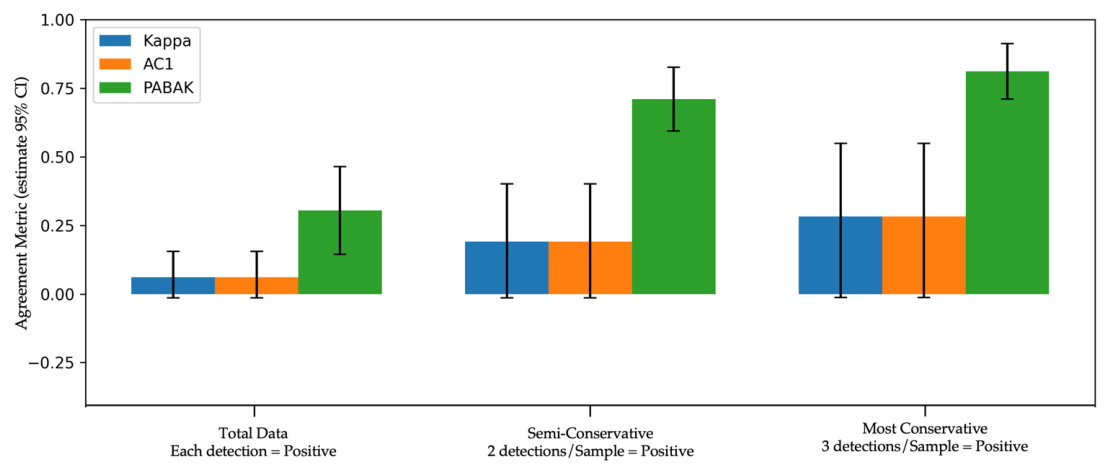
Three statistical tests were performed to provide a quantitative estimate of agreement between qPCR and metabarcoding detection methods. The tests directly compared both methods for each water sample collected, excluding four samples with failed metabarcoding assays. Because the qPCR approach had 12 trials per water sample, the qPCR data set was tested against the metabarcoding with three different parameters to reduce the effect of single positive replicates: (1) total data, single detections were counted as positive, (2) semi conservative, at least two detections needed to equal a positive, (3) most conservative, at least three detections needed to be counted as positive. The statistical tests run were the Cohen Kappa test (κ) [44], Gwet’s AC1 test (AC1) [45] and the prevalence-adjusted bias-adjusted kappa (PABAK) [46]. Each test provides an agreement coefficient between one and negative one. One demonstrates perfect agreement between data sets, negative one demonstrates disagreement, and zero demonstrates random chance. The original plan was to run the Cohen Kappa test only, but the other two tests provide additional robustness when one data set is heavily skewed [45,46]. Given the low number of successful detections of the metabarcoding, the other two tests were included. Nonparametric bootstrap 95% confidence intervals (5000) resamples were generated for each test. Positive qPCR replicates from water samples with failed metabarcoding assays were not included.
3. Results
3.1. Assay Success
Given the specific parameters of this study, comparing lab-developed qPCR detection protocols against a commercial metabarcoding protocol, the targeted qPCR protocol approach for eDNA detection of small animal AIS was more successful than the commercial metabarcoding approach (Table 2). Considering the cost of both approaches, if investigators with limited resources are seeking to detect a finite number of AIS, then the targeted PCR-based approach will likely provide more accuracy in the detection of AIS.
The targeted qPCR method returned a total of 60 positive results from 148 water samples tested (37 water samples each tested for four AIS) and detected each of the targeted AIS. Two AIS, H. anomala and E. ishnus, were detected at least once at each location, C. pengoi was detected at least once in all but one location and D. lumholtzi was detected at three locations (Table 2 and Supplemental Table S1). Conversely, the metabarcoding assays only detected E. ishnus at four locations (Table 2).
Thirty-three, rather than 37, water samples were tested with metabarcoding assays due to assay failure after submission to Nature Metrics. Total data from those analyses included 2,661,948 reads and 1205 total operational taxonomic units (OTUs). The data sets averaged 37 OTUs with a high of 108 OTUs from Erieau in August and a low of two OTUs from Maumee in July. The data sets also represent an average of 80,665 reads with a high of 167,187 reads from Port Colburn in May and a low of 1211 from Maumee in July. Given that the Maumee July sample had the fewest OTUs and fewest reads, that sample may have had issues in the collection or analysis process. Data on specific OTU numbers can be found in the supplementary data (Supplementary Table S1). In total, the data set recovered 375 novel DNA sequence OTUs from invertebrate organisms. Of the OTU sequences that linked to known organisms, the data set included 67 unique families and 124 unique genera. The total data set included 114 DNA sequences that matched unique species that are judged to be reliable indicators of morphologically and genetically identified species.
3.2. AIS Range Data Acquired Through Both Assays
The qPCR data resulted in new detection localities for all AIS tested. Every effort was made to control for contamination, including positive and negative controls. The detections are assumed to be legitimate evidence of AIS DNA presence in the water sampled, even when a single replicate produced a positive result. eDNA is known to degrade quickly, as noted above. Despite that, eDNA detection of a species is not evidence of established populations. Each of these AIS is documented from Lake Erie, so establishment is possible; however, the target AIS were chosen because they are small and likely to be transported in ballast water or by other means. Therefore, a single positive replicate in a location, as with C. pengoi in Erieau, could be the result of an incidental collection and not evidence of establishment. When new locations are reported below, the number of positive replicates is also reported and can be found in the supplementary data.
Echinogammarus ishnus was detected at three of eight localities and four of 33 trials in the metabarcoding data. The qPCR assays detected E. ishnus in all eight localities, 25 of 37 water samples and 36 of 148 triplicate series. The eDNA testing detected E. ishnus at two new localities in Lake Erie, Vermillion River Estuary (qPCR—15 replicates) and Port Clinton (qPCR—7 replicates and metabarcoding). Echinogamarus ishnus was previously detected at all other localities [47].
Hemimysis anomala was never detected via metabarcoding but was detected through qPCR assays in all eight localities, 21 of the 37 water samples and 23 of 148 triplicate series. H. anomala eDNA was detected at four new Lake Erie localities, Vermillion River Estuary (4 replicates), Huron River Estuary (2 replicates), Erieau Marina (2 replicates) and Long Point (3 replicates). There did not appear to be a strong seasonal bias in the H. anomala detection, though it was detected in every location from the September water samples; it was also detected sporadically in each of the other months (Supplementary Table S1). These results seem consistent with other studies in the area, which reported the presence of H. anomala in Lake Ontario and the Finger Lakes of New York, USA, throughout the year, but some fluctuations in the abundance due to water temperature and life cycle [48] and the highest densities in Lake Ontario occurring in the Fall [49].
Cercipagis pengoi was detected at seven of the eight localities tested using qPCR and was never detected in the metabarcoding tests. In total, 11 of 37 water samples and 12 of 148 triplicate series had positive results. Of the localities with eDNA detection, six represent new localities in Lake Erie: Presque Isle Bay (1 replicate), Vermillion River Estuary (3 replicates), Huron River Estuary (1 replicate), Port Clinton (2 replicates), Erieau Marina (1 replicate), Long Point (1 replicate) and Port Colburn (3 replicates). The seasonal trend for C. pengoi favored the later months of the summer. It was never detected in May or June; it was detected in three locations in July, three locations in August and five locations in September. Our trials did not detect C. pengoi at Maumee Bay, though it had been found near Maumee in the past [50] along with various other sites pelagically [47]. The low number of replicates that displayed a positive result for this species is not surprising because it is a mainly pelagic species that is commonly found far from shore, associated with open water [47].
Daphnia lumholtzi was detected in the fewest localities with no positive results in the metabarcoding tests and positive results for three of 37 water samples, six of 148 triplicate series and three different locations: Vermillion River Estuary (August, 3 replicates), Maumee Bay (July, 3 replicates), and Port Colburn (June, 3 replicates). All detections represented new localities, though it was previously found near Port Clinton [51]. The most interesting of these results was finding eDNA in Port Colburn in June because it had previously only been known from the southwest corner of Lake Erie during the later summer months. The southwest corner of Lake Erie is the shallowest and typically the warmest water in Lake Erie [52]. We also note that the location of sampling in Port Colburn was in the docks where laker ships were transporting cargo, meaning that ballast water was likely discharged in that area.
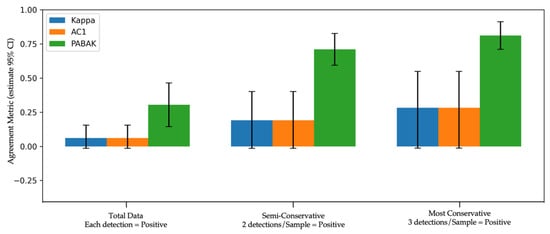
Statistical analyses measuring the agreement between the qPCR data set and metabarcoding data set showed low agreement in the Cohen’s Kappa (κ = 0.06) and AC1 (AC1 = 0.06) but higher concordance with the PABAK test (PABAK = 0.30). In all three tests, the agreement increased with more conservative sampling estimations, showing that there is an increase in concordance when analytical stringency rises. However, κ and AC1 were still at 0.282 for the most conservative treatment of the data (Figure 2), and none of the treatment groups or statistical tests show perfect agreement between the two detection methods. It is also important to note that the statistical agreement between the data sets fails to highlight the lack of detection of four AIS by the commercial metabarcoding assay.
Figure 2.
qPCR and metabarcoding agreement statistics showing Kappa, AC1 and PABAK statistics for all three qPCR treatment groups.
4. Discussion and Conclusions
When AIS detection needs to be accurate and cost-effective, eDNA is often the most reliable method due to the reasons cited in the introduction. The purpose of this study was twofold: (1) to learn more about seasonal and temporal distributions of four AIS in Lake Erie and (2) to compare the eDNA detection success of a targeted qPCR approach to a commercially available, passive metabarcoding approach and possibly determine which method was the more reliable within the limitations of the data collected.
As demonstrated in the results, this data set found many new detection localities for our target AIS. We do not claim that these sites show newly (or previously undetected) established populations. However, the detection sites provide locations of interest for these known AIS and should be included when considering ballast water management strategies or academic studies, such as habitat expansions of these AIS in the LGL or investigating ecological impacts of these four invasive species. As we move forward with our understanding of AIS distributions in the Great Lakes, care needs to be taken to slow their spread, and the first step in control is knowing where they are currently residing. Our hope is that the detection data provided here will help inform other investigators who are looking to further study these AIS.
In some cases, there may be a strong argument for establishment, depending on repeated detections, proximity to established populations and ecology of the organisms. For example, H. anomala was detected each month at the Vermillion River Estuary, though there is no record of it at that location on the Great Lakes Aquatic Nonindigenous Species Information System website [47]. This species lives close to rocks, overwinters in the same place it is found during summer months [30,40] and is established just up the coastline in the Ashtabula River Estuary [47] and Presque Isle [personal collection by the authors]. In contrast, as mentioned above, C. pengoi is a pelagic species, so finding a single positive detection in an area is not sufficient evidence of establishment. With the data collected, there is not enough evidence to make assumptions about temporal distributions of the target AIS beyond the few trends mentioned in the results.
The second purpose of the project was to provide information about the utility of commercial metabarcoding for private companies or small labs (such as academic labs at undergraduate institutions and local governmental groups) that wish to detect AIS or other organisms of importance using eDNA. Often, such groups do not have extensive resources in time and money or possibly lack expertise in next-generation sequencing and data processing, and so utilize commercial labs that can do the work for them. With the increase in eDNA utility and the need to better understand the environmental impact of human activities, there will likely be a great need for commercial groups that can provide information about the presence or absence of ecologically important species, and metabarcoding will be an important tool for obtaining such information. To address that potential need, this project was designed to test the strength of one commercial metabarcoding assay against a targeted qPCR approach with known, species-specific primers. Both approaches were tested in eight localities around Lake Erie across the summer months (May-Sept) of 2024. For all species, the targeted qPCR approach was more successful at eDNA detection than the commercial metabarocoding assay.
We conclude that if investigators are looking to quickly and reliably detect AIS for which there are already primers and PCR protocols established, then they should utilize a targeted qPCR or PCR, eDNA sampling method over the current commercial metabarcoding approach. This seems to be especially important if the organisms do not dominate the ecosystem and contribute little DNA for the metabarcoding assay to detect. We also stress that using extreme care to follow sterile collection, PCR, and electrophoresis laboratory methods is paramount, especially for labs needing to use PCR methods due to available lab equipment.
It is not surprising that, in this instance, the commercially available metabarcoding assay may have fallen short in providing accurate AIS detection data for two reasons. First, metabarcoding in general is prone to error, though false negatives due to amplification bias [19,39]. Second, this commercially available test was designed for broad-spectrum amplification, and we will not have control over the primers or other parameters used in the sequencing process. Despite the potential for error in this case, there is an important place for using DNA metabarcoding in AIS detection and general species sampling. Along with the data on our focus AIS, the 33 metabarcoding analyses detected a total of 114 species, and the data sets provided an enormous amount of additional data about species in Lake Erie throughout the summer. Due to the scope of this study, we have not included those data sets in this manuscript, but are working on assimilating the whole data set to discover how these records match known species, especially AIS, in Lake Erie, with plans to publish shortly.
Supplementary Materials
The following supporting information can be downloaded at: https://www.mdpi.com/article/10.3390/hydrobiology5020011/s1. Supplementary Table S1: Total Data by Month: Column 1—Locations and sample collection months; Columns 2–9—qPCR success rate by species showing total trials and triplicates by locality and month; Column 10—Metabarcoding data, OTUs and Reads for each sample collected. Codes in the table: XX—AIS not detected; Q—Positive for qPCR results at that location; M—Positive metabarcoding result at that location; Blue Letter—AIS was previously found at that location; Red Letter—New detection record of the AIS at that location; Green Fill—Positive qPCR result; Orange Fill—Positive metabarcoding result; Blue Fill—Positive for both types of assays.
Author Contributions
Conceptualization, M.E.G.; methodology and data collection, M.E.G. and A.W.; data curation, A.W. and M.E.G.; writing—original draft preparation, M.E.G. and A.W.; writing—review and editing, M.E.G.; project administration, M.E.G.; funding acquisition, M.E.G. All authors have read and agreed to the published version of the manuscript.
Funding
This research was funded by Great Lakes Protection Fund, grant number #2037.
Data Availability Statement
All new data about positive eDNA reactions for our target AIS is included in this paper and in the supplementary documents. Data about additional species found through metabarcoding with be published in a future manuscript.
Acknowledgments
We would like to thank the Great Lakes Protection Fund, and Penn State Behrend School of Science. We would like to thank Elli Gruwell with help with the artwork and support from Stacie Gruwell. We would also like to thank two anonymous reviewers who provided insightful comments that sculpted the manuscript in many ways and improved final paper. The authors have reviewed and edited the output and take full responsibility for the content of this publication.
Conflicts of Interest
The authors declare no conflicts of interest.
Abbreviations
The following abbreviations are used in this manuscript:
| LGL | Laurentian Great Lakes |
| AIS | Aquatic Invasive Species |
References
- Trebitz, A.S.; Hoffman, J.C.; Darling, J.A.; Pilgrim, E.M.; Kelly, J.R.; Brown, E.A.; Chadderton, W.L.; Egan, S.P.; Grey, E.K.; Hashsham, S.A.; et al. Early detection monitoring for aquatic non-indigenous species: Optimizing surveillance, incorporating advanced technologies, and identifying research needs. J. Environ. Manag. 2017, 202, 299–310. [Google Scholar] [CrossRef] [Scilit]
- Allan, J.D.; McIntyre, P.B.; Smith, S.D.; Halpern, B.S.; Boyer, G.L.; Buchsbaum, A.; Burton, G.A., Jr.; Campbell, L.M.; Chadderton, W.L.; Ciborowski, J.J.; et al. Joint analysis of stressors and ecosystem services to enhance restoration effectiveness. Proc. Natl. Acad. Sci. USA 2013, 110, 372–377. [Google Scholar] [CrossRef] [Scilit] [PubMed]
- Rothlisberger, J.D.; Finnoff, D.C.; Cooke, R.M.; Lodge, D.M. Ship-borne nonindigenous species diminish Great Lakes ecosystem services. Ecosystems 2012, 15, 1–15. [Google Scholar] [CrossRef] [Scilit]
- Pagnucco, K.S.; Maynard, G.A.; Fera, S.A.; Yan, N.D.; Nalepa, T.F.; Ricciardi, A. The future of species invasions in the Great Lakes-St. Lawrence River basin. J. Great Lakes Res. 2015, 41, 96–107. [Google Scholar] [CrossRef] [Scilit]
- Ricciardi, A.; MacIsaac, H.J. Vector control reduces the rate of species invasion in the world’s largest freshwater ecosystem. Conserv. Lett. 2022, 15, e12866. [Google Scholar] [CrossRef] [Scilit]
- Sturtevant, R.A.; Mason, D.M.; Rutherford, E.S.; Elgin, A.; Lower, E.; Martinez, F. Recent history of nonindigenous species in the Laurentian Great Lakes; An update to Mills et al., 1993 (25 years later). J. Great Lakes Res. 2019, 45, 1011–1035. [Google Scholar] [CrossRef] [Scilit]
- Mills, E.L.; Leach, J.H.; Carlton, J.T.; Secor, C.L. Exotic species in the Great Lakes: A history of biotic crises and anthropogenic introductions. J. Great Lakes Res. 1993, 19, 1–54. [Google Scholar] [CrossRef] [Scilit]
- Ricciardi, A. Facilitative interactions among aquatic invaders: Is an “invasional meltdown” occurring in the Great Lakes? Can. J. Fish. Aquat. Sci. 2001, 58, 2513–2525. [Google Scholar] [CrossRef]
- Ricciardi, A. Patterns of invasion in the Laurentian Great Lakes in relation to changes in vector activity. Divers. Distrib. 2006, 12, 425–433. [Google Scholar] [CrossRef] [Scilit]
- Lovell, S.J.; Stone, S.F.; Fernandez, L. The economic impacts of aquatic invasive species: A review of the literature. Agric. Resour. Econ. Rev. 2006, 35, 195–208. [Google Scholar] [CrossRef] [Scilit]
- Havel, J.E.; Kovalenko, K.E.; Thomaz, S.M.; Amalfitano, S.; Kats, L.B. Aquatic invasive species: Challenges for the future. Hydrobiologia 2015, 750, 147–170. [Google Scholar] [CrossRef] [Scilit] [PubMed]
- Blackman, R.C.; Hänfling, B.; Lawson-Handley, L. The use of environmental DNA as an early warning tool in the detection of new freshwater invasive non-native species. CABI Rev. 2018, 13, 1–15. [Google Scholar] [CrossRef] [Scilit]
- Blackman, R.C.; Ling, K.K.S.; Harper, L.R.; Shum, P.; Hänfling, B.; Lawson-Handley, L. Targeted and passive environmental DNA approaches outperform established methods for detection of quagga mussels, Dreissena rostriformis bugensis in flowing water. Ecol. Evol. 2020, 10, 13248–13259. [Google Scholar] [CrossRef] [Scilit]
- Fediajevaite, J.; Priestley, V.; Arnold, R.; Savolainen, V. Meta-analysis shows that environmental DNA outperforms traditional surveys, but warrants better reporting standards. Ecol. Evol. 2021, 11, 4803–4815. [Google Scholar] [CrossRef] [Scilit]
- Klymus, K.E.; Marshall, N.T.; Stepien, C.A. Environmental DNA (eDNA) metabarcoding assays to detect invasive invertebrate species in the Great Lakes. PLoS ONE 2017, 12, e0177643. [Google Scholar] [CrossRef] [Scilit]
- Gruwell, M.E.; Welsbacher, A.; Moore, N.; Cangelosi, A.; Melendez, A.; Sheehan, R.; Knight, I. Working Primers and qPCR Protocols for Rapid eDNA Identification of Four Aquatic Invasive Species Found in the Lower Great Lakes with High Potential for Ballast Transport to Lake Superior. Hydrobiology 2025, 4, 22. [Google Scholar] [CrossRef] [Scilit]
- Fonseca, V.G.; Davison, P.I.; Creach, V.; Stone, D.; Bass, D.; Tidbury, H.J. The application of eDNA for monitoring aquatic non-indigenous species: Practical and policy considerations. Diversity 2023, 15, 631. [Google Scholar] [CrossRef] [Scilit]
- Cangelosi, A.; Balcer, M.; Prihoda, K.; Gruwell, M.; TenEyck, M.; Aicher, R.; Lopez-Camacho, Y.; Knight, I.T.; Grey, E.K. Evaluation of eDNA qPCR monitoring as an early detection tool for a non-native mysid in Great Lakes Waters. J. Great Lakes Res. 2024, 50, 102377. [Google Scholar] [CrossRef] [Scilit]
- Rishan, S.T.; Kline, R.J.; Rahman, M.S. Applications of environmental DNA (eDNA) to detect subterranean and aquatic invasive species: A critical review on the challenges and limitations of eDNA metabarcoding. Environ. Adv. 2023, 12, 100370. [Google Scholar] [CrossRef] [Scilit]
- Rees, H.C.; Maddison, B.C.; Middleditch, D.J.; Patmore, J.R.; Gough, K.C. The detection of aquatic animal species using environmental DNA–a review of eDNA as a survey tool in ecology. J. Appl. Ecol. 2014, 51, 1450–1459. [Google Scholar] [CrossRef] [Scilit]
- Ruppert, K.M.; Kline, R.J.; Rahman, M.S. Past, present, and future perspectives of environmental DNA (eDNA) metabarcoding: A systematic review in methods, monitoring, and applications of global eDNA. Glob. Ecol. Conserv. 2019, 17, e00547. [Google Scholar] [CrossRef] [Scilit]
- Pont, D.; Meulenbroek, P.; Bammer, V.; Dejean, T.; Erős, T.; Jean, P.; Lenhardt, M.; Nagel, C.; Pekarik, L.; Schabuss, M.; et al. Quantitative monitoring of diverse fish communities on a large scale combining eDNA metabarcoding and qPCR. Mol. Ecol. Resour. 2023, 23, 396–409. [Google Scholar] [CrossRef] [Scilit]
- Gehri, R.R.; Larson, W.A.; Gruenthal, K.; Sard, N.M.; Shi, Y. eDNA metabarcoding outperforms traditional fisheries sampling and reveals fine-scale heterogeneity in a temperate freshwater lake. Environ. DNA 2021, 3, 912–929. [Google Scholar] [CrossRef] [Scilit]
- Davison, P.I.; Falcou-Préfol, M.; Copp, G.H.; Davies, G.D.; Vilizzi, L.; Créach, V. Is it absent or is it present? Detection of a non-native fish to inform management decisions using a new highly-sensitive eDNA protocol. Biol. Invasions 2019, 21, 2549–2560. [Google Scholar] [CrossRef] [Scilit]
- Kirtane, A.; Wieczorek, D.; Noji, T.; Baskin, L.; Ober, C.; Plosica, R.; Chenoweth, A.; Lynch, K.; Sassoubre, L. Quantification of environmental DNA (eDNA) shedding and decay rates for three commercially harvested fish species and comparison between eDNA detection and trawl catches. Environ. DNA 2021, 3, 1142–1155. [Google Scholar] [CrossRef] [Scilit]
- Sheehan, R.; Knight, I.T.; Cangelosi, A.; Melendez, A.; Phillips, H.; Welsbacher, A.; Gruwell, M.E. Quantitative assessment of planktonic AIS eDNA signal duration in Great Lakes harbor water microcosms. Manag. Biol. Invasions 2024, 15, 567–580. [Google Scholar] [CrossRef] [Scilit]
- Ellis, M.R.; Clark, Z.S.; Treml, E.A.; Brown, M.S.; Matthews, T.G.; Pocklington, J.B.; Stafford-Bell, R.E.; Bott, N.J.; Nai, Y.H.; Miller, A.D.; et al. Detecting marine pests using environmental DNA and biophysical models. Sci. Total Environ. 2022, 816, 151666. [Google Scholar] [CrossRef] [Scilit]
- Morrissey, S.J.; Schlaefer, J.A.; Jerry, D.R.; Kingsford, M.J. Estimating transport and detectability of Chironex fleckeri environmental DNA in an open coastal bay. J. R. Soc. Interface 2026, 23, 20250354. [Google Scholar] [CrossRef] [Scilit]
- Simmons, M.; Tucker, A.; Chadderton, W.L.; Jerde, C.L.; Mahon, A.R. Active and passive environmental DNA surveillance of aquatic invasive species. Can. J. Fish. Aquat. Sci. 2016, 73, 76–83. [Google Scholar] [CrossRef] [Scilit]
- Melliti, S.; Vautier, M.; Chardon, C.; Jacquet, S. Quantifying invasion dynamics: Quantitative polymerase chain reaction vs. droplet digital polymerase chain reaction in monitoring the alien invasive bloody-red shrimp Hemimysis anomala and its interaction with perch in Lake Geneva. Limnol. Oceanogr. Methods 2025, 23, 212–222. [Google Scholar] [CrossRef] [Scilit]
- Ficetola, G.F.; Miaud, C.; Pompanon, F.; Taberlet, P. Species detection using environmental DNA from water samples. Biol. Lett. 2008, 4, 423–425. [Google Scholar] [CrossRef] [Scilit] [PubMed]
- Wozney, K.M.; Wilson, C.C. Quantitative PCR multiplexes for simultaneous multispecies detection of Asian carp eDNA. J. Great Lakes Res. 2017, 43, 771–776. [Google Scholar] [CrossRef] [Scilit]
- So, K.Y.K.; Fong, J.J.; Lam, I.P.Y.; Dudgeon, D. Pitfalls during in silico prediction of primer specificity for eDNA surveillance. Ecosphere 2020, 11, e03193. [Google Scholar] [CrossRef] [Scilit]
- Kurtz, P.; Santo Domingo, J.; Pyron, R.A.; Wendell, D. Nested PCR amplification of the mitochondrial hypervariable region for non-invasive eDNA detection of Cryptobranchus alleganiensis. PLoS ONE 2025, 20, e0328633. [Google Scholar] [CrossRef] [Scilit]
- Balasingham, K.D.; Walter, R.P.; Mandrak, N.E.; Heath, D.D. Environmental DNA detection of rare and invasive fish species in two Great Lakes tributaries. Mol. Ecol. 2018, 27, 112–127. [Google Scholar] [CrossRef] [Scilit]
- Brown, E.A.; Chain, F.J.; Zhan, A.; MacIsaac, H.J.; Cristescu, M.E. Early detection of aquatic invaders using metabarcoding reveals a high number of non-indigenous species in Canadian ports. Divers. Distrib. 2016, 22, 1045–1059. [Google Scholar] [CrossRef] [Scilit]
- Blackman, R.C.; Constable, D.; Hahn, C.; Sheard, A.M.; Durkota, J.; Hänfling, B.; Lawson Handley, L. Detection of a new non-native freshwater species by DNA metabarcoding of environmental samples--first record of Gammarus fossarum in the UK. Aquat. Invasions 2017, 12, 177–189. [Google Scholar] [CrossRef] [Scilit]
- Wood, S.A.; Pochon, X.; Laroche, O.; von Ammon, U.; Adamson, J.; Zaiko, A. A comparison of droplet digital polymerase chain reaction (PCR), quantitative PCR and metabarcoding for species-specific detection in environmental DNA. Mol. Ecol. Resour. 2019, 19, 1407–1419. [Google Scholar] [CrossRef] [Scilit]
- Acharya-Patel, N.; Allison, M.J.; Helbing, C.C. Environmental DNA: Revolutionizing ecological assessments with genomics. In Genomics and the Global Bioeconomy; Academic Press: Cambridge, MA, USA, 2025; pp. 103–124. [Google Scholar]
- Brown, M.; Boscarino, B.; Oyagi, S.; Tibbetts, M.; Sanchez, C. Novel Methods for Early Detection of the Bloody red Shrimp, Hemimysis anomala. Great Lakes Res. Consort. 2017. [Google Scholar]
- Somerville, C.C.; Knight, I.T.; Straube, W.L.; Colwell, R.R. Simple, rapid method for direct isolation of nucleic acids from aquatic environments. Appl. Environ. Microbiol. 1989, 55, 548–554. [Google Scholar] [CrossRef] [Scilit]
- McKee, A.M.; Spear, S.F.; Peirson, T.W. The effect of dilution and the use of a post-extraction nucleic acid purification column on the accuracy, precision, and inhibition of environmental DNA samples. Biol. Conserv. 2015, 183, 70–76. [Google Scholar] [CrossRef] [Scilit]
- Gruwell, M.E.; O’Brien, G. Revisiting the invasive red swamp crayfish, Procambarus clarkii, at Driehoek Farm in Mpumalanga, South Africa to test eDNA primers and protocols for distribution analysis. Water SA 2026. resubmitted. [Google Scholar]
- McHugh, M.L. Interrater reliability: The kappa statistic. Biochem. Medica. 2012, 22, 276–282. [Google Scholar] [CrossRef] [Scilit]
- Gwet, K. Inter-rater reliability: Dependency on trait prevalence and marginal homogeneity. Stat. Methods Inter-Rater Reliab. Assess. Ser. 2002, 2, 9. [Google Scholar]
- Chen, G.; Faris, P.; Hemmelgarn, B.; Walker, R.L.; Quan, H. Measuring agreement of administrative data with chart data using prevalence unadjusted and adjusted kappa. BMC Med. Res. Methodol. 2009, 9, 5. [Google Scholar] [CrossRef] [Scilit]
- GLANSIS. Great Lakes Aquatic Nonindigenous Species Information System. Available online: https://www.glerl.noaa.gov/glansis/ (accessed on 11 January 2025).
- Brown, M.E.; Morse, R.; O’Neill, K. Spatial, seasonal, and diel distribution patterns of Hemimysis anomala in New York State’s Finger Lakes. J. Great Lakes Res. 2012, 38, 19–24. [Google Scholar] [CrossRef] [Scilit]
- Taraborelli, A.C.; Jakobi, N.; Johnson, T.B.; Bowen, K.; Boscarino, B.T. Distribution, abundance and production of Hemimysis anomala in Lake Ontario. J. Great Lakes Res. 2012, 38, 52–57. [Google Scholar] [CrossRef] [Scilit]
- Therriault, T.W.; Grigorovich, I.A.; Kane, D.D.; Haas, E.M.; Culver, D.A.; MacIsaac, H.J. Range expansion of the exotic zooplankter Cercopagis pengoi (Ostroumov) into western Lake Erie and Muskegon Lake. J. Great Lakes Res. 2002, 28, 698–701. [Google Scholar] [CrossRef] [Scilit]
- Muzinic, C.J. First record of Daphnia lumholtzi Sars in the Great Lakes. J. Great Lakes Res. 2000, 26, 352–354. [Google Scholar] [CrossRef] [Scilit]
- NOAA National Oceanic and Atmospheric Administration. Available online: https://coastwatch.glerl.noaa.gov/satellite-data-products/great-lakes-surface-environmental-analysis-glsea/ (accessed on 17 January 2026).

Disclaimer/Publisher’s Note: The statements, opinions and data contained in all publications are solely those of the individual author(s) and contributor(s) and not of MDPI and/or the editor(s). MDPI and/or the editor(s) disclaim responsibility for any injury to people or property resulting from any ideas, methods, instructions or products referred to in the content. |
© 2026 by the authors. Licensee MDPI, Basel, Switzerland. This article is an open access article distributed under the terms and conditions of the Creative Commons Attribution (CC BY) license.