


Abstract
Mastitis remains one of the most important infectious diseases affecting dairy cows, with substantial consequences for animal health, milk production, and farm profitability. In this study, we extend a nonlinear SIRS–P compartmental model for mastitis transmission in dairy cows by incorporating sensitivity analysis, optimal control, and cost-effectiveness analysis. The model consists of susceptible, infected, and recovered cow populations together with an environmental pathogen compartment, and accounts for direct cow-to-cow transmission, indirect transmission through environmental contamination, recovery, recurrence of infection, recruitment, and culling. A sensitivity analysis of the basic reproduction number is performed to identify the parameters that most strongly influence mastitis transmission. An optimal control problem is then formulated using time-dependent controls that reduce direct transmission, reduce environmental contamination, and enhance recovery. Pontryagin’s Maximum Principle is applied to derive the optimality system, which is solved numerically using the forward–backward sweep method. Seven intervention strategies are compared through numerical simulations and cost-effectiveness analysis using ACER and ICER. The results indicate that the fully integrated strategy , which combines prevention and screening, environmental sanitation, and treatment, provides the largest overall disease reduction. However, Strategy , based on direct transmission reduction, offers the most cost-effective allocation of resources for reducing the mastitis infection burden.
1. Introduction
Mastitis is one of the most important infectious diseases affecting dairy cows and remains a major challenge for dairy production systems worldwide. The disease is characterized by inflammation of the mammary gland and is commonly associated with bacterial infection, reduced milk yield, deterioration of milk quality, increased treatment expenses, and premature culling of affected animals. In addition to its economic consequences, mastitis has important animal welfare implications, since infected cows may experience inflammation, fever, reduced productivity, and recurrent infection. These effects make mastitis control a central component of sustainable dairy-farm management [1,2].
The epidemiology of mastitis is influenced by several interacting factors, including cow-to-cow transmission, environmental contamination, milking hygiene, udder health status, pathogen shedding, lactation stage, and farm management practices. Contaminated bedding materials, milking equipment, manure, and the farm environment may act as reservoirs for mastitis-causing pathogens, thereby contributing to indirect transmission. Moreover, recurrent mastitis and persistent environmental contamination can sustain infection within the herd even when clinical cases are treated. Monitoring udder health, identifying mastitis pathogens, and improving milk hygiene are therefore essential for reducing disease prevalence and improving herd productivity [3,4,5]. Mastitis may also affect reproductive performance and overall herd efficiency, further increasing its economic burden [6].
Mathematical modeling provides a useful framework for describing the transmission dynamics of infectious diseases in livestock populations and for evaluating the potential impact of control strategies before their practical implementation. Compartmental models, in particular, allow the population to be divided into epidemiologically meaningful classes and provide insight into how infection, recovery, recurrence, and environmental contamination interact over time [7,8]. In the context of mastitis, mathematical and computational approaches have been used to study infection dynamics, disease control, prediction, and stability properties [9,10,11,12]. These studies demonstrate the value of mathematical tools for understanding mastitis persistence and for supporting evidence-based dairy herd management.
Several recent works have considered mathematical models for mastitis transmission and control. Izneid et al. [13] investigated an optimal control strategy for a mastitis dynamics model, while Adeyemi and Oluyo [10] studied a model for the control of fly-borne mastitis in cattle. Zlatanovska et al. [9] proposed a mathematical model for the transmission and control of mastitis in dairy cows, incorporating an environmental pathogen component. Other related studies have considered nonlinear incidence, therapeutic responses, and stability and bifurcation features in mastitis systems [12]. However, further work is needed to investigate time-dependent intervention strategies and to compare their epidemiological and economic performance within an environmental mastitis transmission framework.
Optimal control theory is a natural approach for designing time-dependent intervention strategies in epidemiological models. Instead of assuming constant control levels, optimal control allows the intensity of intervention measures to vary over time according to the state of the system and the cost of implementation. This is particularly relevant in dairy-farm management, where screening, hygiene practices, treatment, and management interventions may be intensified during periods of high infection risk and reduced when the disease burden declines. Pontryagin’s Maximum Principle provides the analytical framework for deriving necessary optimality conditions and characterizing the optimal control functions [14,15]. The cost-effectiveness analysis is also essential for comparing alternative intervention policies. The average cost-effectiveness ratio (ACER) measures the average cost per unit of infection averted, while the incremental cost-effectiveness ratio (ICER) compares the additional cost required to obtain additional epidemiological benefit when moving from a less effective strategy to a more effective one. These metrics are useful for distinguishing between the strategy that gives the largest reduction in mastitis burden and the strategy that provides the most efficient allocation of limited intervention resources. For related optimal control and cost-effectiveness approaches in epidemiological modeling, we refer the reader to [16,17,18,19,20,21,22,23,24,25] and the references therein.
In this study, we extend an environmentally driven SIRS–P mastitis model for dairy cows by incorporating normalized sensitivity analysis, time-dependent optimal control, and cost-effectiveness analysis. The model includes susceptible, infected, and recovered cow populations together with an environmental pathogen compartment, thereby capturing two main transmission pathways: direct cow-to-cow transmission and indirect transmission through environmental contamination. A normalized forward sensitivity analysis of the basic reproduction number is performed to identify the parameters that most strongly influence mastitis transmission.
The main novelty of the present study lies in extending the existing SIRS–P mastitis framework, which focused mainly on transmission dynamics and stability properties, to evaluate practical intervention strategies. Three time-dependent controls are introduced to represent prevention and screening, hygiene and environmental sanitation, and treatment-based recovery enhancement. The resulting optimal control problem is analyzed using Pontryagin’s Maximum Principle, and the optimality system is solved numerically to compare seven intervention strategies. Finally, ACER and ICER are used to identify both epidemiologically effective and economically efficient strategies for mastitis control in dairy cows.
The remainder of this paper is organized as follows. Section 2 presents the formulation of the SIRS–P mastitis model and describes the biological meaning of the model components and parameters. Section 3 investigates the sensitivity of the basic reproduction number with respect to key parameters. Section 4 formulates the optimal control problem, establishes the existence of optimal controls, and derives the optimality system using Pontryagin’s Maximum Principle. Section 5 presents the numerical simulations and compares the uncontrolled and controlled dynamics. Section 6 provides the cost-effectiveness analysis using ACER and ICER. Finally, Section 7 concludes the paper.
2. Model Formulation
In this section, we present a nonlinear compartmental model for the transmission dynamics of mastitis in dairy cows. The model is based on the SIRS–P framework proposed in [9], in which mastitis transmission occurs through both direct contact with infected cows and indirect exposure to environmental bacterial contamination.
Let , , and denote the numbers of susceptible, infected, and recovered dairy cows at time t, respectively, and let represent the concentration of mastitis-causing bacteria in the farm environment. The susceptible class consists of cows that are not currently infected but may acquire mastitis through direct contact with infected cows or through exposure to environmental bacterial contamination. The infected class represents cows infected with mastitis; these cows contribute to disease transmission and shed mastitis-causing bacteria into the environment. The recovered class represents cows that have recovered from mastitis. However, recovery is assumed to provide only temporary protection, and recovered cows may lose immunity or experience recurrence and return to the susceptible class. Finally, the environmental pathogen compartment represents the concentration of mastitis-causing bacteria in environmental reservoirs, such as contaminated bedding, milking equipment, manure, and the farm environment, and accounts for indirect transmission through environmental exposure. The total cow population is therefore given by
The model is based on the following biological assumptions. The dairy herd is divided into susceptible , infected , and recovered cows, while the environmental pathogen compartment represents the concentration of mastitis-causing bacteria in the farm environment. Susceptible cows are recruited into the herd at a constant rate , and all cow classes are subject to natural removal or routine culling at rate . Mastitis transmission occurs through two main pathways: direct cow-to-cow transmission, represented by the incidence term , and indirect environmental transmission, represented by the incidence term . Infected cows recover at rate ; however, recovery does not confer permanent immunity, so recovered cows may lose immunity or experience recurrence and return to the susceptible class at rate . Infected cows shed mastitis-causing bacteria into the environment at rate , while the environmental bacterial load decreases naturally due to bacterial removal or decay at rate .
Mastitis transmission is represented through two main pathways. The first is direct cow-to-cow transmission, modeled by the incidence term , where susceptible cows acquire infection through contact with infected cows. The second is indirect environmental transmission, modeled by the incidence term , where susceptible cows acquire infection through exposure to mastitis-causing bacteria present in the farm environment. Therefore, the model captures both within-herd transmission and environmentally mediated transmission. Infected cows recover at rate ; however, recovery does not confer permanent immunity, so recovered cows may lose immunity or experience recurrence and return to the susceptible class at rate . Infected cows shed mastitis-causing bacteria into the environment at rate , while the environmental bacterial load decreases naturally due to bacterial removal or decay at rate . Based on these assumptions, the SIRS–P mastitis model is governed by [9]
subject to the non-negative initial conditions
Table 1.
Description of the parameters of the SIRS–P mastitis model [9].
For the uncontrolled system (1), Zlatanovska et al. [9] investigated the equilibria and their local and global stability properties. However, to the best of our knowledge, the optimal control and cost-effectiveness analysis of this specific environmentally driven SIRS–P mastitis model has not yet been addressed. Therefore, the present study extends the work of Zlatanovska et al. [9] by first examining the sensitivity of the basic reproduction number with respect to key epidemiological parameters and then incorporating time-dependent intervention strategies aimed at reducing direct cow-to-cow transmission, controlling environmental contamination, and enhancing recovery. The resulting optimal control problem is formulated and analyzed using Pontryagin’s Maximum Principle. Furthermore, the epidemiological effectiveness and economic efficiency of different intervention combinations are evaluated using the average cost-effectiveness ratio (ACER) and the incremental cost-effectiveness ratio (ICER).
3. Sensitivity Analysis of the Basic Reproduction Number
Sensitivity analysis is an important tool in epidemiological modeling because it identifies the model parameters that most strongly influence disease transmission. In particular, analyzing the sensitivity of the basic reproduction number helps determine which parameters increase or decrease the transmission potential of the disease. This information is useful for interpreting the biological mechanisms that drive mastitis persistence and for guiding the selection of effective control strategies. Therefore, to identify the parameters that most strongly influence the transmission potential of mastitis, we perform a normalized forward sensitivity analysis of . For a given model parameter p, the normalized forward sensitivity index of with respect to p is defined by
This quantity measures the relative change in caused by a relative change in the parameter p. A positive sensitivity index indicates that an increase in the corresponding parameter increases the transmission potential of mastitis, whereas a negative sensitivity index indicates that an increase in the parameter decreases .
For the SIRS–P mastitis model, the basic reproduction number is given by [9]
Let
Then
Using the parameter values reported in [9], we obtain
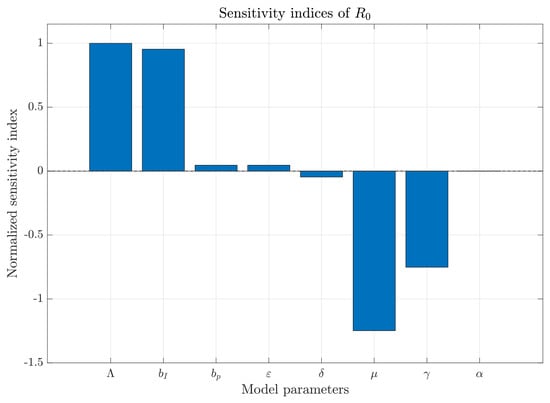
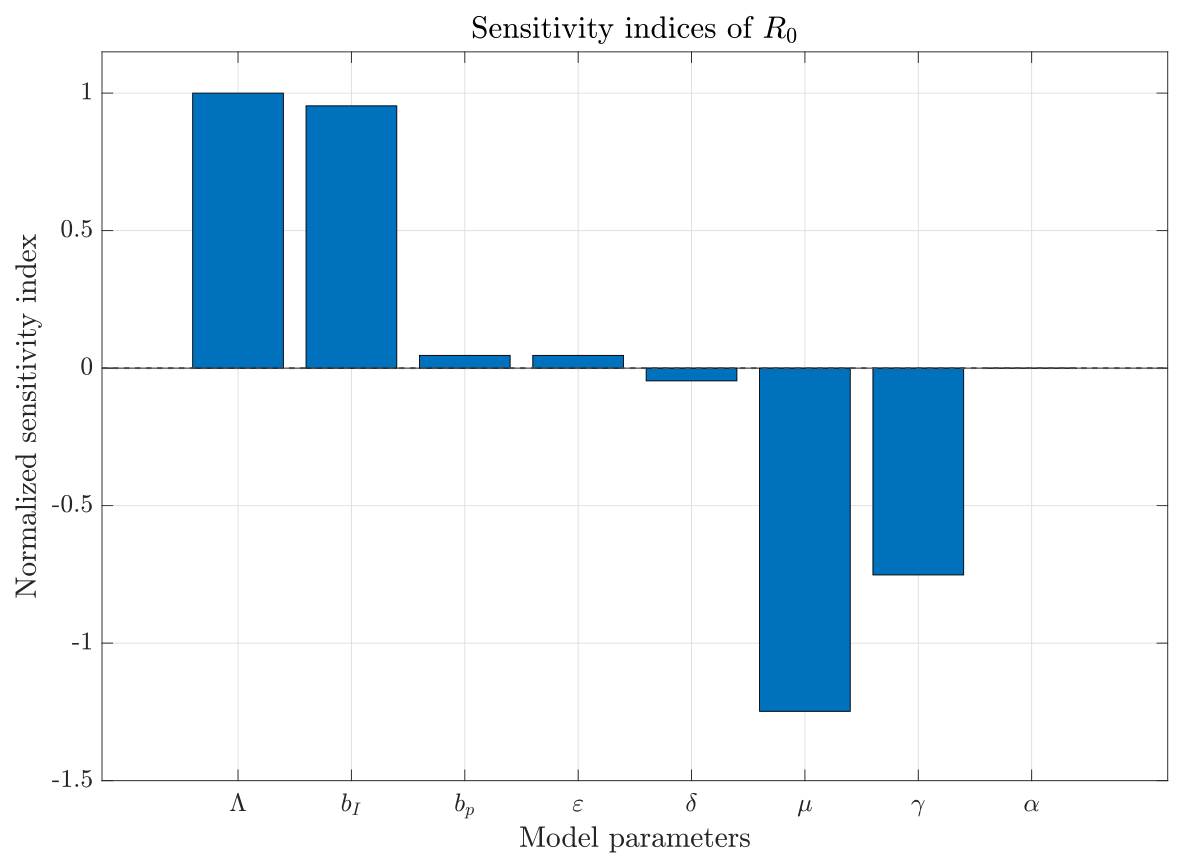
The corresponding normalized sensitivity indices are presented in Table 2 and illustrated in Figure 1.
Table 2.
Normalized forward sensitivity indices of using the parameter values in Table 1.
Figure 1.
Normalized forward sensitivity indices of the basic reproduction number for the SIRS–P mastitis model (1).
The sensitivity results identify the main factors that influence the transmission potential of mastitis. The recruitment rate has a positive sensitivity index equal to 1, indicating that an increase in herd recruitment can increase the number of susceptible cows available for infection and consequently increase . The direct cow-to-cow transmission coefficient also has a strong positive sensitivity index, which shows that direct transmission is one of the key drivers of mastitis spread in the herd. Biologically, this highlights the importance of early detection, screening, separation of infected cows, improved milking order, and management practices that reduce effective contact between susceptible and infected cows.
The environmental transmission coefficient and the bacterial shedding rate have positive sensitivity indices, whereas the bacterial removal rate has a negative sensitivity index. This indicates that environmental contamination and bacterial shedding increase the transmission potential of mastitis, while faster bacterial removal decreases it. Therefore, hygiene and environmental sanitation measures, such as cleaning bedding materials, disinfecting milking equipment, improving manure management, and reducing bacterial persistence in the farm environment, are biologically important for reducing indirect transmission.
The culling rate and recovery rate have negative sensitivity indices, Thus, increasing either parameter reduces the value of . However, although culling mathematically decreases the transmission potential, excessive culling may not be economically desirable because it can lead to the loss of productive cows. In contrast, increasing the recovery rate through timely treatment and appropriate veterinary care is a practical and biologically meaningful intervention. Finally, the recurrence parameter has zero sensitivity index because it does not appear explicitly in the expression for . This does not mean that recurrence is biologically unimportant; rather, it indicates that does not affect the initial invasion threshold measured by . Overall, the sensitivity analysis identifies direct transmission, recovery, culling, and environmental contamination as important factors that should be considered when designing mastitis control strategies.
4. Optimal Control Problem
In this section, we extend the SIRS–P mastitis model (1) by incorporating time-dependent intervention strategies. The aim is to determine effective and economically feasible control measures for reducing mastitis transmission in dairy cows while accounting for the implementation costs of these interventions.
We introduce three time-dependent control variables:
- represents prevention, screening, and herd-management measures aimed at reducing direct cow-to-cow transmission. These measures may include early detection, separation of infected cows, improved milking order, and management practices that reduce effective contact between susceptible and infected cows.
- represents hygiene and environmental sanitation measures aimed at reducing environmental bacterial contamination. This control reduces exposure to contaminated environments and enhances bacterial removal through cleaning and disinfection of bedding materials, sanitation of milking equipment, and improved manure management.
- represents treatment-based interventions aimed at increasing the recovery rate of infected cows. These may include timely veterinary treatment, appropriate antimicrobial therapy, supportive care, and improved clinical management of mastitis cases.
From a practical dairy-farm management perspective, the control may be implemented through routine screening for mastitis, early detection of infected cows, separation or special handling of infected animals, improved milking order, and management practices that reduce effective cow-to-cow transmission. The control may be implemented through strict environmental hygiene measures, including regular cleaning and disinfection of bedding materials, milking equipment, and housing areas, together with improved manure management to reduce bacterial persistence in the farm environment. The control may be implemented through timely veterinary diagnosis, appropriate treatment of infected cows, including antimicrobial therapy when indicated, supportive care, and follow-up monitoring to enhance recovery. Therefore, these three controls represent practical intervention categories that can be incorporated into integrated mastitis management programs.
The controls are assumed to be Lebesgue measurable and bounded. Hence, the admissible control set is defined by
Here, denotes the final time of the intervention period, and represents the maximum feasible intensity of the i-th control.
The controlled SIRS–P mastitis model is given by the following system of ordinary differential equations:
The system is supplemented with the nonnegative initial conditions
In system (2), the factor reduces the direct transmission coefficient , whereas the factor reduces the environmental transmission coefficient . The parameter measures the maximum additional environmental bacterial removal rate generated by sanitation activities. Similarly, measures the maximum additional recovery rate induced by treatment. Here, indicates no implementation of the i-th intervention, whereas represents its maximum admissible intensity.
The objective is to minimize the total burden of mastitis-infected cows, together with the level of environmental bacterial contamination, while balancing the implementation costs of the control measures. Therefore, we define the objective functional
The optimal control problem is to determine a control vector
such that
subject to the controlled system (2) and the prescribed initial conditions.
The weight represents the relative epidemiological and economic burden associated with mastitis-infected cows, including losses due to reduced milk production, treatment requirements, reproductive effects, and further transmission risk. The weight measures the importance assigned to environmental bacterial contamination, reflecting its role in sustaining mastitis transmission.
The constants , , and denote the relative implementation costs of prevention and screening, environmental sanitation, and treatment, respectively. The quadratic terms reflect the increasing marginal cost of applying higher levels of intervention. Thus, the functional (3) balances the epidemiological benefit of reducing mastitis transmission against the economic cost of implementing control measures.
Before deriving the necessary optimality conditions, we first establish the existence of an optimal control for the controlled mastitis system.
Theorem 1.
Assume that all model parameters are nonnegative, with , , and , . Then, for any nonnegative initial condition there exists an optimal control
such that
subject to the controlled mastitis system (2).
Proof.
Let
The admissible control set
is nonempty, since the zero control is admissible. Moreover, is convex, closed, and bounded in . Hence, is weakly sequentially compact in .
For each , the right-hand side of system (2) is measurable in t and continuously differentiable with respect to the state variables. Therefore, it is locally Lipschitz continuous in the state vector x. Hence, for each admissible control, the controlled system admits a unique local solution.
The nonnegative orthant is positively invariant because the right-hand side of each state equation is nonnegative whenever the corresponding state variable is zero. Thus, nonnegative initial data generate nonnegative solutions. Moreover, adding the first three equations of (2) gives
It follows that
Thus, , , and are bounded on . In particular, if
then . Furthermore,
By the comparison theorem, is also bounded on . Hence, all state variables remain in a bounded subset of , and the solution exists on the whole interval .
Let be a minimizing sequence for J, and let denote the corresponding state solution. Since is closed, convex, and bounded in , it is weakly sequentially compact. Hence, there exist a subsequence, still denoted by , and a control such that
The boundedness of the state variables and the boundedness of the right-hand side of the controlled system imply that the sequence is uniformly bounded and equicontinuous on . Therefore, by the Arzelà–Ascoli theorem, there exists a subsequence such that
Since the right-hand side of (2) is continuous in the state variables and affine in the controls, we may pass to the limit in the integral form of the state system. Consequently, is the solution of (2) corresponding to the admissible control .
The integrand of the objective functional is
It is continuous in x and convex in u, since , . Moreover, if
then
which provides coercivity with respect to the controls. Since uniformly and the quadratic control terms are weakly lower semicontinuous, we obtain
Because is a minimizing sequence, it follows that
Therefore, is an optimal control. □
Pontryagin’s Maximum Principle
In this subsection, we derive the necessary optimality conditions for the controlled mastitis model using Pontryagin’s Maximum Principle. Let , , , and be the adjoint variables associated with , , , and , respectively.
The running cost associated with the objective functional is
The Hamiltonian is defined by
By Pontryagin’s Maximum Principle, if is an optimal control with corresponding state solution , then there exist adjoint functions , , satisfying
Thus, the adjoint system is
Since the terminal states are free and no terminal cost is included in the objective functional, the transversality conditions are
The optimal controls are obtained from the stationarity conditions
For , we have
and hence
For , we obtain
so that
For , we obtain
and therefore
Taking into account the bounds on the admissible controls, the optimal controls are characterized by
5. Numerical Simulations
In this section, numerical simulations are performed to illustrate the dynamics of the controlled SIRS–P mastitis model (2) and to evaluate the impact of different intervention strategies on reducing the mastitis burden in dairy cows. The optimality system is solved numerically in MATLAB using the forward–backward sweep method. In this approach, the state equations are integrated forward in time, the adjoint equations are integrated backward in time using the terminal conditions, and the controls are updated iteratively until convergence. The time interval is discretized using , and the final simulation time is taken as .
The parameter values used in the numerical simulations are adopted from [9] and are listed in Table 1. The initial conditions are chosen as Here, , , and represent the initial numbers of susceptible, infected, and recovered cows, respectively, while represents the initial environmental bacterial load.
The objective functional weights are selected as and , while the control cost weights are chosen as . The control efficacy parameters are set as so that maximum sanitation can double the baseline environmental bacterial removal rate, while maximum treatment can double the baseline recovery rate. The controls are bounded by , .
To assess the individual and combined effects of the control measures, seven intervention strategies are considered: , in which only is applied; , in which only is applied; , in which only is applied; , combining and ; , combining and ; , combining and ; and , in which all three controls , , and are implemented simultaneously. Inactive controls are set equal to zero in each strategy. Biologically, represents prevention, screening, and herd-management measures aimed at reducing direct cow-to-cow transmission; represents hygiene and environmental sanitation measures that reduce exposure to contaminated environments and enhance bacterial removal; and represents treatment-based interventions that increase the recovery rate of infected cows. The combined strategies are considered to determine whether integrated intervention programs provide stronger epidemiological benefits than single-control strategies. The main quantities of interest are the reductions in the infected cow population and the environmental bacterial load , together with the total implementation cost and the value of the objective functional.
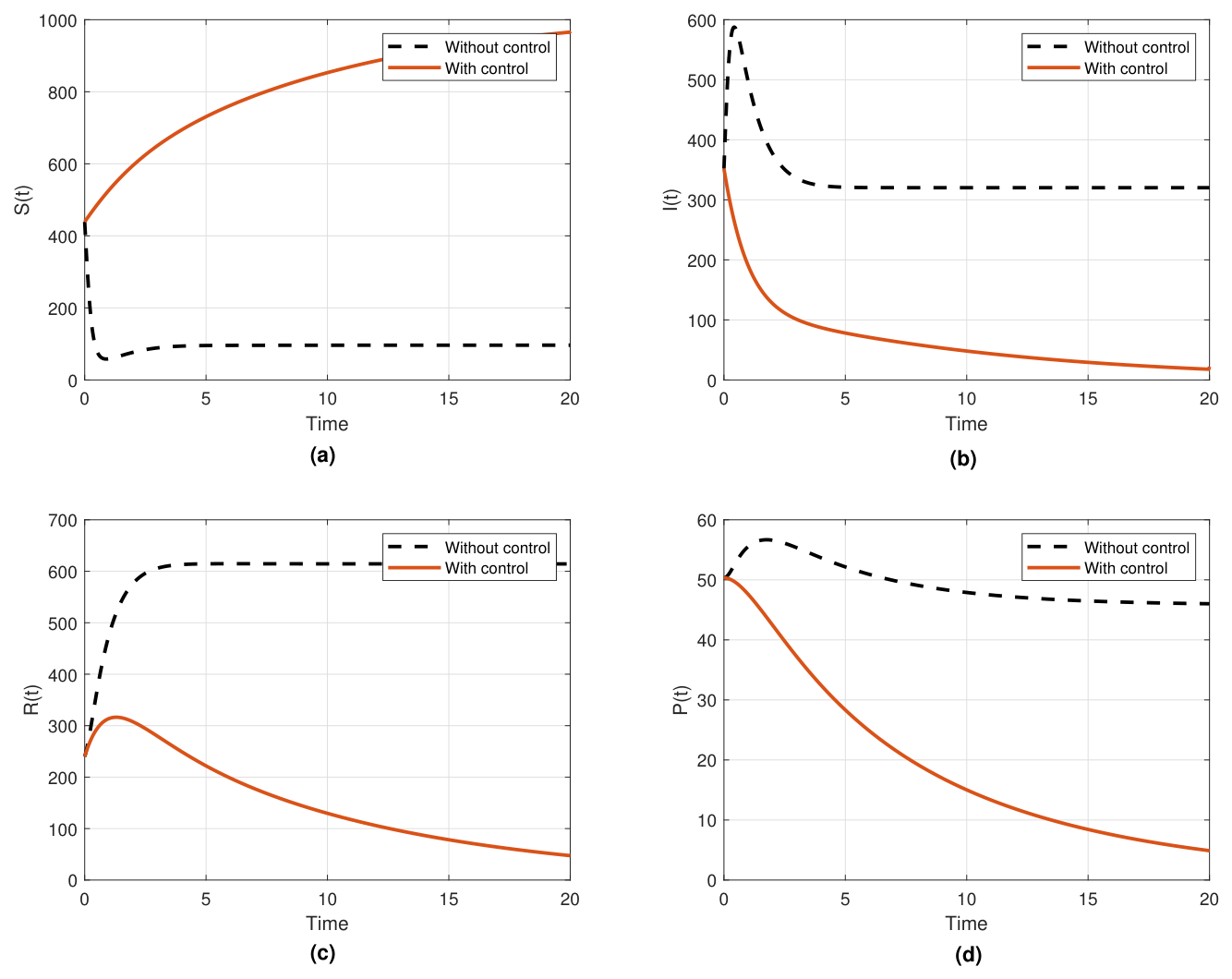
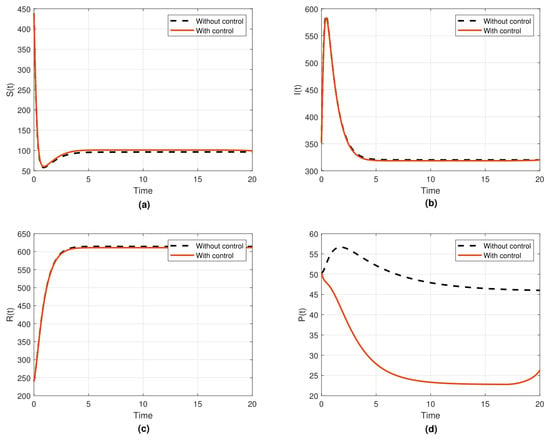
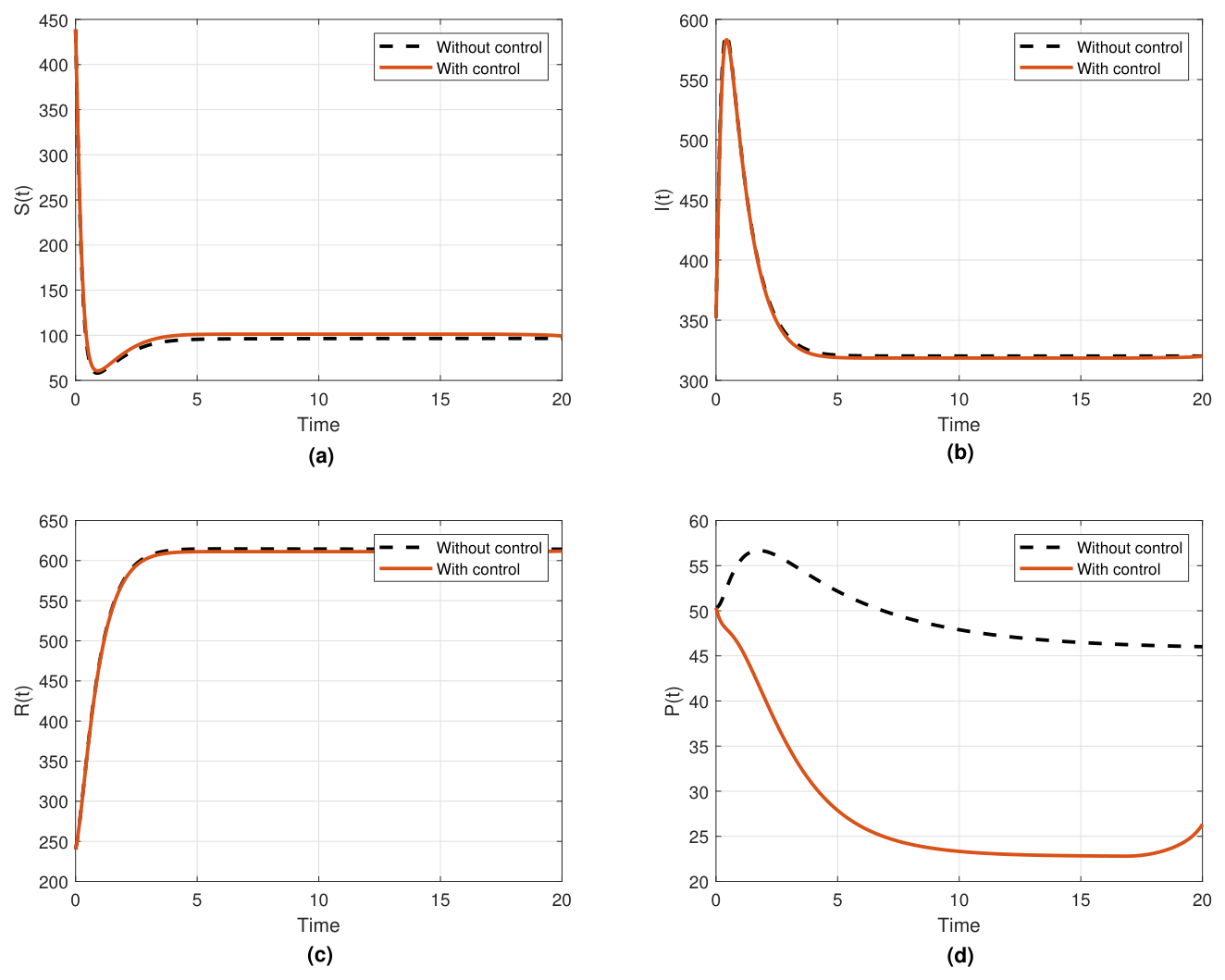
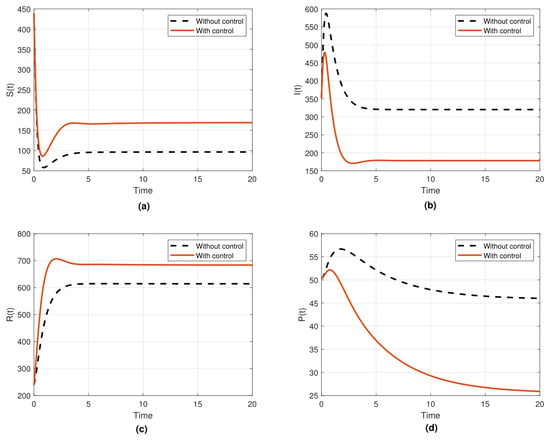
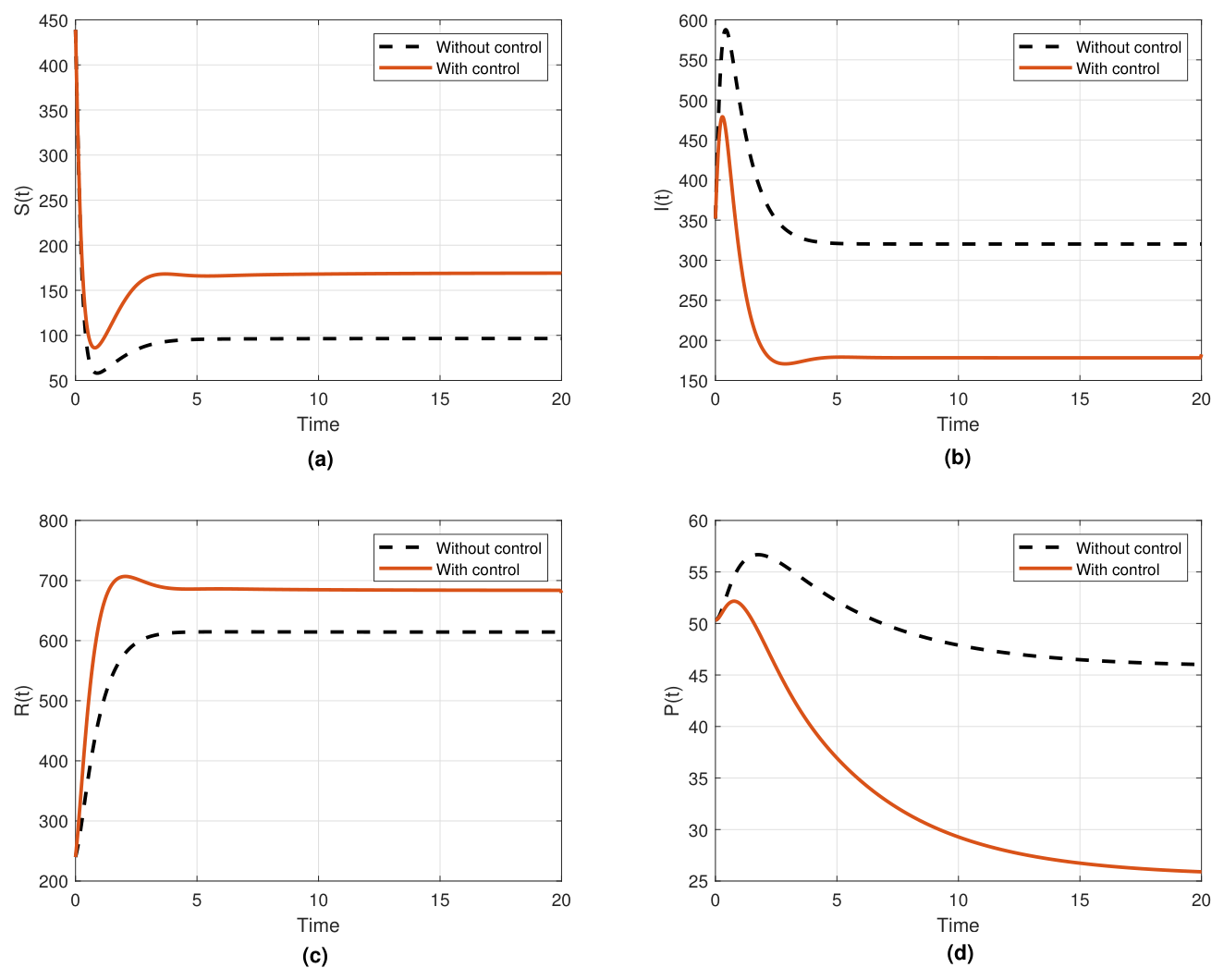
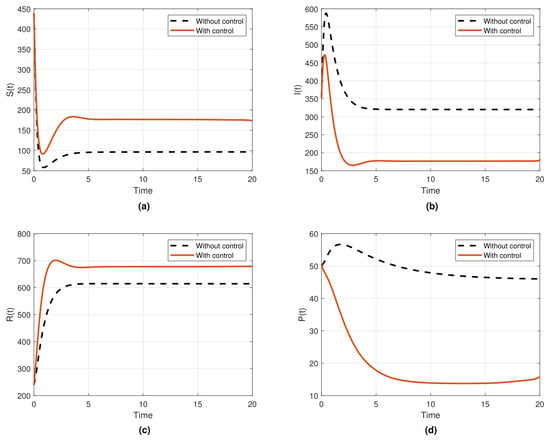
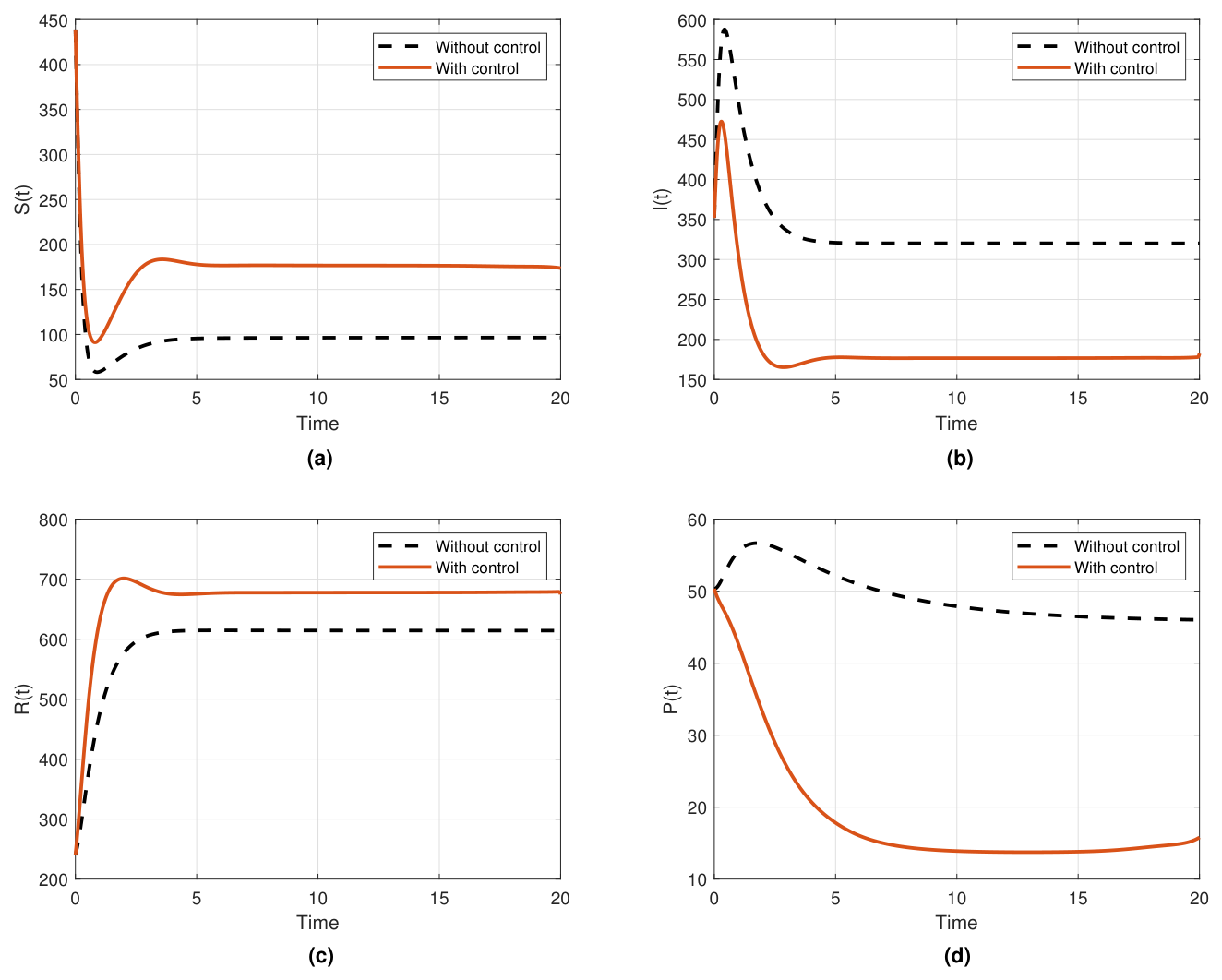
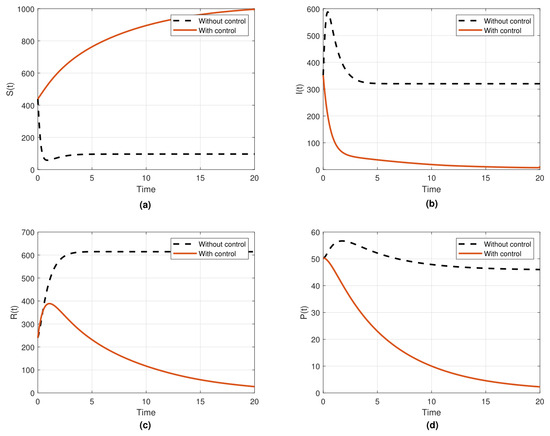
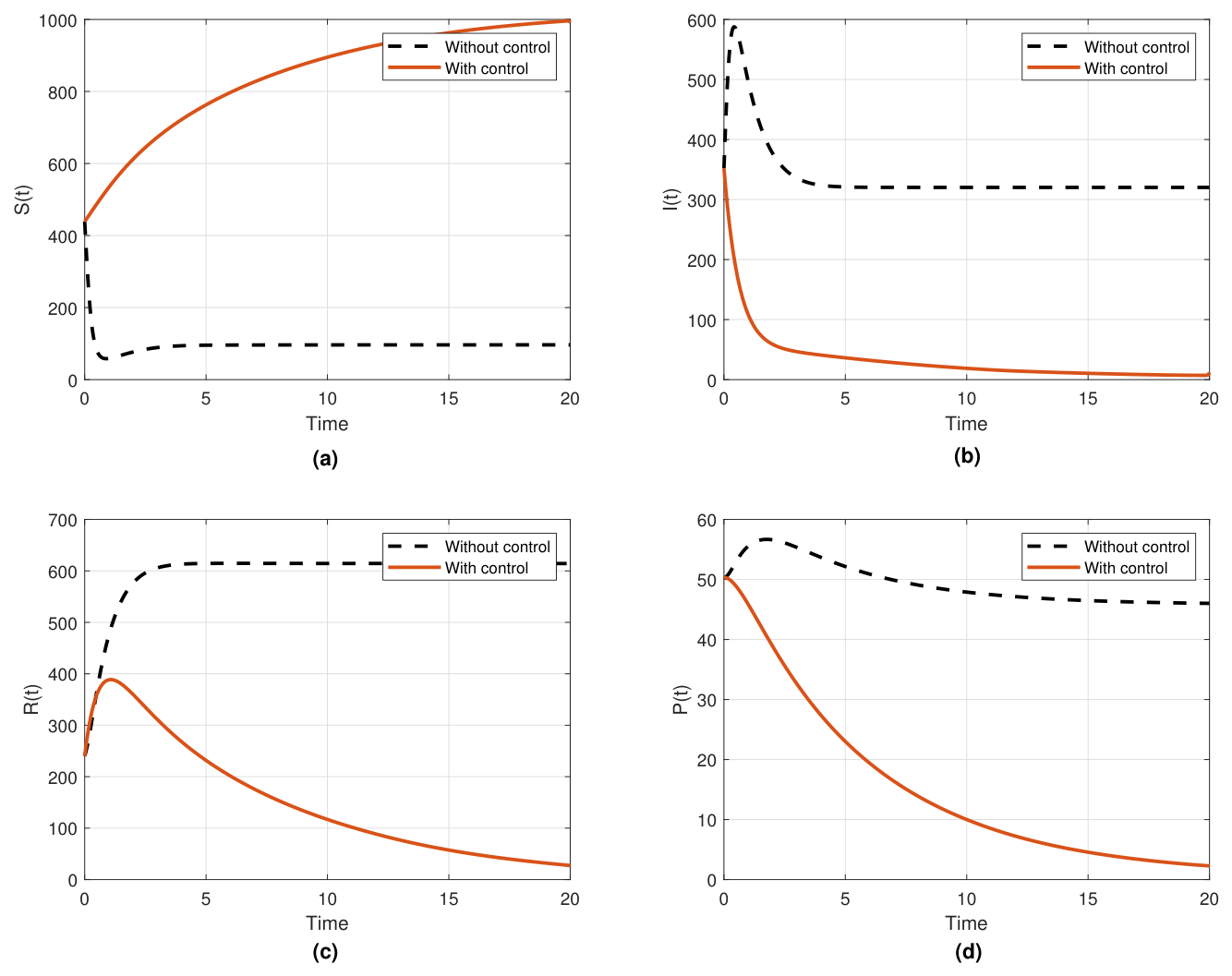
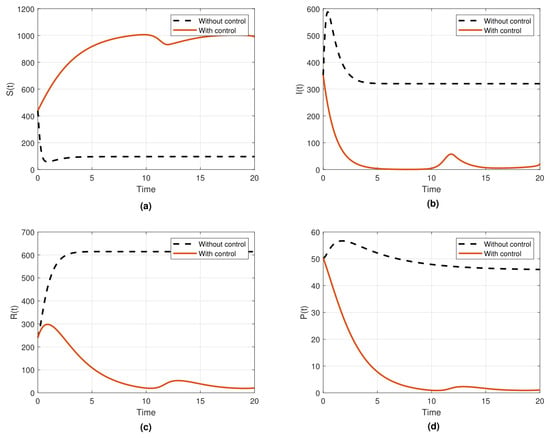
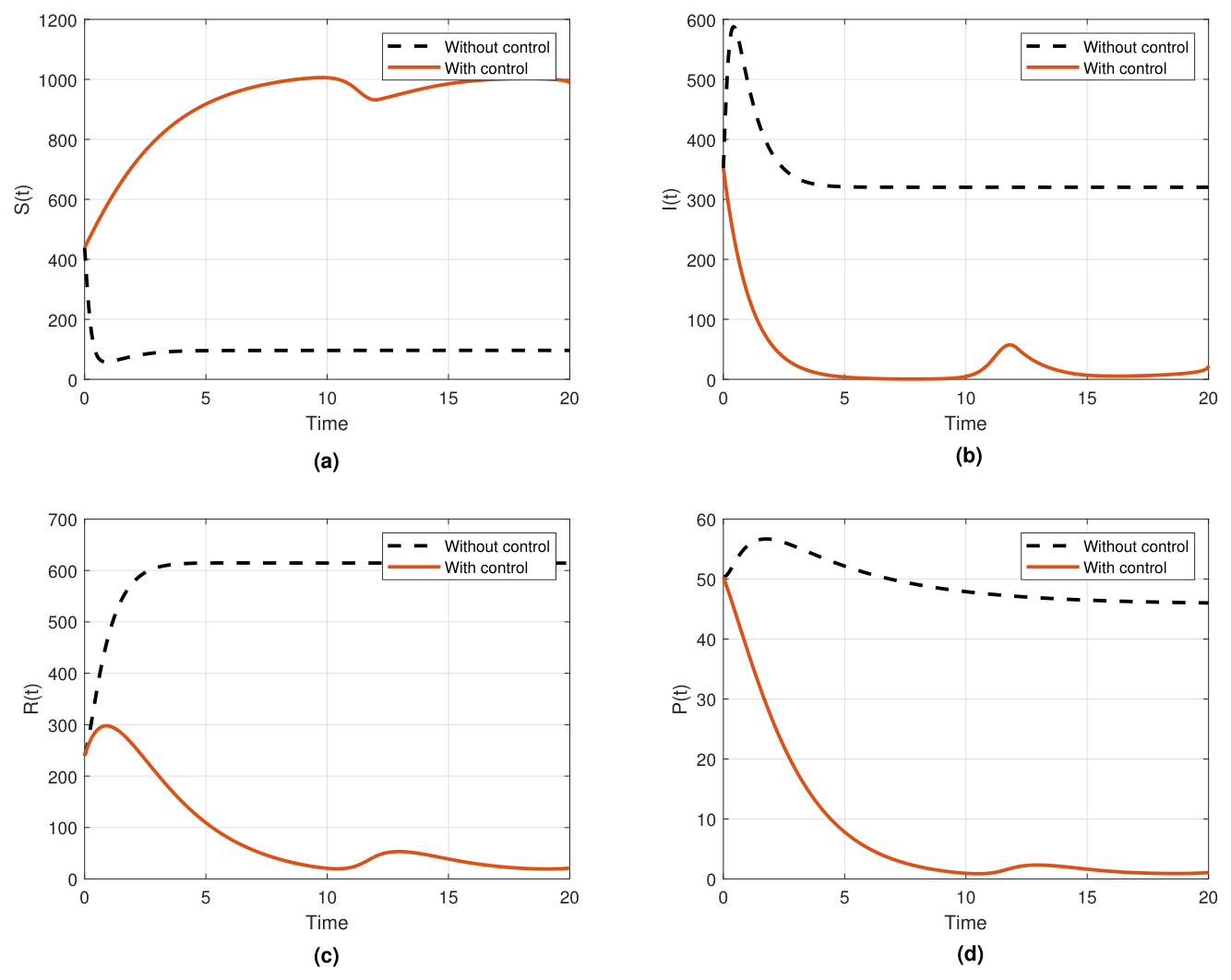
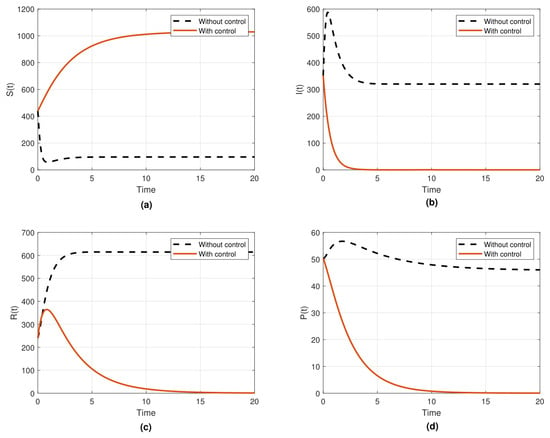
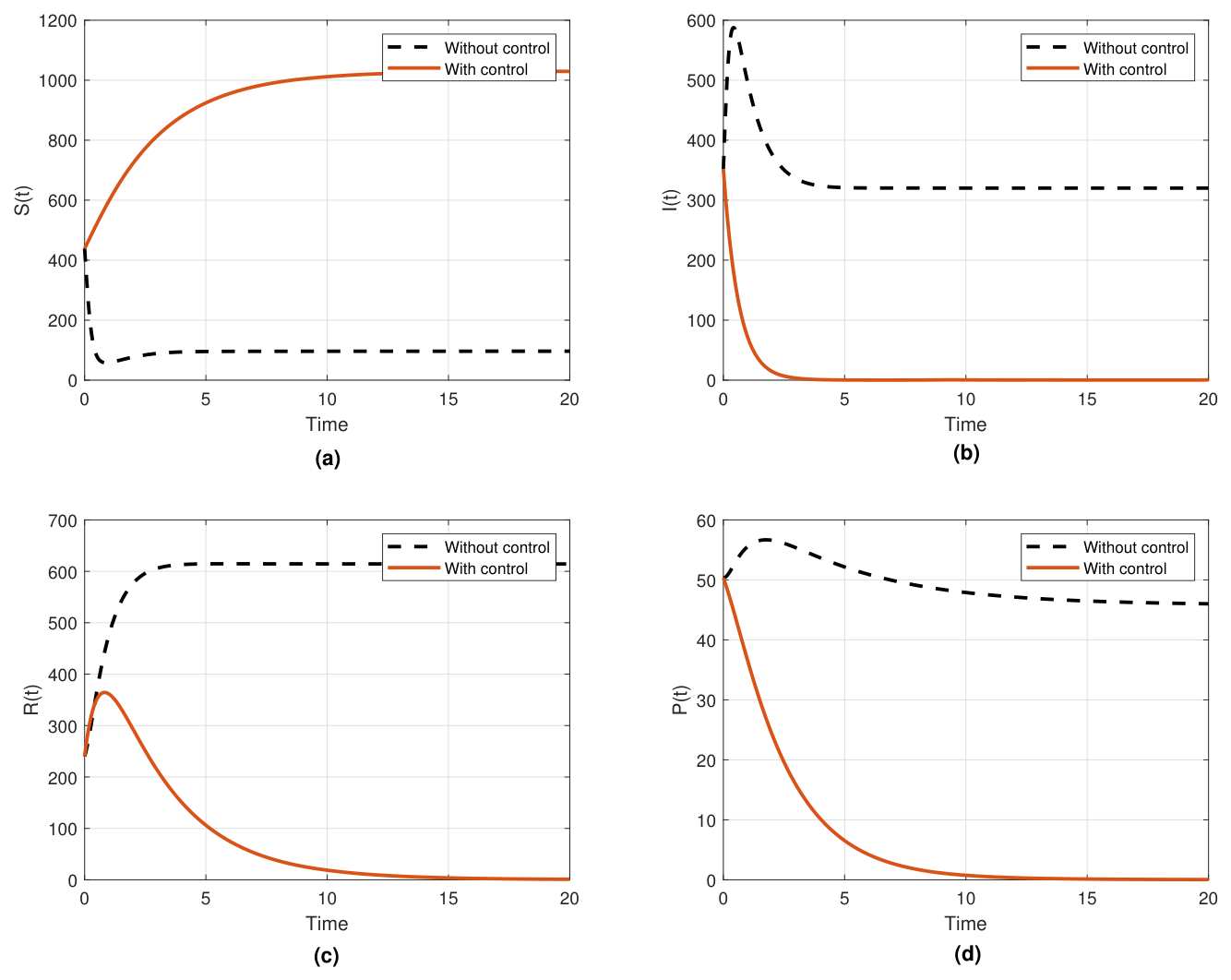
Figure 2, Figure 3, Figure 4, Figure 5, Figure 6, Figure 7 and Figure 8 illustrate the dynamics of the mastitis model under the seven optimal control strategies compared with the uncontrolled case. In these figures, the dashed curves represent the uncontrolled dynamics, whereas the solid curves represent the corresponding controlled dynamics. In the absence of control, the infected cow population persists at a positive endemic level, and the environmental pathogen concentration remains positive throughout the simulation period. This suggests that mastitis may be sustained in the herd through both direct cow-to-cow transmission and environmental contamination.
Figure 2.
Dynamics of model (2) under strategy compared with the uncontrolled case.
Figure 3.
Dynamics of model (2) under strategy compared with the uncontrolled case.
Figure 4.
Dynamics of model (2) under strategy compared with the uncontrolled case.
Figure 5.
Dynamics of model (2) under strategy compared with the uncontrolled case.
Figure 6.
Dynamics of model (2) under strategy compared with the uncontrolled case.
Figure 7.
Dynamics of model (2) under strategy compared with the uncontrolled case.
Figure 8.
Dynamics of model (2) under strategy compared with the uncontrolled case.
Figure 2 shows the effect of Strategy , where only the direct transmission control is applied. This strategy substantially reduces , indicating that prevention, screening, separation of infected cows, and improved herd-management practices are effective in limiting cow-to-cow transmission. The reduction in also follows from the decrease in the number of infected cows shedding bacteria into the environment.
Figure 3 presents Strategy , where only the environmental control is implemented. This strategy reduces the environmental pathogen concentration , confirming the importance of cleaning, disinfection, bedding management, and milking-equipment sanitation. However, its effect on the infected population is comparatively limited, as shown in Figure 3b. This suggests that environmental control alone may not be sufficient to suppress mastitis when direct cow-to-cow transmission remains active.
Figure 4 corresponds to Strategy , where only the treatment control is applied. The infected population decreases compared with the uncontrolled case, while the recovered class increases. This reflects the role of treatment in accelerating recovery. The environmental pathogen concentration also decreases indirectly, since a lower infected population reduces bacterial shedding into the environment.
Figure 5, Figure 6 and Figure 7 show the combined strategies , , and , respectively. Strategy , which combines environmental sanitation and treatment , reduces both environmental contamination and infection through simultaneous bacterial removal and enhanced recovery. Strategy , combining direct transmission reduction and treatment , produces a strong reduction in , because it reduces new infections while increasing the recovery rate of infected cows. Under this strategy, initially increases due to treatment-induced recovery, but later declines as the infected population becomes low and fewer cows enter the recovered class. Strategy , combining direct transmission reduction and environmental sanitation , also strongly suppresses infection by acting on both direct and environmental transmission routes. The corresponding decrease in reflects the reduced flow of cows from the infected class into the recovered class, rather than a deterioration of disease control.
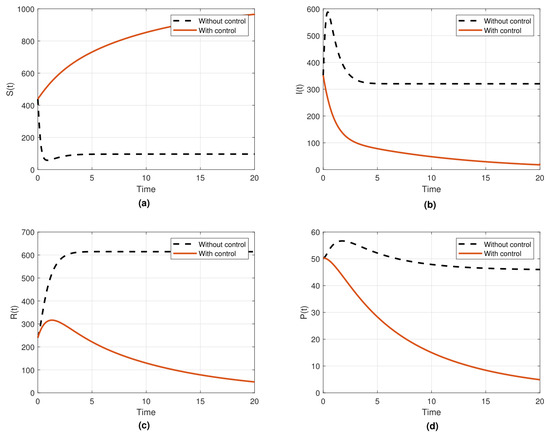
Figure 8 illustrates the fully integrated strategy , in which , , and are applied simultaneously. This strategy strongly reduces the infected cow population , as shown in Figure 8b, and substantially decreases the environmental pathogen concentration , as shown in Figure 8d. The susceptible population is preserved at a higher level, indicating that fewer cows acquire infection during the intervention period. In Figure 8c, the recovered population initially increases due to enhanced recovery, but then declines as the infected population is rapidly reduced and fewer cows subsequently enter the recovered class. Biologically, these results indicate that the combined action of prevention and screening, environmental sanitation, and treatment limits both infection and environmental contamination more effectively than single-control strategies.
Overall, the numerical results indicate that optimal control reduces both the peak infection level and the final mastitis burden. Single-control strategies improve specific aspects of the disease dynamics, but their effects are limited because they target only one transmission mechanism. In contrast, combined strategies provide stronger disease suppression by acting on multiple pathways. In particular, strategies involving , especially , , and , provide the strongest reduction in infected cows. Therefore, the simulations support integrated mastitis management based on direct transmission reduction, environmental sanitation, and timely treatment.
6. Cost-Effectiveness Analysis
In this section, the seven optimal control strategies – are compared using cost-effectiveness analysis. This analysis distinguishes epidemiological effectiveness from economic efficiency, since a strategy may substantially reduce the mastitis burden but require a relatively high implementation cost.
Let and denote the infected cow population and environmental pathogen concentration in the absence of control, respectively. Similarly, let and denote the corresponding quantities under strategy , . The infection burden averted and environmental burden averted are defined by
Larger values of and indicate greater reductions in the infected cow population and environmental pathogen burden, respectively.
The total implementation cost of strategy is given by
where inactive controls are set equal to zero.
To evaluate economic efficiency, we use two distinct measures: the average cost-effectiveness ratio (ACER) and the incremental cost-effectiveness ratio (ICER). The ACER evaluates each intervention strategy separately by measuring the average implementation cost required to avert one unit of disease burden. Thus, a lower ACER indicates a lower average cost per unit of epidemiological benefit. Mathematically, the average cost-effectiveness ratios based on infection burden and environmental burden are respectively defined by
and
If , then the strategy does not reduce the infection burden relative to the uncontrolled case, and the infection-based ACER is not epidemiologically meaningful. Similarly, if , then the strategy does not reduce the environmental burden, and the environment-based ACER is not meaningful.
In contrast to the ACER, which assesses the average efficiency of individual strategies, the ICER compares alternative strategies ordered by increasing effectiveness. It measures the additional cost required to obtain one additional unit of benefit when moving from a less effective strategy to a more effective one. Therefore, the ICER is useful for identifying dominated or extendedly dominated intervention strategies.
For incremental comparison, strategies are ordered according to increasing effectiveness. For two consecutive strategies and , with , the infection-based incremental cost-effectiveness ratio is
The environment-based ICER is obtained analogously by replacing with . A strategy is strictly dominated if another strategy is both less costly and more effective. It is extendedly dominated if its incremental benefit can be obtained more efficiently by moving to a more effective strategy. Dominated and extendedly dominated strategies are excluded from the final cost-effectiveness frontier.
The infection-based and environment-based cost-effectiveness results are presented in Table 3 and Table 4, respectively.
Table 3.
Infection-based cost-effectiveness analysis of the seven control strategies ordered by increasing infection burden averted .
Table 4.
Environment-based cost-effectiveness analysis of the seven control strategies ordered by increasing environmental burden averted .
Table 3 shows that all strategies reduce the infection burden relative to the uncontrolled case, since for all strategies. However, their epidemiological effectiveness and implementation costs differ substantially. Strategy has the lowest implementation cost but produces the smallest infection reduction and the highest infection-based ACER, indicating that environmental sanitation alone is not economically efficient for reducing infected cows when direct cow-to-cow transmission remains active.
From the infection-based ICER comparison, , , and are strictly dominated, while is extendedly dominated. Hence, the final infection-based cost-effectiveness frontier consists of , , and . Among these strategies, , which combines all three controls , , and , is the most epidemiologically effective strategy for reducing infection, since it gives the largest infection burden averted, This indicates that the simultaneous implementation of prevention and screening, environmental sanitation, and treatment produces the strongest overall reduction in mastitis transmission. However, the most effective strategy is not necessarily the most cost-effective. Strategy has the lowest infection-based ACER, and is therefore the most cost-effective strategy with respect to infection reduction. This means that direct transmission reduction through prevention, screening, separation of infected cows, and improved herd-management practices provides the lowest average cost per unit of infection burden averted. The additional cost of moving from to is per additional unit of infection burden averted.
The environment-based comparison in Table 4 shows that is also the most effective strategy for reducing environmental contamination, since it gives the largest environmental burden averted, It also has the lowest environment-based ACER, indicating the smallest average cost per unit of environmental burden averted. Thus, with respect to environmental pathogen reduction, is the most cost-effective strategy. This result reflects the combined effect of environmental sanitation, reduced infection, and enhanced recovery, which together reduce bacterial shedding and environmental persistence. Nevertheless, remains on the environment-based cost-effectiveness frontier because it provides a substantial reduction in environmental burden at a lower total implementation cost than .
Overall, the cost-effectiveness analysis distinguishes epidemiological effectiveness from economic efficiency. Strategy provides the largest overall disease reduction, since it yields the largest reductions in both the infected cow population and the environmental pathogen burden. It is also the most cost-effective strategy with respect to environmental burden reduction based on ACER. In contrast, Strategy is the most economically efficient strategy for reducing infected cows according to the infection-based ACER criterion. Thus, is preferable when the objective is maximum overall disease suppression, whereas , representing direct transmission reduction through prevention, screening, and herd management, is preferable when the objective is to obtain the largest infection reduction per unit cost.
7. Conclusions
In this paper, we investigated the optimal control and cost-effectiveness analysis of an SIRS–P mathematical model for mastitis dynamics in dairy cows. The model incorporates susceptible, infected, and recovered cow populations together with an environmental pathogen compartment, allowing both direct cow-to-cow transmission and indirect transmission through environmental contamination to be represented.
A sensitivity analysis of the basic reproduction number showed that recruitment, direct transmission, culling, and recovery have the strongest influence on the transmission potential of mastitis under the baseline parameter values. These results support control measures aimed at reducing cow-to-cow transmission, improving hygiene, and enhancing recovery through timely treatment.
The model was extended by introducing three time-dependent controls: , representing prevention, screening, and herd-management measures; , representing hygiene and environmental sanitation; and , representing treatment-based interventions. The optimal control problem was formulated by minimizing the infected cow population and environmental pathogen burden together with the quadratic costs of the controls. The existence of optimal controls was established, and the optimality system was derived using Pontryagin’s Maximum Principle and solved numerically by the forward–backward sweep method.
The numerical simulations showed that optimal control reduces the infected cow population and environmental pathogen burden compared with the uncontrolled case. Combined strategies provided stronger disease suppression than single-control strategies by acting on multiple transmission pathways. The cost-effectiveness analysis showed that the fully integrated strategy , which combines prevention and screening, environmental sanitation, and treatment, provides the largest overall disease reduction. However, Strategy , which reduces direct cow-to-cow transmission, is the most cost-effective strategy with respect to infection reduction based on the infection-based ACER criterion.
From a practical dairy-farm management perspective, the results highlight the importance of early detection, regular screening, improved milking hygiene, environmental sanitation, careful handling or separation of infected cows, and timely treatment.
Although the present model provides useful qualitative and quantitative insight into mastitis control, it has some limitations. The numerical simulations are based on parameter values adopted from the literature rather than calibration to farm-level longitudinal data. Therefore, the results should be interpreted as a theoretical and computational assessment of possible intervention strategies rather than direct farm-specific predictions. Future research may extend the present model by incorporating stochastic effects, seasonal variation, farm-level parameter estimation, and fractional-order derivatives to describe possible memory effects in mastitis transmission dynamics.
Funding
This research received no external funding.
Data Availability Statement
The original contributions presented in this study are included in the article. Further inquiries can be directed to the corresponding author.
Acknowledgments
The author expresses his sincere gratitude and appreciation to Onaizah Colleges, Saudi Arabia, for providing the Article Processing Charges (APC) funding for this research.
Conflicts of Interest
The author declares no conflicts of interest.
References
- Cobirka, M.; Tancin, V.; Slama, P. Epidemiology and classification of mastitis. Animals 2020, 10, 2212. [Google Scholar] [CrossRef] [Scilit] [PubMed]
- Tommasoni, C.; Fiore, E.; Lisuzzo, A.; Gianesella, M. Mastitis in dairy cattle: On-farm diagnostics and future perspectives. Animals 2023, 13, 2538. [Google Scholar] [CrossRef] [Scilit] [PubMed]
- Nakov, D.; Trajchev, M. Monitoring udder health and milk hygiene on-farm using quick screening methods. J. Agric. Plant Sci. 2018, 16, 57–63. [Google Scholar]
- Trajchev, M.; Nakov, D.; Petrovska, M.; Jankoska, G. Mastitis pathogens and their antimicrobial susceptibility in early lactating dairy cows. J. Agric. For. 2017, 63, 41–50. [Google Scholar] [CrossRef] [Scilit]
- Hamel, J.; Zhang, Y.; Wente, N.; Krömker, V. Heat stress and cow factors affect bacteria shedding pattern from naturally infected mammary gland quarters in dairy cattle. J. Dairy Sci. 2021, 104, 786–794. [Google Scholar] [CrossRef] [Scilit] [PubMed]
- Dahl, M.O.; Maunsell, F.P.; De Vries, A.; Galvao, K.N.; Risco, C.A.; Hernandez, J.A. Evidence that mastitis can cause pregnancy loss in dairy cows: A systematic review of observational studies. J. Dairy Sci. 2017, 100, 8322–8329. [Google Scholar] [CrossRef] [Scilit] [PubMed]
- Greenhalgh, S.; Rozins, C. A generalized differential equation compartmental model of infectious disease transmission. Infect. Dis. Model. 2021, 6, 1073–1091. [Google Scholar] [CrossRef] [Scilit] [PubMed]
- Slingenbergh, J. World Livestock 2013: Changing Disease Landscapes; Food and Agriculture Organization of the United Nations (FAO): Rome, Italy, 2013. [Google Scholar]
- Zlatanovska, B.; Nakov, D.; Kocaleva, M.; Miteva, M. Mathematical Model for the Transmission and Control of Mastitis in Dairy Cows. Contemp. Math. 2026, 7, 151–171. [Google Scholar] [CrossRef] [Scilit]
- Adeyemi, M.O.; Oluyo, T.O. Mathematical modeling for the control of fly-borne mastitis disease in cattle. Front. Appl. Math. Stat. 2023, 9, 1171157. [Google Scholar] [CrossRef] [Scilit]
- Hyde, R.M.; Down, P.M.; Bradley, A.J.; Breen, J.E.; Hudson, C.; Leach, K.A.; Green, M.J. Automated prediction of mastitis infection patterns in dairy herds using machine learning. Sci. Rep. 2020, 10, 4289. [Google Scholar] [CrossRef] [Scilit] [PubMed]
- Odebiyi, O.A.; Oluyo, T.O.; Adeyemi, M.O.; Oladejo, J.K.; Olaoye, O.; Elijah, E.O.; Ayanrinola, O.W. A Dynamical Study of Stability and Bifurcation in an In-Vitro Bovine Mastitis System Incorporating Nonlinear Incidence and Therapeutic Functions. Niger. J. Technol. Dev. 2026, 23, 213–231. [Google Scholar]
- Izneid, B.A.; Gurmu, E.D.; Obsu, L.L.; Melese, A.S.; Kanan, M.; Al-Qerem, A. Optimal Control Strategy on Mathematical Model for the Dynamics of Mastitis. Appl. Math. Inf. Sci. 2023, 17, 699–711. [Google Scholar] [CrossRef] [Scilit]
- Stafford, E.; Kot, M. Optimal reduced-mixing for an SIS infectious-disease model. J. Biol. Dyn. 2022, 16, 746–765. [Google Scholar] [CrossRef] [Scilit] [PubMed]
- Alemneh, H.T.; Alemu, N.Y. Mathematical modeling with optimal control analysis of social media addiction. Infect. Dis. Model. 2021, 6, 405–419. [Google Scholar] [CrossRef] [Scilit] [PubMed]
- Nyerere, N.; Mbalilo, V.M. Optimal control and cost-effectiveness analysis of Q-fever transmission dynamics in livestock and humans. Results Control Optim. 2025, 20, 100601. [Google Scholar] [CrossRef] [Scilit]
- January, J.; Mwanga, G.; Kibona, I.E.; Mbare, N.S. Modelling and optimal control of rotavirus transmission dynamics with cost effectiveness. Sci. Afr. 2026, 31, e03161. [Google Scholar] [CrossRef] [Scilit]
- Moustafa, M. Cost-effectiveness and optimal control analysis of an SIR-P model for rodent-transmitted infection in agricultural environments. Math. Biosci. Eng. 2026, 23, 1251–1268. [Google Scholar] [CrossRef] [Scilit] [PubMed]
- Al-Ajlan, Z.S.; El-Shahed, M.; Alnafisah, Y. Mathematical Analysis and Optimal Control of a Transmission Model for Respiratory Syncytial Virus. Mathematics 2025, 13, 2929. [Google Scholar] [CrossRef] [Scilit]
- Moustafa, M. Cost-Effectiveness and Optimal Control of Hantavirus Transmission in Rodent Populations. Jambura J. Biomath. 2026, 7, 123–135. [Google Scholar] [CrossRef] [Scilit]
- Alnafisah, Y.; El-Shahed, M. Optimal control of red palm weevil model incorporating sterile insect technique, mechanical injection, and pheromone traps. Alex. Eng. J. 2024, 93, 382–391. [Google Scholar] [CrossRef] [Scilit]
- Jose, S.A.; Ramachandran, R.; Anuwat, J.; Cao, J.; Agarwal, R.P. A fractional derivative approach to infectious disease dynamics: Modeling and optimal control strategies. Model. Earth Syst. Environ. 2025, 11, 229. [Google Scholar] [CrossRef] [Scilit]
- Alemneh, H.T.; Kassa, A.S.; Godana, A.A. An optimal control model with cost effectiveness analysis of Maize streak virus disease in maize plant. Infect. Dis. Model. 2021, 6, 169–182. [Google Scholar] [CrossRef] [Scilit] [PubMed]
- Liu, W.; Zou, G.; Bao, Q.; Wang, S. Optimal prevention and control strategy of infectious disease: Cost-effectiveness analysis based on a modified dynamic model with economic loss. Infect. Dis. Model. 2026, 11, 377–388. [Google Scholar] [CrossRef] [Scilit] [PubMed]
- Jia, P.; Yang, J.; Li, X. Optimal control and cost-effective analysis of an age-structured emerging infectious disease model. Infect. Dis. Model. 2022, 7, 149–169. [Google Scholar] [CrossRef] [Scilit] [PubMed]

Disclaimer/Publisher’s Note: The statements, opinions and data contained in all publications are solely those of the individual author(s) and contributor(s) and not of MDPI and/or the editor(s). MDPI and/or the editor(s) disclaim responsibility for any injury to people or property resulting from any ideas, methods, instructions or products referred to in the content. |
© 2026 by the author. Licensee MDPI, Basel, Switzerland. This article is an open access article distributed under the terms and conditions of the Creative Commons Attribution (CC BY) license.