


Abstract
We introduce and analyze a two-step inertial viscosity-type algorithm for approximating a common solution of a generalized mixed equilibrium problem and the fixed-point problems associated with a family of quasi-nonexpansive mappings in a real Hilbert space. The generalized mixed equilibrium model contains a monotone operator and a proper convex lower semicontinuous function inside an implicit equilibrium resolvent, while a second inverse strongly monotone operator is treated explicitly through two successive forward–resolvent steps. The method further incorporates two inertial corrections, a family-dependent fixed-point step, and viscosity regularization by a contraction. We first establish boundedness of the generated sequence under summability conditions on the inertial parameters. We then derive a uniform descent inequality that simultaneously controls the two equilibrium residuals and the fixed-point residual. Using a residual-based sequence convergence criterion and an appropriate weak regularity condition for the mapping family, we prove that the iterates converge strongly to the unique point of the common solution set satisfying . The abstract theorem is specialized to composite convex minimization, mixed variational inequalities, countable convex feasibility problems, and finite families under cyclic control. A five-dimensional example verifies the assumptions explicitly and illustrates convergence to the viscosity-selected solution.
Keywords:
quasi-nonexpansive mappings; inertial method; strong convergence; weak convergence; Hilbert space; demiclosedness MSC:
47H09; 47H10; 47J25; 54H25
1. Introduction
Fixed-point theory and equilibrium theory provide two closely related frameworks for formulating nonlinear problems arising in optimization, economics, engineering, game theory, and applied analysis. If is a nonlinear mapping on a real Hilbert space, the fixed-point problem consists of finding such that . Contractive mappings admit a unique fixed point and the associated Picard iteration converges strongly by the classical principle of Banach [1], whereas nonexpansive and quasi-nonexpansive mappings generally require more elaborate iterative regularization. The latter classes are especially useful because metric projections, resolvents of monotone operators, feasibility operators, and many optimization algorithms can be represented as fixed-point mappings. Foundational existence results include the theorems of Brouwer [2] and Kakutani [3]; broader geometric and nonlinear-analytic treatments can be found in the monographs of Goebel and Reich [4] and Reich and Shoikhet [5]. Weak convergence and asymptotic regularity for nonexpansive-type iterations were developed, among others, by Opial [6], Bruck, Kuczumow, and Reich [7], and Akashi and Takahashi [8]. Fixed-point theory for set-valued nonexpansive mappings has likewise been studied extensively by Reich and Zaslavski [9,10,11].
Equilibrium problems form a similarly broad model. The minimax principle of Fan [12] and the formulation of Blum and Oettli [13] established the equilibrium problem as a unifying setting that includes variational inequalities, optimization problems, saddle-point systems, complementarity problems, and Nash-type equilibria. In its classical form, one seeks satisfying
where C is a nonempty closed convex subset of a Hilbert space and is a bifunction. The mixed and generalized equilibrium models enlarge this formulation by incorporating convex potential terms and monotone operators. Such extensions are important when the problem contains both a nonsmooth convex component and an operator component, as occurs in constrained convex minimization and mixed variational inequalities. Common-solution schemes linking equilibrium problems with variational inequalities, hierarchical constraints, nonexpansive semigroups, and split formulations were studied, for example, by Bnouhachem and Chen [14], Djafari-Rouhani, Farid, and Kazmi [15], and Kazmi and Rizvi [16].
The problem considered in this paper is the generalized mixed equilibrium problem associated with a bifunction F, a continuous monotone operator , and a proper convex lower semicontinuous function . Its precise formulation is given in (1) in the Preliminaries. This formulation contains several familiar problems. If , it becomes a generalized equilibrium problem; if , it becomes a mixed variational inequality and if both and , it reduces to the classical variational inequality for W. Appropriate choices of F and also recover convex minimization and constrained feasibility models.
A decisive tool in the analysis of equilibrium problems is the resolvent. Combettes and Hirstoaga [17] developed a systematic resolvent approach to equilibrium programming in Hilbert spaces. For generalized mixed equilibrium problems, Zhang [18] established well-definedness and firm nonexpansiveness properties for the corresponding resolvent under standard monotonicity, convexity, and semicontinuity conditions. These properties make the equilibrium resolvent compatible with fixed-point techniques: its fixed-point set coincides with the equilibrium solution set, and firm nonexpansiveness supplies the basic Fejér-type estimates needed in convergence arguments.
The approximation of a point that simultaneously solves an equilibrium problem and a fixed-point problem has, therefore, received sustained attention. Takahashi and Takahashi [19] introduced a strongly convergent method for a generalized equilibrium problem coupled with the fixed points of a nonexpansive mapping. Chang, Lee, and Chan [20] developed a hybrid projection method in a uniformly convex and uniformly smooth Banach space for generalized equilibria, variational inequalities, and common fixed points. Osward, Kumar, and Sangago [21] treated an asymptotically nonexpansive fixed-point constraint, while Farid [22] proposed algorithms specifically for mixed equilibrium and fixed-point problems in Hilbert spaces. The Banach-space methods in this literature rely on duality mappings and generalized projections; useful background is given by Cioranescu [23] and Takahashi [24]. These results demonstrate that the common-solution formulation is flexible enough to encode both equilibrium conditions and additional geometric or dynamical constraints.
Two mechanisms have become particularly effective in obtaining strong convergence. The first is the viscosity method, in which a contraction is combined with the principal fixed-point or equilibrium operator; see, for example, Xu [25]. Besides regularizing the iteration, the contraction selects a distinguished point of the solution set, characterized by . Viscosity-like implicit methods for approximating zeros of monotone operators in Banach spaces were studied by Mendy and Shukla [26]. Maldar and Çetin [27] studied a viscosity-type method for equilibrium and fixed-point problems with data dependence. Related viscosity schemes for split-equality generalized mixed equilibrium problems and infinite families of nonexpansive mappings were considered in [28,29,30]. The second is inertial extrapolation, originating from acceleration ideas and using one or more previous increments to form the next search point. Inertial terms can improve numerical behavior, but they also introduce non-Fejér perturbations that must be controlled carefully. Husain and Asad [31], for example, combined an inertial technique with a subgradient-extragradient method for a modified variational inclusion and a mixed equilibrium problem. More recently, Kajola and Narain [32] established strong convergence of an inertial method for a common fixed-point and mixed equilibrium problem, and Sunthrayuth et al. [33] studied a two-step inertial viscosity-type method for a family of strongly quasi-nonexpansive mappings.
The present work is motivated by these developments, but its equilibrium structure and convergence mechanism are different. We separate two monotone operators according to how they are evaluated. The operator U is placed inside the generalized mixed equilibrium resolvent and is, therefore, handled implicitly. A second operator is kept outside the resolvent and treated by explicit forward steps; accordingly, A is assumed to be -inverse strongly monotone, or equivalently -cocoercive. The combined set is
The desired common-solution set is
where is a family of quasi-nonexpansive mappings satisfying an appropriate weak regularity condition.
The proposed algorithm combines two-step inertial extrapolation, two successive forward–resolvent evaluations, a family-dependent fixed-point step, and viscosity regularization. The use of two forward–resolvent stages yields residual estimates for both equilibrium corrections, while the convex combination of and produces a fixed-point residual. These three residuals are assembled into a single descent term. The final convergence argument is based on a residual convergence criterion related to Wang and Pham [34]; this avoids relying on a monotonicity assumption for the squared-distance sequence.
The main contributions of the paper are the following.
- (i)
- We formulate the algorithm for the domain-safe generalized mixed equilibrium problem , allowing the convex function to be extended-valued and hence to encode additional constraints.
- (ii)
- We establish boundedness of the generated sequence under explicit summability conditions on both inertial coefficients, including a second inertial term that may have a negative sign.
- (iii)
- We derive a uniform key inequality that controls the two forward–resolvent residuals and the fixed-point residual.
- (iv)
- Under the viscosity, step-size, and weak regularity assumptions, we prove strong convergence to the unique point satisfying .
- (v)
- We specialize the theorem to composite convex minimization, mixed variational inequalities, countable convex feasibility, and finite families under cyclic control. A fully specified five-dimensional example illustrates the assumptions and identifies the limiting point explicitly.
The remainder of the paper is organized as follows. Section 2 introduces the generalized mixed equilibrium resolvent and its coupling with the explicit operator A. Section 3 states the proposed algorithm and contains the assumptions for boundedness, the boundedness analysis, the key residual inequality, and the strong convergence theorem. Section 4 presents the applications. The cyclic finite-family specialization is developed in Section 5, and the five-dimensional illustrative example is given in Section 6. Section 7 concludes the paper.
2. Preliminaries
Let H be a real Hilbert space and a nonempty closed convex subset. Let be a bifunction, and nonlinear mappings, a proper function, a contraction, and a family of self-mappings on H.
2.1. The Generalized Mixed Equilibrium Problem and Its Resolvent
Following the real-valued formulation of Zhang [18] and the extended-valued formulation in [35], for a nonlinear mapping the generalized mixed equilibrium problem is to find such that
with solution set denoted as well. This is the domain-safe interpretation of the usual extended-valued formulation: for the equilibrium inequality is automatic.
Conditions (B1)–(B4) below are the standard equilibrium assumptions used in the classical resolvent literature [13,17], while (B5)–(B6) are the usual monotonicity and convexity conditions for generalized mixed equilibrium models. Zhang [18] treats the real-valued case, whereas the extended-valued setting and its resolvent properties are covered in [35].
Assumption 1
(Data of the GMEP).
- (B1)
- for all ;
- (B2)
- F is monotone: for all ;
- (B3)
- for all , ;
- (B4)
- for each , the function is convex and lower semicontinuous;
- (B5)
- is continuous and monotone: for all ;
- (B6)
- is proper, convex, and lower semicontinuous.
For , the resolvent of is initially defined as the set-valued mapping
Lemma 1
(Alakoya, Taiwo, and Mewomo [35] Lemma 2.5). Let Assumption 1 hold. Then, for every and :
- (a)
- is nonempty;
- (b)
- is single-valued;
- (c)
- is firmly nonexpansive, that is,
- (d)
- ;
- (e)
- is closed and convex.
Proof.
Existence in (a) follows from the cited extended-valued resolvent result. For completeness, let and . Using w in the defining inequality for z, using z in the defining inequality for w, and adding the two inequalities, the terms involving cancel. The monotonicity of F and U then gives
Taking proves uniqueness, so the resolvent is single-valued, and the same inequality proves firm nonexpansiveness. Moreover, holds exactly when the regularization term in (2) vanishes and q satisfies (1); hence . Finally, a firmly nonexpansive mapping is nonexpansive, and its fixed-point set in a Hilbert space is closed and convex. This proves (b)–(e). □
Note that in Lemma 1 the operator entering the resolvent need only satisfy (B5); in particular the lemma applies verbatim with U replaced by whenever A is continuous and monotone (which holds, e.g., whenever A is -inverse strongly monotone, since -ISM implies A is monotone and -Lipschitz, hence continuous). We record this as a remark for later use.
Remark 1.
If is monotone and Lipschitz continuous on C, then satisfies (B5), so is well defined, its resolvent is firmly nonexpansive for every , and is closed and convex.
2.2. Coupling with the Monotone Operator A
We now couple the (implicit) resolvent of with an explicit forward step for a second monotone operator . Define
Lemma 2
(Characterization). Let Assumption 1 hold and let be any mapping. For and ,
Proof.
Lemma 3
(Forward step and quasi-nonexpansiveness). Suppose is α-inverse strongly monotone (α-ISM): for all . Then:
- (a)
- for , is nonexpansive on H;
- (b)
- for , and Assumption 1 in force, the map is quasi-nonexpansive with respect to Θ: for all , .
Proof.
(a) For ,
whenever .
(b) Let . By Lemma 2, . By Lemma 1 (c), is firmly nonexpansive, hence nonexpansive; combined with (a),
□
Lemma 4
(Minty-type lemma for ). Assume
- (i)
- Assumption 1 (B1), (B3) and (B4) hold for F;
- (ii)
- is continuous;
- (iii)
- is monotone and Lipschitz continuous;
- (iv)
- is proper, convex, and lower semicontinuous.
If satisfies the dual inequality
then , i.e.,
Proof.
Define for . Fix and, for , set . Convexity of C and of gives . By (B1), . By convexity of (Assumption 1 (B4)) and convexity of , the map is convex (the middle term is affine), so
Applying the dual inequality (4) with gives , hence
so for every and every .
As , strongly. By continuity of U and Lipschitz continuity (hence continuity) of A, ; by lower semicontinuity of at p, , i.e., and by (B3), . Combining these,
Since for all ,
Hence , that is, . As was arbitrary in , . □
3. The Algorithm
Choose initial points and set (so that the inertial terms are well-defined for ; in particular ). Define by
where with , , , . No additional initial data beyond and are required.
Remark 2.
Here is the resolvent (2) of the generalized mixed equilibrium problem : U is treated implicitly (inside the resolvent), while A is treated explicitly (by the forward steps and ), exactly as in a forward–backward splitting for the sum . By Lemma 2, fixed points of the composite maps correspond to solutions of .
3.1. Assumptions for Boundedness
Assumption 2
(Inverse strong monotonicity). is α-inverse strongly monotone (α-ISM), and for all n.
Assumption 3
(Contraction). is a τ-contraction with .
Assumption 4
(Quasi-nonexpansivity). Each is quasi-nonexpansive with respect to Ω: for all , .
Assumption 5
(Parameter conditions).
Assumption 6
3.2. Boundedness
Lemma 5
Proof.
Fix and set , .
- Step 2: Choosing the cut-off index N. Since and , we have and . Fix such that
- Step 3: Finite-phase bound. The convention gives . Define , so and hold for . Applying (11) iteratively for (a finite computation), there exists such that
- Step 4: Inductive phase (). Set . We prove for all by induction. The base case follows from (12). Suppose for all . Together with the finite-phase estimate (12), this gives for all , and hence both and . Inserting into (11) with , , :Since , we get , completing the induction. Hence is bounded by , and consequently , , , are all bounded. □
Remark 3
(Choice of the constant ). The constant is not essential. With , the assumptions imply and . Hence, for any , one may choose N such that and for all . The induction in the proof then gives
which closes whenever . The choice yields the convenient condition used above.
3.3. Augmented Assumptions and Key Inequality
For the strong convergence result, we strengthen the step-size condition and impose a joint regularity requirement on the mappings , together with uniform lower bounds on the fixed-point weights.
Assumption 7
(Inverse strong monotonicity and step-sizes). is α-inverse strongly monotone (α-ISM), so A is monotone and L-Lipschitz with . Moreover,
(The condition is compatible with Assumption 2.)
Assumption 8
(Quasi-nonexpansivity and regularity of ). Each is quasi-nonexpansive with respect to : for all , . Moreover, satisfies the condition (i.e., for every bounded sequence with , every weak cluster point of belongs to ), and there exist such that and for all n.
Lemma 6
(Key inequality). Let Assumptions 1 and 7 hold. For any and all n,
Because , there exist and such that
Proof.
Let . By Lemma 2, for every . Since is firmly nonexpansive (Lemma 1 (c)),
Because , the second term simplifies as
Expanding the right-hand side and cancelling the terms, we obtain
Now write . By -inverse strong monotonicity, . Using Young’s inequality, . Substituting these two estimates into (16) yields
An identical argument with replacing gives
Combining the two inequalities, we obtain (14). Finally, set
Then choose so that and for all ; then (15) follows. □
3.4. Strong Convergence
We recall the following residual-based convergence lemma due to Wang and Pham [34] Lemma 2.3.
Lemma 7
(Wang and Pham [34] Lemma 2.3). Let and be bounded sequences satisfying
where
- (i)
- and ;
- (ii)
- and ;
- (iii)
- and ;
- (iv)
- , and for every subsequence , implies .
Then .
The cited statement is formulated with . Here we use its nonnegative-residual extension with . The proof is unchanged, because condition (iv) directly treats every subsequence along which , including subsequences containing zero residuals.
Theorem 1
(Strong convergence). Assume that all the conditions of Lemma 5 hold (i.e., Assumptions 1 and 2–6), with the step-size condition replaced by the stronger requirement , , (Assumption 7). Suppose furthermore that Assumption 8 is satisfied. Then the sequence generated by (6) converges strongly to the unique satisfying .
Proof.
We first justify the existence and uniqueness of . By Remark 1, is closed and convex. Set , which is nonempty because . We claim that K is closed and convex. If and , then for every n,
so and . If and with , quasi-nonexpansivity gives
The triangle inequality forces equality throughout and hence ; thus . Therefore, is nonempty, closed, and convex. The metric projection is consequently well defined and nonexpansive, so is a -contraction. By the Banach contraction principle it has a unique fixed point .
By Lemma 5, is bounded; let be a common bound for all relevant sequences. Fix .
- Notation. To avoid conflict with the step-size sequence in algorithm (6), we writefor the squared distance from to q.
- Step 1. Inertial estimate. By the triangle inequality,Squaring and using boundedness,SetBy Lemma 5, the difference sequences and are bounded. Moreover, Assumption 5 gives and . Therefore, . The same ratio limits imply ; writing with gives , and likewise for . Hence . Consequently, there exists a null sequence (e.g., ) such that for all large n,
Define (so and ). Then and . Let
We obtain, for all ,
- Step 4. Verification of the residual condition. The sequence is bounded (because is bounded and ). To verify condition (iv) of Lemma 7, let be an arbitrary subsequence such that . Since , the definition of immediately gives
We now prove . Using the last line of algorithm (6) and the definition introduced in Step 2,
Because , it suffices to show . Recall
Now
The first two terms tend to 0 by (26). For the third term, using , the boundedness of the difference sequences, and , , we obtain . Hence . Moreover, . Therefore, and consequently .
- Step 5. Weak cluster point belongs to . Pass to a further subsequence, without changing notation, such thatfor some ; this is possible because is bounded and bounded sequences in a Hilbert space have weakly convergent subsequences. Since , , and , we also have , , . Since and a closed convex subset of a Hilbert space is weakly closed, .
. Recall that . By definition of the resolvent, for every ,
Writing , (27) becomes
By monotonicity of F (Assumption 1 (B2)), . Define for . Since F and U are both monotone,
so H is monotone, i.e., . Using this bound in (28) (which reads , and ) gives
i.e.,
We estimate the right-hand side. Since A is -ISM and monotone,
The first term tends to 0 because strongly and is bounded. Monotonicity of A gives . Consequently,
Also because and . Therefore, for every ,
with , i.e.,
We first show that . Fix , which exists because is proper. Since , weak lower semicontinuity of the real-valued function implies that is bounded below for all sufficiently large k. The linear term in (30) converges, so that inequality with shows that is bounded above. Weak lower semicontinuity of now gives
Thus .
Now fix any . By Assumption 1 (B4), is convex and lower semicontinuous, hence weakly lower semicontinuous, so . Since is a continuous linear functional and , . By weak lower semicontinuity of (Assumption 1 (B6)), . Taking in (30) (using and ),
which is exactly the dual inequality (4). By Lemma 4 (whose hypotheses hold: F satisfies (B1), (B3) and (B4); U is continuous by (B5); A is monotone and Lipschitz by Assumption 7; is proper, convex, lsc by (B6)), we conclude .
. We already have from (26). Since the condition is stated for sequences indexed by all n, we make the following standard embedding. Choose and define a bounded sequence by
For we have , while along the residual tends to zero by (26). Hence . Moreover, , so p is a weak cluster point of . The condition, therefore, gives . Hence .
- Step 6. Verification of . Recall . Because , the variational characterisation of the projection gives . NowSince and , we have , and therefore, . Moreover . Consequently,Thus condition (iv) of Lemma 7 holds with .
- Step 7. Application of the residual convergence lemma. Apply Lemma 7 to (25), ignoring the finite initial segment, withWe have , , and because . Moreover,because . Condition (iv) was proved in Steps 4–6. Hence Lemma 7 yields , that is, strongly. □
Corollary 1
(Family of nonexpansive mappings). Let H be a real Hilbert space and let be nonempty, closed, and convex. Suppose that Assumptions 1, 3, 5 and 7 hold. Let be a family of nonexpansive mappings, and set
where . Assume that:
- (i)
- ;
- (ii)
- the family satisfies the condition: for every bounded sequence such that , every weak cluster point of belongs to K;
- (iii)
- there exist constants such that and for every .
Proof.
Let . Since for every and is nonexpansive, we have, for every ,
Thus each is quasi-nonexpansive with respect to K, and hence with respect to . Assumptions (ii) and (iii), therefore, verify Assumption 8.
Assumption 7 implies Assumption 2, because . Assumptions 3 and 5 provide the contraction and parameter conditions required in Lemma 5, while assumption (i) gives Assumption 6. Consequently, all the hypotheses of Theorem 1 are satisfied. The asserted strong convergence and the uniqueness of the viscosity-selected limit now follow directly from Theorem 1. □
4. Applications
In this section we specialize Theorem 1 to four settings: composite convex minimization, a mixed variational inequality, a countable convex feasibility problem, and a finite family under cyclic control. Throughout, equilibrium inequalities are understood over , as in Section 2.
4.1. Composite Convex Minimization
Let be convex and Fréchet differentiable with L-Lipschitz gradient for some , let be convex and lower semicontinuous, and let be proper, convex, and lower semicontinuous. Consider
Corollary 2.
In algorithm (6), take
Then F satisfies Assumption 1 (B1)–(B4), A is -inverse strongly monotone, and Θ is exactly the solution set of (31). Consequently, if Assumptions 3, 5, 7 and 8 hold with , and
then strongly, where is the unique point of Ω satisfying . In particular, solves (31) and belongs to every .
Proof.
Clearly and . To verify Assumption 1 (B3), set . Convexity gives
while lower semicontinuity gives . Hence and, therefore, . Assumption 1 (B4) follows from convexity and lower semicontinuity of .
By the Baillon–Haddad theorem, the convexity of h and the L-Lipschitz continuity of imply
so is -inverse strongly monotone.
It remains to identify . If q minimizes the objective in (31), fix and put . Optimality, followed by convexity of and , gives
Letting yields
so . Conversely, if , convexity of h gives . Adding this inequality to the defining inequality for shows that the objective at y is not smaller than its value at q. Thus q solves (31). The convergence assertion is now Theorem 1. □
Remark 4.
When , this gives a smooth–nonsmooth composite minimization problem with the additional fixed-point constraints . The smooth term is handled by the forward step, while the extended-valued term φ is handled implicitly by the resolvent and may encode further convex constraints.
4.2. Mixed Variational Inequality
Let be continuous and monotone, let be -inverse strongly monotone, and let be proper, convex, and lower semicontinuous. The mixed variational inequality problem is
Corollary 3.
Proof.
All four assumptions on F are immediate for the zero bifunction. By definition,
which is exactly the solution set of (32). The final assertion follows from Theorem 1. □
Remark 5.
This application separates the operator into a continuous monotone part U, treated implicitly, and a cocoercive part A, treated explicitly. The sum itself need not be Lipschitz continuous.
4.3. Countable Convex Feasibility
Let be nonempty closed convex subsets of H such that
and let be the metric projection onto . We seek a point in
Corollary 4.
Suppose Assumptions 1 and 7 hold, and set . Assume the following joint regularity condition:
Then is quasi-nonexpansive, , and the family satisfies the condition. Consequently, if Assumptions 3 and 5 hold, , , and
then strongly, where is unique.
Proof.
Metric projections are firmly nonexpansive. Hence is quasi-nonexpansive with respect to , and . Since , it is, therefore, quasi-nonexpansive with respect to the common fixed-point set , as required in Assumption 8. Finally, , and (CF) is exactly the condition for this family. Theorem 1, therefore, applies. □
Remark 6.
Condition (CF) is not automatic for an arbitrary countable family. Two useful sufficient cases are as follows:
- (a)
- converges to in the sense of Mosco. Indeed, if and , then , and the weak-limit condition in Mosco convergence gives ;
- (b)
- and . For any weak cluster subsequence and any fixed m, the projected points eventually belong to and have the same weak limit; hence that limit belongs to every .
Thus, under (CF), the algorithm simultaneously solves the generalized mixed equilibrium problem and a countable convex feasibility problem.
5. Finite Families Under Cyclic Control
Let be a finite family of mappings, where , and define the cyclic index and the corresponding sequence by
Thus the algorithm uses the mappings in the order . Set
Corollary 5
(Cyclic finite-family specialization). Suppose Assumptions 1, 3, 5 and 7 hold. Assume further that
- (i)
- each is quasi-nonexpansive with respect to K;
- (ii)
- the cyclic family satisfies the joint regularity condition
- (iii)
- there exist such that and for every n;
- (iv)
- .
Proof.
Because every occurs infinitely often in the cyclic sequence,
Quasi-nonexpansivity with respect to K, condition (35), and the lower bounds on and verify Assumption 8 for the cyclic sequence. Moreover, Assumption 7 implies Assumption 2, while verifies the solution-set assumption. The conclusion, therefore, follows directly from Theorem 1. □
Remark 7
(A sufficient cyclic regularity condition). A simple sufficient condition for (35) is that each is demiclosed at zero and
Indeed, let be bounded with , and let . Since there are only finitely many cyclic indices, a further subsequence has for some fixed . Along this subsequence, . Demiclosedness of at zero yields , proving (35). Thus Corollary 5 applies automatically when the mappings share the same fixed-point set and their residual operators are demiclosed at zero.
6. A Five-Dimensional Illustrative Example
We give explicit data satisfying Corollary 5. Let with its Euclidean inner product and let
Take and let be the restriction to C of the indicator function ; thus on C and . Define and , where
The map U is continuous and monotone. Moreover, for every ,
so A is -inverse strongly monotone with .
For these data, the resolvent is the unique solution of
It can be evaluated explicitly up to one scalar multiplier. Namely,
where if ; otherwise, is the unique solution of
This multiplier formula follows from the optimality condition for (38). In particular, a projection applied after the unconstrained matrix inverse would not, in general, give the resolvent.
Let . Since B is positive semidefinite and , where , the mixed variational inequality solution set is
Indeed, if , choosing in the variational inequality gives . Positive semidefiniteness then implies . Conversely, every satisfies the variational inequality.
- Cyclic family. Let , let be the orthogonal projection onto L, and defineEach is a self-adjoint linear contraction whose eigenvalues belong to ; hence it is firmly nonexpansive. Furthermore,Thus Remark 7 gives the cyclic regularity condition (35), andContraction and target point. SetThe contraction modulus of f is . For ,Consequently, the unique fixed point of isAlgorithm parameters. For , chooseThen , , and . Also , , and . Since is decreasing,Finally,so both ratio series are summable. Hence all the conditions in Assumption 5 are satisfied. In every numerical run we set and . We use , beginning with at , and perform 400 iterations in double precision.
- Explicit verification of the assumptions. The preceding calculations verify all the hypotheses used in Section 3:
- (i)
- is a real Hilbert space and C is nonempty, closed, and convex. Since , conditions (B1)–(B4) hold; U is continuous and monotone and on C is proper, convex, and lower semicontinuous. Thus Assumption 1 is satisfied.
- (ii)
- The operator A is 5-inverse strongly monotone, and , with and . Hence Assumptions 2 and 7 hold.
- (iii)
- The mapping f is a -contraction, so Assumption 3 holds.
- (iv)
- Each cyclic mapping is firmly nonexpansive, hence quasi-nonexpansive, and their common fixed-point set is L. The cyclic regularity condition follows from Remark 7; therefore, Assumptions 4 and 8 are satisfied.
- (v)
- The sequences in (46) satisfy , , , the required summability conditions, and uniform positive lower bounds for and . Thus Assumption 5 holds.
- (vi)
- Finally, , so Assumption 6 is satisfied.
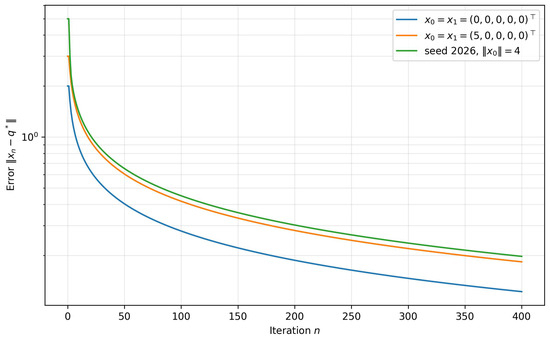
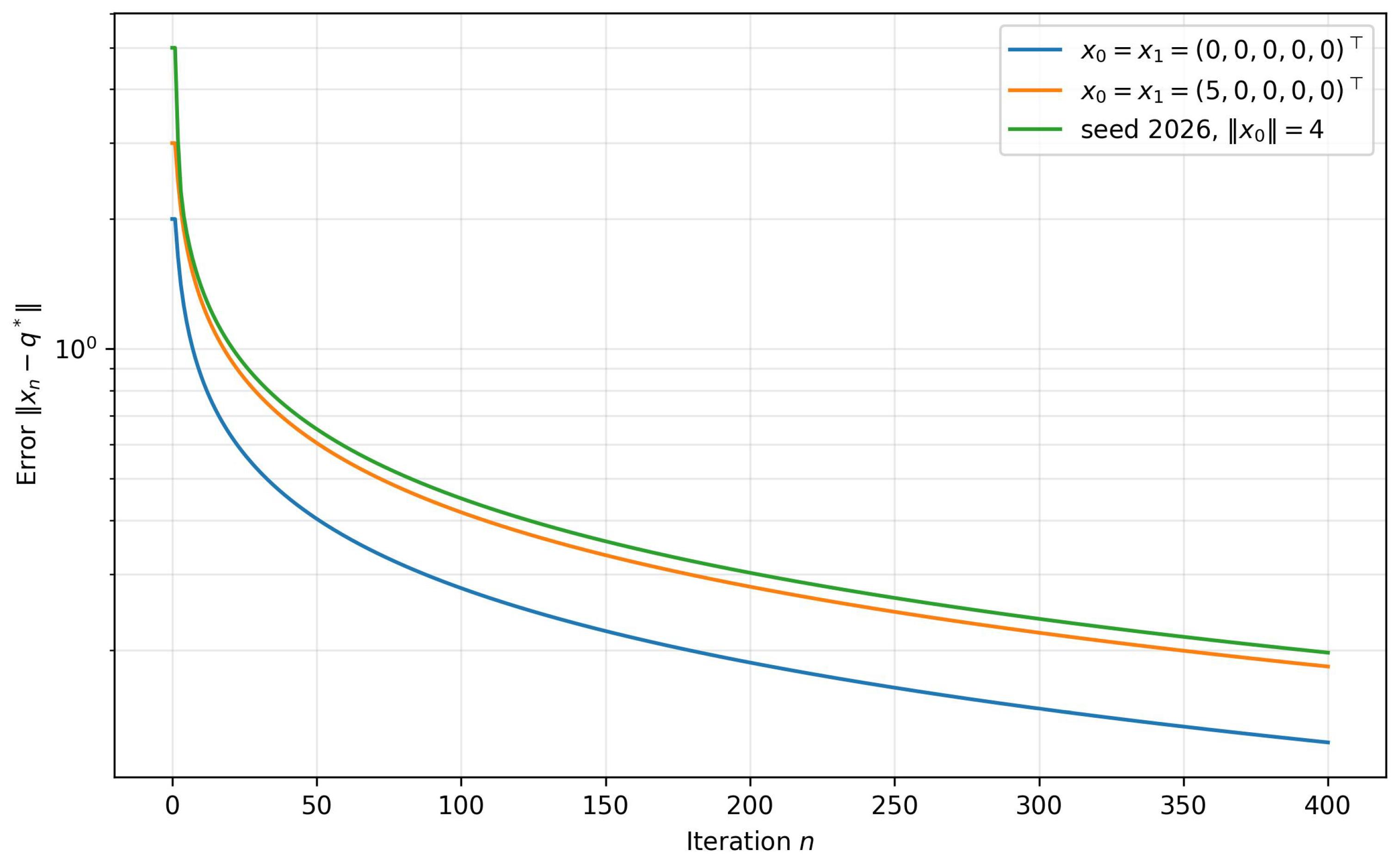
Consequently, every hypothesis of the strong convergence theorem and its cyclic specialization is fulfilled by this example. - Numerical behavior. The following experiments report on a logarithmic vertical scale. Figure 1 uses , , and the seeded pointThe third initial point was chosen randomly. We used seed 2026 so that the same point can be generated again, and adjusted it to have norm 4. All three curves decrease toward the same viscosity-selected point , as predicted by the theorem.Figure 1. Error for three fully specified initial pairs, with . The seeded point has norm 4 and lies in C.
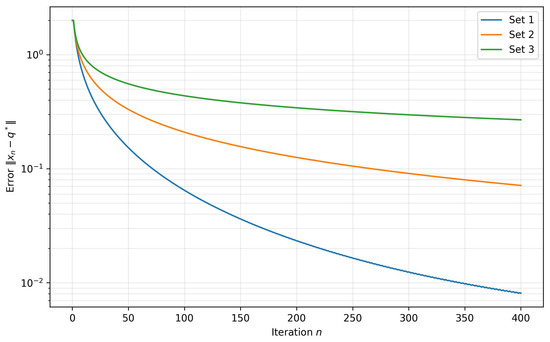
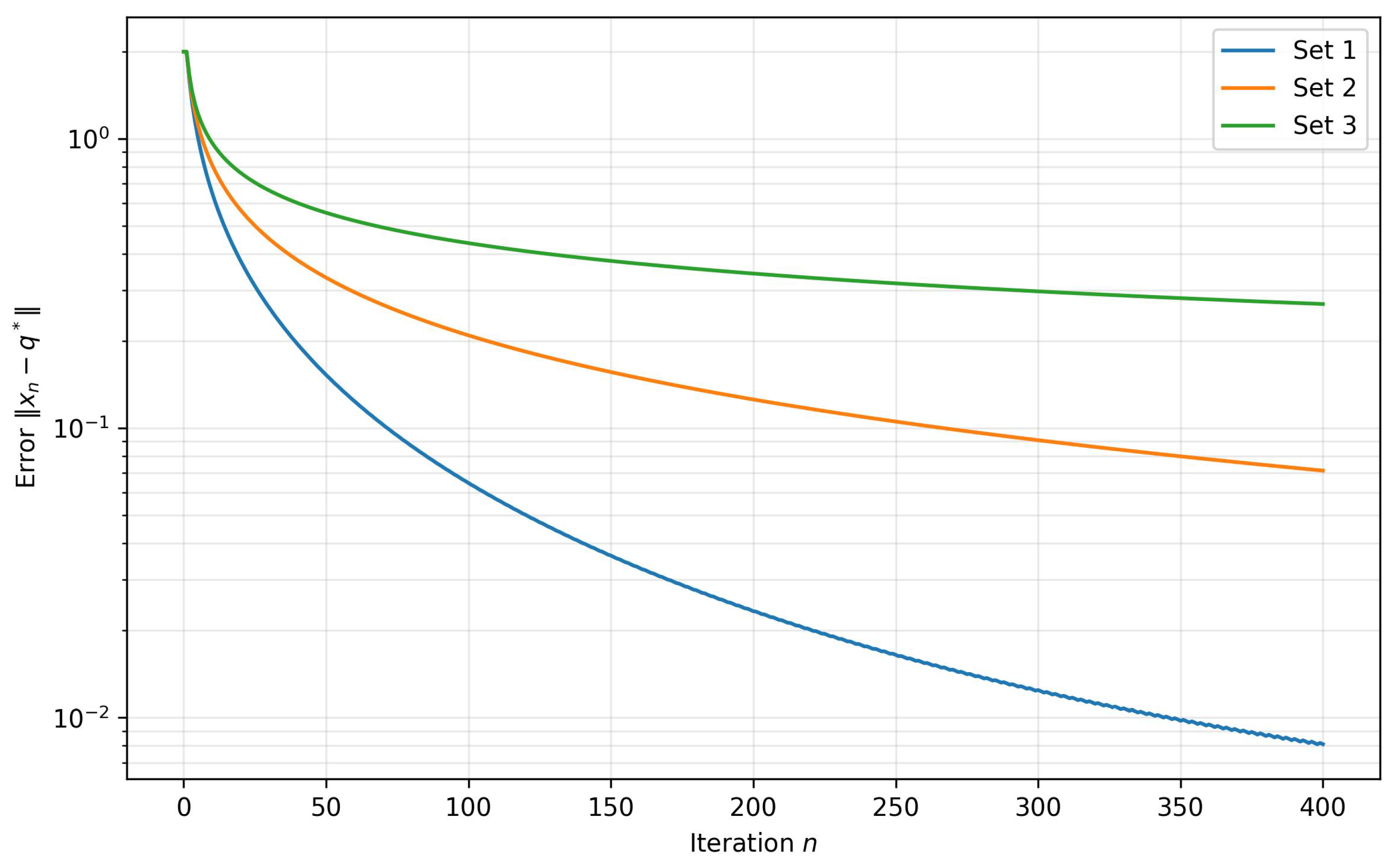
Figure 2 uses and compares the following admissible choices:
In each case and . The curves compare the combined finite-iteration effect of the viscosity and inertial parameters.
Figure 2.
Error for three stated choices of the viscosity and inertial parameters, with . Set 1 converges fastest to the target over the displayed iteration range.
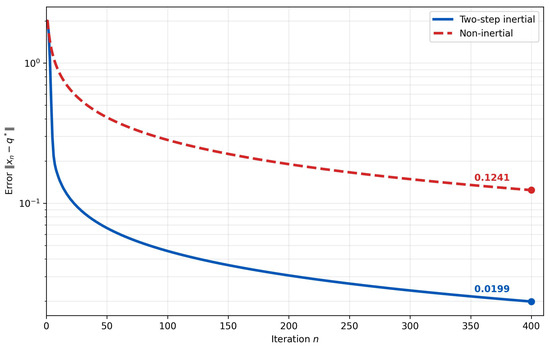
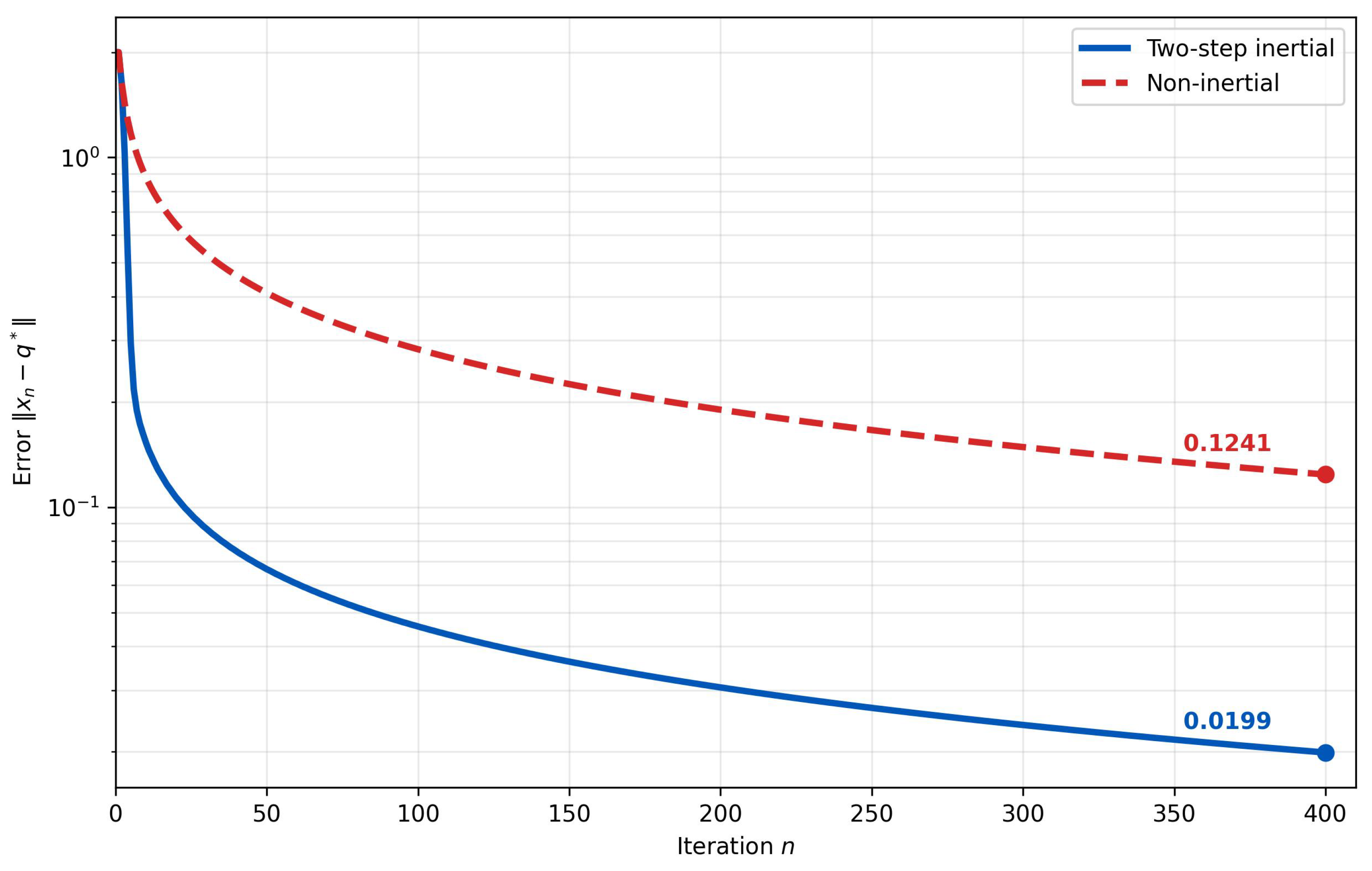
Finally, Figure 3 compares the proposed scheme with the non-inertial variant , using . To make the finite-iteration effect of the inertial correction clearly visible, the inertial run uses the alternative admissible choice
while , , , , and remain as in (46). These coefficients satisfy
so both required ratio series remain summable. A direct implementation gives
Thus the inertial error is of order and is approximately 6.23 times smaller than the non-inertial error at iteration 400. This comparison is specific to the stated admissible parameters and is not a claim of a uniform convergence-rate advantage.
Figure 3.
Reproducible comparison using . The inertial run uses and , whereas the non-inertial run uses ; all remaining parameters are identical. The values marked at iteration 400 were obtained directly from the stated algorithm and parameters.
7. Conclusions
In this paper, we introduced a unified two-step inertial viscosity-type algorithm for finding a common solution of a generalized mixed equilibrium problem and the fixed-point problems of a family of quasi-nonexpansive mappings in a real Hilbert space. The formulation separates the two monotone components of the equilibrium problem: the operator U is treated implicitly through the generalized mixed equilibrium resolvent, whereas the inverse strongly monotone operator A is evaluated explicitly through two forward–resolvent stages. The algorithm also incorporates two inertial corrections, a family-dependent fixed-point step, and viscosity regularization by a contraction.
We first established boundedness of the generated sequence under explicit summability conditions on the inertial parameters, including a second inertial coefficient that may be negative. A uniform descent inequality was then derived to control the two forward–resolvent residuals and the fixed-point residual simultaneously. Together with the weak regularity condition imposed on the mapping family and a residual-based convergence criterion, this estimate yielded strong convergence of the iterates to the unique viscosity-selected point satisfying .
The general result was applied to composite convex minimization, mixed variational inequalities, countable convex feasibility problems, and finite families under cyclic control. The five-dimensional example demonstrated that the assumptions can be verified explicitly and identified the limiting point as . The numerical plots further illustrated convergence from different initial points, sensitivity to the admissible parameter choices, and a clear acceleration of the tested inertial scheme relative to its non-inertial counterpart for the example considered.
Author Contributions
Conceptualization, T.C. and R.S.; methodology, T.C. and R.S.; software, T.C. and R.S.; validation, T.C. and R.S.; investigation, T.C. and R.S.; resources, T.C. and R.S.; data curation, T.C. and R.S.; writing—original draft preparation, T.C. and R.S.; writing—review and editing, T.C. and R.S.; visualization, T.C. and R.S.; supervision, R.S.; project administration, R.S. All authors have read and agreed to the published version of the manuscript.
Funding
This research received no external funding.
Data Availability Statement
The original contributions presented in this study are included in the article. Further inquiries can be directed to the corresponding author.
Acknowledgments
This work was supported by the Directorate of Research and Innovation, iYunivesithi Walter Sisulu.
Conflicts of Interest
The authors declare no conflicts of interest.
References
- Banach, S. Sur les opérations dans les ensembles abstraits et leur application aux équations intégrales. Fundam. Math. 1922, 3, 133–181. [Google Scholar] [CrossRef] [Scilit]
- Brouwer, L.E.J. Über Abbildung von Mannigfaltigkeiten. Math. Ann. 1911, 71, 97–115. [Google Scholar] [CrossRef] [Scilit]
- Kakutani, S. A generalization of Brouwer’s fixed point theorem. Duke Math. J. 1941, 8, 457–459. [Google Scholar] [CrossRef] [Scilit]
- Goebel, K.; Reich, S. Uniform Convexity, Hyperbolic Geometry, and Nonexpansive Mappings. In Monographs and Textbooks in Pure and Applied Mathematics; Marcel Dekker: New York, NY, USA, 1984; Volume 83. [Google Scholar]
- Reich, S.; Shoikhet, D. Nonlinear Semigroups, Fixed Points, and Geometry of Domains in Banach Spaces; Imperial College Press: London, UK, 2005. [Google Scholar]
- Opial, Z. Weak convergence of the sequence of successive approximations for nonexpansive mappings. Bull. Amer. Math. Soc. 1967, 73, 591–597. [Google Scholar] [CrossRef] [Scilit]
- Bruck, R.E.; Kuczumow, T.; Reich, S. Convergence of iterates of asymptotically nonexpansive mappings in spaces with the uniform Opial property. Colloq. Math. 1993, 65, 169–179. [Google Scholar] [CrossRef] [Scilit]
- Akashi, S.; Takahashi, W. Weak convergence theorem for an infinite family of demimetric mappings in a Hilbert space. J. Nonlinear Convex Anal. 2016, 17, 2159–2169. [Google Scholar]
- Reich, S.; Zaslavski, A.J. Convergence of Iterates of Nonexpansive Set-valued Mappings. In Set-Valued Mappings with Applications in Nonlinear Analysis; Taylor & Francis: London, UK, 2002; pp. 411–420. [Google Scholar]
- Reich, S.; Zaslavski, A.J. Generic existence of fixed points for set-valued mappings. Set.-Valued Anal. 2002, 10, 287–296. [Google Scholar] [CrossRef] [Scilit]
- Reich, S.; Zaslavski, A.J. Two results on fixed points of set-valued nonexpansive mappings. Rev. Roum. Math. Pures Appl. 2006, 51, 89–94. [Google Scholar]
- Fan, K. A minimax inequality and applications. In Inequalities III; Shisha, O., Ed.; Academic Press: Cambridge, MA, USA, 1972; pp. 103–113. [Google Scholar]
- Blum, E.; Oettli, W. From optimization and variational inequalities to equilibrium problems. Math. Stud. 1994, 63, 123–145. [Google Scholar]
- Bnouhachem, A.; Chen, Y. An iterative method for a common solution of generalized mixed equilibrium problems, variational inequalities and hierarchical fixed point problems. Fixed Point Theory Appl. 2014, 2014, 155. [Google Scholar] [CrossRef] [Scilit]
- Djafari-Rouhani, B.; Farid, M.; Kazmi, K.R. Common solution to generalized mixed equilibrium problem and fixed point problem for a nonexpansive semigroup in Hilbert space. J. Korean Math. Soc. 2016, 53, 89–114. [Google Scholar] [CrossRef] [Scilit]
- Kazmi, K.R.; Rizvi, S.H. Iterative approximation of a common solution of a split equilibrium problem, a variational inequality problem and a fixed point problem. J. Egypt. Math. Soc. 2013, 21, 44–51. [Google Scholar] [CrossRef] [Scilit]
- Combettes, P.L.; Hirstoaga, S.A. Equilibrium programming in Hilbert spaces. J. Nonlinear Convex Anal. 2005, 6, 117–136. [Google Scholar]
- Zhang, S. Generalized mixed equilibrium problem in Banach spaces. Appl. Math. Mech. (Engl. Ed.) 2009, 30, 1105–1112. [Google Scholar] [CrossRef] [Scilit]
- Takahashi, S.; Takahashi, W. Strong convergence theorem for a generalized equilibrium problem and a nonexpansive mapping in a Hilbert space. Nonlinear Anal. 2008, 69, 1025–1033. [Google Scholar] [CrossRef] [Scilit]
- Chang, S.S.; Lee, H.W.J.; Chan, C.K. A new hybrid method for solving a generalized equilibrium problem, solving a variational inequality problem and obtaining common fixed points in Banach spaces, with applications. Nonlinear Anal. 2010, 73, 2260–2270. [Google Scholar] [CrossRef] [Scilit]
- Osward, R.; Kumar, S.; Sangago, M.G. Approximation of common solutions for a fixed point problem of asymptotically nonexpansive mapping and a generalized equilibrium problem in Hilbert space. J. Egypt. Math. Soc. 2019, 27, 43. [Google Scholar] [CrossRef] [Scilit]
- Farid, M. Two algorithms for solving mixed equilibrium problems and fixed point problems in Hilbert spaces. Ann. Univ. Ferrara 2021, 67, 253–268, Erratum in Ann. Univ. Ferrara 2022, 68, 237. https://doi.org/10.1007/s11565-022-00386-w. [Google Scholar] [CrossRef] [Scilit]
- Cioranescu, I. Geometry of Banach Spaces, Duality Mappings and Nonlinear Problems. In Mathematics and Its Applications; Kluwer Academic Publishers: Dordrecht, The Netherlands, 1990; Volume 62. [Google Scholar] [CrossRef] [Scilit]
- Takahashi, W. Introduction to Nonlinear and Convex Analysis; Yokohama Publishers: Yokohama, Japan, 2009. [Google Scholar]
- Xu, H.-K. Iterative algorithms for nonlinear operators. J. Lond. Math. Soc. 2002, 66, 240–256. [Google Scholar] [CrossRef] [Scilit]
- Mendy, J.T.; Shukla, R. Viscosity like implicit methods for zeros of monotone operators in Banach spaces. Khayyam J. Math. 2022, 8, 53–72. [Google Scholar] [CrossRef]
- Maldar, S.; Çetin, E. Solutions of equilibrium problems with fixed point iteration method and data dependence. Math. Sci. Appl. E-Notes 2026, 14, 1–20. [Google Scholar] [CrossRef] [Scilit]
- Patel, P.; Shukla, R. Viscosity approximation for split equality generalized mixed equilibrium problems with semigroups of nonexpansive mappings. Abstr. Appl. Anal. 2024, 2024, 2812752. [Google Scholar] [CrossRef] [Scilit]
- Patel, P.; Shukla, R. Viscosity approximation methods for generalized modification of the system of equilibrium problem and fixed point problems of an infinite family of nonexpansive mappings. Math. Stat. 2024, 12, 339–347. [Google Scholar] [CrossRef] [Scilit]
- Patel, P.; Shukla, R. Iterative techniques for common solutions of mixed equilibrium problem and fixed points of μ-demicontractive mappings. Asia Pac. J. Math. 2025, 12, 74. [Google Scholar] [CrossRef] [Scilit]
- Husain, S.; Asad, M. An inertial subgradient extragradient algorithm for modified variational inclusion problem and mixed equilibrium problem in real Hilbert space. Ann. Univ. Ferrara 2024, 70, 107–125. [Google Scholar] [CrossRef] [Scilit]
- Kajola, S.A.; Narain, O.K. A strongly convergent algorithm for approximating a common solution to fixed point and mixed equilibrium problems. Results Math. 2024, 79, 283. [Google Scholar] [CrossRef] [Scilit]
- Sunthrayuth, P.; Cholamjiak, P.; Promkam, R.; Yao, J.-C. Two-step inertial viscosity-type method for a family of strongly quasi-nonexpansive mappings with applications. Optimization 2026, 1–37. [Google Scholar] [CrossRef] [Scilit]
- Wang, F.; Pham, H. Improvement of convergence criteria for finding common fixed points of multiple finite demicontractive mappings. Optim. Lett. 2026, 20, 53–65. [Google Scholar] [CrossRef] [Scilit]
- Alakoya, T.O.; Taiwo, A.; Mewomo, O.T. On system of split generalised mixed equilibrium and fixed point problems for multivalued mappings with no prior knowledge of operator norm. Fixed Point Theory 2022, 23, 45–74. [Google Scholar] [CrossRef] [Scilit]
Disclaimer/Publisher’s Note: The statements, opinions and data contained in all publications are solely those of the individual author(s) and contributor(s) and not of MDPI and/or the editor(s). MDPI and/or the editor(s) disclaim responsibility for any injury to people or property resulting from any ideas, methods, instructions or products referred to in the content. |
© 2026 by the authors. Licensee MDPI, Basel, Switzerland. This article is an open access article distributed under the terms and conditions of the Creative Commons Attribution (CC BY) license.