


Abstract
Background: Unsaturated fatty acids have beneficial effects on skin and overall health; however, ingredients in topical oil-in-water emulsions may affect oxygen uptake and formation of oxidation products in skin care formulations synergistically. Methods: This study provides an exploratory cross-study synthesis of oxygen-uptake data from four single-lab studies investigating different ingredient combinations (preservatives, oils, extracts) and storage conditions (intense light, increased temperature). Oxygen-consumption rates were extracted from published data and reanalyzed using effect-size calculations (Hedges’ g) within a multivariate fixed-effects modeling framework. A model-derived reference threshold time was introduced as a hypothetical descriptor to facilitate comparison of oxidation progression under specified assumptions. Results: Across the four included studies, oxygen consumption and reference threshold times varied with oil composition, light exposure, botanical extracts and preservation systems. Although emulsions with coffee ground extract and those preserved with glyceryl caprylate showed the lowest oxygen uptake, direct comparisons were limited by differences in study design and control conditions. Conclusions: Overall, the data suggest that specific combinations of topical formulation ingredients might influence oxidative changes during storage. Potential implications for dermal and systemic health are discussed.
1. Introduction
Polyunsaturated fatty acids, known as PUFA, and in particular Omega-3 fatty acids, have demonstrated beneficial effects in inflammatory skin diseases following both topical [1] and oral application [2], where they can also enter the bloodstream and alter the systemic fatty acid composition advantageously [3].
However, omega-3 fatty acids’ susceptibility to oxidation may compromise cutaneous and even systemic health, as lipid peroxidation generates reactive hydroperoxides that can induce inflammation. The lipid radical is formed by the abstraction of a hydrogen atom from an unsaturated fatty acid (initiation), after which molecular oxygen binds directly to this radical to form a peroxyl radical (propagation). Common PUFA oxidation products, such as hexanal, octanal, (E)-2-decenal, nonanal, (E)-2-undecenal from oleic acid, or (E)-2-nonenal, pentanal and hexanal from linoleic acid, and some of their radical, epoxy, keto, and dimer oxidation products are already well described in the literature [4]. Additionally, it has been demonstrated that consuming oxidized dietary oils poses severe health risks, including cellular damage, inflammation, and metabolic disorders [5,6]. Furthermore, oxidatively unstable pharmaceutical emulsions can amplify oxidative stress in situ by generating oxygen species, e.g., reactive oxygen species (ROS), superoxide anions (O2•–), hydroxyl radicals (HO•), which cause oxidative stress in biological tissues (e.g., cholesterol oxides, activation of proteases, DNA-strand breakage or fragmentation, oxidation of cellular membrane proteins, enzymes and lipids) [7]. Elevated levels of lipid-derived aldehydes such as malondialdehyde (MDA) and 4-hydroxynonenal (4-HNE) correlate with the severity of conditions like atopic dermatitis, urticaria, pemphigus, and melanoma, and activate pro-inflammatory gene expression and cytokine production, while also inducing cell death and increasing oxidative stress [8].
While breaking through the skin’s barrier remains a core aspect for dermatological efficacy, oxidative degradation may paradoxically allow low-molecular-weight oxidation degradation products from skin care to affect superficial skin layers and even reach deeper tissue and the systemic circulation. Percutaneous absorption occurs via intercellular, transcellular, and transfollicular pathways [9]. Penetration enhancers, including alcohols and fatty acids, can transiently disrupt the stratum corneum to increase substance uptake [10,11]. While molecules exceeding 500 Da (such as proteins, polysaccharides and triglycerides) are generally considered to be unable to penetrate intact skin [12,13], oxidized PUFA fragments have molecular sizes ranging from 86 Da to 168 Da and may have the potential to penetrate the skin. Systemic distribution to organs like liver and kidneys [14] has already been reported for parabens [15,16], sunscreen agents [17], and corticosteroids [18]. Whether oxidation products from emulsions undergo absorption and induce cutaneous and/or systemic oxidative stress remains unknown.
While no in vivo studies examined the effects of oxidative stress caused by topical application of lipid peroxides on human skin for ethical reasons, an approach can be attempted from published studies on squalene: the topical application of squalene hydroperoxide (SqOOH) has been associated with cytotoxicity [19], oxidative stress and decrease in glutathione [20,21], pollution-induced damage [22,23], skin aging [24,25], and comedogenic effects [26,27]. Due to their structural similarity, comparable redox properties (E0 = +1.00 V), and small molecular size, fatty acid hydroperoxides may likewise penetrate the stratum corneum and contribute to skin cell damage and inflammation [28].
While lipid peroxidation has been extensively studied and the impact of substances was considered in isolation, the combined influence of formulation components on the quality and safety of topical O/W emulsions under storage and their implications for cutaneous exposure has not yet been quantified. Addressing this issue requires quantitative and directly comparable measures of oxidative degradation reported in product-related kinetic units that allow integration into exposure calculations. Furthermore, formulation parameters need to be systematically varied under defined storage conditions to identify determinants of oxidative stability. However, studies combining systematic formulation adjustments with quantitative oxygen-consumption measurements suitable for exposure assessment remain scarce and standardization between laboratories is limited.
Therefore, the present exploratory cross-study synthesis aimed to re-analyze the oxygen-uptake data of topical O/W emulsions from one research group and to explore formulation factors associated with oxidative instability and cutaneous exposure to oxidation products. A single-laboratory dataset minimizes inter-methodological variability (e.g., measurement devices, ingredient quality) and ensures that differences in oxygen consumption can be more confidently attributed to formulation and storage conditions than to differences in experimental procedures. By providing a quantitative assessment of formulation-specific oxygen consumption, this work contributes to a novel, more exposure-oriented evaluation of oxidative stability in topical emulsions.
2. Materials and Methods
2.1. Data Selection
A global-scale meta-analysis of literature data is currently precluded by the lack of inter-laboratory standardization in cosmetic oxygen-consumption metrics. Limiting this synthesis to a single-center data origin supports baseline homogeneity regarding raw material purity, device calibration, and experimental execution, thereby allowing structural variance to be directly attributed to formulation parameters.
A targeted study selection included institutional work from one research institute that investigated emulsions intended for topical skin application and reported quantitative oxygen uptake or oxygen consumption over a defined storage period, either directly using the unit mg O2/100 g per day or total oxygen uptake [mg O2/100 g] over a defined time period. Risk of bias was assessed by A.S. (with dual validation by A.B.) using a structured, study-specific assessment addressing study design, sample size and replication (number of separate vessels containing one shared emulsion batch), measurement methodology, reporting completeness, control selection, and potential sources of bias related to experimental conditions. While two studies demonstrated a low risk of bias due to rigorous standardization and complete kinetic measurements, methodological variations—such as the reliance on two-point measurements or aggregated daily means—led to a rating of some concerns for the other two studies. The assessment is presented in Table A1.
Four eligible sources examined the oxidation of cosmetic emulsions with in situ and ex situ oxygen measurements containing various preservatives (ethanol, phenethyl alcohol, benzyl alcohol, potassium sorbate, glyceryl caprylate) [29], ethanolic plant extracts preserved with ethanol (cocoa, coffee, citrus peels, apple and Riesling pomace) [30], oils with various fatty acid compositions (sunflower, canola, avocado, hemp seed, coconut) [31] and aqueous plant extracts preserved with potassium sorbate (cocoa, coffee, citrus peels, Riesling pomace, hops, hemp) [32] under different storage conditions involving temperature and light exposure (1000 lux as “intense light” and 10 lux as “darkness”) while all using the same emulsifier and pH balancer. The oxygen concentration in the headspace of sealed sample vessels was measured using either a sensor [29,30,32] or a gas analyzer [31]. In particular, Refs. [29,30] used the same storage vessels and sensor type, but not the same oxygen measurement calibration and individual sensors. The gas analyzer had a built-in calibration function and was quality tested daily for atmospheric oxygen. Two studies were conducted at the microscale [29,30] and two at the mesoscale [31,32]. Since the differences in methods are largely accounted for by the shared oxygen measurand, they can be considered reasonably comparable. One study supplemented physical examination with chromatographic quantification of the marker hexanal, demonstrating that oxidative intermediates (hydroperoxides) were transformed into the terminal oxidation product with exact correlation to antioxidant capacity and oxygen uptake [30]. The emulsion variants, storage duration and temperature, light exposure and metering method were compiled in tabular form from the publications [29,30,31,32].
2.2. Multivariate Fixed-Effects Modeling Framework
The numerical oxygen-uptake values were extracted from the published column charts by digital image analysis (WebPlotDigitizer—Version 4.6, Automeris LLC, Austin, TX, USA), converting the bar heights (means) and error bars (standard deviations) at the pixel level into numerical values based on the respective y-axis scale. Based on the image resolution, the inherent digitization uncertainty was determined to be ±1 px, which corresponds to 0.000395 mg/100 g/d [29], 0.00145 mg/100 g/d [30], 0.116 mg/100 g over 27 days [31] and 0.003012 mg/100 g/d [32]. Values for daily oxygen-consumption rate were applied directly [29,30,32] or, where required for pooling, calculated from total oxygen intake as a quotient with the storage time [31]. Values were rounded to two decimal places; calculations used unrounded values.
An exploratory within-study analysis was performed using oxygen-consumption rate (mg O2/100 g/d) as the primary outcome and study as moderator. In this parameterization, the reported omnibus F-test evaluates whether all four category coefficients are zero; it does not test equality of effects between categories. Standardized mean differences were calculated as Hedges’ g with small sample correction (Hedges’ approximation for J) by formulation category (preservatives, botanical extracts, and oils). For the meta-regression analysis, manually calculated Hedges’ g and corresponding sampling variances were utilized as primary inputs. Shared controls were taken into account by categorizing them as a subgroup. Sensitivity analyses were conducted varying the assumed correlation with rho = 0.3 and rho = 0.7 and is displayed in Appendix B (Table A3). While individual underlying study effect sizes remain identical across all configurations, the aggregated variances and pooled category estimates were sensitive to the assumed correlation with the joint category test losing statistical significance at higher levels of rho.
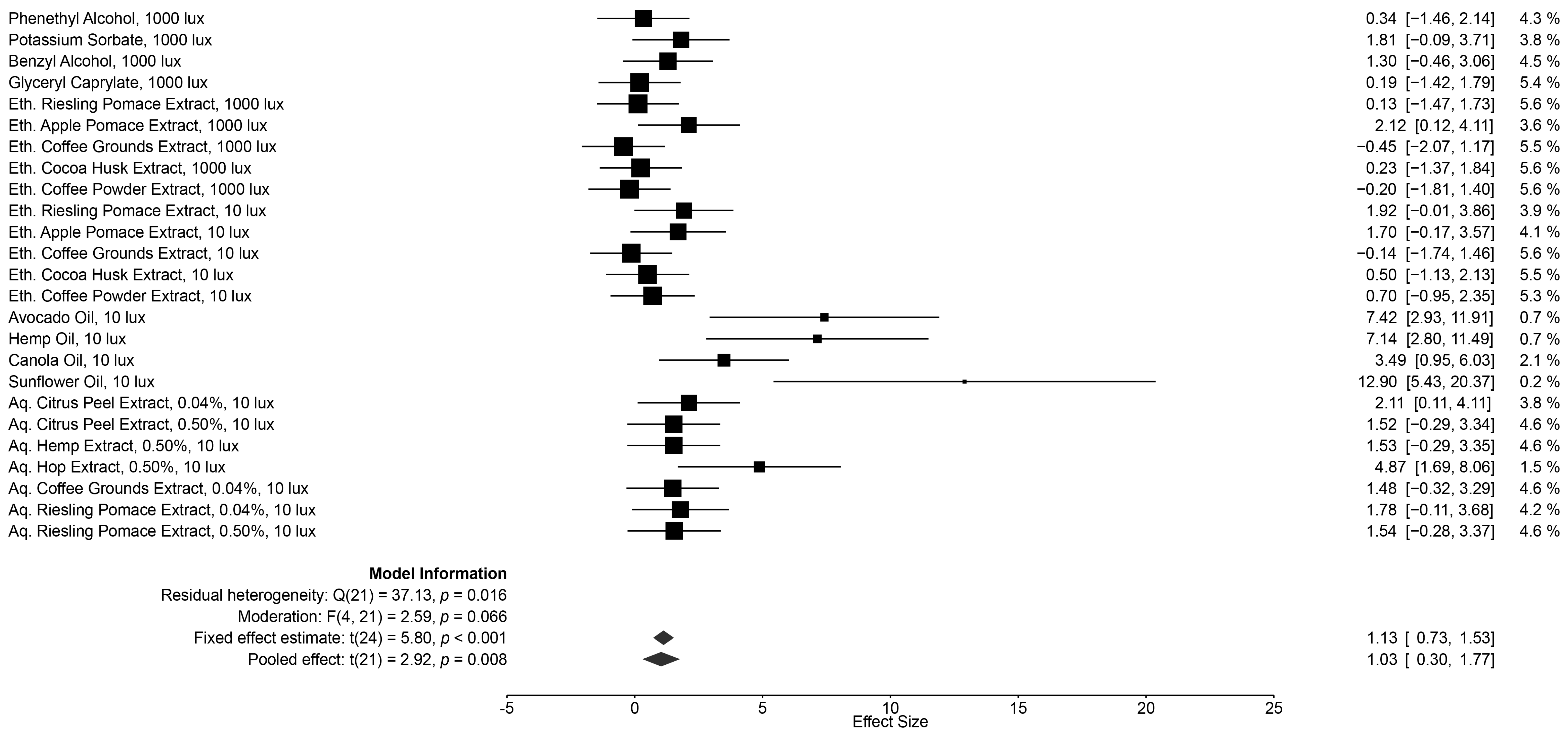
All statistical analyses were performed using JASP (Version 0.98.1; JASP Team, Amsterdam, The Netherlands, 2026) with the dedicated Meta-Analysis module (version 0.95.5). The exact equations and R-Codes are provided in Appendix B. Graphical visualizations were performed using JASP (Version 0.98.1; JASP Team, Amsterdam, The Netherlands, 2026) and Microsoft® PowerPoint® for Microsoft 365 MSO (Version 2607, Build 16.0.20228.20110, 64-bit, Microsoft Corporation, Redmond, WA, USA). The forest plot displays individual effect sizes (Hedges g) with their 95% confidence intervals and relative study weights, alongside the pooled overall estimates (fixed- and random/mixed-effects models), residual heterogeneity (Q-test), and moderator analysis (F-test).
2.3. Reference Threshold Time Model
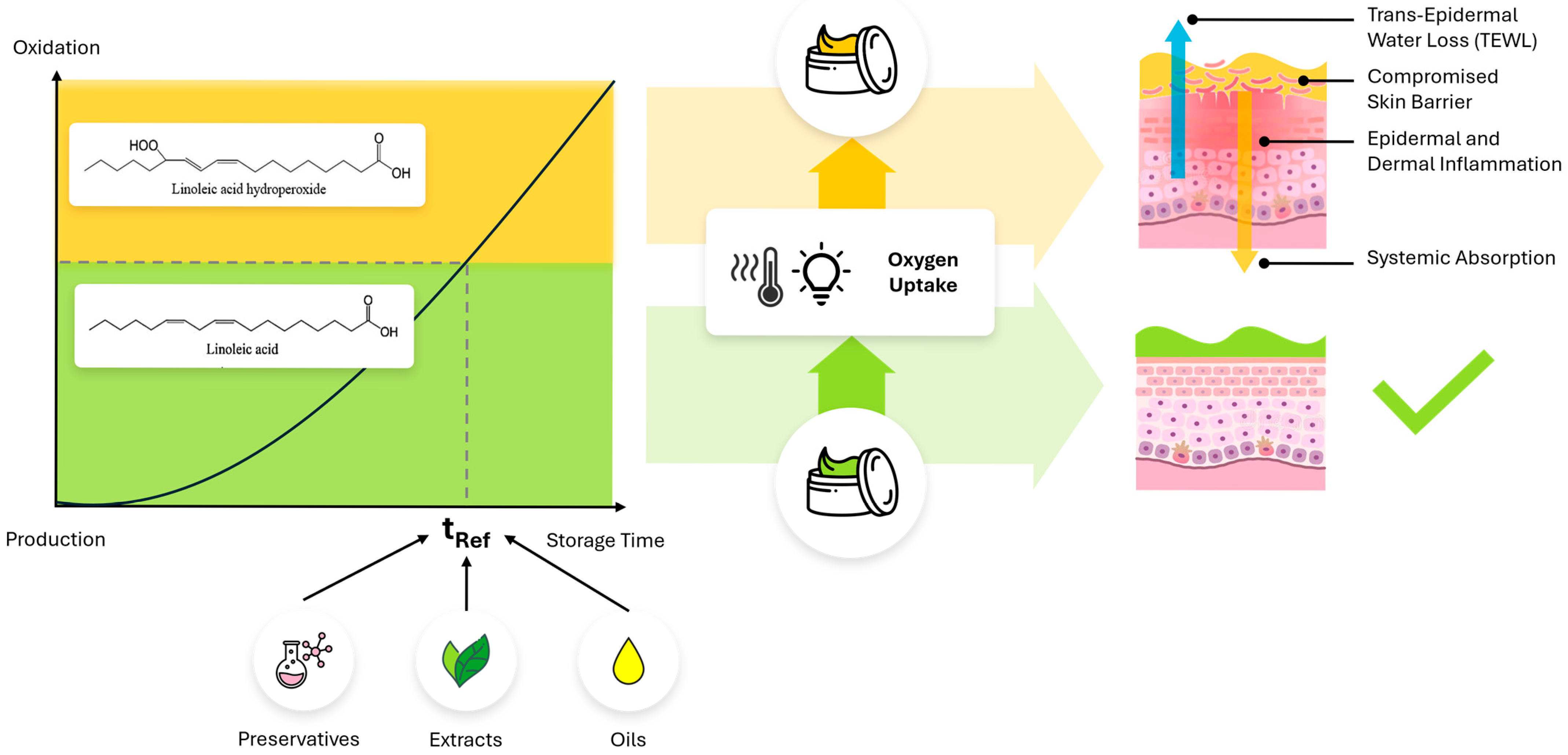
To bridge oxygen-consumption rates and dermatological relevance, a model-derived hypothetical descriptor hereinafter referred to as “reference threshold time” (tRef) was calculated for each formulation. This parameter estimates the time required to reach a cumulative oxygen-uptake reference corresponding to the hydroperoxide concentration inspired by the dermatologically relevant concentration of 10 mM SqOOH on mouse skin [25]. Therefore, a reference threshold of 10 mmol O2 per kg product (equivalent to 320 mg O2/kg or 32 mg O2/100 g) was defined. Then, experimentally determined oxygen-uptake rates from different test methods [29,30,31,32] were converted into tRef, using the relationship, where x represents the measured oxygen-uptake rate in mg O2/100 g/day:
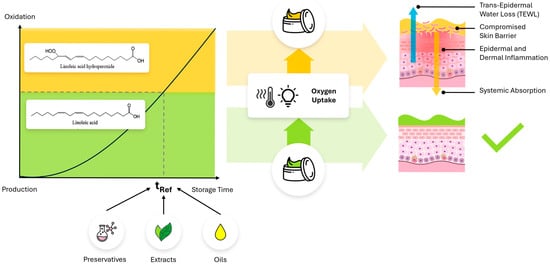
However, several assumptions were applied: SqOOH and lipid hydroperoxides (LipOOH) are both hydroperoxides formed by oxygen addition to unsaturated carbon bonds. The molar hydroperoxide concentration can be used as a proxy for oxygen uptake, assuming the conversion of one mole of oxygen into one mole of peroxide in an emulsion of a 1 g/mL density. Assuming a yield factor (f) of 1.0, corresponding to a 1:1 molar relationship between oxygen uptake and hydroperoxide formation, the threshold of 10 mM peroxides corresponded to approximately 10 mmol O2/kg. Sensitivity analysis using yield factors of 0.75, 0.50, and 0.25 resulted in corresponding oxygen requirements of 13.3, 20, and 40 mmol O2/kg, respectively. However, this conversion assumed a yield factor of unity and did not account for competing oxidation pathways, secondary decomposition, or unquantified hydroperoxide products. It is intended as a comparative, model-based approach of linear oxidative progression and not as a validated measure of dermatological tolerance, product safety, or shelf life. Figure 1 schematically shows the concept of tRef:
Figure 1.
Schematic representation of the oxidation during storage exceeding a defined model-derived descriptor symbolizing reference threshold time (tRef) being influenced by ingredients (preservatives, extracts and oils) with hypothetical pathways for cutaneous exposure.
For practical orientation, calculated tRef values were discussed in the context of typical product shelf lives and periods after opening. For cosmetic products, a reference value of 30 months (913 d) was chosen, which aligns with the regulatory threshold triggering period-after-opening (PAO) labeling under EU Regulation 1223/2009 [33]. In accordance with common industry practices and stability-testing standards, such as the ICH Q1A guideline for pharmaceuticals, a benchmark of 24 months (730 d) was applied to medical devices and medicinal products stored below 25 °C [34,35]. Considering a temperature-dependent reaction acceleration of approximately twofold per 10 K increase (Arrhenius model from 20 °C to 30 °C), these thresholds would correspond to 457 and 365 d, respectively [36].
3. Results
3.1. Comparison of Reference Threshold Times tRef
All four sources used the same underlying measurement principle but differed in measurement setup, procedural details, and operators [29,30,31,32]. The results reveal considerable differences in tRef depending on the formulation, storage conditions, and lipid composition [29,30,31,32]. Comparatively fast-oxidizing systems, particularly emulsions preserved with potassium sorbate or benzyl alcohol [29], exhibited comparatively short tRef (151–744 d). This effect was even more pronounced for certain formulations under intense light exposure, such as the apple pomace extract emulsion (26–30 d). In contrast, some formulations, e.g., containing phenethyl alcohol [29], ethanol [29], glyceryl caprylate [29], coffee grounds [30], and those without extract [30], showed substantially longer tRef (≥1270 d or not calculable). Intense light exposure (fluorescent tube, 6000 K, 1000 lux, 24 h) might have accelerated oxidation, with several samples reaching tRef under 640 d [30], whereas storage in darkness markedly prolonged tRef with only selected formulations like emulsions without extract and coffee grounds extract [30]. However, an emulsion with hop extract with 10 < tRef < 16 is contrary to this [32]. Lipid composition further influenced stability: emulsions containing highly unsaturated oils [31] showed notably short tRef (47–52 d), while saturated systems such as coconut oil exhibited substantially longer tRef (323–1149 d). Additionally, certain extract-containing formulations, such as hop extract, exhibited very rapid oxidation (10–16 d). Table 1 summarizes the data of formulation, storage condition, and measurement methods on daily oxygen-consumption rates and the time required to reach tRef.
Table 1.
Compilation of oil percentage, light exposure (Light Exp., 1000 lux “intense light” and 10 lux “darkness”), temperature (Temp.), storage duration, and measurement method on daily oxygen (ox.) consumption rate (mean, standard deviation (SD) and number of replicates/separate vessels [n]), mean difference compared to control (mean dif., SE), and total oxygen uptake, further calculation of reference threshold time (tRef), in particular mean (calculated from oxygen consumption mean) and the extrapolated range calculated from mean and SD of oxygen consumption [29,30,31,32].
3.2. Exploratory Quantitative Study-Level Synthesis
Four primary studies [29,30,31,32], encompassing 30 experimental variants, including five shared controls, were analyzed in this research. The synthesis revealed a significant pooled effect (estimate = 1.034, 95% CI [0.298, 1.770], t(21) = 2.92, p = 0.008) and significant residual heterogeneity (QE(21) = 37.13, p = 0.016). The omnibus F-test of category coefficients against zero was not statistically significant at rho = 0.5 (F(4, 21.00) = 2.593, p = 0.066). While the specific coefficient for oils was significantly different from zero at rho = 0.5 (estimate = 3.176, 95% CI [0.573, 5.779], t = 2.537, p = 0.019), aqueous extracts (p = 0.121), ethanolic extracts (p = 0.612), and preservatives (p = 0.315) were not. The oil-category effect was significant at rho = 0.3 and 0.5, but not at rho = 0.7, whereas the aqueous-extracts-group was only significant at rho = 0.3, indicating sensitivity to the assumed correlation (Table A3). However, it should be noted that data from Refs. [31,32] derive from non-peer-reviewed sources, where Ref. [31] is a conference poster with peer-reviewed abstract analyzing data from a two-point gas analyzer measurement and Ref. [32] is a technical article describing a case study. The results are summarized in Table 2.
Table 2.
Subgroup-specific pooled effect-size estimates, standard errors, 95% confidence intervals (CI), and t, df and p from the multivariate fixed-effects modeling framework. The model was estimated with effect-size variance–covariance matrix based on Variant as construct with a common correlation of 0.5, Study as cluster, and Control as subcluster.
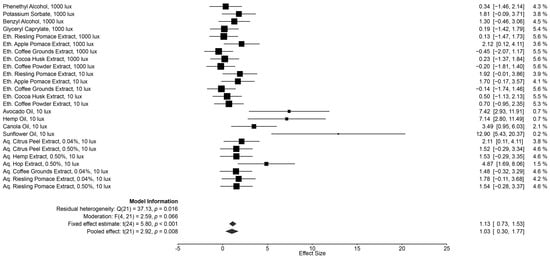
An examination of the pooled effects within each individual primary study revealed notable internal variations within the respective publications. For instance, in Ref. [29] individual variants ranged from a small effect of g = 0.19 for glyceryl caprylate to a larger effect of g = 1.81 for potassium sorbate. The individual effect sizes within Ref. [30] spanned from a negative effect of g = −0.45 for coffee grounds (1000 lux) to a strong positive effect of g = 2.12 for apple pomace (1000 lux). A high magnitude of the standardized effect was observed in Ref. [31] where sunflower oil produced the highest single effect size (g = 12.90). However, values of g should be interpreted in the context of mean differences (Table 1). Finally, individual values in Ref. [32] ranged from g = 1.48 up to a peak of g = 4.87 for hop extract. The corresponding forest plot is displayed in Figure 2.
Figure 2.
Forest plot of effect sizes (Hedges’ g) and model information for trials included in the exploratory cross-study synthesis [29,30,31,32] with the corresponding 95% CI and indicating the weights [%] shown in box size and as values. Positive effect sizes (g > 0) indicate greater oxygen consumption compared to control, consistent with greater oxidation under the experimental conditions; negative values (g < 0) indicate lower oxygen consumption.
4. Discussion
This quantitative synthesis of four primary studies demonstrates that highly unsaturated lipids, potassium sorbate, and apple pomace extract combined with intense light exposure accelerated emulsion degradation. Meanwhile, multifunctional preservatives such as glyceryl caprylates and ethanol as well as extracts from coffee grounds showed comparatively lower oxygen-consumption rates, suggesting a potential stabilizing effect under the investigated conditions [29,30,31,32]. To contextualize these findings, this discussion evaluates the matrix-dependent dual roles of botanical extracts, explores the pathophysiological signaling pathways triggered by oxidized ingredients in the skin and outlines practical strategies for regulatory shelf-life compliance, before discussing the limitations of this work.
4.1. Oxygen Uptake: From Days to Years
These data show comparatively that oxidative degradation of topical emulsions can affect some formulations substantially faster under storage conditions of elevated temperature (30 °C) and light (1000 lux) exposure (Table 1). This is consistent with previous reports demonstrating instability of active ingredients, such as retinol derivatives and ascorbic acid within the first months of storage [37,38]. Nevertheless, storage conditions considered in this work reflect a slight acceleration and do not aim to replicate storage scenarios across the globe throughout the entire year.
While some showed rapid daily oxidation and tRef of a few days, others corresponded to months or years and absorbed oxygen much more slowly. However, it should be considered that some extrapolated values went beyond the time periods observed in the studies [29,30,31,32]. If those samples happen to still be in the induction time, a linear extrapolation would not be appropriate. Therefore, longer observation periods should be addressed in the future. Nevertheless, these intense differences cannot always be explained by the sum of the ingredients alone. Synergistic effects between formulation ingredients or photosensitizers could explain the enhancements [39] and should also be investigated in the future for topical emulsions.
The analysis provided category-specific estimates against zero. As each formulation category was represented by a single primary study, differences between subgroups cannot be disentangled from study-specific methodological characteristics, control formulations, and experimental conditions. The reported pooled effect for oils, high estimated effects and the extreme value for sunflower oil (g = 12.90) must be interpreted strictly as a study-specific contrast against an exceptionally stable coconut oil vehicle instead of a broader underlying effect. However, in the case of sunflower oil emulsion, this might be a valid biochemical reflection of its high PUFA content and rapid oxidation kinetics compared to the stable coconut oil control. This was confirmed in a study of pure oils and the formation of toxic products was discussed [40]. The mean differences between the samples and their controls (Table 1) better reflect the influences on absolute oxygen uptake. Therefore, future studies must implement more nuanced control groups and realistic baseline conditions to prevent artificial inflation of effect sizes and ensure scalable results.
Similar work also investigated the oxidation of skin care formulations, although without reporting daily volumetric oxygen-consumption rates in [mg/100 g/d]. In particular, Clark electrode measurement was performed under iron-catalyzed acceleration [41], an oxygraph measurement of a highly viscous prototype cream diluted with water [42] and the headspace measurement of volatile compounds from a fat-reduced skin formulation [43]. Therefore, the oxidation of topical emulsions represents an area of growing scientific interest.
4.2. Botanicals Balance Dermatological Efficacy and Stability
Some botanical extracts showed considerable antioxidant effects in reducing lipid oxidation rates under storage conditions, whereas oils with high PUFA content, untreated controls and some food residues (e.g., apple pomace) support oxygen uptake, indicating strong compound- and matrix-dependent effects on oxidative stability. However, these results align with previous assumptions: exponential correlation between unsaturated fatty acid content and oxygen-consumption rate has already been reported [31], as well as the mathematical relationship between an extract’s antioxidant capacity and its emulsion’s oxygen uptake and hexanal formation [30]. Moreover, browning and the oxidation of polyphenols to quinones are known to reduce antioxidant activity and deplete phenolic antioxidants [44], which confirms previous findings regarding the low antioxidant capacity of apple pomace extract and the oxidative susceptibility of the emulsion produced from it [30].
On the other hand, coffee grounds, cocoa husk, Riesling (grape) pomace, apple pomace, and citrus peels contain bioactive compounds, particularly polyphenols, flavonoids, and vitamins, with antioxidant and dermatological effects. Their extracts can reduce oxidative stress and inflammation, support collagen synthesis and skin regeneration, and strengthen skin elasticity and barrier function, highlighting their potential as sustainable ingredients in dermocosmetic formulations [45,46,47,48,49]. It is noteworthy that although similar extracts were used in Refs. [30,32], these had different effect sizes. The reason might lie in the preservation system, which has already been discussed: it was suggested that ethanol might affect oxygen solubility, while sorbic acid salts might increase oxidative stress [29]. Therefore, the composition of emulsion, especially with regard to botanical actives, is an important factor for oxidative behavior as well as dermatological efficacy.
4.3. Pro-Inflammatory Mechanisms of Oxidized Skincare Ingredients
Compounds such as 4-hydroxynonenal (4-HNE) and malondialdehyde (MDA), which are associated with oxidative stress and induce inflammatory signaling pathways in the skin [50], may arise both endogenously and from oxidized formulations [51]. While the skin aging exposome and the benefits of antioxidants for skin longevity are well established [52], still, the specific impact of oxidized skincare ingredients remains poorly understood.
Although skin penetration and inflammatory signaling were not assessed in the present work, the literature describes pathways that link product degradation to adverse cutaneous and systemic effects: Mechanistically, penetrated oxidized compounds activate TLR2/4 and NLRP3 pathways in skin cells, triggering NF-κB and AP-1 to generate ROS and pro-inflammatory mediators (e.g., IL-1β, IL-6, TNF-α, MMPs). Concurrently, lipid peroxides disrupt the stratum corneum barrier, increasing transepidermal water loss (TEWL). Subsequent dermal endothelial activation (ICAM-1/VCAM-1 upregulation) promotes leukocyte recruitment and potentially enables systemic translocation of oxidized degradation products [7,8]. Pro-oxidative topical treatment disrupts the stratum corneum lipid bilayer, increasing TEWL and altering barrier permeability [53]. Molecular dynamic simulations showed that lipid peroxidation perturbs the membrane barrier and imposes oxidative stress resulting in apoptosis [54]. Future in vitro studies, e.g., with isotopically labeled lipid hydroperoxides, are needed to elucidate their absorption mechanisms and dermal/systemic responses, analogous to [4].
Dermal absorption might be plausible, especially in combination with enhancing factors, including skin barrier integrity (e.g., atopic skin), ionization, solubility, matrix release, and lipophilicity, as well as the presence of penetration enhancers and further factors affecting skin penetration [55,56,57]. Other low-molecular-weight volatile oxidation products such as acrolein and hexanal [58,59] or oxidized terpenes such as limonene [60] have also been described as irritant or sensitizing even at low concentrations. Latest VOC measurements show that these have also been detected in oxidized cosmetic emulsions [61].
4.4. Implications for Product Shelf Life
It should be considered that although oxygen-uptake-derived tRef can be compared to the industry recommendations, the exploratory nature of this work and the underlying mathematical assumptions do not permit firm conclusions regarding actual shelf life and safety. Importantly, the lack of statistical significance across ingredient groups does not imply safety; instead, it emphasizes responsibility: botanical ingredients, preservatives and oils exhibit matrix-dependent effects that can unexpectedly accelerate oxidative degradation. For the pharmaceutical and cosmetic industry, oxidation-oriented product development and analytical support is consequently becoming increasingly important. These questions should be addressed in future research.
From a regulatory perspective, ensuring oxidative stability is essential for maintaining product safety and efficacy throughout the declared shelf life. Yet, current frameworks, e.g., German Medicinal Products Act (AMG) [34], European Medical Device Regulation 2017/745 (MDR) [35], European cosmetic regulation [33] and ICH-Guidelines [62,63], lack specific guidance on analytical methods for assessing oxidative stability under realistic use conditions. The absence of harmonized criteria highlights the need for standardized metrics, to support evidence-based shelf-life determination and packaging selection.
A reasonable approach to reduce oxidation (besides formulation) would be to minimize exposure to oxygen, elevated temperatures and light, e.g., by using light-absorbing packaging materials, as already suggested for sunscreen packaging [64,65] or storing the product in dark and cool conditions [59], by reducing the packaging and oxygen contact surface and by using inert gases or oxygen-barrier materials [7]. Shelf life can be predicted by modeling packaging permeability based on packaging size, fill level and material thickness [32]. Good manufacturing practices reduce the oxidative risk and help improve functional, efficacy-related and organoleptic quality of cosmetic applications [66]. In organoleptic assessment, masking fragrances also influenced expected skin effect and probability of use—emphasizing the need for consumer protection, as the own assessment of many testers was not adequately depicting the degree of oxidation [59]. These strategies might help to improve product shelf life; however, more specific research is needed, to set reliable restrictions for an oxidation-oriented expiration date.
4.5. Methodological Limitations and Analytical Synthesis
As introduced, utilizing specific measurement metrics to connect oxygen uptake with cutaneous exposure is a novel yet limiting approach. Although all studies shared identical units, methodological differences require the pooled effect sizes to be interpreted as exploratory indicators of relative rather than absolute effects. Statistical robustness and scope of data comparisons are inherently limited by a low study volume per category, single-laboratory data sources, an absence of independent replication, common correlation and multiple variants depending on the same control group. Consequently, this work represents a descriptive, exploratory quantitative synthesis within a meta-analytic framework rather than a confirmatory meta-analysis following a global, systematic search. To overcome these limitations, future work should focus on systematic database searches and global-scale meta-analyses.
Additionally, several analytical limitations are to be considered: First, negative oxygen-consumption rates (<0 mg O2/100 g/d) observed in some samples likely reflect extremely slow oxidation, sensor degradation, or oxygen permeation. Second, the methodology differed across the original sources: miniaturized in situ methods [29,30] enabled continuous sensor monitoring of physical parameters, whereas the mesoscale ex situ method provided endpoint total oxygen uptake but lacked temporal resolution. In contrast, the mesoscale in situ setup combined real-time monitoring with sensory evaluation and shelf-life modeling, though only [30] quantified chemical reaction end-products. Although oil concentrations were comparable across all studies—ranging from 22.8% [29,30] to 18.0% [31,32]—ideal comparability was restricted by these differing experimental conditions. Furthermore, the extrapolated estimates do not fully account for oxygen-related limitations, such as oxygen partial pressure or pressure drop during oxygen uptake, restricted oxygen availability or diffusion. They also neglect complex reaction kinetics, including autoxidation induction periods, non-linear oxygen uptake or peroxide decomposition. Despite these methodological differences, all approaches successfully assessed relative oxidation susceptibility and predicted temporal progression, suggesting that combining in situ and ex situ strategies will enhance analytical robustness in future studies.
Furthermore, extrapolating SqOOH thresholds to emulsion fatty acids and human skin exposure remains unvalidated. Because other ingredients consume oxygen and hydroperoxides decompose, these thresholds rely on literature-derived assumptions rather than direct clinical data. Lowering the yield factor f from 1.0 to 0.75, 0.50, and 0.25 proportionally increases the oxygen-uptake thresholds and extends tRef by factors of approximately 1.3, 2, and 4, respectively. While absolute values are highly sensitive to the assumed yield factor, the relative comparison between formulations remains informative, provided that the same uniform yield factor is applied across all investigated systems. If the true chemical yield factors vary between formulation matrices, the reported stability rankings may shift. Consequently, further verification is required for absolute reliability in topical usage scenarios, making this approach a provisional comparative framework that can be refined as precise cutaneous data become available.
Despite limitations, this novel model-driven descriptor provides a skin-oriented metric for product development, serving as a baseline for future research to determine specific oxygen-uptake thresholds, lipid peroxide yield factors, and their clinical cutaneous impacts.
5. Conclusions
In conclusion, this synthesis demonstrates that specific combinations of oils, preservation systems, and botanical extracts might influence the oxidative stability of topical O/W emulsions during storage in intense light or darkness at 30 °C to different degrees. While the current evidence base is exploratory and varies in methodology, this work successfully introduces the ‘reference threshold time’ as a novel framework that bridges physicochemical measurands with a dermatological reference, creating a previously undescribed comparative and hypothesis-generating tool. For practical application, these findings underscore the necessity of integrating oxidative stability assessments early into formulation development and packaging design. Future research should now focus on the empirical validation of skin-relevant oxygen-uptake thresholds, multi-laboratory collaborations, and mechanistic testing in human in vitro skin models.
Supplementary Materials
The following supporting information can be downloaded at https://www.mdpi.com/article/10.3390/oxygen6040042/s1. File S1: Multivariate fixed-effects meta-analysis and ρ-based sensitivity analyses of oxygen uptake synthesis (JASP file).
Author Contributions
Ideation: A.S.; Conceptualization: A.S. and A.B.; Data Curation: A.S.; Formal Analysis: A.S.; Funding Acquisition: This research received no external funding; Investigation: A.S.; Methodology: A.S.; Project Administration: A.S.; Resources: A.S.; Software: A.S.; Supervision: A.B.; Validation: A.S. and A.B.; Visualization: A.S.; Writing—Original Draft Preparation: A.S.; Writing—Review and Editing: A.S., C.B. and A.B. All authors have read and agreed to the published version of the manuscript.
Funding
This research received no external funding.
Institutional Review Board Statement
Not applicable.
Informed Consent Statement
Not applicable.
Data Availability Statement
This study is a cross-study synthesis based entirely on previously published data. The statistical analysis files generated during this work, in particular the full analytical JASP dataset, including unrounded values, precise numerical settings, and model parameterizations, are supplied as Supplementary Materials.
Acknowledgments
The authors acknowledge the contributions of all investigators and participants of the studies included in this publication. The present work was performed in (partial) fulfillment of the requirements for obtaining the degree “Dr. rer. biol. hum.” from FAU Erlangen-Nürnberg for A.S.
Conflicts of Interest
A.S. is an employee of Dr. Babor GmbH & Co. KG and a member of the scientific advisory board of SEPAWA e.V. This analysis was conducted independently between April and July 2026 by the author outside of official working hours and did not receive any financial support, resources, or influence from the company or the association. It is based on open access studies by the Fraunhofer Institute IVV published between 2022 and 2024.
Appendix A
Risk of Bias
To evaluate the included evidence, five core assessment domains—encompassing study design and replication, measurement methodology, control selection, reporting completeness, and experimental conditions—were adapted to accommodate the physicochemical and in vitro nature of the studies. To ensure full transparency, it is acknowledged that the assessor (A.S.) was involved as an author in the four included primary studies. To reduce subjective bias and improve neutrality, the assessment was strictly bound to five predefined methodological criteria, each rated via a rigid three-tier scale (low risk, some concerns, or high risk) to determine the overall classification. Any identified methodological concerns were uniformly disclosed, and every individual rating was supplemented with a dedicated footnote providing contextual justification to ensure a fully auditable and verifiable process. The following Table A1 shows a structured risk-of-bias assessment of the included studies.
Table A1.
Structured risk-of-bias assessment of the included studies.
Appendix B
Appendix B.1. Statistical Formulas Used in the Multivariate Fixed-Effects Modeling Framework
The following formulas in Table A2 show the exact calculation basis for the effect-size computation.
Table A2.
Formulas used for effect size calculation and modeling framework.
The calculation was performed using JASP, which operates on an underlying R-based infrastructure but does not fully export the comprehensive raw R code or script architecture. The following R-code shows how the multivariate fixed-effects modeling framework was performed:
effectSizeVarianceCovarianceMatrix <- vcalc(
- vi = samplingVariance,
- data = dataset,
- subgroup = Control,
- cluster = IngredientStudy,
- obs = FormulationVariant,
- rho = 0.5
)
fit <- rma.mv(
- yi = Hedges,
- V = effectSizeVarianceCovarianceMatrix,
- data = dataset,
- mods = ~IngredientStudy - 1,
- method = ‘REML’,
- test = ‘t’,
- level = 95
)
To evaluate category-specific effects, data were analyzed using a meta-regression model with multiple treatment arms and controls treated as multivariate outcomes. To account for the statistical dependency of the 25 variants and shared controls, a sampling variance–covariance matrix was constructed via the Gleser–Olkin method using rho = 0.5 [67], REML, vcalc [68], and t-distribution, with IngredientStudy as cluster, Control as subcluster and Study as Moderator. The pooled effect size corresponds to the weighted average effect across studies.
Appendix B.2. Sensitivity Analysis
The following sensitivity analysis in Table A3 shows the exact results for the variation in rho.
Table A3.
Sensitivity analysis for rho = 0.3, rho = 0.5 and rho = 0.7 with *** for p < 0.001, ** for p < 0.01 and * for p < 0.05.
References
- Mateu-Arrom, L.; Mora, I.; Garrote, L. Therapeutic Benefits of Topical Omega-3 Polyunsaturated Fatty Acids in Skin Diseases and Cosmetics: An Updated Systematic Review. J. Cosmet. Dermatol. 2025, 24, e70341. [Google Scholar] [CrossRef] [Scilit]
- Koch, C.; Dölle, S.; Metzger, M.; Rasche, C.; Jungclas, H.; Rühl, R.; Renz, H.; Worm, M. Docosahexaenoic acid (DHA) supplementation in atopic eczema: A randomized, double-blind, controlled trial. Br. J. Dermatol. 2008, 158, 786–792. [Google Scholar] [CrossRef] [Scilit]
- Lindskov, R.; Hølmer, G. Polyunsaturated fatty acids in plasma, red blood cells and mononuclear cell phospholipids of patients with atopic dermatitis. Allergy 1992, 47, 517–521. [Google Scholar] [CrossRef] [Scilit]
- Neff, W.E.; Warner, K.; Byrdwell, W.C. Odor significance of undesirable degradation compounds in heated triolein and trilinolein. J. Am. Oil Chem. Soc. 2000, 77, 1303–1314. [Google Scholar] [CrossRef] [Scilit]
- Islam, F.; Imran, A.; Nosheen, F.; Fatima, M.; Arshad, M.U.; Afzaal, M.; Ijaz, N.; Noreen, R.; Mehta, S.; Biswas, S.; et al. Functional roles and novel tools for improving-oxidative stability of polyunsaturated fatty acids: A comprehensive review. Food Sci. Nutr. 2023, 11, 2471–2482. [Google Scholar] [CrossRef]
- Okparanta, S. Assessment of Rancidity and Other Physicochemical Properties of Edible Oils (Mustard and Corn Oils) Stored at Room Temperature. J. Food Nutr. Sci. 2018, 6, 70. [Google Scholar] [CrossRef] [Scilit]
- Khanum, R.; Thevanayagam, H. Lipid peroxidation: Its effects on the formulation and use of pharmaceutical emulsions. Asian J. Pharm. Sci. 2017, 12, 401–411. [Google Scholar] [CrossRef] [Scilit]
- Li Pomi, F.; Gammeri, L.; Borgia, F.; Di Gioacchino, M.; Gangemi, S. Oxidative stress and skin diseases: The role of lipid peroxidation. Antioxidants 2025, 14, 555. [Google Scholar] [CrossRef] [Scilit]
- Subongkot, T.; Charernsriwilaiwat, N.; Chanasongkram, R.; Rittem, K.; Ngawhirunpat, T.; Opanasopit, P. Development and Skin Penetration Pathway Evaluation Using Confocal Laser Scanning Microscopy of Microemulsions for Dermal Delivery Enhancement of Finasteride. Pharmaceutics 2022, 14, 2784. [Google Scholar] [CrossRef] [Scilit]
- Williams, A.C.; Barry, B.W. Penetration enhancers. Adv. Drug Deliv. Rev. 2004, 56, 603–618. [Google Scholar] [CrossRef] [Scilit]
- Trommer, H.; Neubert, R.H.H. Overcoming the stratum corneum: The modulation of skin penetration. A review. Skin. Pharmacol. Physiol. 2006, 19, 106–121. [Google Scholar] [CrossRef] [Scilit]
- Kalluri, H.; Banga, A.K. Transdermal delivery of proteins. AAPS PharmSciTech 2011, 12, 431–441. [Google Scholar] [CrossRef] [Scilit]
- Paye, M.; Maibach, H.; Barel, A.O. Handbook of Cosmetic Science and Technology; CRC Press: Boca Raton, FL, USA, 2014. [Google Scholar]
- Svensson, C.K. Biotransformation of drugs in human skin. Drug Metab. Dispos. 2009, 37, 247–253. [Google Scholar] [CrossRef] [Scilit]
- Matwiejczuk, N.; Galicka, A.; Brzóska, M.M. Review of the safety of application of cosmetic products containing parabens. J. Appl. Toxicol. 2020, 40, 176–210. [Google Scholar] [CrossRef] [Scilit]
- Aubert, N.; Ameller, T.; Legrand, J.-J. Systemic exposure to parabens: Pharmacokinetics, tissue distribution, excretion balance and plasma metabolites of 14C-methyl-, propyl- and butylparaben in rats after oral, topical or subcutaneous administration. Food Chem. Toxicol. 2012, 50, 445–454. [Google Scholar] [CrossRef] [Scilit]
- Benson, H.A. Assessment and clinical implications of absorption of sunscreens across skin. Am. J. Clin. Dermatol. 2000, 1, 217–224. [Google Scholar] [CrossRef] [Scilit]
- Pascher, F. Systemic reactions to topically applied drugs. Int. J. Dermatol. 1978, 17, 768–775. [Google Scholar] [CrossRef] [Scilit]
- Uchino, T.; Tokunaga, H.; Onodera, H.; Ando, M. Effect of squalene monohydroperoxide on cytotoxicity and cytokine release in a three-dimensional human skin model and human epidermal keratinocytes. Biol. Pharm. Bull. 2002, 25, 605–610. [Google Scholar] [CrossRef] [Scilit]
- Kohno, Y.; Takahashi, M. Peroxidation in Human Skin and Its Prevention. J. Jpn. Oil Chem. Soc. 1995, 44, 248–255. [Google Scholar] [CrossRef] [Scilit]
- Chiba, K.; Yoshizawa, K.; Makino, I.; Kawakami, K.; Onoue, M. Changes in the levels of glutathione after cellular and cutaneous damage induced by squalene monohydroperoxide. J. Biochem. Mol. Toxicol. 2001, 15, 150–158. [Google Scholar] [CrossRef] [Scilit]
- Auffray, B. Protection against singlet oxygen, the main actor of sebum squalene peroxidation during sun exposure, using Commiphora myrrha essential oil. Int. J. Cosmet. Sci. 2007, 29, 23–29. [Google Scholar] [CrossRef] [Scilit]
- Pham, D.-M.; Boussouira, B.; Moyal, D.; Nguyen, Q.L. Oxidization of squalene, a human skin lipid: A new and reliable marker of environmental pollution studies. Int. J. Cosmet. Sci. 2015, 37, 357–365. [Google Scholar] [CrossRef] [Scilit]
- Chiba, K.; Sone, T.; Kawakami, K.; Onoue, M. Skin roughness and wrinkle formation induced by repeated application of squalene-monohydroperoxide to the hairless mouse. Exp. Dermatol. 1999, 8, 471–479. [Google Scholar] [CrossRef] [Scilit]
- Chiba, K.; Kawakami, K.; Sone, T.; Onoue, M. Characteristics of skin wrinkling and dermal changes induced by repeated application of squalene monohydroperoxide to hairless mouse skin. Skin. Pharmacol. Appl. Skin. Physiol. 2003, 16, 242–251. [Google Scholar] [CrossRef] [Scilit]
- Chiba, K.; Yoshizawa, K.; Makino, I.; Kawakami, K.; Onoue, M. Comedogenicity of squalene monohydroperoxide in the skin after topical application. J. Toxicol. Sci. 2000, 25, 77–83. [Google Scholar] [CrossRef] [Scilit]
- Simion, F.A. Acnegenicity and Comedogenicity Testing for Cosmetics. In Handbook of Cosmetic Science and Technology; Paye, M., Maibach, H., Barel, A.O., Eds.; CRC Press: Boca Raton, FL, USA, 2014; pp. 853–860. [Google Scholar]
- Krumova, K.; Cosa, G. Chapter 1. Overview of Reactive Oxygen Species. In Singlet Oxygen: Applications in Biosciences and Nanosciences; Nonell, S., Flors, C., Eds.; The Royal Society of Chemistry: Cambridge, UK, 2016; pp. 1–21. [Google Scholar]
- Springer, A.; Ziegler, H. The Role of Preservatives and Multifunctionals on the Oxidation of Cosmetic O/W Emulsions. Cosmetics 2022, 9, 59. [Google Scholar] [CrossRef] [Scilit]
- Springer, A.; Ziegler, H.; Bach, K. The Influence of Antioxidant Plant Extracts on the Oxidation of O/W Emulsions. Cosmetics 2023, 10, 40. [Google Scholar] [CrossRef] [Scilit]
- Springer, A.; Pazurik, B.; Freiherr, J. Challenges of unsaturated fatty acids in cosmetic formulations. In Proceedings of the Cosmetic Science Conference, Berlin, Germany, 16–18 October 2024; Available online: https://www.researchgate.net/publication/392924573_Challenges_of_Unsaturated_Fatty_Acids_in_Cosmetic_Formulations (accessed on 27 October 2026).
- Rosenow, P.; Destler, E.; Springer, A. The Search for Suitable Packaging for Cosmetics—A Case Study. SOFW J. 2022, 148, 56–59. [Google Scholar]
- European Parliament and Council of the European Union. Regulation (EC) No 1223/2009 of the European Parliament and of the Council of 30 November 2009 on cosmetic products. Off. J. Eur. Union 2009, L 342, 59–209. [Google Scholar]
- Germany. Medicinal Products Act (Arzneimittelgesetz—AMG). Interlocking Version of 12 December 2005 (Federal Law Gazette I, p. 3394), as Last Amended by Article 1 of the Act of 26 June 2026 (Federal Law Gazette I, No. 195). Available online: https://www.gesetze-im-internet.de/englisch_amg/ (accessed on 23 October 2026).
- European Parliament and Council of the European Union. Regulation (EU) 2017/745 of the European Parliament and of the Council of 5 April 2017 on medical devices. Off. J. Eur. Union 2017, L 117, 1–175. [Google Scholar]
- Farhoosh, R. Critical kinetic parameters and rate constants representing lipid peroxidation as affected by temperature. Food Chem. 2021, 340, 128137. [Google Scholar] [CrossRef] [Scilit]
- Temova Rakuša, Ž.; Škufca, P.; Kristl, A.; Roškar, R. Retinoid stability and degradation kinetics in commercial cosmetic products. J. Cosmet. Dermatol. 2021, 20, 2350–2358. [Google Scholar] [CrossRef] [Scilit]
- Gallarate, M.; Carlotti, M.E.; Trotta, M.; Bovo, S. On the stability of ascorbic acid in emulsified systems for topical and cosmetic use. Int. J. Pharm. 1999, 188, 233–241. [Google Scholar] [CrossRef] [Scilit]
- Ghelichi, S.; Hajfathalian, M.; Yesiltas, B.; Sørensen, A.-D.M.; Garcia-Moreno, P.J.; Jacobsen, C. Oxidation and oxidative stability in emulsions. Compr. Rev. Food Sci. Food Saf. 2023, 22, 1864–1901. [Google Scholar] [CrossRef] [Scilit]
- Grootveld, M.; Percival, B.C.; Moumtaz, S.; Gibson, M.; Woodason, K.; Akhtar, A.; Wawire, M.; Edgar, M.; Grootveld, K.L. Commentary: Iconoclastic reflections on the ‘safety’of polyunsaturated fatty acid-rich culinary frying oils: Some cautions regarding the laboratory analysis and dietary ingestion of lipid oxidation product toxins. Appl. Sci. 2021, 11, 2351. [Google Scholar] [CrossRef] [Scilit]
- Thomsen, B.R.; Taylor, R.; Hermund, D.B.; Soerensen, A.-D.M.; Heung, S.Y.; Hyldig, G.; Blenkiron, P.; Jacobsen, C. Exploring the possibility of predicting long-term oxidative stability in prototype skincare formulations using various lipid oxidation initiators. Int. J. Cosmet. Sci. 2019, 41, 89–98. [Google Scholar] [CrossRef] [Scilit]
- Thomsen, B.R. Lipid Oxidation in Skincare Products; Technical University of Denmark: Lundtofte, Denmark, 2018. [Google Scholar]
- Thomsen, B.R.; Taylor, R.; Hyldig, G.; Blenkiron, P.; Jacobsen, C. Lipid Oxidation and Degradation Products in Raw Materials: Low-Fat Topical Skin-Care Formulations. J. Am. Oil Chem. Soc. 2018, 95, 853–864. [Google Scholar] [CrossRef] [Scilit]
- Queiroz, C.; Mendes Lopes, M.L.; Fialho, E.; Valente-Mesquita, V.L. Polyphenol oxidase: Characteristics and mechanisms of browning control. Food Rev. Int. 2008, 24, 361–375. [Google Scholar] [CrossRef] [Scilit]
- Santos, É.; de Macedo, L.M.; Tundisi, L.L.; Ataide, J.A.; Camargo, G.A.; Alves, R.C.; Oliveira, M.B.P.; Mazzola, P.G. Coffee by-products in topical formulations: A review. Trends Food Sci. Technol. 2021, 111, 280–291. [Google Scholar] [CrossRef] [Scilit]
- Scapagnini, G.; Davinelli, S.; Di Renzo, L.; de Lorenzo, A.; Olarte, H.H.; Micali, G.; Cicero, A.F.; Gonzalez, S. Cocoa bioactive compounds: Significance and potential for the maintenance of skin health. Nutrients 2014, 6, 3202–3213. [Google Scholar] [CrossRef] [Scilit]
- Gonçalves, M.B.S.; Marques, M.P.; Correia, F.; Pires, P.C.; Correia, M.; Makvandi, P.; Varela, C.; Cefali, L.C.; Mazzola, P.G.; Veiga, F.; et al. Wine industry by-products as a source of active ingredients for topical applications. Phytochem. Rev. 2024, 24, 4065–4099. [Google Scholar] [CrossRef] [Scilit]
- Arraibi, A.A.; Liberal, Â.; Dias, M.I.; Alves, M.J.; Ferreira, I.C.F.R.; Barros, L.; Barreira, J.C.M. Chemical and Bioactive Characterization of Spanish and Belgian Apple Pomace for Its Potential Use as a Novel Dermocosmetic Formulation. Foods 2021, 10, 1949. [Google Scholar] [CrossRef] [Scilit]
- Zou, Z.; Xi, W.; Hu, Y.; Nie, C.; Zhou, Z. Antioxidant activity of Citrus fruits. Food Chem. 2016, 196, 885–896. [Google Scholar] [CrossRef] [Scilit]
- Pecorelli, A.; Woodby, B.; Prieux, R.; Valacchi, G. Involvement of 4-hydroxy-2-nonenal in pollution-induced skin damage. BioFactors 2019, 45, 536–547. [Google Scholar] [CrossRef] [Scilit]
- Ayala, A.; Muñoz, M.F.; Argüelles, S. Lipid peroxidation: Production, metabolism, and signaling mechanisms of malondialdehyde and 4-hydroxy-2-nonenal. Oxid. Med. Cell Longev. 2014, 2014, 360438. [Google Scholar] [CrossRef] [Scilit]
- Krutmann, J.; Bouloc, A.; Sore, G.; Bernard, B.A.; Passeron, T. The skin aging exposome. J. Dermatol. Sci. 2017, 85, 152–161. [Google Scholar] [CrossRef] [Scilit]
- Weber, S.T.; Thiele, J.J.; Han, N.; Luu, C.; Valacchi, G.; Weber, S.; Packer, L. Topical alpha-tocotrienol supplementation inhibits lipid peroxidation but fails to mitigate increased transepidermal water loss after benzoyl peroxide treatment to human skin. Free Radic. Biol. Med. 2003, 34, 170–176. [Google Scholar] [CrossRef] [Scilit]
- Yadav, D.K.; Kumar, S.; Choi, E.H.; Chaudhary, S.; Kim, M.H. Molecular dynamic simulations of oxidized skin lipid bilayer and permeability of reactive oxygen species. Sci. Rep. 2019, 9, 4496. [Google Scholar] [CrossRef] [Scilit] [PubMed] [PubMed Central]
- Herbig, M.E.; Evers, D.H.; Gorissen, S.; Köllmer, M. Rational Design of Topical Semi-Solid Dosage Forms—How Far Are We? Pharmaceutics 2023, 15, 1822. [Google Scholar] [CrossRef] [Scilit]
- Santos, L.L.; Wu, E.L.; Grinias, K.M.; Koetting, M.C.; Jain, P. Developability profile framework for lead candidate selection in topical dermatology. Int. J. Pharm. 2021, 598, 120750. [Google Scholar] [CrossRef] [Scilit]
- Guy, R.H. Drug delivery to and through the skin. J. Control. Release 2024, 365, 420–435. [Google Scholar] [CrossRef] [Scilit]
- Ernstgård, L.; Dwivedi, A.M.; Lundström, J.N.; Johanson, G. Measures of odor and lateralization thresholds of acrolein, crotonaldehyde, and hexanal using a novel vapor delivery technique. PLoS ONE 2017, 12, e0185479. [Google Scholar] [CrossRef] [Scilit]
- Zheng, L. Intensity of odor and sensory irritation as a function of hexanal concentration and interpresentation intervals: An exploratory study. Percept. Mot. Ski. 2010, 111, 210–228. [Google Scholar] [CrossRef] [Scilit]
- Sukakul, T.; Bruze, M.; Mowitz, M.; Antelmi, A.; Bergendorff, O.; Björk, J.; Dahlin, J.; Hamnerius, N.; Hauksson, I.; Isaksson, M.; et al. Contact allergy to oxidized linalool and oxidized limonene: Patch testing in consecutive patients with dermatitis. Contact Dermat. 2022, 86, 15–24. [Google Scholar] [CrossRef] [Scilit]
- Springer, A.; Pham, Y.L.; Gasser, D.; Freiherr, J. Impact of Storage-Induced Oxidation and Vanillin Masking on Sensory Perception of Sunflower Oil Emulsions. Int. J. Cosmet. Sci. 2026; in press.
- Clapham, D. Stability testing: Photostability testing of new drug substances and products ICH Q1B. In ICH Quality Guidelines; Teasdale, A., Elder, D., Nims, R.W., Eds.; Wiley: Hoboken, NJ, USA, 2017; pp. 45–72. [Google Scholar]
- Rignall, A. ICHQ1A Stability Testing of New Drug Substance and Product and ICHQ1C Stability Testing of New Dosage Forms. In ICH Quality Guidelines; Teasdale, A., Elder, D., Nims, R.W., Eds.; Wiley: Hoboken, NJ, USA, 2017; pp. 3–44. [Google Scholar]
- Briasco, B.; Capra, P.; Mannucci, B.; Perugini, P. Stability study of sunscreens with free and encapsulated UV filters contained in plastic packaging. Pharmaceutics 2017, 9, 19. [Google Scholar] [CrossRef] [Scilit]
- Springer, A.; Reinelt, M.; Jesdinszki, M.; Wunderlich, J. How Can the Right Choice of Packaging Materials Prevent a Loss of Quality in Sun Care Products? SOFW J. 2021, 147, 30–34. [Google Scholar]
- Judde, A. Prévention de l’oxydation des acides gras dans un produit cosmétique: Mécanismes, conséquences, moyens de mesure, quels antioxydants pour quelles applications? Ol. Corps Gras Lipides 2004, 11, 414–418. [Google Scholar] [CrossRef] [Scilit]
- Gleser, L.J.; Olkin, I. Stochastically dependent effect sizes. In The Handbook of Research Synthesis and Meta-Analysis, 2nd ed.; Cooper, H., Hedges, L.V., Valentine, J.C., Eds.; Russell Sage Foundation: Manhattan, NY, USA, 2009; pp. 357–376. [Google Scholar]
- Viechtbauer, W. Conducting meta-analyses in R with the metafor package. J. Stat. Softw. 2010, 36, 1–48. [Google Scholar] [CrossRef] [Scilit]

Disclaimer/Publisher’s Note: The statements, opinions and data contained in all publications are solely those of the individual author(s) and contributor(s) and not of MDPI and/or the editor(s). MDPI and/or the editor(s) disclaim responsibility for any injury to people or property resulting from any ideas, methods, instructions or products referred to in the content. |
© 2026 by the authors. Licensee MDPI, Basel, Switzerland. This article is an open access article distributed under the terms and conditions of the Creative Commons Attribution (CC BY) license.