


Abstract
The purpose of this qualitative study was to explore prospective elementary teachers’ (PTs’) understanding of why, when dividing numbers, we multiply the dividend by the reciprocal of the divisor when the divisor is a rational number. We analyzed a sample of 44 PTs’ written responses on pre- and post-unit assessments, class homework, end-of-semester exam questions that involved division by rational numbers, and task-based interviews. We coded data deductively and inductively to investigate PTs’ procedural and conceptual understanding, and their errors and misconceptions about rational number ideas. We found that (a) a large number of PTs demonstrated procedural knowledge of fraction division across the semester, (b) the number of PTs who demonstrated conceptual knowledge and partial conceptual knowledge of fraction division remained considerably low in data collected earlier in the study, and almost equal to the number of PTs who demonstrated procedural knowledge in data collected later in the study, and (c) a small number of PTs showed misconceptions and errors about fraction division across all data sources. We also discuss the implications of this research in mathematics teaching and mathematics teacher education programs, in mathematics education research, and some of the limitations underlying our study.
1. Introduction
Rational number operations remain one of the most persistently challenging areas in elementary mathematics, for both students and the teachers who teach them [1,2,3,4]. This challenge is crucial because rational number reasoning is one of the gateways to algebraic thinking that make up a large portion of the mathematics that students take in middle and secondary school [5,6]. PTs, therefore, are tasked with preparing their future students to be competent in rational number thinking so that the students can adapt to algebraic thinking in middle and secondary school. To achieve this task, the PTs need to develop the necessary mathematical knowledge for teaching rooted in both procedural and conceptual knowledge about rational numbers. Most PTs, however, enter teacher preparation programs with only procedural fluency in rational number operations and less conceptual knowledge, and if not well prepared, they risk reproducing the same knowledge patterns in their own students [7,8]. There is a need, therefore, for PT preparation programs adopting teaching methods that prepare PTs to teach effectively. One instructional approach that holds theoretical promise for closing this gap is teaching through problem solving. While teaching through problem solving is among the National Council of Teachers of Mathematics’ [9] recommendations for effective mathematics instruction, empirical evidence directly examining how PTs’ procedural and conceptual understanding of specific rational number procedures, such as fraction division, when taught through problem solving, remains limited. This study addresses that gap by providing descriptive findings on how PTs demonstrated both procedural and conceptual knowledge that are essential in their future work as teachers when engaging in a course taught through problem solving. We have two aims for this study: to investigate how PTs demonstrate procedural and conceptual understanding of division involving rational numbers when learning through problem solving, and to examine what types of errors and misconceptions the PTs elicit over the course of such instruction.
2. Theoretical Framework and Related Literature
Our study is conceptually grounded in three areas of literature: (a) Mathematical Knowledge for Teaching (MKT), (b) teaching through problem solving, and (c) rational numbers learning. In the next sections, we discuss our theoretical framework of MKT, followed by a synthesis of what other researchers have found with regard to teaching through problem solving and PTs’ rational number reasoning.
2.1. Mathematical Knowledge for Teaching
To define MKT, it is important to start by understanding Shulman’s [10] work, in which he proposed three forms of knowledge required by teachers: (a) subject matter knowledge, which he defined as the knowledge of how basic mathematics “concepts and principles are organized” (p. 9), (b) pedagogical content knowledge, which he defined as knowledge of useful representations and explanations of subject matter knowledge to make it understandable by students, and (c) curricular knowledge, which he defined as knowledge of “programs designed for the teaching of particular subjects and topics at given level” (p.10).
In extending Shulman’s work [10], Ref. [11] introduced the MKT framework and defined it as the knowledge required by teachers to teach mathematics effectively. Ref. [11] divided subject matter knowledge into three categories: (a) common content knowledge (CCK), which is the mathematical knowledge known by both mathematicians and non-mathematicians, (b) specialized content knowledge (SCK), which is the mathematics content knowledge required specifically by mathematics teachers, and (c) horizon content knowledge, which is the knowledge of how different mathematics topics are related. They also divided pedagogical content knowledge into three categories: (a) knowledge of content and students, which involves understanding students’ learning of various subjects and topics, (b) knowledge of content and teaching for teaching, which involves the ability of teachers to sequence topics for students’ understanding, and (c) knowledge of the curriculum, which involves understanding curriculum materials for a given subject and topic. Our study is grounded in Ball and colleagues’ [11] MKT framing, specifically two forms of subject matter knowledge: CCK and SCK.
2.2. Procedural Knowledge as a Form of CCK and Conceptual Knowledge as a Form of SCK
Much research has been done in the last 40 years to understand how students develop procedural and conceptual knowledge in mathematics [1,3,12,13]. Procedural knowledge is the ability to perform procedures efficiently, and as such, this knowledge may be known by both mathematicians and non-mathematicians, as it may at times involve memorizing and reproducing procedures. On the other hand, conceptual knowledge is the ability to comprehend and understand underlying mathematical principles and relationships. Beyond [12], researchers such as [14,15] argued that both procedural and conceptual knowledge are important for mathematics teachers to teach effectively. We borrow from other researchers such as [11,16] whose definitions of CCK and SCK imply that procedural knowledge can be considered a form of CCK, whereas conceptual knowledge can be considered a form of SCK. With this argument, we do not treat procedural knowledge as fully interchangeable with CCK; neither do we consider conceptual knowledge as fully interchangeable with SCK. SCK also encompasses the ability to represent an idea in ways accessible to learners [11], a dimension our data, which is drawn from PTs’ own problem solving rather than their teaching practice, did not directly assess.
In our study, we use the term procedural understanding to refer to PTs relying on procedural knowledge, and conceptual understanding to refer to PTs demonstrating conceptual knowledge to solve tasks. Reference [12] noted that both forms of knowledge complemented each other and cautioned against the continued overreliance on procedural knowledge, which often leads to a rote memorization of how procedures are done, as compared to conceptual knowledge, which helps students make connections between concepts from different mathematics topics and understand why procedures work. Their caution should be heeded in enhanced mathematics teacher preparation programs tasked with preparing future teachers to mentor students in developing both procedural and conceptual knowledge. In fact, research has shown that most PTs join teacher preparation programs with prior knowledge rooted in procedural fluency with limited conceptual understanding [7,8,17,18], which raises the need for teacher preparation programs to develop the PTs’ conceptual knowledge while at the same time attending to their procedural knowledge. One teaching approach that we have used to achieve this goal is teaching through problem solving [19].
2.3. Teaching Through Problem Solving as a Way to Foster Procedural and Conceptual Understanding
Teaching through problem solving involves engaging students in tasks without predefined solutions to help them develop reasoning and adaptability [20]. In previous studies, we found that teaching through problem solving can support students’ understanding of why mathematical procedures are useful [21,22,23]. Such findings are consistent with Hiebert and Lefevre’s [12] definition of conceptual understanding. To support mathematics teachers in developing both students’ procedural and conceptual knowledge, ref. [24] suggested three checkpoints to be used in teaching through problem solving. First, teaching through problem solving requires teachers to pose problems within students’ reach and allow the students to solve the problems. Secondly, teachers should focus on assessing the methods used by learners in solving a given problem and probe students to search for better methods. The third checkpoint is that teachers should be ready to scaffold student thinking by giving the right clues at the right time during the problem-solving process. We contend that the use of these checkpoints can enhance students’ understanding of procedures and the rationale behind such procedures, that is, procedural and conceptual knowledge, respectively, as we have found in earlier studies [21,22,23]. The checkpoints provided here are just a few constructs of teaching through problem solving, and by using these constructs in our design, we do not aim to oversimplify the approach.
In the following discussion, we present empirical research on how PTs’ procedural and conceptual understandings have been present but unbalanced in the context of rational numbers, specifically fraction division. We also discuss recurring misconceptions held by PTs about fraction division that have impacted their development of procedural and conceptual knowledge.
2.4. Division Involving Rational Numbers: Procedural and Conceptual Knowledge
One key area of mathematics that researchers have shown interest in is the study of conceptual versus procedural knowledge in operations involving rational numbers. The National Council of Teachers of Mathematics [9] defined rational numbers as numbers that can be expressed as the quotient of two integers, with the denominator nonzero. Rational numbers can be expressed in various forms, such as fractions, decimals, and percentages [25]. Although such forms of rational numbers have been well researched, researchers like [26,27] argue that fraction understanding remains the most challenging for PTs. Several operations can be performed on rational numbers, such as addition, subtraction, division, and multiplication. Using Hiebert and Lefevre’s [12] call, albeit 40 years ago, we assert that students need both procedural and conceptual knowledge about rational number operations.
Fractions are among the most widely used representations of rational numbers compared to other representations, such as decimals and percentages. Refs. [1,2] asserted that understanding different fraction representations is key to understanding rational numbers. Ref. [28] noted that since a rational number is “one that can be written in the form where and are both integers and is not equal to ” (p. 271), the understanding of fractions is in itself the understanding of rational numbers.
In recent years, one fraction operation that has proved challenging for most PTs is fraction division [29]. Ref. [30] defined fraction division as the process of determining how many times a fraction fits into another. Refs. [4,31] noted that when dividing fractions, most students use the invert-and-multiply algorithm, a procedural shortcut where the divisor is inverted and multiplied by the dividend. Researchers have consistently shown that while PTs may use the algorithm correctly, they are not able to justify its rationale [32,33]. The conceptual knowledge attached to the invert-and-multiply procedure is that inverting the divisor shows how many quantities of the divisor fit in one unit, and multiplying therefore means taking the number of divisors in one unit and multiplying that by the dividend [34], which is similar to finding how many of the divisors fit into the dividend [30]. For instance, inverting into shows how many quantities of fit in one unit, and inverting into shows how many quantities of fit in one unit. Since the invert-and-multiply rule is very procedure-based, many PTs apply it in fraction division without a conceptual knowledge of why the rule is valid [32,33].
Ref. [32] examined 46 PTs’ understanding of fraction multiplication and division and found that although 73.5% of the participants solved the word-problem tasks correctly, most of them relied on procedural methods rather than conceptual reasoning. The PTs’ conceptual challenges resulted in errors such as switching the dividend and the divisor in division problems (e.g., confusing with ), which signals that reliance on the procedure without conceptual knowledge may lead to errors such as seeing fraction division as a commutative procedure. In a different study, Ref. [35] conducted a comparative qualitative analysis of the performance of 46 U.S. and 30 South Korean elementary PTs on 11 fraction division and multiplication tasks across three domains: posing story problems, solving word problems, and illustrating visual models. Although both groups could execute the standard invert-and-multiply procedure, the U.S. PTs consistently struggled to construct meaningful story problems and visual representations for fraction division. Such findings relate to earlier work by [8,36] who also found that PTs’ overreliance on memorized procedures without conceptual grounding may limit their ability to transfer knowledge to other representations of fractions, such as word problems.
Ref. [37] examined 55 PTs’ procedural and conceptual knowledge of fraction arithmetic by asking them to generate visual representations and story problems for fraction addition, subtraction, division, and multiplication. The participants demonstrated high levels of both procedural and conceptual knowledge for fraction addition and subtraction, but only moderate procedural knowledge and notably weak conceptual knowledge for fraction multiplication and division. With fraction multiplication being a part of fraction division, especially in cases where the invert-and-multiply rule is used, it follows that PTs who rely solely on procedures may have challenges with fraction division if they have challenges with multiplication. Ref. [38] analyzed how 34 PTs made sense of fraction division with remainders through pictorial modeling strategies, drawing on data from video-recorded class sessions and 12 follow-up interviews. The study documented how small-group and whole-class discussions mediated PTs’ development of conceptual understanding, particularly around the meaning of the remainder in fraction division contexts. The small-group discussion context in Sahin and colleagues’ [38] study is consistent with our own prior classroom-based work [22], in which PTs’ engagement in group discussion during problem-solving activities coincided with gains in mathematics achievement. Findings from both studies [22,38] suggest that group discussion may support PTs in demonstrating understanding of fraction concepts, although more research is needed to determine how this extends to procedural and conceptual knowledge of fraction division.
Across the studies reviewed here, it is evident that most PTs have procedural knowledge of fraction division, most of which is rooted mainly in the use of the invert and multiply rule, with less conceptual understanding, which makes it hard for them to transfer their knowledge to other fraction representations. Ref. [38] showed that PTs can develop conceptual understanding when involved in small and whole-class discussions, which is a promising finding that we build on in our study. Consequently, the imbalance between procedural and conceptual knowledge has been proven to cause errors and misconceptions about fraction division, as discussed below.
2.5. Misconceptions in Division Involving Fractions
A misconception refers to a student’s conception that produces a systematic pattern of errors [39]. The conceptions may be tied to students’ past or current knowledge that is incomplete to fully account for either procedural or conceptual knowledge. Ref. [39] argued that mathematics education research should “document misconceptions in as many subject-matter domains as possible” (p. 123). Several researchers have investigated misconceptions about rational number division common among prospective teachers, e.g., [40,41,42]. Ref. [40] studied college students’ misconceptions about fraction operations and found that most students could not correctly solve division tasks. In their study, only 33% of the students were able to correctly solve the problem “.” Some students incorrectly used the invert and multiply rule by inverting the dividend instead of the divisor. Such a misconception can be termed a procedural misconception since it is tied to students’ incorrect use of the invert and multiply procedure. Another study by [43] also revealed a similar misconception and attributed it to PTs’ overreliance on procedures. Refs. [44,45] termed the error of inverting the dividend instead of the divisor as a transformational error, where students correctly read and understand a problem but perform an incorrect symbolic transformation of the problem. According to Ref. [28], students make such errors due to less conceptual understanding associated with mathematics instruction. In another study, Ref. [41] investigated 60 South African PTs’ use of misconceptions related to fraction operations, drawing on written test responses and follow-up interviews. The study identified several recurring misconceptions, including inverting the dividend instead of the divisor during division, and proceeding to cancel out denominators without conceptual justification. Even though not much work has been done on misconceptions about fraction division, some of the studies summarized here show that overreliance on procedures without conceptual reasoning is one cause of errors made by PTs in fraction division, while some of the errors can also be attributed to PTs trying to develop conceptual knowledge. According to Smith and colleagues’ [39] call and the literature summarized above, there is a need to, in the process of discussing procedural and conceptual knowledge, also address PTs’ conceptions that lead to errors and misconceptions with respect to the two forms of knowledge.
3. Research Question
Ref. [46] emphasized that teachers should not only “rely on their past experiences as learners of mathematics” (p. 23), but that mathematics courses for PTs should both address the PTs’ “weaknesses in mathematical knowledge” (p. 23) while also helping them develop a deeper (conceptual) understanding of the mathematics content required for teaching. Ref. [15], in a study of Ghanaian PTs’ procedural and conceptual knowledge of rational numbers, found that PTs did very well in demonstrating procedural knowledge and had challenges with demonstrating conceptual knowledge. From his findings, he recommended that college professors: (a) “adopt teaching methods and strategies that focus on conceptual knowledge in rational numbers” (p. 134), (b) “concentrate more on the conceptual knowledge of rational numbers” (p. 134) since the PTs already had rich procedural knowledge, and (c) prepare assessment material that balances both procedural and conceptual knowledge. In our review of the literature, we found that most PTs hold more procedural knowledge and less conceptual knowledge on fraction division, and that they also hold some misconceptions that need to be addressed to heed the call by Refs. [15,46]. While teaching through problem solving has been proven promising in addressing this gap, we did not find empirical evidence on how PTs demonstrate both procedural and conceptual knowledge, and some of the misconceptions that surface about fraction division in particular, when engaging in a course taught through problem solving. We anticipate that answering this question will help address some of the unpreparedness or underpreparedness faced by mathematics teachers in the area of rational numbers. In particular, our study aims to answer this research question: How do PTs demonstrate procedural and conceptual understanding of why we multiply a dividend by the reciprocal of the divisor when the divisor is a rational number, and what errors and misconceptions resurface and get addressed in the process when engaging in a mathematics content course for PTs taught through problem solving?
4. Materials and Methods
Our research design was a basic qualitative inquiry [47]. We chose a basic qualitative design because our goal was to understand how PTs make meaning of fraction division in the context of teaching through problem solving, without constraining ourselves to a named qualitative tradition. Our study design is qualitative as it satisfies the characteristics of a qualitative study outlined by Ref. [48], that is: (a) it was conducted in the classroom setting where the participants experienced the mathematics content under study; (b) it involved the researchers collecting data themselves; (c) it involved multiple data sources; and (d) it utilized both deductive and inductive analyses to extract themes and patterns from the data sources. Because this study used a basic qualitative design without a comparison group or repeated equivalent measures, we describe patterns coinciding with instruction rather than causal effects of teaching through problem solving.
4.1. Participants
The participants in this study were 44 elementary PTs enrolled in the second course of a mathematics content course for PTs taught through problem solving at a university in the northeastern United States during the Spring 2025 semester. All participants were elementary education majors required to complete the course as part of their teacher preparation program. The sample was a convenience sample, as it involved PTs enrolled in the course at the time of this study. The course was taught in two sections, each with 22 PTs. Participants were first-year to third-year PTs, with most being first-year PTs. Most of the participants had prior experience learning mathematics through problem solving in the first course of the sequence of mathematics courses taught through problem solving in the Fall 2024 semester. Participation in the study was voluntary and did not affect course grades; PTs were informed that opting out would not be penalized.
4.2. Context
We collected data in a mathematics course for PTs that was taught through problem solving. The course met two days a week for 80 min each day and focused on the concepts of rational numbers, geometry, and measurement. We collected data during the rational numbers unit.
This course was taught with an emphasis on PTs learning mathematics through collaborative problem solving. PTs worked together in small groups to solve problems with the goal of developing deeper understandings of the mathematics taught in elementary school and their own MKT. Each section of the course had one instructor and two graduate students interning in the course and supporting the PTs by scaffolding them towards solving problems assigned in class. All the instructors and interns met twice per week, one meeting before weekly classes (on Mondays) to discuss course material and agree on strategies PTs may use in solving problems, and one meeting after weekly classes (every Thursday) to discuss and reflect on strategies and challenges experienced by PTs. Such meetings ensured consistency in how the two sections were taught and how both instructors and interns reasoned about the course material. The role of the instructors of the course was to facilitate the PTs’ problem-solving and knowledge development by first introducing the course materials, then allowing the PTs to solve the material while asking probing questions and scaffolding their approaches. Other instructional moves used by the instructors align with the three checkpoints suggested by [24] on teaching through problem solving. For example, during the rational number unit, we engaged the PTs with rational number tasks modeling arithmetic operations. As part of one activity, the instructor gave the PTs a task (see Figure 1) in which part of the task involved dividing a rational number by another rational number.
Figure 1.
Rational Number Division [49] (p. 208).
Before the PTs worked on the questions above, the instructor engaged them in a discussion of the meaning of division (e.g., how many times the divisor is contained in the dividend). The instructor and the interns walked among the groups, observing the PTs’ work, listening to their discussions, and sometimes posing questions to prompt their thinking. When the PTs finished the task, the instructor led a whole-class discussion by asking groups to present their solutions and justifications.
The PTs had other problems engaging them with division by a rational number, including homework problems asking them to “Explain why when you divide fractions you can invert the second fraction and multiply” [49] (p. 218) and answer “Is taking one-third of a number the same as dividing the number by one-third? Explain” (p. 216). There was emphasis on conjecturing, testing, justifying, and communicating mathematically throughout the course. For more information on this course and a second course with content including the concepts of numeration, operations, number theory, and probability and statistics, see Ref. [50].
4.3. Researcher Positionality
As instructors and interns embedded in the course under study, we occupied dual roles as both teachers and researchers. At the time of the study, Author 2, Author 5, Author 6, and Author 7 were graduate students interning in the course under study and supporting the PTs’ engagement in problem-solving tasks. The interns observed PTs’ work and created a bond with the PTs that later facilitated our data collection processes. For instance, they administered the pre- and post-unit assessments in class; they also scanned the PTs’ classwork and homework materials to facilitate data analysis; and they recruited interview participants without the involvement of the course instructors. Author 1 and Author 3 worked with the interns in interviewing the PTs, and Author 4 served as the lead researcher and course supervisor who had taught the course several times. Authors 1 and 3 had also previously interned in the course and were positioned to teach it later in the Fall 2025 semester. In general, every author had either prior or current experience with the course under study, which gave us close access to PTs’ developing reasoning but also raises the possibility that our course instructional expectations shaped how we interpreted ambiguous responses. Our coding process, however, helped address such possible shortcomings. We describe the specific steps we took to guard against this in Section 4.5.
4.4. Data Collection
We used multiple data sources to explore PTs’ understanding of rational numbers: (a) a pre-unit assessment consisting of three items administered before instruction on rational numbers, with each item having two parts; (b) group classwork from the two problem-solving class sessions each week focused on rational number reasoning; (c) PTs’ weekly written homework; (d) end-of-semester course examinations that included rational number items; (e) a post-unit assessment parallel to the pre-unit assessment administered after three weeks of instruction; and (f) end-of-unit interviews with five participants designed to probe procedural and conceptual reasoning and to assess how PTs’ understanding of rational number ideas had changed. The PTs completed the pre- and post-unit assessments within 5 to 10 min, the classwork and homework within 80-min class sessions, and some within one week after class. They also attempted the exam within two hours, while the interviews lasted for 20 to 30 min. While the first five data artifacts were collected from all students available in class at the time the artifacts were administered, the interview data only relied on five PTs who volunteered to be interviewed based on their availability outside the normal class routine. The five PTs were recruited by graduate student interns who announced the study during one of the lessons towards the end of the semester. The course instructors stepped out during the announcement and recruitment of interview participants, and they were not aware of which PTs agreed to be interviewed. All the data were collected over a span of six weeks. Overall, all the data artifacts used in this study were designed to help us answer our research question in line with our theoretical framework of MKT. Table 1 below details tasks from the pre- and post-unit assessment and interview protocol used for the current study. Sample items from the other data sources, such as classwork and homework, are shown in Figure 1, and they closely resemble the items presented below.
Table 1.
Data Collection Items.
4.5. Data Analysis
We first scanned and stored all data electronically, including pre- and post-unit assessments, classwork, homework, exams, and interviews, in organized folders. We began analysis with a deductive, theory-driven thematic approach [51], by drawing initial codes from prior research on prospective teachers’ rational-number understanding. Our initial codes included procedural understanding and conceptual understanding, extracted from [52]. These codes acted as partial indicators of CCK and SCK, respectively. We then applied inductive coding to capture additional codes emerging from the data, such as misconceptions about rational number ideas.
As explained in Section 4.3 above, all authors had experience with the course under study, either as instructors or graduate student interns. Such experiences ensured familiarity in reasoning about fraction division in the context of teaching through problem solving, partly due to the twice-weekly meetings that were held between all instructors and interns to agree on strategies PTs may elicit in solving problems. As a result of such experiences, all authors had a prior understanding of what procedural and conceptual knowledge are in the context of fraction division. Before coding the data, we reviewed the definitions of the two forms of knowledge and what it meant for a concept to be a misconception. Once all concerns about the two forms of knowledge were addressed, we proceeded to code data in two stages. In Stage 1, each researcher independently coded the pre-unit assessments while noting sample PT responses for which they were unsure of what code to assign, and then we discussed the coded data segments as a group to refine code definitions and ensure consistency. In Stage 2, each researcher coded the remaining data artifacts over a period of 12 weeks, followed by regular weekly team meetings to resolve differences and reach consensus on final codes. To reduce the influence of our instructional experiences on coding, we kept weekly written meeting notes with tables containing each author’s codes per segment and the codes agreed to during the meeting, which served as an audit trail of our coding decisions. During each weekly meeting, each team member would share their codes for each data segment and allow discussions to arrive at one final code. For example, if some team members coded a data segment as conceptual understanding whereas others coded the same data segment as procedural understanding, each person would share their reasons for why they coded that way, and we would discuss their reasons based on the codebook definitions we had developed in stage 1 and agree on one code for the segment. This process allowed us to realize and resolve ambiguous coding instances. During early coding sessions, we observed that many PT responses on the data artifacts required a separate indication of solution status (i.e., whether a response was correct or incorrect, whether a response was incomplete, whether a PT gave no answer, or whether we could not determine the correctness of a response). We also applied such interpretations to all data artifacts, but did not consider them as major themes apart from knowing the number of PTs who exhibited each.
Analysis proceeded sequentially: we reviewed pre- and post-unit assessments first to capture evidence of PTs’ understanding of fraction division between structurally similar assessments, followed by exams, homework, and classwork. We organized, stored, and coded data in MAXQDA 2024 (version 24.11.1; VERBI Software, Berlin, Germany) [53]. After coding, we exported final code frequencies and coded segments as Word documents from MAXQDA and used them to address the study’s research question by considering: (a) the balance of procedural and conceptual reasoning, and (b) the recurring misconceptions in PTs’ work. Our theoretical framing of MKT influenced how we designed the study, what data we collected, and how we analyzed the data. Table 2 below details the code scheme used in our analysis.
Table 2.
Code Scheme.
The codes for procedural understanding and conceptual understanding were mutually exclusive at the participant level, whereas the code for misconception could be tied to either of the two deductive codes and could therefore be classified as a procedural or conceptual misconception, respectively. For example, a PT can show both procedural knowledge and exhibit a misconception in the process. At the response level, we applied conceptual understanding only when a PT explicitly connected the reciprocal to the number of divisor-units contained in one whole. If a PT showed evidence of conceptual knowledge that is not fully in line with our definition, we referred to that as partial conceptual understanding, which means that the PT is in the process of demonstrating conceptual understanding. We report cases of partial conceptual understanding as a category distinct from conceptual understanding throughout our results, since partial conceptual understanding does not fully meet the criteria of conceptual understanding.
5. Results
Our aims in this study were to explore how PTs demonstrate procedural and conceptual understanding of why we multiply a dividend by the reciprocal of the divisor when dividing by a rational number, and what forms of errors and misconceptions the PTs elicit about rational number division when engaging in a course taught through problem solving. We present here our findings under three different themes: procedural understanding, conceptual understanding, and misconceptions in rational number understanding across different datasets. In our findings, we use the pseudonyms PT 1 to PT 44 to refer to the 44 PTs. Of the 44 PTs: (a) 33 completed the pre-unit assessment, with five PTs leaving the questions unanswered; (b) 28 PTs handed in their classwork to be used as data; (c) 40 PTs completed the post-unit assessment, with one PT leaving the questions unanswered; and (d) all 44 PTs completed the final exam. In general, we found that PTs demonstrated various approaches in reasoning procedurally and conceptually about fraction division, while slight misconceptions and errors were also present, with some PTs leaving questions unanswered. Our code frequencies are presented as raw values in Table 3 below. One additional interview response (PT 13) was coded as partial conceptual understanding and is reported separately from conceptual understanding; see Section 5.2.5; hence, the response is not counted in Table 3 and Figure 2.
Table 3.
Code Frequencies by Data Source.
Figure 2.
Code frequencies as a percentage of the valid number of coded segments.
Figure 2 shows the percentages of each theme as compared to the valid N. For example, in the pre-unit assessment, procedural understanding accounted for 82.1% of the coded segments, conceptual understanding accounted for 7.1%, misconceptions accounted for 7.1%, and 3.6% accounted for errors. For each dataset, every PT had one coded segment since we chose to code items that were structurally similar among all artifacts (see Figure 1 and Table 1).
5.1. Procedural Understanding
As noted in Table 2, procedural understanding refers to PTs applying procedures such as the invert and multiply rule when dividing by rational numbers, without justifying why the procedure is valid. Our initial literature-based assumption before the study was that most PTs would display procedural understanding as compared to conceptual understanding. In the following paragraphs, we present evidence of PTs’ procedural understanding in solving problems involving division by a rational number across all datasets: pre-unit assessment, class homework, post-unit assessment, end-of-semester exams, and interviews.
5.1.1. Pre-Unit Assessment
In the pre-unit assessment, 23 PTs demonstrated procedural understanding, with two main approaches being used. In one of the approaches, 22 of the PTs inverted the divisor and multiplied by the dividend, noting that they used the “keep, change, flip” method, as that is the way they have memorized the invert and multiply rule from elementary school. Most of the PTs attributed the procedure to how they were taught in elementary school: that they should keep the first number (the dividend), change the division sign to multiplication, and flip (invert) the second number (the divisor). One of the 23 PTs (PT 4), however, used a different approach, which involved making the denominators of the two fractions similar and then dividing the first numerator and denominator by the second numerator and denominator, respectively, as shown in Figure 3 below. The PT did not, however, explain the justification for why the procedure worked, which is that making the denominators similar makes them cancel out when using the invert and multiply rule, and we resort to just dividing the numerators (i.e., 3 ).
Figure 3.
PT 4’s solution.
5.1.2. Classwork and Homework
In completing class homework, 21 PTs demonstrated procedural understanding in their work, with all 21 relying on the invert-and-multiply rule. In justifying their procedures, most PTs simply noted that the invert-and-multiply rule works because dividing by a number is the same as multiplying by its reciprocal. Other PTs reasoned that since division is the inverse of multiplication, changing division to multiplication implies inverting the dividend. PT 1, for instance, wrote, “It [dividing by a rational number] is the same as multiplying by its reciprocal [because] doing the opposite procedure on the opposite number yields the same product.” The PTs’ reasoning appeared to restate the invert and multiply rule rather than to justify why it is valid.
5.1.3. Post-Unit Assessment
In the post-unit assessment administered towards the end of the course, a total of 34 PTs demonstrated procedural understanding in their work. As in the pre-unit assessment, all 34 PTs used the invert and multiply rule without a clear justification as to why the rule works. PT 28, like 32 other PTs, wrote, “I did keep change flip.” PT 29 similarly wrote, “When dividing fractions, it’s multiplying by the reciprocal.” Other PTs just wrote “KCF” to denote “keep change flip,” while others wrote “reciprocal” to illustrate multiplying by the reciprocal of the divisor.
5.1.4. Final Exams
On the final exams done at the end of the semester, 23 PTs showed procedural understanding in solving a question on division by a rational number. Similar to findings from the pre- and post-unit assessment, most PTs stated that it is possible to invert and multiply because of the “keep-change-flip [rule].” PT 7 wrote, “Because multiplication and division are opposites, when reversing the fraction, the operation is also getting reversed.” Apart from stating “keep-change-flip” as the reason why the invert-and-multiply rule works, other PTs reasoned like PT 7 on the final exams. Their reasoning simply restated the invert-and-multiply rule in different words, but did not justify why the rule is valid.
5.1.5. Interviews
Two of the five PTs interviewed appeared to rely solely on the invert-and-multiply procedure, and when probed to justify why the procedure was valid, their responses appeared to restate the procedure rather than justify why they used it. The two PTs both solved the interview question as . PT 10 explained her reasoning as follows:
I kept three halves. I changed the divisions and multiplication, and then I flipped the numerator and the denominator. So I got three halves times four over one, and then I just multiplied it across. So, three times four is 12, two times one is two, and then divided the 12 by the two and got six.(PT 10, Interview)
Similarly, PT 38 explained his solution as follows:
I used the reciprocal relationship of division between fractions, because flipping the division into multiplication is the same as flipping the denominator and the numerator. And from there you simplify: you multiply three times four is 12, and then two times one is two, and simplify that to six.(PT 38, Interview).
Their explanations relied primarily on procedural descriptions of the invert and multiply rule, with limited explicit reference to the conceptual meaning of fraction division.
5.1.6. Continued Reliance on Procedures Across the Unit
In summary, the above findings demonstrate that procedural understanding remained dominant across all data sources. Initially, 23 PTs relied on procedures like keep-change-flip without explaining their rationale. This trend persisted throughout the semester, as seen in classwork (21 PTs), exams (23 PTs), post-unit assessments (34 PTs), and interviews (two of five PTs). Procedural understanding was the most frequently coded category in every data source.
5.2. Conceptual Understanding
As noted in Table 2, conceptual understanding involved PTs explaining that when dividing a number by a fraction, inverting the fraction shows how many groups of the fraction fit into one whole, hence the need to multiply the number of groups (the reciprocal) by the dividend to know how many groups of the divisor fit into the dividend. In the following subsections, we present instances where PTs demonstrated conceptual understanding across various data artifacts.
5.2.1. Pre-Unit Assessment
In the pre-unit assessment, two PTs, PT 3 and PT 25, demonstrated conceptual understanding. PT 3 drew a number line and marked 12 one-fourth segments to visualize 3 × 4 = 12, illustrating the reciprocal as counting groups of the fraction that fit into one whole, as shown in Figure 4 below. The PT’s work shows that each group of one whole would have four one-fourths, hence 12 one-fourths in three whole units. PT 25 first noted that the answer to the question would be 12, and went on to write, “3 split into 12 parts would be ¼.” Although PT 25 did not demonstrate the solution using any representation, the explanation aligns with PT 3’s solution.
Figure 4.
PT 3’s solution.
5.2.2. Classwork and Homework
When solving ongoing class homework, six PTs demonstrated conceptual understanding in tasks requiring division by a rational number. In responding to one of the homework questions, “Why do we multiply by the reciprocal when dividing fractions?” PT 6 stated that “Dividing by a number is the same as multiplying by its reciprocal [since] you’re asking how many of that fraction fit into the first one.” The PT’s reasoning demonstrated conceptual understanding because inverting a fraction tells how many of those fractions fit into one whole; hence, multiplying shows how many groups of the fraction fit into the dividend. In a different homework question that required PTs to solve , PT 40 wrote, “ divided by is asking how many are in , since there are ’s [] in 1 unit, then we must multiply by .” The PT’s solution is consistent with our explanation of why we invert and multiply when dividing by a rational number. Four other PTs also reasoned like PT 40 and PT 6 on solving homework tasks.
5.2.3. Post-Unit Assessment
In the post-unit assessment done towards the end of the rational numbers unit, one PT, PT 3, demonstrated conceptual understanding of fraction division. In explaining 5 , the PT drew a rectangular strip and divided it into five sections, each representing a value of three one-thirds, as shown in Figure 5 below. The strip had a total of 15 one-thirds. The PT’s conceptual understanding stems from seeing the three one-thirds as one whole, and then drawing five whole units, which is similar to explaining why we could multiply the five by when dividing five by .
Figure 5.
PT 3’s solution.
5.2.4. Final Exams
In the final exams done at the end of the semester, 18 PTs demonstrated conceptual understanding when responding to a question asking why dividing a number by is the same as multiplying the number by . One of the 18, PT 10, explained that “… when you multiply by a reciprocal, it tells how many times that fraction fits into the number. Multiplying by the reciprocal flips the division into multiplication, which gives the same value.” PT 32 wrote, “Division shows how many times something is contained in another value. By multiplying by the reciprocal, you are showing how many s are contained in 1, or .” Both PTs’ reasoning aligns with our definition of conceptual understanding of why the invert and multiply rule works (see Table 2). All the PTs who demonstrated conceptual understanding reasoned similarly to PT 10 and PT 32.
5.2.5. Interviews
In the task-based interviews we conducted with five PTs at the end of the course, two PTs (PT 36 and PT 35) demonstrated conceptual knowledge of fraction division, and one PT (PT 13) demonstrated partial conceptual understanding. We share their explanations below. PT 36 noted that dividing by requires switching the division to multiplication and inverting to . She applied this procedure to have When we probed to explain why this procedure works, she said:
Because in order to divide, you have to change it to multiplication because you’re trying to see how many one-fourths go into three halves, so you have to multiply. And in order to multiply a division problem, you have to switch it over to four over one because one over four times four over one equals one whole. So that means four over one: there are four whole pieces and one-fourth pieces, so that gives you one. So, if you have one fourth and four over one, when you multiply those together, that gives you one. So that’s why you have to flip ‘em [them] over, and then you multiply across and simplify.(PT 36, Interview)
Her reasoning about ÷ meaning how many groups of one-fourths are in three halves, and that multiplied by equals one whole shows that PT 36 had conceptual knowledge of fraction division as she was moving towards recognizing that shows how many groups of are in one whole; hence the need to multiply to get the number of one-fourths in . Her explanation satisfies our definition of conceptual understanding.
PT 13 solved the question similarly to PT 36 but justified her procedure in a different way. She started by arranging Cuisenaire rods as shown in Figure 6 below and then explained that the purple rod represented one unit, while one of each of the four tan rods represented one-fourth of the purple rod. She also added two tan rods to represent three-halves of the purple rod. From this point, PT 13 was not able to clearly explain that one-fourth of the purple rod (one tan rod) is contained in three halves of the purple rod (six tan rods) six times; her way of arranging the rods showed that she could represent the fraction division process in a way that models conceptual understanding. Her use of the Cuisenaire rods draws on the course structure that had exposed the PTs to using manipulatives such as Cuisenaire rods. Because PT 13 did not fully connect her arrangement of the Cuisenaire rods to the number of one-fourths contained in three-halves, her solution does not meet our coding rules for conceptual understanding. We therefore coded her response as partial conceptual understanding (see Table 2) since her representation modeled the division relationship but lacked explicit verbal justification of conceptual understanding.
Figure 6.
PT 13’s representation of fraction division.
Like PT 36 and PT 13, PT 35 also used the keep-change-flip procedure, but she justified the use of the procedure by saying:
…when you flip it to the reciprocal, it shows how much that fraction goes into one [one whole]. So, one fourth into one–four times. And that’s why I flipped to the reciprocal because then it’s like you’re multiplying by the same thing.(PT 35, Interview)
Her reasoning resembles that of PT 36 and also satisfies our definition of conceptual understanding.
5.2.6. General Evidence of PTs’ Conceptual Understanding
In summary, the above findings across our datasets show that the number of PTs who demonstrated conceptual understanding was quite low in some datasets, such as the pre- and post-unit assessments. Although the number was larger in the final exams (18), it was not comparable to that of the PTs who demonstrated procedural knowledge. The interviews with five PTs also allowed PTs to give more justifications for why the invert and multiply procedure is a valid method, with two of the five PTs interviewed demonstrating conceptual knowledge, and one demonstrating partial conceptual understanding. Overall, the number of PTs who demonstrated conceptual understanding was lower than the number of PTs who demonstrated procedural understanding, except for the interviews where the numbers were equal. The different number of PTs who demonstrated conceptual understanding across different datasets may partly reflect differences in task format and response opportunity allowed for each assessment.
5.3. Misconceptions and Terminology Errors
We noted the theme of misconceptions in two different constructs: procedural and conceptual misconceptions, as presented below. Beyond the two forms of misconceptions presented here, we also present some errors demonstrated by PTs related to their use of incorrect terminology.
5.3.1. Pre-Unit Assessment
At the start of the unit, two PTs showed misconceptions in their work. PT 5 used multiplication for division and wrote “3 × = 0.75.” We interpreted this as the PT using the invert-and-multiply rule without inverting the fraction. PT 38 showed a similar procedural misconception, performing multiplication without inverting. In regard to terminology errors, PT 44 solved the question as “3 × = 12,” but referred to this process as cross multiplication instead of the invert-and-multiply process. We coded this response as a terminology error. We coded both misconceptions in the pre-unit assessment as procedural misconceptions.
5.3.2. Classwork and Homework
In class-assigned homework, only one PT, PT 15, expressed misconceptions in the way he solved a question on division. For one of the questions requiring PTs to explain whether taking one-third of a number was similar to dividing the number by one-third, the PT explained the difference between the two concepts by writing, “No, taking of a number takes from a whole… Dividing by you are essentially multiplying by 3 because dividing fractions means you multiply by the reciprocal. Dividing by a fraction increases the value.” The statement, “Dividing by a fraction increases the value,” is a misconception because, whereas dividing a number by a proper fraction like yields a bigger number, dividing the same number by an improper fraction like yields a smaller number. We coded this response as a procedural misconception.
5.3.3. Post-Unit Assessment
We observed two cases of misconceptions about division by rational numbers in the post-unit assessments. For example, PT 5 multiplied five by instead of dividing, meaning the PT probably used multiplication for division or was using the invert and multiply rule, but did not invert the fraction; hence, a procedural misconception. PT 16 inverted , but instead of multiplying, she added the numerators, as shown in Figure 7 below, which we also termed a procedural misconception. The PT seems to have misconceived multiplication as addition. We also observed two cases of terminology errors, where two PTs solved the question correctly but noted that they used cross multiplication, as shown in Figure 8 for PT 44.
Figure 7.
PT 16’s solution.
Figure 8.
PT 44’s solution.
5.3.4. Final Exams
In the end-of-the-semester exam, two PTs showed misconceptions when explaining whether division is the same as multiplying by the reciprocal. PT 41 wrote, “Dividing by the reciprocal is the same as asking how many times the whole fraction goes into the denominator of the other fraction.” We coded this response as a conceptual misconception. To be correct, she would have stated that the reciprocal of a fraction shows the number of fractions that fit in one whole, which changes the division to multiplication. Although her answer was not clear, she appeared to think of division as asking how many times a fraction goes into another number, but the mention of “into the denominator of the other fraction” is what made the response a misconception. Another PT (PT 44) wrote, “Division makes a number smaller, and flipping the fraction and multiplying gives the correct answer.” The misconception here is that division does not always make a number smaller because, in cases where one is dividing by a proper fraction, the result is always bigger. Like PT 15’s response in classwork, we coded this as a procedural misconception. PT 21 wrote, “Dividing is the same as multiplying by the reciprocal due to the associative property,” which is a terminology error because the associative property is not the reason we perform the invert-and-multiply rule.
5.3.5. Persistence in Misconceptions About Division Involving Rational Numbers
The findings above show that instances of misconceptions were evident across all stages of data collection but remained low. Overall, misconceptions involved confusing division with multiplication, using the invert and multiply rule but failing to invert the divisor, or inverting the divisor and performing addition instead of multiplication. Other misconceptions included PTs applying whole-number reasoning to rational numbers by stating that division makes numbers smaller. Besides misconceptions, we found that PTs exhibited terminology errors such as referring to the invert and multiply rule as cross multiplication or associative property. We did not identify any misconceptions among the five PTs that we interviewed, nor did we identify computational errors in any of the datasets.
6. Discussion
Our goal was to investigate PTs’ understanding of why, when dividing a number by a fraction, we change division to multiplication and invert the divisor. The study was set in the context of a mathematics course taught through problem solving. In general, we found that in many cases, most PTs had deep procedural knowledge of fraction division and could apply the invert-and-multiply rule well but could not justify the reasoning behind the procedure. Additionally, a few PTs showed conceptual knowledge about fraction division, while some also had misconceptions that would be classified as procedural or conceptual, as well as terminology errors. These initial findings compare with what other researchers like [8,32,35,36,37] found: most PTs can perform procedures such as the invert and multiply rule but may have challenges justifying why the rule works. As the study progressed, the number of PTs who demonstrated conceptual knowledge kept fluctuating, while at the same time, the number of those who exhibited procedural knowledge remained high. A notable change was towards the end of the study when the number of PTs demonstrating both procedural and conceptual knowledge of fraction division was almost equal, at 52.3% and 40.9% in the final exam, and 40% for both in the interviews, respectively, with one interview participant also demonstrating partial conceptual knowledge. The interviews mainly allowed us to deeply assess the PTs’ understanding of the fraction division concepts because, unlike other data artifacts, which were only written material, the interviews involved the PTs’ verbal justifications of their solutions, and we found that two of the five PTs interviewed demonstrated conceptual understanding, one demonstrated partial conceptual understanding, while two demonstrated procedural knowledge of fraction division. Our findings provide descriptive empirical evidence of how the PTs demonstrated both procedural and conceptual knowledge, which was one of the aims of this study. In general, our findings respond to Hiebert and Lefevre [12] and Hurrell’s [14] recommendations that both procedural and conceptual knowledge are needed to prepare effective mathematics teachers. In so doing, our study highlighted some of the approaches that the PTs used in fraction division that could be classified as procedural knowledge, conceptual knowledge, misconceptions, or terminology errors.
In the process of demonstrating procedural and conceptual knowledge, we noted cases of incomplete conceptions that produced errors, which we termed misconceptions. Of the seven misconceptions observed in the study, procedural misconceptions dominated the numbers, whereas we found only one conceptual misconception. Examples of procedural misconceptions involved: (a) inverting the divisor and then performing addition instead of multiplication (such as PT 16 in the post-unit assessment), (b) changing division to multiplication without inverting the divisor (such as PT 5 in the pre-unit assessment), and (c) using whole-number reasoning to claim that dividing a number by a fraction increases/decreases the number (such as PT 15 in classwork). Procedural misconceptions may have arisen from PTs’ memorization of the invert-and-multiply procedure, with some simply referring to it as KCF (keep-change-flip) without understanding the rationale behind it. We also had four cases of terminology errors, which involved referring to the process of inverting the divisor and multiplying by the dividend as cross multiplication or the associative property. Terminology errors may have arisen from the fact that the PTs, apart from learning about fraction division, also learned about other processes such as cross multiplication and properties of number systems such as associativity. The misconceptions identified in this study are not unique cases but rather reflect knowledge and instructional gaps shown by earlier studies [40,43]. We found one misconception linked to conceptual knowledge, which involved PT 41 reasoning that dividing fractions means finding how many groups of the divisor go into the denominator of the dividend (instead of “into the dividend”). In our data, responses that included justifications for the invert and multiply rule were less frequently associated with misconception codes than responses that restated the procedure; we cannot determine from this design whether justification reduces misconceptions. On the other hand, procedural misconceptions and terminology errors illustrate how memorizing procedures related to operations such as fraction division can distort mathematical meanings when learning fractions. Our findings parallel published findings in PTs’ conceptual and procedural understanding of rational numbers, such as Ref. [15].
In general, our findings show that while PTs also demonstrated conceptual understanding of fraction division, their reliance on procedures without proper justification remained dominant across all datasets. This suggests that most PTs entered the course with procedural knowledge from prior learning experiences, and even though instruction aimed at supporting their demonstration of conceptual knowledge, they still relied on easily accessible procedures from their past instruction. This finding highlights some of the challenges prevalent in developing PTs’ conceptual knowledge when they already have access to procedural knowledge, as procedural knowledge may interfere with PTs’ development of conceptual knowledge. Since the course was very explorative and student-centered, we argue that conceptual learning did not seek to replace the procedures the PTs already brought to the course, but rather it may have coincided with more PTs offering justifications for why those procedures were valid. Moreover, PTs who showed conceptual knowledge also solved the questions correctly, with the majority of them relying on the invert-and-multiply procedure and being able to justify why. This finding may mean that the PTs who demonstrated conceptual knowledge also had procedural knowledge, although our findings did not account for such cases of double coding between procedural and conceptual knowledge. These observations describe conceptual and procedural knowledge co-occurring in the PTs’ responses; they do not establish a directional relationship between the two.
Based on our findings, we conclude that: (a) conceptual understanding of fraction division remained a challenge to the PTs’ fraction knowledge, even when arithmetic accuracy or procedural knowledge was high, similar to other findings [15,27,29], (b) procedural and terminology-based misconceptions were more than conceptual misconceptions, and (c) teaching through problem solving has the potential to create a balance between PTs’ procedural and conceptual knowledge, even though we cannot fully conclude that the PTs’ evidence of conceptual knowledge was solely due to the approach of teaching through problem solving. We also conclude that the procedural and conceptual understanding demonstrated by PTs are forms of knowledge that may relate to CCK and SCK, respectively, which, in a broader sense, relates to PTs’ mathematical knowledge required for their future teaching.
6.1. Implications for Teacher Education
Based on our findings, we recommend that elementary teacher preparation programs may design activities that require PTs to reason, discuss, and defend their mathematical thinking rather than simply memorizing and practicing procedures. Such designs may help PTs demonstrate both procedural and conceptual knowledge, alongside eliciting some misconceptions and errors that can be addressed by mathematics teacher educators. For sample activities that can be used in teaching through problem solving, see [34,49]. Our recommendation echoes Hiebert and Lefevre [12] and Hurrell’s [14] recommendation that knowing both how and why we perform certain mathematical procedures is needed in our classrooms. We extend their recommendation to state that having both procedural and conceptual knowledge will strengthen PTs’ ability to teach mathematics for understanding and foster future PTs’ mathematical reasoning, a recommendation consistent with [54]. Given that our instruction centered on group-based problem-solving activities aimed at eliciting PTs’ understanding, we suggest that mathematics teacher educators can embrace teaching through problem solving to elicit PTs’ conceptual understanding and procedural accuracy. For more details on how a teaching through problem solving course can be designed and enacted, see [21,22,23]. Finally, we recommend targeted instruction that addresses misconceptions that PTs have about fraction division, an approach we did not use in this study and therefore cannot evaluate, but one that may be worth examining in future work. In summary, this study demonstrates that PTs may rely more on procedural knowledge when solving fraction division tasks than they do on conceptual knowledge, and that their engagement in a course taught through problem solving exposed such realities.
6.2. Limitations
Even though this study answered our research question, it also has several limitations. First, the convenience sample was drawn from one course for elementary PTs at one institution, which may limit transferability to other contexts such as middle or high school PTs, or other institutions. Second, data sources varied in task format, time constraints, and opportunity for explanation (e.g., the pre- and post-unit assessments lasted for five to 10 min vs. the final exam, which lasted for two hours), so comparisons across sources should be read cautiously. To overcome this limitation, we chose to report our findings on questions solved by the PTs that were quite similar in structure, for example, questions that were similar in structure across all five of our data artifacts. Moreover, doing a participant-level analysis on comparable items would have offered stronger evidence than the comparisons that we presented here. Third, the absence of a comparison group means that we cannot distinguish the influence of teaching through problem solving from repeated exposure, assessment familiarity, feedback, general participation in the course, maturation, or differences in response conditions. Fourth, as both instructors and researchers, we occupied a dual role that may have shaped data collection and interpretation despite the safeguards described in Section 4.3. Fifth, the changing number of valid responses across data sources, the very small number of interview participants, the volunteer/availability basis of interview participation, and the reliance on frequency counts within a qualitative design made it difficult to compare the same participants across different data sources, which would have provided more insights into the PTs’ reasoning. Finally, findings are specific to fraction division and may not generalize to other rational-number operations unless approached carefully. A future direction in our work related to the above findings would be a longitudinal study involving repeated practices of teaching through problem solving and a participant-level analysis to examine whether and how PTs’ experience in a problem-solving course relates to changes in their demonstrated procedural and conceptual knowledge over time.
Author Contributions
Conceptualization, J.O.M.; methodology, J.O.M. and C.W.S.; software, C.W.S.; validation, J.O.M.; formal analysis, All authors; investigation, All authors; resources, All authors; data curation, All authors; writing—original draft preparation, C.W.S.; writing—review and editing, J.O.M., C.W.S., G.M.B., T.K. and M.J.O.; supervision, J.O.M. All authors have read and agreed to the published version of the manuscript.
Funding
This research received no external funding.
Institutional Review Board Statement
The study was conducted in accordance with the Declaration of Helsinki, and approved by the Institutional Review Board of Syracuse University under IRB # 25-103 on 24 March 2025.
Informed Consent Statement
Informed consent was obtained from all subjects involved in the study.
Data Availability Statement
Data are available on request due to restrictions (e.g., privacy, legal, or ethical reasons), and because the data are part of an ongoing study. Requests to access the datasets should be directed to the corresponding author.
Conflicts of Interest
The authors declare no conflicts of interest.
References
- Lamon, S.J. Rational numbers and proportional reasoning: Toward a theoretical framework for research. In Second Handbook of Research on Mathematics Teaching and Learning; Lester, F.K., Jr., Ed.; Information Age Publishing: Charlotte, NC, USA, 2007; pp. 629–668. [Google Scholar]
- Lamon, S.J. Teaching Fractions and Ratios for Understanding: Essential Content Knowledge and Instructional Strategies for Teachers; Routledge: Oxfordshire, UK, 2020. [Google Scholar] [CrossRef] [Scilit]
- Newton, K.J. An extensive analysis of preservice elementary teachers’ knowledge of fractions. Am. Educ. Res. J. 2008, 45, 1080–1110. [Google Scholar] [CrossRef] [Scilit]
- Siegler, R.S.; Pyke, A.A. Developmental and individual differences in understanding of fractions. Dev. Psychol. 2013, 49, 1994. [Google Scholar] [CrossRef] [Scilit] [PubMed]
- Empson, S.B.; Levi, L. Extending children’s mathematics: Fractions and decimals. Math. Educ. 2011, 27, 403–434. [Google Scholar]
- Wu, H. Understanding Numbers in Elementary School Mathematics; American Mathematical Society: Providence, RI, USA, 2011. [Google Scholar]
- Ball, D.L. Prospective elementary and secondary teachers’ understanding of division. J. Res. Math. Educ. 1990, 21, 132–144. [Google Scholar] [CrossRef] [Scilit] [PubMed]
- Tirosh, D. Enhancing prospective teachers’ knowledge of children’s conceptions: The case of division of fractions. J. Res. Math. Educ. 2000, 31, 5–25. [Google Scholar] [CrossRef] [Scilit]
- National Council of Teachers of Mathematics. Principles and Standards for School Mathematics; National Council of Teachers of Mathematics: Reston, VA, USA, 2000. [Google Scholar]
- Shulman, L.S. Those who understand: Knowledge growth in teaching. Educ. Res. 1986, 15, 4–14. [Google Scholar] [CrossRef]
- Ball, D.L.; Thames, M.H.; Phelps, G. Content knowledge for teaching: What makes it special? J. Teach. Educ. 2008, 59, 389–407. [Google Scholar]
- Hiebert, J.; Lefevre, P. Conceptual and procedural knowledge in mathematics: An introductory analysis. In Conceptual and Procedural Knowledge: The Case of Mathematics; Hiebert, J., Ed.; Lawrence Erlbaum Associates: Mahwah, NJ, USA, 1986; pp. 1–27. [Google Scholar]
- Star, J.R. Reconceptualizing procedural knowledge. J. Res. Math. Educ. 2005, 36, 404–411. [Google Scholar] [CrossRef]
- Hurrell, D. Conceptual knowledge or procedural knowledge or conceptual knowledge and procedural knowledge: Why the conjunction is important to teachers. Aust. J. Teach. Educ. 2021, 46, 57–71. [Google Scholar] [CrossRef] [Scilit]
- Salifu, A.S. Pre-service teachers’ conceptual and procedural knowledge of rational numbers in EP College of Education, Bimbilla, Ghana. Educ. J. 2021, 10, 126–137. [Google Scholar] [CrossRef] [Scilit]
- Newton, J.; Alvey, C.; Hudson, R. Investigating mathematics pre-service teachers’ knowledge for teaching: Focus on quadratic equations. Math. Teach. Educ. Dev. 2022, 24, 86–110. [Google Scholar]
- Li, Y.; Kulm, G. Knowledge and confidence of pre-service mathematics teachers: The case of fraction division. ZDM 2008, 40, 833–843. [Google Scholar] [CrossRef] [Scilit]
- Ma, L. Knowing and Teaching Elementary Mathematics: Teachers’ Understanding of Fundamental Mathematics in China and the United States, 2nd ed.; Routledge: Oxfordshire, UK, 2010. [Google Scholar] [CrossRef] [Scilit]
- Masingila, J.O.; Caviness, S.L.; Simiyu, C.W.; Agbozo, C.T.; Nartey, F. Preparing prospective mathematics teacher educators to teach mathematics through problem solving. Educ. Sci. 2025, 15, 1131. [Google Scholar] [CrossRef] [Scilit]
- Lesh, R.; Zawojewski, J. Problem solving and modeling. In Second Handbook of Research on Mathematics Teaching and Learning; Lester, F.K., Jr., Ed.; Information Age Publishing: Charlotte, NC, USA, 2007; pp. 763–804. [Google Scholar]
- Caviness, S.L.; Masingila, J.O. Mathematics learner and mathematics educator identities in a problem-solving focused mathematics content course. In Proceedings of the 45th Annual Meeting of the North American Chapter of the International Group for the Psychology of Mathematics Education; Lamberg, T., Moss, D., Eds.; University of Nevada: Reno, NV, USA, 2023; Volume 1, pp. 499–508. [Google Scholar]
- Masingila, J.O.; Wambua, V.M. Improving mathematical achievement by engaging prospective primary teachers in learning mathematics through problem solving. In Proceedings of the 4th International Conference on Education, Nairobi, Kenya, 14–16 July 2015; Kenyatta University: Nairobi, Kenya, 2015; Volume 212. [Google Scholar]
- Xie, J.; Masingila, J.O. Examining interactions between problem posing and problem solving with prospective primary teachers: A case of using fractions. Educ. Stud. Math. 2017, 96, 101–118. [Google Scholar] [CrossRef] [Scilit]
- Hiebert, J.; Wearne, D. Developing understanding through problem solving. In Teaching Mathematics Through Problem Solving: Grades 6–12; Charles, R.I., Schoen, H.L., Eds.; National Council of Teachers of Mathematics: Reston, VA, USA, 2003; pp. 3–13. [Google Scholar]
- Van de Walle, J.A.; Karp, K.; Bay-Williams, J.M. Elementary and Middle School Mathematics; Pearson: London, UK, 2013. [Google Scholar]
- Herreros-Torres, D.; Sanz, M.T.; Gómez-Ferragud, C.B. Exploring preservice teachers’ PCK on fractions: Insights from the fraction-as-operator sub-construct. Eurasia J. Math. Sci. Technol. Educ. 2026, 22, em2779. [Google Scholar] [CrossRef] [Scilit] [PubMed]
- Perry, C.J. Elementary preservice mathematics teachers fraction knowledge: An integrative review of research. Educ. Consid. 2023, 49, 6. [Google Scholar] [CrossRef] [Scilit]
- Olanoff, D.; Lo, J.J.; Tobias, J. Mathematical content knowledge for teaching elementary mathematics: A focus on fractions. Math. Enthus. 2014, 11, 267–310. [Google Scholar] [CrossRef] [Scilit]
- Copur-Gencturk, Y. Teachers’ conceptual understanding of fraction operations: Results from a national sample of elementary school teachers. Educ. Stud. Math. 2021, 107, 525–545. [Google Scholar] [CrossRef] [Scilit]
- Petit, M.M.; Laird, R.E.; Ebby, C.B.; Marsden, E.L. A Focus on Fractions: Bringing Research to the Classroom; Routledge: Oxfordshire, UK, 2015. [Google Scholar] [CrossRef] [Scilit]
- Olanoff, D.; Feldman, Z.; Welder, R.M.; Tobias, J.M.; Thanheiser, E.; Hillen, A.F. Greater number of larger pieces: A strategy to promote prospective teachers’ fraction number sense development. In Proceedings of the 38th Annual Meeting of the North American Chapter of the International Group for the Psychology of Mathematics Education; Wood, M.B., Turner, E.E., Civil, M., Eli, J.A., Eds.; University of Arizona: Tucson, AZ, USA, 2016; p. 527. [Google Scholar]
- Kang, H.J. Preservice elementary teachers’ understanding of fraction multiplication and division in multiple contexts. Int. Electron. J. Elem. Educ. 2022, 15, 109–121. [Google Scholar] [CrossRef] [Scilit]
- Nillas, L.A. Fraction operations: Preservice teachers’ misconceptions and perceptions about problem-solving. Math. Educ. 2010, 12, 103–124. [Google Scholar]
- Masingila, J.O.; Lester, F.K.; Raymond, A.M. Mathematics for Elementary Teachers via Problem Solving: Student Resource Handbook, 3rd ed.; Kendall Hunt Publishing: Dubuque, IA, USA, 2022. [Google Scholar]
- Kang, H.J.; Breiten, G. A comparative analysis of strategies for multiplication and division of fractions between elementary preservice teachers in the United States and Korea. Asian J. Math. Educ. 2024, 3, 467–492. [Google Scholar] [CrossRef] [Scilit]
- Ma, L. Knowing and Teaching Elementary Mathematics: Teachers’ Understanding of Fundamental Mathematics in China and the United States, 1st ed.; Lawrence Erlbaum Associates: Mahwah, NJ, USA, 1999. [Google Scholar]
- Morano, S.; Riccomini, P.J. Demonstrating conceptual understanding of fraction arithmetic: An analysis of pre-service special and general educators’ visual representations. Teach. Educ. Spec. Educ. 2020, 43, 314–331. [Google Scholar] [CrossRef] [Scilit]
- Sahin, N.; Gault, R.; Tapp, L.; Dixon, J.K. Pre-service teachers making sense of fraction division with remainders. Int. Electron. J. Math. Educ. 2020, 15, em0552. [Google Scholar] [CrossRef] [Scilit] [PubMed]
- Smith, J.P., III; DiSessa, A.A.; Roschelle, J. Misconceptions reconceived: A constructivist analysis of knowledge in transition. J. Learn. Sci. 1993, 3, 115–163. [Google Scholar] [CrossRef] [Scilit] [PubMed]
- Alghazo, Y.M.; Alghazo, R. Exploring common misconceptions and errors about fractions among college students in Saudi Arabia. Int. Educ. Stud. 2017, 10, 133–140. [Google Scholar] [CrossRef] [Scilit][Green Version]
- Bansilal, S.; Ubah, I. The use of cross multiplication and other mal–rules in fraction operations by pre-service teachers. J. Math. Behav. 2020, 58, 100781. [Google Scholar] [CrossRef] [Scilit]
- Young, E.; Zientek, L.R. Fraction operations: An examination of prospective teachers’ errors, confidence, and bias. Investig. Math. Learn. 2011, 4, 1–23. [Google Scholar] [CrossRef] [Scilit]
- Powell, S.R.; Nelson, G. University students’ misconceptions about rational numbers: Implications for developmental mathematics and instruction of younger students. Psychol. Sch. 2020, 57, 307–331. [Google Scholar] [CrossRef] [Scilit]
- Newman, M.A. An analysis of sixth-grade pupils’ errors on written mathematical tasks. Vic. Inst. Educ. Res. Bull. 1977, 39, 31–43. [Google Scholar]
- Newman, M.A. Strategies for Diagnosis and Remediation; Harcourt Brace Jovanovich: New York, NY, USA, 1983. [Google Scholar]
- Conference Board of the Mathematical Sciences. The Mathematical Education of Teachers II; American Mathematical Society & Mathematical Association of America: Washington, DC, USA, 2012. [Google Scholar]
- Merriam, S.B.; Tisdell, E.J. Qualitative Research: A Guide to Design and Implementation, 4th ed.; Jossey-Bass: Hoboken, NJ, USA, 2016. [Google Scholar]
- Creswell, J.W. Qualitative Inquiry & Research Design: Choosing Among Five Approaches, 3rd ed.; Sage: Thousand Oaks, CA, USA, 2013. [Google Scholar]
- Masingila, J.O.; Lester, F.K.; Raymond, A.M. Mathematics for Elementary Teachers via Problem Solving: Student Activity Manual, 3rd ed.; Kendall Hunt Publishing: Dubuque, IA, USA, 2022. [Google Scholar]
- Masingila, J.O.; Olanoff, D.; Kimani, P.M. Mathematical knowledge for teaching teachers: Knowledge used and developed by mathematics teacher educators in learning to teach via problem solving. J. Math. Teach. Educ. 2018, 21, 429–450. [Google Scholar] [CrossRef] [Scilit]
- Boyatzis, R.E. Transforming Qualitative Information: Thematic Analysis and Code Development; Sage: Thousand Oaks, CA, USA, 1998. [Google Scholar]
- Desai, C.B. Rethinking “Key-Chain Swap” and Other Decontextualized Algorithm Teaching Practices for Rational Number Learners (Order No. 32119548). Available from ProQuest Dissertations & Theses Global. (3226077148). 2025. Available online: https://libezproxy.syr.edu/login?url=https://www.proquest.com/dissertations-theses/rethinking-key-chain-swap-other-decontextualized/docview/3226077148/se-2 (accessed on 20 June 2026).
- VERBI Software, MAXQDA 2024, Version 24.11.1 [Computer Software]; VERBI Software: Berlin, Germany, 2025.
- Olanoff, D.E. Mathematical Knowledge for Teaching Teachers: The Case of Multiplication and Division of Fractions (Order No. 3454404). Available from Dissertations & Theses @ Syracuse University; ProQuest Central; ProQuest Dissertations & Theses Global. (869207805). 2011. Available online: https://libezproxy.syr.edu/login?url=https://www.proquest.com/dissertations-theses/mathematical-knowledge-teaching-teachers-case/docview/869207805/se-2 (accessed on 20 June 2026).


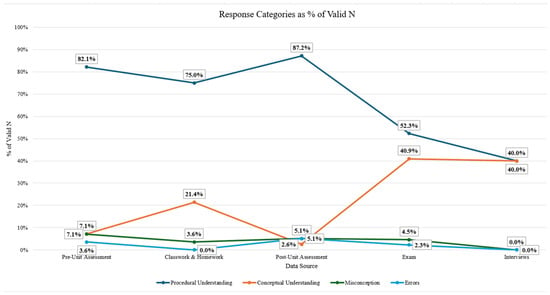
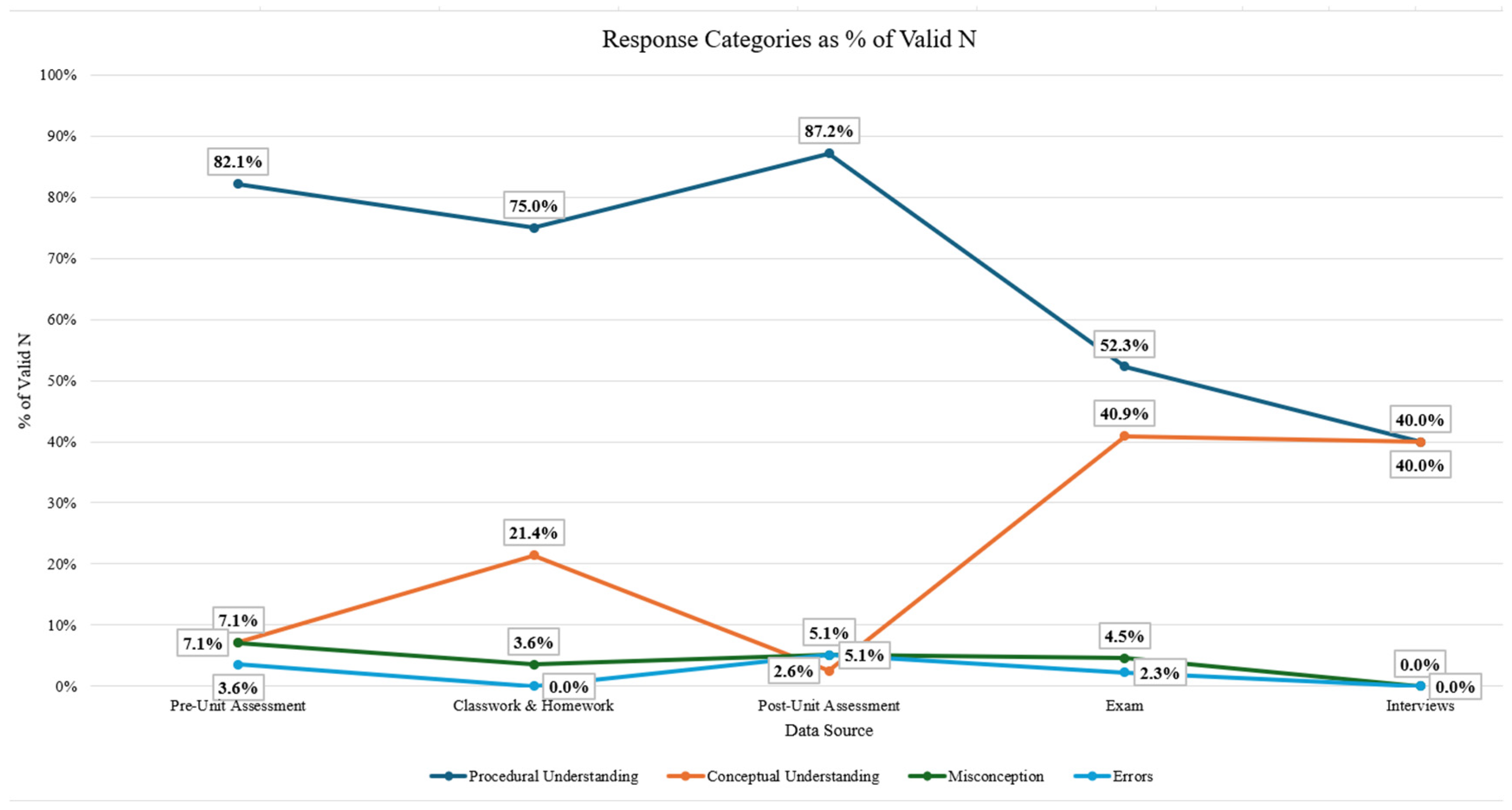
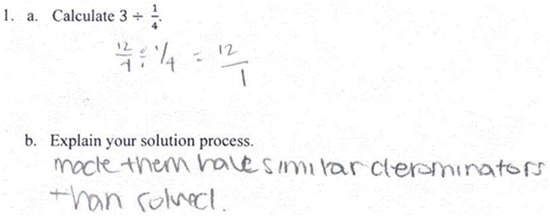
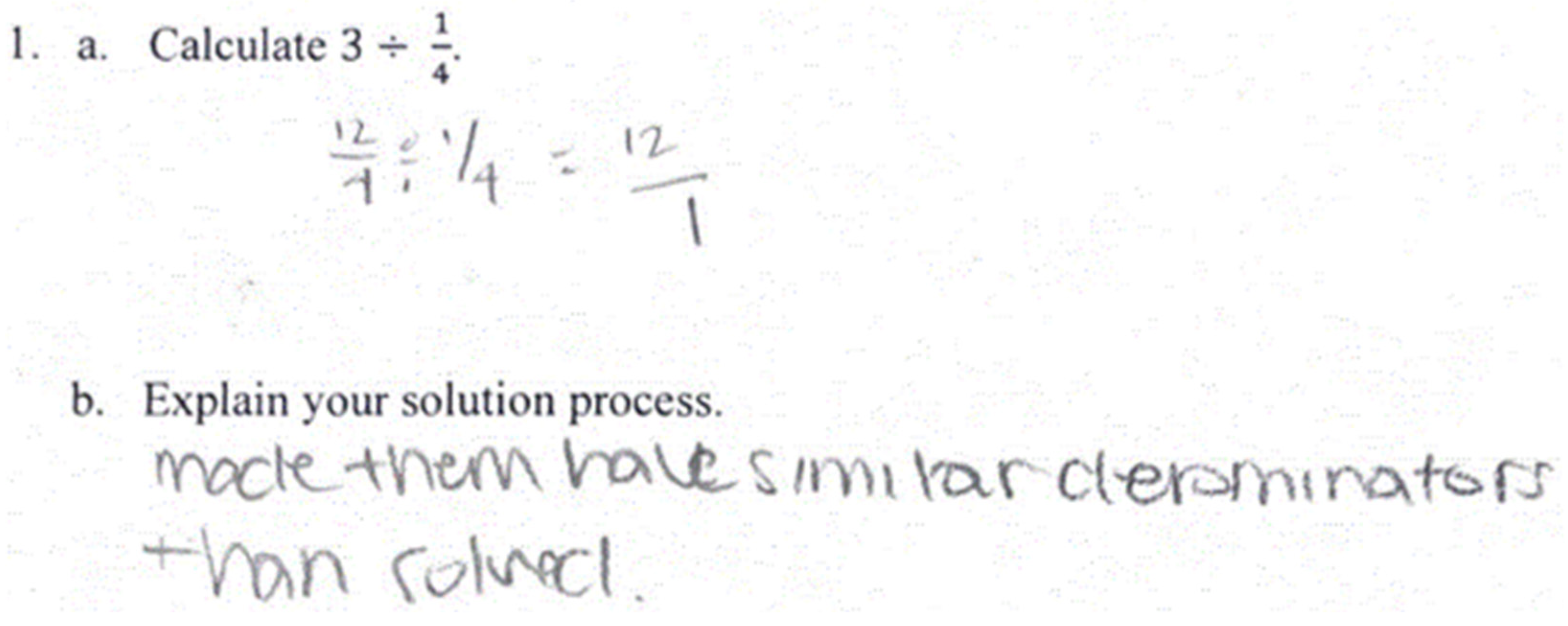
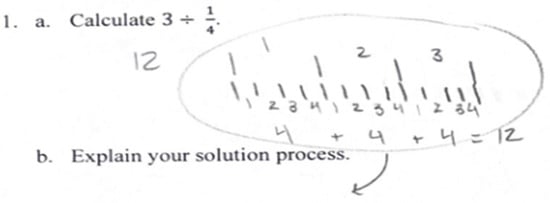
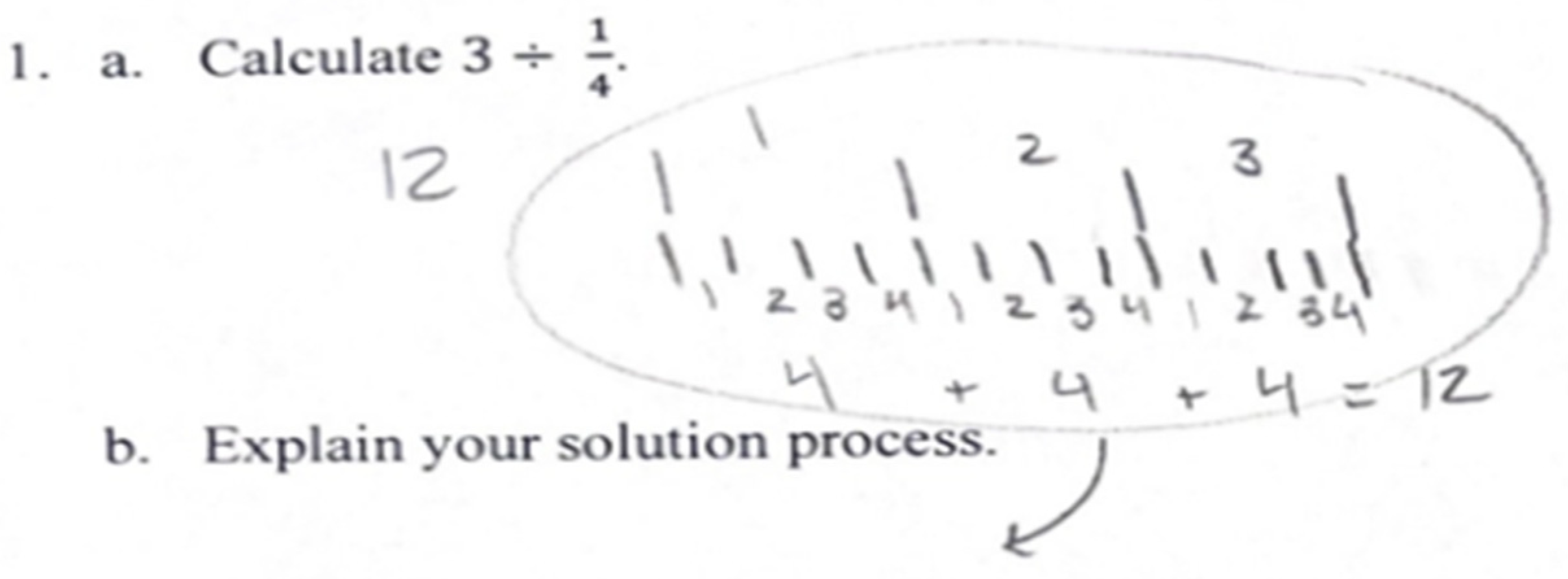
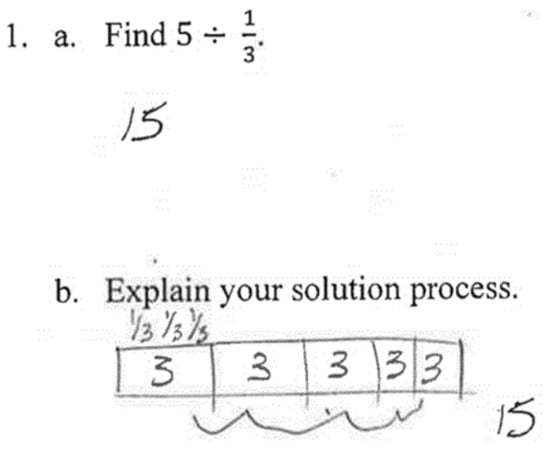
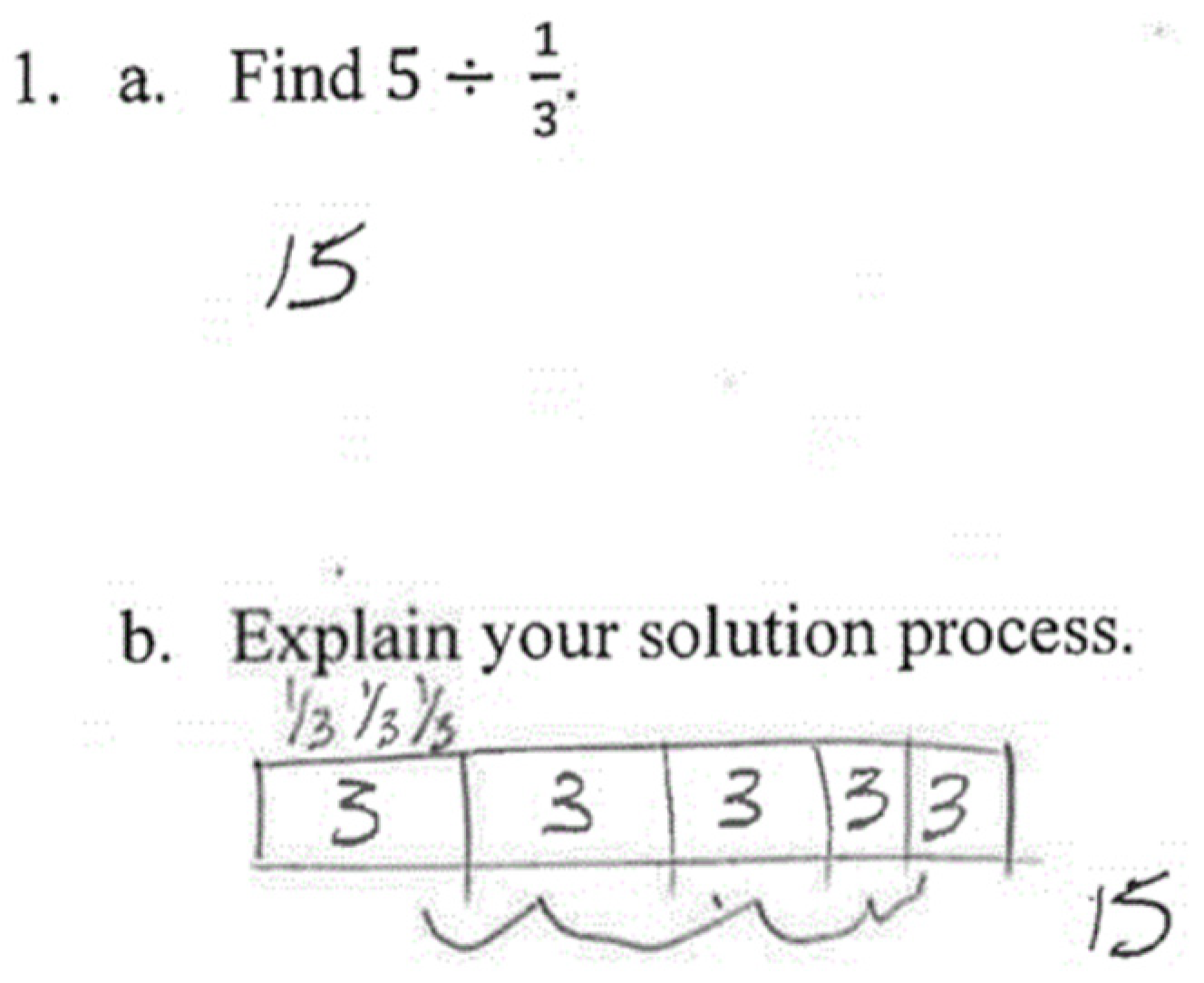
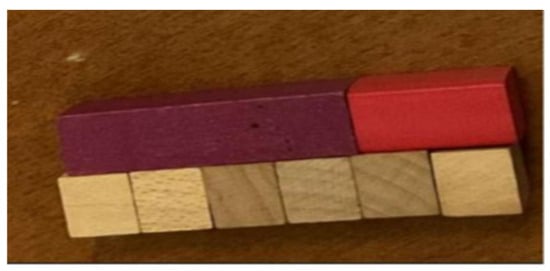
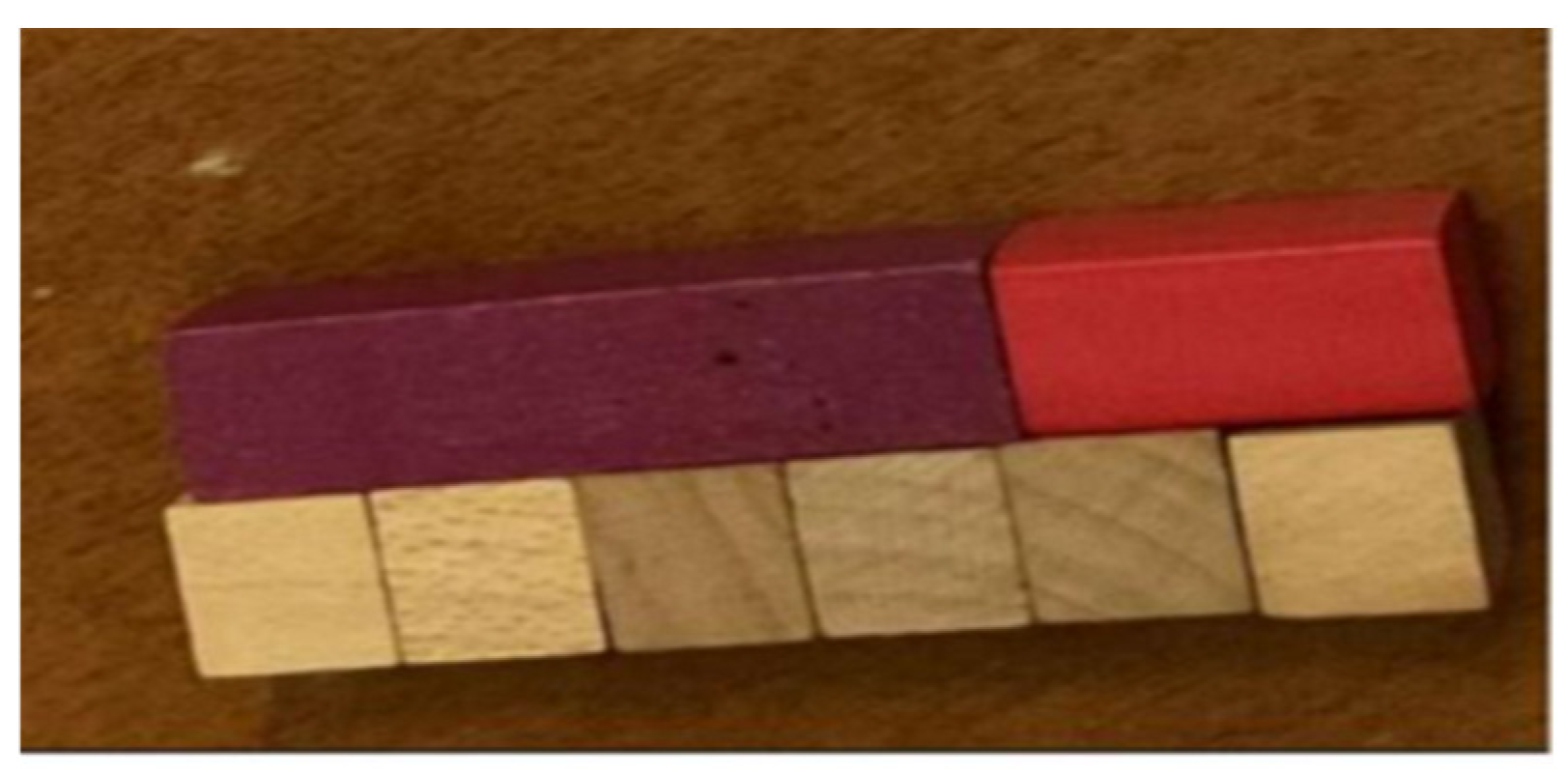


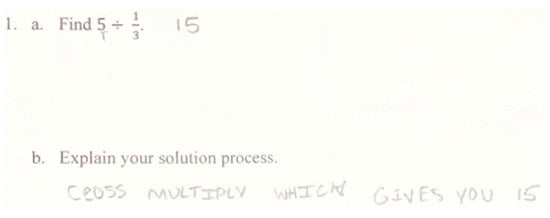
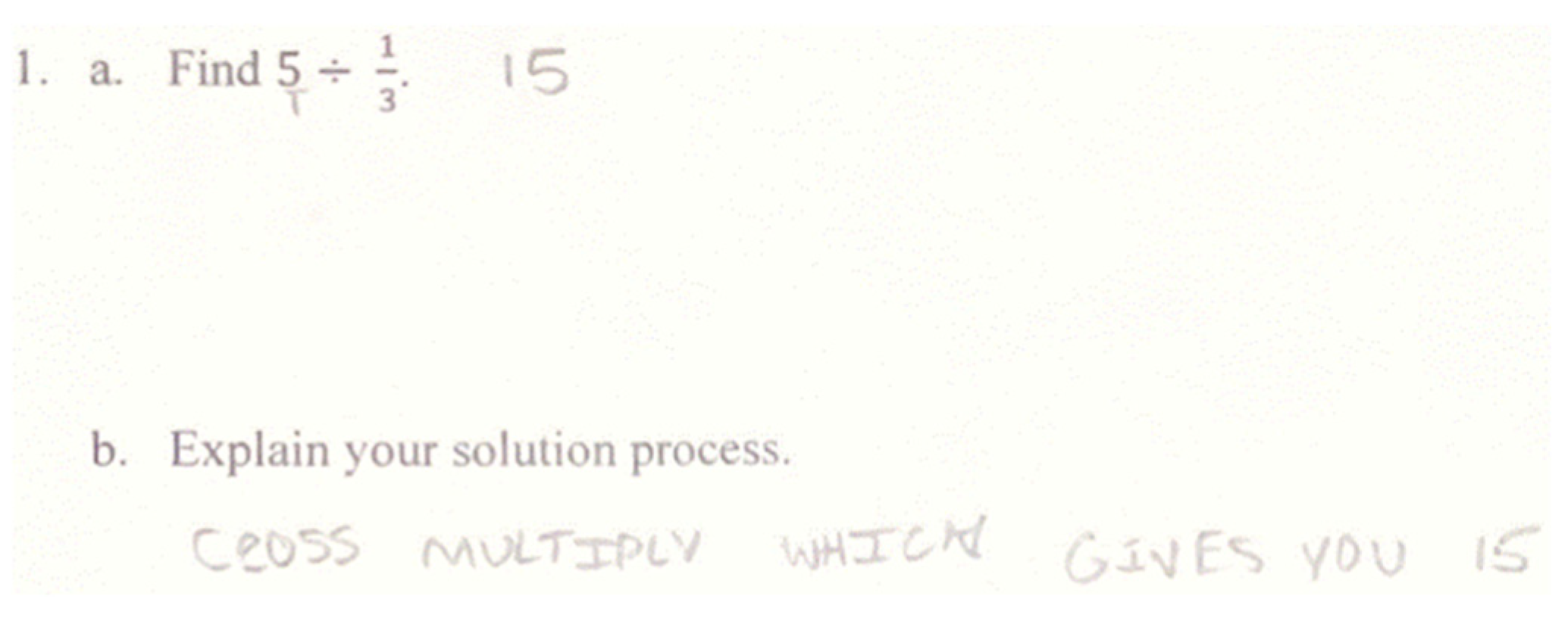

Disclaimer/Publisher’s Note: The statements, opinions and data contained in all publications are solely those of the individual author(s) and contributor(s) and not of MDPI and/or the editor(s). MDPI and/or the editor(s) disclaim responsibility for any injury to people or property resulting from any ideas, methods, instructions or products referred to in the content. |
© 2026 by the authors. Licensee MDPI, Basel, Switzerland. This article is an open access article distributed under the terms and conditions of the Creative Commons Attribution (CC BY) license.