


Abstract
To explore the optimization effects of fixed aquatic water treatment materials combined with immunomodulatory agents on the ecosystem and farming efficiency of Litopenaeus vannamei in high-water-level ponds, this study established experimental ponds (with fixed aquatic water treatment materials and feed supplemented with chitosan oligosaccharides) and control ponds (no fixed water treatment materials applied, fed with basal feed only). Through a comparative trial over a complete farming cycle, the study systematically analyzed changes in plankton community structure and diversity, water physicochemical factors, shrimp growth performance, immune indicators, and muscle nutritional composition. The results showed that in the experimental group, diatoms (Ditylum brightwellii and Skeletonema) dominated the plankton community, while the density of harmful blue-green algae (Oscillatoria and Trichodesmium) significantly decreased, and planktonic animal diversity improved in the later stages. Among the water physicochemical indicators, the experimental group exhibited a 50% reduction in nitrite levels by the later stages, significantly higher than the 33.33% reduction in the control group. Total ammonia nitrogen levels remained lower than those in the control group, with a smaller increase in the later stages. Total phosphorus levels were significantly lower in the experimental group after 80 days, and the later-stage decline in chemical oxygen demand was 11.65% higher than that in the control group. Shrimp body weight increased significantly by 13.23%, while hepatosomatic index, musculosomatic index, and immune enzyme (acid phosphatase and total antioxidant substances) activity also improved markedly. The content of unsaturated fatty acids (linoleic acid and oleic acid) in the muscles significantly increased. The study demonstrated that the combined application of fixed aquatic water treatment materials and chitosan oligosaccharide preparations can optimize the farming water environment, enhance shrimp growth performance and quality, and provide technical support for the ecological cultivation of Litopenaeus vannamei.
1. Introduction
The intensive farming approach of Litopenaeus vannamei (L. vannamei), one of the highest-yielding economic shrimp species in the world, not only boosts output but also encounters problems such as declining water quality, ecological imbalance, and frequent disease outbreaks [1]. Eutrophication is caused by the buildup of nutrients like nitrogen and phosphorus in aquaculture water bodies. When harmful algae, like blue-green algae, proliferate, they can set off a chain reaction of rapid oxygen depletion and toxin release, which directly affects the shrimp’s quality and survival rate [2]. Shrimp immunity decreases under high-density farming circumstances, making them vulnerable to diseases, limiting the industry’s long-term development [3]. Furthermore, in recent years, physical–biological synergistic regulation technology has become a research hotspot for improving aquaculture ecology both domestically and internationally. Through adsorption, ion exchange, and carrier functions, immobilized water treatment materials can effectively remove nitrogen, phosphorus, and other pollutants from water while also offering attachment sites for beneficial microorganisms [4,5]; as a natural immune enhancer, chitosan oligosaccharides can activate the shrimp immune system, improve intestinal microbial balance, and improve their growth performance and disease resistance [6,7]. Sarker et al. [3] found that a solid-phase composite biological filter medium can effectively reduce concentrations of ammonia nitrogen, phosphorus, and organic matter in aquaculture water. It also stabilizes the physical and chemical environment and enhances shrimp growth. Nabaterega et al. [8] indicated that a biological filtration and ecological filter media system can improve the micro-ecological structure of water, inhibit the growth of harmful organisms, and enhance the water’s self-purification capacity. The mechanisms by which they interact with one another in terms of water quality, plankton, and shrimp still need to be carefully investigated, and systematic research on the overall regulatory effects of their combined application in the South American white shrimp farming system has not yet been established. The structure of the plankton community in the aquaculture water, the shrimp’s growth performance, and the nutritional indicators of the shrimp are the three dimensions in which this study reveals the synergistic regulatory effects of immobilized materials and chitosan oligosaccharides through comparative experiments between test ponds and control ponds.
2. Materials and Methods
2.1. Objects of the Experiment
The Pacific white shrimp larvae utilized in the experiment were first-generation specific pathogen-free (SPF) larvae sourced from a local, reputable hatchery. Their initial body length ranged from 0.8 to 1.0 cm. After reaching an average body length of 5 cm and an average weight of 1.7 g, they were stocked in separate ponds. All experimental shrimp larvae originated from the same batch, demonstrating uniform size, absence of disease and limb defects, and exhibiting exceptional health and vitality.
2.2. Experimental Design
The experiment was conducted in a high-level pond designated for L. vannamei shrimp farming and lasted for 110 days. Six identical ponds, each covering an area of 2 ha and with a water depth ranging from 1.5 to 1.7 m, were selected. These ponds featured flat bottoms, uniform aeration equipment, and consistent water inlet and outlet systems. The six ponds were randomly divided into two treatment groups, with three replicate ponds in each group (n = 3). The experimental group received immobilized water treatment material at a rate of 40 kg/hm2 and was supplemented with 0.05‰ chitosan oligosaccharide in their feed. In contrast, the control group was not given any immobilized water treatment material and was fed a basal diet devoid of immune additives. The stocking density of each group was 225,000 nos/ha. Prior to stocking, the physicochemical baseline indicators of the shrimp pond water were collected and measured simultaneously. The initial levels of ammonia nitrogen (0.01 ± 0.003 mg/L), nitrite (0.006 ± 0.001 mg/L), total phosphorus (0.08 ± 0.01 mg/L), and COD (4.2 ± 0.4 mg/L) were found to be statistically similar between the two groups of ponds (p > 0.05).
2.3. Management of Aquaculture
In the experiment, a uniform batch of L. vannamei postlarvae was introduced into six ponds. After the nursery phase, the seedstock was distributed into separate rearing ponds, maintaining a stocking density of 225,000 nos/ha. The shrimp were stocked in separate ponds after reaching a body length of 5 cm. The water temperature was 24–32 °C, the salinity was 18–22‰, the pH was 7.8–8.6, and oxygenation was carried out continuously for 24 h a day. The control group was not administered any water quality treatment materials, and the feed provided was a standard formulation containing a crude protein content of 38%. The aquaculture management measures for both groups were entirely the same. The experimental immobilised water-quality treatment medium consists of a super-energy carbon-source filler that includes three water-quality components. The outer layer consisted of a three-dimensional spherical shell, which offered a uniform, stable, and relatively independent environment for the core components of the filler. The middle layer consisted of a composite polymer material that served as a microbial carrier for the MBBR filler, providing a fixed structure. The chitosaccharide additive utilized in the experiment was a fully water-soluble functional material derived from biomass refining technology. It comprises 24.5% chitosaccharides, exhibits a degree of polymerization ranging from 2 to 8, and has a degree of deacetylation exceeding 95%. It is satisfactory. The control group received no water quality treatments, and the diet consisted of a basic formulation with a crude protein content of 38%. The management measures for aquaculture in both groups were aligned, involving feeding at four specific times throughout the day: 6:00, 10:00, 16:00, and 18:00. The feeding amount was calibrated to range from 3% to 5% of the shrimp’s body weight. At the outset, only water was introduced.
2.4. Sample Collection and Measurement
2.4.1. Water Sample Collection and Measurement
During the trial period, water samples were collected every 15 days before water replacement in the afternoon. A total of five time points were established, corresponding to 50 days, 65 days, 80 days, 95 days, and 110 days of cultivation. The sampling intervals were standardized to 15 days. Water samples were collected using a diagonal sampling method, with two sampling points selected from each pond. Using an organic glass water sampler, 500 mL of water from the upper and lower layers of each sample point was collected. The two water samples from the same pond were mixed evenly to represent the water quality of that pond. The samples were stored in a refrigerated room at 3–4 °C away from direct sunlight, and measurements were completed as soon as possible. Five physicochemical indicators of the water were identified: the N-(1-naphthyl) ethylenediamine spectrophotometric method for determining nitrite, Nessler’s reagent spectrophotometric method for measuring ammonia nitrogen, and the molybdenum-antimony anti-spectrophotometric method for assessing inorganic phosphorus and reactive phosphate.
2.4.2. Collection and Analysis of Phytoplankton Samples
Phytoplankton samples were collected concurrently at the five water sampling intervals. To collect quantitative samples, 30–40 litres of water were sieved using a 25 μm plankton net with a mesh size of 0.064 mm (200 mesh). Utilized a 5% formaldehyde solution for fixation, maintaining a sample-to-fixative ratio of 100:1. Consolidate the sample to a final volume ranging from 100 to 1000 mL following a 24-h sedimentation interval. Thereafter, measure the density of phytoplankton and zooplankton cells (cells/L). Furthermore, use the Shannon–Wiener index to calculate the plankton diversity index. To examine the composition of the dominating species, a qualitative sample was collected using the tow-net method. The Shannon–Wiener diversity index was chosen to assess community diversity, using the following formula:
where S is the number of species (at the genus level) and P i = Ni/N (Ni is the density of the i-th species and N is the total density). Qualitative data are merely used in order to gain better knowledge of species richness, while quantitative data serve as the foundation of the calculations.
H′ = -∑i = 1SP i lnP i,
2.4.3. Collection and Analysis of Shrimp Samples
At the end of the farming period, which lasted 110 days, a random selection of 30 shrimp was made from each pond to assess growth indicators. The body length was measured using a vernier calliper with an accuracy of 0.01 cm, and the body weight was determined with an electronic balance that has an accuracy of 0.01 g. Additionally, recorded the weights of the hepatopancreas and muscle. Subsequently, calculated the hepatosomatic index using the formula
and the condition factor with the formula
hepatosomatic index = hepatopancreas weight/body weight × 100%
condition factor = body weight/body length3 × 100%
The Nanjing Jiancheng Biotechnology Institute provided a specialised detection kit to examine 30 g of homogenised hepatopancreas tissue. Hepatopancreas tissue used for the assessment of immune enzyme activity, and after preparing tissue homogenate, the indicators were tested using a commercially available kit, strictly following the kit instructions: acid phosphatase (ACP) and alkaline phosphatase (AKP) were measured by colorimetric method; glutathione peroxidase (GPX) and Total antioxidant capacity (T-AOC) were measured by ultraviolet spectrophotometry; and malondialdehyde (MDA) was measured by the thiobarbituric acid method. A sample of 100 g of muscle tissue was utilised to analyse routine nutritional components, including moisture, ash, and crude protein, as well as the composition of amino acids and fatty acids. Amino acids are quantified via high-performance liquid chromatography (HPLC), while fatty acids are analysed using gas chromatography–mass spectrometry (GC-MS).
2.5. Data Analysis
Statistical data analysis was conducted utilizing SPSS 20.0 software. Multiple comparisons were performed using Bonferroni correction and were uniformly expressed as “mean ± standard deviation (Mean ± SD, n = 3)”. All tables indicated the number of replicates (n = 3). p < 0.05 indicated a significant difference between groups, and p > 0.05 indicated no significant difference.
3. Results
3.1. The Impact of Composite Regulation Technology on the Physicochemical Properties of Aquaculture Water
3.1.1. Variation in Nitrite Levels
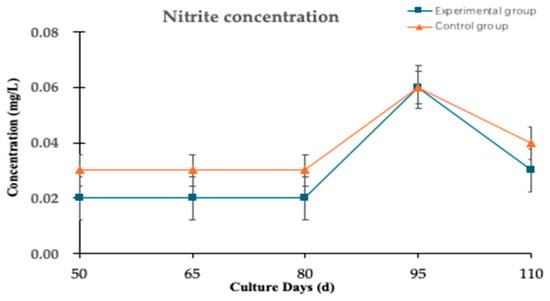
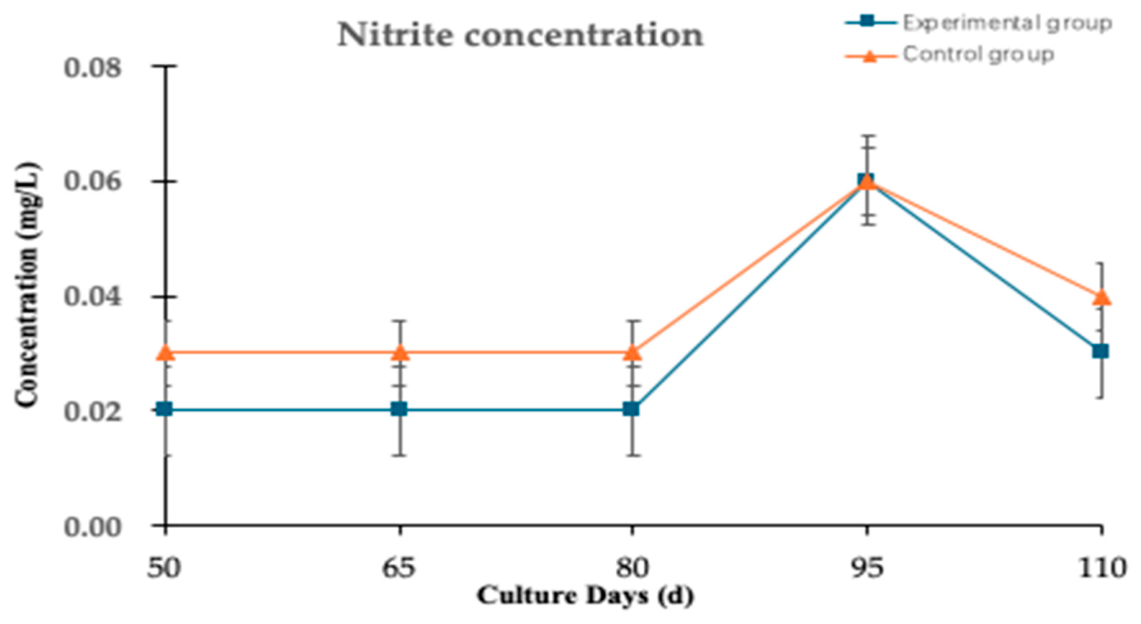
Figure 1 shows variability in nitrite concentration for both the control and experimental groups. In the first phase, both groups exhibited small changes (control: 0.03 mg/L, experimental: 0.02 mg/L).
Figure 1.
Variations in Nitrite concentration in the water of experimental and control ponds.
3.1.2. Variations in Ammonia Nitrogen
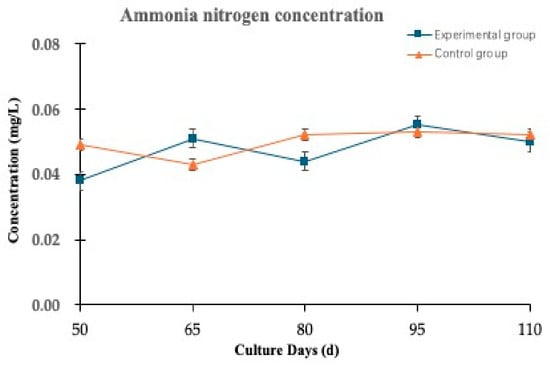
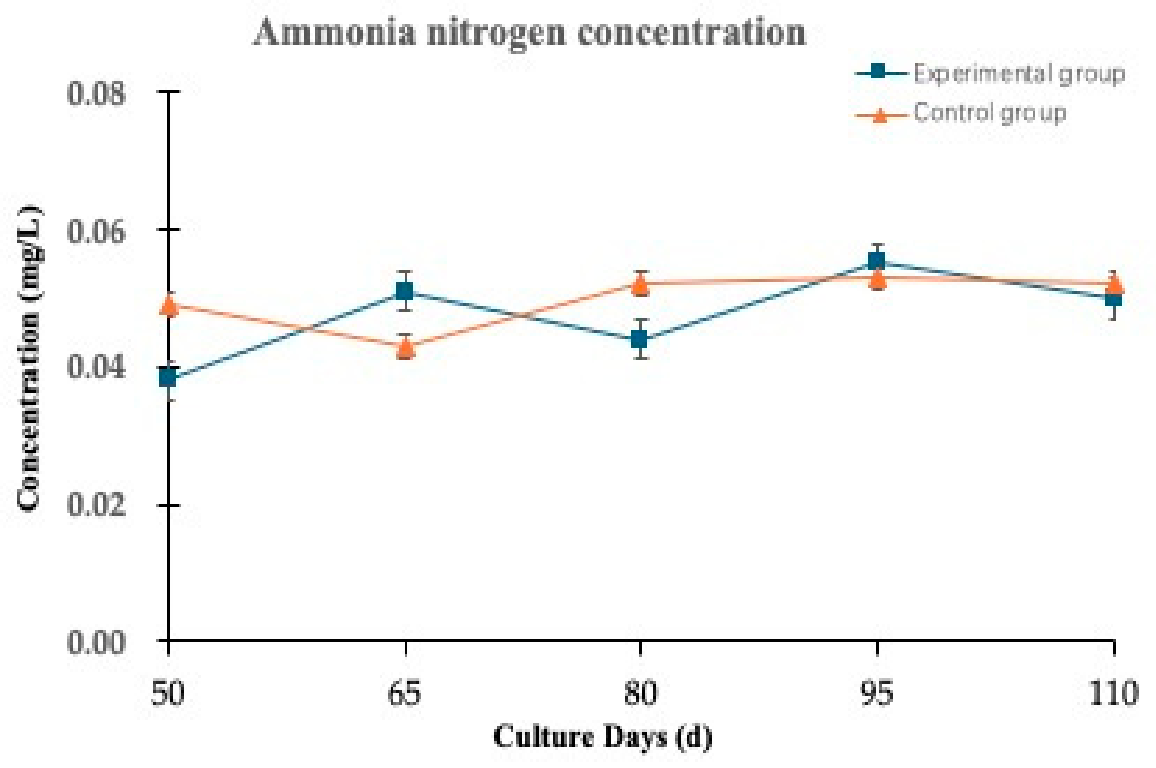
The variations in ammonia nitrogen concentration observed in both the control group and the experimental group are illustrated in Figure 2, demonstrating a wave-like fluctuation over the entire duration of the study. The ammonia nitrogen concentration in the experimental group increased on culture day 65, whereas the control group decreased. On culture day 80, the experimental group showed a decrease in concentration, and the control group’s concentration increased. On culture day 95, the concentrations in both the experimental and control groups were nearly equal; however, the experimental group showed a slightly higher concentration. On culture day 110, the control group showed a slightly higher concentration than the experimental group.
Figure 2.
Changes in ammonia nitrogen concentration in the water during the culture.
3.1.3. Variations in Inorganic Phosphorus and Total Phosphorus Concentrations
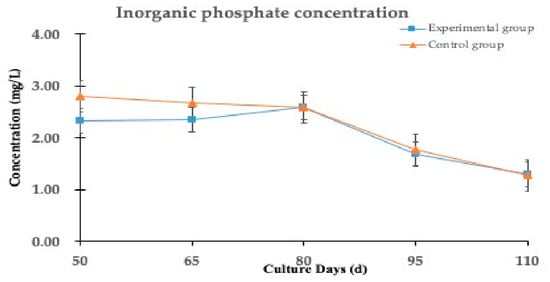
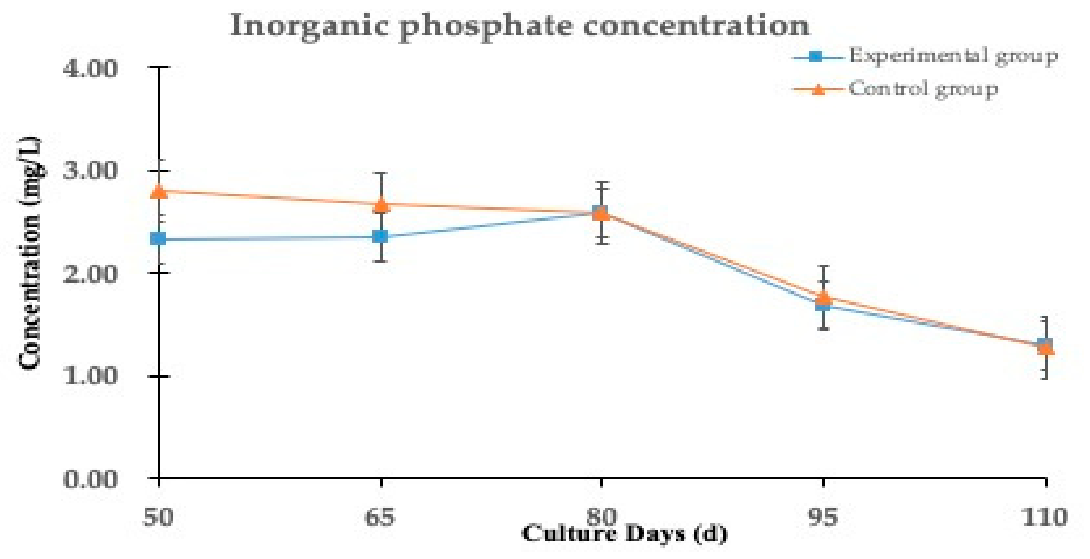
The variations in inorganic phosphate concentrations within both the control and experimental groups are illustrated in Figure 3. The experimental group exhibited an initial increase followed by a decline, peaking at 2.58 mg/L at the 80-day mark. In contrast, the control group showed a continuous decrease, initially achieving a maximum.
Figure 3.
Variations in inorganic phosphorus concentration in the water of the experimental pond and control pond.
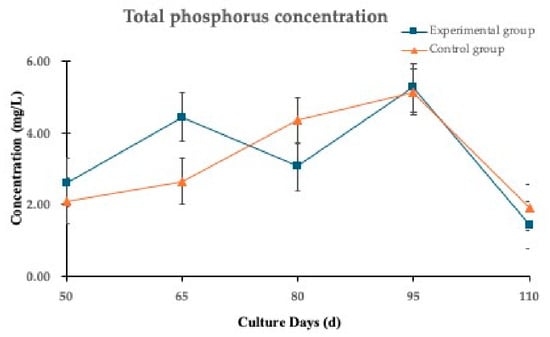
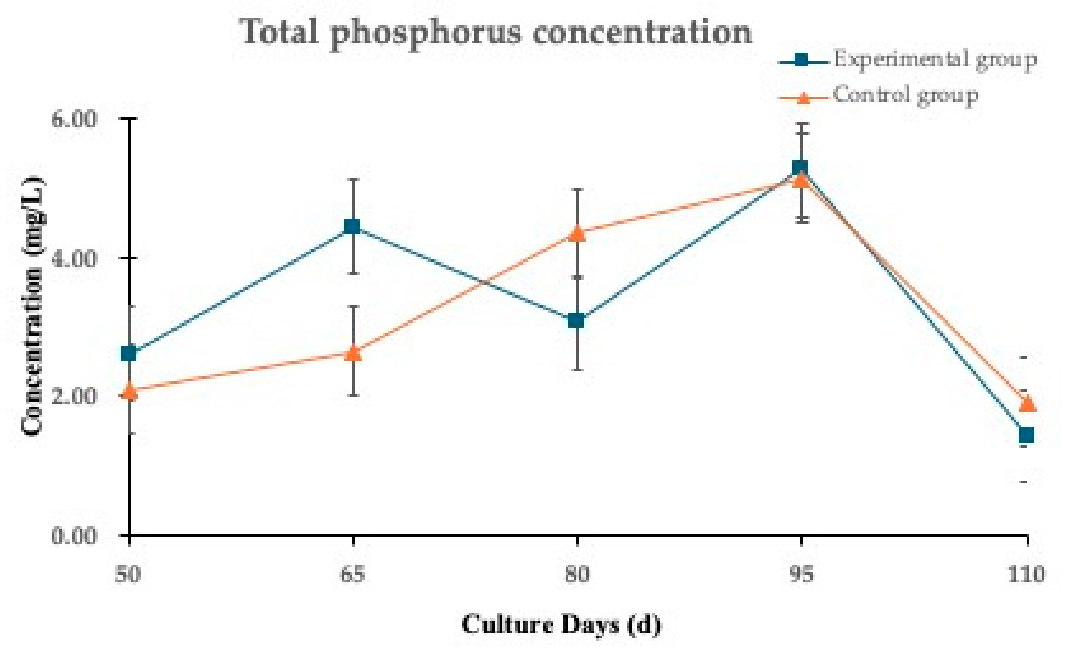
The variations in total phosphorus concentration within both the control and experimental groups are illustrated in Figure 4. On day 50, the experimental group recorded a concentration of 2.61 mg/L, surpassing the control group, which measured 2.10 mg/L. This trend culminated in a peak concentration of 4.44 mg/L on day 65.
Figure 4.
Changes in total phosphorus concentration in the water of the experimental pond and control ponds.
3.1.4. Variations in Chemical Oxygen Demand (COD) Concentration
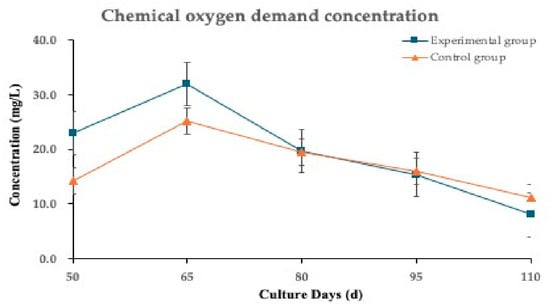
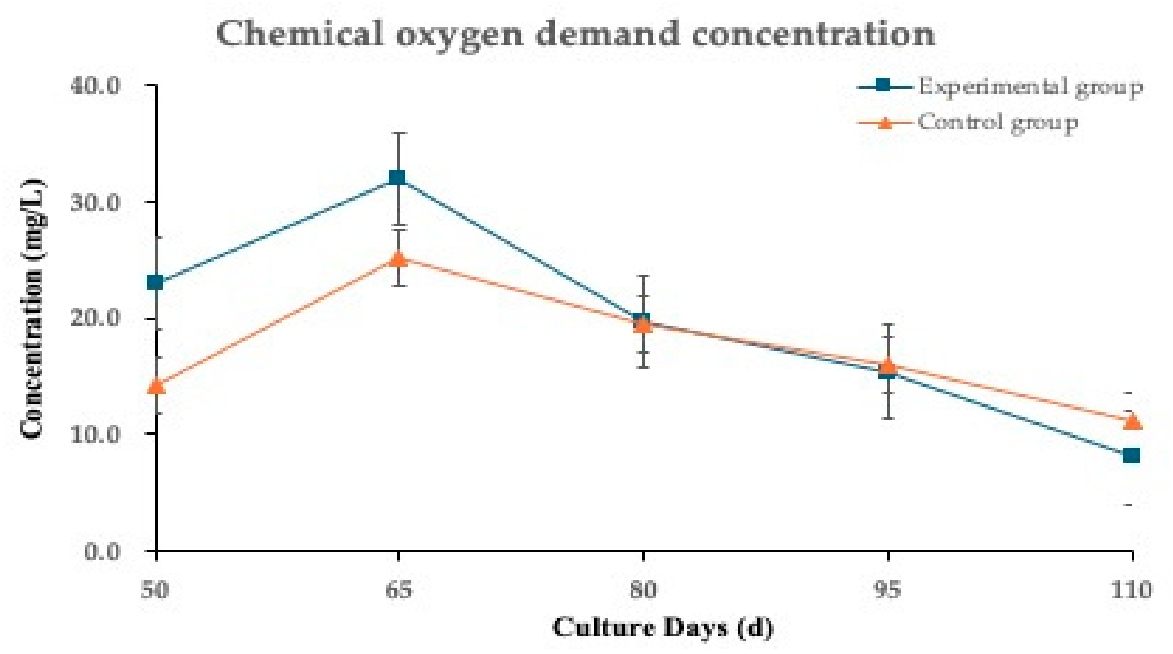
The variations in COD concentration for both the control group and the experimental group are illustrated in Figure 5. From day 50 to day 80, the experimental group exhibited a significantly higher concentration (maximum 32 mg/L) compared to the control group (maximum 25.1 mg/L), with p < 0.05.
Figure 5.
Variations in Chemical Oxygen Demand Concentration in the Experimental and Control Ponds.
3.2. Composite Regulation Technology Impact on Phytoplankton Community Composition
3.2.1. Phytoplankton
After a cultivation period of 50 days, the predominant species observed in both experimental groups were primarily harmful cyanobacteria, particularly Microcystis aeruginosa, with cell densities recorded at 186,700 cells/L in the experimental group and 133,300 cells/L in the control group. These densities were found to be 23 times and 256 times greater than those of diatoms (Cyclotella and Chaetoceros), respectively. On days 65 (P1) and 80, the primary species in the experimental group transitioned to diatoms, notably Cyclotella (26,700 cells/L) and Chaetoceros (600,000 cells/m3), whereas the control group continued to exhibit a minor presence of Microcystis aeruginosa. On day 95, both groups exhibited the presence of Aphanizomenon (cyanobacteria), with the density in the control group (416,700 cells/L) being twice that observed in the experimental group. On day 110, the experimental group exhibited a predominance of diatoms (Chaetoceros and Cyclotella), with no presence of Aphanizomenon observed. In contrast, the control group maintained a density of 133,300 cells/L of Aphanizomenon (Table 1 and Table 2). The diversity index of phytoplankton in the experimental group exhibited a consistent upward trend, whereas the control group displayed variations and maintained a generally low level. The control group showed fluctuations and was generally low. Except for 50 days and 80 days, the planktonic biodiversity index of the experimental group was significantly higher than that of the control group at other time points (p < 0.05). The prevalence of diatoms within the experimental group can increase dissolved oxygen levels in the aquatic environment through the process of photosynthesis, while also mitigating the risk of eutrophication by absorption of nitrogen and phosphorus. Furthermore, the decrease in cyanobacteria, particularly from the genus Microcystis, can lead to a reduction in the consumption of dissolved oxygen.
Table 1.
Quantitative Determination Results of Phytoplankton Cell Count.
Table 2.
Qualitative Determination Results of Phytoplankton Cell Count.
3.2.2. Zooplankton
Copepods (the genus Acartia, Pseudodiaptomus, and Paracalanus) dominated both zooplankton populations. On day 50, the experimental group had a higher density (367 individuals/m3) compared to the control group (267 individuals/m3). Between days 65 and 95, the control group’s density was 3.03 times (303 individuals/m3 vs. 100 individuals/m3), 1.98 times (593 individuals/m3 vs. 300 individuals/m3), and 2.88 times (720 individuals/m3 vs. 250 individuals/m3) higher than the experimental group. On day 110, both groups’ densities peaked, with the experimental group having a slightly greater density (800 individuals/m3) than the control group (725 individuals/m3), as well as an increase in species (two new copepod species) (Table 3 and Table 4). In the initial phase of the culture, the zooplankton diversity index did not differ significantly between the two groups (p > 0.05). During the later phase of culture (80 d–110 d), the experimental group had a significantly higher zooplankton diversity index (2.8–3.2) compared to the control group (1.9–2.3) (p < 0.05). This indicates that the adopted combined regulatory technique improves the living conditions for zooplankton, promotes community diversity, and provides shrimp with a more abundant source of natural food.
Table 3.
Quantitative Determination Results of Zooplankton Population Density.
Table 4.
Qualitative Assessment Results of Zooplankton (Late Culture Period).
3.3. Impact on the Development and Immune Functionality of L. vannamei
3.3.1. Growth Indicators
The experimental group exhibited a body weight increase of 13.23% (p < 0.05) compared to the control group (Table 5). Additionally, both the liver-to-body ratio and muscle-to-body ratio were significantly higher in the experimental group, with increases of 4.19% and 14.59%, respectively, compared to the control group.
Table 5.
Growth Performance Indicators of Litopenaeus vannamei.
3.3.2. Immune and Digestive Physiological Indicators
The activity of acid phosphatase, total antioxidants, and malondialdehyde in the hepatopancreas of shrimp in the experimental group was significantly higher compared to the control group (p < 0.05). Conversely, the activities of alkaline phosphatase and glutathione peroxidase did not differ significantly from those in the control group (p > 0.05). Additionally, the concentration of malondialdehyde was significantly higher in the experimental group than in the control group (p < 0.05) (Table 6).
Table 6.
Immune Enzyme Activity in the Hepatopancreas of L. vannamei.
3.4. Impact on the Nutritional Composition of Muscle in L. vannamei
The nutritional composition of muscle in L. vannamei showed no significant changes in moisture (75.53–76.20%), ash (0.27–0.28%), and crude protein content (20.70–21.90%) between the two groups of shrimp (Table 7). As shown in Table 8, a total of 17 amino acids were detected in the muscle tissue of L. vannamei from both groups. Glutamic acid (Glu) was the most abundant, followed by glycine (Gly), arginine (Arg), and aspartic acid (Asp), while the levels of cystine (Cys), methionine (Met), and histidine (His) were relatively low. Although the total amino acid (TAA), essential amino acid (EAA), and umami-related amino acid (DAA) contents in the experimental group were higher than those in the control group, the differences were not statistically significant (p > 0.05).
Table 7.
Typical Nutritional Components of L. vannamei Muscle.
Table 8.
Amino Acid Composition and Content of Muscle in L. vannamei. Unit: g/100 g.
Table 9 indicates that a total of 23 fatty acids were identified in the muscle samples from both groups of L. vannamei. The experimental group exhibited a minimal concentration of capric acid, whereas the control group showed no detectable levels of it. Palmitic acid and stearic acid constituted the primary saturated fatty acids, whereas oleic acid, linoleic acid, and tetracosic acid represented the principal monounsaturated fatty acids. The experimental group exhibited higher concentrations of palmitic acid at 7.09% and stearic acid at 6.4%, in contrast to the control group, which recorded levels of 6.15% and 5.5%, respectively. The concentrations of EPA and DHA were higher in comparison to the control group; however, the observed differences did not reach statistical significance (p > 0.05). Nevertheless, the contents of linoleic acid (6.22%) and oleic acid (4.43%) were significantly higher than those of the control group (5.42% and 3.78%, respectively). The concentrations of eicosapentaenoic acid (EPA), eicosadienoic acid (EDA), dicosic acid, and tetracosic acid were substantially higher in comparison to the control group (p < 0.05).
Table 9.
Fatty Acid Composition and Content of Muscle in L. vannamei.
4. Discussion
4.1. Regulation Mechanism of Composite Regulation Technology on Physicochemical Factors in Aquaculture Water
The stability of physicochemical factors is crucial for the healthy growth of shrimp. In this study, composite regulation technology effectively regulated nitrite, ammonia nitrogen, total phosphorus, and COD in the water. The experimental group showed better reduction in nitrite and control of ammonia nitrogen in the later stages than the control group. It has been further confirmed that the composite biological filter medium can effectively reduce phosphorus loads and organic pollution in water, demonstrating excellent in situ purification performance for aquaculture water [3]. This is related to the nitrogen conversion effect of immobilized microorganisms and the synergistic effect of chitosan oligosaccharide in reducing nitrogen excretion, consistent with the research of Zhang et al. [9]. After 80 days, the total phosphorus concentration in the experimental group was significantly lower than that in the control group, and the COD reduction was even greater in the later stages, effectively controlling phosphorus and improving the self-purification capacity of the water body, consistent with the results of Chen et al. [10]. The regulatory effect is affected by factors such as the amount of material fed and the stocking density. The optimal parameters and specific mechanisms need further research. Moreover, the synergistic effect of chitosan oligosaccharide and immobilized materials can optimize the aquaculture environment, consistent with the research of Li et al. [11]. This study has certain limitations. The experiment only set the dosage of a single packing material and the addition ratio of a single chitosan oligosaccharide. It only confirmed the superiority of the combined application over a single control method from the perspective of macroscopic water quality indicators. However, the optimal parameters and molecular-level microbial interaction mechanisms under different stocking densities, packing material gradients, and chitosan oligosaccharide addition amounts have not yet been elucidated. Further gradient experiments are needed to supplement the intrinsic synergistic molecular evidence.
4.2. Phytoplankton Community Structure Optimization Response to Composite Regulation Technology
This work used a combined regulation technique to shift the dominance of harmful cyanobacteria such as Trichoderma tectorum in the phytoplankton culture water of L. vannamei to beneficial diatoms like Lycopus lucidus and Lycopus. This aligns with findings from similar international studies on ecological regulation: in situ control measures—such as the application of modified clay or biological filter media—can suppress the photosynthetic proliferation of cyanobacteria and selectively cultivate diatoms by altering the nitrogen-to-silicon ratio and increasing dissolved oxygen levels [12,13]. Chen et al. [14], demonstrated the widespread applicability of this ecological regulation technique. This method successfully suppresses harmful cyanobacteria. Cultivating diatoms enhances phytoplankton diversity. Diatoms also improve dissolved oxygen levels, absorb nitrogen and phosphorus, and optimise the aquatic environment, whereas the control group showed lower community diversity due to cyanobacterial dominance. Although there were no initial disparities in zooplankton diversity among the groups, the experimental group subsequently demonstrated markedly elevated survival rates, reproductive success, and species richness, owing to the superior environment and nutrient supply from the diatoms; these findings align with plankton monitoring data from intensive prawn aquaculture in Vietnam [15] and with the findings of Wang et al. [16]. This technology creates a virtuous cycle in the plankton community and boosts the self-regulatory capacity of the aquatic ecosystem by starting a positive chain reaction: “suppressing cyanobacteria and cultivating diatoms, thereby improving the environment and enhancing zooplankton diversity.” This logic for community regulation works for shrimp ponds in both temperate and tropical zones with different salinity levels [17].
4.3. The Effect of Compound Regulation Technology on the Growth Performance and Immune Function of L. vannamei
In terms of growth performance, the composite regulation technique significantly increased L. vannamei’s body weight (by 13.23%) and muscle ratio (by 14.59%). This is consistent with the findings of Vega-Carranza et al. [18], who reported that including immune-enhancing ecological preparations increased shrimp weight gain by 11.8%. This finding highlights a considerable positive association between improved farming conditions and shrimp growth performance. The growth-promoting effect of the composite regulation was tested using immunological indicator analysis. Immunological index analysis showed that the activity of acid phosphatase in the hepatopancreas of shrimp in the experimental group and the total antioxidant capacity were significantly increased, indicating that this technology can effectively activate the non-specific immune system of shrimp and enhance the body’s antioxidant capacity. These findings indicate that this technique can successfully boost the shrimp’s non-specific immune system and increase the organism’s antioxidant capacity. This is consistent with the findings given by Zhao et al. [19] on the improvement of immune enzyme activity in shrimp using probiotic chemical formulations. MDA is a product of lipid peroxidation. In the later stages of aquaculture, as the amount of feed increases and the biomass of shrimp increases, the overall metabolic load increases, which can easily induce mild lipid peroxidation. In this study, we found that the MDA level in the experimental group was significantly increased, but the T-AOC level in the experimental group was also significantly increased at the same time. The body’s antioxidant system can effectively counteract oxidative damage. Moreover, no negative stress phenotypes, such as disease or low survival rate, were observed in the aquaculture. In the later stages, the feeding strategy needs to be optimized to further reduce the oxidative stress [20].
4.4. Analysis of the Effects of Combined Regulation Technology on the Nutritional Composition of L. vannamei Muscle
Analysis of muscle nutritional composition revealed a significant increase in unsaturated fatty acid content (e.g., linoleic acid, oleic acid) in the experimental group, aligning with findings in international aquatic nutrition research: ecological regulation of the water environment can alter the activity of key enzymes involved in lipid metabolism in shrimp, thereby modulating the accumulation of unsaturated fatty acids in muscle tissue [21,22]. Meanwhile, no significant differences were observed in proximate nutritional components such as moisture, ash, and crude protein—a pattern consistently validated across various ecological regulation systems, including those utilizing microalgal filter media and bioflocs [8,23]. This indicates that the combined regulation technology can optimize the content of specific nutritional components (unsaturated fatty acids) and enhance the product’s nutritional value without compromising the shrimp’s basic nutritional quality. Liu Yan et al. [24] discovered that the regulation of light environments can notably enhance the levels of polyunsaturated fatty acids in the muscles of L. vannamei. The influence of the integrated regulatory technology on unsaturated fatty acids observed in this study may also engage a comparable mechanism of lipid metabolism regulation. The observation that conventional nutrients, including moisture, ash, and crude protein, did not exhibit significant differences aligns with the majority of findings related to environmental regulation technologies [24]. Additionally, while the total amino acid, essential amino acid, and umami-related amino acid contents in the experimental group were higher than those in the control group, the differences were not statistically significant; this trend mirrors findings from numerous domestic and international studies on ecological shrimp farming—such as research by Yu et al. [25] on the nutritional quality of L. vannamei in ecological culture systems and experiments by Kumar et al. [26] on biofloc-based tropical shrimp farming—and aligns with the results of Li et al. [27] regarding the enhancement of muscle amino acid content through ecological regulation, suggesting that extending the regulation period might further intensify this effect.
5. Conclusions
This study demonstrates that the integration of immobilized microorganisms with chitosan oligosaccharides effectively enhances the aquatic environment for L. vannamei farming, diminishes nitrogen, phosphorus, and COD levels, and refines the composition of the phytoplankton community. This technology can significantly enhance shrimp growth, strengthen their immune systems, and increase the amount of unsaturated fatty acids while maintaining the fundamental nutritional quality of the meat, thereby clearly improving both quality and efficiency. The findings of this study provide useful insights regarding the intensive cultivation of shrimp in advanced pond systems and industrial settings, rendering them applicable for real-world production and dissemination. Further refinement of parameters can significantly increase their value for extensive implementation.
Author Contributions
Conceptualization, J.Y. and F.X.; methodology, F.X.; software, Y.W.; validation, J.Y., F.X. and V.S.M.; formal analysis, J.Y.; investigation, Y.W.; resources, F.X.; data curation, J.Y.; writing—original draft preparation, J.Y.; writing—review and editing, V.S.M. and J.Y.; visualization, Y.W.; supervision, F.X.; project administration, F.X.; funding acquisition, J.Y. All authors have read and agreed to the published version of the manuscript.
Funding
This research was funded by Zhoushan City Science and Technology Plan Project (2024C31051).
Institutional Review Board Statement
Ethical review and approval were waived because shrimp are invertebrates and are not classified as laboratory animals under the Guidelines of the National Institutes for Food and Drug Control (NIFDC) on the Welfare and Ethical Review of Laboratory Animals. Specifically, Article 6 of the Guidelines defines laboratory animals as vertebrate animals used for scientific research and testing. Therefore, Litopenaeus vannamei is not subject to mandatory IACUC review under the applicable Chinese regulations.
Informed Consent Statement
Not applicable.
Data Availability Statement
All the data used in this paper has been given in the manuscript.
Conflicts of Interest
The authors declare no conflicts of interest.
References
- Wang, X.; Cao, M.; Yan, B. Research progress on healthy aquaculture of Litopenaeus vannamei. J. Fish. China 2020, 44, 845–858. (In Chinese) [Google Scholar]
- Li, M.; Zhang, H.; Li, J. Microbial community dynamics on immobilized carriers during shrimp culture. Bioresour. Technol. 2021, 335, 125380. [Google Scholar]
- Paul, D.; Hall, S.G. Biochar and Zeolite as Alternative Biofilter Media for Denitrification of Aquaculture Effluents. Water 2021, 13, 2703. [Google Scholar] [CrossRef] [Scilit]
- Emmanuel, A.; Wei, Y.; Ramzan, M.N.; Yang, W.; Zheng, Z. Dynamics of bacterial communities and their relationship with nutrients in a full-scale brackish shrimp recirculating system. Animals 2025, 15, 1400. [Google Scholar] [CrossRef] [Scilit] [PubMed]
- Ding, Y.; Song, X.; Cao, X.; He, L.; Liu, S.; Yu, Z. Healthier Communities of Phytoplankton and Bacteria Achieved via the Application of Modified Clay in Shrimp Aquaculture Ponds. Int. J. Environ. Res. Public Health 2021, 18, 11569. [Google Scholar] [CrossRef] [Scilit] [PubMed]
- Shankari, S.U.; Bharathi, A.; Shanthi, R. Effect of chitosan oligosaccharide on hemocyte count and innate immunity of Litopenaeus vannamei. Int. J. Zool. Investig. 2024, 10, 136–146. [Google Scholar]
- Sun, X.; Hou, J.; Li, D. Chitosan oligosaccharides enhance liver function and immune resPonse in Litopenaeus vannamei. Fish Shellfish Immunol. 2023, 138, 108564. [Google Scholar]
- Nabaterega, R.; Vesuwe, R.N.; Iorhemen, O.T. Statistical evaluation of different filter media and application of multiple criteria analysis to select the best media for pollutants removal in wastewater biofiltration: A review. Sci. Total Environ. 2025, 996, 180104. [Google Scholar] [CrossRef] [Scilit] [PubMed]
- Jing, Z.; Li, L. Effects of microalgae suspension device on growth performance and muscle composition of factory-cultured Litopenaeus vannamei. Chin. J. Fish. Sci. 2023, 30, 1321–1330. (In Chinese) [Google Scholar]
- Ming, C.; Min, L.; Gang, Z. Purification effect and mechanism of composite carbon source immobilized packing on aquaculture wastewater. J. Environ. Sci. 2022, 42, 2345–2353. (In Chinese) [Google Scholar]
- Juan, L.; Qiang, Z.; Li, W. Effects of chitosan oligosaccharide synergistic with water quality improver on culture environment and growth performance of Litopenaeus vannamei. Chin. J. Fish. Sci. 2024, 31, 289–296. (In Chinese) [Google Scholar]
- O’Neil, J.M.; Davis, T.W.; Burford, M.A.; Gobler, C.J. The rise of harmful cyanobacteria blooms: The potential roles of eutrophication and climate change. Harmful Algae 2012, 14, 313–334. [Google Scholar] [CrossRef] [Scilit]
- Wu, Z.X.; Yu, Z.M.; Song, X.X.; Jiang, K.Q.; Cao, X.H.; Yuan, Y.Q. Bacillus amyloliquefaciens-modified clay for controlling harmful algal blooms in eutrophic aquaculture ponds. Front. Microbiol. 2025, 16, 1550905. [Google Scholar] [CrossRef] [Scilit] [PubMed]
- Chen, L.; Zhang, Y.; Wang, Y. Effects of biofloc technology on phytoplankton community and water quality in Litopenaeus vannamei culture ponds. Aquaculture 2023, 44, 45–52. (In Chinese) [Google Scholar]
- Pham, T.H.; Nguyen, T.L.; Van, D.T. Phytoplankton and zooplankton succession in intensive white shrimp ponds in Mekong Delta, Vietnam. Fish. Aquat. Sci. 2023, 26, 47. [Google Scholar]
- Wang, Q.; Chen, X.; Zhang, J. Effects of feed quality on zooplankton community structure in shrimp culture systems. Fish. Sci. 2023, 42, 567–574. (In Chinese) [Google Scholar]
- Zhang, C. Research on healthy seedling production technology of Litopenaeus vannamei in industrialized production. Adv. Fish. Sci. Technol. 2024, 45, 34–41. (In Chinese) [Google Scholar]
- Vega-Carranza, A.S.; Escamilla-Montes, R.; Fierro-Coronado, J.A.; Diarte-Plata, G.; Guo, X.; García-Gutiérrez, C.; Luna-González, A. Investigating the Effect of Bacilli and Lactic Acid Bacteria on Water Quality, Growth, Survival, Immune Response, and Intestinal Microbiota of Cultured Litopenaeus vannamei. Animals 2024, 14, 2676. [Google Scholar] [CrossRef] [Scilit] [PubMed]
- Xin, Z.; Yan, S.; Qi, Z. Enhancement of immune enzyme activity in Litopenaeus vannamei by probiotic compound preparation. Chin. J. Fish. Sci. 2023, 30, 987–996. (In Chinese) [Google Scholar]
- Zhou, H.; Wang, Y.; Chen, L. Redox compensation response of Litopenaeus vannamei under high feeding load and elevated biomass in late cultivation stage: Concurrent increase of MDA and T-AOC without disease outbreak. Aquaculture 2024, 573, 740689. [Google Scholar]
- Zanella, L.; Vianello, F. Polyunsaturated fatty acids from microalgae improve nutritional quality of farmed shrimp muscle. J. Mar. Sci. Eng. 2020, 8, 986. [Google Scholar]
- Niu, L.Y.; Dong, H.B.; Zheng, X.T.; Tan, Z.J.; Zhang, J.S. Effects of LED lighting on muscle nutritional composition of Litopenaeus vannamei reared in a biofloc system. Fish Mod. 2024, 51, 57–65. (In Chinese) [Google Scholar]
- Emerenciano, M.; Gaxiola, G.; Cuzon, G. Biofloc technology application in aquaculture to support sustainable development goals. Aquac. Res. 2017, 48, 6061–6074. [Google Scholar]
- Yan, L.; Hong, Z.; Wei, C. Effects of photoperiod on lipid metabolism and muscle nutrient quality of Litopenaeus vannamei. J. Fish. Nutr. 2025, 31, 456–468. (In Chinese) [Google Scholar]
- Li, M.; Wen, H.; Huang, F.; Wu, M.; Yu, L.; Jiang, M.; Lu, X.; Tian, J. Role of arginine supplementation on muscular metabolism and flesh quality of Pacific white shrimp (Litopenaeus vannamei) reared in freshwater. Front. Nutr. 2022, 9, 980188. [Google Scholar] [CrossRef] [Scilit] [PubMed]
- Xu, W.J.; Pan, L.Q. Effects of bioflocs on growth performance, digestive enzyme activity and body composition of juvenile Litopenaeus vannamei in zero-water-exchange tanks manipulating C/N ratio in feed. Aquaculture 2012, 356–357, 147–152. [Google Scholar] [CrossRef] [Scilit]
- Huang, L.; Wei, C.; Hong, Z. Effect of ecological regulation on the enhancement of amino acid content in the muscle of Litopenaeus vannamei. J. Fish. China 2024, 48, 678–686. (In Chinese) [Google Scholar]

Disclaimer/Publisher’s Note: The statements, opinions and data contained in all publications are solely those of the individual author(s) and contributor(s) and not of MDPI and/or the editor(s). MDPI and/or the editor(s) disclaim responsibility for any injury to people or property resulting from any ideas, methods, instructions or products referred to in the content. |
© 2026 by the authors. Licensee MDPI, Basel, Switzerland. This article is an open access article distributed under the terms and conditions of the Creative Commons Attribution (CC BY) license.