


Abstract
Functional feed ingredients with antimicrobial activities are being explored as a tool to mitigate diseases in Atlantic salmon (Salmo salar L.). Skeletonema marinoi is a marine diatom known to have antimicrobial activity. Here, two separate experiments, including a growth study (Exp. 1) and a bacterial challenge (Exp. 2), were conducted to evaluate the effects of dietary S. marinoi as a functional feed ingredient on the growth, feed utilization, stress biomarkers, antioxidant defense, and immunogenic responses of Atlantic salmon. In Exp. 1, a 16-week growth trial was conducted in a recirculating aquaculture system (RAS) stocked with ten fish (59.6 ± 1.6 g, initial weight) in each of five replicate tanks per treatment. Fish were fed twice daily with either the reference diet or the reference diet supplemented with 0.5% S. marinoi. In Exp. 2, a 27-day bacterial challenge with Vibrio anguillarum Serotype O3 (SO3) was conducted in RAS using 36 fish (100–150 g) per 150 L tank in triplicate. Fish were acclimatized to the RAS for 14 days and fed twice daily with the reference or 0.5% S. marinoi diet prior to the bacterial challenge. Blood plasma, liver, and intestine samples were collected after the growth trial, before (initial, 0 day) and post-challenge (5, 10, 27 days). The results indicated that in Exp. 1, there were no significant differences in survival, final weight, weight gain, feed intake, feed efficiency, condition factor, and hepatosomatic index between fish fed the reference diet and 0.5% S. marinoi diet (p > 0.05). In Exp. 2, before challenge, Atlantic salmon fed the diet with 0.5% S. marinoi showed significantly higher superoxide dismutase (SOD) activity in comparison to fish fed the reference diet. On day 5 post-challenge, significantly higher hepatic malondialdehyde (MDA) was measured in the 0.5% S. marinoi group compared to the reference group. Plasma immunoglobulin M (IgM) level increased (p < 0.05), and intestinal IgM gene expression was up-regulated after challenge in fish fed 0.5% S. marinoi, in contrast to those fed the reference diet at 27 days post-challenge (p < 0.05). Overall, these findings suggest that S. marinoi is more likely to be associated with immune modulation rather than adverse stress response; however, further work is required to confirm pathogen-specific immunity.
1. Introduction
Aquaculture plays a major role in global food production by providing a reliable source of nutritious seafood to meet the needs of a growing global population. The rapid development of the aquaculture industry has been critical in matching overall fish product supply with rising demand, making a substantial contribution to food security [1]. However, such rapid growth has not been without challenges; the expansion of the aquaculture sector has led to increased disease outbreaks that negatively impact fish health, production capacity, and the sustainability of this sector [2,3,4]. Overuse of antibiotics has raised concerns regarding antibiotic resistance and its adverse environmental consequences, thus emphasizing the need for new approaches to enhance the immunity of aquatic organisms [5]. Consequently, there has been a growing interest in investigating functional feed components with antibacterial capabilities as alternative strategies for managing diseases in aquaculture operations.
Functional feed ingredients have been identified as a promising way to increase disease resistance and support growth and health in aquaculture species [6]. These ingredients are defined as dietary components that provide health benefits beyond nutritional demands. Marine diatoms have been investigated as functional feed ingredients due to their bioactive compounds, including fatty acids, polysaccharides, and phenolic compounds, which may contribute to antimicrobial and health-promoting effects [7,8]. Recent studies have also highlighted the antimicrobial properties of marine diatoms as a viable strategy for controlling infectious microorganisms in aquaculture operations [9]. In addition, marine diatoms have been shown to positively correlate with growth parameters and overall health in a variety of aquatic species when incorporated into aquafeeds [10], indicating their potential to enhance both fish welfare and overall productivity.
Skeletonema marinoi is a widely distributed marine diatom species found in temperate coastal waters, where it contributes to primary production and supports the marine food web [11]. It is characterized by its chain-forming structure and silica cell walls (frustules) [12]. Due to its ecological importance, S. marinoi, like many diatoms, contains high-value metabolites and a balanced profile of proteins, carbohydrates, and lipids [7,13,14]. It has also been reported to contain bioactive compounds, including ovothiol B, which is associated with antioxidant properties and reduced oxidative stress [15]. In addition, extracts of S. marinoi have demonstrated antimicrobial activity, indicating its potential as a source of bioactive compounds for functional feed applications [16]. Previous studies have evaluated the use of diatoms or diatom-derived products as feed additives in finfish diets, including in the diets of Atlantic salmon [17,18], Nile Tilapia, Oreochromis niloticus [19], and gilthead sea bream, Sparus aurata [20]. However, the use of S. marinoi as a functional dietary ingredient that provides both nutritional value and bioactive effects remains largely unexplored in Atlantic salmon.
Atlantic salmon (Salmo salar L.) is one of the most valuable fish species in the aquaculture food industry. It is a highly valued finfish due to its high nutritional content, including protein, omega-3 fatty acids, vitamins, and minerals. Infectious disease remains a major constraint in Atlantic salmon production; however, advances in health management, especially vaccination, have markedly reduced the incidence and impact of bacterial diseases, including vibriosis caused by Vibrio species [21]. Nevertheless, in the absence of vaccination or under suboptimal health management, vibriosis outbreaks can still occur, resulting in impaired fish health and substantial economic losses due to increased mortality [1]. Given the vital role of Atlantic salmon in the aquaculture industry and the growing concerns surrounding disease mitigation, it is important to investigate novel approaches that can prevent disease risks while advancing sustainable aquaculture practices. The use of marine diatoms as a functional feed ingredient is a promising approach to improve fish health and enhance the resilience and productivity of Atlantic salmon in aquaculture systems.
This study aimed to assess the effects of Skeletonema marinoi as a functional feed ingredient on the growth performance, feed utilization, condition indices, stress biomarkers, antioxidant defense and immunogenic responses against Vibrio anguillarum SO3 infection of Atlantic salmon through two separate experiments: a growth study (Exp. 1) and a bacterial challenge test with Vibrio anguillarum SO3 (Exp. 2). Furthermore, functional feed additives are commonly tested at low levels to evaluate potential bioactive effects while avoiding major changes in basal diet composition, nutrient balance, or pellet quality. Therefore, in this study, 0.5% S. marinoi was used to determine whether this low inclusion level could influence growth, oxidative stress, antioxidant, or immune responses in Atlantic salmon. To the best of our knowledge, this is the first research to assess the effect of S. marinoi as a functional feed ingredient on the growth and immune responses of Atlantic salmon.
2. Materials and Methods
2.1. Experimental Diets
Table 1 presents the formulation of the experimental diets designed to meet the nutritional requirements of Atlantic salmon [22]. Both diets contain 45.7% crude protein (CP) and 22.5% crude lipid, with one diet being supplemented with 0.5% marine microalgae (S. marinoi) to create the test diet. S. marinoi was produced by Bigelow Laboratory for Ocean Sciences (East Boothbay, ME, USA). Diets were prepared at the Bozeman Fish Technology Center (Bozeman, MT, USA) using standard commercial feed manufacturing methods. Briefly, all mixed ingredients, including 0.5% S. marinoi for the test diet, were ground to less than 200 μm using an air-swept pulverizer before being processed in a twin-screw extruder (DNDL-44, Bühler AG, Uzwil, Switzerland). After extrusion, the pellets were dried in a pulse bed dryer (Bühler AG, Uzwil, Switzerland) to ensure final moisture levels remained below 10%, followed by a 10 min cooling period. Oils were then top-coated using a vacuum coater (A.J. Mixing, Oakville, ON, Canada). The final diets were stored in plastic-lined paper bags at room temperature to maintain freshness.
Table 1.
Experimental formulations for reference and 0.5% S. marinoi diets.
2.2. Growth Trial
The growth study was conducted at the USDA-National Cold Water Marine Aquaculture Center (Franklin, ME, USA) using Atlantic salmon parr sourced from the St. Johns River Atlantic salmon strain. The experimental fish were stocked in a recirculating aquaculture system (RAS) consisting of 10 tanks, each filled with 140 L of saltwater. Each tank was stocked with ten fish, with an initial average weight of 59.6 ± 1.6 g. The two dietary treatments were randomly assigned to ten tanks, with five replicates of each diet. The dietary treatments included a standard reference diet and a test diet (a reference diet supplemented with 0.5% S. marinoi). Fish were fed these diets to satiation twice daily for 16 weeks. Environmental conditions were carefully controlled and monitored daily, maintaining a water temperature of 10 °C, a salinity of 14 ppt, and a photoperiod of 14 h of light and 10 h of dark. Temperature and dissolved oxygen levels were continuously monitored using the InWaterTech water quality monitoring system (Campbell River, BC, Canada). Weekly measurements included water quality parameters such as pH (Oakton pHTestr 5, Vernon Hills, IL, USA), ammonia (Hach method 8155, Hach Lange srl, Lainate, Milan, Italy), nitrite (Hach method 8507, Hach Lange srl, Lainate, Milan, Italy), carbon dioxide (Oxyguard CO2 analyzer, OxyGuard International, Birkerod, Denmark), nitrate (Standard Range Kit, NEC Superior Enzymes, Lake Linden, MI, USA), and salinity (Extech refractometer RF20, Extech, Nashua, NH, USA). Feed intake and mortalities were recorded daily.
Growth Trial Sampling
At the end of the 16-week growth trial, six fish from each tank were randomly selected for condition factor (K factor) measurement. Additionally, three more fish from each tank were humanely euthanized following approved institutional animal care and use protocols (IACUC #: 2023-01), then dissected aseptically to collect liver and intestine samples. The surface of each fish was disinfected with ethanol before dissection to remove the liver and intestinal tissues. The liver was weighed for hepatosomatic index (HSI) analysis. Liver and intestinal samples (about 200 mg) were placed into sterile 1.5 mL tubes and stored at −80 °C for future analysis. Liver tissues were used to measure hepatic lipid peroxidation and antioxidant activity, specifically malondialdehyde (MDA) and superoxide dismutase (SOD), respectively. The intestinal tissue was used to assess immunoglobulin M (IgM) gene expression.
2.3. Bacterial Challenge Experiment
To investigate the immunomodulatory effects of S. marinoi against Vibrio anguillarum SO3 infection, a pathogen challenge was conducted at the University of Maine’s Aquaculture Research Institute—Aquatic Animal Health Lab (Orono, ME, USA). The V. anguillarum serotype O3 (SO3) strain used in the present study was isolate Va-21-5-24b, also referred to as Va210524B. This strain was originally isolated from Atlantic menhaden (Brevoortia tyrannus) collected from the Navesink River, NJ, USA, and was previously shown to induce experimental infection in Atlantic salmon following intraperitoneal injection [23]. The bacterial dosage was selected to avoid excessive acute mortality as described by Lifgren et al. [23]. This trial was carried out in two identical recirculating aquaculture systems (RAS), each consisting of three tanks. These RAS were equipped with individual biofilters and inline UV disinfection units to reduce pathogens prior to water recirculation. The six tanks were randomly assigned to the two dietary treatments, with three tanks per group. Three tanks in the first group were fed the reference diet, while the other three tanks, representing the test group, received the reference diet supplemented with 0.5% S. marinoi. Each tank was stocked with thirty-six post-smolt Atlantic salmon (100–150 g/fish) and filled with 150 L of saltwater (18 ppt) at 14 °C. Before the challenge trial, fish were acclimated to the experimental feed for two weeks. Fish were fed to satiation twice daily prior to the bacterial challenge.
After 14 days of acclimatization, the fish were exposed to Vibrio anguillarum SO3. The challenge trial followed the protocol of a previous study [23]. Briefly, using the cohabitation model, three tanks from each dietary group were infected through intraperitoneal injection with the bacteria. A cohabitation challenge model was used, in which one-third of the fish (12 fish per tank) were randomly selected and intraperitoneally injected with V. anguillarum SO3 and designated as injected shedders, while the remaining two-thirds (24 fish per tank) served as naïve cohabitating sentinel fish. The shedders were anesthetized with 75 mg/L MS-222, buffered with 200 mg/L sodium bicarbonate, and injected intraperitoneally with 0.1 mL of a V. anguillarum SO3 suspension at 5 × 10⁶ CFUs/mL, and then returned to their respective tanks. The shedders were fin-clipped and were not sampled.
Bacterial Challenge Sampling
After the 14-day dietary acclimatization, the initial baseline samples were taken prior to V. anguillarum SO3 exposure (before bacterial challenge), with subsequent samplings at 5, 10, and 27 days post-challenge. Blood, liver, and intestinal samples were collected at each sampling point following approved institutional animal care and use protocols (IACUC #: A2023-02-03). Blood samples were drawn from six fish per tank following sedation with 75 mg/L MS-222 buffered with 200 mg/L sodium bicarbonate. Whole blood was drawn using 3 mL syringes (BD, Franklin Lakes, NJ, USA) and transferred into heparinized tubes. Plasma was separated by microcentrifugation at 3000 rpm for 10 min at 4 °C. Following blood collection, the same six fish were humanely euthanized using 250 mg/L buffered MS-222. The external surface of each fish was disinfected with 70% ethanol prior to aseptic dissection and collection of liver and intestinal tissues. All samples from each fish were collected into 1.5 mL microcentrifuge tubes and stored at −80 °C for subsequent analysis. Plasma samples were used to measure plasma chemistry, including alkaline phosphatase (ALP) activity and immunoglobulin M (IgM). Liver tissues were used to assess hepatic malondialdehyde (MDA) and superoxide dismutase (SOD), and intestinal samples were used to evaluate IgM gene expression.
2.4. Plasma Chemistry, Hepatic Peroxide, and Antioxidant Analysis
Plasma chemistry (ALP and IgM), hepatic MDA, and SOD were analyzed using commercially available assay kits following the manufacturers’ instructions as previously described [24,25]. Briefly, plasma ALP (Abcam, Waltham, MA, USA; Cat. No. ab83369) and IgM (AFG Biosciences, Northbrook, IL, USA, Cat. No. Ek714121) were measured quantitatively using assay kits with a spectrophotometric microplate reader (BioTek Synergy H1, Winooski, VT, USA) at 405 nm and 450 nm, respectively. Hepatic MDA content and SOD activity assays were measured using assay kits from Abcam (Waltham, USA; Cat. No. ab118970) and BioVision (Milpitas, CA, USA; Cat. No. ESOD-100), respectively. For liver MDA and SOD, tissue samples (0.1 g) were homogenized in either buffer or 0.85% saline solution using an automated homogenizer (Bead Ruptor Elite, OMNI International, Kennesaw, GA, USA), followed by centrifugation for 20 min at 4000 rpm. The clear supernatant was pipetted and stored at −80 °C for MDA and SOD analysis, which were quantitatively measured using assay kits and a spectrophotometric microplate reader (BioTek Synergy H1) at 532 nm and 450 nm, respectively.
2.5. Gene Expression Assay
RNA isolation, reverse transcription, and RT-qPCR were conducted according to previous studies [24,25]. Briefly, 100 mg of intestinal tissue was homogenized in 1 mL of TRIzol reagent using an automated bead homogenizer (Bead Ruptor Elite, OMNI International). Chloroform was then added, mixed, and centrifuged at 12,000 rpm, 4 °C for 15 min. The resulting aqueous layer was collected and combined with an equal amount of isopropyl alcohol, followed by another centrifugation at 12,000 rpm for 10 min at 4 °C to precipitate RNA. The RNA pellets were washed using 70% ethanol, dried, and resuspended in RNase-free distilled water. The RNA’s quality and quantity were assessed using a NanoDrop™ spectrophotometer (Thermo Scientific, Waltham, MA, USA). PrimeScript™ One Step RT-PCR Kit (Takara Bio, San Jose, CA, USA; Cat. No. RR055A) was used for cDNA synthesis on a MiniAmp Thermal-cycler (Applied Biosystems, Thermo Fisher Scientific, Waltham, MA, USA).
Real-time quantitative PCR (RT-qPCR) was performed using TB Green® Premix ExTaq™ (Takara Bio, CA, USA; Cat. No. RR420L) on a QuantStudio 3 (Applied Biosystems, Waltham, MA, USA). RT-qPCR was used to measure the relative IgM gene expression in the intestinal tissue of Atlantic salmon (Salmo salar) following protocols and primers (Forward: 5′-AGGCGGAAATTCCCTGACTG-3′; Reverse: 5′-CACGGAGTTGACTGACTCCC-3′) described by Habte-Tsion et al. [24]. β-actin (Forward: 5′- CCAAAGCCAACAGGGAGAA; Reverse: 5′-AGGGACAACACTGCCTGGAT-3′) of Atlantic salmon [26] was used as a reference gene to normalize the expression levels of the target gene. The relative gene expression of IgM in the intestinal tissues was calculated using the 2−ΔΔCt method [27], after verifying that the primers were amplified with 100% efficiency.
2.6. Statistical Analysis
All statistical analyses were conducted using IBM SPSS (Version 29.0, IBM Corp., Chicago, IL, USA). For all diet-related data analyses, the tank was considered the experimental unit. Individual fish sampled within each tank were treated as subsamples, and tank means were used for statistical analysis. Normality of the data was tested with the Shapiro–Wilk and Kolmogorov–Smirnov tests, while Levene’s test assessed homogeneity of variances. For the growth trial, differences between the reference diet and the 0.5% S. marinoi diet were evaluated using an independent t-test. Two-way repeated measures ANOVA was used to assess the effects of time (Day 0, Day 5, Day 10, and Day 27 post-challenge), dietary treatment (reference diet vs. 0.5% S. marinoi diet), and their interaction on the measured parameters. Because the same tanks were followed across sampling times, repeated-measures analyses were conducted at the tank level. When significant diet × time interactions were found, post hoc pairwise comparisons were conducted. All data are reported as mean ± standard error (SE). Statistical significance was set at p < 0.05.
3. Results
3.1. Growth Study
3.1.1. Survival, Growth Performance, Feed Utilization, and Condition Indices
The survival, growth performance, feed utilization, and condition indices of Atlantic salmon fed with the reference diet and the test diet (with 0.5% S. marinoi) are presented in Table 2. At the end of the 16-week growth trial, the survival, final weight, weight gain percentage, feed intake, feed efficiency, K-factor, and HSI analyses showed no significant differences between fish fed the reference and 0.5% S. marinoi diets.
Table 2.
Growth performance, feed utilization, and condition indices of Atlantic salmon fed the reference and 0.5% S. marinoi diets for 16 weeks.
3.1.2. Lipid Peroxidation, Antioxidant, and Immune Gene Expression
Table 3 presents the liver MDA content (a stress biomarker), antioxidant activity (SOD), and immune gene expression in Atlantic salmon following 16 weeks of feeding with the experimental diets. No significant differences were found between dietary treatments in MDA content or SOD activity (p = 0.499 and 0.856, respectively). Similarly, the relative expression of intestinal IgM did not differ significantly between the treatments (p = 0.435).
Table 3.
Liver lipid peroxidation and antioxidant activity, and intestinal IgM gene expression of Atlantic salmon fed with reference and 0.5% S. marinoi diets for 16 weeks.
3.2. Bacterial Challenge
3.2.1. Stress and Immune Biomarkers in Plasma and Liver
Plasma ALP, IgM, liver MDA, and SOD were measured at four time points: before challenge (Day 0) and at 5-, 10-, and 27-day post-challenge. Table 4 shows the effects of diets on each day, the effects of time within each dietary group, and the interactive effect of diet and time.
Table 4.
The interactive effects of dietary treatments and time on biochemical and immunological parameters of Atlantic salmon before and post-bacterial challenge with Vibrio anguillarum SO3.
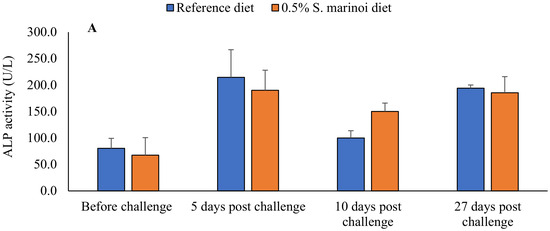
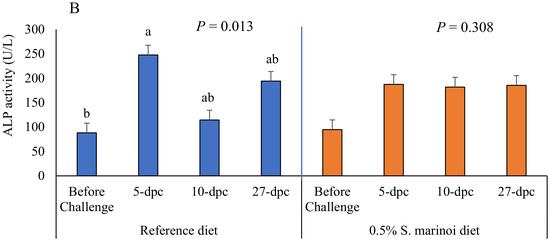
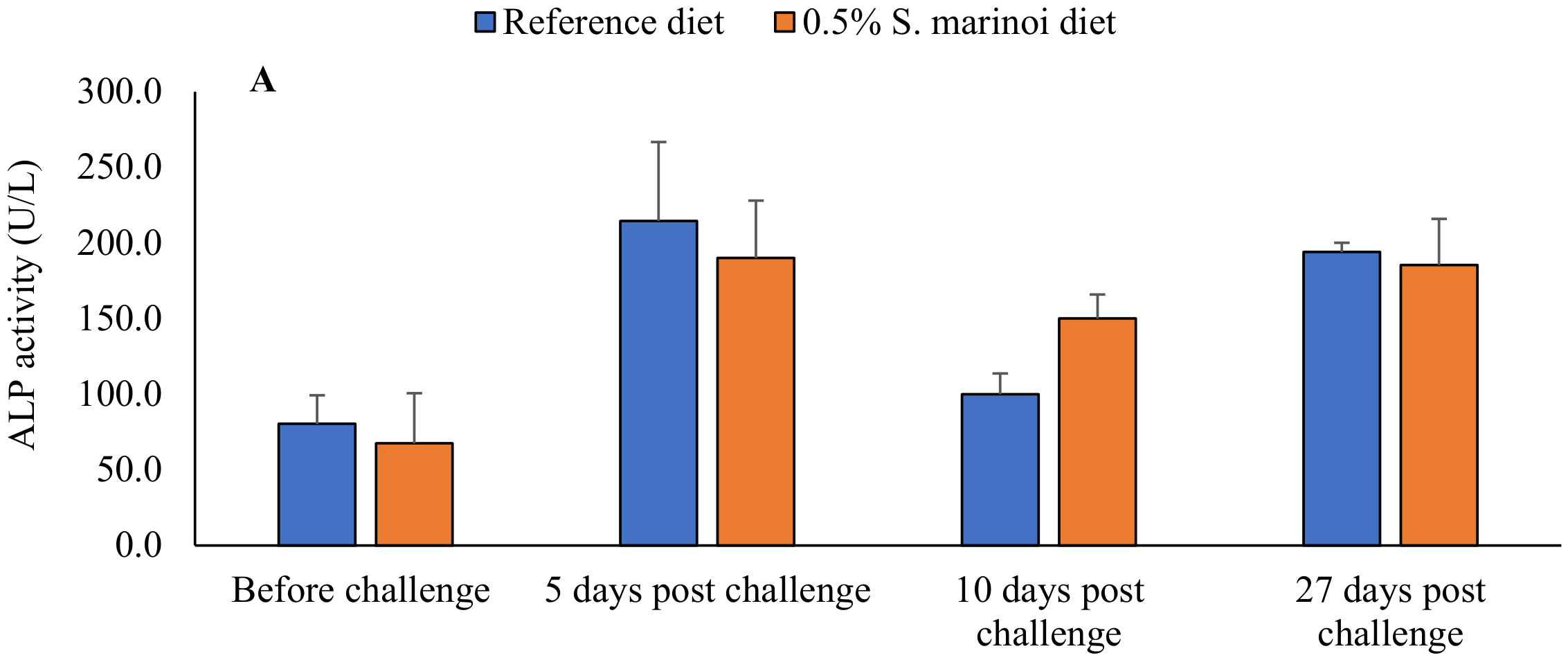
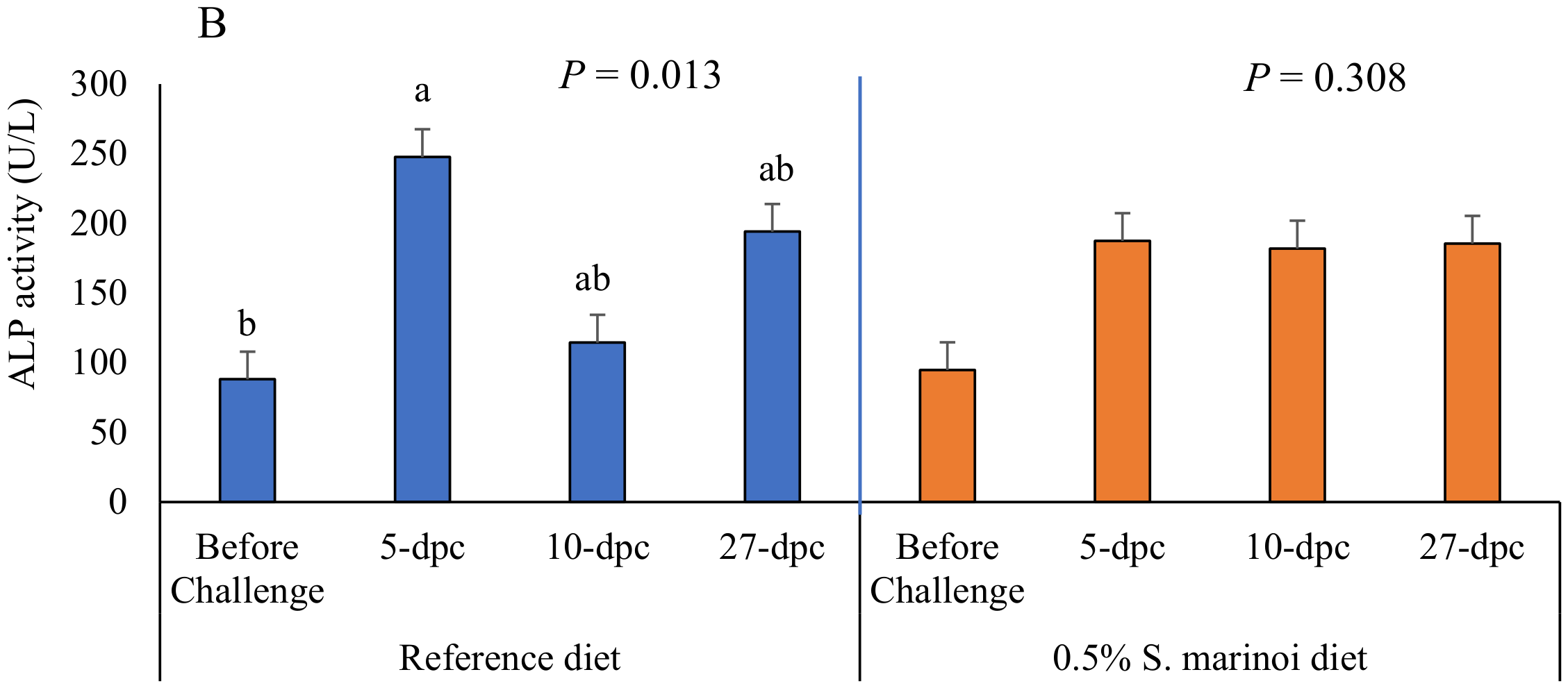
Plasma ALP activity was not significantly affected by diets (Figure 1A). Although a temporary increase in ALP activity was observed at 5 days post-challenge in the control group (p = 0.013; Figure 1B), no consistent or significant diet-related differences were found. Additionally, there was no significant interaction between diet and time on plasma ALP activity (p = 0.072) (Table 4).
Figure 1.
Effect of dietary Skeletonema marinoi on the plasma alkaline phosphatase (ALP) activity of Atlantic salmon, before and after bacterial challenge with Vibrio anguillarum SO3 (5, 10, and 27 days post-challenge) (A). Effect of time within each dietary group on the plasma ALP of Atlantic salmon before and after bacterial challenge (B). Values are means with standard errors represented by vertical bars. Sample size: three tanks per treatment (n = 3) and six sub-samples per tank. Mean values with different letters are significantly different (p < 0.05).
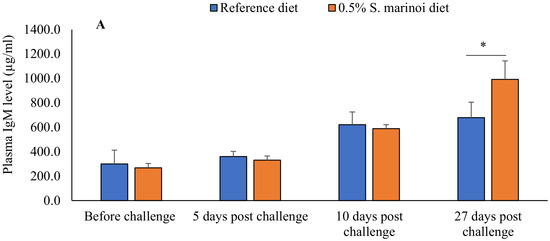
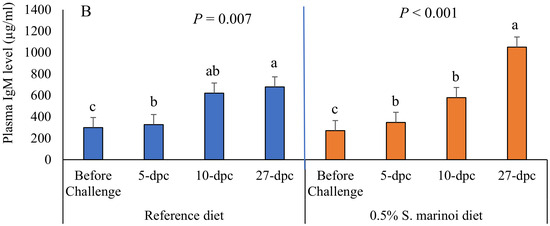
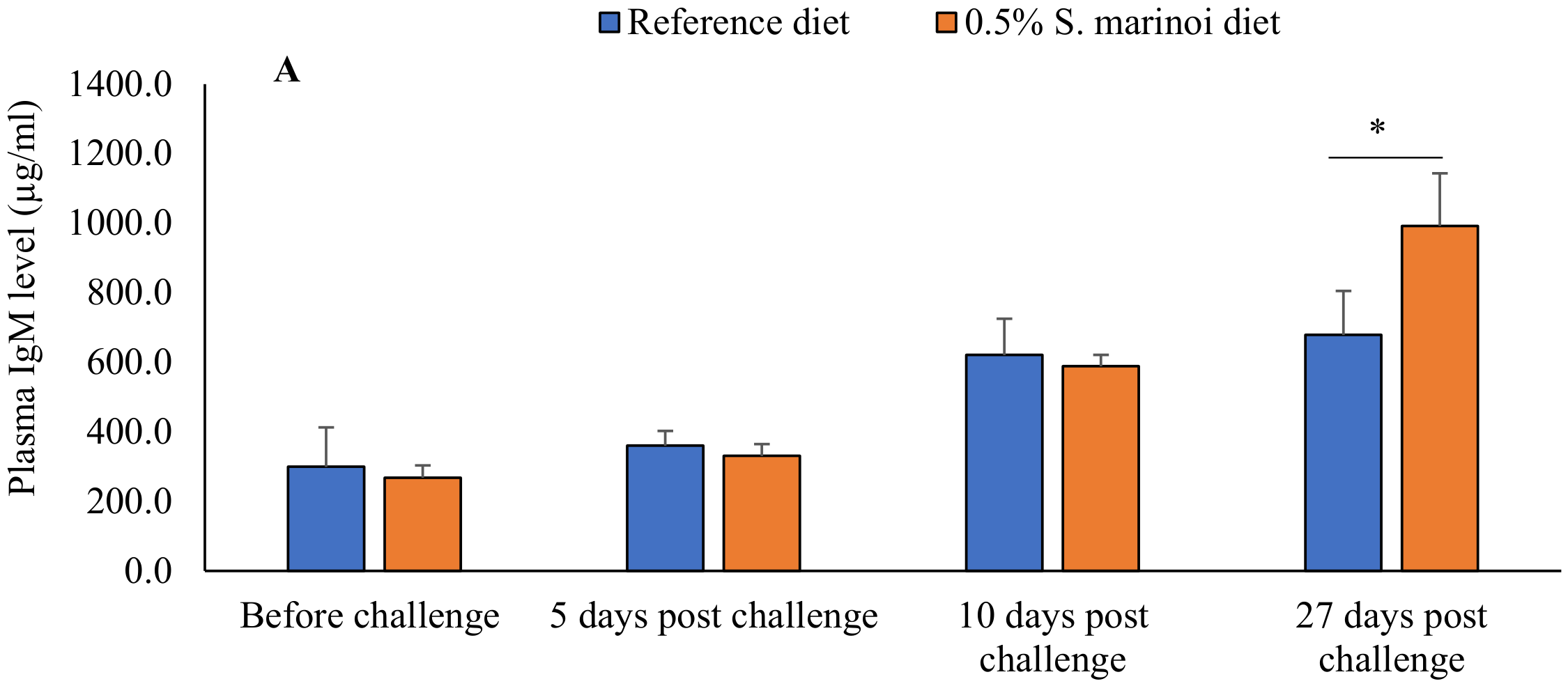
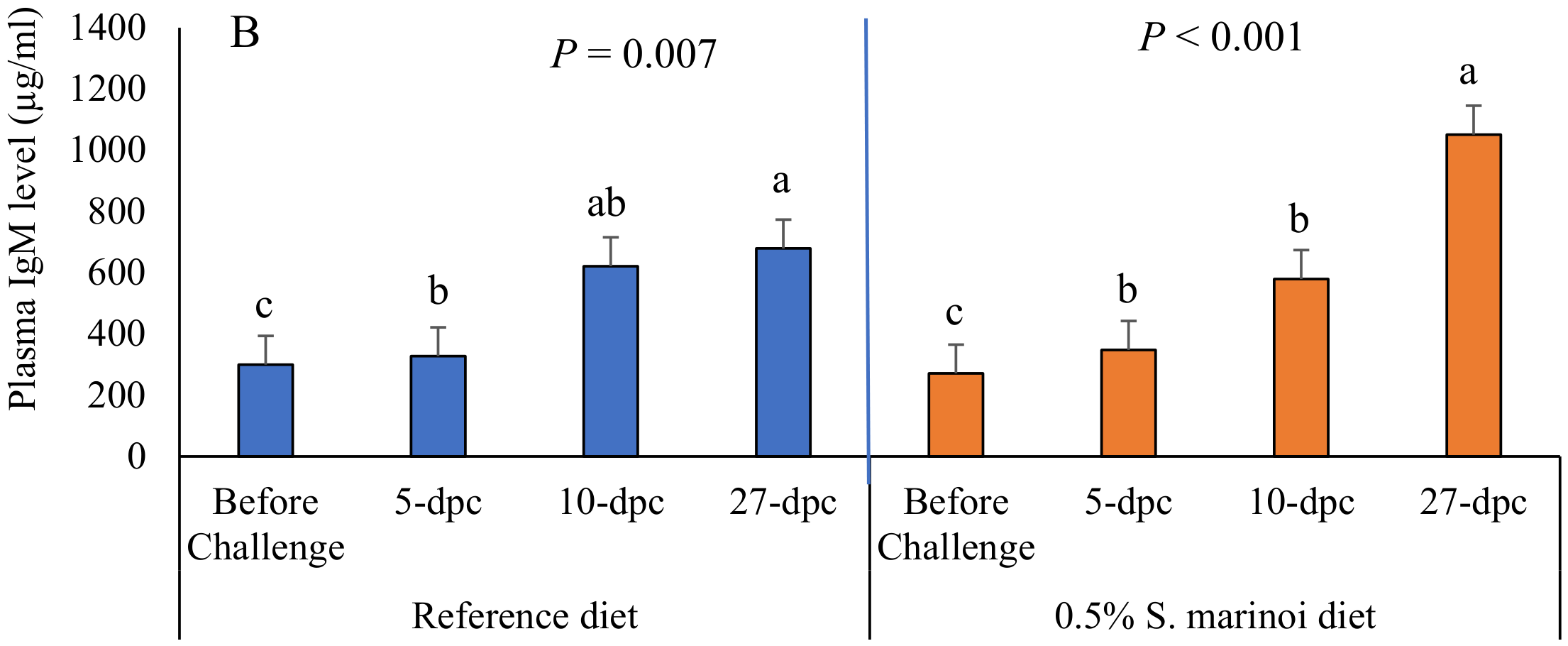
Plasma IgM increased following bacterial challenge in all groups, with significantly higher levels observed in fish fed the 0.5% S. marinoi diet compared to the reference diet at 27 days post-challenge (p < 0.05; Figure 2A). IgM levels also increased significantly over time within each dietary group (Figure 2B). In both the reference and S. marinoi groups, IgM concentrations were lowest prior to challenge and increased post-challenge, reaching peak levels at 27 days (p = 0.007 and p < 0.001, respectively). A significant diet × time interaction (p < 0.001) indicates that the temporal IgM response differed between diets (Table 4).
Figure 2.
Effect of dietary Skeletonema marinoi on the plasma immunoglobulin M (IgM) level of Atlantic salmon, before and after bacterial challenge with Vibrio anguillarum SO3 (5, 10, and 27 days post-challenge) (A). The effect of time within each diet group on the plasma IgM of Atlantic salmon before and after bacterial challenge (B). Values are means with standard errors represented by vertical bars. Sample size: three tanks per treatment (n = 3) and six sub-samples per tank. Asterisk (*) indicates a significant difference at p < 0.05. Mean values with different letters are significantly different (p < 0.05).
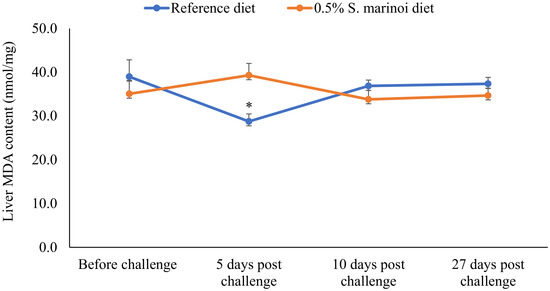
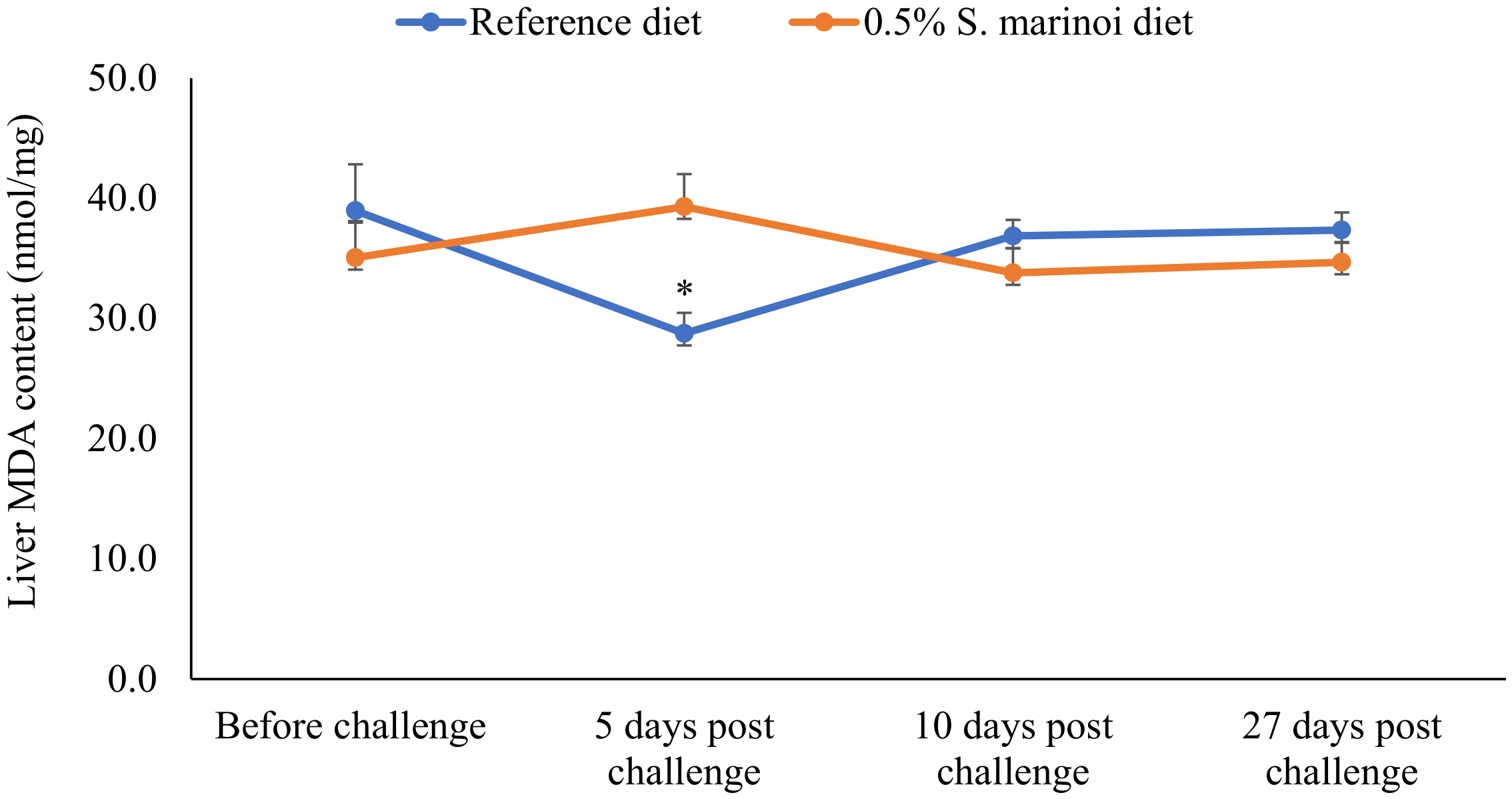
Regarding liver peroxidation, no main effect of diet was found on the hepatic MDA content (p = 0.445) before the bacterial challenge (Figure 3). However, 5 days post-challenge, the 0.5% S. marinoi diet significantly increased the MDA level compared to the reference diet (p = 0.008). At 10 and 27 days post-challenge, there was no significant effect of diet on MDA content. Also, there was no significant difference when looking at the effect of time within each dietary treatment. There was an interactive effect of diet and time on hepatic MDA contents (p = 0.013; Table 4).
Figure 3.
The effect of dietary Skeletonema marinoi on the liver malondialdehyde (MDA) content of Atlantic salmon before and after bacterial challenge with Vibrio anguillarum SO3 (5, 10, and 27 days post-challenge). Sample size: three tanks per treatment (n = 3) and six sub-samples per tank. Mean value with an asterisk (*) is significantly different (p < 0.05).
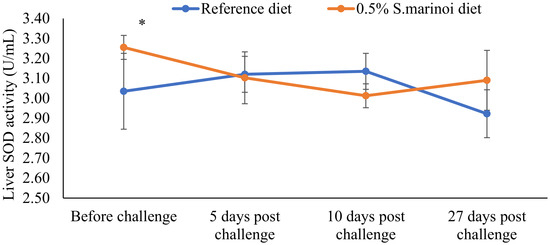
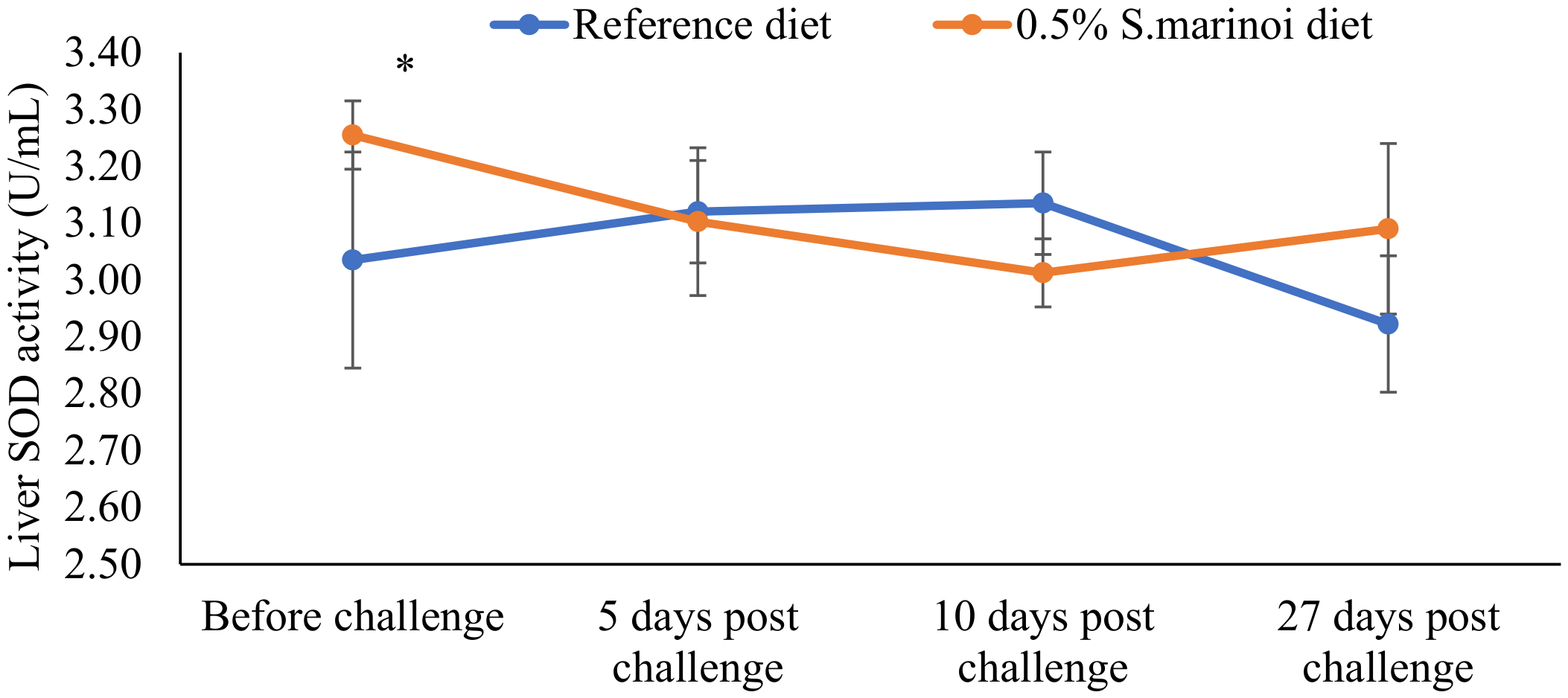
For hepatic SOD activity, there was a significant main effect of diet before the challenge, with higher activity in fish fed the 0.5% S. marinoi diet; however, this effect was not significant after the challenge (Figure 4). Within the 0.5% S. marinoi group, significantly higher SOD activity was observed before the challenge compared to 10 days post-challenge. According to the two-way repeated measures ANOVA, a significant interaction between diet and time was measured for the SOD activities (p = 0.028; Table 4).
Figure 4.
The effect of dietary Skeletonema marinoi on the liver superoxide dismutase (SOD) activity of Atlantic salmon before and after bacterial challenge with Vibrio anguillarum SO3 (5, 10, and 27 days post-challenge). Sample size: three tanks per treatment (n = 3) and four sub-samples per tank. Mean value with an asterisk (*) is significantly different (p < 0.05).
3.2.2. Intestinal Gene Expression
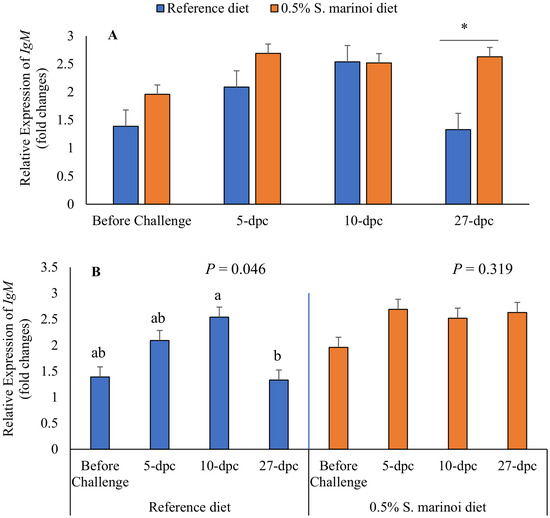
Pairwise comparisons between the groups assessing the effect of diet at each time point showed no significant differences before challenge (p = 0.267), 5 days post-challenge (p = 0.437), or 10 days post-challenge (p = 0.973) in IgM expression (Figure 5A). However, at 27 days post-challenge, the relative expression of IgM mRNA was significantly higher in the 0.5% S. marinoi group than in the reference group (p < 0.001; Figure 5A).
Figure 5.
The effect of dietary Skeletonema marinoi on the relative gene expression of immunoglobulin M (IgM) in the intestine of Atlantic salmon, before and after bacterial challenge with Vibrio anguillarum SO3 (5, 10, and 27 days post-challenge) (A). The effect of time within each dietary group on the intestinal IgM gene expression of Atlantic salmon before and after bacterial challenge (B). Values are means with standard errors represented by vertical bars. Sample size: three tanks per treatment (n = 3) and six sub-samples per tank. Asterisk (*) indicates a significant difference at p < 0.05. Mean values with different letters are significantly different (p < 0.05).
Figure 5B shows the effect of time within each dietary treatment. In the reference group, the relative expression of IgM mRNA was significantly higher at 10 days post-challenge than at 27 days post-challenge (p = 0.046). In contrast, no statistically significant changes over time were observed within the 0.5% S. marinoi group (p = 0.319). Furthermore, the two-way repeated measures ANOVA revealed a significant interaction between diet and time (p < 0.001; Table 5).
Table 5.
The interactive effect of dietary treatments and time on the intestinal IgM gene expression of Atlantic salmon before and post-bacterial challenge with Vibrio anguillarum SO3.
4. Discussion
Diatoms have been reported to exhibit antibacterial activity and to be a potential source of bioactive compounds for therapeutic applications [28,29]. Several studies have evaluated the use of diatoms as feed supplements in the diets of finfish, such as Phaeodactylum tricornutum and Porosira glacialis in the diets of Atlantic salmon [17,18], Thalassiosira weissflogii in the diet of Nile Tilapia [19], and Phaeodactylum tricornutum in the diet of gilthead sea bream [20]. Nevertheless, the inclusion of Skeletonema marinoi as a functional feed ingredient (supplement) that provides both nutritional value and bioactive effects remains largely unexplored in Atlantic salmon diets. To address this, the present study conducted two consecutive trials to evaluate the effects of dietary S. marinoi supplementation on growth performance, feed utilization, stress biomarkers, antioxidant defense, and immune responses in Atlantic salmon, under normal conditions and after bacterial challenge with Vibrio anguillarum SO3. In this study, a single dose (0.5% S. marinoi) was used to determine whether this low inclusion level could influence growth, oxidative stress, antioxidant, or immune responses in Atlantic salmon. Future studies should evaluate graded inclusion levels to establish the optimal dietary level of S. marinoi for Atlantic salmon.
In the growth study, conducted without a bacterial challenge, no significant differences were measured between the reference and 0.5% S. marinoi groups, and no detrimental effects were observed on the survival, final weight, weight gain, feed intake, feed efficiency, K-factor, and HSI of Atlantic salmon. These results indicated that including S. marinoi in Atlantic salmon feed at 0.5% does not negatively affect feed efficiency or growth performance. These findings align with those of Sørensen et al. [17], who investigated the effects of Phaeodactylum tricornutum at 3% and 6% inclusion levels and found no effect on growth performance and physiological responses in post-smolt Atlantic salmon. Similarly, Kiron et al. [30] reported that supplementing the diet with 5% or 10% Nanofrustulium sp. did not affect feed utilization or growth performance of post-smolt Atlantic salmon. However, Eilertsen et al. [18] reported a higher growth rate in Atlantic salmon juveniles fed with 2% diatom (Porosira glacialis). Huervana et al. [19] also reported that the use of Thalassiosira weissflogii paste at 2.55% yielded the highest weight gain in Nile tilapia, with no significant effects observed at higher inclusion levels (6 and 12%). These results suggest the effects of diatom inclusion on fish growth performance could vary due to (i) type or species of diatoms; (ii) inclusion level of the diatoms; (iii) diatom processing; (iv) fish size, stock, or strain; and (v) experimental condition. Similar to the growth results, this study found insignificant effects of the 0.5% S. marinoi diet on the health parameters of Atlantic salmon, such as hepatic MDA content, antioxidant (SOD activity), and intestinal IgM gene expression. These findings indicated that the dietary diatoms intervention alone may not induce a baseline physiological, oxidative, or immunological shift in the absence of stressors.
For further insight into the impact of S. marinoi on Atlantic salmon immunity, a bacterial challenge with Vibrio anguillarum SO3 infection was conducted to assess the effects of the 0.5% S. marinoi on plasma biomarkers, hepatic peroxidation and antioxidant, and intestinal gene expression. Before bacterial challenge (Day 0), there were no significant effects of the 0.5% S. marinoi diet on the measured parameters, including plasma health parameters (ALP activity and IgM level), liver MDA content, and intestinal IgM gene expression, which suggests that the dietary intervention alone may not induce stress or immunological responses in the absence of stressors. This aligns with previous findings [17,30], which reported no significant changes in basal immune markers in Atlantic salmon fed diets supplemented with different diatom-derived additives under normal rearing conditions.
Plasma ALP activity is associated with the release of ALP enzymes from cells to the extracellular fluids, and elevated activity of ALP could occur when there is cell growth, tissue necrosis/cell death, or leakage of ALP [24,25,31]. In this study, the absence of consistent or significant dietary effects suggests that the observed variations in ALP activity may reflect physiological fluctuations rather than a clear response to the dietary inclusion of S. marinoi or the experimental challenge conditions. These findings are consistent with previous studies reporting changes in ALP activity under prolonged stress [32,33], suggesting that ALP activity in fish could also vary over time.
Plasma IgM production is a key component of the specific immune response triggered by antigenic stimulation, with IgM being the predominant immunoglobulin in fish [24,34]. In the present study, plasma IgM levels increased over time following bacterial challenge, which is consistent with the expected antibody response observed in other fish [35]. Plasma IgM levels increased after challenge, with significantly higher levels in fish fed the 0.5% S. marinoi diet compared to those fed the reference diet at 27 days post-challenge. Although the timing is consistent with the delayed antibody kinetics typical of cold-water species [36], the observed increase in IgM levels at 27 days post-challenge indicates that diet may have modulated humoral response in Atlantic salmon.
Fish liver typically has high concentrations of unsaturated fatty acids, with a risk of oxidative damage, which can result in an imbalance of reactive oxygen species [37,38,39]. MDA results from lipid peroxidation and adversely affects fish health at high levels [40], and it is a well-known oxidative stress biomarker in fish [24,41]. In this study, before the challenge, MDA levels were slightly lower in fish fed the reference diet compared to those fed the 0.5% S. marinoi diet, suggesting that S. marinoi supplementation may have a mild antioxidant effect under unstressed conditions. However, a significant divergence in MDA levels was observed after the bacterial challenge. At 5 days post-challenge, fish fed the 0.5% S. marinoi diet exhibited higher MDA levels than those in the reference group, indicating a temporary increase in lipid peroxidation during the early stages of infection. This may represent an early defense mechanism, a pattern similarly observed in stressed or pathogen-challenged fish receiving immunostimulant diets [42]. Interestingly, at 10 days post-challenge, the trend reversed, with MDA levels decreasing in the 0.5% S. marinoi group, whereas they increased in the reference group. This could indicate that the antioxidant mechanisms in the algal-supplemented fish became more effective at mitigating oxidative stress over time, leading to a faster recovery phase. Ibrahim et al. [43] investigated the effects of a microalgae-based diet on catfish (Clarias gariepinus) and observed similar results, showing that fish fed with microalgae exhibited significantly lower MDA levels compared to those on a reference diet. This could indicate reduced lipid peroxidation and oxidative stress, suggesting that the antioxidant compounds present in microalgae effectively mitigate oxidative damage in fish [44,45]. At 27 days post-challenge, MDA levels stabilized in both groups, indicating that oxidative stress resolution had occurred with a more controlled oxidative response in fish fed the 0.5% S. marinoi diet, possibly due to improved immune modulation (antioxidant defense).
Superoxide dismutase (SOD) is a crucial enzyme that catalyzes the dismutation of superoxide radicals, thereby limiting the spread of oxidative damage [46,47]. In this study, before the challenge, a significant main effect of diet was observed, with higher hepatic SOD activity in fish fed the 0.5% S. marinoi diet compared to those fed the reference diet. However, after the challenge, a non-significant transient decrease in SOD activity was measured until 10 days post-challenge, and then it increased in fish fed the 0.5% S. marinoi diet. This finding aligns with Teixeira et al. [20], who reported temporal fluctuations in gilthead seabream fed a diatom-derived β-glucan extract. The trend observed in this study suggests that S. marinoi supplementation might help maintain hepatic antioxidant capacity. However, the effect of dietary diatom inclusion on SOD activity in fish appears to fluctuate over time and may be influenced by physiological or environmental stressors. Reis et al. [48] documented increased SOD activity in gilthead seabream fed β-glucan-rich extract from the diatom Phaeodactylum tricornutum. These findings imply that diatoms could support antioxidant enzyme activity during bacterial challenges. Nonetheless, further research is needed to elucidate the specific mechanisms by which diatoms modulate baseline and extended hepatic antioxidant responses in fish following pathogen challenge.
Similar to plasma IgM, the intestinal IgM gene is also an important immune marker that is activated upon exposure to disease, playing a crucial role in the immune response and helping to identify and neutralize harmful antigens [46,49]. In the present study, the relative expression of the IgM gene in the intestine of Atlantic salmon on Day 27 post-challenge revealed a significant up-regulation in fish fed the 0.5% S. marinoi diet compared to those fed the reference diet. This finding indicates that dietary supplementation with S. marinoi could enhance the immune response of Atlantic salmon. Previous research has shown that the bioactive compounds found in S. marinoi, including β-glucans, polyunsaturated fatty acids (PUFAs), and antioxidants, have the potential to improve immune function in fish [15,50,51]. Although no significant differences in IgM gene expression in the dietary groups were observed at earlier time points (Day 0, 5, and 10 days post challenge), the 0.5% S. marinoi group maintained up-regulated IgM gene expression throughout this period, pointing to the possibility of S. marinoi serving as a functional dietary component that could support immune defense in fish following pathogen exposure. Consistent with the findings of Bhattacharjya et al. [52], this study further highlights the antibacterial properties of S. marinoi against Vibrio anguillarum SO3 infection in Atlantic salmon, emphasizing its promise as a beneficial dietary supplement in aquaculture. Additionally, this work emphasizes the importance of evaluating time-dependent responses when assessing dietary interventions in aquaculture, suggesting that S. marinoi may not only provoke early immune responses against Vibrio anguillarum SO3 infection, but also facilitate more sustained and adaptive immunity during prolonged stress or infection recovery.
5. Conclusions
In conclusion, while the observed increase in plasma IgM and the up-regulation of intestinal IgM gene expression suggest activation of the humoral immune response, plasma total IgM levels were measured and therefore cannot distinguish between antigen-specific responses and non-specific immune stimulation. Although elevated IgM is often interpreted as an indicator of enhanced immune responsiveness, it may also reflect generalized immune activation associated with physiological stress. In the present study, the absence of negative effects on growth performance, feed efficiency, condition indices, and other physiological indicators suggests that the increased plasma IgM levels and up-regulated IgM gene expression in fish fed S. marinoi may reflect immune modulation rather than adverse stress responses. However, further work is required to confirm pathogen-specific immunity using graded levels of S. marinoi as a functional ingredient in the diet of Atlantic salmon. In addition, future studies should evaluate graded inclusion levels to determine the optimal dietary S. marinoi level for Atlantic salmon.
Author Contributions
Conceptualization, M.H.-T., M.P.P., G.B., M.L. and D.A.B.; methodology, K.-M.M., M.H.-T., S.J., J.H., G.B. and W.M.S.; software, K.-M.M. and A.D.A.; validation, K.-M.M., A.D.A. and M.H.-T.; formal analysis, K.-M.M. and A.D.A.; investigation, K.-M.M., A.D.A., J.H. and M.H.-T.; resources, M.H.-T., M.L., G.B., W.M.S. and D.A.B.; data curation, M.H.-T.; writing—original draft preparation, K.-M.M., A.D.A. and S.J.; writing—review and editing, J.H., M.P.P., G.B., W.M.S., D.A.B. and M.H.-T.; visualization, K.-M.M., A.D.A. and M.H.-T.; supervision, M.H.-T.; project administration, M.H.-T.; funding acquisition, M.H.-T. and D.A.B. All authors have read and agreed to the published version of the manuscript.
Funding
Laboratory analysis and salaries of M.H.-T., J.H., K.-M.M., and A.D.A. were supported by the U.S. Department of Agriculture, Agricultural Research Service by NACA Agreement Number 58–8030–0-004 with the University of Maine’s Aquaculture Research Institute. The externship program of S.J. was supported by the USDA-NIFA (Award Number: 2021-68012-35922). Mention of trade names or commercial products in this publication is solely for the purpose of providing specific information and does not imply recommendation or endorsement by the U.S. Department of Agriculture (USDA). USDA is an equal opportunity provider and employer.
Institutional Review Board Statement
The University of Maine holds the Office of Laboratory Animal Welfare (OLAW) of the National Institutes of Health assurance for vertebrate animals used in research, teaching, and outreach (Assurance #: A3754–01). The use of experimental fish was under scientific research protocols of the University of Maine Institutional Animal Care and Use Committee (IACUC Protocol #: A2023-02-03; approved on 30 March 2023) and the USDA—National Cold Water Marine Aquaculture Center Institutional Animal Care and Use Committee (IACUC Protocol #: IACUC #: 2023-01, approved on 2 March 2023), that complied with all relevant international animal welfare laws, guidelines, and policies.
Informed Consent Statement
Not applicable.
Data Availability Statement
Data will be available from the corresponding author upon request.
Acknowledgments
The authors would like to thank the University of Maine, the Aquaculture Research Institute (ARI)—Aquatic Animal Health Lab, and the Fish Nutrition and Nutrigenomics Lab (Orono, ME, USA), the USDA-ARS, National Cold Water Marine Aquaculture Center (Franklin, ME, USA) and USDA-ARS facility in Bozman MT, USA, for allowing their facility and laboratories to complete this study. The authors are thankful to Bigelow Lab for providing the test ingredient. Finally, the authors are very grateful to Sarah Turner, Robert Harrington, Alex Sullivan, Demitri Lifgren, and the ARI team for their help during sample collection.
Conflicts of Interest
All authors declare that there are no conflicts of interest.
References
- Food and Agriculture Organization of the United Nations. The State of World Fisheries and Aquaculture 2020: Sustainability in Action; FAO: Rome, Italy, 2020. [Google Scholar] [CrossRef] [Scilit]
- Bondad-Reantaso, M.G.; Subasinghe, R.P.; Arthur, J.R.; Ogawa, K.; Chinabut, S.; Adlard, R.; Tan, Z.; Shariff, M. Disease and health management in Asian aquaculture. Vet. Parasitol. 2005, 132, 249–272. [Google Scholar] [CrossRef] [Scilit] [PubMed]
- Olesen, I.; Myhr, A.I.; Rosendal, G.K. Sustainable Aquaculture: Are We Getting There? Ethical Perspectives on Salmon Farming. J. Agric. Environ. Ethics 2011, 24, 381–408. [Google Scholar] [CrossRef] [Scilit]
- Naylor, R.L.; Hardy, R.W.; Buschmann, A.H.; Bush, S.R.; Cao, L.; Klinger, D.H.; Little, D.C.; Lubchenco, J.; Shumway, S.E.; Troell, M. A 20-year retrospective review of global aquaculture. Nature 2021, 591, 551–563. [Google Scholar] [CrossRef] [Scilit] [PubMed]
- Defoirdt, T.; Sorgeloos, P.; Bossier, P. Alternatives to antibiotics for the control of bacterial disease in aquaculture. Curr. Opin. Microbiol. 2011, 14, 251–258. [Google Scholar] [CrossRef] [Scilit] [PubMed]
- Dawood, M.A.O.; Koshio, S. Recent advances in the role of probiotics and prebiotics in carp aquaculture: A review. Aquaculture 2016, 454, 243–251. [Google Scholar] [CrossRef] [Scilit]
- Nieri, P.; Carpi, S.; Esposito, R.; Costantini, M.; Zupo, V. Bioactive molecules from marine diatoms and their value for the nutraceutical industry. Nutrients 2023, 15, 464. [Google Scholar] [CrossRef] [Scilit] [PubMed]
- Stonik, V.A.; Stonik, I.V. Some bioactive natural products from diatoms: Structures, biosyntheses, biological roles, and properties (2015–2025). Mar. Drugs 2026, 24, 23. [Google Scholar] [CrossRef] [Scilit] [PubMed]
- García-Beltrán, J.M.; Arizcun, M.; Chaves-Pozo, E. Antimicrobial Peptides from Photosynthetic Marine Organisms with Potential Application in Aquaculture. Mar. Drugs 2023, 21, 290. [Google Scholar] [CrossRef] [Scilit] [PubMed]
- Ahmad, A.W.; Hassan, S.; Banat, F. An overview of microalgae biomass as a sustainable aquaculture feed ingredient: Food security and circular economy. Bioengineered 2022, 13, 9521–9547. [Google Scholar] [CrossRef] [Scilit] [PubMed]
- Johansson, O.N.; Töpel, M.; Pinder, M.I.M.; Kourtchenko, O.; Blomberg, A.; Godhe, A.; Clarke, A.K. Skeletonema marinoi as a new genetic model for marine chain-forming diatoms. Sci. Rep. 2019, 9, 5391. [Google Scholar] [CrossRef] [Scilit] [PubMed]
- Zulfiqar, M.; Stettin, D.; Schmidt, S.; Nikitashina, V.; Pohnert, G.; Steinbeck, C.; Peters, K.; Sorokina, M. Untargeted metabolomics to expand the chemical space of the marine diatom Skeletonema marinoi. Front. Microbiol. 2023, 14, 1295994. [Google Scholar] [CrossRef] [Scilit] [PubMed]
- Putra, D.F.; Mariana, M.Z.; Abidin, S. Effect of Various Feeding of Live Feeds on the Growth and Survival Rate of Black Tiger Shrimp Larvae (Penaeus Monodon). In Proceedings of the 7th International Conference on Multidisciplinary Research; A.R. Research Publication: Ghaziabad, India, 2018; pp. 128–132. [Google Scholar] [CrossRef] [Scilit]
- Yarnold, J.; Karan, H.; Oey, M.; Hankamer, B. Microalgal Aquafeeds as Part of a Circular Bioeconomy. Trends Plant Sci. 2019, 24, 959–970. [Google Scholar] [CrossRef] [Scilit] [PubMed]
- Milito, A.; Castellano, I.; Burn, R.; Seebeck, F.P.; Brunet, C.; Palumbo, A. First evidence of ovothiol biosynthesis in marine diatoms. Free. Radic. Biol. Med. 2020, 152, 680–688. [Google Scholar] [CrossRef] [Scilit] [PubMed]
- Bérard, J.B.; Ouk, T.S.; Sol, V.; Lefoulon, L.; Landolt, C.; Grenier, K.; Saad, N.; Robert, E.; Sibat, M.; Schreiber, N.; et al. Phototoxicity of the ethanolic extract of Skeletonema marinoi for the dermocosmetic improvement of acne. Mar. Drugs 2024, 22, 343. [Google Scholar] [CrossRef] [Scilit] [PubMed]
- Sørensen, M.; Berge, G.; Reitan, K.; Ruyter, B. Microalga Phaeodactylum tricornutum in feed for Atlantic salmon (Salmo salar) -Effect on nutrient digestibility, growth and utilization of feed. Aquaculture 2016, 460, 116–123. [Google Scholar] [CrossRef] [Scilit]
- Eilertsen, H.C.; Elvevoll, E.; Giæver, I.H.; Svenning, J.B.; Dalheim, L.; Svalheim, R.A.; Vang, B.; Siikavuopio, S.; Dragøy, R.; Ingebrigtsen, R.A.; et al. Inclusion of photoautotrophic cultivated diatom biomass in salmon feed can deter lice. PLoS ONE 2021, 16, 0255370. [Google Scholar] [CrossRef] [Scilit] [PubMed]
- Huervana, F.H.; Dionela, C.S.; De La Torre, E.D.S.; Del Castillo, C.S.; Traifalgar, R.F.M. Utilization of marine diatom Thalassiosira weissflogii as a feed additive in seawater-tolerant Nile tilapia (Oreochromis niloticus, Linnaeus 1758) strain. Front. Sustain. Food Syst. 2022, 6, 1052951. [Google Scholar] [CrossRef] [Scilit]
- Teixeira, C.; Peixoto, D.; Hinzmann, M.; Santos, P.; Ferreira, I.; Pereira, G.V.; Dias, J.; Costas, B. Dietary Strategies to Modulate the Health Condition and Immune Responses in Gilthead Seabream (Sparus aurata) Juveniles Following Intestinal Inflammation. Animals 2022, 12, 3019. [Google Scholar] [CrossRef] [Scilit] [PubMed]
- Chukwu-Osazuwa, J.; Cao, T.; Vasquez, I.; Gnanagobal, H.; Hossain, A.; Machimbirike, V.I.; Santander, J. Comparative Reverse Vaccinology of Piscirickettsia salmonis, Aeromonas salmonicida, Yersinia ruckeri, Vibrio anguillarum and Moritella viscosa, Frequent Pathogens of Atlantic Salmon and Lumpfish Aquaculture. Vaccines 2022, 10, 473. [Google Scholar] [CrossRef] [Scilit] [PubMed]
- National Research Council (NRC). Nutrient Requirements of Fish and Shrimp; The National Academies Press: Washington, DC, USA, 2011. [Google Scholar] [CrossRef] [Scilit] [PubMed]
- Lifgren, D.; Turner, S.M.; Welch, T.J.; Bouchard, D.; Polinski, M.P. Limited Experimental Susceptibility of Post-Smolt Atlantic salmon (Salmo salar) to an Emergent Strain of Vibrio Anguillarum Serotype O3. Aquac. J. 2024, 4, 283–292. [Google Scholar] [CrossRef] [Scilit]
- Habte-Tsion, H.M.; Hawkyard, M.; Sealey, W.M.; Bradshaw, D.; Meesala, K.M.; Bouchard, D.A. Effects of Fishmeal Substitution with Mealworm Meals (Tenebrio molitor and Alphitobius diaperinus) on the Growth, Physiobiochemical Response, Digesta Microbiome, and Immune Genes Expression of Atlantic Salmon (Salmo salar). Aquac. Nutr. 2024, 2024, 6618117. [Google Scholar] [CrossRef] [Scilit] [PubMed]
- Meesala, K.-M.; Hong, J.; Sealey, W.M.; Popa, R.; Bouchard, D.A.; Habte-Tsion, M. Effects of fishmeal substitution with defatted black soldier fly larvae and soy protein meals on the growth, physio-biochemical responses, and immune-related gene expression of Atlantic salmon (Salmo salar). Aquaculture 2025, 602, 742335. [Google Scholar] [CrossRef] [Scilit]
- Olsvik, P.A.; Torstensen, B.E.; Hemre, G.I.; Sanden, M.; Waagbø, R. Hepatic oxidative stress in Atlantic salmon (Salmo salar L.) transferred from a diet based on marine feed ingredients to a diet based on plant ingredients. Aquac. Nutr. 2011, 17, 424–436. [Google Scholar] [CrossRef] [Scilit]
- Livak, K.J.; Schmittgen, T.D. Analysis of relative gene expression data using real-time quantitative PCR and the 2−ΔΔCT method. Methods 2001, 25, 402–408. [Google Scholar] [CrossRef] [Scilit] [PubMed]
- Prartono, T.; Mujizat, K.; Kawaroe, M.; Katili, V. Fatty Acid Composition of Three Diatom Species Skeletonema costatum, Thalassiosira sp. and Chaetoceros gracilis. Int. J. Environ. Bioenergy 2013, 6, 28–43. [Google Scholar]
- Dolganyuk, V.; Belova, D.; Babich, O.; Prosekov, A.; Ivanova, S.; Katserov, D.; Patyukov, N.; Sukhikh, S. Microalgae: A Promising Source of Valuable Bioproducts. Biomolecules 2020, 10, 1153. [Google Scholar] [CrossRef] [Scilit] [PubMed]
- Kiron, V.; Phromkunthong, W.; Huntley, M.; Archibald, I.; De Scheemaker, G. Marine microalgae from biorefinery as a potential feed protein source for Atlantic salmon, common carp and whiteleg shrimp. Aquac. Nutr. 2012, 18, 521–531. [Google Scholar] [CrossRef] [Scilit]
- Savova, M.; Kirev, T. Alkaline phosphatase activity in serum of guinea fowl bearing bone tumours induced by osteopetrosis virus strain PTS-56. Avian Pathol. 1992, 21, 667–673. [Google Scholar] [CrossRef] [Scilit] [PubMed]
- Molina, R.; Moreno, I.; Pichardo, S.; Jos, A.; Moyano, R.; Monterde, J.G.; Cameán, A. Acid and alkaline phosphatase activities and pathological changes induced in Tilapia fish (Oreochromis sp.) exposed subchronically to microcystins from toxic cyanobacterial blooms under laboratory conditions. Toxicon 2005, 46, 725–735. [Google Scholar] [CrossRef] [Scilit] [PubMed]
- Xia, H.; Tang, Y.; Lu, F.; Luo, Y.; Yang, P.; Wang, W.; Jiang, J.; Li, N.; Han, Q.; Liu, F.; et al. The effect of Aeromonas hydrophila infection on the non-specific immunity of blunt snout bream (Megalobrama amblycephala). Cent.-Eur. J. Immunol. 2017, 42, 239–243. [Google Scholar] [CrossRef] [Scilit] [PubMed]
- Bag, M.R.; Makesh, M.; Rajendran, K.V.; Mukherjee, S.C. Characterization of IgM of Indian major carps and their cross-reactivity with anti-fish IgM antibodies. Fish Shellfish. Immunol. 2009, 26, 275–278. [Google Scholar] [CrossRef] [Scilit] [PubMed]
- Wu, L.; Yang, Y.; Gao, A.; Li, J.; Ye, J. Teleost fish IgM+ plasma-like cells possess IgM-secreting, phagocytic, and antigen-presenting capacities. Front. Immunol. 2022, 13, 1016974. [Google Scholar] [CrossRef] [Scilit] [PubMed]
- Jung, M.H.; Park, C.S.; Kole, S.; Ryu, J.W.; Jung, S.J. Water temperature and immunization period required to establish immunity against the viral hemorrhagic septicemia virus vaccine in olive flounder (Paralichthys olivaceus). Aquaculture 2024, 591, 741118. [Google Scholar] [CrossRef] [Scilit]
- Bayir, A.; Sirkecioglu, A.N.; Bayir, M.; Haliloglu, H.I.; Kocaman, E.M.; Aras, N.M. Metabolic responses to prolonged starvation, food restriction, and refeeding in the brown trout, Salmo trutta: Oxidative stress and antioxidant defenses. Comp. Biochem. Physiol. Part B Biochem. Mol. Biol. 2011, 159, 191–196. [Google Scholar] [CrossRef] [Scilit] [PubMed]
- Liu, Y.; Han, S.L.; Luo, Y.; Li, L.Y.; Chen, L.Q.; Zhang, M.L.; Du, Z.Y. Impaired peroxisomal fat oxidation induces hepatic lipid accumulation and oxidative damage in Nile tilapia. Fish Physiol. Biochem. 2020, 46, 1229–1242. [Google Scholar] [CrossRef] [Scilit] [PubMed]
- Habte-Tsion, H.-M.; Kolimadu, G.D.; Rossi, W., Jr.; Filer, K.; Kumar, V. Effects of Schizochytrium and micro-minerals on the immune, antioxidant, inflammatory, and lipid-metabolism status of Micropterus salmoides fed high- and low-fishmeal diets. Sci. Rep. 2020, 10, 7457. [Google Scholar] [CrossRef] [Scilit] [PubMed]
- Fan, J.; Zhang, Y.; Zhou, H.; Liu, Y.; Cao, Y.; Dou, X.; Fu, X.; Deng, J.; Tan, B. Dietary Malondialdehyde Damage to the Growth Performance and Digestive Function of Hybrid Grouper (Epinephelus fuscoguttatus♀ × E. lanceolatu♂). Animals 2023, 13, 3145. [Google Scholar] [CrossRef] [Scilit] [PubMed]
- Song, C.; Liu, B.; Li, H.; Tang, Y.; Ge, X.; Liu, B.; Xu, P. Protective Effects of Emodin on Oxidized Fish Oil-Induced Metabolic Disorder and Oxidative Stress through Notch-Nrf2 Crosstalk in the Liver of Teleost Megalobrama amblycephala. Antioxidants 2022, 11, 1179. [Google Scholar] [CrossRef] [Scilit] [PubMed]
- Adel, M.; Yeganeh, S.; Dadar, M.; Sakai, M.; Dawood, M.A.O. Effects of dietary Spirulina platensis on growth performance, humoral and mucosal immune responses and disease resistance in juvenile great sturgeon (Huso huso Linnaeus, 1754). Fish Shellfish. Immunol. 2016, 56, 436–444. [Google Scholar] [CrossRef] [Scilit] [PubMed]
- Ibrahim, H.A.; Reda, R.M.; Galal, A.A.A.; Mahmoud, S.H.; Abdallah, S.H. Efficacy of Amphora coffeaeformis supplemented diets in improving growth performance, health status, and resistance to Aeromonas sobria in Oreochromis niloticus exposed to suboptimal temperature conditions. J. Appl. Phycol. 2025, 37, 1041–1057. [Google Scholar] [CrossRef] [Scilit]
- Marques, A.E.M.L.; Balen, R.E.; da Silva Pereira Fernandes, L.; Motta, C.M.; de Assis, H.C.S.; Taher, D.M.; Meurer, F.; Vargas, J.V.C.; Mariano, A.B.; Cestari, M.M. Diets containing residual microalgae biomass protect fishes against oxidative stress and DNA damage. J. Appl. Phycol. 2019, 31, 2933–2940. [Google Scholar] [CrossRef] [Scilit]
- Vignaud, J.; Loiseau, C.; Hérault, J.; Mayer, C.; Côme, M.; Martin, I.; Ulmann, L. Microalgae Produce Antioxidant Molecules with Potential Preventive Effects on Mitochondrial Functions and Skeletal Muscular Oxidative Stress. Antioxidants 2023, 12, 1050. [Google Scholar] [CrossRef] [Scilit] [PubMed]
- Habte-Tsion, H.M. A review on fish immuno-nutritional response to indispensable amino acids in relation to TOR, NF-κB and Nrf2 signaling pathways: Trends and prospects. Comp. Biochem. Physiol. Part B 2020, 241, 110389. [Google Scholar] [CrossRef] [Scilit] [PubMed]
- Zheng, M.; Liu, Y.; Zhang, G.; Yang, Z.; Xu, W.; Chen, Q. The Applications and Mechanisms of Superoxide Dismutase in Medicine, Food, and Cosmetics. Antioxidants 2023, 12, 1675. [Google Scholar] [CrossRef] [Scilit] [PubMed]
- Reis, B.; Gonçalves, A.T.; Santos, P.; Sardinha, M.; Conceição, L.E.C.; Serradeiro, R.; Pérez-sánchez, J.; Calduch-giner, J.; Schmid-staiger, U.; Frick, K.; et al. Immune status and hepatic antioxidant capacity of gilthead seabream Sparus aurata juveniles fed yeast and microalga derived β-glucans. Mar. Drugs 2021, 19, 653. [Google Scholar] [CrossRef] [Scilit] [PubMed]
- Gong, S.; Ruprecht, R.M. Immunoglobulin M: An Ancient Antiviral Weapon—Rediscovered. Front. Immunol. 2020, 11, 01943. [Google Scholar] [CrossRef] [Scilit] [PubMed]
- Smerilli, A.; Balzano, S.; Maselli, M.; Blasio, M.; Orefice, I.; Galasso, C.; Sansone, C.; Brunet, C. Antioxidant and Photoprotection Networking in the Coastal Diatom Skeletonema marinoi. Antioxidants 2019, 8, 154. [Google Scholar] [CrossRef] [Scilit] [PubMed]
- Mueller, J.; Pauly, M.; Molkentin, J.; Ostermeyer, U.; van Muilekom, D.R.; Rebl, A.; Goldammer, T.; Lindemeyer, J.; Schultheiß, T.; Seibel, H.; et al. Microalgae as functional feed for Atlantic salmon: Effects on growth, health, immunity, muscle fatty acid and pigment deposition. Front. Mar. Sci. 2023, 10, 1273614. [Google Scholar] [CrossRef] [Scilit]
- Bhattacharjya, R.; Kiran Marella, T.; Tiwari, A.; Saxena, A.; Kumar Singh, P.; Mishra, B. Bioprospecting of marine diatoms Thalassiosira, Skeletonema and Chaetoceros for lipids and other value-added products. Bioresour. Technol. 2020, 318, 124073. [Google Scholar] [CrossRef] [Scilit] [PubMed]

Disclaimer/Publisher’s Note: The statements, opinions and data contained in all publications are solely those of the individual author(s) and contributor(s) and not of MDPI and/or the editor(s). MDPI and/or the editor(s) disclaim responsibility for any injury to people or property resulting from any ideas, methods, instructions or products referred to in the content. |
© 2026 by the authors. Licensee MDPI, Basel, Switzerland. This article is an open access article distributed under the terms and conditions of the Creative Commons Attribution (CC BY) license.