


Abstract
Objective physical-function assessment may help personalize supportive care across chimeric antigen receptor (CAR) T-cell therapy, yet rehabilitation evidence remains dispersed. We narratively synthesized adult hematologic CAR T-cell reports identified through a reproducible PubMed search, targeted source verification, conference and registry surveillance, and reference tracking through 7 August 2026. Studies used the six-minute walk test, sit-to-stand tests, gait speed, Timed Up and Go, grip strength, balance testing, Section GG, and the Functional Independence Measure. Prehabilitation and ward-based rehabilitation appeared feasible. Six-minute walk distance was preserved overall in one acute cohort, although cytokine release syndrome and neurotoxicity were associated with worse change. Retrospective studies linked poor endurance, falls, balance or strength deficits, and assistive-device use with hospitalization, neurotoxicity, or mortality. Selected patients improved during inpatient rehabilitation, while recommended postacute services were not consistently received. The evidence is heterogeneous, predominantly single-center, and insufficient for causal or eligibility thresholds. Objective functional phenotyping may nevertheless provide a complementary patient-level data layer for matching assessment, mobility, referral, and recovery pathways to treatment phase and clinical context.
1. Introduction
Chimeric antigen receptor (CAR) T-cell therapy has changed the treatment landscape for relapsed or refractory B-cell malignancies and multiple myeloma. The clinical pathway spans candidacy assessment, apheresis, bridging therapy, lymphodepleting chemotherapy, cellular infusion, surveillance for cytokine release syndrome (CRS) and immune effector cell-associated neurotoxicity syndrome (ICANS), and longer-term recovery. Although the antitumor product is selected according to disease and target biology, supportive care is commonly organized around broad treatment milestones rather than the patient’s evolving functional phenotype.
Recipients may enter treatment with impaired physiologic reserve caused by advanced malignancy, extensive prior therapy, pain, neuropathy, malnutrition, inactivity, or previous hematopoietic cell transplantation. The treatment course can add fever, systemic inflammation, cytopenias, encephalopathy, corticosteroid exposure, intensive-care treatment, and prolonged hospitalization. These exposures create plausible roles for prehabilitation before lymphodepletion, maintenance of mobility and self-care during acute monitoring, intensive rehabilitation after toxicity, and structured post-discharge recovery.
Existing CAR T-cell reviews have emphasized patient-reported outcomes, quality of life, frailty, sarcopenia, or narrative rehabilitation recommendations rather than reproducibly mapping objective physical-function measures and actual rehabilitation delivery [1,2]. Expert recommendations from the American Society for Transplantation and Cellular Therapy have since advocated combined patient-reported and objective assessment, including gait speed, grip strength, the Short Physical Performance Battery, and walk testing when clinically feasible [3]. What remains unclear is which measures have been used in CAR T-cell recipients, when they were administered, what functional trajectories were observed, and how findings influenced referral, service use, discharge planning, and recovery.
This narrative review synthesizes objective or clinician-observed physical function, rehabilitation need and utilization, and defined rehabilitation interventions across the adult hematologic CAR T-cell continuum. It connects objective measurement and functional trajectories with the delivery and receipt of rehabilitation. We distinguish evidence describing function or prognosis from evidence evaluating rehabilitation interventions, then propose a physiology-informed supportive-care framework for future testing. Functional measures are not treated as genomic biomarkers, and associations are not interpreted as causal effects.
2. Literature Identification and Interpretive Approach
2.1. Scope
The review focused on adults who received, were scheduled to receive, or were evaluated for CAR T-cell therapy for a hematologic malignancy. Reports were considered directly relevant when they described an objective or clinician-observed physical-function measure; rehabilitation need, referral, utilization, or disposition; or a defined rehabilitation or prehabilitation intervention. Measures of interest included walk or endurance tests, sit-to-stand performance, gait speed, Timed Up and Go, balance tests, grip or other quantified strength, the Short Physical Performance Battery, standardized activities-of-daily-living or mobility ratings, falls, assistive-device use, and wearable activity. Pediatric-only samples, solid tumors, nonmalignant indications, and preclinical studies were outside the clinical scope. Mixed cellular-therapy cohorts were interpreted only when CAR T-cell findings were separately reported or directly relevant to pathway design.
2.2. Literature Identification and Report Selection
A reproducible PubMed search combined Medical Subject Headings and keywords for CAR T-cell therapy, product names, rehabilitation, exercise, physical function, mobility, activities of daily living, frailty, and sarcopenia. Search development drew on evidence-synthesis and search-reporting guidance [4,5,6,7]; the article remains a narrative review, not a systematic or scoping review. We also considered the Scale for the Assessment of Narrative Review Articles (SANRA) quality domains [8]. The unrestricted search returned 767 records on 26 and 27 July 2026 and 774 on 7 August 2026, recovering all 12 prespecified PubMed-indexed benchmark reports. The seven newly indexed records were assessed for relevance; Tremblay et al. added one directly relevant adult report. Supplementary File S1 provides the exact strategy, execution details, and count definitions.
Mohamed S. Ahmed led literature identification, initial title and abstract assessment, relevance-based report selection, and review of available full texts and supplements. Yusuf Zahran subsequently reviewed the selected evidence, followed by senior review by Ali H. Mushtaq. Reports were prioritized when they addressed the adult hematologic population and at least one domain specified in Section 2.1. Targeted publisher and conference searches, ClinicalTrials.gov checks, and reference tracking supplemented PubMed; the 27 entries in the working source tracker were therefore not a subset produced by systematically screening the 774 records. The core synthesis comprised 16 empirical study families, represented by 12 peer-reviewed journal reports and four conference reports. Contextual reviews, companion reports, and trial registrations were distinguished from these empirical families. Where only an indexed abstract or conference report was available, interpretation was limited to that source. The complete Herr, Parker, and Kiefer articles were obtained on 28 July 2026. Related reports were linked by authors, cohort, setting, dates, and identifiers to avoid double-counting; the final Alharthy communication superseded its precursor abstract. There was no comprehensive multi-database search or Preferred Reporting Items for Systematic Reviews and Meta-Analyses (PRISMA)-style eligibility accounting.
2.3. Narrative Synthesis
Evidence was organized into functional assessment and prognostic associations, rehabilitation interventions, and service utilization. Interpretation considered design, sample size, missing assessments, CAR T-specific reporting, timing, comparators, and confounding. Conference reports and registry-only studies were not treated as equivalent to completed journal reports. No meta-analysis, pooled effect estimate, formal certainty rating, or validated clinical threshold was produced.
2.4. Evidence Appraisal and Bias Safeguards
All three authors reviewed the final evidence map and checked study descriptions and source-dependent claims against the cited reports, supplements, indexed abstracts, or registry records. Numerical findings, sample size, product, timing, and evidence status were checked. The sequential review described in Section 2.2 and final collaborative verification were not blinded independent duplicate eligibility screening. The archived selection records did not constitute a prospectively completed record-by-record eligibility log. All authors reviewed and approved the final manuscript.
Retrospective associations were interpreted for selection, confounding, missing testing, and reverse causation. Rehabilitation-utilization findings were considered susceptible to confounding by indication and access; mixed cohorts were not used to infer CAR T-specific effects without separable data. Small studies and conference reports were considered vulnerable to imprecision and selective reporting. OpenAI Codex (GPT-5 documented for initial drafting in July 2026; later model versions were not recorded) assisted with literature navigation, manuscript organization and drafting, table and figure preparation, and document checks; the authors reviewed and verified the content and retained responsibility for the synthesis.
2.5. Patient and Public Involvement
No patient or public contributor participated in the literature synthesis.
3. Evidence Synthesis
3.1. Literature Landscape
The core evidence comprised 16 empirical study families: 12 peer-reviewed journal reports and four conference reports [9,10,11,12,13,14,15,16,17,18,19,20,21,22,23,24]. These included assessment and prognostic cohorts, service evaluations, a matched inpatient-rehabilitation cohort, a five-patient case series, and a case report. Table 1 identifies all 16 families and their reporting limitations. The larger 27-entry source tracker also contained contextual and research-in-progress material and should not be interpreted as 27 completed clinical studies.
Table 1.
Empirical reports informing the narrative review.
Most evidence originated from single centers. Lymphoma predominated, with multiple myeloma and smaller leukemia representation; CD19-directed products were most common. Completed rehabilitation reports are summarized in Table 2. Protocols and registry-only interventions are presented separately in Table 3 and do not contribute effectiveness or safety results.
Table 2.
Completed rehabilitation and service-delivery reports.
Table 3.
Intervention protocols and trial registrations without outcome results at 7 August 2026.
3.2. Functional Assessment and Prognostic Associations
Pretreatment assessment identified deficits that were not apparent from ambulation alone. In the McCourt service evaluation, 16 of 17 patients tested at baseline walked less than 80% of the age- and sex-predicted six-minute walk distance, and all 16 completing the one-minute sit-to-stand test scored below the 25th centile [9]. These observations describe baseline vulnerability; they do not establish that prehabilitation changes subsequent toxicity or survival.
Multidomain geriatric assessment placed physical findings alongside cognition, nutrition, medication burden, and social support. Yates et al. evaluated 61 older adults, of whom 53 received CAR T-cell therapy [10]. Impaired walk performance and grip strength were common even among those recommended to proceed immediately. Composite clinic recommendations were associated with hospitalization and survival, but these associations cannot be attributed to an individual physical test or to the effect of optimization.
Tremblay et al. described 43 adults aged at least 70 years considered for therapy; 27 were treated [11]. Mobility impairment accompanied cognitive and medication-related vulnerabilities. Together, these reports favor characterizing multiple domains rather than equating chronological age with functional reserve. Their selected, single-center populations do not establish a candidacy rule.
In a conference cohort of 78 adults, Shouse et al. associated very low baseline walk distance with prolonged hospitalization and lower day-100 survival [12]. Eight patients unable to complete testing were assigned zero distance, conflating noncompletion with measured low performance. The study-specific 500-ft threshold is therefore exploratory and should not be generalized to treatment eligibility or rehabilitation referral.
Nair et al. evaluated 91 adults with non-Hodgkin lymphoma before infusion [13]. Recent falls and impaired single-leg balance were associated with ICANS; assistive-device use, strength deficits, and a positive Romberg test were associated with mortality. Walk, gait-speed, and Timed Up and Go data were incomplete. Combining adverse physical findings with CAR-HEMATOTOX identified survival differences, but external validation and incremental-value testing are required before this approach can support individual prediction.
Herr et al. extended this question to delayed movement and neurocognitive treatment-emergent events (MNTs), distinct from ICANS, after ciltacabtagene autoleucel [14]. Only four of 21 patients developed MNTs. A step-up heart-rate and recovery threshold identified a subgroup in which all developed MNTs; this does not mean that the threshold identified every MNT case. Few events, data-driven threshold selection, and no external validation make the result hypothesis-generating rather than a clinical decision rule.
3.3. Prehabilitation Before CAR T-Cell Therapy
Paired functional-test data were available for only nine patients in the McCourt study: 22 had baseline assessments, and 18 had both baseline and pre-admission assessments [9]. Thus, only half of those assessed at both visits contributed paired functional tests. In this selected subset, six-minute walk distance increased by a mean 58.6 m and one-minute sit-to-stand performance by 3.2 repetitions. The physiotherapist-led program combined individualized home aerobic and resistance exercise, education, goal setting, and remote support. Missing paired data and the absence of a comparator prevent attribution of improvement to the program.
Parker et al. enrolled 20 older adults in home-based exercise prehabilitation; 17 completed follow-up [15]. Remotely supervised resistance exercise and prescribed aerobic activity were acceptable to participants, with high reported adherence. Chair-stand and arm-curl performance improved, and one minor episode of exercise-related foot pain resolved after modification. The proof reported a walk-distance improvement but omitted absolute distances. The uncontrolled design, selected sample, exploratory outcomes, and absence of post-CAR T functional testing restrict the findings to feasibility and preliminary within-person change.
A conference report by McGoldrick et al. described multidisciplinary prehabilitation and inpatient support in 174 transplantation or CAR T-cell recipients, including 24 CAR T-cell recipients [16]. Most functional outcomes were not separately reported for the CAR T-cell subgroup. The report illustrates a delivery model but does not establish CAR T-specific intervention effectiveness.
3.4. Acute Functional Trajectories During Rehabilitation
Hamada et al. followed 77 adults who received ward-based rehabilitation during hospitalization and underwent functional assessment before lymphodepletion and one month after infusion [17]. The program combined stretching, resistance exercise, and aerobic training, generally five times weekly for 20–40 min. All participants received rehabilitation; there was neither a nonrehabilitation comparator nor a comparison of prescribed rehabilitation doses.
Median six-minute walk distance was approximately 450 m at both assessments. Group-level preservation cannot be attributed to rehabilitation. Moderate or severe toxicity according to the study-specific modified CRS classification, ICANS, and hemoglobin change were associated with the change in walk distance. Reported walk-distance changes were −67.5 m with ICANS and +10.6 m without ICANS. The modified CRS classification incorporated prolonged grade 1 fever and should not be equated with standard CRS grades. These findings describe toxicity-associated functional trajectories. They provide a rationale for studying reassessment during acute illness, but do not establish that toxicity-adapted exercise dosing improves recovery or modifies CRS or ICANS.
In a prospective conference cohort of 60 adults, Galli et al. described reduced Barthel independence and increased Conley fall-risk scores during the first two post-infusion weeks, followed by partial recovery at discharge [18]. Twenty patients had already been discharged before day 14, so changing denominators limit the interpretation of serial group means. This is evidence about the timing of functional change, not evidence that a specific rehabilitation schedule is effective.
Neither report established a standardized mobility restriction, exercise-intensity threshold, or rehabilitation algorithm during CRS or ICANS. Potential adaptations to medical instability and cognitive or balance impairment are discussed below as a proposed clinical framework, separate from the observed trajectories.
3.5. Rehabilitation Need, Utilization, and Discharge Destination
Harkins et al. reported that 39 of 49 assessed inpatients in a 99-patient cohort were recommended skilled rehabilitation [19]. Receipt matched recommendations for 21 of 22 home-health referrals, but only one of nine skilled-nursing and five of eight acute-rehabilitation referrals. This illustrates a gap between assessed need and service receipt. The report did not establish the contribution of payer restrictions, caregiver support, infection-control requirements, or local capacity to that gap.
Alharthy et al. reported formal rehabilitation use at discharge in 22% of 304 adults [20]. Age, performance status, albumin, and corticosteroid exposure predicted utilization; utilization was also associated with inferior survival. The final communication superseded the 16% estimate in the precursor conference abstract, which was not counted as a separate cohort. These findings are compatible with rehabilitation use marking vulnerability and treatment burden, not rehabilitation causing poorer survival.
Cioce et al. described 54 CAR T-cell recipients within a 498-patient cellular-therapy cohort [21]. Discharge assessments included independence, fall risk, clinical deterioration, and care complexity. These measures describe related but distinct constructs, and adjusted analyses did not establish CAR T-specific risk prediction. Their findings should not be conflated with performance-test evidence or intervention effects.
3.6. Inpatient Rehabilitation and Postacute Recovery
Villanueva et al. matched 19 CAR T-cell rehabilitation inpatients to 19 non-CAR T-cell patients from an 84-patient hematologic malignancy cohort [22]. Self-care, transfer, mobility, and performance measures improved during admission, without statistically significant between-group differences in the reported gains. The comparison was between two groups receiving rehabilitation, not rehabilitation versus usual care; absence of a significant difference does not demonstrate equivalence.
CAR T-cell recipients tolerated substantial interdisciplinary therapy, but six of 19 required an unplanned acute-care transfer [22]. Two returned to rehabilitation within 72 h. Ongoing orthostasis, cytopenias, infection, equipment needs, and subsequent therapy requirements underscore the selection and medical surveillance needed to interpret these feasibility findings.
In Kiefer et al., five adults entered rehabilitation 70–239 days after infusion and increased ergometer workload, duration, or both during individualized stays [23]. One progressed from rollator dependence to short-distance cane use. Enhanced hygiene and medical monitoring accompanied exercise and psychological support. The very small uncontrolled series, variable timing, and simultaneous recovery preclude estimates of comparative effectiveness or general safety.
Gupta et al. described recovery from severe encephalopathy-related dependence to short-distance walking and supervised activities of daily living after coordinated acute and inpatient rehabilitation care [24]. The case illustrates communication between oncology and physiatry, not a typical recovery trajectory or evidence that earlier physiatry referral changes outcomes.
No included report validated CAR T-specific inpatient-rehabilitation admission criteria. Reported care required individualized assessment of medical stability, functional goals, participation capacity, and ongoing clinical needs. Prior toxicity alone cannot be used to infer either suitability or unsuitability from these selected cohorts.
3.7. Post-Discharge and Ongoing Intervention Research
Post-discharge outcome data were sparse. McCourt et al. offered telephone follow-up and community referral, but incomplete functional testing prevented evaluation of durable recovery [9]. Service provision should therefore be distinguished from demonstrated long-term benefit.
Four intervention programs illustrate prospective research directions: Step Up activity coaching after transplantation or CAR T-cell therapy, multimodal telerehabilitation, activity with or without nutritional support, and myeloma-specific prehabilitation [25,26,27,28]. Their designs, populations, and outcome targets are summarized separately in Table 3. No outcome results were posted in the registry records at the review cutoff of 7 August 2026; planned enrollment is not an analyzed sample. These records inform the research agenda, not conclusions about benefit or safety.
3.8. Measurement Coverage and Evidence Gaps
Performance measures addressed endurance, lower-extremity performance, strength, gait, and balance. Clinician-rated Section GG, Functional Independence Measure, and Barthel scores addressed assistance and independence in particular care settings. Falls and assistive-device use were historical or observed indicators, not interchangeable with standardized performance tests.
The Conley Scale, Modified Early Warning Score, Braden Scale, and discharge or care-complexity indices assess related risks or clinical needs rather than physical performance itself. Table 1 therefore labels the combined domain as functional and related clinical measures and identifies the construct represented. No core outcome set, CAR T-specific meaningful-change threshold, or validated multivariable referral rule was established.
4. Discussion
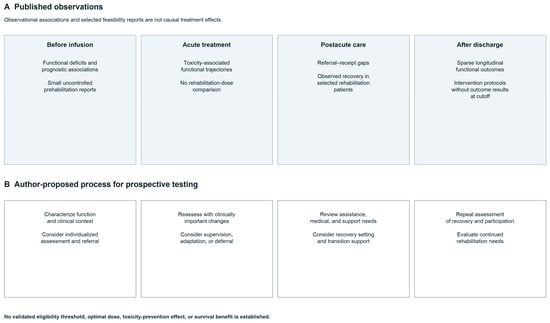
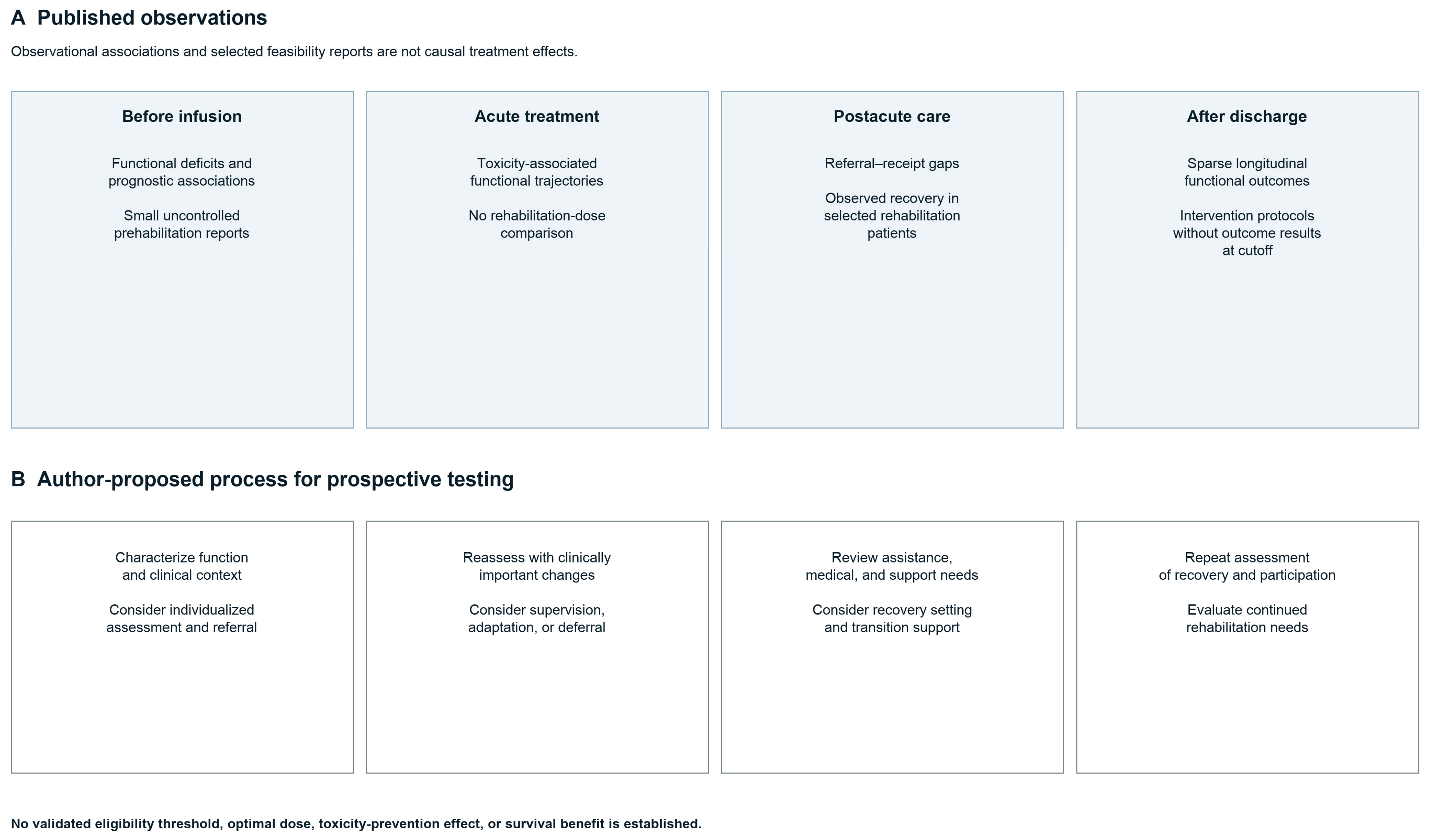
Objective assessments reveal functional heterogeneity before therapy and during recovery, while small intervention reports show that selected patients can participate in rehabilitation. These are different findings: a prognostic association does not establish a modifiable causal pathway, and within-person improvement does not establish treatment efficacy. The framework in Figure 1 makes this distinction explicit.
Figure 1.
Published observations and a proposed supportive-care framework across CAR T-cell therapy. The upper panel summarizes published observations and identifies evidence gaps and protocols without outcome results. The lower panel is an author-proposed, hypothesis-generating process, not a pathway tested by those studies. Positioning across treatment phases indicates timing, not causality. No numeric eligibility or referral threshold, optimal exercise dose, prevention of CRS or ICANS, or survival benefit is established. Sources by phase: before infusion, functional assessment and prognostic reports [9,10,11,12,13,14] and prehabilitation reports [9,15,16]; acute treatment, functional trajectories [17,18] and absence of a rehabilitation-dose comparator [17]; postacute care, utilization reports [19,20] and selected rehabilitation cohorts [22,23,24]; after discharge, longitudinal assessment [9] and intervention protocols without outcome results at the review cutoff [25,26,27,28]. CAR, chimeric antigen receptor; CRS, cytokine release syndrome; ICANS, immune effector cell-associated neurotoxicity syndrome.
The upper panel of Figure 1 summarizes published observations; the lower panel presents the authors’ proposed supportive-care process. Linking assessment to referral, adapting activity to clinical stability, and reassessing recovery are hypotheses for evaluation, not a validated algorithm or evidence-based prescription of rehabilitation dose.
4.1. Which Functional Domains Are Most Informative
Endurance has the broadest measurement coverage, but walk distance integrates cardiopulmonary capacity, anemia, neurologic function, symptoms, and motivation rather than isolating one physiologic mechanism. Strength and chair-rise performance add complementary information about force generation and task performance; balance, falls, and device use characterize mobility vulnerability. Assistance-based scales describe independence and support needs. No domain or combination has demonstrated sufficient comparative prognostic performance to be preferred universally [3,9,10,11,12,13,14,17,22].
A compact multidomain battery is a reasonable candidate for prospective evaluation, not an established standard specific to CAR T-cell therapy. Test choice should account for feasibility, burden, and contraindications; inability to test should be recorded with its reason rather than automatically equated with a measured score of zero. Patient-reported function and participation can complement performance tests, particularly when clinical instability limits testing [3].
4.2. When Should Function Be Assessed
Pretreatment assessment provides a baseline, acute assessments describe changes during toxicity, and discharge assessment characterizes assistance and equipment needs. These functions differ, and a single admission value cannot characterize the entire trajectory [9,17,18,19,22]. A schedule before lymphodepletion, during clinically relevant acute changes, at discharge, and at day 30 and day 100 is proposed for prospective evaluation; the present review does not establish the optimal intervals. Later assessment should include community mobility and participation, for which evidence remains sparse.
Medical stability, cognition, hemodynamics, symptoms, blood counts, and balance are relevant to the feasibility of an assessment or activity session. Physiatrists, oncologists, therapists, and nursing teams could use these contextual findings to consider supervision, deferral, or reassessment. However, this is a proposed safety-oriented process, not a dose algorithm validated by Hamada et al. or evidence that exercise prevents or treats CRS or ICANS. Early physiatry involvement is similarly a coordination strategy whose timing and outcome benefit require testing.
4.3. What Supports Intervention Rather than Assessment
Home prehabilitation studies support acceptability and delivery feasibility in selected patients; acute and postacute reports describe participation, observed recovery, and continuing medical needs [9,15,16,17,22,23,24]. Without appropriate controls, observed gains may reflect selection, spontaneous recovery, concurrent treatment, or measurement effects. The matched rehabilitation study provides a useful comparator for the experience of rehabilitation, but cannot estimate its benefit over no rehabilitation. Adverse events were incompletely and inconsistently captured, and small samples cannot establish safety for higher-risk patients. No report establishes an optimal dose, a toxicity-adapted treatment effect, or improved survival attributable to rehabilitation.
4.4. What Is Needed Before Function Guides Care Decisions
Prediction studies require prespecified measures and thresholds, transparent handling of missing tests, adequate event counts, and external multicenter validation. Calibration and added value beyond established clinical models are necessary before scores alter care. A prognostic association alone does not show that changing the score changes the outcome. No single test should be used to deny CAR T-cell therapy on the basis of this evidence. Decisions about rehabilitation access also require separation of measured need from caregiver, geographic, financial, and institutional constraints [10,11,12,13,14,19,20].
Prospective intervention studies should compare clearly specified pathways with appropriate usual-care or active comparators, distinguish assessment from treatment exposure, and document frequency, intensity, duration, progression, adherence, reasons for interruption, and adverse events. Patient-important outcomes should include independence, participation, caregiver burden, service receipt, and sustained recovery rather than test improvement alone. Trials should evaluate whether a function-informed decision improves benefit, burden, safety, and equitable access. The ongoing programs in Table 3 address parts of this agenda but provide no outcome evidence at the review cutoff [25,26,27,28].
4.5. Limitations
Most reports were small, retrospective, single-center, uncontrolled, or conference-only. Measures, timing, intervention dose, and safety definitions varied; missing testing was plausibly related to illness severity. Mixed transplantation cohorts and selected rehabilitation populations restrict generalizability. Disease burden, prior therapy, toxicities, corticosteroid exposure, referral patterns, and spontaneous recovery could not be disentangled. This narrative review also used one reproducible bibliographic search plus targeted surveillance rather than a comprehensive multi-database search. Collaborative final source verification was not independent duplicate eligibility screening, and no formal risk-of-bias instrument was applied. Relevant studies may have been missed, and publication and selection bias remain possible. The synthesis therefore supports a research framework, not pooled effect estimates or clinical prescribing rules.
5. Conclusions
Objective and clinician-observed assessments describe heterogeneous endurance, strength, balance, mobility, and self-care across CAR T-cell therapy. Baseline deficits have been associated with toxicity, hospitalization, and survival, while small rehabilitation reports document feasibility and observed functional change in selected patients. These findings do not establish causal benefit, optimal rehabilitation dose, or validated eligibility and referral thresholds. A function-informed supportive-care pathway is a testable proposal that requires prospective multicenter validation and controlled evaluation before it can be considered an evidence-based algorithm.
Supplementary Materials
The following supporting information can be downloaded at: https://www.mdpi.com/article/10.3390/physiologia6040059/s1, Supplementary File S1: Search Methods, including Table S1 (Executed Search Metadata), the exact PubMed search strategy, source-identification procedures, count reconciliation, and source-assessment limitations.
Author Contributions
Conceptualization, M.S.A. and A.H.M.; methodology, M.S.A. and A.H.M.; investigation, M.S.A., Y.Z. and A.H.M.; validation, M.S.A., Y.Z. and A.H.M.; data curation, M.S.A. and Y.Z.; visualization, M.S.A.; writing—original draft preparation, M.S.A.; writing—review and editing, M.S.A., Y.Z. and A.H.M.; supervision, A.H.M.; project administration, M.S.A. All authors have read and agreed to the published version of the manuscript.
Funding
This research received no external funding.
Institutional Review Board Statement
Not applicable. This review analyzed published and publicly available information and did not involve human participants or identifiable private information.
Informed Consent Statement
Not applicable.
Data Availability Statement
This narrative review synthesized published reports and trial registrations and generated no new patient-level data or pooled effect estimates. The supporting evidence is identified in the references and summarized in Table 1, Table 2 and Table 3; the executed PubMed search strategy and metadata are provided in Supplementary File S1.
Acknowledgments
OpenAI Codex assisted with manuscript preparation as described in Section 2.4. The authors reviewed and verified the content and take responsibility for the manuscript.
Conflicts of Interest
The authors declare no conflicts of interest.
References
- Obaisi, O.; Fontillas, R.C.; Patel, K.; Ngo-Huang, A. Rehabilitation needs for patients undergoing CAR T-cell therapy. Curr. Oncol. Rep. 2022, 24, 741–749. [Google Scholar] [CrossRef] [Scilit] [PubMed]
- Efficace, F.; Cannella, L.; Sparano, F.; Giesinger, J.M.; Vignetti, M.; Baron, F.; Bruera, E.; Luppi, M.; Platzbecker, U. Chimeric antigen receptor T-cell therapy in hematologic malignancies and patient-reported outcomes: A scoping review. HemaSphere 2022, 6, e802. [Google Scholar] [CrossRef] [Scilit] [PubMed]
- Farhan, S.; Kennedy, V.E.; Espinoza-Gutarra, M.R.; Lust, H.; Bobillo, M.S.O.; Lin, A.Y.; Olin, R.L.; Lin, R.J.; Rentscher, K.E.; Taylor, M.R.; et al. Assessing physical function in transplantation and CAR-T recipients: Expert recommendations from the survivorship, aging and biobehavioral special interest groups of ASTCT. Transplant. Cell. Ther. 2025, 31, 742–755. [Google Scholar] [CrossRef] [Scilit] [PubMed]
- Peters, M.D.J.; Godfrey, C.; McInerney, P.; Munn, Z.; Tricco, A.C.; Khalil, H. Scoping reviews (2020). In JBI Manual for Evidence Synthesis; Aromataris, E., Lockwood, C., Porritt, K., Pilla, B., Jordan, Z., Eds.; JBI: North Adelaide, Australia, 2024. [Google Scholar] [CrossRef] [Scilit]
- Tricco, A.C.; Lillie, E.; Zarin, W.; O’Brien, K.K.; Colquhoun, H.; Levac, D.; Moher, D.; Peters, M.D.J.; Horsley, T.; Weeks, L.; et al. PRISMA extension for scoping reviews: Checklist and explanation. Ann. Intern Med. 2018, 169, 467–473. [Google Scholar] [CrossRef] [Scilit] [PubMed]
- Rethlefsen, M.L.; Kirtley, S.; Waffenschmidt, S.; Ayala, A.P.; Moher, D.; Page, M.J.; Koffel, J.B.; PRISMA-S Group. PRISMA-S: An extension to the PRISMA Statement for reporting literature searches in systematic reviews. Syst. Rev. 2021, 10, 39. [Google Scholar] [CrossRef] [Scilit] [PubMed]
- McGowan, J.; Sampson, M.; Salzwedel, D.M.; Cogo, E.; Foerster, V.; Lefebvre, C. PRESS peer review of electronic search strategies: 2015 guideline statement. J. Clin. Epidemiol. 2016, 75, 40–46. [Google Scholar] [CrossRef] [Scilit] [PubMed]
- Baethge, C.; Goldbeck-Wood, S.; Mertens, S. SANRA—A scale for the quality assessment of narrative review articles. Res. Integr. Peer Rev. 2019, 4, 5. [Google Scholar] [CrossRef] [Scilit] [PubMed]
- McCourt, O.; Maciocia, P.; Roddie, C.; Hwang, A.; Wood, L.; Panopoulou, A.; Springell, D.A.; Al Bakir, M.; O’Reilly, M. Single-centre experience of implementing physiotherapist-led prehabilitation for chimeric antigen receptor T cell therapy. eJHaem 2024, 5, 1033–1037. [Google Scholar] [CrossRef] [Scilit] [PubMed]
- Yates, S.J.; Cursio, J.F.; Artz, A.; Kordas, K.; Bishop, M.R.; Derman, B.A.; Kosuri, S.; Riedell, P.A.; Kline, J.; Jakubowiak, A.; et al. Optimization of older adults by a geriatric assessment-guided multidisciplinary clinic before CAR T-cell therapy. Blood Adv. 2024, 8, 3785–3797. [Google Scholar] [CrossRef] [Scilit] [PubMed]
- Tremblay, A.; Boisvert, R.; Chevalier, M.; Roux-Dubois, N.; Lambert-Perreault, N.; Malenfant, C.; Carmichael, P.-H.; Émond, J.-P.; Dionne, C. Geriatric assessment in patients aged 70 years and older considered for CAR T-cell therapy: A retrospective study. Cancers 2026, 18, 2289. [Google Scholar] [CrossRef] [Scilit] [PubMed]
- Shouse, G.; Tran, R.; Osborn, J.; Budde, L.E. Physical therapy assessment of baseline function and endurance predicts short term outcomes in commercial CAR T patients with lymphoma. Blood 2021, 138, 570. [Google Scholar] [CrossRef] [Scilit]
- Nair, N.M.; Hahn, T.E.; Jacobson, H.; Holtan, S.; Davila, M.L.; McCarthy, P.L.; Betts, B.C.; Ross, M.; Ray, A.; McKenzie, R.; et al. ICANS and mortality after CAR-T therapy for NHL patients can be predicted using physical function measures of falls, balance and strength deficits, and use of an assistive device. Bone Marrow Transplant. 2025, 60, 1657–1659. [Google Scholar] [CrossRef] [Scilit] [PubMed]
- Herr, M.M.; Nair, N.M.; Hahn, T.; Peterson, C.; Hillengass, J.; Jacobson, H.; Schofield, G.; McCarthy, P.L.; Malek, E.; McKenzie, R.; et al. Pretreatment physical function as a risk factor for movement and neurocognitive treatment-emergent events in multiple myeloma patients treated with cilta-cel. J. Neurol. Sci. 2026, 482, 125771. [Google Scholar] [CrossRef] [Scilit] [PubMed]
- Parker, N.H.; Kim, J.; Bean, M.; De Vera, M.T.; Carmella, R.; Duca, A.; Corallo, S.; Delgado, L.C.; Merritt, E.; McCoy, J.; et al. Exercise prehabilitation for older adults undergoing CAR-T: Feasibility, acceptability, and preliminary outcomes. Transplant. Cell. Ther. 2026, in press. [Google Scholar] [CrossRef] [Scilit] [PubMed]
- McGoldrick, B.; Evans, E.; Williams, J.; Martin, G.; Warren, M.; Davies, D.; Hillberg, C.; Fletcher, K.; Ford, J.; Downing, A.; et al. The impact of physiotherapy prehabilitation on physical fitness, length of stay, readmission rates, quality of life and patient level costing for hematopoietic stem cell transplant and CAR-T recipients. Blood 2024, 144, 2284. [Google Scholar] [CrossRef] [Scilit]
- Hamada, R.; Arai, Y.; Kitawaki, T.; Nakamura, N.; Murao, M.; Matsushita, M.; Miyasaka, J.; Asano, T.; Jo, T.; Nishikori, M.; et al. Fluctuation of physical function during chimeric antigen receptor T-cell therapy during rehabilitation intervention: Real-world data and risk factor analyses. eJHaem 2024, 5, 1252–1259. [Google Scholar] [CrossRef] [Scilit] [PubMed]
- Galli, E.; Schifitto, E.; Pansini, I.; Corrente, A.; Capitani, A.; Laviano, T.; Sechi, C.; Cioce, M.; Sora, F.; Chiusolo, P.; et al. Assisting patients during CAR-T therapy: A dynamic score-based analysis of nursing burden, clinical complexity, and functional decline. Presented at the European Hematology Association Congress, Stockholm, Sweden, 11–14 June 2026. Abstract PF1388. [Google Scholar]
- Harkins, K.; Moore, D.; Cao, F.; Knowlton, S.; Jensen, C.; Grover, N. Rehabilitation needs and clinical associations post CAR T-cell therapy: A retrospective analysis. Blood 2025, 146, 4524. [Google Scholar] [CrossRef] [Scilit]
- Alharthy, H.; Abu-Haimed, A.; Thomas, R.E.; Fenton, G.A.; Kehm, J.W.; Abushullaih, F.; Nicholas, M.A.; Davidson, E.N.; Rapoport, A.P.; Yared, J.A.; et al. Predictors of rehabilitation utilization after CAR T-cell therapy. Transplant. Cell. Ther. 2026. [Google Scholar] [CrossRef] [Scilit] [PubMed]
- Cioce, M.; Raponi, M.; Visintini, C.; Pascucci, D.; Botti, S.; Laurenti, P.; Nuzzo, C.; Vetrugno, G.; Nicolotti, N.; Iula, A.; et al. Dependence and clinical fragility in hematopoietic stem cell transplant and CAR-T therapy: A retrospective study. Support Care Cancer 2025, 33, 881. [Google Scholar] [CrossRef] [Scilit] [PubMed]
- Villanueva, E.W.; Lewis, C.W.; Abplanalp, K.; Shahpar, S.; Mhatre, P.V.; Karmali, R.; Roy, I. Inpatient rehabilitation outcomes of cancer patients after chimeric antigen receptor T-cell therapy. Am. J. Phys. Med. Rehabil. 2025, 104, 821–825. [Google Scholar] [CrossRef] [Scilit] [PubMed]
- Kiefer, T.; Lüders, C.; Völler, H.; Daeschlein, G. Rehabilitation of patients after CAR T-cell therapy: Experiences on 5 patients. Transpl. Immunol. 2023, 76, 101770. [Google Scholar] [CrossRef] [Scilit] [PubMed]
- Gupta, E.; Fu, J.B.; Bruera, E. A case report on the communication between oncologists and physiatrists in the establishment of functional prognosis while undergoing chimeric antigen receptor T-cell therapy. J. Med. Life 2020, 13, 94–97. [Google Scholar] [CrossRef] [Scilit] [PubMed]
- Pedreira, P.B.; Somers, T.J.; Fisher, H.M.; Winger, J.G.; Patterson, E.; Diachina, A.; Martinson, E.; Majestic, C.; Pittman, A.S.; Cobb, M.; et al. Hybrid-delivered cognitive behavioral symptom management and activity coaching intervention for patients following hematopoietic stem cell transplant or CAR T-cell therapy: Protocol of a randomized controlled trial. Contemp. Clin. Trials 2026, 166, 108332. [Google Scholar] [CrossRef] [Scilit] [PubMed]
- ClinicalTrials.gov. Multimodal Telerehabilitation in Patients Undergoing CAR-T Cell Immunotherapy; NCT07390071. Available online: https://clinicaltrials.gov/study/NCT07390071 (accessed on 7 August 2026).
- ClinicalTrials.gov. Non-Pharmacological Interventions for Neurotoxicity in Hematologic Patients Receiving CAR-T Therapy; NCT07173166. Available online: https://clinicaltrials.gov/study/NCT07173166 (accessed on 7 August 2026).
- ClinicalTrials.gov. Prehabilitation with Aerobic and Resistance Exercise for Improving Physical Fitness and Quality of Life Outcomes in Older Patients Undergoing CAR-T Therapy for Relapsed or Refractory Multiple Myeloma; NCT07045727. Available online: https://clinicaltrials.gov/study/NCT07045727 (accessed on 7 August 2026).

Disclaimer/Publisher’s Note: The statements, opinions and data contained in all publications are solely those of the individual author(s) and contributor(s) and not of MDPI and/or the editor(s). MDPI and/or the editor(s) disclaim responsibility for any injury to people or property resulting from any ideas, methods, instructions or products referred to in the content. |
© 2026 by the authors. Licensee MDPI, Basel, Switzerland. This article is an open access article distributed under the terms and conditions of the Creative Commons Attribution (CC BY) license.