


Abstract
Beef may serve as a vehicle for transmission of biological hazards to humans. Despite established hygiene controls, contamination may occur during slaughter, carcass dressing, processing, distribution, and food preparation. This study aimed to identify and characterise biological hazards potentially associated with beef consumption in metropolitan France. It used a structured methodology that qualitatively evaluated data from government, non-governmental, and literature sources. A pre-established inventory of 54 foodborne biological hazards was screened to identify the meatborne (n = 40) and then potentially beef consumption-associated biological hazards (n = 24). The list was qualitatively evaluated according to literature search results based on the evidence of foodborne transmission through beef, occurrence of human cases in France, documented contamination of beef or edible bovine tissues, disease severity, and availability of characterization data. Finally, 11 hazards (nine bacteria and two parasites) were retained and detailed regarding the applicable regulatory criteria for specific beef-product categories, standardized detection methods, and thermal-inactivation parameters of these organisms. This qualitative profile may support surveillance planning, laboratory-method selection, and hygiene controls across the beef chain in metropolitan France while guiding future research and strengthening consumer protection.
1. Introduction
Beef is an important protein source for the French population, with about 21 kg per capita per annum consumption [1]. It is consumed in several forms, including minced meat, intact cuts, processed products, and edible offal [2]. Various biological hazards, including viruses, bacteria, fungi, and parasites, are associated with beef contamination, resulting in illnesses in consumers [3]. Mota et al. reported that the top eight biological hazards in beef were associated with 0.035 (0.015–0.068) deaths and 2.80 (1.24–5.19) disability-adjusted life years (DALYs) per 100,000 of the French population [4]. In 2023, 21% of documented foodborne outbreaks in France were associated with consumption of meat—10% poultry and 11% other meats [5].
Muscle-to-meat transformation inevitably exposes these tissues to contamination, either by pathogens from the animals themselves, constituting endogenous contamination, or by agents from the environment, constituting exogenous contamination [6]. However, the mere presence of a biological hazard in animals or the environment does not necessarily translate into a high risk to consumers. Risk for these hazards also depends on the prevalence and concentration of the agent, its survival or growth in the edible meat, the amount and frequency of consumption, food-preparation practices, susceptibility of exposed consumers, and the severity of the resulting disease [4]. For example, some zoonotic parasites, including Cryptosporidium parvum and Giardia duodenalis, are present in bovines; however, their risk of transmission through beef consumption is considered low [6].
European and French food-hygiene requirements include preventive controls and procedures based on HACCP principles at slaughter and processing establishments; however, these measures cannot eliminate all contamination risks [7]. Several studies have revealed the actual presence of certain bacterial species responsible for meat spoilage or potentially pathogenic to humans in the environment of processing facilities and slaughterhouses, as well as on carcasses [8]. In this context, the identification of relevant hazards informs hygiene programs and HACCP-based controls. The French Agency for Food, Environmental and Occupational Health & Safety (ANSES) publishes biological-hazard fact sheets to assist food-sector professionals in managing food safety and preparing guides to good hygiene practice, but these resources are mainly organized by individual hazard rather than by a specific food chain [9,10].
Information relevant to biological hazards in the beef chain has historically been dispersed across epidemiological surveillance reports, hazard-specific assessments, scientific studies, analytical standards, regulatory documents, and professional guides [6,11,12]. More recently, ANSES developed a multicriteria tool to prioritise biological and chemical food risks and applied it specifically to food-hazard combinations in the beef-meat sector [9]. Although the recent ANSES framework provided a comprehensive basis for prioritizing biological and chemical food-hazard combinations in the French beef sector, an accessible academic synthesis focused specifically on biological hazards, detection methods, microbiological criteria, thermal behavior, and practical control measures remains useful.
This review aimed to identify biological hazards potentially associated with beef consumption in France and to summarize available information on their detection, microbiological criteria, thermal inactivation, and control. It intends to support hazard identification and highlight priorities for surveillance and further research.
2. Materials and Methods
This study combines a structured literature review with qualitative hazard profiling based on biological hazard inventories, authors’ expertise, expert consultations, and literature evidence. It is not designed as a systematic review, meta-analysis, or quantitative microbial risk assessment.
The review question was: which biological hazards pathogenic to humans are potentially associated with beef consumption in metropolitan France? The scope was limited to the biological hazards potentially relevant to beef consumption in metropolitan France. The manuscript does not formally demonstrate statistical or quantitative significance. The food scope included intact beef cuts, minced beef, meat preparations, processed and ready-to-eat beef products, and edible bovine offal where relevant. Because the occurrence and control of biological hazards differ among these categories, product-specific distinctions were retained during hazard characterization.
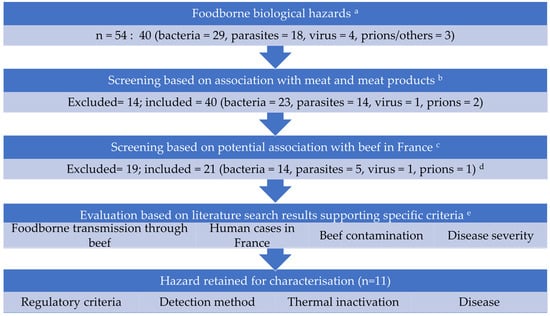
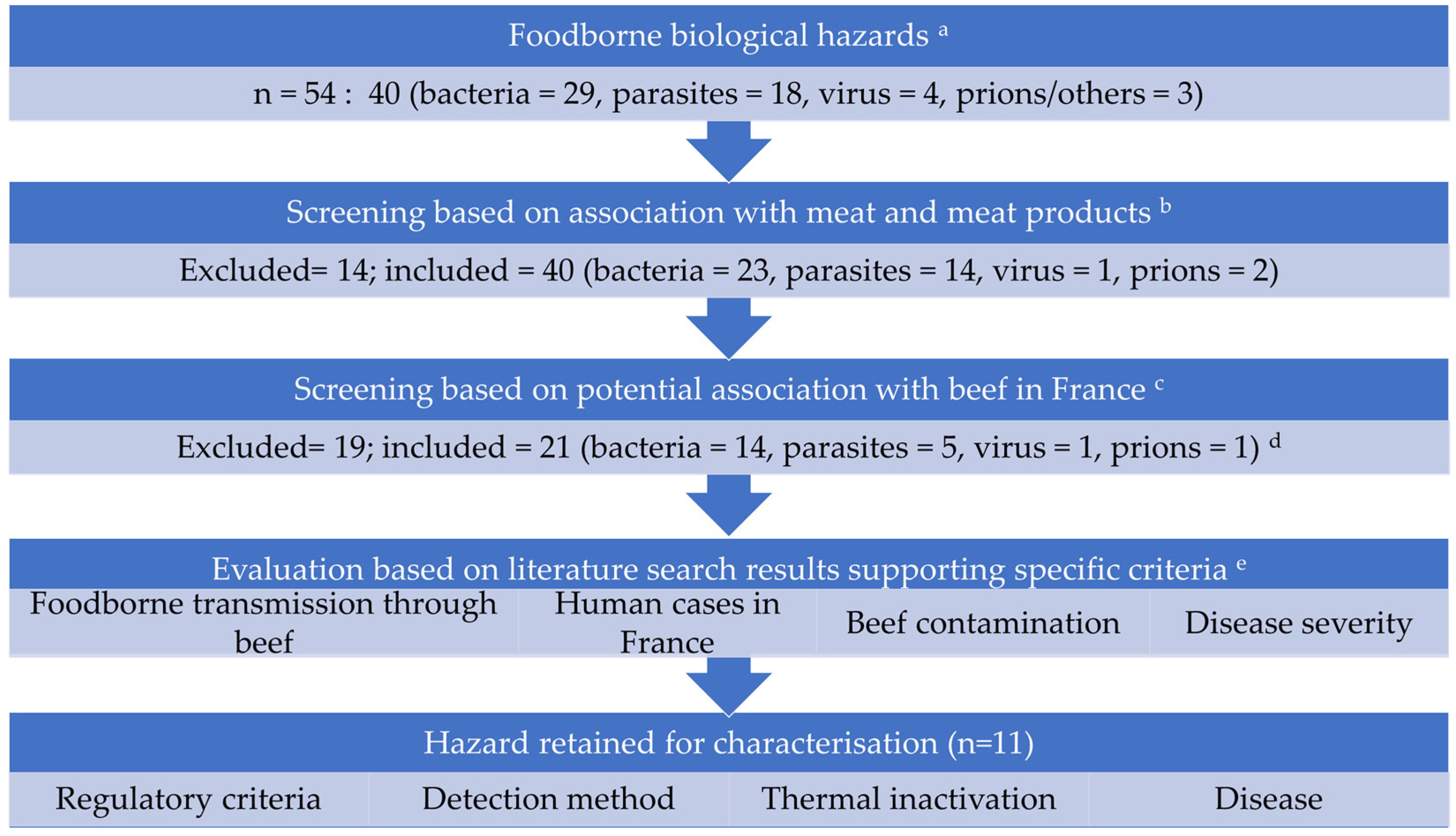
The screening and selection process of hazards has been shown in Figure 1. The first list of 54 foodborne biological hazards in France was derived from Audiat-Perrin et al. [12] (Supplementary Table S1). That study derived the list from an initial dataset of 335 biological hazards relevant to human health from the Belgian Scientific Institute of Public Health [13], and then screened based on food transmissibility and applied four filters: EU regulations, ANSES datasheets, EFSA zoonoses reports (2015–2016), or French HACCP guides [12]. Our initial expert evaluation showed that 40 of these hazards had a meat association for their transmission. Further, 21 had a justifiable beef association. Three more biological hazards (Sarcocystis spp., Bacillus anthracis, and Burkholderia pseudomallei) were considered at this stage based on their appearance in the previous beef-associated hazard list in France [6,11].
Figure 1.
Complete process of screening and selection of biological hazards associated with beef consumption in France. a List retrieved from Audiat-Perrin et al. [12]. b Pathogens in Food [14]; c screening based on evidence from Tesson et al. [7], Pathogens in Food [14], Fosse and Magras [6]; d three additional hazards were added based on previous reports by Fosse et al. [11]; e decision based on evidence from a second-stage literature search on Web of Science, Scopus, and PubMed, using the keywords (France AND beef AND hazard).
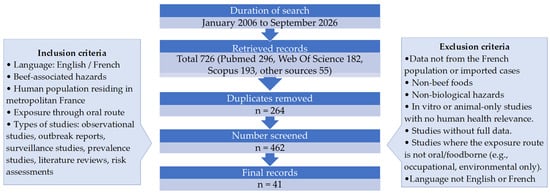
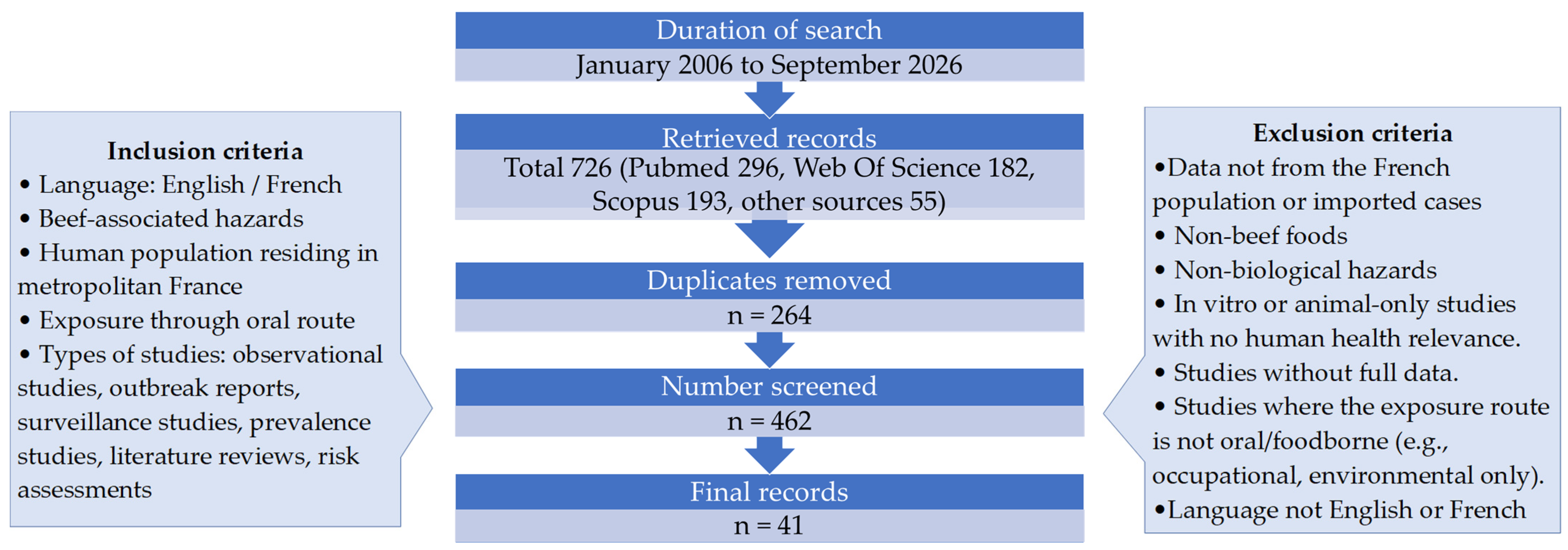
The second-stage literature search was conducted in Web of Science, Scopus, and PubMed (Figure 2). Search strategies combined terms related to foodborne hazards, beef, cattle, and France using Boolean operators (Supplementary Table S2). Records published from January 2006 to September 2026 were considered. Two reviewers (M.F. and E.K.) screened the literature, and consensus was reached on conflicting selections through discussion among all researchers. The selected studies (n = 41; Supplementary Table S3) served as a reference to evaluate 24 hazards according to evidence of foodborne transmission through beef, occurrence of human cases in France, documented contamination of beef or edible bovine tissues, potential disease severity, and availability of data for hazard characterization.
Figure 2.
Literature search steps to select the evidence for evaluation of the pre-selected list of biological hazards.
This approach allowed for the exclusion of certain hazards to finally obtain a list of those retained. Finally, microbiological criteria in regulations, the presence or absence of standardized methods, detection methods, and D and z values were identified from the literature and ANSES’s hazard fact sheets.
Overall, two categories of evidence were considered: (i) France-specific epidemiological and surveillance evidence was used to assess national relevance; (ii) international studies, challenge tests, and laboratory investigations were considered when characterizing beef contamination, detection methods, thermal resistance, and control measures.
3. Results
As part of our analysis of the 24 foodborne biological hazards (Table 1), detailed explanations were provided regarding the reasons for excluding each of the 13 hazards that were not retained as beef-associated foodborne biological hazards in France (Table 2). In parallel, a specific characterization was carried out for the 11 hazards that were retained (Table 3).
Table 1.
Selection of foodborne biological hazards for their relevance to beef consumption in France.
Table 2.
Reasons for not retaining selected biological hazards for detailed characterization.
Table 3.
Characterization, detection, and thermal control of biological hazards retained in relation to beef consumption in France *.
4. Discussion
The qualitative hazard-profiling approach retained 11 biological hazards for detailed consideration in relation to beef consumption in metropolitan France. They included nine bacteria and two parasites, depicting the variety of contamination routes and control requirements across the beef chain. The strength and nature of the evidence varied among hazards. For example, EHEC (a clinically significant subset of shiga-toxin-producing E. coli), S. enterica, Toxoplasma gondii, Campylobacter, Listeria monocytogenes, and Taenia saginata were supported by direct evidence from French cattle, beef, or human epidemiology, whereas the relevance of hazards such as Staphylococcus aureus, Clostridium perferigins, Yersinia enterocolitica, and Bacillus cereus was based more strongly on their occurrence in meat products or processing environments, biological plausibility, and availability of characterization data. Although there was no recent evidence of Clostridium botulinum caused and beef-associated intoxications in humans in France, it was retained based on its importance in potential contamination of raw and processed beef products. Nevertheless, retention of these hazards in the profile does not mean that they contribute equally to human disease [2]. Their public-health significance depends on their prevalence and concentration in beef, the type of meat product involved, consumer preparation practices, disease severity and the susceptibility of the exposed population, and the effectiveness of existing regulatory controls [7].
All identified hazards may contaminate and persist in the meat chain through various routes. Some bacterial hazards such as STEC, Campylobacter spp., and non-typhoidal Salmonella are primarily associated with cattle reservoirs and contamination during slaughter or carcass dressing [7,11]. Meanwhile, L. monocytogenes is more relevant to processed or ready-to-eat products because post-processing contamination and growth during refrigerated storage may influence exposure. C. botulinum, C. perfringens, B. cereus, and S. aureus require consideration of storage, cooling, reheating, and toxin or spore formation rather than contamination alone [30,43]. On the contrary, T. gondii and T. saginata are tissue-associated parasites whose control depends on animal infection, inspection, and inactivation of infective tissue stages [64,66]. Therefore, the prevention of biological hazards associated with beef requires harmonized controls involving slaughter hygiene, sanitation, maintenance of the cold chain, prevention of cross-contamination, and appropriate food preparation [95].
The product category of beef is also important when interpreting risk. Contamination of intact cuts is generally concentrated on the surface, whereas mincing redistributes surface contamination throughout the product and mechanical tenderization may transfer surface contamination into deeper tissues [8]. Therefore, minced and raw or lightly cooked beef preparations necessitate stringent control of raw materials, handling, and internal cooking conditions. However, we did not evaluate the product-specific contamination by biological hazards, and thus, future studies should address this limitation.
This analysis also revealed differences in the availability of microbiological criteria, standardized detection methods, and thermal-control information. ANSES provides biological-hazard fact sheets to support food-safety management and the preparation of guides to good hygiene practice, but the available information is generally organized by individual hazard rather than by a specific food chain [10]. For some biological hazards, standardized culture or molecular methods are available, whereas others require toxin detection, tissue digestion, bioassays, or non-standardized molecular approaches. Molecular detection should be interpreted cautiously because the mere finding of DNA does not necessarily demonstrate the presence of viable or infective organisms.
The thermal inactivation values also require careful interpretation. D-values and z-values depend on various factors including microbial strain or biological form, food matrices, pH, water activity, lipid content, and experimental conditions [26]. Moreover, the inactivation values for vegetative cells, spores, toxins, cysts, or parasitic stages are not directly interchangeable [96]. Consequently, the values presented in Table 3 should be regarded as characterization data rather than universal recommendations. Likewise, the microbiological criteria should be linked to the specific beef product form, processing stage, and sampling plan to which they apply.
The present profile is complementary to the recent French framework developed by ANSES for prioritising biological and chemical food-hazard combinations in the beef-meat sector [9]. ANSES’s assessment defines beef-product categories, evaluates relevant food-hazard combinations, applies public-health criteria, and includes multicriteria prioritisation and uncertainty analysis. The present study, however, takes a hazard-centred approach and consolidates information on disease outcomes, analytical methods, microbiological criteria, and thermal-inactivation parameters. However, the absence of systematic product-level characterization limits direct comparison with the ANSES results. It should therefore be interpreted as accessible hazard-characterization and laboratory information rather than a substitute for the more extensive official prioritisation framework.
Some retained biological hazards, e.g., S. aureus and Yersinia enterocolitica, have not been reported in any recent beef-associated foodborne outbreaks; however, recent reports have highlighted the presence of Y. enterocolitica in slaughterhouses [56] and S. aureus in processed meat products [52]. Considering these documented occurrences in beef, their ability to cause human illness, and the availability of relevant characterization data, these hazards were retained for detailed consideration. Some previous studies have also reported them as beef-associated biological hazards [11], while others have not prioritized them [4,7,12].
This review has several limitations. Hazard selection was qualitative and relied on the availability of evidence regarding foodborne transmission, association with beef, occurrence in France, disease severity, and availability of characterization data. Reliance on preexisting hazard inventory may have resulted in the omission and non-prioritisation of new, rare, emerging, or underdiagnosed hazards. Moreover, heterogeneity in investigations, food categories, analytical methods, and geographic settings may have limited direct comparison across sources. Overall, this review primarily addresses hazard identification and selected aspects of hazard characterization; it does not include exposure assessment, dose-response modelling, or quantitative risk characterization.
5. Conclusions
This qualitative literature-based study retained 11 biological hazards for detailed consideration in association with beef consumption in France and consolidated information on their occurrence, detection, microbiological criteria, and thermal behavior. These hazards should not be interpreted as representing equivalent levels of risk, because their public-health importance depends on product-specific exposure, epidemiological attribution, disease severity, and the effectiveness of existing controls. The profile may support surveillance planning, laboratory-method selection, and hygiene controls across the beef chain while providing a basis for more detailed risk assessments. Future research should focus on product-specific prevalence and contamination data, improve attribution of human cases to beef, and validate detection and thermal-inactivation methods in representative beef matrices. Periodic updates will be needed to account for emerging hazards, new surveillance evidence, changes in consumption, and evolving regulatory requirements.
Supplementary Materials
The following supporting information can be downloaded at: https://www.mdpi.com/article/10.3390/hygiene6040088/s1, Table S1: Foodborne biological hazards and their transmission through meat and/or beef; Table S2: Number of studies from research queries; Table S3: Information sources retrieved from literature search.
Author Contributions
Conceptualization, M.F. and M.T.M.; methodology, M.F. and E.K.; validation, M.F.; formal analysis, M.T.M.; investigation, E.K.; resources, M.T.M.; data curation, M.F. and E.K.; writing—original draft preparation, M.F. and E.K.; writing—review and editing, M.T.M.; visualization, E.K.; supervision, M.F. and M.T.M.; project administration, M.T.M.; All authors have read and agreed to the published version of the manuscript.
Funding
The APC was funded by the research support program of Alfort National Veterinary School, France.
Institutional Review Board Statement
Not applicable.
Informed Consent Statement
Not applicable.
Data Availability Statement
The original contributions presented in this study are included in the article/Supplementary Materials. Further inquiries can be directed to the corresponding author.
Acknowledgments
The authors acknowledge the student support from the Master One Health program at the University of Paris East, Creteil, and resources provided by the Alfort National Veterinary School, Maisons-Alfort.
Conflicts of Interest
The authors declare no conflicts of interest.
References
- Agreste–FranceAgriMer. 2025, An Increase in Consumption of Meat in France and a Growing Dependence on Imports [en 2025, Une Hausse de la Consommation de Viande en France et Une Dépendance Croissante Aux Importations]. In Conjoncture—Synthèses; Agreste, la Statistique Agricole: Paris, France, 2026; pp. 1–6. [Google Scholar]
- Mota, J.D.O.; Guillou, S.; Pierre, F.; Membré, J.-M. Public Health Risk-Benefit Assessment of Red Meat in France: Current Consumption and Alternative Scenarios. Food Chem. Toxicol. 2021, 149, 111994. [Google Scholar] [CrossRef] [Scilit]
- Van Cauteren, D.; Le Strat, Y.; Sommen, C.; Bruyand, M.; Tourdjman, M.; Da Silva, N.J.; Couturier, E.; Fournet, N.; De Valk, H.; Desenclos, J.-C. Estimated Annual Numbers of Foodborne Pathogen–Associated Illnesses, Hospitalizations, and Deaths, France, 2008–2013. Emerg. Infect. Dis. 2017, 23, 1486–1492. [Google Scholar] [CrossRef] [Scilit]
- Mota, J.D.O.; Guillou, S.; Pierre, F.; Membré, J.-M. Quantitative Assessment of Microbiological Risks Due to Red Meat Consumption in France. Microb. Risk Anal. 2020, 15, 100103. [Google Scholar] [CrossRef] [Scilit]
- Fournier, L.; Horrigue, I.; Laurent, E.; Billecoq, I.; Jones, G.; Tourdjman, M.; Chereau, F.; Silva, N.J.D.; de Valk, H.; France, S. Publique Surveillance of Foodborne Outbreaks, Data of Mandatory Declaration, 2023 [Surveillance des Toxi-Infections Alimentaires Collectives (TIAC), Données de la Déclaration Obligatoire, 2023]; Santé Publique France: Saint-Maurice, France, 2026; p. 11.
- Fosse, J.; Magras, C. Biological Hazards and Meat Consumption [Dangers Biologiques et Consommation des Viandes], 1st ed.; Éditions Tec & Doc: Paris, France, 2004; ISBN 2-7430-0663-3. [Google Scholar]
- Tesson, V.; Federighi, M.; Cummins, E.; de Oliveira Mota, J.; Guillou, S.; Boué, G. A Systematic Review of Beef Meat Quantitative Microbial Risk Assessment Models. Int. J. Environ. Res. Public Health 2020, 17, 688. [Google Scholar] [CrossRef] [Scilit]
- Khalid, T.; Hdaifeh, A.; Federighi, M.; Cummins, E.; Boué, G.; Guillou, S.; Tesson, V. Review of Quantitative Microbial Risk Assessment in Poultry Meat: The Central Position of Consumer Behavior. Foods 2020, 9, 1661. [Google Scholar] [CrossRef] [Scilit]
- ANSES. AVIS1 de l’Agence Nationale de Sécurité Sanitaire de L’alimentation, de L’environnement et du Travail Relatif au Développement et à la Mise en Place d’un Outil de Priorisation des Risques Biologiques et Chimiques Liés Aux Aliments. Partie 2: Identification et Renseignement des Critères Relatifs Aux Couples Aliment-Danger Biologique et Chimique de la Filière «Viandes Bovines»; Saisine N° 2023-AUTO-0020—PrioR (Partie 2); ANSES: Maisons-Alfort, France, 2026.
- ANSES. Fiches de Dangers Biologiques Transmissibles par les Aliments. Available online: https://www.anses.fr/fr/content/fiches-de-dangers-biologiques-transmissibles-par-les-aliments (accessed on 10 September 2026).
- Fosse, J.; Seegers, H.; Magras, C. Prioritising the risk of foodborne zoonoses using a quantitative approach: Application to foodborne bacterial hazards in pork and beef. Rev. Sci. Tech. 2008, 27, 643–655. [Google Scholar]
- Audiat-Perrin, F.; Guillier, L.; Augustin, J.-C.; Bornert, G.; Federighi, M.; Gautier, M.; Jourdan-da Silva, N.; Pouillot, R.; Merad, M.; on behalf of the Anses Working Group on Prioritization of Food Risks; et al. Into the Jungle of Biological Agents of Foodborne Diseases: Time to Put Some Order for the French Risk Manager. Foodborne Pathog. Dis. 2024, 21, 536–545. [Google Scholar] [CrossRef] [Scilit]
- Belgian Biosafety Server Tools—Belgian Classification for Micro-Organisms Based on Their Biological Risks. Available online: https://www.biosafety.be/content/tools-belgian-classification-micro-organisms-based-their-biological-risks (accessed on 23 September 2026).
- Gonzales-Barron, U.; Faria, A.S.; Thebault, A.; Guillier, L.; Mendes, L.R.; Silva, L.R.; Messens, W.; Kooh, P.; Cadavez, V. Pathogens-in-Foods (PIF): An Open-Access European Database of Occurrence Data of Biological Hazards in Foods. Microb. Risk Anal. 2025, 29, 100342. [Google Scholar] [CrossRef] [Scilit]
- Sante Publique France Anthrax [Charbon]. Available online: https://www.santepubliquefrance.fr/en/charbon/data (accessed on 6 October 2026).
- Elbarbary, N.; Rhouma, N.R.; Abdelhafeez, M.M.; Almutairi, L.A.; Al-Doaiss, A.A.; Ahmed, A.E.; El-Hawary, S.F.; Dandrawy, M.K.; Bekhit, M.M.; Darwish, W.S.; et al. Bacillus Cereus in Meat Products: Prevalence, Toxins Profile, Antibiogram Profile, and Antimicrobial Activity of Apple Cider Vinegar. Ital. J. Food Sci. 2025, 37, 255–256. [Google Scholar] [CrossRef] [Scilit]
- Glasset, B.; Herbin, S.; Guillier, L.; Cadel-Six, S.; Vignaud, M.-L.; Grout, J.; Pairaud, S.; Michel, V.; Hennekinne, J.-A.; Ramarao, N.; et al. Bacillus Cereus-Induced Food-Borne Outbreaks in France, 2007 to 2014: Epidemiology and Genetic Characterisation. Eurosurveillance 2016, 21, 30413. [Google Scholar] [CrossRef] [Scilit]
- Mailles, A.; Rautureau, S.; Horgne, J.M.L.; Poignet-Leroux, B.; d’Arnoux, C.; Dennetière, G.; Faure, M.; Lavigne, J.P.; Bru, J.P.; Garin-Bastuji, B. Re-Emergence of Brucellosis in Cattle in France and Risk for Human Health. Eurosurveillance 2012, 17, 20227. [Google Scholar] [CrossRef] [Scilit]
- Sante Publique France Brucellosis Data. Available online: https://www.santepubliquefrance.fr/en/brucellose/data (accessed on 6 October 2026).
- Mercier, I. Incidence of Melioidosis in France from 2012 to 2018 [Incidence de la Mélioïdose en France de 2012 à 2018]. Doctoral Thesis, Université de Bretagne Occidentale, Brest, France, 2020. [Google Scholar]
- Gauthier, J.; Gérôme, P.; Defez, M.; Neulat-Ripoll, F.; Foucher, B.; Vitry, T.; Crevon, L.; Valade, E.; Thibault, F.M.; Biot, F.V. Melioidosis in Travelers Returning from Vietnam to France. Emerg. Infect. Dis. 2016, 22, 1671–1673. [Google Scholar] [CrossRef] [Scilit]
- Gallay, A.; Bousquet, V.; Siret, V.; Prouzet-Mauléon, V.; De Valk, H.; Vaillant, V.; Simon, F.; Le Strat, Y.; Mégraud, F.; Desenclos, J.-C. Risk Factors for Acquiring Sporadic Campylobacter Infection in France: Results from a National Case-Control Study. J. Infect. Dis. 2008, 197, 1477–1484. [Google Scholar] [CrossRef] [Scilit]
- Thépault, A.; Poezevara, T.; Quesne, S.; Rose, V.; Chemaly, M.; Rivoal, K. Prevalence of Thermophilic Campylobacter in Cattle Production at Slaughterhouse Level in France and Link Between C. jejuni Bovine Strains and Campylobacteriosis. Front. Microbiol. 2018, 9, 471. [Google Scholar] [CrossRef] [Scilit]
- Haddad, N.; Tareb, R.; Federighi, M. Campylobacter; Société Française de Microbiologie: Paris, France, 2024; ISBN 978-2-87805-042-4. [Google Scholar]
- Le Bouquin, S.; Lucas, C.; Souillard, R.; Le Maréchal, C.; Petit, K.; Kooh, P.; Jourdan-Da Silva, N.; Meurens, F.; Guillier, L.; Mazuet, C. Human and Animal Botulism Surveillance in France from 2008 to 2019. Front. Public Health 2022, 10, 1003917. [Google Scholar] [CrossRef] [Scilit]
- Munir, M.T.; Mtimet, N.; Guillier, L.; Meurens, F.; Fravalo, P.; Federighi, M.; Kooh, P. Physical Treatments to Control Clostridium botulinum Hazards in Food. Foods 2023, 12, 1580. [Google Scholar] [CrossRef] [Scilit]
- Sante Publique France Botulism. Available online: https://www.santepubliquefrance.fr/en/botulisme/data (accessed on 3 November 2026).
- Souillard, R.; Rouxel, S.; Dorenlor, V.; Kuntz, G.; Mahé, F.; Poezevara, T.; Eono, F.; Avouac, A.; Kerphérique, S.; Jambou, L.; et al. Monitoring of Clostridium botulinum in Poultry and Cattle Manure During Spreading Operations. Toxins 2026, 18, 406. [Google Scholar] [CrossRef] [Scilit]
- Fosse, J.; Seegers, H.; Magras, C. Foodborne Zoonoses Due to Meat: A Quantitative Approach for a Comparative Risk Assessment Applied to Pig Slaughtering in Europe. Vet. Res. 2008, 39, 1–16. [Google Scholar] [CrossRef] [Scilit]
- Tran, C.; Diancourt, L.; Maladen, V.; Le Bouquin, S.; Ledormand, P.; Feurer, C.; Le Maréchal, C.; Mtimet, N.; Mazuet, C.; Guillier, L.; et al. Potential Dissemination and Persistence of Clostridium perfringens along the Slaughtering Process in French Cattle, Pig or Poultry Slaughterhouses. Int. J. Food Microbiol. 2027, 462, 112037. [Google Scholar] [CrossRef] [Scilit]
- Tran, C.; Poezevara, T.; Maladen, V.; Guillier, L.; Mtimet, N.; Malayrat, C.; Coadou, T.; Jambou, L.; Rouxel, S.; Le Bouquin, S.; et al. Isolation Rate, Genetic Diversity, and Toxinotyping of Clostridium perfringens Isolated from French Cattle, Pig or Poultry Slaughterhouses. Food Microbiol. 2026, 133, 104898. [Google Scholar] [CrossRef] [Scilit]
- Johnson, R.; Mills, J.; Pittet, J.-L.; Rannou, M.; Bird, P. Evaluation of the GENE-UP® EHEC Detection Method for the Detection of Enterohemorrhagic E. coli in Select Foods: Collaborative Study: First Action Method 2020.06. J. AOAC Int. 2021, 104, 1072–1083. [Google Scholar] [CrossRef] [Scilit]
- Krug, C.; Jourdan-Da Silva, N.; Tourdjman, M.; Mariani-Kurkdjian, P.; Cointe, A.; Lefèvre, S.; Bélichon, S.; Postic, C.; Françon, M.; Herber, H.; et al. Nationwide Outbreak of Shiga Toxin-Producing Escherichia coli Infections Associated with Frozen Pizzas, France, 2022. Eurosurveillance 2026, 31, 2500506. [Google Scholar] [CrossRef] [Scilit]
- Institut Pasteur. Escherichia coli Food Poisoning Outbreak: Update on the Epidemiological Situation. Available online: https://www.pasteur.fr/en/whats-new/latest-news/news/escherichia-coli-food-poisoning-outbreak-update-epidemiological-situation (accessed on 3 November 2026).
- Mazuy-Cruchaudet, C.; Bavai, C.; Fach, P.; Loukiadis, E. Prevalence of the 7 Major Serogroups of Enterohemorrhagic Escherichia coli (EHEC) in Fresh Minced Beef in France: A Novel Real-Time PCR Strategy for Their Early Detection in Food; Zoonoses and Public Health: Amsterdam, The Netherlands, 2012; Volume 59, p. 13. [Google Scholar]
- de Larminat, J.; La, K.; Bidet, P.; Birgy, A.; Liguori, S.; Phlipaux, P.; Courroux, C.; Crombé, F.; Blanco, J.; Coppo, P.; et al. Hemolytic Uremic Syndrome Outbreak in Adults and Shiga Toxin–Producing Escherichia coli Negative for Locus of Enterocyte Effacement, France, 2025. Emerg. Infect. Dis. J. 2026, 32, 592–602. [Google Scholar] [CrossRef] [Scilit]
- Bibbal, D.; Loukiadis, E.; Kérourédan, M.; Ferré, F.; Dilasser, F.; de Garam, C.P.; Cartier, P.; Oswald, E.; Gay, E.; Auvray, F.; et al. Prevalence of Carriage of Shiga Toxin-Producing Escherichia coli Serotypes O157:H7, O26:H11, O103:H2, O111:H8, and O145:H28 among Slaughtered Adult Cattle in France. Appl. Environ. Microbiol. 2015, 81, 1397–1405. [Google Scholar] [CrossRef] [Scilit]
- Auvray, F.; Lecureuil, C.; Taché, J.; Leclerc, V.; Deperrois, V.; Lombard, B. Detection, Isolation and Characterization of Shiga Toxin-Producing Escherichia coli in Retail-Minced Beef Using PCR-Based Techniques, Immunoassays and Colony Hybridization. Lett. Appl. Microbiol. 2007, 45, 646–651. [Google Scholar] [CrossRef] [Scilit]
- Wi, Y.M.; Shin, J.H.; Choi, J.Y.; Shin, J.M.; Jeon, C.H.; Kim, S.-H.; Kim, Y.; Ko, K.S. High Prevalence of Asymptomatic Enterotoxigenic Escherichia coli Carriers among Food Handlers in a Hospital Foodborne Outbreak. J. Infect. Public Health 2026, 19, 103194. [Google Scholar] [CrossRef] [Scilit]
- Fravalo, P.; Auvray, F.; Boni, M.; Borges, F.; Bornert, G.; Carlin, F.; Chubilleau, C.; Coton, M.; Daube, G.; Desriac, N.; et al. Opinion of the French Agency for Food, Environmental and Occupational Health & Safety (ANSES) on Defining Pathogenic Strains of Shiga Toxin-Producing Escherichia coli. Food Risk Assess Eur. 2025, 3, 0065E. [Google Scholar] [CrossRef] [Scilit]
- Balière, C. Les Escherichia coli Potentiellement Pathogènes Dans L’environnement Littoral: Cas des STEC et des EPEC. Ph.D. Thesis, Université de Bretagne Occidentale, Brest, France, 2016. [Google Scholar]
- Sante Publique France Listériose en France. Période 1999–2024; Santé Publique France: Saint-Maurice, France, 2025. [Google Scholar]
- Roussel, S.; Leclercq, A.; Santolini, J.; Agbessi, A.; Chenal-Francisque, V.; Lailler, R.; Lecuit, M.; Pihier, N.; Brisabois, A. Surveillance of Listeria monocytogenes in Food [Surveillance des Listeria monocytogenes Dans les Aliments]. Bull. Epidémiologique Hebd. 2012, 50, 51–56. [Google Scholar]
- French Ministry of Agriculture and Food Sovereignty. Bovine Tuberculosis: The Situation in France [Tuberculose Bovine: La Situation en France]. Available online: https://agriculture.gouv.fr/tuberculose-bovine-la-situation-en-france (accessed on 8 October 2026).
- Bonifait, L.; Thépault, A.; Baugé, L.; Rouxel, S.; Le Gall, F.; Chemaly, M. Occurrence of Salmonella in the Cattle Production in France. Microorganisms 2021, 9, 872. [Google Scholar] [CrossRef] [Scilit]
- Michel, V.; De Sousa Violante, M.; Feurer, C.; Mistou, M.-Y.; Mallet, L. Epidemiology of Salmonella in the Livestock Sector Using a Genomic approachEpidemiology of Salmonella in the Livestock Sector Using a Genomic approach. Agron. Innov. 2024, 88, 137–149. [Google Scholar] [CrossRef]
- Laukkanen-Ninios, R.; Foddai, A.; Sandberg, M.; Nagel-Alne, G.E.; Bonardi, S.; Roasto, M.; Kautto, A.H.; Blagojevic, B.; Fredriksson-Ahomaa, M.; Barco, L.; et al. Surveillance and Control of Salmonella Spp. in Bovine Meat Safety Assurance Systems in Nine European Countries. Food Control 2027, 191, 112421. [Google Scholar] [CrossRef] [Scilit]
- Wang, Z.; Xu, Q.; Liu, S.; Liu, Y.; Gao, Y.; Wang, M.; Zhang, L.; Chang, H.; Wei, Q.; Sui, Z. Rapid and Multiplexed Quantification of Salmonella, Escherichia coli O157:H7, and Shigella flexneri in Ground Beef Using Flow Cytometry. Talanta 2022, 238, 123005. [Google Scholar] [CrossRef] [Scilit]
- Warmate, D.; Onarinde, B.A. Food Safety Incidents in the Red Meat Industry: A Review of Foodborne Disease Outbreaks Linked to the Consumption of Red Meat and Its Products, 1991 to 2021. Int. J. Food Microbiol. 2023, 398, 110240. [Google Scholar] [CrossRef] [Scilit]
- Institut Pasteur. Shigellosis: Symptoms, Treatment, Prevention. Available online: https://www.pasteur.fr/en/your-health/understanding-diseases/diseases-z/shigellosis (accessed on 3 November 2026).
- Warren, B.R.; Parish, M.E.; Schneider, K.R. Shigella as a Foodborne Pathogen and Current Methods for Detection in Food. Crit. Rev. Food Sci. Nutr. 2006, 46, 551–567. [Google Scholar] [CrossRef] [Scilit]
- Coton, E.; Dubée, M.; Pawtowski, A.; Denoyelle, C.; Mounier, J. Microbiota Associated with Commercial Dry-Aged Beef in France. Food Res. Int. 2024, 181, 114118. [Google Scholar] [CrossRef] [Scilit]
- Pinamonti, D.; Manzano, M.; Maifreni, M.; Bianco, S.; Domi, B.; Ferrin, A.; Anba-Mondoloni, J.; Dechamps, J.; Briandet, R.; Vidic, J. Prevalence and Characterization of Staphylococcus aureus Isolated from Meat and Milk in Northeastern Italy. J. Food Prot. 2025, 88, 100442. [Google Scholar] [CrossRef] [Scilit]
- Esnault, E.; Labbé, A.; Houdayer, C.; Denis, M. Yersinia enterocolitica Prevalence, on Fresh Pork, Poultry and Beef Meat at Retail Level, in France. In Proceedings of the International Conference on the Epidemiology and Control of Biological, Chemical and Physical Hazards in Pigs and Pork, Portland, ME, USA, 9–12 September 2013; Iowa State University, Digital Press: Portland, ME, USA, 2013; pp. 72–75. [Google Scholar]
- Le Guern, A.-S.; Martin, L.; Savin, C.; Carniel, E. Yersiniosis in France: Overview and Potential Sources of Infection. Int. J. Infect. Dis. 2016, 46, 1–7. [Google Scholar] [CrossRef] [Scilit]
- FranceAgriMer. EVANHOTY: Evaluation of the Involvement of the Pig and Beef Sectors in Human Yersiniosis in France and the Evolution of Yersinia Enterocolitica Using Discriminating Molecular Techniques [EVANHOTY: Évaluation de L’implication des Filières Porcine et Bovine Dans les Yersinioses Humaines en France et de L’évolution de Yersinia Enterocolitica par L’utilisation de Techniques Moléculaires Discriminantes]; FranceAgriMer: Montreuil, France, 2024.
- Costa, D.; Razakandrainibe, R.; Valot, S.; Vannier, M.; Sautour, M.; Basmaciyan, L.; Gargala, G.; Viller, V.; Lemeteil, D.; Ballet, J.-J.; et al. Epidemiology of Cryptosporidiosis in France from 2017 to 2019. Microorganisms 2020, 8, 1358. [Google Scholar] [CrossRef] [Scilit]
- Costa, D.; Razakandrainibe, R.; Sautour, M.; Valot, S.; Basmaciyan, L.; Gargala, G.; Lemeteil, D. French national network on surveillance of human Cryptosporidiosis. Human Cryptosporidiosis in Immunodeficient Patients in France (2015–2017). Exp. Parasitol. 2018, 192, 108–112. [Google Scholar] [CrossRef] [Scilit]
- Costa, D.; Razakandrainibe, R.; Basmaciyan, L.; Raibaut, J.; Delaunay, P.; Morio, F.; Gargala, G.; Villier, V.; Mouhajir, A.; Levy, B.; et al. A Summary of Cryptosporidiosis Outbreaks Reported in France and Overseas Departments, 2017–2020. Food Waterborne Parasitol. 2022, 27, e00160. [Google Scholar] [CrossRef] [Scilit]
- Hoffmann, S.; Devleesschauwer, B.; Aspinall, W.; Cooke, R.; Corrigan, T.; Havelaar, A.; Angulo, F.; Gibb, H.; Kirk, M.; Lake, R.; et al. Attribution of Global Foodborne Disease to Specific Foods: Findings from a World Health Organization Structured Expert Elicitation. PLoS ONE 2017, 12, e0183641. [Google Scholar] [CrossRef] [Scilit]
- Mammeri, M.; Polack, B. Giardiasis in Livestock [La Giardiose Chez Les Animaux de Production]. Nouv. Prat. Vét. Élev. Santé 2025, 17, 30–35. [Google Scholar] [CrossRef] [Scilit]
- Moniot, M.; Combes, P.; Costa, D.; Argy, N.; Durieux, M.-F.; Nicol, T.; Nourrisson, C.; Poirier, P. Simultaneous Detection of Sarcocystis hominis, S. Heydorni, and S. Sigmoideus in Human Intestinal Sarcocystosis, France, 2021–2024. Emerg. Infect. Dis. J. 2025, 31, 559–563. [Google Scholar] [CrossRef] [Scilit]
- Bertin, M.; Lemieux, D.; Rosero, A.; Albaric, O.; Oudot, N.; Willemse, C.; Chiesa, F.; Magras, C.; Capellier, J.M. Sarcocystis hominis Is Frequently Associated with Eosinophilic Myositis Lesions in Cattle [Sarcocystis hominis Est Fréquemment Associé Aux Lésions de Myosite Éosinophilique Chez les Bovins]. Renc. Rech. Rumin. 2014, 21, 321–324. [Google Scholar]
- Blaga, R.; Aubert, D.; Thébault, A.; Perret, C.; Geers, R.; Thomas, M.; Alliot, A.; Djokic, V.; Ortis, N.; Halos, L.; et al. Toxoplasma gondii in Beef Consumed in France: Regional Variation in Seroprevalence and Parasite Isolation. Parasite 2019, 26, 77. [Google Scholar] [CrossRef] [Scilit]
- Dupuy, C.; Morlot, C.; Gilot-Fromont, E.; Mas, M.; Grandmontagne, C.; Gilli-Dunoyer, P.; Gay, E.; Callait-Cardinal, M.-P. Prevalence of Taenia saginata Cysticercosis in French Cattle in 2010. Vet. Parasitol. 2014, 203, 65–72. [Google Scholar] [CrossRef] [Scilit]
- Dupuy, C.; Guillet, P.; Auge, M.; Serra, L.; Darnal, S.; Jeuffé, E.; Polack, B. Épidémiosurveillance de la Cysticercose Bovine en France: Situation en 2016. Bull. Epidémiologique 2019, 89, 6. [Google Scholar]
- Morignat, E.; Amat, J.-P.; Maignien, T.; Baron, T.; Méry, L. Bilan de la Surveillance de l’ESB en France en 2023. Bull. Epidémiologique 2024, 103, 1–4. [Google Scholar]
- Santé Publique France. Creutzfeldt-Jakob Disease. Available online: https://www.santepubliquefrance.fr/en/maladie-de-creutzfeldt-jakob/data (accessed on 22 October 2026).
- Lhomme, S.; Magne, S.; Perelle, S.; Vaissière, E.; Abravanel, F.; Trelon, L.; Hennechart-Collette, C.; Fraisse, A.; Martin-Latil, S.; Izopet, J.; et al. Clustered Cases of Waterborne Hepatitis E Virus Infection, France. Viruses 2023, 15, 1149. [Google Scholar] [CrossRef] [Scilit]
- Turlewicz-Podbielska, H.; Augustyniak, A.; Wojciechowski, J.; Pomorska-Mól, M. Hepatitis E Virus in Livestock—Update on Its Epidemiology and Risk of Infection to Humans. Animals 2023, 13, 3239. [Google Scholar] [CrossRef] [Scilit]
- Couturier, E.; Abravanel, F.; Figoni, J.; Van Cauteren, D.; Septfons, A.; Lhomme, S.; Durand, J.; Izopet, J.; De Valk, H. Surveillance de l’hépatite E en France, 2002–2016. Bull. Epidémiol Hebd. 2018, 28, 566–574. [Google Scholar]
- ISO 7932:2004/Amd 1:2020; Microbiology of Food and Animal Feeding Stuffs—Horizontal Method for the Enumeration of Presumptive Bacillus cereus—Colony-Count Technique at 30 °C. International Organization for Standardization (ISO): Geneva, Switzerland, 2020.
- ISO 18465:2017; Microbiology of the Food Chain—Quantitative Determination of Emetic Toxin (Cereulide) Using LC-MS/MS. International Organization for Standardization (ISO): Geneva, Switzerland, 2017.
- ISO 10272-1:2017/Amd 1:2023; Microbiology of the Food Chain—Horizontal Method for Detection and Enumeration of Campylobacter spp.—Part 1: Detection Method—Amendment 1: Inclusion of Methods for Molecular Confirmation and Identification of Thermotolerant Campylobacter spp., the Use of Growth Supplement in Preston Broth and Changes in the Performance Testing of Culture Media. International Organization for Standardization (ISO): Geneva, Switzerland, 2023.
- ISO 10272-2:2017/Amd 1:2023; Microbiology of the Food Chain—Horizontal Method for Detection and Enumeration of Campylobacter spp.—Part 2: Colony-Count Technique—Amendment 1: Inclusion of Methods for Molecular Confirmation and Identification of Thermotolerant Campylobacter spp. and Changes in the Performance Testing of Culture Media. International Organization for Standardization (ISO): Geneva, Switzerland, 2023.
- van Asselt, E.D.; Zwietering, M.H. A Systematic Approach to Determine Global Thermal Inactivation Parameters for Various Food Pathogens. Int. J. Food Microbiol. 2006, 107, 73–82. [Google Scholar] [CrossRef] [Scilit]
- ISO/TS 17919:2013; Microbiology of the Food Chain—Polymerase Chain Reaction (PCR) for the Detection of Food-Borne Pathogens—Detection of Botulinum Type A, B, E and F Neurotoxin-Producing Clostridia. International Organization for Standardization (ISO): Geneva, Switzerland, 2013.
- ISO 15213-2:2023; Microbiology of the Food Chain—Horizontal Method for the Detection and Enumeration of Clostridium spp.—Part 2: Enumeration of Clostridium perfringens by Colony-Count Technique. International Organization for Standardization (ISO): Geneva, Switzerland, 2023.
- ISO/TS 15213-3:2024; Microbiology of the Food Chain—Horizontal Method for the Detection and Enumeration of Clostridium spp.—Part 3: Detection of Clostridium perfringens. International Organization for Standardization (ISO): Geneva, Switzerland, 2024.
- ISO 16654:2001/Amd 2:2023; Microbiology of Food and Animal Feeding Stuffs—Horizontal Method for the Detection of Escherichia coli O157—Amendment 2: Inclusion of Performance Testing of All Culture Media and Reagents. International Organization for Standardization (ISO): Geneva, Switzerland, 2023.
- ISO/TS 13136:2012; Microbiology of Food and Animal Feed—Real-Time Polymerase Chain Reaction (PCR)-Based Method for the Detection of Food-Borne Pathogens—Horizontal Method for the Detection of Shiga Toxin-Producing Escherichia coli (STEC) and the Determination of O157, O111, O26, O103 and O145 Serogroups. International Organization for Standardization (ISO): Geneva, Switzerland, 2012.
- ISO 11290-1:2017/Amd 1:2026; Microbiology of the Food Chain—Horizontal Method for the Detection and Enumeration of Listeria Monocytogenes and of Listeria spp.—Part 1: Detection Method—Amendment 1: Inclusion of Storage of the Samples Before Analysis and Changes in the Control Strain for Performance Testing of Culture Media and Reagents. International Organization for Standardization (ISO): Geneva, Switzerland, 2026.
- ISO 11290-2:2017/Amd 1:2026; Microbiology of the Food Chain—Horizontal Method for the Detection and Enumeration of Listeria Monocytogenes and of Listeria spp.—Part 2: Enumeration Method—Amendment 1: Inclusion of Storage of the Samples before Analysis and Changes in the Control Strain for Performance Testing of Culture Media and Reagents. International Organization for Standardization (ISO): Geneva, Switzerland, 2026.
- ISO 6579-1:2017; Microbiology of the Food Chain—Horizontal Method for the Detection, Enumeration and Serotyping of Salmonella—Part 1: Detection of Salmonella spp. International Organization for Standardization (ISO): Geneva, Switzerland, 2017.
- ISO/TS 6579-2:2012; Microbiology of Food and Animal Feeding Stuffs—Horizontal Method for the Detection, Enumeration and Serotyping of Salmonella—Part 2: Enumeration by a Miniaturized Most Probable Number Technique. International Organization for Standardization (ISO): Geneva, Switzerland, 2012.
- NF U47-100; Animal Health Analysis Methods—Isolation and Identification of any Salmonella Serotype or Specified Salmonella Serotypes in the Animal Production Sector [Méthodes D’analyse en Santé Animale—Recherche par L’isolement et Identification de tout Sérovar ou de Sérovar(s) Spécifié(s) de Salmonelles dans L’environnement des Productions Animales]. Association Française de Normalisation (AFNOR): Paris, France, 2007.
- NF U47-102; Animal Health Analysis Methods—Isolation and Identification of Any Salmonella Serotype or Specified Salmonella Serotypes in Mammals [Méthodes D’analyse en Santé Animale—Isolement et Identification de tout Sérovar ou de Sérovar(s) Spécifié(s) de Salmonelles chez les Mammifères]. Association Française de Normalisation (AFNOR): Paris, France, 2008.
- McMinn, R.P.; King, A.M.; Milkowski, A.L.; Hanson, R.; Glass, K.A.; Sindelar, J.J. Processed Meat Thermal Processing Food Safety—Generating D-Values for Salmonella, Listeria monocytogenes, and Escherichia coli. Meat Muscle Biol. 2018, 2, 168–179. [Google Scholar] [CrossRef] [Scilit]
- ISO 10273:2017; Microbiology of the Food Chain—Horizontal Method for the Detection of Pathogenic Yersinia enterocolitica. International Organization for Standardization (ISO): Geneva, Switzerland, 2017.
- ISO/TS 18867:2015; Microbiology of the Food Chain—Polymerase Chain Reaction (PCR) for the Detection of Food-Borne Pathogens—Detection of Pathogenic Yersinia enterocolitica and Yersinia pseudotuberculosis. International Organization for Standardization (ISO): Geneva, Switzerland, 2015.
- ISO 6888-1:2021/Amd 1:2023; Microbiology of the Food Chain—Horizontal Method for the Enumeration of Coagulase-Positive Staphylococci (Staphylococcus aureus and Other Species)—Part 1: Method Using Baird-Parker Agar Medium—Amendment 1. International Organization for Standardization (ISO): Geneva, Switzerland, 2023.
- ISO 6888-2:2021/Amd 1:2023; Microbiology of the Food Chain—Horizontal Method for the Enumeration of Coagulase-Positive Staphylococci (Staphylococcus aureus and Other Species)—Part 2: Method Using Rabbit Plasma Fibrinogen Agar Medium—Amendment 1. International Organization for Standardization (ISO): Geneva, Switzerland, 2023.
- ISO 19020:2017; Microbiology of the Food Chain—Horizontal Method for the Immunoenzymatic Detection of Staphylococcal Enterotoxins in Foodstuffs. International Organization for Standardization (ISO): Geneva, Switzerland, 2017.
- Ozturk, S.; Huang, L.; Sheen, S.; Hwang, C.-A. Thermal Inactivation of Staphylococcus aureus in Ground Beef—Kinetic Analysis of Isothermal and Dynamic Heating with the Weibull Model1. Int. J. Food Microbiol. 2026, 459, 111916. [Google Scholar] [CrossRef] [Scilit]
- Augustin, J.; Kooh, P.; Bayeux, T.; Guillier, L.; Meyer, T.; Jourdan-Da Silva, N.; Villena, I.; Sanaa, M.; Cerf, O.; Blanchemanche, S.; et al. Contribution of Foods and Poor Food-Handling Practices to the Burden of Foodborne Infectious Diseases in France. Foods 2020, 9, 1644. [Google Scholar] [CrossRef] [Scilit]
- Munir, M.T.; Federighi, M. Control of Foodborne Biological Hazards by Ionizing Radiations. Foods 2020, 9, 878. [Google Scholar] [CrossRef] [Scilit]

Disclaimer/Publisher’s Note: The statements, opinions and data contained in all publications are solely those of the individual author(s) and contributor(s) and not of MDPI and/or the editor(s). MDPI and/or the editor(s) disclaim responsibility for any injury to people or property resulting from any ideas, methods, instructions or products referred to in the content. |
© 2026 by the authors. Licensee MDPI, Basel, Switzerland. This article is an open access article distributed under the terms and conditions of the Creative Commons Attribution (CC BY) license.