


Abstract
Transport cages used for live poultry constitute a major source of cross-contamination in slaughterhouses, particularly regarding Salmonella spp. The aim of this study was to evaluate the improvement of washing parameters—specifically temperature and detergent conductivity—in reducing Salmonella contamination as well other microbial parameters in turkey transport cages under industrial conditions. Six washing conditions were tested by combining three temperatures (40, 45, and 60 °C) and different detergent conductivities (0–4 mS/cm), using an alkaline chlorinated detergent. Microbiological analyses included Salmonella spp. and indicators such as mesophilic aerobic bacteria and Enterobacteriaceae, assessed before and after washing at three time points during the processing day. High initial contamination levels were observed in all cases. Results demonstrated a clear synergistic effect between temperature and detergent conductivity. The treatment at 60 °C and 2 mS/cm provided the most effective balance, achieving total elimination of Salmonella and significant reductions in indicator microorganisms without the need for maximum detergent concentration. Increasing conductivity beyond this level did not lead to substantial improvements. These findings support the optimization of washing parameters as a key prerequisite program within HACCP systems in poultry slaughterhouses.
1. Introduction
Foods of animal origin, and particularly poultry meat, represent one of the main sources of human salmonellosis [1]. Salmonella has been identified as the principal causative agent associated with multinational outbreaks (20 outbreaks with 849 cases) reported in the European Union in 2024 [2]. According to this report, and across all (not only multi-country), Salmonella foodborne outbreaks in the EU in 2024 were 1238, with 10164 cases, 1823 hospitalizations and 17 deaths. Nineteen outbreaks were related to broiler meat.
Within the European Union, and specifically in Spain, specific regulations have been developed for the control of foodborne zoonoses [3,4,5]. In turkey meat production, particular attention has been focused on the control of Salmonella spp. [6,7]. Reducing the presence of this microorganism throughout all stages of production is a priority objective [7]. High prevalence rates can only be effectively addressed through comprehensive management of the entire production process.
In slaughterhouses, all processes must emphasize the prevention of carcass contamination and the achievement of the highest hygienic standards, particularly with regard to reducing Salmonella prevalence. The monitoring of microbiological hygiene indicators, such as mesophilic aerobic bacteria and enterobacteria, at different stages of slaughter is an important tool for evaluating process performance. European regulations and international recommendations establish limits for these microorganisms in the final product [8].
In general, fecal contamination of carcasses during slaughter is considered the main source of microbiological hazards in poultry meat, including turkey. This contamination can spread from one carcass to another, making the prevention of contact with fecal material a critical control point within any HACCP system [9]. Regarding Salmonella, its complete elimination from poultry production environments may not be feasible; however, a significant reduction can be achieved through the implementation of appropriate control strategies within a comprehensive food safety plan based on HACCP principles, applied throughout the entire production chain up to consumption [10].
Concerning the role of different processing stages in carcass contamination, the effectiveness of cleaning and disinfection plans for facilities and equipment is of great importance from the moment birds are received at the slaughterhouse. Therefore, regular analytical evaluations are essential to verify the adequacy of installations prior to production, as residual contamination or the presence of biofilms may not be visually detectable and can constitute a significant hazard for food safety [11]. These authors have indicated that reliance solely on initial cleanliness, assessed through pre-operational inspections and microbiological analyses, is insufficient. During daily operations, tools and equipment may become contaminated, and it is very important to plan for regular cleaning measures during production processes, to keep a visual check on any dirt that accumulates during the working period, carrying out analyses to determine its accumulation during the production process [11]. White et al. [12] also consider that the poultry industry requires rapid and effective means of cleaning and disinfecting its facilities and resources.
Within this context, transport vehicles may act as disease transmission vectors if they are not properly cleaned and disinfected after unloading and before reuse. Transport cages used for broilers can become heavily contaminated with fecal material, contributing to the spread of pathogens between farms [13,14]. Furthermore, the transport of Salmonella-positive flocks leads to contamination of cages, which must therefore be cleaned and disinfected after each use to prevent cross-contamination of subsequent flocks [15]. In Spain, regulations require that vehicles used for transporting animals be cleaned, washed, and disinfected after unloading [16]. Transport cages must also meet specific requirements, including preventing the loss of excreta and feathers, allowing observation of animals, and being suitable for effective cleaning and disinfection before loading and after unloading [17].
Allen et al. [18] report that traditional cleaning systems for plastic poultry transport crates are insufficient to eliminate microbial contamination. White et al. [12] propose improvements including the use of disinfectants and foaming cleaning systems applied using compressed air foam systems (CAFSs).
To reduce Salmonella prevalence at the slaughterhouse level, and considering the contamination introduced by transport cages, it is necessary to evaluate measures such as optimizing washing parameters to reduce pathogen spread. This approach is part of prerequisite programs for cleaning and disinfection within HACCP systems, particularly in the initial stages of poultry slaughtering processes [14].
The use of transport cages can be divided into four stages: reception of live birds, unloading and transfer to the processing line, cleaning and disinfection of cages, and reloading of clean cages onto disinfected transport vehicles. The present study focuses on optimizing the cleaning and disinfection stage, based on standard procedures [19,20,21], including removal of coarse debris, application of detergents, rinsing, disinfection, and final rinsing.
Few studies have specifically addressed cleaning and disinfection processes for transport cages, although some have included cage contamination within broader studies. Some research has focused on Campylobacter [19]. Among the studies focusing most closely on transport crates, Zang et al. [22] conducted an evaluation of plastic crates inoculated with Salmonella Enteritidis, comparing the use of slightly acidic electrolyzed water with tap water; Atterbury et al. [13] propose an improved protocol that includes high-pressure nozzles, heated water and a greatly improved filtration system. Meanwhile, Dzieciolowski et al. [21] conducted a study under slaughterhouse conditions on the crates used to evaluate their cleaning and disinfection process.
Among the key parameters influencing cleaning efficiency, temperature and detergent conductivity are particularly important [23,24,25]. Temperature enhances degreasing and disinfection but is limited by the risk of corrosion in galvanized iron cages. Conductivity reflects detergent concentration, which must be carefully controlled to ensure effective cleaning without excessive chemical use. Although time is also a relevant factor, it is typically constrained by processing line speed and is therefore less flexible. Proper configuration of washing equipment, including nozzle number, orientation, and pressure, is also essential.
While traditional hygiene indicators in poultry slaughterhouses include mesophilic aerobic bacteria and Enterobacteriaceae [26], the control of pathogens such as Salmonella is critical, particularly in early processing stages.
The objective of this study was to evaluate improvements in transport cage cleaning by optimizing temperature and detergent conductivity, in order to reduce Salmonella contamination and other microbiological parameters in poultry slaughterhouses.
2. Materials and Methods
2.1. Experimental Design
Six washing conditions were evaluated using commercial Spectak BPCTM (Diversey, Fort Mill, SC, USA) (an alkaline chlorinated detergent primarily based on sodium hydroxide), classified and labeled according to Spanish regulation [27], based on two main parameters: temperature and conductivity. Three application temperatures were tested (40 °C, 45 °C, and 60 °C), and different conductivity levels were applied, ranging from no detergent use to 1, 2, and 4 mS/cm.
The relationship between detergent concentration and conductivity is shown in Table 1.
Table 1.
Relationship between detergent concentrations and the conductivity of the detergent used.
The washing process was performed under industrial conditions, following the operational speed of the processing line, with a total duration of approximately 1 min 45 s. The process consisted of three stages: (a) initial removal of solid material (water only), 30 s; (b) application of detergent, 40 s; (c) final rinsing (water only), 25 s.
Based on this procedure, six washing conditions were tested by combining different temperatures and conductivity levels, as described in Table 2.
Table 2.
Description of the washing conditions used.
In addition to visual inspection, which is always required in cleaning and disinfection verification procedures, microbiological control was carried out applying the following criteria for the microbiological parameters specified: Salmonella spp.: absence; mesophilic aerobic bacteria (MAB): 106 CFU/cm2; Enterobacteriaceae: 5 × 10³ CFU/cm2 [26].
2.2. Sampling Procedure
The study was conducted during winter, when there is greater accumulation of organic matter in cages due to higher humidity conditions in farms. Sampling was performed at three time points to evaluate the performance of the washing system over time: start of the process (t0); mid-process (t8): after 8 h of starting the slaughter step; end of process (t16): after 16 h.
For each condition, sampling was carried out on the same day. Three cages were analyzed before and after each washing condition. Surface samples were collected using sterile wipes (bioMérieux, Marcy-l’Étoile, France), individually packaged. Each wipe consisted of a sterile cotton cloth (200 × 250 mm) impregnated with an isotonic solution to prevent osmotic shock during sampling. Surface samples were collected using a sterile 10 × 10 cm template (100 cm2) placed on the selected area (three levels of each cage: upper, middle, and lower surfaces). Using a sterile pre-moistened swab or sponge, the entire delimited area was sampled by rubbing horizontally, vertically and diagonally while applying uniform pressure. Sampling was performed by rubbing the wipe over to obtain a representative sample. After sampling, each wipe was transferred into a sterile bag containing 225 mL of buffered peptone water. Subsequent microbiological analyses were then carried out according to the protocols described below.
2.3. Microbiological Analysis
2.3.1. Detection of Salmonella
Salmonella detection was performed using the ELFA (Enzyme-Linked Fluorescent Assay) technique with the VIDAS® system (bioMérieux, Madrid, Spain). Specifically, the VIDAS® UP Salmonella assay was used [14,28], which is an automated qualitative test for detecting Salmonella in food products, environmental samples, and primary production samples. In these ELFA assays, the enzyme alkaline phosphatase breaks down the substrate (4-methylumbelliferyl phosphate) into a fluorescent product (4-methylumbelliferone) [29]. Positive results were considered presumptive, according to Dwivedi et al. [30], and required confirmation using culture-based methods. Confirmation was performed by streaking samples onto a chromogenic selective medium (ASAP™ agar, bioMèrieux), followed by incubation at 37 ± 2 °C for 24 ± 3 h.
Characteristic colonies (pink-purple) were selected and confirmed using a latex agglutination test specific for Salmonella spp. (Salmonella spp. látex kit, bioMérieux ref. MGNF42).
2.3.2. Detection of Mesophilic Aerobic Bacteria (MAB) and Enterobacteriaceae
To determine the occurrence and count of MAB and Enterobacteriaceae, the TEMPO TVC and TEMPO EB tests (BioMérieux, Madrid, Spain) were used, in accordance with Crowley et al. and Owen et al. [31,32], respectively. Samples were inoculated into the culture medium vial, and once the incubation period had elapsed, they were transferred using a specific tube to a card containing 48 wells of three different volumes: 2.25, 22.5 and 225 mL. The card was sealed tightly and incubated for 40–48 h for MAB and 22–27 h for Enterobacteriaceae. The microorganisms present on the card hydrolyzed the substrate in the culture medium, causing a fluorescent signal to appear, being detected by the TEMPO reader. Depending on the number and type of positive wells, the TEMPO system automatically calculates the number of microorganisms using the Most Probable Number (MPN) method and expresses this as CFU/cm2.
2.4. Statistical Analysis
Statistical analyses were performed using SPSS 15.0 (IBM Company, Armonk, NY, USA) and Microsoft Excel (Microsoft 365, Redmond, DC, USA). Cochran’s Q test was used for Salmonella occurrence and non-parametric analysis (Kruskal–Wallis) was applied for microbial counts. Fisher’s exact test was used to assess the influence of conditions on the elimination of Salmonella.
3. Results
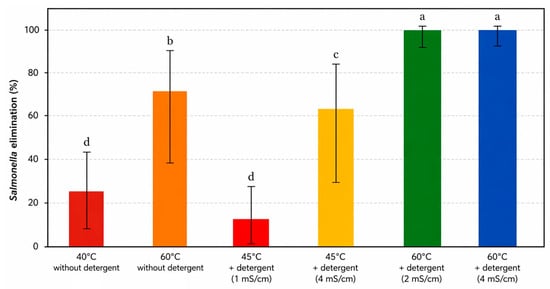
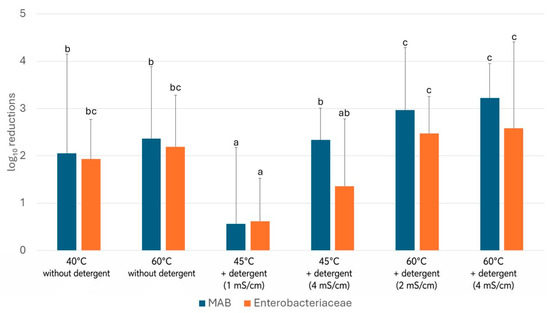
Our results (Table 3, Table 4, Table 5, Table 6, Table 7 and Table 8) show clear trends. The results show that the decisive factor is not just the temperature, but the combination of both (synergistic effect). In cases where we did not use detergent, the results, as expected, improved with increasing temperature (60 °C) (Table 3 and Table 4; Figure 1 and Figure 2), although Salmonella was not eliminated over the course of the day, and in some cases the situation even worsened after 16 h (Table 3 and Table 4). Suboptimal washing conditions showed variability (p < 0.05) and, in some cases, increased contamination over time, indicating process instability. In contrast, optimal conditions (60 °C combined with detergent conductivity ≥ 2 mS) showed consistent results across all sampling times (Table 7), with complete absence of Salmonella and stable reductions in indicator microorganisms, demonstrating the robustness of the cleaning process.
Table 3.
Results obtained before and after cleaning of cages (C1, C2 and C3) with water at 40 °C without detergent, at different working times.
Table 4.
Results obtained before and after cleaning of cages (C1, C2 and C3) with water at 60 °C without detergent, at different working times.
Table 5.
Results obtained before and after cleaning of cages (C1, C2 and C3) with water at 45 °C with detergent (conductivity 1 mS), at different working times.
Table 6.
Results obtained before and after cleaning of cages (C1, C2 and C3) with water at 45 °C with detergent (conductivity 4 mS), at different working times.
Table 7.
Results obtained before and after cleaning of cages (C1, C2 and C3) with water at 60 °C with detergent (conductivity 2 mS), at different working times.
Table 8.
Results obtained before and after cleaning of cages (C1, C2 and C3) with water at 60 °C with detergent (conductivity 4 mS), at different working times.
Figure 1.
Effect of washing conditions on Salmonella elimination. a: No differences between these treatments; highest Salmonella elimination rates (100%). b: Significantly lower than group a (p < 0.05), but significantly higher than groups c and d. c: Significantly lower than groups a and b (p < 0.05), but significantly higher than group d. d: Lowest Salmonella elimination rates; significantly different from all other groups (p < 0.05).
Figure 2.
Effect of washing conditions on MAB and Enterobacteriaceae reduction. a–c: Different letters indicate statistically significant differences in microbial parameter reduction among washing conditions (p < 0.05).
On the other hand, the effectiveness of washing treatments was evaluated based on Salmonella elimination rates (Figure 1). A statistically significant association (p < 0.01) was observed between washing conditions and Salmonella elimination. Suboptimal conditions, such as washing without detergent or at lower temperatures, showed limited effectiveness (12.5–71% elimination). In contrast, the combination of 60 °C with detergent conductivity ≥ 2 mS achieved complete elimination (100%) in all tested samples (Figure 1). No statistically significant differences were observed between 2 mS and 4 mS at 60 °C, indicating that increasing detergent concentration beyond this level does not improve efficacy.
Regarding indicators (MAB and Enterobacteriaceae), an overall descriptive statistical analysis confirmed that washing performance was primarily determined by the synergistic effect of temperature and detergent conductivity (Figure 2).
Condition 1 showed highly heterogeneous MAB log reductions, reflecting poor process stability. Condition 2 improved microbial reduction (2.36 ± 1.53 log), although variability remained considerable. Condition 3 demonstrated the poorest efficacy, confirming that low detergent conductivity at 45 °C was insufficient. Conditions 5 and 6 (at 60 °C) confirmed the synergistic effect of temperature and detergent conductivity. Condition 5 (60 °C and 2 mS), the first treatment to achieve complete Salmonella elimination (100%), also produced the highest combined reductions in MAB (2.97 ± 1.32 log) and Enterobacteriaceae (2.47 ± 0.79 log), without the need of a higher detergent input.
These results showed significant differences (p < 0.05) between washing conditions, with higher temperatures combined with detergent application resulting in markedly lower microbial counts. In contrast, no statistically significant differences (p > 0.05) were detected between sampling times (t0, t8, t16), likely due to the limited sample size and variability of the data. Overall, suboptimal washing conditions showed greater variability and, in some cases, increased microbial counts, suggesting process instability. Conversely, optimal conditions (60 °C and ≥2 mS) resulted in consistent reductions across all sampling times, demonstrating robust process performance. Reductions of up to 3–5 log units were observed under optimal conditions, particularly for Enterobacteriaceae, which showed greater sensitivity to the treatments compared to total mesophilic aerobic bacteria.
In general terms, and as expected, washing performance tends to decline over time under suboptimal conditions, and 45 °C is clearly insufficient. Therefore, among the tested conditions, the combination of 60 °C and 2 mS represents the most effective option, providing robust results and statistically significant improvements in Salmonella elimination.
4. Discussion
Considering our results as a whole, it is clear that the most appropriate washing conditions include the application of detergent. At 45 °C, the use of detergent does not guarantee Salmonella elimination in many cases and, similar to washing without detergent, microbial counts do not consistently decrease after treatment. At this temperature, only higher detergent concentrations (4 mS) lead to a substantial reduction in indicator microorganisms and improved Salmonella elimination rates.
Within the tested conditions, 60 °C can be identified as the optimal temperature. In this context, it is particularly relevant that a conductivity of 2 mS already achieves optimal results: complete Salmonella elimination and several log reductions in indicator microorganisms, with values approaching or falling within acceptable limits. Moreover, these results are consistent across all sampling times (t0, t8, and t16), demonstrating process robustness.
Increasing detergent concentration beyond 2 mS at 60 °C does not further improve the results and instead leads to higher resource consumption, indicating overdosing without additional benefit. In fact, one of the limiting factors is the material of the cages, which in this case is galvanized iron. Excessively high temperatures may accelerate corrosion processes, reducing equipment lifespan [33]. Therefore, the selection of washing parameters must balance hygiene effectiveness with material preservation. Additionally, the economic aspect must be considered. The use of higher detergent concentrations increases operational costs without providing significant additional benefits, as demonstrated in this study. The identified optimal condition (60 °C and 2 mS) represents a compromise between efficacy and efficiency. And it is also important to note that, in industrial practice, washing is typically followed by a disinfection step, often using agents such as peracetic acid, as it is our case. Although this step was not included in the present study in order to isolate the effect of washing parameters, its application would likely further enhance microbial reduction. In most cases, the disinfectant is added at authorized truck wash facilities [34].
The results obtained in this study are consistent with previous research. Gomolka-Pawlicka et al. [35] have already highlighted, based on data collected over nine seasons (with results grouped by season), the need to implement strict hygiene measures on farms in order to improve the effectiveness of cage cleaning and disinfection at any time of year. These authors consider that negligence in this regard facilitates the spread of microorganisms (in the case of their study, Campylobacter) amongst the birds just before they enter the slaughterhouse, thereby increasing the risk of meat contamination.
Our findings are all the more significant when we consider that Borges et al. [36,37] report cases in which contamination levels in the cages increased following the cleaning process, suggesting that the cleaning procedure was ineffective. In our experience, something similar has happened in some cases when detergent has not been used. Borges et al. [37] argue that the birds arrived at the slaughterhouse already contaminated, even though such contamination increases during the slaughterhouse phase due to cross-contamination.
Among the few studies we are aware of concerning transport cages, Atterbury et al. [13], in a commercial-scale trial, found that, when a combination of mechanical energy, heat and chemicals (i.e., detergent and disinfectant) was used, the results showed significant improvements in cage cleanliness, achieving reductions of up to 3–6 and 3–8 log CFU per cage for Campylobacter and Enterobacteriaceae. Also focusing more on the reduction in Campylobacter, Allen et al. [18] demonstrated that the most effective treatments were a combination of soaking at 55 °C, brushing for 90 s and washing for 15 s at 60 °C, followed by the application of disinfectant. They also achieved good results by including the use of ultrasound. In both cases, the reduction in Enterobacteriaceae was 4 log, although the methods were not as effective against aerobic microorganisms. This last point has turned out to be similar to what we found in our study.
With regard to more specific findings on Salmonella, as in our study, Zang et al. [22] conducted an experiment on plastic crates, achieving the greatest reductions in Salmonella Enteritidis—which had been previously inoculated into the crates—using tap water (15 s of exposure, resulting in a reduction of 3.12 log CFU/cm2). Mildly acidified electrolyzed water, applied for 40 s with an available chlorine concentration of 50 mg/L, also proved effective.
On the other hand, Dzieciolowski et al. [21] adapt their experimental design to slaughterhouse conditions, as in our case, and evaluate four protocols that differ in approach from ours and monitor only certain indicators (mesophilic aerobic bacteria and enterobacteria). One of these authors’ treatments does not include disinfection, as in our experiment, but does include drying with dehumidification. In this case, they achieve reductions in total mesophilic aerobes of 1.5 logarithmic cycles, broadly consistent, even lesser than the results of our various treatments.
We are unable to compare our results with those obtained by White et al. [12], as their study focused on laying hen cages and did not evaluate the active ingredient we used. However, these authors argue that the characteristics of cleaning and disinfection regimes can vary significantly and must be taken into account when selecting a chemical product for the disinfection of such surfaces.
5. Conclusions
The results of this study demonstrate that the combined increase in washing temperature and detergent conductivity significantly improves the effectiveness of cleaning transport cages used in poultry slaughterhouses. A clear synergistic effect between both parameters was observed, with the optimal condition identified at 60 °C and 2 mS. Under these conditions, the elimination rate for Salmonella was 100%, and a significant reduction in hygiene indicator microorganisms was achieved, while avoiding excessive detergent use. Increasing detergent concentration beyond this level did not provide additional microbiological benefits, indicating that maximum chemical input is not necessary for effective cleaning. From an industrial perspective, the optimization of washing parameters allows for improved hygiene control, reduced operational costs, and the preservation of equipment integrity, particularly in systems using galvanized materials. These findings reinforce the importance of cleaning and disinfection as a key prerequisite within HACCP systems and highlight the role of transport cages as a critical point in the control of microbiological hazards in poultry processing.
Author Contributions
Conceptualization, F.A. and L.M.M.; methodology, F.A. and L.M.M.; software, F.A. and L.M.M.; validation, F.A., M.J.R., R.J. and L.M.M.; formal analysis, F.A. and L.M.M.; investigation, F.A., M.J.R. and L.M.M.; resources, F.A. and R.J.; data curation, F.A. and L.M.M.; writing—original draft preparation, L.M.M.; writing—review and editing, L.M.M.; visualization, F.A., M.J.R. and L.M.M.; supervision, F.A., R.J. and L.M.M.; project administration, F.A. and R.J.; funding acquisition, R.J. and L.M.M. All authors have read and agreed to the published version of the manuscript.
Funding
This research was funded by Campus of International Excellence in the Agri-Food Sector (ceiA3) and Research Group MICAL, University of Cordoba, Spain.
Data Availability Statement
The data that support the findings of this study are available from the corresponding author upon reasonable request.
Acknowledgments
The authors would like to thank Rafael Moreno-Rojas and Alicia Moreno-Ortega for their assessment on data processing.
Conflicts of Interest
The authors declare no conflicts of interest.
Abbreviations
The following abbreviations are used in this manuscript:
| EFSA | European Food Safety Authority |
| ECDC | European Center for Disease Prevention and Control |
| HACCP | Hazard Analysis and Critical Control Point |
| MAB | Mesophilic aerobic bacteria |
References
- Sun, T.; Liu, Y.; Qin, X.; Aspridou, Z.; Zheng, J.; Wang, X.; Li, Z.; Dong, Q. The prevalence and epidemiology of Salmonella in retail raw poultry meat in China: A systematic review and meta-analysis. Foods 2021, 10, 2757. [Google Scholar] [CrossRef] [Scilit]
- EFSA; ECDC. The European Union One Health 2024 zoonoses report. EFSA J. 2025, 23, e9759. [Google Scholar] [CrossRef] [Scilit] [PubMed]
- Anonymous. Regulation (EC) No 2160/2003 of the European Parliament and of the Council. Off. J. Eur. Union 2003, 325, 1–15. [Google Scholar]
- Ministerio de Agricultura, Pesca y Alimentación (MAPA). Real Decreto 1084/2005; Boletín Oficial del Estado (BOE): Madrid, Spain, 2005. [Google Scholar]
- Cano, N.; Arispón, F.; Jordano, R.; Medina, L.M. Monitoring hygienic measures for decreasing Salmonella occurrence in turkey barns. Arch. Leb. J. Food Saf. Food Qual. 2020, 71, 75–80. [Google Scholar] [CrossRef]
- Anonymous. Commission Regulation of 12 December 2012 Concerning a Union Target for the Reduction of Salmonella Enteritidis and Salmonella Typhimurium in Flocks of Turkeys, as Provided for in Regulation (EC) No 2160/2003 of the European Parliament and of the Council, 1190/2012/EU. Available online: https://www.legislation.gov.uk/eur/2012/1190/data.pdf (accessed on 23 April 2026).
- Ministerio de Agricultura, Alimentación y Medio Ambiente (MAGRAMA). Programa Nacional de Salmonella en Pavos. 2016. Available online: https://www.mapa.gob.es/es/ (accessed on 23 April 2026).
- Anonymous. Commission Regulation (EC) No 2073/2005. Off. J. Eur. Union 2005, 338, 1–26. [Google Scholar]
- Dede, N.A.; Gürakan, G.C.; Bozoglu, T.F. Designing for hygienic operation. In Encyclopedia of Food Microbiology, 2nd ed.; Batt, C.A., Tortorello, M.-L., Eds.; Academic Press: London, UK, 2014; Volume 3, pp. 166–170. [Google Scholar]
- Cox, J.M.; Pavic, A. Salmonella. In Encyclopedia of Food Microbiology, 2nd ed.; Batt, C.A., Tortorello, M.-L., Eds.; Academic Press: London, UK, 2014; Volume 3, pp. 322–331. [Google Scholar]
- Álvarez Gurrea, J.C.; Sanz Cervera, S.; Rodríguez Jerez, J.J. Evolución de la Contaminación de Superficies Durante los Procesos Productivos en Pymes del Sector Cárnico. Ind. Cárnica 2017. Available online: https://www.interempresas.net/Industria-Carnica/167316-Evolucion-contaminacion-superficies-durante-procesos-productivos-pymes-sector-carnico.html (accessed on 23 April 2026).
- White, D.; Gurung, S.; Zhao, D.; Tabler, T.; McDaniel, C.; Styles, D.; McKenzie, S.; Farnell, Y.; Farnell, M. Foam or spray application of agricultural chemicals to clean and disinfect layer cages. J. Appl. Poult. Res. 2018, 27, 416–423. [Google Scholar] [CrossRef] [Scilit]
- Atterbury, R.J.; Gigante, A.M.; Tinker, D.; Howell, M.; Allen, V.M. Improved cleaning system for poultry transport crates. J. Appl. Microbiol. 2020, 128, 1776–1784. [Google Scholar] [CrossRef] [Scilit] [PubMed]
- Cano Vilches, N. Evaluación de la Contaminación por Salmonella en Pavos Previa a su Entrada en Planta de Sacrificio. Eficacia de las Medidas Implantadas Para su Reducción y Control. Ph.D. Thesis, Universidad de Córdoba, Córdoba, Spain, 2020. [Google Scholar]
- Van Immerseel, F.; De Zutter, L.; Houf, K.; Pasmans, F.; Haesebrouck, F.; Ducatelle, R. Strategies to control Salmonella in the broiler production chain. World’s Poult. Sci. J. 2009, 65, 367–392. [Google Scholar] [CrossRef] [Scilit]
- Jefatura del Estado. Ley 8/2003, de 24 de Abril, de Sanidad Animal. 2003. Available online: https://www.boe.es/buscar/act.php?id=BOE-A-2003-8510 (accessed on 23 April 2026).
- Ministerio de Agricultura, Pesca y Alimentación (MAPA). Real Decreto 328/2003; Boletín Oficial del Estado (BOE): Madrid, Spain, 2003; pp. 13054–13064. [Google Scholar]
- Allen, V.M.; Burton, C.H.; Wilkinson, D.J.; Whyte, R.T.; Harris, J.A.; Howell, M.; Tinker, D.B. Evaluation of cleaning treatments in poultry transport crates. Br. Poult. Sci. 2008, 49, 233–240. [Google Scholar] [CrossRef] [Scilit] [PubMed]
- Morgan, R.B.; Sierra-Arguello, Y.M.; Perdoncini, G.; Borges, K.A.; Furian, T.Q.; Gomes, M.J.P.; Lima, D.; Salle, C.T.P.; Moraes, H.L.S.; Nascimento, V.P. Transport crates contamination with Campylobacter spp. Poult. Sci. 2022, 101, 101909. [Google Scholar] [CrossRef] [Scilit] [PubMed]
- Milvaques, A.; Donet, C.; Canet, J.J.; Balbastre, J. Limpieza y Desinfección en Instalaciones Avícolas. Christeyns, 2023. Available online: https://www.christeyns.com/es-es/limpieza-y-desinfeccion-en-instalaciones-avicolas/ (accessed on 23 April 2026).
- Dzieciolowski, T.; Boqvist, S.; Ryden, J.; Hansson, I. Cleaning and disinfection of transport crates. Poult. Sci. 2022, 101, 101521. [Google Scholar] [CrossRef] [Scilit] [PubMed]
- Zang, Y.T.; Li, B.M.; Bing, S.; Cao, W. Modeling disinfection of poultry transport cages. Poult. Sci. 2015, 94, 2059–2065. [Google Scholar] [CrossRef] [Scilit] [PubMed]
- Moerman, F.; Rizoulières, P.; Majoor, F.A. Cleaning in place (CIP) in food processing. In Hygiene in Food Processing: Principles and Practice; Lelieveld, H.L.M., Holah, J., Napper, D., Eds.; Woodhead Publishing: Cambridge, UK, 2014; pp. 305–383. [Google Scholar]
- European Hygienic Engineering & Design Group (EHEDG). Guideline 52: Basic Principles of Cleaning and Disinfection in Food Manufacturing; EHEDG: Frankfurt, Germany, 2021. [Google Scholar]
- European Hygienic Engineering & Design Group (EHEDG). Guideline 50: Hygienic Design Requirements for CIP Installations; EHEDG: Frankfurt, Germany, 2019. [Google Scholar]
- Pascual Anderson, M.R. Técnicas para el Análisis Microbiológico de Alimentos y Bebidas; Ministerio de Sanidad y Consumo, Centro Nacional de Alimentación y Nutrición, Servicio de Microbiología: Madrid, Spain, 1982. [Google Scholar]
- Anonymous. Regulation (EC) No 1272/2008. Off. J. Eur. Union 2008, 353, 1–1355. [Google Scholar]
- Bird, P.; Fisher, K.; Boyle, M.; Huffman, T.; Juenger, M.; Benzinger, M.J.; Bedinghaus, P.; Flannery, J.; Crowley, E.; Agin, J.; et al. Evaluation of VIDAS UP Salmonella (SPT) assay for the detection of Salmonella in a variety of foods and environmental samples: Collaborative study. J. AOAC Int. 2013, 96, 808–821. [Google Scholar] [CrossRef] [Scilit] [PubMed]
- Banada, P.P.; Bhunia, A.K. Antibodies and immunoassays for detection of bacterial pathogens. In Principles of Bacterial Detection: Biosensors, Recognition Receptors and Microsystems; Zourob, M., Elwary, S., Turner, A., Eds.; Springer: New York, NY, USA, 2008; pp. 567–602. [Google Scholar]
- Dwivedi, H.P.; Devulder, G.; Jenuja, V.K. Salmonella detection by immunoassays. In Encyclopedia of Food Microbiology, 2nd ed.; Batt, C.A., Tortorello, M.-L., Eds.; Academic Press: London, UK, 2014; Volume 3, pp. 339–342. [Google Scholar]
- Crowley, E.; Bird, P.; Torontali, M.; Agin, J.; Goins, D.; Johnson, R. TEMPO TVC for the enumeration of aerobic mesophilic flora in foods: Collaborative study. J. AOAC Int. 2009, 92, 165–174. [Google Scholar] [CrossRef] [Scilit]
- Owen, M.; Willis, C.; Lamph, D. Evaluation of the TEMPO® most probable number technique for the enumeration of Enterobacteriaceae in food and dairy products. J. Appl. Microbiol. 2010, 109, 1810–1816. [Google Scholar] [CrossRef] [Scilit] [PubMed]
- Fontana, M.G.; Greene, N.D. Corrosion Engineering, 3rd ed.; McGraw-Hill Education: New York, NY, USA, 1987; pp. 60–120. [Google Scholar]
- Anonymous. Real Decreto 638/2019; BOE-A-2019-16637; Boletín Oficial del Estado (BOE): Madrid, Spain, 2019; pp. 127704–127718. Available online: https://www.boe.es/eli/es/rd/2019/11/08/638 (accessed on 23 April 2026).
- Gomolka-Pawlicka, M.; Pastuszczak-Frak, M.; Uradzinski, J.; Migowska-Calik, A.; Wysok, B.; Lachowicz, T. Campylobacter in transport cages. Med. Weter. 2014, 70, 107–111. [Google Scholar]
- Borges, K.A.; Martelo, E.B.; dos Santos, L.A.; Furian, T.Q.; Cisco, I.C.; Manto, L.; dos Santos, L.R. Detection and quantification of Salmonella spp. in poultry slaughterhouses of southern Brazil. J. Infect. Dev. Ctries. 2019, 13, 455–460. [Google Scholar] [CrossRef] [Scilit] [PubMed]
- Borges, K.A.; Cisco, I.C.; Furian, T.Q.; Tedesco, D.C.; Rodrigues, L.B.; do Nascimento, V.P.; dos Santos, L.R. Detection and quantification of Campylobacter spp. in Brazilian poultry processing plants. J. Infect. Dev. Ctries. 2020, 14, 109–113. [Google Scholar] [CrossRef] [Scilit] [PubMed]

Disclaimer/Publisher’s Note: The statements, opinions and data contained in all publications are solely those of the individual author(s) and contributor(s) and not of MDPI and/or the editor(s). MDPI and/or the editor(s) disclaim responsibility for any injury to people or property resulting from any ideas, methods, instructions or products referred to in the content. |
© 2026 by the authors. Licensee MDPI, Basel, Switzerland. This article is an open access article distributed under the terms and conditions of the Creative Commons Attribution (CC BY) license.