


Abstract
Secular changes in the physical growth of children in the 20th century have been examined largely between cohorts of boys or men, with fewer studies examining changes among girls/women or both sexes. Sex-specific growth trajectories and differential cultural treatment of the sexes can affect how girls and boys respond to changes in the ontogenetic environment. This study examined secular change in height (cm) and weight (kg) in affluent Portuguese school children from three periods over the 20th century: an early (1913–1916), middle (1929–1943), and late (1992–2012) period. Anthropometric data was taken from medical records and archives of two boarding schools located in or near Lisbon: the Colégio Militar for boys and the Instituto de Odivelas for girls. Height and weight data were collated from over 1349 children (over 825 boys and 524 girls), aged to 10 to 17 years. Height and weight were plotted against age for the three periods to assess secular changes and sex differences in the secular trend. Results indicate a similar pattern of secular change across boys and girls, wherein children measured in the late period demonstrated an increase in height and weight, with the greatest increase occurring between the middle and late periods. The increase in height and weight can be attributed to changes to the socioeconomic environment in Portugal after the 1960s, but particularly after the democratic transition of 1974. This includes population-wide improvements in living standards, sanitation, decreased disease load, access to medical care and improved quantity and quality of nutrition. Cultural-based preferential treatment of boys may have taken place, as boys increased more in relative and absolute height and weight.
1. Introduction
Secular trends are changes in the physical growth of children or in adult stature occurring over generations within a certain population and are generally examined using cohort studies. Traditionally, these types of studies have focused on men or boys, as historical data sources for males are much more readily available and were considered to reflect the overall growth of children or attained stature (Tanner et al., 1975; Schell, 1989; Fogel, 1986; Floud, 1994; Bogin, 1999). In recent years, some studies have begun to contrast secular changes between the sexes, as patterns of sexual dimorphism and data about women and girls can provide additional insights into the environmental factors behind secular trends. Many of these studies are driven by concerns over childhood obesity, and thus focus on increases in weight, body mass index, and body fat percentage observed over the last 50 years (Ayub Ali et al., 2001; Cardoso & Padez, 2008; Sun et al., 2012; Lissner et al., 2013; Costa et al., 2017). Most secular trend studies conducted solely on girls, however, tend to focus on age at menarche and the onset of puberty (see Kaplowitz, 2006 for a review of such studies, and more recent studies documenting these changes in multiple settings, e.g., Jones et al., 2008; Song et al., 2015; Marván et al., 2020), as menstruation is the sexual maturity landmark that is most easily observed in girls. Predominantly, these studies identify improvements in nutritional and socioeconomic conditions as drivers of these secular trends. Others have looked at the how changes to a population’s socioeconomic status over time have influenced child weights and heights (Malina et al., 2004; Hosseini et al., 2010; Negasheva et al., 2023). These studies, while examining both male and female children, generally fail to dive deeper into the analysis of the differences between how boys and girls respond to environmental stress. They sometimes also lack data over many decades.
Secular change is often taken as a synonym for positive secular change, which is generally associated with improvements in environmental conditions that affect growth (Stinson, 2012). Portugal, like other European countries, experienced an increase in height and weight for age in children during the 20th century. This secular trend occurred as a result of a multitude of political, social, and economic factors, most importantly the end of a dictatorship in 1974, which led to overall improvements in diet, healthcare, and socioeconomic status among the total population (Cardoso, 2008; Cardoso & Murray, 2025). Gains in adult height and weight have been thoroughly documented (Castro et al., 1998; Padez, 2002; Padez & Johnston, 1999; Sobral, 1990), and research has also been conducted on positive secular trends among Portuguese boys (Cardoso, 2008; Cardoso & Padez, 2008; Cardoso & Caninas, 2010). Although increases in height and weight have been observed among adult Portuguese women (Conceição et al., 2012), changes in Portuguese girls remain poorly understood. Gaining insight on these changes would provide a richer and better understanding of how environmental changes throughout the 20th century affected the Portuguese population. In addition, it can also allow for the examination of sexual dimorphism in response to changing environmental stress and provide important insights into gender disparities that can affect growth over time in any population. More recently, Cermeño et al. (2023) and Cardoso and Murray (2025) examined changes in height and weight among boys and girls in Lisbon; however, their studies had limited scope and did not focus on gender differences.
Though both boys and girls likely benefitted from wide-ranging improvements in the ontogenetic environment across the 20th century, their impact on growth across the sexes may be unequal due to sex-based responses to adverse growth environments. Males are proposed to be more sensitive to the effects of environmental stress than females (Greulich, 1951; Stini, 1969; Stinson, 1985; Díez Navarro et al., 2017). Since females must allocate a set amount of energy towards reproduction, there is selective pressure for biological buffering against stress effects on growth. In contrast, males are more likely to experience reductions in growth and development in adverse environmental conditions and improvements in growth and development during favourable conditions. The effect of differential eco-sensitivity is strongest in children who have experienced prenatal stress (Stinson, 1985). This may be because there are complex sex-based cultural factors affecting children in the post-natal period that may mediate post-natal stress (Stinson, 2012). Because of this complexity, the hypothesis that males are less buffered against environmental stress during growth and development can be said to have a limited predictive value.
While girls may have a biological buffer against growth retardation resulting from stress, in certain societies, boys may have a culturally mediated one. Cultural buffering is present when one sex is given preferential treatment in the way of food allocation, care, and other factors. When a certain sex receives preferential treatment due to culturally predicated norms specific to time and place, they are more likely to experience positive growth. Cultural preference practices can include preferential food allocation, access to medical care or education, demands on physical labour, and psychosocial support and care, and they are documented to alternatively favour either boys or girls depending on time and place (Gillett-Netting & Perry, 2005; Wamani et al., 2007; Prall & Scelza, 2017; Hassan et al., 2019). Evidence suggests that in early 20th century southern Europe, cultural preferences favoured boys: boys may have received unequal allocation of food in the household, and girls may have been expected to take on more household labour (Livi-Bacci, 1991; Beltrán Tapia & Gallego-Martínez, 2017). In this setting, boys may have benefitted from a culturally mediated buffer against environmental hardships. Thus, two factors may be affecting sex differences in secular trends in 20th century Portugal: the biological buffering of girls, and the cultural buffering of boys.
This study investigates whether Portuguese schoolgirls experienced secular trends in growth comparable to those documented for Portuguese boys over the 20th century. While previous research has established a strong positive secular trend in height and weight among boys, equivalent patterns in girls have yet to be characterized. Existing studies (e.g., Cermeño et al., 2023; Cardoso & Murray, 2025) are limited in scope, and available data on adult Portuguese women (Conceição et al., 2012) do not permit detailed, sex-specific comparisons. Accordingly, this study addresses two primary research questions: (1) Did Portuguese schoolgirls exhibit significant secular increases in height and weight (including in developmental timing of growth) over the 20th century? (2) Were the magnitude and timing of those changes comparable to those observed in boys? These questions are evaluated through the following hypotheses: H1: Portuguese schoolgirls experienced a significant positive secular trend in height and weight (and acceleration in timing of growth) over the 20th century. H2: The magnitude of secular change in height and weight (and acceleration in timing of growth) did not differ significantly between girls and boys. H3 (alternative): The magnitude and/or timing of secular changes differed significantly by sex, reflecting differential sensitivity to environmental improvements or sex-specific social conditions. Testing these hypotheses will help determine whether growth responses to improved environmental conditions in Portugal were broadly similar across the sexes, or whether they reflect sex-based biological sensitivity and/or historically documented preferential treatment of boys and men afforded in Portuguese society (e.g., Robinson, 2015).
2. Materials and Methods
Height is a better indicator of secular changes in living conditions and standard of living because it is a cumulative indicator of growth and reflects nutritional history of the child. While weight can fluctuate in either direction more easily than height and thus reflects more recent nutritional history, both measures of physical growth were collected as complimentary indicators of health.
The height and weight data used in this study were obtained from medical records of boys and girls attending two boarding schools in Lisbon, the Colégio Militar and the Instituto de Odivelas, respectively. Data available covered an almost 100-year period between the early 20th century and the early 21st century. The Colégio Militar is a preparatory, secondary, and military boarding school in Lisbon that was founded in 1803 and whose primary function is to provide education to the sons of military officers (Matos, 2003). The Instituto de Odivelas is a similar boarding school established in 1900, originally under the name of Instituto Infante D. Afonso, to educate the daughters of high-ranking military officers (Pintassilgo, 2010). Both schools were initially created to support children whose fathers had died or were injured on duty, but soon they were opened to all school-aged children of high-ranking military officers. Over time, both schools became more accepting of civilians, but these children were typically drawn from wealthier families who belonged to the upper middle class or aristocracy (Cardoso, 2008). In 2015, the Instituto de Odivelas closed, and its female students began attending the Colégio Militar, which is no longer a boys-only school. Although students came from all over the country, the Lisbon area and its surroundings are better represented in the student populations. Consequently, these height and weight data are a better representation of the growth status of girls and boys from a higher socioeconomic segment of Portugal during the 20th and 21st centuries.
Height and weight data were obtained for boys and girls from a mix of medical records and summary information published in internal records of both schools. Anthropometric data were taken from 10- to 17-year-olds by physicians or nurses from both schools, who used medical stadiometers and scales. Three periods were selected for which height and weight data were available from both schools. In some cases, raw data were available, but for other periods, data were collected as the means and standard deviations of heights or weights for students at each age. For the boys, the following three periods of dates were selected for the sample data: an earlier period dated to 1913–1914, a middle period dated to 1929–1937, for both of which only summary data were obtained from records of the school (Colégio Militar, 1913, 1914, 1930, 1934, 1938, 1939a, 1939b), and a later period dated to 1999–2006 (n = 825), where raw data were retrieved from individual medical records of the boys attending the Colégio Militar. For the girls, similar periods were selected: an earlier period dated to 1914–1916 where summary data were obtained from Santos (1916) and a middle (n = 261) and late period (n = 263) where raw data were retrieved from the individual medical files of girls attending the Instituto de Odivelas in 1929–1943 and 1992–2012, respectively.
For all these periods, the data from several different years were grouped together in order to account for the relatively small sample sizes from each individual year or set of years. However, the grouping of non-contemporaneous years into broader periods may mask short-term fluctuations and assumes relative stability within each period, which may not be the case. Total sample size is unknown, as sample size from the boys’ early and middle periods and the girls’ early period were not recorded. However, total sample size is greater than 1349 children (over 825 boys and 524 girls). Due to the nature of the datasets, data from each period include some longitudinal data, as both boys and girls who remained in the school for a number of years would have been measured annually at different ages. The differences between boys and girls in the range of years for each time reflects availability of data. As a result, comparisons between sexes and across periods should be interpreted cautiously, as they are based on datasets that are not fully equivalent in structure or temporal coverage. It should also be noted that the data sources differ in structure across periods, with some consisting of individual-level longitudinal observations and others of aggregated summary statistics, which introduces limitations in comparability and analytical precision.
To examine secular increases in height and weight for boys and girls, distance growth profiles were created for the early (1913–1916), middle (1929–1943), and late (1992–2012) periods. Profiles were then compared visually among boys and girls to assess secular changes over the 20th century. Increments of height and weight between the three periods (difference in height and weight between early and middle, between middle and late, and between early and late) were also calculated to quantify the timing and magnitude of the secular changes in both sexes. Given the mixed nature of the data (individual vs. aggregated), these comparisons are mainly descriptive and do not account for differences in sample composition or variance structure across periods.
Sex-based differences in secular change were examined visually by comparing the growth profiles of boys and girls and were quantified by comparing the increments of height and weight between the three periods among both sexes. Additionally, a measure of sexual dimorphism was calculated to compare sex differences in growth between the different periods and examine differences in magnitude or timing of the secular change. Sexual dimorphism was calculated as the differences in means between boys and girls for height and weight for each period and for each age, divided by the corresponding mean of boys and then multiplied by 100 to provide a percentage of sexual dimorphism (Frayer, 1980). Trends in sexual dimorphism were also broken down as age-related increments within each sex. However, the reliability of these estimates is affected by the absence of sample size data for some groups and the reliance on aggregated values in earlier periods.
The developmental timing in height and weight gain across the periods was also compared among and between the sexes by constructing interval growth plots for height and weight over the age range in boys and girls. Peak change across age intervals was estimated by subtracting the mean height and weight for any one age from the mean height and weight of the next age (e.g., gain at 10 years of age = mean 11-year-olds – mean of 10-year-olds). While the nature of data is not appropriate to extract tempo and intensity from the growth data, these intervals were calculated as a best attempt to visualize the pubertal growth spurt and examine whether peak height or weight gain was also changing over the early, middle, or late period. The resulting plots were visually examined. Because these estimates are derived from cross-sectional or partially longitudinal data and, in some cases, from aggregated means, they should be interpreted as approximations rather than precise measures of growth dynamics.
3. Results
Table 1 and Table 2 present the sample sizes, standard deviations, and age-specific means for boys and girls, along with the differences in means and the percentage of sexual dimorphism for height and weight, respectively. Generally, children measured in the late period demonstrated a dramatic increase in height and weight compared to those in the earlier periods, with the greatest increase occurring between the middle and late periods.
Table 1.
Age-specific mean () height (cm), standard deviation (SD), and sample size (N) for girls and boys from the early (1913–1916), middle (1929–1942), and late (1992–2012) periods. The absolute difference in height between boys and girls is represented by b-g. Percent sexual dimorphism for each age is represented by θ. Average () and standard deviation (SD) for height, sample size (N) and total growth between ages 10 and 17 (Δ) for each period are also listed.
Table 2.
Age-specific mean () weight (kg), standard deviation (SD), and sample size (N) for girls and boys from the early (1913–1916), middle (1929–1942), and late (1992–2012) periods. The absolute difference of weight between boys and girls is represented by b-g. Percent sexual dimorphism is represented by θ. Average () and standard deviation (SD) for weight, sample size (N) and total weight gain between ages 10 and 17 (Δ) for each period are also listed.
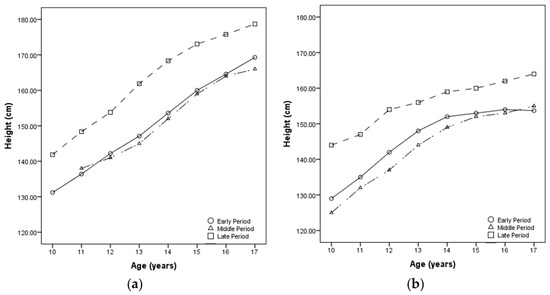
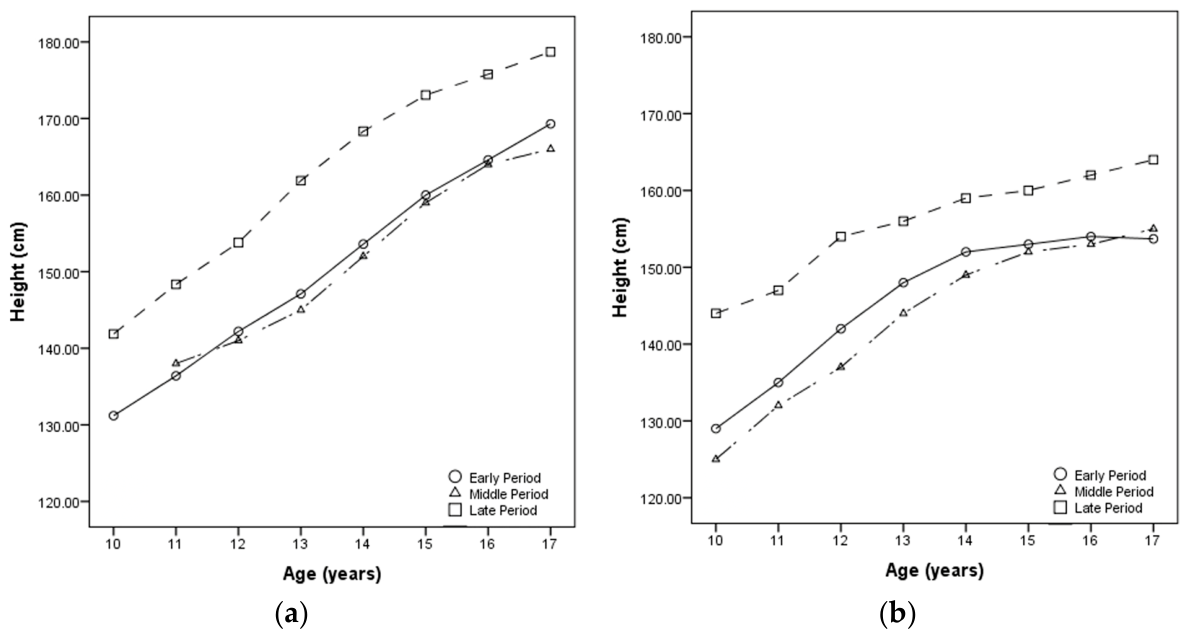
Examining height first, Figure 1 and Figure 2 illustrate changes across the three periods within each sex and the differences between the sexes, respectively. From the early to the middle period, average height experienced practically no increase among boys (there may have even been a slight decrease), but a larger increase was observed between the middle and late periods (Figure 1a). Female students demonstrated a marked decrease in height between the early and middle periods but also showed an increase in height between the middle and late periods that surpasses the loss between the two earlier periods (Figure 1b). In the early and middle periods, there is a plateauing in the average height of the older girls (around 16 and 17 years) in all three periods that is not present in the boys, meaning that females have achieved their adult height around 16 or 17 years of age, but males are continuing to grow. This trend is reduced in the late period, indicating that girls may have continued growth after 17 years of age.
Figure 1.
Growth profiles showing average heights (cm) for (a) boys and (b) girls from ages 10 to 17 in the early (1913–1916), middle (1927–1943), and late (1992–2012) periods.
Figure 2.
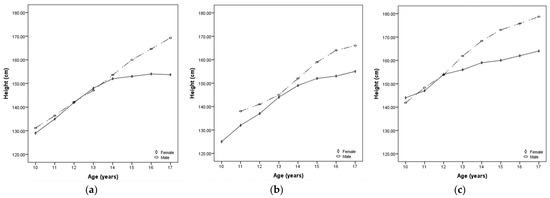
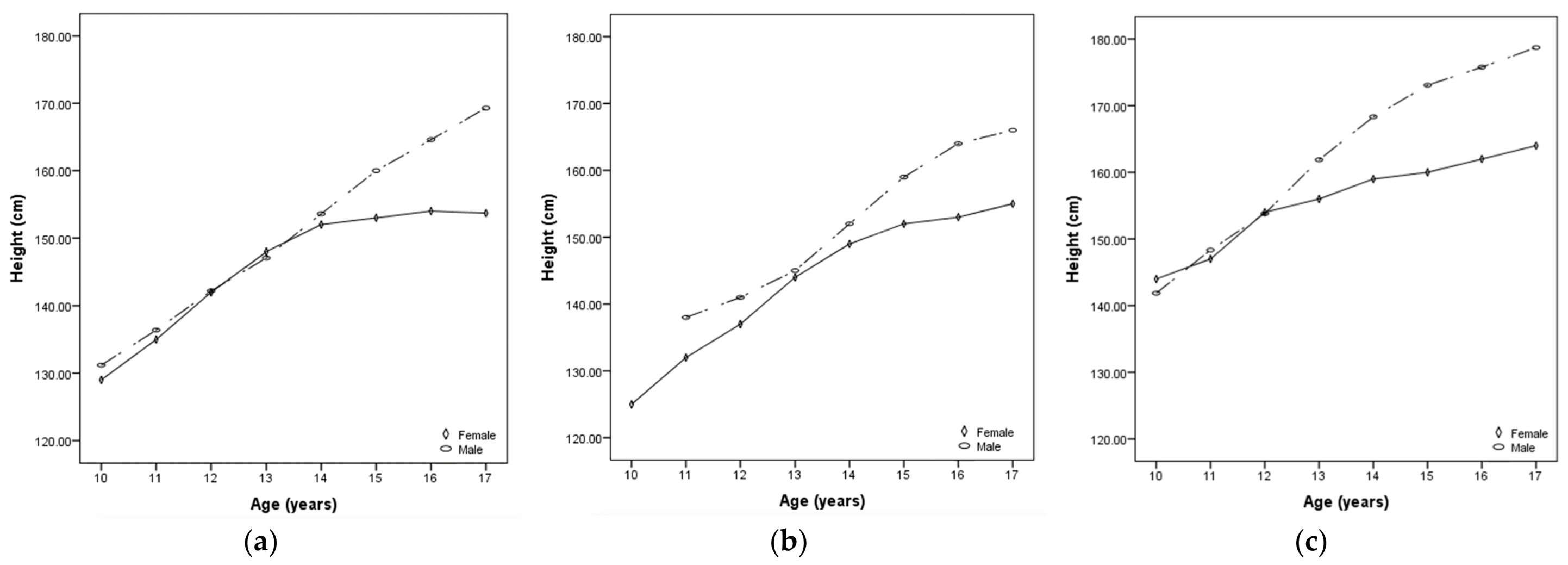
From left to right, sex comparison of growth profiles showing average height (cm) of boys and girls ages 10 to 17 during the (a) early period (1913–1916), (b) middle period (1929–1943), and (c) late period (1992–2012).
Boys were unilaterally taller than girls at the averages taken at ages 10 through 17 in the early and middle periods, but not in the late period (Figure 2). During the late period, the average height for girls at ages 10 (144.00 cm) and 12 (154.00 cm) were higher than for boys (141.90 cm and 153.80, respectively) of the same age. Comparatively, a reversal is also seen at age 13 in the earlier period, where girls temporarily exceed boys in height. This may be related to the observation that the age where girls’ and boys’ heights become overlapped (and more equal) happens progressively earlier, as the pubertal growth spurt of females happens earlier over time.
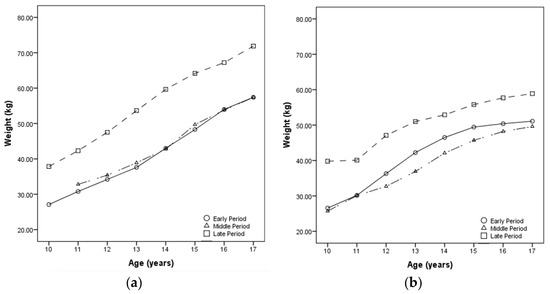
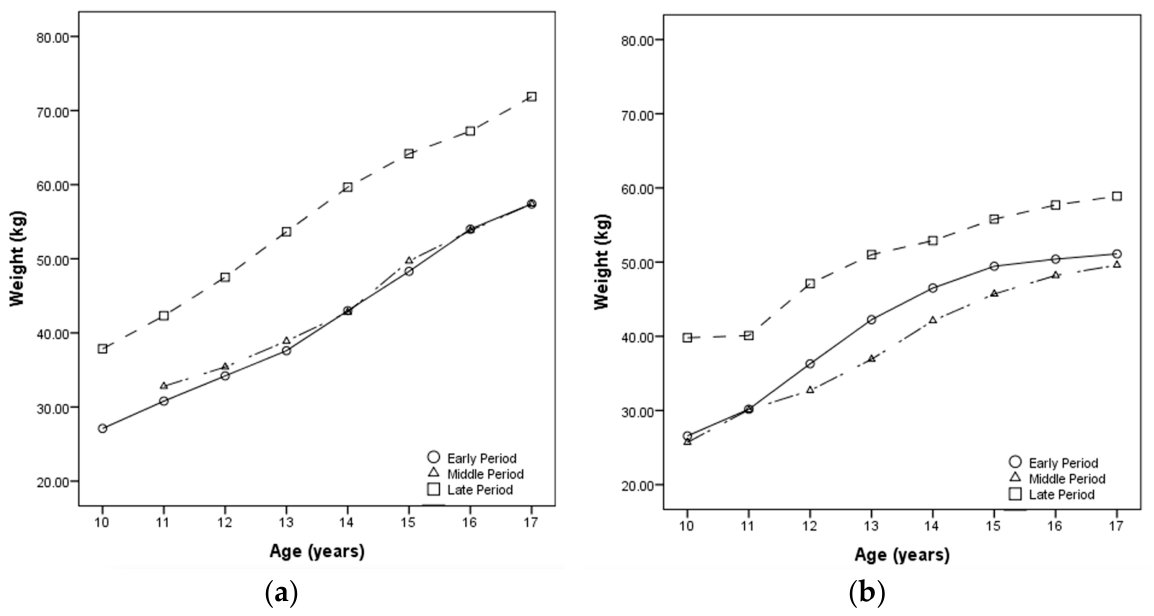
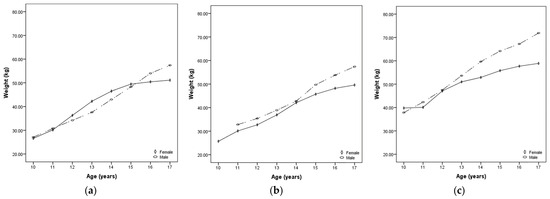
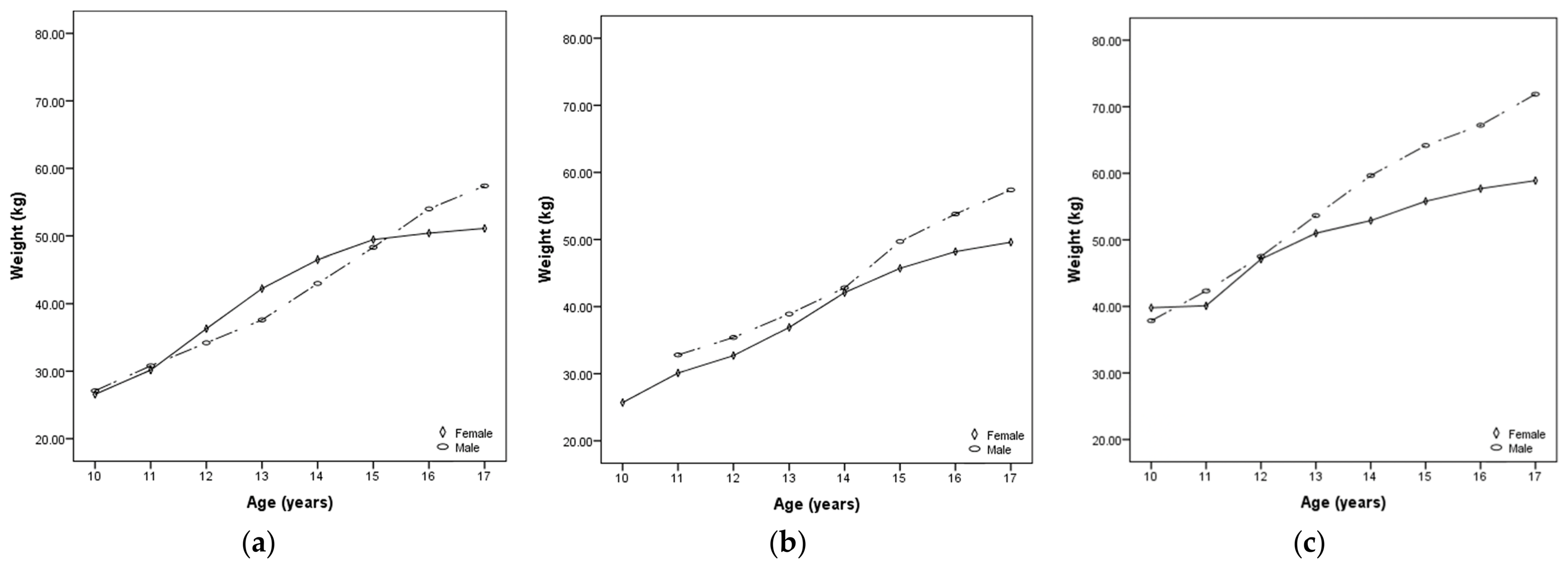
Weight also showed similar secular changes, and Figure 3 and Figure 4 illustrate trends across the three periods within each sex and the differences between the sexes, respectively. Boys’ weights were typically higher than girls’ weights for each period (see Table 2), but average weight difference between boys and girls at each age was not consistent. In the early period, the boys are consistently heavier than the girls across all age categories. In the middle period, this trend changes, and girls are on average heavier than boys until 16 years of age, after which the boys are heavier (Figure 3). In the late period, on average, 10-year-old girls are heavier than boys, but after this, the sex averages start to slowly diverge (Figure 4). Girls also experience a trend of weight plateauing around 16 years of age in the three periods, although the slope of the trend line suggests continued weight gain after 17 years in the late period (Figure 3b).
Figure 3.
Growth profiles showing average weights (kg) for (a) boys and (b) girls from ages 10 to 17 in the early (1913–1916), middle (1927–1943), and late (1992–2012) periods.
Figure 4.
From left to right, sex comparison of growth profiles showing average weight (cm) of boys and girls ages 10 to 17 during the (a) early period (1913–1916), (b) middle period (1929–1943), and (c) late period (1992–2012).
Table 3 provides mean increments of height and weight between the three periods. Boys demonstrated an average increase in height of 12.18 cm between the early and late periods, and girls experienced an average increase in height of 10.06 cm between those same periods (Table 3). Average weights of each cohort increased by 13.99 kg in boys and 12.14 kg for the girls between the early and late periods (Table 3). The observed increase in height is driven entirely by gains between the middle and late periods in both sexes, as height actually declined from the early to middle period. Similarly, the increase in weight is primarily attributable to changes between the middle and late periods, with only a minimal contribution from the early to middle period. Absolute gains in height and weight are greater in boys than in girls, and girls experienced a greater reduction in height between the early and middle period.
Table 3.
Increments in mean height (cm) and weight (kg) for age in boys and girls between the early (1913–1916), middle (1929–1942), and late (1992–2012) periods.
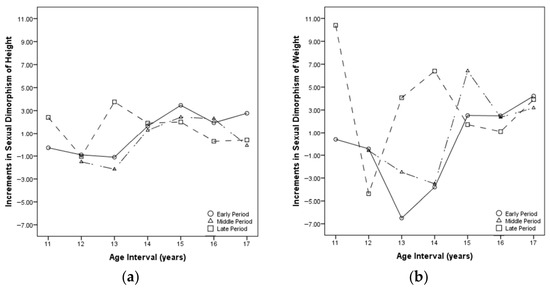
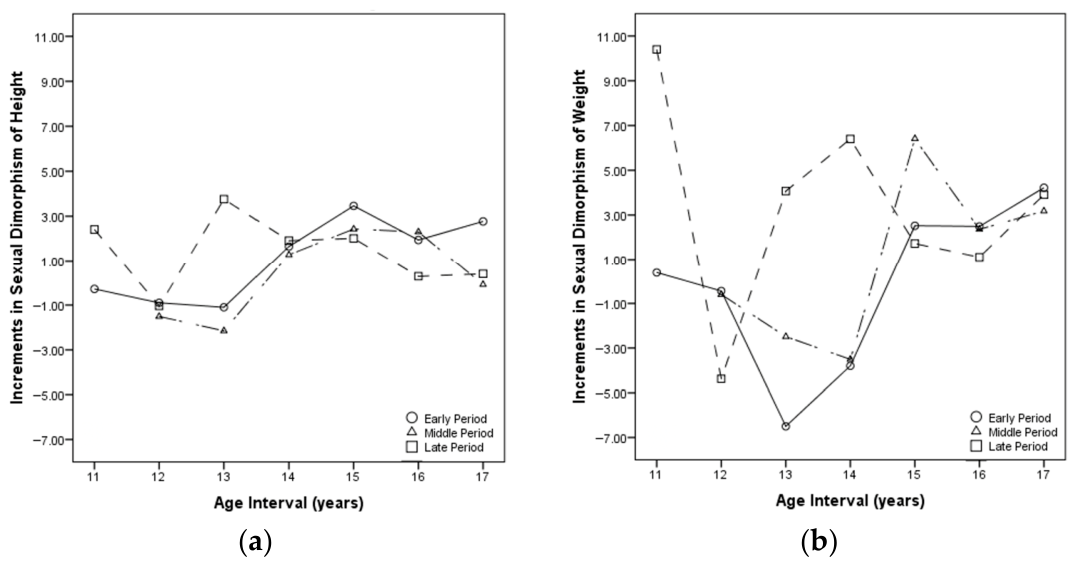
Sex differences in secular changes in growth can be further assessed using percent sexual dimorphism; however, dimorphism shows little variation across the three periods (Table 1 and Table 2). Overall, height dimorphism increases slightly over time (Table 1), and weight dimorphism decreases first, after increasing again (Table 2). When these trends in sexual dimorphism are examined as age-related increments, a slight increase in height dimorphism in the late period is also seen, particularly in children under 14 years of age when compared to the two other periods (Figure 5a). Weight, however, demonstrated a larger difference in sexual dimorphism between periods, with the later period showing the greatest age-related changes (Figure 5b). Boys and girls remain similar in weight until about age 12, after which boys begin to get heavier than girls.
Figure 5.
Age-related incremental change in percent sexual dimorphism of (a) average height (cm) and (b) average weight (kg). Age intervals in these plots refer to the difference in means between that age and the next (i.e., 10 years age interval refers to the difference between the mean of 10- and 11-year-olds).
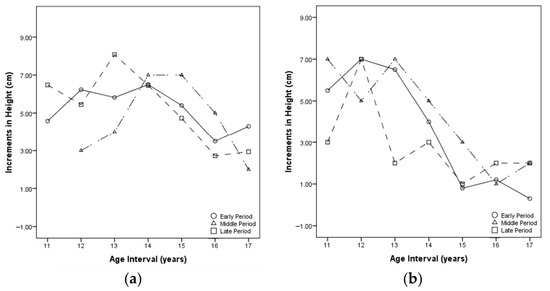
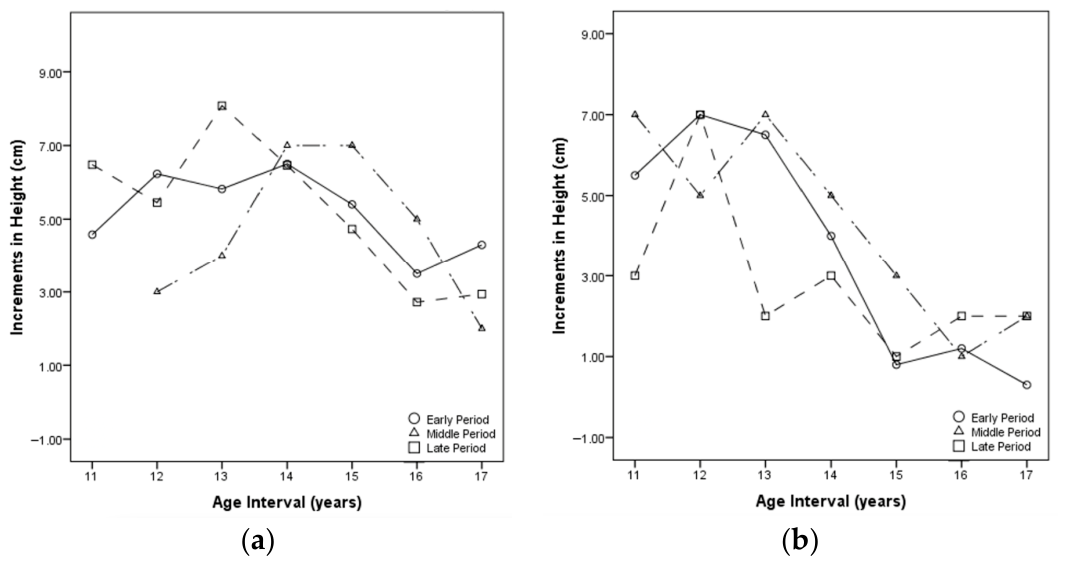
Age-related incremental changes in growth for height over the three periods and in both sexes are shown in Figure 6 to illustrate changes in developmental timing. Gains in height and weight from one age cohort to the next did differ between boys and girls. In the early and middle periods, boys reached their peak gain in height and weight between 13 and 16, while in the late period, peak gain in height and weight was reached earlier, around 12 to 14 years (Figure 6a). In girls, peak gain in height and weight were reached between 10 and 13 in the early and middle periods (Figure 6b) but between 11 and 12 in the late period. This may reflect a shift in the growth spurt of boys to an earlier age and a shift in the growth spurts of girls into a more definitive time frame.
Figure 6.
Age-related incremental changes in growth for height (cm) among (a) boys and (b) girls in the early (1913–1916), middle (1929–1943), and late (1992–2012) periods. Age intervals in these plots refer to the difference in means between that age and the next (i.e., 10 years age interval refers to the difference between the mean of 10- and 11-year-olds).
4. Discussion
Portuguese schoolgirls exhibit significant secular increases in height and weight over the 20th century similar although not identical to that of boys. This increase in height and weight was accompanied by an apparent shift in growth timing over the 20th century, with the pubertal growth spurt in boys seemingly occurring at progressively younger ages. Over the study span, not only was there an increase in the final height of both sexes but is it being reached earlier than in the early and middle periods. A similar trend is present among the weight data. Changes in average height and weight over the 20th century occurred most noticeably at different ages in girls and boys. Boys begin to add on height and weight around 13 years of age in the early and late periods, while girls increase in average height and weight roughly two years earlier, around 11 years old. This observation falls in agreement with what is known about developmental differences in girls and boys (Bogin, 1999).
The secular trend found among the female students of the Instituto de Odivelas can be attributed to the same social phenomena that promoted height and weight gains among the boys from the Colégio Militar: improvements to the socioeconomic environment in Portugal after the 1960s and particularly after 1974 that impacted child health and growth (Cardoso, 2008; Cardoso & Padez, 2008; Cardoso & Caninas, 2010; Cardoso & Murray, 2025). At the start of the 20th century, Portugal was a highly stratified society with a small social elite owning and controlling most of the country’s resources (Baiôa et al., 2003). The inequality did not improve with the rise of a dictatorship in 1926, which reinforced the stratified, isolated nature of the country. The dictatorship aimed at creating a patriarchal society where the role of women was to stay in the domestic sphere to engage in domestic labour and child rearing (Joaquim, 1997; Robinson, 2015; Wall et al., 2005). Some social liberties gained by the previous republican revolution were lost during the directorship. These losses, together with the repressive nature of the regime, may help explain the significant decline in average height observed in girls—and to a lesser extent in boys—while weight remained largely unchanged in both sexes during the transition to the middle period, coinciding with the early phase of the dictatorship.
Social and economic conditions began to improve towards the end of and then with the fall of the dictatorship in 1974 and with Portugal’s inclusion in the European economic community in 1986 (Corkill, 2003). Children born after this time would have experienced not only an overall increase in quality of diet and a decrease in their exposure to infection and pathogens, all of which impact human growth (Cardoso, 2008; Cardoso & Murray, 2025), but also a significant reduction in the stress associated with living under chronic toxic stress of social–economic–political–emotional inequality and insecurity of the Portuguese dictatorship. This social–economic–political–emotional (SEPE) environment influences the quality of the material conditions for human biology, including height, weight and other dimensions of growth, through social and moral signals that operate in community networks (Bogin et al., 2018; Hermanussen et al., 2019; Hermanussen & Scheffler, 2016). SEPE associations with human growth in height and weight are described here in terms of Portuguese social history and the economic conditions of the recent past and present, namely, the transition of political regimes from a dictatorship (1926–1974) to a democracy (1974–present). While the attribution of observed changes to broad socioeconomic and political transformations is indirect, it is considered plausible and supported by other studies.
While Portuguese schoolgirls exhibit significant secular increases in height and weight over the 20th century, including an acceleration in pubertal growth similar to that observed in boys, there are subtle sex differences in both the magnitude and timing of these changes. The height of boys at the Colégio Militar increased by 4% over the century, and their weight increased by 14%. Comparatively, girls at the Instituto de Odivelas experienced a similar increase in height of 3%, but their weight only increased by 10%. Both boys and girls experienced a decline in height, although this decrease was more pronounced in girls. Consequently, the largest increases in height and weight for boys occurred between the middle and late periods, while girls experienced more modest gains. This smaller secular change experienced by girls is consistent with the results of Conceição et al. (2012), who documented a small increase in height among women compared to men.
Other than general differences in magnitude, sex differences in the secular change of height appear to reflect an increase in dimorphism in the late period. Sex differences in the secular change of weight appeared more variable, with the late period also being the most dimorphic. Most of the variations in dimorphism in the secular trend of height and weight are observed in children under 16 years of age in all three periods, with the peak of sex differences occurring at progressively younger ages. After 16 years of age, the level of dimorphism remains more constant. This is a likely reflection of shifts in the pubertal growth spurt over time. In the early period, girls are taller and heavier until around 13–14 years old, after which boys outgrow them. In the middle period, a similar trend is present. Sexual dimorphism in the secular trend is at its highest and most variable in the late period, meaning the differences between boys and girls are the most pronounced at this time. Dimorphism goes from very high, favouring boys at age 11, to favouring girls at age 12 during their growth spurt in both height and weight. Boys go through their growth spurt at around age 13, and dimorphism favours them once again. Overall, dimorphism is higher among average weight than average height for all three periods.
Can cultural preference towards boys be responsible for the differences in growth between girls and boys across the three periods? Historically, there has been a sharp difference between the roles and expectations of men and women in Portuguese society (Joaquim, 1997; Robinson, 2015; Rodrigues, 1995; Wall et al., 2005). Women and girls have a greater probability of being burdened with labour, both inside and outside the home, of suffering from neglect and malnutrition, and thus of ill health compared to males, all of which can directly impact growth. However, over time, political and social changes have occurred in the late 20th century that may have reduced the gender gap (Robinson, 2015). There are several scenarios by which cultural preference could explain the findings of differential sexual dimorphism in this study. However, we are not able to distinguish between an increase in height that is due to the positive environment and one that is due to cultural buffering, as both could result in the same trends depending on their magnitude and changes in their dynamics over time. Regardless of the scenarios above, however, our results indicate that boys in this study appear to be more sensitive to changes in the environment than girls, whether that is due to a greater response to a positive environment or to a cultural buffer. When conditions deteriorate, boys’ height should suffer the most or would have if not for the cultural-preference buffer, but when conditions improve, they also tend to experience the most absolute improvement in height. In contrast, the girls’ growth is less variable in the face of improving environmental circumstances than boys, because secular increases are triggered only by improvements to the environment—assuming that cultural preference for boys is always present and of similar magnitude over time.
Although changes in the secular trend of height and weight demonstrate a similar pattern between the sexes, there are some important differences. It is expected that if boys are more environmentally sensitive in terms of growth, then in the early and middle periods, boys’ weights would be very similar to those of girls. However, what is observed is a slight difference of average weight for age during these periods, where boys seem to be heavier until girls undergo their first growth spurt, at which point the gap narrows but does not disappear. This pattern can also be observed in the average height of boys and girls during the middle period. Boys experience a plateauing (or mild decrease) of height and weight between the early and middle periods, while the girls experience, on average, a marked decrease in height and plateauing of weight between the same periods. The above evidence seems to suggest a scenario wherein boys experienced disproportionately larger amounts of growth compared to girls in the late period due to the combination of increased sensitivity to a positive environmental change and cultural buffering. Cultural preference for boys during growth and development can work as a buffer against adverse environments but may also further promote growth in improved environments—as may be the case documented here. However, while these explanations based on culturally mediated preferential treatment of boys are plausible, they remain inferred rather than empirically demonstrated.
This study has been able to show a consistent secular change in height and weight of Portuguese girls’ concomitant to that of boys and has raised some hypotheses about the associated changes in sex differences of height and weight. However, this sample is composed mainly of affluent children, the majority of whom belonged to military families. This could mean that the students observed in this study are unrepresentative of changes in growth occurring in the general population, particularly in terms of gender inequality. Since this is a privileged sample, the gender gap may not be as apparent or have as serious consequences as in a more limited resource environment of poor or low socioeconomic status individuals. For example, there is evidence that groups of high-status individuals may be the first to respond to positive changes in the environment, as they are likely the first recipients of increases in nutritional quality, access to healthcare, and other factors which can influence secular growth (Cardoso & Padez, 2008). Thus, these children can be considered indicative of wider trends in rising standards of living, although they may be the first to reap their benefits. Comparisons with boys and girls from different socioeconomic groups are needed to further compare this pattern.
Other concerns that can be raised with this study include the cross-sectional, summarized nature of the data, including an uncertain amount of longitudinal data, which may introduce random fluctuations and add or remove variations that conceal a more accurate pattern of change. Sample sizes for certain periods and age groups are relatively small, and some interpretations are based on modest absolute differences (e.g., less than 2 cm in height or approximately 1 kg in weight). These factors limit the robustness of the findings, as small differences may fall within the range of normal variation. This limitation is further compounded by the absence of variability estimates (e.g., standard deviations) for some periods, which restricts the ability to assess statistical significance and confidence in the observed patterns.
It is also unclear how the socioeconomic status of the students may have shifted over time, especially when considering the fact that more civilians were accepted to the schools during the late 20th century. This study assumes the relative socioeconomic status of the boys and girls did not change over time, but if it did, the results and interpretations could be impacted in unknown ways. The data for boys and girls are also derived from different institutions, which may reflect differences in diet, healthcare, or admission criteria; these factors should be considered as potential confounders when interpreting sex differences in growth—but currently, their effect is unknown. Furthermore, this study is primarily descriptive in nature, and many of the interpretations presented are not supported by formal statistical testing. As a result, the observed patterns and trends should be interpreted with caution, as they have not been rigorously evaluated for statistical significance. Despite these issues, it is clear that both genders experienced similar changes in height and weight throughout the 20th century in response to the same changes in the environment and that sex differences in the secular trend of height and weight need to be further explored.
Both boys and girls experienced an increase in height and weight over the 20th century, most likely due to population-wide improvements in socioeconomic status, nutritional status, improved sanitation, and decreased disease load. Boys seem to have increased more in relative and absolute height and weight, which is expected since they are likely more sensitive to environmental change than girls. Cultural buffering may have taken place in the early and middle periods, and possibly even the late period, wherein boys experienced slightly higher pre-pubescent weights and heights due to culturally mediated preferential treatment common in Portugal. More research is needed to see if this trend holds true, especially across different levels of socioeconomic status.
Author Contributions
Conceptualization, H.F.V.C., L.S. and J.M.; methodology and formal analysis, J.M., H.F.V.C. and L.S.; resources, H.F.V.C.; data curation, H.F.V.C.; writing—original draft preparation, J.M.; writing—review and editing, and H.F.V.C., L.S. and J.M.; supervision, H.F.V.C.; funding acquisition, H.F.V.C. All authors have read and agreed to the published version of the manuscript.
Funding
This research was partially funded by grant #SFRH/BPD/22142/2005, awarded by the Fundação para a Ciência e Tecnologia, Portugal.
Data Availability Statement
Restrictions apply to the availability of these data. Data were obtained from Colégio Militar and Instituto de Odivelas (Estado-Maior do Exército—Army General Staff) and are available from the authors with the permission of the Estado-Maior do Exército, or Colégio Militar.
Acknowledgments
We want to thank the two anonymous reviewers for their helpful comments and suggestions. Thanks are extended to Coronel José Bernardino Serra, former Director of the Instituto de Odivelas, for allowing access to the records of the girls, and nurse Raquel Freitas who kindly collected their data for us. We would also like to thank Major-General Medeiros and Major-General Passos (former Directors of the Colégio Militar) for allowing access to the records of the boys. Colonel Ferreira’s support and nurse First Sergeant Almeida’s assistance also facilitated the access to the records of boys.
Conflicts of Interest
The authors declare no conflict of interest.
References
- Ayub Ali, M. D., Lestrel, P. E., & Ohtsuki, F. (2001). Adolescent growth events in eight decades of Japanese cohort data: Sex differences. American Journal of Human Biology, 13(3), 390–397. [Google Scholar] [CrossRef]
- Baiôa, M., Fernandes, P. J., & Meneses, F. R. (2003). The political history of twentieth-century Portugal. E-Journal of Portuguese History, 1(2), 1–18. [Google Scholar]
- Beltrán Tapia, F. J., & Gallego-Martínez, D. (2017). Where are the missing girls? Gender discrimination in 19th-century Spain. Explorations in Economic History, 66, 117–126. [Google Scholar] [CrossRef] [Scilit]
- Bogin, B. (1999). Patterns of human growth. Cambridge University Press. [Google Scholar]
- Bogin, B., Hermanussen, M., & Scheffler, C. (2018). As tall as my peers—Similarity in body height between migrants and hosts. Anthropologischer Anzeiger, 74(5), 363–374. [Google Scholar] [CrossRef] [Scilit] [PubMed]
- Cardoso, H. F. V. (2008). Secular changes in body height and weight of Portuguese boys over one century. American Journal of Human Biology, 20(3), 270–277. [Google Scholar] [CrossRef] [Scilit] [PubMed]
- Cardoso, H. F. V., & Caninas, M. (2010). Secular trends in social class differences of height, weight and BMI of boys from two schools in Lisbon, Portugal (1910–2000). Economics and Human Biology, 8(1), 111–120. [Google Scholar] [CrossRef] [Scilit] [PubMed]
- Cardoso, H. F. V., & Murray, N. J. (2025). Growing up in a growing economy: Reassessing changes in biological living standards in Portugal during the twentieth century. Economics & Human Biology, 59, 101556. [Google Scholar] [CrossRef] [Scilit]
- Cardoso, H. F. V., & Padez, C. (2008). Changes in height, weight, BMI and in the prevalence of obesity among 9- to 11-year-old affluent Portuguese schoolboys, between 1960 and 2000. Annals of Human Biology, 35(6), 624–638. [Google Scholar] [CrossRef] [Scilit]
- Castro, J. J., Dias, J. A., Baptista, F., Garcia e Costa, J., Galvão-Teles, A., & Camilo-Alves, A. (1998). Secular trends of weight, height and obesity in cohorts of young Portuguese males in the District of Lisbon: 1960–1990. European Journal of Epidemiology, 14, 299–303. [Google Scholar] [CrossRef] [Scilit]
- Cermeño, A. L., Palma, N., & Pistola, R. (2023). Stunting and wasting in a growing economy: Biological living standards in Portugal during the twentieth century. Economics & Human Biology, 51, 101267. [Google Scholar] [CrossRef] [Scilit]
- Colégio Militar. (1913). Annuario do real colégio militar, anno lectivo de 1912–1913. Imprensa Nacional. [Google Scholar]
- Colégio Militar. (1914). Annuario do real colégio militar, anno lectivo de 1913–1914. Imprensa Nacional. [Google Scholar]
- Colégio Militar. (1930). Anuário do colégio militar, ano lectivo de 1929–1930. Tipografia Minerva. [Google Scholar]
- Colégio Militar. (1934). Anuário do colégio militar, ano lectivo de 1930–1931 e 1931–1932. Tipografia Minerva. [Google Scholar]
- Colégio Militar. (1938). Anuário do colégio o militar, ano lectivo de 1932–1933 e 1933–1934. Grandes Oficinas Gráficas Minerva. [Google Scholar]
- Colégio Militar. (1939a). Anuário do colégio militar, ano lectivo de 1934–1935 e 1935–1936. Grandes Oficinas Gráficas Minerva. [Google Scholar]
- Colégio Militar. (1939b). Anuário do colégio militar, ano lectivo de 1936–1937. Grandes Oficinas Gráficas Minerva. [Google Scholar]
- Conceição, E., Garcia, S., Padez, C., & Cardoso, H. F. V. (2012). Changes in stature of Portuguese women born between 1966 and 1982, according to educational level. Antropologia Portuguesa, 29, 81–96. [Google Scholar] [CrossRef] [Scilit]
- Corkill, D. (2003). Aspects of Portugal’s economic development during the late Estado Novo. Portuguese Journal of Social Science, 2(1), 61–72. [Google Scholar] [CrossRef] [Scilit]
- Costa, A. M., Costa, M. J., Reis, A. A., Ferreira, S., Martins, J., & Pereira, A. (2017). Secular trends in anthropometrics and physical fitness of young Portuguese school-aged children. Acta Médica Portuguesa, 30(2), 108–114. [Google Scholar] [CrossRef] [Scilit]
- Díez Navarro, A., Marrodán Serrano, M. D., Gómez de Arriba, A., Vargas Brizuela, A., Pacheco del Cerro, J. L., Sánchez-Álvarez, M., López Ejeda, N., Moreno Romero, S., Prado Martínez, C., Cabañas Armesilla, M. D., & Martínez Alvarez, J. R. (2017). Female eco-stability and severe malnutrition in children: Evidence from humanitarian aid interventions of action against hunger in African, Asian and Latin American countries. Nutrición Clínica y Dietética Hospitalaria, 37(4), 127–134. [Google Scholar] [CrossRef] [Scilit]
- Floud, R. (1994). The heights of Europeans since 1750: A new source for European economic history. In J. Komlos (Ed.), Stature, living standards and economic development: Essays in anthropometric history (pp. 9–24). The University of Chicago Press. [Google Scholar]
- Fogel, R. W. (1986). Physical growth as a measure of the economic well-being of populations: The eighteenth and nineteenth centuries. In F. Falkner, & J. M. Tanner (Eds.), Human growth: A comprehensive treatise (pp. 263–281). Plenum Press. [Google Scholar]
- Frayer, D. W. (1980). Sexual dimorphism and cultural evolution in the late Pleistocene and Holocene of Europe. Journal of Human Evolution, 9(5), 399–415. [Google Scholar] [CrossRef] [Scilit]
- Gillett-Netting, R., & Perry, G. (2005). Parental investment and growth among Hadza children. Human Nature, 16, 437–453. [Google Scholar]
- Greulich, W. W. (1951). The growth and developmental status of Guamanian school children in 1947. American Journal of Physical Anthropology, 9(1), 55–70. [Google Scholar] [CrossRef] [Scilit]
- Hassan, A., Schaffnit, S. B., Sear, R., Urassa, M., & Lawson, D. W. (2019). Fathers favour sons, mothers don’t discriminate: Sex-biased parental care in northwestern Tanzania. Evolutionary Human Sciences, 1, e13. [Google Scholar] [CrossRef] [Scilit]
- Hermanussen, M., Bogin, B., & Scheffler, C. (2019). The impact of social identity and social dominance on the regulation of human growth: A viewpoint. Acta Paediatrica, 108(12), 2132–2134. [Google Scholar] [CrossRef] [Scilit] [PubMed]
- Hermanussen, M., & Scheffler, C. (2016). Stature signals status: The association of stature, status and perceived dominance—A thought experiment. Anthropologischer Anzeiger, 73(4), 265–274. [Google Scholar] [CrossRef] [Scilit]
- Hosseini, M., Taslimi, S., Dinarvand, P., Jones, M. E., & Mohammad, K. (2010). Trends in weights, heights, BMI and comparison of their differences in urban and rural areas for Iranian children and adolescents 2–18-year-old between 1990–1991 and 1999. Child Care, Health and Development, 36(6), 858–867. [Google Scholar] [CrossRef] [Scilit] [PubMed]
- Joaquim, T. (1997). Menina e moça: A construção social da feminilidade, séculos XVII–XIX. Fim de Século. [Google Scholar]
- Jones, L. L., Griffiths, P. L., Norris, S. A., Pettifor, J. M., & Cameron, N. (2008). Age at menarche and the evidence for a positive secular trend in urban South Africa. American Journal of Human Biology, 21(1), 130–132. [Google Scholar] [CrossRef] [Scilit]
- Kaplowitz, P. (2006). Pubertal development in girls: Secular trends. Current Opinion in Obstetrics and Gynecology, 18(5), 487–491. [Google Scholar] [CrossRef] [Scilit] [PubMed]
- Lissner, L., Mehlig, K., Sjöberg, A., Chaplin, J., Niklasson, A., & Albertsson-Wikland, K. (2013). Secular trends in weight, height and BMI in young Swedes: The grow up Gothenburg studies. Acta Paediatrica, 102(3), 314–317. [Google Scholar] [CrossRef] [Scilit] [PubMed]
- Livi-Bacci, M. (1991). Population and nutrition: An essay on European demographic history (No. 14). CUP Archive. [Google Scholar]
- Malina, R. M., Peña Reyes, M. E., Swee, K. T., Buschang, P. H., Little, B. B., & Koziel, S. (2004). Secular change in height, sitting height and leg length in rural Oaxaca, southern Mexico: 1968–2000. Annals of Human Biology, 31(6), 615–633. [Google Scholar] [CrossRef] [Scilit]
- Marván, M. L., Castillo-López, R. L., Del-Callejo-Canal, D. D., Canal-Martínez, M., & Núñez-de la Mora, A. (2020). Secular trends in age at menarche in 20th century Mexico: Differences by ethnicity, area of residency, and socioeconomic status. American Journal of Human Biology, 32(6), e23404. [Google Scholar] [CrossRef] [Scilit]
- Matos, J. A. C. (2003). História do Colégio Militar. Estado-Maior do Exército. [Google Scholar]
- Negasheva, M. A., Khafizova, A. A., & Movsesian, A. A. (2023). Secular trends in height, weight, and body mass index in the context of economic and political transformations in Russia from 1885 to 2021. American Journal of Human Biology, 36(2), e23992. [Google Scholar] [CrossRef] [Scilit]
- Padez, C. (2002). Stature and stature distribution in Portuguese male adults 1904-1998: The role of environmental factors. American Journal of Human Biology, 14(1), 39–49. [Google Scholar] [CrossRef] [Scilit]
- Padez, C., & Johnston, F. (1999). Secular trends in male adult height 1904-1996 in relation to place of residence and parent’s educational level in Portugal. Annals of Human Biology, 26(3), 287–298. [Google Scholar] [CrossRef] [Scilit]
- Pintassilgo, J. (2010). Exemplaridade institucional e renovação pedagógica: Reflexões a partir das viagens de professores do Instituto de Odivelas. Revista Brasileira de História da Educação, 22, 65–86. [Google Scholar]
- Prall, S., & Scelza, B. (2017). Child fosterage and sex-biased nutritional outcomes among Namibian pastoralists. American Journal of Human Biology, 29, e23058. [Google Scholar] [CrossRef] [Scilit]
- Robinson, H. (2015). The changing role of women in Portugal. Perspectives on Business and Economics, 33(6), 49–60. [Google Scholar] [CrossRef] [Scilit]
- Rodrigues, J. A. (1995). Continuidade e mudança nos papeis das mulheres portuguesas urbanas: O aparecimento de novas estruturas familiares. Cadernos condição feminina No 40. Comissão para a Igualdade e para os Direitos das Mulheres, Lisboa. [Google Scholar]
- Santos, O. A. (1916). O crescimento da criança portuguesa. Boletim Bibliográfico da Universidade de Coimbra, 3, 175–233. [Google Scholar]
- Schell, L. M. (1989). Community health assessment through physical anthropology: Auxological epidemiology. Human Organization, 45(4), 321–327. [Google Scholar] [CrossRef] [Scilit]
- Sobral, F. (1990). Secular changes in stature in southern Portugal between 1930 and 1980 according to conscript data. Human Biology, 62, 491–504. [Google Scholar]
- Song, Y., Ma, J., Agardh, A., Lau, P. W. C., Hu, P., & Zhang, B. (2015). Secular trends in age at menarche among Chinese girls from 24 ethnic minorities, 1985 to 2010. Global Health Action, 8(1), 26929. [Google Scholar] [CrossRef] [Scilit]
- Stini, W. A. (1969). Nutritional stress and growth: Sex difference in adaptive response. American Journal of Physical Anthropology, 31(3), 417–426. [Google Scholar] [CrossRef] [Scilit]
- Stinson, S. (1985). Sex differences in environmental sensitivity during growth and development. American Journal of Physical Anthropology, 28, 123–147. [Google Scholar] [CrossRef] [Scilit]
- Stinson, S. (2012). Growth variation: Biological and cultural factors. In S. Stinson, B. Bogin, R. Huss-Ashmore, & D. O’Rourke (Eds.), Human biology: An evolutionary and biocultural perspective. John Wiley and Sons. [Google Scholar]
- Sun, S. S., Deng, X., Sabo, R., Carrico, R., Schubert, C. M., Wan, W., & Sabo, C. (2012). Secular trends in body composition for children and young adults: The Fels longitudinal study. American Journal of Human Biology, 24(4), 506–514. [Google Scholar] [CrossRef] [Scilit]
- Tanner, J. M., Whitehouse, R. H., Marshall, W. A., Healy, M. J. R., & Goldstein, H. (1975). Assessment of skeletal maturity and prediction of adult height (TW2 method). Academic Press. [Google Scholar]
- Wall, K., Nunes, C., & Matias, A. R. (2005). Female migration vision. Immigrant women in Portugal: Migration trajectories, main problems and policies [Preliminary report-research in progress]. Lisbon Institute of Social Science. [Google Scholar]
- Wamani, H., Åstrøm, A. N., Peterson, S., Tumwine, J. K., & Tylleskär, T. (2007). Boys are more stunted than girls in Sub-Saharan Africa: A meta-analysis of 16 demographic and health surveys. BMC Pediatrics, 7, 17. [Google Scholar] [CrossRef] [Scilit]

Disclaimer/Publisher’s Note: The statements, opinions and data contained in all publications are solely those of the individual author(s) and contributor(s) and not of MDPI and/or the editor(s). MDPI and/or the editor(s) disclaim responsibility for any injury to people or property resulting from any ideas, methods, instructions or products referred to in the content. |
© 2026 by the authors. Licensee MDPI, Basel, Switzerland. This article is an open access article distributed under the terms and conditions of the Creative Commons Attribution (CC BY) license.