


Abstract
This article examines the cognitive theory expressed in early Buddhist Pāli sources by situating their analyses of perception, language, and meditative experience within a psychosemiotic framework. It argues that Buddhist thinkers conceived cognition as a stratified process emerging from the dynamic interaction between sensory and effectual domains, culminating in the semiotic determinations of nāmarūpa and the proliferative activity of conceptual constructs. Drawing on parallels with Peircean pansemioticism, the study highlights how both traditions interpret phenomena as sign-constituted events and how contemplative practice can intervene in the habitual chains of semiosis that ordinarily shape human experience. By bridging Buddhist phenomenology with contemporary cognitive science and semiotics, this work proposes that the Buddhist model—precise in its technical vocabulary and rich in its analyses of attention, perception, and conceptualization—offers valuable tools for understanding and modulating cognitive processes in both theoretical and practical domains.
1. Introduction
The present article aims to investigate the cognitive theory outlined in Buddhist texts belonging to the Pāli corpus (Collins, 1990; Gombrich, 2006; Levman, 2016, 2020). Its purpose is to demonstrate that in these texts Buddhist thinkers developed a refined and thorough reflection on cognitive processes and, in particular, on the relationship between cognition and language—situating cognitive processes within a semiotic, or more precisely psychosemiotic, system that explains their dynamics by unifying language (Genjun, 1986; Kalupahana, 1999; Levman, 2017), the mechanisms that produce semiotic efficacy (semiosis), and cognition (Divino, 2025c).
This work falls within cognitive and semiotic anthropology (Bender et al., 2010; Kjaerholm, 2013; Kronenfeld et al., 2011; Levinson, 2022; Singer, 1980), as it aims to study Buddhist meditation from a perspective that unifies Uexküll’s biosemiotic theory with the construction of percepts and complex cognitions, which subsequently flow into the structuring of sociocultural networks. Furthermore, dialog between anthropology and biosemiotics is already underway (Schroer, 2021).
Conversely, the Buddhist meditation is of undeniable anthropological interest: its foundation is precisely a theory of processes of aggregation—that is, of how, starting from a fundamental qualitative core, human cognitions are able to construct levels of complex meaning capable of coordinating not only the way an individual “exists in the world”, but also how subjects coordinate with one another in constructing true sociocultural “environments” (Bloch, 1991).
Anthropological studies on meditation are beginning to explore the relationship between contemplative practice and the way one’s worldview and sense of identity are modified (Divino, 2024a), but a theory capable of interpreting these processes has not yet been developed. Naturally, the aim here is not to provide a single interpretive key, but rather to propose a methodology that may be useful for future developments of an anthropology of meditation.
Contemplative practice is presented as an exercise capable of redirecting the processes that normally lead to the automatic proliferation of concepts (papañca) and to the unconscious influence of signs in human thought. This practice neutralizes automatisms and loosens the causal chains underlying semiosis (Section 3.3), thereby freeing human cognitions from the action of signs (D’Amato, 2003; Harvey, 1986; Lettner, 2021a), which ordinarily function as meaning-bearing units that regulate the processes through which human beings perceive objects in the world (Xiong, 2018), but also concepts, identities (Collins, 1982; Harvey, 2013; Nave et al., 2021; Polak, 2018), norms (Gethin, 2004; Karunadasa, 1996), ideas, beliefs (Fuller, 2005), opinions, and epistemic models—whose influence is usually undergone unconsciously.
By acting on the links that trigger the mechanisms of habituation to these semiotic stimuli (driving cognitive reactions and behavioral or ideological consequences), contemplative practice shifts the subject’s awareness from a passive, automatic state to an alert one, capable of recognizing such links, influences, and cognitive processes—and potentially of positioning itself outside them.
To explain these complex mechanisms, Buddhist thought develops from the outset an in-depth reflection on these processes through the adoption of a specialized technical lexicon, in which the choice of the semantic roots composing the technical terms is made with extreme care, so that each term can indicate specific aspects of the cognitive process.
This reflection includes a lexicon comparable to that of the cognitive sciences and, in particular, of semiotics and biosemiotics (Alter, 2022; Brier, 2006; Velmezova et al., 2015), since in Buddhist theory consciousness is a field dependent on interactions between environmental processes and subjective perceptions—implying, in turn, the development of a technical vocabulary aimed at describing such psycho-ecological dynamics.
Today, the study of contemplative practice is at the center of psychological debate not only because of research on the benefits of meditation, but also because this practice offers innovative interpretative frameworks capable of opening new frontiers for cognitive studies. However, most of these studies focus on quantitative data collected through psychological research on modern meditative experiences, without taking into account the extensive literature on meditation already present in the Buddhist world.
Analyzing these texts would not only shed light on aspects of meditation that transcend mindfulness—which is inspired by only one specific contemplative exercise among the many described in Buddhist texts or still practiced today in diverse traditions—but would also provide cognitive science with new and valuable tools and methodologies.
In this article, I will therefore analyze the fundamental aspects of Buddhist cognitive and psychosemiotic theory in the Pāli texts, in an attempt to initiate this transdisciplinary dialog. Since there is a heated debate concerning the homogeneity of the literary corpus in question, I refer to the discussion in Appendix A for more information on the topic and the reasons for my choice to focus on these specific texts.
1.1. On the Fundamental Buddhist Cognitive–Semiotic Concepts
From a terminological point of view, Buddhist thought is characterized by the use of very precise technical jargon, where the choice of semantic roots composing each technical term is decidedly careful and serves to indicate the nuance of the term with accuracy. There are several concepts that we can trace back to a theory of cognitive processes, and in this paper, I will summarize the most important ones: the role of the relationship between perceiver and environment (Section 2), the process of progressive cognitive stratification consisting of five main layers (Section 3), and finally the semiotic coordination of these processes, carried out by the force of semiosis (see Section 3.3 in particular).
In the Buddhist understanding, the relationship between the sensory dimension and the effectual dimension constitutes the beginning of the cognitive process, which is nothing other than the culmination of a progressive stratification, or complexification, of environmental data. This begins precisely with the reception of a sensory complex and, starting from it, constructs fundamental percepts, that is, sense-interpretations of certain sections of the sensory flow that begin to be associated with determined values (already proto-culturalized) or with perceptual categories (for example, the idea of a single “roughness” into which one can organizationally converge the perception of various “rough” surfaces), that is, an organization of the purely qualitative datum.
The percepts are subsequently organized, driven by volitional impulse, into specific cognitive constructs—concepts associable with values of fundamental usability—and finally distinguished into specific, well-recognizable, nameable identities. The function of discernment, the culmination of this cognitive process, serves precisely to distinguish A sharply from B, and so on (Squarcini, 2018, p. 211).
All these cognitive processes are well represented in the philosophical reflections we find in the Pāli Buddhist texts, and have led many scholars to hypothesize the possibility of a semiotic reading of contemplative practice, understood as an exercise concerned precisely with the overcoming of semiosic processes through progressive analysis of the cognitive activities that underlie them (Arning, 2009).
Attempts at a semiotic reading of Buddhist thought have been carried out by Lettner, in two important works that focus primarily on the Abhidhamma (Lettner, 2021b), but also by others who have recognized genuine processes of desemioticization of cognitive processes brought about by contemplative practice. The production of specific visions through the manipulation or evocation of specific signs is recognized as an integral part of Buddhist meditative exercises (Greene, 2021).
These semiotic reflections are not a Buddhist invention and were therefore not a novelty for the Indian cultural world. Battles over the semiotic primacy of veridiction engaged the entire Indian philosophical panorama (Squarcini, 2008, 2011a, 2011b), and Buddhism merely entered the scene by expanding the already rich grammatical reflection that had already in antiquity traced connections between language and cognition (Bausch, 2016; Bronkhorst, 2010, 2011; Deshpande, 2016; Jurewicz, 2010; Levman, 2017). In Buddhism, this reflection is greatly expanded starting precisely from contemplative practice and from its capacity to produce a cessation of the influence of signs in cognitive processes (Squarcini, 2020), intervening directly in the action of semiosis (Tragel, 2023) which, otherwise, would proceed by automatism, continuing to produce concepts and percepts (Section 3.2).
This reading is also proving useful for understanding more clearly the functioning of meditative practice within cognitive science, sometimes tracing it back to processes of generative semiotic activity (Morioka, 2024).
Since the aim of this discussion is to introduce into the field of cognitive anthropology the concepts developed by Buddhist reflections on perception and cognition, a specific appendix has been created to collect all the main themes addressed in this paper, in order to provide a terminological guide for the reader (see Appendix B). As will become clear, one of the main advantages of a cognitive–anthropological approach to Buddhism is that it supports the study of meditation and, in particular, the growing debate within contemplative studies concerning appropriate methodologies for conducting an ethnography of meditation, allowing for a qualitative investigation of the complex experiences associated with contemplative practice.
1.2. Pansemioticism and Psychosemiotic Theory
The starting point of our investigation is Peirce’s semiotic theory (Peirce, 1982), and especially the notions of sign and semiosis (Barbieri, 2009). I will also examine the problem of reference and interpretation as related to the cognitive process (Bellucci, 2016; Dewey, 1946; Eco, 1976; Feibleman, 1940; Kilstrup, 2015; Liszka, 1990; Peirce, 1977, 2017; Queiroz & El-Hani, 2006; Sánchez-Ovcharov & Suárez, 2024; Savan & Peraldi, 1980; Short, 1996). The link between signs and cognitive processes has been repeatedly made evident by linguistics. Ferdinand de Saussure, the father of linguistic science, spoke explicitly of psychological processes (de Saussure, 2002, pp. 20–21; 2016, pp. 76, 80, 153), and semiology, the science of signs he proposed, was conceived as capable of contributing to psychology (Krampen, 1987; Reda, 2016).
Peirce, for his part, denied that his discipline, semiotics, could be considered a form of psychology, since he rejected certain basic assumptions of psychology as a science. In his reflections, he developed a methodology centered on the analysis of whatever “thing” might be present to attention at any given moment. Peirce saw no differences between phenomena and signs (Deledalle, 1981; Feibleman, 1940; Greenlee, 1976; Rosensohn, 1974), since both are “determinates” that present themselves to the attention of a subject’s consciousness. Moreover, every sign or phenomenon can be subjected to the analytical process that reveals its primary qualitative constituents, confirming that every phenomenal or cognitive construct is the result of an aggregation of several elements, or Minimal Phenomenal Units.
Peirce would christen this analysis “phaneroscopy”, insofar as it focuses on the phaneron, that is, everything that is present to the mind regardless of whether that thing may be considered physical or not (CP 1.284). The phaneron is thus that which is par excellence directly observable (CP 1.286).
Phaneroscopy, as mentioned, is unconcerned with the psychological nature of these constitutive factors (Bellucci, 2014; Bruzy et al., 1980; Fisch & Turquette, 1966; Rosensohn, 1974, p. 74; Shafiei & Pietarinen, 2019). At the same time, however, acknowledging that Peirce dealt with cognition and cognitive processes is inevitable (Cunningham, 1998; Gagliano, 2014). That he wished to free these analyses of cognitive systems from the psychological framework matters little for our purposes, since we will use his considerations in order to compare them with Buddhist theories.
Peirce writes in a note to CP 5.448 that the entire universe is “perfused with signs”. This conception serves to explain that “a sign should leave its interpreter to supply a part of its meaning”. Semiotics is essentially founded on reciprocal relational links among diverse signs, and every phenomenon (“not merely the universe of existents, but all that wider universe”, Peirce writes) is nothing but the unity of a semiotic interaction capable of determining meaning through a process in which, for example, one sign functions as the interpretant of another sign (a representamen), but in turn the interpreting sign may be the representamen, or the semiotic determinate, for another sign, and so on. According to Peirce, “each former thought suggests something to the thought which follows it, i.e., is the sign of something to this latter”. In other words, “there is no intuition or cognition not determined by previous cognitions” (CP 5.284).
This model describes a system in which tout se tient, where only interactions bring about determinations, and thus where no isolated meaning or phenomenon can exist as something “existent in itself”, in the sense of autonomous and self-sufficient.
This reading is obviously applied also to cognitive processes, which are actors in this wider system where everything is sign: “all this universe is perfused with signs, if it is not composed exclusively of signs”. We will therefore indicate by convention this vision of the all-pervasiveness of signs as “pansemioticism”, that is, the idea according to which everything is sign (πάντα σημεῖόν ἐστιν). Peirce confirms that the sign is understood as the minimal unit governing cognitive processes: “whenever we think, we have present to the consciousness some feeling, image, conception, or other representation, which serves as a sign” (CP 5.283).
Cognition is semiotically understood as a force of contextual determination of a section of the pansemiotic network of events. Saussure describe this process of semiotic determination as an act of segmentation of the phenomenal reality, represented as an indistinct nebula of indeterminate meaning, from which the cognitive act (de Saussure, 2016, pp. 215–216) divide certain portions of that nebula to draw the general characteristics of a “concept” to which is then associated a specific nominal signifier (Bouquet, 1992; Ruthorf, 2010).
Within Peirce’s theory the sign acquires a distinctly cognitive character. The sign is any object of a cognitive determination: the intentional direction toward a given section of the pansemiotic “nebula” determines it as a thought whose object of such intentionality is a “sign”, a given determinate. In this more refined system than that we found in Saussure’s Cours, we understand the sign “n’est pas le simple appariement—fût-ce sur une base doublement différentielle—d’une valeur signifiante et d’une valeur signifiée: il est en lui-même une valeur, «spirituelle», inscrite dans (et produite par) sa matérialité” (Bouquet, 2016, p. 260).
The subject itself, too, in determining itself through the act of thinking, is a sign (CP 5.283): “When we think, then, we ourselves, as we are at that moment, appear as a sign”.
Peirce further develops a triadic cognitive model. The sign as such possesses three distinct references. That is, a semiotic determinate is such insofar as (CP 5.283):
- “sign to some thought which interprets it”;
- “sign for some object to which in that thought it is equivalent”;
- “sign in some respect or quality, which brings it into connection with its object.”
This reading essentially views the sign as any possible object of an experiencing individual’s cognitive attention. Metareflective attention does nothing but make the individual a determinate sign, that is, the object of his own attention.
When we think, to what thought does that thought-sign which is ourself address itself? It may, through the medium of outward expression, which it reaches perhaps only after considerable internal development, come to address itself to thought of another person. But whether this happens or not, it is always interpreted by a subsequent thought of our own.(CP 5.284)
In this sense, every “determinate” datum is a sign, and therefore Peirce’s cognitive theory is identifiable as pansemiotic.
This vision, according to which no cognitive distinction is essentially detected between objects and signs, is useful for grasping the starting point of the Buddhist elaborations of the idea of sign.
For a modern definition of pansemioticism we borrow the one reworked by Westerhoff from Eco. In his work, Westerhoff attributes pansemioticism to a Baroque-era belief according to which every object in the world is in itself a bearer of meaning: “every object, whether natural or artificial signifies one or several other objects” (Westerhoff, 2001, p. 633). The reasons for such an elaboration are to be sought in certain particular events such as the rediscovery of ancient writing systems, the Baroque fascination with Egyptian hieroglyphs—believed to bear very ancient wisdom—or the symbolic prestige of medals, ancient coins and antiquarian objects, the heritage of epigrams, proverbs, adages and rhetorical traditions, all united with a theological-metaphysical horizon that interprets the world as a divine book, an inheritance of the medieval and Renaissance conception of mundus liber which leads one to believe that every creature is a sign, an image, a mirror of the Creator.
Now, we will avoid this theological interpretation, proposing a pansemioticism based on biosemiotic reflections applied to the Buddhist reading of cognitive processes and of their anchoring in a complex network of phenomenal relations in which each appearing is conditioned by the interaction of phenomena themselves conditioned by others, and can in turn become one of the causes (hetu) conditioning (paccaya) the appearing of other phenomena. Each of these interactions generates a “determination”, which acts as a stimulus capable of determining a response.
This corresponds to the Baroque conception of the world as a network of signs, even though the reasons for such an interpretation are not to be sought in the role of a creator, but in physical tendencies common to all systems (Pelc, 2000). Just as a given sequence of purine and pyrimidine bases “means something” in the context of the histological system that performs protein synthesis, the human being develops, in the context of his psychoecological system (Augustyn, 2009; Favareau & Kull, 2015; Maran & Kleisner, 2010; Rama, 2021; Tønnessen et al., 2018), the capacity to associate certain phonetic sequences with shared concepts. But this capacity to associate forms with concepts is universal, and is certainly not a human peculiarity. What varies is simply the nature of the “form”, to be understood in an extended sense as any particular configuration: whether it involves shapes, colors, sounds—of every possible frequency intelligible by a receptor—smells, movements, combinations of various data, and so on. These “forms” associated with a “concept” are “signs” (Jappy, 2023), or, to use a biosemiotic term, “perceptual marks” (see Section 2).
2. The Environmental Perspective (āyatanāni)
The first concept we will analyze is that of environmental perception. The concept of āyatana has a decidedly extensive use in archaic Buddhism. It is one of the most important concepts of archaic Pāli Buddhism (Ellis, 2021; Giustarini, 2005), but translating this term is a difficult task. Literally, the term indicates an “abode”, but its use in technical jargon evokes rather a sphere or a determined field of action.
There are two types of āyatanas (or āyatanāni, in the Pāli plural). The two types reflect the two polarities of an environmental circuit, two aspects of an interaction of the field of action that play a fundamental role in initiating the perceptual-cognitive process.
The type of mechanism described by these texts is comparable to that of environmental perception, as described by psychoecology and, more specifically, by biosemiotics.
At the basis of every perceptual process, which in turn constitutes the basis for cognitive constructs in the Buddhist sense, lies sensory experience. This experience is exclusively ecological in nature, described as the interaction between the two āyatanas: the sensory one and the effectual one.
Fundamental in this sense is Uexküll’s highly important work “The Theory of Meaning” (von Uexküll, 1982), in which the author explains how biological subjectivities inhabit their own “world”, unique to each organism and structured from a network of “meanings”—ways of interpreting objects in the world that are given differently and uniquely for every organism.
Objects, in the peculiar worlds of each organism, are not mere inert things, but “meaning-carriers”, possessing specific values that vary from individual to individual. These values are multistratal and involve not only marks of usability but also symbolic and cultural meanings: in one of Uexküll’s examples, we read that for a girl playing in the park, a flower may have an esthetic value and be transformed into an “ornamental” object, while for a cow grazing in the park, the flower has the value of “wholesome fodder”.
Because every behavior begins by creating a perceptual cue and ends by printing an effector cue on the same meaning-carrier, one may speak of a *functional circle that connects the meaning-carrier with the subject.(von Uexküll, 1982, p. 31)
In the biosemiotic system, in fact, the experience of a given environment (Umwelt) is something each animal constitutes in a peculiar way, through the establishment of an interpretive relationship toward the sign-units emitted by “external” environmental actors and the reception of those stimuli by the animal’s “internal” system. This mechanism could be understood also as a circuit between subject’s experience and representation of reality (see Figure 1).
Figure 1.
Circuit of representation in the biosemiotic theory emphasizing the representative act of Vertretung (Samain, 2021, p. 130) as the basic function of meaning construction. For specific terminology, see Appendix B.
The circuit established in this peculiar relationship is composed of various elements: the sensory system of the animal is equipped with a set of sensory organs (Merkorgan), capable of capturing signals, sensory stimuli, from the surrounding environment (von Uexküll, 2010). These stimuli are considered by Uexküll as perceptual marks that convey true semiotic values, insofar as they are interpretable by the animal’s perceptual system in a specific way. For this reason, the exchange of signals involves true sign-units (Merkzeichen).
Naturally, the value of perceptual signs is not the same for everyone: for a bee, a flower will emit perceptual marks, acting as signs (Zeichen), interpretable as having a clearly different value, i.e., meaning (Bedeutung), than for a human being, due to the different relations that exist among participants in a given environmental system. These signs are integral part of the environment, and they do not act as a mere interpretation of the objects (Samain, 2021, p. 119).
The set of organs capable of emitting these signals is called “effectual” (Wirkorgan). The circuit that describes the relationship between sensory and effectual organs constitutes the Innenwelt, the “internal world”. In turn, the dynamics of the Innenwelt can be described as a functional circuit (Funkionskreis) between the world of effectors (Wirkwelt) and the world of sensors (Merkwelt). The sensory organ functions as a receptor (Rezeptor) endowed with its own characteristics (Merkmalträger), whereas the effector (Effektor) is what carries an “effect” (Wirkmalträger) that can be interpreted by the sensory system (see Figure 2).
Figure 2.
Visual representation of the functional circuit (Funktionskreis) in Uexküll’s theory (von Uexküll, 1982, p. 32). This circuit is comparable to the āyatana dynamic described in the Pāli texts, where as representation of the Merkwelt we have the ajjhattikāni āyatanāni, and for the Wirkwelt the bāhirāni āyatanāni. For the technical terminology, see Appendix B.
In the system presented in the Pāli texts the process is surprisingly similar. There are in fact twelve possible āyatanas, six classified as “internal” and six as “external” (chayimāni… ajjhattikabāhirāni āyatanāni, DN 28).
There exists a peculiar relationship between these two groups. Each āyatana is indeed a type of organ, sensory or effectual, and is associated with its counterpart. For example, the “internal” āyatana corresponding to the sensory organ of sight, that is, the eye, has as its specific sense-object an effectual organ, another āyatana, but an “external” one, called “form”. The eye is that “internal” sensory organ capable of perceiving its specific “external” effectual object. In the constitution of this specific cycle, a relational link is established, defined as “contact” (phassa), which is the cause for the arising of a specific discerning capacity, or consciousness. Every effectual–sensory relational link is the cause of the arising of a specific consciousness, which is precisely the discriminative capacity, the distinction among diverse forms, to organize them into specific identities, namely visual consciousness (cakkhuviññāṇa).
The texts also consider this circuit as an illusory mechanism, which gives the false conviction of a gap between the internal world and the external world. It is the specific relationship constituted by the two polarities of a unit in their interaction that produces this illusion of “the two extremes,” as the texts describe them. AN 6.61, for example, describes this circuit as follows: “the six internal sense fields are one extreme; the six external sense fields are the second extreme; discernment stands in the middle, and craving is the seamstress” (cha kho… ajjhattikāni āyatanāni eko anto, cha bāhirāni āyatanāni dutiyo anto, viññāṇaṃ majjhe, taṇhā sibbinī). The capable meditator has transcended this double polarity, has known both extremes (yo ubhonte viditvāna), without remaining stuck in the middle (majjhe mantā na lippati). Such a one is defined as a “great man” (mahāpuriso), for his ability to have escaped the seamstress (‘sodha sibbinimaccagā’ti).
The division into two groups of āyatanas, six internal and six external, is reiterated in many texts, such as MN 112, MN 115, and MN 148.
It should also be noted that a term describing this functional circuit between āyatanas does exist, and it is designated as “world” (loka) in numerous texts (Divino, 2024b). The structure of these discourses often revolves around the description of the “origin” of the world (lokassa samudaya), described in the same terms as the functional circuit, that is, contact between the sensory organ and the effectual organ. Likewise, the “end” (anta, atthaṅgama) of the world (the “end” is understood in phenomenological terms, that is, as the cessation of the conditions allowing the phenomenon “world” to be configured) consists in the dissolution of the causal link between effector and sensor (SN 12.44).
Let us now briefly present the six organs that interact in this circuit (see Table 1). These are often listed already paired between sensory organ and sense-object (cakkhuñceva rūpā ca, sotañceva saddā ca, ghānañceva gandhā ca, jivhā ceva rasā ca, kāyo ceva phoṭṭhabbā ca, mano ceva dhammā ca, DN 28). Alternatively, one speaks directly of “dimension” in terms of sensory capacity, where, for example, we have the “dimension of sight”, the “dimension of hearing”, and so on (cakkhāyatanaṃ, sotāyatanaṃ, ghānāyatanaṃ, jivhāyatanaṃ, kāyāyatanaṃ, manāyatanaṃ, MN 9).
Table 1.
Development of the twelve sensory dimensions through the dynamic of contact (phassa) between sense-organ and corresponding object.
Finally, sensory data are not processed individually, but in a fascicular manner (Johansson, 1979), as a continuum in which the visual datum is associated with any auditory, tactile datum, and so on. Vision is an ecological process (Gibson, 2014), but for the Buddhists, this is true for every other sensory dimension, not only the visual one.
2.1. The Preponderance of Form/Sight
The eye (cakkhu) is the organ capable of the visual faculty (cakkhundriya). Its sense-object, that is, the effectual datum, is defined as “form” (rūpa). A few lines must be devoted to this association. The concept of rūpa is in fact one of the most important in Buddhist cognitive theory, and indeed it stands out among other concepts related to effectual data.
This happens due to a synecdochic shift. Form is considered the prevalent sensory datum, and it heads the list of effectual organs. For this reason, what has occurred is precisely a process of synecdoche, in which rūpa is often invoked to indicate, in reality, the totality of effectual possibilities and not only the visual one. This is why one sometimes speaks of “cognitive form” or of “morphological datum”, meaning not only the object of sight. One must keep this in mind in numerous circumstances in which rūpa appears as an element of an interaction process, to avoid believing that such a cognitive process involves only sight or images.
An example of this grouping is found in SN 18.2, a text entitled “Discourse on Form” (Rūpasutta), but which in fact speaks of all six effectual organs. The theme of the text is moreover the impermanent nature (aniccā) of all six. The condition of impermanence refers to the mutable (vipariṇāmi) and non-static nature of the conditions that allow a given phenomenon to appear as such. Another Rūpasutta that speaks of the perishable nature of all sense-objects is SN 25.2. The same occurs for the perceptual aspect (cf. Rūpasaññāsutta, SN 25.6), specific to each sense-object. In addition to a specific perception, each sense-object corresponds to a possible intention (cetanā, SN 25.7), which too is only temporary and relative to the moment of processing the datum.
A consequence of intentionality is then desire (taṇhā), which likewise develops in a manner specific to each sense-object, and, like them, is temporary and perishable (SN 25.8). The corresponding sensory organs, like the sense-objects, are also perishable and impermanent (SN 18.1; SN 18.11; SN 25.1; SN 26.1).
In a specific sense, however, rūpa essentially represents two things: the perception of shape and the perception of color. Shape is a continuum, and the distinction among distinct forms is an operation of segmentation of that continuum. The perceptual field reduces the sensory continuum to more general data, oriented precisely by the percepts that function as orienting prototypes (Cruse, 2006; Geeraerts, 2008).
This occurs by virtue of a principle of cognitive economy. When one perceives form, for instance, one cannot conceive it in its countless details and nuances; this would render sensoriality subject to overstimulation. Therefore, already at this stage, the sensory organs carry out a process of partial inhibition of the stimulus, seeking forms already known and expected to be “recognized”. In short, a process of selection and reduction to certain archetypes is carried out, archetypes one learns to recognize in the course of life. The result is that when someone sees with the eyes, he is no longer able to grasp every single feature and detail of form (so cakkhunā rūpaṃ disvā na nimittaggāhī hoti nānubyañjanaggāhī, AN 10.99). The same happens with all other sensory data.
The term rūpa also indicates “appearance”, i.e., that which is immediately visible and that is often correlated with culturally determined values. This mode of knowing is considered intrinsic to the human being, and Buddhism adopts a drastically critical stance toward these processes of habituation.
One who judges on the basis of formal appearance (rūpappamāṇo rūpappasanno) is defined as ignorant of the true “internal and external” processes, incapable of knowing them and of seeing them (ajjhattañca na jānāti, bahiddhā ca na passati), and therefore becomes conditioned by rumors, by “voices” (sa ve ghosena vuyhati).
The interaction between perceptual marks and human sensoriality generates desire toward pleasant senses (SN 27.2), or the sense of gratification (SN 35.17). Not knowing these mechanisms renders human beings dependent on them, and not knowing (ananubodhā) that their true nature (the configuration that allows their phenomenal appearing) is impermanent and perishable generates suffering (SN 33.1; SN 33.11-5; SN 33.16-20; SN 33.21-5; SN 33.26-30).
The nature of these processes is that of continual morpho-phenomenic conformations produced by the interaction of fundamental factors, which continually bind, unbind, and recombine in different conformations, giving the illusion that the objects of the world are “a continuous arising, appearing and regenerating” (rūpānaṃ uppādo ṭhiti abhinibbatti pātubhāvo…, SN 26.2).
For this reason, the texts constantly insist on the illusoriness of forms (by extension, of every sensory datum), on their unreliability, or on the fact that because of them sentient beings become harmed (rūpesu vihaññamāne…, Snp 5.17). Indeed, on the very same root of rūpa is built the verb ruppanti, “to inflict” (cf. ruppanti rūpesu janā pamattā).
2.2. Sound/Hearing, Odor/Olfaction, Flavor/Taste, Surface/Body
The senses mentioned in the Buddhist lists from the second to the fifth do not require a section for each of them, since they are not treated with the same attention given to sight or to the sixth sense (see Section 2.3).
Usually, they appear in lists dealing with issues related to sensoriality, since the problems involved are common to all six. Each of these is also called part of the “six dimensions of contact” (chayimāni… phassāyatanāni, AN 3.61). The relation of phassa is in every respect a “contact” between sensory organ and effectual organ: in the case of sight, it is the contact between electromagnetic radiation and the photoreceptors of the retina, namely cones and rods, through the opsins that are photosensitive; in the case of hearing, it is the contact between the mechanical vibrations of the air and the basilar membrane, which subsequently, through the bending of the cilia and the opening of ion channels, receives these vibrations in order to translate them into an electrical signal; for smell, we have the contact between specific airborne molecules and the olfactory receptors at the level of the epithelium: it is precisely a conjunction, a chemical bond between the odorant molecule and the protein receptor that allows the transduction cascade leading to olfactory perception; in the case of taste, there are other molecules and chemical ions analyzed by receptor cells different from those of smell, located in the taste buds; and in the case of touch, it is the mechanical stimuli determined by the contact between a surface and the cutaneous mechanoreceptors that allow the tactile experience.
The Buddhist texts employ a specific lexicon also from the verbal point of view, to indicate things such as hearing, smelling, tasting, and so on (cakkhunā rūpaṃ disvā… sotena saddaṃ sutvā… ghānena gandhaṃ ghāyitvā… jivhāya rasaṃ sāyitvā… kāyena phoṭṭhabbaṃ phusitvā…, AN 3.16; AN 3.61). It should be noted that the organ assigned to tactile perception is not designated as “skin” but directly as “body” (kāya).
2.3. Thought/Ideas: The Sixth Sense
Buddhist cognitive theory is a six-sense system, and therefore a system with six types of effectors. We have seen the first five, but the sixth requires its own section, since it plays a fundamental role in the explanations concerning higher processes, which from sensations then lead to more complex constructs.
The sixth sensory organ is called manas, and its sense-object is called dhamma. These two terms are rather difficult to handle (Johansson, 1965), since they have been translated in the most disparate ways, often by establishing associations with Western concepts thought to be similar but which in fact are not perfectly comparable to these notions.
The etymological root of manas is Proto-Indo-European *men-, which, to give an idea, lies behind Latin mēns, Greek μάντις, or Old English ġemynd, from which modern “mind” derives. Translating manas as mind, however, could be a considerable mistake, because it transports into the term the Western meaning, which sees the mind as a separate dimension, a rēs cōgitāns, distinct and separated from the rēs extēnsa. The mind/body division is entirely absent in Buddhism, at least in the sense in which it appears from Descartes onward.
The term manas is directly connected with the verb maññati, which means “to think”. We see this verb used specifically as “to think”, for example: “the fool thinks this to be beautiful, because he is governed by ignorance” (subhato naṃ maññati bālo, avijjāya purakkhato, Snp 1.11); or: “whatever one thinks to be thus, in reality turns out to be otherwise” (yena yena hi maññanti, tato taṃ hoti aññathā, Snp 3.8).
The noun equivalent of “thinking” is therefore “thought”, and this term is the most logical translation of manas. From the perspective of the sensory sphere, manas is understood as the organ responsible for thought—not a “mind”, but one of the six sensory organs—and it is important to emphasize that it operates within the sphere of sensoriality.
We do not have a valid translation to indicate that organ responsible for thought, since both “mind” and “brain” would be reductionist with respect to the function of manas. We will therefore leave the term untranslated.
To better understand the function of manas, it is useful to examine its sense-object: dhamma. Because it is the sense-object of the thinking organ, the translation of dhamma is also complex: “idea” or “mental object” may be valid, but “phenomenon” in a general sense is also applicable. The problem with this term lies in its decidedly extensive use in the Buddhist texts. Without any doubt, we can say that it is the most frequently used term, and its use ranges enormously—from indicating any generic “thing”, to a more specific object of attention, or even an “instruction” and, by extension, “the Buddhist teaching” (buddhadhamma). Yet, if we maintain its generic meaning, close to the idea of “thing”, its use as “teaching” also appears sensible: the buddhadhamma is “that which concerns the Buddha”, “the thing of the Buddha”, “what the Buddha says”. The use of “thing” or “fact” in a generic sense is equally extensive, and we find it in expressions such as “there are two things” (dveme… dhammā, AN 2.87), or “truth and lie are a dual phenomenon” (saccaṃ musāti dvayadhammamāhu, Snp 4.12). Or again, “there is a thing that arises in the world to the detriment and suffering of the people” (ekadhammo… loke uppajjamāno uppajjati bahujanāhitāya bahujanāsukhāya…, Iti 18).
The more specialized use of the generic “thing” is precisely that of a “phenomenon”. The most evocative example is one that also closes the circle of the six effectual possibilities. In SN 22.94 we read: “form is a phenomenon of the world in the world that the Realized One understands and comprehends” (rūpaṃ… loke lokadhammo taṃ tathāgato abhisambujjhati abhisameti). This formula, “a phenomenon of the world in the world” (loke lokadhammo), is repeated five times: referring to form, referring to sensation, to perception, to volitions, and to discernment. These five factors constitute the basis of the fundamental cognitive theory of archaic Buddhism, which we will examine in Section 3.
What interests us here is the expression loke lokadhammo. We know, on the one hand, that loka corresponds to the concept of Umwelt. On the other hand, there is a particular construct: loka-dhammo, that possibly represents a “worldly phenomenon”, or a “phenomenon of the world”. Such a “world-phenomenon” is found in the world (loke), reproducing a model of splitting that is very frequent in Buddhist phenomenological analyses (especially in the case of sati meditation). This splitting, however, is only apparent, and points to a perfect coincidence between perceived phenomenon and thing-in-itself, hence the presence of the world-phenomenon in the world. The same operation is performed in the context of sati meditation, where four cognitive factors, including dhamma itself, are first analyzed in their supposed dual nature (but self-contained), and then reduced to singularity. In the case of the phenomenon, indeed, one is first invited to meditate on “the phenomenon in the phenomenon” (dhammesu dhammānupassī viharati), and then, at the culmination of contemplation, to dwell in the awareness of the fact that “there exists a phenomenon”, not two (‘atthi dhammā’ti vā panassa sati paccupaṭṭhitā hoti, MN 10; DN 22).
In its use as the object of the thinking organ, dhamma would seem to indicate what Peirce called the phaneron, that is, a “collective total” of all that is in any way “present to the mind”, regardless of whether it corresponds to something real or not (CP 1.284).
Stated otherwise, phaneron is defined as anything directly observable par excellence (CP 1.286), but this does not imply an exclusively physical nature of the phaneron; on the contrary, the emphasis seems placed on its cognitive nature, since only attention can be directed toward something directly observable.
We can define dhammas in this final sense as basic qualities, both mental and physical. When we consider this particular understanding of what a dhamma is alongside the defining of the world or experience in its entirety (sabbaṃ) in terms of the five aggregates or the twelve spheres of sense, then we can go one step further and say that dhammas are the basic qualities, both mental and physical, that in some sense constitute experience or reality in its entirety.(Gethin, 2004, p. 521)
This double nature of the phenomenon, neither wholly physical nor wholly psychological, is preserved in the idea of dhamma.
Now, a note must be developed regarding the specialization of this term in Abhidhammic literature which, building on the reflections present in the suttas, develops a careful phenomenological analysis in which dhamma is used to indicate the essential non-analyzable unit, a minimal phenomenal unit reached by analyzing phenomenal processes and recognizing in each of them the specific causal links (Bronkhorst, 2016), and any causal links of those causal links, and so on, until arriving at those fundamental qualitative units no longer further analyzable (Lysenko, 2018, p. 23).
In this literature, dhamma is opposed to paññatti, literally a “designated” or a “concept” (Bronkhorst, 1985; Cousins, 1983; Karunadasa, 1996, 2019; Williams, 1981), which comes to indicate that degree of reality defined as sammuti, that is, conventional, whereas a dhamma is a paramattha, an absolute in the phenomenological sense (Divino, 2025b).
The study of paññatti thus specializes in a science of complex cognitive constructs in the Abhidhamma, but while the extension of this term from earlier literature does not excessively alter its meaning—since paññatti already indicated a concept or a designation and thus readily lent itself to indicate cognitive phenomena of a complex order—the specialization of the term dhamma reduced its semantics considerably, causing it to shift from any object of attention to a specific fundamental unit of a phenomenon, thereby altering its original meaning, namely that of object of manas, that is, of the sensory organ assigned to thought.
The semantics of the term dhamma in the suttas is quite broad and does not coincide solely with that of “idea”, but precisely with that of an object of attention, a thought, something knowable (ñeyya). To summarize using Gethin’s words, “the early Buddhist understanding of dhammas as the basic mental and physical qualities that constitute experience or reality” (Gethin, 2004, p. 533).
It must be specified that this meaning of dhamma, that is, as the object of manas, should not be understood as sign or perceptual mark. To indicate these latter two possibilities, Buddhists employ different terms, such as nimitta (Crosby, 2019), in the case of a well-determined sign whose meaning is clearly recognizable, or saṅkhā, in the case of a concept, a definition, something that evokes a categorical belonging (Boster, 2005). Semiotic data such as nimitta can likewise be evoked through specific cognitive activity, and many meditation exercises are based on the capacity to fix certain signs to attention in a stable way, manipulate them at will (Crosby, 2020, p. 125), or subject them to a process of rarefaction, that is, decomposition of their constitutive units until the mere qualitative datum is emphasized and extended.
3. The Principle of Aggregation (khandha)
The principle of aggregation is a fundamental conceptual device in Buddhist cognitive theory. The notion of aggregation is primarily phenomenological: it concerns the emergence, the appearing, of a phenomenon X in dependence upon the interaction (aggregation) of specific phenomenal conditions—namely, other fundamental phenomena whose interaction determines the appearing of phenomenon X. This phenomenological sense is preserved in the meaning of the etymological root skand-, “rising”, derived from Proto-Indo-European skend- “to jump”, “to ascend”. Among the more common meanings of the Sanskrit skandha are also “shoulder”, “torso”, and “tree trunk”. However, it is from one of its secondary meanings—“multitude”, “undifferentiated quantity”, “part”, or “section”—that Buddhists derive the technical term (rendered in Pāli as khandha) designating that particular composite phenomenon X which depends on the interaction of other phenomena (a, b, c, … → X).
The cycle of the five aggregates of attachment (pañcupādānakkhandhā) is probably one of the core teachings of archaic Buddhism, and it is also the basis of the cognitive theory set out in these texts. Since this system is the consequence of the internal/external functional circuit (Section 2), I have chosen to introduce it at this point of the discussion.
As the name itself indicates, the five aggregates (pañcakkhandhā) describe the basis of cognitive processes, or rather, how cognitions are structured through a process of aggregation (cf. Figure 3).
Figure 3.
Representation of the cycle of the five aggregates. As stated, it is a mechanism of progressive stratification of layers of meaning that concentrate around an original qualitative-sensorial nucleus. However, once the outermost level of consciousness is reached (viññāṇa), its mechanisms of discernment (division of the sensorial continuum into recognizable data that one expects to find in the world) preemptively reverberate on reality by directly influencing the way of perceiving the qualitative nucleus.
The system described is a sort of crystallization around a matrix. The backward path—phenomenological analysis of cognitive constructs—returns to the fundamental qualitative nucleus of all phenomena.
We will therefore proceed to analyze this stratification in the order in which it is presented in the texts (such as AN 4.90; AN 9.66; MN 13; MN 14; SN 18.10; SN 22.48; SN 25.10; SN 26.10; SN 27.10; SN 45.178; SN 56.13). There are several ways to classify the five aggregates, grouping them, for example, by function.
The most common grouping is that between the cognitive factors (cetasika) and the rest (Polak, 2023b, p. 673). According to this classification, the part of the process involving sensation, perception, and volition falls within the sphere of the cognitive factors. Excluded from these are the fundamental qualitative nucleus—namely form (whose meaning is the same as in Section 2.1)—which is the trigger of the aggregation process, and the final phase, which culminates in the development of proper discernment.
Inspired by Peirce, we may instead consider the cycle of the five aggregates as having three fundamental phases. In his cognitive theory Peirce distinguishes three fundamental moments or functions: feeling, willing, and knowing. The description of these functions is very simple: feeling characterizes the basic sensory nucleus, to which is associated, as a secondary function, the volitional structure, and finally, the development of full cognition, which places the sign within the mediating context belonging to a complex system, such as, for example, a set of values and norms determined socioculturally. This triadic system explaining the cognitive process (Knight, 1965, p. 86) is also useful for understanding the way in which different systems determine the ability to recognize an object (CP 2.231). In Buddhism the conception is the same: cognition means “way of knowing” objects. Form is “known” by the eye (cakkhuviññeyyā rūpā) in a peculiar way, also through the stratification process that leads to discernment (Kalupahana, 1999, p. 40).
If we apply this to the cycle of the five Buddhist aggregates, we realize that the phase of feeling/sensation is represented by the first two elements of the cycle; the second phase is represented by the third and the fourth, while discernment corresponds to the function of knowing/cognition (cf. Figure 4).
Figure 4.
Representation of the five aggregates as part of the basic cognitive process of Feeling–Willing–Knowing theorized by Peirce.
The purpose of meditation on the five aggregates is to recognize the phenomenological process that leads to appearing, that is, to the manifestation of each individual aggregate, which is not an autonomous unit but the product of the interaction of causes and conditions, and therefore, just as it can manifest, it can also disappear (iti rūpaṃ, iti rūpassa samudayo, iti rūpassa atthaṅgamo), which does not mean that it ceases to exist, but that its morpho-phenomenal configuration has changed.
The name of the aggregate refers to any of its manifestations, whether past, future, or present; internal or external; solid or subtle; inferior or superior; far or near (rūpaṃ atītānāgatapaccuppannaṃ ajjhattaṃ vā bahiddhā vā oḷārikaṃ vā sukhumaṃ vā hīnaṃ vā paṇītaṃ vā yaṃ dūre santike vā, ayaṃ vuccati rūpakkhandho, SN 22.48).
3.1. Form-Sensation and the Functional Circuit
The first two aggregates, which in our theory represent the fundamental sensory nucleus, are precisely form (rūpa) and sensation (vedanā). This term is translated both as sensation and feeling, in order to emphasize its bodily nature.
We are, in every respect, facing the basis of the functional circuit explored in Section 2. The form–sensation dynamic is in fact the outcome of the contact (phassa) between the effectual organ (represented by the concept of “form”, which evokes all possible effectual organs) and the sensory organ assigned to feeling. The acquisition of the datum results in vedanā, which therefore simply represents the passage from effector to sensor.
In other words, the first two aggregates are nothing but a re-proposition of the functional circuit, in the passage from the stimulus operated by the effectual organ to its sensory reception. The phase of sensation must not be confused with perception, which begins to associate certain data with a degree of semanticity.
We may understand the three major phases of the cognitive process as referring to three types of sign. The purely sensory datum is a sheer qualitative sign, a “feeling tone” (Batchelor, 2018), something Peirce would have defined as firstness (Champagne, 2018, p. 112), and which therefore pertains to the experience of vaguely determined elements: it is possible to distinguish sensorily something “smooth” from something “rough” even without having the concept necessary to generalize the idea of smooth or rough, and thus sensory experience is something that allows a primordial organization of thought.
Even an infant, before learning language from adults, begins to recognize recurring elements in the “world” it inhabits through sensory experience. For this reason too, sensory experience is already a prototype of cognitive power. In MN 43 it is stated that sensation (vedanā) is what makes one “feel” (vedeti), but the term used to indicate the act of feeling may also be translated as “to experience” or “to know”. In certain contexts, the verb vedeti is a synonym of “to understand” (cf. MN 91 or SN 35.87), and therefore to say “it is called feeling because it makes feel” (vedeti vedetī’ti kho, āvuso, tasmā vedanāti vuccati) is not a redundant statement, since the verb indicating sensory experience already implies in itself a cognitive nuance, as Attwood also pointed out in a recent work (Attwood, 2018).
3.2. Perception and Willing and the Volitional Dimension
The third and fourth aggregates are called “perception” (saññā) and “volition” (saṅkhāra), although the latter term possesses a double nuance: volitional on the one hand and conceptual on the other. Indeed, it could rightly also be translated as “constructs”, in the sense of eidetic-cognitive constructs.
These are two phases linked by the synthetic nature of their processes. Both terms are built from the prefix saṃ-, whose meaning is “to put together”. What they are associated with, however, is different: whereas perception involves an association for cognitive purposes, as the root of the verb “to know” (saṃ + √ñā) suggests, volition possesses an active nuance, implying the verb “to do” (saṃ + √kar).
Again, MN 43 associates perception with the verb built from the same roots: ‘sañjānāti sañjānātī’ti kho, āvuso, tasmā saññāti vuccati, “it is called ‘perception’ because it perceives”.
In this case as well, the verb sañjānāti possesses a cognitive nuance. It indicates both the act of perceiving and of knowing something, “acquiring awareness”, “being aware” of something through knowledge.
The action of perception (saññā) can be defined in many respects as a principle of semantic organization (Divino, 2023b). Its position within the aggregation process is intermediate: it follows the acquisition of the sensory datum but precedes conceptual realization. As Del Toso writes, “saññā processes the bare contact and the result of the bare contact (that is, vedanā) in order to transform such a result into an actual sensory ‘information’; that is, into a datum that is so made available to the consciousness” (Del Toso, 2015, p. 698).
In other words, perception is a principle of recognizing the identity of a certain set of sensory data, without yet associating them directly with a well-defined concept. It is a synthetic-associative force, as the name indicates, because it “knows” (√ñā) through “association” (saṃ). Kalupahana uses the expression “synthetic knowledge” (Kalupahana, 1999, p. 39). We may assume that the nature of this association is that of certain specific sensory data being “assimilated” to a certain semantic prototype in formation.
The action is thus very similar to that described by the psychologist E. Rosch in hypothesizing how subjects cognitively organize categories (Rosch, 1975), through general associative principles: a bird will be defined by a set of generic traits associated with one another, and which apply to all birds: having wings, having a beak, being able to fly. Obviously, these are general principles not exempt from the possibility of error: a penguin may inadvertently be excluded from the category of birds because, biological classification aside, it does not fly, and is therefore farther from being perceived as a general bird-prototype than a robin or a crow.
A series of analogous concepts are associated with the idea of perception, such as saññī, the perceiver, or its opposite asaññī, one lacking perception (by extension, one who is unaware), or again saññasaññī, proprioception or the perceiver’s perception (cf. Snp 4.11).
As for the term saṅkhāra, it requires further attention. First, the construction of this technical term is analogous to that of terms such as saṅkhata, a past participle built from the same roots as saṅkhāra, that is, “to assemble” and “to do”. This term indicates any phenomenon whose constituents can be recognized. In other words, every conditioned phenomenon is a saṅkhata, in opposition to the unconditioned (asaṅkhata), which is ultimate in its nature, meaning that it does not depend on others (Stella & Divino, 2023).
By itself, therefore, the aggregate saṅkhāra evokes the idea of a construct of a higher order. We know it follows the perceptual moment, so translating it as a degree of “conceptualization” is appropriate. Nonetheless, dictionaries also indicate the possibility of a “volitional” aspect. The practically coincident nature of conception and volition depends on the relationship that exists between mental dispositions and usability.
Even in animals, the ability to discern objects in the world depends primarily on their usefulness. For a small bird building its nest, dry twigs will have a perceptual value entirely different from stones, since the twigs possess an intrinsic usability, that is, a value “useful” to the bird for its ends. In this sense, cognitions associate with the concept of the twig certain value-correlates interpretable as volitional possibilities: the desire to grasp that twig is functional to its use in building the nest. Human beings are no different in predominantly seeking in the world what is useful for them. However, this is only possible at a level beyond the merely perceptual one, which is the conceptual.
The close association of percepts and concepts, the fact that both belong to the category of “willing” in Peirce’s system, is confirmed by the fact that these two levels are both susceptible to the process of proliferation (papañca). Depending on the texts, one may speak of the proliferation of percepts (papañcasañña, SN 35.94) or of the proliferation of concepts (papañcasaṅkhā, Snp 4.11; Snp 4.14), but often the two things are associated, and in texts such as MN 18 or Ud 7.7 one speaks of “proliferation of percepts and concepts” (papañcasaññāsaṅkhā), which confirms to us that these two phases of the aggregative process are indeed part of a sub-group.
The idea of pansemiotic “proliferation” refers to a mechanism in which the cognitive processes have reached a stage such that they actively produce cognitive associations during the subject’s experience.
A subject who has fully acquired a conceptual system is no longer capable of an ante-predicative perception, but will undergo an anticipatory action of concepts, tending to apply categorical organization to the things of the world even in the absence of well-defined identities.
Stated differently, the immediate sensory datum is no longer available as such, but is nevertheless tendentially associated with some conceptual category.
For example, walking in the forest I may encounter plants whose name I know, and in receiving their sensory data relative to “form” (rūpa-vedanā), I will correctly associate those aspects with specific value-correlates, identifying their perceptual marks (saññā), and thus a principle of general organization. Immediately, I will reduce the plant to the corresponding concept (saṅkhā), and with it to all its possible associated volitions, which refer to a usability relative to the cultural contexts identifying the concept. The identification of the plant is completed the moment I have distinguished it entirely from another object (see Section 3.3 on discernment).
What happens in the circumstance in which I encounter an unknown object? From its general characteristics I may infer that it is a “plant”, even without knowing whether to identify it as a “poppy” or a “fern”. However, the very fact of conceptualizing it as a “plant” already implies the preventive nature of percepts, which act by constantly making associations between the new and the already known.
Since in Buddhism every recognizable identity—one that has a series of culturally grounded value correlates—is the result of an aggregation process starting from a fundamental qualitative core, it follows that no “thing” in the world, recognizable through the attribution of a specific identity, is anything other than a composite set of layers.
Not entirely overlapping but certainly comparable is Uexküll’s idea of a “theory of the composition of nature”, which holds that both the organism and the objects it perceives in its Umwelt are bodies resulting from a process of composition. Without such compositional processes, their interaction would be impossible.
The organized body (Organismus) of the subject represents the meaning-utilizer or, at least, the meaning-receiver. If these two factors are joined by the same meaning, then they have been jointly composed by nature. The content of the theory of the composition of nature consists of the rules that govern such pairings.(von Uexküll, 1982, p. 52)
In other words, there exists a form of mutual dependence and reciprocal determination between subjects and environment. There is no unilateral determination in which the environment shapes individuals, since they, in turn, can shape the environment. This reciprocal influence between subjects and environment—parts of a single circuit—constitutes two sides of the same coin. This feature is defined by Buddhists as “interdependence”.
Understanding these similarities is extremely useful for outlining an anthropological theory of meditation. As a conception that describes how the action of signs within human experience is capable of structuring complex constructs in the sociocultural order and in the domain of perceptions of value-correlates, the Buddhist theory of the aggregates and, above all, of name-and-form (a true semiosic process) must be regarded as an authentic semiotic anthropology.
Semiotic anthropology has the great merit of being able to explain complex sociocultural mechanisms through a theory that can operate across diverse contingent configurations—that is, across different sociocultural and historical realities. As Singer writes, although Peirce “wrote before anthropology developed its concepts of social, cultural, and personality systems” (Singer, 1980, p. 495), he nonetheless succeeded in anticipating the fundamental achievements of anthropology; and this is because semiotics possesses the full capacity to describe systems. As further evidence, Peirce’s theories later found wide application in social anthropology (Kjaerholm, 2013).
3.3. Knowing/Discernment and Semiosis
The term viññāṇa indicates the fifth and final aggregate, that is, the outermost level. It is composed of vi + √ñā, where the prefix indicates a “division” or “section” of something, while the root √ñā, which we have already seen, indicates knowing. Unlike perception, which indicates a synthetic-associative kind of knowledge, the fifth aggregate seems to indicate an act of discernment.
Although viññāṇa is indeed often translated as “consciousness”, it is more appropriate to speak of discernment or discriminative power, since the term, as it is semantically constituted, “involves analysis, discrimination or distinguishing” (Kalupahana, 1999, p. 38).
If perception synthesizes a continuum of sensory data into organized prototypes that lead to subsequent identification with recognizable ideas, the discernment phase acts as a process of completed identification: object A is knowable as “A” by virtue of its separation from B, C, and so on. The system that constructs the power of discernment implies a world of “discrete” entities, that is, cognitively isolated in order to separate them sharply from one another. In this way, one “knows” (masters) the cogitated object through the discerning force: “it is called ‘discernment’ because it discerns” (‘vijānāti vijānātī’ti kho, āvuso, tasmā viññāṇanti vuccati, MN 43). Again, the meaning of the verb vijānāti is that of “discerning” in order to “know”.
We have said that there are three types of signs corresponding to the three levels of cognitive stratification. The first two aggregates concern a “qualitative sign”, a primary datum that does not refer to any second, while the perceptual-conceptual dimension constructs and elaborates a sign that we might call a “perceptual sign” (Merkzeichen), in reference to Uexküll’s system.
The sign with which the dimension of vijānāti deals is a fully semiotic level, and indeed the cognitive act functions as an interpretant in a system of semiotic determination that, in technical jargon, is defined as “semiosis” (Champagne, 2022; Kruse, 1990; Kull, 1998; Mandoki, 2004).
We find a description of this process in certain fundamental statements, which indicate to us a relationship of dependence between viññāṇa and a particular factor called nāmarūpa. This term, which literally means “name–form” or “name-and-form”, is probably the most important concept of archaic Buddhist thought and its cognitive theory.
This dependent relationship is stated in texts such as MN 9, MN 11, and MN 38, where the role of discernment as determiner of the name–form dyad is introduced: “discernment is the condition for name–form, and name–form is the condition for the six dimensions; the six dimensions are condition for contact” (viññāṇapaccayā nāmarūpaṃ, nāmarūpapaccayā saḷāyatanaṃ, saḷāyatanapaccayā phasso). Since the role of discernment is that of determining “signs” discretely—that is, distinguishing them sharply from one another—we may begin to infer that this nāma-rūpa dyad is something semiotically determined.
The question of nāmarūpa is closely connected to the cognitive process of the five aggregates and constitutes its psychosemiotic development. Treating all the details related to this particular dyad would, however, take too long, and I will therefore refer to other studies that have dealt with it.
The first to theorize a semiotic function of the nāmarūpa dyad was E. Small, in an article where he proposed a comparison with the Saussurean idea of signifier and signified (Small, 1987). However, there were no further developments of this proposal until at least 2014, when Olalde published a detailed analysis of the nāmarūpa dyad in the Pāli canon (Olalde, 2014), noting significant correspondences with earlier conceptions concerning language (vāc) and the construction of the perception of reality. Above all, Olalde recognizes the possibility of a correspondence between nāma/rūpa and the categories of signifier and signified.
In diesem Sinne wäre Smalls Vermutung, Saussure könnte in nāmarūpa einen Anstoß für seine Zeichentheorie gefunden haben, nicht so verkehrt. Nāman würde dann für den Signifikant—image acoustique—, rūpa für das Signifikat—concept—stehen.(Olalde, 2014, pp. 47–48)
The construction of the sign carried out by the force of nāmarūpa should not, however, be understood as an operation that begins from a concrete datum (form) in order to associate it with an abstract signifier (name). In short, the duality between abstract and concrete finds little support in Indian texts.
Kategorien wie “Abstrakt” und “Konkret” erweisen sich als wenig brauchbar aufgrund der Fülle an Bedeutungen, die nāman und rūpa aufweisen, sowie aufgrund der verschiedenen Vorstellungen, die mit ihnen verbunden werden. Weder läßt sich nāman auf etwas Abstraktes beschränken, noch rūpa auf etwas Konkretes. Darüber hinaus impliziert der Gebrauch solcher Begriffe eine Unterscheidung zwischen Vorstellung und sogenannter objektiver Wirklichkeit, die diesen Texten nicht gerecht wird.(Olalde, 2014, p. 48)
The association is of a more complex kind, also considering the connection between the fifth aggregate (discernment) and this semiotic force. In particular, it is the nominal aspect of the dyad (nāma) that creates certain problems. Its association with the signifier can be valid only if the signifier is not reduced to a mere ideal phonetic sequence, but rather to something that already has an identity-bearing character in itself.
Nāma is therefore already a sign, incomplete, which functions as part of a semiosic process together with other signs that determine its role. In many respects, the concept of nāma is closer to that of representamen, which would allow us to identify rūpa as the dynamic object to which the representamen refers (Colapietro, 1987, p. 207). The sign is therefore what stands in the interaction between nāma and rūpa, even if it is the representamen that performs the role normally perceived as the determining semiotic factor, since it is that which is subject to the interpretation of a third sign, the interpretant, which determines its meaning.
This semiotic reading has been proposed recently and is based on the comparison between the function of the name–form dyad and cognitive semiotics. These studies suggest interpreting the name–form dyad as a process of semiosis (Divino, 2025c).
To this we must add some important considerations. DN 15 further informs us that nāma is that which is perceived as possessing “forms, attributes, signs, and details through which the aggregate of phenomena” allows us to recognize what is called nāma (ākārehi yehi liṅgehi yehi nimittehi yehi uddesehi nāmakāyassa paññatti hoti). In the absence of these factors enabling the appearance of the nominal phenomenon, even form could not be identified (tesu ākāresu tesu liṅgesu tesu nimittesu tesu uddesesu asati api nu kho rūpakāye adhivacanasamphasso paññāyetha).
The cognitive nature of the nominal representamen is further confirmed by MN 9, a text that breaks down the name–form dyad to reveal what defines its two components. Whereas the aspect of form is traced back to the elemental system of the four fundamental stages (cattāri ca mahābhūtāni, catunnañca mahābhūtānaṃ upādāyarūpaṃ), which is a way of indicating the effectual nature of form—“earth, fire, water, air”, thus having its basis in the physical possibilities enabling its configuration—the nominal aspect is described in terms of cognitive functions: “sensation, perception, intention, contact, and attention” (vedanā, saññā, cetanā, phasso, manasikāro). Moreover, two of these components are already part of the five aggregates. This confirms for us the distinctly cognitive nature of the nominal aspect, involving volitional–intentional processes and the directionality of attention.
The text also refers to the six sensory spheres, but when it lists them, it informs us that it refers to the six internal sensory spheres. These, we are told, originate in dependence on name–form, and the cessation of name–form determines the cessation of their functions (nāmarūpasamudayā saḷāyatanasamudayo, nāmarūpanirodhā saḷāyatananirodho; cf. also SN 12.58 and DN 14). This particular relationship of dependence between the sensory organs and the name–form dyad contradicts Olalde’s reading according to which the two components of the dyad refer to the five aggregates divided into physical and mental aggregates. The totality of the action of name–form semiosis is “internal”, thus there is no dualism with physicality, which is something true also in the biosemiotic circuits (Samain, 2021, p. 122).
And yet, MN 9 also reconfirms the dependence of name–form on the aggregate of discernment (viññāṇasamudayā nāmarūpasamudayo, viññāṇanirodhā nāmarūpanirodho), thereby depicting a situation in which the name–form dyad would be the result of a further development of the cognitive aggregation process, but in turn the action of semiosis retroactively determines the cognitive modalities of the “internal” sensory organs, which depend on the semiosic action. This is confirmed for us by a very ancient text (see Appendix A), Snp 4.13, which states: “When a person sees, they see nothing but name-and-form; and having seen this, they will know only in this way” (passaṃ naro dakkhati nāmarūpaṃ, disvāna vā ñassati tānimeva).
Olalde proposes an actual genealogy of the concept of nāma in order to understand its semiotic nuances more clearly. In the Vedic world, there existed a perfect coincidence between the name and the thing itself. This is connected in part to the magical conception of language and of the evocative power of the name (Bausch, 2016). In this conception, the name would not yet be a “reference” to what it evokes (keine abstrakte Identität), but would be the thing (or more often the divinity) itself that is invoked (Olalde, 2014, p. 40). However, in the same period, nāma also had other uses, such as that of a recognition sign (Erkennungszeichen) used to identify things, persons, or animals belonging to a group in which they shared characteristics, appearance, nature, and so on. The example is the name of the “frog”, which indicates all possible frogs in the world. This is already a semiotic level of organization of reality.
This conception of the sign subsequently evolves in a psychist direction, that is, a sign as Daseinsmacht, an existential power: something that determines the character of the individual and persists after the death of his body. The centrality of the name develops to such an extent that in the Śatapatha Brāhmaṇa it becomes even superior to form and capable of determining its shape (gestaltende Kraft), and only subsequently, after shaping it, would it be associated with it, creating an identity correspondence (Olalde, 2014, p. 24): “Jedem Namen entspricht eine Gestalt”, each name corresponds to a specific form.
This conception shapes the creation myth in Bṛhadāraṇyaka Upaniṣad 1.4.7, where we finally see the name–form dyad acting as a unit: a force capable of “determining” (vyākriyate) what was previously “undetermined” (avyākṛtam). The determining force is already a semiosic conception of processes.
If, however, in the Upaniṣads the nāmarūpa dyad was used to grant individuality to entities and to determine empirical reality (Dort bezeichnet es die “Individualität” sowie “die empirische Realität”), in Buddhism this force distinctly indicates the semiosic action that defines a “sign”.
Here my reading diverges substantially from that offered by Olalde, since she insists that the earliest Buddhist meaning of nāmarūpa is that of the individual’s psychophysical unity. This reading is skewed by the greater importance that Olalde assigns to the role of nāmarūpa in the context of the chain of dependent production (paṭiccasamuppāda), a twelve-phase system intended to explain the arising, the growth, the passing away—and potentially the rebirth—of a psychophysical individual (Ellis, 2020).
It must be said that this system is possibly more recent than that of the five aggregates (Vetter, 1988, p. 103), and therefore giving it greater importance than texts that mention nāmarūpa, for instance in Snp 4 or Snp 5, is rather problematic (Divino, 2023a).
Olalde compares nāma to the geistige Komponente and rūpa to the Körper (Olalde, 2014, p. 70). In her conception, then, Buddhism would have a distinction between mind and body, and would indicate the individual that combines these two aspects as nāmarūpa. Nonetheless, the fact that in certain respects it the term nāmarūpa is explicitly used to indicate an individual, a body/object endowed with a name, does not necessarily follow from the reasons offered by Olalde.
She believed that the nāmarūpa dyad was initially conceived as synonymous with the five aggregates, where however, four of them—the cognitive components—would be represented by nāma, while rūpa would essentially represent itself, as the first aggregate.
This, however, created an inconsistency, since in the paṭiccasamuppāda system it is stated, as elsewhere, that nāmarūpa follows viññāṇa. To resolve this inconsistency, Olalde maintains that the Buddhists further decomposed the five aggregates, indicating that only the cognitive factors (cetasika) corresponded to nāma, leaving viññāṇa outside. Likewise, she considers the conception of nāma expressed in MN 9—which we mentioned earlier—to be a later elaboration (Olalde, 2014, pp. 128–129).
This interpretation does not take into account ancient texts such as Snp 4.13, where the term nāmarūpa already appears, and its conception is distinctly that of a “determiner” of identity, very similar to the idea found in Bṛhadāraṇyaka Upaniṣad. The reading provided by Snp 4.13 also confirms for us the reason why nāmarūpa will later be indicated as dependent on viññāṇa, since only this interpretation explains the divisive function of semiosis as a further determination of a discriminative force, which divides what must be known into A, B, C, and so forth.
Finally, consideration must also be given to what SN 47.42 states concerning relations of dependence among certain elements. In fact, just as it is said that nourishment (āhāra) finds meaning only in the body (kāya), or that contact (phassa) depends on sensation (vedanā), in the same way nāmarūpa is said to depend on cognition (citta).
4. Concluding Remarks
In this paper, I have presented some foundations of the cognitive–anthropological theory expressed in the Pāli texts, and thus as part of the philosophical reflections of the Theravāda school.
The aim is to provide tools for those engaged in philosophy of language, cognitive sciences, and, above all, contemplative studies (Komjathy, 2018; Lundh, 2022; Roth, 2006), in order to understand more clearly the links between meditation and semiosic processes, contextualizing the reasons that led the Buddhists to hypothesize a profound connection between language and perceptual-cognitive processes, and how meditation intervenes precisely within the context of these processes, producing a cessation of semiosic proliferation or controlling the action of signs in human thought—subverting a prevailing condition in which, instead, it is the influence of signs that predominantly conditions thought, without the humans being aware of it (Blomberg & Żywiczyński, 2022; Edelglass, 2019; Polak, 2023a).
The reflections developed thus far allow us to draw together the various strands that have guided this inquiry into the Buddhist cognitive–semiotic system and its pansemiotic implications. What has emerged is that early Buddhist thought presents a remarkably coherent theory in which cognitive processes, linguistic determinations, and phenomenological analyses converge into a unified psychosemiotic framework. The main themes of this paper—environmental perception, the stratified nature of cognition, the semiotic functioning of nāmarūpa (see Figure 5), and the pervasive action of signs within ordinary experience—coalesce to show that cognition is never a neutral reception of data but a dynamic pattern of determinations arising from the interplay between perceiver and environment, between sensory activation and conceptual proliferation, and finally between discrete discernment and the semiosic forces that sustain it.
Figure 5.
Reworking of Peirce’s triadic structure of semiosis starting from the Buddhist theory of the sign and comparing it with biosemiotic perception processes.
Pansemiotic interpretation, initially articulated through Peirce’s insight that the universe is “perfused with signs”, finds here an unexpectedly fertile parallel in the Buddhist analysis. This is not because the two traditions share a historical genealogy but because they begin from comparable intuitions: that whatever appears to consciousness is already structured, that its appearing depends on relations, and that the subject who knows is never outside this web but is itself one of the signs crystallized within it.
In this sense, applying a pansemiotic reading from Peirce to Buddhism is not only coherent but particularly effective, as it allows us to illuminate how the Buddhist try to overcome semiosis, sign proliferations, and conceptual determinations—can be read as an account of the very mechanisms by which the phaneron becomes segmented, aggregated, and interpreted.
The Buddhist nāmarūpa dyad, far from being a merely anthropological description of the individual, functions as a genuine semiotic operator: it determines identities, furnishes the matrix for conceptual discrimination, and sustains the very possibility of a world. Thus, Peirce’s pansemioticism provides a conceptual bridge that helps elucidate the Buddhist view of cognitive construction, while the Buddhist materials in turn offer a living phenomenology of how such semiosic processes may be interrupted, attenuated, or transformed through contemplative practice.
Ultimately, the benefits of an in-depth study of cognitive science from a Buddhist perspective become evident once one recognizes the degree to which Buddhist thought has already mapped the terrain that contemporary research seeks to navigate. The Buddhist analysis does not solely describe cognitive processes; it embeds them within a broader ecology of signs, intentions, perceptual prototypes, and volitional dispositions, while also offering methodological tools—above all meditation—for intervening in these processes from within. This contributes not only a descriptive but a transformative dimension to cognitive inquiry.
By showing how the habituated action of signs can be neutralized, how proliferations can be dismantled, and how attention can be trained to perceive the arising and fading of phenomena with precision, the Buddhist perspective expands the scope of cognitive science beyond computational or neural correlates. It introduces a first-person phenomenological rigor capable of revealing layers of cognitive construction often invisible to external measurement. In this sense, engaging Buddhist cognitive theory is not a matter of intercultural comparison alone; it is an opportunity to enrich contemporary models with an ancient yet sophisticated understanding of how cognition is shaped, sustained, and potentially liberated from the automatism of semiosis.
Funding
This research received no external funding.
Institutional Review Board Statement
Not applicable.
Informed Consent Statement
Not applicable.
Data Availability Statement
The original contributions presented in this study are included in the article. Further inquiries can be directed to the corresponding author.
Acknowledgments
I sincerely thank Marilena Fatigante for hosting my seminars on Buddhist psychoanthropology and psychosemiotics from 2024 to 2025, as part of her research project at the Faculty of Psychology at Sapienza University of Rome. The results of this research were presented to graduate students and researchers in cultural psychology, social psychology, and the social sciences. Marilena’s support and that of the LinC research center were crucial to the successful development of this research.
Conflicts of Interest
The author declare no conflicts of interest.
Abbreviations
The following abbreviations are used in this manuscript:
| CP | Peirce’s Collected Papers (Collected Papers, 8 volumes [1931–1958], 1958) |
| Buddhist texts: | |
| Snp | Suttanipāta, Andersen, Dines, and Smith, Helmer (1913) (eds.), Sutta-Nipāta (Oxford: Oxford University Press). |
| Iti | Itivuttaka, Kashyap, Bhikkhu (1959) (ed.), The Khudda-kapāṭha-Dhammapada-Udāna-Itivuttaka-Suttanipāta (Bihar: Pāli Publication Board). Other reference edition: Mahāsaṅgīti Tipiṭaka Buddhavasse 2500. |
| DN | Dīghanikāya, Davids, T. W. Rhys, and Carpenter, J. Estlin (1890–1911) (eds.), The Dīgha Nikāya (London: Henry Frowde for the Pali Text Society). |
| MN | Majjhimanikāya, Trenckner, Vilhelm, and Chalmers, Robert (1888–1925), The Majjhima-nikāya (Pali Text Society Text Series, 60; London: Published for the Pali Text Society, by H. Frowde). |
| SN | Saṃyuttanikāya, Feer, Léon (1884–1904) (ed.), Saṃyutta-nikāya, 6 vols (London: Henry Frowde for the Pali Text Society). |
| AN | Aṅguttaranikāya, Morris, Richard, Hardy, E., Hunt, Mabel, and Davids, C. A. F. Rhys (1885–1910) (eds.), The Aṅguttara-Nikâya, 6 vols (London: Pali Text Society). |
Appendix A
In this appendix I intend to briefly discuss the question of the antiquity of the corpus of Pāli texts that have been analyzed in this paper.
The reason why I refer to the corpus of Pāli texts is not to be found in the homogeneity of this collection—which in fact presents significant stratification—but rather in its recognition as an authoritative source within the Theravāda tradition. The question of the antiquity of the Pāli sources is indeed debated, and it is well known that within them one finds both texts of great antiquity and decidedly much more recent additions. This is a corpus that has stratified and expanded over the centuries, and it is therefore necessary to distinguish the earlier sources from later reworkings for the purposes of our analysis.
The idea of a homogeneous Pāli “canon” is partly linked to a European colonial vision that tended to regard this body of texts as an equivalent of sacred scripture modeled on the monotheistic religions. Leaving aside the debate on the far-from-monolithic nature of even the sacred texts of the major monotheistic traditions, I align here with Collins in holding that one cannot properly speak of a Pāli “canon” (Collins, 1990), but rather of a corpus of literary texts written in Pāli.
Within this corpus, many philologists agree that the collection of the Suttanipāta contains some of the oldest texts, especially for stylistic and linguistic reasons (Chaturvedi, 2010, p. 73). Cousins emphasizes that certain sections—though not all—of the Suttanipāta can certainly be credited with considerable antiquity (Cousins, 1985, p. 219). According to Vetter, it is Snp 4 and Snp 5 that contend for this primacy of antiquity, and Vetter goes so far as to theorize that the Aṭṭhakavagga (Snp 4) is in fact a collection of testimonies of pre-Buddhist traditions that early Buddhism incorporated at a very archaic stage of its formation, thus bearing witness to proto-Buddhist forms of ascetic thought (Vetter, 1988, pp. 101–106). It should also be noted that Snp 4 and Snp 5 already contain numerous references to the concept of nāmarūpa (Divino, 2025a), which will be central to my semiotic and cognitive–anthropological analysis. Indeed, the treatment of this concept in the Suttanipāta differs from how it is handled in other Nikāya and Abhidhamma texts. Throughout the Suttanipāta, nāmarūpa appears as a force in its own right, capable of shaping and directing cognitive processes, whereas in other texts it sometimes has this function but more often is understood as part of a broader process. This distinction should also lead us to reflect on the possible antiquity of the nāmarūpa dyad; as discussed in Section 3, this conception reflects a more archaic origin that recalls the Vedic idea of name and the power of naming.
Scholars such as Gómez acknowledge the antiquity of Snp 4 and 5 without necessarily asserting the presence of pre-Buddhist substrata, which are difficult to determine. Nevertheless, Gómez recognizes in the radical anti-dogmatism and anti-dualism of some sections of Snp 4 something that anticipates later developments in well-known schools, such as the philosophy of Nāgārjuna, which would draw heavily on non-dualism in constructing its thought. This leads Gómez to see in Snp 4 a form of “proto-Madhyamaka” (Gomez, 1976).
While the antiquity of Snp 4 and 5 is generally recognized, there is no agreement as to which of the two is older. Most scholars favor Snp 4, as noted by Burford, who sees Snp 5 as representing a later phase that bears witness to a more organized Buddhist community (Burford, 1996).
It should also be noted that the language used is an excellent criterion for evaluating the antiquity of certain texts. The type of language employed in Snp 4 clearly reflects more archaic lexical and morphosyntactic formulas than those found in other sections (Hoernle, 1916). To this philological analysis must be added considerations of meter and composition, which in the most archaic strata appear even to emulate Vedic forms: Warder states that Snp 4 and 5 display a vatta that “appears older in structure” than that of other collections already considered ancient, such as the Jātakas, the Theratherīgāthā, and the Dhammapada (Warder, 1967, p. 16).
However, while linguistic and doctrinal criteria are a good way of identifying archaic layers of the canon, later additions composed in more recent language do not necessarily imply a more recent origin of the doctrinal material itself (Bodhi, 2017, pp. 13, 27–30). This points to a composite stratification: many texts that are certainly later in their linguistic form draw upon themes or even verses from more archaic sections, reworking them. A similar heterogeneity of form and content can be seen, for example, in the commentarial tradition (Norman, 2004, p. 71). Indeed, even for Snp 4 and 5, scholars such as Jayawickrama agree on phases of progressive composition (Bodhi, 2017, p. 32). This linguistic polymorphism, which bears witness to progressive stratification, can also be observed in texts such as Snp 3.7, which presents a fusion of multiple ballads from different traditions and a stylistic mixture of prose and verse (Perera, 1980, pp. 68–69). Considerations of antiquity also extend to Snp 1.3, a text that has been the subject of much philological debate following the discovery of its Gāndhārī variant. As Salomon writes, Snp 1.3, “along with similar texts included in the Snp, has been referred to as one of the earlier or even one of the earliest texts in the Pali Tipiṭaka by various authors and on various grounds” (Salomon, 2000, p. 15).
However, these testimonies of antiquity “do not mean that they reflect a phase of development that predates the establishment of some sort of organized and settled monastic communities; they reflect a separate, but not necessarily earlier, tradition” (p. 15).
Appendix B
In this appendix I will present a list of the technical terms encountered in the course of our cognitive–anthropological analysis. The purpose of this list is to highlight the affinities between the conceptual devices of biosemiotics and those of Buddhist thought, in order to facilitate their understanding for readers working in cognitive anthropology.
| Biosemiotic Technicism | Translation |
| Bedeutung | meaning |
| Effektor | effector, object that is recognizable by the perceiver through its properties (“effects”) |
| Funktionskreis | functional circle/functional circuit |
| Gegenfüge | counter-structure or relational structure |
| Innenwelt | inner world (organism’s internal functional world) |
| Merkmalträger | bearer of perceptual features |
| Merkorgan | perceptual organ |
| Merkzeichen | perceptual sign |
| Merkwelt | perceptual world |
| Rezeptor | receptor |
| Träger | Bearer, carrier |
| Umwelt | organism-specific meaningful environment |
| Vertretung | representation; standing-for |
| Wirkmalträger | bearer of causal effects |
| Wirkorgan | effector organ |
| Wirkwelt | world of effects |
| Zeichen | sign |
| Buddhist Technicism | Translation |
| āyatana/āyatanāni | sense sphere; sensory or effectual field |
| bāhirāni āyatanāni | external sense fields |
| cakkhuviññāṇa | visual consciousness |
| cetanā | intention |
| dhamma | phenomenon; object of thought |
| hetu | cause |
| khandha/pañcakkhandhā | aggregate(s), principle of aggregation |
| loka | experiential world |
| loka-dhamma | world-phenomenon |
| manas | thinking faculty (sixth sense) |
| manasikāra | attention |
| nāmarūpa | name-and-form, name-form dyad |
| nimitta | sign; perceptual mark |
| paccaya | condition |
| papañca | conceptual proliferation |
| paññatti | conceptual designation |
| paramattha | ultimate (phenomenological) reality |
| phassa | contact |
| rūpa | form; appearance |
| saññā | perception; recognition |
| saṅkhāra | volitional and conceptual formations |
| saṅkhā | concept; cognitive construct |
| sammuti | conventional reality |
| vedanā | sensation; feeling tone |
| viññāṇa | discriminative consciousness |
Both biosemiotic theory and early Buddhist thought converge on a view of cognition that is fundamentally relational, processual, and semiotically mediated, rather than representational in the naïve sense. In neither system is the mind conceived as a passive mirror of an external world composed of self-standing objects; instead, what appears as “the world” (the semiotic environment) is already the result of an interpretive coupling between a living subject and its environment.
In Uexküll’s biosemiotics, every organism inhabits an Umwelt: a world not defined by physical objects as such, but by meaning-carriers—stimuli that acquire functional tone (Ton) for a specific organism (see von Uexküll, 1982). A flower, for example, is not a flower “in itself”, but fodder for the cow, ornament for the child, nectar-source for the bee, and so on. The Umwelt is thus not a projection nor a psychological construction, but the result of a semiotic ecology produced by the selective attunement of receptors and effectors within a functional circuit (Funktionskreis). Perception and action form a closed loop in which signs arise, circulate, and regulate behavior.
Early Buddhist theory describes an almost identical structure through the doctrine of the six sense spheres (āyatanāni). The specific relation between a sensory organ and its object of perception, such as eye and form, ear and sound, mind (manas) and phenomena (dhamma), are not independent entities but correlated poles of a single cognitive circuit. Their contact (phassa) gives rise to discernment (viññāṇa), which is a differentiating function: the capacity to distinguish this from that. What we call “the world” (loka) is nothing other than the ongoing interaction of these sensory and effectual domains. As the texts repeatedly state, the world arises when these relations arise and ceases when they cease.
In both systems, therefore, cognition is not inside the head. It is a field phenomenon generated by the dynamic coupling between organism and environment. The Umwelt corresponds closely to the Buddhist loka: both designate not a physical universe, but a phenomenal world structured by meaning, relevance, and “value”.
Ultimately, Buddhist thought understands perception (saññā) as a process of marking, recognizing, and categorizing the sensory flow. What is seen is not raw data, but data already filtered through semiotic distinctions. The emergence of nāmarūpa—name-and-form—marks precisely this moment in which the continuum of experience is cut into identifiable, nameable units. This is functionally identical to Peirce’s and Uexküll’s claim that a sign brings something into determinacy by making it stand for something else.
References
- Alter, J. (2022). Biosemiotics and religion: Theoretical perspectives on language, society and the supernatural. Theory, Culture & Society, 39(1), 101–121. [Google Scholar] [CrossRef] [Scilit]
- Arning, C. (2009). Into the realm of zeroness: Peirce’s categories and Vipassana meditation. Semiotica, 176(1/4), 95–115. [Google Scholar] [CrossRef] [Scilit]
- Attwood, J. (2018). Defining Vedanā: Through the looking glass. Contemporary Buddhism, 19(1), 31–46. [Google Scholar] [CrossRef] [Scilit]
- Augustyn, P. (2009). Uexküll, peirce, and other affinities between biosemiotics and biolinguistics. Biosemiotics, 2(1), 1–17. [Google Scholar] [CrossRef] [Scilit]
- Barbieri, M. (2009). Three types of semiosis. Biosemiotics, 2(1), 19–30. [Google Scholar] [CrossRef] [Scilit]
- Batchelor, M. (2018). Vedanā or feeling tone: A practical and contemporary meditative exploration. Contemporary Buddhism, 19(1), 54–68. [Google Scholar] [CrossRef] [Scilit]
- Bausch, L. M. (2016). Philosophy of language in the Rgveda. Annals of the Bhandarkar Oriental Research Institute, 97, 24–56. [Google Scholar]
- Bellucci, F. (2014). “Logic, considered as semeiotic”: On Peirce’s philosophy of logic. Transactions of the Charles S. Peirce Society, 50(4), 523–547. [Google Scholar] [CrossRef] [Scilit]
- Bellucci, F. (2016). Inferences from signs: Peirce and the recovery of the σημεῖον. Transactions of the Charles S. Peirce Society, 52(2), 259–284. [Google Scholar] [CrossRef] [Scilit]
- Bender, A., Hutchins, E., & Medin, D. (2010). Anthropology in cognitive science. Topics in Cognitive Science, 2(3), 374–385. [Google Scholar] [CrossRef] [Scilit]
- Bloch, M. (1991). Language, anthropology and cognitive science. Man, 26(2), 183–198. [Google Scholar] [CrossRef] [Scilit]
- Blomberg, J., & Żywiczyński, P. (2022). Language and its limits: Meaning, reference and the ineffable in Buddhist philosophy. Topoi, 41(3), 483–496. [Google Scholar] [CrossRef] [Scilit]
- Bodhi, B. (2017). The Suttanipāta: An ancient collection of the Buddha’s discourses together with its commentaries, Paramatthajotikā II and excerpts from the Niddesa. Wisdom Publications. [Google Scholar]
- Boster, J. S. (2005). Categories and cognitive anthropology. In Handbook of categorization in cognitive science (pp. 75–106). Elsevier. [Google Scholar] [CrossRef] [Scilit]
- Bouquet, S. (1992). La sémiologie linguistique de saussure: Une théorie paradoxale de la référence? Langages, 107, 84–95. [Google Scholar] [CrossRef] [Scilit]
- Bouquet, S. (2016). Ontologie et épistemologie de la linguistique dans les textes originaux de ferdinand de saussure. Entornos, 29(2), 257–268. [Google Scholar] [CrossRef] [Scilit]
- Brier, S. (2006). Biosemiotics. In Encyclopedia of language & linguistics (pp. 31–40). Elsevier. [Google Scholar] [CrossRef] [Scilit]
- Bronkhorst, J. (1985). Dharma and Abhidharma. Bulletin of the School of Oriental and African Studies, 48(2), 305–320. [Google Scholar] [CrossRef] [Scilit]
- Bronkhorst, J. (2010). Philosophy and language in India: An overview. Antiquorum Philosophia, 4, 11–21. [Google Scholar]
- Bronkhorst, J. (2011). Language and reality: On an episode in Indian thought. BRILL. [Google Scholar] [CrossRef] [Scilit]
- Bronkhorst, J. (2016). Abhidharma and Indian thinking. In Text, history, and philosophy (pp. 29–46). BRILL. [Google Scholar] [CrossRef] [Scilit]
- Bruzy, C., Burzlaff, W., Marty, R., & Réthoré, J. (1980). La sémiotique phanéroscopique de Charles S. Peirce. Langages, 58, 29–59. [Google Scholar] [CrossRef] [Scilit]
- Burford, G. (1996). Culaniddesa. In K. Potter (Ed.), Encyclopedia of Indian philosophies: Abhidharma Buddhism to 150 A.D. Motilal Banarsidass Publishing House. [Google Scholar]
- Champagne, M. (2018). Consciousness and the philosophy of signs (Vol. 19). Springer International Publishing. [Google Scholar] [CrossRef] [Scilit]
- Champagne, M. (2022). Reality and semiosis. In J. Pelkey (Ed.), Bloomsbury semiotics—Volume 1 (pp. 129–147). Bloomsbury. [Google Scholar]
- Chaturvedi, N. (2010). The literary characteristics of the Sutta Nipāta. Proceedings of the Indian History Congress, 70, 73–77. [Google Scholar]
- Colapietro, V. (1987). Is Peirce’s theory of signs truly general. Transactions of the Charles S. Peirce Society, 23(2), 205–234. [Google Scholar]
- Collins, S. (1982). Selfless persons. Cambridge University Press. [Google Scholar] [CrossRef] [Scilit]
- Collins, S. (1990). On the very idea of the Pali canon. The Journal of the Pali Text Society, 15, 89–126. Available online: https://archive.org/download/jpts-xv-1990/On%20the%20Very%20Idea%20of%20the%20Pa%CC%84li%20Canon%20-%20Steven%20Collins_text.pdf (accessed on 27 December 2025).
- Cousins, L. S. (1983). Nibbana and Abhidhamma. Buddhist Studies Review, 1(2), 95–109. [Google Scholar] [CrossRef] [Scilit]
- Cousins, L. S. (1985). The group of discourses (sutta-nipāta). Vol. I. Translated by K. R. Norman, with alternative translations by I. B. Horner and Walpola Rahula. (Pali Text Society translation series, 44) pp. iv, 190. London, Pali Text Society, Distributed by Routledge and Kegan Paul, London. 1984. £15.00. Journal of the Royal Asiatic Society of Great Britain & Ireland, 117(2), 219–220. [Google Scholar] [CrossRef] [Scilit]
- Crosby, K. (2019). Abhidhamma and Nimitta in eighteenth-century meditation manuscripts from Sri Lanka: A consideration of orthodoxy and heteropraxy in Boran Kammaṭṭhāna. Contemporary Buddhism, 20(1–2), 111–151. [Google Scholar] [CrossRef] [Scilit]
- Crosby, K. (2020). Esoteric Theravada: The story of the forgotten meditation tradition of southeast Asia. Shambhala Publications. [Google Scholar]
- Cruse, D. A. (2006). Prototype theory and lexical semantics: Meanings and prototypes (RLE linguistics B: Grammar). In D. Geeraerts (Ed.), Cognitive linguistics: Basic readings (pp. 392–412). Mouton de Gruyter. [Google Scholar] [CrossRef] [Scilit]
- Cunningham, D. J. (1998). Cognition as semiosis. Theory & Psychology, 8(6), 827–840. [Google Scholar] [CrossRef] [Scilit]
- D’Amato, M. (2003). The semiotics of signlessness: A Buddhist doctrine of signs. Semiotica, 2003(147), 185–207. [Google Scholar] [CrossRef] [Scilit]
- Deledalle, G. (1981). Le representamen et l’objet dans la semiosis de Charles S. Peirce. Semiotica, 33(3–4), 195–200. [Google Scholar] [CrossRef] [Scilit]
- Del Toso, K. (2015). The function of Saññā in the perceptual process according to the Suttapiṭaka: An appraisal. Philosophy East and West, 65(3), 690–716. [Google Scholar] [CrossRef] [Scilit]
- de Saussure, F. (2002). Écrits de linguistique générale. Gallimard. [Google Scholar]
- de Saussure, F. (2016). Cours de linguistique générale. Payot & Rivages. [Google Scholar]
- Deshpande, M. (2016). Language in vedic texts with reference to time and ritual. Annals of the Bhandarkar Oriental Research Institute, 97, 79–88. [Google Scholar]
- Dewey, J. (1946). Peirce’s theory of linguistic signs, thought, and meaning. The Journal of Philosophy, 43(4), 85–95. [Google Scholar] [CrossRef] [Scilit]
- Divino, F. (2023a). An anthropological outline of the sutta nipāta: The contemplative experience in early Buddhist poetry. Religions, 14(2), 172. [Google Scholar] [CrossRef] [Scilit]
- Divino, F. (2023b). Dualism and psychosemantics: Holography and pansematism in early buddhist philosophy. Comparative Philosophy: An International Journal of Constructive Engagement of Distinct Approaches toward World Philosophy, 14(2), 1–40. [Google Scholar] [CrossRef] [Scilit]
- Divino, F. (2024a). Re-visioning ethnography through meditative practice: The proposal for a contemplative anthropology and its experience through visual elicitation technique. Journal of Contemplative Studies, 1–40. [Google Scholar] [CrossRef] [Scilit]
- Divino, F. (2024b). The shores beyond the world: Fire and ocean as founding metaphors of early Buddhist poetic philosophy. The Indian International Journal of Buddhist Studies, 24, 51–88. [Google Scholar]
- Divino, F. (2025a). Beyond semiosis: Early Buddhist phenomenology and theory of consciousness. Cogent Arts & Humanities, 12(1), 2529679. [Google Scholar] [CrossRef] [Scilit]
- Divino, F. (2025b). Gates of consciousness: Buddhist phenomenology of cognition in the Abhidhamma. Philosophies, 10(3), 68. [Google Scholar] [CrossRef] [Scilit]
- Divino, F. (2025c). Semiosis and Nāmarūpa: Exploring the early Buddhist theory of signs through cognitive semiotics. Philosophies, 10(4), 93. [Google Scholar] [CrossRef] [Scilit]
- Eco, U. (1976). Peirce’s notion of interpretant. MLN, 91(6), 1457–1472. [Google Scholar] [CrossRef] [Scilit]
- Edelglass, W. (2019). “That is why the buddha laughs”: Apophasis, Buddhist practice, and the paradox of language. Journal of Dharma Studies, 1(2), 201–214. [Google Scholar] [CrossRef] [Scilit]
- Ellis, G. (2020). Dependent origination as emergence of the subject—A cognitive-psychological approach. Contemporary Buddhism, 21(1–2), 263–283. [Google Scholar] [CrossRef] [Scilit]
- Ellis, G. (2021). Āyatana, the Buddha’s forgotten teaching. Academia Letters, 1–4. [Google Scholar] [CrossRef] [Scilit]
- Favareau, D., & Kull, K. (2015). On biosemiotics and its possible relevance to linguistics (pp. 13–28). Springer. [Google Scholar] [CrossRef] [Scilit]
- Feibleman, J. K. (1940). Peirce’s phaneroscopy. Philosophy and Phenomenological Research, 1(2), 208. [Google Scholar] [CrossRef] [Scilit]
- Fisch, M., & Turquette, A. (1966). Peirce’s triadic logic. Transactions of the Charles S. Peirce Society, 2(2), 71–85. [Google Scholar]
- Fuller, P. (2005). The notion of Diṭṭhi in Theravāda Buddhism: The point of view. Routledge. [Google Scholar] [CrossRef] [Scilit]
- Gagliano, M. (2014). Peirce e la Semiotica cognitiva. Rivista Italiana Di Filosofia Del Linguaggio, 179–191. [Google Scholar] [CrossRef] [Scilit]
- Geeraerts, D. (2008). Prototypes, stereotypes, and semantic norms. In G. Kristiansen, & R. Dirven (Eds.), Cognitive sociolinguistics (pp. 21–40). Mouton de Gruyter. [Google Scholar] [CrossRef] [Scilit]
- Genjun, S. (1986). Linguistic approach to Buddhist thought. Motilal Banarsidass. [Google Scholar]
- Gethin, R. (2004). He who sees dhamma sees dhammas: Dhamma in early Buddhism. Journal of Indian Philosophy, 32(5–6), 513–542. [Google Scholar] [CrossRef] [Scilit]
- Gibson, J. J. (2014). The ecological approach to visual perception. Psychology Press. [Google Scholar] [CrossRef] [Scilit]
- Giustarini, G. (2005). A note on Saḷāyatanas in Pāli Nikāyas. Annali Dell’Università Degli Studi Di Napoli, 65(1/4), 153–178. [Google Scholar]
- Gombrich, R. (2006). Theravāda Buddhism A social history from ancient Benares to modern Colombo. Routledge. [Google Scholar]
- Gomez, L. O. (1976). Proto-Mādhyamika in the Pāli canon. Philosophy East and West, 26(2), 137–165. [Google Scholar] [CrossRef] [Scilit]
- Greene, E. M. (2021). Confirmatory visions and the semiotics of meditative experience. In Chan before Chan (pp. 57–109). University of Hawaii Press. [Google Scholar] [CrossRef] [Scilit]
- Greenlee, D. (1976). Peirce’s concept of sign: Further reflections. Transactions of the Charles S. Peirce Society, 12(2), 135–147. [Google Scholar]
- Harvey, P. (1986). “Signless” meditations in Pāli Buddhism. The Journal of the International Association of Buddhist Studies, 9(1), 25–52. [Google Scholar]
- Harvey, P. (2013). The selfless mind: Personality, consciousness and nirvana in early Buddhism. Routledge. [Google Scholar] [CrossRef] [Scilit]
- Hoernle, P. (1916). The Sutta Nipāta in a Sanskrit version from Eastern Turkestan. Journal of the Royal Asiatic Society, 48(4), 709–732. [Google Scholar] [CrossRef] [Scilit]
- Jappy, T. (2023). Biosemiotics and peirce. Language and Semiotic Studies, 9(2), 143–162. [Google Scholar] [CrossRef] [Scilit]
- Johansson, R. (1965). Citta, mano, vinnana—A psychosemantic investigation. University of Ceylon Review, 23(1/2), 165–215. [Google Scholar]
- Johansson, R. (1979). The dynamic psychology of early Buddhism. Curzon Press, Scandinavian Institute of Asian Studies. [Google Scholar]
- Jurewicz, J. (2010). Fire and cognition in the Rgveda. Dom Wydawniczy ELIPSA. [Google Scholar]
- Kalupahana, D. J. (1999). The Buddha’s philosophy of language. Sarvodaya Vishva Lekha Publication. [Google Scholar]
- Karunadasa, Y. (1996). The dhamma theory. Buddhist Publication Society. [Google Scholar]
- Karunadasa, Y. (2019). The Theravāda Abhidhamma: Inquiry into the nature of conditioned reality. Wisdom Publications. [Google Scholar]
- Kilstrup, M. (2015). Naturalizing semiotics: The triadic sign of Charles Sanders Peirce as a systems property. Progress in Biophysics and Molecular Biology, 119(3), 563–575. [Google Scholar] [CrossRef] [Scilit] [PubMed]
- Kjaerholm, L. (2013). Ground, self, sign: The semiotic theories of Charles Sanders Peirce and their applications in social anthropology. In A. K. Giri, & J. Clammer (Eds.), Philosophy and anthropology: Border crossing and transformations (pp. 185–200). Anthem Press. [Google Scholar]
- Knight, T. (1965). Charles Peirce. Twayne Publishers. [Google Scholar]
- Komjathy, L. (2018). Introducing contemplative studies. John Wiley & Sons Ltd. [Google Scholar]
- Krampen, M. (1987). Ferdinand de Saussure and the development of semiology. In Classics of semiotics (pp. 59–88). Springer. [Google Scholar] [CrossRef] [Scilit]
- Kronenfeld, D. B., Bennardo, G., de Munck, V. C., & Fischer, M. D. (Eds.). (2011). A companion to cognitive anthropology. Wiley. [Google Scholar] [CrossRef] [Scilit]
- Kruse, F. (1990). Nature and semiosis. Transactions of the Charles S. Peirce Society, 26(2), 211–224. [Google Scholar]
- Kull, K. (1998). On semiosis, umwelt, and semiosphere. Semiotica, 120(3–4), 299–310. [Google Scholar]
- Lettner, A. T. (2021a). Peirce’s semiotic pragmaticism and Buddhist soteriology: Steps towards modelling “thought forms” of signlessness. In Pragmatism, spirituality and society (pp. 187–219). Springer. [Google Scholar] [CrossRef] [Scilit]
- Lettner, A. T. (2021b). Semiotic roots and Buddhist routes in phenomenology and intercultural philosophy: A Peircean study of Abhidharma Buddhist theories of consciousness and perception. In Roots, routes and a new awakening (pp. 47–74). Springer. [Google Scholar] [CrossRef] [Scilit]
- Levinson, S. C. (2022). Cognitive anthropology. In J. Verschueren, & J.-O. Östman (Eds.), Handbook of pragmatics (pp. 164–170). John Benjamins Publishing Company. [Google Scholar] [CrossRef] [Scilit]
- Levman, B. G. (2016). The language of early Buddhism. Journal of South Asian Languages and Linguistics, 3(1), 1–41. [Google Scholar] [CrossRef] [Scilit]
- Levman, B. G. (2017). Language theory, phonology and etymology in Buddhism and their relationship to Brahmanism. Buddhist Studies Review, 34(1), 25–51. [Google Scholar] [CrossRef] [Scilit]
- Levman, B. G. (2020). Pāli, the language: The medium and message. Cambridge Scholars publishing. [Google Scholar]
- Liszka, J. J. (1990). Peirce’s interpretant. Transactions of the Charles S. Peirce Society, 26(1), 17–62. [Google Scholar]
- Lundh, L.-G. (2022). Experimental phenomenology as an approach to the study of contemplative practices. Frontiers in Psychology, 12, 751298. [Google Scholar] [CrossRef] [Scilit] [PubMed]
- Lysenko, V. (2018). The Buddhist philosophy of language in India: An overview. In M. Herat (Ed.), Buddhism and linguistics (pp. 19–33). Springer International Publishing. [Google Scholar] [CrossRef] [Scilit]
- Mandoki, K. (2004). Power and semiosis. Semiotica, 1/4(151), 97–114. [Google Scholar] [CrossRef] [Scilit]
- Maran, T., & Kleisner, K. (2010). Towards an evolutionary biosemiotics: Semiotic selection and semiotic co-option. Biosemiotics, 3(2), 189–200. [Google Scholar] [CrossRef] [Scilit]
- Morioka, M. (2024). Connecting mindfulness practice to generative semiotic activity—Self-other referent in umwelt and semiosphere. Integrative Psychological and Behavioral Science, 58(3), 855–868. [Google Scholar] [CrossRef] [Scilit]
- Nave, O., Trautwein, F.-M., Ataria, Y., Dor-Ziderman, Y., Schweitzer, Y., Fulder, S., & Berkovich-Ohana, A. (2021). Self-boundary dissolution in meditation: A phenomenological investigation. Brain Sciences, 11(6), 819. [Google Scholar] [CrossRef] [Scilit]
- Norman, K. R. (2004). On translating the suttanipata. Buddhist Studies Review, 21(1), 69–84. [Google Scholar] [CrossRef] [Scilit]
- Olalde, L. (2014). Zum Begriff ‘nāmarūpa’: Das individuum im Pāli-Kanon. Lumbini International Research Institute. [Google Scholar] [CrossRef]
- Peirce, C. S. (1977). Semiotic and significs (C. S. Hardwick, Ed.). Indiana University Press. [Google Scholar]
- Peirce, C. S. (1982). Writings of Charles S. Peirce (8 volumes, 1982–2009), Peirce edition project. Indiana University Press. [Google Scholar]
- Peirce, C. S. (2017). Écrits sur le signe. Textes rassemblés traduits et commentés par Gérard Deledalle. Éditions du Seuil. [Google Scholar]
- Pelc, J. (2000). Semiosis and semiosics vs. semiotics. Semiotica, 128(3–4), 425–434. [Google Scholar] [CrossRef] [Scilit]
- Perera, L. P. N. (1980). An analysis of the sela sutta of the sutta Nipata. Buddhist Studies Review, 4(3), 66–70. [Google Scholar] [CrossRef] [Scilit]
- Polak, G. (2018). Language, conscious experience and the self in early Buddhism: A cross-cultural interdisciplinary study. Journal of the Oxford Centre for Buddhist Studies, 14, 37–76. [Google Scholar]
- Polak, G. (2023a). Can cessation be a cognitive state? Philosophical implications of the apophatic teachings of the early Buddhist Nikāyas. Philosophy East and West, 73(3), 740–761. [Google Scholar] [CrossRef] [Scilit]
- Polak, G. (2023b). Who identifies with the aggregates? Philosophical implications of the selected Khandwa passages in the Nikāyas. Journal of Indian Philosophy, 51(5), 663–685. [Google Scholar] [CrossRef] [Scilit]
- Queiroz, J., & El-Hani, C. N. (2006). Semiosis as an emergent process. Transactions of the Charles S. Peirce Society, 42(1), 78–116. [Google Scholar] [CrossRef] [Scilit]
- Rama, T. (2021). Biosemiotics at the bridge between eco-devo and representational theories of mind. Rivista Italiana Di Filosofia Del Linguaggio, 15(2), 59–92. [Google Scholar] [CrossRef]
- Reda, G. (2016). Ferdinand de Saussure in the era of cognitive linguistics. Language and Semiotic Studies, 2(2), 89–100. [Google Scholar] [CrossRef] [Scilit]
- Rosch, E. (1975). Cognitive representations of semantic categories. Journal of Experimental Psychology: General, 104(3), 192–233. [Google Scholar] [CrossRef]
- Rosensohn, W. (1974). The phenomenology of Charles S. Peirce: From the doctrine of categories to Phaneroscopy. Grüner. [Google Scholar]
- Roth, H. (2006). Contemplative studies: Prospects for a new field. Teachers College Record: The Voice of Scholarship in Education, 108(9), 1787–1815. [Google Scholar] [CrossRef] [Scilit]
- Ruthorf, H. (2010). Linguistic arbitrariness and the ‘Nebulous’ world of vorstellung in Saussure. Rivista Italiana Di Filosofia Del Linguaggio, 3, 157–168. [Google Scholar] [CrossRef]
- Salomon, R. (2000). A Gāndhārī version of the rhinoceros sūtra: British library Kharoṣṭī fragment 5B. University of Washington Press. [Google Scholar]
- Samain, D. (2021). Le béhaviorisme sémiotique de Jakob von Uexküll. Histoire Épistémologie Langage, 43(2), 113–136. [Google Scholar] [CrossRef] [Scilit]
- Savan, D., & Peraldi, F. (1980). La séméiotique de Charles S. Peirce. Langages, 58, 9–23. [Google Scholar] [CrossRef] [Scilit]
- Sánchez-Ovcharov, C., & Suárez, M. (2024). Peirce’s pragmatism, semiotics, and physical representation. European Journal of Pragmatism and American Philosophy, XVI(1), 1–18. [Google Scholar] [CrossRef] [Scilit]
- Schroer, S. A. (2021). Jakob von Uexküll: The concept of umwelt and its potentials for an anthropology beyond the human. Ethnos, 86(1), 132–152. [Google Scholar] [CrossRef] [Scilit]
- Shafiei, M., & Pietarinen, A.-V. (Eds.). (2019). Peirce and Husserl: Mutual insights on logic, mathematics and cognition (Vol. 46). Springer International Publishing. [Google Scholar] [CrossRef] [Scilit]
- Short, T. L. (1996). Interpreting Peirce’s interpretant: A response to Lalor, Liszka, and Meyers. Transactions of the Charles S. Peirce Society, 32(4), 488–541. [Google Scholar]
- Singer, M. (1980). Signs of the self: An exploration in semiotic anthropology. American Anthropologist, 82(3), 485–507. [Google Scholar] [CrossRef] [Scilit]
- Small, E. S. (1987). Semiotic referentiality: Saussure’s sign and the Sanskrit Nama-Rupa. The American Journal of Semiotics, 5(3), 447–459. [Google Scholar] [CrossRef] [Scilit]
- Squarcini, F. (2008). Tradition, veda and law: Studies on South Asian classical intellectual traditions. Società Editrice Fiorentina. [Google Scholar]
- Squarcini, F. (2011a). Pāṣaṇḍin, vaitaṇḍika, vedanindaka and nāstika. On criticism, dissenters and polemics and the South Asian struggle for the semiotic primacy of veridiction. Orientalia Suecana, 60, 101–115. [Google Scholar]
- Squarcini, F. (2011b). Tradens, traditum, recipiens: Introductory remarks on the semiotics, pragmatics and politics of tradition. In Boundaries, dynamics and construction of traditions in South Asia (pp. 11–38). Anthem Press. [Google Scholar] [CrossRef] [Scilit]
- Squarcini, F. (2018). Le colombe e gli avvoltoi. Sull’economia politica delle ‘ecologie religiose’ del passato, in India e non solo. Annali Di Ca’ Foscari. Serie Orientale, 54, 205–238. [Google Scholar] [CrossRef] [Scilit]
- Squarcini, F. (2020). La cimosa e il ‘nichilista’. Fra ontologia, evacuazione e neutralizzazione dei segni figurali in Nāgārjuna. Consonanze, 11(2), 69–86. [Google Scholar] [CrossRef]
- Stella, A., & Divino, F. (2023). The metaphysical turn in the history of thought: Anaximander and Buddhist philosophy. Philosophies, 8(6), 99. [Google Scholar] [CrossRef] [Scilit]
- Tønnessen, M., Maran, T., & Sharov, A. (2018). Phenomenology and biosemiotics. Biosemiotics, 11(3), 323–330. [Google Scholar] [CrossRef] [Scilit]
- Tragel, E. M. (2023). Mindful meaning-breaking: Transformation of semiosis in Chan Buddhist meditation. In E. Kõvamees, O. Miyamoto, & A. Randviir (Eds.), Concepts for semiotics II (pp. 99–117). University of Tartu Press. [Google Scholar]
- Velmezova, E., Kull, K., & Cowley, S. J. (Eds.). (2015). Biosemiotic perspectives on language and linguistics (Vol. 13). Springer International Publishing. [Google Scholar] [CrossRef] [Scilit]
- Vetter, T. (1988). The ideas and meditative practices of early Buddhism. BRILL. [Google Scholar] [CrossRef] [Scilit]
- von Uexküll, J. (1982). The theory of meaning. Semiotica, 42(1), 25–82. [Google Scholar] [CrossRef] [Scilit]
- von Uexküll, J. (2010). A foray into the worlds of animals and humans. University of Minnesota Press. [Google Scholar]
- Warder, A. K. (1967). Pali metre: A contribution to the history of Indian literature. Pali Text Society. [Google Scholar]
- Westerhoff, J. C. (2001). A world of signs: Baroque pansemioticism, the polyhistor and the early modern Wunderkammer. Journal of the History of Ideas, 62(4), 633–650. [Google Scholar] [CrossRef]
- Williams, P. M. (1981). On the Abhidharma ontology. Journal of Indian Philosophy, 9(3), 227–257. [Google Scholar] [CrossRef] [Scilit]
- Xiong, J. (2018). Object-hood and objectification in Buddhist philosophy: Origin and obstacle of language. In Buddhism and linguistics (pp. 81–99). Springer International Publishing. [Google Scholar] [CrossRef] [Scilit]

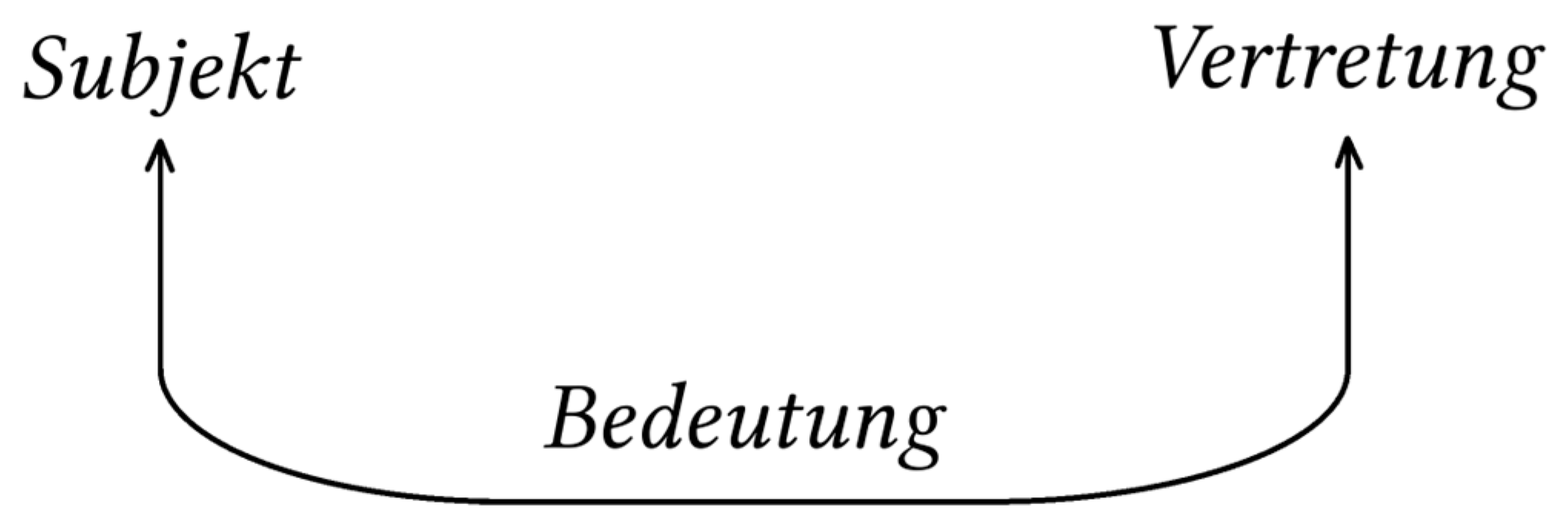
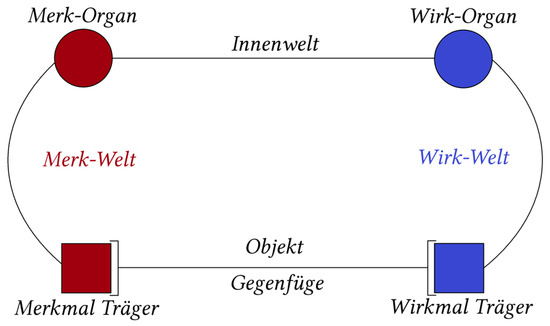
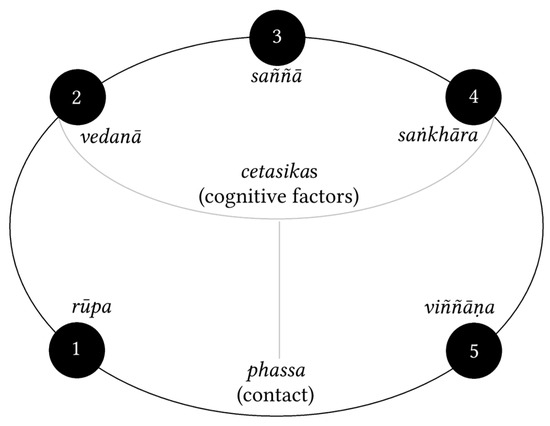
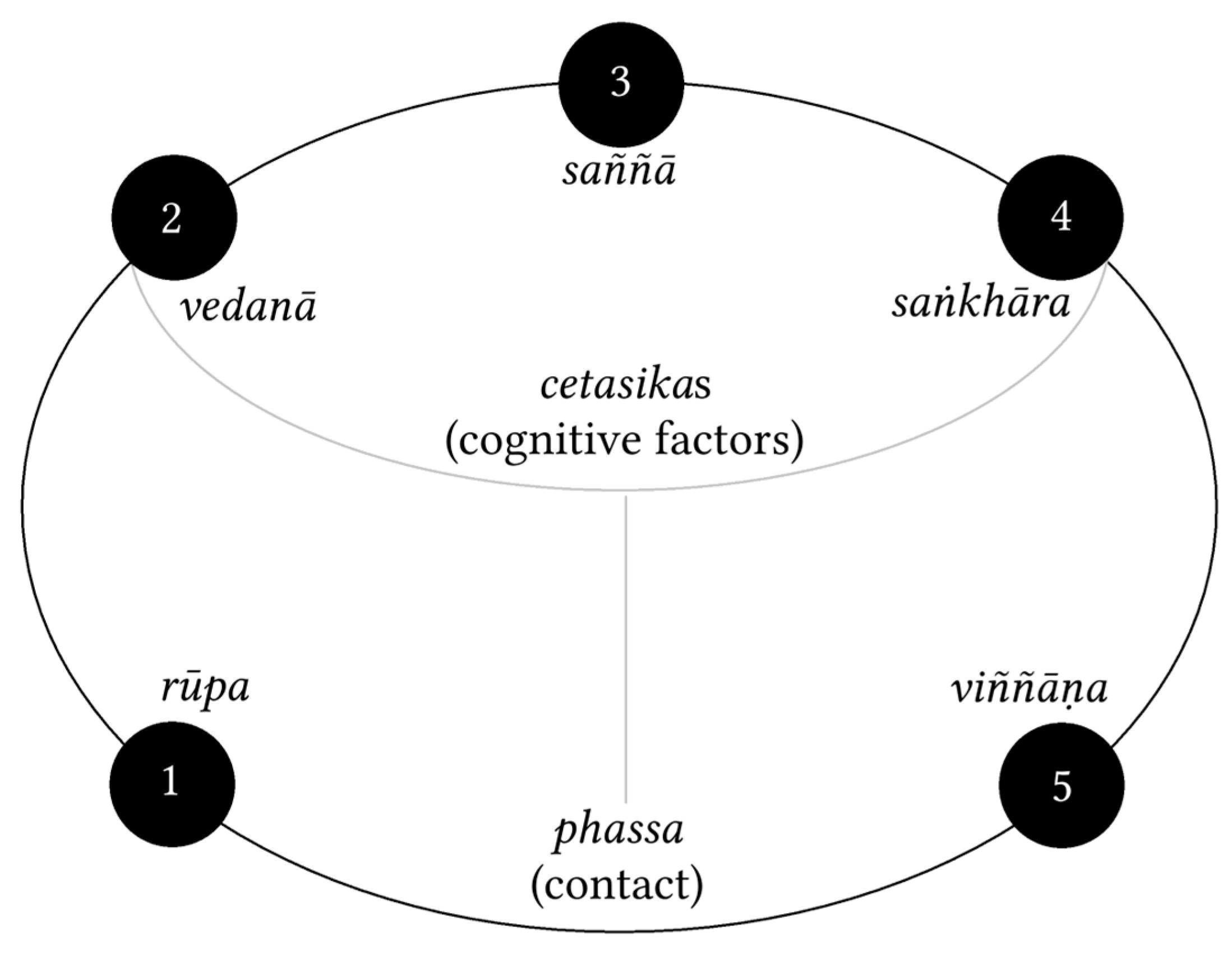
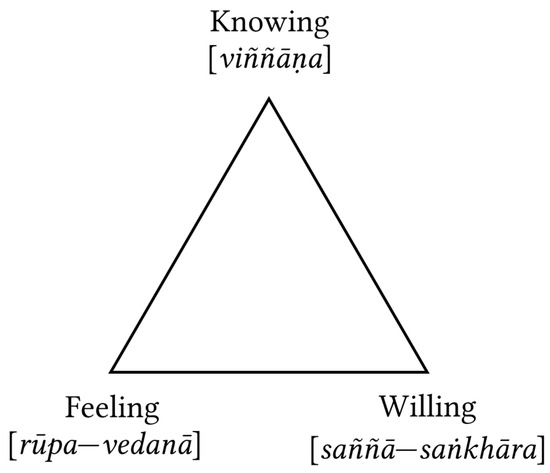
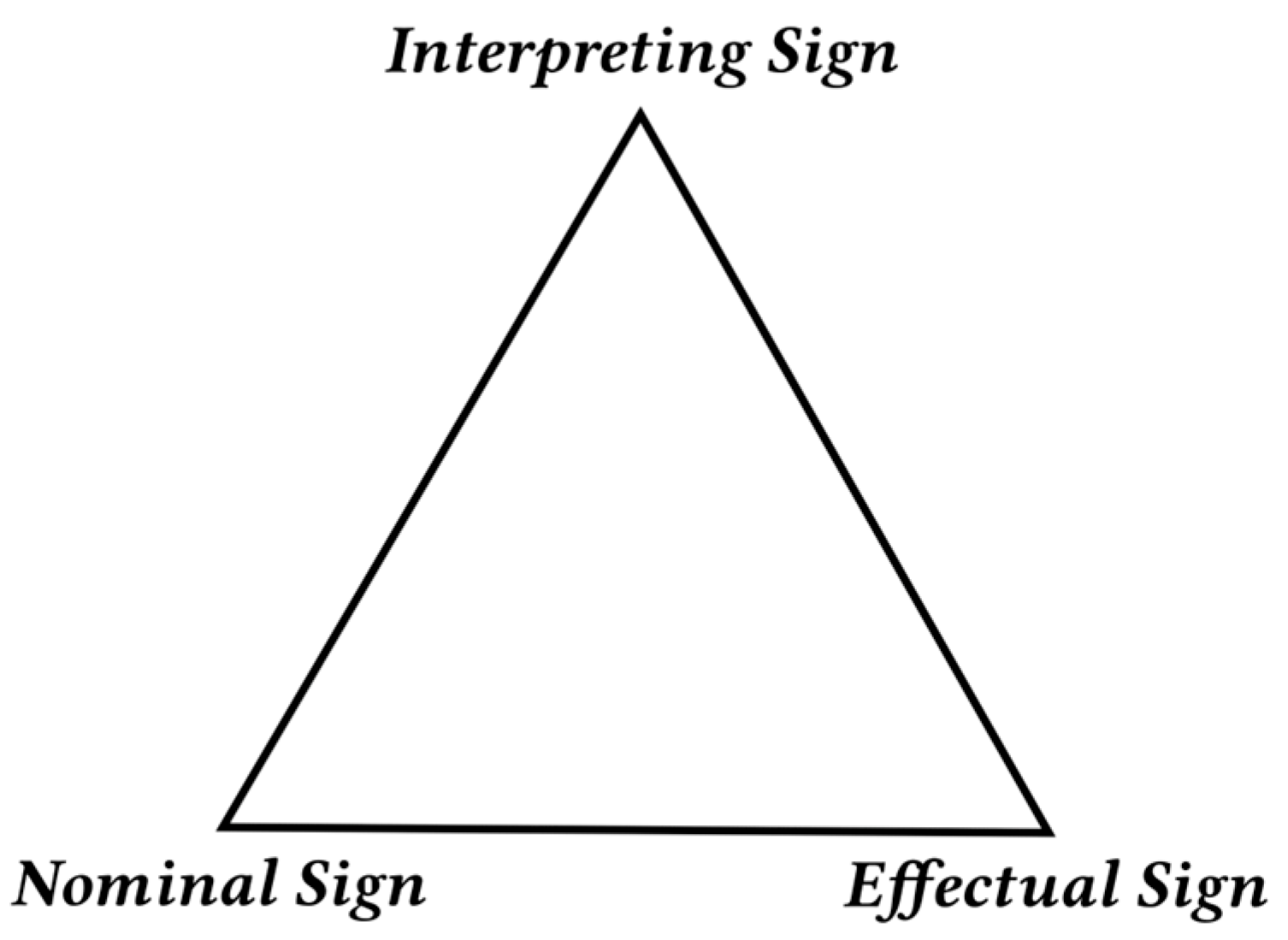

Disclaimer/Publisher’s Note: The statements, opinions and data contained in all publications are solely those of the individual author(s) and contributor(s) and not of MDPI and/or the editor(s). MDPI and/or the editor(s) disclaim responsibility for any injury to people or property resulting from any ideas, methods, instructions or products referred to in the content. |
© 2026 by the author. Licensee MDPI, Basel, Switzerland. This article is an open access article distributed under the terms and conditions of the Creative Commons Attribution (CC BY) license.