


Abstract
Architecture is arguably the human activity most directly invested in giving form to material objects and spaces. Across cultures and historical periods, architectural practice has been inseparable from the deliberate shaping of matter into useful and meaningful configurations. Over the past two decades, however, form has appeared to lose its centrality within architectural discourse. Social, environmental, and technological agendas increasingly displace formal inquiry, reframing form as secondary, insufficient, or ethically suspect—a condition further intensified by the proliferation of AI-generated images. This article reviews the development of form in Western architectural culture by retracing three enduring lineages of formal logic—normative, generative, and aesthetic—rooted respectively in Platonic idealism, Aristotelian materialism, and Kantian aesthetics. While this genealogical framework offers conceptual clarity, it also reveals persistent tensions concerning the origin, agency, and value of form. Recent hybrid practices challenge the sufficiency of any single lineage, pointing instead toward a relational understanding of form as a mediating protocol between social values, material realities, and perceptual experience. The article advances a field-based model in which architecture operates within a dynamic space defined by these three poles, proposing form as an active and indispensable instrument of architectural thought and practice.
1. Introduction: The Question of Form Today
1.1. Architecture and the Primacy of Form
Architecture is arguably the human activity most directly invested in giving durable and consequential form to material objects and spaces. Across cultures and historical periods, architecture has been understood not merely as construction, but as the deliberate shaping of matter into intelligible, inhabitable, and meaningful configurations. In this sense, form has traditionally been inseparable from architecture’s material, spatial, and cultural ambitions [1].
From antiquity onward, architectural thought has consistently framed form as a constitutive condition of architecture, rather than a superficial attribute. In Vitruvius’ triad of firmitas, utilitas, and venustas, form mediates between structural necessity, use, and appearance [2] (I.3.2). Later, Gottfried Semper would describe architecture as the formal residue of material practices, techniques, and social rituals, underscoring the idea that form arises from—and gives coherence to—the interaction between matter, making, and culture [3]. Modern architects repeatedly reaffirmed this position, most succinctly when Louis Kahn observed that “Form is what a thing wants to be” [4] (p. 111).
Within this long tradition, the notion of beauty itself was also understood as fundamentally dependent on formal order and geometric proportion. In classical philosophy, from Plato to Aristotle, beauty was associated with harmony, symmetry, and intelligible structure [5,6] (Metaphysics XIII.3). In architectural theory, this conception reemerged through Renaissance notions of proportion and concinnitas, most clearly articulated by Leon Battista Alberti [7] (Book VI). In this tradition, form was not merely a vehicle of beauty—it was understood as a primary condition of architectural judgment and value.
Few modern statements capture this constitutive role of form more clearly than Le Corbusier’s assertion that “Architecture is the masterly, correct, and magnificent play of masses brought together in light” [8] (p. 16). Form, here, is neither decoration nor representation, but the very medium through which architecture becomes perceptible, operative, and meaningful.
1.2. A Contemporary Paradox: The Waning Centrality of Form
Despite this long-standing association, form appears today to be progressively losing its centrality in architectural discourse and practice. Over the past few decades, several influential currents have displaced formal concerns, reframing them as secondary, insufficient, or even ethically suspect.
Different contemporary “turns” have each contributed to this displacement in distinct ways. Within digital discourse, authors such as Mario Carpo have described a shift from authored form to computed outcomes, in which geometry emerges from processes, data, or algorithms rather than from compositional intention [9]. In environmentally driven design, theorists such as Michael Hensel have questioned the primacy of form in favor of performance-oriented and ecological criteria, often treating formal articulation as secondary to material, environmental, or systemic behavior [10]. Similarly, socially and politically oriented practices—exemplified by Teddy Cruz—frequently regard formal autonomy as insufficient or irrelevant in addressing urgent questions of inequality, governance, and justice [11].
Taken together, these positions contribute to a contemporary climate in which form no longer functions as architecture’s primary focus, but is instead displaced by concerns with process, performance, or moral urgency. As a result, architecture risks losing form as one of its primary instruments of disciplinary knowledge and agency, raising fundamental questions about what remains specific to architectural practice—and its own capacity to act, innovate, and judge. If architecture does not shape the world through form, then through what other means does it claim disciplinary agency?
1.3. This Is Not New: Recurrent Crises of Form
The current marginalization of form is not unprecedented. Periods of profound cultural, economic, or social transformation have repeatedly produced moments in which architectural form was questioned, temporarily suspended, and sometimes rejected. Far from being anomalies, such episodes recur at times when architecture’s established languages no longer appear adequate to emerging conditions.
Among the historical precedents examined later in this article is the Renaissance repudiation of Gothic architecture as irrational or barbaric in contrast to classical norms, a view codified in early modern historiography [12,13]. In another example, the Industrial Revolution transformed architectural form into a commodity, generated an unprecedented proliferation of styles, and undermined shared formal conventions. Early glass-and-iron structures—such as the Crystal Palace in London (1851)—emerged as a direct challenge to traditional architectural expression, destabilizing long-standing assumptions about representation and meaning [14]. This condition would later find explicit formulation in early modernist critiques of form itself, most famously in Ludwig Mies van der Rohe’s declaration: “We know no forms, only building problems” [15]. Similar dynamics resurfaced in the 1960s and 1970s, when architecture was again criticized for its perceived ideological complicity or social irrelevance [16].
Taken together, these episodes suggest that the questioning of form often accompanies moments of disciplinary uncertainty, when architecture is forced to renegotiate its tools, values, and modes of agency.
1.4. AI, Image Proliferation, and the Destabilization of Form
Today, AI-generated images appear to challenge, once again, the meaning and purpose of architecture. By producing formally convincing architectural images at unprecedented speed and scale, artificial intelligence brings to the surface long-standing tensions between form, intention, judgment, and value. The issue is not simply the novelty of these tools, but the conditions they create: an explosion of form without authorship, an abundance of images detached from the immediate processes of material construction, use, or context, and a growing difficulty in distinguishing architectural form from generic visual output.
In this respect, generative AI should not be confused with the generative lineage of form described in this article. Generative design typically begins with explicit constraints or processes that permit unpredictable formal outcomes; AI generation, by contrast, operates through largely opaque processes while tending to produce recognizable configurations derived from existing examples. Nor are these outputs necessarily detached from material or normative determinants: such determinants may persist indirectly, as formal traces embedded in the architectural precedents on which AI models have been trained.
Seen historically, the current moment recalls earlier episodes discussed above. At the onset of the Industrial Revolution, the machine reproduction of ornamental components similarly destabilized the value of established architectural languages, contributing to the proliferation of styles and to a crisis of formal meaning that would later provoke strong modernist reactions against ornament. More recently, early digital modeling tools enabled visual experimentation that led to an explosion of exuberant forms, generating enduring opposition toward so-called “blob” architecture and a broader suspicion of digital design processes. In all these cases, the multiplication of forms eroded shared criteria by which architectural form could be judged, interpreted, and justified [17].
If the present marginalization of form is understood in this light, it may be less a rejection than a prelude to a new formal regime—a sign that inherited conceptions of form are no longer adequate to emerging conditions of production and representation. Artificial intelligence does not explain this condition but intensifies it, bringing unresolved questions about architectural knowledge, expertise, and responsibility into sharper focus [17].
1.5. Aim, Scope, and Methodological Position
This article examines the development of form in Western architectural culture through a historical and genealogical approach, focusing on key moments when the origin, meaning, or agency of form was redefined or contested. The inquiry is deliberately limited to Western architectural theories of form and does not attempt a social or institutional history of the political, economic, colonial, or labor systems through which architecture has been produced. It does so by retracing three persistent lineages of formal logic—normative, generative, and aesthetic—that reappear throughout the historical material. These lineages are intended as analytical tendencies rather than mutually exclusive categories: individual practices may combine or shift among them, a condition explicitly developed through the field model proposed later in the article. Rather than proposing immediate solutions to contemporary debates, it returns to these moments of transition to identify trends, patterns, and correlations that may help clarify what is at stake today.
The article does not advance a linear or deterministic explanation of architectural history. Instead, it treats history as a sequence of interrelated episodes, in which concepts of form are repeatedly reconfigured in response to shifting cultural, social, and technical conditions. This approach aligns with conceptual histories such as Adrian Forty’s analysis of architectural terms as contingent and evolving constructs, whose meanings change through use, debate, and reinterpretation rather than through cumulative progress [18]. Rather than contesting any single existing account of architectural form, this study brings historically distinct conceptions into a common genealogical framework and examines their relationships through the normative, generative, and aesthetic lineages identified in the analysis.
The historical sequence presented here is not intended as a comprehensive explanatory model, nor as a closed theoretical system. Its purpose is more limited and provisional: to identify recurring configurations and moments of tension in the ways architecture has understood and mobilized form, and to suggest why these questions have reemerged with particular urgency today. The article thus positions itself as a point of departure for further investigation, rather than as a final framework—opening the ground for subsequent conceptual work on form in contemporary architectural theory and practice.
2. Foundations of the Concept of Form (Antiquity to German Idealism)
2.1. Antiquity: First Principles of Form
Western architectural thought inherits its foundational understanding of form from classical antiquity, where form is articulated through a fundamental tension that will persist throughout architectural theory: the opposition between form as an abstract, normative idea and form as an immanent, material principle.
In the philosophy of Plato, form (eidos or idea) is conceived as a metaphysical and transcendent reality. Forms exist independently of material objects and prior to their realization in the sensible world. Material artifacts are understood as imperfect copies or manifestations of ideal models that reside in the intelligible realm. Within this framework, form functions as a normative standard: it defines what a thing ought to be, rather than how it comes into being [19,20]. Architectural form, by implication, is conceived as a top-down imposition of rational order onto matter, guided by geometry, proportion, and harmony [21]. The authority of form thus lies outside material practice, in an abstract and universal order that architecture is called upon to embody.
Aristotle fundamentally revises this conception by reconceiving form as immanent rather than transcendent. In his hylomorphic theory, form (morphē) and matter (hylē) are inseparable principles of being. Form is not an external model imposed on passive matter, but the internal organization that actualizes material potential. It operates as a cause—formal cause—through which matter becomes a determinate entity [6,22] (Metaphysics VII). Within this framework, form emerges through process, causality, and performance, rather than through imitation of an ideal [23]. Applied to architecture, this conception supports a lineage in which form is understood as arising from material properties, constructional logic, and the internal coherence of a system, rather than from abstract norms.
Already in antiquity, then, form oscillates between two irreducible positions: form as normative idea and form as material principle. This polarity—between top-down imposition and bottom-up emergence—will structure Western architectural thought for centuries, often implicitly, and will repeatedly resurface in moments of disciplinary transformation.
2.2. Middle Ages and Early Modern Period: Divergence and Rediscovery
During the Middle Ages, Aristotelian conceptions of form as an immanent principle were absorbed and transformed within scholastic natural philosophy. While medieval architectural practice is rarely accompanied by explicit theoretical discourse on form, it nevertheless embodies a conception of form closely tied to construction, material constraint, and incremental making. Gothic architecture, in particular, exemplifies a mode of form production grounded in structural behavior, geometric rationalization, and craft knowledge [24,25]. Form arises through the negotiation of forces, materials, and techniques, producing spatial configurations that are intelligible in terms of performance rather than adherence to abstract canons.
This proto-scientific rationalism, rooted in observation and practical experimentation, stands in marked contrast to the reorientation that occurs during the Renaissance. Humanist architects and theorists return to classical sources and reassert form as an abstract, normative ideal derived from antiquity. Proportion, geometry, and canon become central instruments for organizing architectural space, while treatises by Alberti and others articulate architecture as a liberal art grounded in intellectual design rather than manual construction. Medieval architecture is retrospectively dismissed as irrational, vulgar, or primitive precisely because it lacks explicit conformity to classical norms [26].
The Renaissance thus reinstates a Platonic conception of form as conceptual order imposed on matter [7]. Architecture is once again understood primarily as the realization of preexisting ideals, and the distance between design and making widens accordingly. This shift sharpens the divergence between two trajectories: form as an imposed intellectual model, and form as an emergent outcome of material and technical processes. The tension between these trajectories will remain unresolved, reappearing in new guises in modern architectural theory [27].
2.3. Late Eighteenth-Century Germany: Emergence of Three Modern Conceptions of Form
By the late eighteenth century, the classical polarity between idea and matter is no longer sufficient to account for the expanding philosophical and cultural understanding of form. German philosophy introduces a decisive transformation by expanding this binary into a three-pole system, which will become foundational for modern conceptions of form in architecture.
In the philosophy of Immanuel Kant, form is redefined as a condition of aesthetic judgment rather than as material substance or symbolic content. In the Critique of Judgment, Kant distinguishes form from both matter and concept: form structures the way phenomena are experienced by the subject, independently of meaning or utility [28]. Aesthetic judgment is based on the free play of imagination and understanding, and form operates at the level of appearance (Erscheinung), organizing sensory experience without prescribing origin or purpose. This conception establishes a lineage in which form is neither an imposed ideal nor a material outcome, but a relational structure between object and subject. Architectural form, in this view, is apprehended phenomenologically: its significance lies in how it is perceived, experienced, and judged, rather than in what it represents or how it is produced [29]. Kant thus opens a third domain of form—orthogonal to the initial polarity—grounded in perception and aesthetic experience.
In reaction to both classical normativity and Kantian formal abstraction, Romantic thinkers associated with Naturphilosophie reconceive form as emergent, developmental, and self-generating. Figures such as Johann Wolfgang von Goethe, Friedrich Schlegel, and Friedrich Schiller emphasize growth, transformation, and internal generative forces [30]. Goethe’s notion of Urform and his studies of metamorphosis frame form as the outcome of continuous variation rather than static perfection [31]. Within this lineage, form is not designed or judged first; it comes into being through process. Emphasis is placed on becoming rather than being, on formation (Bildung) rather than final state [32]. This conception of form as origin establishes a generative paradigm that privileges immanence, temporality, and self-organization—an approach that will later inform biological theories of morphogenesis and, much later, computational and environmental form-finding practices.
A third modern conception emerges with German Idealism, particularly in the work of Friedrich Wilhelm Joseph Schelling and Georg Wilhelm Friedrich Hegel. Here, form is reconceived as the expression of meaning, spirit (Geist), or idea. Art and architecture are understood as symbolic manifestations of cultural and historical consciousness, through which abstract ideas acquire visible and spatial form [33,34]. In this framework, form is neither purely perceptual nor purely material. It is intelligible and expressive, mediating between concept and appearance. Architecture becomes a privileged medium for the articulation of collective values and historical identity. This lineage provides the philosophical foundation for later normative conceptions of form, in which architecture is tasked with representing social, political, or cultural meaning.
By the end of the eighteenth century, form is no longer governed by a single logic. The classical polarity between idea and matter expands into a three-pole system: form as perception (Kant), form as origin (Romanticism), and form as meaning (Idealism). These poles do not resolve one another. Instead, they establish enduring lineages that will reappear—fragmented, recombined, and contested—throughout modern and contemporary architecture. This tripartite foundation provides the conceptual framework for the historical developments examined in the following chapters. It allows architectural form to be understood not as a stable category, but as a site of ongoing negotiation between normative, generative, and aesthetic conceptions of architectural practice.
3. Three Modern Lineages of Form (Industrialization and Early Modernity)
The Industrial Revolution profoundly altered the conditions under which architectural form was produced, interpreted, and valued. On the one hand, the mechanical production of building components enabled an unprecedented proliferation of architectural styles, contributing to the eclectic historicism of the nineteenth century and to a gradual devaluation of ornament as a bearer of cultural meaning. On the other hand, industrialization simultaneously inaugurated a new formal regime grounded in material production, engineering logic, and structural efficiency, bringing into focus a modern crisis of form.
Few buildings make this dual condition more legible than the Crystal Palace. The building introduced cast iron at an unprecedented architectural scale, representing the first new structural material in over two millennia [35]. Its prefabricated components and modular logic enabled rapid assembly, while its near-total absence of an architectural language or stylistic articulation challenged established conventions of representation [36]. At the same time, the Crystal Palace housed the Great Exhibition of 1851, assembling thousands of ornamental and artistic objects drawn from diverse cultures—many already subject to mechanical reproduction. The building thus juxtaposed a radically new material and structural system with an encyclopedic display of historical forms, exposing a growing disjunction between production and representation [13].
3.1. Form as Generative Principle: Material, Structural, and Processual Lineages
It was precisely this condition that provided Gottfried Semper with the impetus for Der Stil, a systematic investigation into the origin and evolution of Kunstform, tracing ornamental motives back to material practices, techniques of making, and social rituals [3]. For Semper, architectural form did not originate as an abstract idea imposed upon matter, nor could it be reduced to structural necessity alone. Instead, form emerged historically from material operations, gradually acquiring symbolic value through repetition, use, and cultural sedimentation [37].
Semper’s theory is one of the earliest modern attempts to reconcile material origin and cultural meaning. Form was neither arbitrary nor purely representational, but grounded in the logic of making and the conditions of production. This conception would later inform a tectonic tradition in architectural theory, articulated in the twentieth century by figures such as Eduard Sekler [38] and Kenneth Frampton [1].
Semper’s material logic was adopted by Adolf Loos in his polemics against ornament at the turn of the twentieth century, asserting that “every material possesses its own language of form” [39]. In Loos’ formulation, a complex genealogy is compressed into a quasi-deterministic relationship between material and formal expression, which becomes central to modernism’s opposition to ornament. Importantly, his rejection of ornament, in opposition to the Viennese Secession, is explicitly moral and cultural, making him a hybrid figure within the generative lineage, in which material logic is mobilized in support of a normative judgment [16].
A parallel but distinct articulation of generative form emerges in the work of Eugène Viollet-le-Duc, who places structure at the origin of architectural form. In his Lectures on Architecture, Viollet-le-Duc insists that “all architecture proceeds from structure,” explicitly rejecting Renaissance traditions in which form was treated as a primary aesthetic consideration [40]. For Viollet-le-Duc, form follows necessarily from structural logic: if the structure changes, the form must change accordingly. Architectural form is thus conceived as the direct consequence of constructional principles rather than as stylistic choice or symbolic projection.
Alongside these material and structural approaches, a further strand of generative thinking emerges through biological and morphological models of form, extending ideas already articulated in Romantic Naturphilosophie. These ideas unfold within the broader intellectual horizon shaped by Charles Darwin’s theory of evolution, which foregrounds variation and adaptation over fixed typologies [41]. Form is thereby repositioned as contingent, temporal, and responsive, rather than as a timeless ideal or canonical model. This shift provides a crucial background for later scientific and architectural interpretations of form as emergent and contingent.
Early visual and theoretical explorations by Ernst Haeckel—most notably his Kunstformen der Natur—present form as a manifestation of underlying generative laws operating across scales, reinforcing the notion of morphology as process rather than static configuration [42]. Later, a more explicit and rigorous articulation of morphogenesis appears in D’Arcy Wentworth Thompson’s On Growth and Form, where biological form is explained through physical constraint and forces acting on matter—a non-teleological account of form that would prove particularly influential for later generative and computational approaches [43].
Taken together, these strands articulate a conception of form as generative: arising from material practices, structural logic, and processual dynamics rather than from symbolic intent or abstract norms.
3.2. Form as Abstract Idea: Normative, Typological, and Social Lineages
A second modern lineage conceives form as a normative and corrective principle in response to the cultural effects of industrialization. For a number of theorists and architects, form operates as an antidote to the perceived barbarism of mechanical reproduction, stylistic eclecticism, and the destabilizing effects of mass culture.
This position is articulated with particular clarity by Hermann Muthesius, whose critique of nineteenth-century historicism is grounded in the belief that architecture required a renewed formal discipline capable of resisting stylistic excess. As Muthesius writes, “It is all a matter of restoring order and rigor in our modes of expression, and the outward sign can only be good form” [44]. As Adrian Forty observes in his discussion of “form as antidote to mass culture,” this conception positions form as a bulwark against the fragmentation and commodification of cultural production brought about by industrial modernity [18].
Implicit in this position is an understanding of form that resonates with German Idealist aesthetics, particularly the Hegelian conception of form as the sensuous manifestation of meaning or Geist [33]. While not always explicitly philosophical, these architectural theories treat form as an intelligible and communicative structure, capable of embodying collective values and historical consciousness. In this lineage, form is conceived less as an emergent outcome than as a vehicle for cultural coherence and social order.
The social dimension of form is made explicit in the writings of Adolf Behne, who describes form as an eminently social matter, inseparable from the organization of modern life [45]. A similar conviction underlies the work of Bruno Taut, who believes in architecture’s transformative potential and the power of form as an instrument of social renewal [46]. In Taut’s expressionist projects and writings, form is charged with ethical and utopian significance, capable of reshaping consciousness and fostering new social relations. Here, form operates as an intentional construct, invested with normative and reformist agency.
These tensions come into sharp focus in the work of Walter Gropius and the pedagogical project of the Bauhaus. While Gropius consistently emphasized architecture’s social mission, the Bauhaus faced a fundamental educational paradox: how could students be taught “to give form to space” if form was understood as a metaphysical category—one that, by definition, could not be directly transmitted through instruction? Gropius resolved this impasse by grounding formal education in modern production methods, constructions, and materials [47,48]. This solution reveals a structural limitation in abstract conceptions of form: throughout the twentieth century, idealistic positions often required support from material or technical frameworks—unrelated to their stated intent—to remain operative.
3.3. Form as Aesthetic Experience: Perception, Appearance, and Autonomy
A third modern lineage approaches form primarily as aesthetic experience, focusing on appearance, perception, and the conditions under which form is apprehended and interpreted. Its philosophical foundation lies in the Kantian conception of form as a condition of aesthetic judgment, independent of function or conceptual meaning [28]. Post-Kantian aesthetic theory increasingly frames form as a phenomenon received by the subject rather than imposed by the object. Thinkers such as Johann Friedrich Herbart and Robert Zimmermann recast aesthetics in formal and psychological terms, emphasizing relations, perception, and the conditions of aesthetic judgment [49,50]. This shift relocates form from ontology to experience.
The concept of empathy (Einfühlung), articulated by Hermann Lotze and later developed in art history and psychology, further grounds form in bodily and emotional perception [51]. Heinrich Wölfflin translates these ideas into a systematic formal analysis of visual form [52], while August Schmarsow extends them to architectural space as an experiential construct [53]. Together, these approaches consolidate an aesthetic lineage in which form is understood as a perceptual structure rather than a material or normative one.
At the same time, privileging form as an aesthetic category provokes strong reactions in modern culture. Artistic movements—from Dada and Surrealism to later Situationist critique—challenge the reification of form as a product of capitalist rationalization, exploring the formless, the transient, and the ludic as alternatives [54]. These critiques, while external to architecture, reinforce a growing suspicion toward form understood as an end in itself. This tension is mirrored within modern architecture itself, most notably in Ludwig Mies van der Rohe’s rejection of form as a guiding principle. “We know no forms, only building problems. Form is not the goal but the result of our work,” Mies writes, positioning form as subordinate to constructional and social concerns [15]. Here, opposition to formalism serves to assert architecture’s commitment to higher purposes—efficiency, rationality, or social responsibility—against the perceived autonomy of aesthetic form.
Across these developments, the Kantian lineage of form as aesthetic experience proves both productive and unstable, continually provoking oppositions and reconfigurations that underscore form’s contested status within modern architectural discourse.
4. Polarization of Form in Late Modern Architecture (Second Half of the Twentieth Century)
In the decades following the Second World War, modern architecture entered a phase of institutional maturity. The formal language developed during the early twentieth century—once experimental and polemical—had solidified into a pervasive and largely uncontested doctrine. Principles of functional clarity, rational organization, and abstraction were widely presented as the normative architectural expression of a modern society. Yet their large-scale application, particularly in housing and urban development, often produced environments perceived as monotonous or socially inadequate. The functionalist promise of modernism appeared increasingly compromised in the hands of ordinary professional practice, generating dissatisfaction not with architecture’s social ambition as such, but with its formal results [16].
4.1. Normative and Social Conceptions of Form
In response, a number of architects rejected the modernist canon while remaining firmly committed to architecture’s social agenda and to a central role for form. Crucially, form was no longer understood as a stylistic expression or neutral container, but as a framework intentionally designed to structure social relations. This position is articulated with particular clarity by Team 10, and especially by Alison and Peter Smithson, who asserted that “each form is an active force: it creates the community; it is life itself made manifest” [55]. Here, architectural form is treated as directly equivalent to social form, capable of shaping patterns of interaction, association, and collective life.
At the urban scale, Kevin Lynch advances a related argument by identifying intelligibility as a normative quality of form. In response to what he describes as the “vast sprawl” of contemporary cities, Lynch frames legible urban form as an antidote to disorientation and alienation [56]. Normativity here is cognitive rather than stylistic: form is valued for its capacity to structure experience, memory, and orientation within complex environments.
A more radical—but ultimately still normative—strand emerges from anti-form movements that nevertheless retain a prescriptive social agenda, associated with the Situationists and their architectural descendants. Projects by Constant Nieuwenhuys, Archigram, Cedric Price, and later Bernard Tschumi reject permanence and fixed spatial order in favor of adaptability, indeterminacy, and event-based systems [57,58,59]. Architecture is reconceived as infrastructure or framework rather than as a stable object, often invoking technology as a vehicle for social transformation—a position strongly promoted by Reyner Banham.
Yet the paradox of this anti-form position quickly becomes apparent. As Banham himself notes in his discussion of the “New Brutalism,” the rejection of conventional form rarely results in the absence of form, but rather in unusual or irreverent formal expressions [60]. This contradiction is particularly evident in Constant’s New Babylon, conceived as an anti-form manifesto yet dominated by monumental, gravity-defying structures whose permanence and visual power run counter to the project’s stated aims. As with the Bauhaus—and later the high-tech movement—appeals to flexibility and technology tend to consolidate into recognizable and prescriptive formal regimes.
A comparable tension emerges in built work such as the Centre Pompidou in Paris. Despite its rhetoric of flexibility and indeterminacy, the project ultimately relies on conventional compositional devices, including a dominant elevation and the emphatic use of oversized structural elements. As critics such as Alan Colquhoun have observed, its reformist ambitions are partially undermined by the persistence of established formal canons [61].
A related—but distinct—normative use of architectural form can be observed later in the work of the Office for Metropolitan Architecture (OMA). While often associated with diagrammatic and analytical methods, OMA’s use of the diagram is fundamentally prescriptive rather than exploratory: it operates as a governing device that organizes program, circulation, and social interaction in advance of formal resolution. Here, the diagram functions as a formal surrogate, translating analytical logic into spatial order and reinforcing architecture’s normative agency [62].
Taken together, these projects reveal a normative use of technology and form: despite differing strategies and rhetorics, they deploy architecture as an instrument of social reform, grounded in a prescriptive vision of society rather than in open-ended generative processes.
4.2. Semiotic and Autonomist Approaches to Form
A distinct source of renewal in late modern architecture emerges from linguistic and semiotic theory. As the dominance of functionalist doctrine intensified, its emphasis on utility and social purpose provoked a counter-movement that sought to reclaim architecture’s autonomy as a cultural and intellectual discipline. Drawing on structural linguistics—most notably the work of Ferdinand de Saussure—architectural form was reconceived as a system of internal relations rather than as a direct expression of function, structure, or social intent [63].
Within this framework, form operates as language. Meaning is produced through difference, convention, and syntax, not through correspondence with use or performance, while also increasingly detached from any aesthetic consideration. This approach informs the work of architects associated with Dutch structuralism, including Aldo van Eyck and Herman Hertzberger, who emphasize the internal coherence of architectural language and the organization of spatial relationships [55,64]. While socially engaged, their theoretical grounding privileges autonomy and relational structure over explicit normative prescription.
The autonomist impulse becomes more pronounced in the work of Aldo Rossi, for whom architectural type functions as an invariant formal and historical construct, largely independent of use [65]. Comparable concerns with image, reference, and perceptual effect characterize the work of James Stirling, whose eclectic engagement with historical motifs and visual complexity aligns closely with an aesthetic and semiotic conception of form [66]. This trajectory reaches its most explicit articulation in the work of Peter Eisenman, who advances a conception of architecture as pure syntax. In Eisenman’s work, form is deliberately delinked from function and meaning, operating instead as a self-referential system governed by internal transformations [67].
A crucial reversal occurs with Robert Venturi and Denise Scott Brown. Rather than asserting the autonomy of form, they deliberately privilege meaning over form. In Learning from Las Vegas, Venturi et al. [68] identify rich symbolic and communicative content in the ostensibly formless architecture of the “Ugly and Ordinary” roadside environment. Meaning is located in signs, symbols, and cultural codes, while architectural form itself is effectively marginalized. Subsequent postmodern theorists, including Charles Jencks, further elaborate this separation, underscoring the growing disjunction between form and meaning within architectural discourse [69].
4.3. Generative, Structural, and Environmental Determinants of Form
Alongside normative and semiotic positions, a third late-modern trajectory extends a consistent lineage of generative form as an emergent outcome of systems, performance, structure, or environmental conditions. Rather than being prescribed in advance, form arises through the interaction of forces, constraints, and matter that resist full authorial control.
The notion of structural form-finding has its origin in Antoni Gaudí’s use of hanging-chain models at the turn of the century, where geometry emerges directly from applied forces acting on matter [70]. In the mid-twentieth century, this lineage is further developed by Félix Candela, Pier Luigi Nervi, and Frei Otto, whose reliance on physical models, minimal surfaces, and structural optimization position form as the outcome of parametric relationships rather than compositional intent [71,72,73].
In all these cases, geometry emerges from structural equilibrium and material behavior rather than from ideology or representation. This generative trajectory is further extended by early work on environmental performance. Figures such as Victor Olgyay and Aladar Olgyay frame form in response to climatic forces, energy, and comfort, introducing performance criteria that increasingly shape architectural geometry [74]. Ralph Knowles’ studies on solar access and shadow casting further position environmental forces as parametric drivers of form, linking geometry directly to environmental performance [75].
A special position within this lineage is occupied by Buckminster Fuller. While often presented as a champion of performance and systems, Fuller deploys geometry and technology in a highly dogmatic manner, framing them as universal solutions rather than as exploratory tools [76]. In this sense, Fuller straddles the line between generative method and normative ideology, revealing another internal tension within late-modern approaches to form.
While these generative positions are primarily animated by material and structural conditions, socially minded architects increasingly resort to analogous bottom-up observation of social dynamics to arrive at a spatial framework intended to guide social behavior. Giancarlo De Carlo’s emphasis on participation and user involvement frames form as emerging from collective processes rather than being imposed from above [77]. While often discussed in social or ethical terms, De Carlo’s approach relies on generative mechanisms whereby spatial configurations arise through iterative interaction among users, context, and design frameworks.
Christopher Alexander further radicalizes this position by grounding architectural form in the observation of recurring social patterns [78]. Rather than prescribing form as a normative model, Alexander’s pattern language proposes a generative system in which form emerges from the aggregation of localized, repeatable relationships. In this respect, his work anticipates later process-based and algorithmic approaches, positioning social dynamics themselves as a generative substrate. Reconsidered through this lens, De Carlo and Alexander align more closely with the generative lineage than with normative social reform.
Just as architects in the normative lineage profess anti-form stances yet arrive at assertive formal regimes, architects in the generative lineage increasingly resort to bottom-up observation of social dynamics to arrive at prescriptive spatial forms. This symmetry underscores a central condition of late-modern architecture—one already anticipated in earlier historical moments: whether form is embraced, subordinated, or rejected, it repeatedly reasserts itself as an unavoidable dimension of architectural production.
5. Form in the Digital Age (1980s–Present)
The digital era marks a decisive transformation in architectural culture, comparable in scope—though not in nature—to the Industrial Revolution. The initial phase of digitalization in architecture, spanning roughly from the late 1950s through the 1970s, is characterized by the introduction of computational methods within structural engineering. The definitive case study of this phase is Arup’s engineering of the Sydney Opera House, which pioneered the use of digital computers for structural analysis on a major architectural project [35,79]. The iconic roof “sails” were famously sketched by Jørn Utzon in their essential configuration prior to computational analysis; digital tools were subsequently mobilized to resolve their structural logic, material behavior, and constructability [80]. Computation, in this instance, functioned not as a generative device but as a means of validation. The architectural idea preceded the algorithm.
A prominent lineage of projects exemplifies this approach, beginning with Frank Gehry’s early experiments with digitally assisted fabrication—often traced back to the “Fish” sculpture in Barcelona (1982)—and later extending to a range of more conventional practices [81]. In these cases, engineering firms and specialist consultants played a crucial role in translating expressive forms into buildable systems, providing computational expertise as a technical service rather than as a generative design partner [82]. Importantly, this tradition did not challenge the primacy of architectural intention or the conventional sequence of design. Architects continued to rely largely on analog tools—sketches, physical models, and intuitive formal exploration—for conceptual development, while computation entered the process downstream as technical support without introducing a new conception of form [83].
5.1. The Digital Turn: Spline Modeling and the Expansion of Appearance
A second phase emerges in the mid-1990s with the widespread availability of new modeling and animation software. Unlike the earlier use of computation as an analytical instrument, this phase foregrounds the computer as a medium of visual and formal experimentation. Spline-based modeling, non-linear transformations, and continuous surfaces enabled architects to explore smooth transitions and topological variation, producing forms that were difficult—if not impossible—to draw or conceive using traditional representational techniques [84]. This shift is closely associated with figures such as Greg Lynn and Bernard Cache, whose work in the late 1990s promoted what became known as “non-standard” or “blob” architecture [85]. In this context, digital tools were often borrowed from animation and visualization industries, and questions of structure, material behavior, and construction were frequently deferred or disregarded altogether.
This phase marked the first moment when digital computation acquired a recognizable architectural language, giving a highly visible—and controversial—public face to a transformation that had been unfolding more quietly for decades. The proliferation of formally exuberant projects generated widespread fascination, but also sharp criticism, particularly regarding their apparent detachment from social, environmental, and constructive concerns [86]. Notably, several figures associated with earlier semiotic and autonomist traditions entered into uneasy alliances with this new digital formalism. One emblematic case is the association of Peter Eisenman with a younger generation of digitally savvy designers, as well as the long-standing partnership between Zaha Hadid and Patrik Schumacher, in parallel with the work of the first generation of digital native designers, such as UNStudio, FOA, and SHoP Architects [87].
Within the framework developed in this article, this phase aligns decisively with the aesthetic lineage of form, privileging appearance, continuity, and perceptual impact. At the same time, the formal opulence and technical opacity associated with digital formalism would soon provoke strong reactions. Both the environmental and the social agendas that gained prominence in the following decade can be interpreted, at least in part, as responses to this moment—reacting not only against its visual excesses, but also against a growing sense of estrangement from an increasingly technical and opaque design process.
5.2. The Environmental Turn: From Generative Ambition to Normalization
A third phase of the digital era emerges in the mid-2000s with the increasing adoption of parametric and algorithmic design tools. Unlike spline-based modeling, which focuses on manipulating geometry directly, parametric approaches prioritize the definition of rules, relationships, and constraints. Form is no longer drawn or sculpted; it is computed as the outcome of a system [81]. Several influential theorists have articulated this shift explicitly. Mario Carpo describes the digital turn as a condition in which form loses its traditional status as a stable, authored object, becoming a variable and non-identical result of computational processes [86]. As in earlier moments, this phase generated its own recognizable formal outcomes, yet its defining characteristic lies less in appearance than in process. Architectural form emerges from computational procedures that integrate multiple criteria simultaneously, challenging traditional notions of authorship, intention, and control. In this sense, parametric and algorithmic design align most clearly with the generative lineage of form traced throughout this article.
This shift coincides with broader cultural and material pressures, including the impending energy transition and growing awareness of resource scarcity. In part as a reaction to the formal excesses of digital formalism, parametric tools were increasingly oriented toward simulation and optimization [88]. Objective functions related to energy efficiency, structural performance, and material economy began to shape architectural geometry, producing formal outcomes based on performance criteria rather than the direct expression of architectural intention. This position is articulated with particular clarity in Michael Hensel’s work on performance-oriented architecture, which explicitly de-emphasizes form as a primary design driver in favor of material systems and environmental responsiveness [10]. Similarly, sustainability-oriented theorists such as Steffen Lehmann have argued for an architectural agenda in which ecological responsibility takes precedence over formal experimentation [89]. In parallel, research-driven practices and institutions, such as the MIT Media Lab, have promoted conceptions of form as emerging from material computation, fabrication logics, or biological analogies, as exemplified by the work of Neri Oxman [90].
After an initial experimental period, however, many of these techniques were absorbed into conventional digital workflows. The integration of algorithmic logics into widely adopted platforms such as Autodesk Revit contributed to the normalization—and partial trivialization—of parametric design, as digital tools became instruments for streamlining production across all phases of practice, from concept to construction and post-occupancy management [86]. Computational power has thus been increasingly coopted to mitigate the adverse effects of design decisions made by traditional means, producing compliance reports and performance simulations that often legitimize—rather than question—the continued use of complex geometry for predominantly aesthetic ends.
By the time algorithmic design became embedded in standard professional workflows, the digital era had completed its most radical reconfiguration of architectural form. What remained was a discipline profoundly transformed in its technical means, yet increasingly uncertain about the meaning and agency of form itself—a condition that sets the stage for the contemporary retreat from form examined in the following section.
5.3. The Social Turn: Form as Politically Insufficient
In socially and politically oriented architectural discourse, form is increasingly regarded as structurally incapable of addressing issues of inequality, power, and social justice. Architectural agency is relocated from the formal object to processes of participation, negotiation, and political engagement. This position is articulated forcefully by Jeremy Till, who argues that architecture “depends” not on formal autonomy, but on its entanglement with social, economic, and political forces [91]. Within this framework, formal concerns are often treated as professionally insular or politically insufficient.
Similarly, the work of Teddy Cruz and Fonna Forman advances an explicitly political urbanism in which architecture operates as a platform for social agency rather than as a producer of formal artifacts [11]. Grassroots and participatory practices, such as Atelier d’Architecture Autogérée, likewise emphasize process, self-organization, and collective authorship, often treating form as incidental or provisional [92,93]. Across these positions, form is frequently framed as a professional fetish or as a distraction from more urgent political work. While buildings inevitably take form, formal questions are displaced from the center of architectural discourse, replaced by concerns with participation, governance, and social impact.
This stance has clear historical precedents in earlier socially minded movements, from Bruno Taut and Team 10 to Giancarlo De Carlo, which framed form as a means of structuring social relations rather than as an autonomous aesthetic object. And, as with earlier socially oriented movements, the rejection of formal autonomy does not entail the absence of form. Buildings, infrastructures, and spatial interventions necessarily assume formal configurations, even when these are framed as provisional or instrumental. The social lineage thus reiterates a persistent tension, observed throughout the history traced in this article, between the aspiration to transcend form and the inevitability of formal expression in architectural practice. The distinction, therefore, may lie less in whether form is produced than in the processes by which it is produced and the degree of agency attributed to it: socially oriented practices can range from prescriptive spatial frameworks to forms that emerge through participation, appropriation, or incremental transformation.
More recently, a set of so-called “circular” or low-carbon practices has sought to generate new architectural languages from vernacular techniques, recycled materials, and low-energy construction methods. While often framed as ethical or environmental imperatives, these approaches operate through a generative engagement with material constraint, resulting in distinct formal vocabularies that emerge from reuse, adaptation, and resource limitation. In this respect, such practices constitute a hybrid position, combining normative intent with emergent material logic—further complicating the contemporary status of form.
6. Discussion: Toward a Field Model of Architectural Form
6.1. A Genealogy of Form: Trends, Patterns, and Correlations
When architectural history is examined through the genealogies developed in this article, recurring patterns and correlations become apparent. Rather than describing a linear progression or stylistic evolution, the three lineages—normative, generative, and aesthetic—reveal persistent modes of reasoning about form that resurface across periods of cultural, social, and technological transformation. Their recurrence suggests that form in architecture is not simply a matter of taste or technique, but the primary site where architectural meaning, agency, and innovation are negotiated.
Normative form reasserts itself when architecture is called upon to represent, enact, or reform collective values. From Renaissance theories of proportion to German Idealist aesthetics, and from Enlightenment utopianism to modernist social reform, form has repeatedly been mobilized as an instrument of order, identity, and persuasion. This lineage extends beyond explicitly “formal” architectures to include anti-form positions that nonetheless deploy architecture normatively, from Constant and Archigram to contemporary diagrammatic practices. Whether through classical canons, rhetorical uses of technology, or abstract organizational schemas, normative practices share a belief in the capacity of form to project social, political, or moral order. What unites these positions is a top-down logic grounded in a priori values that seek formal expression.
Generative form follows a different trajectory. It is historically associated with vernacular architecture, medieval urban morphology, and pre-modern building cultures, in which form arises from climatic conditions, material availability, and accumulated construction knowledge. Its theoretical articulation gains clarity with the rise of empirical science and the Industrial Revolution, which introduce calculable materials and structural optimization. Theories of evolution further contribute a temporal dimension, framing form as the outcome of adaptation and selection rather than ideal prescription. From Semper and Viollet-le-Duc to Gaudí and Frei Otto, this lineage conceives form as exploratory and performative, guided by bottom-up processes rather than symbolic intent. Yet precisely because of its reliance on material and physical determinism, generative form has often struggled to articulate broader cultural or political agency.
Aesthetic form occupies a third position, grounded in theories of perception, subjectivity, and sensuous experience. Emerging from Kantian aesthetics and later psychological and phenomenological accounts of space, this lineage foregrounds form as an autonomous domain of architectural inquiry. From early modern debates on perception to postwar autonomist practices, and later digital explorations of continuous geometry, aesthetic form emphasizes appearance, language, and experiential intensity. Yet aesthetic form has repeatedly been marginalized as superficial or “formalistic,” particularly when architectural discourse privileges social responsibility or technical performance over perceptual and symbolic agency.
Taken together, these genealogies demonstrate that the apparent marginalization of form in contemporary practice is not unprecedented. Rather, it echoes earlier moments when form was questioned, redefined, or temporarily displaced in response to broader transformations. At the same time, this investigation brings to the fore recurrent and unresolved questions concerning the origin, agency, and value of architectural form.
6.2. Normative Form and the Question of Origin
The first critical question raised by this genealogy concerns the origin of form—particularly within normative practices. How do abstract values such as equality, justice, or social order become architectural form? Since such values have no intrinsic relation to material, structure, or construction, the path from principle to form remains elusive.
This problem is already implicit in Platonic aesthetics, where form exists a priori and artistic production is conceived as its imperfect imitation. The artist must apprehend form intellectually before making begins, reinforcing a hierarchy that privileges contemplative intelligence over material engagement. Renaissance humanists such as Alberti and Barbaro inherit this position, emphasizing adherence to classical canons as guarantors of beauty and legitimacy within the liberal arts. Form is justified through reference to established models rather than discovered through material exploration. This also raises a structural problem of innovation: how does novelty emerge within a regime of inherited models?
Modern normative practices encounter similar difficulties. Socially minded architects—from Bruno Taut to Walter Gropius—sought forms capable of embodying new social orders, yet often lacked a clear generative pathway. Gropius resolved this impasse by appealing to modern materials and industrial production, while others, including Le Corbusier and Mies van der Rohe, turned to the visual languages of the avant-garde. More recently, diagrammatic practices such as those of OMA deploy abstraction as an operational bridge between political ambition and architectural form. In each case, normative positions rely on auxiliary methods—material logics, aesthetic practices, or generative tools they do not fully acknowledge—to remain operative, revealing a structural tension between value-driven intent and formal implementation.
6.3. Generative Form and the Question of Agency
If normative form struggles with origin, generative form raises a complementary question concerning agency. Here, agency refers not primarily to the human or institutional actors responsible for producing form, but to the capacity of formal logics themselves to constrain, enable, and redirect architectural outcomes in ways that are not reducible to originating intentions. Material, structural, and processual practices provide clear mechanisms for form-finding, yet their outcomes often appear insufficient to address broader cultural or social aspirations.
This tension is evident in Semper’s attempt to derive symbolic meaning from material practices and persists in tectonic theories that treat form as the expression of constructional logic. Gothic structures, vernacular forms, and later engineering-driven architectures demonstrate extraordinary technical ingenuity, yet frequently fail to satisfy representational or cultural demands. Even the highly optimized forms of Fuller or Frei Otto found limited applicability beyond experimental contexts. Similarly, Pier Luigi Nervi’s lightweight concrete vaults were often compromised by ad hoc adaptations to comply with prevailing aesthetic preferences. Contemporary parametric design encounters analogous limits: algorithms respond only to explicit criteria, leaving tacit knowledge, interpretation, and judgment beyond computational reach.
As a result, generative practices are often confined to laboratories, consultancies, or aestheticized applications in prototypes and pavilions detached from material efficiency. The question remains unresolved: how can forms generated through non-human logics—energy flows, material behavior, systemic interaction—acquire cultural agency without reverting to normative imposition or symbolic overcoding? Generative form also raises the question of authorship: if an algorithm selects the shape of a building based on optimization routines and objective functions, who—or what—is the designer of the building?
6.4. Aesthetic Form and the Question of Value
The aesthetic lineage confronts a third question related to value. Can form grounded primarily in perception, language, or artistic autonomy produce meaningful architecture?
Suspicion toward aesthetic form has deep historical roots in the Ancient Greek preference for intellectual over manual activity. While Kantian aesthetics elevate subjective judgment, they also exclude utility, reinforcing the separation between beauty and purpose. Modern functionalism radicalizes this divide by rejecting form altogether, framing it as a distraction from social responsibility. Consequently, “formalism” becomes a recurring accusation against architects perceived as insufficiently engaged with ethical or political concerns.
Early modernists temporarily found a way back to creative practice—Le Corbusier’s daily painting routine is emblematic, as is the Bauhaus’s early embrace of artistic experimentation through figures such as Kandinsky and Moholy-Nagy. When these formal explorations failed to yield clear social outcomes, however, technology and material rationality increasingly replaced artistic practice as the legitimizing force of architectural form.
Yet aesthetic practices persist, often finding legitimacy through external discourses—philosophy, history, or theory. Rossi appeals to collective memory; James Stirling mobilizes historical reference and visual ambiguity; Eisenman, and later a generation of digital formalists, to linguistic and post-structuralist frameworks, most notably those of Derrida and Gilles Deleuze. These strategies underscore the difficulty of defending aesthetic form on its own terms within a discipline that repeatedly demands justification through utility, morality, or performance. They also raise a persistent question of authority: who gets to decide when a new form is appropriate to the problem at hand?
Nonetheless, aesthetic exploration continues to offer a valuable—and indeed irreplaceable—tool for discovery and innovation in architecture. Its productive capacity becomes particularly evident when combined with other modes of practice, as exemplified by a range of hybrid figures who mobilize aesthetic form alongside normative ambition or generative processes. It is to these hybrid configurations, and to the field they collectively produce, that the concluding chapter now turns.
6.5. Toward a Three-Polar Field Model
Many influential architects operate between lineages, combining normative ambition with aesthetic experimentation, or generative processes with symbolic intent. Rather than resolving the tensions outlined above, these practices productively inhabit them. Le Corbusier’s artistic practice, Mies’s synthesis of technology and abstraction, and later computational-aesthetic hybrids exemplify this productive overlap.
The analytical value of this relational approach becomes clearer when practices with comparable ambitions are examined through the different processes by which they arrive at form. OMA, for example, combines strong normative intentions concerning program and social organization with aesthetic experimentation, while its diagrammatic methods translate these intentions into a largely prescriptive spatial framework. Socially minded architects such as Giancarlo De Carlo and Christopher Alexander begin from similarly explicit social concerns, but move toward the generative pole by allowing participation, patterns of use, and bottom-up observation to influence spatial outcomes. The comparison suggests that similar normative ambitions may produce very different forms of architectural agency depending on the processes through which they are translated into form.
Taken together, these cases suggest that architectural form is best understood not as belonging to discrete categories, but as operating within a field defined by three poles: normative values, generative processes, and aesthetic experience. Practices occupy positions within this field rather than adhering rigidly to a single lineage (Figure 1). Seen in this way, historical contradictions become intelligible as shifts in emphasis rather than as failures or inconsistencies.
Figure 1.
Conceptual diagram of the proposed three-polar field model, locating selected architectural practices discussed in the article according to their relative affinities with the normative, generative, and aesthetic poles.
Participatory and socially oriented practices, therefore, do not constitute a separate category: they remain closer to the normative pole when political or ethical objectives prescribe spatial outcomes, but move toward the generative pole when form emerges through participation, appropriation, or incremental transformation. Anti-form rhetoric does not eliminate form; rather, it shifts the processes through which form is produced and the agency attributed to it.
Some of the most influential and enduring practices—including those of Steven Holl, Herzog & de Meuron, and Rem Koolhaas—occupy a central position in this field, drawing selectively from all three lineages. This suggests that each lineage captures a fundamental aspect of architectural reality and contributes something essential to the continued relevance of form. Rather than opposing one another, practices oriented toward social engagement, generative logics, or creative exploration can benefit from recognizing the partiality of each pole—and from working across the full gradient of formal possibility. It is this expanded field of form, rather than any single lineage, that offers the most promising ground for architectural agency today. A systematic application of the model to individual buildings, projects, and design processes lies beyond the scope of this genealogical study and constitutes a direction for subsequent research into the agency of form.
7. Conclusions
This article has retraced a condensed history of architectural form through three enduring lineages: normative, generative, and aesthetic. Rooted respectively in Platonic idealism, Aristotelian materialism, and Kantian aesthetics, these lineages provide a framework for understanding how form has been conceived, contested, and redefined across Western architectural culture.
These three poles align with broader domains of human experience—intellectual and normative reasoning, material and performative engagement, and perceptual and affective experience—as well as with distinct modes of architectural inquiry: top-down projection, bottom-up exploration, and lateral experimentation. They also resonate with contemporary initiatives, such as the New European Bauhaus, which seek to reconcile social equity, environmental responsibility, and aesthetic quality, often without explicitly articulating the formal logic that binds these ambitions together.
While the genealogical model offers clarity, it also exposes persistent questions concerning the origin, agency, and value of form. Hybrid practices repeatedly challenge the sufficiency of any single lineage, pointing instead toward a relational understanding of form as both outcome and catalyst of architectural inquiry. Rather than invalidating the model, these hybrids suggest the need for a more flexible framework that can accommodate gradients, overlaps, and transformations.
The field model proposed here gestures toward such a framework. By conceiving form as operating within a dynamic space defined by normative, generative, and aesthetic poles, architecture can be understood as a site of negotiation between social values, material realities, and perceptual experience. In this sense, form retains its mediating role—between individual and collective, nature and culture, intention and contingency. It is precisely this mediating capacity that makes the field model a productive lens for rethinking the future of architectural practice in the age of artificial intelligence, when authorship, judgment, and formal agency are increasingly redistributed across human and non-human actors.
In design pedagogy, the field model could serve not as a prescriptive method but as a reflective framework: students can be asked to identify the normative values, generative constraints, and aesthetic judgments that shape a project, and to examine how shifts in emphasis alter its formal outcomes. Such an approach would make formal agency explicit without reducing design either to autonomous formalism or to the deterministic optimization of technical and environmental criteria.
Far from signaling the end of form, contemporary challenges underscore its continued relevance. The task ahead is not to abandon form, but to rethink its agency within an increasingly complex field of forces. By reframing form as a field rather than a doctrine, this article offers a point of departure for renewed debate—one that treats form not as a residue of past paradigms, but as an active and indispensable instrument of architectural thought and practice.
Funding
This research received no external funding.
Institutional Review Board Statement
Not applicable.
Informed Consent Statement
Not applicable.
Data Availability Statement
No new data were created or analyzed in this study. Data sharing is not applicable to this article.
Acknowledgments
During the preparation of this manuscript, the author used ChatGPT (GPT-5.2, OpenAI; version available in January 2026) to improve the readability and language of the manuscript. After using this tool, the author reviewed and edited the content as needed and takes full responsibility for the content of the published article.
Conflicts of Interest
The author declares no conflicts of interest.
References
- Frampton, K. Studies in Tectonic Culture; MIT Press: Cambridge, MA, USA, 1995. [Google Scholar]
- Vitruvius. Ten Books on Architecture; Rowland, I.D., Translator; Howe, T.N., Ed.; Narr., and Illus.; Cambridge University Press: Cambridge, UK, 1999. [Google Scholar]
- Semper, G. Der Stil; Bruckmann: Munich, Germany, 1860–1863. [Google Scholar]
- Kahn, L.I. Louis I. Kahn: Writings, Lectures, Interviews; Latour, A., Ed.; Rizzoli International Publications: New York, NY, USA, 1991. [Google Scholar]
- Plato. Philebus; Frede, D., Translator; Hackett Publishing Company: Indianapolis, IN, USA, 1993. [Google Scholar]
- Aristotle. Metaphysics. In The Complete Works of Aristotle: The Revised Oxford Translation; Barnes, J., Ed.; Princeton University Press: Princeton, NJ, USA, 1984; Volume 2. [Google Scholar]
- Alberti, L.B. On the Art of Building in Ten Books; MIT Press: Cambridge, MA, USA, 1988. [Google Scholar]
- Le Corbusier. Vers Une Architecture; Crès: Paris, France, 1923. [Google Scholar]
- Carpo, M. The Second Digital Turn; MIT Press: Cambridge, MA, USA, 2017. [Google Scholar]
- Hensel, M. Performance-Oriented Architecture; Routledge: London, UK, 2010. [Google Scholar]
- Cruz, T.; Forman, F. The Political Equator; MIT Press: Cambridge, MA, USA, 2022. [Google Scholar]
- Vasari, G. Le Vite de’ Più Eccellenti Pittori, Scultori e Architettori, Nelle Redazioni Del 1550 e 1568; Bettarini, R., Barocchi, P., Eds.; Sansoni: Florence, Italy, 1966–1997. [Google Scholar]
- Rykwert, J. The First Moderns; MIT Press: Cambridge, MA, USA, 1980. [Google Scholar]
- Banham, R. Theory and Design in the First Machine Age; Architectural Press: London, UK, 1960. [Google Scholar]
- Mies van der Rohe, L. Working Theses (1923). In Programs and Manifestoes on 20th-Century Architecture; Conrads, U., Ed.; Bullock, M., Translator; MIT Press: Cambridge, MA, USA, 1975; pp. 74–75. [Google Scholar]
- Tafuri, M. Architecture and Utopia; MIT Press: Cambridge, MA, USA, 1976. [Google Scholar]
- Carpo, M. Every Dataset is a Canon. Archit. Des. 2024, 94, 14–19. [Google Scholar] [CrossRef] [Scilit]
- Forty, A. Words and Buildings; Thames & Hudson: London, UK, 2000. [Google Scholar]
- Plato. Timaeus; Zeyl, D.J., Translator; Hackett Publishing Company: Indianapolis, IN, USA, 2000. [Google Scholar]
- Annas, J. An Introduction to Plato’s Republic; Oxford University Press: Oxford, UK, 1981. [Google Scholar]
- Wittkower, R. Architectural Principles in the Age of Humanism; Academy Editions: London, UK, 1973. [Google Scholar]
- Barnes, J. Aristotle: A Very Short Introduction; Oxford University Press: Oxford, UK, 1982. [Google Scholar]
- Owens, J. The Doctrine of Being in the Aristotelian Metaphysics; Pontifical Institute of Mediaeval Studies: Toronto, Canada, 1978. [Google Scholar]
- Kidson, P. Gothic architecture. In Pelican History of Art; Penguin: Harmondsworth, UK, 1980. [Google Scholar]
- Mark, R. Experiments in Gothic Structure; MIT Press: Cambridge, MA, USA, 1982. [Google Scholar]
- Panofsky, E. Gothic Architecture and Scholasticism; Meridian Books: New York, NY, USA, 1957. [Google Scholar]
- Carpo, M. Architecture in the Age of Printing; MIT Press: Cambridge, MA, USA, 2001. [Google Scholar]
- Kant, I. Critique of Judgment; Hackett: Indianapolis, IN, USA, 1987. [Google Scholar]
- Bowie, A. Aesthetics and Subjectivity; Manchester University Press: Manchester, UK, 1990. [Google Scholar]
- Beiser, F. German Idealism; Harvard University Press: Cambridge, MA, USA, 2002. [Google Scholar]
- von Goethe, J.W. The Metamorphosis of Plants; MIT Press: Cambridge, MA, USA, 2009. [Google Scholar]
- Berlin, I. The Roots of Romanticism; Princeton University Press: Princeton, NJ, USA, 1999. [Google Scholar]
- Hegel, G.W.F. Lectures on Aesthetics; Clarendon Press: Oxford, UK, 1975. [Google Scholar]
- Benjamin, A. Art, Mimesis and the Avant-Garde; Routledge: London, UK, 1991. [Google Scholar]
- Addis, B. Building: 3000 Years of Design, Engineering and Construction; Phaidon Press: London, UK, 2007. [Google Scholar]
- Frampton, K. Modern Architecture: A Critical History, 4th ed.; Thames & Hudson: London, UK, 2007. [Google Scholar]
- Mallgrave, H.F. Gottfried Semper: Architect of the Nineteenth Century; Yale University Press: New Haven, CT, USA, 1996. [Google Scholar]
- Sekler, E. Structure, construction, tectonics. In Structure in Art and in Science; Kepes, G., Ed.; George Braziller: New York, NY, USA, 1965; pp. 89–95. [Google Scholar]
- Loos, A. The Principle of Cladding (1898). In Spoken into the Void: Collected Essays 1897–1900; Newman, J.O.; Smith, J.H., Translators; MIT Press: Cambridge, MA, USA, 1982; pp. 66–69. [Google Scholar]
- Viollet-le-Duc, E. Entretiens sur l’architecture; A. Morel: Paris, France, 1863–1872. [Google Scholar]
- Darwin, C. On the Origin of Species; John Murray: London, UK, 1859. [Google Scholar]
- Haeckel, E. Kunstformen der Natur; Verlag des Bibliographischen Instituts: Leipzig, Germany; Vienna, Austria, 1899–1904. [Google Scholar]
- Thompson, D.W. On Growth and Form; Cambridge University Press: Cambridge, UK, 1917. [Google Scholar]
- Muthesius, H. Stilarchitektur Und Baukunst; Bruckmann: Munich, Germany, 1902. [Google Scholar]
- Behne, A. Der Moderne Zweckbau; Drei Masken Verlag: Berlin, Germany, 1926. [Google Scholar]
- Taut, B. Die Neue Baukunst in Europa Und Amerika; Julius Hoffmann Verlag: Stuttgart, Germany, 1929. [Google Scholar]
- Gropius, W. Programme of the Staatliches Bauhaus in Weimar (1919). In Programs and Manifestoes on 20th-Century Architecture; Conrads, U., Ed.; Bullock, M., Translator; MIT Press: Cambridge, MA, USA, 1975; pp. 49–53. [Google Scholar]
- Gropius, W. The New Architecture and the Bauhaus; Faber & Faber: London, UK, 1935. [Google Scholar]
- Herbart, J.F. Lehrbuch zur Einleitung in Die Philosophie, 4th ed.; August Wilhelm Unzer: Königsberg, Russia, 1837. [Google Scholar]
- Zimmermann, R. Allgemeine Ästhetik Als Formwissenschaft; Braumüller: Vienna, Austria, 1865. [Google Scholar]
- Lotze, H. Mikrokosmos; Hirzel: Leipzig, Germany, 1856–1864. [Google Scholar]
- Wölfflin, H. Principles of Art History; Dover: New York, NY, USA, 1950. [Google Scholar]
- Schmarsow, A. The essence of architectural creation. In Empathy, Form, and Space; Mallgrave, H.F., Ikonomou, E., Eds.; Getty Center: Santa Monica, CA, USA, 1994. [Google Scholar]
- Bürger, P. Theory of the Avant-Garde; University of Minnesota Press: Minneapolis, MN, USA, 1984. [Google Scholar]
- Smithson, A. (Ed.) Team 10 Primer; MIT Press: Cambridge, MA, USA, 1968. [Google Scholar]
- Lynch, K. The Image of the City; MIT Press: Cambridge, MA, USA, 1960. [Google Scholar]
- Constant, N. New Babylon; Gemeentemuseum: The Hague, The Netherlands, 1974. [Google Scholar]
- Archigram. Archigram; Studio Vista: London, UK, 1971. [Google Scholar]
- Mathews, S. From Agit-Prop to Free Space; Black Dog: London, UK, 2007. [Google Scholar]
- Banham, R. The New Brutalism. Archit. Rev. 1955, 118, 354–361. [Google Scholar]
- Colquhoun, A. The architecture of the Pompidou Centre. In Essays in Architectural Criticism; MIT Press: Cambridge, MA, USA, 1981. [Google Scholar]
- Koolhaas, R. S, M, L, XL; Monacelli Press: New York, NY, USA, 1995. [Google Scholar]
- de Saussure, F. Course in General Linguistics; McGraw-Hill: New York, NY, USA, 1966. [Google Scholar]
- Hertzberger, H. Lessons for Students in Architecture; Uitgeverij 010 Publishers: Rotterdam, The Netherlands, 1991. [Google Scholar]
- Rossi, A. The Architecture of the City; MIT Press: Cambridge, MA, USA, 1982. [Google Scholar]
- Stirling, J.; Wilford, M. Buildings and Projects; Thames & Hudson: London, UK, 1994. [Google Scholar]
- Eisenman, P. House of Cards; Oxford University Press: New York, NY, USA, 1987. [Google Scholar]
- Venturi, R.; Scott Brown, D.; Izenour, S. Learning from Las Vegas; MIT Press: Cambridge, MA, USA, 1972. [Google Scholar]
- Jencks, C. The Language of Post-Modern Architecture; Academy Editions: London, UK, 1977. [Google Scholar]
- Collins, G.R. Antonio Gaudi: Structure and Form. Perspecta 1963, 8, 63–90. [Google Scholar] [CrossRef] [Scilit]
- Candela, F. Structural Applications of Hyperbolic Paraboloidical Shells. J. Am. Concr. Inst. 1955, 51, 397–416. [Google Scholar] [CrossRef] [Scilit]
- Nervi, P.L. Structures; F.W. Dodge Corporation: New York, NY, USA, 1956. [Google Scholar]
- Otto, F. Tensile Structures; MIT Press: Cambridge, MA, USA, 1973; Volume 1. [Google Scholar]
- Olgyay, V.; Olgyay, A. Design with Climate; Princeton University Press: Princeton, NJ, USA, 1963. [Google Scholar]
- Knowles, R. Sun, Rhythm, and Form; MIT Press: Cambridge, MA, USA, 2003. [Google Scholar]
- Fuller, R.B. Operating Manual for Spaceship Earth; E.P. Dutton: New York, NY, USA, 1969. [Google Scholar]
- De Carlo, G. Architecture’s public. In Architecture and Participation; Spon Press: London, UK, 2005. [Google Scholar]
- Alexander, C.; Ishikawa, S.; Silverstein, M. A Pattern Language; Oxford University Press: New York, NY, USA, 1977. [Google Scholar]
- Zunz, G.J. Report to the Minister for Public Works on the Roof Structure for the Sydney Opera House; Ove Arup & Partners: London, UK, 1965. [Google Scholar]
- Drew, P. The Masterpiece: Jørn Utzon; Hardie Grant: Melbourne, Australia, 1999. [Google Scholar]
- Kolarevic, B. Architecture in the Digital Age; Spon Press: New York, NY, USA, 2003. [Google Scholar]
- Balmond, C. Informal; Prestel: Munich, Germany, 2002. [Google Scholar]
- Picon, A. Digital Culture in Architecture; Birkhäuser: Basel, Switzerland, 2010. [Google Scholar]
- Lynn, G. Animate Form; Princeton Architectural Press: New York, NY, USA, 1999. [Google Scholar]
- Cache, B. Earth Moves: The Furnishing of Territories; Speaks, M., Ed.; Boyman, A., Translator; MIT Press: Cambridge, MA, USA, 1995. [Google Scholar]
- Carpo, M. The Digital Turn in Architecture 1992–2012; Wiley: London, UK, 2012. [Google Scholar]
- Schumacher, P. The Autopoiesis of Architecture; Wiley: Chichester, UK, 2011; Volume 1. [Google Scholar]
- Hawkes, D. The Environmental Tradition; Routledge: London, UK, 1996. [Google Scholar]
- Lehmann, S. The Principles of Green Urbanism; Earthscan: London, UK, 2010. [Google Scholar]
- Oxman, N. Material-Based Design Computation. Doctoral Dissertation, Massachusetts Institute of Technology, Cambridge, MA, USA, 2010. [Google Scholar]
- Till, J. Architecture Depends; MIT Press: Cambridge, MA, USA, 2009. [Google Scholar]
- Atelier d’Architecture Autogérée. Do It Yourself Urbanism: From Tactical Interventions to Mass-Scale Urban Transformation; AAA/Peprasse Editions: Paris, France, 2011. [Google Scholar]
- Petcou, C.; Petrescu, D. R-Urban or how to co-produce a resilient city. Ephemera 2015, 15, 249–262. [Google Scholar]
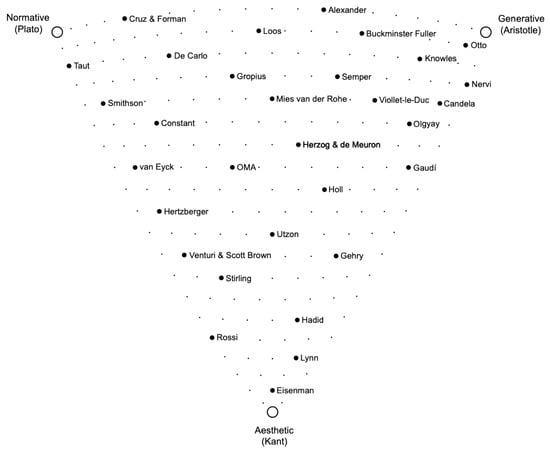
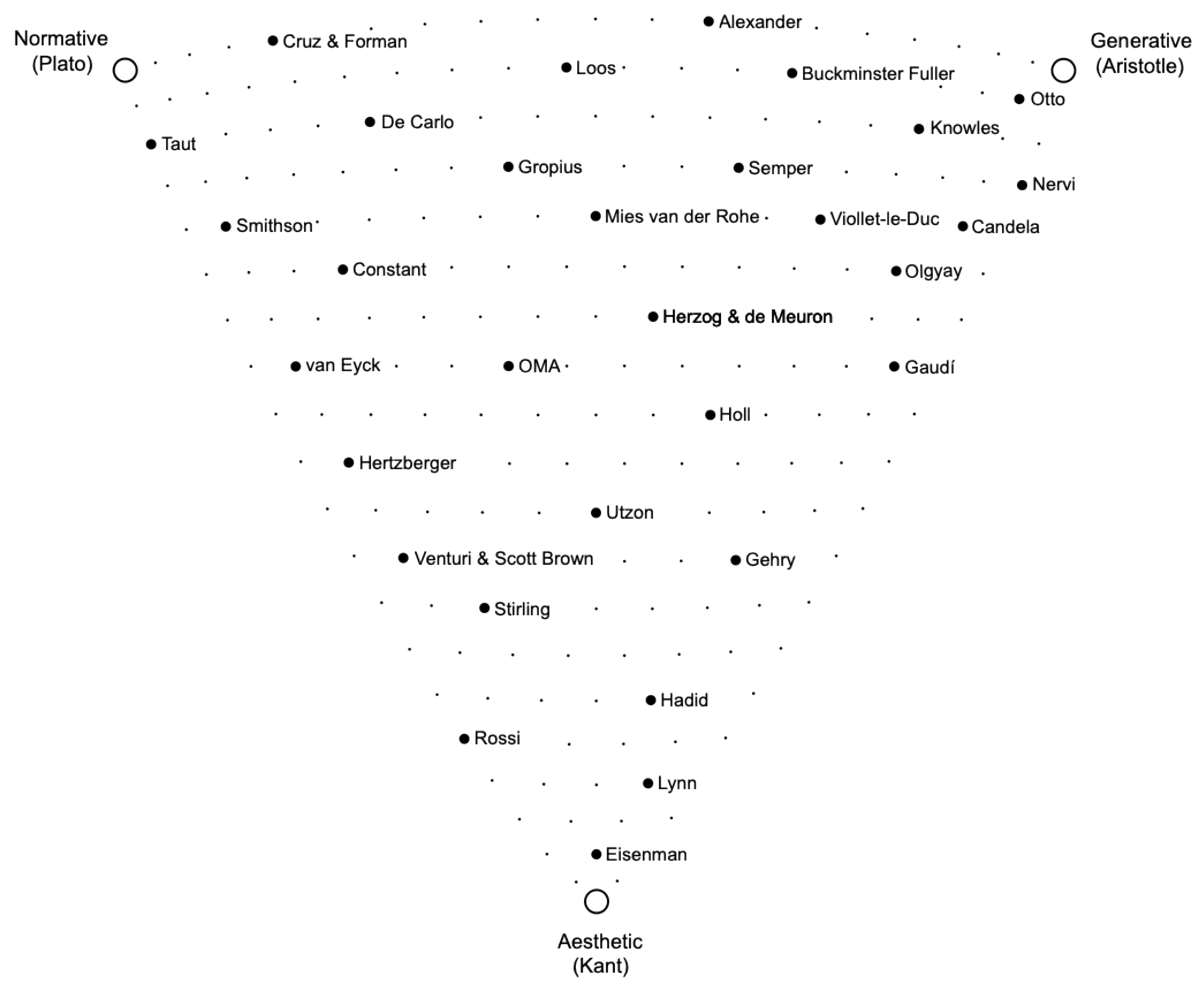
Disclaimer/Publisher’s Note: The statements, opinions and data contained in all publications are solely those of the individual author(s) and contributor(s) and not of MDPI and/or the editor(s). MDPI and/or the editor(s) disclaim responsibility for any injury to people or property resulting from any ideas, methods, instructions or products referred to in the content. |
© 2026 by the author. Licensee MDPI, Basel, Switzerland. This article is an open access article distributed under the terms and conditions of the Creative Commons Attribution (CC BY) license.