


Abstract
Background/Objectives: Understanding the pharmacokinetics (PK) of antiepileptic and anti-inflammatory drugs under different physiological conditions is essential for optimizing therapy. Phenytoin, a widely used antiepileptic, and indomethacin, a nonsteroidal anti-inflammatory drug, are frequently prescribed in women of reproductive age. This study aimed to evaluate the influence of age, pregnancy, and dosing regimens on the PK of both drugs, as well as to investigate potential drug–drug interactions (DDIs). Methods: PK parameters of phenytoin and indomethacin were systematically analyzed in women aged 20–45 years under non-pregnant and pregnant conditions. Different dosing regimens were compared, and coadministration studies were conducted to assess DDI. Results: Phenytoin demonstrated stable absorption and bioavailability across ages and during pregnancy. Single daily dosing (300 mg once daily) yielded slightly higher peak concentration (Cmax) values, while fractionated dosing (100 mg q8h) produced significantly higher drug exposure (AUC) and absorption fraction, particularly with prolonged administration, reflecting saturable metabolism. During pregnancy, systemic exposure (Cmax and AUC) was modestly reduced, while absorption and distribution remained unchanged. Indomethacin showed minimal age-related variability and linear pharmacokinetics across dosing regimens. In pregnancy, exposure was reduced (lower Cmax and AUC) with delayed Tmax, indicating slower absorption. Importantly, no PK DDI was observed, as indomethacin parameters remained unchanged except for Tmax, which was lower in the interaction scenario compared with baseline, suggesting a faster absorption rate without affecting overall exposure or peak concentration in the presence of phenytoin. Conclusions: Phenytoin and indomethacin exhibit stable and predictable PK across ages and during pregnancy, with dose-dependent characteristics that align with their known metabolic profiles. The absence of clinically relevant DDI supports their safe concomitant use. These findings provide preliminary reassuring evidence for clinicians and contribute to a better understanding of their pharmacological behavior in diverse patient populations.
1. Introduction
The use of medications during pregnancy is highly prevalent, with estimates indicating that up to 90% of pregnant women are exposed to at least one drug during gestation [1,2]. Despite this, fewer than 10% of drugs have been adequately studied and labeled for safe use in pregnancy, and less than 0.5% of clinical trials in Europe currently include pregnant women [3,4]. Historical tragedies such as thalidomide and diethylstilbestrol led to strict regulatory restrictions that still discourage the inclusion of pregnant women in clinical studies [5,6]. Ethical concerns, particularly those prioritizing fetal protection over maternal autonomy, have further reinforced this exclusion [7]. Consequently, most prescriptions in pregnancy are off-label, relying on extrapolation from non-pregnant populations and clinician judgment, increasing the risk of underexposure and toxicity [8].
Pregnancy is associated with profound physiological and metabolic adaptations that significantly affect drug absorption, distribution, metabolism, and excretion (ADME). Examples include increases in plasma volume, cardiac output (CO), and glomerular filtration rate (GFR), along with reductions in serum albumin and dynamic modulation in drug-metabolizing enzymes [9]. Cytochrome P450 (CYP) expression is markedly altered: CYP3A4, CYP2C9, and CYP2B6 are induced, while CYP1A2 and CYP2C19 are downregulated, and CYP2D6 activity varies according to genetic polymorphism [10,11]. Such changes introduce substantial interindividual variability in drug disposition, complicating dose optimization. In addition, pregnancy modifies the baseline on which drug–drug interactions (DDIs) occur, amplifying the clinical impact of enzymatic induction or inhibition [12].
Physiologically based pharmacokinetic (PBPK) modeling has emerged as a valuable approach for addressing these challenges. PBPK integrates drug-specific physicochemical and metabolic parameters with population-level physiological data, enabling simulations under pregnancy-specific conditions. Regulatory agencies, including the European Medicines Agency (EMA) and Food and Drug Administration (FDA), increasingly recommend PBPK modeling to guide dose optimization, anticipate DDIs, and reduce reliance on empirical dosing strategies in vulnerable populations [13,14]. However, despite its recognized potential, applications of PBPK in pregnancy remain limited, highlighting the need for studies focusing on clinically relevant drugs used in this population.
Two drugs of particular interest are indomethacin, a nonsteroidal anti-inflammatory drug (NSAID), and phenytoin, an antiepileptic drug (AED). Indomethacin has been used in obstetrics since the 1970s as a tocolytic agent to delay preterm labor by inhibiting prostaglandin synthesis [15,16,17]. Although effective, its use remains controversial due to potential maternal gastrointestinal (GI) adverse effects and fetal risks [17]. Nonetheless, it continues to be prescribed for both pregnant and non-pregnant women, making it clinically relevant beyond obstetric use. Phenytoin, one of the most widely prescribed AEDs worldwide, is no longer considered a first-line treatment during pregnancy. It is currently recommended as a second-line therapy for acute epileptic seizure management rather than as a routine maintenance [18], given its teratogenicity, variable pharmacokinetics (PK), and strong enzyme-inducing properties [19,20,21,22]. However, phenytoin remains in use, particularly in low-resource settings where safer alternatives may be unavailable. Because both phenytoin and indomethacin are used in women of reproductive age, concomitant exposure can occur not only during obstetric interventions but also in the treatment of inflammatory conditions and seizure disorders. Indeed, both drugs are metabolized by CYP2C9, and phenytoin is a potent inducer of CYP2C9 and CYP3A4, suggesting a plausible risk of PK interactions when co-administered [23]. Such induction may accelerate indomethacin metabolism, potentially reducing its systemic exposure and therapeutic efficacy.
The present study sought to develop and validate PBPK models for indomethacin and phenytoin to systematically evaluate their PK under different physiological conditions. Specifically, we investigated the influence of age (20–45 years), pregnancy, and dosing regimens, and assessed the potential for DDIs between the two drugs. Our simulations demonstrated linear PK for indomethacin and nonlinear dose-dependent behavior for phenytoin, consistent with their known metabolic pathways. Pregnancy was associated with reduced exposure to indomethacin and variable effects on phenytoin, but no clinically relevant DDI was predicted. Although these findings are encouraging, they remain preliminary as they are based solely on in silico simulations. Thus, while no significant PK interaction was identified, clinical studies are still required to confirm these results and to establish the safety of concomitant use.
2. Materials and Methods
2.1. PBPK Model Development for Non-Pregnant Subjects
PBPK models were built using GastroPlus v9.8.3 (Simulation Plus Inc., Lancaster, CA, USA). For both drugs, the models were replicated based on existing PK data and established methodologies, especially Alqahtani et al. (2015) [24] for indomethacin and Rodriguez-Vera et al. (2023) [25] for phenytoin. Physicochemical and PK properties of indomethacin and phenytoin were compiled from published scientific literature and experimental data reported in regulatory drug databases, including PubChem, DrugBank, and the FDA. Missing data in published studies were estimated and optimized using ADMET Predictor® (Version 10.3; Simulation Plus Inc., Lancaster, CA, USA). The structural characterization of each compound was performed using MedChem Designer™ (Version 10.0; Simulation Plus Inc., Lancaster, CA, USA). The input of physicochemical, PK, and physiological parameters for the indomethacin and phenytoin PBPK models is detailed in Table 1.
Table 1.
Input data used in the indomethacin and phenytoin PBPK model.
Models for indomethacin and phenytoin consisted of 13 tissue compartments, including lungs, adipose, muscle, liver, spleen, heart, brain, kidneys, skin, reproductive organs, red marrow, yellow marrow, and the rest of the body. Each compartment was defined by its volume, an associated tissue blood flow rate, and tissue-to-plasma partition coefficients (Kp). For indomethacin, Kp values were extracted from the study by Alqahtani et al. (2015) [24], with some adjusted to better fit the observed PK data (Table 2). For phenytoin, Kp values corresponded to the default GastroPlus values calculated using the Lukacova (Rodgers-single) method. Both drugs have a relatively small volume of distribution (0.10 and 0.80 L/kg), good water solubility, and high permeability. The amount of drug distributed to the tissues is primarily limited by tissue blood flow; thus, the tissue distribution of indomethacin and phenytoin was assumed as a perfusion-limited model.
Table 2.
Tissue-to-Plasma Partition Coefficients (Kp) of indomethacin and phenytoin used in the development of the PBPK models.
The absorption process of indomethacin and phenytoin was set as the advanced compartmental absorption and transit (ACAT) model, with human-physiological-fasted conditions used as the GastroPlus default. Indomethacin is recommended to be administered after meals or with food or antacids [30], and phenytoin is recommended to be taken under fasted conditions to optimize absorption [31]. Thus, both compounds were assumed to be taken in fasted conditions. The base PBPK models consisted of the simulation of an oral administration (immediate release, IR, tablet) of 50 mg of indomethacin in a healthy, non-pregnant, fasting, 30-year-old American woman, and an oral administration (IR tablet) of 300 mg of phenytoin under the same physiological conditions. This initial parametrization aimed to replicate previously published PBPK models. The PBPK physiologies, including organ weights, volumes, and blood flow rates, were generated using the Population Estimates for Age-Related Physiology (PEAR Physiology) module.
2.2. Model Evaluation and Validation
The evaluation of the model involved two main steps: first, calculating the ratio between observed and predicted values, and second, the visual inspection of the predicted plasma profile with the clinical data obtained from the literature. Plasma concentration versus time (Cp-time) data points from the selected articles (Table S1) were extracted from the WebPlotDigitizer tool (https://web.eecs.utk.edu), v3.4 (accessed on 11 June 2025). These digitized values were then loaded into GastroPlus, where the PKPlus model was used to validate the models. For phenytoin, predictions were evaluated against clinical data from Caraco et al. [32]. Clinical data from Rytting et al. [33] were used to evaluate and validate the indomethacin model’s performance. The simulation predictions were compared with data from studies involving healthy, non-pregnant individuals for indomethacin and phenytoin. The models were considered acceptable when the fold-error (FE) was below 2.
2.3. PBPK Model Development for Pregnant Subjects
Following the validation of models for non-pregnant individuals, the simulations were extended to pregnant PBPK (p-PBPK) models to characterize drug PK during pregnancy. Separate p-PBPK models were established for each drug (indomethacin and phenytoin) using the PEAR module. In these simulations, body weight was adjusted to include both baseline body weight and pregnancy-associated weight gain, following the same equations applied to healthy subjects. The models incorporated pregnancy-related physiological changes, including alterations in tissue volume, blood flow distribution, enzyme and transporter expression, plasma protein binding, and other parameters influencing drug disposition in both the mother and the fetus. All simulations were conducted for the first trimester, corresponding to 10 weeks of pregnancy. Second- and third-trimester simulations were not included due to the limited availability of clinical PK data for phenytoin and indomethacin in later stages of pregnancy. Additionally, the FDA recommends avoiding NSAIDs, including indomethacin, from 20 weeks of gestation onward, as their use beyond this point may cause fetal renal dysfunction, oligohydramnios, and in some cases, neonatal renal impairment. Consequently, characterizing the PK of indomethacin during early pregnancy becomes clinically relevant and aligns with the specific objective of this study.
The Vmax and Km parameters were not manually adjusted to represent pregnancy-induced variations in metabolic enzyme activity. Instead, the PEAR module automatically recalculated these parameters from the non-pregnant baseline when the pregnancy physiology option was selected, ensuring consistency with the underlying physiological changes.
2.4. Dose and Physiologies Simulation
The PK profiles of indomethacin and phenytoin were modeled in a virtual population with specific individual characteristics, particularly age. The selected age range for this study was 20 to 45 years, in 5-year intervals, covering the main reproductive period. This choice reflects the period of highest clinical relevance to pregnancy and allows evaluation of the age-related impact on the PK of both drugs. The rationale behind each simulated age group is detailed in Table 3.
Table 3.
Description of the rationale behind selecting specific ages for simulation to reflect clinical practice more accurately.
Dosing regimens were established according to FDA-approved labeling for each drug to ensure clinical representativeness. Indomethacin was administered at 50 mg every 24, 12, and 8 h (q24h, q12h, and q8h), over a 240 h period (10 days). Phenytoin was evaluated under two dosing schemes: 100 mg q8h and 300 mg q24h, each simulated for 168 h (7 days) and 240 h (10 days). The simulation windows were defined to capture steady-state conditions. Given its short half-life (~4.5 h), indomethacin reaches PK steady state within one day; however, a 10-day course was simulated to reflect typical clinical treatment durations (7–14 days). In contrast, phenytoin requires 7–10 days to achieve steady state due to its nonlinear kinetics; thus, 168 h (7 days) and 240 h (10 days) simulations were designed to represent early and near-maximal steady-state conditions, respectively.
2.5. Quantitative Prediction of DDI
To study potential PK interactions after the coadministration of indomethacin and phenytoin in virtual non-pregnant women, phenytoin’s Emax and EC50 values for CYP2C9 were input into the DDI module of GastroPlus. The physicochemical, ADME, and PK parameters obtained in the previous steps were used as input. Table 4 provides crucial information for the DDI simulation, focusing on phenytoin’s induction effects as the perpetrator. Steady-state predictions and dynamic simulations were run. The dose and dose interval of the substrate (indomethacin) and inducer (phenytoin) were set based on FDA drug instructions. The intake of 50 mg q8h of indomethacin and 300 mg q24h, and 100 mg q8h of phenytoin was simulated in a 25-year-old American healthy female.
Table 4.
Input interaction parameters used in the DDI simulations.
The classification of DDI is determined by comparing the AUC ratio in the presence or absence of the perpetrator and is categorized as no interaction, weak, moderate, or strong based on the magnitude of this ratio. An AUC ratio between 1.25 and 2 indicates a weak interaction. A moderate interaction is defined with an AUC ratio range between 2 and 5. When the AUC ratio > 5, the interaction is classified as strong. The predicted DDI AUC ratios were calculated with the following equation (Equation (1)):
3. Results and Discussion
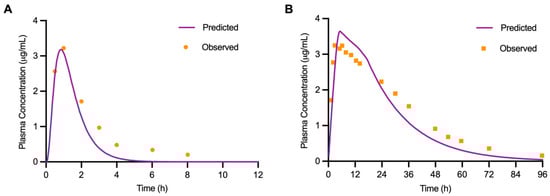
To evaluate the PK of indomethacin and phenytoin under different scenarios, PBPK-based models for both drugs were first developed and validated. The final models were used to predict the PK profile of a healthy, fasting, 30-year-old American female weighing 60 kg (Figure 1). The simulated concentration-time curves closely matched the observed values. The parameters evaluated include the maximum concentration (Cmax), time to peak concentration (Tmax), area under the concentration-time curve over time (AUC0–t), area under the concentration-time curve extrapolated to infinity (AUC0–inf), and maximum liver concentration (Cmax liver). Similarly to the other parameters, the predicted Cmax, Tmax, and AUC0–t parameters were consistent (within a <2-fold error) with reference data (observed values), as presented in Table 5. In particular, the predicted Cmax values were generally close to the observed values, with fold errors (FE) ranging from 0.96 to 0.99. This indicates an accurate estimation of peak concentration following 50 mg indomethacin and 300 mg phenytoin doses. For Tmax, the indomethacin model predicted a peak occurring 12% earlier than observed, whereas the phenytoin model predicted a 61% delay. Although both predictions fall within the acceptable FE range threshold, this suggests slight discrepancies in absorption kinetics or distribution phase, which are also evident upon visual inspection of the Cp-time curves. The predicted AUC0–t for indomethacin was 38% lower than the observed value, suggesting the model may underestimate systemic exposure, possibly due to a slightly higher predicted clearance rate (as visually confirmed in the fitted profiles). The PBPK model of phenytoin demonstrated a minor underprediction (19% lower than observed) of overall drug exposure over time. Overall, the PBPK models for both drugs demonstrated adequate predictive performance and were therefore considered suitable to support subsequent simulations in this study.
Figure 1.
Predicted (lines) and observed (dots) plasma concentration-time profiles of (A) indomethacin following a single oral dose of 50 mg and (B) phenytoin following a single oral dose of 300 mg in a healthy, fasting, 30-year-old American woman.
Table 5.
Model validation: comparison of predicted and observed pharmacokinetic parameters following oral administration of indomethacin and phenytoin.
3.1. Influence of Age on Indomethacin and Phenytoin Pharmacokinetics
To investigate whether age influences PK parameters of both drugs, we simulated their therapeutic regimens in virtual American female subjects aged 20, 25, 30, 35, 40, and 45 years (Table 6 and Table 7). It revealed overall stability across this adult age range, with only minimal variations detected. For indomethacin, Tmax remained constant at approximately 0.8 h in all age groups, indicating that the absorption rate is not age-dependent. Similarly, in Table 6, the predicted Cmax showed only a slight progressive reduction with advancing age, suggesting a negligible impact of age on peak plasma concentrations. The systemic exposure, expressed by AUC0–∞ and AUC0–t, is also nearly identical among age groups. However, there is a systematic bias (consistent underprediction of ~38.7% relative to reference data), suggesting a model tendency to slightly overestimate clearance; however, this deviation was uniform across age groups and therefore not age-related. The predicted oral bioavailability (F) demonstrated no association with age. Other absorption-related parameters, such as fraction absorbed (Fa) and fraction dissolved (FDp), remained stable at 100%, confirming that dissolution and intestinal absorption are not limiting factors for indomethacin exposure in this population. This absence of clinical relevance indicates that dose adjustments or additional monitoring are not necessary in healthy adult non-pregnant women.
Table 6.
Simulated PK parameters of indomethacin (mean ± SD) in non-pregnant women stratified by age group. Percent change (% Change vs. Reference) represents the relative difference from the reference value (observed value).
Table 7.
Simulated PK parameters of phenytoin (mean ± SD) in non-pregnant women stratified by age group. Percent change (% Change vs. Reference) represents the relative difference from the reference value (observed value).
Such stability aligns with expectations for this age group, as women between 20 and 45 years generally maintain preserved hepatic and renal function, without the decline in metabolic capacity that typically occurs in the elderly [35,36]. Likewise, the enzymatic activity of CYP2C9 and UGT2B7, key enzymes responsible for indomethacin clearance, remains relatively constant throughout adulthood. The limited impact of age may also be explained by the physicochemical characteristics of indomethacin, which ensure efficient solubility and absorption, thereby reducing the impact of subtle age-related physiological differences on systemic exposure [37]. The consistent PK trends across adult age groups support the extrapolation of data obtained in non-pregnant women to broader adult populations, reinforcing the robustness of indomethacin PK [7,38].
Similarly, the analysis of phenytoin PK in non-pregnant women aged 20 to 45 years demonstrated no clinically relevant variations. In Table 7, the results showed overall stability across the different age groups, with only minor fluctuations observed. Cmax values remained consistent, increasing slightly with age (from 3.347 to 3.358 µg/mL), corresponding to a 2.98% to 3.32% deviation from the reference values. Likewise, systemic exposure (AUC0–t) showed a variation between the age groups, increasing from 104.76 to 108.75 µg·h/mL. Although the percent change remained negative (−13.51% to −10.22%), this underprediction was consistent across all ages, indicating a model-related bias rather than a physiological age effect. This is consistent with the PBPK base model for a 30-year-old woman, as previously stated. Thus, while the model slightly overestimates clearance, this tendency is not age-dependent.
Although these changes are small, they may be attributed to age-associated reductions in hepatic clearance or plasma protein binding, processes known to evolve gradually throughout adulthood but becoming more clinically relevant in elderly populations [39,40]. The differences observed in Cmax and AUC, though detectable, are of small magnitude and unlikely to have clinical consequences in women aged 20–45 years. This aligns with what physiological expectations, as hepatic enzyme activity, including CYP2C9 and CYP2C19, which are primarily responsible for phenytoin metabolism, remains relatively stable during adulthood [35,36]. These findings indicate that in non-pregnant women between 20 and 45 years, the PK of phenytoin remains highly predictable and stable, with only marginal age-related increases in systemic exposure. These small changes are not clinically relevant and do not warrant dose adjustments, reinforcing the robustness of phenytoin’s PK profile across different adult ages.
3.2. Effect of Dosing Regimens on Indomethacin and Phenytoin Pharmacokinetics
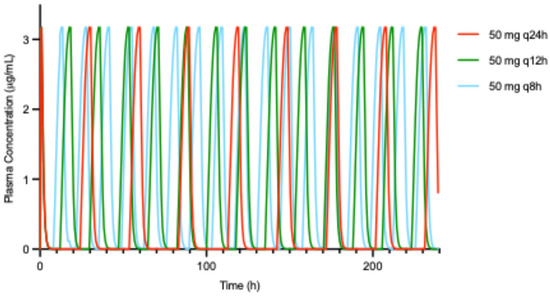
Subsequently, different dosing regimens were explored to assess the effect of administration frequency on the disposition of both indomethacin and phenytoin. First, using the developed and validated model for indomethacin, the following clinically relevant oral dosing schedules were simulated: 50 mg q8h, 50 mg q12h, and 50 mg q24h. These regimens were selected in accordance with FDA dosing recommendations. Figure 2 displays the Cp-time profiles of indomethacin under the different simulated dosing schedules. All regimens produced sharp peaks and a complete decline to baseline prior to the next administration.
Figure 2.
Simulated plasma concentration-time profiles of indomethacin in the standard PBPK model (healthy, fasting, 30-year-old woman, 60 kg) under different dosing regimens: 50 mg q24h, 50 mg q12h, and 50 mg q8h over 240 h.
Analysis of the PK parameters revealed no variation with increasing dosing intervals. Cmax remained unchanged across regimens at about 3.2 µg/mL, indicating that the peak plasma concentration following each dose is independent of the dosing interval. This suggests that absorption and distribution processes are consistent with published data showing rapid and complete absorption of indomethacin [37,41]. In contrast, systemic exposure (AUC) increased with higher dosing frequency, rising from 5.26 µg·h/mL after a single dose to 105 µg·h/mL following 50 mg q12 h. This increase does not reflect incomplete elimination or drug accumulation, since indomethacin has a relatively short half-life, approximately 4–5 h, and plasma concentrations return to near zero before the next dose is given [37]. Instead, the higher AUC is explained by the greater total amount of drug administered over the same time frame when dosing intervals are shortened, resulting in proportionally greater systemic exposure. The Fa remained constant at 100% across all regimens, confirming complete absorption and supporting previous reports of high oral bioavailability of indomethacin [42].
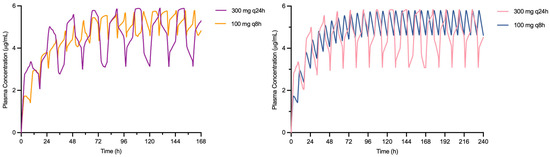
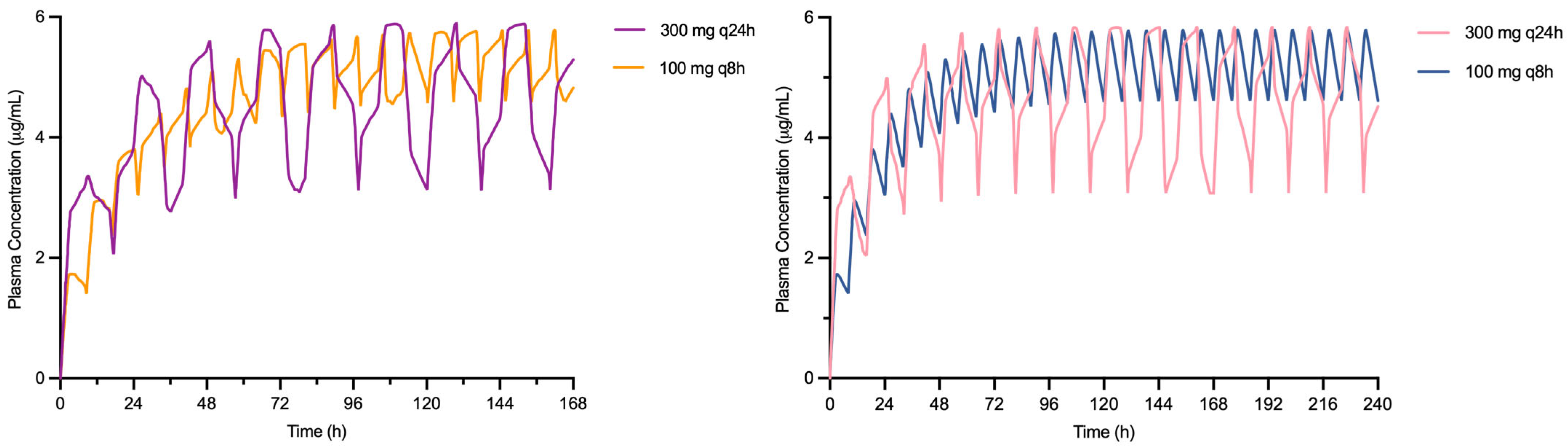
Thereafter, the PBPK base model for phenytoin was applied to compare two dosing regimens: 100 mg orally q8h and 300 mg orally once daily (Figure 3). Each virtual treatment was simulated over 168 h (7 days) and 240 h (10 days) to evaluate the PK profiles under steady-state and extended dosing conditions. Table 8 summarizes the PK parameters across the different dosing regimens.
Figure 3.
Simulated plasma concentration-time profiles of indomethacin in the standard PBPK model (healthy, fasting, 30-year-old woman, 60 kg) under different dosing regimens: 300 mg q24h for 168 h, 100 mg q8h for 168 h, 300 mg q24h for 240 h, and 100 mg q8h for 240 h.
Table 8.
Simulated pharmacokinetic parameters (Cmax, AUC0–∞, Fa) of phenytoin under different dosing regimens in the standard PBPK model.
As observed, following a single 300 mg dose, the peak plasma concentration was 3.35 µg/mL, with an AUC of 105.5 µg·h/mL, and Fa of 87.9%. When the same dose was administered once daily (q24h) for 168 h, Cmax increased to 5.83 µg/mL, while the AUC rose markedly to 762.9 µg·h/mL. Extending treatment to 240 h further increased the AUC, whereas Cmax remained stable, suggesting consistent peak concentrations across prolonged therapy, as expected. More frequent administration with 100 mg three times daily (q8h) produced a similar Cmax (5.8 µg/mL), but systemic exposure was higher than that observed with the once-daily regimen. This indicates that dividing the total daily dose into smaller, more frequent administrations increases overall exposure, even though peak concentrations are not substantially altered. Unlike indomethacin, phenytoin exhibited a clear accumulative effect during repeated dosing. This is explained by its long elimination half-life (approximately 22 h in adults) and non-linear kinetics. At therapeutic concentrations, metabolism via CYP2C9 and CYP2C19 approaches saturation, resulting in dose- and time-dependent accumulation until steady-state is achieved, typically after 7–10 days of continuous administration [43,44,45]. Clinically, this has important implications for a drug like phenytoin, which has both non-linear kinetics and a narrow therapeutic index. Different scenarios may occur in patients treated with phenytoin: (i) a higher risk of adverse drug reactions (ADRs) due to disproportionate rises in AUC, (ii) unexpectedly large increases in steady-state levels caused by small increases in daily dose or changes in dosing frequency, (iii) earlier onset of toxicity with more frequent dosing compared to once-daily dosing. Therefore, redistributing the same total daily dose into more frequent administrations can inadvertently elevate systemic exposure and the risk of toxicity, underscoring the need for careful therapeutic drug monitoring (TDM) in patients receiving phenytoin [43,45]. This PK profile explains the progressive increase in AUC and higher Cmax values observed with prolonged regimens (240 h). The Fa remained high, close to 100% for 100 mg doses and close to 88% for 300 mg, consistent with saturable absorption at higher single doses [43,44]. Overall, these results demonstrate that phenytoin undergoes PK accumulation, with systemic exposure (AUC) and Cmax progressively increasing during multiple dosing.
3.3. Impact of Pregnancy on Indomethacin and Phenytoin Pharmacokinetics
Several physiological changes that occur during pregnancy can affect how the body handles administered drugs, leading to possible changes in the PK as pregnancy progresses [46]. In this study, we analyzed the PK changes between a 25-year-old pregnant woman and a 25-year-old non-pregnant woman (Table 9). Simulations assessing the impact of pregnancy-related physiological transformations on drug disposition demonstrated that pregnancy resulted in a consistent decrease in systemic exposure across all four tested therapeutic regimens. Cmax was reduced by −5.88% in the pregnant model compared to the non-pregnant reference, declining from 3.178 µg/mL to 2.991 µg/mL under all simulated conditions. AUC0–t was also lower in pregnant women, with reductions ranging from −4.84% to −5.03% depending on the regimen. At 50 mg q24h, AUC0–t decreased from 52.66 to 50.09 µg·h/mL, while at 50 mg q8h it decreased from 158.0 to 150.3 µg·h/mL. These results are consistent with clinical studies reporting lower indomethacin AUC in pregnant women [27,47].
Table 9.
Simulated pharmacokinetic parameters of indomethacin in 25-year-old pregnant and non-pregnant women. Percent change (% Change vs. Reference) represents the relative difference from the reference value (observed value).
These reductions are consistent with physiological changes that influence drug disposition during gestation. Regarding distribution, pregnancy induces a 40–50% increase in plasma volume and total body water, expanding the apparent volume of distribution of highly protein-bound and lipophilic compounds such as indomethacin [9,39]. This dilutional effect lowers peak plasma concentrations even when the absorbed dose remains unchanged. Additionally, maternal fat mass increases by approximately 4 kg, further augmenting the volume of distribution for lipophilic drugs. Increased CO in early pregnancy, which also contributes to the expanded distribution volume, may further explain our findings [48]. Concurrently, the decline in serum albumin and α1-acid glycoprotein levels increases the unbound fraction of indomethacin, partially accounting for the observed decrease in plasma concentrations [39,40].
Pregnancy is also associated with changes in drug metabolism. Indomethacin undergoes extensive hepatic elimination via CYP2C9-mediated oxidation and UGT2B7-mediated glucuronidation, both of which are upregulated during pregnancy, together with increased CYP3A4 activity, resulting in enhanced metabolic clearance [30,40,41]. These mechanisms likely contribute to the reduced systemic exposure of indomethacin observed in the pregnant woman. Moreover, pregnancy is associated with a 50% increase in renal plasma flow and glomerular filtration rate, which may accelerate renal elimination of indomethacin metabolites and further reduce circulating drug concentrations [42,43]. For drugs with a narrow therapeutic window, such as indomethacin, increased clearance during pregnancy can result in subtherapeutic concentrations and suboptimal symptom control [48].
Although the reduction in exposure is modest compared to the simulated non-pregnant woman, the clinical relevance of this change depends on the therapeutic objective. According to FDA guidelines, indomethacin is indicated during pregnancy for the treatment of preterm labor, a condition in which maintaining consistent pharmacological effect is critical [49]. Failure to achieve adequate drug concentrations could result in uncontrolled preterm labor, posing risks to both mother and fetus. Interindividual physiological variability during pregnancy may further influence treatment response. This study suggests that the first trimester is associated with small reductions in plasma drug concentrations, which could potentially lead to subtherapeutic exposure, thereby compromising maternal and fetal outcomes. Furthermore, additional factors not accounted for in this analysis, such as maternal age, genetic polymorphisms, and body weight, could exacerbate these effects. Hypothetically, if a 25-year-old pregnant woman carried a genetic variant that upregulated CYP2C9, systemic exposure could be further reduced, potentially lowering peak plasma concentrations below 0.3 µg/mL, which is below the therapeutic threshold for indomethacin. These findings highlight the potential value of personalized indomethacin therapy, taking into account individual patient characteristics to optimize efficacy and safety during pregnancy.
Regarding drug absorption, it has been reported that nausea and vomiting in early pregnancy can reduce the amount of drug available for absorption following oral administration. On one hand, reduced gastric acid production and increased mucus secretion raise gastric pH, which increases the ionization of weak acids such as indomethacin, thereby decreasing absorption. Additionally, slower intestinal motility and decreased gastric acid secretion during pregnancy may further influence drug absorption and oral bioavailability. On the other hand, increased CO and intestinal blood flow may enhance drug absorption, effectively balancing the aforementioned effects and resulting in minimal impact of GI changes on oral bioavailability and therapeutic effect [48]. This is precisely what was observed in our study: absolute bioavailability (F%) showed only minimal differences between groups, indicating that indomethacin absorption is not significantly affected by pregnancy.
Although pregnancy-related physiological adaptations theoretically favor indomethacin absorption, these effects were insufficient to counterbalance the dominant elimination-driven reduction in exposure. This illustrates a frequent paradox in pregnancy pharmacology: even when oral absorption is preserved, the dominant changes in distribution, metabolism, and excretion lead to reduced systemic exposure. Such complexity reinforces the limitations of empirical dose adjustments and highlights the value of PBPK models in providing mechanistic insights into pregnancy-induced changes in drug disposition. From a clinical perspective, the magnitude of the exposure reduction observed in this study is unlikely to necessitate routine dose adjustments, but it emphasizes the need for further studies integrating individual patient characteristics to evaluate drug behavior and interindividual variability in response during pregnancy.
In turn, Table 10 illustrates the impact of gestational physiological adaptations on the ADME of phenytoin in a 25-year-old woman under pregnant and non-pregnant conditions across all dosing regimens. Following a single 300 mg dose, pregnancy produced a slight increase in Cmax (+6.66%), rising from 3.347 to 3.570 µg/mL, while AUC0–t remained unchanged (104.7 µg·h/mL in both groups). In contrast, F% decreased marginally by −0.77%. Under multiple-dose conditions, pregnancy induced modest but regimen-dependent changes in systemic exposure. For the 300 mg q24h regimen, Cmax increased by +1.45% (from 5.793 to 5.877 µg/mL), while AUC0–t also showed a slight increase (+0.45%). In this scenario, F% increased by +0.42% compared with the non-pregnant reference. Conversely, a reduction in exposure was observed under the 100 mg q8h regimen, where Cmax decreased by −4.52%, AUC0–t by −7.20%, and F% by −1.46%.
Table 10.
Simulated pharmacokinetic parameters of phenytoin in 25-year-old pregnant and non-pregnant women. Percent change (% Change vs. Reference) represents the relative difference from the reference value (observed value).
Unlike indomethacin, for which pregnancy uniformly reduced drug exposure, phenytoin displayed variable results. With respect to absorption, oral bioavailability showed only minor differences (≤1.5%) across all dosing regimens, indicating that pregnancy is not a major factor influencing the oral absorption of phenytoin.
Regarding PK parameters that describe drug disposition, our results are heterogeneous, which can be explained by the multiple physiological mechanisms occurring during pregnancy. The decrease in serum albumin and α1-acid glycoprotein concentrations, which increases the free fraction of highly protein-bound drugs, could plausibly contribute to reduced total plasma concentrations, given that phenytoin is a lipophilic compound with high plasma protein affinity [49,50,51]. However, a reduction in Cmax is observed only for the 100 mg q8h regimen. In contrast, for the single-dose 300 mg and 300 mg q24h regimens, an increase in peak plasma concentration is observed. A similar pattern is seen for AUC values. This discrepancy in Cmax and AUC patterns for phenytoin is primarily attributable to its nonlinear kinetics and competition for plasma protein-binding sites. In the single-dose 300 mg and 300 mg q24h regimens, the total amount of phenytoin administered at once is higher. With the reduction in plasma protein concentrations that occurs during pregnancy, the free fraction increases substantially, potentially leading to more rapid saturation of hepatic metabolism. This may result in a disproportionate and rapid increase in free and total concentrations, producing a higher-than-expected peak under conditions of reduced protein binding. In the more frequent, lower-dose regimen (100 mg q8h), the drug is cleared more efficiently before reaching the level of metabolic saturation observed with larger doses.
Another possible explanation is pregnancy-related alteration in CYP enzyme activity. As previously noted, phenytoin is mainly metabolized by CYP2C9 and CYP2C19, and pregnancy is associated with increased CYP2C9 activity but decreased CYP2C19 activity [10,38,51]. This balance of opposing enzymatic changes likely contributes to the inconsistent differences in systemic exposure observed between groups. Renal elimination may also contribute to altered phenytoin disposition during pregnancy, as increased renal plasma flow and glomerular filtration rate accelerate the clearance of phenytoin metabolites [9,52]. P-glycoprotein (P-gp) has also been reported to be upregulated during pregnancy, suggesting that drugs with affinity for this transporter may undergo enhanced efflux, directly affecting bioavailability by limiting absorption and distribution [49]. However, once again, the inconsistency of the results prevents precise inference regarding the mechanisms underlying phenytoin’s altered kinetics.
Based on these simulations, the direction and magnitude of changes in phenytoin disposition depend on both dose and regimen. Given its narrow therapeutic index and nonlinear (i.e., saturable) elimination, these findings underscore the importance of TDM in pregnant patients receiving phenytoin to ensure both efficacy and safety. Even minor deviations in total or unbound concentrations may compromise seizure control in susceptible patients. The dynamic physiological changes occurring throughout pregnancy introduce time-dependent variability, meaning that a single concentration measurement may not reliably reflect dtug exposure. Therefore, longitudinal assessment of phenytoin levels may support safer and more effective therapy in pregnant patients, ensuring that dosing decisions remain aligned with the evolving physiological state.
3.4. DDI Evaluation: Simulation of Indomethacin as the Victim and Phenytoin as the Perpetrator
The results from the simulations in a 25-year-old female for indomethacin and phenytoin provide insights into how DDI impacts PK parameters (Table 11). Indomethacin undergoes extensive hepatic metabolism, primarily via CYP2C9 and by UGT2B7 [53,54]. Phenytoin is a well-documented inducer of multiple metabolic enzymes, such as CYP2C9 and CYP3A4, which can accelerate the clearance of co-administered substrates [44,45]. In the co-administration of both drugs, induction is expected to decrease indomethacin systemic exposure, reflected by reductions in AUC and Cmax.
Table 11.
Analysis of DDI predictions for indomethacin co-administered with phenytoin in a 25-year-old female.
The evaluation of the PK interaction between phenytoin as the perpetrator and indomethacin as the victim drug demonstrated that co-administration did not result in significant alterations in the PK profile of indomethacin. In non-pregnant women (see Tables S2–S6), the parameters Cmax, AUC0–t, AUC0–∞, as well as the oral bioavailability parameters Fa%, FDp% and F%, remained comparable to those that resulted from control conditions without phenytoin (indomethacin baseline), except for Tmax. It is important to note that GastroPlus determines Tmax as the time of the highest plasma concentration over the entire simulation window (240 h in this study), including the accumulation phase, so the elevated Tmax values reported reflect the software’s calculation method rather than a physiologically implausible result.
Cmax values of indomethacin were unchanged in the presence of phenytoin, indicating that peak plasma systemic exposure was not affected by the concomitant drug. A reduction in Tmax was observed under the DDI condition relative to the indomethacin baseline, indicating a faster absorption rate of indomethacin in the presence of phenytoin, while Cmax and AUC remained essentially unchanged. The AUC parameters were consistent with the control conditions, supporting the absence of an inhibitory or inductive effect of phenytoin on the overall clearance of indomethacin. Although indomethacin is partially metabolized by the enzyme CYP2C9, the same enzyme responsible for phenytoin metabolism and induction, the unchanged systemic exposure implies that this metabolic pathway was not significantly affected to the point of altering indomethacin disposition.
Previous studies have shown that indomethacin undergoes extensive glucuronidation via UGT2B7, in addition to oxidative metabolism [42,53]. These routes may compensate for any potential CYP2C9 induction by phenytoin, thereby preventing meaningful PK changes. This compensatory effect reflects the ability of parallel metabolic pathways to maintain overall clearance even when one pathway is induced, thereby stabilizing systemic exposure under co-administration conditions. Furthermore, phenytoin, while recognized as a strong inducer of CYP2C9 and CYP3A4 [44], may not reach an induction threshold sufficient to impact indomethacin clearance under the simulated conditions. The absence of significant differences suggests that the concomitant use of indomethacin and phenytoin is unlikely to require dose adjustment or additional monitoring in non-pregnant women [54]. Nevertheless, it should be emphasized that these conclusions are based on simulations, and further clinical studies are warranted to confirm the lack of interaction in real-world scenarios, particularly in populations with altered metabolisms.
4. Conclusions
This study developed and validated PBPK models for both indomethacin and phenytoin, allowing for a comprehensive assessment of their PK profiles under clinically relevant conditions. The models were consistent with published in vitro and in vivo data, providing a robust framework to explore the influence of age, dosing regimens, pregnancy, and DDIs. The analysis demonstrated that the difference in ages between 20- and 45-year-olds results in only minor effects on the PK of both drugs. Regarding dosing regimens, indomethacin showed linear PK, with systemic exposure increasing proportionally to dosing frequency. In contrast, phenytoin exhibited non-linear kinetics, as expected, with fractionated regimens leading to higher overall exposure than once daily administration. Pregnancy significantly altered the PK profiles of both drugs. For indomethacin, pregnancy-related changes led to reduced systemic exposure. In contrast, phenytoin exhibited variable exposure across regimens, reflecting the opposing influence of enzyme induction and inhibition during pregnancy.
Regarding the DDI study, it showed no clinically relevant alterations in the PK of indomethacin in non-pregnant women, except for the decreased Tmax, indicating a faster absorption rate of indomethacin in the presence of phenytoin without affecting maximum plasma concentration or total exposure. Although both drugs undergo metabolism primarily via CYP2C9, systemic exposure to indomethacin remained unchanged upon co-administration. These results suggest a low risk of reduced efficacy or increased toxicity for indomethacin when co-administered with phenytoin in non-pregnant populations, although clinical confirmation would still be required.
Notwithstanding, this study presents several limitations, such as the inability to extend DDI simulations to pregnant women, which restricts conclusions in the most clinically relevant population: (i) all simulations were restricted to the first trimester, and our findings apply only to early pregnancy and should not be extrapolated to second- or third-trimester, (ii) some parameters were derived from in silico predictions rather than experimental data, adding uncertainty, particularly in nonlinear kinetic contexts, (iii) the use of a single standard patient profile did not capture interindividual variability, including pharmacogenomic differences, (iv) physiological parameters for pregnancy were incorporated based on default GastroPlus pregnancy model, and these values remain approximations and may not fully capture interindividual variability or the dynamic trajectory of physiological changes across gestation, and (v) the limited availability of pregnancy-specific PK data prevented full external validation, reflecting the persistent underrepresentation of pregnant women in clinical research. An additional limitation of this study relates to the use of the GastroPlus ACAT model for simulating drug absorption. Recent reports have identified issues in the implementation of the pH-partition hypothesis for passive absorption within the ACAT framework [55]. As a result, PBPK simulations relying on these models may not fully capture in vivo absorption kinetics, which could impact the accuracy of predicted systemic exposure. Future work should include sensitivity analyses to assess the influence of uncertainties in absorption parameters on PK outcomes, particularly for drugs whose absorption is pH-dependent or highly variable. This would help quantify the potential impact of model assumptions and enhance confidence in the simulation results.
In conclusion, this work showcases PBPK modeling as a powerful, innovation-driven approach to de-risk dosing decisions, particularly in populations where clinical data are sparse (e.g., pregnancy). By mechanistically integrating physiological change with drug properties and regimen design, the models provide actionable insights to support dose selection, TDM strategies, and safer pharmacotherapy, while establishing a scalable in silico foundation that can be readily adapted to additional drugs, special populations, and prospective “virtual trials” in future studies.
Supplementary Materials
The following supporting information can be downloaded at: https://www.mdpi.com/article/10.3390/ijtm5040058/s1, Table S1: Plasma concentration versus time (Cp-time) data points for phenytoin and for indomethacin. Table S2: Pharmacokinetic parameters of indomethacin in a 20-year-old female simulation under drug–drug interaction (DDI) with phenytoin. Table S3: Pharmacokinetic parameters of indomethacin in a 30-year-old female simulation under drug–drug interaction (DDI) with phenytoin. Table S4: Pharmacokinetic parameters of indomethacin in a 35-year-old female simulation under drug–drug interaction (DDI) with phenytoin. Table S5: Pharmacokinetic parameters of indomethacin in a 40-year-old female simulation under drug–drug interaction (DDI) with phenytoin. Table S6: Pharmacokinetic parameters of indomethacin in a 45-year-old female simulation under drug–drug interaction (DDI) with phenytoin.
Author Contributions
Conceptualization, N.V.; methodology, M.G. and L.M.; formal analysis, M.G., L.M. and N.V.; investigation, M.G. and L.M.; writing—original draft preparation, M.G.; writing—review and editing, L.M. and N.V.; supervision, N.V.; project administration, N.V.; funding acquisition, N.V. All authors have read and agreed to the published version of the manuscript.
Funding
This work was financed by the FEDER—Fundo Europeu de Desenvolimento Regional through COMPETE 2020—Operational Programme for Competitiveness and Internationalization (POCI), Portugal 2020, and by Portuguese funds through the FCT—Fundação para a Ciência e a Tecno-logia, in a framework of the projects in CINTESIS, R&D Unit (reference UIDB/4255/2020), and within the scope of the project “RISE—LA/P/0053/2020.” N.V. would also like to thank the support from the FCT and FEDER (European Union), award number IF/00092/2014/CP1255/CT0004, PRR-09/C06-834I07/2024.P11721, 2024.18026.PEX and the Chair in Onco-Innovation at the FMUP.
Institutional Review Board Statement
According to our institutional policies and local regulations, ethical review and approval were waived for this study because the analyses performed in our work are based exclusively on aggregated and fully anonymized data available in scientific literature.
Informed Consent Statement
Patient consent was waived for this study because the analyses performed in our work are based exclusively on aggregated and fully anonymized data available in scientific literature.
Data Availability Statement
The original contributions presented in this study are included in the article/Supplementary Material. Further inquiries can be directed to the corresponding author.
Acknowledgments
L.M. thanks FCT for her PhD Grant (2024.02576.BD).
Conflicts of Interest
The authors declare no conflict of interest.
Abbreviations
The following abbreviations are used in this manuscript:
| ADME | Absorption, Distribution, Metabolism, and Excretion |
| AED | Antiepileptic Drug |
| AUC | Area Under the Concentration–Time Curve |
| AUC0–∞ | Area Under the Curve from Time Zero to Infinity |
| AUC0–t | Area Under the Curve from Time Zero to Last Time Point |
| BBB | Blood–Brain Barrier |
| BCS | Biopharmaceutics Classification System |
| Cmax | Maximum Plasma Concentration |
| Cmax liver | Maximum Hepatic Concentration |
| CYP | Cytochrome P450 |
| CYP1A2 | Cytochrome P450 Isoenzyme 1A2 |
| CYP2B6 | Cytochrome P450 Isoenzyme 2B6 |
| CYP2C9 | Cytochrome P450 Isoenzyme 2C9 |
| CYP2C19 | Cytochrome P450 Isoenzyme 2C19 |
| CYP2D6 | Cytochrome P450 Isoenzyme 2D6 |
| CYP3A4 | Cytochrome P450 Isoenzyme 3A4 |
| DDI | Drug–Drug Interaction |
| Diff. Coeff. | Diffusion Coefficient |
| EMA | European Medicines Agency |
| Fa% | Fraction Absorbed |
| F% | Oral Bioavailability |
| FDA | Food and Drug Administration |
| FDp% | Fraction Dissolved in the Intestine |
| GFR | Glomerular Filtration Rate |
| MW | Molecular Weight |
| ND | Not Determined |
| NSAID | Nonsteroidal Anti-Inflammatory Drug |
| PBPK | Physiologically Based Pharmacokinetic |
| Peff | Effective Human Jejunal Permeability |
| PK | Pharmacokinetics |
| pKa | Ionization Constant |
| TDM | Therapeutic Drug Monitoring |
| Tmax | Time to Reach Maximum Concentration |
| UGT | Uridine 5′-Diphospho-Glucuronosyltransferase |
| UGT2B7 | Uridine 5′-Diphospho-Glucuronosyltransferase 2B7 |
References
- Smolina, K.; Hanley, G.E.; Mintzes, B.; Oberlander, T.F.; Morgan, S. Trends and Determinants of Prescription Drug Use during Pregnancy and Postpartum in British Columbia, 2002–2011: A Population-Based Cohort Study. PLoS ONE 2015, 10, e0128312. [Google Scholar] [CrossRef] [Scilit] [PubMed]
- Engeland, A.; Bjørge, T.; Klungsøyr, K.; Hjellvik, V.; Skurtveit, S.; Furu, K. Trends in Prescription Drug Use during Pregnancy and Postpartum in Norway, 2005 to 2015. Pharmacoepidemiol. Drug Saf. 2018, 27, 995–1004. [Google Scholar] [CrossRef] [Scilit] [PubMed]
- Templeton, A. European Board and College of Obstetrics and Gynaecology (EBCOG). Eur. J. Obstet. Gynecol. Reprod. Biol. 2016, 201, 209–210. [Google Scholar] [CrossRef] [Scilit]
- User, G. EMA Releases Guidelines on Inclusion of Pregnant and Breastfeeding Individuals in Clinical Trials. Available online: https://www.clinicalpathwaysresearch.com/blog/2025/8/11/ema-releases-guidelines-on-inclusion-of-pregnant-and-breastfeeding-individuals-in-clinical-trials (accessed on 14 October 2025).
- Blehar, M.C.; Spong, C.; Grady, C.; Goldkind, S.F.; Sahin, L.; Clayton, J.A. Enrolling Pregnant Women: Issues in Clinical Research. Womens Health Issues Off. Publ. Jacobs Inst. Womens Health 2013, 23, e39–e45. [Google Scholar] [CrossRef] [Scilit]
- Lyerly, A.D.; Little, M.O.; Faden, R. The Second Wave: Toward Responsible Inclusion of Pregnant Women in Research. Int. J. Fem. Approaches Bioeth. 2008, 1, 5–22. [Google Scholar] [CrossRef]
- van der Graaf, R.; van der Zande, I.S.E.; den Ruijter, H.M.; Oudijk, M.A.; van Delden, J.J.M.; Oude Rengerink, K.; Groenwold, R.H.H. Fair Inclusion of Pregnant Women in Clinical Trials: An Integrated Scientific and Ethical Approach. Trials 2018, 19, 78. [Google Scholar] [CrossRef] [Scilit]
- Freriksen, J.J.M.; Schalkwijk, S.; Colbers, A.P.; Abduljalil, K.; Russel, F.G.M.; Burger, D.M.; Greupink, R. Assessment of Maternal and Fetal Dolutegravir Exposure by Integrating Ex Vivo Placental Perfusion Data and Physiologically-Based Pharmacokinetic Modeling. Clin. Pharmacol. Ther. 2020, 107, 1352–1361. [Google Scholar] [CrossRef] [Scilit]
- Pinheiro, E.A.; Stika, C.S. Drugs in Pregnancy: Pharmacologic and Physiologic Changes That Affect Clinical Care. Semin. Perinatol. 2020, 44, 151221. [Google Scholar] [CrossRef] [Scilit]
- Tornio, A.; Filppula, A.M.; Niemi, M.; Backman, J.T. Clinical Studies on Drug-Drug Interactions Involving Metabolism and Transport: Methodology, Pitfalls, and Interpretation. Clin. Pharmacol. Ther. 2019, 105, 1345–1361. [Google Scholar] [CrossRef] [Scilit]
- Tracy, T.S.; Venkataramanan, R.; Glover, D.D.; Caritis, S.N. National Institute for Child Health and Human Development Network of Maternal-Fetal-Medicine Units Temporal Changes in Drug Metabolism (CYP1A2, CYP2D6 and CYP3A Activity) during Pregnancy. Am. J. Obstet. Gynecol. 2005, 192, 633–639. [Google Scholar] [CrossRef] [Scilit] [PubMed]
- Wadelius, M.; Darj, E.; Frenne, G.; Rane, A. Induction of CYP2D6 in Pregnancy. Clin. Pharmacol. Ther. 1997, 62, 400–407. [Google Scholar] [CrossRef] [Scilit]
- Jones, H.M.; Dickins, M.; Youdim, K.; Gosset, J.R.; Attkins, N.J.; Hay, T.L.; Gurrell, I.K.; Logan, Y.R.; Bungay, P.J.; Jones, B.C.; et al. Application of PBPK Modelling in Drug Discovery and Development at Pfizer. Xenobiotica Fate Foreign Compd. Biol. Syst. 2012, 42, 94–106. [Google Scholar] [CrossRef] [Scilit]
- Wagner, C.; Zhao, P.; Pan, Y.; Hsu, V.; Grillo, J.; Huang, S.M.; Sinha, V. Application of Physiologically Based Pharmacokinetic (PBPK) Modeling to Support Dose Selection: Report of an FDA Public Workshop on PBPK. CPT Pharmacomet. Syst. Pharmacol. 2015, 4, 226–230. [Google Scholar] [CrossRef] [Scilit]
- Zuckerman, H.; Reiss, U.; Rubinstein, I. Inhibition of Human Premature Labor by Indomethacin. Obstet. Gynecol. 1974, 44, 787–792. [Google Scholar] [CrossRef] [Scilit] [PubMed]
- Niebyl, J.R.; Blake, D.A.; White, R.D.; Kumor, K.M.; Dubin, N.H.; Robinson, J.C.; Egner, P.G. The Inhibition of Premature Labor with Indomethacin. Am. J. Obstet. Gynecol. 1980, 136, 1014–1019. [Google Scholar] [CrossRef] [Scilit] [PubMed]
- Rane, A.; Oelz, O.; Frolich, J.C.; Seyberth, H.W.; Sweetman, B.J.; Watson, J.T.; Wilkinson, G.R.; Oates, J.A. Relation between Plasma Concentration of Indomethacin and Its Effect on Prostaglandin Synthesis and Platelet Aggregation in Man. Clin. Pharmacol. Ther. 1978, 23, 658–668. [Google Scholar] [CrossRef] [Scilit] [PubMed]
- Royal College of Obstetricians & Gynaecologists. Epilepsy in Pregnancy; RCOG: London, UK, 2016; Available online: https://www.rcog.org.uk/media/rzldnacf/gtg68_epilepsy.pdf (accessed on 6 November 2025).
- Morrell, M.J. Epilepsy in Women. Am. Fam. Physician 2002, 66, 1489–1494. [Google Scholar]
- Zahn, C.A.; Morrell, M.J.; Collins, S.D.; Labiner, D.M.; Yerby, M.S. Management Issues for Women with Epilepsy: A Review of the Literature. Neurology 1998, 51, 949–956. [Google Scholar] [CrossRef] [Scilit]
- Harden, C.L.; Hopp, J.; Ting, T.Y.; Pennell, P.B.; French, J.A.; Hauser, W.A.; Wiebe, S.; Gronseth, G.S.; Thurman, D.; Meador, K.J.; et al. Practice Parameter Update: Management Issues for Women with Epilepsy–Focus on Pregnancy (an Evidence-Based Review): Obstetrical Complications and Change in Seizure Frequency: Report of the Quality Standards Subcommittee and Therapeutics and Technology Assessment Subcommittee of the American Academy of Neurology and American Epilepsy Society. Neurology 2009, 73, 126–132. [Google Scholar] [CrossRef] [Scilit]
- Meador, K.J.; Baker, G.A.; Browning, N.; Cohen, M.J.; Bromley, R.L.; Clayton-Smith, J.; Kalayjian, L.A.; Kanner, A.; Liporace, J.D.; Pennell, P.B.; et al. Fetal Antiepileptic Drug Exposure and Cognitive Outcomes at Age 6 Years (NEAD Study): A Prospective Observational Study. Lancet Neurol. 2013, 12, 244–252. [Google Scholar] [CrossRef] [Scilit]
- Sun, Z.; Zhao, N.; Zhao, X.; Wang, Z.; Liu, Z.; Cui, Y. Application of Physiologically Based Pharmacokinetic Modeling of Novel Drugs Approved by the U.S. Food and Drug Administration. Eur. J. Pharm. Sci. 2024, 200, 106838. [Google Scholar] [CrossRef] [Scilit] [PubMed]
- Alqahtani, S.; Kaddoumi, A. Development of Physiologically Based Pharmacokinetic/Pharmacodynamic Model for Indomethacin Disposition in Pregnancy. PLoS ONE 2015, 10, e0139762. [Google Scholar] [CrossRef] [Scilit] [PubMed]
- Rodriguez-Vera, L.; Yin, X.; Almoslem, M.; Romahn, K.; Cicali, B.; Lukacova, V.; Cristofoletti, R.; Schmidt, S. Comprehensive Physiologically Based Pharmacokinetic Model to Assess Drug-Drug Interactions of Phenytoin. Pharmaceutics 2023, 15, 2486. [Google Scholar] [CrossRef] [Scilit]
- Kong, S.T.; Lim, S.-H.; Lee, W.B.; Kumar, P.K.; Wang, H.Y.S.; Ng, Y.L.S.; Wong, P.S.; Ho, P.C. Clinical Validation and Implications of Dried Blood Spot Sampling of Carbamazepine, Valproic Acid and Phenytoin in Patients with Epilepsy. PLoS ONE 2014, 9, e108190. [Google Scholar] [CrossRef] [Scilit] [PubMed]
- Peterson, G.M.; McLean, S.; Aldous, S.; Von Witt, R.J.; Millingen, K.S. Plasma Protein Binding of Phenytoin in 100 Epileptic Patients. Br. J. Clin. Pharmacol. 1982, 14, 298–300. [Google Scholar] [CrossRef] [Scilit]
- Duggan, D.E.; Hogans, A.F.; Kwan, K.C.; McMahon, F.G. The Metabolism of Indomethacin in Man. J. Pharmacol. Exp. Ther. 1972, 181, 563–575. [Google Scholar] [CrossRef] [Scilit]
- Almond, L.M.; Mukadam, S.; Gardner, I.; Okialda, K.; Wong, S.; Hatley, O.; Tay, S.; Rowland-Yeo, K.; Jamei, M.; Rostami-Hodjegan, A.; et al. Prediction of Drug-Drug Interactions Arising from CYP3A Induction Using a Physiologically Based Dynamic Model. Drug Metab. Dispos. Biol. Fate Chem. 2016, 44, 821–832, Correction in Drug Metab. Dispos. Biol. Fate Chem. 2016, 44, 877. [Google Scholar] [CrossRef] [Scilit]
- Indomethacin: MedlinePlus Drug Information. Available online: https://medlineplus.gov/druginfo/meds/a681027.html (accessed on 6 November 2025).
- Buckinghamshire Healthcare NHS Trust. Guideline 73FM.6: Phenytoin Information for Prescribing, Monitoring and Administration in Adults; NHS: London, UK, 2022; Available online: https://www.bucksformulary.nhs.uk/docs/Guideline_73FM.pdf (accessed on 6 November 2025).
- Caraco, Y.; Muszkat, M.; Wood, A.J. Phenytoin Metabolic Ratio: A Putative Marker of CYP2C9 Activity in Vivo. Pharmacogenetics 2001, 11, 587–596. [Google Scholar] [CrossRef] [Scilit]
- Rytting, E.; Nanovskaya, T.N.; Wang, X.; Vernikovskaya, D.I.; Clark, S.M.; Cochran, M.; Abdel-Rahman, S.M.; Venkataramanan, R.; Caritis, S.N.; Hankins, G.D.V.; et al. Pharmacokinetics of Indomethacin in Pregnancy. Clin. Pharmacokinet. 2014, 53, 545–551. [Google Scholar] [CrossRef] [Scilit]
- Polasek, T.M.; Patel, F.; Jensen, B.P.; Sorich, M.J.; Wiese, M.D.; Doogue, M.P. Predicted Metabolic Drug Clearance with Increasing Adult Age. Br. J. Clin. Pharmacol. 2013, 75, 1019–1028. [Google Scholar] [CrossRef] [Scilit]
- Mangoni, A.A.; Jackson, S.H.D. Age-Related Changes in Pharmacokinetics and Pharmacodynamics: Basic Principles and Practical Applications. Br. J. Clin. Pharmacol. 2004, 57, 6–14. [Google Scholar] [CrossRef] [Scilit]
- Schmucker, D.L. Liver Function and Phase I Drug Metabolism in the Elderly: A Paradox. Drugs Aging 2001, 18, 837–851. [Google Scholar] [CrossRef] [Scilit]
- Davies, N.M.; Anderson, K.E. Clinical Pharmacokinetics of Naproxen. Clin. Pharmacokinet. 1997, 32, 268–293. [Google Scholar] [CrossRef] [Scilit]
- Ke, A.B.; Greupink, R.; Abduljalil, K. Drug Dosing in Pregnant Women: Challenges and Opportunities in Using Physiologically Based Pharmacokinetic Modeling and Simulations. CPT Pharmacomet. Syst. Pharmacol. 2018, 7, 103–110. [Google Scholar] [CrossRef] [Scilit]
- Rowland, M.; Tozer, T.N. Clinical Pharmacokinetics and Pharmacodynamics: Concepts and Applications; Wolters Kluwer Health/Lippincott William & Wilkins: Philadelphia, PA, USA, 2011; ISBN 978-0-7817-5009-7. [Google Scholar]
- Applied Clinical Pharmacokinetics, 3e|AccessPharmacy|McGraw Hill Medical. Available online: https://accesspharmacy.mhmedical.com/book.aspx?bookID=1374 (accessed on 14 October 2025).
- Pacifici, G.M. Clinical Pharmacology of Ibuprofen in Preterm Infants: A Meta-Analysis of Published Data. Med. Express 2014, 1, 55–61. [Google Scholar] [CrossRef]
- Richens, A. Clinical Pharmacokinetics of Phenytoin. Clin. Pharmacokinet. 1979, 4, 153–169. [Google Scholar] [CrossRef] [Scilit] [PubMed]
- Perucca, E. Clinically Relevant Drug Interactions with Antiepileptic Drugs. Br. J. Clin. Pharmacol. 2006, 61, 246–255. [Google Scholar] [CrossRef] [Scilit] [PubMed]
- Patsalos, P.N.; Berry, D.J.; Bourgeois, B.F.D.; Cloyd, J.C.; Glauser, T.A.; Johannessen, S.I.; Leppik, I.E.; Tomson, T.; Perucca, E. Antiepileptic Drugs--Best Practice Guidelines for Therapeutic Drug Monitoring: A Position Paper by the Subcommission on Therapeutic Drug Monitoring, ILAE Commission on Therapeutic Strategies. Epilepsia 2008, 49, 1239–1276. [Google Scholar] [CrossRef] [Scilit]
- Coppola, P.; Kerwash, E.; Nooney, J.; Omran, A.; Cole, S. Pharmacokinetic Data in Pregnancy: A Review of Available Literature Data and Important Considerations in Collecting Clinical Data. Front. Med. 2022, 9, 940644. [Google Scholar] [CrossRef] [Scilit]
- Hebert, M.F.; Easterling, T.R.; Kirby, B.; Carr, D.B.; Buchanan, M.L.; Rutherford, T.; Thummel, K.E.; Fishbein, D.P.; Unadkat, J.D. Effects of Pregnancy on CYP3A and P-Glycoprotein Activities as Measured by Disposition of Midazolam and Digoxin: A University of Washington Specialized Center of Research Study. Clin. Pharmacol. Ther. 2008, 84, 248–253. [Google Scholar] [CrossRef] [Scilit]
- Feghali, M.; Venkataramanan, R.; Caritis, S. Pharmacokinetics of Drugs in Pregnancy. Semin. Perinatol. 2015, 39, 512–519. [Google Scholar] [CrossRef] [Scilit]
- Balevic, S.J.; Weiner, D.; Hornik, C.P.; Cohen-Wolkowiez, M.; Gonzalez, D.; Wang, X.; Xu, M.; Abdel-Rahman, S.Z.; Rytting, E. Indomethacin Pharmacokinetics and Pharmacodynamics in Pregnancies with Preterm Labor: The Need for Dose-Ranging Trials. J. Clin. Pharmacol. 2024, 64, 728–736. [Google Scholar] [CrossRef] [Scilit] [PubMed]
- Buxton, I.L.O. Pharmacokinetics: The Dynamics of Drug Absorption, Distribution, Metabolism, and Elimination. In Goodman & Gilman’s: The Pharmacological Basis of Therapeutics; Brunton, L.L., Hilal-Dandan, R., Knollmann, B.C., Eds.; McGraw-Hill Education: New York, NY, USA, 2017. [Google Scholar]
- Bardy, A.H.; Hiilesmaa, V.K.; Teramo, K.; Neuvonen, P.J. Protein Binding of Antiepileptic Drugs during Pregnancy, Labor, and Puerperium. Ther. Drug Monit. 1990, 12, 40–46. [Google Scholar] [CrossRef] [Scilit] [PubMed]
- Odutayo, A.; Hladunewich, M. Obstetric Nephrology: Renal Hemodynamic and Metabolic Physiology in Normal Pregnancy. Clin. J. Am. Soc. Nephrol. 2012, 7, 2073–2080. [Google Scholar] [CrossRef] [Scilit] [PubMed]
- Williams Obstetrics-NLM Catalog-NCBI. Available online: https://www.ncbi.nlm.nih.gov/nlmcatalog/101626979 (accessed on 14 October 2025).
- Fujiwara, R.; Nakajima, M.; Yamanaka, H.; Katoh, M.; Yokoi, T. Product Inhibition of UDP-Glucuronosyltransferase (UGT) Enzymes by UDP Obfuscates the Inhibitory Effects of UGT Substrates. Drug Metab. Dispos. 2008, 36, 361–367. [Google Scholar] [CrossRef] [Scilit]
- Alqahtani, S.; Kaddoumi, A. Development of a Physiologically Based Pharmacokinetic/Pharmacodynamic Model to Predict the Impact of Genetic Polymorphisms on the Pharmacokinetics and Pharmacodynamics Represented by Receptor/Transporter Occupancy of Central Nervous System Drugs. Clin. Pharmacokinet. 2016, 55, 957–969. [Google Scholar] [CrossRef] [Scilit]
- PBPK Modeling to Support Bioavailability and Bioequivalence Assessment in Pediatric Populations-PubMed. Available online: https://pubmed.ncbi.nlm.nih.gov/40140126/ (accessed on 12 December 2025).

Disclaimer/Publisher’s Note: The statements, opinions and data contained in all publications are solely those of the individual author(s) and contributor(s) and not of MDPI and/or the editor(s). MDPI and/or the editor(s) disclaim responsibility for any injury to people or property resulting from any ideas, methods, instructions or products referred to in the content. |
© 2025 by the authors. Licensee MDPI, Basel, Switzerland. This article is an open access article distributed under the terms and conditions of the Creative Commons Attribution (CC BY) license (https://creativecommons.org/licenses/by/4.0/).