


Abstract
Atmospheric microplastics are increasingly recognized as mobile particulate contaminants that can be emitted, resuspended, transported, and deposited across indoor, terrestrial, marine, high-altitude, and remote environments. However, reported abundances and particle characteristics remain difficult to compare because studies differ in sampling design, reporting units, particle-size limits, contamination control, and polymer identification. This review combines concise bibliometric mapping with a critical narrative synthesis. A Web of Science Core Collection search for 2000–2024 retrieved 356 English-language articles and reviews, of which 280 met the eligibility criteria. Publication output increased rapidly after 2020. Co-citation and keyword analyses identified three major themes: occurrence, transport, and deposition; sampling and analytical characterization; and exposure and potential ecological and health implications. The synthesis shows that active air sampling and passive deposition collection measure different atmospheric processes, while inconsistent blank correction, recovery assessment, and polymer confirmation limit inter-study comparability. Field observations and modelling support long-range transport and the importance of particle morphology, but quantitative source attribution remains uncertain. Current evidence supports inhalation exposure and biological plausibility, yet is insufficient to establish population-level risks or causal links with specific diseases. Future research should prioritize harmonized monitoring, stronger QA/QC, improved detection of small particles and nanoplastics, and integrated transport–exposure assessment.
1. Introduction
Microplastics, commonly defined as plastic particles smaller than 5 mm, are now recognized not only as contaminants of aquatic and terrestrial environments but also as mobile particulate pollutants in the atmosphere [1,2]. The atmospheric pathway is scientifically important because it connects particle emission, resuspension, long-range transport, and dry and wet deposition, thereby enabling microplastics to move among indoor, urban, terrestrial, marine, high-altitude, and remote environments [3,4,5,6]. Airborne microplastics may originate from textile abrasion, road and tire wear, the fragmentation of plastic products, agricultural activities, waste handling, industrial processes, and the resuspension of previously deposited particles. Their atmospheric residence and deposition are governed by the combined effects of particle size, density, morphology, surface properties and ageing, meteorological conditions, and removal processes. Recent observational, experimental, and modelling studies further indicate that elongated fibers and particles around 1 μm may have particularly high long-range transport potential because they are removed less efficiently than many larger or more compact particles [7,8,9]. Atmospheric transport therefore provides plausible pathways for cross-media environmental transfer and human inhalation exposure. However, the detection of microplastics in air, deposition samples, or human respiratory tissues demonstrates environmental occurrence and exposure plausibility rather than confirmed ecological damage or causal relationships with specific adverse health outcomes [10,11].
Despite the rapid expansion of research in recent years, reliable comparison among atmospheric microplastic studies remains challenging [11,12]. Active air sampling and passive deposition collection target different atmospheric processes and produce fundamentally different measurements, generally expressed as airborne concentrations and deposition fluxes, respectively. Studies also vary substantially in sampler design, sampling duration and volume, filter characteristics, pretreatment procedures, contamination control, blank correction, particle-size detection limits, and polymer-confirmation criteria [13,14,15]. Small microplastics and nanoplastics remain particularly underrepresented because they fall below the reliable detection limits of many commonly used analytical methods, while background contamination becomes increasingly important at smaller particle-size scales [11,15]. Consequently, the large differences in reported abundance, size distribution, morphology, and polymer composition may reflect not only genuine environmental variability but also inconsistencies in sampling, contamination control, and analytical procedures [12,13]. Improving methodological transparency, standardization, and comparability is therefore essential for evaluating spatial patterns, atmospheric transport, environmental exposure, and potential risks.
Available field observations demonstrate that atmospheric microplastics occur across diverse environments, although their abundance and particle characteristics vary substantially among locations and seasons. Atmospheric deposition studies have reported differences among urban, suburban, rural, coastal, high-altitude, and remote areas, with comparatively high deposition fluxes often observed in regions affected by intensive human activities [5]. Indoor environments have also frequently shown higher microplastic abundances than outdoor environments, particularly where textile use, occupant activity, limited ventilation, and particle resuspension are important; however, the magnitude of this difference varies among buildings and sampling strategies [11]. The detection of microplastics over marine regions and at locations far from major population centers further supports their potential for atmospheric transport and cross-regional redistribution [7]. Nevertheless, these observations do not establish a universal concentration gradient among environments, because reported patterns are also influenced by local sources, meteorological conditions, topography, sampling duration, particle-size range, contamination control, and analytical detection limits [13].
Common sources of atmospheric microplastics include the resuspension of urban dust, tire and road wear, building materials, landfills, waste burning, textile abrasion, household furnishings, and industrial emissions [16,17,18,19]. Microplastics originating from different sources may vary substantially in size, morphology, and aerodynamic behavior. Fibrous microplastics may be released from textiles, including clothing, blankets, curtains, and other household materials, through mechanical abrasion and weathering [20]. Fragmented particles may be generated through the long-term degradation, mechanical wear, and fragmentation of larger plastic products, including construction materials and traffic-related plastics. Fibers are frequently reported as the dominant morphology in indoor air and atmospheric deposition samples. Smaller microplastic particles are also often reported to be more abundant than larger particles [21,22]. However, the observed size distributions may be strongly influenced by sampling strategy, sampler and filter characteristics, analytical detection limits, size-dependent recovery efficiency, and polymer-identification methods [23,24]. Therefore, size-distribution results should be interpreted with methodological caution rather than regarded as a universal environmental pattern.
2. Materials and Methods
2.1. Data Collection
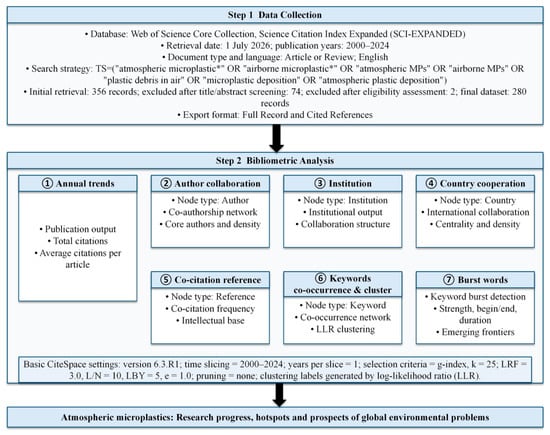
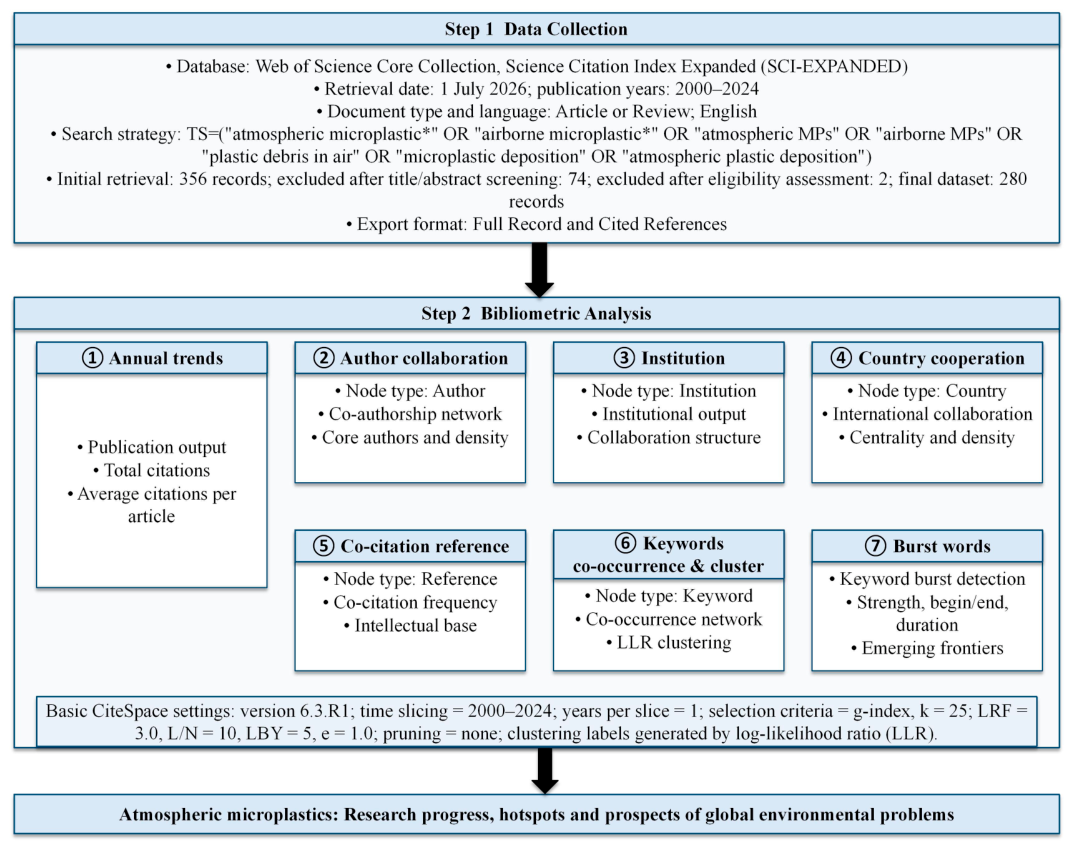
The bibliometric dataset was retrieved from the Science Citation Index Expanded database within the Web of Science Core Collection. The search was conducted on 1 July 2026 to minimize potential discrepancies caused by daily database updates. The search covered publications from 2000 to 2024 and was restricted to peer-reviewed articles and reviews written in English. The final search string was: TS = (“atmospheric microplastic*” OR “airborne microplastic*” OR “atmospheric MPs” OR “airborne MPs” OR “plastic debris in air” OR “microplastic deposition” OR “atmospheric plastic deposition”) AND PY = (2000–2024) AND DT = (Article OR Review) AND LA = (English). This search yielded 356 records.
This study was designed as a bibliometric review supplemented by a narrative synthesis. The literature identification and screening process was reported with reference to the PRISMA 2020 flow diagram to improve transparency. However, no formal risk-of-bias assessment was conducted because the primary aim of this study was to map publication trends, collaboration patterns, knowledge structures, research hotspots, and emerging themes, rather than to evaluate causal effects or intervention outcomes.
To ensure reproducibility, explicit inclusion and exclusion criteria were established. Studies were included if they met all of the following criteria: (1) the study focused on atmospheric microplastics, airborne microplastics, atmospheric deposition or transport of microplastics, or indoor/outdoor airborne exposure to microplastics; (2) the publication was a peer-reviewed article or review; (3) the publication year was between 2000 and 2024; and (4) the publication was written in English. Studies were excluded if they: (1) investigated microplastics only in marine, freshwater, soil, sediment, food, biological, or wastewater environments without a substantive atmospheric component; (2) were duplicate records; (3) were non-academic materials, such as meeting abstracts, editorials, corrections, book chapters, or news items; or (4) were outside the target publication period.
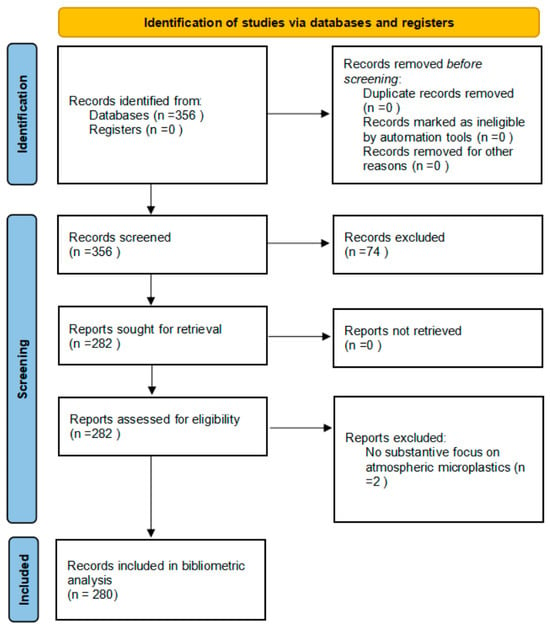
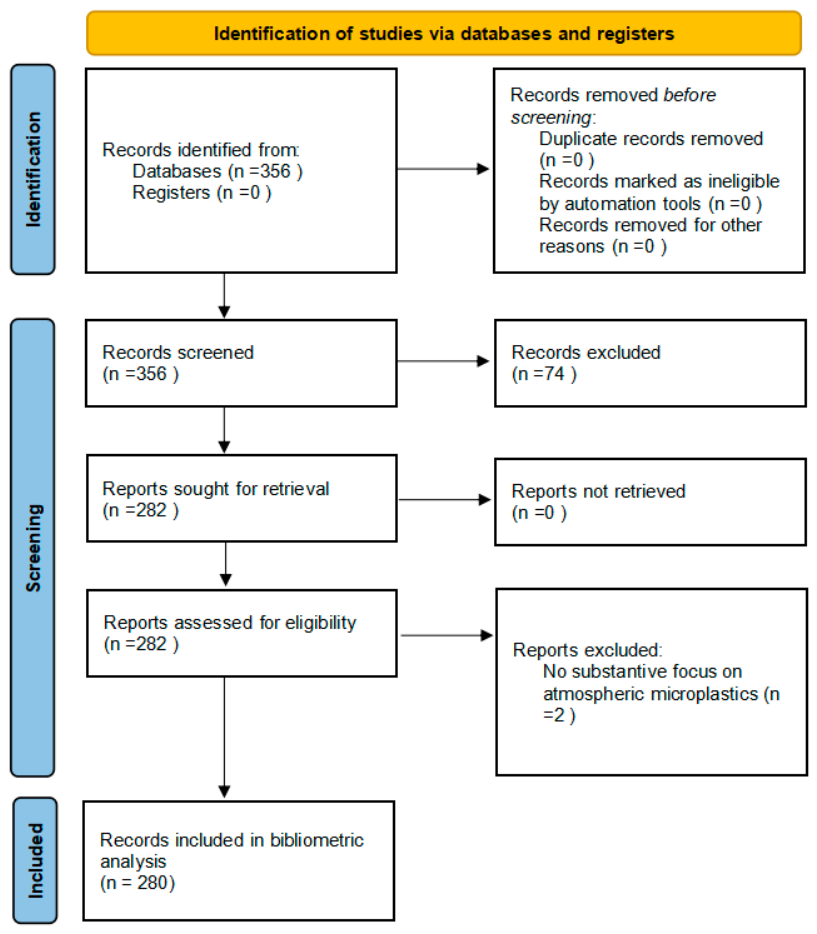
After retrieval, the records were screened according to the predefined inclusion and exclusion criteria. Titles and abstracts were first examined to exclude records that were clearly unrelated to atmospheric microplastics, such as studies focusing solely on marine, freshwater, soil, sediment, food, biological, or wastewater microplastics without a substantive atmospheric component. A total of 74 records were excluded at this stage. The remaining 282 records were further checked for eligibility. During eligibility assessment, two additional records were excluded because they did not provide a substantive focus on atmospheric microplastics. Finally, 280 records were retained for bibliometric analysis. All retained records were used for bibliometric analysis, whereas the narrative synthesis was developed based on the bibliometric results together with representative studies relevant to the identified research themes.
The retrieved records were exported as plain text files in the format of “full record and cited references” for CiteSpace analysis. The overall study selection process, including identification, screening, eligibility assessment, and inclusion, is summarized in the PRISMA-style flow diagram shown in Figure 1.
Figure 1.
PRISMA-style flow diagram of literature identification, screening, eligibility assessment, and inclusion for bibliometric analysis.
2.2. Methods of Data Analysis
The bibliometric analysis was conducted using CiteSpace 6.3.R1. The full records and cited references exported from the Web of Science Core Collection were imported into CiteSpace for visualization and network analysis. The time span was set as 2000–2024, with one year per slice. The selection criterion was g-index with k = 25. The main parameters were set as follows: link retaining factor (LRF) = 3.0, look back years (LBY) = 5, L/N = 10, and e = 1.0. No pruning strategy was applied. For keyword clustering analysis, cluster labels were generated using the log-likelihood ratio (LLR) algorithm.
As shown in Figure 2, the bibliometric analysis included annual publication trends, author collaboration, institutional collaboration, country cooperation, reference co-citation, keyword co-occurrence and clustering, and keyword burst analysis. These analyses were used to describe the temporal development, collaboration structure, intellectual base, research hotspots, thematic clusters, and emerging trends of atmospheric microplastic research. Bibliometric indicators such as publication frequency, citation frequency, centrality, co-occurrence frequency, and burst strength were interpreted as descriptive indicators rather than direct measures of research quality, environmental risk, or confirmed health effects.
Figure 2.
Research framework.
3. Results
3.1. Annual Academic Output and Influence Evolution Trend
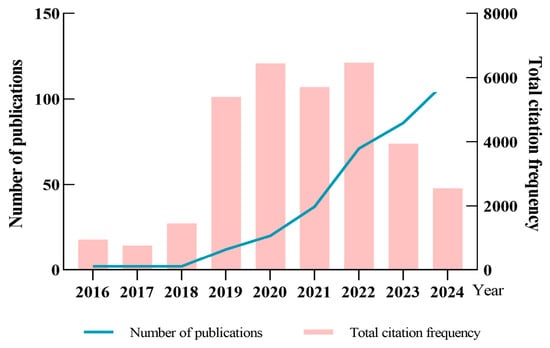
Atmospheric microplastic research expanded rapidly between 2016 and 2024, particularly after 2020, with annual publication output reaching its highest level in the most recent years (Figure 3). This sustained increase indicates growing scientific attention to atmospheric microplastics as an emerging environmental research topic. In contrast, cumulative citation counts did not increase synchronously with publication output. Articles published during the middle years of the study period generally accumulated more citations, whereas publications from 2023 and 2024 showed comparatively lower citation totals. This pattern primarily reflects differences in citation windows, as recently published studies have had less time to be read and cited. Therefore, citation counts should be interpreted together with publication age and should not be regarded as direct indicators of research quality. Overall, Figure 3 demonstrates the rapid expansion of the field while also illustrating the time-dependent nature of citation accumulation.
Figure 3.
Annual publication output and cumulative citation trends in atmospheric microplastic research from 2016 to 2024. The blue line represents the annual number of publications on the left axis, and the pink bars represent the cumulative total citations on the right axis. Citation counts were obtained from the Web of Science Core Collection on 1 July 2026.
3.2. Research Collaboration and Intellectual Structure
Collaboration analyses showed that atmospheric microplastic research has become increasingly international but remains unevenly distributed across a limited number of countries, institutions, and research teams. China contributed the largest number of publications, while the United States, England, Canada, Australia, and several European and Asian countries also played important roles in international cooperation. These results were interpreted as indicators of research activity and collaboration structure rather than direct measures of scientific quality. Detailed author, institutional, and country-level collaboration results are provided in Figures S1 and S2 and Table S1.
Reference co-citation analysis was used to identify the intellectual foundations of the field. The co-citation network showed an acceptable structure and relatively coherent clustering, with a modularity Q value of 0.3995 and a weighted mean silhouette value of 0.7341. The principal co-cited studies established four interconnected research foundations: atmospheric transport and deposition in urban and remote environments [24,25], the occurrence and potential sources of atmospheric microplastics [26,27], analytical methods and methodological standardization [18], and airborne exposure and potential health implications [28]. Together, these foundations indicate that the field has developed from documenting atmospheric occurrence and deposition toward examining transport mechanisms, source attribution, analytical reliability, exposure pathways, and potential environmental and health implications. Detailed co-citation rankings are provided in Table S2.
3.3. Research Hotspots and Trend Analysis
3.3.1. Keyword Analysis
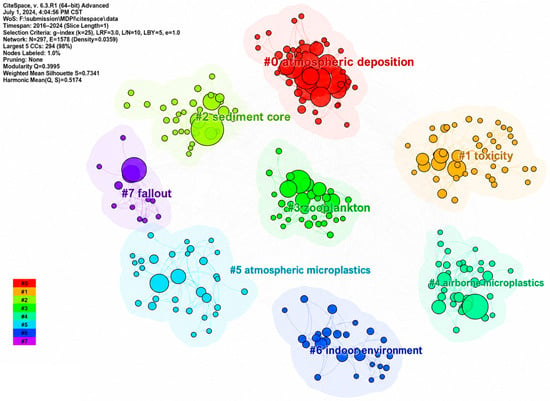
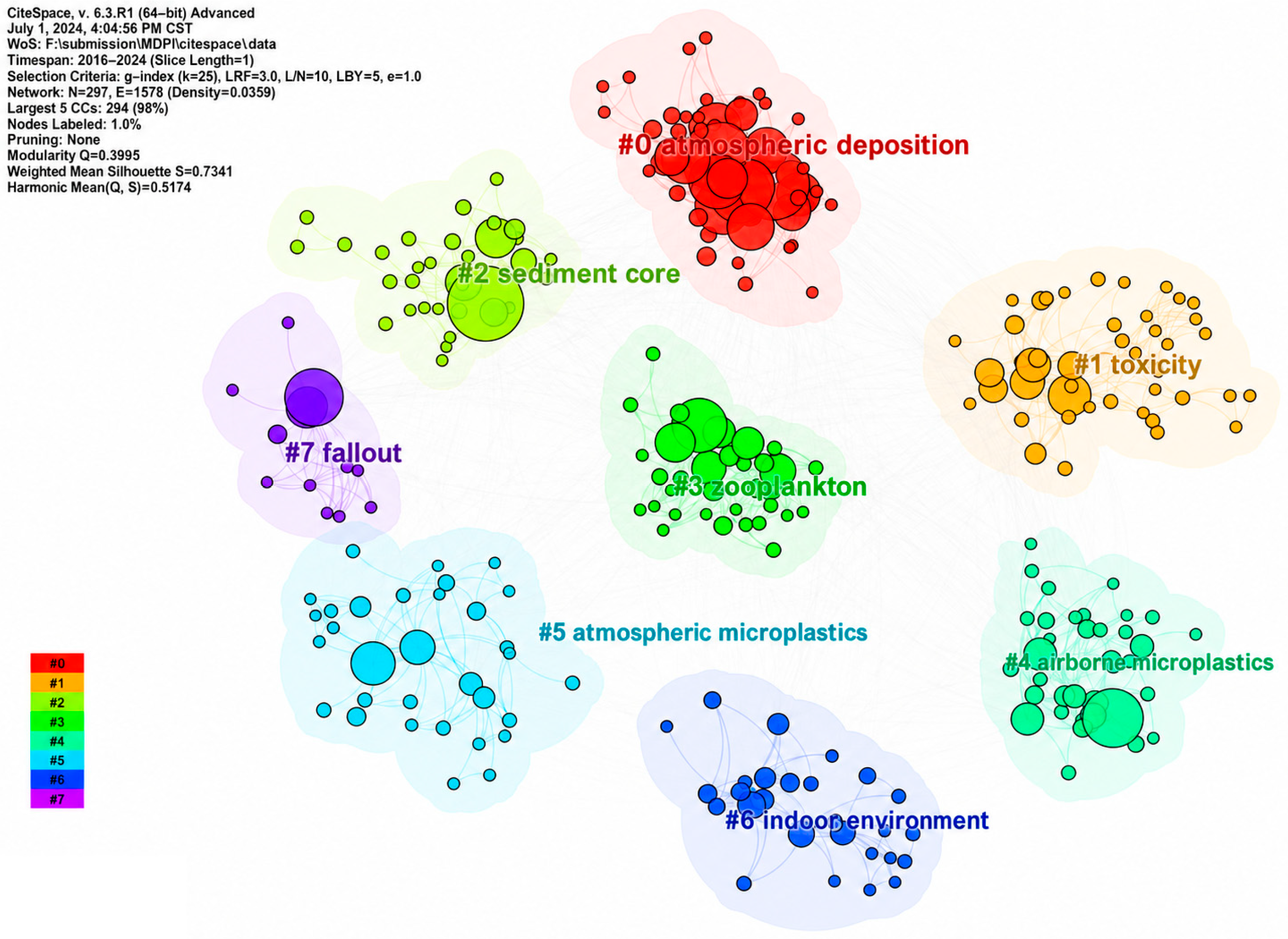
Keyword co-occurrence and clustering analyses were conducted to identify the principal research themes in atmospheric microplastic research. The detailed keyword co-occurrence network and the 20 most frequent keywords are provided in Figure S3 and Table S3, respectively. As shown in Figure 4, the keyword clustering network had a modularity Q value of 0.3995 and a weighted mean silhouette value of 0.7341, indicating an acceptable clustering structure and relatively coherent thematic groupings. A total of 13 clusters were generated, and the eight largest clusters are summarized in Table 1.
Figure 4.
Keyword clustering map of atmospheric microplastic research. Clusters were generated using the log-likelihood ratio algorithm. Different colors represent different keyword clusters, and cluster labels indicate the main thematic terms identified by CiteSpace.
Table 1.
Main research hotspots and keyword clusters in atmospheric microplastic research.
The clustering results identified three principal research themes. The first concerned atmospheric transport and deposition, represented by clusters #0 “atmospheric deposition” and #7 “fallout.” The second focused on exposure and potential health effects, represented mainly by cluster #1 “toxicity” and partly by cluster #4 “airborne microplastics.” The third addressed atmospheric occurrence, analytical identification, and indoor exposure, represented by clusters #4 “airborne microplastics,” #5 “atmospheric microplastics,” and #6 “indoor environment.” Clusters #2 “sediment core” and #3 “zooplankton” reflected peripheral cross-media connections with sedimentary accumulation, marine environments, and biological exposure rather than the core themes of atmospheric microplastic research. These thematic patterns provide the organizational framework for the subsequent critical synthesis.
3.3.2. Progress and Challenges in Key Research Areas
Occurrence, Characteristics, Sources, and Atmospheric Transport
Field observations from remote mountain, marine, and high-altitude environments support the potential for long-range atmospheric transport of microplastics, including transport over distances exceeding 1000 km [24,29,30]. Sea spray and resuspended road dust may act as primary or secondary sources in some remote environments, although their relative contributions remain uncertain. Meteorological conditions further regulate atmospheric transport and removal: stronger winds may enhance particle dispersion, whereas precipitation generally promotes deposition [31]. These findings indicate that observed spatial patterns are jointly influenced by source strength, meteorological conditions, and particle properties rather than by geographic distance alone.
Recent observational and modelling studies further indicate that atmospheric transport cannot be explained by meteorological conditions alone, because particle morphology and model parameterization also strongly influence predicted transport and deposition. By combining deposition measurements with inverse and dispersion modelling, Evangeliou et al. estimated source-specific emissions and atmospheric redistribution of microplastics, but model validation indicated that particle removal and deposition processes remain insufficiently constrained [32]. Hemispheric observations from East Asia to Antarctica further showed that fibers were transported more efficiently than fragments, suggesting that morphology is a major determinant of long-range transport [7]. Although air-mass backward trajectories can help identify potential transport pathways and source regions, they reconstruct air-mass histories rather than quantitatively separating individual source contributions [7]. Laboratory experiments provide a physical explanation for these observations: the settling velocities of microplastic fibers were up to 76% lower than those of volume-equivalent spheres, and incorporating shape-corrected settling velocities substantially increased their simulated horizontal and vertical transport [8].
These findings demonstrate that neither atmospheric modelling nor particle characteristics alone can provide definitive source attribution. Reliable source apportionment therefore requires convergence among multiple independent lines of evidence. Polymer composition and additive profiles may help link particles to candidate source materials [33,34], whereas morphology, size, color, and weathering characteristics provide information on emission, fragmentation, and environmental transformation processes. Meteorological observations and air-mass trajectories can identify plausible transport pathways, while dispersion or inverse models can evaluate atmospheric redistribution, and local or regional emission inventories can constrain the locations and relative strengths of potential sources [35]. However, common polymers such as PE, PET, PP, and PS are used in diverse consumer, textile, construction, traffic-related, and industrial products and therefore cannot be treated as source-specific tracers [17,18,19,20], backward trajectories identify potential pathways rather than quantitative source contributions [7], and model estimates remain sensitive to uncertainties in particle settling, resuspension, and wet and dry removal [8,32]. Attribution confidence should therefore increase only when polymer and additive signatures, particle characteristics, meteorological evidence, modelling results, and source inventories are mutually consistent. Disagreement among these lines of evidence should be explicitly reported as source-attribution uncertainty.
Indoor and outdoor atmospheric microplastics may differ substantially in abundance, morphology, and polymer composition. Amato-Lourenço et al. (2022) studied the atmospheric microplastic deposition in indoor and outdoor environments in Sao Paulo, Brazil, and found that the average settlement rate in indoor environments was 309.40 ± 214.71 items/m2/day, while the average settlement rate in outdoor environments was 123.20 ± 47.09 items/m2/day [36]. The study also showed differences in dominant polymer types and morphological characteristics between indoor and outdoor environments. Many studies have reported higher atmospheric microplastic abundances indoors than outdoors, with fibers frequently dominating indoor samples and fragments accounting for a larger proportion in some outdoor environments. However, the magnitude and consistency of these patterns vary with building characteristics, occupant activities, ventilation, local sources, and sampling strategies. Polyester, polyethylene (PE) and polypropylene (PP) are the predominant polymer types indoors, whereas polyester, PE and polyethylene terephthalate (PET) represent the most frequently detected polymers in outdoor atmospheric samples [37]. Across studies, reported differences in atmospheric microplastic abundance, morphology, and polymer composition reflect both genuine environmental heterogeneity and method-dependent observation. Source intensity, ventilation, particle resuspension, meteorological conditions, and topography influence the particles present in a given environment, whereas sampler design, sampling duration, lower size cut-off, filter characteristics, pretreatment, blank correction, and polymer-confirmation criteria determine the fraction that is ultimately detected. These methodological filters may preferentially retain or exclude particular particle sizes and morphologies, thereby altering the apparent dominance of fibers, indoor–outdoor contrasts, and regional patterns. Consequently, environmental differences should not be inferred solely from reported numerical concentrations. Meaningful comparisons require studies to be evaluated according to sampling process, reporting unit, particle-size range, and QA/QC performance.
Sampling, Analytical Identification, and Quality Assurance
Reliable characterization of atmospheric microplastics depends on the combined performance of sampling, pretreatment, particle identification, and quality assurance. Sampling strategy is particularly important because active and passive methods target different atmospheric processes and produce fundamentally different measurements.
Active sampling uses pump-based devices to collect suspended airborne particles onto filters and usually reports particle number per unit air volume, such as items/m3 [28,38]. It is suitable for short-term monitoring, indoor and outdoor exposure assessment, and size-selective sampling of particulate matter. However, the measured particle population may be influenced by inlet geometry, flow rate, sampling duration, filter pore size, and the aerodynamic behavior of fibers and irregular particles. Consequently, large fibers may be inefficiently collected by some size-selective inlets, whereas particles below the analytical detection limit may remain unreported.
Passive sampling collects particles deposited over a defined surface area and period, with results generally expressed as deposition flux, such as items/m2/day [24,39]. It is simple, inexpensive, and suitable for long-term monitoring in remote or high-altitude environments. Nevertheless, the measured flux can be affected by collector design, wind, precipitation, resuspension, post-depositional loss, and contamination during extended exposure. Passive sampling therefore does not directly represent the concentration of suspended microplastics in air.
Because active sampling measures airborne concentration whereas passive sampling measures deposition flux, results obtained using the two approaches should not be treated as interchangeable or directly converted. Cross-study comparisons should consider the sampled atmospheric fraction, sampling duration, air volume or collector area, meteorological conditions, particle-size threshold, and contamination-control procedures. The main methodological differences between the two approaches are summarized in Table 2.
Table 2.
Comparison of active and passive sampling methods for atmospheric microplastics.
After sampling, pretreatment should be adapted to the sample matrix and analytical objective rather than applied as a uniform procedure. Filters containing relatively low particle and organic-matter loads may be analyzed directly or subjected only to gentle rinsing and filtration, thereby reducing particle loss and additional contamination. In contrast, deposition samples containing abundant organic matter, mineral dust, or biological material may require digestion or density separation before polymer identification.
Oxidative digestion with hydrogen peroxide or Fenton reagent is commonly used to remove organic matter, although excessive reaction temperature or duration may alter particle morphology or damage susceptible polymers [40,41,42]. Acid or alkaline digestion can remove specific biological or inorganic matrices, but strong reagents may affect polymer stability [40,42,43]. Enzymatic digestion generally preserves polymer integrity more effectively, but it is comparatively costly and time-consuming [42,43]. Density separation is particularly relevant to dust-rich or deposition samples, although recovery depends on the density of the separation solution and the polymers present [42,44]. Each additional digestion, transfer, or filtration step may also cause particle loss or introduce contamination. Therefore, pretreatment should be minimized where possible and selected according to matrix complexity, target particle size, expected polymer composition, and the subsequent analytical technique.
The identification of atmospheric microplastics should distinguish morphological screening from chemical confirmation. Visual microscopy is useful for recording particle number, size, shape, and color, but it is subjective and may lead to false-positive identification, particularly for transparent fragments and natural or semi-synthetic fibers [45,46]. Therefore, visual criteria should be used for preliminary screening rather than as the sole basis for identifying microplastics. SEM provides high-resolution information on surface morphology, weathering, cracks, and particle–matrix interactions [28], but it cannot independently confirm polymer composition and should be combined with spectroscopic or thermal methods.
Vibrational spectroscopic techniques provide particle-level polymer identification while retaining information on particle number, size, and morphology. Micro-FTIR and FTIR imaging are widely used to identify common atmospheric polymers and can analyze many particles across a filter surface [42,43,47]. However, their performance is affected by particle size, filter material, surface contamination, spectral overlap, and library-matching criteria. Conventional micro-FTIR generally has limited sensitivity for particles below approximately 10–20 μm. Raman microscopy can analyze smaller particles and offers higher spatial resolution, but fluorescence from pigments, weathered surfaces, additives, and organic residues may obscure polymer spectra, while mapping large sample areas can be time-consuming [42,43,48]. Automated spectral mapping and computer-assisted classification can improve analytical throughput, although their accuracy remains dependent on spectral libraries, preprocessing procedures, classification algorithms, and manual validation [49].
Thermal methods provide complementary mass-based information. Py-GC/MS identifies and quantifies polymers through characteristic thermal-decomposition products and is less constrained by particle size or fluorescence interference [50]. Thermal desorption or thermo-extraction–desorption GC/MS can additionally characterize volatile additives and other thermally released compounds [51]. However, these methods are destructive and generally provide polymer mass rather than particle number, morphology, or size. Consequently, particle-number concentrations obtained by FTIR or Raman imaging and polymer-mass concentrations obtained by thermal analysis should not be treated as directly interchangeable. Combining particle-based spectroscopy with mass-based thermal analysis can provide a more complete characterization [52], but the analytical method should ultimately be selected according to the target particle size, sample matrix, required reporting unit, and study objective.
Nanoplastics require separate consideration because the lower size limits of analytical methods directly determine the fraction of atmospheric plastic particles that can be observed. Particle-resolved μ-FTIR generally does not resolve the nanoscale fraction, whereas conventional Raman mapping, despite its higher spatial resolution, remains constrained by weak signals, fluorescence interference, long acquisition times, and increasing contamination risks at small particle sizes [42,43,48]. Surface-enhanced Raman spectroscopy has enabled the identification of individual plastic particles below 1 μm [53], while thermal-desorption-based mass spectrometry has been applied to polymer-specific detection and semiquantification in Alpine snow and urban PM2.5 samples [54,55]. Fractional aerosol sampling coupled with Py-GC/MS has further enabled size-resolved quantification of airborne plastic particles down to 0.43 μm [56], and bioaerosol single-particle mass spectrometry has demonstrated real-time identification of polystyrene micro–nanoplastics in urban aerosols [57]. However, these methods are not directly equivalent: particle-based techniques retain information on individual particles but may be selective or throughput-limited, whereas mass-based thermal methods quantify polymer mass without preserving particle number, morphology, or size [50,51,52]. Consequently, existing atmospheric monitoring and inhalation-exposure estimates may represent only the analytically accessible fraction of the total micro- and nanoplastic population [11,55,56]. Failure to capture the smallest particles may bias reported size distributions and underestimate their potential contributions to atmospheric transport and respiratory exposure [11,57]. Studies should therefore report the lower size cut-off, method-specific detection and recovery limits, and explicitly acknowledge the unmeasured nanoscale fraction [13,15,56].
Quality assurance and contamination control should be implemented throughout field sampling, sample transport, pretreatment, and instrumental analysis. Field blanks should accompany sampling campaigns to assess contamination introduced during sampler deployment, retrieval, and transportation, whereas procedural blanks should undergo the same digestion, filtration, transfer, and identification steps as environmental samples. Laboratory airborne blanks may also be necessary when samples are exposed during filtration, microscopic observation, or particle transfer. Contamination should be minimized through the use of cleaned or non-plastic equipment, covered sample containers, filtered reagents, and controlled laboratory procedures. Recovery experiments using reference particles should be conducted where possible to evaluate particle loss during digestion, separation, and filtration. At small microplastic and nanoplastic size scales, background contamination from laboratory air, consumables, reagents, and laboratory infrastructure becomes increasingly important and may substantially affect data interpretation [13].
Blank results should not be corrected using an arbitrary subtraction procedure. Dawson et al. compared 51 control and blank correction approaches and found that only a small proportion produced suitable results, with approaches based on limits of detection and quantification showing comparatively reliable performance [14,15]. Therefore, studies should explicitly report the type and number of blanks, blank particle counts and characteristics, the blank-correction procedure, recovery results, detection and quantification limits, and both raw and corrected concentrations. For spectroscopic identification, the spectral library, matching threshold, manual validation procedure, and proportion of particles chemically confirmed should also be reported. Harmonized reporting across sampling, sample preparation, quality assurance, polymer identification, and quantification is essential for improving the reproducibility and comparability of atmospheric microplastic studies [13,14].
Overall, no single sampling or analytical method can fully characterize atmospheric microplastics across the complete range of particle sizes, morphologies, and polymer types. Reliable assessment therefore requires method selection according to the target atmospheric process and research objective, together with complementary particle-based and mass-based analyses where appropriate. Standardized contamination control, blank correction, recovery assessment, and transparent reporting are equally important because methodological differences can substantially influence reported abundance, polymer composition, and particle-size distributions. Improving methodological consistency is therefore a prerequisite for robust comparisons among studies and for subsequent assessments of environmental exposure and potential health risks.
Potential Ecological and Health Risks of Atmospheric Microplastics
Atmospheric microplastics may have environmental implications through two main pathways: deposition into terrestrial and aquatic environments and direct inhalation exposure. However, evidence of atmospheric occurrence or exposure should be distinguished from evidence of adverse effects. The detection of microplastics in air, deposition samples, or biological tissues demonstrates environmental transfer and exposure plausibility, but does not by itself establish ecological damage or human disease. Therefore, the available evidence should be evaluated according to the environmental compartment, exposure route, particle size, dose, and type of experimental model.
Through dry and wet deposition, atmospheric microplastics can transfer plastic particles from the atmosphere to soils, surface waters, vegetation, and other environmental receptors [17]. Environmental microplastics may contain plastic additives, sorb organic contaminants, and provide surfaces for microbial colonization [58,59,60,61]. Nevertheless, the environmental significance of this carrier effect depends on the concentration and bioavailability of the associated substances, their desorption under relevant environmental or biological conditions, and the exposure received by organisms. Theoretical studies have suggested that PET microplastics and nanoplastics may interact with gaseous pollutants under specific conditions [62], but direct evidence demonstrating the importance of these interactions in the ambient atmosphere remains limited. Similarly, size-dependent toxicity and trophic transfer have been reported in aquatic organisms [63,64], but these findings arise from non-atmospheric exposure scenarios and cannot be directly extrapolated to atmospheric deposition or inhalation. Thus, current evidence supports the possibility of cross-media transport and ecological exposure, whereas the magnitude of ecological effects caused specifically by atmospheric microplastics remains uncertain.
Evidence of human respiratory exposure has increased in recent years. Microplastics have been detected in human lung tissue using Raman spectroscopy and micro-FTIR, while plastic particles have also been identified in sputum and nasal lavage fluid from indoor and outdoor workers [65,66]. These observations support inhalation as a plausible exposure pathway and indicate that some particles can deposit in the upper or lower respiratory tract. However, the detection of particles in respiratory samples does not establish their source, duration of retention, biological activity, or causal relationship with respiratory disease. Differences in tissue digestion, particle-size detection limits, contamination correction, and polymer-confirmation methods should also be considered when interpreting these findings.
Experimental studies have reported oxidative stress, inflammatory responses, and tissue injury following exposure to microplastics or nanoplastics [67,68,69]. More broadly, studies of inhaled environmental particles have identified airway inflammation and altered cellular or smooth-muscle responses as biologically relevant mechanisms [70,71].
However, many experiments use monodisperse spherical particles, a limited range of polymers, nanoplastics rather than environmentally dominant microplastic fibers, and doses that may exceed those measured in ambient air. These experimental conditions facilitate mechanistic investigation but limit direct extrapolation to environmentally relevant inhalation exposure. Evidence from occupational settings should also be interpreted separately because workers may experience higher concentrations, longer exposure durations, and simultaneous exposure to plastic additives, dust, and other co-pollutants.
Overall, current evidence supports the occurrence of inhalation exposure and the biological plausibility of respiratory effects, but remains insufficient to quantify population-level health risks associated with ambient atmospheric microplastics. Major uncertainties include actual inhaled dose, deposition and clearance in different regions of the respiratory tract, differences between microplastics and nanoplastics, the relative contributions of particle properties and associated chemicals, and long-term dose–response relationships. Standardized personal-exposure measurements, exposure-relevant toxicological studies, and well-designed epidemiological investigations are therefore required before causal associations with specific respiratory diseases can be established [11].
3.3.3. Frontier Analysis of Atmospheric Microplastics
As shown in Table 3, the strongest burst keywords included accumulation, plastic debris, sea, plastics, marine environment, coastal, synthetic fibers, atmospheric fallout, environmental samples, and health risk. Among these terms, accumulation showed the highest burst strength of 3.23, followed by health risk at 2.84, synthetic fibers at 2.15, and plastic debris at 2.11. Their temporal distribution indicates a gradual transition from broad concerns about plastic accumulation and marine pollution toward more atmosphere-specific questions involving particle morphology, deposition processes, analytical methods, and potential health implications.
Table 3.
The top 10 keywords with the strongest citation bursts.
During the early stage from 2016 to 2020, the bursts of accumulation, plastic debris, sea, marine environment, and coastal showed that atmospheric microplastic research remained closely connected to the broader field of marine plastic pollution. Early studies mainly sought to confirm the occurrence and environmental accumulation of microplastics and to understand the role of atmospheric transport in linking marine and terrestrial environments. From 2020 onward, the emergence of synthetic fibers, atmospheric fallout, and environmental samples reflected increasing attention to the dominant morphologies of airborne microplastics, their dry and wet deposition, and the reliability of environmental sampling and identification methods. The later burst of health risk indicated growing concern regarding inhalation exposure and possible biological effects. However, this development represents an expansion of research attention rather than confirmation of causal relationships between ambient atmospheric microplastic exposure and specific diseases.
Keyword burst analysis was conducted to identify temporal shifts in research attention. As shown in Table 3, early burst terms, including “accumulation,” “plastic debris,” “sea,” “marine environment,” and “coastal,” reflected the close connection between early atmospheric microplastic studies and the broader field of marine plastic pollution. Since 2020, the emergence of “synthetic fibers,” “atmospheric fallout,” “environmental samples,” and “health risk” has indicated increasing attention to particle morphology, atmospheric deposition, analytical reliability, and inhalation exposure.
Overall, the burst results suggest a shift from documenting the occurrence and accumulation of atmospheric microplastics toward examining transport processes, methodological reliability, and potential exposure implications. These terms represent changes in research emphasis rather than confirmation of environmental or health effects.
4. Discussion
This study combined bibliometric mapping with a critical narrative synthesis to examine the development and current scientific status of atmospheric microplastic research. The bibliometric results identified a transition from broad concerns regarding plastic accumulation and marine pollution toward atmospheric transport, particle morphology, analytical methods, and potential exposure effects. However, the scientific synthesis indicates that the rapid growth in publication output has not been accompanied by equivalent progress in data comparability, quantitative source attribution, or exposure–effect assessment. The principal challenge is therefore no longer simply documenting the occurrence of atmospheric microplastics, but determining whether reported spatial and temporal patterns reflect genuine environmental variability or differences in sampling, pretreatment, particle-size detection, contamination correction, and polymer identification.
Three cross-cutting uncertainties emerge from the available evidence. First, atmospheric transport is supported by observations in urban, marine, polar, and high-altitude environments, but quantitative source contributions remain difficult to resolve because several sources produce overlapping particle morphologies and polymer profiles. Second, active concentration measurements, passive deposition fluxes, particle-based spectroscopy, and mass-based thermal analyses describe different aspects of atmospheric microplastics and should not be treated as directly interchangeable. Third, evidence of respiratory exposure and experimental biological responses supports exposure plausibility and potential hazard, but remains insufficient to establish population-level risks under ambient conditions. These uncertainties demonstrate why bibliometric attention to transport, analytical methods, and health-related terms should not be equated with equivalent levels of scientific certainty.
The value of the bibliometric component therefore lies primarily in identifying the thematic structure and temporal evolution of the field, rather than in ranking authors, institutions, or countries. Co-citation, clustering, and burst patterns provided a framework for organizing the critical synthesis, but they should not be interpreted as indicators of the strength of environmental, toxicological, or epidemiological evidence.
This study has several limitations. First, the bibliometric dataset was obtained only from the Science Citation Index Expanded database within the Web of Science Core Collection and was restricted to English-language articles and reviews; relevant studies indexed elsewhere or published in other languages may therefore have been omitted. Second, citation-based indicators are affected by publication age, database coverage, author keyword selection, and keyword standardization. Third, although the narrative synthesis incorporated representative and recent studies related to the identified themes, it was not designed as a formal systematic review with study-level risk-of-bias assessment or meta-analysis. Differences in sampling processes, reporting units, particle-size ranges, and analytical confirmation also prevented quantitative synthesis across studies. Consequently, the results should be interpreted as an integrated bibliometric and critical narrative overview rather than a definitive quantitative assessment of atmospheric microplastic occurrence, exposure, or risk.
Supplementary Materials
The following supporting information can be downloaded at: https://www.mdpi.com/article/10.3390/microplastics5030164/s1, Figure S1: Author collaboration network in atmospheric microplastic research. Each node represents an author, and the node size reflects the number of publications. The links between nodes indicate co-authorship relationships, and thicker links represent stronger collaboration. Only the most influential author labels are displayed to improve readability; Figure S2: Country collaboration network in atmospheric microplastic research. Each node represents a country or region, and the node size reflects the number of publications. Links between nodes indicate international collaboration, and thicker links represent stronger collaboration relationships. Only major country or region labels are displayed to improve readability; Figure S3: Keyword co-occurrence network in atmospheric microplastic research. Each node represents a keyword, and node size reflects keyword frequency. Links between nodes indicate co-occurrence relationships, and thicker links represent stronger associations between keywords; Table S1: List of the top ten scientific research institutions in the number of papers published on atmospheric microplastics; Table S2: List of frequently cited literature in the field of atmospheric microplastics; Table S3: High-frequency keywords in the keyword co-occurrence network. File S1: PRISMA 2020 Checklist [72].
Author Contributions
Conceptualization, S.X. and L.Y.; methodology, N.Z. and S.L.; formal analysis, A.W.; data curation, A.W.; software, A.W.; visualization, A.W.; investigation, N.Z.; resources, N.Z., S.L. and L.Y.; supervision, S.X. and L.Y.; project administration, S.X.; funding acquisition, S.X.; writing—original draft preparation, S.X. and A.W.; writing—review and editing, S.X. and A.W. All authors have read and agreed to the published version of the manuscript.
Funding
This work was supported by the National Natural Science Foundation of China (No. 42171158, 41771220), the Key Research and Development Program of Shaanxi Province (No. 2021SF-435S), and the Open Research Fund Project of the Key Laboratory of Ecological Environment and Meteorology of Qinling Mountains and Loess Plateau of China Meteorological Administration (2021G-10).
Institutional Review Board Statement
Not applicable. This study did not involve humans or animals.
Informed Consent Statement
Not applicable.
Data Availability Statement
The bibliometric data used in this study were retrieved from the Science Citation Index Expanded database within the Web of Science Core Collection. The search strategy, retrieval date, document-type and language restrictions, inclusion and exclusion criteria, and screening procedure are described in Section 2.1. The processed bibliometric dataset can be made available from the corresponding author upon reasonable request, subject to Web of Science database licensing restrictions.
Conflicts of Interest
The authors declare that they have no known competing financial interests or personal relationships that could have appeared to influence the work reported in this paper.
Abbreviations
The following abbreviations are used in this manuscript:
| DT | Document type |
| FTIR | Fourier-transform infrared spectroscopy |
| GC/MS | Gas chromatography/mass spectrometry |
| H2O2 | Hydrogen Peroxide |
| LA | Language |
| LBY | Look back years |
| LLR | Log-likelihood Ratio |
| L/N | Links per node |
| LOD | Limit of detection |
| LOQ | Limit of quantification |
| LRF | Link retaining factor |
| MP | Microplastic |
| MPs | Microplastics |
| PE | Polyethylene |
| PET | Polyethylene Terephthalate |
| PP | Polypropylene |
| PS | Polystyrene |
| PRISMA | Preferred Reporting Items for Systematic Reviews and Meta-Analyses |
| PY | Publication year |
| Py-GC/MS | Pyrolysis Gas Chromatography-Mass Spectrometry |
| QA/QC | Quality assurance and quality control |
| SCI-EXPANDED | Science Citation Index Expanded |
| SEM | Scanning Electron Microscope |
| TS | Topic Search |
| WoS | Web of Science |
References
- Thompson, R.C.; Olsen, Y.; Mitchell, R.P.; Davis, A.; Rowland, S.J.; John, A.W.G.; McGonigle, D.; Russell, A.E. Lost at sea: Where is all the plastic? Science 2004, 304, 838. [Google Scholar] [CrossRef] [Scilit]
- Andrady, A.L. Microplastics in the marine environment. Mar. Pollut. Bull. 2011, 62, 1596–1605. [Google Scholar] [CrossRef] [Scilit] [PubMed]
- Shao, L.; Li, Y.; Jones, T.; Santosh, M.; Liu, P.; Zhang, M.; Xu, L.; Li, W.; Lu, J.; Yang, C.-X. Airborne microplastics: A review of current perspectives and environmental implications. J. Clean. Prod. 2022, 347, 131048. [Google Scholar] [CrossRef] [Scilit]
- Welsh, B.; Aherne, J.; Paterson, A.M.; Yao, H.; McConnell, C. Atmospheric deposition of anthropogenic particles and microplastics in south-central Ontario, Canada. Sci. Total Environ. 2022, 835, 155426. [Google Scholar] [CrossRef] [Scilit] [PubMed]
- Kernchen, S.; Loder, M.G.J.; Fischer, F.; Fischer, D.; Moses, S.R.; Georgi, C.; Nolscher, A.C.; Held, A.; Laforsch, C. Airborne microplastic concentrations and deposition across the weser river catchment. Sci. Total Environ. 2022, 818, 151812. [Google Scholar] [CrossRef] [Scilit] [PubMed]
- Munyaneza, J.; Jia, Q.; Qaraah, F.A.; Hossain, M.F.; Wu, C.; Zhen, H.; Xiu, G. A review of atmospheric microplastics pollution: In-depth sighting of sources, analytical methods, physiognomies, transport and risks. Sci. Total Environ. 2022, 822, 153339. [Google Scholar] [CrossRef] [Scilit] [PubMed]
- Chen, Q.; Shi, G.; Revell, L.E.; Zhang, J.; Zuo, C.; Wang, D.; Le Ru, E.C.; Wu, G.; Mitrano, D.M. Long-range atmospheric transport of microplastics across the southern hemisphere. Nat. Commun. 2023, 14, 7898. [Google Scholar] [CrossRef] [Scilit] [PubMed]
- Tatsii, D.; Bucci, S.; Bhowmick, T.; Guettler, J.; Bakels, L.; Bagheri, G.; Stohl, A. Shape matters: Long-range transport of microplastic fibers in the atmosphere. Environ. Sci. Technol. 2024, 58, 671–682. [Google Scholar] [CrossRef] [Scilit] [PubMed]
- Seijo, M.; Whelan, M.J.; Gouin, T.; Praetorius, A. Particle properties and environmental factors control atmospheric transport and deposition of micro- and nanoplastics. Commun. Earth Environ. 2025, 6, 975. [Google Scholar] [CrossRef] [Scilit]
- Jenner, L.C.; Rotchell, J.M.; Bennett, R.T.; Cowen, M.; Tentzeris, V.; Sadofsky, L.R. Detection of microplastics in human lung tissue using mftir spectroscopy. Sci. Total Environ. 2022, 831, 154907. [Google Scholar] [CrossRef] [Scilit] [PubMed]
- Eberhard, T.; Casillas, G.; Zarus, G.M.; Barr, D.B. Systematic review of microplastics and nanoplastics in indoor and outdoor air: Identifying a framework and data needs for quantifying human inhalation exposures. J. Expo. Sci. Environ. Epidemiol. 2024, 34, 185–196. [Google Scholar] [CrossRef] [Scilit] [PubMed]
- Mbachu, O.; Jenkins, G.; Pratt, C.; Kaparaju, P. A new contaminant superhighway? A review of sources, measurement techniques and fate of atmospheric microplastics. Water Air Soil Pollut. 2020, 231, 85. [Google Scholar] [CrossRef] [Scilit]
- Cowger, W.; Booth, A.M.; Hamilton, B.M.; Thaysen, C.; Primpke, S.; Munno, K.; Lusher, A.L.; Dehaut, A.; Vaz, V.P.; Liboiron, M.; et al. Reporting guidelines to increase the reproducibility and comparability of research on microplastics. Appl. Spectrosc. 2020, 74, 1066–1077. [Google Scholar] [CrossRef] [Scilit] [PubMed]
- Dawson, A.L.; Santana, M.F.M.; Nelis, J.L.D.; Motti, C.A. Taking control of microplastics data: A comparison of control and blank data correction methods. J. Hazard. Mater. 2023, 443, 130218. [Google Scholar] [CrossRef] [Scilit] [PubMed]
- Aslam, I.; Roeffaers, M.B.J. Contamination control in micro- and nanoplastics research: A diagnostic framework for reproducible analysis. Environ. Sci. Nano 2026, 13, 1249–1254. [Google Scholar] [CrossRef] [Scilit]
- Song, Y.K.; Hong, S.H.; Jang, M.; Han, G.M.; Jung, S.W.; Shim, W.J. Combined effects of uv exposure duration and mechanical abrasion on microplastic fragmentation by polymer type. Environ. Sci. Technol. 2017, 51, 4368–4376. [Google Scholar] [CrossRef] [Scilit] [PubMed]
- Enyoh, C.E.; Verla, A.W.; Verla, E.N.; Ibe, F.C.; Amaobi, C.E. Airborne microplastics: A review study on method for analysis, occurrence, movement and risks. Environ. Monit. Assess. 2019, 191, 668. [Google Scholar] [CrossRef] [Scilit] [PubMed]
- Zhang, Y.; Kang, S.; Allen, S.; Allen, D.; Gao, T.; Sillanpaa, M. Atmospheric microplastics: A review on current status and perspectives. Earth-Sci. Rev. 2020, 203, 103118. [Google Scholar] [CrossRef] [Scilit]
- Huang, Y.; Qing, X.; Wang, W.; Han, G.; Wang, J. Mini-review on current studies of airborne microplastics: Analytical methods, occurrence, sources, fate and potential risk to human beings. Trac-Trends Anal. Chem. 2020, 125, 115821. [Google Scholar] [CrossRef] [Scilit]
- Chen, G.; Fu, Z.; Yang, H.; Wang, J. An overview of analytical methods for detecting microplastics in the atmosphere. Trac-Trends Anal. Chem. 2020, 130, 115981. [Google Scholar] [CrossRef] [Scilit]
- Liu, K.; Wu, T.; Wang, X.; Song, Z.; Zong, C.; Wei, N.; Li, D. Consistent transport of terrestrial microplastics to the ocean through atmosphere. Environ. Sci. Technol. 2019, 53, 10612–10619. [Google Scholar] [CrossRef] [Scilit] [PubMed]
- Song, Z.; Liu, K.; Wang, X.; Wei, N.; Zong, C.; Li, C.; Jiang, C.; He, Y.; Li, D. To what extent are we really free from airborne microplastics? Sci. Total Environ. 2021, 754, 142118. [Google Scholar] [CrossRef] [Scilit] [PubMed]
- Chen, G.; Feng, Q.; Wang, J. Mini-review of microplastics in the atmosphere and their risks to humans. Sci. Total Environ. 2020, 703, 135504. [Google Scholar] [CrossRef] [Scilit] [PubMed]
- Allen, S.; Allen, D.; Phoenix, V.R.; Le Roux, G.; Jimenez, P.D.; Simonneau, A.; Binet, S.; Galop, D. Atmospheric transport and deposition of microplastics in a remote mountain catchment. Nat. Geosci. 2019, 12, 339–344. [Google Scholar] [CrossRef] [Scilit]
- Wright, S.L.; Ulke, J.; Font, A.; Chan, K.L.A.; Kelly, F.J. Atmospheric microplastic deposition in an urban environment and an evaluation of transport. Environ. Int. 2020, 136, 105411. [Google Scholar] [CrossRef] [Scilit] [PubMed]
- Liu, K.; Wang, X.; Fang, T.; Xu, P.; Zhu, L.; Li, D. Source and potential risk assessment of suspended atmospheric microplastics in shanghai. Sci. Total Environ. 2019, 675, 462–471. [Google Scholar] [CrossRef] [Scilit] [PubMed]
- Klein, M.; Fischer, E.K. Microplastic abundance in atmospheric deposition within the metropolitan area of Hamburg, Germany. Sci. Total Environ. 2019, 685, 96–103. [Google Scholar] [CrossRef] [Scilit] [PubMed]
- Abbasi, S.; Keshavarzi, B.; Moore, F.; Turner, A.; Kelly, F.J.; Dominguez, A.O.; Jaafarzadeh, N. Distribution and potential health impacts of microplastics and microrubbers in air and street dusts from Asaluyeh County, Iran. Environ. Pollut. 2019, 244, 153–164. [Google Scholar] [CrossRef] [Scilit] [PubMed]
- Gonzalez-Pleiter, M.; Edo, C.; Aguilera, A.; Viudez-Moreiras, D.; Pulido-Reyes, G.; Gonzalez-Toril, E.; Osuna, S.; De Diego-Castilla, G.; Leganes, F.; Fernandez-Pinas, F.; et al. Occurrence and transport of microplastics sampled within and above the planetary boundary layer. Sci. Total Environ. 2021, 761, 143213. [Google Scholar] [CrossRef] [Scilit] [PubMed]
- Aves, A.; Ruffell, H.; Evangeliou, N.; Gaw, S.; Revell, L.E. Modelled sources of airborne microplastics collected at a remote southern hemisphere site. Atmos. Environ. 2024, 325, 120437. [Google Scholar] [CrossRef] [Scilit]
- Huang, Y.; He, T.; Yan, M.; Yang, L.; Gong, H.; Wang, W.; Qing, X.; Wang, J. Atmospheric transport and deposition of microplastics in a subtropical urban environment. J. Hazard. Mater. 2021, 416, 126168. [Google Scholar] [CrossRef] [Scilit] [PubMed]
- Evangeliou, N.; Tichy, O.; Eckhardt, S.; Zwaaftink, C.G.; Brahney, J. Sources and fate of atmospheric microplastics revealed from inverse and dispersion modelling: From global emissions to deposition. J. Hazard. Mater. 2022, 432, 128585. [Google Scholar] [CrossRef] [Scilit] [PubMed]
- Kitahara, K.-I.; Nakata, H. Plastic additives as tracers of microplastic sources in Japanese road dusts. Sci. Total Environ. 2020, 736, 139694. [Google Scholar] [CrossRef] [Scilit] [PubMed]
- Yamahara, S.; Kubota, R.; Tun, T.Z.; Nakata, H. Source traceability of microplastics in road dust using organic/inorganic plastic additives as chemical indicators. Sci. Total Environ. 2024, 932, 172808. [Google Scholar] [CrossRef] [Scilit] [PubMed]
- Evangeliou, N.; Grythe, H.; Klimont, Z.; Heyes, C.; Eckhardt, S.; Lopez-Aparicio, S.; Stohl, A. Atmospheric transport is a major pathway of microplastics to remote regions. Nat. Commun. 2020, 11, 3381. [Google Scholar] [CrossRef] [Scilit] [PubMed]
- Amato-Lourenço, L.F.; dos Santos Galvão, L.; Wiebeck, H.; Carvalho-Oliveira, R.; Mauad, T. Atmospheric microplastic fallout in outdoor and indoor environments in são paulo megacity. Sci. Total Environ. 2022, 821, 153450. [Google Scholar] [CrossRef] [Scilit] [PubMed]
- Gaston, E.; Woo, M.; Steele, C.; Sukumaran, S.; Anderson, S. Microplastics differ between indoor and outdoor air masses: Insights from multiple microscopy methodologies. Appl. Spectrosc. 2020, 74, 1079–1098. [Google Scholar] [CrossRef] [Scilit] [PubMed]
- Wang, X.; Li, C.; Liu, K.; Zhu, L.; Song, Z.; Li, D. Atmospheric microplastic over the south china sea and east indian ocean: Abundance, distribution and source. J. Hazard. Mater. 2020, 389, 121846. [Google Scholar] [CrossRef] [Scilit] [PubMed]
- Dris, R.; Gasperi, J.; Saad, M.; Mirande, C.; Tassin, B. Synthetic fibers in atmospheric fallout: A source of microplastics in the environment? Mar. Pollut. Bull. 2016, 104, 290–293. [Google Scholar] [CrossRef] [Scilit] [PubMed]
- Wang, W.; Wang, J. Investigation of microplastics in aquatic environments: An overview of the methods used, from field sampling to laboratory analysis. Trac-Trends Anal. Chem. 2018, 108, 195–202. [Google Scholar] [CrossRef] [Scilit]
- Munno, K.; Helm, P.A.; Jackson, D.A.; Rochman, C.; Sims, A. Impacts of temperature and selected chemical digestion methods on microplastic particles. Environ. Toxicol. Chem. 2018, 37, 91–98. [Google Scholar] [CrossRef] [Scilit] [PubMed]
- Luo, X.; Wang, Z.; Yang, L.; Gao, T.; Zhang, Y. A review of analytical methods and models used in atmospheric microplastic research. Sci. Total Environ. 2022, 828, 154487. [Google Scholar] [CrossRef] [Scilit] [PubMed]
- Silva, A.B.; Bastos, A.S.; Justino, C.I.L.; da Costa, J.A.P.; Duarte, A.C.; Rocha-Santos, T.A.P. Microplastics in the environment: Challenges in analytical chemistry a review. Anal. Chim. Acta 2018, 1017, 1–19. [Google Scholar] [CrossRef] [Scilit] [PubMed]
- Imhof, H.K.; Schmid, J.; Niessner, R.; Ivleva, N.P.; Laforsch, C. A novel, highly efficient method for the separation and quantification of plastic particles in sediments of aquatic environments. Limnol. Oceanogr. Methods 2012, 10, 524–537. [Google Scholar] [CrossRef] [Scilit]
- Löder, M.G.J.; Gerdts, G. Methodology used for the detection and identification of microplastics—A critical appraisal. In Marine Anthropogenic Litter; Bergmann, M., Gutow, L., Klages, M., Eds.; Springer International Publishing: Cham, Switzerland, 2015; pp. 201–227. [Google Scholar] [CrossRef] [Scilit]
- Song, Y.K.; Hong, S.H.; Jang, M.; Han, G.M.; Rani, M.; Lee, J.; Shim, W.J. A comparison of microscopic and spectroscopic identification methods for analysis of microplastics in environmental samples. Mar. Pollut. Bull. 2015, 93, 202–209. [Google Scholar] [CrossRef] [Scilit] [PubMed]
- Huang, X.; Chen, Y.; Meng, Y.; Liu, G.; Yang, M. Are we ignoring the role of urban forests in intercepting atmospheric microplastics? J. Hazard. Mater. 2022, 436, 129096. [Google Scholar] [CrossRef] [Scilit] [PubMed]
- Lenz, R.; Enders, K.; Stedmon, C.A.; Mackenzie, D.M.A.; Nielsen, T.G. A critical assessment of visual identification of marine microplastic using raman spectroscopy for analysis improvement. Mar. Pollut. Bull. 2015, 100, 82–91. [Google Scholar] [CrossRef] [Scilit] [PubMed]
- Kozloski, R.; Cowger, W.; Arienzo, M.M. Moving toward automated µftir spectra matching for microplastic identification: Addressing false identifications and improving accuracy. Microplastics Nanoplastics 2024, 4, 27. [Google Scholar] [CrossRef] [Scilit]
- Käppler, A.; Fischer, M.; Scholz-Böttcher, B.M.; Oberbeckmann, S.; Labrenz, M.; Fischer, D.; Eichhorn, K.-J.; Voit, B. Comparison of μ-atr-ftir spectroscopy and py-gcms as identification tools for microplastic particles and fibers isolated from river sediments. Anal. Bioanal. Chem. 2018, 410, 5313–5327. [Google Scholar] [CrossRef] [Scilit] [PubMed]
- Mizuguchi, H.; Takeda, H.; Kinoshita, K.; Takeuchi, M.; Takayanagi, T.; Teramae, N.; Pipkin, W.; Matsui, K.; Watanabe, A.; Watanabe, C. Direct analysis of airborne microplastics collected on quartz filters by pyrolysis-gas chromatography/mass spectrometry. J. Anal. Appl. Pyrolysis 2023, 171, 105946. [Google Scholar] [CrossRef] [Scilit]
- Fan, W.; Salmond, J.A.; Dirks, K.N.; Cabedo Sanz, P.; Miskelly, G.M.; Rindelaub, J.D. Evidence and mass quantification of atmospheric microplastics in a coastal new zealand city. Environ. Sci. Technol. 2022, 56, 17556–17568. [Google Scholar] [CrossRef] [Scilit] [PubMed]
- Xu, G.; Cheng, H.; Jones, R.; Feng, Y.; Gong, K.; Li, K.; Fang, X.; Tahir, M.A.; Valev, V.K.; Zhang, L. Surface-enhanced raman spectroscopy facilitates the detection of microplastics <1 μm in the environment. Environ. Sci. Technol. 2020, 54, 15594–15603. [Google Scholar] [CrossRef] [Scilit] [PubMed]
- Materić, D.; Kasper-Giebl, A.; Kau, D.; Anten, M.; Greilinger, M.; Ludewig, E.; van Sebille, E.; Röckmann, T.; Holzinger, R. Micro- and nanoplastics in alpine snow: A new method for chemical identification and (semi)quantification in the nanogram range. Environ. Sci. Technol. 2020, 54, 2353–2359. [Google Scholar] [CrossRef] [Scilit] [PubMed]
- Kirchsteiger, B.; Materić, D.; Happenhofer, F.; Holzinger, R.; Kasper-Giebl, A. Fine micro- and nanoplastics particles (pm2.5) in urban air and their relation to polycyclic aromatic hydrocarbons. Atmos. Environ. 2023, 301, 119670. [Google Scholar] [CrossRef] [Scilit]
- Morioka, T.; Tanaka, S.; Kohama-Inoue, A.; Watanabe, A. The quantification of the airborne plastic particles of 0.43–11 μm: Procedure development and application to atmospheric environment. Chemosphere 2024, 351, 141131. [Google Scholar] [CrossRef] [Scilit] [PubMed]
- Zhang, C.; Qin, Y.; Li, L.; Aruffo, E.; Li, S.; Li, X.; Zhang, N.; Wu, Y.; Li, H.; Zhang, Y.; et al. Real-time detection of urban atmospheric micro-nanoplastics and their chemical mixing state using bioaerosol single-particle mass spectrometry. Environ. Sci. Technol. 2025, 59, 21600–21608. [Google Scholar] [CrossRef] [Scilit] [PubMed]
- Fries, E.; Dekiff, J.H.; Willmeyer, J.; Nuelle, M.-T.; Ebert, M.; Remy, D. Identification of polymer types and additives in marine microplastic particles using pyrolysis-gc/ms and scanning electron microscopy. Environ. Sci.-Processes Impacts 2013, 15, 1949–1956. [Google Scholar] [CrossRef] [Scilit] [PubMed]
- Koelmans, A.A.; Besseling, E.; Wegner, A.; Foekema, E.M. Plastic as a carrier of pops to aquatic organisms: A model analysis. Environ. Sci. Technol. 2013, 47, 7812–7820. [Google Scholar] [CrossRef] [Scilit] [PubMed]
- Teuten, E.L.; Saquing, J.M.; Knappe, D.R.U.; Barlaz, M.A.; Jonsson, S.; Bjorn, A.; Rowland, S.J.; Thompson, R.C.; Galloway, T.S.; Yamashita, R.; et al. Transport and release of chemicals from plastics to the environment and to wildlife. Philos. Trans. R. Soc. B-Biol. Sci. 2009, 364, 2027–2045. [Google Scholar] [CrossRef] [Scilit] [PubMed]
- Jiang, P.; Zhao, S.; Zhu, L.; Li, D. Microplastic-associated bacterial assemblages in the intertidal zone o the yangtze estuary. Sci. Total Environ. 2018, 624, 48–54. [Google Scholar] [CrossRef] [Scilit] [PubMed]
- Ortega, D.E.; Cortes-Arriagada, D. Atmospheric microplastics and nanoplastics as vectors of primary air pollutants- a theoretical study on the polyethylene terephthalate (pet) case. Environ. Pollut. 2023, 318, 120860. [Google Scholar] [CrossRef] [Scilit] [PubMed]
- Van Cauwenberghe, L.; Janssen, C.R. Microplastics in bivalves cultured for human consumption. Environ. Pollut. 2014, 193, 65–70. [Google Scholar] [CrossRef] [Scilit] [PubMed]
- Brennecke, D.; Ferreira, E.C.; Costa, T.M.M.; Appel, D.; da Gama, B.A.P.; Lenz, M. Ingested microplastics (>100 μm) are translocated to organs of the tropical fiddler crab Uca rapax. Mar. Pollut. Bull. 2015, 96, 491–495. [Google Scholar] [CrossRef] [Scilit] [PubMed]
- Amato-Lourenço, L.F.; Carvalho-Oliveira, R.; Júnior, G.R.; Dos Santos Galvão, L.; Ando, R.A.; Mauad, T. Presence of airborne microplastics in human lung tissue. J. Hazard. Mater. 2021, 416, 126124. [Google Scholar] [CrossRef] [Scilit] [PubMed]
- Jiang, Y.; Han, J.; Na, J.; Fang, J.; Qi, C.; Lu, J.; Liu, X.; Zhou, C.; Feng, J.; Zhu, W.; et al. Exposure to microplastics in the upper respiratory tract of indoor and outdoor workers. Chemosphere 2022, 307, 136067. [Google Scholar] [CrossRef] [Scilit] [PubMed]
- Choudhury, A.; Simnani, F.Z.; Singh, D.; Patel, P.; Sinha, A.; Nandi, A.; Ghosh, A.; Saha, U.; Kumari, K.; Jaganathan, S.K.; et al. Atmospheric microplastic and nanoplastic: The toxicological paradigm on the cellular system. Ecotoxicol. Environ. Saf. 2023, 259, 115018. [Google Scholar] [CrossRef] [Scilit] [PubMed]
- Prata, J.C. Airborne microplastics: Consequences to human health? Environ. Pollut. 2018, 234, 115–126. [Google Scholar] [CrossRef] [Scilit] [PubMed]
- Woo, J.-H.; Seo, H.J.; Lee, J.-Y.; Lee, I.; Jeon, K.; Kim, B.; Lee, K. Polypropylene nanoplastic exposure leads to lung inflammation through p38-mediated nf-κb pathway due to mitochondrial damage. Part. Fibre Toxicol. 2023, 20, 2. [Google Scholar] [CrossRef] [Scilit] [PubMed]
- Berntsen, P.; Park, C.Y.; Rothen-Rutishauser, B.; Tsuda, A.; Sager, T.M.; Molina, R.M.; Donaghey, T.C.; Alencar, A.M.; Kasahara, D.I.; Ericsson, T.; et al. Biomechanical effects of environmental and engineered particles on human airway smooth muscle cells. J. R. Soc. Interface 2010, 7, S331–S340. [Google Scholar] [CrossRef] [Scilit] [PubMed]
- Greene, C.M.; Riha, R.L. Environment and lung health in a rapidly changing world. Eur. Respir. Rev. 2024, 33, 240057. [Google Scholar] [CrossRef] [Scilit] [PubMed]
- Page, M.J.; McKenzie, J.E.; Bossuyt, P.M.; Boutron, I.; Hoffmann, T.C.; Mulrow, C.D.; Shamseer, L.; Tetzlaff, J.M.; Akl, E.A.; Brennan, S.E. The PRISMA 2020 statement: An updated guideline for reporting systematic reviews. BMJ 2021, 372, n71. [Google Scholar] [CrossRef] [Scilit] [PubMed]

Disclaimer/Publisher’s Note: The statements, opinions and data contained in all publications are solely those of the individual author(s) and contributor(s) and not of MDPI and/or the editor(s). MDPI and/or the editor(s) disclaim responsibility for any injury to people or property resulting from any ideas, methods, instructions or products referred to in the content. |
© 2026 by the authors. Licensee MDPI, Basel, Switzerland. This article is an open access article distributed under the terms and conditions of the Creative Commons Attribution (CC BY) license.