


Abstract
Analyzing microplastics in marine organisms is essential for understanding the ecological and toxicological impacts of marine microplastic pollution in coastal food webs. This study investigated microplastic ingestion in three edible invertebrate species commonly found on Vietnamese sandy beaches, wedge clam Donax sp., hermit crabs Pagurus sp., and horn-eyed ghost crabs Ocypode ceratophthalmus, which differ in feeding modes and mobility, using micro-Fourier Transform Infrared spectroscopy (µ-FTIR) with a detection limit of 20 µm. Results showed that all three species ingested microplastics, with ingestion patterns varying according to species-specific traits and habitat-related feeding behaviors. The highly mobile crabs Ocypode ceratophthalmus (omnivore) and Pagurus sp. (scavenger) were found to partially reflect the polymer pollution in their ambient environment. The higher ingestion rate and diversity of polymer types observed in sedentary Donax sp. suggest that this species could serve as a potential bioindicator for microplastic pollution, given its mixed suspension and deposit feeding habits that integrate pollution from both the water column and beach sediments. Overall, these results reveal widespread microplastic ingestion among edible beach fauna, highlighting potential ecological and human health concerns, and emphasizing the need for targeted pollution management and increased public awareness. Advancing our understanding will require larger datasets and controlled experiments to more robustly assess species-specific responses and the likelihood of trophic transfer.
1. Introduction
Beach ecosystems are increasingly contaminated by plastic debris, with particular concern for the impact of microplastics (MPs, <5 mm, >1 µm) [1] on fauna and their role in wider ecosystem functioning [2]. The small size of MPs, often resembling the natural prey of beach invertebrates, increases their bioavailability despite their lack of nutritional value [3,4]. Additionally, MP biofilms act as dual carriers of nutrients and contaminants that provide minimal nutritional input through biological growth but predominantly facilitate contaminant transfer within the marine food web [5].
Microplastic ingestion may strongly relate to fauna feeding strategies and the ambient levels of MP pollution [6]. Suspension feeders like bivalves filter large volumes of water and sediment, making them prone to ingesting MPs [7,8]. Deposit feeders such as polychaetes and amphipods may consume MPs embedded in sediment [9]. Predators like ghost crabs can ingest MPs indirectly by consuming contaminated prey, contributing to the upward movement of MPs in food chains [10]. Scavengers and detritivores, including crabs but also many polychaetes and other crustaceans, exhibit exploratory feeding behaviors that further increase their risk of ingesting MPs [11,12]. As a main food source for fish, shorebirds, and humans, they also act as vectors for MPs through the food web [13].
The ingestion of MPs may cause various harmful effects, including gut blockages, reduced feeding efficiency, and impaired reproduction [9,14]. MPs may also act as carriers for persistent organic pollutants and heavy metals, which can accumulate in organisms and bio-magnify through food webs, raising concerns about transfer to fish, birds, and humans [15]. Some studies have reported an increased presence of antibiotic resistance genes in association with MPs; however, antibiotic resistance genes of pathogenic bacteria such as Aeromonas salmonicida, Vibrio spp., Escherichia coli, and Salmonella increased in the presence of MPs, suggesting that MPs can facilitate the spread of pathogens and antimicrobial resistance in aquatic environments [16]. Additionally, behavioral changes have been observed in response to MP exposure, such as altered burrowing in ghost crabs [17] and delayed shell selection in hermit crabs [18], behaviors essential to survival. Previous microcosms have also shown that MPs may induce physiological stress and negatively affect the survival of Donax faba [19] and can potentially disrupt the antioxidant defense mechanisms in this species [20]. Such impacts threaten not only individual species but the stability of entire beach ecosystems, where invertebrates contribute to nutrient cycling, sediment turnover, and energy flow [21,22,23,24].
In Vietnam, high concentrations of MPs have been detected on sandy beaches [25,26], with polymer compositions showing significant relationships with the spatial variability in benthic community structure [27]. MPs were detected in different bivalves such as cultured clams, oysters, blood cockles [28], and green mussels [25]. Seafood is highly valued in Vietnam due to its long coastline and thriving aquaculture, and the collection of edible beach organisms like clams and crabs by local communities may further increase human exposure to MPs. Notably, MPs tend to accumulate in the gastrointestinal tracts of shellfish [29], and because many bivalves and some crustaceans like shrimps are consumed completely, humans may face high MP exposure [30].
This study aimed to investigate, for the first time, the occurrence and characteristics of MPs in edible beach fauna commonly consumed by local Vietnamese communities. Specifically, we studied whether three species of beach invertebrates ingest MPs, and explored their bioindicator potential for MP pollution in Vietnamese sandy beaches. We hypothesize that sessile species are more suitable bioindicators for environmental MP concentrations than mobile species, and that mobile species may also ingest MPs originating from zones other than where they were collected. Sessile species are considered more suitable bioindicators of environmental MP contamination because their limited mobility ensures prolonged exposure to local conditions, allowing MP loads to reflect site-specific pollution levels. In contrast, mobile species may accumulate MPs from multiple habitats, reducing their reliability as indicators of local environmental concentrations. We also hypothesize that MP ingestion increases with longer exposure to waterborne pollution, such as in low-tide compared to mid-tide organisms. Ultimately, these findings aim to raise public and policy awareness on the possible impact on human health via consumption of contaminated seafood, and offer science-based support for environmental management of MP pollution in beach ecosystems.
2. Methodology
2.1. Sampling
Sediment and fauna samples for MP analysis were collected in September and October 2022 at ten locations from three sandy beaches located in the southern part of Vietnam: Bai Sau (20th of September), Binh Tien (5th of October), and Phan Ri Cua (6th of October). Binh Tien is a reflective beach with low macrolitter pollution and limited direct human impact. Phan Ri Cua, also a reflective beach, is situated in an urban area near a fishing port and is heavily polluted, with large amounts of accumulated plastic waste. The beach is primarily frequented by local communities, and although it occasionally undergoes volunteer clean-ups, plastic debris remains widespread. Bai Sau, in contrast, is a dissipative beach and a major tourist destination, attracting over 10 million visitors annually. It is manually cleaned every day to support tourism activities. Despite these differences, all three beaches are ubiquitously contaminated by MPs, shaped by the interplay of beach morphodynamics and diverse pollution sources [26]. Sampling locations were randomly positioned along a 100 m transect on each beach. As the species occurred at different locations, wedge clams Donax sp. were sampled at Bai Sai beach in the mid and low-tide zones, horn-eyed ghost crabs Ocypode ceratophthalmus were collected in the high-tide zones at Bai Sau and Binh Tien beaches, and hermit crabs Pagurus sp. were selected in the low-tide zones at Binh Tien and Phan Ri Cua beaches. Due to limited taxonomic resolution and the absence of comprehensive species-level identification keys for wedge clams and hermit crabs from Vietnamese populations, these organisms were identified only to the genus level, while horn-eyed ghost crabs could be reliably identified to the species level. However, specimens of the Donax sp. and Pagurus sp. were morphologically identical. The three considered species are further referred to as Donax, Pagurus, and Ocypode. All three species are consumed locally and contribute to food supplies and small-scale aquaculture of fishes and shrimps. Donax supports local fisheries through their commercial importance as a valuable food source, and plays a vital ecological role in sandy beaches. Donax are small bivalves inhabiting the intertidal zone, capable of rapid burrowing [31]. Being primary filter and deposit feeders, Donax consume microscopic phytoplankton and detritus [31], while being preyed upon by higher trophic levels including birds, fish, and humans. Their sedentary lifestyle and feeding method make them particularly susceptible to accumulating pollutants, including sedimentary MPs [32] that are resuspended or ingested during occasional deposit feeding [33]. Pagurus are nocturnal scavenging crustaceans, moving across the substrate using borrowed shells. They feed on organic debris and decaying matter, which often contain contaminated particles, and their moderate mobility makes them good indicators of sediment-borne contamination [34,35,36]. Ocypode is a fast-moving, nocturnal crab that feeds on insects, small fish, shrimp, and detritus [37]. Though less exposed to waterborne pollutants due to their behavior above the waterline, this species remains sensitive to marine plastic pollution [10,17], e.g., via stranded MPs entangled in an algal wrack line or the consumption of contaminated prey.
Five to ten Donax individuals were selected from each of triplicated 30 × 30 cm, 15 cm deep quadrat samples that were randomly deployed at the low and mid-tide zone of Bai Sau (Table 1). The average shell length of Donax individuals from each replicate ranged from 7.24 ± 0.38 mm to 8.84 ± 0.54 mm (Table 1). Due to their highly mobile nature, Ocypode and Pagurus were collected by hand. Fifteen Ocypode specimens (shell lengths range between 6.32 ± 2.86 mm to 6.77 ± 1.65 mm, Table 1) were selected from the high-tide zone at Binh Tien and Bai Sau beaches. Fifteen Pagurus individuals (the average shell opening ranging from 5.23 ± 3.17 to 12.86 ± 2.43 mm, Table 1) were collected from the low-tide zones of Binh Tien and Phan Ri Cua beaches. There was no replicate sample for Ocypode and Pagurus. All samples were preserved in aluminum bags and immediately stored on dry ice in the field. Subsequently, they were transferred to a laboratory and stored in a freezer at −20 °C until analysis.

Table 1.
Biometric characteristics of different specimens of the three analyzed species (min–max, mean ± SD). WW: wet weight. BT: Binh Tien beach, PRC: Phan Ri Cua beach, BS: Bai Sau beach. HT: high tide, MT: mid tide, LT: low tide. 1, 2, 3 are replicates. Ind.: individual.
Sediment samples for MP analysis at the sampling locations were collected to a depth of 10 cm using a polycarbonate core (10.2 cm in diameter, 20 cm in height) of which the top 2.5 cm layer was considered the most relevant sediment feeding zone for the species. This sediment layer was subsampled using a 4 cm inner diameter metal core to minimize the risk of plastic contamination. Samples were stored in aluminum cups, immediately placed on dry ice in the field, and later transferred to a −20 °C freezer until laboratory processing.
2.2. Sample Analysis
2.2.1. Sample Preparation
All fauna specimens were thawed at room temperature before analysis. After thawing, the surface of each specimen was carefully washed three times with filtered distilled water to remove foreign bodies. The body size and total weight of each specimen were determined. Biometric characteristics of different specimens of the three analyzed species are presented in Table 1. For analysis of MPs in fauna, the stomachs of Ocypode specimens were carefully dissected, while the soft tissues for Pagurus and Donax were separated from their shells. Each dissected stomach or tissue sample was weighed (Table 1), then rinsed again with filtered distilled water to remove residual particles, and placed into a pre-rinsed 500 mL glass beaker.
2.2.2. Microplastic Extraction from Fauna
Specimens from each replicate or location were pooled into groups of 10 or 5 individuals for Donax, and 15 individuals for both Pagurus and Ocypode. While pooling was required to meet analytical requirements, this approach does not allow direct evaluation of inter-individual variability. To extract MPs, 50 mL of 5% sodium dodecyl sulfate (SDS) solution was added to each sample, which was then left at room temperature for 24 h to help dissolve the fat content [38,39]. The next step in the extraction process is the digestion of organic matter [26]. The beakers were then placed in a water bath at 60 °C for 24 h. Samples were filtered using cellulose nitrate filters (8 μm pore size). Subsequently, 50 mL of 10% potassium hydroxide (KOH) solution was added to each beaker, which was then covered with aluminum foil and heated at 60 °C for 48 h [26]. After digestion, samples were filtered onto polytetrafluoroethylene (PTFE) membrane filters (10 μm pore size) [26]. Filters were placed in glass Petri dishes, covered with glass lids, and left to dry at room temperature for at least 24 h [26]. MP concentrations in fauna were expressed as the number of particles per individual (particles individual−1).
2.2.3. Microplastic Extraction from Sediment
Microplastics were extracted from the sediment and described in detail in Nguyen et al. (2025) [26]. Briefly, density separation with sodium iodide (NaI) solution (density 1.6 kg L−1) was performed on 20 g wet sediment subsamples. Organic matter was removed with 10% KOH solution, and filtration followed the same procedure as that for fauna samples. An additional 5 g subsample of thawed sediment was dried at 60 °C to determine the moisture content. The moisture concentration was used to calculate the dry weight of the initial ~20 g wet sediment sample, since MP concentrations were expressed as the number of particles per kilogram of dried sediment (particles kg−1 DW).
2.2.4. Microplastic Identification
Dried PTFE filters from both fauna and sediment samples were analyzed using micro-Fourier Transform Infrared (μFTIR) spectroscopy (Nicolet iN10 FT-IR Microscope; Thermo Fisher Scientific, Madison, WI, USA) with a detection limit of 20 μm [40]. The entire filter surface was scanned; each particle’s spectrum was recorded (reflection mode, spectral range 1300–4000 cm−1, 150 × 150 μm aperture, spectral resolution 16 cm−1). Particle measurements, specifically the longest diameter (length, μm), were collected. The obtained spectra were compared with reference libraries (Bibliotheque Particule, Thermo Fisher Scientific, Paris, France, and an in-house library, Ghent University, Belgium). Polymer identity was determined based on the Pearson correlation coefficient, using a threshold match of ≥75%; for polyacrylamide (PAM), a higher threshold of >80% was applied due to its spectral similarity to the PTFE filter [26]. Particles below these thresholds (<75% or <80% for PAM) were excluded [26].
2.2.5. Quality Control and Blank Corrections
All extractions and analyses were conducted in a dedicated MP laboratory, where no other activities were carried out to minimize contamination. Prior to analysis, the work area was thoroughly cleaned with a 70% ethanol solution. Pre-rinsed glass or stainless-steel tools and equipment were used throughout the process to avoid introducing plastic particles. In addition, all distilled water and chemical solutions were filtered through 1.2 μm membrane filters before use. To monitor and control potential MP contamination, three blank controls were processed in parallel for each sample type. For fauna samples, clean empty glass beakers were left open under the fume hood during sample processing. These blanks were then subjected to the same procedures as actual samples, including the addition of SDS and KOH solutions. Analysis of the blank filters revealed that no MPs were detected. For sediment samples, quality control was implemented by processing three laboratory blank controls in parallel, using clean distilled water instead of sediment. These blanks were processed identically to the sediment samples through the entire protocol, including density separation and digestion steps. One particle of polyethylene terephthalate (PET) was detected in only one of the three sediment blanks. Therefore, to ensure reliable analysis, the final data were corrected by subtracting one PET particle from each replicate sediment sample in which PET was identified.
2.3. Data Analysis
Data on MPs in Donax and their sedimentary habitat were presented per replicate, whereas for the ambient environments of Ocypode and Pagurus, MPs in sediment were reported as average values because no replicate fauna samples were available. MP concentrations in both fauna and sediment were categorized into 100 µm size class intervals (see Supplementary Tables S1 and S2). These data were then analyzed using RELATE analysis in PRIMER VI to assess potential relationships between MP compositions presented both in Donax and in the ambient sediment (rank correlation method: spearman, Number of permutations: 9999) [41]. RELATE analyses were applied for the full dataset of all MPs size classes, and separately for data subdataset of MPs size classes smaller than 200 µm as they were the most abundant particles. The data were log (x + 1) transformed prior to RELATE analysis.
Further, T-test was conducted using R version 4.3.1 to evaluate the differences in Donax MPs ingestion for species collected from the mid-tide and low-tide zones [42]. The data were log (x + 1) transformed prior to T-test analysis. Finally, the spearman correlation tests were employed to evaluate the relation between the total ingested MPs by Donax (all MP size classes, and particles smaller than 200 µm) and the ambient sediment MP levels at the six sampling locations [42].
3. Results and Discussion
3.1. Ingestion
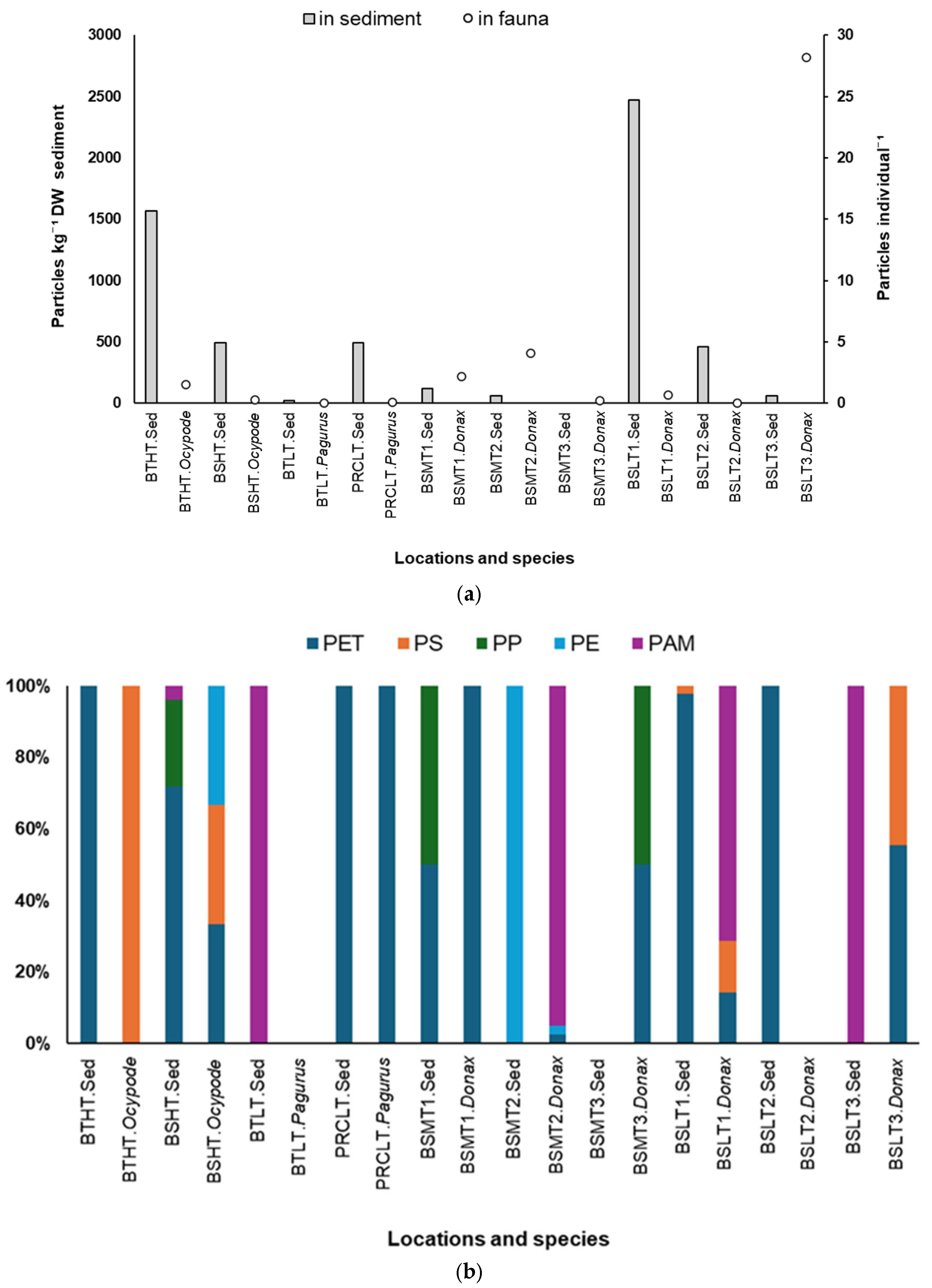
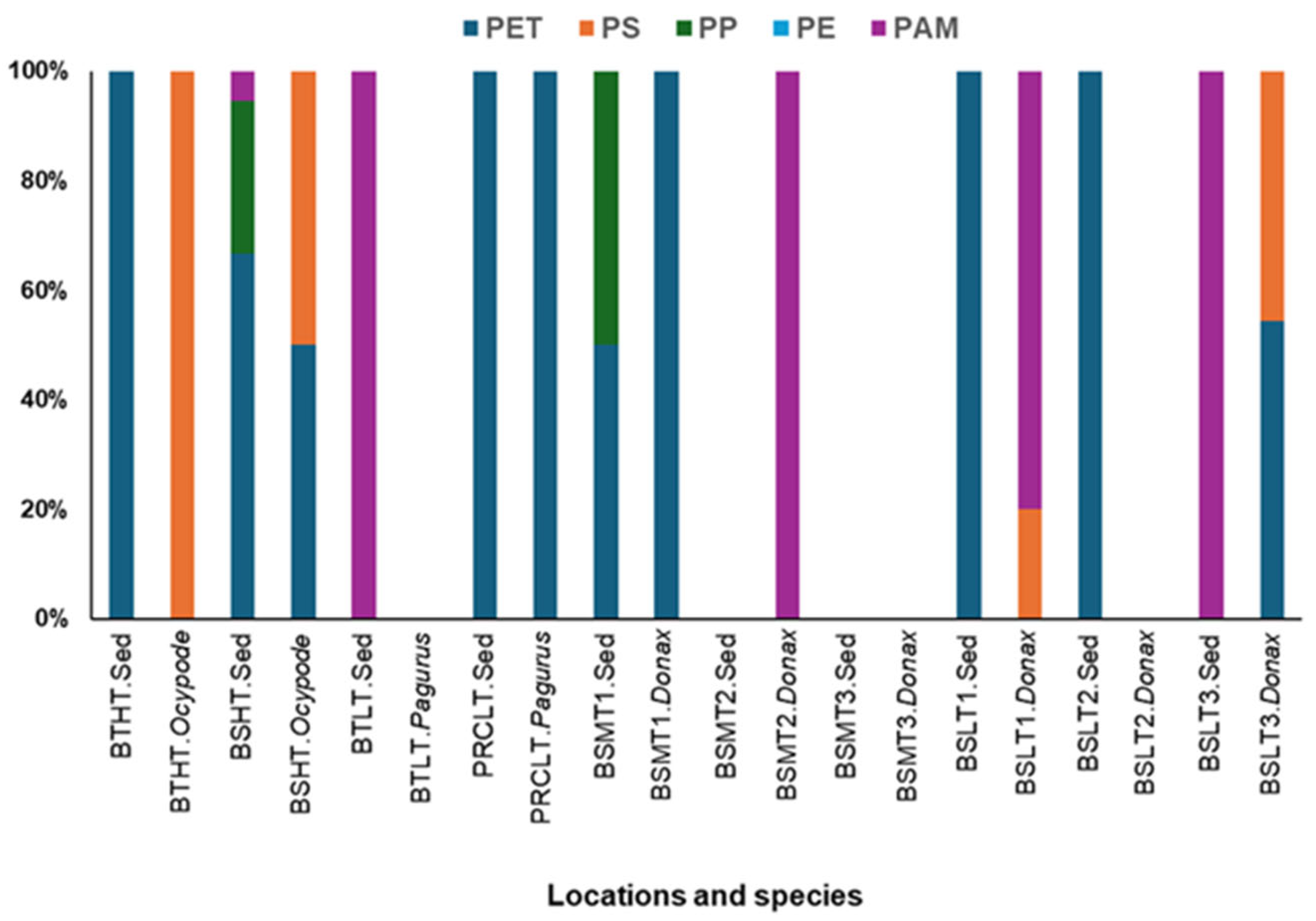
Microplastics were detected in all analyzed species (Figure 1a,b). Specimens from eight samples were recorded as ingesting MPs with the concentration ranging from 0.07 particles individual−1 in Pagurus at PRC LT to 28.2 particles individual−1 in Donax at BS LT3 (Figure 1a). In total, five polymer types were identified in analyzed taxa including polyethylene terephthalate (PET), polystyrene (PS), polypropylene (PP), polyacrylamide (PAM), and polyethylene (PE) (Figure 1b). PET was ingested by all three taxa, i.e., Donax, Ocypode, and Pagurus (Figure 1b). PAM and PP were mainly found ingested by Donax while PS and PE were ingested by both Donax and Ocypode (Figure 1b).
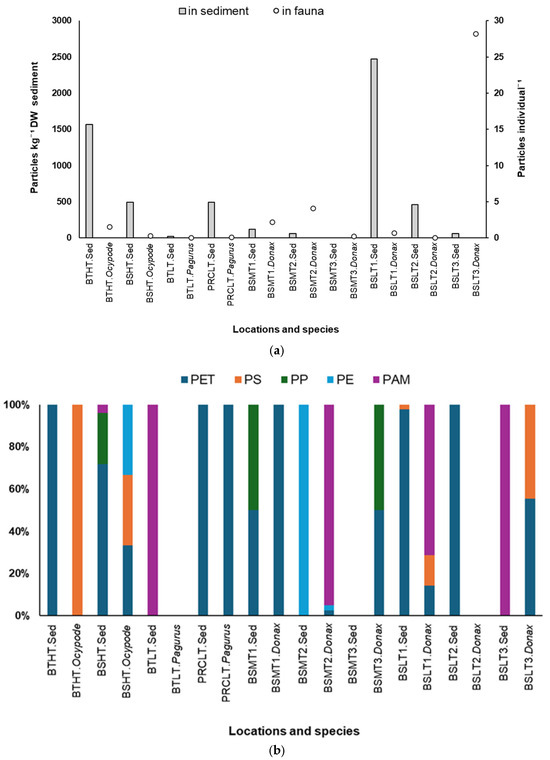
Figure 1.
(a) The total concentration of microplastics in sediment (primary y-axis; particles kg−1 DW sediment) and ingested by fauna (secondary y-axis; particles individual−1). (b) The proportion of polymer composition in sediment and in fauna. BT: Binh Tien beach, PRC: Phan Ri Cua beach, BS: Bai Sau beach. HT: high tide, MT: mid tide, LT: low tide. 1, 2, 3 are replicates. Sed: sediment. DW: dry weight.
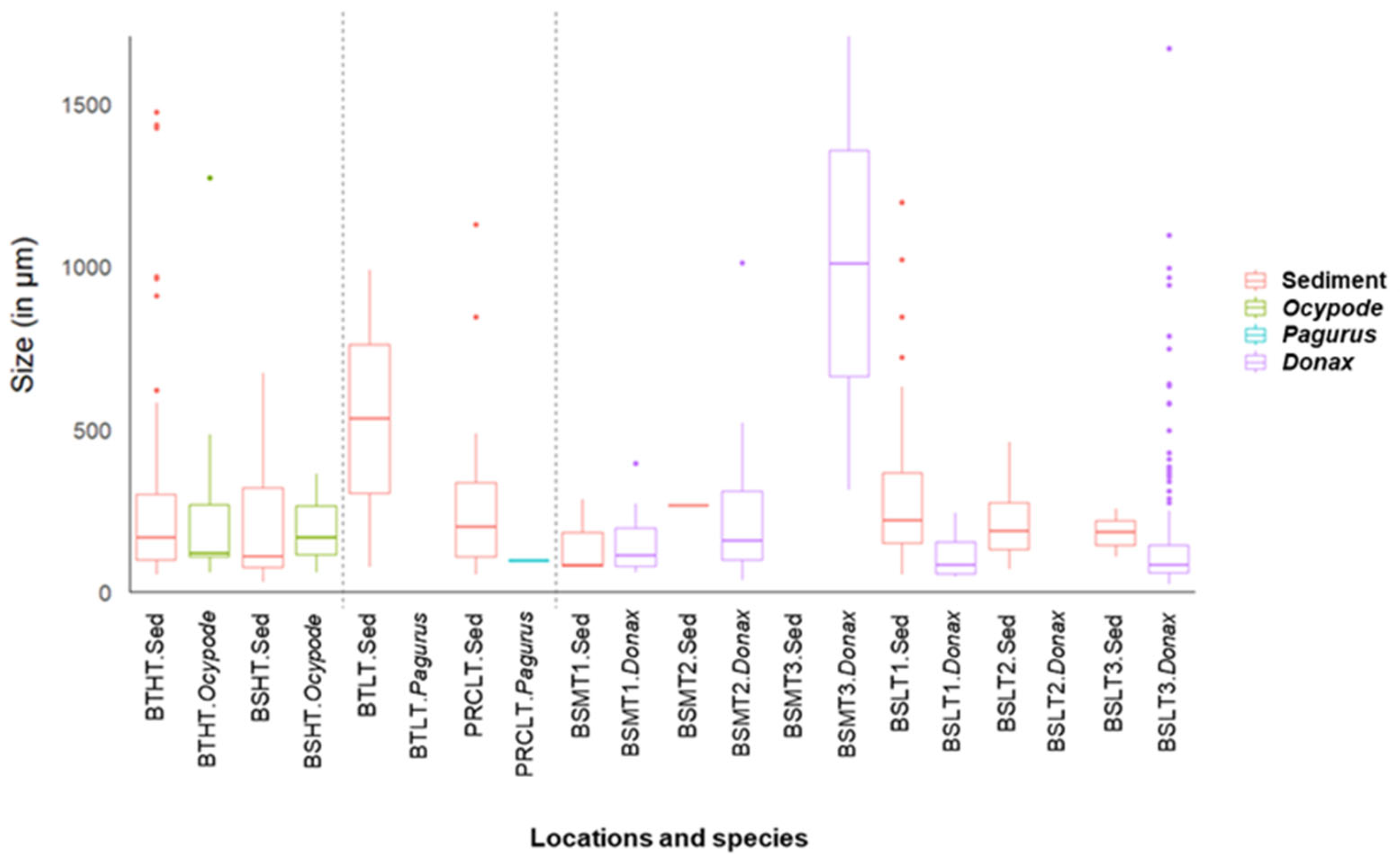
Among the fauna, Donax ingested most MPs, with considerable variation among sampling sites: from 0.2 particles individual−1 at BS MT3 to 28.2 particles individual−1 at BS LT3 (Figure 1a). There were no MPs detected in Donax individuals collected from BS LT2. Previous studies have reported comparable or lower levels of MPs in different Donax species. For instance, D. cuneatus from Tuticorin coast of Gulf of Mannar, India was found to contain between 0.29 and 2.7 particles individual−1, with MP abundance decreasing as clam size increases [32]. In D. trunculus collected along the Tuscany Coast (Mediterranean Sea) and the Bulgarian Black Sea coast, MPs were detected in concentrations ranging from 0.06 to 2.52 particles individual−1 ([43] and references therein). Compared to these specimens, Donax from the BS LT3 sample exhibited higher MP ingestion (28.2 particles individual−1), which was not consistent with the MP concentration in the surrounding sediment. This may be explained by its primary filter feeding behavior [43]. All polymer types (PET, PS, PP, PE, and PAM) were found in Donax, with particle sizes ranging from 22.6 to 1703.8 µm and a median particle size of 90.3 µm across samples (Figure 2), with 48% of the particles being smaller than 200 µm (Supplementary Table S1). Similarly, Narmatha Sathish et al. (2020) reported that D. cuneatus collected from the Tuticorin coast predominantly ingested MPs between 100 and 250 µm in size [32], whereas D. trunculus from Tuscany coast ingested MPs over a wider size range (20–2000 µm) [43]. Importantly, however, life stage and animal size can define contaminant uptake [32]. The Donax specimens in this study were juveniles [31,32,44], with the average shell length ranging from 7.24 ± 0.38 mm to 8.84 ± 0.54 mm (Table 1). The total wet weight ranged from 0.05 ± 0.01 g to 0.57 ± 0.28 g (Table 1). Juveniles Donax have been reported to ingest more MPs than adults [32,44]. Notably, Donax primarily ingest detritus and plankton, with food particles generally ranging from very fine materials (<1 µm) up to approximately 1000 µm in size, depending on their life stage. This range overlaps with the MP particle sizes found here in Donax, suggesting potential accumulation in the gastrointestinal tract [9]. In bivalves, most MPs are eliminated within 1–3 days [45]. However, polyethylene terephthalate (PET) is retained longer (>9 h) in Donax trunculus tissues than other polymers (3–6 h), indicating a greater potential for accumulation despite overall rapid depuration [46]. MP retention in Donax is further influenced by particle characteristics (size, shape, polymer type), species-specific feeding and digestive processes, individual physiological traits, and environmental conditions [45,47]. In addition, especially larger particles may pose risks of clogging, causing physical blockages, ultimately compromising fitness and survival [9,48].
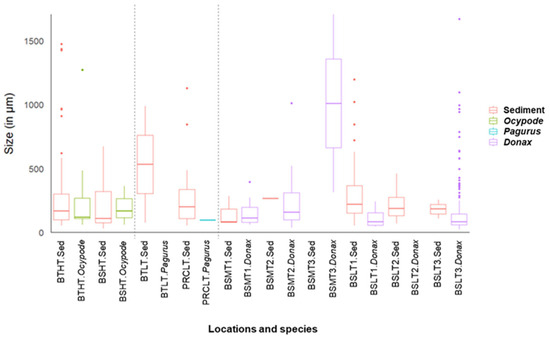
Figure 2.
Box plot showing microplastic size in sediment (orange) and in fauna: Ocypode: green, Pagurus: blue, Donax: purple. BT: Binh Tien beach, PRC: Phan Ri Cua beach, BS: Bai Sau beach. HT: high tide, MT: mid tide, LT: low tide. 1, 2, 3 are replicates.
Ocypode was found to ingest lower numbers of MPs ranging from 0.2 particles individual−1 at BS HT to 1.53 particles individual−1 at BT HT (Figure 1a). Three polymer types including PET, PS, and PE were found in Ocypode with sizes varying between 60.2 and 1272 µm and a median size of 119.7 µm across samples (Figure 1b and Figure 2), with 35% being less than 200 µm (Supplementary Table S1). There is no information available on the specific polymer types ingested by Ocypode at other locations. However, (non-identified) MPs were also documented in Ocypode species from Grussaí Beach Arch in southeast Brazil where O. quadrata individuals contained higher MP concentrations (1 and 158 particles individual−1) and larger polymer sizes (300 to 5000 µm) [10]. The specimens of O. ceratophthalmus in our study were recorded as juveniles according to their biometrics [37], with the average carapace length ranging from 6.32 ± 2.86 mm to 6.77 ± 1.65 mm. The total wet weight ranged between 0.29 ± 0.27 g and 0.46 ± 1.07 g (Table 1).
Pagurus ingested 0.07 particles individual−1 at the polluted beach PRC LT, while no MPs were detected from specimens collected in BT LT (Figure 1a). PET was the only polymer detected in Pagurus specimens (Figure 1b). In Pagurus, MP size was small compared to Donax and Ocypode, with a median size of 94.3 µm (Figure 2). Pagurus specimens had the average carapace length varying between 23.63 ± 13.89 mm and 24.34 ± 6.50 mm, with weights ranging from 1.54 ± 0.96 g to 2.62 ± 1.08 g (Table 1). Only Gebruk et al. (2021) reported MPs in the gut content of the species Pagurus pubescens; however, no further information was provided on MP concentration, size and polymer type [49]. Experimental studies have, however, reported behavioral changes and physiological responses in Pagurus when exposed to polyethylene spheres (PE) of 4 mm even though no MP ingestion was observed [34,50].
The ingestion of MPs by diverse beach fauna points to potential ecological and physiological impacts. Ingested MPs can accumulate in the gastrointestinal tracts of marine organisms, causing false satiation and reduced nutrient absorption, ultimately compromising fitness and survival [9]. MPs may also act as vectors for chemical additives and adsorbed pollutants that, once released internally, can induce inflammation, endocrine disruption, and organ damage [51]. Behavioral effects have also been documented: Pagurus bernhardus exposed to MPs shows delayed shell selection behavior which may have serious consequences for their survival, growth and reproduction [12,34]; Ocypode species reduce burrow construction under MP exposure [10]. Such stress responses can impair sediment aeration, nutrient cycling, and detritus processing, thereby diminishing the ecological roles of beach invertebrates [9].
The dominance of smaller-sized MPs (<200 µm) ingested by animals highlights species-specific patterns in MP size ingestion. Figure 2 demonstrates a mismatch between the sizes of MPs ingested by invertebrates and those present in the ambient sediment. In all taxa, the majority of ingested plastics were <200 µm. However, patterns differed between the two crab species and Donax. Overall, the median sizes of MPs found in crabs were smaller than those found in the sediment. This suggests that crabs either do not ingest larger particles or that ingested MPs are subsequently fragmented into smaller particles during passage through the gastric mill and through the churning mechanism of the stomach cardia [6,48]. Alternatively, the lower ingestion rates may be influenced by asynchronous molting events, during which crabs undergo prolonged periods of reduced feeding activity or starvation, potentially resulting in enhanced egestion of MPs [52]. In contrast, Donax ingested many MP particles larger than those present in the sediment (Figure 2), indicating an additional ingestion pathway for this species through filter feeding (see Section 3.2).
All recorded polymer types are used in many applications. Nguyen et al. (2025) discussed the sources of polymer types on the same studied beaches [26]. PET is primarily used in water bottles, food packaging, and synthetic textile fibers; PAM is applied in plastic production, water and wastewater treatment, fishing and aquaculture, and consumer products such as packaging and adhesives; PP is commonly associated with urban waste, including bottle caps, disposable containers, and straws; and PS is mainly used in packaging, cosmetics, and fishing-related activities [26]. PE microplastics in coastal environments largely originate from the fragmentation of plastic bags, packaging materials, and fishing gear, with additional inputs from runoff, wastewater discharge, maritime activities, and tourism [26]. Most studies show that microplastics negatively affect aquatic invertebrates, impacting feeding, growth, reproduction, and survival, though some report limited effects [53]. Polystyrene (PS) was widely used to study ecotoxicological effect on marine fauna, while PE, PP, PET, and PAM pose lower risks but can act as pollutant vectors or release additives [54]. Toxicity arises from the polymer itself, its additives, or absorbed environmental chemicals, with environmental plastics being potentially more harmful than pristine polymers used in experiments [54].
3.2. The Role of Benthos as Bioindicators for Microplastic Pollution
Microplastics were present in nearly all sediment samples (except one replicate at BS MT3) and were most abundant in the low-tide zone of Bai Sau beach (Figure 1a), which is a shallow sloping touristic beach with more than 10 million tourists each year [55]. Sediment MP concentrations ranged from 20.37 ± 35.29 to 2473 particles kg−1 DW, with particle sizes spanning between 30.2 and 1471 µm, with an overall median size of 181.25 µm (Figure 2). Five polymer types, PET, PS, PP, PE, and PAM, were identified from the sediment samples, with most MPs being smaller than 200 µm, accounting for >23.4% of the total number of particles (Supplementary Table S2).
Microplastic ingestion by beach fauna only partly reflected sediment contamination. Ocypode from Bai Sau high-tide zones ingested PET, consistent with local sediment pollution, while its mobility may explain the uptake of PE and PS found to be present in the sediment of the adjacent mid- or low-tide zones (Figure 1b, also in [26]). The ingested PET particle in the hermit crab Pagurus matched the full dominance of that polymer in PRC LT sediments, whereas no MPs were detected in specimens from BT LT, where sediments contained only PAM (Figure 1b).
For Donax, ingestion patterns varied among sites. Individuals from BS MT1, BS MT2, and BS LT1 partly mirrored sedimentary polymers (PET, PE, PET and PS, respectively), whereas Donax from BS MT3 and BS LT3 contained polymers (PET, PP, PS) not found in corresponding sediments (Figure 1). RELATE analysis confirmed no significant correlation between ingested and sediment MPs across 100 µm size class intervals, whether all sizes were considered (p = 0.26) or only particles <200 µm (p > 0.05). Neither were significant correlations found between total ingested MPs by Donax and the ambient sediment MP levels (r = −0.26, p = 0.66). This indicates that the MPs found inside Donax do not directly reflect the types or amounts of MPs present in the surrounding sediments, suggesting that ingestion is not solely driven by local sediment availability. As a filter feeder, Donax likely acquires MPs from both sediment and the water column. Only Donax from BS MT1 showed a PET match between ingested and sediment MPs <200 µm (Figure 3), indicating that sediment is not the sole MP source. Additionally, the greater number of larger MPs ingested by Donax compared to those present in the sediment (except at BS LT1) suggests that Donax primarily acquires plastics from the water column. Previous studies have documented considerable variation in MP sizes between beach seawater and sediment. Khuyen et al. (2021) reported that at the Can Gio Mangrove Biosphere Reserve (Vietnam), MP sizes differed between seawater and sediment, with larger fragments and fibers occurring in the sediment [56]. Similarly, Expósito et al. (2021) observed smaller MPs in seawater and a broader, often larger, size range in sediment along the Tarragona coast (Western Mediterranean) [57]. In contrast and similarly to our study, Ronda et al. (2023) found larger MPs in seawater than those in sand in Buenos Aires Province (Argentina) [58]. Narmatha Sathish et al. (2020) partly found that MPs in clams (D. cuneatus) mirrored sediment composition [32]. Interestingly, MPs occurred in Donax from BS MT3 despite their absence in the ambient sediment, while the most polluted sediment (BS LT1) did not correspond with higher ingestion. The highest ingestion occurred at BS LT3, where sediment MP levels were low, further supporting our hypothesis of additional uptake from the water column. Overall, Donax from low-tide zones ingested more MPs (9.63 ± 16.08 particles individual−1) than those from mid-tide areas (2.17 ± 1.95 particles individual−1), although this trend was not statistically significant (T-test, p = 0.33). This may reflect that longer submersion at low tide increases filtration time and MP exposure. Additionally, the presence of small-sized PS (<200 µm), ranging from negatively to positively buoyant polymers (0.9–1.1 g cm−3), exclusively in Donax, provides further evidence of waterborne MP pollution (Figure 3).
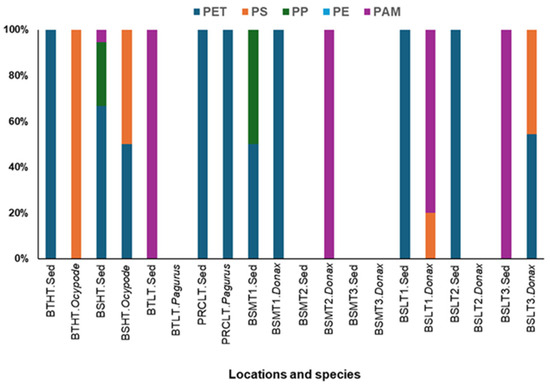
Figure 3.
Particles smaller than 200 µm: The proportion of polymer composition in sediment and in fauna. BT: Binh Tien beach, PRC: Phan Ri Cua beach, BS: Bai Sau beach. HT: high tide, MT: mid tide, LT: low tide. 1, 2, 3 are replicates. Sed: sediment.
While multiple species ingest MPs, only a few reliably reflect the degree of environmental pollution on sandy beaches. For instance, Costa et al. (2019) found that although O. quadrata mirrored the types of MPs present in sediments, it did not accurately represent their quantities [10]. In our study, apart from feeding mode, high MP ingestion in Donax may also be influenced by biological factors such as juvenile stage, retention time, metabolic rate, and reduced egestion, as well as by environmental variability between the sampled sediments and the exact spot where the animals were collected. The lack of correlation between sediment MPs and ingestion, therefore, indicates a more complex interplay of factors. Moreover, some clam species have been observed to reduce their filtration rates as a mechanism to limit MP uptake [59]. This capacity to regulate MP incorporation reduces the effectiveness of pure suspension feeders as a broad ecological guild for biomonitoring purposes and may partly explain the absence of a clear correlation between ingestion and habitat contamination. Therefore, it has been recommended to select specific indicator species rather than relying solely on suspension feeders for MP biomonitoring [32,60]. Additionally, ingestion rates and MP accumulation in organisms are influenced by factors such as MP size, shape, and chemical composition, alongside biological processes including respiration, feeding, digestion, and excretion.
Our results suggest that MP density, species feeding mode, and beach morphodynamics (i.e., tidal inundation) jointly determine the likelihood of ingestion. These findings highlight the potential of benthic organisms as bioindicators of MP pollution, contingent on species-specific traits and habitat influences. However, relatively low ingestion rates in Pagurus indicate that careful selection of indicator species and larger sample sizes are required for robust assessments. The higher ingestion rates and polymer diversity observed in Donax underscore its suitability as a bioindicator species, reflecting its sedentary suspension/deposit feeding habits that integrate local environmental conditions [32,33]. The high mobility of Ocypode may lead to exposure to MPs from larger spatial scales, with implications for site-specificity of its bioindicator potential. Further work involving larger datasets and controlled experiments is clearly needed to better evaluate species-specific responses and potential trophic transfer.
3.3. The Implications for Human Health via Ingestion of Beach Fauna
This study documented the presence of MPs in the stomach of ghost crabs (O. ceratophthalmus), and the soft tissues of clams (Donax) and hermit crabs (Pagurus). The three studied taxa serve as prey for higher trophic levels, raising concerns about the trophic transfer of MPs to predators including fish, birds, and ultimately humans, and pointing to broader ecological risks [15]. The detection of MPs in these ecologically and economically important coastal fauna highlights a potential exposure for local communities in Vietnam, where these species are commonly collected as food. MPs have been recorded in commercial fish species, with concentrations ranging from 0.2 to 42 particles individual−1 [61]. The MP concentrations reported for other shellfish are comparable to the range observed in our Donax. Specifically, brown shrimp (Crangon crangon) were reported to ingest 1.23 ± 0.99 particles individual−1 [62], cultured Pacific oysters (Crassostrea gigas) contained 1.0 ± 1.1 to 18.54 ± 10.08 particles individual−1 [63], green mussels (Perna viridis) ingested 25.05 ± 5.36 particles individual−1 [25], and other cultured bivalves, including Blue mussel (Mytilus edulis), contained 0.61 ± 0.56 particles individual−1; clams (Meretrix lyrata, M. meretrix, Mactra grandis) and blood cockles (Anadara granosa) showed average concentrations of 10.84 ± 2.61 particles individual−1 [28,64]. The concentrations of MPs in these food sources are comparable to the range observed in our Donax (0.2–28.2 particles individual−1) and O. ceratophthalmus (0.2–1.53 particles individual−1). Because these species are small, local consumers typically do not remove the gastrointestinal or abdominal contents prior to consumption, which increases the likelihood of MPs being directly ingested by humans. Potential effects include physical damage to tissues, induction of oxidative stress, and inflammatory responses [65,66]. Additionally, MPs can act as vectors for toxic chemicals or pathogens, raising concerns about long-term health impacts [66]. To mitigate these risks, it is advisable to remove the digestive organs before consumption, which could significantly reduce human exposure to MPs and their associated contaminants. Further, our work underscores the urgent need to raise public awareness and implement targeted management strategies aimed at reducing environmental pollution and mitigating its downstream impacts on food safety and human health.
4. Conclusions
In conclusion, all three species ingested MPs, with ingestion patterns varying according to species-specific traits and habitat-related feeding behaviors. The highly mobile crabs Ocypode and Pagurus were found to partly reflect polymer pollution in their ambient environment. The higher ingestion rate and diversity of polymer types observed in sedentary Donax suggest that this species could serve as a potential bioindicator for MP pollution, given its mixed suspension and deposit feeding habits that integrate pollution from both the water column and beach sediments. These findings reveal widespread MP ingestion among edible beach fauna, highlighting potential ecological and human health risks, and emphasizing the need for targeted pollution management and increased public awareness. Further work involving larger datasets and controlled experiments is clearly needed to better evaluate species-specific responses and potential trophic transfer.
Supplementary Materials
The following supporting information can be downloaded at https://www.mdpi.com/article/10.3390/microplastics5020065/s1, Table S1: Size classes of polymer composition in fauna (particles·ind−1). BT: Binh Tien beach, PRC: Phan Ri Cua beach, BS: Bai Sau beach. HT: high tide, MT: Mid tide, LT: Low tide. 1, 2, 3 are replicates; Table S2: Size classes of polymer composition in sediment (particles·kg−1 dry weight sediment). BT: Binh Tien beach, PRC: Phan Ri Cua beach, BS: Bai Sau beach. HT: high tide, MT: Mid tide, LT: Low tide. 1, 2, 3 are replicates.
Author Contributions
M.Y.N.: Conceptualization, design, formal analysis, writing and revision of the manuscript. A.V.: conceptualization, design, revision of the manuscript. C.V.C.: Conceptualization, design, writing and revision of the manuscript. X.Q.N.: Conceptualization, design, supported with sample collection in the field, revision of the manuscript. M.V. and J.A.: Supported with the MPs sample processing protocol and analysis; revision of the manuscript. All authors have read and agreed to the published version of the manuscript.
Funding
This research is funded by BOF Research Funding for Doctoral Scholarships by Ghent university, Belgium (01W02821), VLIR-UOS (Flemish Interuniversities Council_University Development Cooperation), and Institute of Life Sciences, Vietnam Academy of Science and Technology, Vietnam.
Institutional Review Board Statement
Not applicable.
Data Availability Statement
The raw data supporting the conclusions of this article will be made available by the authors on request.
Acknowledgments
Data collection on microplastics and fauna identification were possible through EMBRC Belgium–FWO (I001621N, I000825N) at the Marine Biology Research group and the Blue growth research lab, Ghent University.
Conflicts of Interest
The authors declare no conflicts of interest.
References
- Kershaw, P.J.; Rochman, C.M. Sources, Fate and Effects of Microplastics in the Marine Environment: Part 2 of a Global Assessment; Reports and Studies-IMO/FAO/Unesco-IOC/WMO/IAEA/UN/UNEP Joint Group of Experts on the Scientific Aspects of Marine Environmental Protection (GESAMP) Eng No. 93; International Maritime Organization: London, UK, 2015. [Google Scholar]
- Costa, L.L.; Fanini, L.; Ben-Haddad, M.; Pinna, M.; Zalmon, I.R. Marine litter impact on sandy beach fauna: A review to obtain an indication of where research should contribute more. Microplastics 2022, 1, 554–571. [Google Scholar] [CrossRef]
- Costa, L.L.; David da Costa, I.; da Silva Oliveira, A.; Zalmon, I.R. “Microplastic ecology”: Testing the influence of ecological traits and urbanization in microplastic ingestion by sandy beach fauna. Estuar. Coast. Shelf Sci. 2023, 290, 108406. [Google Scholar] [CrossRef]
- Lusher, A. Microplastics in the marine environment: Distribution, interactions and effects. In Marine Anthropogenic Litter; Springer: Cham, Switzerland, 2015; pp. 245–307. [Google Scholar] [CrossRef]
- Wang, J.; Guo, X.; Xue, J. Biofilm-Developed Microplastics as Vectors of Pollutants in Aquatic Environments. Environ. Sci. Technol. 2021, 55, 12780–12790. [Google Scholar] [CrossRef] [PubMed]
- Piarulli, S.; Vanhove, B.; Comandini, P.; Scapinello, S.; Moens, T.; Vrielinck, H.; Sciutto, G.; Prati, S.; Mazzeo, R.; Booth, A.M.; et al. Do different habits affect microplastics contents in organisms? A trait-based analysis on salt marsh species. Mar. Pollut. Bull. 2020, 153, 110983. [Google Scholar] [CrossRef]
- Santana, M.F.M.; Ascer, L.G.; Custódio, M.R.; Moreira, F.T.; Turra, A. Microplastic contamination in natural mussel beds from a Brazilian urbanized coastal region: Rapid evaluation through bioassessment. Mar. Pollut. Bull. 2016, 106, 183–189. [Google Scholar] [CrossRef]
- Van Colen, C.; Moereels, L.; Vanhove, B.; Vrielinck, H.; Moens, T. The biological plastic pump: Evidence from a local case study using blue mussel and infaunal benthic communities. Environ. Pollut. 2021, 274, 115825. [Google Scholar] [CrossRef]
- Wright, S.L.; Thompson, R.C.; Galloway, T.S. The physical impacts of microplastics on marine organisms: A review. Environ. Pollut. 2013, 178, 483–492. [Google Scholar] [CrossRef]
- Costa, L.L.; Arueira, V.F.; da Costa, M.F.; Di Beneditto, A.P.M.; Zalmon, I.R. Can the Atlantic ghost crab be a potential biomonitor of microplastic pollution of sandy beaches sediment? Mar. Pollut. Bull. 2019, 145, 5–13. [Google Scholar] [CrossRef]
- Nanninga, G.B.; Horswill, C.; Lane, S.M.; Manica, A.; Briffa, M. Microplastic exposure increases predictability of predator avoidance strategies in hermit crabs. J. Hazard. Mater. Lett. 2020, 1, 100005. [Google Scholar] [CrossRef]
- Watts, A.J.R.; Lewis, C.; Goodhead, R.M.; Beckett, S.J.; Moger, J.; Tyler, C.R.; Galloway, T.S. Uptake and Retention of Microplastics by the Shore Crab Carcinus maenas. Environ. Sci. Technol. 2014, 48, 8823–8830. [Google Scholar] [CrossRef]
- Abisha, C.; Kutty, R.; Gurjar, U.R.; Jaiswar, A.K.; Deshmuke, G.; Sasidharan, A.; Xavier, K.A.M. Microplastic prevalence, diversity and characteristics in commercially important edible bivalves and gastropods in relation to environmental matrices. J. Hazard. Mater. Adv. 2024, 13, 100392. [Google Scholar] [CrossRef]
- Bour, A.; Avio, C.G.; Gorbi, S.; Regoli, F.; Hylland, K. Presence of microplastics in benthic and epibenthic organisms: Influence of habitat, feeding mode and trophic level. Environ. Pollut. 2018, 243, 1217–1225. [Google Scholar] [CrossRef] [PubMed]
- Setälä, O.; Fleming-Lehtinen, V.; Lehtiniemi, M. Ingestion and transfer of microplastics in the planktonic food web. Environ. Pollut. 2014, 185, 77–83. [Google Scholar] [CrossRef] [PubMed]
- Cholewinska, P.; Wojnarowski, K.; Szeligowska, N.; Pokorny, P.; Hussein, W.; Hasegawa, Y.; Dobicki, W.; Palic, D. Presence of microplastic particles increased abundance of pathogens and antimicrobial resistance genes in microbial communities from the Oder river water and sediment. Sci. Rep. 2025, 15, 16338. [Google Scholar] [CrossRef]
- Arueira, V.F.; Zalmon, I.R.; Costa, L.L. Is the ghost crab’s feeding behavior a good early indicator of human pressure in sandy beaches? Reg. Stud. Mar. Sci. 2022, 53, 102381. [Google Scholar] [CrossRef]
- Watts, A.J.R.; Urbina, M.A.; Goodhead, R.; Moger, J.; Lewis, C.; Galloway, T.S. Effect of microplastic on the gills of the shore crab Carcinus maenas. Environ. Sci. Technol. 2016, 50, 5364–5369. [Google Scholar] [CrossRef]
- Athulya, P.A.; Chandrasekaran, N. Exposure of true to life microplastics to Donax faba under two different pH conditions: A microcosm approach. Reg. Stud. Mar. Sci. 2023, 67, 103197. [Google Scholar] [CrossRef]
- Sunil, Z.; Thomas, J.; Mukherjee, A.; Chandrasekaran, N. Microplastics and leachate materials from pharmaceutical bottle: An in vivo study in Donax faba (Marine Clam). Environ. Toxicol. Pharmacol. 2023, 101, 104205. [Google Scholar] [CrossRef]
- Harris, R.J.; Pilditch, C.A.; Hewitt, J.E.; Lohrer, A.M.; Van Colen, C.; Townsend, M.; Thrush, S.F. Biotic interactions influence sediment erodibility on wave-exposed sandflats. Mar. Ecol. Prog. Ser. 2015, 523, 15–30. [Google Scholar] [CrossRef][Green Version]
- Mestdagh, S.; Fang, X.; Soetaert, K.; Ysebaert, T.; Moens, T.; Van Colen, C. Seasonal variability in ecosystem functioning across estuarine gradients: The role of sediment communities and ecosystem processes. Mar. Environ. Res. 2020, 162, 105096. [Google Scholar] [CrossRef]
- Montserrat, F.; Van Colen, C.; Degraer, S.; Ysebaert, T.; Herman, P.M.J. Benthic community-mediated sediment dynamics. Mar. Ecol. Prog. Ser. 2008, 372, 43–59. [Google Scholar] [CrossRef]
- Van Oevelen, D.; Soetaert, K.; Middelburg, J.J.; Herman, P.M.J.; Moodley, L.; Hamels, I.; Moens, T.; Heip, C.H.R. Carbon flows through a benthic food web: Integrating biomass, isotope and tracer data. J. Mar. Res. 2006, 64, 453–482. [Google Scholar] [CrossRef]
- Do, V.M.; Trinh, V.T.; Le, X.T.T.; Nguyen, D.T. Evaluation of microplastic bioaccumulation capacity of mussel (Perna viridis) and surrounding environment in the North coast of Vietnam. Mar. Pollut. Bull. 2024, 199, 115987. [Google Scholar] [CrossRef] [PubMed]
- Nguyen, M.Y.; Vanreusel, A.; Ngo, X.Q.; Vercauteren, M.; Asselman, J.; Van Colen, C. Microplastic pollution in Vietnamese sandy beaches: Exploring the role of beach morphodynamics and local management. Mar. Pollut. Bull. 2025, 214, 117838. [Google Scholar] [CrossRef]
- Nguyen, M.Y.; Ann, V.; Xuan, Q.N.; Carl, V.C. Ecology of sandy beaches in Vietnam: Exploring the effects of environmental gradients and local microplastic pollution for macro—and meiofauna distribution. Reg. Stud. Mar. Sci. 2025, 93, 104726. [Google Scholar] [CrossRef]
- Doan, T.O.; Duong, T.T.; Pham, L.A.; Nguyen, T.M.; Pham, P.T.; Hoang, T.Q.; Phuong, N.N.; Nguyen, T.L.; Pham, T.T.H.; Ngo, T.D.M.; et al. Microplastic accumulation in bivalves collected from different coastal areas of Vietnam and an assessment of potential risks. Environ. Monit. Assess. 2023, 195, 1511. [Google Scholar] [CrossRef]
- Li, Q.; Ma, C.; Zhang, Q.; Shi, H. Microplastics in shellfish and implications for food safety. Curr. Opin. Food Sci. 2021, 40, 192–197. [Google Scholar] [CrossRef]
- Jin, M.; Wang, X.; Ren, T.; Wang, J.; Shan, J. Microplastics contamination in food and beverages: Direct exposure to humans. J. Food Sci. 2021, 86, 2816–2837. [Google Scholar] [CrossRef]
- Baeta, M.; Solís, M.A.; Frias-Vidal, S.; Claramonte, L.; Ballesteros, M. Management and ecology of the wedge clam (Donax trunculus) in the NW Mediterranean Sea: The case of Ebro Delta (NE Spain). Reg. Stud. Mar. Sci. 2023, 66, 103158. [Google Scholar] [CrossRef]
- Narmatha Sathish, M.; Immaculate Jeyasanta, K.; Patterson, J. Monitoring of microplastics in the clam Donax cuneatus and its habitat in Tuticorin coast of Gulf of Mannar (GoM), India. Environ. Pollut. 2020, 266, 115219. [Google Scholar] [CrossRef]
- Takar, S.; Jawahar, P.; Gurjar, U.R.; Kingston, S.D.; Neethiselvan, N.; Pereira, J.J.; Jagadis, I. Food and Feeding Habits of Wedge Clam (Donax cuneatus) Off Thoothukudi, Gulf of Mannar, India. Indian J. Anim. Res. 2021, 57, 328–333. [Google Scholar] [CrossRef]
- Crump, A.; Mullens, C.; Bethell, E.J.; Cunningham, E.M.; Arnott, G. Microplastics disrupt hermit crab shell selection. Biol. Lett. 2020, 16, 20200030. [Google Scholar] [CrossRef] [PubMed]
- McDaid, A.; Cunningham, E.M.; Crump, A.; Hardiman, G.; Arnott, G. Does microplastic exposure and sex influence shell selection and motivation in the common European hermit crab, Pagurus bernhardus? Sci. Total Environ. 2023, 855, 158576. [Google Scholar] [CrossRef] [PubMed]
- Briffa, M.; Arnott, G.; Hardege, J.D. Hermit crabs as model species for investigating the behavioural responses to pollution. Sci. Total Environ. 2024, 906, 167360. [Google Scholar] [CrossRef]
- Hughes, R.N.; Hughes, D.J.; Smith, I.P.; Lucrezi, S.; Schlacher, T.A. The ecology of ghost crabs. Oceanogr. Mar. Biol. Annu. Rev. 2014, 52, 201–256. [Google Scholar]
- Löder, M.G.J.; Imhof, H.K.; Ladehoff, M.; Löschel, L.A.; Lorenz, C.; Mintenig, S.; Piehl, S.; Primpke, S.; Schrank, I.; Laforsch, C.; et al. Enzymatic Purification of Microplastics in Environmental Samples. Environ. Sci. Technol. 2017, 51, 14283–14292. [Google Scholar] [CrossRef]
- Lopes, C.; Fernández-González, V.; Muniategui-Lorenzo, S.; Caetano, M.; Raimundo, J. Improved methodology for microplastic extraction from gastrointestinal tracts of fat fish species. Mar. Pollut. Bull. 2022, 181, 113911. [Google Scholar] [CrossRef]
- Schwaferts, C.; Niessner, R.; Elsner, M.; Ivleva, N.P. Methods for the analysis of submicrometer- and nanoplastic particles in the environment. TrAC Trends Anal. Chem. 2019, 112, 52–65. [Google Scholar] [CrossRef]
- Clarke, K.R.; Gorley, R.N.; Somerfield, P.; Warwick, R.M. Change in Marine Communities: An Approach to Statistical Analysis and Interpretation, 3rd ed.; PRIMER-E, Ltd., Plymouth Marine Laboratory: Plymouth, UK, 2014; p. 262. [Google Scholar]
- R Core Team. R: A Language and Environment for Statistical Computing; R Foundation for Statistical Computing: Vienna, Austria, 2023. [Google Scholar]
- Malloggi, C.; Nalbone, L.; Bartalena, S.; Guidi, M.; Corradini, C.; Foti, A.; Gucciardi, P.G.; Giarratana, F.; Susini, F.; Armani, A. The Occurrence of Microplastics in Donax trunculus (Mollusca: Bivalvia) Collected along the Tuscany Coast (Mediterranean Sea). Animals 2024, 14, 618. [Google Scholar] [CrossRef]
- Secco, S.; Cesarini, G.; Gallitelli, L.; Suaria, G.; Paluselli, A.; Di Gioacchino, M.; Sodo, A.; Scalici, M. Multi-matrix approach to microplastic pollution in the bivalve Donax trunculus, sediment and water along the Mediterranean coasts. Environ. Pollut. 2025, 375, 126318. [Google Scholar] [CrossRef]
- Sun, T.; Ji, C.; Li, F.; Shan, X.; Wu, H. The legacy effect of microplastics on aquatic animals in the depuration phase: Kinetic characteristics and recovery potential. Environ. Int. 2022, 168, 107467. [Google Scholar] [CrossRef]
- Olivieri, Z.; Cesarini, G.; Orsini, M.; De Santis, S.; Scalici, M. Uptake of Microplastics in the Wedge Clam Donax trunculus: First Evidence from the Mediterranean Sea. Water 2022, 14, 4095. [Google Scholar] [CrossRef]
- Xu, Z.; Huang, L.; Xu, P.; Lim, L.; Cheong, K.-L.; Wang, Y.; Tan, K. Microplastic pollution in commercially important edible marine bivalves: A comprehensive review. Food Chem. X 2024, 23, 101647. [Google Scholar] [CrossRef] [PubMed]
- Watts, A.J.R.; Urbina, M.A.; Corr, S.; Lewis, C.; Galloway, T.S. Ingestion of plastic microfibers by the crab Carcinus maenas and its effect on food consumption and energy balance. Environ. Sci. Technol. 2015, 49, 14597–14604. [Google Scholar] [CrossRef] [PubMed]
- Gebruk, A.; Zalota, A.K.; Dgebuadze, P.; Ermilova, Y.; Spiridonov, V.A.; Shabalin, N.; Henry, L.-A.; Henley, S.F.; Mokievsky, V.O. Trophic niches of benthic crustaceans in the Pechora Sea suggest that the invasive snow crab Chionoecetes opilio could be an important competitor. Polar Biol. 2020, 44, 57–71. [Google Scholar] [CrossRef]
- Cunningham, E.M.; Mundye, A.; Kregting, L.; Dick, J.T.A.; Crump, A.; Riddell, G.; Arnott, G. Animal contests and microplastics: Evidence of disrupted behaviour in hermit crabs Pagurus bernhardus. R. Soc. Open Sci. 2021, 8, 211089. [Google Scholar] [CrossRef]
- Ali, S.S.; Alsharbaty, M.H.M.; Al-Tohamy, R.; Schagerl, M.; Al-Zahrani, M.; Kornaros, M.; Sun, J. Microplastics as persistent and vectors of other threats in the marine environment: Toxicological impacts, management and strategical roadmap to end plastic pollution. Environ. Chem. Ecotoxicol. 2025, 7, 229–251. [Google Scholar] [CrossRef]
- Sánchez-Paz, A.; García-Carreño, F.; Muhlia-Almazán, A.; Peregrino-Uriarte, A.B.; Hernández-López, J.; Yepiz-Plascencia, G. Usage of energy reserves in crustaceans during starvation: Status and future directions. Insect Biochem. Mol. Biol. 2006, 36, 241–249. [Google Scholar] [CrossRef]
- Trestrail, C.; Nugegoda, D.; Shimeta, J. Invertebrate responses to microplastic ingestion: Reviewing the role of the antioxidant system. Sci. Total Environ. 2020, 734, 138559. [Google Scholar] [CrossRef]
- Galloway, T.S.; Cole, M.; Lewis, C. Interactions of microplastic debris throughout the marine ecosystem. Nat. Ecol. Evol. 2017, 1, 0116. [Google Scholar] [CrossRef]
- VTCNEWS. Tourism in Ba Ria–Vung Tau is Booming, Welcoming Over 10 Million Visitors. Available online: https://vtcnews.vn/du-lich-ba-ria-vung-tau-bung-no-don-hon-10-trieu-khach-ar889908.html (accessed on 14 December 2025).
- Khuyen, V.T.K.; Le, D.V.; Fischer, A.R.; Dornack, C. Comparison of Microplastic Pollution in Beach Sediment and Seawater at UNESCO Can Gio Mangrove Biosphere Reserve. Glob. Chall. 2021, 5, 2100044. [Google Scholar] [CrossRef] [PubMed]
- Expósito, N.; Rovira, J.; Sierra, J.; Folch, J.; Schuhmacher, M. Microplastics levels, size, morphology and composition in marine water, sediments and sand beaches. Case study of Tarragona coast (western Mediterranean). Sci. Total Environ. 2021, 786, 147453. [Google Scholar] [CrossRef] [PubMed]
- Ronda, A.C.; Menéndez, M.C.; Tombesi, N.; Álvarez, M.; Tomba, J.P.; Silva, L.I.; Arias, A.H. Microplastic levels on sandy beaches: Are the effects of tourism and coastal recreation really important? Chemosphere 2023, 316, 137842. [Google Scholar] [CrossRef] [PubMed]
- Xu, X.Y.; Lee, W.T.; Chan, A.K.Y.; Lo, H.S.; Shin, P.K.S.; Cheung, S.G. Microplastic ingestion reduces energy intake in the clam Atactodea striata. Mar. Pollut. Bull. 2017, 124, 798–802. [Google Scholar] [CrossRef]
- Ben-Haddad, M.; Abelouah, M.R.; Hajji, S.; De-la-Torre, G.E.; Oualid, H.A.; Rangel-Buitrago, N.; Ait Alla, A. The wedge clam Donax trunculus L., 1758 as a bioindicator of microplastic pollution. Mar. Pollut. Bull. 2022, 178, 113607. [Google Scholar] [CrossRef]
- Hantoro, I.; Löhr, A.J.; Van Belleghem, F.G.A.J.; Widianarko, B.; Ragas, A.M.J. Microplastics in coastal areas and seafood: Implications for food safety. Food Addit. Contam. Part A 2019, 36, 674–711. [Google Scholar] [CrossRef]
- Devriese, L.I.; van der Meulen, M.D.; Maes, T.; Bekaert, K.; Paul-Pont, I.; Frère, L.; Robbens, J.; Vethaak, A.D. Microplastic contamination in brown shrimp (Crangon crangon, Linnaeus 1758) from coastal waters of the Southern North Sea and Channel area. Mar. Pollut. Bull. 2015, 98, 179–187. [Google Scholar] [CrossRef]
- Do, V.M.; Dang, T.T.; Le, X.T.T.; Nguyen, D.T.; Phung, T.V.; Vu, D.N.; Pham, H.V. Abundance of microplastics in cultured oysters (Crassostrea gigas) from Danang Bay of Vietnam. Mar. Pollut. Bull. 2022, 180, 113800. [Google Scholar] [CrossRef]
- Phuong, N.N.; Poirier, L.; Pham, Q.T.; Lagarde, F.; Zalouk-Vergnoux, A. Factors influencing the microplastic contamination of bivalves from the French Atlantic coast: Location, season and/or mode of life? Mar. Pollut. Bull. 2018, 129, 664–674. [Google Scholar] [CrossRef]
- Schirinzi, G.F.; Pérez-Pomeda, I.; Sanchís, J.; Rossini, C.; Farré, M.; Barceló, D. Cytotoxic effects of commonly used nanomaterials and microplastics on cerebral and epithelial human cells. Environ. Res. 2017, 159, 579–587. [Google Scholar] [CrossRef]
- Winiarska, E.; Jutel, M.; Zemelka-Wiacek, M. The potential impact of nano- and microplastics on human health: Understanding human health risks. Environ. Res. 2024, 251, 118535. [Google Scholar] [CrossRef]
Disclaimer/Publisher’s Note: The statements, opinions and data contained in all publications are solely those of the individual author(s) and contributor(s) and not of MDPI and/or the editor(s). MDPI and/or the editor(s) disclaim responsibility for any injury to people or property resulting from any ideas, methods, instructions or products referred to in the content. |
© 2026 by the authors. Licensee MDPI, Basel, Switzerland. This article is an open access article distributed under the terms and conditions of the Creative Commons Attribution (CC BY) license.