


Abstract
The migratory shad, Hilsa (Tenualosa ilisha) is an iconic species of profound economic and cultural value across the Indian sub-continent due to its delicious taste and significant contributions to gross domestic product (GDP). Lack of fundamental genomic data regarding sex determination, impedes development of optimized breeding techniques and target conservation goals. In this study, a next-generation sequencing (NGS)-based genotyping technique was applied to identify sex-linked markers, modes of sex determination, putative sex-determining genes and the population genomic structure of Hilsa. Genotyping of 94 Hilsa individuals (46 males and 48 females) collected from four distinct locations of Bangladesh (three different river systems and Bay of Bengal as a marine site) revealed 31,696 single-nucleotide polymorphisms (SNPs) and 12,754 presence/absence (PA) loci. Among these SNPs and PA, we identified 20 SNPs that were heterozygous in females but homozygous in males and 4 PA loci which were only present in females. Therefore, this study conclusively identifies a female heterogametic (ZZ/ZW) sex determination system in Hilsa. Comparative BLAST analysis using sex-linked loci against Hilsa genomes resulted in the identification of five candidate genes potentially involved in sex-determination pathways. Moreover, population genetic analysis revealed low spatial genetic differentiation among the four sampling sites but notable divergence between males and females (minimum 1.8–2.8% variation in principal coordinate analysis). For most of the sampling sites, higher observed heterozygosity (Ho) compared to expected heterozygosity (He) is the indicative of a robust population status with minimal evidence of inbreeding. Our study provides a baseline for further improving the management and conservation of the wild populations of the species.
1. Introduction
The river shad, Hilsa (Tenualosa ilisha), is the national fish of Bangladesh and it is considered as one of the most commercially important species across the entire Indian sub-continent [1,2]. Hilsa holds the top position in overall capture fish production in Bangladesh, contributing approximately 12% (0.53 million metric tons) of total fish production, and it has contributed 1.15% to the national GDP of Bangladesh in 2022 [3,4]. Hilsa is a diadromous species and, depending on the life history stage and season, it naturally occurs in all water types (fresh, brackish and marine) [5]. While 60–70% of global production comes from Bangladesh, Hilsa faced a severe production decline in the 1990s due to overfishing and poor management—particularly indiscriminate harvesting of juveniles (locally known as Jatka) and gravid females in the river systems during spawning season [6,7]. With proper implementation of the Hilsa conservation act (essentially banning Hilsa harvest during its spawning season and regulating mesh size of fishing nets to avoid Jatka catch) from 2006, the production of this species has recovered and has seen a gradual increasing trend over the last 15 years [8,9]. Hilsa is an iconic fish food item to the people of Bangladesh and also across South-East Asia due to its delicious taste and high nutritional value. This fish is an integral part for the celebrations of many cultural festivals across the Indian sub-continent [4]. Thus, Hilsa constitutes both commercial and cultural value to a large number of people. Moreover, this species has attracted global attention to ≈17 million expatriate Bangladeshi [10,11,12].
There is also a sex-specific difference in consumer preference because females of this species grow faster (become larger in size) compared to the males [13,14,15]. As such, female individuals, particularly gravid females, constitute higher consumer preferences because of the special taste of eggs [16,17]. Currently, Hilsa production is completely dependent on the wild capture/harvest from the river systems and also from the Bay of Bengal [4,9,18]. Considering its economic importance and higher demand, efforts have been made to initiate the artificial breeding and farming of the species which still remained unsuccessful. It is, however, expected that this continual effort will bring success in artificial breeding and seed production of this iconic fish species in the near future. If the breeding technique of this species is developed, undoubtedly production of larger proportions of female cohorts will get the priority.
Due to smaller size of males, local fishermen and associated communities believe that Hilsa undergo sex reversal (protandric hermaphroditic: males become females after a certain time) which has not been tested scientifically [6,7]. In order to produce larger proportions of a particular sex for farming and to unravel the sex-reversal confusion, knowledge on sex determination is the prime and fundamental step. This, in turn, will help to manipulate the sex ratio of Hilsa for aquaculture and also for fishery-management purposes. Although Hilsa is of central importance as a primary fishery species in Bangladesh, to date, only limited molecular work has been conducted. Recently, the draft genome of Hilsa has been sequenced [10,15] that will provide enormous opportunities for addressing many unanswered questions relating to the genetics, biology, ecology and conservation of the species. Still, from a genetic perspective, many basic biological features of Hilsa remain unknown, including: modes of sex determination, genes involved in growth, maturation and sex determination, karyotypes, sex chromosomes and chromosomal polymorphisms across populations, among others. In particular, the identification of the mode of sex determination, sex-determining genes and sex chromosomes is of great importance to help produce larger quantities of female cohorts if a breeding technique of this species is developed. Therefore, the present study aims to identify the mode of sex determination of Hilsa by applying a genotyping-by-sequencing (GBS) approach which will undoubtedly provide valuable information on the sex determination mechanism, subsequently leading to powerful insights for better farming potential and/or management as well as conservation. In this study we applied Diversity Arrays Technology sequencing (DArTseq) to identify sex-linked markers and to identify the mode of sex determination of Hilsa. DArTseq is a next-generation sequencing (NGS)-based GBS approach which has been found as an effective technique to precisely identify the mode of sex determination across a wide range of species, including fish, amphibians and reptiles [19,20,21,22].
2. Materials and Methods
2.1. Sample Collection and Preservation
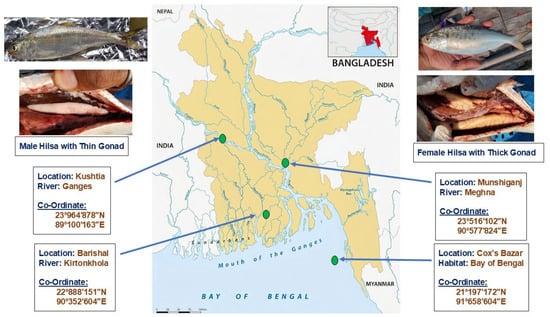
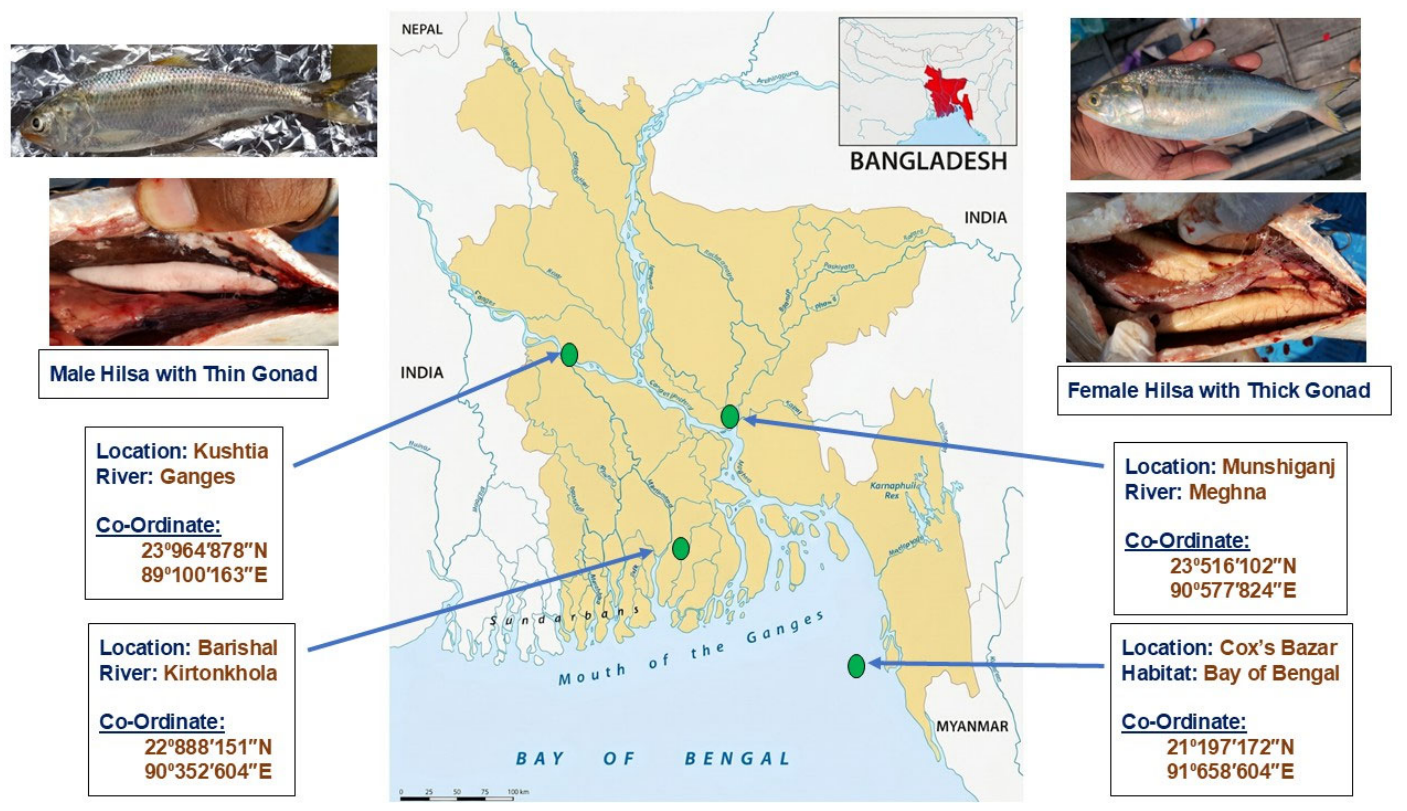
A total of 94 adult Hilsa (Tenualosa ilisha) (body weight ranging between 600 and 1100 g) were collected from four sites of Bangladesh including three different major river systems and the Bay of Bengal (Figure 1 and Table 1). Phenotypic sexes (male and female) of all individuals were identified at the sampling sites by observation of genital pore and gonads (testes and ovaries). Freshly collected individuals of Hilsa were dissected on the fishermen’s boats and pectoral fins and muscle tissues were sampled to immediately preserve in 90% ethanol. Ethanol-preserved Hilsa tissue samples were brought to the Fish Biology and Genetics laboratory of Fisheries and Marine Resource Technology Discipline, Khulna University, for DNA extraction using a kit (Qiagen, Hilden, Germany). The quality of the DNA samples was evaluated in 2% agarose gel electrophoresis and quantified in Nano-Drop (Nabi, Seoul, Republic of Korea). DNA extractions were performed according to the required animal ethics clearance approved by the Animal Ethics Committee under the Research and Innovation Center (RIC), Khulna University (Ref. No.: KUAEC-2021/09/21). High-quality DNA samples were sent to the Diversity Array Technology (DArT) PTY, LTD, University of Canberra, Australia, for NGS.
Figure 1.
Sampling sites (green circles) for the Hilsa fish collection from four different locations of Bangladesh.
Table 1.
Sampling sites and number of individuals collected from each location to discover the mode of sex determination and sex-linked markers of Hilsa (Tenualosa ilisha).
2.2. Diversity Arrays Technology Sequencing (Dart-Seq) and Data Processing
DNA library preparations and sequencing were performed at the DArT Facility that employs a high-throughput genotyping-by-sequencing method [23] using a pair of restriction enzymes for genomic complexity reduction. In brief, extracted DNA (≈200 ng per sample) from each sample was digested with PstI and SphI restriction enzymes. Adapter ligation reactions were then performed using the two restriction-specific adapters consisting of an Illumina flow-cell attachment region. Ligated fragments were subsequently enriched with 30 cycles of PCR including an initial denaturation step at 94 °C for 1 min, followed by 30 cycles of 94 °C for 20 s, 58 °C for 30 s, and 72 °C for 45 s, with a final extension at 72 °C for 7 min. Equimolar amounts of amplified products from each sample were sequenced in Illumina Hiseq2000 Platform (Illumina, San Diego, CA, USA) for single-read sequencing with 77 cycles (77 bases).
Approximately 5.8 million raw sequence reads were generated for each fish sample from the Illumina Hiseq2000. Raw sequences obtained from the Illumina were used for quality filtering to identify single nucleotide polymorphisms (SNPs) and restriction-site-associated polymorphism (Present/Absent) across the entire dataset. Raw sequence reads generated from Illumina were initially processed in proprietary DArT analytical pipelines (DArT PL). At first, the raw Fastq files were assessed to filter out the low-quality reads: sequences with reproducibility <90%, read depth <3.5 for SNPs or 5 for present/absent (PA) loci. Adapter sequences were then removed from the initial quality filtered reads. Trimmed and clean-read sequences were used for another quality filtering step by applying default threshold parameters (phred score >10). High-quality sequences were subsequently loaded in the secondary proprietary pipeline of DArT (DArTsoft14) for SNP and PA loci calling. Identified polymorphic SNPs and PA loci were listed in a csv file and provided as the initial dataset. Each homozygous SNP locus was presented as either “0”, alternatively known as “homozygous reference”, or “1”, alternatively known as “homozygous SNP”, while the heterozygous locus was presented as “2” in the initial dataset. If an allele failed to call successfully for an individual due to sequencing error or low-quality genomic DNA, the locus was presented as a null allele or “-”. For PA loci, the allele was presented as “1” and the absence of the allele in the genomic representation was referred to as “0”. Similar to the SNP loci, null alleles for PA loci were also presented as “-”.
2.3. Identification of Sex-Linked Loci
Both the dominant (PA of restriction recognition site) and co-dominant (SNP) loci were assessed for identifying sex-linked loci of Hilsa. To identify the mode of sex determination in Hilsa, data was analyzed according to the methods outlined in [22,24]. First, we separated the dataset according to the phenotypic sexes (male and female) and filtered out loci (both SNPs and PA) that showed a call ratio below 80% in each sex. This was done to eliminate the probability of getting false-positive results because of the ambiguity in the allelic form of a locus with null allele. The remaining loci were tested for the presence of both male heterogametic sex determination (XX/XY) and female heterogametic sex determination (ZZ/ZW) systems. For SNPs, a locus was identified as sex-linked if it was 100% heterozygous in one sex and 100% homozygous in the opposite sex. For instance, in an XX/XY system, a locus is sex-linked only if it is heterozygous in all males (an XY form) and homozygous in all females (XX form). Similarly, for a ZZ/ZW system, loci that were heterozygous in all females (a ZW form) and homozygous in all males (a ZZ form) were identified as sex-linked. For PA loci, we applied the same filtering criteria as SNPs where markers were present in all individuals of one sex and absent in all individuals of the opposite sex. We used the “countif” formula in Microsoft Excel to identify sex-linked loci in Hilsa. The “rdist” function in the “rdist” package for the computational platform “R” version 3.6.2 [24] was used to calculate the Pairwise genetic distance (Hamming distance matrix). The Cochran–Armitage trend test (CATT) was performed using R package “CATT” version 2.0 [25].
2.4. Basic Local Alignment Search Tool (BLAST) to Identify Sex-Determining Genes
To identify candidate sex-determining genes in T. ilisha, we performed BLAST (https://blast.ncbi.nlm.nih.gov/Blast.cgi, accessed on 20 January 2026) searches using the sequences of all sex-linked SNP and PA loci against the T. ilisha draft genome and also against the NCBI database. A strict stringency for the BLAST search was applied against the draft genome of Hilsa (10−6) for precisely identifying sex-linked gene/s and genomic regions [26,27]. We followed which genes or genomic regions of Hilsa genome were BLAST-searched against the NCBI database using a relax stringency of e value (10−3) to find out the name of the sex-linked gene/s [28,29]. In parallel, sequences of all sex-linked SNP and PA loci were also BLAST-searched against the NCBI database to receive wider coverage of sex-linked genes [27,30]. This is because the Hilsa draft genome is not well-annotated. Therefore, BLAST-searching against the NCBI database helped identify a higher number of sex-linked genes.
2.5. Estimating Random Sex-Linkage
As high-throughput sequencing provides thousands of markers, we preferred to estimate the probability that some of these markers might show random associations with sex. This could be challenging particularly if the sample size is small [31]. The following formula describes the probability of a locus being sex-linked by chance:
Pi = 0.5n
Here, P is the probability that a given locus, “i” is sex-linked. The probability that either a female or a male is homozygous at a given locus is 0.5. The number of individuals sequenced at the locus is n. After sequencing, we multiplied P by the number of high-quality SNPs to estimate how many SNPs were expected to exhibit a sex-linked pattern by chance. Using this calculation, we valued the estimated number of expected sex-linked markers produced by chance across a range of sample sizes and loci for comparisons with other studies.
2.6. Population Genetic Structure Analysis
Principle Coordinates Analysis (PCoA) was undertaken on all males and females from each locality using “dartR”, version 2.7.2 [32], and the results were plotted using “ggplot2” version 3.4.2 [33]. The genetic structure was estimated using the program Structure, version 2.3.4 [34]. The analysis was performed for a presumed number of populations “K” = from 1 to 10. Using an admixture model, the analysis was run 10 times for each “K” value, with 10,000 burn-in length and 10,000 MCMC replication after burn-in. The overall genetic differentiation among localities as well as between sexes was estimated using Analysis of Molecular Variance (AMOVA), undertaken using the function “poppr.amova” in the package “poppr”, version 2.9.4 [35].
3. Results
Next-generation sequencing (NGS) of 94 Hilsa individuals by DArT-seq resulted in 31,696 SNPs and 12,754 PA loci. The mean call ratio in the SNP data (combining male and female) was 0.89 with a mean of 0.15 polymorphism information content (PIC). In the PA data, the mean call ratio was 0.93 while the mean PIC was 0.23.
3.1. Identification of Sex-Linked Markers
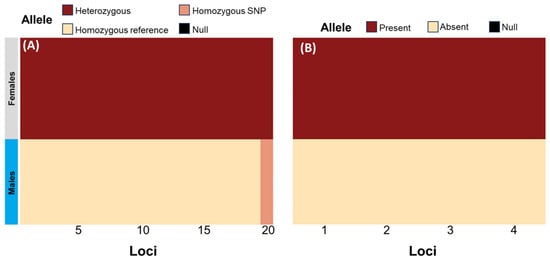
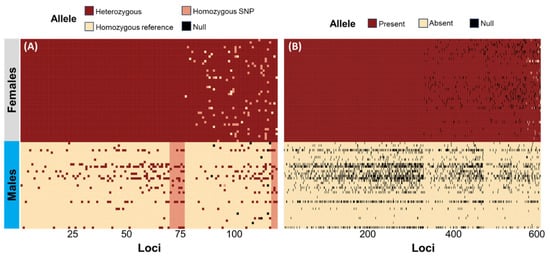
Our analysis resulted in 20 sex-linked SNPs, all of which were heterozygous in females and homozygous in males. In addition, four sex-linked PA loci were only present in females but not in males. Therefore, the findings conclusively identified a female heterogametic sex-determination system (ZZ/ZW) in the migratory river shad, Hilsa (Figure 2, Table 2 and Table S1). All 24 sex-linked loci were 100% concordant (Heterozygous/Present in females and homozygous/Absent in males) to our filtering criteria (Table 2). The mean reproducibility of the sex-linked SNP loci was 0.99 while the sex-linked PA loci were 1. The analysis did not detect any SNP and PA loci to suggest a male heterogametic sex-determination system (XX/XY) in Hilsa.
Figure 2.
Allelic form of sex-linked loci in Tenualosa ilisha from Bangladesh. (A) SNP loci. (B) PA loci. Heterozygous = loci with both alleles of an SNP present in an individual. Homozygous reference = loci with only reference allele of an SNP present in an individual. Homozygous SNP = loci with only the alternate allele (or the SNP allele) of an SNP present in an individual. Present = PA loci that are present in an individual. Absent = PA loci that are absent in an individual. Null = allele that has not been called.
Table 2.
Number and type of sex-linked markers identified in Tenualosa ilisha collected from four different locations of Bangladesh. SNP = single-nucleotide polymorphism. PA = presence or absence of the restriction recognition site.
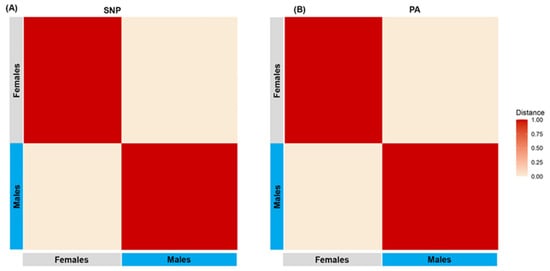
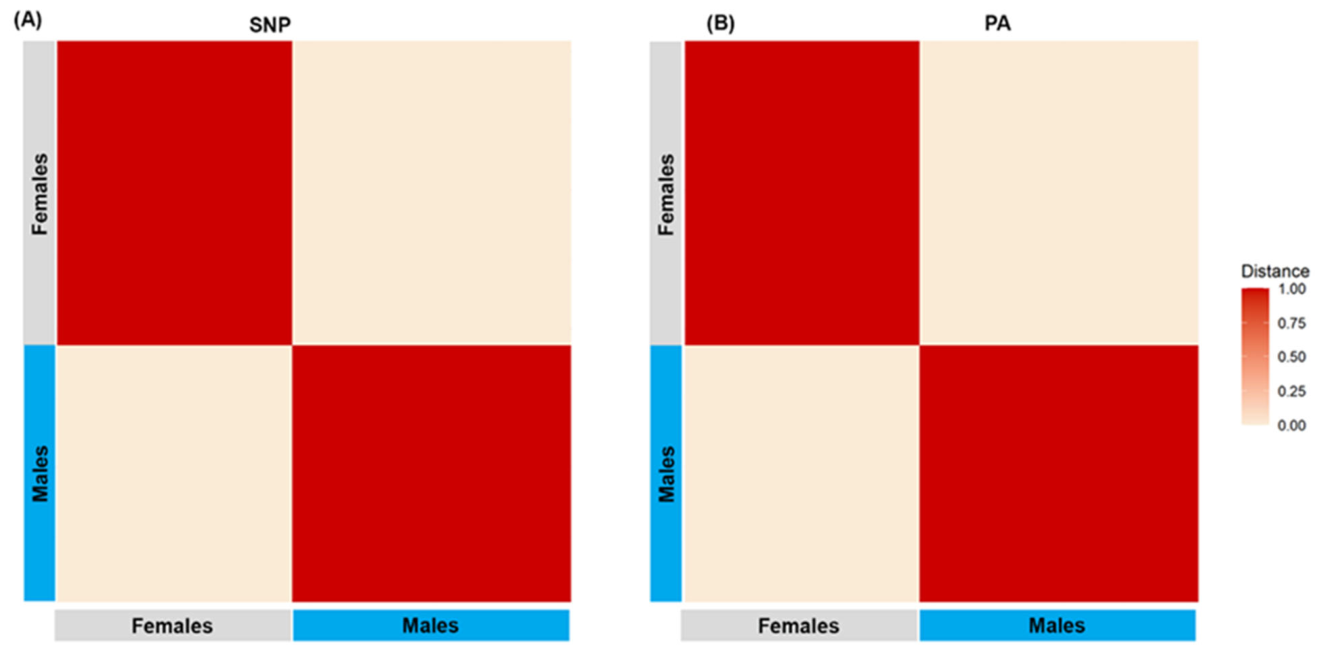
The pairwise Hamming distance matrix analysis using sex-linked SNPs and PA loci (Figure 3A,B) showed the highest differentiation between males and females, suggesting a 100% association of these markers to the putative sex chromosomes. The overall genetic distance between the two sexes of Hilsa was 1 for both SNP and PA loci. The Cochran–Armitage test verifies the significant association of all 20 SNP loci (z = 1, p =0) and four PA loci (z = 1, p =0) with phenotypic sexes.
Figure 3.
Pairwise Hamming distance matrix between males and females of Hilsa (Tenualosa ilisha): (A) sex-linked SNP loci with 0:100% (male: female) criterion and (B) sex-linked PA loci with 0: 100% (male: female) criterion.
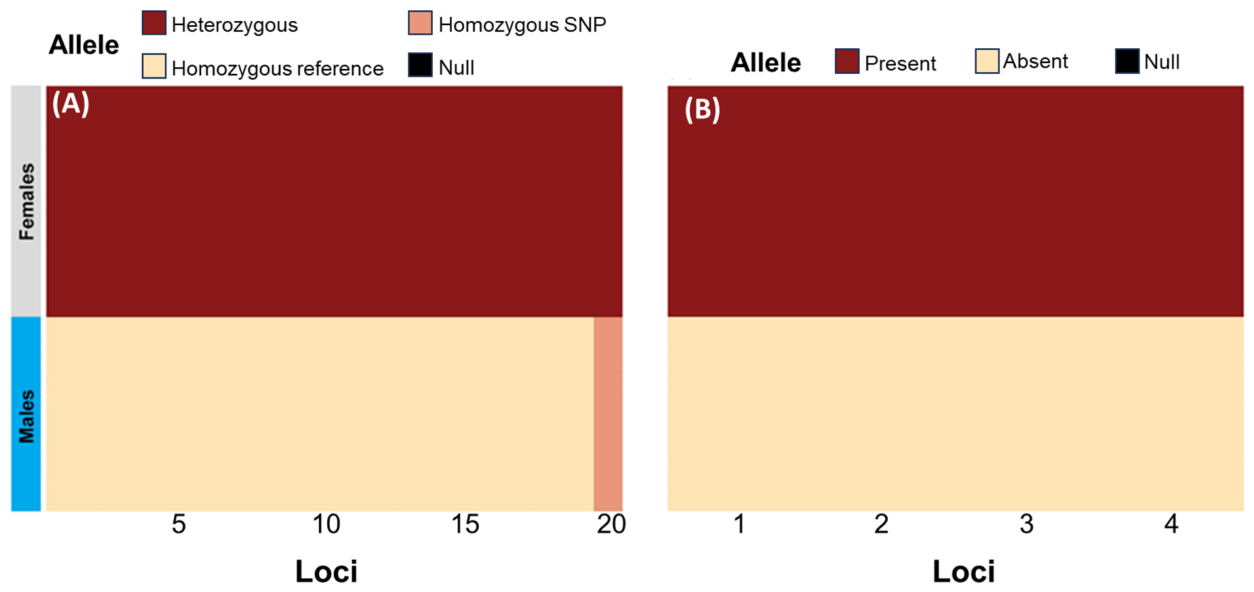
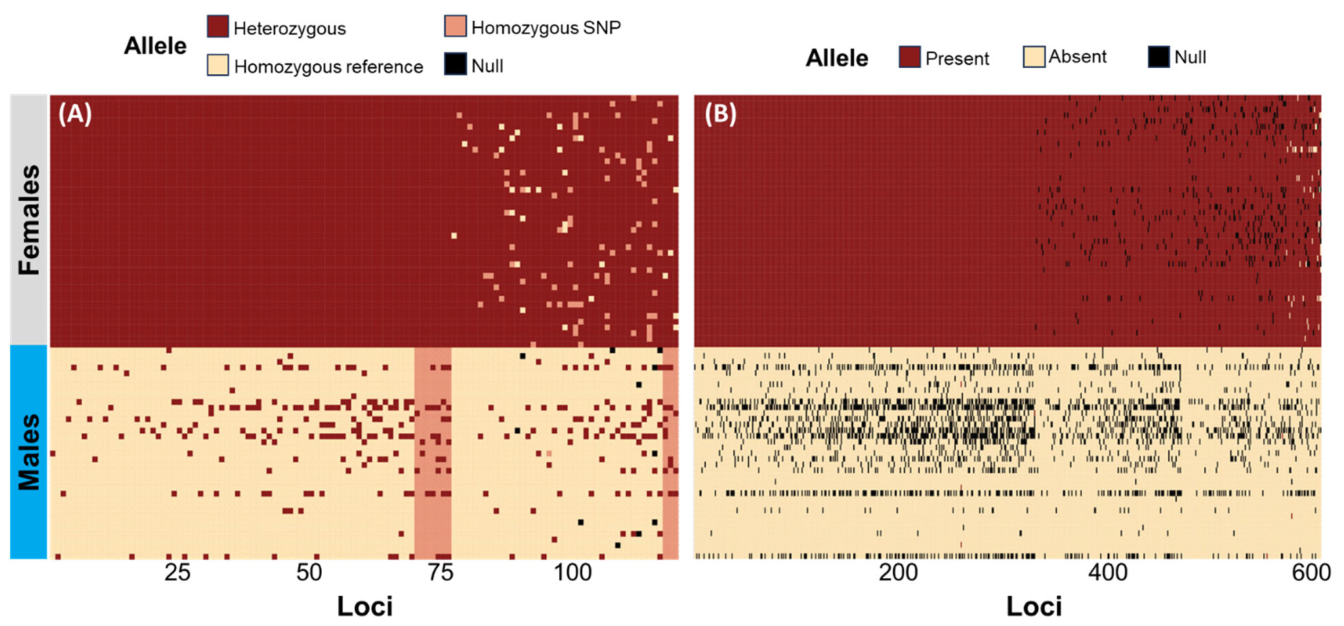
In addition to 24 sex-linked markers, we identified 119 sex-linked recombinant SNP and 607 PA loci that are not 100% but 80% or more concordant to each sex, supporting female heterogamety within this species (Figure 4) (Table S2). Out of 119 sex-linked recombinant SNPs, 76 loci showed a heterozygous allelic form in all females and a homozygous allelic form in 80% or more males. The rest 43 sex-linked recombinant SNPs showed 20% or less discordance in both sexes. Similarly for the sex-linked recombinant PA loci, out of 607, a total of 330 loci showed no discordance in female genotypes (present in 100% female) but 20% or less discordance in the male genotype. The remaining 277 PA loci showed 20% or less discordance in both sexes. However, the discordance with the sex-linked recombinant PA loci was predominantly raised from null allele instead of a present/absent allelic form (Figure 4).
Figure 4.
Allelic form of sex-linked recombinant loci in Tenualosa ilisha from Bangladesh. (A) SNP loci. (B) PA loci. Heterozygous = loci with both alleles of an SNP present in an individual. Homozygous reference = loci with only reference allele of an SNP present in an individual. Homozygous SNP = loci with only the alternate allele (or the SNP allele) of an SNP present in an individual. Present = PA loci that are present in an individual. Absent = PA loci that are absent in an individual. Null = allele that has not been called.
3.2. Population Genetic Structure and Test for Population-Specific Sex Determination
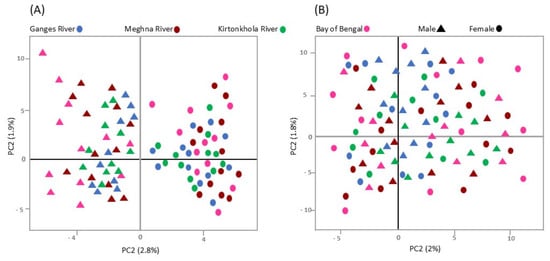
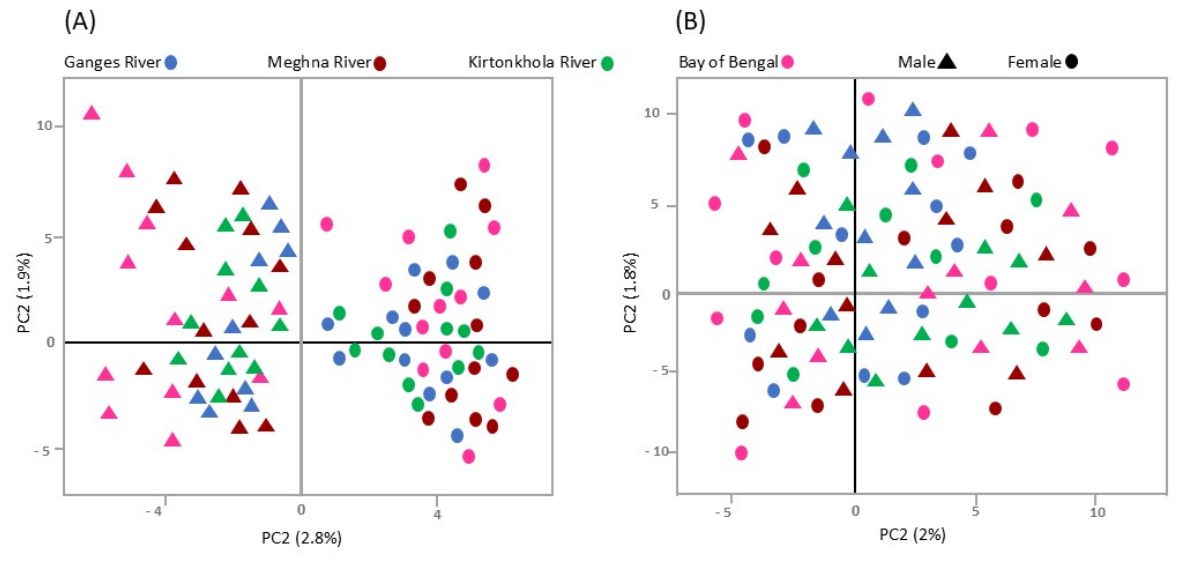
For population genetic analyses, we used the co-dominant SNP loci only. We initially filtered out loci that have a call ratio below 0.95, reproducibility below 0.9, and minor allele frequency below 0.05. This stringent filtering retained a total of 9391 SNPs out of 31,696. These include 20 sex-linked SNP loci, 119 sex-linked recombinant SNP loci and 9252 high-quality autosomal SNP loci. Principal coordinate analysis showed genetic clustering between sexes instead of sampling sites (Figure 5A). To investigate the potential population differentiation among the sampling sites in this species, we performed another principal coordinate analysis using 9252 high-quality autosomal SNPs (excluding the sex-linked and sex-linked recombinant SNPs). The PCA using autosomal loci indicates no genetic structure of this species across four sampling sites of Bangladesh. Almost minimal variation (between 1.8 and 2.8%) in each of the principal coordinates indicates the genetic clustering was attributed by the sex-linked loci in Figure 5A. To confirm that there is no genetic structure among localities, we performed a structure analysis along with an AMOVA test. The structure analysis confirms a lack of a genetic structure of this species within Ganges River, Meghna River, Arial Kha River and Bay of Bengal sites (Figure S1). The hierarchical AMOVA demonstrated that almost all the variation within this dataset was attributed to that within individuals (99.6% while tested against locations and 99.5% while tested against sexes) (Table 3). A 0.2% variation was attributed to variation among sampling sites while a 0.2% variation was attributed to that between sexes. The population genetic structure analysis distinctively indicates that all the samples used in this study belong to a single population.
Figure 5.
Principal coordinate analysis (PCoA) of Tenualosa ilisha from the four different locations of Bangladesh. (A) Comparisons among males and females while, (B) comparisons among the sampling sites.
Table 3.
Analysis of Molecular Variance (AMOVA) across locality and sexes using 9252 high-quality autosomal SNPs. * = significant with p < 0.05.
3.3. Genetic Diversity
The genetic diversity analysis was performed using 9252 high-quality autosomal SNPs. The overall observed heterozygosity (Ho) for all samples was 0.279 (±0.157), while the unbiased expected heterozygosity (uHe) was 0.278 (±0.133) (Table 4). The inbreeding coefficient (FIS) for all samples from the four locations was −0.005. The genetic diversity analysis across the four localities revealed variations in results: samples from the Ganges River and Bay of Bengal exhibited higher Ho than uHe. The highest observed heterozygosity was observed for the Bay of Bengal (Ho = 0.346 ± 0.114) followed by the Ganges (Ho = 0.311 ± 0.196), Arial Kha (Ho = 0.270 ± 0.165) and Meghna (0.255 ± 0.160). However, the unbiased expected heterozygosity was almost the same for all three localities (uHe in Arial Kha = 0.275 ± 0.143; in Ganges = 0.288 ± 0.145 and in Meghna = 0.270 ± 0.144). The inbreeding coefficient was 0.019 in Arial Kha, −0.093 in Bay of Bengal, −0.080 in Ganges and 0.057 in Meghna. In comparison between females and males, the observed and unbiased expected heterozygosity was 0.279 (±0.160) and 0.281 (±0.138) in females and 0.290 (±0.172) and 0.282 (±0.138) in males. The inbreeding coefficient in females was 0.028 and −0.026 in males.
Table 4.
Observed (Ho) and unbiased expected (uHe) heterozygosity for each locality, sex and overall, in Hilsha collected from four different sites of Bangladesh. FIS = (median) inbreeding coefficient.
3.4. Estimation of Random Sex-Linkage
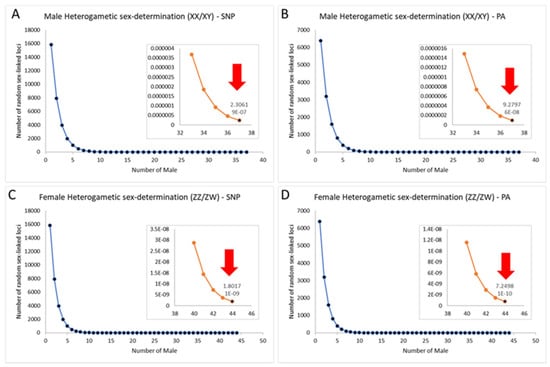
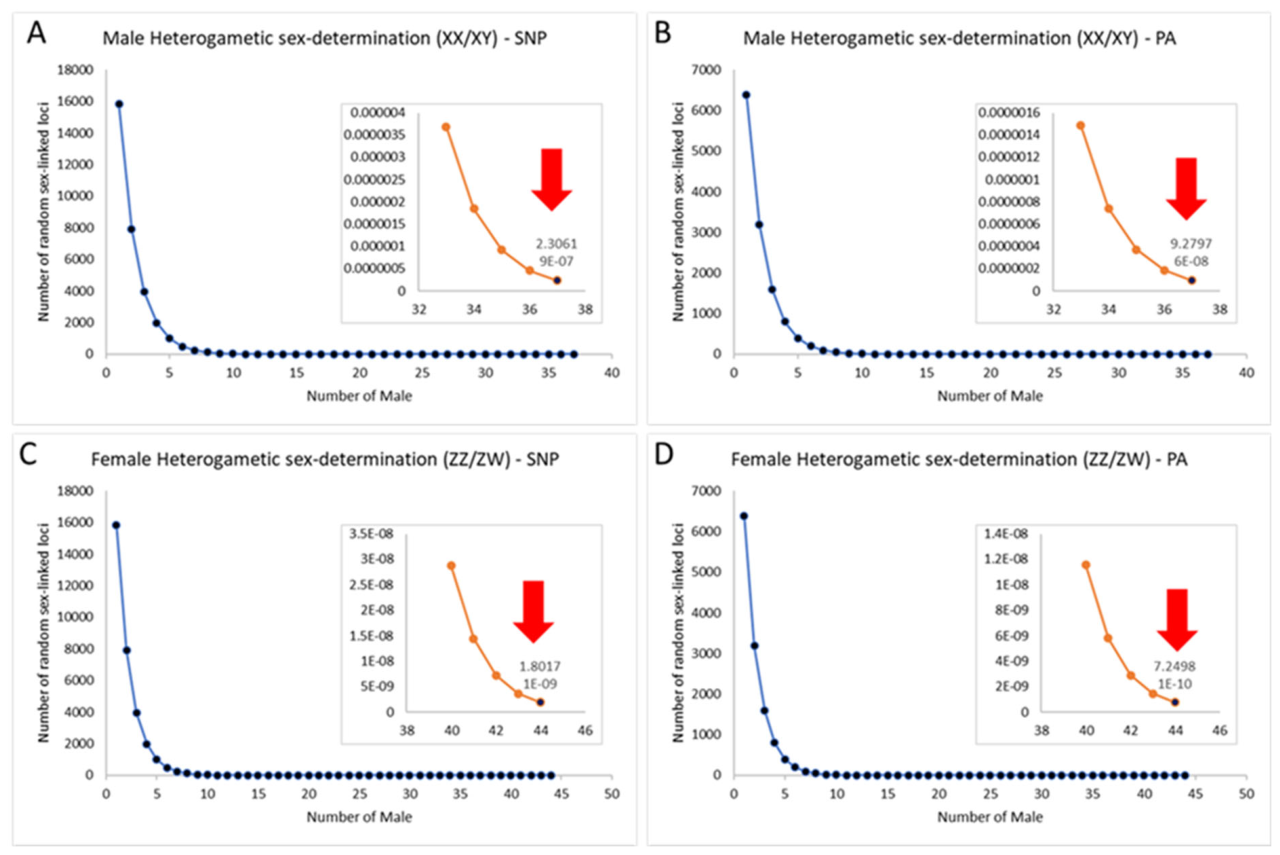
To estimate the probability of candidate loci that might show random associations with sex under a small sample size, we estimated the random sex-linkage for 46 males and 48 females using the 31,696 SNP and 12,754 PA loci (Figure 6A–D). The results indicate the probability of getting one spurious sex-linked SNP locus is 2.3 × 10⁻⁷ for a male heterogametic sex-determination system while this probability for PA loci is 9.3 × 10⁻⁸. Similarly, for a female heterogametic sex-determination system, the probability of getting one spurious SNP locus is 1.8 × 10⁻⁹ and for a sex-linked PA locus it is 7.2 × 10⁻¹⁰.
Figure 6.
Probability test for random sex-linkage against number of individual and loci analyzed in this study.
3.5. Putative Genes Relating to the Processes of Sex Determination in Tenualosa ilisha
A two-step BLASTn search (mapping against Hilsa draft genome and NCBI database) revealed identification of candidate genes with putative roles for sex determination in Tenualosa ilisha. Searching for homologous sequences in the T. ilisha (taxid: 373995) genome and also in the NCBI database identified four sex-linked SNPs and one sex-linked PA loci. These five sex-linked loci were found to be homologous to five different genes (JAG2B, MDN1, TULP4B, GRM1A and ZFP260-Like) based on sequence similarity with various fish species (Table 5).
Table 5.
Identification of putative sex-determining genes in Tenualos ilisha based on BLAST searching.
4. Discussion
Application of genotyping technique on 94 individuals (46 males and 48 females) of Hilsa (Tenualosa ilisha) resulted in the identification of 31,696 SNPs and 12,754 PA (present/absent) loci. Analysis of this large dataset conclusively identified a female heterogametic (ZZ/ZW) sex-determination system (homogametic ZZ male and heterogametic ZW female) for the study species. An adequate number of biological samples, sufficient sequencing depth, larger numbers of loci, higher call ratio and reproducibility of the dataset determine the success in precise isolation of sex-linked markers and the identification of sex-determination mechanisms in a species [19,36,37,38,39]. Relatively higher sample size from each sex, high number of initial loci to perform the sex-linked marker analyses and high mean call ratio and reproducibility of those loci strengthen the outcome of this study. Furthermore, the random sex-linkage analysis indicates that the markers identified as sex-linked in this study are certainly not so by chance and have a maximum association to each sex type.
This study identified a female heterogamety in T. ilisha where male individuals possess a pair of Z chromosomes while females possess one Z and one W chromosome as their sex chromosome. In a recent study using cytogenetic analyses, [40] reported absence of heteromorphic sex chromosomes in this species from Bangladesh. Along with the sex-linked loci, identification of many sex-linked recombinant loci (30 times higher than the sex-linked loci) supports the presence of a homomorphic sex chromosome pair that potentially goes through recombination in this species [22,41,42,43]. In another study, [44] indicated the presence of sexual dimorphism within the T. ilisha samples from Iran [44]. However, the author did not clearly indicate on which sex the polymorphism is present; a further investigation on sex determination and karyo-morphology of the species across its entire distribution range is needed [44].
Sex-linked loci have been proved to be informative and reliable not only for inferring the mode of sex determination in a particular species but also a molecular method of sexing individuals at any stage of their life cycle [39,45,46,47,48,49]. Identified sex-linked loci in this study will be an efficient method of molecular sexing of Hilsa (T. Ilisha). Furthermore, sex-linked loci identified in this study could serve as the first line of data to develop even simpler sexing methods such as a PCR assay for Hilsa. Such methods will be effective in shedding light on the sex reversal debate of this iconic fish species.
Two-step BLASTn searching against the T. ilisha genome and NCBI database identified five putative sex-lined genes including JAG2B, MDN1, TULP4B, GRM1A and ZFP260-Like. The protein-coding JAG2B gene is functionally involved in the Notch signaling pathway and essential for proper embryonic development [50,51,52]. On the other hand, working as a chaperone, the MDN1 gene is predicted to enable ATP binding activity and involved in ribosomal large-subunit assembly [24,49,53]. The TULP4B and GRM1A genes are functionally involved in protein ubiquitination and work as a receptor, respectively [28,54,55,56]. The ZFP260-like gene involved in transcription and transcription regulation plays a role as an activator [20,57,58]. None of these genes have been reported as sex-determining genes in previous studies. However, these five genes might play supporting/essential roles in the sex-determination pathway in Hilsa (and potentially broadly other fish) which requires further investigation.
Population genomic analysis revealed an absence of population structure among the four sampled populations in this study, indicating a single large population of Hilsa. Some degree of variation was observed between males and females irrespective of the populations. This is most likely because Hilsa spends most of its life cycle in the Bay of Bengal but migrates to the inland river systems for spawning. Earlier investigations revealed contrasting results: populations (different river systems) exhibited genetic variation [14,16] while no or very little genetic variation was observed between river systems and considered a single large population [9,11,12,59]. None of these studies tested sex-specific genetic variation and therefore, ignored chromosome-specific variations. Therefore, this study precisely documented the population genomic structure of Hilsa considering both sex- and habitat (river system)-specific samples and confirmed a single population of this species across its entire distribution range in Bangladesh (with limited/low genetic variation among sampling sites). Almost equal overall observed and expected heterozygosity (Table 4) indicates a smaller chance of inbreeding and thus, the wild stocks of Hilsa can still be considered adequate. Therefore, existing conservation strategies must be followed (banning Hilsa harvest during spawning season and also maintaining sanctuaries for larval development) strictly for the sustainable production of Hilsa.
Overall findings of this study provide several applied aspects for the aquaculture efficiency and conservation of Hilsa in Bangladesh. As female individuals of Hilsa are larger in size, females will be preferable to aqua farmers if the breeding technique of this species is developed. The female heterogametic sex-determination mechanism (ZW) will provide a fundamental clue to farmers for using hormonal sex-reversal combined with progeny testing to generate neo-males (genotypic females reversed phenotypically into males). On the other hand, a single genetic stock of Hilsa clearly indicates that the migratory cohorts are deeply connected with continuous gene flow. Therefore, nationwide bans on Hilsa harvesting during peak breeding season and also seasonal restrictions on juvenile (Jatka) harvesting can effectively safeguard the entire national stock simultaneously, rather than just isolated fragments. Hilsa is highly migratory and belongs to a single stock; protecting adult spawners and nursing juveniles in one specific sanctuary can directly replenish the populations in other parts of the country. Low genetic differentiation is clearly indicative of a high gene flow throughout the migratory routes [60,61,62,63,64,65,66,67], and therefore, localized genetic collapses are less of a pressing danger than physical barriers. As a single genetic stock, broodstock collected from any viable location of Bangladesh can be used for captive breeding, and offspring can be safely released into any river basin to boost wild populations (there is no risk of genetic pollution).
5. Conclusions
The current study provides the first genomic resource for identifying a sex-determination mechanism, sex-linked loci and putative sex-determining genes of the migratory river shad, Tenualosa ilisha. Results of this study conclusively identified a ZZ/ZW sex-determining system for Hilsa (female heterogametic system which is the mirror image of the XY system). In addition, a comprehensive number of sex-linked loci (20 SNP markers and four PA) were identified that provide ideal opportunities to validate the identified markers in the future. The study also revealed five putative genes that are likely to be involved with the processes related to sex determination in Hilsa. Population genetic structure revealed a single population of Hilsa from its entire distribution range in Bangladesh; sampling sites exhibited lower genetic variation with a relatively higher amount of variation among the males and females (irrespective of sampling sites). Results of this study will act as a foundation to investigate different biological questions of interest at a finer scale, including PCR validation of the identified sex-linked makers, characterization and expression profiling of the sex-determining genes, and testing the possibility of sex reversal (hermaphroditism) in its life cycle. These future works will undoubtedly help to achieve target goals, including aquaculture/farming and management to ensure the sustainable production of Hilsa.
Supplementary Materials
The following supporting information can be downloaded at: https://www.mdpi.com/article/10.3390/dna6030035/s1, Table S1: Number and sequences of the sex-linked markers (20 SNP and 4 PA loci) of Hilsa samples. Table S2: Number and sequences of the autosomal markers for the Hilsa fish samples. Figure S1: Structure plots using 9252 high-quality autosomal SNPs of Hilsa (Tenualosa ilisha) suggesting no genetic structure of Tenualosa ilisha across the four sampling sites of Bangladesh.
Author Contributions
Conceptualization, M.N.K., M.N.N., D.A.H. and M.L.R.; Methodology, M.N.K., M.N.N., D.A.H., T.E. and M.L.R.; Validation, M.N.K., W.A., F.S., T.E. and M.L.R.; Formal Analysis, M.N.K., F.S., T.E. and M.L.R.; Investigation, M.N.K., W.A. and M.L.R.; Data Curation, M.N.K., W.A., F.S. and M.L.R.; Writing—Original Draft Preparation, M.N.K., W.A. and F.S.; Writing—Review and Editing, D.A.H., T.E. and M.L.R.; Visualization, F.S. and M.L.R.; Supervision, M.N.N. and M.L.R.; Project Administration, M.L.R. All authors have read and agreed to the published version of the manuscript.
Funding
This project was funded by the BAS-USDA Endowment Program, Bangladesh Academy of Sciences. Grant ID: 4th Phase BAS-USDA KU FI–21.
Institutional Review Board Statement
The animal study protocol was approved by the Animal Ethics Committee (ACE) of Khulna University (protocol code: KUAEC-2021/09/20; date of approval: 20 September 2010).
Informed Consent Statement
Not applicable.
Data Availability Statement
Preliminary data are uploaded as supplementary documents. Data will be available upon reasonable request.
Acknowledgments
We (all the authors) acknowledge the grant support provided by the Bangladesh Academy of Sciences (BAS). The authors are grateful to the local fishermen for their support during sampling.
Conflicts of Interest
The authors declare no conflicts of interest.
References
- Ahsan, D.A.; Naser, M.N.; Bhaumik, U.; Hazra, S.; Bhattacharya, S.B. Migration, Spawning Patterns and Conservation of Hilsa Shad (Tenualosa ilisha) in Bangladesh and India. In IUCN, International Union for Conservation of Nature and Natural Resources, 1st ed.; IUCN: Gland, Switzerland, 2014. [Google Scholar]
- Hehera, B.K.; Singh, N.S.; Paria, P. Population genetic structure of Indian Shad, Tenualosa ilisha inferred from variation in mitochondrial DNA sequences. J. Environ. Biol. 2015, 36, 1193–1197. [Google Scholar]
- DoF (Department of Fisheries). Yearbook of Fisheries Statistics of Bangladesh 2021-22; Ministry of Fisheries and Livestock and Department of Fisheries: Dhaka, Bangladesh, 2023; Volume 38, 138p. [Google Scholar]
- Akram, W.; Tabassum, M.; Rahi, M.L. Cellular, Physiological, and Biochemical Basis of Adaptive Response to Variable Osmotic Environments by the River Shad, Tenualosa ilisha. J. Appl. Ichthyol. 2023, 2023, 4910938. [Google Scholar] [CrossRef] [Scilit]
- Mou, S.N.; Rupa, A.A.; Chowdhury, M.A.A.; Rahi, M.L.; Baten, A.; Ali, A.A.; Khan, H.; Amin, M.A.; Islam, M.R. Muscle transcriptome provides insights into the allergen profile of habitat specific mature hilsa shad (Tenualosa ilisha). Curr. Chin. Sci. 2024, 4, 202–213. [Google Scholar] [CrossRef] [Scilit]
- Chowdhury, M.A.A.; Islam, M.R.; Amin, A.; Mou, S.N.; Ullah, K.N.; Baten, A.; Shoyaib, M.; Ali, A.A.; Chowdhury, F.T.; Rahi, M.L.; et al. Integrated transcriptome catalog of Tenualosa ilisha as a resource for gene discovery and expression profiling. Sci. Data 2023, 10, 214. [Google Scholar] [CrossRef] [Scilit] [PubMed]
- Rupa, A.A.; Mou, S.N.; Chowdhury, M.A.A.; Rahi, M.L.; Ali, A.A.; Khan, H.; Amin, M.A.; Islam, M.R. Deciphering salinity-induced transcriptomic variations in osmoregulatory tissues gills and kidney of Hilsa shad (Tenualosa ilisha). Biores. Commun. 2025, 11, 1764–1777. [Google Scholar] [CrossRef] [Scilit]
- Hossain, M.S.; Sharifuzzaman, S.M.; Rouf, M.A.; Pomeroy, R.S.; Hossain, M.D.; Chowdhury, S.R.; Uddin, S.A. Tropical hilsa shad (Tenualosa ilisha): Biology, fishery and management. Fish Fish. 2018, 20, 44–65. [Google Scholar] [CrossRef] [Scilit]
- Sunny, A.R.; Bhuyian, M.S.; Sazzad, S.A.; Miah, M.F.; Ashrafuzzaman, M.; Islam, K.; Mamun, M.A.A.; Prodhan, S.H. Nexus of Ecosystem Services and Hilsa (Tenualosa ilisha) Genetic Diversity to Strengthen Wetland Conservation Policy Within the SDG Framework. Oceans 2026, 7, 38. [Google Scholar] [CrossRef] [Scilit]
- Das, A.; Ianakiev, P.; Baten, A.; Nehleen, R.; Ehsan, T.; Ahmed, O.; Islam, M.R.; Naser, M.N.; Marma, M.S.; Khan, H. Genome of Tenualosa ilisha from the river Padma, Bangladesh. BMC Res. Notes 2018, 11, 921. [Google Scholar] [CrossRef] [Scilit] [PubMed]
- Sarker, A.; Jiang, J.; Naher, H.; Huang, J.; Sarker, K.K.; Yin, G.; Baqki, M.A.; Li, C. Cross-species gene enrichment revealed a single population of Hilsa shad (Tenualosa ilisha) with low genetic variation in Bangladesh waters. Sci. Rep. 2021, 11, 11560. [Google Scholar] [CrossRef] [Scilit] [PubMed]
- Alam, M.N.; Khan, M.G.Q.; Mollah, M.B.R.; Alam, M.S.; Hasan, S.S.; Islam, M.S. Genetic diversity, population structure, and demographic history of anadromous Hilsa shad (Tenualosa ilisha) across diverse geographical regions: A comparative study between Bangladesh and Iraq. Ecol. Evol. 2026, 16, e73524. [Google Scholar] [CrossRef] [Scilit] [PubMed]
- Devlin, R.H.; Nagahama, Y. Sex determination and sex differentiation in fish: An overview of genetic, physiological, and environmental influences. Aquaculture 2002, 208, 191–364. [Google Scholar] [CrossRef] [Scilit]
- Asaduzzaman, M.; Igarashi, Y.; Wahab, M.A.; Nahiduzzaman, M.; Rahman, M.J.; Phillips, M.J.; Huang, S.; Asakawa, S.; Rahman, M.M.; Wong, L.L. Population Genomics of an Anadromous Hilsa Shad Tenualosa ilisha Species across its diverse migratory habitats: Discrimination by fine-scale local adaptation. Genes 2019, 11, 46. [Google Scholar] [CrossRef] [Scilit] [PubMed]
- Mohindra, V.; Dangi, T.; Tripathi, R.K.; Kumar, R.; Singh, R.K.; Jena, J.K.; Mohapatra, T. Draft genome assembly of Tenualosa ilisha, Hilsa shad, provides resource for osmoregulation studies. Sci. Rep. 2019, 9, 16511. [Google Scholar] [CrossRef] [Scilit] [PubMed]
- Asaduzzaman, M.; Wahab, M.A.; Rahman, M.M.; Nahiduzzaman, M.; Rahman, M.J.; Roy, B.K.; Philips, M.J.; Wong, L.L. Morpho-genetic divergence and adaptation of anadromous Hilsa shad (Tenualosa ilisha) along their heterogenic migratory habitats. Front. Mar. Sci. 2020, 7, 538968. [Google Scholar] [CrossRef] [Scilit]
- Mahmoud, A.A.; Brunelli, J.P.; Drew, R.E.; Thorgaard, G.H. Mapping of five candidate sex-determining loci in rainbow trout (Oncorhynchus mykiss). BMC Genet. 2009, 10, 2. [Google Scholar] [CrossRef] [Scilit] [PubMed]
- Islam, M.M.; Essam, Y.M.; Ali, L. Economic incentives for sustainable Hilsa fishing in Bangladesh: An analysis of the legal and institutional framework. Mar. Policy 2016, 68, 8–22. [Google Scholar] [CrossRef] [Scilit]
- Suntronpong, A.; Panthum, T.; Laopichienpong, N.; Nguyen, D.H.M.; Kraichak, E.; Singchat, W.; Ariyaraphong, N.; Ahmad, S.F.; Muangmai, N.; Duengkae, P.; et al. Implications of genome-wide single nucleotide polymorphisms in jade perch (Scortum barcoo) reveals the putative XX/XY sex-determination system, facilitating a new chapter of sex control in aquaculture. Aquaculture 2022, 548, 737587. [Google Scholar] [CrossRef] [Scilit]
- Payet, S.D.; Pratchett, M.S.; Saenz-Agudelo, P.; Berumen, M.L.; DiBattista, J.D.; Harrison, H.B. Demographic histories shape population genomics of the common coral grouper (Plectropomus leopardus). Evol. Appl. 2022, 15, 1221–1235. [Google Scholar] [CrossRef] [Scilit] [PubMed]
- Alexander, H.J.; Richardson, J.M.L.; Edmands, S.; Anholt, B.R. Sex without sex chromosomes: Genetic architecture of multiple loci independently segregating to determine sex ratios in the copepod Tigriopus californicus. J. Evol. Biol. 2015, 28, 2196–2207. [Google Scholar] [CrossRef] [Scilit] [PubMed]
- Abozaid, H.; Wessels, S.; Hörstgen-Schwark, G. Effect of rearing temperatures during embryonic development on the phenotypic sex in zebrafish (Danio rerio). Sex. Dev. 2011, 5, 259–265. [Google Scholar] [CrossRef] [Scilit] [PubMed]
- Kilian, A.; Wenzl, P.; Huttner, E.; Carling, J.; Xia, L.; Blois, H.; Caig, V.; Heller-Uszynska, K.; Jaccoud, D.; Hopper, C.; et al. Diversity arrays technology: A generic genome profiling technology on open platforms. In Data Production and Analysis in Population Genomics: Methods and Protocols; Humana Press: Totowa, NJ, USA, 2012; pp. 67–89. [Google Scholar]
- Longo, G.C.; D′Amelio, K.; Larson, W.; Enciso, C.E.; Torre, J.; Minich, J.J.; Michael, T.P.; Craig, M.T. Population genomics reveals panmixia in Pacific Sardine (Sardinops sagax) of the North Pacific. Evol. Appl. 2025, 18, e70154. [Google Scholar] [CrossRef] [Scilit] [PubMed]
- R Core Team. R: A Language and Environment for Statistical Computing, v. 3.3.1; R Foundation for Statistical Computing: Vienna, Austria, 2017. [Google Scholar]
- Rahi, M.L.; Shah, M.S. Triploidization in rohu x mrigal hybrid and comparison of growth performance of triploid hybrid. Aquac. Res. 2012, 43, 1867–1879. [Google Scholar]
- Rahi, M.L.; Mather, P.B.; Ezaz, T.; Hurwood, D.A. The molecular basis of freshwater adaptation in prawns: Insights from comparative transcriptomics of three Macrobrachium species. Genome Biol. Evol. 2019, 11, 1002–1018. [Google Scholar] [CrossRef] [Scilit] [PubMed]
- Moshtaghi, A.; Rahi, M.L.; Mather, P.B.; Hurwood, D.A. Understanding the genomic basis of adaptive response to variable osmotic niches in freshwater prawns: A comparative intraspecific RNA-Seq analysis of Macrobrachium australiense. J. Hered. 2017, 108, 544–552. [Google Scholar] [CrossRef] [Scilit] [PubMed]
- Staelens, J.; Rombaut, D.; Vercauteren, I.; Argue, B.; Benzie, J.; Vuylsteke, M. High-density linkage maps and sex-linked markers for the black tiger shrimp (Penaeus monodon). Genetics 2008, 179, 917–925. [Google Scholar] [CrossRef] [Scilit] [PubMed]
- Ventura, T.; Aflalo, E.D.; Weil, S.; Kashkush, K.; Sagi, A. Isolation and characterization of a female-specific DNA marker in the giant freshwater prawn Macrobrachium rosenbergii. Heredity 2011, 107, 456–461. [Google Scholar] [CrossRef] [Scilit] [PubMed]
- Rahi, M.L.; Amin, S.; Mather, P.B.; Hurwood, D.A. Candidate genes that have facilitated freshwater adaptation by Palaemonid prawns in the genus Macrobrachium: Identification and expression validation in a model species (M. koombooloomba). PeerJ 2017, 5, e2977. [Google Scholar] [CrossRef] [Scilit] [PubMed]
- Mijangos, J.L.; Gruber, B.; Berry, O.; Pacioni, C.; Georges, A. dartR v2: An accessible genetic analysis platform for conservation, ecology and agriculture. Methods Ecol. Evol. 2022, 13, 2150–2158. [Google Scholar] [CrossRef] [Scilit]
- Wickham, H.; Chang, W.; Wickham, M.H. Package ‘ggplot2’. In Create Elegant Data Visualisations Using the Grammar of Graphics; Version 2016; Volume 2, pp. 1–189. Available online: https://ggplot2.tidyverse.org/reference/ggplot2-package.html (accessed on 22 July 2026).
- Evanno, G.; Regnaut, S.; Goudet, J. Detecting the number of clusters of individuals using the software STRUCTURE: A simulation study. Mol. Ecol. 2005, 14, 2611–2620. [Google Scholar] [CrossRef] [Scilit] [PubMed]
- Kamvar, Z.N.; Tabima, J.F.; Grünwald, N.J. Poppr: An R package for genetic analysis of populations with clonal, partially clonal, and/or sexual reproduction. PeerJ 2014, 2, e281. [Google Scholar] [CrossRef] [Scilit] [PubMed]
- Bemmels, J.B.; Owens, G.L. Incorporating population genomic perspectives into kelp conservation and aquaculture in the Pacific Northwest. Evol. Appl. 2026, 19, e70287. [Google Scholar] [CrossRef] [Scilit] [PubMed]
- Ogata, M.; Hasegawa, Y.; Ohtani, H.; Mineyama, M.; Miura, I. The ZZ/ZW sex-determining mechanism originated twice and independently during evolution of the frog, Rana rugosa. Heredity 2018, 100, 92–99. [Google Scholar]
- Mank, J.E.; Avise, J.C. Evolutionary diversity and turn-over of sex determination in teleost fishes. Sex. Dev. 2009, 3, 60–67. [Google Scholar] [CrossRef] [Scilit] [PubMed]
- Richardson, J.M.L.; Alexander, H.J.; Anholt, B.R. Variance components of sex determination in the copepod Tigriopus californicus estimated from a pedigree analysis. Ecol. Evol. 2023, 13, e9997. [Google Scholar] [CrossRef] [Scilit] [PubMed]
- Horayra, M.A.; Khan, M.A.R.; Akbar, F.; Saha, S.; Chowdhury, M.; Begum, K.N. A Karyological Study of Tenualosa ilisha (Hamilton, 1822) from the Confluence of Padma and Meghna River of Bangladesh. Bangladesh J. Zool. 2021, 49, 243–255. [Google Scholar] [CrossRef] [Scilit]
- Otake, H.; Masuyama, H.; Mashima, Y.; Shinomiya, A.; Myosho, T.; Nagahama, Y.; Matsuda, M.; Hamaguchi, S.; Sakaizumi, M. Heritable artificial sex chromosomes in the medaka, Oryzias latipes. Heredity 2010, 105, 247–256. [Google Scholar] [CrossRef] [Scilit] [PubMed]
- Charlesworth, D. Evolution of recombination rates between sex chromosomes. Philos. Trans. R. Soc. B Biol. Sci. 2017, 372, 20160456. [Google Scholar] [CrossRef] [Scilit]
- Khanam, T.; Wehner, S.; Taggart, J.B.; de Verdal, H.; Benzie, J.A.H.; Bekaert, M.; McAndrew, B.J.; Penman, D.J. Sex determination in the GIFT strain of tilapia is controlled by a locus in linkage group. BMC Genet. 2020, 21, 49. [Google Scholar] [CrossRef] [Scilit]
- Majeed, M.H. Chromosomal study of Tenualosa ilisha fish from Shatt-Al-Arab River. J. Environ. Bio-Sci. 2016, 30, 59–60. [Google Scholar]
- Couch, A.J.; Unmack, P.J.; Dyer, F.J.; Lintermans, M. Who’s your mama? Riverine hybridization of threatened freshwater Trout and Murray Cod. PeerJ 2016, 4, e2593. [Google Scholar] [CrossRef] [Scilit] [PubMed]
- Bayés, À.; Collins, M.O.; Reig-Viader, R.; Gou, G.; Goulding, D.; Izquierdo, A. Evolution of complexity in the zebrafish synapse proteome. Nat. Commun. 2017, 8, 14613. [Google Scholar] [CrossRef] [Scilit] [PubMed]
- Gammerdinger, W.J.; Kocher, T.D. Unusual diversity of sex chromosomes in African cichlid fishes. Genes 2018, 9, 480. [Google Scholar] [CrossRef] [Scilit] [PubMed]
- Lockley, E.C.; Eizaguirre, C. Effects of global warming on species with temperature-dependent sex determination: Bridging the gap between empirical research and management. Evol. Appl. 2021, 14, 2361–2377. [Google Scholar] [CrossRef] [Scilit] [PubMed]
- Dung, H.M.N.; Thitipong, P.; Jatupong, P.; Nararat, L.; Ekaphan, K.; Worapong, S.; Ahmad, S.F.; Muangmai, N.; Peyachoknagu, S.; Na-Nakorn, U.; et al. An investigation of ZZ/ZW and XX/XY sex determination systems in north African catfish (Clarias gariepinus, Burchell, 1822). Front. Genet. 2021, 11, 562856. [Google Scholar] [CrossRef] [Scilit]
- Masly, J.P.; Presgraves, D.C. High-resolution genome-wide dissection of the two rules of speciation in drosophila. PLoS Biol. 2007, 5, e243. [Google Scholar] [CrossRef] [Scilit] [PubMed]
- Mank, J.E.; Hosken, D.J.; Wedell, N. Conflict on the sex chromosomes: Cause, effect, and complexity. Cold Spring Harb. Perspect. Biol. 2014, 6, a017715. [Google Scholar] [CrossRef] [Scilit] [PubMed]
- Zohu, Q.; Chen, S. Progress in studies of sex determination mechanisms and sex control techniques in Cynoglossus semilaevis. Front. Agric. Sci. Eng. 2016, 3, 113–123. [Google Scholar] [CrossRef] [Scilit]
- Hosseini, S.; Simianer, H.; Tetens, J.; Brenig, B.; Herzog, S.; Sharifi, A.R. Efficient phenotypic sex classification of zebrafish using machine learning methods. Ecol. Evol. 2019, 9, 13332–13343. [Google Scholar] [CrossRef] [Scilit] [PubMed]
- Rahi, M.L.; Mather, P.B.; Cioffi, M.B.; Ezaz, T.; Hurwood, D.A. Genomic basis of freshwater adaptation in the Palaemonid prawn genus Macrobrachium: Convergent evolution following multiple independent colonization events. J. Mol. Evol. 2023, 91, 976–989. [Google Scholar] [CrossRef] [Scilit] [PubMed]
- Alexander, D.H.; Novembre, J.; Lange, L. Fast model-based estimation of ancestry in unrelated individuals. Genome Res. 2009, 19, 1655–1664. [Google Scholar] [CrossRef] [Scilit] [PubMed]
- Pennell, M.W.; Mank, J.E.; Peichel, C.L. Transitions in sex determination and sex chromosomes across vertebrate species. Mol. Ecol. 2019, 27, 3950–3963. [Google Scholar]
- Wells, S.J.; Dale, J. Contrasting gene flow at different spatial scales revealed by genotyping-by-sequencing in Isocladus armatus, a massively colour polymorphic New Zealand marine isopod. PeerJ 2018, 6, e5462. [Google Scholar] [CrossRef] [Scilit] [PubMed]
- Rahi, M.L.; Mather, P.B.; Hurwood, D.A. Do plasticity in gene expression and physiological responses in Palaemonid prawns facilitate adaptive response to different osmotic challenges? Comp. Biochem. Physiol. Part A Mol. Integr. Physiol. 2021, 251, 110810. [Google Scholar] [CrossRef] [Scilit]
- Verma, R.; Singh, M.; Kumar, S. Unraveling the limits of mitochondrial control region to estimate the fine scale population genetic differentiation in anadromous fish Tenualosa ilisha. Scientifica 2016, 2016, 2035240. [Google Scholar] [CrossRef] [Scilit] [PubMed]
- Schiavon, L.; Desvignes, T.; Ronco, F.; Matschiner, M.; Gastaldi, M.; Koppetsch, T.; Schrøder-Nielsen, A.; Postlethwait, J.H.; Prestanti, A.; Stranci, F.; et al. Sex differentiation and long-distance gene flow in the elusive Antarctic fish Aethotaxis mitopteryx. Ecol. Evol. 2025, 15, e71847. [Google Scholar] [CrossRef] [Scilit] [PubMed]
- Bernal-Durán, V.; Donoso, D.; Piñones, A.; Jonsson, P.R.; Benestan, L.; Landaeta, M.F.; Naretto, J.; Gerard, K.; Haye, P.A.; Gonzalez-Wevar, C.; et al. Combining population genomics and biophysical modelling to assess connectivity Patterns in an Antarctic fish. Mol. Ecol. 2024, 33, e17360. [Google Scholar] [CrossRef] [Scilit] [PubMed]
- Bista, I.; Wood, J.M.D.; Desvignes, T.; McCarthy, S.A.; Matschiner, M.; Ning, Z.; Tracey, A.; Torrance, J.; Sims, Y.; Chow, W.; et al. Genomics of cold adaptations in the Antarctic Notothenioid fish radiation. Nat. Commun. 2023, 14, 3412. [Google Scholar] [CrossRef] [Scilit] [PubMed]
- Fauchet, L.; Ferchaud, A.-L.; Guay, J.-C.; Moore, J.; Derôme, N.; April, J.; Bernatchez, L. Multidisciplinary evaluation of a 10-year restoration program for two endangered Atlantic Salmon (Salmo salar) populations. Evol. Appl. 2026, 19, e70289. [Google Scholar] [PubMed]
- Carbonneau, A.; April, J.; Normandeau, E.; Ferchaud, A.-L.; Nadeau, V.; Bernatchez, L. Population genomics, life-history tactics, and mixed-stock subsistence fisheries in the northernmost American Atlantic salmon populations. Evol. Appl. 2024, 17, e13654. [Google Scholar] [CrossRef] [Scilit] [PubMed]
- Deflem, I.S.; Calboli, F.C.F.; Christiansen, H.; Hellemans, B.; Raeymaekers, J.A.M.; Volckaert, F.A.M. Contrasting population genetic responses to migration barriers in two native and an invasive freshwater fish. Evol. Appl. 2022, 15, 2010–2027. [Google Scholar] [CrossRef] [Scilit] [PubMed]
- Pedrazzini, C.; Strasser, H.; Zemp, N.; Holderegger, R.; Widmer, F.; Enkerli, J. Spatial and temporal patterns in the population genomics of the European cockchafer Melolontha melolontha in the Alpine region. Evol. Appl. 2023, 16, 1586–1597. [Google Scholar] [CrossRef] [Scilit] [PubMed]
- Brennan, R.S.; Healy, T.M.; Bryant, H.J.; La, V.; Schulte, P.M.; Whitehead, A. Integrative population and physiological genomics reveals mechanisms of adaptation in Killifish. Mol. Biol. Evol. 2018, 35, 2639–2653. [Google Scholar] [CrossRef] [Scilit] [PubMed]

Disclaimer/Publisher’s Note: The statements, opinions and data contained in all publications are solely those of the individual author(s) and contributor(s) and not of MDPI and/or the editor(s). MDPI and/or the editor(s) disclaim responsibility for any injury to people or property resulting from any ideas, methods, instructions or products referred to in the content. |
© 2026 by the authors. Licensee MDPI, Basel, Switzerland. This article is an open access article distributed under the terms and conditions of the Creative Commons Attribution (CC BY) license.