


Abstract
Agroindustrial residues represent heterogeneous biomass resources whose anaerobic conversion can be strongly influenced by pretreatment. This study evaluated seven residues: banana peel, potato peel, pineapple peel, coconut fiber, maize cob, coffee parchment, and cocoa parchment, under untreated, organosolv-treated, and precomposted conditions. Physicochemical and bromatological properties were characterized across the three biomass conditions, whereas baseline lignocellulosic composition was determined only for untreated materials. Methane production and biogas composition were assessed for the organosolv-treated and precomposted residues. Organosolv and precomposting produced contrasting compositional responses. Precomposted materials showed lower chemical oxygen demand and volatile-solid proportions, whereas organosolv largely preserved the organic fraction and increased the relative contribution of fiber and carbohydrates. Biochemical methane potential (BMP) differed markedly between pretreatments (p < 0.001), with organosolv-treated residues showing an average BMP 62.2% higher than that of precomposted residues. Methane concentration remained close to 50% and did not differ significantly between pretreatments. The first two principal components explained 79.2% of the compositional variation and showed distinct multivariate patterns among biomass conditions. Exploratory calculations based on experimental BMP and solids data estimated methane recoveries of 305.25 and 155.74 Nm3 CH4 t−1 wet biomass for organosolv-treated and precomposted materials, respectively. Under the conditions evaluated, organosolv showed greater potential for methane-oriented valorization and provides a basis for subsequent semi-continuous and pilot-scale evaluation.
1. Introduction
Agroindustrial processing produces a wide range of residual biomasses that retain considerable amounts of organic matter after the main product has been recovered. The magnitude of this resource is particularly relevant in Junín. In 2024, regional production reached approximately 503.0 thousand t of potato, 450.5 thousand t of pineapple, 222.8 thousand t of plantain, 67.4 thousand t of coffee, 35.3 thousand t of cocoa, and 22.4 thousand t of hard yellow maize, representing about 1.30 million t of primary agricultural biomass associated with six of the residue streams evaluated in this study [1]. When these materials have no defined use, their carbon and nutrient content remains underutilized. Anaerobic digestion provides a route for converting part of this organic fraction into methane while reducing the amount of biodegradable material remaining in the residue. Experimental assessments of agricultural wastes have shown substantial differences in methane production among feedstocks, even when they are evaluated under comparable digestion conditions [2].
This compositional heterogeneity becomes particularly relevant when residues from different agroindustrial chains are compared. Potato peel illustrates the behavior of a readily biodegradable food-processing residue, for which measurable methane recovery has been reported under mono-digestion and after mechanical or chemical pretreatment [3]. Pineapple residues provide a contrasting example in which digestion performance is strongly influenced by substrate formulation and operating conditions [4]. More lignocellulosic feedstocks show a different response: thermal pretreatment of coffee husks has improved anaerobic biodegradability [5], whereas cocoa residues have demonstrated methane production despite their more complex structural matrix [6]. These examples highlight that differences among residues may arise from composition, pretreatment response, or digestion conditions rather than from feedstock identity alone.
The structure of lignocellulosic biomass is one of the main factors that can restrict biological conversion. Cellulose and hemicellulose represent potentially degradable carbon sources, but their accessibility is reduced when they remain embedded within a lignin-rich matrix. For this reason, pretreatment is commonly directed toward altering the physical or chemical organization of the material before anaerobic digestion. Experiments with chemically treated areca husk showed that changes in lignocellulosic composition, solubilization, and volatile solids were closely associated with subsequent biogas production [7]. Similar responses have been reported for corn stalk, where pretreatment modified chemical properties relevant to anaerobic conversion and affected the accessibility of the organic fraction to microbial degradation [8].
Organosolv and biological pretreatments act through different pathways and therefore should not be expected to produce the same response across all feedstocks. Organosolv treatment uses an organic solvent system to modify the lignocellulosic matrix and remove part of the less accessible fraction. Its application to olive oil pomace improved the suitability of the residual material for anaerobic digestion and allowed the production of methane-rich biogas after treatment [9]. Precomposting follows a different route, relying on a controlled period of aerobic microbial activity before anaerobic digestion. Short composting pretreatments have been shown to modify substrate characteristics and the subsequent pattern of biogas production [10]. Biological pretreatment of corn straw has also demonstrated that changes occurring before digestion can improve degradation, although the magnitude of the response depends on treatment conditions and on the characteristics of the original biomass [11].
These contrasting responses make direct comparison among residues particularly useful. Biochemical methane potential provides a standardized measure of methane recovery relative to the volatile solids supplied, but methane yield alone does not explain why one substrate performs differently from another. Measurements of total and volatile solids, pH, chemical oxygen demand, ash, and related compositional variables provide complementary information on the condition of the organic fraction entering digestion. Studies of plant- and food-derived substrates have shown that methane potential varies with feedstock properties [12], while experimental digestion of agroindustrial residues has confirmed that substrate characteristics can influence gas production and process behavior [13]. Combining compositional characterization with methane yield therefore provides a stronger basis for comparing feedstocks.
From a biomass valorization perspective, pretreatment should also be assessed according to whether the compositional changes it produces improve the subsequent recovery of useful products. Sequential conversion schemes have shown that lignocellulosic residues can retain value after an initial treatment step and subsequently be directed toward biomethane production [14]. Because the same pretreatment may preserve biodegradable compounds in one residue while removing or consuming them in another, evaluating both composition and methane recovery is important when comparing valorization pathways for chemically diverse biomasses.
The present study evaluates seven agroindustrial residues in Peru—banana peel, potato peel, pineapple peel, coconut fiber, maize cob, coffee parchment, and cocoa parchment—using two contrasting pretreatment strategies: organosolv and precomposting; untreated materials were retained as compositional references, while the physicochemical changes associated with both pretreatments were evaluated through moisture, total and volatile solids, fixed solids, pH, chemical oxygen demand, ash, fat, protein, fiber, and carbohydrate-related parameters. Methane yield and biogas composition were subsequently assessed for the organosolv-treated and precomposted materials. The interpretation combines substrate characterization with biochemical methane potential because this joint approach provides a clearer basis for distinguishing feedstock quality and anaerobic conversion performance [15]. The study therefore aimed to determine how organosolv and precomposting influence biomass characteristics and methane recovery across seven agroindustrial residues, to identify the combinations with greater potential for anaerobic valorization, and to explore associations between biomass composition and methane yield. In addition, experimental BMP and solids data were used to derive exploratory indicators of methane recovery per unit of biomass and substrate requirement. It was hypothesized that the two pretreatments would produce contrasting effects on biomass characteristics and methane recovery across the evaluated residues.
2. Materials and Methods
2.1. Study Area
This study was conducted in Junín, Peru, and all laboratory analyses were performed at the School of Agroindustrial Engineering, Faculty of Engineering, Universidad Nacional Autónoma Altoandina de Tarma (UNAAT), in Acobamba, Tarma. Institutional information indicates that the Agroindustrial Engineering program operates within the university campus and associated laboratory facilities, while the UNAAT institutional repository identifies the campus location in Huancucro, Acobamba, along Carretera La Florida–Cochayoc km2 [16].
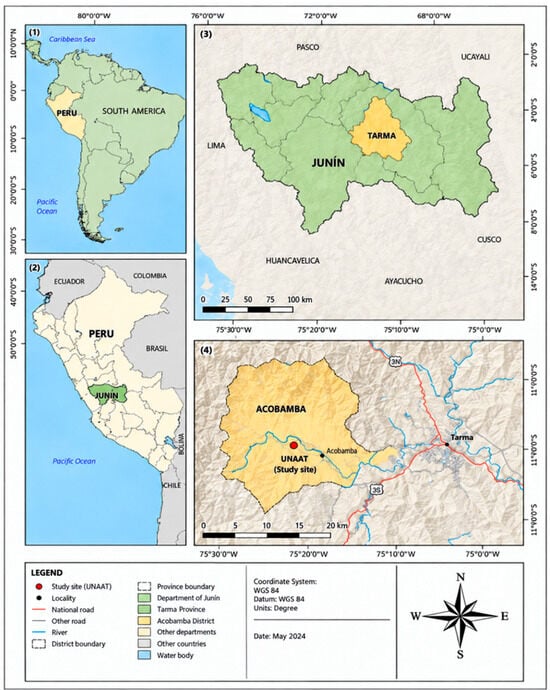
Tarma was used as the geographic reference for the study area. Official geographic information places the city of Tarma at approximately 11°25′ S and 75°41′ W, at about 3050 m above sea level. At a broader scale, the department of Junín is located in the central Andean region of Peru and includes both highland and montane environments, providing the regional agroecological context for the agricultural and agroindustrial activities associated with the residues evaluated in this study [17] (Figure 1).
Figure 1.
Geographic location of the study area in central Peru. (1) Location of Peru within South America; (2) location of the department of Junín within Peru; (3) location of Tarma Province within Junín; and (4) location of the study site at the School of Agroindustrial Engineering, Faculty of Engineering, Universidad Nacional Autónoma Altoandina de Tarma (UNAAT), in Acobamba, Tarma, Junín, Peru.
2.2. Raw Materials and Experimental Design
Seven agroindustrial residues generated in the Junín region of Peru were evaluated in this study: banana peel, potato peel, pineapple peel, coconut fiber, maize cob, coffee parchment, and cocoa parchment. Coconut fiber and maize cob were obtained from local markets in Tarma; pineapple peel was supplied by Greenbox SAC, Peru a local company in Tarma; banana peel was collected from local fried-banana vendors in El Pedregal, Chanchamayo; potato peel was obtained from the university dining facility; and coffee and cocoa parchment were collected from a solid-waste treatment facility in Chanchamayo, Junín. The materials were transported to the INITA laboratory at the Universidad Nacional Autónoma Altoandina de Tarma (UNAAT) for preparation and subsequent analyses. After collection, the residues were air-dried and then oven-dried at 65 °C for approximately four days. The dried materials were ground, passed through a 425 µm sieve, vacuum-packed, and stored at room temperature under laboratory conditions (approximately 15 °C), protected from moisture and direct sunlight. Samples were stored for approximately 15 days before organosolv processing.
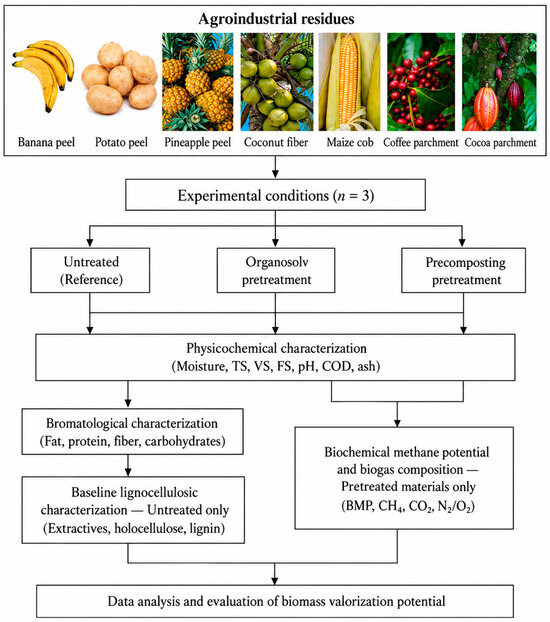
These materials were selected to represent contrasting agroindustrial residues with different physicochemical and compositional characteristics. The experimental approach considered three biomass treatment conditions for each residue: untreated material, organosolv-treated material, and precomposted material, generating 21 residue–treatment combinations. Untreated materials were used as compositional references. Physicochemical and bromatological analyses were performed across the three biomass conditions, baseline lignocellulosic composition was determined only for untreated materials, and methane production and biogas composition were evaluated for the organosolv-treated and precomposted residues. The corresponding analytical procedures are described in the following subsections (Figure 2).
Figure 2.
Experimental workflow for the seven agroindustrial residues evaluated under untreated, organosolv-treated, and precomposted conditions. Physicochemical and bromatological characterization was performed across the three biomass conditions, whereas baseline lignocellulosic composition was determined only for the untreated materials. Biogas composition and biochemical methane potential were evaluated only for the organosolv-treated and precomposted residues.
2.3. Pretreatment Procedures
2.3.1. Organosolv Pretreatment
The organosolv pretreatment used an ethanol–acetic acid system adapted from Hernández et al. [18]. The prepared biomass described in Section 2.2 was introduced into a 5 L high-pressure digester at a dry-basis mass of 400 g. The reactor then received 2.0 L of distilled water, 2.0 L of ethanol, and 12 mL of acetic acid and was sealed and maintained at 175 °C for 2.5 h. After cooling, the treated material was filtered to separate the solid and liquid fractions. The solid fraction was washed with distilled water and dried at room temperature before subsequent characterization and anaerobic digestion, while the liquid fraction containing the solubilized components was retained separately.
2.3.2. Precomposting Pretreatment
Precomposting was applied as a biological pretreatment to the seven agroindustrial residues. After pretreatment, the recovered biomass was used for physicochemical and bromatological characterization and for the anaerobic digestion assays. Precomposting was evaluated as a contrasting treatment to organosolv because biological pretreatments can modify biomass characteristics through a different pathway before anaerobic conversion [19].
2.4. Anaerobic Digestion Assay and Reactor Operation
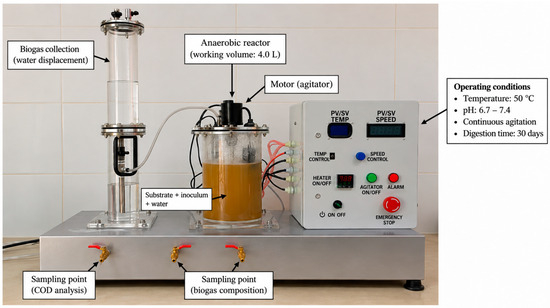
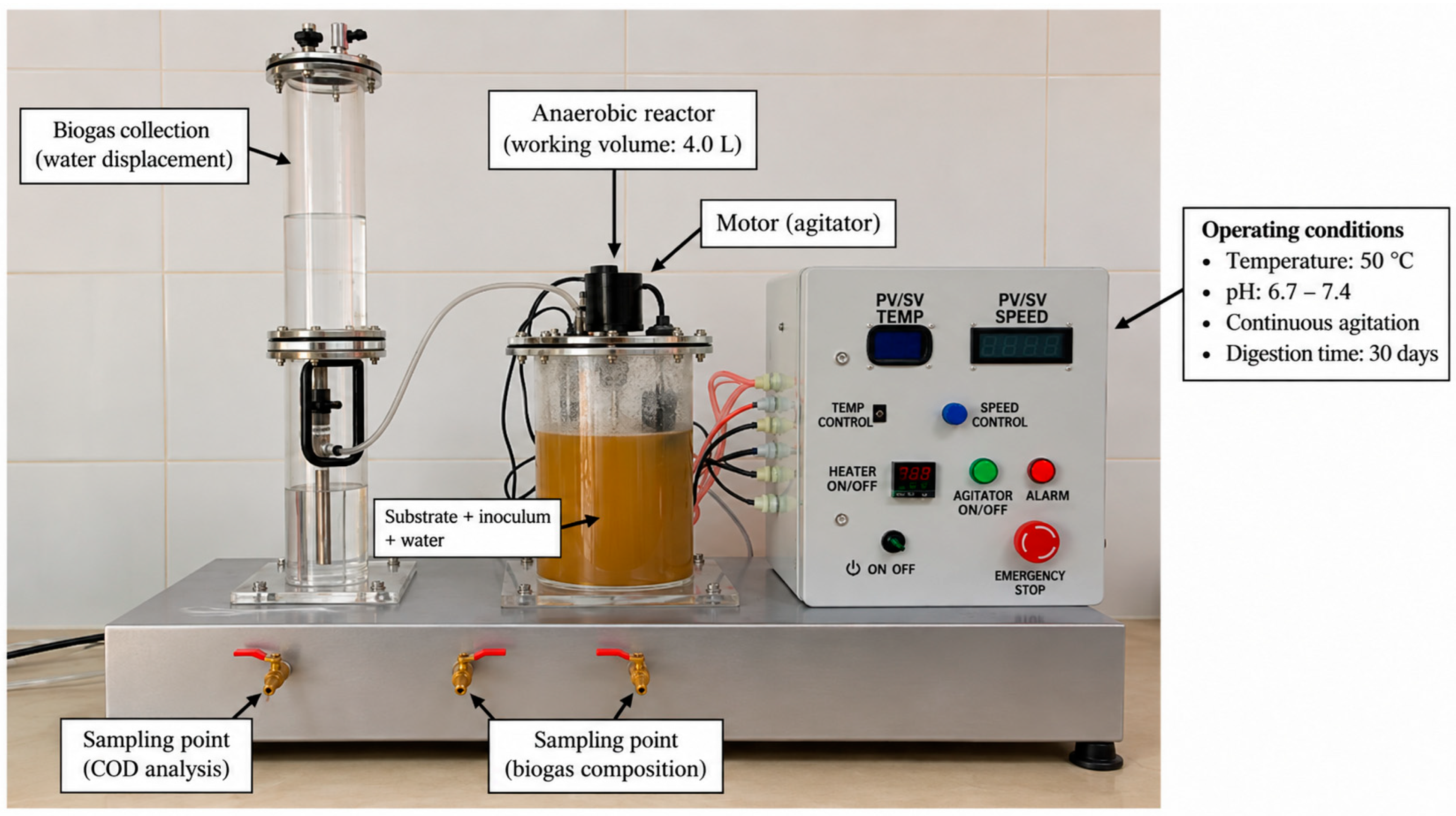
Anaerobic digestion assays were established for the seven agroindustrial residues under three biomass conditions: untreated, organosolv-treated, and precomposted, resulting in 21 residue–treatment combinations. Each system was formulated with the substrate mass specified in Table 1, 0.8 L of BIOEM inoculum, and the corresponding volume of water to obtain a nominal working volume of 4.0 L. The prepared formulations were transferred to bioreactors and operated for 30 days at 50 °C under continuous agitation. Reactor pH was monitored throughout the digestion period and maintained within the range of 6.7–7.4. These operating conditions were kept consistent among residue–treatment combinations to allow direct evaluation of differences associated with biomass type and pretreatment (Table 1). A schematic representation of the anaerobic digestion system and the main operating conditions is provided in Figure 3.
Table 1.
Formulation of the anaerobic digestion systems used for the seven agroindustrial residues.
Figure 3.
Anaerobic digestion system used in this study. The setup consisted of a 4.0 L reactor connected to a biogas collection column by water displacement. The reactor contained the corresponding substrate, 0.8 L of BIOEM inoculum, and water. The system was operated for 30 days at 50 °C under continuous agitation, with pH maintained between 6.7 and 7.4. Samples were collected for COD determination and biogas composition analysis.
Liquid samples were withdrawn from the bioreactors during the experimental period for chemical oxygen demand (COD) determination. Gas samples were collected separately from the same experimental systems for biogas composition and methane characterization, as described in Section 2.8.
2.5. Physicochemical Characterization
The physicochemical characterization of the agroindustrial residues included residual moisture, total solids (TS), volatile solids (VS), fixed solids (FS), and pH. Residual moisture was determined gravimetrically by drying the samples at 105 °C for 4 h, following the procedure established for biomass solids determination [20]. Total solids were determined gravimetrically after moisture removal. Fixed solids were quantified after incineration at 550 °C and expressed on a dry-solid basis. Volatile solids, also expressed on a dry-solid basis, were calculated as the complementary fraction of fixed solids. The pH of each material was then determined potentiometrically in an aqueous suspension prepared at a 1:10 sample-to-water ratio (m/v), with measurements recorded after stabilization of the electrode response [20]. The same analytical procedures were applied to untreated, organosolv-treated, and precomposted materials to maintain consistency among the 21 residue–treatment combinations.
2.6. Bromatological and Baseline Lignocellulosic Characterization
Bromatological characterization was performed on the untreated, organosolv-treated, and precomposted residues following the Official Methods of Analysis of AOAC INTERNATIONAL [21]. Total ash was determined by incineration at 550 °C, crude fat by continuous Soxhlet extraction, crude protein by the Kjeldahl method using a nitrogen-to-protein conversion factor of 6.25, and crude fiber by successive acid and alkaline digestion. Carbohydrate content was calculated by difference as 100 − (% moisture + % ash + % crude fat + % crude protein). Baseline lignocellulosic characterization was performed only on the seven untreated residues and included extractive content, holocellulose, and lignin. These measurements described the original feedstocks and were not used to infer changes caused by either pretreatment [22].
Extractive content was determined by Soxhlet extraction following TAPPI T 204 cm-97. Finely ground biomass of known moisture content was placed in a cellulose extraction thimble and extracted under solvent reflux until the solvent became visually clear. The extractive content was then determined gravimetrically after solvent removal.
Holocellulose was determined in extractive-free material using the Jayme–Wise method. Approximately 1 g of dry sample was treated with 75 mL of 1.5% sodium chlorite solution and five drops of concentrated acetic acid at 75 °C for 40 min. Acetic acid and approximately 1 g of sodium chlorite were then added again, and the reaction continued for another 40 min. The resulting solid fraction was filtered, washed with distilled water, dried at 105 °C, and quantified gravimetrically.
Lignin was determined in extractive-free biomass using the Klason procedure. Approximately 0.5 g of sample was treated with 5 mL of 72% sulfuric acid for 15 min, diluted with 150 mL of distilled water, and heated under reflux for 50 min. The acid-insoluble residue was then filtered, washed, dried, and weighed according to TAPPI T 222.
2.7. Chemical Oxygen Demand Determination
Chemical oxygen demand (COD) was determined for the 21 residue–treatment combinations as an indicator of the oxidizable organic fraction present in each experimental system. Samples collected from the bioreactors were subjected to closed-tube acid digestion at 150 °C, followed by spectrophotometric quantification in accordance with the principles of ISO 15705 [23]. Results were expressed as mg O2 g−1 on a dry-solid basis. The same procedure was applied to untreated, organosolv-treated, and precomposted materials to permit direct comparison of COD among biomass conditions.
2.8. Biogas Composition and Biochemical Methane Potential
Biogas composition was determined for the organosolv-treated and precomposted residues, corresponding to 14 residue–treatment combinations. Gas samples collected from the digestion systems were analyzed by gas chromatography with a thermal conductivity detector (GC-TCD) using Molsieve/PoraPLOT columns. Methane (CH4), carbon dioxide (CO2), and the remaining gaseous fraction (N2/O2) were quantified as volumetric percentages following ASTM D1946 [24] and the gas-sampling principles established in ISO 10715 [25].
Instrument calibration was performed using a certified gas mixture containing 60% CH4 and 40% CO2, traceable to NIST. Each residue–treatment combination was analyzed in triplicate. Biochemical methane potential (BMP) was determined from the methane generated relative to the volatile solids supplied to the digestion system and expressed as NmL CH4 g−1 VS. Determination and reporting of methane potential followed the principles described in VDI 4630 for fermentation testing of organic materials [26] and ISO 11734 for anaerobic biodegradability assessment based on biogas production [27]. Methane composition and BMP were determined from the same experimental systems used for physicochemical monitoring, thereby allowing methane recovery to be interpreted in relation to the characteristics of each pretreated biomass. Untreated residues were not included in the methane composition and BMP dataset.
2.9. Exploratory Methane Recovery and Substrate Requirement Calculations
To complement the experimental BMP results with indicators of practical biomass use, methane recovery and substrate requirements were estimated for the organosolv-treated and precomposted residues. These calculations were based on the experimentally determined BMP, total solids (TS), volatile solids (VS), substrate mass, and reactor working volume. Untreated residues were excluded because BMP values were not available for this condition.
Methane recovery per unit of wet biomass was estimated as (1):
where YCH4 is methane recovery (Nm3 CH4 t−1 wet biomass), BMP is expressed as NmL CH4 g−1 VS, and TSf and VSf are the total-solid and volatile-solid contents expressed as decimal fractions.
The amount of wet biomass required to produce 1 Nm3 of methane was calculated as (2):
where MCH4 is expressed as kg wet biomass Nm−3 CH4.
Initial volatile-solid loading in each experimental reactor was calculated as (3):
where LVS is the initial volatile-solid loading (g VS L−1), Ms is the substrate mass introduced into the reactor (g), and VR is the working volume (L).
Finally, the expected cumulative methane recovery for each 4 L experimental system was estimated from (4):
where VCH4 is expressed as NL CH4 per reactor over the 30-day digestion period. These estimates were used only as exploratory indicators for comparing biomass utilization efficiency under the two pretreatments and were not interpreted as engineering equations for full-scale biodigester design.
2.10. Statistical Analysis
Statistical analyses were conducted in SAS version 9.4 (SAS Institute Inc., Cary, NC, USA) [28]. Laboratory results were available as means ± standard error (SE) from three analytical replicates. When needed for descriptive purposes, standard deviations were obtained as SD = SE × √3. Analytical replicates were used to estimate measurement precision and were not treated as independent experimental units [29].
Treatment effects on moisture, total solids, volatile solids, fixed solids, pH, chemical oxygen demand, ash, crude fat, crude fiber, crude protein, and carbohydrate content were evaluated with linear mixed models. Biomass condition (untreated, organosolv-treated, and precomposted) was included as a fixed effect, and agroindustrial residue was used as a random blocking factor. When the biomass-condition effect was significant, least-squares means were compared using Tukey-adjusted pairwise comparisons [30]. Results are reported as adjusted means ± SE, with 95% confidence intervals where appropriate.
Biogas variables were analyzed separately because methane measurements were available only for organosolv-treated and precomposted materials. BMP was the primary response variable, while methane concentration was treated as a complementary indicator of biogas quality. Pretreatment was included as a fixed effect and agroindustrial residue as a random block. The treatment effect was expressed as the estimated mean difference with its 95% confidence interval. CO2 and N2/O2 were summarized descriptively.
Principal component analysis (PCA) included volatile solids, pH, COD, crude fiber, crude protein, and carbohydrate content. The 21 residue–treatment combinations were the observational units. Variables were standardized to zero mean and unit variance before analysis, and the first two components were retained for graphical interpretation based on their explained variance and loadings [31]. Mathematically complementary or strongly redundant variables, such as moisture–total solids and volatile solids–fixed solids, were not entered together.
Spearman rank correlations were calculated separately for the organosolv-treated and precomposted residues. Within each pretreatment, BMP was related to volatile solids, pH, COD, crude fiber, crude protein, and carbohydrate content. A second correlation set related BMP to the baseline lignocellulosic characteristics of the corresponding untreated feedstocks: extractive content, holocellulose, and lignin. Each correlation set therefore comprised the seven agroindustrial residues (n = 7). Two-sided exact permutation p-values were used, and p-values within each set were adjusted using the Benjamini–Hochberg false discovery rate procedure [32]. Because of the small number of residues, these correlations were interpreted as exploratory.
Relative changes in COD, volatile solids, and pH with respect to untreated biomass were calculated as descriptive indicators and were not subjected to additional inferential testing. Model residuals were assessed using the Shapiro–Wilk test and graphical inspection. Statistical significance was set at p < 0.05. Compact letter displays were used only for comparisons involving more than two biomass conditions [33].
3. Results
3.1. Physicochemical Response to Pretreatment
Biomass condition affected moisture and total solids (TS) (F2,12 = 38.00, p < 0.001; Table 2). Precomposted biomass had 12.19 percentage points more moisture than organosolv-treated biomass and, correspondingly, 12.19 percentage points less TS. Untreated and organosolv-treated materials did not differ significantly in either variable. Volatile solids (VS) and fixed solids (FS) also differed among biomass conditions (F2,12 = 7.04, p = 0.0095). Precomposted materials contained 4.05 percentage points less VS and 4.05 percentage points more FS than organosolv-treated materials, whereas untreated and organosolv-treated biomass showed no significant differences.
Table 2.
Physicochemical properties of seven agroindustrial residues under untreated, organosolv-treated, and precomposted conditions.
pH showed the strongest response to biomass condition (F2,12 = 80.86, p < 0.001). Organosolv-treated biomass had a pH 0.74 units higher than untreated material, while precomposted biomass was 1.86 units higher than untreated material and 1.11 units higher than organosolv-treated biomass. All three conditions differed significantly. Model residuals showed no significant departure from normality for any physicochemical variable (Shapiro–Wilk, p ≥ 0.205).
3.2. Bromatological Changes Among Biomass Conditions
Pretreatment affected most bromatological properties of the agroindustrial residues (Table 3). Ash content differed significantly among biomass conditions (F2,12 = 7.04, p = 0.0095). Precomposting increased ash content by 3.52 percentage points relative to untreated biomass and by 4.05 percentage points relative to organosolv-treated material, whereas untreated and organosolv conditions did not differ significantly.
Table 3.
Bromatological properties of seven agroindustrial residues under untreated, organosolv-treated, and precomposted conditions.
Crude fat showed no significant treatment effect (F2,12 = 3.83, p = 0.0518). In contrast, crude fiber differed markedly among treatments (F2,12 = 11.67, p = 0.0015). Relative to untreated biomass, fiber content increased by 30.54 percentage points after organosolv treatment and by 19.55 percentage points after precomposting. The two pretreatments did not differ significantly from each other. Crude protein was also affected by treatment (F2,12 = 9.42, p = 0.0035). Both pretreatments resulted in lower protein contents than the untreated condition, with reductions of 2.99 percentage points for organosolv and 3.48 percentage points for precomposting. No significant difference was detected between the two pretreatments. Carbohydrate content showed the clearest bromatological response (F2,12 = 26.54, p < 0.001). Carbohydrate content was 6.36 percentage points higher in organosolv-treated biomass than in untreated material and 14.86 percentage points higher than in precomposted biomass. In contrast, carbohydrate content in precomposted biomass was 8.50 percentage points lower than in untreated material. Residual distributions did not depart significantly from normality for any bromatological variable evaluated (Shapiro–Wilk, p ≥ 0.076).
3.3. Baseline Lignocellulosic Characteristics of the Agroindustrial Residues
The untreated agroindustrial residues showed marked differences in baseline lignocellulosic composition (Table 4). Extractives represented between approximately 2% and 21% of dry biomass, with the largest proportions observed in pineapple and banana and peel the smallest in coffee parchment and maize cob. Holocellulose was the predominant fraction in coffee parchment, maize cob, and potato, exceeding 70% of dry biomass in these residues. Pineapple peel showed an intermediate proportion, whereas cocoa parchment had the lowest holocellulose content among the evaluated materials. In the lignocellulosic profiles described here, residues with lower holocellulose content, particularly cocoa parchment and coconut fiber, showed comparatively high lignin proportions, exceeding 45% of dry biomass, whereas potato had less than 15% lignin. Banana peel presented comparatively high proportions of both extractives and lignin. These baseline measurements were used exclusively to characterize compositional differences among the seven untreated feedstocks and were not subjected to treatment comparisons.
Table 4.
Baseline lignocellulosic composition of the seven untreated agroindustrial residues.
3.4. Chemical Oxygen Demand and Organic Matter Response
Chemical oxygen demand differed significantly among biomass conditions (F2,12 = 141.39, p < 0.001; Table 5). Relative to the untreated condition, organosolv-treated systems showed an average COD decrease of 9.42%, with reductions ranging from 5.04% to 13.56% across residues. Precomposted systems showed a larger COD decrease relative to the untreated condition, averaging 29.06%, with individual reductions ranging from 20.54% to 35.65%. Changes in volatile solids, expressed as percentage-point differences from untreated biomass, were less uniform among residues. Organosolv showed an average difference of +0.52 percentage points, whereas precomposting averaged −3.52 percentage points. Across residues, precomposting ranged from an increase of 1.58 percentage points to a decrease of 6.40 percentage points. pH differences were expressed separately in pH units: organosolv-treated residues were 0.60–1.10 units above untreated values, whereas precomposted residues were 1.20–2.80 units above untreated values. These comparisons were descriptive and were not subjected to additional inferential testing. COD model residuals showed no departure from normality (Shapiro–Wilk, W = 0.973, p = 0.804).
Table 5.
Chemical oxygen demand of the agroindustrial residues under the three biomass conditions.
3.5. Methane Yield and Biogas Performance
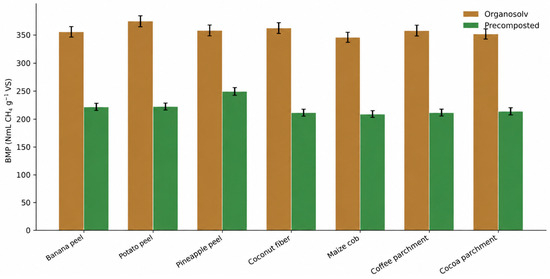
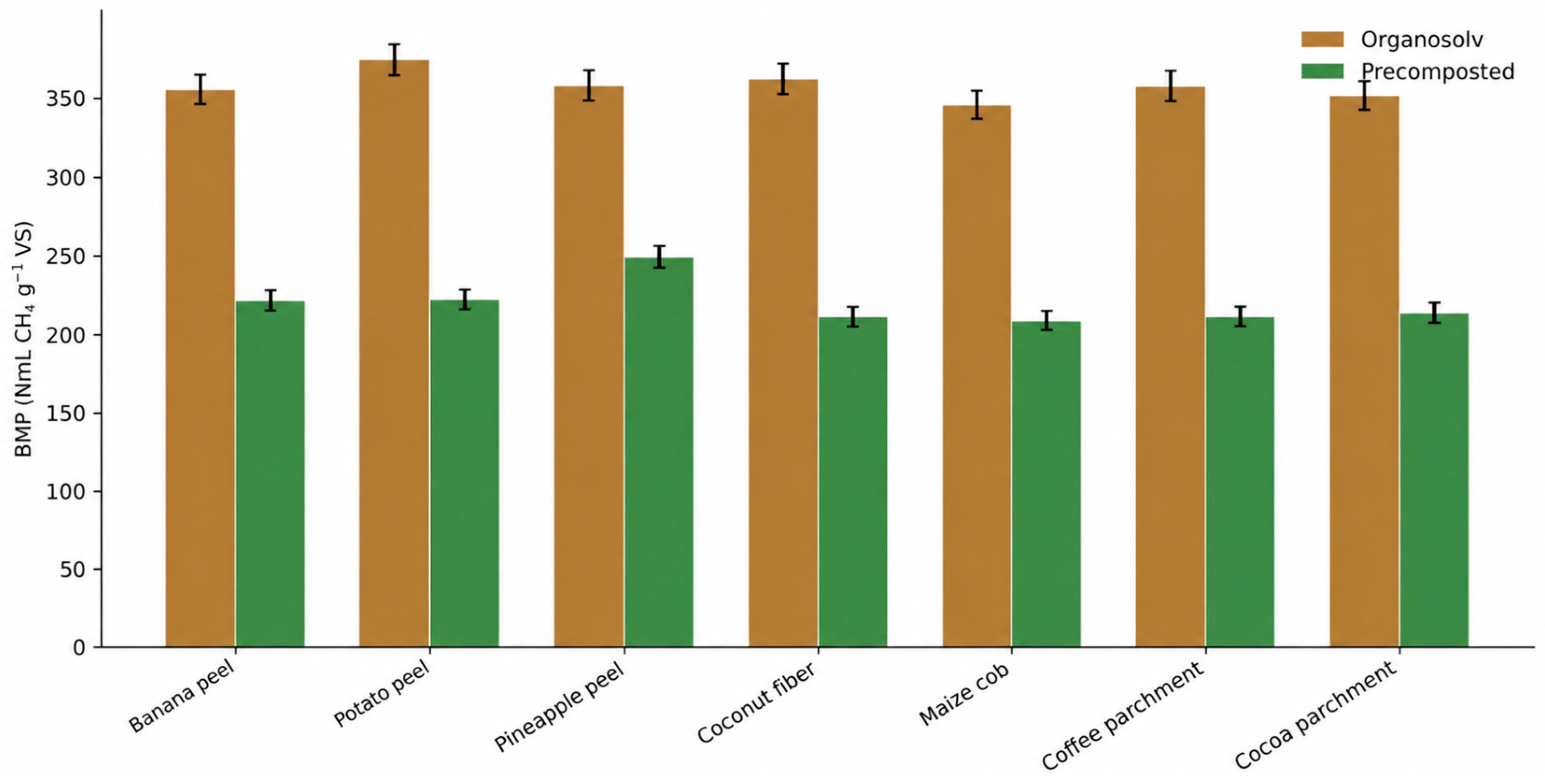
Biochemical methane potential differed markedly between pretreatments (F1,6 = 668.58, p < 0.001; Table 6). Organosolv treatment produced higher BMP than precomposting for each of the seven agroindustrial residues evaluated (Figure 4). Across residues, BMP was on average 136.07 NmL CH4 g−1 VS higher under organosolv than under precomposting (95% CI: 123.19–148.95). This represented an average BMP increase of 62.2% relative to precomposting, ranging from 43.3% for pineapple peel to 69.6% for coconut fiber.
Table 6.
Biogas composition and biochemical methane potential of organosolv-treated and precomposted agroindustrial residues.
Figure 4.
Biochemical methane potential (BMP) of seven agroindustrial residues following organosolv and precomposting pretreatments. Bars represent means ± standard error (n = 3 analytical determinations).
Methane concentration, in contrast, did not differ significantly between pretreatments (F1,6 = 2.81, p = 0.145). The estimated difference between organosolv and precomposting was −0.37 percentage points (95% CI: −0.91 to 0.17), and CH4 concentrations remained close to 50% across all residue–treatment combinations. CO2 varied within a similarly narrow range, while the N2/O2 fraction remained at 0.40% in all systems. Model residuals showed no significant departure from normality for either BMP or CH4 (Shapiro–Wilk, p > 0.05).
3.6. Multivariate Patterns of Biomass Response to Pretreatment
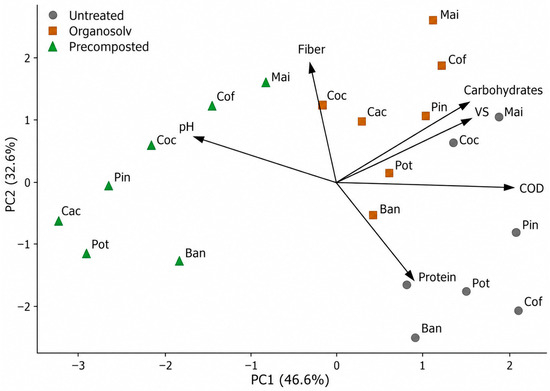
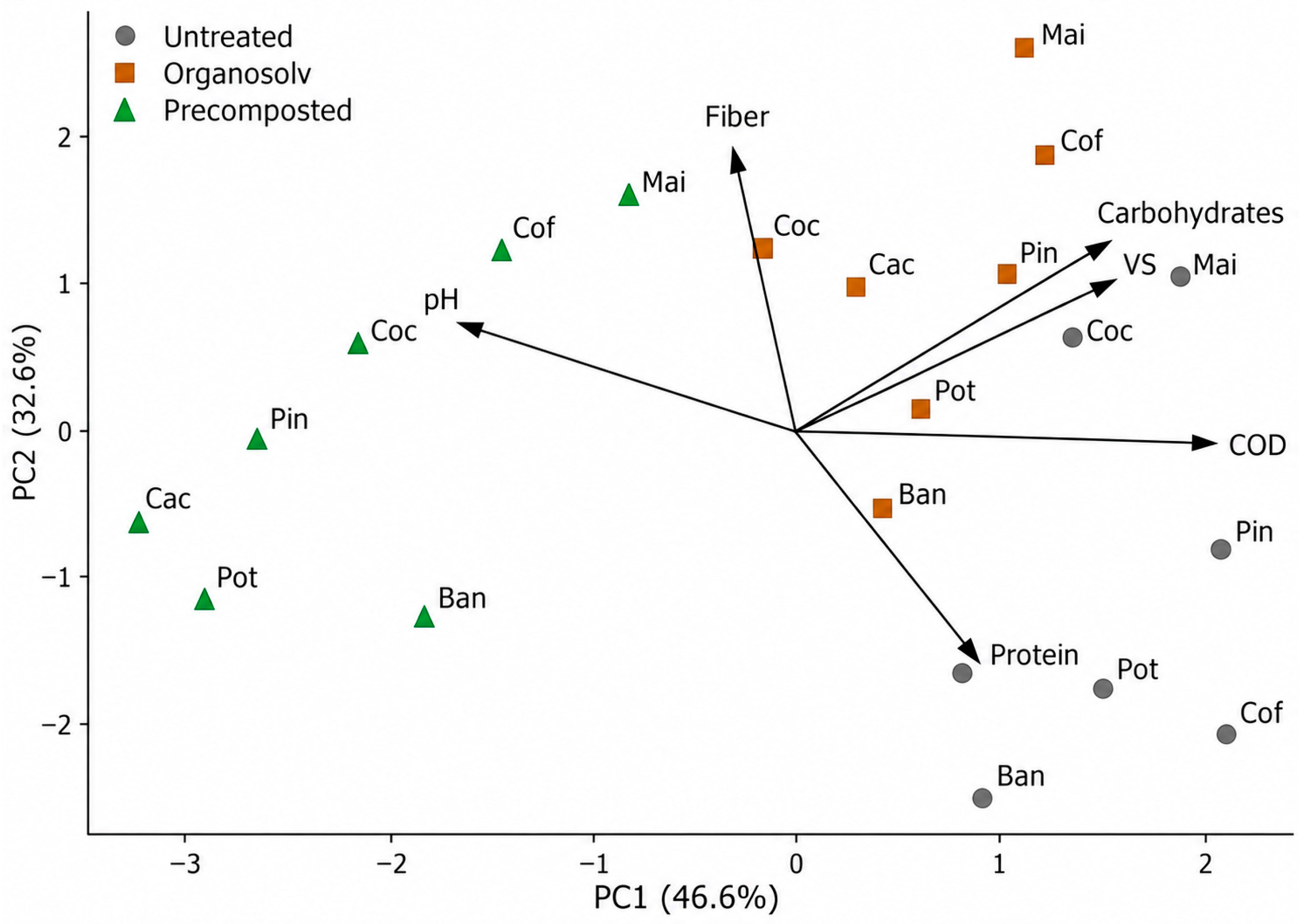
Principal component analysis revealed distinct multivariate patterns among biomass conditions (Figure 5). The first two principal components accounted for 79.2% of the total standardized variance, with PC1 explaining 46.6% and PC2 explaining 32.6%. PC1 was primarily associated with COD, pH, volatile solids, and carbohydrate content, whereas PC2 was mainly defined by crude fiber and crude protein (Table 7).
Figure 5.
Principal component analysis biplot of the 21 residue–treatment combinations based on volatile solids, pH, COD, crude fiber, crude protein, and carbohydrate content. PC1 and PC2 explained 46.6% and 32.6% of the total variance, respectively. Symbols distinguish untreated, organosolv-treated, and precomposted biomass conditions.
Table 7.
Loadings and variance explained by the first two principal components for physicochemical and bromatological characteristics.
Untreated materials were concentrated predominantly on the positive side of PC1, whereas precomposted residues shifted toward negative PC1 scores. Organosolv-treated materials were positioned mainly on the positive side of PC2, although the magnitude of this displacement varied among residues.
3.7. Exploratory Associations Between Biomass Characteristics and Methane Yield
The associations between biomass characteristics and BMP differed between the two pretreatments (Table 8). Under organosolv treatment, the correlation coefficients were generally weak to moderate, with the largest absolute coefficient observed for crude protein (ρ = 0.429). None of the physicochemical or bromatological variables was significantly associated with BMP after false-discovery-rate adjustment.
Table 8.
Spearman rank correlations between biomass characteristics and biochemical methane potential under organosolv and precomposting pretreatments.
Precomposted materials showed larger absolute correlation coefficients for several variables. BMP was negatively related to crude fiber (ρ = −0.750, p = 0.066) and volatile solids (ρ = −0.714, p = 0.088), while COD showed a moderate negative coefficient (ρ = −0.607). Among the baseline lignocellulosic characteristics, extractive content showed the largest coefficient with BMP under precomposting (ρ = 0.857, p = 0.024). However, none of these relationships remained statistically significant after Benjamini–Hochberg adjustment, including extractive content (q = 0.071). Baseline holocellulose and lignin also showed no significant associations with BMP under either pretreatment.
3.8. Exploratory Methane Recovery and Substrate Requirement
The derived indicators showed a consistent advantage of organosolv-treated biomass in terms of methane recovery per unit of wet material (Table 9). Across the seven residues, estimated methane recovery averaged 305.25 Nm3 CH4 t−1 wet biomass under organosolv treatment compared with 155.74 Nm3 CH4 t−1 wet biomass after precomposting, representing an average increase of approximately 96.0%. The highest estimated recovery was obtained for organosolv-treated coffee parchment, followed by potato peel and maize cob, whereas the lowest value corresponded to precomposted coconut fiber.
Table 9.
Exploratory methane recovery and substrate-requirement indicators derived from the experimental BMP and solids data.
The amount of wet biomass required to obtain 1 Nm3 CH4 reflected the same pattern. Organosolv-treated residues required an average of 3.28 kg wet biomass Nm−3 CH4, compared with 6.45 kg wet biomass Nm−3 CH4 for precomposted materials, corresponding to a reduction of approximately 49.1% in substrate requirement. Among the evaluated combinations, organosolv-treated coffee parchment showed the lowest estimated biomass requirement, while precomposted coconut fiber showed the highest.
Initial volatile-solid loading averaged 57.25 g VS L−1 for organosolv-treated systems and 54.79 g VS L−1 for precomposted systems. Over the 30-day experimental period, estimated cumulative methane recovery from the 4 L reactors averaged 81.60 NL CH4 reactor−1 under organosolv treatment and 48.23 NL CH4 reactor−1 after precomposting. These values are exploratory estimates derived from the experimental BMP and solids data and should not be interpreted as full-scale biodigester performance.
4. Discussion
4.1. Pretreatment-Induced Changes in Biomass Characteristics
Organosolv and precomposting produced contrasting compositional responses across the seven residues. Organosolv largely preserved the solids profile while increasing the relative contribution of crude fiber and carbohydrates, whereas precomposting was associated with lower volatile solids and carbohydrates and higher moisture, ash, and pH. These patterns indicate that the two pretreatments affected different biomass fractions. The higher fiber proportion after organosolv treatment is consistent with the fractionating action of ethanol-based solvent systems, which can remove part of the non-cellulosic matrix and leave a solid fraction relatively enriched in structural carbohydrates [34]. Similar responses have been reported for organosolv-treated lignocellulosic biomass intended for subsequent biological conversion [35]. In the present study, however, these changes should be interpreted as relative compositional enrichment because lignin was quantified only in the untreated materials. Consequently, the present data do not allow direct quantification of lignin removal or a mass balance linking lignin loss to the higher BMP observed after organosolv treatment.
Precomposting followed a different pattern, characterized by a reduction in the organic fraction and an increase in the relative mineral contribution. Partial aerobic degradation before anaerobic digestion can consume readily biodegradable compounds and modify the physicochemical environment of the substrate [36]. The variation observed among residues therefore suggests that pretreatment response may depend on the characteristics of the original feedstock rather than on treatment alone.
4.2. Feedstock Composition and Anaerobic Conversion Response
The baseline lignocellulosic profiles in this study confirmed that the seven residues represented chemically contrasting feedstocks, ranging from materials dominated by holocellulose to others with a greater lignin contribution. These differences are relevant to anaerobic conversion because lignin can restrict microbial access to structural carbohydrates and reduce the fraction of biomass available for methane formation [37].
In our exploratory analysis, no single baseline component consistently explained BMP under both pretreatments. This result suggests that the methanogenic response cannot be attributed to one compositional fraction alone. Previous studies have likewise shown that methane production from lignocellulosic biomass reflects the combined influence of lignin, cellulose organization, holocellulose, and extractives [38]. The contribution of lignin removal to the observed methane response therefore remains unresolved and should not be inferred quantitatively from the present dataset.
Based on the present results, the differences in methane yield among residues may therefore reflect both their initial composition and the way each pretreatment modified substrate accessibility. This interpretation remains tentative, but it is consistent with experimental evidence showing that greater physical accessibility of lignocellulosic material can improve subsequent biogas production without changing feedstock identity [39].
4.3. COD Response, Methane Yield, and Pretreatment Effectiveness
The contrasting COD and BMP responses observed in this study indicate that pretreatment effectiveness cannot be judged from organic-matter reduction alone. Organosolv-treated systems showed higher COD values than precomposted systems while producing consistently higher methane yields, suggesting that a larger fraction of oxidizable carbon remained available for anaerobic conversion. Comparable improvements in methane recovery after organosolv treatment have been reported for forest residues [40], hydrolyzed corncob [41], and organosolv-treated spruce and birch [42].
Precomposted systems showed a greater decline in COD relative to the untreated condition but lower BMP. One possible explanation is that aerobic pretreatment altered or consumed part of the biodegradable fraction before methanogenesis. This interpretation is supported by studies on corn stover, where aerobic hydrolysis time strongly affected subsequent digestion performance [43], and on food waste, where an intermediate pretreatment duration improved methane-production rate without increasing final methane potential [44]. Methane concentration remained similar between pretreatments, indicating that the main treatment effect concerned methane yield rather than gas composition. Comparable increases in methane yield after organosolv fractionation have been reported for rubber wood [45] and Salicornia biomass [46].
4.4. Multivariate Patterns and Biomass–Methane Relationships
The PCA showed distinct multivariate patterns among untreated, organosolv-treated, and precomposted materials based on the combined contribution of COD, pH, volatile solids, carbohydrates, fiber, and protein. Similar multivariate approaches have been used to interpret compositional variation relevant to methane production in lignocellulosic substrates [47,48].
The exploratory Spearman analysis addressed the associations between individual biomass characteristics and BMP. Under organosolv, correlation coefficients were generally weak to moderate, whereas precomposted materials showed larger absolute coefficients for some variables; however, none remained significant after correction for multiple testing. Previous studies have likewise reported that methane yield may vary with different combinations of cellulose, lignin, soluble fractions, proteins, lipids, and other substrate characteristics [49,50,51].
Baseline extractives showed the largest positive coefficient with BMP under precomposting, but this relationship was not significant after adjustment and should therefore be regarded as an exploratory pattern rather than a predictive relationship. Large feedstock datasets also show substantial variation in methane potential among chemically different agricultural materials, while individual crop fractions can exhibit contrasting digestion responses [52,53]. These results support further evaluation of the observed multivariate and correlation patterns without attributing methane response to a single compositional indicator.
4.5. Practical Implications for Anaerobic Biomass Valorization
The exploratory calculations extend the BMP results to quantities that are easier to interpret for biomass management. Organosolv-treated residues required less wet biomass to obtain an equivalent methane volume, but these values should be considered screening indicators rather than direct predictions of continuous-reactor performance. Semi-pilot and pilot studies have shown that BMP-derived expectations can inform larger-scale evaluation, although differences between batch and continuous operation remain relevant [54,55].
The initial volatile-solid loading used in the present reactors provides a reference for subsequent experiments. Future semi-continuous trials should evaluate organic loading rate, hydraulic retention time, and feeding frequency independently, since increasing loading does not necessarily produce proportional methane gains and may reduce process stability [56,57]. A preliminary energy screening was performed for the organosolv condition. Using the average methane recovery of 305.25 Nm3 CH4 t−1 wet biomass and a methane lower heating value of 35.8 MJ Nm−3, the gross methane-energy output was approximately 10.93 GJ t−1 wet biomass. Based on the laboratory organosolv formulation and the average solids content of the treated biomass, the theoretical sensible-heat requirement for heating the biomass and ethanol–water mixture from approximately 15 to 175 °C was estimated at about 4.60 GJ t−1 wet biomass. This leaves a preliminary gross energy margin of approximately 6.33 GJ t−1 before accounting for reactor heat losses, solvent separation, and heat recovery. Because post-treatment solid recovery and actual solvent-recovery energy were not measured, this calculation should be regarded as an upper-bound screening estimate rather than a complete net-energy balance.
Solvent recovery is also critical to process feasibility. The laboratory formulation corresponds to a high ethanol demand, making solvent recycling essential at larger scale. Techno-economic analyses of organosolv systems indicate that solvent losses should remain below approximately 2%, corresponding to recovery rates of about 98% or higher, while process simulations have reported ethanol recovery near 97 wt% [58]. At larger scale, the higher methane recovery observed after organosolv treatment should be considered together with solvent recovery, energy demand, equipment requirements, and operating costs. Previous techno-economic studies show that process viability depends on plant capacity, energy integration, and pretreatment intensity [59,60]. An economic assessment was not conducted here; these factors should therefore be addressed in future pilot-scale evaluation.
4.6. Study Scope, Strengths, and Future Research
The experimental design provided a controlled comparison of seven chemically contrasting agroindustrial residues under identical digestion conditions, allowing pretreatment performance to be evaluated without changes in reactor temperature, working volume, inoculum addition, or digestion time. This comparative framework is useful at the screening stage because BMP tests can identify promising feedstock–pretreatment combinations before more resource-intensive continuous trials are undertaken [61]. However, batch performance does not always translate directly to continuously operated systems, as shown by comparisons between BMP and semi-continuous digestion of pretreated agroindustrial biomass [62].
The next experimental stage should therefore retain the most promising combinations identified here while introducing independent biomass batches, semi-continuous feeding, and a wider range of organic loading rates and retention times. To provide a preliminary link between the batch and continuous operating frameworks, the observed initial volatile-solid loading can be related to organic loading rate through OLR = LVS/HRT, where OLR is expressed as g VS L−1 d−1, LVS is the initial volatile-solid concentration in the reactor, and HRT is the hydraulic retention time in days. Using the observed range of 51.88–59.43 g VS L−1, projected OLR values would be approximately 2.59–2.97 g VS L−1 d−1 at an HRT of 20 d, 1.73–1.98 g VS L−1 d−1 at 30 d, and 1.30–1.49 g VS L−1 d−1 at 40 d. These values should be regarded as starting ranges for semi-continuous CSTR trials rather than validated operating conditions. Extended reactor studies have shown that responses observed in batch tests may change as microbial adaptation, substrate accumulation, and feeding dynamics become relevant [63]. Pretreatment intensity should also be optimized for individual feedstocks because lignocellulosic materials differ in structural resistance and response to fractionation [64]. Biological pretreatments require similar optimization because their effectiveness depends on residence time, microbial activity, and preservation of methane-forming substrates [65].
The present study contributes an integrated evaluation of methane yield, biomass composition, multivariate patterns, and substrate requirements rather than treating BMP as an isolated endpoint. Future work should extend this framework to digestate characterization, pilot-scale methane productivity, and post-treatment lignocellulosic characterization. Quantifying lignin, holocellulose, and extractives before and after pretreatment, together with solid-mass recovery, will allow component-specific mass balances and direct assessment of the relationship between lignin removal and methane recovery. Such validation is important because BMP does not reproduce all operational constraints of full-scale digestion [66]. For organosolv-treated biomass, further optimization should also include solvent recovery and reuse [67].
5. Conclusions
This study showed that organosolv and precomposting produced clearly contrasting responses across the seven agroindustrial residues. Organosolv largely preserved the volatile-solid fraction and resulted in consistently higher methane yields, whereas precomposting was associated with lower COD and volatile solids. Organosolv increased BMP by an average of 62.2% relative to precomposting, while methane concentration remained similar between treatments, indicating that the main difference concerned methane yield per unit of volatile solids rather than the CH4 proportion of the biogas. The exploratory conversion indicators followed the same pattern. Organosolv-treated residues yielded an estimated 305.25 Nm3 CH4 t−1 of wet biomass and required approximately 3.28 kg wet biomass to produce 1 Nm3 CH4, compared with 155.74 Nm3 CH4 t−1 of wet biomass and 6.45 kg wet biomass Nm−3 CH4 after precomposting. These results identify organosolv as the more promising pretreatment for methane-oriented valorization under the evaluated conditions. Further semi-continuous and pilot-scale studies are needed to determine whether this advantage is maintained under practical operating conditions.
Author Contributions
Conceptualization, R.M.B.-P. and B.S.-R.; methodology, R.M.B.-P.; software, B.A.R.-B.; validation, A.P.N.A., Y.J.R.D. and N.R.-C.; formal analysis, B.A.R.-B.; investigation, R.M.B.-P.; resources, R.M.B.-P.; data curation, G.W.Q.-S., D.A.C.-C. and B.S.-R.; writing—original draft preparation, R.M.B.-P. and B.A.R.-B.; writing—review and editing, R.M.B.-P., A.P.N.A., Y.J.R.D., N.R.-C., G.W.Q.-S., D.A.C.-C., B.S.-R. and B.A.R.-B.; visualization, R.M.B.-P.; supervision, A.P.N.A.; project administration, B.A.R.-B.; funding acquisition, R.M.B.-P. All authors have read and agreed to the published version of the manuscript.
Funding
This article is an outcome of the Science, Technology, and Innovation Project “Potential of Agroindustrial Residues Generated in the Junín Region for Biogas Production through Anaerobic Co-Digestion: An Energy-Sustainable Solution for the UNAAT Ecological House” (Project Code P3-24-04-02), funded by “UNAAT INVESTIGA” through the Office of the Vice Presidency for Research of the Universidad Nacional Autónoma Altoandina de Tarma.
Institutional Review Board Statement
Not applicable.
Informed Consent Statement
Not applicable.
Data Availability Statement
The data supporting the findings of this study are available from the corresponding author upon reasonable request.
Acknowledgments
The authors thank the Universidad Nacional Autónoma Altoandina de Tarma (UNAAT) for the institutional and financial support provided for this research. B.A.R.-B. dedicates this work to the memory of Marilyn Zuleth Ruiz Guzmán. During the preparation of this manuscript, the authors used OpenAI ChatGPT (GPT-5.6 Sol) to improve the quality of the English and refine the scientific writing, particularly in Section 4. The authors reviewed and edited the output and take full responsibility for the content of this publication.
Conflicts of Interest
The authors declare no conflicts of interest.
Abbreviations
The following abbreviations are used in this manuscript:
| BMP | Biochemical methane potential |
| COD | Chemical oxygen demand |
| TS | Total solids |
| VS | Volatile solids |
| FS | Fixed solids |
| PCA | Principal component analysis |
| CH4 | Methane |
| CO2 | Carbon dioxide |
| GC-TCD | Gas chromatography with thermal conductivity detection |
| HRT | Hydraulic retention time |
| OLR | Organic loading rate |
| CSTR | Continuous stirred-tank reactor |
References
- Ministerio de Desarrollo Agrario y Riego. Anuario Estadístico de La Producción Agrícola 2024; Sistema Integrado de Estadística Agraria (SIEA): Lima, Peru, 2025. [Google Scholar]
- Davila, E.L.; Hernández, J.J.; González, L.M.L.; Cardoso, E.L.B.; Amarante, E.B.; Velázquez, L.M.C.; Romero-Romero, O. Biochemical Methane Potential of Agro-Wastes as a Renewable Source Alternative for Electrical Energy Production in Cuba. Cienc. Y Tecnol. Agropecu. 2022, 23, e1890. [Google Scholar] [CrossRef] [Scilit]
- Edwiges, T.; Frare, L.; Mayer, B.; Lins, L.; Mi Triolo, J.; Flotats, X.; de Mendonça Costa, M.S.S. Influence of Chemical Composition on Biochemical Methane Potential of Fruit and Vegetable Waste. Waste Manag. 2018, 71, 618–625. [Google Scholar] [CrossRef] [Scilit]
- Achinas, S.; Li, Y.; Achinas, V.; Euverink, G.J.W. Biogas Potential from the Anaerobic Digestion of Potato Peels: Process Performance and Kinetics Evaluation. Energies 2019, 12, 2311. [Google Scholar] [CrossRef] [Scilit]
- Otieno, E.O.; Kiplimo, R.; Mutwiwa, U. Optimization of Anaerobic Digestion Parameters for Biogas Production from Pineapple Wastes Co-Digested with Livestock Wastes. Heliyon 2023, 9, e14041. [Google Scholar] [CrossRef] [Scilit]
- Passos, F.; Cordeiro, P.H.M.; Baeta, B.E.L.; de Aquino, S.F.; Perez-Elvira, S.I. Anaerobic Co-Digestion of Coffee Husks and Microalgal Biomass after Thermal Hydrolysis. Bioresour. Technol. 2018, 253, 49–54. [Google Scholar] [CrossRef] [Scilit]
- Vannarath, A.; Thalla, A.K. Effects of Chemical Pretreatments on Material Solubilization of Areca Catechu L. Husk: Digestion, Biodegradability, and Kinetic Studies for Biogas Yield. J. Environ. Manag. 2022, 316, 115322. [Google Scholar] [CrossRef] [Scilit]
- Venturin, B.; Frumi Camargo, A.; Scapini, T.; Mulinari, J.; Bonatto, C.; Bazoti, S.; Pereira Siqueira, D.; Maria Colla, L.; Alves, S.L.; Paulo Bender, J.; et al. Effect of Pretreatments on Corn Stalk Chemical Properties for Biogas Production Purposes. Bioresour. Technol. 2018, 266, 116–124. [Google Scholar] [CrossRef] [Scilit]
- Paz, A.; Solisio, C.; Converti, A.; Casazza, A.A. Application of Organosolv Technology to Improve the Anaerobic Digestion of Olive Oil Pomace. Ind. Crops Prod. 2023, 204, 117249. [Google Scholar] [CrossRef] [Scilit]
- Zou, S.; Kang, D. Relationship between Anaerobic Digestion Characteristics and Biogas Production under Composting Pretreatment. Renew. Energy 2018, 125, 485–494. [Google Scholar] [CrossRef] [Scilit]
- Guan, S.; He, C.; Li, P.; Li, P.; Hou, T.; Gao, Z.; Li, G.; Jiao, Y. Enhancement of Anaerobic Digestion of Corn Straw: Effect of Biological Pretreatment and Heating with Bio-Heat Recovery from Pretreatment. Fermentation 2024, 10, 160. [Google Scholar] [CrossRef] [Scilit]
- Navarro, B.L.; Challiol, A.Z.; Bortoloti, M.A.; Kuroda, E.K.; Fernandes, F. Methane Production Potential from Anaerobic Digestion of Plant Biomass Residues and Food Waste as Substrates. J. Mater. Cycles Waste Manag. 2022, 24, 2470–2482. [Google Scholar] [CrossRef] [Scilit]
- Elif Gulsen Akbay, H. Anaerobic Mono and Co-Digestion of Agro-Industrial Waste and Municipal Sewage Sludge: Biogas Production Potential, Kinetic Modelling, and Digestate Characteristics. Fuel 2024, 355, 129468. [Google Scholar] [CrossRef] [Scilit]
- Nurika, I.; Azizah, N.; Suhartini, S.; Jung, Y.H.; Barker, G.C. Integrated Biorefinery Approach: The Generation of Bioproducts Vanillin and Biomethane Through a Sequential Bioconversion of Lignocellulose From Oil Palm Empty Fruit Bunch (OPEFB). Waste Biomass Valor. 2024, 15, 903–915. [Google Scholar] [CrossRef] [Scilit]
- Llanos-Lizcano, R.; Senila, L.; Modoi, O.C. Evaluation of Biochemical Methane Potential and Kinetics of Organic Waste Streams for Enhanced Biogas Production. Agronomy 2024, 14, 2546. [Google Scholar] [CrossRef] [Scilit]
- Cordova Zacarias, L.S.; Mendoza Vega, D.B. Extracción y Caracterización de Aceite esencial de la Especie Aromática Hierbabuena (Mentha spicata) Producido en los Distritos de Tarma. 2025. Available online: https://repositorio.unaat.edu.pe/items/013cb39a-3ccc-4257-911b-e9bf4d37705c (accessed on 2 September 2026).
- Pérez, W.E.; Flores-Marquez, R.; Carbajal, C.; Solórzano-Acosta, R. Pesticide Residue Patterns along Edaphic and Climatic Gradients in Peruvian Coastal and Andean Agroecosystems. Environ. Chall. 2026, 24, 101559. [Google Scholar] [CrossRef] [Scilit]
- Hernandez, J.; Romero, V.; Escalante, A.; Toriz, G.; Rojas, O.J.; Sulbaran, B. Agave Tequilana Bagasse as Source of Cellulose Nanocrystals via Organosolv Treatment. BioResources 2018, 13, 3603–3614. [Google Scholar] [CrossRef] [Scilit]
- Wang, L.; Liu, C.; Wei, B.; Song, C.; Cai, F.; Liu, G.; Chen, C. Effects of Different Microbial Pretreatments on the Anaerobic Digestion of Giant Grass under Anaerobic and Microaerobic Conditions. Bioresour. Technol. 2021, 337, 125456. [Google Scholar] [CrossRef] [Scilit]
- Jose, S.; Sajeena, B.B. Performance and Kinetic Study of Poultry Litter Co-Digestion with Delignified Coir Pith for Biomethane Generation. Biomass Bioenergy 2025, 199, 107909. [Google Scholar] [CrossRef] [Scilit]
- Latimer, G.W., Jr. (Ed.) Official Methods of Analysis of AOAC INTERNATIONAL, 22nd ed.; Oxford University Press: New York, NY, USA, 2023. [Google Scholar]
- Lupoi, J.S.; Singh, S.; Simmons, B.A.; Henry, R.J. Assessment of Lignocellulosic Biomass Using Analytical Spectroscopy: An Evolution to High-Throughput Techniques. Bioenerg. Res. 2014, 7, 1–23. [Google Scholar] [CrossRef] [Scilit]
- Bertrand-Krajewski, J.-L.; Winkler, S.; Saracevic, E.; Torres, A.; Schaar, H. Evaluation of DC Voltage Ripple in Single-Phase H-Bridge PWM Inverters. In Proceedings of the NOVATECH 2007, Lyon, France, 25–28 May 2007. [Google Scholar]
- Angelidaki, I.; Alves, M.; Bolzonella, D.; Borzacconi, L.; Campos, J.L.; Guwy, A.J.; Kalyuzhnyi, S.; Jenicek, P.; van Lier, J.B. Defining the Biomethane Potential (BMP) of Solid Organic Wastes and Energy Crops: A Proposed Protocol for Batch Assays. Water Sci. Technol. 2009, 59, 927–934. [Google Scholar] [CrossRef] [Scilit]
- Raposo, F.; Fernández-Cegrí, V.; De la Rubia, M.A.; Borja, R.; Béline, F.; Cavinato, C.; Demirer, G.; Fernández, B.; Fernández-Polanco, M.; Frigon, J.C.; et al. Biochemical Methane Potential (BMP) of Solid Organic Substrates: Evaluation of Anaerobic Biodegradability Using Data from an International Interlaboratory Study. J. Chem. Technol. Biotechnol. 2011, 86, 1088–1098. [Google Scholar] [CrossRef] [Scilit]
- Holliger, C.; Alves, M.; Andrade, D.; Angelidaki, I.; Astals, S.; Baier, U.; Bougrier, C.; Buffière, P.; Carballa, M.; de Wilde, V.; et al. Towards a Standardization of Biomethane Potential Tests. Water Sci. Technol. 2016, 74, 2515–2522. [Google Scholar] [CrossRef] [Scilit]
- Wellinger, A.; Murphy, J.P.; Baxter, D. The Biogas Handbook: Science, Production and Applications; Elsevier: Amsterdam, The Netherlands, 2013; ISBN 978-0-85709-498-8. [Google Scholar]
- SAS Institute Inc. SAS/STAT® 15.3 User’s Guide; SAS Institute Inc.: Cary, NC, USA, 2023. [Google Scholar]
- Lazic, S.E.; Clarke-Williams, C.J.; Munafò, M.R. What Exactly Is ‘N’ in Cell Culture and Animal Experiments? PLoS Biol. 2018, 16, e2005282. [Google Scholar] [CrossRef] [Scilit]
- Tukey, J.W. Comparing Individual Means in the Analysis of Variance. Biometrics 1949, 5, 99–114. [Google Scholar] [CrossRef] [Scilit]
- Jolliffe, I.T.; Cadima, J. Principal Component Analysis: A Review and Recent Developments. Phil. Trans. R. Soc. A 2016, 374, 20150202. [Google Scholar] [CrossRef] [Scilit]
- Benjamini, Y.; Hochberg, Y. Controlling the False Discovery Rate: A Practical and Powerful Approach to Multiple Testing. R. Stat. Soc. J. Ser. B Methodol. 1995, 57, 289–300. [Google Scholar] [CrossRef] [Scilit]
- Piepho, H.-P. An Algorithm for a Letter-Based Representation of All-Pairwise Comparisons. J. Comput. Graph. Stat. 2004, 13, 456–466. [Google Scholar] [CrossRef] [Scilit]
- Hermsdorff, G.B.; Escobar, E.L.N.; da Silva, T.A.; Filho, A.Z.; Corazza, M.L.; Ramos, L.P. Ethanol Organosolv Pretreatment of Sugarcane Bagasse Assisted by Organic Acids and Supercritical Carbon Dioxide. Carbohydr. Polym. 2023, 300, 120263. [Google Scholar] [CrossRef] [Scilit]
- Sarkar, O.; Rova, U.; Christakopoulos, P.; Matsakas, L. Organosolv Pretreated Birch Sawdust for the Production of Green Hydrogen and Renewable Chemicals in an Integrated Biorefinery Approach. Bioresour. Technol. 2022, 344, 126164. [Google Scholar] [CrossRef] [Scilit]
- Xu, H.; Li, Y.; Hua, D.; Zhao, Y.; Chen, L.; Zhou, L.; Chen, G. Effect of Microaerobic Microbial Pretreatment on Anaerobic Digestion of a Lignocellulosic Substrate under Controlled pH Conditions. Bioresour. Technol. 2021, 328, 124852. [Google Scholar] [CrossRef] [Scilit]
- Pokój, T.; Klimiuk, E.; Bułkowska, K.; Kowal, P.; Ciesielski, S. Effect of Individual Components of Lignocellulosic Biomass on Methane Production and Methanogen Community Structure. Waste Biomass Valor. 2020, 11, 1421–1433. [Google Scholar] [CrossRef] [Scilit]
- Stachowiak–Wencek, A.; Bocianowski, J.; Waliszewska, H.; Borysiak, S.; Waliszewska, B.; Zborowska, M. Statistical Prediction of Biogas and Methane Yields during Anaerobic Digestion Based on the Composition of Lignocellulosic Biomass. BioRes 2021, 16, 7086–7100. [Google Scholar] [CrossRef] [Scilit]
- Bharadwaj, A.; Holwerda, E.K.; Regan, J.M.; Lynd, L.R.; Richard, T.L. Enhancing Anaerobic Digestion of Lignocellulosic Biomass by Mechanical Cotreatment. Biotechnol. Biofuels 2024, 17, 76. [Google Scholar] [CrossRef] [Scilit]
- Kabir, M.M.; Rajendran, K.; Taherzadeh, M.J.; Sárvári Horváth, I. Experimental and Economical Evaluation of Bioconversion of Forest Residues to Biogas Using Organosolv Pretreatment. Bioresour. Technol. 2015, 178, 201–208. [Google Scholar] [CrossRef] [Scilit]
- Sulbarán-Rangel, B.; Alarcón Aguirre, J.S.; Breton-Deval, L.; del Real-Olvera, J.; Gurubel Tun, K.J. Improvement of Anaerobic Digestion of Hydrolysed Corncob Waste by Organosolv Pretreatment for Biogas Production. Appl. Sci. 2020, 10, 2785. [Google Scholar] [CrossRef] [Scilit]
- Matsakas, L.; Nitsos, C.; Vörös, D.; Rova, U.; Christakopoulos, P. High-Titer Methane from Organosolv-Pretreated Spruce and Birch. Energies 2017, 10, 263. [Google Scholar] [CrossRef] [Scilit]
- Qu, J.; Sun, Y.; Awasthi, M.K.; Liu, Y.; Xu, X.; Meng, X.; Zhang, H. Effect of Different Aerobic Hydrolysis Time on the Anaerobic Digestion Characteristics and Energy Consumption Analysis. Bioresour. Technol. 2021, 320, 124332. [Google Scholar] [CrossRef] [Scilit]
- Wu, C.; Yu, M.; Huang, Q.; Ma, H.; Gao, M.; Wang, Q.; Sakai, K. Stimulation of Methane Yield Rate from Food Waste by Aerobic Pre-Treatment. Bioresour. Technol. 2018, 261, 279–287. [Google Scholar] [CrossRef] [Scilit]
- Charnnok, B.; Sawangkeaw, R.; Chaiprapat, S. Integrated Process for the Production of Fermentable Sugar and Methane from Rubber Wood. Bioresour. Technol. 2020, 302, 122785. [Google Scholar] [CrossRef] [Scilit]
- Cayenne, A.; Monção, M.; Matsakas, L.; Rova, U.; Christakopoulos, P.; Thomsen, M.H.; Uellendahl, H. Enhancing the Methane Yield of Salicornia spp. via Organosolv Fractionation as Part of a Halophyte Biorefinery Concept. Energies 2024, 17, 1074. [Google Scholar] [CrossRef] [Scilit]
- Xu, F.; Wang, Z.-W.; Li, Y. Predicting the Methane Yield of Lignocellulosic Biomass in Mesophilic Solid-State Anaerobic Digestion Based on Feedstock Characteristics and Process Parameters. Bioresour. Technol. 2014, 173, 168–176. [Google Scholar] [CrossRef] [Scilit]
- Liu, X.; Bayard, R.; Benbelkacem, H.; Buffière, P.; Gourdon, R. Evaluation of the Correlations between Biodegradability of Lignocellulosic Feedstocks in Anaerobic Digestion Process and Their Biochemical Characteristics. Biomass Bioenergy 2015, 81, 534–543. [Google Scholar] [CrossRef] [Scilit]
- El Achkar, J.H.; Lendormi, T.; Hobaika, Z.; Salameh, D.; Louka, N.; Maroun, R.G.; Lanoisellé, J.-L. Anaerobic Digestion of Nine Varieties of Grape Pomace: Correlation between Biochemical Composition and Methane Production. Biomass Bioenergy 2017, 107, 335–344. [Google Scholar] [CrossRef] [Scilit]
- Li, Y.; Jin, Y.; Borrion, A.; Li, H.; Li, J. Effects of Organic Composition on the Anaerobic Biodegradability of Food Waste. Bioresour. Technol. 2017, 243, 836–845. [Google Scholar] [CrossRef] [Scilit]
- Lymperatou, A.; Engelsen, T.K.; Skiadas, I.V.; Gavala, H.N. Prediction of Methane Yield and Pretreatment Efficiency of Lignocellulosic Biomass Based on Composition. Waste Manag. 2023, 155, 302–310. [Google Scholar] [CrossRef] [Scilit]
- Lallement, A.; Peyrelasse, C.; Lagnet, C.; Barakat, A.; Schraauwers, B.; Maunas, S.; Monlau, F. A Detailed Database of the Chemical Properties and Methane Potential of Biomasses Covering a Large Range of Common Agricultural Biogas Plant Feedstocks. Waste 2023, 1, 195–227. [Google Scholar] [CrossRef] [Scilit]
- Xu, H.; Li, Y.; Hua, D.; Mu, H.; Zhao, Y.; Chen, G. Methane Production from the Anaerobic Digestion of Substrates from Corn Stover: Differences between the Stem Bark, Stem Pith, and Leaves. Sci. Total Environ. 2019, 694, 133641. [Google Scholar] [CrossRef] [Scilit]
- Fiore, S.; Ruffino, B.; Campo, G.; Roati, C.; Zanetti, M.C. Scale-up Evaluation of the Anaerobic Digestion of Food-Processing Industrial Wastes. Renew. Energy 2016, 96, 949–959. [Google Scholar] [CrossRef] [Scilit]
- Netshivhumbe, R.; Faloye, F.; Tolessa, A.; Görgens, J.; Goosen, N. Anaerobic Co-Digestion of Fish Sludge Originating from a Recirculating Aquaculture System. Waste Biomass Valor. 2024, 15, 5589–5605. [Google Scholar] [CrossRef] [Scilit]
- Shafiei, M.; Kabir, M.M.; Zilouei, H.; Sárvári Horváth, I.; Karimi, K. Techno-Economical Study of Biogas Production Improved by Steam Explosion Pretreatment. Bioresour. Technol. 2013, 148, 53–60. [Google Scholar] [CrossRef] [Scilit]
- Patinvoh, R.J.; Lundin, M.; Taherzadeh, M.J.; Sárvári Horváth, I. Dry Anaerobic Co-Digestion of Citrus Wastes with Keratin and Lignocellulosic Wastes: Batch And Continuous Processes. Waste Biomass Valor. 2020, 11, 423–434. [Google Scholar] [CrossRef] [Scilit]
- Chrisandina, N.J.; Kwok, T.T.; Bommarius, A.S.; Realff, M.J. Techno-Economic Analysis of Water Precipitation for Lignin Value Prior to Pulping. Chem. Eng. Res. Des. 2019, 143, 4–10. [Google Scholar] [CrossRef] [Scilit]
- Teghammar, A.; Forgács, G.; Sárvári Horváth, I.; Taherzadeh, M.J. Techno-Economic Study of NMMO Pretreatment and Biogas Production from Forest Residues. Appl. Energy 2014, 116, 125–133. [Google Scholar] [CrossRef] [Scilit]
- Kim, J.R.; Hu, Y.; Zavala, V.M.; Karthikeyan, K.G. Techno-Economic Analysis of Pretreatments to Dairy Manure Biomass for Enhanced Biogas Production. Bioresour. Technol. Rep. 2022, 20, 101275. [Google Scholar] [CrossRef] [Scilit]
- van der Berg, D.J.; Teke, G.M.; Görgens, J.F.; van Rensburg, E. Predicting Commercial-Scale Anaerobic Digestion Using Biomethane Potential. Renew. Energy 2024, 235, 121304. [Google Scholar] [CrossRef] [Scilit]
- Janke, L.; Weinrich, S.; Leite, A.F.; Sträuber, H.; Nikolausz, M.; Nelles, M.; Stinner, W. Pre-Treatment of Filter Cake for Anaerobic Digestion in Sugarcane Biorefineries: Assessment of Batch versus Semi-Continuous Experiments. Renew. Energy 2019, 143, 1416–1426. [Google Scholar] [CrossRef] [Scilit]
- Wright, A.; Rollinson, A.; Yadav, D.; Lisowski, S.; Iza, F.; Holdich, R.; Radu, T.; Hemaka Bandulasena, H.C. Plasma-Assisted Pre-Treatment of Lignocellulosic Biomass for Anaerobic Digestion. Food Bioprod. Process. 2020, 124, 287–295. [Google Scholar] [CrossRef] [Scilit]
- Karthikeyan, P.K.; Bandulasena, H.C.H.; Radu, T. A Comparative Analysis of Pre-Treatment Technologies for Enhanced Biogas Production from Anaerobic Digestion of Lignocellulosic Waste. Ind. Crops Prod. 2024, 215, 118591. [Google Scholar] [CrossRef] [Scilit]
- Brémond, U.; de Buyer, R.; Steyer, J.-P.; Bernet, N.; Carrere, H. Biological Pretreatments of Biomass for Improving Biogas Production: An Overview from Lab Scale to Full-Scale. Renew. Sustain. Energy Rev. 2018, 90, 583–604. [Google Scholar] [CrossRef] [Scilit]
- Koch, K.; Hafner, S.D.; Weinrich, S.; Astals, S.; Holliger, C. Power and Limitations of Biochemical Methane Potential (BMP) Tests. Front. Energy Res. 2020, 8, 63. [Google Scholar] [CrossRef] [Scilit]
- Galbe, M.; Wallberg, O. Pretreatment for Biorefineries: A Review of Common Methods for Efficient Utilisation of Lignocellulosic Materials. Biotechnol. Biofuels 2019, 12, 294. [Google Scholar] [CrossRef] [Scilit]

Disclaimer/Publisher’s Note: The statements, opinions and data contained in all publications are solely those of the individual author(s) and contributor(s) and not of MDPI and/or the editor(s). MDPI and/or the editor(s) disclaim responsibility for any injury to people or property resulting from any ideas, methods, instructions or products referred to in the content. |
© 2026 by the authors. Licensee MDPI, Basel, Switzerland. This article is an open access article distributed under the terms and conditions of the Creative Commons Attribution (CC BY) license.