


Abstract
A discrete Hartley transform (DHT)-based orthogonal frequency division multiplexing (OFDM) scheme is investigated for intensity modulation/direct detection (IM/DD) visible light communication (VLC) systems, where transmitted signals are required to be real-valued and non-negative. To address this constraint, a practical unipolar transmission framework with corresponding bipolar reconstruction is developed. By exploiting the real-valued and self-inverse properties of the DHT, the proposed scheme removes the need for Hermitian symmetry and enables full utilization of available subcarriers. Under equal-bandwidth conditions, this results in an approximately 50% reduction in computational complexity compared with conventional DCO-OFDM and ACO-OFDM schemes. Theoretical analysis and numerical results further show that the proposed approach achieves comparable bit error rate (BER) performance while exhibiting improved spectral confinement, as reflected by reduced out-of-band sidelobes under identical filtering conditions. In addition, it maintains spectral efficiency equivalent to DCO-OFDM under the same bandwidth constraint. These advantages are achieved at the cost of restricting subcarrier modulation to real-valued constellations, which may reduce flexibility in frequency-selective channels. Overall, these findings support DHT-OFDM as a low-complexity, spectrally confined multicarrier waveform for IM/DD VLC systems, particularly in scenarios where efficient spectrum utilization and reduced adjacent-channel interference are required.
1. Introduction
Orthogonal frequency division multiplexing (OFDM) is a multi-carrier modulation technique that has been widely adopted in modern broadband communication systems for its high spectral efficiency and robustness against channel impairments [1,2]. By dividing a wide frequency band into many narrow subcarriers, OFDM enables reliable and high-speed data transmission. It is used not only in traditional RF wireless systems such as Wi-Fi and 4G/5G, but also plays an important role in emerging terahertz [3,4] and optical [5,6,7] communication systems to further enhance data rates and spectral efficiency. In OFDM, modulation is efficiently implemented using the fast Fourier transform (FFT) [8]. The fundamental principle of OFDM is to partition the available channel bandwidth into multiple orthogonal subcarriers, enabling the conversion of high-rate data streams into parallel lower-rate substreams, which are then modulated onto each subcarrier. Due to the orthogonality among subcarriers, OFDM significantly mitigates inter-symbol interference (ISI) caused by multipath propagation, as each subcarrier can be considered to experience flat fading when its bandwidth is much smaller than the channel’s coherence bandwidth. Consequently, channel equalization becomes considerably simpler, often requiring only a single-tap equalizer per subcarrier. These features have made OFDM a cornerstone modulation scheme in various wireless and wired communication standards.
In visible light communication (VLC) systems, light-emitting diodes (LEDs) are typically employed as transmitters to fulfill the dual roles of ambient illumination and wireless data transmission [9,10,11,12]. To ensure compatibility with general lighting requirements, intensity modulation and direct detection (IM/DD) is the predominant optical modulation scheme, as it allows the use of incoherent light sources and maintains continuous and flicker-free illumination. However, IM/DD imposes a stringent constraint on the transmitted optical signals: only real-valued, non-negative (unipolar) waveforms are physically meaningful, as negative optical intensities are not possible. Applying OFDM directly in the optical domain thus poses unique challenges. While OFDM is highly attractive in the electrical domain due to its superior spectral efficiency and ability to combat channel dispersion, its conventional implementation produces complex-valued and bipolar time-domain signals, which are not directly suitable for optical IM/DD transmission. A widely used approach to address this incompatibility is to enforce Hermitian symmetry in the frequency domain before performing the inverse discrete Fourier transform (IDFT). This ensures that the resulting time-domain signal is real-valued, but additional processing is required to guarantee unipolarity, and the spectral efficiency is inevitably reduced due to the imposed symmetry constraint. Therefore, designing optical OFDM schemes that both satisfy the physical requirements of IM/DD and retain high spectral efficiency remains an important research topic in the development of high-performance VLC systems.
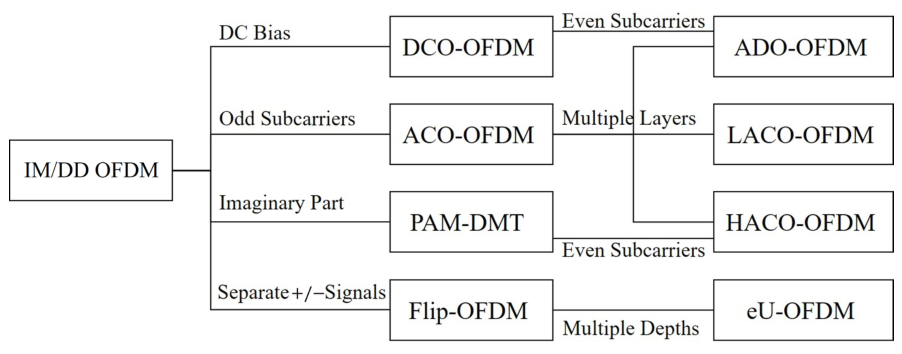
Figure 1 presents a structural overview of the principal techniques developed to adapt OFDM to IM/DD optical systems. As depicted, the initial challenge arises from the requirement that optical signals must be real-valued and non-negative due to the physical nature of light intensity. This constraint has given rise to several classes of OFDM signal formatting strategies. One widely adopted method is DC-biased optical OFDM (DCO-OFDM) [13,14,15], which introduces a direct current (DC) offset to ensure the entire transmitted waveform remains positive. While straightforward to implement, DCO-OFDM suffers from suboptimal energy efficiency, as the DC component does not contribute to data transmission but increases average optical power consumption. Furthermore, because DCO-OFDM requires Hermitian symmetry in the frequency domain to produce real-valued time-domain signals, only half of the available subcarriers can carry independent information, leading to reduced spectral efficiency. An alternative is asymmetrically clipped optical OFDM (ACO-OFDM) [16,17,18], which encodes data exclusively on the odd-indexed subcarriers and employs asymmetric clipping to generate a unipolar output. This approach completely avoids the need for a DC bias, thus improving energy efficiency. However, it also halves the available subcarrier capacity, resulting in a significant reduction in spectral efficiency. Pulse-amplitude modulated discrete multitone (PAM-DMT) schemes [19,20,21] exploit the imaginary component of the OFDM signal, using only real-valued pulse amplitude modulation on selected subcarriers. This offers implementation simplicity but still requires careful subcarrier allocation and does not fully address the spectral efficiency limitations imposed by the unipolar constraint. Other schemes, such as Flip-OFDM [22,23,24], operate by separating the positive and negative parts of the bipolar OFDM signal and transmitting them in consecutive time slots, effectively doubling the transmission duration for each OFDM symbol and thereby reducing the net data rate. Recent developments have focused on hybrid and layered approaches, including asymmetrically clipped DC-biased optical OFDM (ADO-OFDM) [25,26,27], layered ACO-OFDM (LACO-OFDM) [28,29,30,31], hybrid ACO-OFDM (HACO-OFDM) [32,33,34,35], as well as enhanced unipolar OFDM (eU-OFDM) [36,37,38]. These advanced techniques aim to recover some of the lost spectral efficiency by multiplexing information onto both even and odd subcarriers, or by introducing multiple hierarchical layers and signal depths. While these approaches offer improvements in bandwidth utilization and potentially better trade-offs between energy and spectral efficiency, they often require more complex transmitter and receiver architectures.
Figure 1.
Classification of variant OFDM schemes for IM/DD VLC systems.
Although numerous OFDM variants have been developed to satisfy the real-valued and non-negative signal requirements imposed by IM/DD optical systems, most existing solutions, such as DCO-OFDM and ACO-OFDM, still involve trade-offs in spectral efficiency, energy efficiency, or implementation complexity. From a practical perspective, these trade-offs originate from the fundamental constraint that IM/DD VLC systems require real-valued and non-negative transmitted waveforms, which makes the direct application of conventional OFDM inefficient or structurally constrained. In this context, real-valued transforms, particularly the discrete Hartley transform (DHT), have attracted growing interest as an alternative basis for optical OFDM. DHT-based OFDM (DHT-OFDM) [39,40,41] removes the need for Hermitian symmetry and allows all subcarriers to carry independent information, which is advantageous for bandwidth utilization and implementation efficiency. Rather than aiming to universally outperform existing schemes, DHT-OFDM provides a different trade-off among computational complexity, spectral efficiency, and spectral confinement. At the same time, this benefit is accompanied by an inherent limitation: DHT-OFDM is restricted to real-valued constellations, which reduces modulation flexibility, especially in frequency-selective channels.
While prior studies have demonstrated the feasibility of DHT-based OFDM, a systematic investigation under practical IM/DD constraints remains limited. In particular, issues such as unipolar signal generation, bipolar signal reconstruction, and fair performance evaluation under consistent system constraints have not been fully addressed. This motivates a comprehensive study that jointly considers system architecture, signal processing strategy, and performance trade-offs under consistent comparison conditions, in order to assess the practical applicability of DHT-OFDM in VLC systems. The main contributions of this work are summarized as follows.
- 1.
- A DHT-based OFDM scheme is investigated for IM/DD VLC systems, and a practical unipolar transmission framework together with a bipolar signal reconstruction strategy is developed under the real-valued and non-negative signal constraints.
- 2.
- A fair evaluation framework is established under equal-bandwidth and equal-symbol-rate conditions, and the proposed scheme is systematically compared with representative IM/DD OFDM schemes, including DCO-OFDM and ACO-OFDM.
2. DHT-OFDM for IM/DD VLC Systems
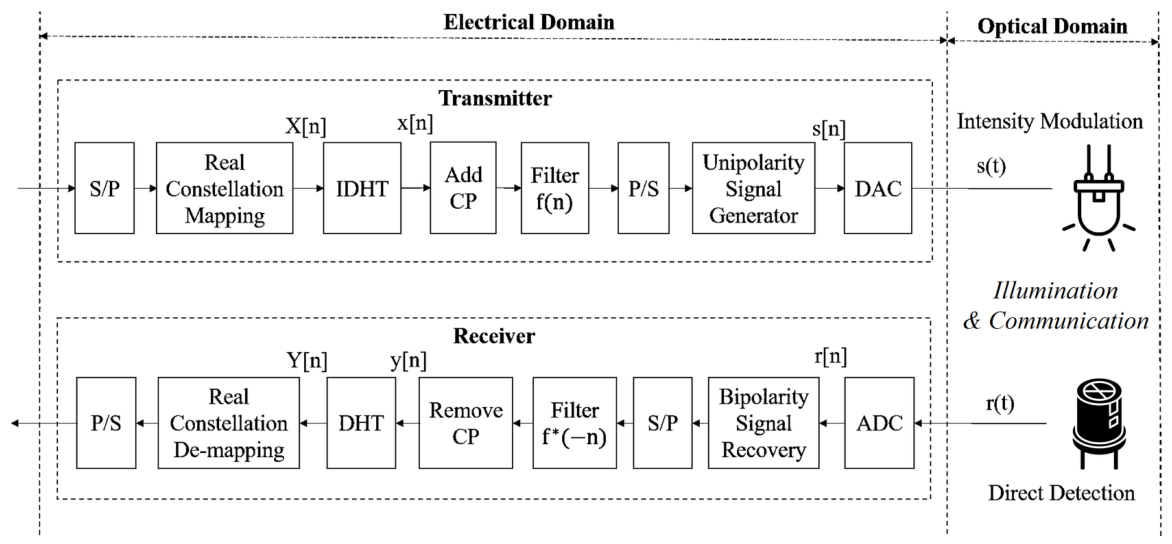
Figure 2 depicts the overall architecture of a DHT-OFDM communication system tailored for IM/DD optical links. The system is logically divided into the electrical and optical domains, encompassing both the transmitter and receiver signal processing chains. At the transmitter, the input bitstream is first converted from serial to parallel (S/P) form, followed by real-valued constellation mapping such as pulse amplitude modulation (PAM) or binary phase-shift keying (BPSK), producing the frequency-domain vector . This vector undergoes an N-point inverse discrete Hartley transform (IDHT), generating a real-valued time-domain sequence , expressed as
Subsequently, a cyclic prefix (CP) is appended to mitigate inter-symbol interference (ISI) induced by multipath propagation, and the signal is passed through a shaping filter for bandwidth limitation. After parallel-to-serial (P/S) conversion, a unipolarity signal generator processes the bipolar waveform to produce a non-negative sequence , which is then converted to an analog waveform via a digital-to-analog converter (DAC). The resulting electrical signal modulates the intensity of the LED, forming the optical carrier for transmission. At the receiver, a photodetector (PD) converts the incoming optical intensity to an electrical signal , which is then digitized by an analog-to-digital converter (ADC) to obtain the discrete sequence . The bipolarity signal recovery block reconstructs the original bipolar waveform from the received unipolar signal. After serial-to-parallel (S/P) conversion, the signal is filtered by the matched filter and the cyclic prefix is removed. The recovered time-domain samples are then transformed back into the frequency domain via the N-point DHT, yielding . Finally, real-valued constellation de-mapping and parallel-to-serial (P/S) conversion retrieve the original information bits. This architecture leverages the properties of the discrete Hartley transform to enable efficient and hardware-friendly implementation, supporting all-real arithmetic throughout the modulation and demodulation process. By eliminating the need for Hermitian symmetry and facilitating unipolar signal generation, the proposed DHT-OFDM system is well-suited for high-efficiency IM/DD optical wireless communication.
Figure 2.
Block diagram of the DHT-OFDM transceiver for IM/DD VLC systems.
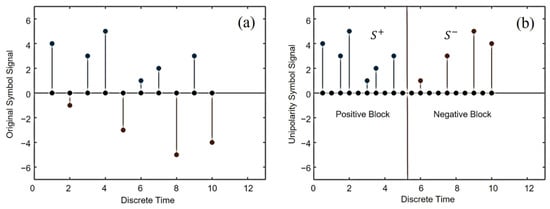
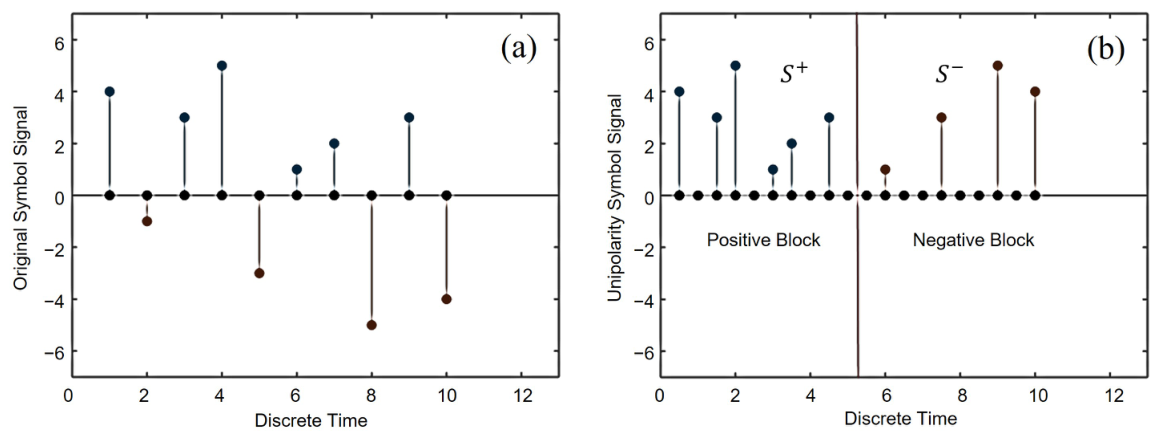
Figure 3a presents the original symbol sequence obtained after IDHT processing, which contains both positive and negative samples. In the context of IM/DD systems, where only non-negative optical intensities can be physically realized, the bipolar signal must be converted to a format suitable for optical modulation. Figure 3b depicts the unipolarity encoding procedure. The signal is separated into two consecutive blocks: the positive block () and the negative block (). The positive block consists of the original positive samples, while all negative values are set to zero. Conversely, the negative block is constructed by inverting the original negative samples (taking their absolute values) while setting positive samples to zero. These two blocks are then concatenated in time to form the unipolar symbol sequence, which maintains the information of both positive and negative components of the original IDHT output in a non-negative representation. This block-based unipolar mapping enables the resulting sequence to directly modulate the intensity of the optical carrier, such as an LED, ensuring physical realizability in the optical domain while preserving the original data integrity for subsequent signal recovery at the receiver. This approach is a key enabler for the practical deployment of DHT-OFDM in IM/DD-based visible light communication systems. The unipolar mapping adopted in this work represents each bipolar sample using two non-negative blocks to satisfy the IM/DD constraint. This introduces a temporal expansion of the transmitted signal, as each sample is conveyed over two consecutive intervals. More generally, different IM/DD OFDM schemes enforce non-negativity through different mechanisms, each associated with a specific resource trade-off. For instance, DCO-OFDM introduces a DC bias at the cost of increased average optical power, while ACO-OFDM sacrifices spectral utilization by transmitting information only on a subset of subcarriers. In contrast, the present scheme trades temporal resources for signal feasibility.
Figure 3.
(a) Original bipolar symbol sequence obtained from the output of the IDHT. (b) Unipolar symbol sequence generation by separating the positive and inverted negative components into two consecutive blocks for IM/DD systems.
To recover the original bipolar OFDM symbols from the non-negative received intensity, the received sequence is partitioned into positive () and negative () blocks corresponding to the unipolar mapping at the transmitter. The bipolar sequence is then reconstructed as
This reconstruction determines the signal polarity by comparing the two received blocks and selecting the corresponding component. This formulation provides a direct and practical approach for recovering the bipolar sequence from the unipolar transmission structure. After reconstruction, the original OFDM symbols can be retrieved using the DHT followed by symbol demapping.
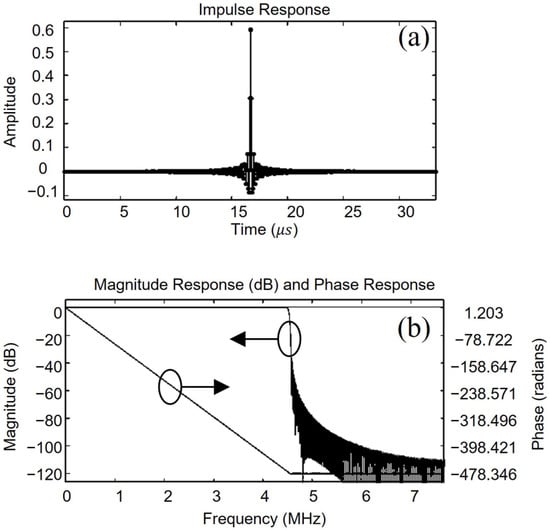
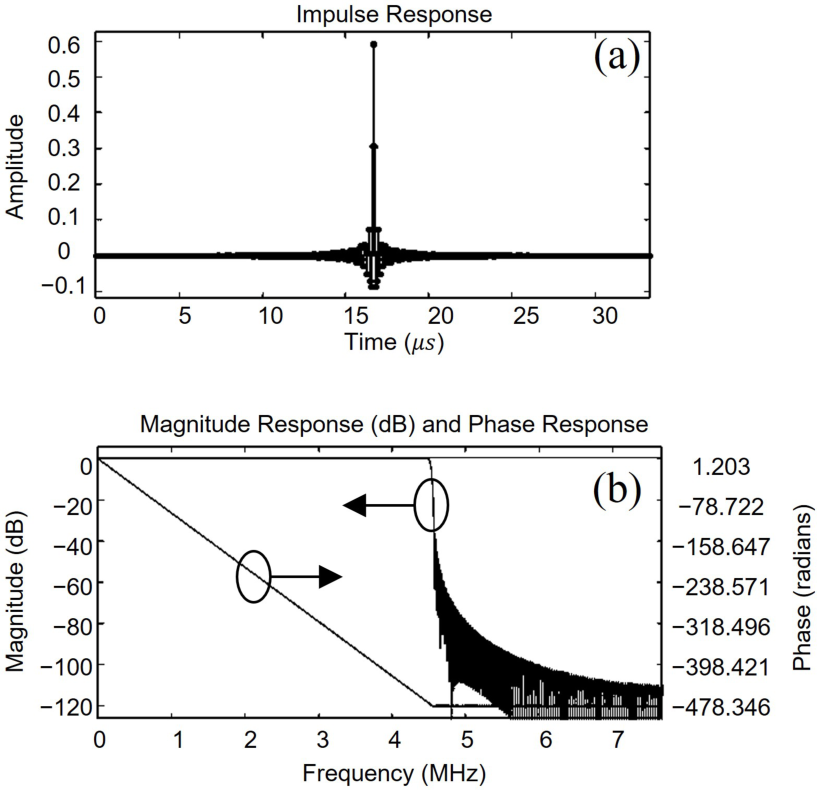
To ensure effective spectral confinement and minimize inter-carrier interference in DHT-OFDM systems, the modulated subcarrier signal is shaped by a carefully designed finite impulse response (FIR) filter. The ideal filter should exhibit a flat passband covering all active subcarriers, a sharp transition band to limit the width of guard bands, and high stopband attenuation to suppress out-of-band emissions. Figure 4a presents the impulse response of the filter, which demonstrates the expected sinc waveform with a main lobe centered in time and rapidly decaying side lobes, ensuring smooth transitions to zero at both ends. Figure 4b shows the magnitude and phase responses of the filter. The magnitude response features a flat passband up to the designed cutoff frequency, followed by a steep roll-off in the transition region, and strong attenuation in the stopband—characteristics essential for maintaining signal integrity and minimizing adjacent channel interference. The phase response is also plotted, indicating the linear phase property of the filter, which preserves the temporal structure of the transmitted signal. Overall, such a filter design is crucial for restricting the signal bandwidth to the allocated spectral region and protecting neighboring channels. Only a small number of subcarriers near the band edges are subject to attenuation effects, while the vast majority experience minimal distortion within the flat passband.
Figure 4.
(a) Impulse response and (b) corresponding magnitude (dB) and phase response of a typical sinc-based FIR filter used in DHT-OFDM systems.
3. Performance Analysis
Table 1 summarizes the computational complexity and spectral efficiency of DCO-OFDM, ACO-OFDM, and DHT-OFDM schemes. Among various IM/DD OFDM schemes, DCO-OFDM and ACO-OFDM are selected as benchmark references due to their fundamental roles and widespread adoption. More advanced variants, such as LACO-OFDM and HACO-OFDM, are typically derived from these basic frameworks, making DCO-OFDM and ACO-OFDM representative baselines for comparison. The comparison is carried out under consistent system assumptions with N subcarriers, total bandwidth , and identical information bit rate , so that both spectral efficiency and computational effort can be evaluated on a unified basis. In DCO-OFDM, the imposition of Hermitian symmetry constrains the input spectrum, limiting the number of independent information-bearing subcarriers to . As a result, the achievable spectral efficiency is . ACO-OFDM further reduces the utilization of spectral resources by restricting transmission to odd subcarriers, yielding a spectral efficiency of . In contrast, DHT-OFDM removes the Hermitian symmetry requirement and allows all subcarriers to carry real-valued information. By serially transmitting the positive and negative components, it achieves a spectral efficiency equivalent to DCO-OFDM under the same bandwidth constraint, while maintaining full subcarrier utilization. From a computational perspective, the differences among these schemes should be interpreted in conjunction with their spectral utilization. Under the equal-bandwidth condition, DHT-OFDM benefits from full subcarrier usage, whereas DCO-OFDM and ACO-OFDM inherently sacrifice degrees of freedom due to symmetry and subcarrier allocation constraints. Consequently, although the underlying transform operations are of comparable order, DHT-OFDM achieves a lower effective computational effort per transmitted information bit. Under the equal-symbol-rate condition, where the same symbol transmission rate is maintained across all schemes, ACO-OFDM requires an increased transform size to preserve the same information throughput, leading to a higher computational burden. In contrast, DCO-OFDM and DHT-OFDM can maintain the required data rate without enlarging the transform size, resulting in comparable computational complexity. It is also worth noting that DHT-OFDM operates entirely in the real domain, enabling a unified modulation and demodulation structure without Hermitian symmetry. However, this property restricts the modulation format to one-dimensional constellations such as M-PAM or BPSK, which reduces flexibility in frequency-selective channels where higher-order two-dimensional constellations are typically preferred [42,43,44]. Therefore, while DHT-OFDM improves spectral resource utilization and effective computational efficiency, it introduces a trade-off between implementation simplicity and modulation flexibility. Overall, the differences summarized in Table 1 arise from the interplay between spectral resource utilization, transform requirements, and modulation constraints, rather than from the transform structure alone.
Table 1.
Comprehensive Comparison of DCO-OFDM, ACO-OFDM, and DHT-OFDM Schemes.
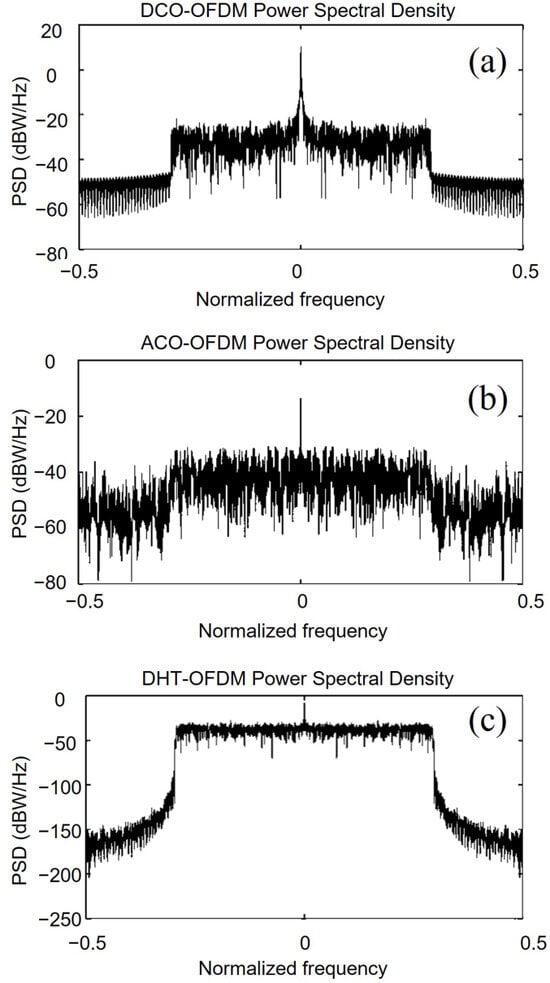
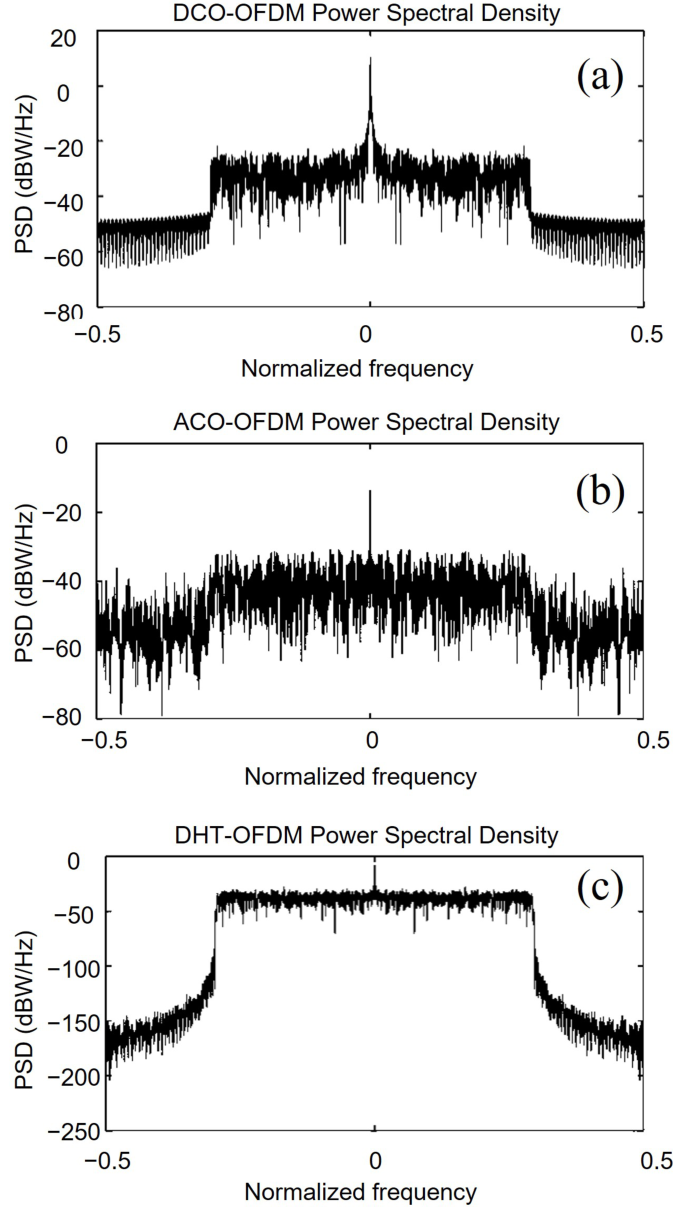
Figure 5 compares the power spectral densities (PSD) of DCO-OFDM, ACO-OFDM, and DHT-OFDM signals. In Figure 5a,b, both DCO-OFDM and ACO-OFDM exhibit pronounced spectral sidelobes outside the main signal band, with ACO-OFDM demonstrating the highest out-of-band emission among the three. In contrast, as shown in Figure 5c, the DHT-OFDM scheme achieves significantly lower sidelobe levels, resulting in much cleaner spectral confinement within the allocated bandwidth. This improved spectral purity reduces adjacent channel interference and enables more efficient utilization of the available spectrum, thereby enhancing the overall bandwidth efficiency of the communication system. The PSD difference mainly arises from the signal structure and the corresponding unipolar signal generation process. In DCO-OFDM, DC biasing may introduce clipping-related nonlinear distortion in practical implementations, while ACO-OFDM employs only odd subcarriers, resulting in a discontinuous spectral structure and increased spectral leakage. By contrast, DHT-OFDM avoids both biasing-induced distortion and asymmetric subcarrier allocation, leading to improved spectral confinement under the same filtering conditions.
Figure 5.
Power spectral density (PSD) comparison of (a) DCO-OFDM, (b) ACO-OFDM, and (c) DHT-OFDM signals. (Subcarrier modulation: PAM8, DFT or DHT size: 1024, cyclic prefix length: 72, filter structure: direct-form FIR, filter length: 513).
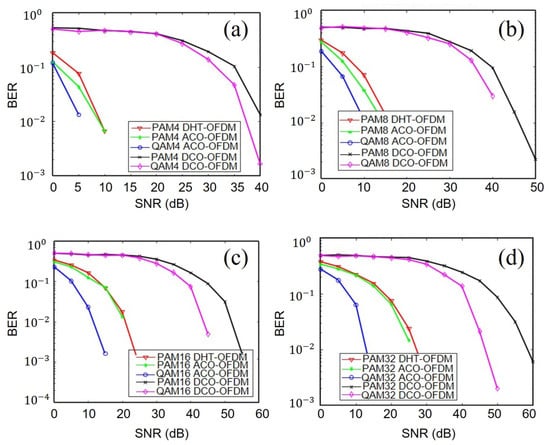
Figure 6 illustrates the bit error rate (BER) performance of DHT-OFDM, ACO-OFDM, and DCO-OFDM schemes in an additive white Gaussian noise (AWGN) channel, with identical bandwidth and increasing subcarrier modulation orders: (a) 4, (b) 8, (c) 16, and (d) 32. Across all cases, the DHT-OFDM scheme achieves significantly lower BER compared to DCO-OFDM, and demonstrates performance that closely matches or even surpasses PAM-based ACO-OFDM as the modulation order increases. These results indicate that DHT-OFDM provides better noise resilience and improved energy efficiency relative to conventional approaches when operating under the same bandwidth constraints.
Figure 6.
BER performance comparison of DHT-OFDM, ACO-OFDM, and DCO-OFDM in an AWGN channel with equal bandwidth, for modulation orders of (a) 4, (b) 8, (c) 16, and (d) 32, respectively. (Symbols per block: 6; block count: 50; subcarriers per block: 12; cyclic prefix size: 72).
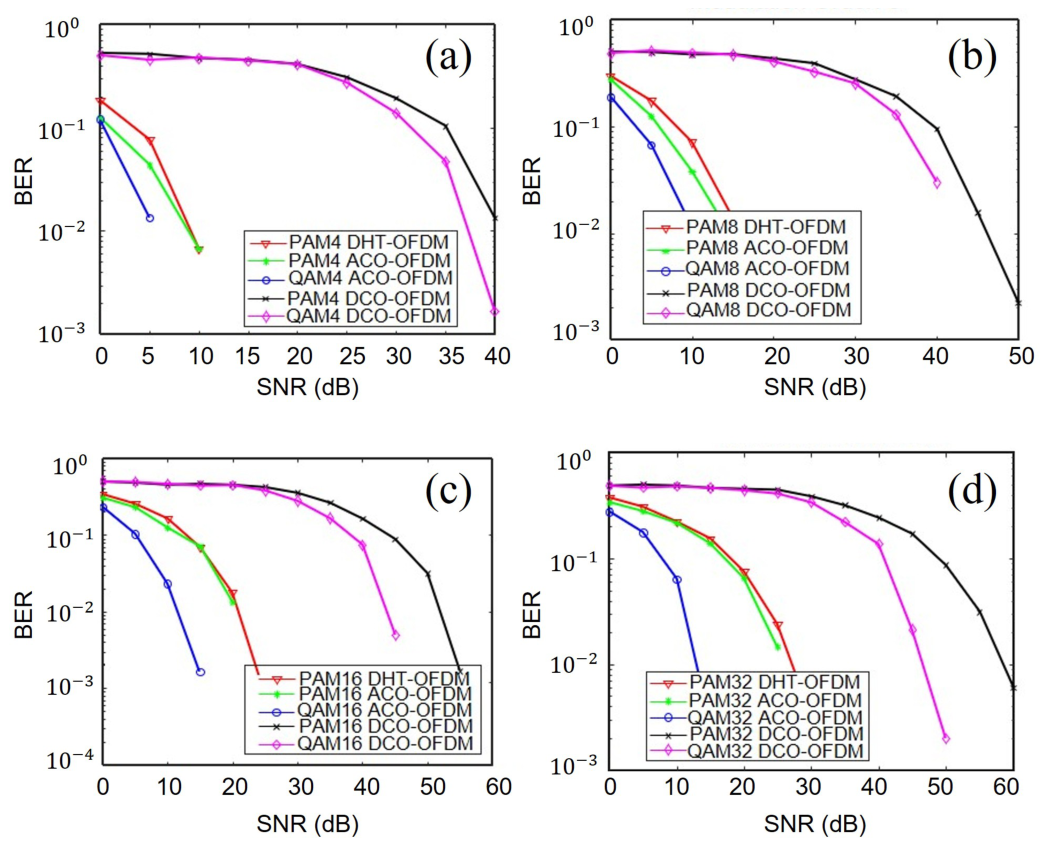
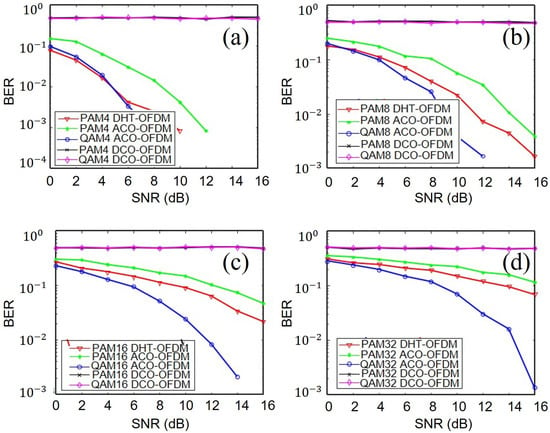
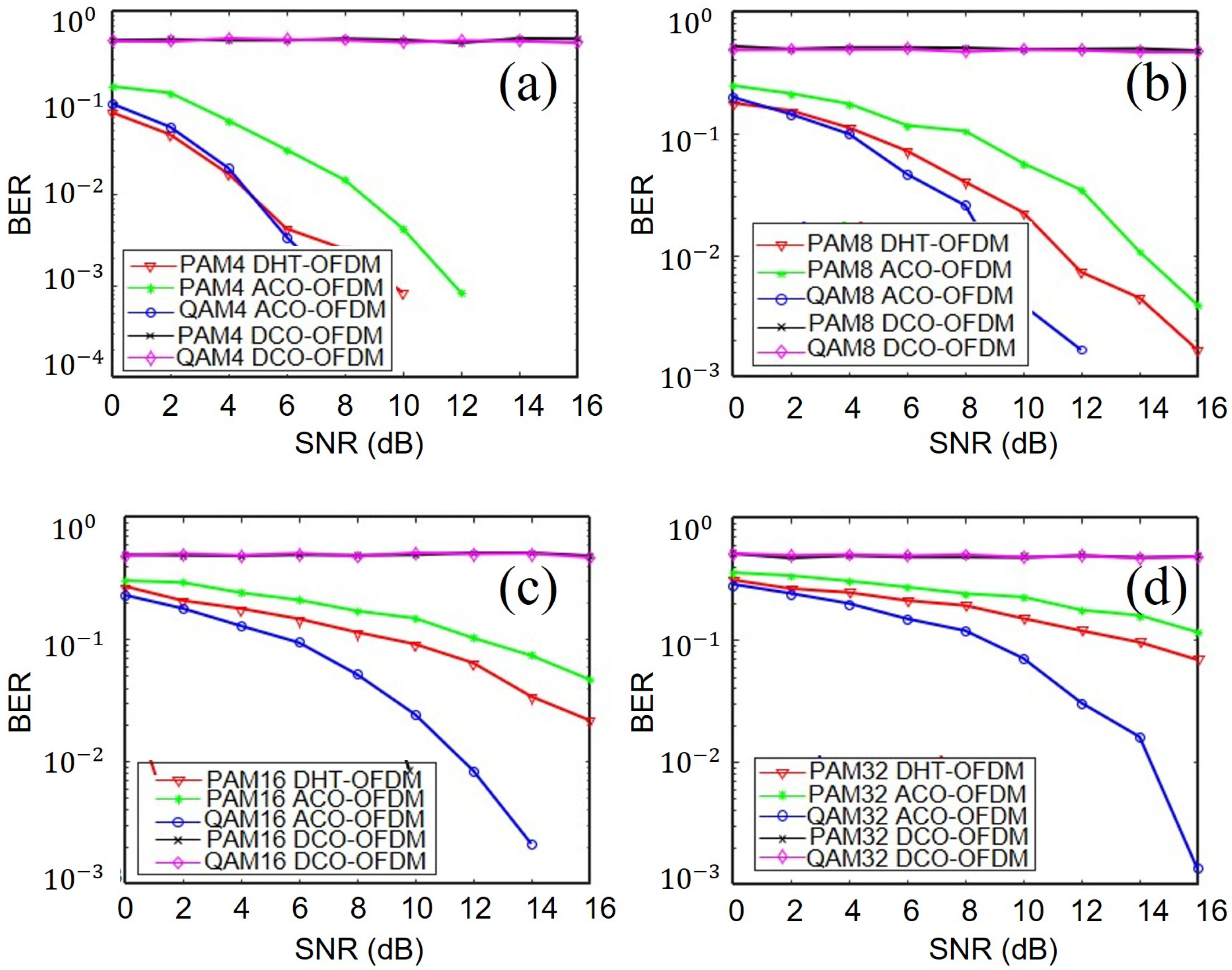
Figure 7 presents the simulated BER performance of DHT-OFDM, ACO-OFDM, and DCO-OFDM schemes at the same symbol rate for different modulation orders: (a) 4, (b) 8, (c) 16, and (d) 32. The results show that DHT-OFDM achieves BER performance nearly identical to that of QAM4-based ACO-OFDM across all modulation orders, and consistently outperforms both DCO-OFDM and PAM-based ACO-OFDM. Notably, as the modulation order increases, DHT-OFDM maintains its BER advantage while providing better energy efficiency compared to the conventional schemes at the same symbol rate.
Figure 7.
BER performance comparison of DHT-OFDM, ACO-OFDM, and DCO-OFDM at equal symbol rate for modulation orders of (a) 4, (b) 8, (c) 16, and (d) 32. (Sub-modulation orders: 4, 8, 16, 32; symbols per block: 6; block count: 50; subcarriers per block: 12, 14, 24; cyclic prefix size: 72).
To compare the frequency-domain behavior of DFT-OFDM and DHT-OFDM under practical channel conditions, we examine their mathematical models in the presence of multipath fading. The received signal vector can be expressed as
where is the transmitted symbol vector, F and are the DFT and inverse DFT matrices, A represents the channel convolution matrix, and is the noise vector. The DFT matrix is given by
A key property of DFT-based OFDM is that the transformation can diagonalize the channel matrix A in the frequency domain:
where denotes the channel frequency response on each subcarrier. This diagonalization eliminates inter-carrier interference (ICI), allowing for simple one-tap equalization per subcarrier regardless of channel multipath effects. In contrast, when employing the DHT in the OFDM system, the corresponding received signal model becomes
where the DHT matrix is defined as
However, unlike the DFT, the DHT cannot fully diagonalize the channel convolution matrix. The resulting transformation is
which generally yields a non-diagonal matrix. As a result, the channel introduces coupling between symmetric subcarriers, leading to inter-carrier interference (ICI) in frequency-selective fading environments. Consequently, a simple one-tap equalizer is insufficient, and multi-tap equalization or more sophisticated interference mitigation techniques are required to recover the transmitted data. To quantify the overall severity of such subcarrier coupling, we further define the ICI ratio, denoted by , as
where G denotes the equivalent channel matrix in the transform domain, i.e., for DFT-OFDM and for DHT-OFDM, and is the Frobenius norm. In (9), the numerator represents the total off-diagonal energy corresponding to inter-subcarrier coupling, while the denominator represents the useful diagonal energy associated with the desired subcarrier responses. Therefore, provides a compact quantitative measure of the relative ICI strength. A smaller indicates that the equivalent channel is closer to diagonal and that one-tap equalization remains effective, whereas a larger implies stronger cross-subcarrier interference and a higher likelihood of performance degradation in frequency-selective channels. In summary, while DHT-OFDM retains implementation and efficiency advantages in flat-fading or AWGN channels, its performance may be degraded in multipath environments due to ICI. This highlights the importance of careful channel equalization [45,46,47,48] design when deploying DHT-OFDM in practical VLC systems.
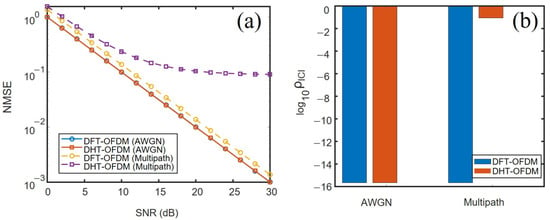
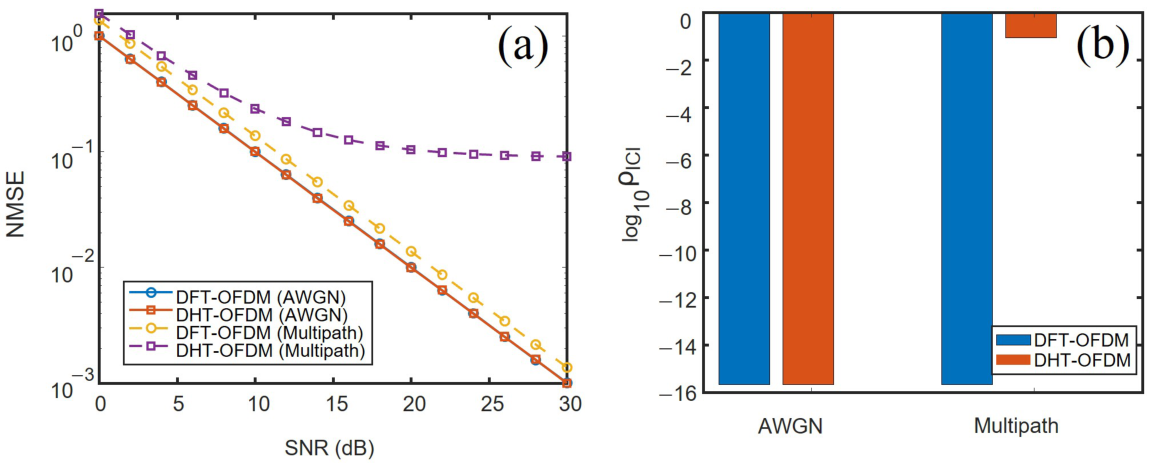
Figure 8a compares DFT-based and DHT-based OFDM under AWGN and frequency-selective multipath channels. Compared with BER, which is affected by hard decision thresholds, normalized mean squared error (NMSE) more directly reflects the impact of ICI on signal reconstruction. Under AWGN conditions, both schemes exhibit nearly identical behavior, and the NMSE decreases monotonically with increasing SNR, as expected for orthogonal transforms in the absence of significant channel-induced ICI. Under multipath propagation, however, DFT-OFDM continues to improve with SNR whereas DHT-OFDM exhibits a pronounced high-SNR error floor. This result indicating that its performance becomes interference-limited rather than noise-limited, and is consistent with Figure 8b, which plots the ICI ratio in both channel conditions. Under AWGN, both transforms yield very small ICI ratios, confirming negligible inter-subcarrier coupling. Under multipath channels, the ICI ratio in the DFT domain remains very low, whereas that in the DHT domain increases markedly. This indicates the DHT-domain equivalent channel is no longer effectively diagonal, and the resulting ICI is responsible for the observed NMSE floor. While this result highlights the intrinsic ICI of DHT-OFDM under such channels, the interference may still be mitigated by appropriate equalization strategies.
Figure 8.
(a) NMSE versus SNR for DFT-OFDM and DHT-OFDM under AWGN and frequency-selective multipath channels. (b) Corresponding ICI ratio in the DFT and DHT domains. (BPSK modulation; subcarriers per block: 64; cyclic prefix size: 16; The AWGN channel was given by , whereas the multipath channel was ).
4. Conclusions
This work has presented a systematic investigation of DHT-OFDM for IM/DD VLC systems, including its signal structure, implementation characteristics, and comparative performance with conventional DCO-OFDM and ACO-OFDM schemes. By exploiting the real-valued and self-inverse properties of the discrete Hartley transform, DHT-OFDM removes the need for Hermitian symmetry and enables full subcarrier utilization, leading to a reduction in computational complexity on the order of 50% under equal bandwidth conditions. Both theoretical analysis and simulation results demonstrate that DHT-OFDM achieves comparable BER performance while providing improved spectral confinement, as reflected by its lower out-of-band sidelobes relative to DCO-OFDM and ACO-OFDM. In addition, under consistent bandwidth constraints, DHT-OFDM maintains a spectral efficiency equivalent to DCO-OFDM, while offering a more implementation-efficient structure due to its real-valued processing. Nevertheless, the restriction of DHT-OFDM to one-dimensional real-valued modulation limits its flexibility in frequency-selective channels, where complex constellations are typically advantageous for adaptive transmission. This trade-off reflects a fundamental constraint imposed by IM/DD systems, where signal non-negativity must be ensured. Future work will focus on experimental validation using hardware platforms under realistic VLC channel conditions, including multipath propagation and device nonlinearity, as well as the investigation of adaptive equalization and modulation strategies to improve robustness in frequency-selective environments.
Funding
This work was supported by the 2022 Research Start Program 202206.
Institutional Review Board Statement
Not applicable.
Informed Consent Statement
Not applicable.
Data Availability Statement
All data supporting the findings of this study are already included within this article.
Conflicts of Interest
The author declares no conflicts of interest.
References
- Hwang, T.; Yang, C.; Wu, G.; Li, S.; Li, G.Y. OFDM and Its Wireless Applications: A Survey. IEEE Trans. Veh. Technol. 2008, 58, 1673–1694. [Google Scholar] [CrossRef] [Scilit]
- Armstrong, J. OFDM for Optical Communications. J. Light. Technol. 2009, 27, 189–204. [Google Scholar] [CrossRef] [Scilit]
- Hermelo, M.F.; Shih, P.-T.; Steeg, M.; Ng’oma, A.; Stöhr, A. Spectral Efficient 64-QAM-OFDM Terahertz Communication Link. Opt. Express 2017, 25, 19360–19370. [Google Scholar] [CrossRef] [Scilit]
- Chakraborty, S.; Parisi, C.; Saha, D.; Thawdar, N. A Case for OFDM in Ultra-Broadband Terahertz Communication: An Experimental Approach. In Proceedings of the 5th ACM Workshop on Millimeter-Wave and Terahertz Networks and Sensing Systems; Association for Computing Machinery: New York, NY, USA, 2021; pp. 1–6. [Google Scholar]
- Mesleh, R.; Elgala, H.; Haas, H. On the Performance of Different OFDM Based Optical Wireless Communication Systems. J. Opt. Commun. Netw. 2011, 3, 620–628. [Google Scholar] [CrossRef] [Scilit]
- Oubei, H.M.; Duran, J.R.; Janjua, B.; Wang, H.-Y.; Tsai, C.-T.; Chi, Y.-C.; Ng, T.K.; Kuo, H.-C.; He, J.-H.; Alouini, M.-S.; et al. 4.8 Gbit/s 16-QAM-OFDM Transmission Based on Compact 450-Nm Laser for Underwater Wireless Optical Communication. Opt. Express 2015, 23, 23302–23309. [Google Scholar] [CrossRef] [Scilit]
- Chen, Y.; Kong, M.; Ali, T.; Wang, J.; Sarwar, R.; Han, J.; Guo, C.; Sun, B.; Deng, N.; Xu, J. 26 m/5.5 Gbps Air-Water Optical Wireless Communication Based on an OFDM-Modulated 520-Nm Laser Diode. Opt. Express 2017, 25, 14760–14765. [Google Scholar] [CrossRef] [Scilit]
- Duhamel, P.; Vetterli, M. Fast Fourier Transforms: A Tutorial Review and a State of the Art. Signal Process. 1990, 19, 259–299. [Google Scholar] [CrossRef] [Scilit]
- Burchardt, H.; Serafimovski, N.; Tsonev, D.; Videv, S.; Haas, H. VLC: Beyond Point-to-Point Communication. IEEE Commun. Mag. 2014, 52, 98–105. [Google Scholar] [CrossRef] [Scilit]
- Feng, L.; Hu, R.Q.; Wang, J.; Xu, P.; Qian, Y. Applying VLC in 5G Networks: Architectures and Key Technologies. IEEE Netw. 2016, 30, 77–83. [Google Scholar] [CrossRef] [Scilit]
- Che, M.; Kuboki, T.; Kato, K. Proposal of Cost-Efficient and Low-Complexity Platform for Software Defined Visible Light Communication. In 2017 22nd Microoptics Conference (MOC); IEEE: Piscataway, NJ, USA, 2017; pp. 330–331. [Google Scholar]
- Ndjiongue, A.R.; Ferreira, H.C.; Ngatched, T.M. Visible Light Communications (VLC) Technology. In Wiley Encyclopedia of Electrical and Electronics Engineering; John Wiley & Sons, Inc.: Hoboken, NJ, USA, 1999; pp. 1–15. [Google Scholar]
- Carruthers, J.B.; Kahn, J.M. Multiple-Subcarrier Modulation for Non-Directed Wireless Infrared Communication. In 1994 IEEE GLOBECOM. Communications: The Global Bridge; IEEE: Piscataway, NJ, USA, 1994; Volume 2, pp. 1055–1059. [Google Scholar]
- Zhang, M.; Zhang, Z. An Optimum DC-Biasing for DCO-OFDM System. IEEE Commun. Lett. 2014, 18, 1351–1354. [Google Scholar] [CrossRef] [Scilit]
- Chen, C.; Videv, S.; Tsonev, D.; Haas, H. Fractional Frequency Reuse in DCO-OFDM-Based Optical Attocell Networks. J. Light. Technol. 2015, 33, 3986–4000. [Google Scholar] [CrossRef] [Scilit]
- Armstrong, J.; Lowery, A. Power Efficient Optical OFDM. Electron. Lett. 2006, 42, 1. [Google Scholar] [CrossRef] [Scilit]
- Zhang, X.; Wang, Q.; Zhang, R.; Chen, S.; Hanzo, L. Performance Analysis of Layered ACO-OFDM. IEEE Access 2017, 5, 18366–18381. [Google Scholar] [CrossRef] [Scilit]
- Li, X.; Mardling, R.; Armstrong, J. Channel Capacity of IM/DD Optical Communication Systems and of ACO-OFDM. In 2007 IEEE International Conference on Communications; IEEE: Piscataway, NJ, USA, 2007; pp. 2128–2133. [Google Scholar]
- Lee, S.C.J.; Randel, S.; Breyer, F.; Koonen, A.M. PAM-DMT for Intensity-Modulated and Direct-Detection Optical Communication Systems. IEEE Photonics Technol. Lett. 2009, 21, 1749–1751. [Google Scholar] [CrossRef] [Scilit]
- Islim, M.S.; Tsonev, D.; Haas, H. Spectrally Enhanced PAM-DMT for IM/DD Optical Wireless Communications. In 2015 IEEE 26th Annual International Symposium on Personal, Indoor, and Mobile Radio Communications (PIMRC); IEEE: Piscataway, NJ, USA, 2015; pp. 877–882. [Google Scholar]
- Islim, M.S.; Haas, H. Augmenting the Spectral Efficiency of Enhanced PAM-DMT-Based Optical Wireless Communications. Opt. Express 2016, 24, 11932–11949. [Google Scholar] [CrossRef] [Scilit]
- Fernando, N.; Hong, Y.; Viterbo, E. Flip-OFDM for Optical Wireless Communications. In 2011 IEEE Information Theory Workshop; IEEE: Piscataway, NJ, USA, 2011; pp. 5–9. [Google Scholar]
- Tsonev, D.; Sinanovic, S.; Haas, H. Novel Unipolar Orthogonal Frequency Division Multiplexing (U-OFDM) for Optical Wireless. In 2012 IEEE 75th Vehicular Technology Conference (VTC Spring); IEEE: Piscataway, NJ, USA, 2012; pp. 1–5. [Google Scholar]
- Fernando, N.; Hong, Y.; Viterbo, E. Flip-OFDM for Unipolar Communication Systems. IEEE Trans. Commun. 2012, 60, 3726–3733. [Google Scholar] [CrossRef] [Scilit]
- Dissanayake, S.D.; Armstrong, J. Comparison of Aco-Ofdm, Dco-Ofdm and Ado-Ofdm in Im/Dd Systems. J. Light. Technol. 2013, 31, 1063–1072. [Google Scholar] [CrossRef] [Scilit]
- Hameed, S.M.; Abdulsatar, S.M.; Sabri, A.A. Performance Enhancement for Visible Light Communication Based ADO-OFDM. Opt. Quantum Electron. 2021, 53, 339. [Google Scholar] [CrossRef] [Scilit]
- Miriyala, G.; Mani, V. A Nonlinear Modelled Low-Complex ADO-OFDM for Visible Light Communication Systems. Optik 2021, 246, 167831. [Google Scholar] [CrossRef] [Scilit]
- Wang, Q.; Qian, C.; Guo, X.; Wang, Z.; Cunningham, D.G.; White, I.H. Layered ACO-OFDM for Intensity-Modulated Direct-Detection Optical Wireless Transmission. Opt. Express 2015, 23, 12382–12393. [Google Scholar] [CrossRef] [Scilit] [PubMed]
- Yang, F.; Sun, Y.; Gao, J. Adaptive LACO-OFDM with Variable Layer for Visible Light Communication. IEEE Photonics J. 2017, 9, 7907908. [Google Scholar] [CrossRef] [Scilit]
- Sun, Y.; Yang, F.; Gao, J. Novel Dimmable Visible Light Communication Approach Based on Hybrid LACO-OFDM. J. Light. Technol. 2018, 36, 4942–4951. [Google Scholar] [CrossRef] [Scilit]
- Li, B.; Xu, W.; Feng, S.; Li, Z. Spectral-Efficient Reconstructed LACO-OFDM Transmission for Dimming Compatible Visible Light Communications. IEEE Photonics J. 2019, 11, 7900714. [Google Scholar] [CrossRef] [Scilit]
- Ranjha, B.; Kavehrad, M. Hybrid Asymmetrically Clipped OFDM-Based IM/DD Optical Wireless System. J. Opt. Commun. Netw. 2014, 6, 387–396. [Google Scholar] [CrossRef] [Scilit]
- Li, B.; Xu, W.; Zhang, H.; Zhao, C.; Hanzo, L. PAPR Reduction for Hybrid ACO-OFDM Aided IM/DD Optical Wireless Vehicular Communications. IEEE Trans. Veh. Technol. 2017, 66, 9561–9566. [Google Scholar] [CrossRef] [Scilit]
- Zhang, T.; Sun, L.; Zhao, C.; Qiao, S.; Ghassemlooy, Z. Low-Complexity Receiver for HACO-OFDM in Optical Wireless Communications. IEEE Wirel. Commun. Lett. 2020, 10, 572–575. [Google Scholar] [CrossRef] [Scilit]
- Wang, T.; Hou, Y.; Ma, M. A Novel Receiver Design for HACO-OFDM by Time-Domain Clipping Noise Elimination. IEEE Commun. Lett. 2018, 22, 1862–1865. [Google Scholar] [CrossRef] [Scilit]
- Tsonev, D.; Haas, H. Avoiding Spectral Efficiency Loss in Unipolar OFDM for Optical Wireless Communication. In 2014 IEEE International Conference on Communications (ICC); IEEE: Piscataway, NJ, USA, 2014; pp. 3336–3341. [Google Scholar]
- Mulinde, R.; Nguyen, K.D.; Cowley, W.G. BER Analysis of Optical eU-OFDM Transmission over AWGN. In 2015 9th International Conference on Signal Processing and Communication Systems (ICSPCS); IEEE: Piscataway, NJ, USA, 2015; pp. 1–6. [Google Scholar]
- Tsonev, D.; Islim, M.S.; Haas, H. OFDM-Based Visible Light Communications. In Optical Wireless Communications: An Emerging Technology; Springer: Cham, Switzerland, 2016; pp. 255–298. [Google Scholar]
- Che, M.; Kuboki, T.; Kato, K. Dimmable Optical OFDM Based on Discrete Hartley Transform for Indoor Visible Light Illumination and Communication. In 2018 23rd Opto-Electronics and Communications Conference (OECC); IEEE: Piscataway, NJ, USA, 2018; pp. 1–2. [Google Scholar]
- Jao, C.-K.; Long, S.-S.; Shiue, M.-T. DHT-Based OFDM System for Passband Transmission over Frequency-Selective Channel. IEEE Signal Process. Lett. 2010, 17, 699–702. [Google Scholar] [CrossRef] [Scilit]
- Qasem, Z.A.; Wang, J.; Leftah, H.A.; Sun, H.; Hong, S.; Qi, J.; Esmaiel, H. Real Signal DHT-OFDM with Index Modulation for Underwater Acoustic Communication. IEEE J. Ocean. Eng. 2022, 48, 246–259. [Google Scholar] [CrossRef] [Scilit]
- Che, M.; Kuboki, T.; Kato, K. Trellis Coded Three Dimensional Carrierless Amplitude and Phase Modulation. In 2019 24th OptoElectronics and Communications Conference (OECC) and 2019 International Conference on Photonics in Switching and Computing (PSC); IEEE: Piscataway, NJ, USA, 2019; pp. 1–3. [Google Scholar]
- Lin, B.; Tang, X.; Ghassemlooy, Z.; Fang, X.; Lin, C.; Li, Y.; Zhang, S. Experimental Demonstration of OFDM/OQAM Transmission for Visible Light Communications. IEEE Photonics J. 2016, 8, 7906710. [Google Scholar] [CrossRef] [Scilit]
- Kumari, M.; Sheetal, A.; Sharma, R. Performance Analysis of Symmetrical and Bidirectional 40 Gbps TWDM-PON Employing m-QAM-OFDM Modulation with Multi-Color LDs Based VLC System. Opt. Quantum Electron. 2021, 53, 455. [Google Scholar] [CrossRef] [Scilit]
- Rajbhandari, S.; Chun, H.; Faulkner, G.; Haas, H.; Xie, E.; McKendry, J.J.; Herrnsdorf, J.; Gu, E.; Dawson, M.D.; O’Brien, D. Neural Network-Based Joint Spatial and Temporal Equalization for MIMO-VLC System. IEEE Photonics Technol. Lett. 2019, 31, 821–824. [Google Scholar] [CrossRef] [Scilit]
- Che, M.; Kuboki, T.; Kato, K. Nonlinear Compensation for Indoor Visible Light Communication Systems with Carrierless Amplitude and Phase Modulation. Jpn. J. Appl. Phys. 2019, 58, SJJA02. [Google Scholar] [CrossRef] [Scilit]
- Kisacik, R.; Yagan, M.; Uysal, M.; Pusane, A.; Yalcinkaya, A. A New LED Response Model and Its Application to Pre-Equalization in VLC Systems. IEEE Photonics Technol. Lett. 2021, 33, 955–958. [Google Scholar] [CrossRef] [Scilit]
- Chen, C.; Nie, Y.; Liu, M.; Du, Y.; Liu, R.; Wei, Z.; Fu, H.; Zhu, B. Digital Pre-Equalization for OFDM-Based VLC Systems: Centralized or Distributed? IEEE Photonics Technol. Lett. 2021, 33, 1081–1084. [Google Scholar] [CrossRef] [Scilit]

Disclaimer/Publisher’s Note: The statements, opinions and data contained in all publications are solely those of the individual author(s) and contributor(s) and not of MDPI and/or the editor(s). MDPI and/or the editor(s) disclaim responsibility for any injury to people or property resulting from any ideas, methods, instructions or products referred to in the content. |
© 2026 by the author. Licensee MDPI, Basel, Switzerland. This article is an open access article distributed under the terms and conditions of the Creative Commons Attribution (CC BY) license.