


Definition
Disciplinary literacy refers to the specialized practices of reading, writing, and reasoning that are unique to each academic discipline—the distinct ways in which scientists, historians, mathematicians, and literary scholars construct, communicate, and critique knowledge within their fields. Although disciplinary literacy is relevant across the lifespan and across all phases of education, its demands become most salient as learners advance through schooling and encounter increasingly specialized texts and discourse conventions. It is distinguished from content-area literacy, which applies general study and comprehension strategies across subjects, and from the foundational literacy skills emphasized in the early-grades Science of Reading. Where foundational literacy concerns the components by which children learn to read (phonemic awareness, phonics, fluency, vocabulary, and comprehension), disciplinary literacy concerns how learners read, write, and think as participants in a discipline once those foundations are largely in place. In secondary teacher preparation specifically, disciplinary literacy denotes both a body of pedagogical knowledge and a set of instructional competencies that content-area teacher candidates are increasingly expected to demonstrate—including the capacity to make discipline-specific reading and writing practices visible and teachable for their students. Its theoretical foundations lie in scholarship documenting that literacy demands become more specialized, rather than more general, as students advance through schooling. As educator preparation systems, particularly in the United States, formally integrate Science of Reading principles into program requirements, disciplinary literacy has emerged as the established, though comparatively less codified, extension of that movement into the secondary content areas, where disciplinary reading and writing instruction have historically received limited systematic attention.
1. Introduction
Literacy has long been treated, in both schooling and public policy, as a competence acquired in the early grades and thereafter assumed. This view conceives of literacy primarily as foundational reading—the ability to decode print and comprehend text—which, once attained, is expected to function as a transparent tool applied uniformly across subjects. The assumption underwrites the familiar exhortation that “every teacher is a teacher of reading,” a slogan that has circulated through secondary schools for decades and that has reliably frustrated the content-area teachers it was meant to mobilize [1]. The difficulty is not that secondary teachers reject literacy, but that the generic reading strategies they are urged to adopt often bear little resemblance to the specialized ways of reading and writing that define their disciplines.
The construct of disciplinary literacy emerged to name precisely this mismatch. Content-area literacy—the dominant framework for decades—addressed the problem by equipping teachers with general comprehension strategies applicable across subjects: previewing, summarizing, and graphic organizers. Disciplinary literacy represents a different claim. In their influential reframing, Shanahan and Shanahan argued that the literacy demands placed on students do not simply intensify as schooling progresses; they diverge [1]. A chemist, a historian, and a mathematician read, write, and evaluate texts in fundamentally different ways, drawing on distinct purposes, conventions, and habits of skepticism. Where content-area literacy treats the discipline as a context for applying general strategies, disciplinary literacy treats it as constitutive of how reading and writing work. Research consistently indicates that these specialized practices are not effectively transmitted as a transferable set of skills layered atop content instruction; they require cultivation within each discipline, by teachers who understand how knowledge is made and communicated in their field [1].
A third body of knowledge bears on this picture: the Science of Reading, a substantial and growing research tradition concerned with how reading develops and how it is most effectively taught. Distinct from both content-area literacy and disciplinary literacy, the Science of Reading has generated rigorous evidence about the foundational skills—decoding, phonological awareness, fluency, and language comprehension—that underlie all reading. As this tradition has reshaped literacy policy primarily in the United States, though with parallel reform activity in other English-speaking contexts [2], the resulting reforms have concentrated, appropriately, on the early grades where foundational literacy skills are acquired. Yet the same research tradition also makes clear that proficient reading of complex, discipline-specific text requires more than foundational skills alone. The secondary grades, where students encounter the dense and specialized texts of the disciplines, represent the point at which disciplinary literacy becomes indispensable—and at which teacher preparation has been least systematically equipped to address it [3,4].
This entry provides a consolidated reference account of disciplinary literacy as it bears on the preparation of secondary teachers. It defines the construct and distinguishes it from content-area literacy and foundational literacy; traces its historical development from content-area reading through the contemporary Science of Reading movement; surveys the discipline-specific practices that characterize literacy in science, history, mathematics, the language arts, and world languages; and describes how educator preparation programs have sought to integrate this knowledge into coursework, clinical experiences, and faculty development. It closes by situating these developments within the current policy landscape, acknowledging limitations and debates in the field, and identifying directions for further development. Throughout, the aim is descriptive and synthetic rather than advocative: to render an established but fragmented body of knowledge accessible as a coherent reference.
2. Genesis and History
2.1. From “Every Teacher a Teacher of Reading” to Content-Area Literacy
The proposition that secondary teachers share responsibility for students’ reading development is not new. Its lineage reaches back to the early twentieth century and was consolidated mid-century in the content-area reading movement, which sought to equip subject-matter teachers with general comprehension strategies, including previewing text, activating prior knowledge, summarizing, and questioning, that could be applied to the textbooks of any discipline. These strategies were valuable and widely disseminated, but they shared a common premise: that reading is a general capacity, and that improving it is a matter of applying broadly useful techniques regardless of subject. Content-area literacy, in this sense, treated the discipline as a context for reading rather than as a constitutive feature of it.
This premise produced a durable tension. Secondary teachers, trained as specialists in their subjects, frequently experienced generic literacy strategies as additions imposed from outside their disciplines, worthwhile in principle but disconnected from the intellectual work of doing science or history. The result, documented across decades of research, was uneven uptake and persistent resistance [1].
2.2. The Disciplinary Turn
The decisive reconceptualization came with Shanahan and Shanahan’s 2008 analysis, which proposed that literacy be understood as increasingly specialized rather than increasingly general as students advance [1]. Drawing on studies of how disciplinary experts read the texts of their fields, they described a progression from basic literacy (the foundational decoding and comprehension skills of the early grades), through intermediate literacy (the generic comprehension strategies of content-area reading), to disciplinary literacy (the specialized practices specific to particular fields). The key claim was that the highest level is not a refinement of the lower ones but a qualitatively distinct set of practices: the historian reading for sourcing and corroboration, the chemist coordinating textual, symbolic, and graphical representations, the mathematician reading for logical entailment.
Moje extended and complicated this account by foregrounding the social and cultural dimensions of disciplinary practice. In a series of works spanning the review of disciplinary literacy literature [5], a call to foreground the disciplines in secondary teaching [6], and a synthesis of disciplinary literacy as a social and cultural enterprise [7], Moje argued that learning a discipline’s literacy is inseparable from learning to participate in its community, including its norms of argument, its standards of evidence, and its characteristic identities. Disciplinary literacy, on this view, is not merely a set of cognitive strategies but a form of socialization into ways of knowing. This framing connected disciplinary literacy to questions of equity and access, since the conventions of academic disciplines are not equally visible or available to all students.
2.3. Convergence with the Science of Reading
Parallel to the disciplinary turn, a distinct research tradition, commonly termed the Science of Reading, was accumulating evidence about how reading develops and how it is most effectively taught. Foundational to this tradition is the Simple View of Reading, which holds that reading comprehension is the product of word recognition and language comprehension [8]. Scarborough’s widely reproduced “reading rope” elaborated these two strands into their component skills, illustrating how word-recognition processes (phonological awareness, decoding, sight recognition) and language-comprehension processes (background knowledge, vocabulary, language structures, verbal reasoning, literacy knowledge) become increasingly interwoven as skilled reading develops [9]. Synthesizing work in cognitive science, Seidenberg situated these models within a broader account of reading as a skill grounded in the mapping of print to speech and meaning [10].
As this research base translated into policy and practice, the term “Science of Reading” came to denote both the underlying research and the instructional reforms drawn from it [11]. Crucially for the present entry, the Science of Reading and disciplinary literacy are complementary rather than competing. The former specifies the components necessary for reading to occur at all and is most directly relevant to the early grades; the latter specifies the specialized practices required to read and write the complex texts of the disciplines and is most directly relevant to the secondary grades. The language-comprehension strand of the Simple View, encompassing background knowledge, vocabulary, and verbal reasoning, provides the conceptual bridge between the two: it is within this strand that disciplinary knowledge and discipline-specific language exert their influence on comprehension. A complete account of literacy development thus requires both traditions, with disciplinary literacy describing what advanced, discipline-embedded reading and writing demand once foundational skills are in place.
3. Related Concepts and Distinctions
Because disciplinary literacy is frequently conflated with adjacent concepts, precise distinctions are essential to its use as a reference construct. Three contrasts are particularly consequential.
Foundational literacy versus disciplinary literacy. Foundational literacy refers to the constrained skills of phonemic awareness, phonics, and fluency by which learners acquire the capacity to read words, together with the language comprehension that renders those words meaningful [8,9]. These skills are the proper emphasis of early reading instruction. Disciplinary literacy presupposes them: it concerns what becomes possible, and what new demands arise, when a reader who can decode and broadly comprehend confronts the specialized texts of a discipline.
Content-area literacy versus disciplinary literacy. Content-area literacy comprises general strategies, such as note-taking, summarizing, and graphic organizers, applied across subjects to support comprehension of textbooks and other instructional materials. Disciplinary literacy comprises the specialized practices that experts within a field use to read, write, and reason. The former asks how a generic strategy can help a student understand a science text; the latter asks how a scientist actually reads, and how students might be apprenticed into that practice. The two are not opposed, since generic strategies retain value, but they are distinct, and the distinction is routinely lost in practice [1,7,12].
Academic language. Academic language denotes the vocabulary, grammatical structures, and discourse patterns characteristic of schooling and of disciplinary communication, including nominalizations, passive constructions, technical terminology, and dense information structures that differ markedly from everyday speech. Academic language is a central object of disciplinary literacy instruction, since each discipline mobilizes language in distinctive ways; it is also a recognized site of inequity, as students differ in their prior exposure to these forms. Supporting multilingual learners and culturally and linguistically diverse students in accessing disciplinary language is a substantial concern within the field [13,14,15,16].
4. Disciplinary Literacy Across the Content Areas
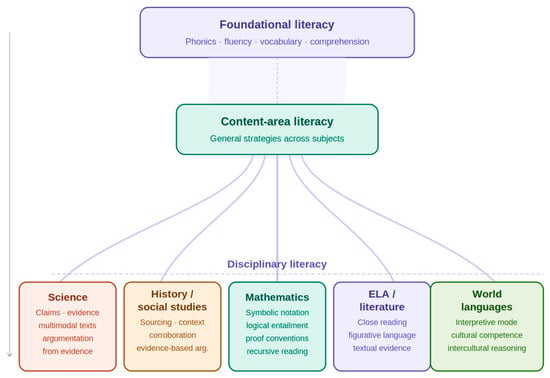
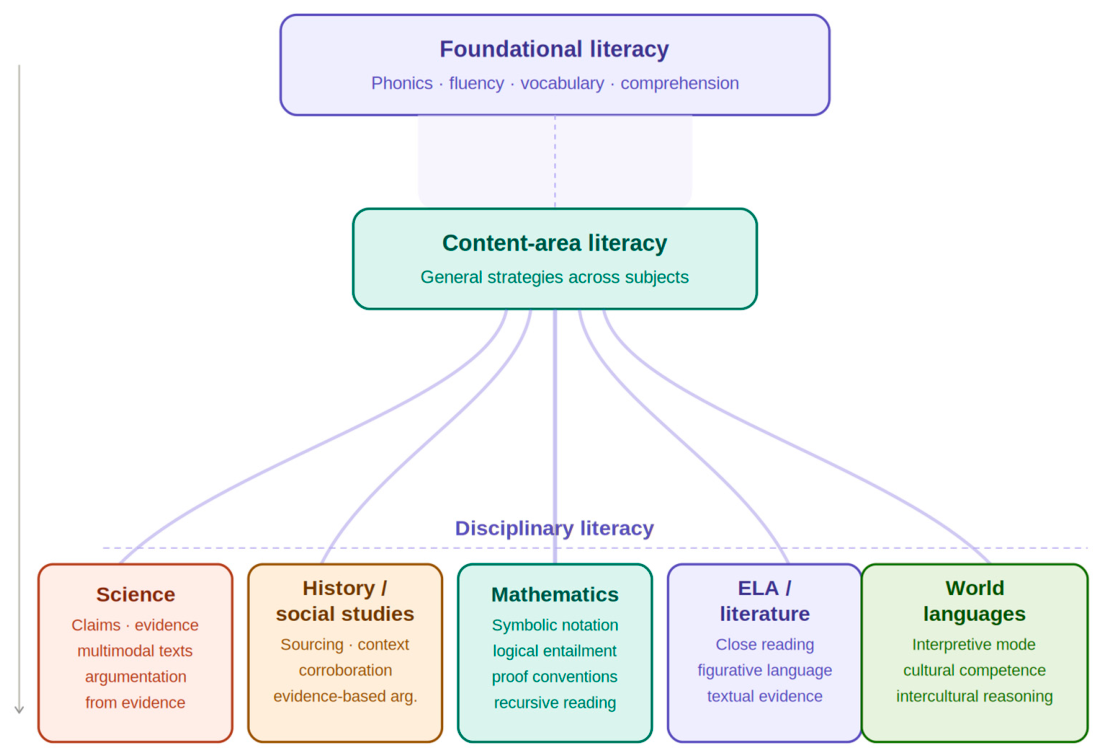
The defining claim of disciplinary literacy, that reading and writing practices diverge by field, is most concretely illustrated by contrasting the disciplines themselves. The following sketches are necessarily compact, but they convey the qualitative differences that the construct is meant to capture (Figure 1).
Figure 1.
The developmental progression from foundational literacy through content-area literacy to disciplinary literacy across the secondary content areas. Adapted from [1].
Science. Scientific literacy involves coordinating multiple representational forms, including prose, mathematical notation, diagrams, graphs, and tables, that together constitute a scientific argument. Reading in science entails attending to the relationship between claims and evidence, interpreting visual and quantitative data alongside text, and recognizing the conventions of the empirical report. Writing in science emphasizes precision, the explicit warranting of claims, and the impersonal register of the discipline. These practices align with contemporary expectations that science instruction engage students in argumentation from evidence and in the construction and critique of explanations, as outlined in both the Next Generation Science Standards and New York State Science Standards.
History. Historical literacy is characterized by practices such as sourcing (attending to who produced a document, when, and why), contextualization (situating a text within its historical moment), and corroboration (comparing accounts across sources). Where novice readers may treat a textbook as a repository of settled fact, expert historical reading treats every text as an authored interpretation to be weighed against others. Writing in history centers on the construction of evidence-based arguments from primary and secondary sources.
Mathematics. Mathematical literacy demands a close, recursive form of reading in which every symbol and term carries precise meaning and in which comprehension is verified through logical entailment rather than narrative flow. Mathematical text integrates natural language, symbolic notation, and visual representation, and reading it often requires moving non-linearly, rereading, working with examples, and reconstructing arguments. Writing in mathematics emphasizes justification, the explicit statement of conditions, and the conventions of proof and explanation.
Literature and the language arts. Literary literacy involves close reading attentive to figurative language, structure, point of view, and the layered relationship between text and meaning, as well as interpretation that is defensible by reference to textual evidence. While the language arts are often regarded as the home of “literacy” in general, disciplinary literacy reframes them as one discipline among several, with their own specialized reading and writing practices rather than a generic standard against which other subjects are measured.
World languages (languages other than English, LOTE). Literacy in world language education is organized around communication in a target language across three modes, interpretive, interpersonal, and presentational, as articulated in the field’s World-Readiness Standards [17]. Reading and writing in this discipline are inseparable from cultural competence: interpreting an authentic text requires not only decoding unfamiliar linguistic structures but also recognizing the cultural perspectives and conventions that give the text meaning. The interpretive mode draws explicitly on literacy strategies, including identifying main ideas and supporting details, inferring meaning from context, and discerning an author’s perspective, applied to texts in a language the reader is still acquiring. World languages thus illustrate the disciplinary literacy premise in a distinctive register: the specialized practices of the field unite linguistic, textual, and intercultural reasoning that have no exact parallel in the other content areas.
Across these cases, the common lesson is that there is no single act of “reading” that, once mastered, suffices for all subjects. The practices of each discipline need to be made visible and taught explicitly—a recognition that places specific and substantial demands on the teachers responsible for doing so [1,7].
5. Applications in Educator Preparation
Because disciplinary literacy is enacted within each subject area, secondary teachers benefit from not only deep content knowledge but also an understanding of how literacy operates in their discipline and how to apprentice students into it. This recognition bears directly on educator preparation programs (EPPs), which are responsible for developing such capacities in teacher candidates. Several application areas recur in the literature and in program practice.
Coursework. Approaches to incorporating disciplinary literacy into preparation coursework range from dedicated content-area literacy courses to the embedding of disciplinary literacy within subject-specific methods courses. The latter approach reflects the construct’s central premise: that literacy in a discipline is best addressed alongside the teaching of that discipline rather than as a separate, generic module. In science and mathematics methods courses, for example, this can mean treating the reading of scientific arguments or mathematical proofs as integral to learning to teach the subject. Attention to culturally sustaining pedagogy and the needs of multilingual learners, introduced in the definitional work of the field, is most effectively integrated into methods coursework and clinical preparation rather than treated as supplementary concerns [13,14,15].
Clinical experiences. Field placements and clinical experiences offer candidates the opportunity to observe and practice disciplinary literacy instruction in authentic classrooms. The effectiveness of these experiences depends on the presence of mentor teachers who themselves understand and enact disciplinary literacy. This dependency is itself a recognized challenge, since many practicing teachers were prepared before the construct became prominent.
Faculty knowledge. A distinctive feature of the secondary case is that the faculty who teach subject-specific methods courses are typically content-area specialists whose own preparation may have included little exposure to literacy frameworks [3,16,18]. Integrating disciplinary literacy into preparation, therefore, implicates not only candidates but also the disciplinary expertise and literacy knowledge of teacher educators themselves. This consideration distinguishes secondary from elementary preparation, where literacy is already a central component.
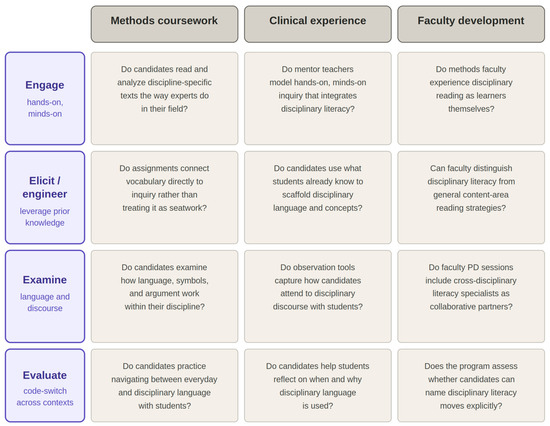
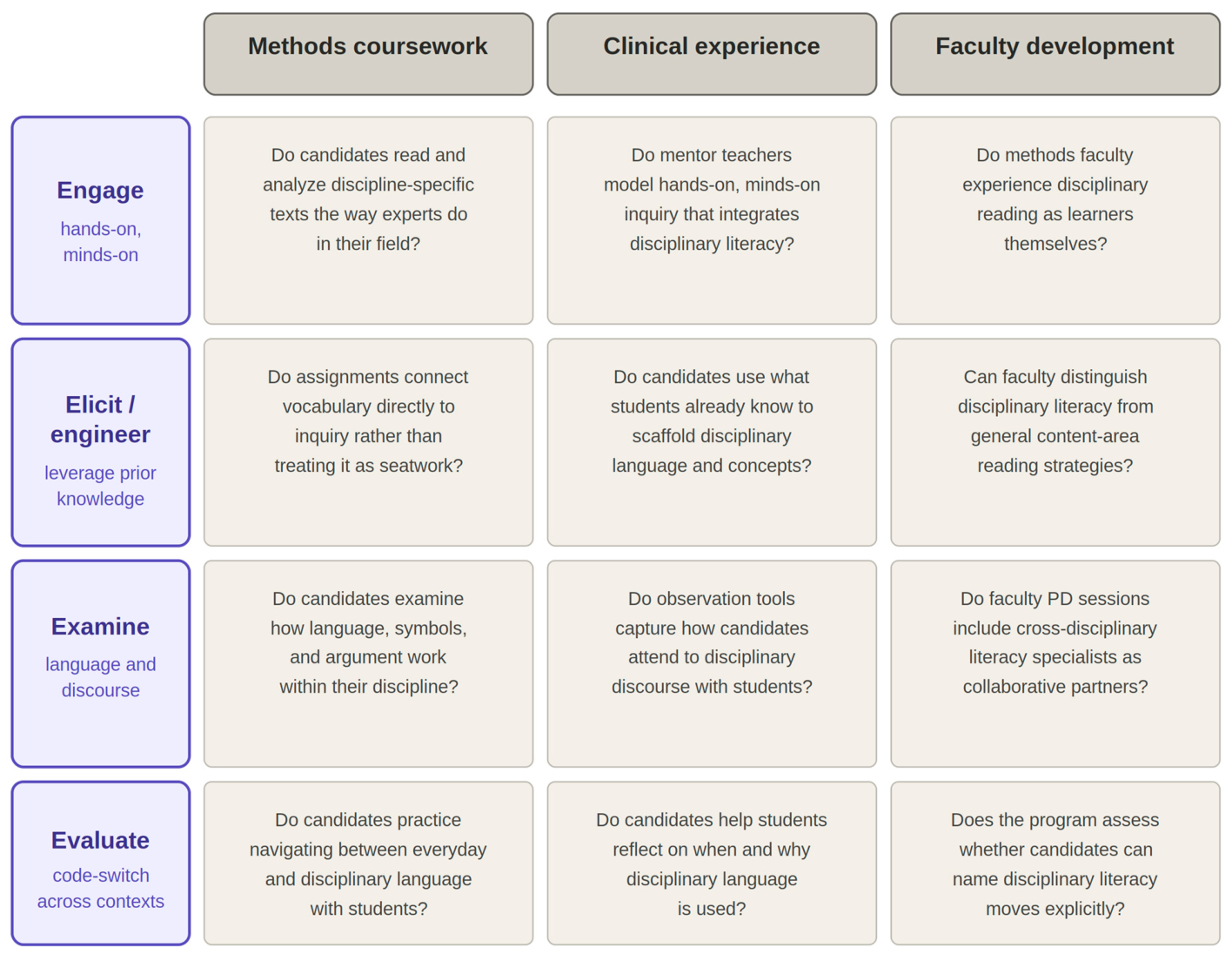
Moje’s (2015) [7] 4Es heuristic provides the organizing spine for this audit. Developed from Moje’s career in secondary classrooms and disciplinary literacy research, the heuristic reminds teachers to build four dimensions into disciplinary instruction. Engage prompts teachers to involve students in the everyday practices of the discipline—framing questions, working with data, and communicating claims—rather than treating literacy as separable from disciplinary work [7]. Elicit/Engineer directs teachers to draw out the knowledge students already bring while scaffolding the language, skills, and conceptual structures needed to participate in disciplinary inquiry. Examine calls teachers to draw explicit attention to how language, symbols, and argument function within the discipline, making visible the discourse conventions that often remain hidden. Evaluate encourages teachers to support students in developing meta-discursive awareness—the capacity to judge when, why, and how disciplinary language is and is not useful, including across the multiple communities students navigate daily. Figure 2 applies these four dimensions across the three sites where EPPs can act, including methods coursework, clinical experience, and faculty development, as a practical audit tool for identifying where disciplinary literacy is integrated and where gaps remain [19].
Figure 2.
A 4E disciplinary literacy audit matrix for secondary educator preparation programs. Audit prompt questions are organized by the 4Es heuristic (Moje, 2015) [7] across three sites of EPP action.
Assessment and accreditation. Performance assessments used in teacher preparation have, in various forms, required candidates to demonstrate attention to academic language and to the literacy demands of their content. Programmatic accreditation frameworks similarly press EPPs to evidence candidates’ readiness to support literacy within the disciplines. These mechanisms have helped to formalize disciplinary literacy as an expectation of preparation, even where the supporting coursework and faculty capacity remain uneven.
6. Current Status and Considerations
Disciplinary literacy occupies a paradoxical position in contemporary educator preparation: it is widely endorsed in principle and unevenly realized in practice [3,4,16,18]. The construct is well established in the research literature and increasingly named in standards and accreditation expectations, yet its systematic integration into secondary preparation, particularly within subject-specific methods courses taught by content specialists, remains incomplete.
This unevenness is thrown into relief by the current wave of Science of Reading policy in the United States. As state and system-level education authorities move to align educator preparation with reading research, the resulting requirements have concentrated, by design, on foundational and early-grades literacy. In New York State, for example, the State University of New York adopted a system-wide policy aligning all educator preparation programs with the Science of Reading, with new programs subject to the policy immediately and existing programs given until December 2026 to update curriculum and clinical experiences [20]. The enumerated components, including phonemic awareness, phonics, fluency, comprehension, vocabulary, background knowledge, writing, oral language, motivation, and multi-tiered support, reflect the foundational emphasis of the reform [20]. At the state level, New York’s participation in a national Path Forward initiative produced an action plan focused on teacher preparation in early childhood, childhood, English to speakers of other languages, literacy, and students with disabilities [21]. Secondary content-area certification is not a primary focus of these particular foundational-literacy requirements [22].
This pattern, a robust policy emphasis on foundational literacy alongside a comparatively under-specified treatment of secondary disciplinary literacy, is not a criticism of the reforms, which address a documented and consequential need in early reading. It is, rather, an observation about scope. The Science of Reading establishes why foundational skills matter and how they are taught; disciplinary literacy describes the specialized practices that build upon those skills in the secondary grades. The two are complementary stages of a single developmental arc, and the current policy moment, by formalizing attention to the first, brings into sharper view the comparatively less codified status of the second.
7. Limitations and Debates
For all its influence, disciplinary literacy is not without unresolved tensions, and a balanced account of the construct must acknowledge the debates that accompany it. Several recur in the literature.
Competition with foundational and intermediate literacy. Perhaps the most consequential concern is that a strong emphasis on discipline-specific practices may not serve the substantial population of secondary students who have not yet attained grade-level reading and writing. Where many adolescents still require support with basic comprehension, fluency, and general academic strategies, a primary focus on apprenticing students into expert disciplinary practices risks leaving those needs unmet. A narrowly disciplinary framing can also be read to imply that content teachers no longer share responsibility for the foundational and intermediate strategy instruction that struggling readers continue to require [1]. The construct describes the apex of a developmental progression; in practice, classrooms contain students distributed across the whole of it.
The novice–expert gap. A related question concerns how fully adolescents can be apprenticed into practices that, by definition, characterize disciplinary experts. Proponents are careful to clarify that disciplinary literacy instruction does not aim to make experts of teenage students, but rather to help them begin to read, write, and reason in ways aligned with how experts work. Even so, the distance between novice and expert raises genuine questions about which disciplinary practices are developmentally accessible, how they should be sequenced, and how the necessarily simplified classroom version relates to authentic disciplinary work.
Conditions of implementation. Beyond these conceptual matters lie practical constraints that condition whether disciplinary literacy can be enacted as intended. Reported obstacles include insufficient instructional time within content courses already pressed to cover prescribed material, large class sizes that limit individualized support, uneven access to suitable texts and resources, and, most pertinent to teacher preparation, a shortage of professional development that addresses disciplinary literacy specifically rather than general literacy strategies [2,18,23]. Recent scholarship has further documented the need to center equity and culturally sustaining approaches in disciplinary literacy instruction, with studies revealing persistent gaps in how equitable practices are conceptualized and enacted across disciplines [24,25]. These conditions mean that the gap between the construct as articulated and its realization in classrooms is often substantial.
Terminological conflation. Finally, a persistent practical limitation is the conflation of disciplinary literacy with the content-area literacy it was meant to distinguish itself from. The term is frequently adopted while the underlying practice continues to emphasize general comprehension and study strategies rather than discipline-specific apprenticeship. This slippage complicates both implementation and the interpretation of claims about disciplinary literacy’s effects, and it is itself a reason that careful definitional work, of the kind this entry attempts, remains useful.
8. Future Directions
Several lines of development follow from the current state of the field, each posed here as an open consideration rather than a recommendation. First, questions of measurement remain unsettled: there is no broadly accepted means of assessing teacher candidates’ disciplinary literacy knowledge or their capacity to teach it [26], and the development of valid, discipline-sensitive measures is an open area. Second, the preparation of teacher educators themselves, particularly content-area methods faculty, emerges repeatedly as a precondition for integrating disciplinary literacy into preparation, raising questions about professional learning at the level of the professoriate. Third, the relationship between foundational and disciplinary literacy invites further articulation, both conceptually and in the design of preparation that addresses the full developmental range. Finally, as the Science of Reading policy continues to expand, the question of whether and how the secondary disciplinary extension will be incorporated into preparation requirements remains to be resolved. Each of these directions reflects the field’s broader trajectory: from establishing disciplinary literacy as a construct toward operationalizing it within the systems that prepare teachers.
Author Contributions
Conceptualization, M.R.E.-B. and E.H.; investigation, M.R.E.-B. and E.H.; writing—original draft preparation, M.R.E.-B.; writing—review and editing, M.R.E.-B. and E.H. All authors have read and agreed to the published version of the manuscript.
Funding
This research received no external funding.
Institutional Review Board Statement
Not applicable.
Informed Consent Statement
Not applicable.
Data Availability Statement
No new data were created or analyzed in this study. Data sharing is not applicable to this article.
Conflicts of Interest
The authors declare no conflicts of interest.
References
- Shanahan, T.; Shanahan, C. Teaching Disciplinary Literacy to Adolescents: Rethinking Content-Area Literacy. Harv. Educ. Rev. 2008, 78, 40–59. [Google Scholar] [CrossRef] [Scilit]
- McLean Davies, L.; Potter, T.; Herrington, M.H. Legitimising Disciplinary Literacy: Rewriting the Rules of the Literacy Game and Enhancing Secondary Teachers’ Professional Habitus. Aust. J. Lang. Lit. 2022, 45, 359–374. [Google Scholar] [CrossRef] [Scilit]
- Scott, C.E.; McTigue, E.M.; Miller, D.M.; Washburn, E.K. The What, When, and How of Preservice Teachers and Literacy Across the Disciplines: A Systematic Literature Review of Nearly 50 Years of Research. Teach. Teach. Educ. 2018, 73, 1–13. [Google Scholar] [CrossRef] [Scilit]
- Rainey, E.C.; Maher, B.L.; Moje, E.B. Learning Disciplinary Literacy Teaching: An Examination of Preservice Teachers’ Literacy Teaching in Secondary Subject Area Classrooms. Teach. Teach. Educ. 2020, 94, 103123. [Google Scholar] [CrossRef] [Scilit]
- Moje, E.B. Developing Socially Just Subject-Matter Instruction: A Review of the Literature on Disciplinary Literacy Teaching. Rev. Res. Educ. 2007, 31, 1–44. [Google Scholar] [CrossRef]
- Moje, E.B. Foregrounding the Disciplines in Secondary Literacy Teaching and Learning: A Call for Change. J. Adolesc. Adult Lit. 2008, 52, 96–107. [Google Scholar] [CrossRef] [Scilit]
- Moje, E.B. Doing and Teaching Disciplinary Literacy with Adolescent Learners: A Social and Cultural Enterprise. Harv. Educ. Rev. 2015, 85, 254–278. [Google Scholar] [CrossRef] [Scilit]
- Gough, P.B.; Tunmer, W.E. Decoding, Reading, and Reading Disability. Remedial Spec. Educ. 1986, 7, 6–10. [Google Scholar] [CrossRef] [Scilit]
- Scarborough, H.S. Connecting Early Language and Literacy to Later Reading (Dis)abilities: Evidence, Theory, and Practice. In Handbook of Early Literacy Research; Neuman, S.B., Dickinson, D.K., Eds.; Guilford Press: New York, NY, USA, 2001; pp. 97–110. [Google Scholar]
- Seidenberg, M. Language at the Speed of Sight: How We Read, Why So Many Can’t, and What Can Be Done About It; Basic Books: New York, NY, USA, 2017. [Google Scholar]
- Shanahan, T. What Constitutes a Science of Reading Instruction? Read. Res. Q. 2020, 55, S235–S247. [Google Scholar] [CrossRef] [Scilit]
- Ippolito, J.; Dobbs, C.L.; Charner-Laird, M. Disciplinary Literacy Inquiry and Instruction, 2nd ed.; Harvard Education Press: Cambridge, MA, USA, 2024. [Google Scholar]
- Gay, G. Culturally Responsive Teaching: Theory, Research, and Practice, 3rd ed.; Teachers College Press: New York, NY, USA, 2018. [Google Scholar]
- August, D.; Shanahan, T. (Eds.) Developing Literacy in Second-Language Learners: Report of the National Literacy Panel on Language-Minority Children and Youth; Lawrence Erlbaum Associates: Mahwah, NJ, USA, 2006. [Google Scholar]
- Paris, D. Culturally Sustaining Pedagogy: A Needed Change in Stance, Terminology, and Practice. Educ. Res. 2012, 41, 93–97. [Google Scholar] [CrossRef] [Scilit]
- Savitz, R.S.; Morrison, J.D.; Brown, C.; Aldrich, C.; Kane, B.D.; O’Byrne, W.I. Secondary Teachers’ Adolescent Literacy Efficacy and Professional Learning Considerations. Read. Res. Q. 2024, 59, e521. [Google Scholar] [CrossRef] [Scilit]
- National Standards Collaborative Board. World-Readiness Standards for Learning Languages, 4th ed.; ACTFL: Alexandria, VA, USA, 2015. [Google Scholar]
- Savitz, R.S.; Morrison, J.D.; Brown, C.; Kane, B.D.; Aldrich, C.; O’Byrne, W.I. Middle and High School Teachers’ Perceived Expertise and Needs in Disciplinary Literacy. AERA Open 2025, 11. [Google Scholar] [CrossRef] [Scilit]
- Gabriel, R. Doing Disciplinary Literacy: Teaching Reading and Writing Across the Content Areas; Teachers College Press: New York, NY, USA, 2023. [Google Scholar]
- State University of New York. SUNY to Adopt System-Wide “Science of Reading” Policy. Available online: https://www.suny.edu/suny-news/press-releases/1-26/1-28-26/reading.html (accessed on 25 May 2026).
- New York State Education Department. New York State Path Forward Initiative. Available online: https://www.nysed.gov/teacher-leader-development/new-york-state-path-forward-initiative (accessed on 25 May 2026).
- Holston, S.; Putman, H.; Peske, H. State of the States 2024: Five Policy Actions to Strengthen Implementation of the Science of Reading; National Council on Teacher Quality: Washington, DC, USA, 2024; Available online: https://www.nctq.org/research-insights/state-of-the-states-2024 (accessed on 11 June 2026).
- Brozo, W.G.; Moorman, G.; Meyer, C.; Stewart, T. Content Area Reading and Disciplinary Literacy: A Case for the Radical Center. J. Adolesc. Adult Lit. 2013, 56, 353–357. [Google Scholar] [CrossRef] [Scilit]
- Dobbs, C.L.; Ippolito, J.; Charner-Laird, M. Fostering Equitable Disciplinary Literacy Practices. Educ. Sci. 2025, 15, 225. [Google Scholar] [CrossRef] [Scilit]
- Lee, S.Y. Seeing the Brain, Scientizing the Teacher Knowledge: The Question of Equity in the Science of Reading Reforms. Teach. Coll. Rec. 2025, 127, 152–186. [Google Scholar] [CrossRef] [Scilit]
- Michigan Department of Education. Disciplinary Literacy Standards for the Preparation of Middle Grades and Secondary Teachers; Michigan Department of Education: Lansing, MI, USA, 2024. Available online: https://www.michigan.gov/mde/-/media/Project/Websites/mde/educator_services/prof_practices/Disciplinary-Literacy-Prep-Standards.pdf (accessed on 11 June 2026).
Disclaimer/Publisher’s Note: The statements, opinions and data contained in all publications are solely those of the individual author(s) and contributor(s) and not of MDPI and/or the editor(s). MDPI and/or the editor(s) disclaim responsibility for any injury to people or property resulting from any ideas, methods, instructions or products referred to in the content. |
© 2026 by the authors. Licensee MDPI, Basel, Switzerland. This article is an open access article distributed under the terms and conditions of the Creative Commons Attribution (CC BY) license.