Review

Successful School Leadership and Critical Pathways to Improve Student Learning

Educational Leadership, Policy and Technology Studies, College of Education, University of Alabama, Tuscaloosa, AL 35487, USA
Encyclopedia 2026, 6(4), 72; https://doi.org/10.3390/encyclopedia6040072
Submission received: 15 November 2025 / Revised: 20 January 2026 / Accepted: 23 February 2026 / Published: 25 March 2026
(This article belongs to the Section Social Sciences)

Abstract

Since the late 1970s, scholars began to develop effective school leadership models that enhance student achievement. Recent research over the past three decades has consistently shown that school leadership influences student learning mainly through indirect mechanisms rather than direct effects. The purpose of this narrative review is to synthesize the major and emerging research on school leadership models and their indirect effects on student learning and to identify the critical pathways through which school leaders successfully improve student outcomes. This narrative review delineates and presents six key pathways by which school leaders promote student learning and counteract the negative effects of students’ socio-economic status. In addition, the review highlights what distinguishes successful school principals from others and the complexity of school leadership.

1. Introduction

The field of educational administration has undergone about seventy years of development and evolution. Ref. [1], a bibliometric review of research on educational administration from 1960 to 2018, identified four key Schools of Thought that have emerged over time: Leadership for Learning, Leadership and Cultural Change, School Effectiveness and School Improvement, and Leading Teachers. A paradigm shift from “school administration” to “school leadership” over the course of the six decades was observed. Leadership for student learning and development has become the “cognitive anchor” of the intellectual structure of the knowledge base in the field. This review focuses on this cognitive anchor. More specifically, this review synthesizes the major and most influential research on school leadership models and their indirect effects on student learning and presents the critical pathways through which school leaders successfully improve student outcomes. School leadership encompasses the core qualities and evidence-informed practices through which school leaders cultivate a strong learning culture, develop collective teacher capacity, and engage families to promote students’ academic and holistic development and achievement, while building the school resilience needed to thrive within complex educational contexts and interconnected ecological systems over time. School leaders may include principals, assistant principals, teacher leaders, leadership teams, and other actors who exercise leadership responsibilities for school-wide matters that extend beyond individual classrooms. In this paper, success is defined as a considerable improvement in student learning and other educational outcomes. Early research on effective leadership, emerging from the school effectiveness movement in North America, focused primarily on student academic achievement. More recent research on successful school leadership, drawing on effective leadership research, has adopted a broader conception of outcomes, encompassing not only academic performance but also students’ emotional, social, and psychological development.
Considering that the leadership of the principal (principalship) is the most pivotal form of leadership within school leadership, this review broadly examines the research literature on school leadership; it also necessarily engages with a more specific body of principalship-focused research. Therefore, this article begins with the broader domain of school leadership research and then engages representative research on principalship. School leadership and principalship, however, are not treated as interchangeable terms in this study; rather, principalship is conceptualized as a specific and critical subset within the broader school leadership domain this review focuses on.
Recent research over the past three decades has consistently shown that school leadership significantly influences student learning, second only to classroom instruction, and that this influence is mainly through indirect mechanisms rather than direct effects (e.g., [2,3]). The following sections first review the origins and development of research on effective school leadership for improving student achievement and broader educational outcomes. Next, the six key pathways through which successful school leaders promote student learning and counteract the negative effects of students’ socio-economic status are presented. Finally, the distinguishing features of SSL, along with the complexity of school leadership practice, are discussed. This narrative review does not attempt to be fully exhaustive; rather, it synthesizes the most cited or influential research on the topic.

2. Effective School Leadership: Its Origin and Development

Effective school leadership originates from the school effectiveness movement, a wave of research and reform that began in the late 1960s–1970s in response to the Coleman Report’s claim that schools had little impact on student learning, demonstrating instead that school practices can significantly improve achievement, especially for disadvantaged students. Since then, several school leadership models—such as instructional [2,4,5,6,7,8,9,10], transformational [11,12,13,14], moral [15,16,17,18,19,20,21], distributed [22], culturally responsive [23,24,25,26,27], and equitable [28] leadership. Instructional leadership was the first major leadership model to emerge in the educational leadership literature following the decline of instructional supervision as a disciplinary inquiry. Early work on instructional leadership shifted attention away from mere inspection and compliance toward leadership functions and responsibilities related to improving instruction and student learning outcomes, and shaping school culture and setting a clear instructional direction for the school as well. Among various formulations, the model developed by Hallinger and his colleagues became the most representative and widely cited. This version conceptualized instructional leadership as comprising three core leadership dimensions: defining the school mission (setting direction), managing the instructional program (improving instruction), and promoting a positive school learning climate (improving school culture) [10].
Transformational leadership was subsequently introduced into the field of educational leadership in the 1980s. Drawing on leadership theories originally developed in other sectors—particularly business and the military—this model was adapted and further elaborated for educational settings (e.g., [13]) and was fully developed within K–12 education by Kenneth Leithwood and his associates [11,12,14]. Their formulation incorporated key dimensions of instructional leadership, including setting direction, improving instruction, and shaping school culture, while extending the model through a distinct focus on developing teachers. This additional dimension emphasized leadership practices such as providing intellectual stimulation, offering individualized support, inspiring shared commitment, and modeling desired values and practices. Moreover, Leithwood and colleagues introduced components uniquely suited to and effective in K–12 contexts, including fostering collaborative organizational structures and strengthening relationships with parents and communities, thereby broadening the scope of leadership practices aimed at enhancing student learning.
At the same time, moral or values-based leadership emerged, focusing primarily on the ethical and moral dimensions of leadership. Influential work by scholars such as Hodgkinson, Sergiovanni, Starratt, and Begley emphasized, through a values paradigm, moral reasoning, for example, emphasizing the central role of moral judgment and ethical decision-making in educational leadership. While instructional leadership and transformational leadership are more focused on leadership practices, moral leadership is more focused on values and qualities of leadership. Later, distributed leadership, prominently advanced by scholars such as Spillane [28], broadened the focus of leadership beyond the principal to include multiple actors within the school. This perspective emphasized how leadership responsibilities are distributed, allocated, and enacted across individuals and groups to address schoolwide matters.
Toward the turn of the twenty-first century, increasing student diversity in many countries prompted scholars and practitioners to attend more explicitly to issues of culture, language, and equity. School leaders began responding to growing populations of immigrant students and English language learners by introducing bilingual and culturally responsive instructional programs and by aligning curriculum and pedagogy with students’ cultural backgrounds. These developments gave rise to culturally responsive school leadership, which reframes students’ cultural and linguistic differences as assets rather than deficits and emphasizes the creation of inclusive, culturally responsive school cultures.
Building on this work, a growing body of scholarship has examined leadership practices aimed at improving equity in student outcomes. Reviews of the emerging equity leadership literature suggest that such leadership incorporates many core practices identified in earlier successful leadership frameworks, while also adding an explicit focus on developing culturally responsive curriculum, instruction, and school culture.
Across these models, instructional leadership and transformational leadership remain the most empirically studied. Research on these approaches has consistently reported significant—though generally small and indirect—effects on student learning. Distributed leadership has also been linked to positive student outcomes in some studies. In contrast, empirical evidence regarding the direct effects of moral leadership, culturally responsive leadership, and equity-focused leadership on student learning remains limited, indicating a clear need for further systematic investigation.
Following the development of these individual leadership models—each identifying and focusing on important aspects of effective school leadership—leading scholars in different countries began to develop overarching leadership frameworks that integrate key elements from these models. For example, Kenneth Leithwood and his associates synthesized the most empirically supported features of prior leadership models and incorporated them into an overarching framework of school leadership. Building on their earlier work on transformational leadership, they developed comprehensive frameworks such as Basics of Successful School Leadership [29] and Successful School Leadership [30], which bring together core leadership practices shown to contribute to improved school and student outcomes. Other overarching leadership frameworks include, for example, Learning-Centered Leadership [31,32], Best Evidence Leadership Framework based on New Zealand data [33], and the Ontario Leadership Framework (OLF) [34]—the most comprehensive one as commented by Hitt and Tucker [35].
Ontario Leadership Framework (OLF) [34,36] incorporates key elements from major leadership approaches developed over the past three decades. It includes five leadership practice domains: setting directions, building relationships and developing people, developing the organization, improving the instructional program, and securing accountability. It not only includes leadership practices, but also personal resources (cognitive, social, and psychological resources, along with values and ethics), and the interaction of leadership behaviors with contextual factors (i.e., information about how, where, and when to enact those practices). Hence, it is the most holistic framework for capturing the complexities of SSL to date. Each of these frameworks contributes to our understanding of effective school leadership for improving student learning.
While school leadership involves more than the principal—such as assistant principal, school-wide teacher leaders, middle leaders, department heads, subject leaders, and school counselors—the principal remains the most pivotal figure in a school. Consequently, many studies have focused specifically on principalship. Principals shape school culture, strengthen teaching quality, foster family and community partnerships, and secure necessary resources. Taken together, principalship is probably the most influential contributor to student success. A leading strand of this research is the International Successful School Principalship Project (ISSPP), which stands out for examining successful principalship using a broad, inclusive view of student success—including academic, emotional, and social outcomes. The ISSPP spans more than 20 countries and over 20 years, making it the largest and longest-running international study of successful principalship.
The ISSPP project has produced about 300 international studies focused on the “how”, “when”, and “why” of successful principalship. To date, over 23 within-country and 63 cross-country comparative studies have been published, comprising 16 journal articles (e.g., [37,38]), 31 book chapters (e.g., [39]), 12 books (e.g., [40]), and 4 research reports (e.g., [41]). Major findings of the ISSPP research indicate that successful principals share commonalities in successful practices, but enact them differently, with early approaches varying. The successful principalship practices reported from the ISSPP research fall into the five domains of OLF, but accentuate the leadership practices that navigate layers of contextual influence with contextual intelligence and political acuity. Successful principals are not only resilient themselves, but also inspire others and build school resilience [42]. Such leadership practices, along with those that build strong, trusting, and fruitful working relationships and positive connections within and across broader ecological layers of the learning environment, foster school resilience, vitality, and adaptive growth in nested or layered ecosystems. This addition illustrates the growing complexity of SSL. Principals are drawing on a wider repertoire of fit-for-purpose, context-specific strategies and actions rooted in broad educational purposes and values. These school leadership research and more specifically principalship research developments established a solid understanding of the foundational principles of effective or successful leadership, as well as informed leadership standards globally.

3. Successful School Leadership: Critical Pathways to Improve Student Learning

Among the several leadership models developed over the last decades, the majority—such as moral leadership and culturally responsive leadership—remain largely conceptual, with limited empirical validation of their psychometric properties or the development of robust instruments to examine their effects on student learning. To date, the most empirically tested leadership models are instructional leadership and transformational leadership, followed by distributed leadership. Overall, these models demonstrate small but significant effects on student achievement (e.g., [14,43]). Although [32] argued that instructional leadership exerts approximately four times the impact of transformational leadership on student learning, their categorization excluded several key dimensions of transformational leadership conceptualized by Leithwood and colleagues, particularly those involving instructional improvement practices. The planful form of distributed leadership had a positive, small effect on student learning [44]. Complementing these findings, a meta-analysis reported an average effect size of 0.25, indicating that a one standard deviation increase in school leadership is associated with a 7–10 percentile gain in student achievement [45].
By the end of the last century, a broad consensus had emerged that school leadership affects student learning largely through indirect rather than direct effects, through key school conditions including in particular the dispositions and practices of teachers (e.g., [2,45,46,47,48,49,50]. Those key conditions make important and relatively direct contributions to student learning, although some are more direct than others (e.g., [51]). Teachers’ working conditions, for example, influence teachers’ practices, which in turn have major consequences for student learning. A substantial amount of research has examined the mediating variables. Some of these variables are more malleable to leadership influence than the others. Leithwood and colleagues identified thirteen significant contributors to student learning at the school level whose positive effects outweigh the negative impact of socio-economic status (SES), with absolute effect sizes greater than that of SES, and which are amenable to leadership influence. They classified these variables into four key paths—rational, emotional, organizational, and family [52,53], the most comprehensive leadership pathway framework for improving schools and student learning.
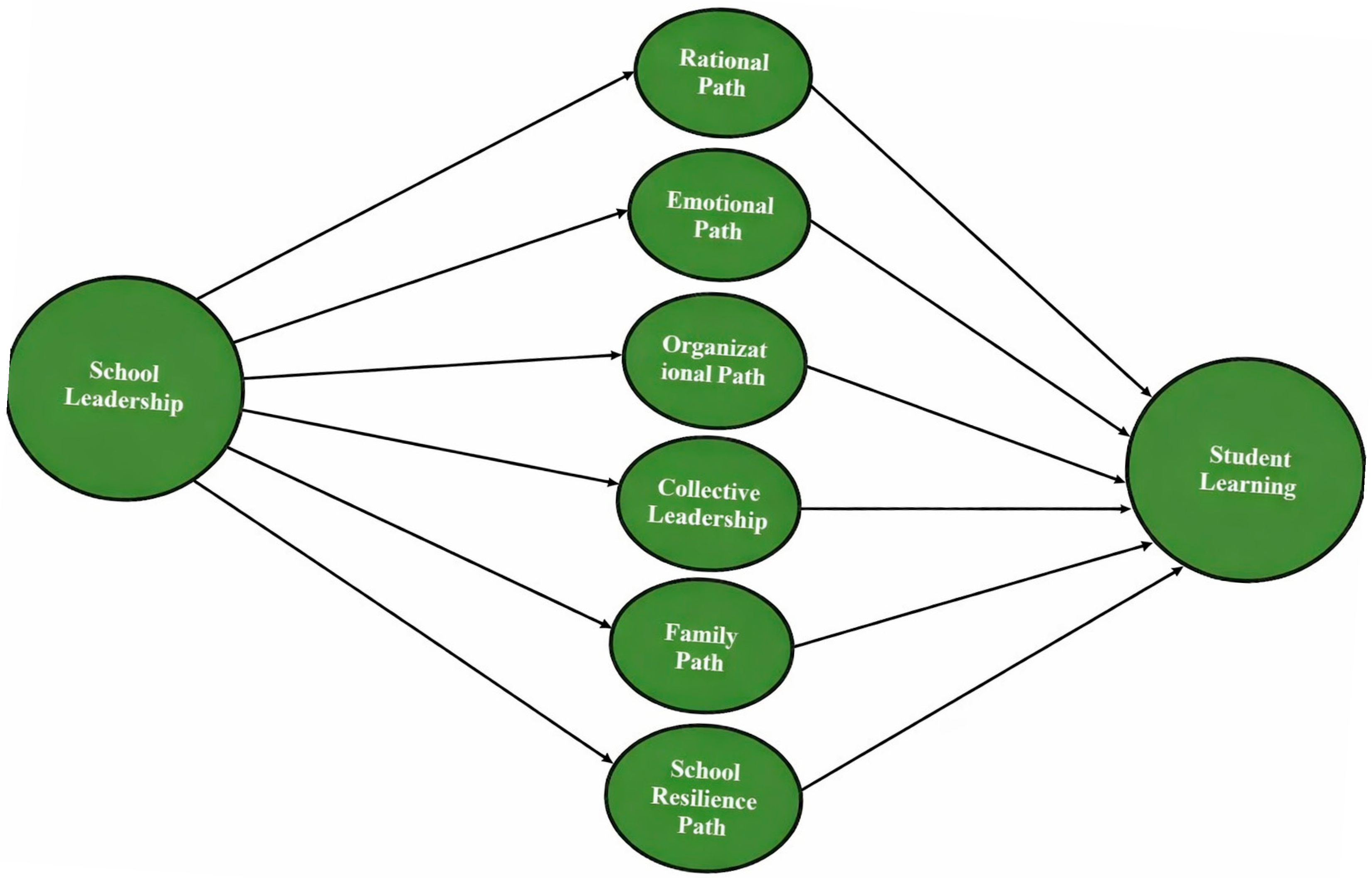
Over the past two decades, increasing research on teacher leadership has further highlighted that effective or successful schools benefit when leaders cultivate collaborative and empowering teacher leadership, which serves as an additional critical pathway for improving student learning. Additionally, a very recent inquiry has begun to focus on organizational resilience. Additionally, recent inquiries have begun to focus on organizational resilience in schools. Traditionally, organizational resilience has been conceptualized as an outcome of a school’s capacity to adapt and sustain improvement over time [54]. Emerging evidence, however, suggests that resilience should also be intentionally developed as a leadership-driven pathway toward school success, particularly given the dynamic political, economic, policy, and ecological contexts in which schools operate [55,56,57,58,59]. Given this, the following section presents six critical pathways through which school leaders foster student success (see Figure 1 below).

3.1. Rational Path

Leithwood and his associates [52,53] identified thirteen significant producers of student learning at the school level and classified them into the Four Paths. These key variables are the factors that contribute to student learning to a similar extent as or a greater extent than Socioeconomic Status (SES) and that are malleable to school leadership influence (i.e., there is a significant correlation existing between the two). Such factors include teacher-, school-, and parent-related variables. The most effective path is the Rational Path, through which school leadership explains the largest amount of variance in student learning [60]. Four variables on the Rational Path are rooted in the knowledge and skills of school staff members about curriculum, teaching, and learning—the technical core of schooling: Classroom Instruction, Academic Press, Use of Instructional Time, and Disciplinary Climate. Academic Press, for example, has a large effect on student learning (weighted mean r = 0.50) and is highly responsive to school leadership influence (weighted mean r = 0.47) [61]. School leaders can improve the status of Academic Press (AP) by aligning school policies, expectations, norms, and rewards to create a coherent academic climate that promotes high achievement, balancing strong expectations with caring relationships, trust, and social–emotional support, and building community with stakeholders as AP is most effective when combined with communal support and strong school–community connections.

3.2. Emotional Path

The Emotional Path includes the feelings, dispositions, or affective states of staff members, both individually and collectively, shaping the nature of their work. Three variables are associated with this path: Collective Teacher Efficacy, Teacher Trust, and Teacher Commitment. For example, collective teacher efficacy has a significant impact on student learning (weighted mean r = 0.51) and is susceptible to school leadership influence (weighted mean r = 0.39) [62]. Integrated, transformational, and instructional leadership had a stronger effect on Collective Teacher Efficacy than distributed or supportive/collegial models. Each of the four leadership domains has a similar, close to large effect on Collective Teacher Efficacy. Teacher Trust has a moderately large effect on student learning (weighted mean r = 0.38). Teachers’ trust in parents and students had the strongest association with student achievement (r = 0.54), followed by trust in colleagues (r = 0.32) and trust in the principal (r = 0.28) [63]. Teacher Trust is highly amenable to the influence of school leadership (weighted mean r = 0.51). School leadership had the strongest effect on teachers’ trust in the principal (r = 0.72), followed by trust in colleagues or overall trust (r = 0.47). Its effect on teachers’ trust in parents and students was not significant. Supportive and collegial leadership showed the largest impact on overall teacher trust (r = 0.72), followed by authentic/moral leadership (r = 0.62) and learning-centered leadership (r = 0.60). Leadership practices that strengthened school culture—such as improving teaching conditions, fostering collaboration, and broadening participation—had the strongest effect on teacher trust, followed by practices focused on developing people and setting directions. Therefore, principals must employ leadership practices in all domains across leadership styles and strengthen all dimensions of trust, including teachers’ trust in students and parents, to effectively improve student learning.

3.3. Teacher Leadership Path

A growing body of research has examined teacher leadership and its impact on student learning outcomes. The broader conceptualization of teacher leadership emphasizes teachers’ contributions to a learning community, influencing colleagues’ practices, and taking responsibility for improving student outcomes (e.g., [63,64]). Instructional leadership is no longer limited to principals, as teachers also exercise leadership that shapes the quality of teaching and student learning [65]. Teacher leadership can be understood as a primary manifestation or enactment of distributed leadership in schools. Distributed leadership provides the overarching conceptual lens that explains how leadership is shared and enacted across the organization, while teacher leadership focuses on teachers, the most important non-administrative leaders/actors in the school that exercise leadership, and what they do in practice.
Similarly, middle leadership operates between senior leadership and classroom practice, serving as a key mechanism through which distributed leadership is enacted in schools. Middle leaders not only indirectly influence teaching but also directly support teachers’ professional learning, instructional coordination, and capacity building, thereby translating school-wide leadership priorities into classroom practice [66,67]. Recent research highlights the growing significance of middle leaders as instructional leaders and brokers of professional learning, particularly in complex and reform-oriented school contexts. The amount of authority and influence middle leaders have in a school varies. Leading from the middle does not mean that this leadership is in a middle tier. Instead, it means getting close to the teaching and learning that is at the heart of the profession [68]. Overall, teacher leadership, middle leadership, and instructional leadership each show positive effects on student learning [69,70,71,72,73,74].
Successful principals were reported to build leadership capacity in schools in a variety of ways. They created formal and informal collaborative teacher teams (e.g., Spain [75]), decentralized leadership with shared responsibility and distinct roles (e.g., Sweden [76]), strengthened communication through regular meetings with team leaders (e.g., Sweden [77]), and redesigned leadership and staff structures with training for all (mixed comprehensive school context [78]). They also applied culturally responsive leadership to develop leadership capacity in diverse, high-needs schools (urban U.S. school [78]).

3.4. Organizational Path

Variables on the Organizational Path include features of schools that structure the relationships and interactions among organizational members including, for example, cultures, policies, and standard operating procedures. Three variables are populated on this path: Safe, Orderly, and Inclusive Environment, Collaborative Structures and Culture, and Organization of Planning and Instructional Time. Collaborative Structures and Culture, for example, is especially prominent in schools that make significant progress in students’ achievement (e.g., [79,80]). A review of data-use research found that teacher collaboration—through common assessments, shared decision-making, and exchanging best practices—was key to improving student outcomes [81]. Likewise, a collaborative school culture is strongly linked to teachers’ perceived effectiveness in special education programs [82]. Successful principals create teacher teams, professional learning communities, teams, or data teams (e.g., [83]. These processes were leveraged to help teachers engage in collective critical reflection, debate, and collaborative inquiries into student progress and effective instructional practices [84,85] or teaching and leadership expertise [86,87].

3.5. Family Path

Variables on the Family Path include those reflecting family expectations for their children, family culture and support for students, and community orientations toward schooling and education. These variables—such as parent expectations, forms of communication, and parents’ social and intellectual capital about schooling—collectively form Family Educational Culture [88]. These variables had moderately high effects on student math achievement (r = 0.39–0.42) [89]. Other research also supports the importance of the family path. Meta-analyses on the relationship between various types of parental involvement generally reported a small-to-moderate effect (e.g., [90,91]. Of the six types of school-based parental involvement programs parental involvement actions such as shared reading (0.51), teacher–parent partnership (0.35), checking homework (0.27), and teacher–parent communication (0.28) have significant positive effects on student outcomes for those emphasizing.
School Leadership had moderate to strong relationships with all three dimensions of Family Educational Culture (r = 0.59, 0.63, 0.68). Successful school leadership had a significant but small indirect effect on student achievement through Family Educational Culture (9%), controlling for SES. SSL practices related to Re-Designing the Organization showed the strongest positive effects on the three Family Path variables, followed by Developing People, which had moderate positive effects [3].

3.6. School Resilience Path

Understanding the reciprocal dynamics between leadership and organizational resilience is crucial for developing educational systems that are not only operationally effective but also adaptable and capable of navigating emerging challenges [92]. This growing recognition has expanded scholarly attention beyond structural and organizational capacity for change to manage uncertainty and crises and guide others through them [93]. Principals must first build their own resilience so they can cultivate teacher resilience, which subsequently promotes student resilience—ultimately creating a “school resilience cascade” in support of quality education [94].
Recent inquiry has increasingly positioned resilience within a complexity and ecological systems perspective, emphasizing the dynamic interplay between leadership actions and the evolving conditions of schooling. Traditionally, resilience has been conceptualized as an outcome of a school’s capacity to adapt and sustain improvement over time (e.g., [54]). However, contemporary scholarship, influenced by systems and resilience theory, reframes resilience as a leadership-developed capacity, which can be intentionally cultivated to enhance a school’s adaptive functioning amid uncertainty, disruption, contextual turbulence, and crisis [58,95,96,97]. This school resilience capacity is a school’s capacity to continue progressing even under challenging conditions, drawing on its “resilience points” or internal energy to move forward [58]. From a complex systems view, resilient schools emerge not from isolated acts of individual strength, but from distributed, relational processes that reinforce feedback loops across organizational structures, cultures, and practices [98]. This orientation shifts attention from resilience as a passive end-state to a proactive, systemic, and relational resource that enables schools to “bounce forward” rather than merely “bounce back” in response to adversity [96,97].
Twenty years of research in England indicate that successful school principals play the most crucial role in creating values-driven organizational capacity, conditions, and cultures that enable the school organization to respond to, adapt to, and thrive amidst internal and external challenges and changes [99]. Successful principals apply systems thinking, understand how parts interact with the whole, and view issues systemically, navigate contextual layers with political acuity, and address both technical and complex problems with leader, teacher, student, i.e., school, resilience [58,99,100], thus enabling the school not only to survive in complex contexts but also to push through and thrive in on-going adversity or crisis. This phenomenon of school resilience emerged across successful schools in the ISSPP case studies. While effective schools thrive in generally stable and low-adversity contexts, resilient schools succeed despite facing ongoing or crisis-level adversity [58]. Thus, successful school leaders cultivate school resilience so that the school can adapt to change, withstand disruptions, adversities, or crises, and continue pursuing its goals while sustaining a healthy and thriving environment. Building school resilience is crucial to sustaining school success. Principals who sustained school success were described as active, curious, and restless leaders who continually sought new ideas and innovative ways to improve practice. They also invested in sustained, in-depth, and schoolwide professional development for teachers, extending learning opportunities across the entire staff and, in some cases, to parents and the broader school community.
Successful school leaders enact upon all five domains of school leadership—setting high expectations, promoting strong instructional performance, fostering supportive environments, cultivating shared responsibility and leadership, enhancing organizational capacity for continuous improvement, and building school resilience. The level of intensity, targets/school goals, and focus with which they apply these domains differ when schools face ongoing adversity or crisis conditions, thus the emphasis of the fifth domain, cultivating school resilience, vitality, and adaptive growth in nested/layered ecosystems of ongoing adversity [42].

4. What Distinguishes Successful School Principals from Others

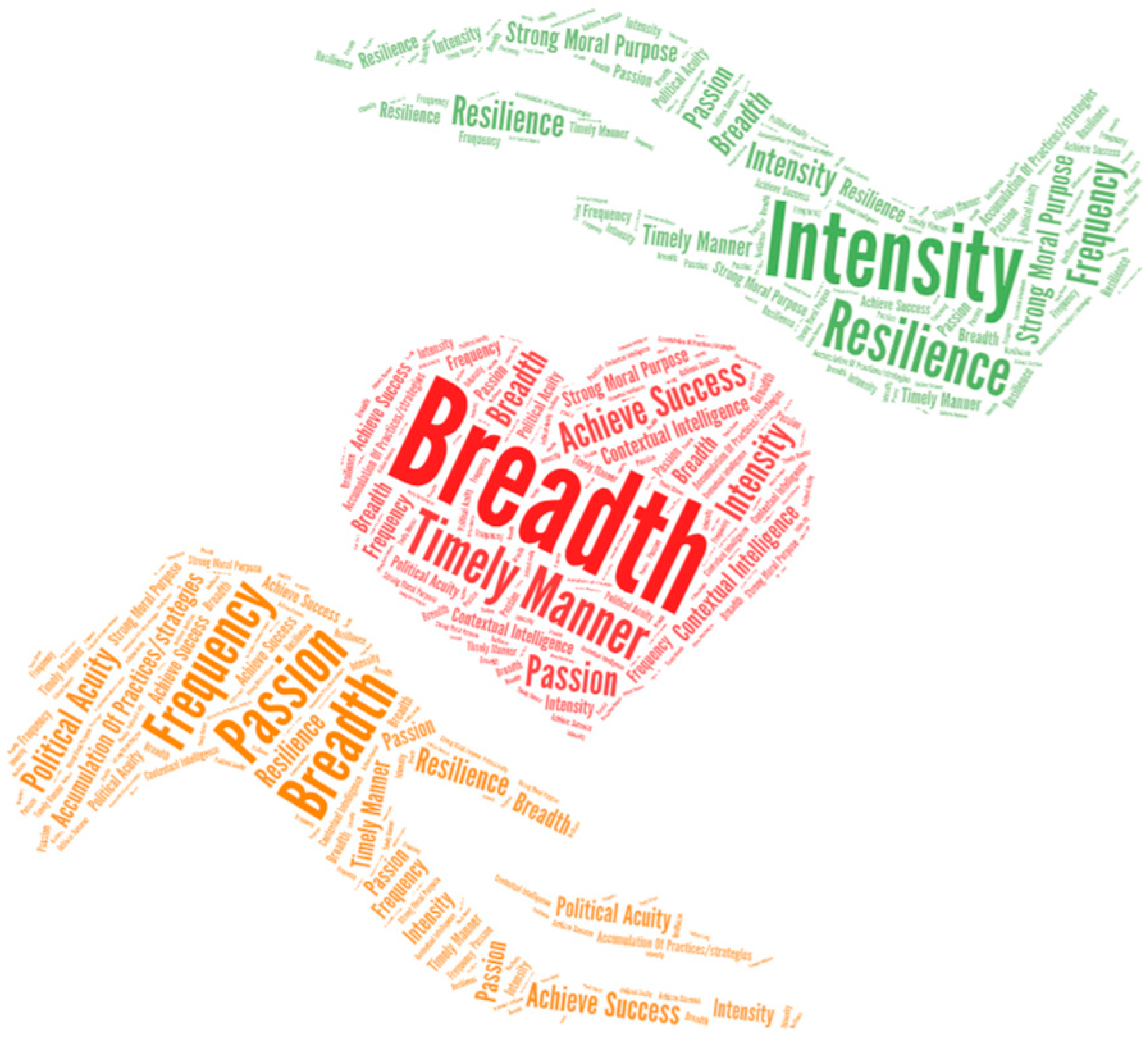
Meta-syntheses [42,101,102,103,104] of more than 100 case studies on successful principalship produced by the ISSPP across approximately 20 countries (e.g., Australia, Cyprus, Denmark, Indonesia, Israel, Japan, Kenya, Mexico, New Zealand, Norway, South Africa, Spain, Sweden, Switzerland, the UK, and the U.S.) suggest that what distinguishes successful principals from less successful ones is the breadth and accumulation of practices and strategies they employ, as well as the frequency and intensity with which they enact them in a timely and contextually responsive manner to achieve success. These practices are driven by principals’ resilience, passion, contextual intelligence, political acuity, and, above all, a strong moral purpose (see Figure 2).
Although successful principals enacted a common set of core leadership practices, they adapted the focus, intensity, frequency, and selection and combination of these practices in different school contexts. In low-SES schools, principals emphasized equity-driven, community-embedded approaches—building trust, strengthening behavioral and learning environments, and anchoring their work in moral purpose—whereas leaders in mid- and high-SES schools prioritized instructional innovation, holistic development, and student voice. In ethnically diverse settings, principals redesigned curriculum and fostered inclusive instruction and school culture, while in more homogeneous schools, they leveraged shared cultural norms to unify vision and encourage professional inquiry. Urban school principals centered safety and efficacy building; suburban leaders invested in professional development and external networks; and rural leaders relied on close relationships, community engagement, and creative resource management. Differences emerged across school levels as well, with elementary schools focusing on family engagement and foundational learning, middle schools emphasizing relational support through transitional years, and high schools strengthening teacher professionalism and student agency. Across all contexts, however, successful principals shared several core practices, i.e., most frequently demonstrated practices, including articulating a clear vision, cultivating trustful relationships, promoting authentic learning and high expectations, exercising distributed leadership, and continuously scanning their environments to inform adaptive decision-making [101].
At the beginning of a school improvement or turnaround effort, successful principals focus on enhancing the school environment, strengthening community engagement, and demonstrating clear leadership and a compelling vision. Sooner or later, successful principals improve the status of the variables on the six critical paths presented above [60,102]. In the later phase, continuing improvement and growth were key themes for principals aiming to sustain success or move the school ever further forward. Principals made further adjustments to address specific needs and challenges, resolve ongoing issues within the school, or promote innovation [42].
Successful principals demonstrate eight categories of leadership qualities: cognitive capacities, interpersonal capabilities, dispositions, skills/capacities, motivation, values and beliefs, emotional understanding/literacy, and social intelligence. These inherent qualities are interconnected and mutually reinforcing. For example, a principal’s beliefs may shape their values and dispositions; some of these qualities are relatively stable and less malleable (e.g., religious beliefs held by Indonesian Muslim principals), whereas others can be intentionally developed over time through professional learning (e.g., pedagogical knowledge, leadership training) [103].
Successful principals demonstrate a set of personal and professional qualities, including caring, compassion, commitment, resilience, confidence, flexibility, openness, strong professional knowledge, problem-solving expertise, effective emotional regulation, and apply systems thinking [42]. Across studies, successful principals who sustained school success are consistently characterized as curious, improvement-oriented leaders who demonstrate a strong passion for continuous learning, ongoing school improvement, and deepening and widening professional development for stakeholders [42].
These qualities, when combined, gave rise to their leadership practices, which directly and indirectly influenced school processes. Principals’ qualities were shaped primarily by internal influences, including life and work experiences, family background, and education, and were less affected by external contextual factors. Variations were also observed across school levels. For instance, empathy was more frequently emphasized among elementary school principals, whereas confidence was more prevalent among principals at the secondary level. Across differing geographic contexts—urban, suburban, and rural—principals drew upon and applied qualities such as resilience and passion in context-appropriate ways to address local needs in challenging contexts [42].
Successful principals navigate policy and social contexts of their schools with contextual intelligence and political acuity. For example, they responded simultaneously to multiple layers of contextual influence. At the micro- and meso-levels [104], they addressed student characteristics (e.g., socioeconomic status, ethnicity, home language) and the needs of the immediate community. At the exo-level, they engaged with district or municipal policies and expectations, while at the macro-level, they operated within broader national education systems, policies, and reforms. Across these layers, successful principals balanced top-down external mandates with local school and community needs, while remaining grounded in the school’s core values to support diverse student populations [105].

5. Nature and Complexities of School Leadership

5.1. Nature of Successful School Leadership

School leadership comprises at least four components: leadership qualities, practices, and interactions with stakeholders, as well as the interplay between these elements and the nested, interconnected contexts. These components influence one another and collectively define leadership. How success is perceived and determined reflects the principal’s values, priorities, the most significant contextual influences, and the expectations of key stakeholders. These factors shape what principals do (e.g., their selection of leadership actions and strategies) and how they do it. Although the definition of a school’s success is influenced by multiple contextual factors, stakeholder interests, and school characteristics, it is ultimately determined by the principal and/or school leadership.
Given varying student populations, community expectations, and school challenges, principals begin the school improvement process by addressing the most pressing needs. The strategies they adopt at the outset depend on both internal and external contextual factors. Ultimately, successful principals achieve cultural shifts (e.g., relationships and academic culture) and improve four capacities in schools: collective instructional capacity, collective leadership capacity, the organizational capacity for continuous improvement, and the school’s resilience capacity to succeed in adverse contexts. These interim successes directly contribute to student achievement and overall school success, enabling schools to sustain progress and continually improve. This chain of influence further reinforces, expands, and strengthens principals’ leadership knowledge, expertise in improvement and change, beliefs about leadership, and personal resources. More research is needed to understand how principals navigate complex political landscapes with acuity and wisdom to achieve and sustain success. Understanding how they build their schools’ resilience—ensuring that they not only survive but also thrive in challenging contexts—is also crucial for future leadership development.

5.2. Complexity in School Leadership

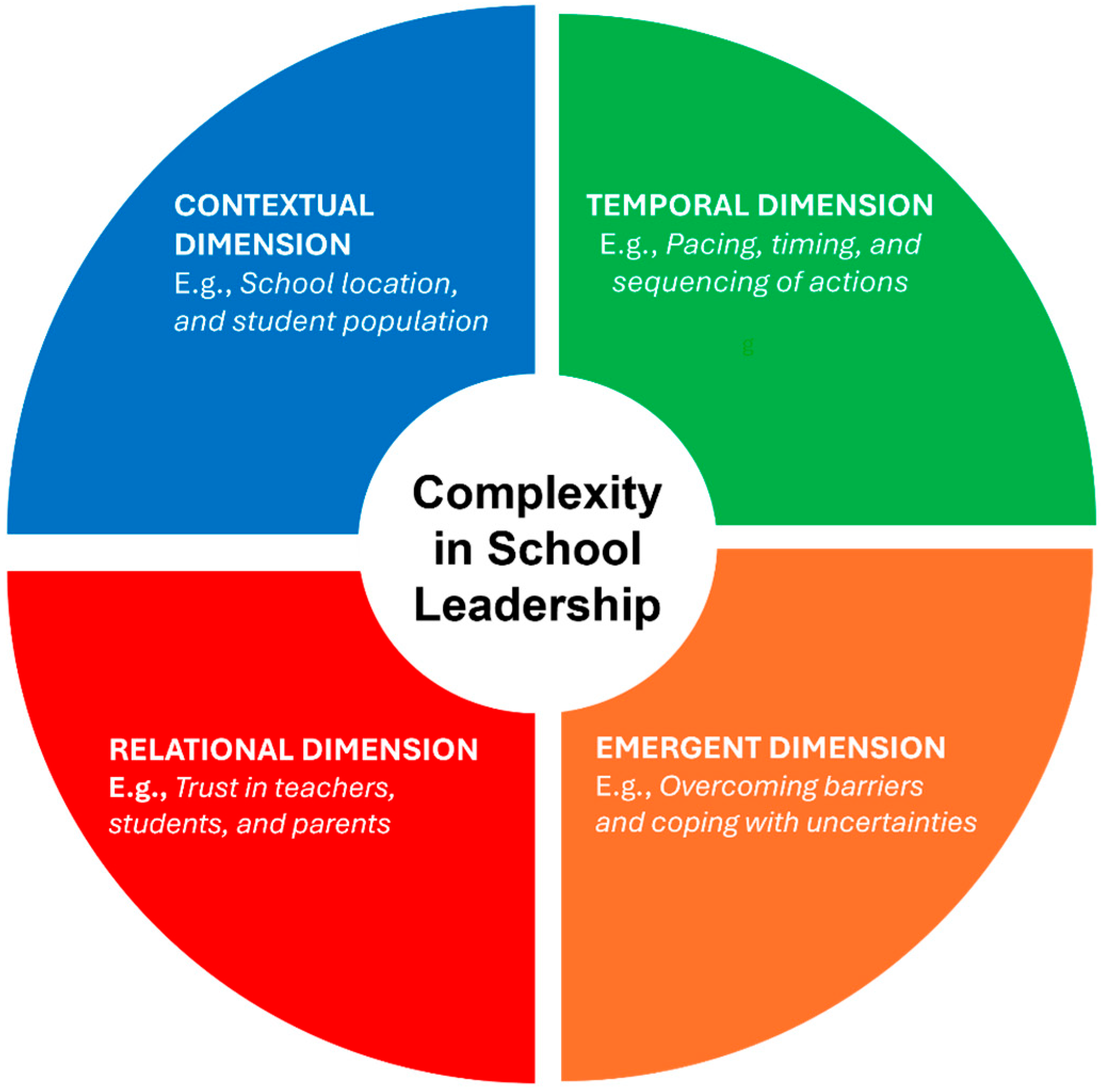
This review suggests that school leadership encompasses at least four dimensions of complexity: contextual, relational, temporal, and emergent (see Figure 3). The term of dimension here refers to a distinct but interrelated analytical aspect of leadership that captures a particular domain of influence that makes school leadership challenging or complicates leaders’ work. Below, the complexity of successful school leadership is discussed, along with its implications for future research.

5.2.1. Contextual Dimension

Current research suggests tentative claims regarding how successful school leaders enact and achieve success in specific contexts, considering factors such as school level, location, and student population. Even less is known about how they navigate success when multiple contextual factors interact—for example, how principals achieve success in urban elementary schools with diverse student populations. This underscores the need to explore principalship more deeply and to make its complexity visible, learnable, and manageable for researchers and practitioners.
To better understand these dynamics, more case studies and qualitative validation are needed in similar contexts. The Contingency School of Leadership [105,106], prominent in the 1960s, emphasized the importance of context in leadership. However, it declined due to criticisms of its rigidity—such as its focus on matching a leader’s style with situational factors—its limited adaptability, and the complexity of applying its frameworks in dynamic, real-world environments [107]. Without returning to the narrow purpose of “matching” leadership style with contexts, unpacking what and how successful principals achieve success in different contexts is both needed and rewarding.
In recent years, small but increasing numbers of scholars, including members of the International Successful School Principalship Project (ISSPP), have increasingly drawn on complexity theory [108], particularly Bronfenbrenner’s Human Ecological Systems Theory [109], as a conceptual lens for understanding how successful principals interact with the nested systems in which schools are embedded [110]. Although originally developed to explain children’s development, this ecological framework has been adapted to understand leadership by positioning the principal at the center of interacting ecological systems. From this perspective, principals are examined in relation to their interactions with stakeholders and contextual conditions across micro-, meso-, exo-, macro-, and chrono-system levels, which are arranged as nested structures, each contained within the next. This adaptation provides a framework for conceptualizing the multiple, intersecting environments in which principals work and for understanding how leadership practices are shaped by and responsive to context. The meta-synthesis of successful school cases across 19 countries [104] finds that successful principals responded differently and more urgently to address the immediate needs of students, teachers, and the school and to meet the requests or expectations of parents and the immediate school community more than those of broader contexts. They also reacted equally to external non-negotiable mandates, such as those from the state, in their work. That is, successful principals respond to contextual factors based on the extent of their influence. Although national policies aimed at improving student achievement operate at the outermost layer of the educational environment, they nonetheless strongly shape principals’ priorities when enacted and enforced at the local level. Future research could further explore this area to not only illuminate the complexity of principals’ work but also identify the specific skills and competencies they need to succeed in ever-changing or adverse contexts.

5.2.2. Relational Dimension

Inevitable relationships add to the complexity of leadership in dynamic educational systems, where practices evolve through interactions with individuals and groups across nested systems. Supportive and trustful relationships serve as both the glue and the lubricant for individual interactions in schools, making the execution of tasks, capacity building, and goal realization more effective, efficient, and collaborative. Research suggests that teachers’ trust in students and parents, taken collectively, is among the strongest contributors to student learning outcomes across different trust relationships [108]. However, there is limited empirical evidence explaining how principals support teachers in building this trust, indicating an important gap that warrants further investigation. Similarly, although many successful schools adopt a student-centered approach, existing research has paid relatively little attention to how principals cultivate student-centered relationships, involve students in instructional design and school governance, and intentionally build relational trust between school leaders and students. Future research can explore leadership’s various strategies to build trust in schools and with parent communities, and to build positive and supportive relationships with students.
To examine leadership–context interactions, ISSPP scholars, for example, have increasingly adopted Bronfenbrenner’s Human Ecological Systems Theory. However, applications of this framework in the leadership literature have focused primarily on how principals respond to contextual factors across ecological layers. The core emphasis of the human ecological framework, by contrast, is on human-to-human interactions, positioning the principal as an active agent at the center of nested systems who interacts with stakeholders across micro-, meso-, exo-, macro-, and chrono-levels. How principals intentionally build relationships with teachers, students, parents, and communities across these ecological layers remains underexplored and represents a critical area for future research. Complexity theory also provides a perspective, viewing institutions, cultures, groups, and individuals as systems. These systems interact with one another while also being partially shaped by larger systems of governance [111]. Each of these elements—teachers, schools, education, and culture—functions as a system within a broader, interconnected framework. These theoretical perspectives can help illuminate the more relational dimensions of school leadership.

5.2.3. Temporal Dimension

Time is another dimension that further adds to the complexity of leadership. It encompasses several aspects, including the pacing, timing, and sequencing of leadership actions in various phases of school improvement; the evolution of successful school leadership over time; the duration a principal spends at a particular school; the length of time a principal has served in the role; and the timing of when to implement specific leadership practices in conjunction with contextual influences. Successful principals make timely decisions based on the right circumstances, aligning actions with interactions across groups and layers of influence in their environment. Time also interacts with resources, support systems, and policy changes, highlighting the importance of precise timing in leadership actions.
As mentioned in the previous section, principals achieve success by prioritizing certain leadership practices during the different school improvement phases. The meta-synthesis of successful principals in multiple countries in the past 25 years [105] shows a shift from reactive to strategic leadership. Between 2002 and 2013, principals primarily addressed immediate internal challenges—such as student behavior, academic achievement, enrollment decline, and family dynamics—while responding to strong external accountability pressures through short-term problem solving, data-driven decision-making, and active communication with stakeholders. From 2014 onward, leadership became increasingly strategic as principals recognized that challenges related to student diversity, immigration, poverty, and socioeconomic inequality were long-term and systemic. Successful principals focused on building inclusive and culturally responsive school cultures, strengthening collective instructional and leadership capacity, balancing external and internal accountability, and implementing targeted supports for diverse and high-need student populations to ensure sustained improvement and school resilience. Very limited research evidence is reported on how school leadership is associated with principals’ tenure, years of leadership, and contextual influence. Future studies could examine these aspects and the complexity of time in leadership more comprehensively and on a broader scale.

5.2.4. Emergent Dimension

The lack of support, policy barriers, resource limitations, sudden issues, and other unexpected challenges—such as the pandemic—can significantly hinder or alter what school leaders are able to achieve, further adding to the complexity of their work. What differentiates successful principals from others is their ability to secure resources, creatively overcome barriers and constraints, achieve breakthroughs, cope with uncertainty, and ultimately prevail, even in challenging and unexpected situations. This ability stems from a combination of leadership knowledge, expertise, experience, contextual intelligence, predictive and forward-thinking abilities, and possibly other critical competencies. Our synthesis [104] identifies three key leadership practices (e.g., Reacting to the context with contextual intelligence and being proactive) that enable principals to excel in adapting to changing environments and building schools’ resilience. Future research can explore this area further to not only unveil the complexity of principals’ work but also identify the specific qualities, knowledge, skills, and competencies they need to address uncertain, unexpected challenges in ever-changing contexts.

6. Conclusions

This review traces the development of research on effective and successful school leadership over the past few decades and synthesizes what is currently known about the key components of successful leadership, including leadership qualities, leadership practices, and their interactions with context. Emerging research—particularly meta- and qualitative syntheses—has begun to identify patterns in how successful leadership practices vary across different contexts. However, this body of knowledge remains limited, and substantial gaps exist for future research to fill in. Although research conducted more than a decade ago established that successful leadership encompasses a set of common practices across contexts, more needs to be explored about how principals navigate increasingly complex and dynamic environments. Existing research has only begun to address the contextual dimension of leadership complexity, and much less is known about the human-to-human interactions between principals and key stakeholders within the nested systems in which schools operate. Additionally, evidence suggests that principals adopt different strategies across phases of school improvement and a two-stage evolution of principalship emerged: reactive leadership (2002–2013), focusing on immediate challenges and student achievement, and strategic leadership (2014–2022), emphasizing inclusivity, capacity building, and equity. Further research is needed to understand how leaders respond to uncertainty and unexpected challenges and how leadership practices are shaped over time by leaders’ experience, or more broadly, leadership qualities. Overall, recent scholarship signals a tentative move toward a more comprehensive understanding of successful school leadership that integrates leadership practices, leadership qualities, context, and time, but this multidimensional perspective remains underdeveloped and warrants further investigation. Contextual, time, and resource factors influenced the focus, timing, choice, enactment, frequency, and intensity of these practices, adding to the principalship complexity. Successful principals build their school’s capacity and resilience to manage change, navigating challenges with contextual intelligence, political acumen, and creative solutions to overcome obstacles and achieve and sustain success despite resource limitations. Further research is needed to explore these areas.

Funding

This research received no external funding.

Institutional Review Board Statement

Not applicable.

Informed Consent Statement

Not applicable.

Data Availability Statement

No new data were created or analyzed in this study. Data sharing is not applicable to this article.

Conflicts of Interest

The author declares no conflicts of interest.

Abbreviations

The following abbreviations are used in this manuscript:
ISSPPInternational Successful School Principalship Project
SESSocio-Economic Status
SSLSuccessful School Leadership

References

  1. Hallinger, P.; Kovačević, J. A Bibliometric Review of Research on Educational Administration: Science Mapping the Literature, 1960 to 2018. Rev. Educ. Res. 2019, 89, 335–369. [Google Scholar] [CrossRef] [Scilit]
  2. Hallinger, P.; Heck, R. Reassessing the principal’s role in school effectiveness: A review of empirical research, 1980–1995. Educ. Adm. Q. 1996, 32, 5–44. [Google Scholar] [CrossRef] [Scilit]
  3. Leithwood, K.; Sun, J.-P.; Hua, C.; Zhang, S.-J. Family educational culture: Its meaning, measure and contribution to student learning. J. Sch. Leadersh. 2024, 34, 414–442. [Google Scholar] [CrossRef] [Scilit]
  4. Bossert, S.; Dwyer, D.; Rowan, B.; Lee, G. The instructional management role of the principal. Educ. Adm. Q. 1982, 18, 34–64. [Google Scholar] [CrossRef] [Scilit]
  5. Hallinger, P.; Murphy, J. Assessing the instructional leadership behavior of principals. Elem. Sch. J. 1985, 86, 217–248. [Google Scholar] [CrossRef] [Scilit]
  6. Heck, R.H.; Larson, T.; Mercoulides, G. Principal instructional leadership and school achievement: Validation of a causal model. Elem. Sch. J. 1990, 96, 527–549. [Google Scholar]
  7. Heck, R.; Hallinger, P. Conceptual models, methodology, and methods for studying school leadership. In The 2nd Handbook of Research in Educational Administration; Murphy, J., Seashore-Louis, K., Eds.; McCutchan: San Francisco, IN, USA, 1999. [Google Scholar]
  8. Leithwood, K.A.; Begley, P.T.; Cousins, J.B. The nature, causes and consequences of principals’ practices: An agenda for future research. J. Educ. Adm. 1990, 28, 5–31. [Google Scholar] [CrossRef] [Scilit]
  9. Leithwood, K.; Montgomery, D.J. The role of the elementary school principal in program improvement. Rev. Educ. Res. 1982, 52, 309–339. [Google Scholar] [CrossRef]
  10. Hallinger, P. The evolving role of American principals: From managerial to instructional to transformational leaders. J. Educ. Adm. 1992, 30, 35–50. [Google Scholar] [CrossRef] [Scilit]
  11. Leithwood, K. The move towards transformational leadership. Educ. Leadersh. 1992, 495, 8–12. [Google Scholar]
  12. Leithwood, K. Leadership for school restructuring. Educ. Adm. Q. 1994, 30, 498–518. [Google Scholar] [CrossRef] [Scilit]
  13. Podsakoff, P.M.; MacKenzie, S.B.; Moorman, R.H.; Fetter, R. Transformational leader behaviors and their effects on followers’ trust in leader, satisfaction, and organizational citizenship behaviors. Leadersh. Q. 1990, 1, 107–142. [Google Scholar] [CrossRef] [Scilit]
  14. Leithwood, K.; Sun, J. The nature and effects of transformational schoolleadership: A meta-analytic review of unpublished research. Educ. Adm. Q. 2012, 48, 387–423. [Google Scholar] [CrossRef] [Scilit]
  15. Greenfield, T.B. Theory about what? Some more thoughts about theory in educational administration. UCEA Rev. 1976, 17, 4–9. [Google Scholar]
  16. Hodgkinson, C. Educational Leadership: The Moral Art; State University of New York Press: Albany, NY, USA, 1991. [Google Scholar]
  17. Sergiovanni, T.J. Moral Leadership: Getting to the Heart of School Improvement, 1st ed.; Jossey-Bass: San Francisco, CA, USA, 1992. [Google Scholar]
  18. Starratt, R.J. Building on Ethical School: A Practical Response to the Moral Crises in Schools; Falmer Press: London, UK, 1994. [Google Scholar]
  19. Willower, D.J. Inquiry in educational administration: Pitfalls and possibilities. Educ. Manag. Adm. 1997, 25, 437–449. [Google Scholar] [CrossRef] [Scilit]
  20. Begley, P.T. Cognitive perspectives on values in administration: A quest for coherence and relevance. Educ. Adm. Q. 1996, 32, 403–426. [Google Scholar] [CrossRef] [Scilit]
  21. Begley, P.T. In pursuit of authentic school leadership practices. In The Ethical Dimensions of School Leadership; Begley, P.T., Johansson, O., Eds.; Springer Science & Business Media: Dordrecht, The Netherlands, 2003; pp. 1–12. [Google Scholar]
  22. Spillane, J.P. Distributed Leadership; Jossey-Bass: San Francisco, CA, USA, 2006. [Google Scholar]
  23. Gay, G. Culturally Responsive Teaching: Theory, Research, and Practice, 2nd ed.; Teacher College Press: New York, NY, USA, 2010. [Google Scholar]
  24. Johnson, L.S. Making her community a better place to live: Culturally responsive urban school leadership in historical context. Leadersh. Pol. Sch. 2006, 5, 19–36. [Google Scholar] [CrossRef] [Scilit]
  25. Ryan, J. Inclusive leadership and social justice for schools. Leadersh. Pol. Sch. 2006, 5, 3–17. [Google Scholar] [CrossRef] [Scilit]
  26. Webb-Johnson, G.C.; Carter, N. Culturally responsive urban school leadership: Partnering to improve outcomes for African American learners. Natl. J. Urban Educ. Pract. 2007, 1, 77–99. [Google Scholar]
  27. Khalifa, M.A.; Gooden, M.A.; Davis, J.E. Culturally responsive school leadership: A synthesis of the literature. Rev. Educ. Res. 2016, 86, 1272–1311. [Google Scholar] [CrossRef] [Scilit]
  28. Leithwood, K. A review of evidence about equitable school leadership. Educ. Sci. 2021, 11, 377. [Google Scholar] [CrossRef] [Scilit]
  29. Leithwood, K.; Louis, K.; Anderson, S.; Wahlstrom, K. How Leadership Influences Student Learning: A Review of the Evidence Linking Leadership to Student Learning; The Wallace Foundation: New York, NY, USA, 2004. [Google Scholar]
  30. Leithwood, K.; Riehl, C. What we already know about successful school leadership. In A New Agenda: Directions for Research on Educational Leadership; Firestone, W.A., Riehl, C., Eds.; Teachers College Press: New York, NY, USA, 2005; pp. 12–27. [Google Scholar]
  31. Hallinger, P.; Liu, S. Mapping the terrain of educational leadership and management in China: A systematic review of research, 1995–2016. Educ. Manag. Adm. Leadersh. 2017, 45, 301–325. [Google Scholar]
  32. Murphy, J.; Elliot, S.N.; Goldring, E.; Porter, A.C. Learning-Centered Leadership: A Conceptual Foundation; Wallace Foundation: New York, NY, USA, 2006. [Google Scholar]
  33. Robinson, V.M.J.; Lloyd, C.A.; Rowe, K.J. The impact of leadership on student outcomes: An analysis of the differential effects of leadership types. Educ. Adm. Q. 2008, 44, 635–674. [Google Scholar] [CrossRef] [Scilit]
  34. Leithwood, K. The Ontario Leadership Framework 2012 with a Discussion of the Research Foundations; Institute for Educational Leadership and the Ontario Ministry of Education: Toronto, ON, Canada, 2012. [Google Scholar]
  35. Hitt, D.H.; Tucker, P.D. Systematic review of key leader practices found to influence student achievement: A unified framework. Rev. Educ. Res. 2016, 86, 531–569. [Google Scholar] [CrossRef] [Scilit]
  36. Leithwood, K. The Ontario leadership framework: Successful school leadership practice and personal leadership resources. In How School Leadership Influences Student Learning: The Four Paths; Leithwood, K., Sun, J.P., Pollock, K., Eds.; Springer: New York, NY, USA, 2017; pp. 31–45. [Google Scholar]
  37. Jacobson, S.L.; Brooks, S.; Giles, C.; Johnson, L.; Ylimaki, R. Successful leadership in three high-poverty urban elementary schools. Leadersh. Policy Sch. 2007, 6, 291–317. [Google Scholar] [CrossRef] [Scilit]
  38. Moos, L.; Johansson, O.; Day, C. How School Principals Sustain Success over Time: International Perspectives; Springer-Kluwer: Dordrecht, The Netherlands, 2011. [Google Scholar]
  39. Gurr, D.; Drysdale, L.; Goode, H. International educational leadership projects. In Educational Leadership for Social Justice and Improving High-Needs Schools: Findings from 10 Years of International Collaboration; Barnett, B., Woods, P., Eds.; Information Age Publishing: Charlotte, NC, USA, 2021; pp. 13–29. [Google Scholar]
  40. Day, C.; Leithwood, K. Successful Principal Leadership in Times of Change: An International Perspective; Springer: Dordrecht, The Netherlands, 2007. [Google Scholar]
  41. Day, C.; Gu, Q.; Sammons, P. The impact of leadership on student outcomes: How successful school leaders use transformational and instructional strategies to make a difference. Educ. Adm. Q. 2016, 52, 221–258. [Google Scholar] [CrossRef] [Scilit]
  42. Sun, J.; Day, C.; Zhang, R.; Zhang, H.; Huang, T.; Lin, J. Successful school principalship: A meta-synthesis of 20 Years of international case studies. Educ. Sci. 2024, 14, 929. [Google Scholar] [CrossRef] [Scilit]
  43. Hallinger, P. Leadership for learning: Lessons from 40 years of empirical research. J. Educ. Adm. 2011, 49, 125–142. [Google Scholar] [CrossRef] [Scilit]
  44. Leithwood, K.; Mascall, B.; Strauss, D. Distributed Leadership According to the Evidence; Routledge: New York, NY, USA, 2009. [Google Scholar]
  45. Marzano, R.J.; Waters, T.; McNulty, B.A. School Leadership That Works: From Research to Results; Association for Supervision and Curriculum Development: Alexandria, VA, USA, 2005. [Google Scholar]
  46. Hallinger, P.; Heck, R.H. Exploring the principal’s contribution to school effectiveness: 1980–1995. Sch. Eff. Sch. Improv. 1998, 9, 157–191. [Google Scholar] [CrossRef] [Scilit]
  47. Hallinger, P.; Heck, R.H. Exploring the journey of school improvement: Classifying and analyzing patterns of change in school improvement processes and outcomes. Sch. Eff. Sch. Improv. 2009, 20, 1–27. [Google Scholar] [CrossRef] [Scilit]
  48. Heck, R.H.; Hallinger, P. Modeling the effects of school leadership on teaching and learning over time. J. Educ. Adm. 2014, 52, 653–681. [Google Scholar]
  49. Leithwood, K.; Seashore Louis, K. Linking Leadership to Student Learning; John Wiley & Sons: San Francisco, CA, USA, 2011. [Google Scholar]
  50. Robinson, V.M.J.; Hohepa, M.; Lloyd, C. School Leadership and Student Outcomes: Identifying What Works and Why; Best Evidence Synthesis Iteration (BES); Ministry of Education: Wellington, New Zealand, 2008. [Google Scholar]
  51. Leithwood, K.; Jantzi, D. A review of transformational school leadership research 1996–2005. Leadersh. Policy Sch. 2005, 4, 177–199. [Google Scholar] [CrossRef] [Scilit]
  52. Leithwood, K.; Patten, S.; Jantzi, D. Testing a conception of how school leadership influences student learning. Educ. Adm. Q. 2010, 46, 671–706. [Google Scholar] [CrossRef] [Scilit]
  53. Leithwood, K.; Sun, J.-P.; Pollock, K. (Eds.) How school leaders contribute to student success: The four paths. In Studies in Educational Leadership; Springer: Toronto, ON, Canada, 2017; Volume 22. [Google Scholar]
  54. Hargreaves, A.; Fink, D. Sustainable Leadership; Jossey-Bass: San Francisco, CA, USA, 2006. [Google Scholar]
  55. Gu, Q.; Day, C. Teachers’ resilience: A necessary condition for effectiveness. Teach. Teach. Educ. 2007, 23, 1302–1316. [Google Scholar] [CrossRef] [Scilit]
  56. Day, C.; Gu, Q. Resilient Teachers, Resilient Schools: Building and Sustaining Quality in Testing Times; Routledge: Abingdon, UK, 2014. [Google Scholar]
  57. Liu, S.; Hallinger, P.; Feng, D. Organizational resilience in schools: A review and conceptual framework. Unpublished manuscript/Conference paper. 2022.
  58. Patterson, J.L.; Patterson, J.; Collins, L. Bouncing Back: How Your School Can Succeed in the Face of Adversity; Eye on Education: Larchmont, NY, USA, 2002. [Google Scholar]
  59. Schechter, C.; Halevi, L. Resilient Leadership: School Leaders Thriving in Adversity and Crisis; Emerald Publishing Limited: London, UK, 2023. [Google Scholar]
  60. Leithwood, K.; Sun, J.; Schumacker, R.; Hua, C. Psychometric properties of the successful school leadership survey. J. Educ. Adm. 2023, 61, 385–404. [Google Scholar] [CrossRef] [Scilit]
  61. Sun, J.; Zhang, R.; Murphy, J.; Zhang, S. The effects of academic press on student learning and its malleability to school leadership: A meta-analysis of 30 years of research. Educ. Adm. Q. 2024, 60, 226–268. [Google Scholar] [CrossRef] [Scilit]
  62. Sun, J.-P.; Leithwood, K.; Zhang, R. A meta-analytical review of research on collective teacher efficacy. Educ. Adm. Q. 2024; submitted.
  63. Sun, J.-P.; Zhang, R. Conceptualizing the critical path linked by teachers’ trust. In Proceedings of the 34th Annual Convention of the University Council for Educational Administration (UCEA), Virtual, 17–19 November 2020. [Google Scholar]
  64. Katzenmeyer, M.; Moller, G. Awakening the Sleeping Giant: Helping Teachers Develop as Leaders, 3rd ed.; Corwin: Thousand Oaks, CA, USA, 2009. [Google Scholar]
  65. Nguyen, D.; Harris, A.; Ng, D. A review of the empirical research on teacher leadership 2003–2017: Evidence, patterns and implications. J. Educ. Adm. 2019, 58, 60–80. [Google Scholar] [CrossRef] [Scilit]
  66. Hallinger, P. Instructional leadership and the school principal: A passing fancy that refuses to fade away. Leadersh. Policy Sch. 2005, 4, 221–239. [Google Scholar] [CrossRef] [Scilit]
  67. Day, C.; Grice, C. Leading Schools in Times of Change; Springer: Cham, Switzerland, 2019. [Google Scholar]
  68. Hargreaves, A.; Shirley, D.L. Leading from the middle: Its nature, origins and importance. J. Prof. Cap. Community 2020, 5, 92–114. [Google Scholar] [CrossRef] [Scilit]
  69. Harris, A. Teacher leadership as distributed leadership: Heresy, fantasy or possibility? Sch. Leadersh. Manag. 2003, 23, 313–324. [Google Scholar] [CrossRef] [Scilit]
  70. Harris, A. Distributed leadership: According to the evidence. J. Educ. Adm. 2008, 46, 172–188. [Google Scholar] [CrossRef] [Scilit]
  71. Harris, A. Distributed Leadership Matters: Perspectives, Practicalities, and Potential; Corwin: Thousand Oaks, CA, USA, 2014. [Google Scholar]
  72. Hattie, J. Visible Learning: A Synthesis of Over 800 Meta-Analyses Relating to Achievement; Routledge: London, UK, 2009. [Google Scholar]
  73. Edwards-Groves, C.; Grootenboer, P.; Rönnerman, K. Middle Leading and Educational Change: The Practice of School Leadership; Springer: Cham, Switzerland, 2018. [Google Scholar]
  74. Leithwood, K.; Harris, A.; Hopkins, D. Seven strong claims about successful school leadership revisited. Sch. Leadersh. Manag. 2020, 40, 5–22. [Google Scholar] [CrossRef] [Scilit]
  75. Moral-Santaella, C. Successful school leadership for social justice in Spain. J. Educ. Adm. 2021, 60, 72–85. [Google Scholar] [CrossRef] [Scilit]
  76. Moos, L.; Johansson, O. The International Successful School Principalship Project: Success sustained? J. Educ. Adm. 2009, 47, 765–780. [Google Scholar] [CrossRef] [Scilit]
  77. Moller, J.; Vedoy, G.; Presthus, A.M.; Skedsmo, G. Successful principalship in Norway: Sustainable ethos and incremental changes? J. Educ. Adm. 2009, 47, 731–741. [Google Scholar] [CrossRef] [Scilit]
  78. Moller, J. Democratic schooling in Norway: Implications for leadership in practice. Leadersh. Policy Sch. 2006, 5, 53–69. [Google Scholar] [CrossRef] [Scilit]
  79. Jacobson, S.L.; Day, C. The International Successful School Principalship Project (ISSPP): An overview of the project, the case studies and their contexts. Int. Stud. Educ. Adm. 2007, 35, 3–10. [Google Scholar]
  80. Jacobson, S.L. Leadership for success in high-poverty elementary schools. J. Educ. Leadersh. Policy Pract. 2008, 23, 3–17. [Google Scholar]
  81. Hill, K.L. Predictive Indicators of High Performing Schools: A Study of Evaluative Inquiry and the Effective Use of Achievement Test Data. Ph.D. Thesis, University of Minnesota, Minneapolis, MN, USA, 2010. [Google Scholar]
  82. Lomos, C.; Hofman, R.H.; Bosker, R.J. Professional communities and student achievement: A meta-analysis. Sch. Eff. and Sch. Improv. 2011, 22, 121–148. [Google Scholar] [CrossRef] [Scilit]
  83. Sun, J.; Przybylski, R.; Johnson, B.J. A review of research on teachers’ use of student data: From the perspective of school leadership. Educ. Assess. Eval. Account. 2016, 28, 5–33. [Google Scholar] [CrossRef] [Scilit]
  84. Kristoff, B.L. Transformational Leadership, Professional School Culture, and Perceived Effectiveness in Specialized Programs for Students with Disabilities. Ph.D. Thesis, Rutgers University, New Brunswick, NJ, USA, 2003. [Google Scholar]
  85. Gurr, D.; Goode, H.; Drysdale, L. What we know about successful school leadership from 24 Australian cases and an open systems model of school leadership. In Global Perspectives on Successful School Principals; Day, C., Sun, J., Leithwood, K., Eds.; Springer: Cham, Switzerland, 2025; pp. 79–108. [Google Scholar]
  86. Dugan, T.; Bennett, J. USA—The story of new principals. In Leading Schools Successfully-Stories from the Field; Day, C., Gurr, D., Eds.; Routledge: London, UK, 2014; pp. 70–84. [Google Scholar]
  87. Zbar, V.; Marshall, G.; Power, P. Better Schools, Better Teachers, Better Results: A Handbook for Improved Performance Management in Your School; Acer Press: Sydney, Australia, 2007. [Google Scholar]
  88. Gurr, D.; Drysdale, J.; Mulford, B. Australian principal instructional leadership: Direct and indirect influence. Magis Rev. Int. Investig. Educ. 2010, 2, 299–314. [Google Scholar]
  89. Quinn, J.; McEachen, J.; Fullan, M.; Gardner, M.; Drummy, M. Dive into Deep Learning: Tools for Engagement; Corwin Press: Thousand Oaks, CA, USA, 2019. [Google Scholar]
  90. Fan, X.; Chen, M. Parental involvement and students’ academic achievement: A meta-analysis. Educ. Psychol. Rev. 2001, 13, 1–22. [Google Scholar] [CrossRef] [Scilit]
  91. Jeynes, W.H. Parental Involvement and Academic Success; Routledge: New York, NY, USA, 2011. [Google Scholar]
  92. Leithwood, K.; Patrician, P. Changing the educational culture of the home to increase student success at school. Societies 2015, 5, 664–685. [Google Scholar] [CrossRef] [Scilit]
  93. Benoliel, P.; Schechter, C. Smart collaborative ecosystem: Leading complex school systems. J. Educ. Admin. 2023, 61, 239–255. [Google Scholar]
  94. Masten, A.S. Ordinary Magic: Resilience in Development, 2nd ed.; Guilford Press: New York, NY, USA, 2014. [Google Scholar]
  95. Ungar, M. (Ed.) The Social Ecology of Resilience: A Handbook of Theory and Practice; Springer: New York, NY, USA, 2012. [Google Scholar] [CrossRef] [Scilit]
  96. Kim, Y. Organizational resilience and employee outcomes: The role of psychological capital and teamwork. J. Contingencies Crisis Manag. 2020, 28, 176–186. [Google Scholar] [CrossRef] [Scilit]
  97. Jacobson, S.L.; Johnson, L.; Ylimaki, R.; Giles, C. Successful leadership in challenging US schools: Enabling principles, enabling schools. J. Educ. Adm. 2005, 43, 607–618. [Google Scholar] [CrossRef] [Scilit]
  98. Mincu, M.; Colman, A.; Day, C.; Gu, Q. Lessons from two decades of research about successful school leadership in England: A humanistic approach. Educ. Sci. 2023, 13, 187. [Google Scholar]
  99. Gurr, D.; Drysdale, L.; Goode, H. Global research on principal leadership. In The Oxford Research Encyclopedia of Educational Administration; Nobit, G.W., Ed.; Oxford University Press: Oxford, UK, 2020. [Google Scholar]
  100. Zhang, R. Successful Principal Practices: A Meta-Ethnographic Review of the Case Studies on Successful School Principalship Across Eighteen Countries. Ph.D. Thesis, The University of Alabama, Tuscaloosa, AL, USA, 2024. [Google Scholar]
  101. Zhang, H. A Meta-Ethnography of International Case Studies on Contributors to School Success. Ph.D. Thesis, The University of Alabama, Tuscaloosa, AL, USA, 2025. [Google Scholar]
  102. Huang, T. Leadership Qualities of Successful School Principals: A Meta-Synthesis of the Case Studies in the ISSPP. Ph.D. Thesis, The University of Alabama, Tuscaloosa, AL, USA, 2024. [Google Scholar]
  103. Sun, J.-P.; Day, C.; Zhang, H.; Lin, J.; Huang, T.; Zhang, R.; Gurr, D.; Ylimaki, R.; Gu, Q. Exploring contextual complexity in successful principalship: A meta-synthesis of international case studies. In Proceedings of the Annual Conference of the University Council of Educational Administration (UCEA), San Juan, PR, USA, 19–22 November 2025. [Google Scholar]
  104. Fiedler, F.E. A Theory of Leadership Effectiveness; McGraw-Hill: New York, NY, USA, 1967. [Google Scholar]
  105. House, R.J. A path–goal theory of leader effectiveness. Adm. Sci. Q. 1971, 16, 321–339. [Google Scholar] [CrossRef] [Scilit]
  106. Yukl, G.A. Leadership in Organizations, 8th ed.; Pearson: Boston, MA, USA, 2013. [Google Scholar]
  107. Haggis, T. ‘Knowledge must be contextual’: Some possible implications of complexity and dynamic systems theories for educational research. Educ. Philos. Theory 2008, 40, 158–176. [Google Scholar] [CrossRef] [Scilit]
  108. Morrison, K. School Leadership and Complexity Theory; Routledge: London, UK, 2012. [Google Scholar]
  109. Day, C.; Gurr, D. (Eds.) How Successful Schools Are More Than Effective: Principals Who Build and Sustain Teacher and Student Wellbeing and Achievement; Springer: Berlin/Heidelberg, Germany, 2024. [Google Scholar]
  110. Sun, J.-P.; Zhang, R.; Forsyth, P. The effects of teacher trust on student learning and the malleability of teacher trust to school leadership: A 35-year meta-analysis. Educ. Adm. Q. 2023, 59, 744–810. [Google Scholar] [CrossRef] [Scilit]
  111. Bronfenbrenner, U. The Ecology of Human Development: Experiments by Nature and Design; Harvard University Press: Cambridge, MA, USA, 1979. [Google Scholar]
Figure 1. School leaders’ influence on student learning through the six critical paths.
Encyclopedia 06 00072 g001
Figure 2. What Distinguishes Successful School Principals from Others.
Encyclopedia 06 00072 g002
Figure 3. Four Dimensions of Complexity in School Leadership.
Encyclopedia 06 00072 g003
Disclaimer/Publisher’s Note: The statements, opinions and data contained in all publications are solely those of the individual author(s) and contributor(s) and not of MDPI and/or the editor(s). MDPI and/or the editor(s) disclaim responsibility for any injury to people or property resulting from any ideas, methods, instructions or products referred to in the content.