


Definition
Doctoral supervisor training and professional development comprise the formal and informal processes through which academics develop, maintain, and extend the knowledge, judgement, and professional practices used to supervise doctoral researchers. These processes address the multidimensional nature of doctoral supervision, including disciplinary and methodological guidance, research pedagogy and feedback, supervisory relationships and communication, organisation of the doctoral process, responsiveness to candidate diversity and context, and reflective professional practice. Development may occur through initial induction, formal courses, mentoring, peer learning, communities of practice, reflective activities, blended or online provision, and continuing professional development across a supervisory career.
1. Introduction
Doctoral supervision is increasingly conceptualised as specialized academic and professional work rather than as an activity that follows automatically from research expertise. Halse and Malfroy [1] theorized doctoral supervision as professional work comprising a learning alliance, habits of mind, scholarly expertise, technê, and contextual expertise, thereby locating supervision within a combination of intellectual, relational, practical, and contextual judgement. A recent systematic review of doctoral students’ perspectives similarly organised supervisory competence into five broad areas—domain knowledge, research methodology, pedagogical competence, relationships, and functional aspects—reinforcing the multidimensional character of the role [2].
The breadth of these expectations has direct implications for preparation. Formal supervisor development is increasingly conceptualised as extending beyond orientation to institutional procedures. In Sweden, for example, Karampelias et al. [3] found that 17 of the 18 universities considered in their analysis had developed a PhD-supervisor course. Their syllabus analysis identified themes that included laws and regulations, ethical aspects, inclusive supervision, good supervisory practice, reflective practice, the doctoral-education process, and supervisor–candidate communication and relationships. The study illustrates how formal preparation can encompass regulatory, pedagogical, relational, ethical, and reflective dimensions.
Institutionalization of supervisor development does not, however, resolve the question of effectiveness. McCulloch and Loeser [4] noted that induction and continuing professional development had become features of institutional policy and codes of practice while evidence concerning effects on supervisors’ learning and everyday practice remained limited. Current UK provision also distinguishes initial development for less-experienced supervisors from continuing development for experienced supervisors. In a 2026 review of 149 UK research-degree-awarding institutions, Taylor [5] used this distinction between Initial Professional Development and Continuing Professional Development and recommended that programme duration and content better reflect the complexity of contemporary research supervision.
Supervisory competence refers to the capabilities involved in doctoral supervision, while training represents one set of structured means through which those capabilities may be developed. Professional development is understood more broadly as the continuing process through which supervisors develop, maintain, and extend their knowledge, judgement, and practice through both formal and informal learning across a supervisory career. These dimensions are closely connected: supervisory competence concerns what supervisors need to be able to do, training provides structured opportunities for developing those capabilities, and professional development encompasses the broader and continuing processes through which supervisory practice evolves over time. Because doctoral education is organised differently across national and institutional systems, expectations of supervisors and arrangements for their preparation and continuing development should be understood as context-dependent rather than assumed to be uniform or directly transferable.
2. Doctoral Supervision as a Professional Practice
2.1. From an Experience-Based Role to Professional Practice
Conceptualizing doctoral supervision as professional work makes visible responsibilities that can otherwise remain implicit. In Halse and Malfroy’s model, scholarly expertise is one component of supervisory practice operating alongside a learning alliance, habits of mind, practical know-how, and contextual expertise [1]. The model is not presented as a universal template; rather, it provides a language for understanding why supervisory work involves more than disciplinary accomplishment.
Pearson and Brew [6] likewise argued that supervisor development should be grounded in an explicit understanding of what supervisors do and why they do it. Their framework links development to the educative processes through which research candidates acquire expertise and attributes in different disciplinary, institutional, and professional contexts. From this perspective, professional development is closely connected to the purposes and practices of supervision rather than limited to procedural compliance.
2.2. Doctoral Supervision as Pedagogy
A professional conception of supervision also involves recognising its pedagogical character. Bruce and Stoodley [7] studied 35 higher-degree research supervisors and identified nine qualitatively different ways in which supervision was experienced as teaching, including imparting academic expertise, upholding academic standards, promoting learning to research, enabling student development, forming productive communities, and contributing to society. These categories describe supervisors’ experiences rather than prescribe a universal teaching model, but they show that supervision can be understood as an educational practice with multiple purposes.
Åkerlind and McAlpine [8] further found that supervisors’ understandings of the purpose of the doctorate were closely connected to the pedagogical strategies they described using. They argued that supervisor development should address not only research skills and supervisory techniques but also the purposes and intentions that shape practice. Proestakis-Maturana and Terrazas-Núñez [9] provide a complementary contextual perspective from Chile. In interpreting the views of doctoral-program directors, supervisors, and students, they found that research training and supervision carried strong motivational and emotional components and were permeated by explicit and implicit norms of the scientific context. Taken together, these studies position doctoral pedagogy as both purposeful and situated rather than as a set of techniques detached from the environments in which research formation occurs.
2.3. Supervisory Practice as Ongoing Professional Learning
Supervision can also be a source of learning for supervisors themselves. In two complementary interview studies with experienced supervisors, Halse [10] found that supervision shaped participants’ knowledge, identities, understanding of students, engagement with university contexts, and pedagogical relationships. Halse conceptualised this as an ongoing process of “becoming a supervisor”, suggesting that professional identity and supervisory judgement may continue to develop through practice.
This view of supervision as a site of ongoing learning aligns with research on workplace learning in supervisor development, where reflection and professional dialogue are understood as processes through which experience can be interpreted and incorporated into practice [11]. Supervisory experience, therefore, does not in itself constitute professional development; its developmental value depends on how experience is examined, interpreted, and integrated into evolving supervisory judgement.
2.4. Institutionalization and Professional Expectations
The professionalisation of supervision is also visible in the emergence of explicit expectations and recognition structures. The UK Council for Graduate Education (UKCGE) Good Supervisory Practice Framework identifies ten areas of practice spanning recruitment, supervisory relationships, co-supervision, research support, writing and feedback, progress monitoring, candidate development, completion and examination, dissemination, and reflection on practice [12]. Such frameworks are professional standards rather than evidence that compliance causes improved doctoral outcomes; their relevance lies in making supervisory responsibilities explicit and discussable within institutions.
Once doctoral supervision is treated as professional and pedagogical work, the next question is what capabilities are involved in performing that work. The competence literature provides a useful bridge between the role itself and the forms of development designed to support it.
3. Competencies of Doctoral Supervisors
3.1. Conceptualizing Supervisory Competence
Supervisory competence is best understood as multidimensional and context-sensitive. Haley et al. [2] systematically reviewed 96 peer-reviewed studies of doctoral students’ perspectives and organised the literature around domain knowledge, research methodology, pedagogical competence, relationships, and functional aspects. The evidence base was uneven: relational and pedagogical dimensions were studied much more frequently than domain and methodological competence. The distribution of research attention therefore should not be treated as a ranking of the relative importance of competence domains.
3.2. Academic and Methodological Competence
Haley et al. [2] distinguish academic competence, which includes sufficient familiarity with a candidate’s field to guide intellectual development while recognising the limits of one’s expertise and when complementary expertise is needed, from research-methodological competence, which concerns guidance on methodological choice, ethical research conduct, and the development and quality of candidates’ research skills. Their review found comparatively little literature focused primarily on these domains, which makes them important areas for continued attention rather than peripheral aspects of supervision.
Discipline-specific evidence illustrates how general competence can interact with local research conditions. Raffing et al. [13] interviewed 20 PhD supervisors in the medical sciences and identified development needs related to formal responsibilities, general supervisory problems, mentoring different groups of candidates, leadership and management, and professional skills; clinical supervisors additionally described operational challenges such as patient recruitment and scheduling within clinical environments. The study supports contextual supplementation of common supervisory expectations rather than a single discipline-neutral specification of practice.
3.3. Pedagogical Competence and Feedback
Pedagogical competence includes helping candidates learn to conduct research, write academically, engage critically with evidence, and develop greater independence [2]. Doctoral writing is therefore an important site of supervisory pedagogy, because feedback on developing texts can connect research learning, academic writing, critical engagement, and increasing independence. Feedback combines epistemic judgement with pedagogical and relational work, so development in this domain may address not only what feedback is provided but also its timing, form, and degree of guidance as candidates develop. Practice-based initiatives have used supervisors’ own feedback examples and structured feedback activities to support development in this area [14,15]. At the institutional level, however, attention to preparing supervisors to support doctoral writing remains uneven across programmes [16].
Recent student-perspective evidence supports the value of adaptation. Haley and Holmqvist [17] interviewed 15 doctoral students in Education at two Swedish universities and found differences in the supervisory approaches valued at the beginning, middle, and end of the doctoral journey. Later-stage participants were more able to recognise supervisors’ knowledge limits and placed greater value on autonomy and independence. The authors describe the stage comparisons as illustrative because of the small qualitative sample, so the findings support adaptive thinking rather than a fixed stage model.
3.4. Relational and Communicative Competence
Haley et al. [2] identify relational competence as one of the most extensively researched aspects of doctoral supervision and describe it as including supportive and collegial professional relationships, engagement with candidates’ work, communication of expectations, and support for candidates’ connections with research communities and networks. These relational capabilities are intertwined with pedagogy but should not be reduced to candidate satisfaction; they provide conditions within which intellectual challenge, feedback, and increasing independence can be sustained.
Pinto [18] interviewed 11 international doctoral students in Portugal and examined how communication was experienced within an intercultural setting. Participants valued availability, commitment, empathy, personal and emotional support, and timely constructive communication. Within this setting, the study illustrates how relational competence may need to respond to candidates’ backgrounds and expectations.
3.5. Functional and Project-Management Competence
Functional competence concerns the organisation of supervision: clarifying roles and expectations, establishing working arrangements, monitoring progress, and responding to practical problems [2]. In the Danish health-sciences study, Raffing et al. [13] identified leadership, management, formal responsibilities, and the handling of supervisory problems among the areas in which supervisors wanted further development. Functional competence therefore includes both the routine organisation of candidature and judgement about how to manage context-specific difficulties.
3.6. Inclusive, Intercultural, and Contextual Competence
Inclusive and intercultural competence concerns how supervisors recognise and respond to differences in educational, linguistic, cultural, and research backgrounds. Pinto [18] found that participants valued supervisors who understood students’ origin contexts, acknowledged how those contexts shaped learning and research, and showed flexibility toward linguistic variation. In a separate Swedish study, Haley and Holmqvist [17] found that the relative importance of supervisory approaches varied across doctoral stages, reinforcing the idea that competent supervision involves adaptation to candidate development and context. These studies are small and context-specific, but together they support responsiveness rather than a uniform supervisory script.
3.7. Reflective and Professional Competence
Supervisory competence is also developmental and professionally situated. In a survey of 561 doctoral supervisors at a Finnish research-intensive university, Pyhältö et al. [19] found that perceived supervisory competence was positively associated with supervisory experience, support from the scholarly community, and engagement in supervisory-development activities. Because the design was cross-sectional and competence was self-reported, these associations do not establish that development activities caused higher competence; they do, however, locate perceived competence within both individual experience and professional community.
Professional frameworks make reflection explicit as part of supervisory practice. UKCGE [12] includes reflection on and enhancement of practice among its ten areas of good supervision. Such frameworks can help articulate expectations and structure development, but they do not in themselves demonstrate improved doctoral outcomes. Table 1 synthesises the competence domains and associated professional-development approaches identified across the literature reviewed, providing an evidence-informed overview rather than a universally validated or prescriptive competency framework.
Table 1.
Evidence-informed synthesis of doctoral supervisor competence domains and illustrative professional-development approaches.
Treating competence as multidimensional changes the training question. Supervisor development is not simply a matter of transmitting regulations; it involves selecting formats that can address different combinations of knowledge, judgement, practice, reflection, and context.
4. Models of Doctoral Supervisor Training and Development
4.1. Induction and Formal Supervisor Courses
Formal courses and induction programmes are among the most visible institutional approaches to preparing supervisors. Karampelias et al. [3] showed through their analysis of Swedish course syllabi that formal preparation can address regulatory, ethical, inclusive, relational, and reflective dimensions of supervision. A contrasting perspective comes from Cuban biomedical doctoral education, where Rodríguez Perón [27] describes doctoral tutoring as a role commonly learned through experience and notes that potential tutors infrequently receive specific preparation; on that basis, he argues for dedicated tutor-development programmes. Because this is an opinion article rather than an intervention study, it provides a context-specific rationale for formal preparation rather than evidence of its prevalence or effectiveness.
McCulloch and Loeser [4] assessed the Supervising@UniSA induction programme over a medium- and longer-term horizon and reported gains in understanding and knowledge together with changes in supervisory practice for the majority of attendees. The study therefore provides evidence of supervisor-level learning and practice change, while candidate completion and other distal outcomes were beyond its scope. Formal development can also take the form of sustained programmes: Wichmann-Hansen et al. [14] described a semester-long programme for experienced supervisors requiring approximately 60 h of participant engagement, including four face-to-face seminar days and work between sessions. This example illustrates the intensity that some development programmes may involve rather than establishing a preferred duration.
4.2. Practice-Based and Reflective Development
Some programmes place authentic supervisory practice at the centre of development. Wichmann-Hansen et al. [14] incorporated supervisors’ own feedback examples, current supervisory challenges, and peer observation of real meetings, while Jara [20] used case discussion, peer exchange, interaction with experienced supervisors, and reflection in a blended programme. Together, these studies show how supervisors’ own practice can become a focus for reflection, discussion, and improvement within development programmes.
4.3. Peer Learning and Communities of Practice
Peer-learning models organise supervisor development as a social and dialogic process. Hill and Vaughan [21] described a Community of Practice based on structured discussion, practitioner inquiry, and protected time for reflection, while Wittek et al. [22] examined peer-support groups in which supervisors worked through challenges from their own practice. Both examples show how structured collegial dialogue can help supervisors work through challenges arising in their own practice.
4.4. Blended and Online Development
Blended and online formats broaden how supervisor development can be organised. Jara [20] provides an example of blended, research-based development. Vaughan et al. [28] examined the transition of an established Community of Practice to online delivery and reported that more structured facilitation was needed to support openness, trust, participation, and a sense of community, while online tools also offered accessibility and participatory affordances. The participant survey response was low, so quantitative perceptions from that study require caution.
Golding [29] extended online development to experienced supervisors through collaborative workshops across ten areas of doctoral supervision, engagement with scholarly literature and professional experience, and structured reflection linked to professional recognition. The study contributes evidence about programme design and iterative development rather than a controlled comparison of online and face-to-face formats.
4.5. Recognition and Institutional Incentives
Professional recognition and institutional incentives can form part of supervisor-development provision. Hill and Vaughan [21] linked their Community of Practice programme to SEDA professional-development accreditation while retaining a dialogic and practitioner-inquiry model. Wichmann-Hansen et al. [14] similarly show how mandatory development for experienced academics can be supported through senior-management commitment, resources, and incentive structures. These examples highlight institutional conditions that can support participation and professionalisation, while questions about their effects on doctoral outcomes require separate evaluation. Organised training provides one route into supervisor development, but professional learning continues beyond initial preparation as supervisory practice, contexts, and responsibilities evolve.
5. Continuing Professional Development
5.1. From Induction to Career-Long Professional Learning
Preparation for doctoral supervision is increasingly treated as extending beyond an initial training event. Halse [10] showed that supervisory practice can reshape professional knowledge and identity among experienced supervisors. Turner [30] described the development of four early-career academics beginning doctoral supervision as variable, personalized, emotional, and time-dependent, with recurring challenges involving expectations, supervisory relationships, and commitment. In South Africa, Motshoane and McKenna [31] surveyed 186 participants across institutional types and disciplines and similarly portrayed the transition from doctoral candidate to supervisor as involving shifts in identity, postgraduate pedagogy, and understanding of institutional expectations; the authors argue that development opportunities need to be contextualized and involve actors with institutional authority. These studies differ in design and setting, but together they support treating entry into supervision as a developmental transition rather than as the automatic consequence of completing a doctorate.
The balance between structured preparation and experiential learning may also vary with supervisory experience. At the National University of Lesotho, Tlali [32] found that supervisors described learning through experience and that preferences for formal training, co-supervision, and mentoring varied with experience. Although the study was conducted in a single university and included postgraduate supervision more broadly, it shows how formal and experiential forms of learning may be combined differently across career stages and resource contexts.
5.2. Workplace Learning, Reflection, and Collegial Development
Continuing professional development also occurs through workplace learning and collegial engagement rather than through formal programmes alone. Huet and Casanova [11] identified self-reflection and dialogue across formal and informal settings as recurring processes in supervisor learning, while McCormack [26] illustrates how supervisory narratives can support deliberate reflection on practice. Structured peer dialogue and mentoring provide related routes for learning [22,23]. Taken together, this literature suggests that learning embedded in supervisory work can complement formal development across a supervisory career and within different disciplinary and institutional contexts.
5.3. Experienced Supervisors and Professional Renewal
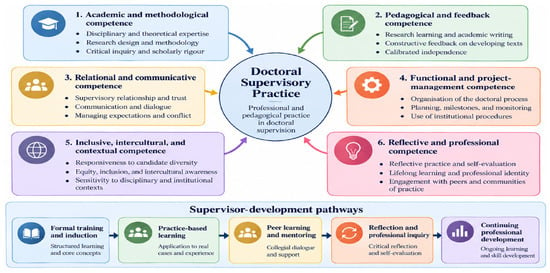
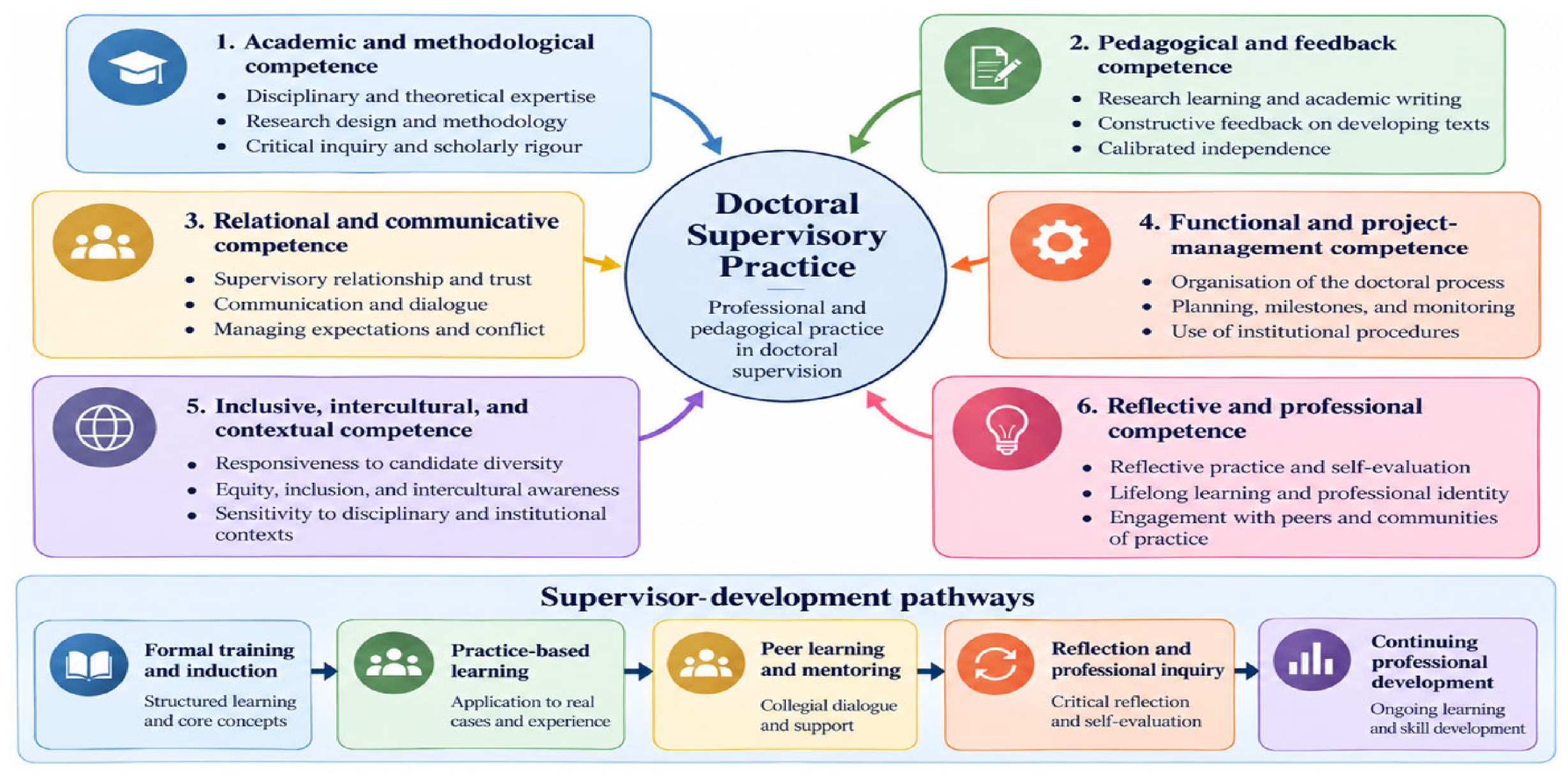
Experienced supervisors continue to benefit from opportunities for professional development [14,29]. At later career stages, development may place greater emphasis on reflection on established practice, difficult cases, peer exchange, adaptation to new contexts, and professional recognition than on basic procedural orientation. This difference in emphasis reinforces the view of supervisor development as a continuing professional process rather than a rigid novice–expert progression. Across career stages, these competence domains and development pathways together portray supervisor development as a continuing, multidimensional process (Figure 1).
Figure 1.
Conceptual synthesis of doctoral supervisory competence and supervisor-development pathways.
6. Evaluating the Effectiveness of Supervisor Development
6.1. What Counts as Effectiveness?
Evaluation is strengthened when different levels of evidence are kept distinct. Participant satisfaction can indicate acceptability but does not demonstrate learning. Learning can be examined through knowledge, confidence, or observable skill, while transfer into day-to-day supervisory practice is a further outcome. Candidate experience and more distal outcomes such as completion, time to degree, publication, or wellbeing lie further downstream. The distinction drawn by McCulloch and Loeser [4] between programme evaluation and longer-term impact is therefore important.
Baseer et al. [15] provide an instructive example because their micro-feedback workshop combined participant-reaction measures with an Objective Structured Teaching Exercise to assess feedback skills. The study used the first two levels of the Kirkpatrick framework and explicitly recognised the limitations of relying only on self-reported improvement. Direct observation or structured assessment can therefore strengthen claims about learning, although the study was small and situated in health sciences.
6.2. Supervisor-Level Outcomes
Several studies have assessed supervisor-level outcomes directly. McCulloch and Loeser [4] reported medium- and longer-term effects of their induction workshop on supervisors’ understanding, knowledge, and reported practice. Baseer et al. [15] reported a 56% learning gain on pre–post OSTE scores in a quasi-experimental study involving 17 doctoral supervisors, providing direct evidence of short-term improvement in a specific feedback skill. Neither study should be rewritten as evidence of improved completion or other distal candidate outcomes.
Survey research provides complementary but non-causal evidence. Pyhältö et al. [19] found that engagement in supervisory-development activities was positively associated with perceived supervisory competence in a cross-sectional survey of 561 supervisors. Jara [20] likewise reported shifts in participants’ perspectives and practice in a programme evaluation. Together, these studies indicate professional learning at different levels while also illustrating the heterogeneity of measures used to describe improvement.
6.3. Candidate-Level and Institutional Evidence
Candidate perspectives can strengthen evaluation by reducing exclusive reliance on supervisor self-assessment. Baseer et al. [15] compared supervisor and supervisee perceptions of feedback before and after the workshop; an initial difference became negligible after the intervention, with supervisors’ perceptions shifting toward those originally held by supervisees. This is evidence about alignment of feedback perceptions, not about a distal doctoral outcome.
Wichmann-Hansen et al. [14] provide an especially important causal caution. Their faculty showed high and increasing student satisfaction with supervisors during the period in which the long-term development programme operated, but the authors explicitly stated that a causal relationship between the programme and student responses could not be established. The same case documented departmental initiatives and possible changes in supervisory culture, showing how programme evaluation can include organisational practices while avoiding attribution of every concurrent change to the intervention.
6.4. Methodological Challenges
Causal inference remains difficult because much of the available evidence comes from programme evaluations, qualitative studies, institutional cases, or cross-sectional surveys. Participation and institutional context can also influence who engages in development and how outcomes are reported. As outcomes become more distal from the development activity, attribution becomes correspondingly more demanding.
A stronger evaluation architecture may combine multiple sources and time points: structured measures of supervisor learning, evidence of transfer into practice, and candidate-reported experience. The approaches used by McCulloch and Loeser [4] and Baseer et al. [15] illustrate complementary ways of extending evaluation beyond immediate participant reaction, including medium- and longer-term follow-up, structured skills assessment, and supervisee perspectives, without implying a single preferred evaluation model.
The way effectiveness is evaluated is not independent of institutional policy. Universities determine what development is required, which forms of recognition are available, and which outcomes are monitored. Institutional approaches therefore form the next level of the supervisor-development system.
7. Institutional Approaches
7.1. Mandatory Versus Voluntary Development
Institutional policies vary substantially in whether supervisor development is mandatory. Taylor [5] identified information on initial professional development across 147 UK institutions: 125 required mandatory initial development, 14 offered it voluntarily, and eight had no identifiable provision. By contrast, the 2025 EUA-CDE survey of 217 responding European universities found obligatory supervisor training in all or most doctoral programmes at 17% of institutions, whereas voluntary training was regulated in all or most programmes at 59% [33]. As the two studies differ in sampling frames and methods, these figures are best interpreted descriptively rather than as directly comparable prevalence estimates. In Malaysia, the Malaysian Qualifications Agency’s national standards require supervisors of research master’s and doctoral degrees to undertake structured supervisor training addressing roles, responsibilities, expectations, institutional policies and rules, and interpersonal challenges involving personal, cultural, academic, and intellectual issues [34].
The 2024 UK Research Supervision Survey provides associational evidence about mandatory provision. Among 5174 usable responses from 141 institutions, respondents who had experienced mandatory induction or regular mandatory development reported higher confidence in some areas of supervisory practice [35]. Because these are cross-sectional self-reports, the findings do not establish that mandatory provision is causally superior to voluntary provision.
7.2. Recognition and Professionalisation
Recognition provides another institutional mechanism for making supervisory practice visible. The UKCGE Good Supervisory Practice Framework [12] offers a common set of practice domains that can be used to articulate expectations and professional development. Taylor [5] additionally documented institutional awards, external recognition, and the inclusion of research supervision in many publicly available promotion criteria. These mechanisms indicate growing visibility and professionalisation of supervision; their effects on supervisory quality require separate evaluation.
7.3. Novice and Experienced Supervisors
Institutional provision may also vary according to supervisory experience. Taylor [5] distinguishes Initial Professional Development from Continuing Professional Development, while evidence from several contexts indicates that emerging supervisors may benefit more from structured preparation and experienced supervisors may place greater value on peer exchange, mentoring, reflection, and practice-based development [14,29,31,32,35]. These differences point to the value of tailoring development to supervisory experience and professional need rather than treating supervisor learning as a uniform process.
7.4. Generic and Discipline-Sensitive Provision
Institutional design involves balancing common supervisory expectations with disciplinary and contextual needs. Guerin et al. [16] mapped supervisor-development provision across Australian universities and found substantial diversity in centrally provided programmes, including uneven attention to preparing supervisors to support doctoral writing. In creative writing, Ellison et al. [36] report that generic supervisor training could be experienced as insufficiently relevant to distinctive features of creative-practice doctorates and argue for discipline-sensitive peer support and guidance. Together, these studies indicate that common institutional provision may need to be complemented by forms of development responsive to distinctive disciplinary practices and supervisory demands.
7.5. Institutional Responsibility for Quality
Institutional responsibility extends beyond attendance requirements. Universities shape eligibility to supervise, access to mentoring and reflection, continuing-development opportunities, recognition, workload arrangements, and mechanisms for addressing poor practice. The EUA-CDE survey documents increasing institutionalization of supervisory rules and guidelines across European doctoral education [33], while Taylor [5] calls for closer attention to the duration, content, recognition, and reward of development provision. Policy architecture also varies outside these systems. In China, Lu [37] analysed four national policy documents and policies at two leading research universities, showing how doctoral-supervision policy is translated from national to institutional levels and arguing that supervisor eligibility and authority receive comparatively limited attention in the documents reviewed. These examples illustrate institutional responsibility as a combination of qualification rules, development provision, professional expectations, and local interpretation rather than as training attendance alone.
Institutional quality also depends on the conditions surrounding supervisory work. In a descriptive evaluation involving 77 CARTA supervisor-workshop respondents affiliated with 10 African institutions, Igumbor et al. [38] found that participants identified supervision training, multidisciplinary exposure, research infrastructure and resources, and institutional support among the conditions associated with effective doctoral supervision. These findings situate supervisor development within a broader institutional and research environment in which training operates alongside organisational resources, disciplinary exposure, and support structures. Such conditions also shape how development can be sustained across supervisory careers and adapted to changing institutional and doctoral contexts.
8. Challenges and Future Directions
8.1. Strengthening Evidence of Effectiveness
A persistent research challenge is to strengthen evidence about what supervisor development changes and how long those changes persist. Available studies provide useful evidence about satisfaction, learning, competence, and reported or observed practice, while evidence connecting development interventions to candidate experience and distal outcomes is less developed [4]. Future studies would benefit from specifying the intended outcome, measurement strategy, time horizon, and plausible mechanism connecting development to supervisory practice. Longitudinal and multi-perspective evaluation may provide a more informative basis for examining persistence and transfer where feasible [4,15], without constituting a single universally preferred design.
8.2. Sustainable Career-Long Development
Sustainability is a second challenge. Golding [29] notes that systematic development of doctoral-supervision capacity can be difficult or expensive to provide at scale and reports an educational-design approach intended to be sustainable and transferable for experienced supervisors. Taylor [5] similarly argues that UK provision should move beyond short, regulation-heavy formats and distinguish initial from continuing professional development. The problem is therefore not simply to expand provision, but to design development that remains meaningful, feasible, and adaptable across supervisory careers.
8.3. Inclusive and Wellbeing-Aware Development
Supervisor development also increasingly addresses diversity, inclusion, and wellbeing while retaining clear professional boundaries. Showunmi et al. [24] synthesized challenges involving power and feedback, belonging and support, racialized judgements of competence, cultural misunderstanding, and communication or language barriers in their rapid review of inclusive doctoral supervision. Hazell et al. [39] analysed free-text responses from 1783 UK doctoral researchers and found that supervision was perceived as affecting mental health and wellbeing; their practice implications call for positive supervisory practice, sensitive responses to disclosures, and appropriate signposting. The relevant developmental goal is not to turn supervisors into therapists, but to strengthen awareness, communication, boundary management, and knowledge of support pathways.
8.4. Context-Sensitive and Globally Distributed Evidence
The geographical distribution of evidence warrants attention, but supervisor-development research is not confined to the systems most frequently represented in programme evaluations and sector reports. Research on doctoral supervisor development also encompasses Latin American studies from Chile and Cuba [9,27], African evidence from Lesotho, South Africa, and a CARTA network spanning 10 institutions [31,32,38], and Asian policy research from Malaysia and China [34,37], alongside transnational initiatives involving Vietnam, Indonesia, and China [25]. Even with this broader coverage, detailed programme evaluations and longitudinal evidence remain unevenly distributed across national and institutional settings. Particular models or policy arrangements should therefore not be assumed to transfer unchanged between doctoral systems.
African evidence illustrates both the value of broader coverage and its limits. Omoya et al. [40] identified 12 studies in their scoping review of doctoral-training challenges in Africa and noted that, although supervisor professional development had been introduced in some contexts, its impacts were not often reported. Igumbor et al. [38] provide primary, multi-institutional evidence from CARTA supervisors, but their descriptive design concerns perceptions of effective supervision rather than causal evaluation of the training itself. The need is therefore for more contextually grounded and evaluative research across a wider range of doctoral systems.
Transnational development makes contextual adaptation especially visible. Everitt et al. [25] report a pilot Community of Practice programme developed across six partner institutions in the United Kingdom, Vietnam, Indonesia, and China through knowledge exchange. Their evaluation identified positive experiences alongside practical and linguistic challenges involving timing, digital platforms, breadth of participation, and language facilitation. The study supports local co-design and intercultural dialogue as implementation principles within transnational professional development.
8.5. Generative AI and Evolving Supervisory Practice
Generative artificial intelligence is an emerging and rapidly evolving area of doctoral supervision and supervisor professional development, and its empirical evidence base is still developing. Qi et al. [41] found that discussion of generative AI could become a delicate or taboo topic in supervision meetings involving international doctoral students in Australian humanities, arts, and social-science contexts. They recommend ongoing supervisory dialogue and locally negotiated expectations aligned with changing disciplinary, institutional, and publisher policies. These recommendations should be interpreted within the disciplinary and institutional context of the study.
Jensen et al. [42] compared authentic supervisory feedback encounters with simulated chatbot feedback and found different emphases: chatbot interactions foregrounded candidate agency and task-focused information, whereas supervisor feedback was relational, contextual, and developmental. Their exploratory self-study suggests that generative AI may supplement rather than replace supervisory feedback. For professional development, the emerging issue is therefore broader than technical AI literacy; it includes how supervisors negotiate responsible use while preserving relational and developmental functions of supervision.
Taken together, these challenges point toward an evolving professional-learning system rather than a finite training curriculum. Future development is likely to require stronger evaluation, sustainable career-long opportunities, greater attention to inclusion and context, and mechanisms for responding to changes in doctoral practice without overstating what particular interventions have been shown to achieve.
9. Conclusions
Doctoral supervision is a multidimensional professional and pedagogical practice that extends beyond disciplinary and research expertise alone. It involves academic and methodological guidance, pedagogical judgement, relational and communicative capability, organisation of the doctoral process, responsiveness to candidate and contextual differences, and reflective professional practice. Accordingly, the preparation of doctoral supervisors cannot be reduced to procedural induction or the transmission of institutional regulations.
Supervisor development is more appropriately understood as a continuing professional process that may begin with formal preparation but develops further through experience, reflection, peer dialogue, mentoring, communities of practice, and other forms of workplace and professional learning. Different approaches may serve different purposes and career stages, and their relevance depends partly on disciplinary, institutional, cultural, and national contexts. This makes flexibility and contextual adaptation important features of supervisor-development provision.
Available evidence supports the value of distinguishing participation and satisfaction from learning, changes in supervisory practice, candidate experience, and more distal doctoral outcomes. Existing studies provide evidence of supervisor learning, perceived competence, specific skill development, and changes in reported or observed practice, but stronger causal claims require greater methodological caution. In particular, improvements occurring alongside professional-development initiatives should not automatically be attributed to those initiatives when study designs do not support such conclusions.
Doctoral supervisor development is therefore both an individual and an institutional responsibility. Universities and doctoral-education systems shape the expectations, opportunities, resources, recognition, and conditions within which supervisory practice develops. Future provision will need to remain sustainable across supervisory careers, responsive to diversity and wellbeing, sensitive to disciplinary and geographical context, and capable of adapting to emerging changes in doctoral practice, including generative artificial intelligence. Viewed in this way, doctoral supervisor training and professional development form an evolving professional-learning system rather than a finite training requirement.
Author Contributions
Conceptualization, V.T.C.B., Y.M.A.A., H.E.L.G. and R.A.C.-S.; methodology, V.T.C.B. and H.E.L.G.; investigation, V.T.C.B., Y.M.A.A., J.D.S.H., L.M.H.R., A.A.L., C.P.A.A., J.M.S.S. and J.L.R.N.; data curation, J.D.S.H., L.M.H.R., C.P.A.A. and J.M.S.S.; formal analysis, V.T.C.B., Y.M.A.A., J.D.S.H., A.A.L., H.E.L.G., J.M.S.S., J.L.R.N. and R.A.C.-S.; validation, L.M.H.R., A.A.L., C.P.A.A., J.L.R.N. and R.A.C.-S.; writing—original draft preparation, V.T.C.B., Y.M.A.A. and J.D.S.H.; writing—review and editing, all authors; supervision, H.E.L.G. and R.A.C.-S.; project administration, V.T.C.B. and H.E.L.G. All authors have read and agreed to the published version of the manuscript.
Funding
This research received no external funding.
Institutional Review Board Statement
Not applicable.
Informed Consent Statement
Not applicable.
Data Availability Statement
No new data were created or analyzed in this study. Data sharing is not applicable to this article.
Conflicts of Interest
The authors declare no conflicts of interest.
References
- Halse, C.; Malfroy, J. Retheorizing Doctoral Supervision as Professional Work. Stud. High. Educ. 2010, 35, 79–92. [Google Scholar] [CrossRef] [Scilit]
- Haley, A.; Holmqvist, M.; Johansson, K. Supervisors’ Competences from Doctoral Students’ Perspectives—A Systematic Review. Educ. Rev. 2025, 77, 1971–1990. [Google Scholar] [CrossRef] [Scilit]
- Karampelias, C.; Stigmar, M.; Auer, N. Behind the Scenes of Doctoral Success: A Mixed Methods Approach to Exploring PhD Supervision Courses in Swedish Higher Education Institutions. Stud. High. Educ. 2025, 50, 1138–1150. [Google Scholar] [CrossRef] [Scilit]
- McCulloch, A.; Loeser, C. Does Research Degree Supervisor Training Work? The Impact of a Professional Development Induction Workshop on Supervision Practice. High. Educ. Res. Dev. 2016, 35, 968–982. [Google Scholar] [CrossRef] [Scilit]
- Taylor, S. Supporting Research Supervision Practice: A Review of UK Provision; Next Generation Research SuperVision Project and UK Council for Graduate Education: York, UK, 2026. [Google Scholar] [CrossRef]
- Pearson, M.; Brew, A. Research Training and Supervision Development. Stud. High. Educ. 2002, 27, 135–150. [Google Scholar] [CrossRef] [Scilit]
- Bruce, C.; Stoodley, I. Experiencing Higher Degree Research Supervision as Teaching. Stud. High. Educ. 2013, 38, 226–241. [Google Scholar] [CrossRef] [Scilit]
- Åkerlind, G.; McAlpine, L. Supervising Doctoral Students: Variation in Purpose and Pedagogy. Stud. High. Educ. 2017, 42, 1686–1698. [Google Scholar] [CrossRef] [Scilit]
- Proestakis-Maturana, A.; Terrazas-Núñez, W. Research Training and Supervision in Doctoral Programs. Magis 2017, 10, 85–104. [Google Scholar] [CrossRef] [Scilit]
- Halse, C. Becoming a Supervisor: The Impact of Doctoral Supervision on Supervisors’ Learning. Stud. High. Educ. 2011, 36, 557–570. [Google Scholar] [CrossRef] [Scilit]
- Huet, I.; Casanova, D. Exploring the Professional Development of Doctoral Supervisors through Workplace Learning: A Literature Review. High. Educ. Res. Dev. 2022, 41, 774–788. [Google Scholar] [CrossRef] [Scilit]
- UK Council for Graduate Education Good Supervisory Practice Framework. Available online: https://supervision.ukcge.ac.uk/good-supervisory-practice-framework (accessed on 5 September 2026).
- Raffing, R.; Jensen, T.B.; Tønnesen, H. Self-Reported Needs for Improving the Supervision Competence of PhD Supervisors from the Medical Sciences in Denmark. BMC Med. Educ. 2017, 17, 188. [Google Scholar] [CrossRef] [Scilit] [PubMed]
- Wichmann-Hansen, G.; Godskesen, M.; Kiley, M. Successful Development Programs for Experienced Doctoral Supervisors—What Does It Take? Int. J. Acad. Dev. 2020, 25, 176–188. [Google Scholar] [CrossRef] [Scilit]
- Baseer, N.; Degnan, J.; Moffat, M.; Mahboob, U. Micro-Feedback Skills Workshop Impacts Perceptions and Practices of Doctoral Faculty. BMC Med. Educ. 2020, 20, 29. [Google Scholar] [CrossRef] [Scilit] [PubMed]
- Guerin, C.; Walker, R.; Aitchison, C.; Laming, M.M.; Padmanabhan, M.C.; James, B. Doctoral Supervisor Development in Australian Universities: Preparing Research Supervisors to Teach Writing. J. Acad. Lang. Learn. 2017, 11, A88–A103. [Google Scholar]
- Haley, A.; Holmqvist, M. Supervisory Approaches Valued at Different Stages of the Doctoral Journey: Perspectives from Students in Education. Scand. J. Educ. Res. 2026, 1–14. [Google Scholar] [CrossRef] [Scilit]
- Pinto, S. International Doctoral Students’ Perspectives on the Qualities of Supervisors: Expectations for Intercultural Supervision in Portuguese Higher Education. Res. Comp. Int. Educ. 2024, 19, 46–62. [Google Scholar] [CrossRef] [Scilit]
- Pyhältö, K.; Tikkanen, L.; Anttila, H. Relationship between Doctoral Supervisors’ Competencies, Engagement in Supervisory Development and Experienced Support from Research Community. Innov. Educ. Teach. Int. 2024, 61, 555–569. [Google Scholar] [CrossRef] [Scilit]
- Jara, M. Research-Based Doctoral Supervision Development Programme: Learning through Peer Learning, Reflection and Case Studies. Innov. Educ. Teach. Int. 2021, 58, 441–450. [Google Scholar] [CrossRef] [Scilit]
- Hill, G.; Vaughan, S. Conversations about Research Supervision—Enabling and Accrediting a Community of Practice Model for Research Degree Supervisor Development. Innov. Educ. Teach. Int. 2018, 55, 153–163. [Google Scholar] [CrossRef] [Scilit]
- Wittek, A.L.; de Lange, T.; Kirkevold, M. Supervisors Supporting Supervisors in the Context of Higher Education. Scand. J. Educ. Res. 2024, 68, 520–538. [Google Scholar] [CrossRef] [Scilit]
- Jackson, D.; Power, T.; Usher, K. Learning to Be a Doctoral Supervisor: Experiences and Views of Nurse Supervisors of Higher Degree Research Students. J. Clin. Nurs. 2021, 30, 1060–1069. [Google Scholar] [CrossRef] [Scilit] [PubMed]
- Showunmi, V.; Younas, F.; Gutman, L.M. Inclusive Supervision: Bridging the Cultural Divide. Encyclopedia 2024, 4, 186–200. [Google Scholar] [CrossRef] [Scilit]
- Everitt, J.; Cui, V.; Thomson, K.; Nguyen, T.T.T.; Vu, H. Intercultural Dialogue: Experiences of Developing and Piloting a UK-Based Community of Practice Doctoral Supervisor Development Programme in Transnational Higher Education. PRACTICE 2026, 1–18. [Google Scholar] [CrossRef] [Scilit]
- McCormack, C. Stories Return Personal Narrative Ways of Knowing to the Professional Development of Doctoral Supervisors. Stud. Contin. Educ. 2009, 31, 141–156. [Google Scholar] [CrossRef] [Scilit]
- Rodríguez Perón, J.M. The Training of Doctoral Tutors as an Academic Option of the Contemporary Cuban Medical University. Rev. Cuba. Med. Mil. 2021, 50, e0210534. [Google Scholar]
- Vaughan, S.; Blackburn, C.; Curzon, R. Continuing Conversations: Moving Support for Doctoral Supervisors’ Professional Development Online. Innov. Educ. Teach. Int. 2021, 58, 716–726. [Google Scholar] [CrossRef] [Scilit]
- Golding, J. Sustainable, Affordable, and Transferable Approaches to Experienced Doctoral Supervisor Development. Int. J. Acad. Dev. 2025, 30, 216–231. [Google Scholar] [CrossRef] [Scilit]
- Turner, G. Learning to Supervise: Four Journeys. Innov. Educ. Teach. Int. 2015, 52, 86–98. [Google Scholar] [CrossRef] [Scilit]
- Motshoane, P.; McKenna, S. Crossing the Border from Candidate to Supervisor: The Need for Appropriate Development. Teach. High. Educ. 2021, 26, 387–403. [Google Scholar] [CrossRef] [Scilit]
- Tlali, T.V. Exploring the Prospects for Professional Development of Postgraduate Supervisors at the National University of Lesotho. Scholarsh. Teach. Learn. South 2023, 7, 84–105. [Google Scholar] [CrossRef] [Scilit]
- Marti, S.; Peneoasu, A.-M. Doctoral Education in Europe Today: Enhanced Structures and Practices for the European Knowledge Society—2025 EUA-CDE Survey Report I; European University Association: Brussels, Belgium, 2025; Available online: https://www.eua.eu/publications/reports/doctoral-education-in-europe-today-enhanced-structures-and-practices-for-the-european-knowledge-society.html (accessed on 5 September 2026).
- Malaysian Qualifications Agency. Standards: Master’s and Doctoral Degree, 2nd ed.; Malaysian Qualifications Agency: Cyberjaya, Malaysia, 2021. Available online: https://www2.mqa.gov.my/qad/v2/2021/June/Final%20MDD%202021%20-%20upload%20v3.pdf (accessed on 5 September 2026).
- Gower, O.; Clegg, K.; Cleaver, D. UK Research Supervision Survey 2024 Report; UK Council for Graduate Education: Lichfield, UK, 2024; Available online: https://ukcge.ac.uk/resources/resource-library/ukrss2024 (accessed on 5 September 2026).
- Ellison, E.; Batty, C.; Joseph, S.; Owens, A. Supervising Doctorates in Creative Writing: What Is the Lived Experience? New Writ. 2025, 22, 543–564. [Google Scholar] [CrossRef] [Scilit]
- Lu, B. Challenging Policy Barriers to Doctoral Supervision: Qualifying as a Supervisor and Recruiting Students in Chinese Research Universities. In Doctoral Education as If People Matter: Critical Issues for the Future; Österlind, M.-L., Denicolo, P., Apelgren, B.-M., Eds.; Brill: Leiden, The Netherlands, 2022; pp. 43–57. [Google Scholar] [CrossRef] [Scilit] [PubMed]
- Igumbor, J.O.; Bosire, E.N.; Karimi, F.; Katahoire, A.; Allison, J.; Muula, A.S.; Peixoto, A.; Otwombe, K.; Gitau, E.; Bondjers, G.; et al. Effective Supervision of Doctoral Students in Public and Population Health in Africa: CARTA Supervisors’ Experiences, Challenges and Perceived Opportunities. Glob. Public Health 2022, 17, 496–511. [Google Scholar] [CrossRef] [Scilit] [PubMed]
- Hazell, C.M.; Berry, C.; Haywood, D.; Birkett, J.; Mackenzie, J.-M.; Niven, J. Understanding How Doctoral Researchers Perceive Research Supervision to Impact Their Mental Health and Well-Being. Couns. Psychother. Res. 2025, 25, e12762. [Google Scholar] [CrossRef] [Scilit]
- Omoya, O.; Jacob, U.S.; Odeyemi, O.A.; Odeyemi, O.A. Exploring Perspectives: A Scoping Review of the Challenges Facing Doctoral Training in Africa. High. Educ. 2025, 89, 1103–1127. [Google Scholar] [CrossRef] [Scilit]
- Qi, J.; Tuxworth, J.; Gomes, C. Navigating Supervisory Conversations about Gen AI: Taboo and Supervisory Power Dynamics. High. Educ. Q. 2026, 80, e70151. [Google Scholar] [CrossRef] [Scilit]
- Jensen, L.X.; Bearman, M.; Boud, D.; Konradsen, F. Feedback Encounters in Doctoral Supervision: The Role of Generative AI Chatbots. Assess. Eval. High. Educ. 2026, 51, 849–862. [Google Scholar] [CrossRef] [Scilit]

Disclaimer/Publisher’s Note: The statements, opinions and data contained in all publications are solely those of the individual author(s) and contributor(s) and not of MDPI and/or the editor(s). MDPI and/or the editor(s) disclaim responsibility for any injury to people or property resulting from any ideas, methods, instructions or products referred to in the content. |
© 2026 by the authors. Licensee MDPI, Basel, Switzerland. This article is an open access article distributed under the terms and conditions of the Creative Commons Attribution (CC BY) license.