


Abstract
Presenteeism, characterized by going to work sick, has become increasingly prevalent in nursing, a profession with high social and interpersonal demands. It is associated with a deterioration of the health of nurses, a reduction in the excellence of care, and a decrease in safety for users. Burnout is related to stress and mental overload and is characterized by exhaustion and fatigue. Objective: To map the evidence on the relationship between presenteeism and burnout in nurses. Methods: A literature review was carried out using the EBSCOHost Research search engine in various databases. Eight studies were selected and analyzed. Results: The studies identify a consistent relationship between burnout and presenteeism in nurses. Emotional exhaustion, resulting from burnout, can lead nurses to go to work despite being ill, due to a sense of responsibility, ethical duty, or organizational pressures. Most studies are cross-sectional, which limits the ability to establish causal relationships and identify specific interventions to reduce burnout-related presenteeism in nursing. Conclusions: It is essential to invest in health management policies for nurses to reduce burnout and minimize the consequences of presenteeism.
1. Introduction
Presenteeism is a phenomenon that has been addressed since the 1950s. It refers to the presence of professionals in the workplace when they are ill, which has an impact on their performance, concentration, and productivity [1].
Although it is a global phenomenon, it is particularly common in the health sector, and especially in professions that are more socially and interpersonally demanding, such as nursing [2,3].
Nurses are the largest group of caregivers in the healthcare system [2]. This professional class often shows up for work even if they have physical or psychological limitations, driven by a sense of responsibility and commitment to their profession [3].
In a study conducted in Portugal in 2016, involving 151 nurses, it was found that 91.4% of nurses, even with one or more health problems, go to work [4].
In the field of nursing, presenteeism, in addition to reducing work performance, will increase health costs and can affect the care provided [5], increasing the number of adverse events related to patient safety through medication errors, falls, or the transmission of hospital infections [2].
Presenteeism represents a considerable challenge to organizational performance [2], making it essential to understand its underlying factors in order to develop effective interventions in health systems. This phenomenon is driven by a diverse set of reasons, ranging from work-related factors [2,5], such as work overload, and emotional factors, such as burnout [3,6], to cultural and personal influences, such as a strong sense of professional duty [2,3].
Burnout is characterized by exhaustion, demotivation, and reduced professional effectiveness due to stress in the workplace [6]. Burnout and psychological exhaustion are prevalent in nurses and are related to poorer professional performance. A direct relationship between burnout and presenteeism has also been reported [6].
It is therefore clear that presenteeism and burnout are two phenomena that significantly affect the health of nursing professionals and the care provided to patients. We therefore set out to map the evidence on the relationship between presenteeism and burnout in nurses by carrying out a literature review.
2. Methods
According to some authors, literature reviews are a necessity when trying to make evidence-based decisions. By carrying them out, it is possible to assess the existing knowledge on a given topic or issue, using standardized methods for systematic reviews [7].
According to Cochrane, a review is an accelerated systematic review that uses simplified methods to produce evidence more quickly, while maintaining an adequate level of methodological rigor. These reviews are often carried out to support urgent health decisions, reducing detailed steps in assessing the quality of studies [7].
There are eight stages to a systematic review, according to Cochrane’s guidelines, which will be described and developed in the course of this work: definition of the research question and eligibility criteria, search and selection of studies, data extraction, assessment of the risk of bias, presentation of results, interpretation of results, and conclusions [7].
2.1. Definition of the Research Question
Based on the proposed topic, and fulfilling the assumptions defined by Cochrane for carrying out a literature review, we sought to answer the following question: “What evidetence is there on the relationship between presenteeism and burnout in nurses?”
2.2. Inclusion and Exclusion Criteria
Considering the primary objective of this literature review, to map the evidence on the relationship between presenteeism and burnout in nurses, the starting question was defined, based on the PICo method, and eligibility criteria were drawn up for the selection of suitable studies, as can be seen in Table 1.
Table 1.
Eligibility criteria based on the PICo framework.
It was also decided to examine articles in English and Portuguese that gave full access and were published in the last 10 years (between 2015 and 2025).
This research included primary and secondary studies, of qualitative origin, whose level of evidence was equal to or greater than 4. The use of gray literature in this research was limited.
2.3. Research
Initially, the search strategy involved defining the necessary descriptors. Descriptors validated by Medline—Medical Subject Headings (MeSh) and health sciences descriptors (DeCs) were used.
The search was carried out in January 2025 and then repeated and verified by another researcher using the EBSCOHost Research search engine in the following databases: CINAHL Complete, MEDLINE Complete, Nursing & Allied Health Collection: Comprehensive, Cochrane Central Register of Controlled Trials, Cochrane Database of Systematic Reviews, Cochrane Methodology Register, Library, Information Science & Technology Abstracts, MedicLatina and Cochrane Clinical Answers.
The search strategy combined the selected key descriptors (Nursing, Presenteeism and Burnout) using the Boolean operators OR and AND. The final expression used in the databases was (Nursing OR Nurs*) AND (Presen-teeism OR “Sickness Presenteeism”) AND (“psychological exhaustion” OR burnout OR “burn out”).
2.4. Study Selection
In the selection process, the studies were extracted and stored in Excel®, and duplicate articles were removed with the search engine used (EBSCOHost) and manually by the researchers.
The selection process was carried out by the four reviewers after a pilot exercise in which fifteen titles and abstracts were evaluated. In this way, the selection system was checked and tested. To resolve potential conflicts, the abstracts were then double-checked and the excluded abstracts analyzed. In order to read all the studies and then include them in this review, a pilot exercise was carried out to test the selection method. All the reviewers took part in the selection and, in the end, one reviewer filtered out the excluded articles.
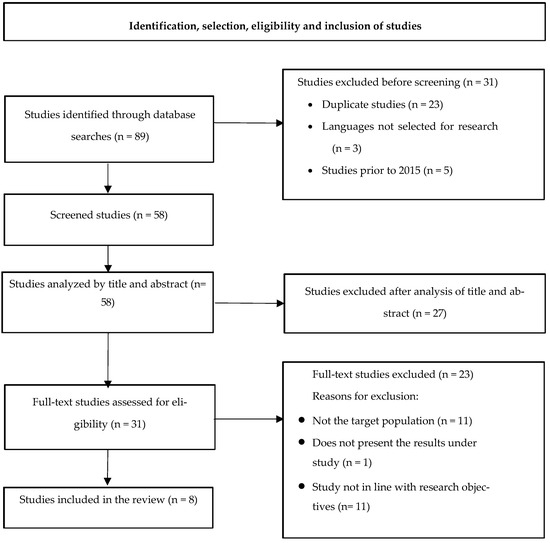
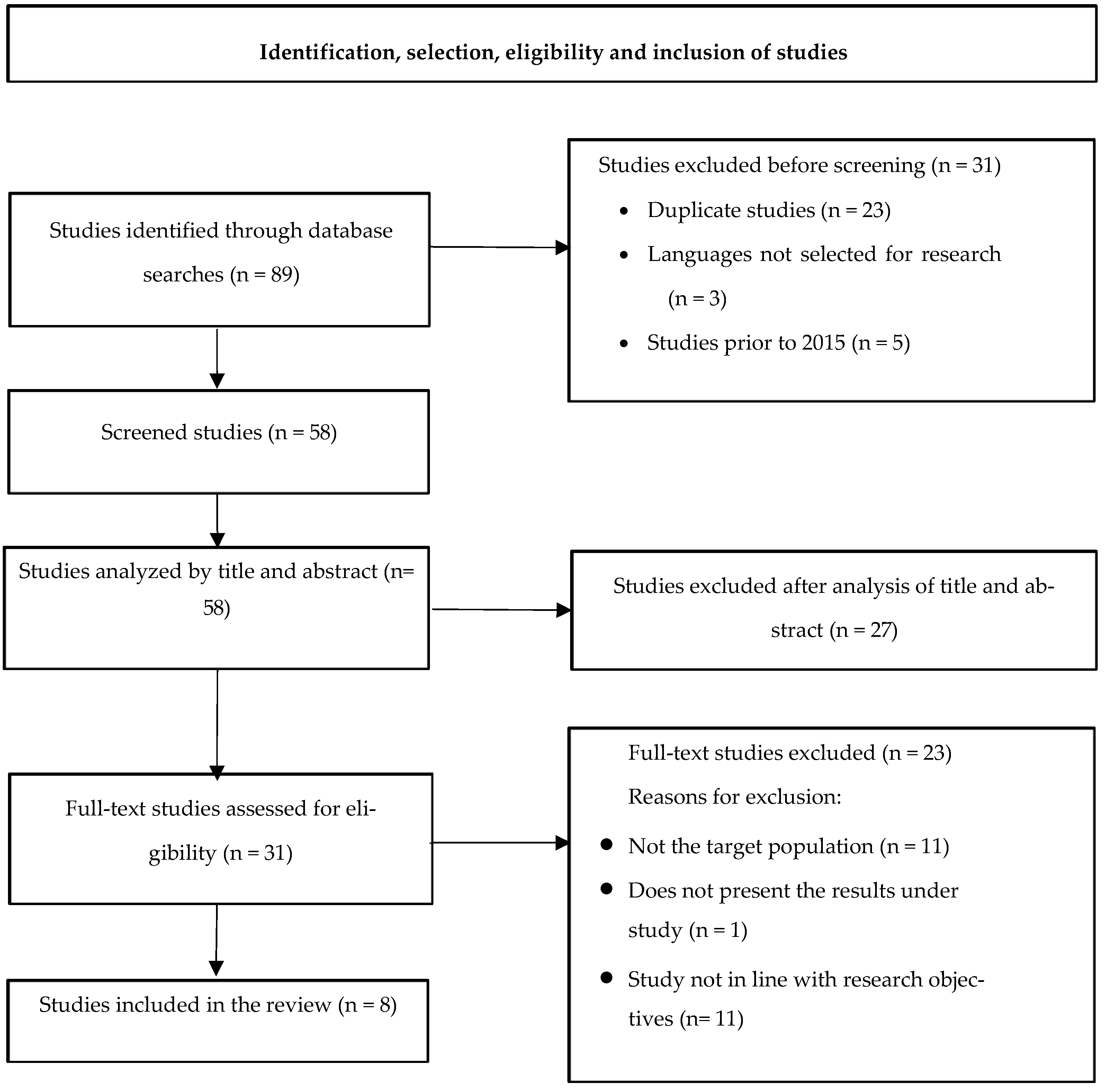
The flowchart, adapted from Preferred Reporting Items for Systematic Reviews and Meta-Analyses (PRISMA) [8], summarizes the selection process (Figure 1).
Figure 1.
Flowchart adapted from PRISMA.
2.5. Data Extraction
Data extraction complied with Cochrane’s suggestions and was carried out by two reviewers by filling in a table with the specifics of the publication (title, authors, year, and magazine/journal of publication), level of evidence, objectives of the study, characteristics of the sample/publication (sample size, country of application, demographic characteristics such as gender and age), description of the intervention (method of study used and mode of application), and results and conclusions obtained (existing relationships between the phenomena under study or others considered relevant). The data was then validated by a third reviewer.
2.6. Quality Assessment and Risk of Bias
The critical appraisal grids of the Joanna Briggs Institute were used to determine the risk of bias, and were completed by two reviewers. They were then checked by a third reviewer to ensure that they had been completed correctly.
The quality of the articles was assessed according to the sum of points (one point for “YES” and zero points for the other options, “No”, “Not applicable”, and “Not specific”), based on the criteria determined by Camp and Legge [9], articles are considered to be of excellent quality if they score over 90%, of high quality if they score 80—90%, and of average quality if they score between 70 and 79%.
Evaluating the quality of the journals in which the articles are published is also a relevant indicator. To achieve this, we used the SJR tool, available at www.scimagojr.com, to determine the quartile of publication.
2.7. Summary
Based on the Cochrane guidelines, a table was drawn up (Appendix A), which presents, in a structured and summarized way, the evidence found in the eight selected studies.
2.8. Considerations
The information in this literature review is the author’s own and all citations are referenced, with no involvement by the participants.
This review was carried out on the basis of all ethical and legal considerations.
The protocol for this review was registered with the Open Science Framework (https://osf.io/4x9qs).
3. Results
3.1. Study Selection
The aforementioned search strategy identified 89 studies, which were distributed in the following databases: Medline Complete = 43, CINAHL Complete = 34, Cochrane Central Register of Controlled Trials = 9, and Nursing & Allied Health Collection = 7.
An initial analysis excluded twenty-three duplicate articles, three articles that did not fit the defined language, and five articles with a publication date prior to 2015. Fifty-eight articles were then screened and, after analyzing the title and abstract, thirty-one were chosen for full analysis. Considering the eligibility criteria defined and after a full analysis of the articles, eight articles were selected for this literature review. A detailed description of the research can be found in the flowchart adapted from the PRISMA guidelines (Figure 1).
3.2. Characterization of the Studies
A full analysis of the studies led to the inclusion of eight for the development of this work [2,3,5,10,11,12,13,14]. All the studies were published recently, one in 2017 [5], one in 2019 [12], three in 2021 [3,11,13], one in 2022 [14], one in 2024 [2], and the last in 2025 [10].
As far as the level of evidence is concerned, two are qualitative studies with level of evidence III [2,3], five are analytical cross-sectional studies with level of evidence IV [10,11,12,13,14], and one is a systematic literature review with level of evidence Ia [5].
It should be noted that there are few studies with high levels of evidence in this thematic area, which can be considered a limitation and a suggestion for the future.
3.3. Assessment of the Level of Evidence and Risk of Bias
To assess the level of evidence, the guidelines issued by the Joanna Briggs Institute were used, so all the articles were analyzed by two reviewers and the critical evaluation grids provided were filled in (Table 2, Table 3 and Table 4).
Table 2.
Critical evaluation of the systematic literature review.
Table 3.
Critical evaluation of cross-sectional studies.
Table 4.
Critical evaluation of qualitative studies.
This literature review included five cross-sectional studies, two qualitative studies, and one systematic literature review, published in high-impact journals (Q1 and Q2).
A summary of the particularities of the studies included in this study can be found in Table 5.
Table 5.
Study characteristics and main results.
Thus, of the analytical cross-sectional studies, two were considered to be of excellent quality [11,14] and the other three were considered to be of high quality [10,12,13].
Of the qualitative studies selected, both are classified as high-quality [2,3]. The systematic literature review was classified as being of excellent quality [5].
Of the eight studies selected, only two did not present a risk of bias because they met all the criteria assessed [11,14]. The remaining studies did not meet at least one of the criteria and therefore presented a risk of bias.
3.4. Presentation and Analysis of Results
Presenteeism has been determined by the authors as a phenomenon with negative consequences for the professionals, the patient, and the institution [10]. The productivity of professionals and the quality of their performance is profoundly affected [2]. Nurses are considered to be a professional class at high risk of presenteeism [11], with high levels of incidence [2] and a high prevalence during and after the COVID-19 pandemic [14].
All the studies were carried out in a hospital setting and were aimed at professional nurses.
The analytical cross-sectional studies [10,11,12,13,14] were all carried out using self-administered questionnaires. Differences in sample size were evident, ranging from 386 [12] to 42,843 nurses [10].
The participating nurses were mostly female, with percentages of over 90% in all the studies. Interestingly, one of the studies had only female nurses as participants [10]. The age range of the participants was between 31 and 41 years old.
The researchers tried to use validated scales to collect the data. With regard to the study of presenteeism and loss of productivity, the Stanford Presenteeism Scale (SPS) [10,12,13,14], Healthcare Productivity Survey (HPS) [11], Job-Stress-Related Presenteeism Scale (JSRPS) [11], and Nurses Work Functioning Questionnaire (NWFQ) [11] were used.
In one of the studies [11], the authors tried to be more detailed in determining the factors that precede presenteeism, using specific scales: Safety Attitudes Questionnaire (SAQ); Perceived Stress Scale; and Nurse Professional Value Scale-Revised (NPVS-R).
The consequences of presenteeism were also studied using scales such as Professional Quality of Life Scale [11,12], MissCare Survey Part [11], Healthcare Team Vitality Instrument [12], Overall Perceptions of Safety and Frequency of events da Agency for Healthcare Research and Quality (AHRQ) [12], Flourishing Scale [12], Chalder Fatigue Scale [12,14], and Occupational Fatigue Exhaustion/Recovery Scale [12].
The Maslach Burnout Inventory-Human Services Survey (MBI-HSS) [10,13,14] was used to study burnout.
To understand perceived social support, the Perceived Social Support Scale (PSSS) was used [10,11].
Studies with larger population samples indicate a high incidence of presenteeism among nurses [10,13,14].
Presenteeism due to illness has been correlated with burnout and loss of productivity [10,11,12,13,14].
Professional burnout related to the high workload is also evident [10,14] and leads to fatigue, burnout, and loss of productivity [14]. The intensity and pressure of the workload, related to the shortage of human resources, gradually diminishes nurses’ enthusiasm and resilience, leading to burnout [10,13,14].
The perception of stress and the work environment are strongly related to presenteeism, as is the harmony of professional and personal life [11].
It has been suggested that professional ethics, organizational culture, and the existing hierarchy can restrict sick leave, thus boosting presenteeism [10]. During the COVID-19 pandemic, an increase in presenteeism among nurses was visible [10,14].
Measures to provide social support and improve the working environment were evaluated and found to be associated with moderate presenteeism and burnout when appropriate strategies were implemented (leadership, prioritizing healthy lifestyle habits, physical and mental health), reducing physical and mental exhaustion and decreasing loss of productivity [10,11]. It has also been determined that deep action strategies related to emotional management have a direct and positive impact on presenteeism, reducing it [13].
The safety of users has also been assessed, as presenteeism can jeopardize this [12]. It has been found that presenteeism is related to an increase in the frequency of adverse events (such as falls, medication errors, and lost care).
A limitation was the cross-sectional design of the studies, which prevents a causal relationship from being established between the correlations examined. All the authors suggest longitudinal or experimental studies to validate the information obtained.
The qualitative studies selected [2,3] used semi-structured, face-to-face interviews. They suggest applying consolidated criteria for qualitative research and for the structure of the interview. The questions used in the interviews are available in both studies.
The qualitative studies were applied to a similar sample of between 15 and 17 nurses. There was a higher percentage of interviews with female nurses—80% [2] and 58.7% [3]—and the age range of the participants was between 35.3 and 37.29 years. In both studies, the average length of professional experience was around 13 years.
The reasons identified for presenteeism on the part of the nurses were related to issues of professional ethics [2], namely, the lack of human resources, the fear of overburdening colleagues, and the potential impact on salary or vacations. Nurses felt a strong sense of duty and responsibility towards patients, often prioritizing patient care over their own well-being [2]. This reinforced the fact that working with physical and mental discomfort leads to overload and affects the working environment.
The feelings of depersonalization, neglect, and forgetfulness has also been identified [3].
The importance of developing strategies that promote a healthier working environment is reinforced, thus limiting mental and physical overload and, consequently, presenteeism [2,3].
Both qualitative studies mention the small sample size and the fact that the study was carried out in only a few health units as a limitation and reinforce the risk of interpretative bias, suggesting that the research be extended to more nurses and in more locations [2,3].
The systematic review of the literature included [5] was aimed at cohort studies whose target population was nurses and which addressed absenteeism and presenteeism due to illness. The search was carried out on PubMed, ProQuest, and Emerald and covered articles published between 1950 and 2016. The quality of the included studies was assessed using the Newcastle–Ottawa Scale.
A systematic review of the literature shows that absenteeism and presenteeism due to illness are challenging behaviors in nursing, as they increase healthcare costs, cause adverse events, and have an impact on healthcare [5]. Only one Dutch study, from 2009, addressed the issue of presenteeism, demonstrating that more research is still needed in this area and revealing the challenge of measuring presenteeism as it is a subject associated with some subjectivity. Three relevant antecedents leading to presenteeism were identified: work demands, burnout, and exhaustion. The depersonalization of nurses was considered to be one of the consequences of presenteeism [5], compatible with what was shown in the qualitative studies already analyzed [2,3].
To facilitate the comparative analysis and synthesis of the eight selected studies, the characteristics and main results have been systematized in Table 5.
4. Discussion
Presenteeism is a phenomenon that has been identified as a recurring problem among nurses, especially in hospital settings or in places with excessive workloads [11]. It is a situation in which the worker attends work despite feeling physically or mentally ill [6]. The consequences of presenteeism for the healthcare professional, the patient, and the healthcare organization can be significant [14]. Its practice can lead to reduced productivity and increased risks related to patient safety [13].
Although presenteeism may seem attractive to organizations, in reality, it causes a problem with productivity, overloads other employees and, according to some authors, costs more than absenteeism [15,16].
Burnout, an equally common phenomenon in nursing, is associated with excessive workload and emotional pressure. The feelings of professional exhaustion, despondency, and decreased effectiveness are characteristic of burnout [6].
Fiorini et al. [17] point out that emotional exhaustion, one of the components of burnout, leads to a decrease in work performance and an increase in presenteeism.
The aim of this literature review was to map the evidence on the complex relationship between presenteeism and burnout in nurses. The analysis of the eight selected studies reveals that it is not a simple correlation or a one-way street [14]. We can see that it is a dynamic process, often cyclical and mediated by multiple factors, be they work-related, emotional or organizational. Burnout, in particular, plays a central role, not only as a consequence of presenteeism but also as a mediating mechanism that links working conditions to a loss of productivity and deterioration in the quality of care [5,12,13].
4.1. Cyclical Relationship Between Presenteeism and Burnout
The literature suggests that there is a two-way relationship between presenteeism and burnout, feeding off each other and creating a vicious circle that is difficult to break [10]. It is reported that nurses with burnout symptoms are more prone to presenteeism, as they feel pressured to continue working even when they are exhausted [11,18].
Li et al. [14] indicate that fatigue and exhaustion resulting from burnout may mediate this relationship with presenteeism. They show a clear sequence in which presenteeism caused by illness increases nurses’ fatigue levels, promoting burnout and culminating in the loss of productivity and negatively affecting the quality of care. This shows that going to work sick has potentially measurable negative consequences.
In addition, Rainbow et al. [11] suggest that a work environment characterized by high levels of stress and negative perceptions aggravates presenteeism, which in turn can intensify burnout, creating a vicious cycle of physical and emotional overload that is difficult to break.
Zhang et al. [10] emphasize that presenteeism and burnout are positively correlated, which means that as presenteeism increases, so does the likelihood of suffering from professional burnout.
Brborović et al. [5] also revealed the reciprocal relationship between exhaustion and presenteeism, identifying burnout as a key factor.
This two-way dynamic reinforces that exhausted professionals often feel pressured to work, exacerbating their symptoms and perpetuating this cycle [10].
4.2. MediatingMechanisms of Presenteeism and Burnout
Various mediating mechanisms shed light on how presenteeism leads to negative outcomes.
At the organizational level, work demands and exhaustion are consistently identified as direct antecedents of presenteeism [16,19].
Rainbow et al. [12] point to the work environment, stress, and the imbalance between one’s professional and personal life as determining factors for presenteeism.
On the other hand, the constant need to manage one’s emotions in order to meet organizational expectations contributes to nurses’ psychological exhaustion [13].
Song et al. [13] highlight the role of emotional labor, showing that burnout mediated the relationship between emotional labor and presenteeism in Chinese nurses. They suggest that emotional exhaustion can lead professionals to show up for work even when they are not in ideal condition. They also showed that presenteeism correlated with superficial performance, depersonalization, emotional exhaustion, and low personal accomplishment. Thus, the greater the emotional workload and burnout, the more frequent the presenteeism among nurses.
Li et al. [14] also present a serial mediation model, highlighting fatigue as an intermediate stage between presenteeism and burnout, directly affecting productivity and quality of care.
Qualitative studies offer an indispensable insight into the lived experience, giving nurses a voice. The perception of low autonomy at work and the lack of organizational support also contribute to the persistence of this problem [3].
In fact, Mohammadi et al. [3] reinforce that feelings of injustice, lack of decision-making power, and a damaged professional identity are powerful triggers for presenteeism.
This whole perspective is reinforced by the cultural context, especially evident in Asian studies. The culture of sacrifice and the feeling of duty and responsibility, which is not evident in Western studies, leads nurses to prioritize the care of the patient over their own well-being [2,10,20].
4.3. Implications for Management Practice and Policy
The consequences of presenteeism and burnout affect not only the individual nurse, but the entire health system. Patient safety can be compromised as presenteeism has been associated with increased medication errors, falls, reduced productivity, and higher healthcare costs. In addition, burnout can lead to decreased work performance, increased absenteeism, and higher rates of professional turnover. All of these factors will put a strain on healthcare resources and contribute to a deterioration in the quality of nursing care [19].
Although studies are limited, understanding this complete web of factors is crucial to developing more effective strategies and minimizing the growing problem of presenteeism in nursing.
On the one hand, a commitment to training is necessary and some authors stress the importance of professionals recognizing this phenomenon, being aware of its consequences and prioritizing the management of their health [10].
On the other hand, studies suggest that social support moderates the negative impact of presenteeism on burnout and productivity [3,10], which highlights the urgent need to create more favorable and psychologically safe working environments [13,18,21,22].
Rainbow et al. [11] argue that the working environment, stress, and harmony between one’s professional and personal life are all related. Presenteeism influences the relationship between the work environment and burnout and lack of care, which means that the role of the work environment can be important.
Zhang et al. [10] emphasize increasing organizational support as a strategy to mitigate the negative effects associated with presenteeism and burnout. Healthcare organizations must take care of their professionals by implementing clear sick leave policies and promoting a culture where valuing well-being is a priority [3].
Song et al. [13] reinforce that the integration of emotional management and therapy techniques and mindfulness strategies can have a positive impact on emotional regulation and a reduction in burnout. Therefore, both at the individual and team levels, interventions should be promoted to improve emotional management skills.
Finally, the implications for patient safety are undeniable. The association between presenteeism and omitted or poorer-quality care makes it clear that investing in nurses’ health means investing directly in the safety and excellence of the care provided [11,12].
It is therefore essential to invest in the health of nurses, with health policies focused on ensuring the physical well-being and, above all, the psychological well-being of professionals. It is important to have in-depth knowledge of presenteeism and burnout among nurses and among the managers of healthcare organizations, because only in this way will it be possible to maintain the safety and excellence of care.
4.4. Limitations and Future Research
The qualitative [2,3] and cross-sectional [10,11,12,13,14] studies analyzed do not allow us to determine the causality of the relationship between presenteeism and burnout. However, they do shed some light on the impact of presenteeism and burnout on professionals, users and healthcare organizations, and even suggest strategies for reducing their long-term effects.
On the one hand, qualitative studies [2,3] explore feelings of injustice, feelings of duty and responsibility, the lack of decision-making power, and the fear of overburdening colleagues, giving nurses a voice.
On the other hand, quantitative studies [10,11,12,13,14] test existing models, attempt to quantify the strength of relationships, and cover more relevant samples.
Finally, the systematic literature review [5] makes it possible to verify the state of the art and highlights the scarcity of quality longitudinal studies on the subject, which justifies the need for further research.
The literature analyzed converges on the need for more in-depth research on this subject, with the development of longitudinal and experimental studies that allow more robust causal relationships to be established between presenteeism and burnout. A priority line of future research involves designing and testing specific interventions aimed at mitigating presenteeism, such as programs focused on emotional management and mindfulness or on building an organizational climate with greater social support. In addition, it is crucial to study and quantify the direct impact of presenteeism on objective indicators of patient safety and quality of care, such as omitted care and other adverse events.
5. Conclusions
The relationship between presenteeism and burnout is a complex and multifaceted problem, with significant implications for both nursing professionals and the functioning of health services as a whole.
Throughout this literature review, it is clear that the relationship between presenteeism and burnout in nurses transcends a simple correlation, revealing a vicious cycle in which burnout acts as a central mediating mechanism. Driven by a combination of organizational, emotional, and cultural factors, the act of working sick triggers a process that aggravates exhaustion, which in turn intensifies burnout.
Burnout not only mediates the loss of productivity and compromises patient safety but also increases the likelihood of future presenteeism, perpetuating the cycle. The evidence shows that various strategies, such as social support, can moderate the negative impacts of presenteeism and burnout, serving as a crucial protective factor.
It is possible to conclude that intervening in burnout is not just treating a symptom, but acting at the epicenter of a systemic problem. Protecting the physical and mental well-being of nurses, through supportive management policies and a healthy organizational culture, is not only an ethical obligation, but an indispensable condition for the sustainability of the profession and for the safety and quality of care provided to users.
Author Contributions
Conceptualization, A.C.V., M.V., M.S., P.C. and L.S.; methodology, A.C.V., M.V., M.S., P.C., S.M.D., I.R. and L.S.; validation, I.R., S.S. and J.T.; formal analysis, A.C.V., M.V., M.S., S.M.D. and P.C.; investigation, A.C.V., M.V., M.S., S.M.D. and P.C.; writing, A.C.V., M.V., M.S., S.M.D. and P.C.; writing—review and editing, A.C.V., M.V., M.S., P.C., S.M.D., I.R., S.S., J.T. and L.S.; visualization, I.R., S.S., J.T. and L.S.; supervision, L.S.; All authors have read and agreed to the published version of the manuscript.
Funding
This research received no external funding.
Institutional Review Board Statement
Not applicable.
Informed Consent Statement
Not applicable.
Data Availability Statement
No new data were created or analyzed in this study. Data sharing is not applicable to this article.
Conflicts of Interest
The authors declare no conflicts of interest.
Appendix A
References
- Johns, G. Presenteeism in the Workplace: A Review and Research Agenda. Organ. Behav. 2010, 31, 519–542. [Google Scholar] [CrossRef] [Scilit]
- Hung, S.P.; Ming, J.L.; Tsao, L.I.; Jeng, C. A Preliminary Qualitative Exploration of the Lived Experiences of Presenteeism among Taiwanese Nursing Staff. J Nurs Adm. 2024, 54, E40–E45. [Google Scholar] [CrossRef] [Scilit] [PubMed]
- Mohammadi, M.M.; Nayeri, N.D.; Varaei, S.; Rasti, A. The Nurse without a Nurse: The Antecedents of Presenteeism in Nursing. BMC Nurs. 2021, 20, 143. [Google Scholar] [CrossRef] [Scilit] [PubMed]
- Barbosa, D.S. Presente mas Ausente: O Fenómeno do Presenteísmo em Enfermeiros Portugueses; Dissertação de Mestrado, Escola Superior de Enfermagem do Porto, 2016, Repositório Científico do Porto. Available online: http://hdl.handle.net/10400.26/17532 (accessed on 5 April 2025).
- Brborović, H.; Daka, Q.; Dakaj, K.; Brborović, O. Antecedents and Associations of Sickness Presenteeism and Sickness Absenteeism in Nurses: A Systematic Review. Int. J. Nurs. Pract. 2017, 23, e12598. [Google Scholar] [CrossRef] [Scilit]
- Dyrbye, L.N.; Shanafelt, T.D.; Johnson, P.O.; Johnson, L.A.; Satele, D.; West, C.P.A. Cross-Sectional Study Exploring the Relationship between Burnout, Absenteeism, and Job Performance among American Nurses. BMC Nurs. 2019, 18, 57. [Google Scholar] [CrossRef] [Scilit]
- Garritty, C.; Hamel, C.; Trivella, M.; Gartlehner, G.; Nussbaumer-Streit, B.; Devane, D.; Kamel, C.; Griebler, U.; King, V.J. Updated Recommendations for the Cochrane Rapid Review Methods Guidance for Rapid Reviews of Effectiveness. BMJ 2024, 384, e076335. [Google Scholar] [CrossRef] [Scilit]
- Page, M.J.; McKenzie, J.E.; Bossuyt, P.M.; Boutron, I.; Hoffmann, T.C.; Mulrow, C.D.; Shamseer, L.; Tetzlaff, J.M.; Akl, E.A.; Brennan, S.E.; et al. The PRISMA 2020 Statement: An Updated Guideline for Reporting Systematic Reviews. Br. Med. J. 2021, 372, n71. [Google Scholar] [CrossRef] [Scilit]
- Camp, S.; Legge, T. Simulation as a Tool for Clinical Remediation: An Integrative Review. Clin Simul Nurs. 2018, 16, 48–61. [Google Scholar] [CrossRef] [Scilit]
- Zhang, X.; Wei, N.; Li, M.; Li, L.; Lv, X.; Zhang, Y.; Davidson, P.M.; Cao, Y. Sickness Presenteeism, Job Burnout, Social Support and Health-Related Productivity Loss among Nurses in the Chinese Nurses’ Health Cohort Study (TARGET): A Cross-Sectional Survey. Int J Nurs Stud. 2025, 162, 104962. [Google Scholar] [CrossRef] [Scilit]
- Rainbow, J.G.; Drake, D.A.; Steege, L.M. Nurse Health, Work Environment, Presenteeism and Patient Safety. West. J. Nurs. Res. 2019, 42, 332–339. [Google Scholar] [CrossRef] [Scilit]
- Rainbow, J.G.; Gilbreath, B.; Steege, L.M. Risky Business: A Mediated Model of Antecedents and Consequences of Presenteeism in Nursing. Nurs. Res. 2021, 70, 85–94. [Google Scholar] [CrossRef] [Scilit] [PubMed]
- Song, J.; Liu, F.; Li, X.; Qu, Z.; Zhang, R.; Yao, J. The Effect of Emotional Labor on Presenteeism of Chinese Nurses in Tertiary-Level Hospitals: The Mediating Role of Job Burnout. Front. Public Health. 2021, 9, 733458. [Google Scholar] [CrossRef] [Scilit] [PubMed]
- Li, Y.; Guo, B.; Wang, Y.; Lv, X.; Li, R.; Guan, X.; Li, L.; Li, J.; Cao, Y. Serial-Multiple Mediation of Job Burnout and Fatigue in the Relationship between Sickness Presenteeism and Productivity Loss in Nurses: A Multicenter Cross-Sectional Study. Front. Public Health 2022, 9, 812737. [Google Scholar] [CrossRef] [Scilit]
- Demerouti, E.; Le Blanc, P.M.; Bakker, A.B.; Schaufeli, W.B.; Hox, J. Present but Sick: A Three-Wave Study on Job Demands, Presenteeism and Burnout. Career Dev. Int. 2009, 14, 50–68. [Google Scholar] [CrossRef] [Scilit]
- Figueiredo, M.E.M.; Teixeira, C.M.M.; Silva, A.M.M.; Gomes, J.H.G.O. presentismo nos enfermeiros no contexto português: Uma revisão da literatura. Lat. Am. J. Dev. 2024, 6, e2424. [Google Scholar] [CrossRef] [Scilit]
- Fiorini, L.A.; Houdmont, J.; Griffiths, A. Nurses’ Perceived Work Performance and Health during Presenteeism: Cross-Sectional Associations with Personal and Organisational Factors. J. Nurs. Manag. 2020, 28, 544–553. [Google Scholar] [CrossRef] [Scilit]
- Gerlach, M.; Hahn, S.; Rossier, C.; Geese, F.; Hamers, J.; Backhaus, R. Presenteeism among nurses: An integrative review. Int. J. Nurs. Stud. Adv. 2024, 7, 100261. [Google Scholar] [CrossRef] [Scilit]
- Pereira, F.; Querido, A.; Verloo, H.; Bieri, M.; Laranjeira, C. Consequences of Nurse Presenteeism in Switzerland and Portugal and Strategies to Minimize It: A Qualitative Study. Healthc. 2022, 10, 1871. [Google Scholar] [CrossRef] [Scilit]
- Shan, G.; Wang, S.; Wang, W.; Guo, S.; Li, Y. Presenteeism in nurses: Prevalence, consequences, and causes from the perspectives of nurses and chief nurses. Front. Psychiatry 2021, 11, 584040. [Google Scholar] [CrossRef] [Scilit]
- Santos, B.S.; Rocha, F.L.R.; Bortolini, J.; Terra, F.S.; Valim, M.D. Factors associated with presenteeism in nursing workers. Rev. Bras. Enferm. 2022, 75, e20201290. [Google Scholar] [CrossRef] [Scilit]
- Sousa, L.; Mestre, R.; Tomás, J.; Severino, S.; Guerra, N.; José, H. Strategies for preventing presenteeism in nursing. Manag. (Montevideo) 2025, 3, 147. [Google Scholar] [CrossRef] [Scilit]

Disclaimer/Publisher’s Note: The statements, opinions and data contained in all publications are solely those of the individual author(s) and contributor(s) and not of MDPI and/or the editor(s). MDPI and/or the editor(s) disclaim responsibility for any injury to people or property resulting from any ideas, methods, instructions or products referred to in the content. |
© 2025 by the authors. Licensee MDPI, Basel, Switzerland. This article is an open access article distributed under the terms and conditions of the Creative Commons Attribution (CC BY) license (https://creativecommons.org/licenses/by/4.0/).