


Abstract
Background: Chloride is the principal extracellular anion but is seldom used in risk assessment in kidney disease, where attention centres on sodium and potassium. Individual cohorts have linked abnormal serum chloride to mortality, but the evidence has not been synthesised. Methods: We searched PubMed, OpenAlex, the Web of Science Core Collection and Embase (to 13 July 2026) for longitudinal observational studies reporting a multivariable-adjusted association between serum chloride and all-cause (primary) or cardiovascular (secondary) mortality in adults with chronic kidney disease (CKD) or on maintenance dialysis. Adjusted hazard ratios (HRs) were pooled using DerSimonian–Laird random-effects models; studies on incompatible continuous scales were summarised narratively. Risk of bias was assessed using QUIPS, the Newcastle–Ottawa Scale, and GRADE. Results: Seven cohort studies (10,692 participants) were included. In the primary pool of three categorical studies, hypochloraemia was associated with higher all-cause mortality (pooled-adjusted HR 2.46; 95% CI 1.79–3.38; τ2 = 0; I2 = 0%). Two haemodialysis cohorts modelling chloride continuously reported associations in the same direction but on different scales and were not pooled; one younger peritoneal-dialysis cohort showed the opposite direction. Certainty was low to very low. Conclusions: Serum chloride may carry prognostic information, but its direction appears context- and modality-dependent, causality remains unproven, and it is not yet a validated risk-stratification marker.
Keywords:
chloride; dyschloraemia; hypochloraemia; chronic kidney disease; dialysis; mortality; prognosis; meta-analysis 1. Introduction
Chloride is present in extracellular fluid at a higher concentration than any other anion, yet it is rarely the object of clinical attention. In kidney disease, prognostic interest in electrolytes has concentrated almost entirely on sodium and potassium, and chloride is generally treated as a passive counter-ion that tracks sodium and acid–base status. This view has been challenged over the past decade. Chloride participates in the tubuloglomerular feedback that sets renin release through the macula densa, contributes to acid–base regulation, and is sensed by the with-no-lysine (WNK) kinases that govern distal sodium handling and blood pressure [1,2,3]. These roles give chloride physiological importance independent of sodium, and the term “dyschloraemia” has been proposed for chloride derangements that are not simply mirror images of dysnatraemia [4].
Outside nephrology, serum chloride has emerged as a prognostic signal in its own right. Lower serum chloride predicts mortality in acute and chronic heart failure, where the association is stronger and more consistent than that of sodium and has prompted a re-appraisal of chloride as a keystone of diuretic physiology [5,6,7,8,9]. In these settings the relationship is typically inverse—lower chloride, worse outcome—and persists after adjustment for sodium, bicarbonate, diuretic use and kidney function [5,10]; a comparable inverse gradient has been reported in the general population [11,12]. Whether the same holds in chronic kidney disease (CKD) and dialysis, where chloride handling is profoundly altered by reduced nephron mass, metabolic acidosis and the dialysis prescription itself, has been examined only in scattered single-cohort reports.
Several such cohorts now exist, spanning non-dialysis CKD, haemodialysis and peritoneal dialysis, but they differ in how chloride is modelled (continuous versus categorical), in the direction of the reported association, and in the populations studied. No synthesis has been attempted for this question. The existing chloride literature in acute care addresses a different problem—the chloride load delivered by intravenous fluids in critical illness and its association with acute kidney injury [13,14]—rather than endogenous serum chloride as a prognostic marker in chronic kidney disease. This leaves clinicians without a pooled estimate of whether, and in which direction, serum chloride carries prognostic information in kidney disease.
We therefore conducted a systematic review and meta-analysis of longitudinal studies reporting adjusted associations between serum or plasma chloride and mortality in adults with CKD or on maintenance dialysis. We set out to quantify the association between hypochloraemia and all-cause mortality; secondary aims addressed cardiovascular mortality and the continuous chloride–mortality relationship, and hypochloraemia and hyperchloraemia were handled separately because they represent opposite exposures.
2. Methods
This review follows the PRISMA 2020 reporting guidelines (Appendix A) [15] and Cochrane Handbook methodology [16]. The protocol was registered in the Open Science Framework (OSF) database (Registration: https://osf.io/9p4hj, accessed on 24 July 2026). We state the timeline explicitly: the literature search and study selection commenced before the protocol was registered, so the registration was retrospective and this review was not prospectively registered. Consequently, the analyses reported here should not be regarded as pre-specified in the strict sense. The core question (hypochloraemia and all-cause mortality), the eligibility criteria and the search strategy were defined before data extraction and analysis; the following analyses were added post hoc after the studies were identified: the composite-outcome sensitivity analysis, the narrative treatment of the continuous haemodialysis cohorts, the cardiovascular-mortality pool, the leave-one-out and cumulative analyses, and the GRADE certainty assessment. Any deviation from the protocol is noted explicitly.
2.1. Eligibility Criteria
We applied a PICOTS framework: population: adults (≥18 years) with CKD of any stage (G1–G5, not requiring dialysis) or on maintenance dialysis (haemodialysis or peritoneal dialysis); exposure: serum or plasma chloride concentration, modelled continuously (per unit or per standard deviation) or categorically (e.g., quartiles, tertiles, or defined hypo-/hyperchloraemia thresholds); comparator: for categorical models, the reference chloride category; outcomes: all-cause mortality (primary) and cardiovascular mortality (secondary); timing: longitudinal follow-up of any duration; study design: cohort or nested case–control studies reporting a multivariable-adjusted effect estimate (HR, OR or RR) with a 95% confidence interval.
We excluded studies of the chloride content of intravenous fluids (saline versus balanced solutions), studies confined to acute kidney injury without a CKD/dialysis population, transplant-only populations, studies reporting only unadjusted associations, and studies in which the exposure was a derived ratio (e.g., sodium-to-chloride or C-reactive-protein-to-chloride ratio) rather than the chloride concentration itself, since a ratio confounds the chloride signal with its denominator.
2.2. Information Sources and Search
We searched PubMed (NCBI E-utilities), OpenAlex, the Web of Science Core Collection and Embase from inception to 13 July 2026, combining controlled vocabulary and free-text terms for chloride/hypochloraemia/hyperchloraemia with terms for CKD and dialysis and for mortality or survival. The ClinicalTrials.gov registry was also searched to identify any completed or ongoing studies of serum chloride and outcomes in kidney disease. The full search strings for each database are available from the corresponding author on request. Reference lists of included studies and relevant reviews were screened manually to identify additional records. Records in any language were eligible.
Because dedicated grey-literature databases could not be separately examined, unpublished and grey-literature studies may exist; we carried this limitation forward into the GRADE assessment of publication bias.
2.3. Study Selection and Data Extraction
Records were de-duplicated by DOI, PubMed identifier and normalised title. Title/abstract screening, full-text eligibility assessment and data extraction were performed by one reviewer (K.A.A.) and independently checked in full by a second author (M.A.); any discrepancies were resolved by discussion with reference to the source article. Risk-of-bias (QUIPS and Newcastle–Ottawa scale) and GRADE assessments were likewise made by one author and verified by a second. We did not conduct fully independent duplicate screening by two blinded reviewers, and this is acknowledged as a limitation (see the Strengths and Limitations). From each included study we extracted the first author, year, country, design, population and dialysis modality, sample size, number of deaths, follow-up duration, chloride units, the exposure model and contrast (including whether chloride was measured at baseline or as a time-varying covariate), the precise reference category, the complete multivariable adjustment set, and the adjusted effect estimate with its confidence interval for each outcome. Where a study reported several adjustment models, the most fully adjusted model was used, and any discrepancy between the extracted value and the primary publication was reconciled against the source.
2.4. Risk of Bias
Risk of bias was assessed at the study level with the Quality In Prognosis Studies (QUIPS) tool [17], across its six domains: study participation, study attrition, prognostic factor measurement, outcome measurement, study confounding, and statistical analysis and reporting. Each domain was rated low, moderate or high, and an overall judgement was assigned. The Newcastle–Ottawa Scale [18] was applied in parallel as a complementary quality score.
2.5. Data Synthesis
Effect estimates were analysed on the natural-log hazard-ratio scale; standard errors were derived from the reported 95% confidence intervals. Estimates were pooled using random-effects models with between-study variance (τ2) estimated by the DerSimonian–Laird method of moments, and the summary confidence interval was based on the standard inverse-variance random-effects variance. Because the observed τ2 was zero, this interval coincides with the fixed-effect interval. We initially applied a Hartung–Knapp variance correction, but with only three studies and no observed heterogeneity, its variance factor fell below one and narrowed rather than widened the interval; we therefore did not use it for the primary interval, and instead report a modified Hartung–Knapp interval (variance factor bounded at one) and a 95% prediction interval as conservative sensitivity analyses, interpreted with caution given k = 3. Exact τ2, Q and I2 are reported for each pool. Heterogeneity was quantified with the I2 statistic and τ2, with the explicit caveat that I2 is imprecise and difficult to interpret when only a few studies are pooled. Analyses were performed in Python (version 3.11.15; NumPy version 2.4.6, SciPy version 1.17.1).
Because hypochloraemia and hyperchloraemia represent opposite exposures, they were pooled separately. Studies contrasting the lowest chloride category with a reference category (all-cause mortality) formed the primary pool. Studies modelling chloride continuously were not pooled: the two available cohorts reported estimates on incompatible scales (per 1 mmol/L and per 1 standard deviation) that could not be converted to a common unit from the reported data, so they are summarised narratively. Cardiovascular mortality was pooled where two or more studies reported it on a common scale. Robustness was examined by leave-one-out analysis and by cumulative meta-analysis ordered by publication year. Setting-specific estimates (non-dialysis CKD versus peritoneal dialysis) are reported descriptively rather than as a formal subgroup analysis, given the small number of studies. With fewer than ten studies on a common scale, formal small-study/funnel-plot tests (including Egger’s regression) are uninformative and were not performed, in line with Cochrane guidance; the possibility of reporting bias was instead assessed narratively and incorporated into the GRADE publication-bias domain. The analyses reported here were not prospectively registered; the timeline and post hoc analyses are described in Section 2.1.
2.6. Certainty of Evidence
Certainty was rated using the GRADE approach adapted for reviews of prognostic factors [19], starting at high certainty for bodies of evidence from cohort studies and rating down for risk of bias, inconsistency, indirectness, imprecision and publication bias.
3. Results
3.1. Study Selection
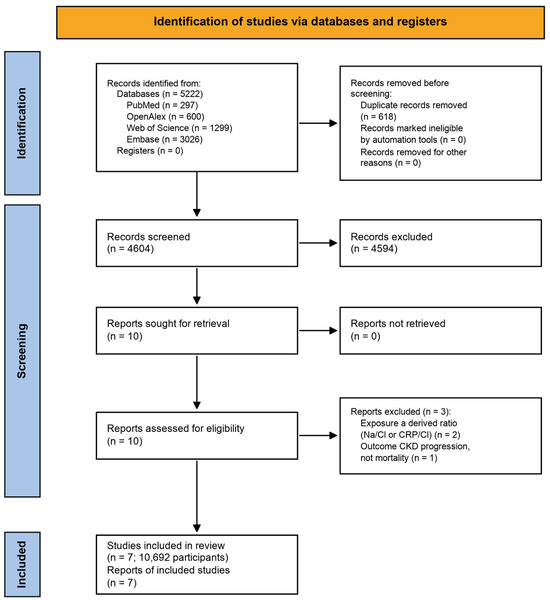
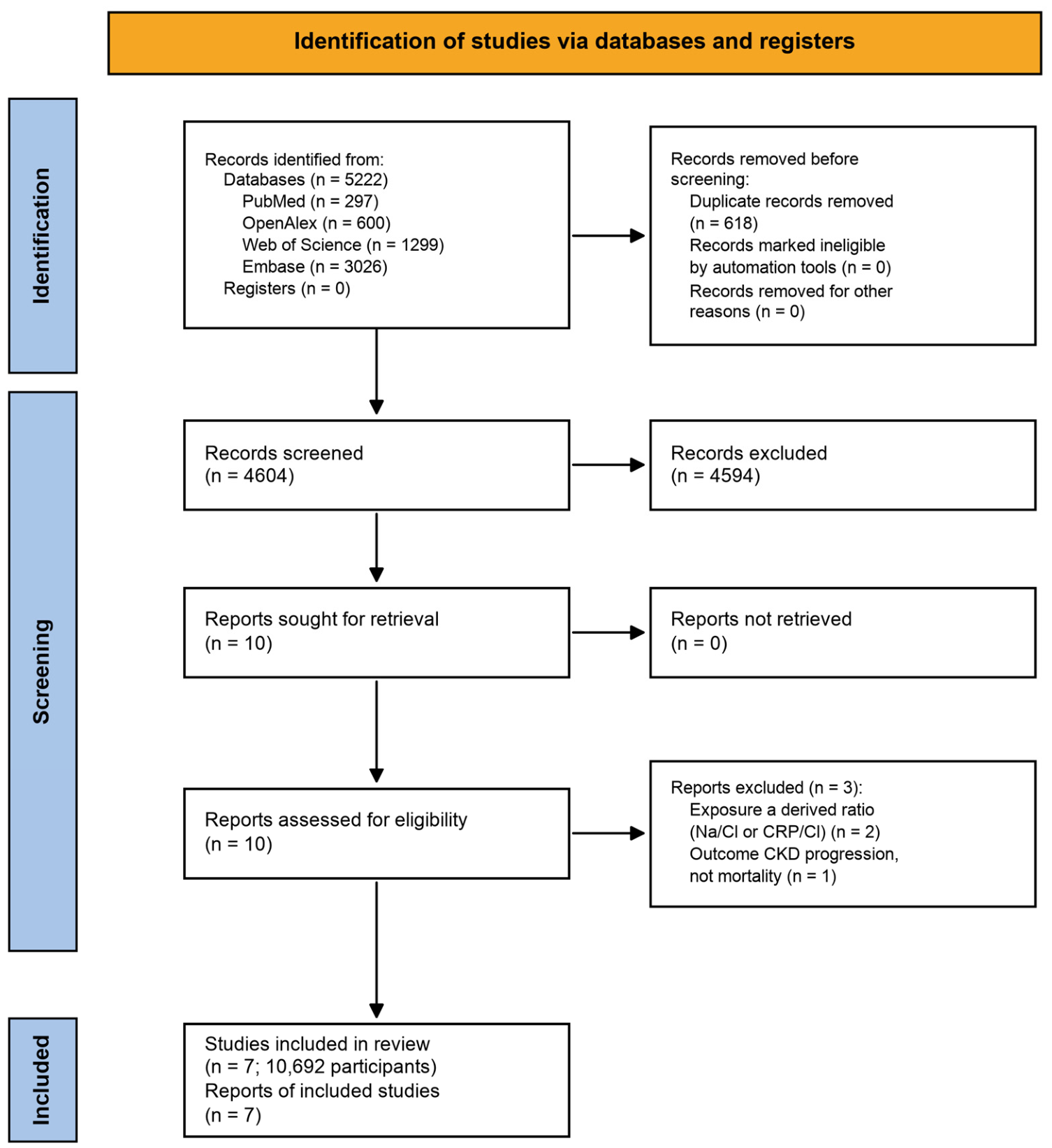
The search returned 5222 records (297 from PubMed, 600 from OpenAlex, 1299 from the Web of Science Core Collection, and 3026 from Embase). After removal of 618 duplicates, 4604 unique records were screened by title and abstract. Ten reports were assessed in their full text, of which three were excluded: two because the exposure was a derived ratio (sodium-to-chloride ratio [20] and C-reactive-protein-to-chloride ratio [21]) rather than the chloride concentration, and one because the only outcome was CKD progression (eGFR decline) rather than mortality [22]. Seven cohort studies met all criteria and were included (Figure 1).
Figure 1.
PRISMA 2020 flow diagram of study identification, screening and inclusion.
3.2. Study Characteristics
The seven studies comprised 10,692 participants and were conducted in Japan (four), China (two) and Spain (one) (Table 1). Two studies were performed with non-dialysis CKD cohorts (CKD-ROUTE, stages G2–G5 [23]; an Osaka cohort with stages G3–G5 [24]), two in maintenance haemodialysis [25,26], and three in peritoneal dialysis [27,28,29]. Follow-up ranged from 20 to 60 months and the number of deaths per study ranged from 66 to 503. Four studies modelled chloride categorically (quartiles or tertiles; lowest versus a reference category); three of these reported all-cause mortality that was direct and one (Kubota 2020 [24]) reported a composite of death and cardiovascular events, and the latter contributed to a sensitivity analysis only. Two haemodialysis studies modelled chloride continuously (per unit or per standard deviation of higher chloride levels), and one peritoneal-dialysis study used the highest chloride quartile as the exposure. Adjustment sets were substantial in all studies and included sodium in most, allowing the chloride signal to be separated from concurrent dysnatraemia.
Table 1.
Characteristics and adjustment sets of the seven included cohort studies.
3.3. Risk of Bias Results
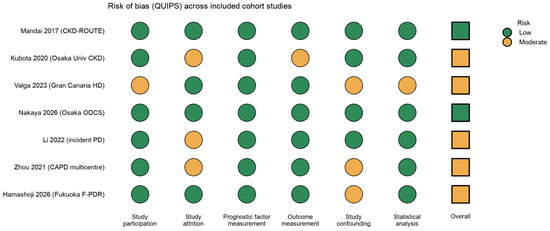
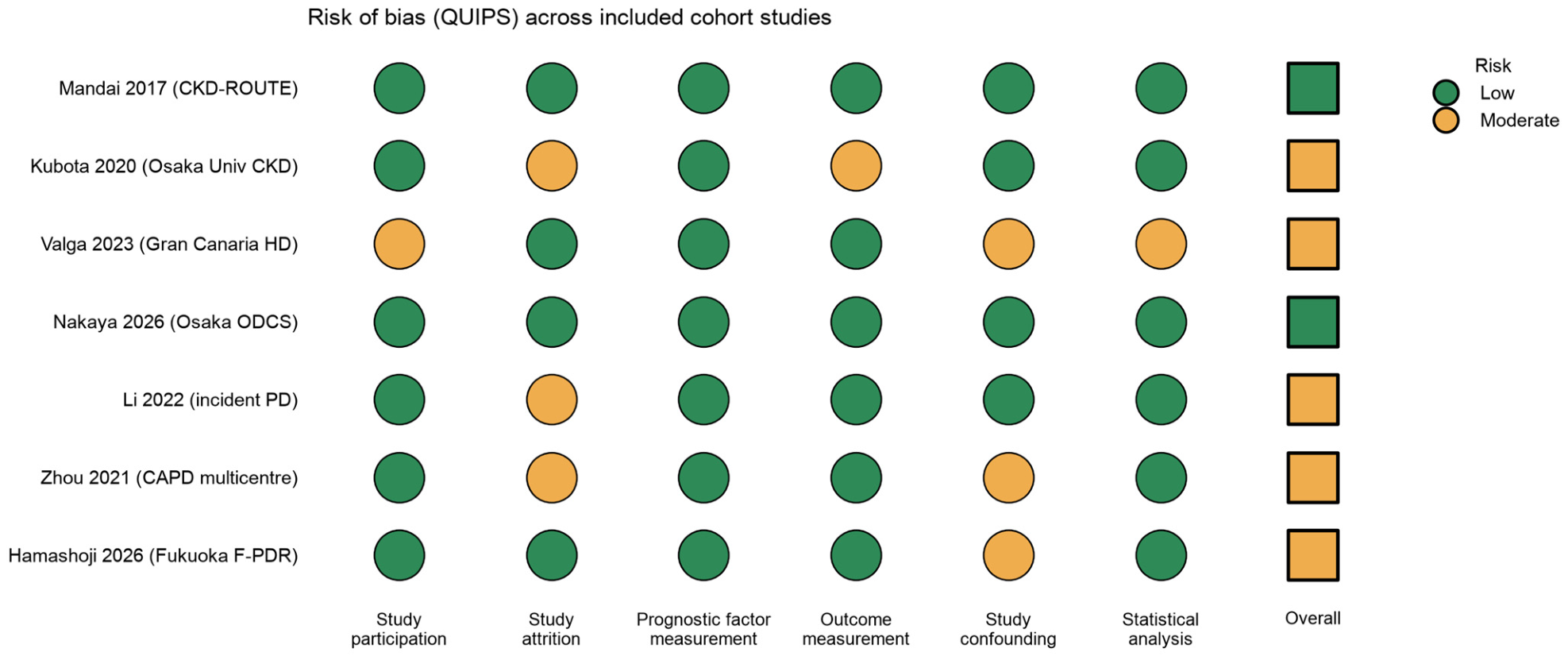
Two studies were rated as having an overall low risk of bias and five as moderate risk (Figure 2). The commonest concerns were the retrospective design of several cohorts, a composite (rather than pure all-cause) outcome in one study [24], a modest sample size and stepwise variable selection in one haemodialysis cohort [25], and residual confounding in the single study reporting the opposite exposure direction [28]. Newcastle–Ottawa scores ranged from six to eight out of nine. No study was excluded on the basis of risk of bias.
Figure 2.
Risk-of-bias summary (QUIPS) across the six prognosis domains and overall judgement for each of the seven included cohort studies [23,24,25,26,27,28,29].
3.4. Hypochloraemia and All-Cause Mortality (Primary Analysis)
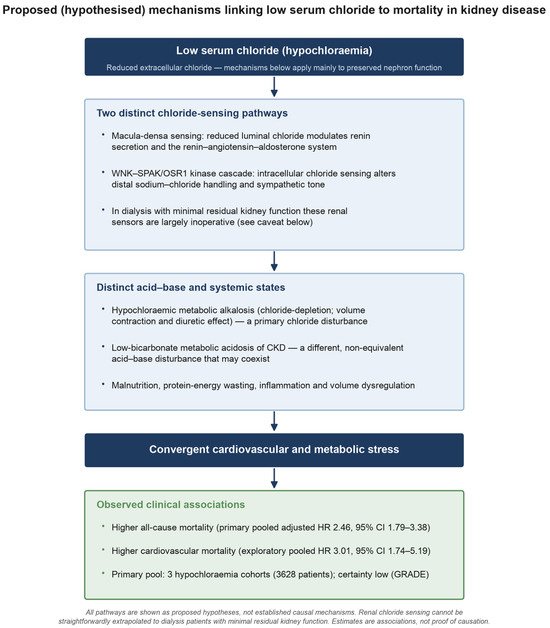
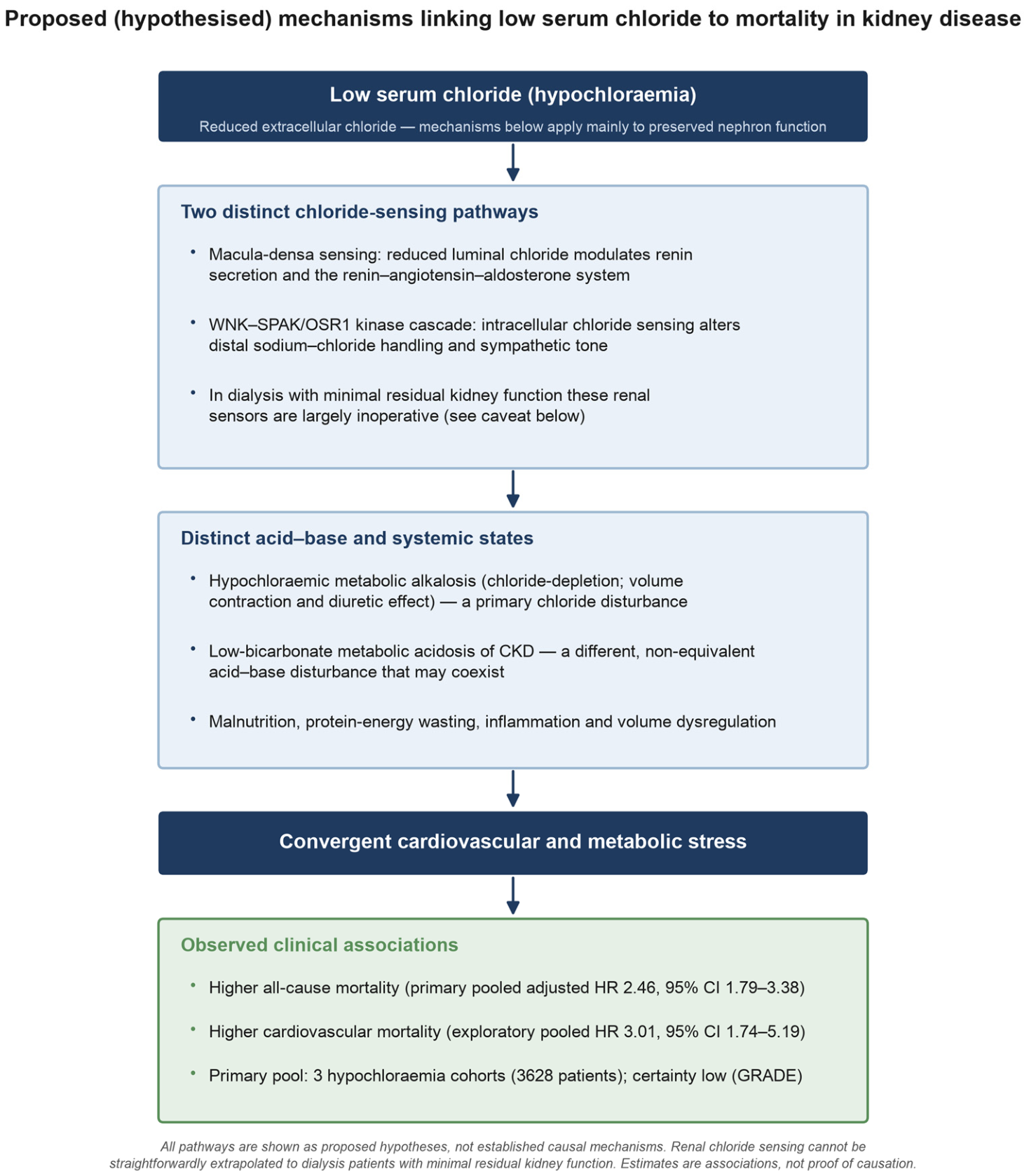
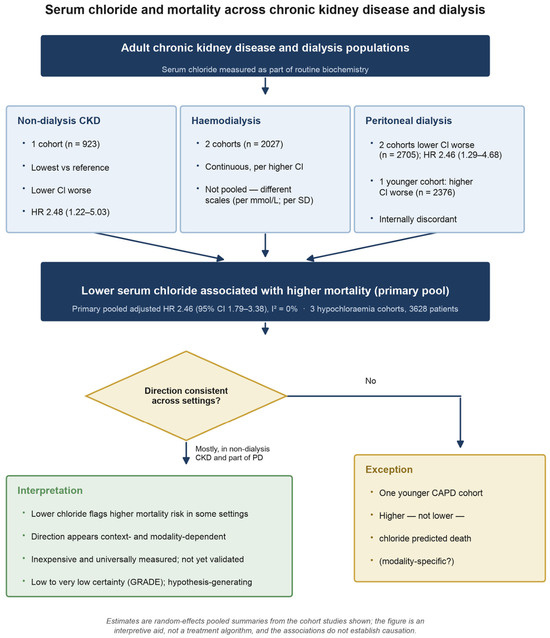
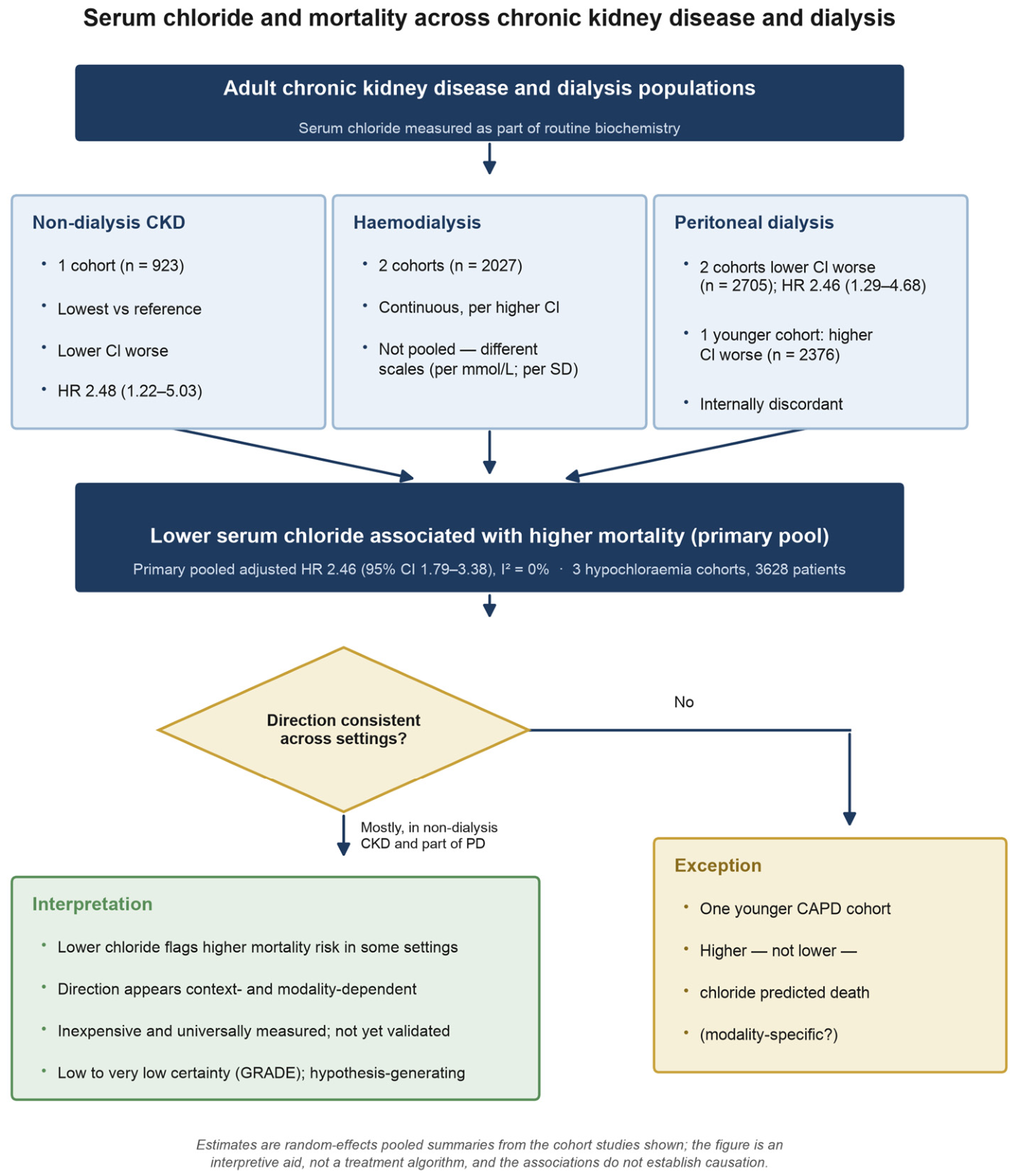
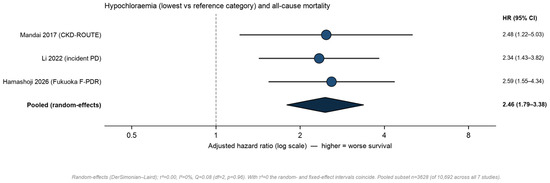
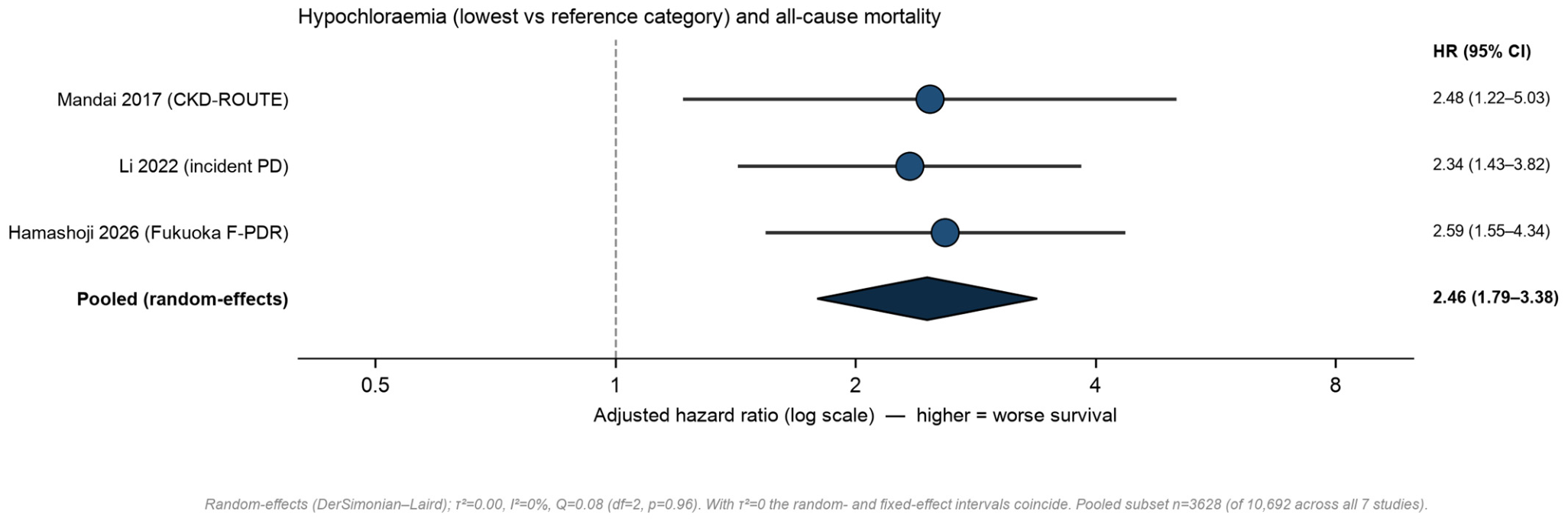
The physiological pathways that plausibly connect low serum chloride to mortality are outlined in Figure 3, and the overall pattern of associations across care settings is summarised in Figure 4. Three studies contrasted the lowest chloride category against a reference category for all-cause mortality, spanning non-dialysis CKD [23], incident peritoneal dialysis [27] and maintenance peritoneal dialysis [29]. The point estimates were closely concordant—HR 2.48 (95% CI 1.22–5.03), 2.34 (1.43–3.82) and 2.59 (1.55–4.34) respectively—and pooled to a multivariable-adjusted HR of 2.46 (95% CI 1.79–3.38) for lower versus reference chloride (DerSimonian–Laird random-effects model; τ2 = 0.000, Q = 0.079, df = 2, p = 0.96, I2 = 0%) (Figure 5). Because τ2 was zero, this random-effects interval coincides with the fixed-effect interval. We originally applied a Hartung–Knapp adjustment, but with only three studies and no observed heterogeneity, its variance factor was below one which inappropriately narrowed the interval; we therefore report the standard random-effects interval and, for sensitivity analyses, a modified Hartung–Knapp interval and a 95% prediction interval (both approximately 1.23–4.94), which are necessarily very wide with three studies and are of limited inferential value. We emphasise that I2 = 0% here reflects only the absence of detectable statistical heterogeneity among three estimates and should not be read as evidence of clinical or physiological homogeneity, given the differing chloride thresholds and case-mix of the contributing cohorts. Adding the Osaka non-dialysis CKD study [24], which used a composite of death and cardiovascular events, as a sensitivity analysis left the estimate essentially unchanged (HR 2.38, 95% CI 1.80–3.14; I2 = 0%), using the same DerSimonian–Laird random-effects model. Leave-one-out analysis confirmed robustness: omitting any single study produced pooled HRs between 2.39 and 2.55, which remained significant.
Figure 3.
Proposed (hypothesised) mechanisms that may link low serum chloride to adverse outcomes in kidney disease. Two distinct chloride-sensing pathways are shown separately: (i) macula-densa sensing of luminal chloride, which modulates renin secretion and the renin–angiotensin–aldosterone system, and (ii) intracellular chloride sensing by the with-no-lysine (WNK)–SPAK/OSR1 kinase cascade in the distal nephron. The figure also distinguishes hypochloraemic metabolic alkalosis (a primary chloride-depletion state) from low-bicarbonate metabolic acidosis of CKD, which are different acid–base disturbances and are not equivalent. These renal chloride-sensing mechanisms operate in the setting of preserved nephron function and cannot be extrapolated in a straightforward manner to patients with minimal or absent residual kidney function on dialysis, in whom chloride is governed largely by dialysate composition, ultrafiltration and nutritional–inflammatory status. All pathways are shown as proposed hypotheses, not established causal mechanisms; the schematic is illustrative and not to scale.
Figure 4.
Graphical summary of the principal findings across the chronic kidney disease–dialysis spectrum, showing the pooled primary estimate across care settings and the single cohort in which the direction was reversed. The full review comprises seven studies (10,692 patients); the primary pooled estimate is drawn from the three categorical hypochloraemia cohorts (3628 patients), while the haemodialysis panel reflects the two continuous-chloride studies.
Figure 5.
Forest plot of the primary analysis: multivariable-adjusted hazard ratios for all-cause mortality comparing the lowest serum chloride category with the reference category, across the three categorical hypochloraemia cohorts [23,27,29]. The pooled estimate is from a DerSimonian–Laird random-effects model (τ2 = 0; the random-effects and fixed-effect intervals therefore coincide).
3.5. Continuous Chloride in Haemodialysis (Narrative Synthesis)
Two maintenance-haemodialysis cohorts modelled chloride as continuous exposure. Both reported that higher chloride was associated with lower all-cause mortality, but on different and incompatible exposure scales: Valga et al. reported an HR of 0.84 per 1 mmol/L higher chloride (95% CI 0.77–0.92) [25], whereas Nakaya et al. reported an HR of 0.82 per 1 standard-deviation higher chloride (95% CI 0.75–0.90) [26]. Because the standard deviation of serum chloride was not reported by Valga et al., these estimates cannot be converted to a common unit, and pooling them would be invalid. We therefore present them narratively rather than as a combined estimate. Both cohorts point in the same direction as the categorical analysis in non-dialysis CKD—that is, lower chloride tracking with higher mortality—but this concordance should be read qualitatively, not as a pooled effect.
3.6. Cardiovascular Mortality
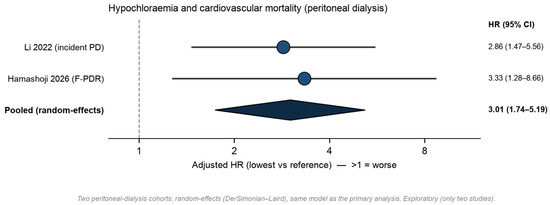
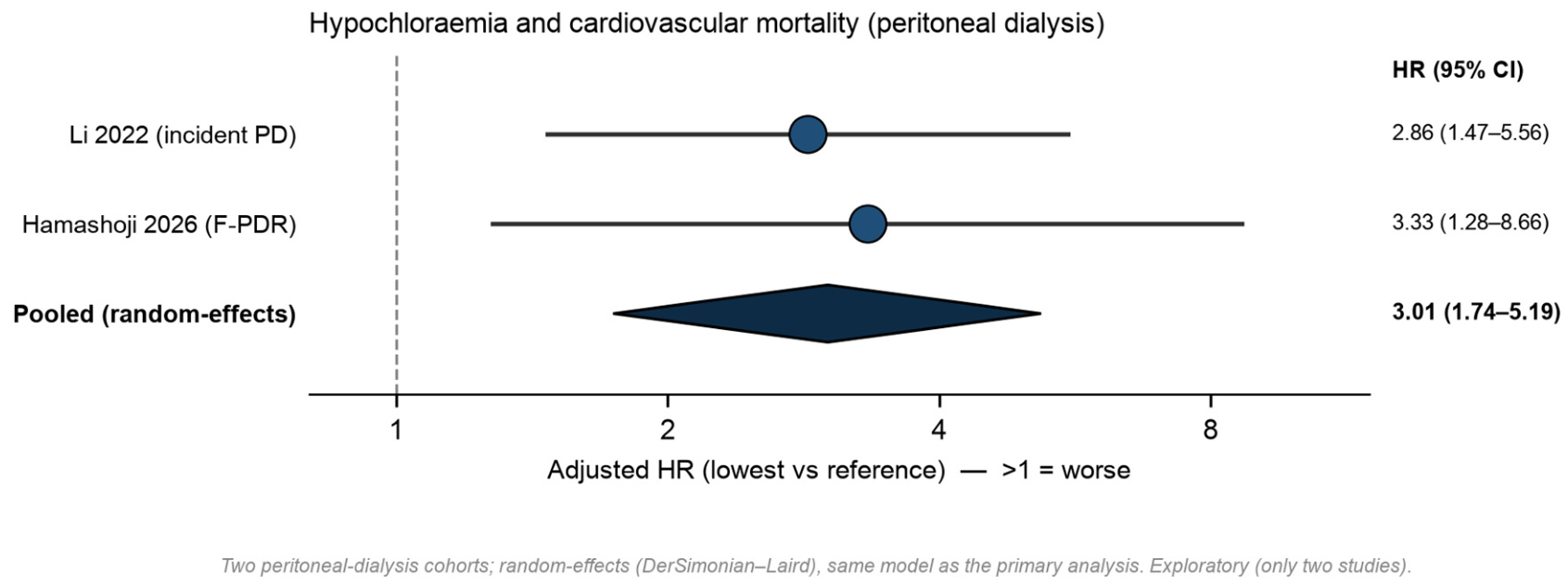
Two peritoneal-dialysis studies reported cardiovascular mortality for the lowest versus reference chloride category [27,29]. Pooled with the same DerSimonian–Laird random-effects model, hypochloraemia was associated with a higher risk of cardiovascular death (adjusted HR 3.01, 95% CI 1.74–5.19; I2 = 0%; Figure 6). With only two studies and few events, this secondary estimate should be regarded as exploratory.
Figure 6.
Forest plot of the secondary analysis: hypochloraemia and cardiovascular mortality in two peritoneal-dialysis cohorts [27,29]. The very wide confidence interval reflects the small number of studies and events, and the estimate is exploratory.
3.7. The Discordant Cohort
One multicentre study of continuous ambulatory peritoneal dialysis reported the opposite direction: the highest chloride quartile (≥107 mmol/L versus the lowest) was associated with higher all-cause mortality (HR 2.03, 95% CI 1.45–2.83) and cardiovascular mortality (HR 2.95, 95% CI 1.80–4.95) [28]. This population was distinctly younger (mean age 46 years) than the others. Because the exposure direction and reference category are opposite to those of the hypochloraemia studies, this cohort was not pooled with them; this is in keeping with the plan to treat hypochloraemia and hyperchloraemia as separate exposures. Rather than a mere “exception,” this cohort may reflect modality-specific peritoneal-dialysis physiology, different acid–base or volume statuses, a distinct dialysis prescription, or a non-linear chloride–mortality relationship; this is discussed below in the peritoneal-dialysis stratum.
3.8. Subgroup and Cumulative Analyses
Because only three categorical studies were available, spread across different care settings, a formal subgroup analysis was not meaningful; the setting-specific estimates are therefore presented descriptively. The single non-dialysis CKD study reported an HR of 2.48 (95% CI 1.22–5.03), and the two peritoneal-dialysis studies gave a descriptive pooled HR of 2.46 (95% CI 1.29–4.68). This is an observation across a small number of heterogeneous cohorts, not evidence of a uniform effect across the CKD–dialysis spectrum. A cumulative meta-analysis ordered by year showed that the pooled estimate was numerically stable since the first study (2.48 in 2017, 2.38 by 2022, 2.46 by 2026). We had intended to examine cohort mean age as a possible moderator of the directional heterogeneity, but mean age was reported in only two of the seven cohorts, so a meta-regression on age was not attempted; the age difference in the discordant cohort is therefore noted descriptively rather than modelled.
3.9. Publication Bias and Certainty
With only three studies on a common categorical scale, formal small-study or funnel-plot tests (including Egger’s regression) are uninformative and were not performed, in line with Cochrane guidance that such tests require at least ten studies. We therefore assessed reporting bias narratively. Because grey literature could not be fully searched and few small negative studies of this specific question are likely to have been published, small-study and publication bias cannot be excluded.
Applying the GRADE approach for prognostic-factor reviews, the body of evidence began at high certainty (cohort studies) and was rated down by two levels to low for the primary hypochloraemia–all-cause mortality outcome: one level for imprecision (only three studies included, and a confidence interval and prediction interval that remain wide) and one level for indirectness (differing chloride thresholds and case-mix across non-dialysis CKD and peritoneal dialysis). Risk of bias, inconsistency (I2 = 0%) and publication bias were each judged not serious enough to warrant a further full downgrade, although suspected publication bias was recorded as a concern within this low rating rather than as an additional level. For cardiovascular mortality, the evidence was rated down by three levels to very low (imprecision from only two studies and a few events, indirectness, and suspected publication bias). The pooled estimates and their GRADE certainty ratings are summarised in Table 2.
Table 2.
Summary of pooled findings and GRADE certainty of evidence.
4. Discussion
In this first systematic review of serum chloride as a prognostic marker in kidney disease, the relationship between chloride and mortality differed by kidney-function stratum, and we therefore interpret it separately in three settings. In non-dialysis CKD, the single categorical cohort showed a multivariable-adjusted association between lower chloride and higher all-cause mortality (HR 2.48). In peritoneal dialysis, two categorical cohorts likewise associated lower chloride with higher mortality, while a third, younger CAPD cohort showed the opposite direction (higher chloride predicting death), so the PD evidence is internally discordant. In haemodialysis, two cohorts modelling chloride continuously each associated lower chloride with higher mortality, but on incompatible exposure scales that precluded pooling. The pooled primary estimate (HR 2.46, 95% CI 1.79–3.38) should therefore be read as an association concentrated in non-dialysis CKD and part of the PD evidence, not as a uniform effect “across the CKD–dialysis spectrum.” Determinants of serum chloride differ substantially among these settings—residual renal handling, acid–base balance, diuretics and volume in non-dialysis CKD; intermittent fluid and electrolyte shifts, dialysate composition and interdialytic weight gain in haemodialysis; and continuous dialysate exposure, ultrafiltration and buffer composition in peritoneal dialysis—so similar numerical associations need not reflect a common chloride–mortality pathway. This prognostic signal parallels the weight now attributed to dysnatraemia in dialysis, where hyponatraemia predicts mortality in both cohort studies and meta-analysis [30,31].
These results align with findings already reported in cardiovascular medicine. Lower serum chloride predicts death in heart failure, where it has outperformed sodium as a prognostic marker; the association survives adjustment for diuretic dose and kidney function; and chloride is increasingly viewed as central to diuretic response [5,6,32,33]. Several mechanisms link low chloride to poor outcomes and are shared across these conditions (Figure 3). Chloride is integral to the tubuloglomerular feedback sensed at the macula densa and to WNK-kinase-dependent distal sodium transport; hypochloraemia activates this pathway and is linked to neurohormonal activation and diuretic resistance [4]. Low serum chloride also commonly reflects metabolic alkalosis or contraction from aggressive diuresis [34], which are states that carry their own risk. In kidney disease specifically, chloride is entangled with metabolic acidosis [35], nutritional status [36,37] and volume control, so a low chloride level may mark several adverse processes at once. Low serum bicarbonate, which frequently accompanies these disturbances, is itself an established predictor of death in CKD [38,39]. Whether chloride contributes causally to mortality or simply reflects underlying disease severity, acid–base disturbance, malnutrition or volume dysregulation cannot be resolved by observational, aggregate-level data. Importantly, these mechanisms are best evidenced in settings with preserved nephron function; in patients with minimal or absent residual kidney function on dialysis, renal chloride sensing is largely inoperative, and any prognostic association is more likely to reflect dialysis-related physiology and comorbidity than the pathways in Figure 3.
The cohort that ran counter to the others has a bearing on interpretation. In a younger continuous-ambulatory-peritoneal-dialysis population (mean age 46 years), higher chloride levels predicted death [28]. Hyperchloraemia in dialysis may signal a different physiology—metabolic acidosis from acid retention, dietary or dialysate chloride load, or inflammation [40]—and its consequences may differ by age, comorbidity and modality. This directional heterogeneity is the strongest argument against premature clinical use of chloride for risk stratification: the prognostic meaning of a given chloride value is likely to be context-dependent, and a single threshold applied across the CKD–dialysis spectrum would be misleading. It also points to a research priority—characterising the chloride–mortality relationship by age and modality, ideally with individual-participant data able to model non-linear (U- or J-shaped) associations that aggregate data cannot.
The clinical appeal of chloride is its cost and ubiquity. Chloride is reported on every basic metabolic panel at no additional charge, requires no new assay, and is already in the electronic record of essentially every patient with kidney disease. If its prognostic value is confirmed, it could be incorporated into existing risk models at negligible marginal cost, which few candidate biomarkers allow. The present evidence does not yet support that step, but it is strong enough to justify the studies needed to confirm it.
Strengths and Limitations
The main strengths are the separate handling of hypochloraemia and hyperchloraemia as opposite exposures, the use of only multivariable-adjusted estimates, a prognosis-specific risk-of-bias tool (QUIPS) alongside the Newcastle–Ottawa Scale, and the GRADE certainty framework. Every extracted estimate and its source are reported in full within the article, and the complete database-specific search strategies are provided in the Appendix B and Appendix C.
Several limitations temper the conclusions, and we have deliberately widened rather than narrowed our claims in response to them. First, screening, full-text assessment, data extraction, risk-of-bias scoring and GRADE rating were performed by one reviewer and independently verified by a second, rather than by two fully independent, blinded reviewers working in parallel; this may increase the risk of selection or extraction error. Second, only three studies contributed to the primary pool: the summary interval is correspondingly imprecise (and a prediction interval spanning roughly 1.23–4.94 illustrates how little can be said with confidence about a future cohort); an I2 of 0% indicates only the absence of detectable statistical heterogeneity and not clinical homogeneity; and no formal small-study or funnel-plot testing was justified. Third, the categorical contrasts used differing chloride cut-off points and populations heterogeneous in stage and modality, producing indirectness; the two continuous haemodialysis cohorts could not be pooled because their exposure scales (per 1 mmol/L versus per 1 SD) were incompatible. Fourth, all included studies are observational, and adjustment for the correlated exposures that travel with chloride—sodium, bicarbonate, volume status, diuretic use, nutritional status and inflammation—was inconsistent across cohorts; most accounted for sodium and kidney function, fewer for bicarbonate, and fewer still for nutrition or inflammation, so residual and unmeasured confounding cannot be excluded and causality cannot be inferred. Fifth, and critically, none of the included studies evaluated the discrimination (e.g., c-statistic), calibration, or incremental predictive value of serum chloride over established risk factors; the evidence therefore concerns association, not validated prognostic performance, and serum chloride cannot yet be recommended as a risk-stratification tool. Sixth, the search covered four bibliographic databases (PubMed, OpenAlex, the Web of Science Core Collection and Embase) and the ClinicalTrials.gov registry but did not separately interrogate dedicated grey-literature sources, so publication and small-study bias cannot be excluded. Finally, the geographic concentration in East Asia and Spain limits generalisability, and few studies modelled chloride flexibly enough to detect the non-linear (U- or J-shaped) relationship that the discordant cohort suggests may exist.
5. Conclusions
Serum chloride appears to carry prognostic information in chronic kidney disease, but the direction and magnitude of its association with mortality depend on kidney function, dialysis modality, acid–base status, volume status and treatment-related factors, and its biological meaning appears to be context- and modality-dependent. In non-dialysis CKD and in part of the peritoneal-dialysis evidence, lower chloride showed a multivariable-adjusted association with a two- to three-fold higher risk of death; in a younger CAPD cohort, the association was reversed. Chloride is a marker rather than a demonstrated causal determinant: causality remains unproven, and no included study evaluated its discrimination, calibration or incremental predictive value. Serum chloride is nonetheless inexpensive, universally measured and currently overlooked in kidney risk assessment, and the coherence of the hypochloraemia signal in non-dialysis CKD justifies dedicated prospective and individual-participant studies—particularly ones that model chloride non-linearly and separately by dialysis modality and age, and that formally assess predictive performance—before any clinical use for risk stratification.
Author Contributions
Conceptualization, K.A.A. and M.A.; methodology, K.A.A. and M.A.; formal analysis, K.A.A. and M.A.; data curation, K.A.A., M.A., A.J.A., M.A.A. and M.M.A.; investigation (study screening and data extraction), K.A.A., M.A., A.J.A., M.A.A. and M.M.A.; writing—original draft preparation, K.A.A. and M.A.; writing—review and editing, K.A.A., M.A., A.J.A., M.A.A. and M.M.A.; supervision, K.A.A. and M.A. All authors have read and agreed to the published version of the manuscript.
Funding
This research received no external funding.
Institutional Review Board Statement
Not applicable. This study is a synthesis of previously published aggregate data and did not involve new research on humans or animals.
Informed Consent Statement
Not applicable.
Data Availability Statement
This study is a synthesis of previously published aggregate data; all data supporting the findings, including every extracted effect estimate and its source, are presented within the article, its tables and figures, and the appendices. The complete database-specific search strategies (Appendix B) and full risk-of-bias assessments (Appendix C) are included. No individual-participant data were used. Additional details are available from the corresponding author on reasonable request.
Acknowledgments
During the preparation of this manuscript, the authors used AI-assisted tools (Claude, Anthropic) solely to support the design and visual refinement of the schematic educational illustrations presented in Figure 3 and Figure 4. The authors also used Grammarly (Grammarly Inc.) to assist with language and grammar checking of the manuscript text. All clinical information, data, and interpretations are the authors’ own; the authors have reviewed and edited all output and take full responsibility for the content of this publication.
Conflicts of Interest
The authors declare no conflicts of interest.
Appendix A
Table A1.
PRISMA 2020 checklist. Section numbers refer to the corresponding location in this manuscript; partial or non-applicable items are annotated.
Appendix B
- Full database-specific search strategies.
All databases were searched from inception to 13 July 2026 using the same three-concept structure: Block A (chloride exposure) AND Block B (CKD/dialysis population) AND Block C (mortality/prognosis outcome), with title-only NOT terms excluding intravenous-fluid/resuscitation studies. Records were exported, merged and de-duplicated by DOI → PubMed identifier → normalised title. Hits: PubMed 297; OpenAlex 600; Web of Science Core Collection 1299; Embase 3026 (total 5222; 618 duplicates removed; 4604 screened).
Appendix B.1. PubMed/MEDLINE (Searched 13 July 2026; 297 Records)
(chloride[tiab] OR hypochlor*[tiab] OR hyperchlor*[tiab] OR dyschlor*[tiab]) AND (“chronic kidney disease”[tiab] OR CKD[tiab] OR “end-stage renal”[tiab] OR “end-stage kidney”[tiab] OR ESRD[tiab] OR ESKD[tiab] OR dialysis[tiab] OR hemodialysis[tiab] OR haemodialysis[tiab] OR “peritoneal dialysis”[tiab] OR uremi*[tiab] OR uraemi*[tiab]) AND (mortalit*[tiab] OR survival[tiab] OR death[tiab] OR prognos*[tiab] OR outcome*[tiab]) NOT (saline[ti] OR crystalloid*[ti] OR resuscitat*[ti] OR “fluid therapy”[ti]) NOT (editorial[pt] OR comment[pt] OR “case reports”[pt])
Appendix B.2. OpenAlex (Searched 13 July 2026; 600 Records)
The same three concept blocks (chloride OR hypochlor* OR hyperchlor* OR dyschlor*) AND (chronic kidney disease OR CKD OR ESRD OR ESKD OR dialysis OR haemodialysis OR peritoneal dialysis OR uraemia) AND (mortality OR survival OR death OR prognosis OR outcome) were retrieved via the OpenAlex API and filtered to journal articles.
Appendix B.3. Web of Science Core Collection (Topic Search; Searched 13 July 2026; 1299 Records)
TS = ((chloride OR hypochlor* OR hyperchlor* OR dyschlor*) AND (“chronic kidney disease” OR CKD OR “end-stage renal” OR “end-stage kidney” OR ESRD OR ESKD OR dialysis OR hemodialysis OR haemodialysis OR “peritoneal dialysis” OR uremi* OR uraemi*) AND (mortalit* OR survival OR death OR prognos* OR outcome*)) NOT TI = (saline OR crystalloid* OR resuscitat* OR “fluid therapy”). Refined to Document Type: Article.
Appendix B.4. Embase (Embase.com Advanced; Searched 13 July 2026; 3026 Records)
(‘chloride’/exp OR chloride:ti,ab,kw OR hypochlor*:ti,ab,kw OR hyperchlor*:ti,ab,kw OR dyschlor*:ti,ab,kw) AND (‘chronic kidney failure’/exp OR ‘hemodialysis’/exp OR ‘peritoneal dialysis’/exp OR ‘chronic kidney disease’:ti,ab,kw OR ckd:ti,ab,kw OR ‘end-stage renal’:ti,ab,kw OR esrd:ti,ab,kw OR eskd:ti,ab,kw OR dialysis:ti,ab,kw OR hemodialysis:ti,ab,kw OR haemodialysis:ti,ab,kw OR ‘peritoneal dialysis’:ti,ab,kw OR uremi*:ti,ab,kw OR uraemi*:ti,ab,kw) AND (mortalit*:ti,ab,kw OR survival:ti,ab,kw OR death:ti,ab,kw OR prognos*:ti,ab,kw OR outcome*:ti,ab,kw) NOT (saline:ti OR crystalloid*:ti OR resuscitat*:ti OR ‘fluid therapy’:ti)
Appendix B.5. Trial Registry (Searched 13 July 2026)
ClinicalTrials.gov was searched with “chloride” AND (“chronic kidney disease” OR dialysis) AND (mortality OR survival OR outcome). The registry search identified no eligible cohort study with serum chloride as a prognostic marker of mortality in CKD or dialysis.
Appendix C
Table A2.
Study-level risk-of-bias assessment: QUIPS domain judgements, Newcastle–Ottawa Scale (NOS) stars, overall rating, and rationale.
References
- Oppermann, M.; Mizel, D.; Huang, G.; Li, C.; Deng, C.; Theilig, F.; Bachmann, S.; Briggs, J.; Schnermann, J.; Castrop, H. Macula densa control of renin secretion and preglomerular resistance in mice with selective deletion of the B isoform of the Na,K,2Cl co-transporter. J. Am. Soc. Nephrol. 2006, 17, 2143–2152. [Google Scholar] [CrossRef] [Scilit]
- Murillo-de-Ozores, A.R.; Chávez-Canales, M.; de Los Heros, P.; Gamba, G.; Castañeda-Bueno, M. Physiological Processes Modulated by the Chloride-Sensitive WNK-SPAK/OSR1 Kinase Signaling Pathway and the Cation-Coupled Chloride Cotransporters. Front. Physiol. 2020, 11, 585907. [Google Scholar] [CrossRef] [Scilit] [PubMed]
- Chen, J.C.; Lin, M.X.; Cheng, C.J. WNK4 kinase: Role of chloride sensing in the distal convoluted tubule. Curr. Opin. Nephrol. Hypertens. 2021, 30, 166–172. [Google Scholar] [CrossRef] [Scilit] [PubMed]
- Berend, K.; van Hulsteijn, L.H.; Gans, R.O. Chloride: The Queen of Electrolytes? Eur. J. Intern. Med. 2012, 23, 203–211. [Google Scholar] [CrossRef] [Scilit] [PubMed]
- Mazón-Ruiz, J.; Banegas-Deras, E.J.; Fernández-Rodríguez, J.M.; Domingo, M.; de la Espriella, R.; Llàcer, P.; Cobo-Marcos, M.; Trullàs, J.C.; Biegus, J.; Bayés-Genís, A.; et al. The chloride paradigm shift in heart failure: From neglected ion to keystone of precision diuretic therapy. Eur. J. Heart Fail. 2025, 27, 3084–3095. [Google Scholar] [CrossRef] [Scilit] [PubMed]
- Tran, D.H.; Truyen, T.T.T.T.; Pham, V.N.A.; Nhut Do, C.M.; Vo, P.D.; Phan, T.C.; Le, H.M.N.; Tran, H.N.T.; Luu, B.M.T.; Nguyen, T.H.D.; et al. Hypochloraemia independently associates with short-term mortality in patients with acute heart failure: A study from Vietnam. Open Heart 2026, 13, e003635. [Google Scholar] [CrossRef] [Scilit] [PubMed]
- Bellino, M.C.; Massari, F.; Albanese, M.; Ursi, R.; Angelini, G.; Lisi, F.; Amato, L.; Scicchitano, P.; Guida, P.; Brunetti, N.D.; et al. Baseline and incident hypochloremia in chronic heart failure outpatients: Clinical correlates and prognostic role. Eur. J. Intern. Med. 2021, 84, 32–37. [Google Scholar] [CrossRef] [Scilit] [PubMed]
- Misumi, K.; Matsue, Y.; Nogi, K.; Sunayama, T.; Dotare, T.; Maeda, D.; Kagiyama, N.; Kasai, T.; Kitai, T.; Oishi, S.; et al. Usefulness of Incorporating Hypochloremia into the Get With The Guidelines-Heart Failure Risk Model in Patients With Acute Heart Failure. Am. J. Cardiol. 2022, 162, 122–128. [Google Scholar] [CrossRef] [Scilit] [PubMed]
- Stankowski, K.; Villaschi, A.; Tartaglia, F.; Figliozzi, S.; Pini, D.; Chiarito, M.; Stefanini, G.; Cannata, F.; Condorelli, G. Prognostic value of hypochloremia on mortality in patients with heart failure: A systematic review and meta-analysis. J. Cardiovasc. Med. 2024, 25, 499–510. [Google Scholar] [CrossRef] [Scilit] [PubMed]
- Van den Eynde, J.; Martens, P.; Dauw, J.; Nijst, P.; Meekers, E.; Ter Maaten, J.M.; Damman, K.; Filippatos, G.; Lassus, J.; Mebazaa, A.; et al. Serum Chloride and the Response to Acetazolamide in Patients with Acute Heart Failure and Volume Overload: A Post Hoc Analysis From the ADVOR Trial. Circ. Heart Fail. 2024, 17, e011749. [Google Scholar] [CrossRef] [Scilit] [PubMed]
- Hou, X.; Xu, W.; Zhang, C.; Song, Z.; Zhu, M.; Guo, Q.; Wang, J. L-Shaped Association of Serum Chloride Level With All-Cause and Cause-Specific Mortality in American Adults: Population-Based Prospective Cohort Study. JMIR Public Health Surveill. 2023, 9, e49291. [Google Scholar] [CrossRef] [Scilit] [PubMed]
- He, X.; Liu, C.; Chen, Y.; He, J.; Dong, Y. Risk of Cardiovascular Mortality Associated With Serum Sodium and Chloride in the General Population. Can. J. Cardiol. 2018, 34, 999–1003. [Google Scholar] [CrossRef] [Scilit] [PubMed]
- Bandak, G.; Kashani, K.B. Chloride in intensive care units: A key electrolyte. F1000Research 2017, 6, 1930. [Google Scholar] [CrossRef] [Scilit] [PubMed]
- Shao, M.; Li, G.; Sarvottam, K.; Wang, S.; Thongprayoon, C.; Dong, Y.; Gajic, O.; Kashani, K. Dyschloremia Is a Risk Factor for the Development of Acute Kidney Injury in Critically Ill Patients. PLoS ONE 2016, 11, e0160322. [Google Scholar] [CrossRef] [Scilit] [PubMed]
- Page, M.J.; McKenzie, J.E.; Bossuyt, P.M.; Boutron, I.; Hoffmann, T.C.; Mulrow, C.D.; Shamseer, L.; Tetzlaff, J.M.; Akl, E.A.; Brennan, S.E.; et al. The PRISMA 2020 Statement: An Updated Guideline for Reporting Systematic Reviews. BMJ 2021, 372, n71. [Google Scholar] [CrossRef] [Scilit] [PubMed]
- Higgins, J.P.T.; Thomas, J.; Chandler, J.; Cumpston, M.; Li, T.; Page, M.J.; Welch, V.A. (Eds.) Cochrane Handbook for Systematic Reviews of Interventions, version 6.4; Cochrane: London, UK, 2023.
- Hayden, J.A.; van der Windt, D.A.; Cartwright, J.L.; Côté, P.; Bombardier, C. Assessing Bias in Studies of Prognostic Factors. Ann. Intern. Med. 2013, 158, 280–286. [Google Scholar] [CrossRef] [Scilit] [PubMed]
- Stang, A. Critical evaluation of the Newcastle-Ottawa scale for the assessment of the quality of nonrandomized studies in meta-analyses. Eur. J. Epidemiol. 2010, 25, 603–605. [Google Scholar] [CrossRef] [Scilit] [PubMed]
- Foroutan, F.; Guyatt, G.; Zuk, V.; Vandvik, P.O.; Alba, A.C.; Mustafa, R.; Vernooij, R.; Arevalo-Rodriguez, I.; Munn, Z.; Roshanov, P.; et al. GRADE Guidelines 28: Use of GRADE for the assessment of evidence about prognostic factors: Rating certainty in identification of groups of patients with different absolute risks. J. Clin. Epidemiol. 2020, 121, 62–70. [Google Scholar] [CrossRef] [Scilit] [PubMed]
- You, J.; Gu, S.; Su, N.; Feng, X.; Peng, F.; Xu, Q.; Zhan, X.; Wen, Y.; Wang, X.; Tian, N.; et al. Serum Sodium to Chloride Ratio and Mortality on Continuous Ambulatory Peritoneal Dialysis: A Multicentre Retrospective Study. MedComm 2025, 6, e70041. [Google Scholar] [CrossRef] [Scilit] [PubMed]
- Valga, F.; Monzón, T.; De la Flor, J.C.; Santana-Del-Pino, A.; Vega-Díaz, N.; Sanchez-Santana, A.Y.; Antón-Pérez, G.; Ruiz-Santana, S.; Rodríguez-Pérez, J.C.; Perez-Borges, P. C-Reactive Protein-to-Serum Chloride Ratio: A Novel Marker of All-Cause Mortality in Maintenance Haemodialysis Patients. Medicina 2024, 60, 1765. [Google Scholar] [CrossRef] [Scilit] [PubMed]
- Khatri, M.; Zitovsky, J.; Lee, D.; Nayyar, K.; Fazzari, M.; Grant, C. The Association between Serum Chloride Levels and Chronic Kidney Disease Progression: A Cohort Study. BMC Nephrol. 2020, 21, 165. [Google Scholar] [CrossRef] [Scilit] [PubMed]
- Mandai, S.; Kanda, E.; Iimori, S.; Naito, S.; Noda, Y.; Kikuchi, H.; Akazawa, M.; Oi, K.; Toda, T.; Sohara, E.; et al. Association of Serum Chloride Level with Mortality and Cardiovascular Events in Chronic Kidney Disease: The CKD-ROUTE Study. Clin. Exp. Nephrol. 2017, 21, 104–111. [Google Scholar] [CrossRef] [Scilit] [PubMed]
- Kubota, K.; Sakaguchi, Y.; Hamano, T.; Oka, T.; Yamaguchi, S.; Shimada, K.; Matsumoto, A.; Hashimoto, N.; Mori, D.; Matsui, I.; et al. Prognostic Value of Hypochloremia versus Hyponatremia among Patients with Chronic Kidney Disease—A Retrospective Cohort Study. Nephrol. Dial. Transplant. 2020, 35, 987–994. [Google Scholar] [CrossRef] [Scilit] [PubMed]
- Valga, F.; Monzon, T.; Vega-Diaz, N.; Santana, A.; Moscol, G.; Ruiz-Santana, S.; Rodriguez-Perez, J.C. Serum Chloride as a Marker of Cardiovascular and All-Cause Mortality in Chronic Hemodialysis Patients: 5-Year Follow-Up Study. Nefrologia (Engl. Ed.) 2023, 43, 47–56. [Google Scholar] [CrossRef] [Scilit] [PubMed]
- Nakaya, R.; Shoji, T.; Nakatani, S.; Nagata, Y.; Fujii, H.; Kurajoh, M.; Imanishi, Y.; Emoto, M.; Morioka, T. Association between Serum Chloride and Mortality in Patients on Maintenance Hemodialysis: The Osaka Dialysis Complication Study (ODCS). Clin. Exp. Nephrol. 2026, 30, 923–935. [Google Scholar] [CrossRef] [Scilit] [PubMed]
- Li, H.; Wang, Y.; Xu, Y.; Wu, K.; Lu, X.; Qiu, Y.; Yang, X.; Liu, Q.; Mao, H. Association between Serum Chloride Levels with Mortality in Incident Peritoneal Dialysis Patients. Nutr. Metab. Cardiovasc. Dis. 2022, 32, 624–631. [Google Scholar] [CrossRef] [Scilit] [PubMed]
- Zhou, L.; Wang, X.; Zhan, X.; Feng, X.; Wang, N.; Peng, F.; Wen, Y.; Wu, X. Serum Chloride and Mortality in Patients on Continuous Ambulatory Peritoneal Dialysis: A Multicentre Retrospective Study. eClinicalMedicine 2021, 41, 101133. [Google Scholar] [CrossRef] [Scilit] [PubMed]
- Hamashoji, T.; Tsuneyoshi, S.; Okamura, K.; Yamada, S.; Tsuruya, K.; Nakano, T.; Ago, T. Association of Serum Chloride Concentration with All-Cause and Cardiovascular Mortality in Patients Undergoing Peritoneal Dialysis: The Fukuoka Peritoneal Dialysis Registry. Kidney Med. 2026, 8, 101441. [Google Scholar] [CrossRef] [Scilit] [PubMed]
- Li, J.; Song, P.; Yang, D.; Liu, Y. A Systematic Review and Meta-Analysis: Hyponatremia Predicted All-Cause and Cardiovascular Mortality in Dialysis Population. Blood Purif. 2022, 51, 345–354. [Google Scholar] [CrossRef] [Scilit] [PubMed]
- Rhee, C.M.; Ayus, J.C.; Kalantar-Zadeh, K. Hyponatremia in the Dialysis Population. Kidney Int. Rep. 2019, 4, 769–780. [Google Scholar] [CrossRef] [Scilit] [PubMed]
- Arora, N. Serum Chloride and Heart Failure. Kidney Med. 2023, 5, 100614. [Google Scholar] [CrossRef] [Scilit] [PubMed]
- Nozaki, Y.; Yoshihisa, A.; Sato, Y.; Ohara, H.; Sugawara, Y.; Abe, S.; Misaka, T.; Sato, T.; Oikawa, M.; Kobayashi, A.; et al. Persistent Hypochloremia Is Associated with Adverse Prognosis in Patients Repeatedly Hospitalized for Heart Failure. J. Clin. Med. 2023, 12, 1257. [Google Scholar] [CrossRef] [Scilit] [PubMed]
- Emmett, M. Metabolic Alkalosis: A Brief Pathophysiologic Review. Clin. J. Am. Soc. Nephrol. 2020, 15, 1848–1856. [Google Scholar] [CrossRef] [Scilit] [PubMed]
- Kraut, J.A.; Madias, N.E. Adverse Effects of the Metabolic Acidosis of Chronic Kidney Disease. Adv. Chronic Kidney Dis. 2017, 24, 289–297. [Google Scholar] [CrossRef] [Scilit] [PubMed]
- Bonanni, A.; Mannucci, I.; Verzola, D.; Sofia, A.; Saffioti, S.; Gianetta, E.; Garibotto, G. Protein-energy wasting and mortality in chronic kidney disease. Int. J. Environ. Res. Public Health 2011, 8, 1631–1654. [Google Scholar] [CrossRef] [Scilit] [PubMed]
- Graterol Torres, F.; Molina, M.; Soler-Majoral, J.; Romero-González, G.; Rodríguez Chitiva, N.; Troya-Saborido, M.; Socias Rullan, G.; Burgos, E.; Paúl Martínez, J.; Urrutia Jou, M.; et al. Evolving Concepts on Inflammatory Biomarkers and Malnutrition in Chronic Kidney Disease. Nutrients 2022, 14, 4297. [Google Scholar] [CrossRef] [Scilit] [PubMed]
- Navaneethan, S.D.; Schold, J.D.; Arrigain, S.; Jolly, S.E.; Wehbe, E.; Raina, R.; Simon, J.F.; Srinivas, T.R.; Jain, A.; Schreiber, M.J., Jr.; et al. Serum bicarbonate and mortality in stage 3 and stage 4 chronic kidney disease. Clin. J. Am. Soc. Nephrol. 2011, 6, 2395–2402. [Google Scholar] [CrossRef] [Scilit] [PubMed]
- Lombardi, G.; Chesnaye, N.C.; Caskey, F.J.; Dekker, F.W.; Evans, M.; Heimburger, O.; Pippias, M.; Torino, C.; Szymczak, M.; Drechsler, C.; et al. Longitudinal serum bicarbonate and mortality risk in older patients with advanced chronic kidney disease: Analyses from the EQUAL cohort. Clin. Kidney J. 2024, 17, sfae254. [Google Scholar] [CrossRef] [Scilit] [PubMed]
- Nagami, G.T. Hyperchloremia—Why and How. Nefrologia 2016, 36, 347–353. [Google Scholar] [CrossRef] [Scilit] [PubMed]

Disclaimer/Publisher’s Note: The statements, opinions and data contained in all publications are solely those of the individual author(s) and contributor(s) and not of MDPI and/or the editor(s). MDPI and/or the editor(s) disclaim responsibility for any injury to people or property resulting from any ideas, methods, instructions or products referred to in the content. |
© 2026 by the authors. Licensee MDPI, Basel, Switzerland. This article is an open access article distributed under the terms and conditions of the Creative Commons Attribution (CC BY) license.