


Abstract
This study presents a slide-based video cognitive behavioral therapy (CBT)-informed psychoeducational intervention for chronic kidney disease (CKD) and end-stage kidney disease (ESKD) patients. The intervention addresses the lack of mental healthcare interventions for CKD patients, who experience disproportionate mental health challenges. The intervention is available in English and Spanish. The intervention includes four modules on the following: 1. depression; 2. anxiety; 3. locus of control and social support; and 4. treatment adherence, each with exercises. The intervention was tested with a sample of 45 CKD and ESKD patients, including individuals with CKD not receiving hemodialysis (HD) and individuals with ESKD receiving HD. Results showed a statistically significant within-participant reduction in PHQ-9 scores from pre- to post-intervention. The intervention did not yield significant pre- to post- changes in patients’ anxiety or locus of control. Associations between treatment adherence and depression, anxiety, locus of control, social support, and resilient coping were not statistically significant after applying the Bonferroni correction. Participant feedback was positive; they identified breathing exercises as the most helpful component, followed by medication adherence strategies, and referenced family members as supports. These preliminary results show that this CBT-informed intervention may have the potential to address depression in CKD/ESKD patients.
1. Review of the Literature
1.1. CKD and ESKD
Kidney diseases are the ninth leading cause of death globally, with 1.5 million deaths in 2023 [1]. Chronic kidney disease (CKD) and end-stage kidney disease (ESKD), the last stage of renal failure requiring renal replacement therapy (RRT), are highly prevalent diseases, with approximately 14% (35.5 million individuals) of U.S. adults diagnosed with CKD and 0.31% (808,000 individuals) living with ESKD [2].
CKD is progressive and may lead to kidney failure requiring hemodialysis (HD) or transplantation [3]. Dialysis therapy is the most frequently used method of RRT, but transplantation is the preferred outcome for most ESKD patients. CKD is more common among Black adults (20%) than Latinx adults (14%), Asian adults (14%), and white adults (12%) [4]. ESKD prevalence is also 4 times more likely to develop among Black adults; 2 times more likely among Latinx, American Indian, and Alaska Native adults; and 1.4 times more likely among Asian adults than white adults [4].
1.2. Depression and CKD
Psychiatric comorbidities are prevalent among CKD patients. Based on the 2015 to 2019 National Survey on Drug Use and Health (NSDUH) data, Wilk et al. [5] estimated the national prevalence of mental illness at 26.6% and severe mental illness at 7.1% among CKD patients in the US. Depression is the most common comorbid psychiatric condition among CKD patients, and incidence and prevalence rates continue to increase. In both the CKD and ESKD population, approximately 20–30% of patients experience depressive symptoms [6].
Recently, Reyes et al. [7] found that higher levels of depression are correlated with lower levels of treatment adherence, quality of life, and social support in a population of patients with ESKD.
1.3. Anxiety and CKD
Anxiety is also prevalent in CKD populations and is associated with reduced health-related quality of life (HRQoL) and poorer treatment adherence [8]. Prevalence estimates vary widely, varying from 12% to 52%, according to a systematic review [9]. Huang et al. [10] conducted a meta-analysis and systematic review including N = 61 studies and found the pooled prevalence of anxiety disorders and elevated anxiety symptoms among ESKD patients across all studies to be high, at 19% and 43%, respectively.
Schouten et al. [11] demonstrated that anxiety and depressive symptoms are both correlated with a heightened risk of hospitalization and death among HD patients.
1.4. Social Support and CKD
Social support is an established protective factor in individuals with chronic illness [12]. Social support is positively associated with higher health-related quality of life and treatment adherence in ESKD patients [13]. Hemodialysis patients who are married, live with family members, and have larger social networks have more success at coping with symptoms of HD treatment [14].
Social support also positively impacts fluid and diet adherence [15]. In contrast, decreased social support is related to poorer compliance with treatment, increased risk of mortality, and poorer coping [16]. Reyes et al. [7] showed that an aspect of social support, affectionate support, moderates the relationship between depression and lab-rated treatment adherence in ESKD patients.
1.5. Adherence
Non-adherence is a core issue in CKD and ESKD management. Compliance encompasses adherence to medication, dietary, exercise, and dialysis attendance. Interdialytic weight gain (IDWG), phosphorus and potassium levels, and blood pressure are frequent lab data used to capture adherence. Reyes et al. [7] developed a composite adherence scale and found that 36% of participants had “Almost Complete Adherence,” with the most non-adherence occurring in non-compliance with blood pressure medications. Additional psychological factors, including the doctor–patient relationship and resilience, are associated with adherence outcomes [17].
1.6. Locus of Control
Locus of control is defined as how individuals perceive the relationship between their behaviors and the outcomes of their behaviors [18]. More specifically, Rotter [18] distinguished between internal and external control to explain the extent to which these outcomes occur due to one’s own behavior or personality as opposed to the extent to which they occur due to chance. Rotter’s locus of control scale [18] has been widely applied across domains [19].
Health locus of control emerged as a concept by Wallston et al. [20] in their creation of the multidimensional health locus of control scale (MHLC) with forms A, B, and C [21]. Form C includes internal, chance, doctors, and other people subscales [21]. Bayhakki et al. [22] found significant associations between internal locus of control and partnership, problem solving, and emotional management. Buster et al. [23] demonstrated that kidney transplant patients had a slightly higher external rather than internal locus of control. Additionally, Mehrtak et al. [24] demonstrated that teaching CBT techniques improved internal locus of control in HD patients.
1.7. Interventions
There has since been a shifting emphasis in the literature on non-pharmaceutical interventions to improve the quality of life in HD patients [25]. These include psychological, psychoeducational, aromatherapy [26], music therapy [27], and exercise [28] interventions.
Cukor et al. [29], in partnership with Mehrotra et al. [30], spearheaded psychonephrology by demonstrating the efficacy of CBT therapies for depression in HD patients. Mehrotra et al. [30] found that sertraline treatment was modestly more effective than CBT in reducing depression symptoms among HD patients. Barello and colleagues’ [31] recent systematic review and meta-analysis showed that psychosocial interventions significantly reduced anxiety and depression in HD patients, with effects diminishing over time. Zhang and colleagues [25] found that psychoeducational interventions had significant short-term effects on anxiety, depression, and quality of life. There is extensive literature on digital CBT-based interventions among chronic illness populations [32]. With respect to the CKD population, Marin and colleagues’ [33] meta-analysis found variable effects across technology-based interventions, with virtual reality (VR) and CBT-based apps showing the greatest improvements. More recent digital health interventions have expanded beyond symptom management to emphasize self-management and social support [34,35]. Across meta-analyses, interventions demonstrated small to large effects on depression and anxiety among HD patients, with standardized mean differences ranging from approximately −0.29 to −0.99. These findings suggest that non-pharmacological interventions meaningfully improve psychological distress.
1.8. Aims and Hypotheses
The present study is a pilot of a self-guided CBT-informed intervention in Spanish and English for CKD/HD patients. This approach to intervention facilitates access to mental healthcare for HD patients, including those from underserved populations. While CBT interventions for dialysis patients have been conducted in Spanish [36], few include Latino/a HD populations [37].
The primary aim of the study was to examine if the intervention would decrease self-reported depression and anxiety among the participants. With this aim in mind, our first hypothesis was that participants’ ratings of psychological distress, as measured by depression and anxiety, would significantly decrease from pre- to post-intervention. A secondary aim of the study was to examine if the intervention would increase participants’ self-reported locus of control, specifically dimensions including (a) internality, (b) chance, (c) doctors, and (d) other people from pre- to post- intervention.
We also examined how patients’ reports of adherence correlated with their reports of depression and anxiety, as well as social support, locus of control, and resilient coping. Finally, we sought participants’ opinions on the module exercises in order to inform future iterations of the intervention.
1.9. Theoretical Framework
The intervention is informed by Beck’s [38] standard CBT framework and Cukor and colleagues’ (2014) [29] CBT for ESKD manual, integrating psychoeducation about depression and ESKD, behavioral activation, coping strategies, and problem solving. Modifications included adapting the intervention for a broader CKD population rather than exclusively HD patients, as well as delivering the content through a prerecorded telehealth video with interactive exercises to increase accessibility compared to a traditional group or chairside format. Participants were asked to complete the intervention in one dialysis session.
There are four modules to address the aforementioned aims: 1. Psychoeducation on life changes and depression associated with ESKD (exercise: behavioral activation and activity scheduling); 2. Psychoeducation on adherence (exercise: who are your motivators/strategies for improving adherence); 3. Psychoeducation on anxiety (exercise: mindfulness); and 4. Psychoeducation on resilient coping and social support (exercise: identify social supports). Each module will be approximately five minutes in length, with as much time as needed to complete an exercise following each module.
Module 1: Psychoeducation on Life Changes with HD and Depression
This module focused on life changes due to CKD, including changes with health, family dynamics, finances, the loss of energy, future plans, control, sexuality, hobbies, and diet. With these adjustments comes stress, and many experience depression and/or anxiety. The module discussed the mind–body connection and how feeling physically unwell can worsen mental wellbeing, and conversely, how mental distress can exacerbate CKD symptoms. This module is supported by Cukor et al. [1] and Zegarow et al. [39], who demonstrated the efficacy of CBT-based interventions in reducing depressive symptoms among HD patients.
Module 1: Exercise on Behavioral Activation: The speaker explained behavioral activation and asked participants to list three activities they enjoy. Participants then scheduled these activities into their daily or weekly routine. Behavioral activation, a core element of CBT developed by Beck [38], focuses on increasing engagement in goal-directed activities to counteract the withdrawal and inactivity characteristic of depression. Behavioral activation proved efficacious in Lerma and colleagues’ [40] RCT, resulting in improved levels of depression, anxiety, and quality of life at follow-up.
Module 2: Psychoeducation on Anxiety and Fear of the Unknown
This module was informed by Cukor et al. [29], who focused on normalizing anxiety and discussing coping strategies. The module introduced diaphragmatic/box breathing and explained the evolutionary tiger fight-or-flight response to stressors. Relaxation techniques, such as deep breathing and muscle relaxation exercises, have proven highly effective in improving the quality of life for HD patients [39]. Moreover, Abu Maloh et al. [41] demonstrated the effectiveness of Benson’s relaxation technique on decreasing perceived stress in HD patients.
Module 2: Diaphragmatic/Box Breathing. The speaker first demonstrated how to practice diaphragmatic breathing, then box breathing. Visuals were used to help explain these breathwork techniques.
Module 3: Psychoeducation on Motivation and Adherence
Adherence is a major issue for many CKD patients. Informed by Cukor and colleagues’ [29] “motivation for healthy living” module, this module prompted patients to think about what drives them, such as being present for their children. This module also introduced strategies for improving adherence, including diet, exercise, and medication. Zhang and colleagues’ [25] meta-analysis included studies that incorporated medical educational content, such as diet and medication management, alongside psychoeducational content for HD patients. As discussed in the meta-analyses by Barello et al. [31] and Zhang et al. [25], patient education in combination with psychosocial interventions is an important factor for change. This module encouraged participants to identify their motivators and strategies for improving adherence, aligning with findings that psychotherapy techniques, such as problem solving, are effective in reducing depression and anxiety [25].
Module 3: Identify Motivators and Strategies for Improving Adherence: Participants were asked to identify their motivations and/or motivators for healthy living. They were then prompted to identify a health behavior to change, for example, diet adherence, medication adherence, or exercise adherence. Participants then noted a specific strategy to improve their chosen health behavior. For diet adherence, strategies included creating a diet plan with a nutritionist, limiting sodium, potassium, and phosphorus, and reducing liquid intake by using a smaller cup. For medication adherence, these included setting a reminder or alarm to take medications, using pill organizers, keeping spare medicine in a bag/wallet, and taking medicine alongside a daily habit. For exercise adherence, these strategies included walking, swimming, or yoga and exercising at least three times a week for 30 min.
Module 4: Psychoeducation on Resilient Coping and Social Support
This module explained how protective factors, such as healthy coping skills and social support, encouraged resiliency in overcoming obstacles. The speaker discussed resilient coping strategies, including problem solving, believing that one can grow from difficult situations, control in the face of challenges, and finding ways to replace losses. The module also included psychoeducation on social isolation as a common symptom of depression and emphasized the importance of social support in managing kidney disease. Social support was not as widely covered in interventions described above, but in Barello and colleagues’ [31] review, there was a significant medium effect from interventions that included social support in reducing anxiety and depression among HD patients. Zhang and colleagues [25] also emphasized the effectiveness of interventions that focus on coping strategies and social support.
Module 4: Social Support: Participants were asked to identify people in their lives whom they could reach out to. The speaker suggested sharing this list of people with a doctor or social worker. Resources, including psychotherapy, medication, and lists of support groups and helplines, were also shared to spread awareness and support patients who endorsed suicidal ideation on the PHQ-9.
The intervention was reviewed by multiple experts, including the chief nephrologist and chief nurse of the recruited dialysis unit, the CBT psychologist and statistician, and the native Spanish speaker and psychologist who reviewed all translations of measures and materials and informed the cultural adaptation of the intervention.
2. Methods
2.1. Participants
After receiving full IRB approval from Nassau University Medical Center in East Meadow, NY (NUMC; # 25-289) and Adelphi University in Garden City, NY (#20240089), data were collected from a total of N = 45 participants. The majority of participants were recruited from the dialysis unit at Holly Patterson Extended Care Facility, which is associated with NUMC (n = 35). Additional participants were recruited online through cloud research (n = 6) and social media groups on Facebook and Reddit (n = 4).
Participants were adult patients (aged 18 and above) with CKD or ESKD, reflecting diverse demographics in terms of gender, race, and ethnicity. Exclusion criteria included the inability to comprehend English or Spanish, assessed in-person for hemodialysis center patients and via phone screenings for online participants, and current diagnoses of psychosis or dementia.
2.2. Measures
Demographic Questionnaire
Participants completed a self-report demographic questionnaire regarding age, gender, race, ethnicity/nationality, marital status, living situation, education status, and household income.
Patient Health Questionnaire 9 (PHQ-9; Kroenke et al., 2001 [42])
The PHQ-9 [42] is a self-report measure of depression severity consisting of nine items that ask participants whether they have experienced depressive symptoms over the past two weeks. Items are rated on a 4-point Likert scale ranging from 0 (not at all) to 3 (nearly every day). The scale had good internal consistency (α = 0.89 pre-intervention, α = 0.90 post-intervention).
Generalized Anxiety Disorder 7 (GAD-7; Spitzer et al., 2006 [43])
The GAD-7 [43] is a self-report measure assessing the severity of anxiety symptomatology on a 4-point Likert scale from 0 (not at all) to 3 (nearly every day). Scores of 10 or higher indicate that an individual may meet criteria for GAD. The scale has demonstrated excellent reliability (α = 0.93), particularly in dialysis populations (α = 0.90), which is comparable to the present study (α = 0.95 pre-intervention, α = 0.94 post-intervention) [43].
Medical Outcomes Study Questionnaire on Social Support (MOS; Sherbourne & Stewart, 1991 [44])
This 19-item measure evaluates individuals’ perceived access to social support rated on a Likert scale from 1 (none of the time) to 5 (all of the time). The scale includes four dimensions: (a) emotional/informative support, (b) tangible support, (c) affectionate support, and (d) positive social interaction. The scale demonstrated excellent internal consistency (α = 0.91) in chronic disease populations and HD populations (α = 0.97), which is comparable to the present study (α = 0.98) [7,44].
Brief Resilient Coping Scale (BRCS; Sinclair & Wallston, 2004 [45])
This 4-item scale [45] measures the extent to which individuals cope with stressors. Items are assessed on a 5-point Likert scale from 1 (does not describe me at all) to 5 (describes me very well). The scale demonstrated adequate internal consistency (α = 0.69) in the initial validity study with rheumatoid arthritis populations and showed even higher internal consistency in the present study (α = 0.90).
Medical Outcomes Study General Adherence Measure (GAM; Hays, 1994 [46])
The general adherence measure [46] is a 5-item measure derived from the general adherence scale of the Medical Outcomes Study. Patients are asked to identify whether they feel they act in accordance with their physician’s treatment plans on a 6-point Likert scale from 1 (strongly disagree) to 6 (strongly agree). The scale has demonstrated acceptable internal consistency, with Cronbach’s α = 0.72 in Reyes et al. [7], α = 0.90 in Fuertes et al. [17] when items 1 and 3 were removed, and α = 0.63 in the current study.
Health Locus of Control Measure (MHLC form C; Wallston et al., 1994 [47])
The multidimensional health locus of control form C [47] was developed to assess a condition-specific health locus of control scale in contrast to forms A and B, which focus on generalized beliefs. The measure contains four subscales: (a) internality, (b) chance, (c) doctors, and (d) other people, rated on a 6-point Likert scale from 1 (strongly disagree) to 6 (strongly agree). Previous studies have reported good internal consistency ranging from Cronbach’s α = 0.63 to 0.90 across subscales [48]. All subscales showed good internal consistency in the present study: internality (α = 0.88 pre-intervention, α = 0.86 post-intervention), chance (pre α = 0.87, post α = 0.88), doctors (pre α = 0.85, post α = 0.69), other people (pre α = 0.69, post α = 0.75).
2.3. Procedures
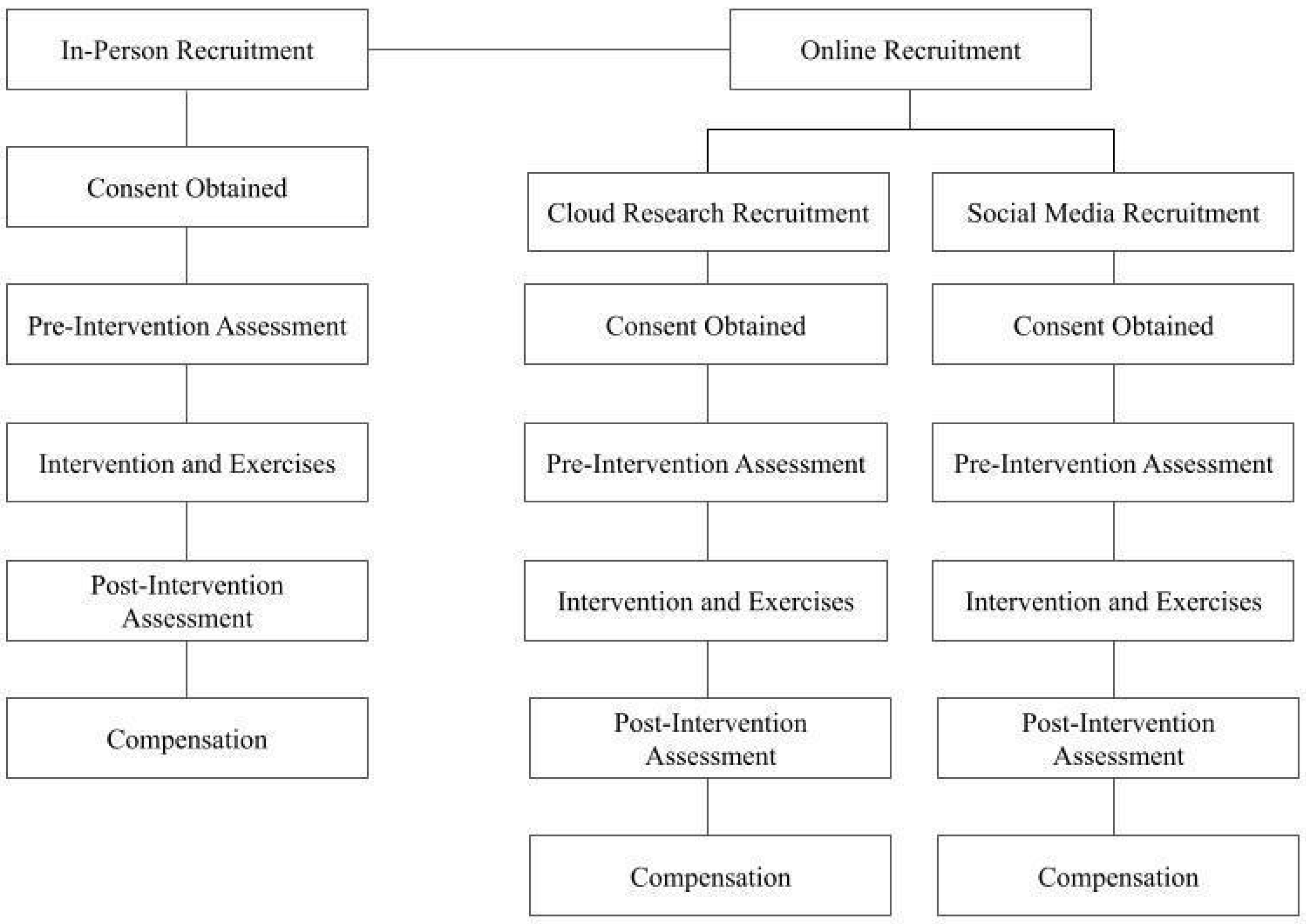
All procedures are outlined in Figure 1. The HD patients at NUMC were approached by the chief nurse about participation in the project. Patients were informed of the voluntary nature of participation, with the option to decline without any repercussions on their treatment. No data was collected before obtaining consent, ensuring patient confidentiality through physical distancing in the HD unit. Participants were given a Google Drive intervention link on their smartphones or the dialysis laptops/tablets to watch four module videos and complete associated exercises. Materials, including consent forms, measures, and the intervention, were translated into Spanish for Spanish-speaking patients. Participants were then compensated $10 for their participation.
Figure 1.
Participant Flow.
At baseline, directly before watching the video, all participants were asked to complete measures examining depression severity [42], anxiety [43], treatment adherence [46], resilient coping [45], social support [44], and health locus of control [47]. HD participants viewed the intervention video via Google Drive and completed it, while online participants accessed the same materials through Qualtrics. Post-intervention, directly after watching the video, all participants repeated the PHQ-9, GAD-7, MHLC-C, and completed Likert and qualitative feedback items. In-person participants were asked to complete all measures in the same sitting, and online participants were prompted to do the same on a Qualtrics survey.
2.4. Use of AI Tools
Artificial intelligence (AI), specifically ChatGPT, was used as a supportive tool to assist in writing the intervention script and manuscript, particularly with organizing and synthesizing the relevant literature, improving formatting in accordance with APA style guidelines, and refining overall writing clarity and flow. All content generated with AI was carefully reviewed and edited by the author to ensure accuracy, clinical relevance, and alignment with the study’s objectives. Although AI was used to support the writing process, all critical thinking, analysis, and interpretation were conducted by the authors.
2.5. Data Analysis
Planned data analysis involved calculating means, standard deviations, internal consistency coefficients, and Pearson product-moment correlations for total scale scores using SPSS Version 31.0 software. Paired samples t-tests examined outcome differences pre- to post-intervention. Multiple regression and bootstrapping assessed exploratory moderation effects. A priori power analyses using G* power = 0.80 and α = 0.05 indicated that a sample size of N = 34 would be sufficient to conduct paired samples t-tests with an effect size of dz = 0.50, N = 115 would be sufficient to examine correlations with an effect size of r = 0.30, and N = 395 for moderations with an effect size of f2 = 0.02. Effect sizes were selected based on standard estimates of medium effect sizes for t-tests and correlations and small effects for moderations. The Bonferroni correction was used to account for multiple testing. Consequently, significance was measured at p < 0.008 for t-tests, p < 0.000292 for correlations, and p < 0.00125 for moderations. The final sample was sufficient for primary analyses, but was underpowered for correlation and moderation analyses. Thus, these latter analyses were considered exploratory.
Listwise deletion was used at the scale level, assuming data were missing completely at random, reducing the sample size and statistical power. Missing data were addressed using sum-equivalent scores to retain participants with one or two missing items on a scale. When a participant was missing more than one or two items on a scale, they were excluded from analyses (PHQ-9 > 2 items; GAD-7 > 2 items missing; social support > 2 items missing; adherence > 1 item missing; resilient coping > 1 item missing; locus of control > 2 items missing). Sum equivalent scores were calculated to retain data for participants with greater than 80% of scale completion. Social support and locus of control subscales were only calculated when all items within the subscale were present. First, mean scores were calculated for each scale and then multiplied by the total number of scale items to produce a sum-equivalent score. These sum-equivalent scores were then used in all statistical analyses to maintain consistency while preserving data. Consequently, the sample size varied slightly across analyses and is reported for each analysis.
3. Results
The sample included 21 females (46.7%) and 23 males (51.1%), with an average age of 53.67 (SD = 18.37, range = 23–85 years). Twenty participants identified as Black or African American (44.4%), 13 as Hispanic or Latino/a (28.9%), seven as white (15.6%), two as other (4.4%), one as Asian or Pacific Islander (2.2%), and two did not answer (4.4%).
Thirty-five participants (77.8%) recruited from the dialysis unit received HD. Of those recruited online, one participant (2.2%) received peritoneal dialysis, and nine participants (20%) had CKD (Table 1). Dialysis status and CKD stage information were not available for the six participants recruited through CloudResearch. Among Facebook/Reddit participants, one reported stage 1 CKD (2.2%), one reported stage 2 (2.2%), one reported stage 3 (2.2%), and the one participant receiving peritoneal dialysis reported stage 5 (2.2%).
Table 1.
Participant demographics (N = 45).
Thirty-one (68.9%) participants completed the survey in English and 14 (31.1%) inSpanish. Additionally, participants reported their approximate total annual household income. Eleven participants (24.4%) reported earning less than $10,000, 12 participants (26.7%) between $10,000 and $20,000, four participants (8.9%) between $21,000 and $30,000, two participants (4.4%) between $31,000 and $40,000, two participants (4.4%) between $41,000 and $50,000, two participants (4.4%) between $51,000 and $60,000, three participants (6.7%) over $70,000, and nine participants (20.0%) did not answer.
3.1. Results by Hypothesis
There were no significant differences in these results whether the intervention was watched in English or Spanish. The first hypothesis was that participants’ ratings of psychological distress, as measured by depression and anxiety, would significantly decrease from pre- to post-intervention. This hypothesis is partially supported by paired-samples t-test results (Table 2). PHQ-9 scores decreased from pre-intervention (M = 6.86, SD = 5.92) to post-intervention (M = 5.12, SD = 5.40). This decrease was statistically significant, t(40) = −3.86, p < 0.001, d = −0.60. GAD-7 scores decreased from pre-intervention (M = 5.90, SD = 6.34) to post-intervention (M = 5.70, SD = 5.40) but were not statistically significant, t(39) = −0.48, p = 0.637, d = −0.08. A secondary aim of the study was to examine if the intervention would increase participants’ self-reported locus of control, specifically domains of (a) internality, (b) chance, (c) doctors, and (d) other people, from pre- to post-intervention. The results show that while locus of control dimensions of internality, doctors, and other people increased from pre-intervention to post-intervention, the results were not statistically significant, (internality: t(30) = 0.71, p = 0.482, d = −0.128; doctors t(30) = 1.43, p = 0.164, d = −0.256; other people t(28) = 1.18, p = 0.249, d = 0.218). Meanwhile, the chance dimension decreased, though this change was not significant (t(23) = −1.09, p = 0.289, d = −0.221). We also examined how patients’ reports of adherence were correlated with their reports of depression and anxiety (Table 3). Treatment adherence was not significantly associated with depression, r(35) = −0.265, p = 0.113, or anxiety, r(34) = −0.097, p = 0.574. Total social support scores did not moderate (i.e., diminish) the negative, albeit not statistically significant, relationship between depression and treatment adherence, R2 = 0.23, F(3, 31) = 3.13, p = 0.040, CI [−0.025. 004], nor anxiety and adherence, R2 = 0.43, F(3, 32) = 2.38, p = 0.089, CI [−0.018. 008]. Our correlation analyses found that total social support and resilient coping were not significantly correlated, though they showed a medium effect, r(37) = 0.48, p = 0.002.
Table 2.
T-tests.
Table 3.
Correlation Matrix.
Following the intervention, participants completed a series of Likert scale questions about their experience and their beliefs on whether they would apply exercises learned to their daily lives (For the behavioral activation exercise in which participants scheduled an activity, 10 participants (22.2%) said they were “Very Likely” to engage in the activity they scheduled consistently over the next month, and 13 participants (28.9%) said they were “Likely.” Regarding the anxiety module diaphragmatic breathing exercise, 10 participants (22.2%) reported they were “Very Likely” to use the demonstrated breathing exercises as a coping strategy over the next month, and 12 participants (26.7%) said they were “Likely.” For the adherence exercise, 14 participants (31.1%) said they were “Very Likely” to utilize the strategy they selected to improve their chosen health behavior (diet, exercise, or medication adherence) over the next month, and 14 participants (31.1%) said they were “Likely.” For social support outreach, 18 participants (40.0%) said they were “Very Likely” to reach out to the individuals they listed as a part of their social support network over the next month, and nine participants (20.0%) said they were “Likely.” Overall, participants generally reported the intervention was helpful and likely to improve mood, coping, adherence, locus of control, and social support.
3.2. Qualitative Intervention Feedback
Participants most frequently identified the breathing exercises as the most helpful component, followed by medication adherence strategies (Table 4). Most participants did not suggest changes. In the depression module behavioral activation exercise, participants listed activities that provide them with a sense of happiness or peace, most commonly spending time with loved ones (37.8%), spending time with friends (11.1%), reading (15.6%), and listening to music (13.3%), relaxation strategies (11.1%), meditation (11.1%), with smaller proportions reporting prayer/religion (4.4%), cooking, exercising, and watching sports (4.4% each). Multiple participants reported hobbies, including crafting, art, playing soccer, gardening, singing, dancing, fishing, and gaming.
Table 4.
Qualitative feedback.
In the motivation and adherence module exercise, participants were asked to identify their motivations and/or motivators for healthy living. Forty percent cited family, followed by “myself” (8.9%), staying alive (6.7%), and friends, religion, their partner, and employment (4.4% each). As a second part of the motivation and adherence module, participants completed an additional exercise in which they were asked to select one health behavior to change: diet, medication adherence, or exercise. Forty percent selected diet, 37.8% exercise, and 11.1% medication adherence. Selected diet strategies included limiting sodium, potassium, and phosphorus (24.4%), nutritionist support (13.3%), and fluid restriction (6.7%). Medication adherence strategies included setting reminders (4.4%), carrying spare medication (6.7%), and taking medicine alongside a daily habit (4.4%). Selected exercise strategies included walking, swimming, or yoga (20.0%) and exercising for at least 30 min three times weekly (24.4%). Some participants selected more than one strategy.
In the resilient coping and social support module, participants were asked to write down one or more people whom they can call when they need someone to talk to. Many participants wrote specific names, while others identified the relationship. Participants most frequently noted their children (26.6%), friends (20.0%), partners (15.5%), siblings and mothers (13.3% each), cousins (6.7%), and others including doctors (6.7%) and pastors (2.2%).
4. Discussion
The present study pilots a self-guided digital CBT-informed intervention in Spanish and English for CKD and HD patients. The sample was small but represented a diverse group of racial, ethnic, and socioeconomic backgrounds that reflects current prevalence data for CKD and ESKD patients [6]. Participants were recruited from both a dialysis center, where patients were on hemodialysis, and online, where patients had varying stages of CKD. The current sample is consequently broad and may have limited generalizability.
The results showed a statistically significant decrease in depression. These findings are consistent with results from previous CBT interventions for HD patients that demonstrated reductions in depression [25,29]. Although statistically significant, clinically, the change in depression mean scores was modest pre- to post-intervention. Moreover, because the PHQ-9 and GAD-7 were repeated immediately after the intervention, despite assessing symptoms over the preceding two weeks, the overlapping recall periods preclude interpreting the observed change as clinical improvement. Most dimensions of locus of control increased from pre- to post-intervention, but not at a statistically significant level. While this segment of the intervention may need additional development, it is possible that the non-significant result was a consequence of the small size of the sample. At least one study has found that teaching CBT techniques improved HD patients’ internal locus of control [24].
Adherence was not significantly associated with depression, anxiety, or total scores of social support, and total social support scores did not significantly moderate the association between depression and treatment adherence. However, the previous literature has shown that social support may mitigate the psychological and emotional effects of depression that reduce adherence among CKD patients [9,28]. Support can help with practical tasks, such as attending appointments or complying with dietary restrictions, can reduce symptoms of depression, including hopelessness and low motivation, and promote further social interaction that counteracts the withdrawal and isolation often seen in depression [15,16]. Our qualitative results support the findings linking social support and depression. Among our sample, 37.8% of participants noted spending time with their family or loved ones in the behavioral activation exercise, 40% referenced their family in the motivators for healthy living exercise, and most participants noted family members in the social support exercise. A total of 20% noted friends as social support.
The current results offer preliminary insight into the use of this intervention with CKD/HD patients. This study could be enhanced with a replication that uses a larger and more diverse sample size, and perhaps extends the intervention to better address the anxiety that is often associated with CKD.
5. Conclusions
In conclusion, the present study provides preliminary evidence for the potential use of our CBT-based intervention in addressing depression in CKD/HD patients. The intervention may also help patients understand the value of social support in coping with CKD.
Author Contributions
Conceptualization, O.B.F., J.N.F., S.R., M.T.M. and T.C.; methodology, O.B.F., J.N.F. and M.T.M.; software, O.B.F., J.N.F. and M.T.M.; validation, O.B.F., J.N.F. and M.T.M.; formal analysis, O.B.F., J.N.F. and M.T.M.; investigation, O.B.F. and J.N.F.; re-sources, O.B.F., J.N.F. and S.R.; data curation, O.B.F. and J.N.F.; writing—original draft preparation, O.B.F.; writing—review and editing, O.B.F., J.N.F. and M.T.M.; visualization, O.B.F.; supervision, J.N.F.; project administration, O.B.F., S.R. and T.C. All authors have read and agreed to the published version of the manuscript.
Funding
This research received no external funding.
Institutional Review Board Statement
The study was conducted in accordance with the Declaration of Helsinki and approved by the Institutional Review Board of Adelphi University (20240089, 2 October 2025) and Nassau University Medical Center (25-289, 4 September 2025).
Informed Consent Statement
Informed consent was obtained from all subjects involved in the study.
Data Availability Statement
The original contributions presented in this study are included in the article. Further inquiries can be directed to the corresponding author.
Acknowledgments
During the preparation of this manuscript/study, the authors used ChatGPT for the purposes of organizing and synthesizing the relevant literature, improving formatting in accordance with APA style guidelines, and refining overall writing clarity and flow. The authors have reviewed and edited the output and take full responsibility for the content of this publication.
Conflicts of Interest
The authors declare no conflicts of interest. Authors O.B.F., J.N.F., and S.R. funded participant compensation in this study.
References
- Mark, P.B.; Stafford, L.K.; Grams, M.E.; Aalruz, H.; ElHafeez, S.A.; Abdelgalil, A.A.; Abdulkader, S.; Abeywickrama, H.M.; Abiodun, O.O.; Abramov, D.; et al. Global, regional, and national burden of chronic kidney disease in adults, 1990–2023, and its attributable risk factors: A systematic analysis for the Global Burden of Disease Study 2023. Lancet 2025, 406, 2461–2482. [Google Scholar] [CrossRef] [Scilit] [PubMed]
- Bello, A.K.; Okpechi, I.G.; Levin, A.; Ye, F.; Damster, S.; Arruebo, S.; Donner, J.A.; Caskey, F.J.; Cho, Y.; Davids, M.R.; et al. An update on the global disparities in kidney disease burden and care across world countries and regions. Lancet Glob. Health 2024, 12, e382–e395. [Google Scholar] [CrossRef] [Scilit] [PubMed]
- American Kidney Fund. Chronic Kidney Disease (CKD): Symptoms, Treatment, Causes & Prevention; American Kidney Fund: Rockville, MD, USA, 2021. [Google Scholar]
- Centers for Disease Control and Prevention. Chronic Kidney Disease in the United States, 2023; Centers for Disease Control and Prevention: Atlanta, GA, USA, 2023.
- Wilk, A.S.; Hu, J.C.; Chehal, P.; Yarbrough, C.R.; Ji, X.; Cummings, J.R. National estimates of mental health needs among adults with self-reported CKD in the United States. Kidney Int. Rep. 2022, 7, 1630–1642. [Google Scholar] [CrossRef] [Scilit] [PubMed]
- Shirazian, S.; Grant, C.D.; Aina, O.; Mattana, J.; Khorassani, F.; Ricardo, A.C. Depression in chronic kidney disease and end-stage renal disease: Similarities and differences in diagnosis, epidemiology, and management. Kidney Int. Rep. 2016, 2, 94–107. [Google Scholar] [CrossRef] [Scilit] [PubMed]
- Reyes, M.; Fuertes, J.N.; Moore, M.T.; Punnakudiyil, G.J.; Calvo, L.; Rubinstein, S. Psychological and relational factors in ESRD hemodialysis treatment in an underserved community. Patient Educ. Couns. 2021, 104, 149–154. [Google Scholar] [CrossRef] [Scilit] [PubMed]
- Alosaimi, F.D.; Asiri, M.; Alsuwayt, S.; Alotaibi, T.; Bin Mugren, M.; Almufarrih, A.; Almodameg, S. Psychosocial predictors of nonadherence to medical management among patients on maintenance dialysis. Int. J. Nephrol. Renov. Dis. 2016, 9, 263–272. [Google Scholar] [CrossRef] [Scilit] [PubMed]
- Murtagh, F.E.; Addington-Hall, J.; Higginson, I.J. The prevalence of symptoms in end-stage renal disease: A systematic review. Adv. Chronic Kidney Dis. 2007, 14, 82–99. [Google Scholar] [CrossRef] [Scilit] [PubMed]
- Huang, C.W.; Wee, P.H.; Low, L.L.; Koong, Y.L.A.; Htay, H.; Fan, Q.; Foo, W.Y.M.; Seng, J.J.B. Prevalence and risk factors for elevated anxiety symptoms and anxiety disorders in chronic kidney disease: A systematic review and meta-analysis. Gen. Hosp. Psychiatry 2021, 69, 27–40. [Google Scholar] [CrossRef] [Scilit] [PubMed]
- Schouten, R.W.; Haverkamp, G.L.; Loosman, W.L.; Chandie Shaw, P.K.; van Ittersum, F.J.; Smets, Y.F.C.; Vleming, L.J.; Dekker, F.W.; Honig, A.; Siegert, C.E.H. Anxiety symptoms, mortality, and hospitalization in patients receiving maintenance dialysis: A cohort study. Am. J. Kidney Dis. 2019, 74, 158–166. [Google Scholar] [CrossRef] [Scilit] [PubMed]
- Cohen, S. Social relationships and health. Am. Psychol. 2004, 59, 676–684. [Google Scholar] [CrossRef] [Scilit] [PubMed]
- Varghese, S.A. Social support: An important factor for treatment adherence and health-related quality of life of patients with end-stage renal disease. J. Soc. Serv. Res. 2018, 44, 1–18. [Google Scholar] [CrossRef] [Scilit]
- Li, H.; Jiang, Y.; Lin, C.C. Factors associated with self-management by people undergoing hemodialysis: A descriptive study. Int. J. Nurs. Stud. 2014, 51, 208–216. [Google Scholar] [CrossRef] [Scilit] [PubMed]
- Kim, B.; Kim, J. Influence of uncertainty, depression, and social support on self-care compliance in hemodialysis patients. Ther. Clin. Risk Manag. 2019, 15, 1243–1251. [Google Scholar] [CrossRef] [Scilit] [PubMed]
- Untas, A.; Thumma, J.; Rascle, N.; Rayner, H.; Mapes, D.; Lopes, A.A.; Fukuhara, S.; Akizawa, T.; Morgenstern, H.; Robinson, B.M.; et al. The associations of social support and other psychosocial factors with mortality and quality of life in the dialysis outcomes and practice patterns study. Clin. J. Am. Soc. Nephrol. 2011, 6, 142–152. [Google Scholar] [CrossRef] [Scilit] [PubMed]
- Fuertes, J.N.; Friedman, O.B.; Moore, M.T.; Rubinstein, S. CKD patients’ emotional well-being: An examination of their psychological stressors and support factors. Kidney Dial. 2025, 5, 26. [Google Scholar] [CrossRef] [Scilit]
- Rotter, J.B. Generalized expectancies for internal versus external control of reinforcement. Psychol. Monogr. 1966, 80, 1–28. [Google Scholar] [CrossRef] [Scilit]
- Halpert, R.; Hill, R. 28 Measures of Locus of Control; Will to Power Press: Beach Haven, NJ, USA, 2011. [Google Scholar]
- Wallston, K.A.; Wallston, B.S.; DeVellis, R. Development of the multidimensional health locus of control (MHLC) scales. Health Educ. Monogr. 1978, 6, 160–170. [Google Scholar] [CrossRef] [Scilit] [PubMed]
- Wallston, K.A. The validity of the multidimensional health locus of control scales. J. Health Psychol. 2005, 10, 623–631. [Google Scholar] [CrossRef] [Scilit] [PubMed]
- Bayhakki, B.; Asrin, W.J.; Putri, S.A. Relationship between health locus of control and self-management in chronic kidney disease patients undergoing hemodialysis. J. Educ. Technol. Inf. Soc. Sci. Health 2023, 2, 892. [Google Scholar] [CrossRef] [Scilit]
- Buster, S.; Ozsaker, E. Locus of control, self-efficacy perception and treatment adherence in kidney transplant patients. Transpl. Immunol. 2022, 75, 101723. [Google Scholar] [CrossRef] [Scilit] [PubMed]
- Mehrtak, M.; Habibzadeh, S.; Farzaneh, E.; Rjaei-Khiavi, A. Effectiveness of teaching cognitive-behavioral techniques on locus of control in hemodialysis patients. Electron. Physician 2017, 9, 5631–5637. [Google Scholar] [CrossRef] [Scilit] [PubMed]
- Zhang, L.; Zou, L.; Zhou, L. Effectiveness of psychoeducational interventions on psychological distress and health-related quality of life among patients with maintenance hemodialysis: A systematic review and meta-analysis. Ren. Fail. 2024, 46, 2331613. [Google Scholar] [CrossRef] [Scilit] [PubMed]
- Zhang, C.; Mu, H.; Yang, Y.F.; Zhang, Y.; Gou, W.J. Effect of aromatherapy on quality of life in maintenance hemodialysis patients: A systematic review and meta-analysis. Ren. Fail. 2023, 45, 2164202. [Google Scholar] [CrossRef] [Scilit] [PubMed]
- Wu, X.L.; Ji, B.; Yao, S.D.; Wang, L.L.; Jiang, Z.Y. Effect of music intervention during hemodialysis: A comprehensive meta-analysis. Eur. Rev. Med. Pharmacol. Sci. 2021, 25, 3822–3834. [Google Scholar] [CrossRef] [Scilit] [PubMed]
- Hu, H.; Liu, X.; Chau, P.H.; Choi, E.P.H. Effects of intradialytic exercise on health-related quality of life in patients undergoing maintenance haemodialysis: A systematic review and meta-analysis. Qual. Life Res. 2022, 31, 1915–1932. [Google Scholar] [CrossRef] [Scilit] [PubMed]
- Cukor, D.; Ver Halen, N.; Asher, D.R.; Coplan, J.D.; Weedon, J.; Wkya, K.E.; Saggi, S.J.; Kimmel, P.L. Psychosocial intervention improves depression, quality of life, and fluid adherence in hemodialysis. J. Am. Soc. Nephrol. 2014, 25, 196–206. [Google Scholar] [CrossRef] [Scilit] [PubMed]
- Mehrotra, R.; Cukor, D.; Unruh, M.; Rue, T.; Heagerty, P.; Cohen, S.D.; Dember, L.M.; Diaz-Linhart, Y.; Dubovsky, A.; Greene, T.; et al. Comparative efficacy of therapies for treatment of depression for patients undergoing maintenance hemodialysis: A randomized clinical trial. Ann. Intern. Med. 2019, 170, 369–379. [Google Scholar] [CrossRef] [Scilit] [PubMed]
- Barello, S.; Anderson, G.; Acampora, M.; Bosio, C.; Guida, E.; Irace, V.; Guastoni, C.M.; Bertani, B.; Graffigna, G. The effect of psychosocial interventions on depression, anxiety, and quality of life in hemodialysis patients: A systematic review and meta-analysis. Int. Urol. Nephrol. 2023, 55, 897–912. [Google Scholar] [CrossRef] [Scilit] [PubMed]
- Adhikary, D.; Barman, S.; Ranjan, R. Internet-based cognitive behavioural therapy for individuals with depression and chronic health conditions: A systematic review. Cureus 2023, 15, e37822. [Google Scholar] [CrossRef] [Scilit] [PubMed]
- Marin, A.E.; Redolat, R.; Gil-Gómez, J.A.; Mesa-Gresa, P. Addressing cognitive function and psychological well-being in chronic kidney disease: A systematic review on the use of technology-based interventions. Int. J. Environ. Res. Public Health 2023, 20, 3342. [Google Scholar] [CrossRef] [Scilit] [PubMed]
- Ho, C.Y.; Siregar, D.; Yen, M.; Sung, J.M.; Wang, M.C.; Lin, W.H. Messaging app for CKD lifestyle modification. JMIR Hum. Factors 2025, 12, e73935. [Google Scholar] [CrossRef] [Scilit] [PubMed]
- Donald, M.; Jassemi, S.; Love, S.; Crysdale, G.; Sparkes, D.; Delgado, M.; Ferreira, L.; Pearson, B.; Verdin, N.; Ahrenholz, K.; et al. My Kidneys My Health program adaptation. Can. J. Kidney Health Dis. 2025, 12, 20543581251370922. [Google Scholar] [CrossRef] [Scilit] [PubMed]
- González-Flores, C.J.; Garcia-Garcia, G.; Lerma, C.; Guzmán-Saldaña, R.M.E.; Lerma, A. Effect of cognitive behavioral intervention combined with the resilience model to decrease depression and anxiety symptoms and increase the quality of life in ESRD patients treated with hemodialysis. Int. J. Environ. Res. Public Health 2023, 20, 5981. [Google Scholar] [CrossRef] [Scilit] [PubMed]
- Sullivan, J.E.; Choi, N.G.; Vazquez, C.E.; Neaves, M.A. Psychosocial depression interventions in dialysis patients. Res. Soc. Work Pract. 2019, 29, 910–923. [Google Scholar] [CrossRef] [Scilit]
- Beck, A.T. Cognitive Therapy and the Emotional Disorders; International Universities Press: New York, NY, USA, 1976. [Google Scholar]
- Zegarow, P.; Manczak, M.; Rysz, J.; Olszewski, R. The influence of cognitive-behavioral therapy on depression in dialysis patients: Meta-analysis. Arch. Med. Sci. 2020, 16, 1271–1278. [Google Scholar] [CrossRef] [Scilit] [PubMed]
- Lerma, A.; Perez-Grovas, H.; Bermudez, L.; Peralta-Pedrero, M.L.; Robles-García, R.; Lerma, C. Brief cognitive behavioural intervention for depression and anxiety symptoms improves quality of life in chronic haemodialysis patients. Psychol. Psychother. 2017, 90, 105–123. [Google Scholar] [CrossRef] [Scilit] [PubMed]
- Abu Maloh, H.I.A.; Soh, K.L.; Chong, S.C.; Ismail, S.I.F.; Soh, K.G.; Abu Maloh, D.I.; AbuRuz, M.E. Efficacy of Benson’s relaxation technique on stress and pain among patients undergoing maintenance hemodialysis: A systematic review. SAGE Open Nurs. 2024, 10, 23779608241251663. [Google Scholar] [CrossRef] [Scilit] [PubMed]
- Kroenke, K.; Spitzer, R.L.; Williams, J.B. The PHQ-9: Validity of a brief depression severity measure. J. Gen. Intern Med. 2001, 16, 606–613. [Google Scholar] [PubMed]
- Spitzer, R.L.; Kroenke, K.; Williams, J.B.; Löwe, B. A brief measure for assessing generalized anxiety disorder: The GAD-7. Arch. Intern Med. 2006, 166, 1092–1097. [Google Scholar] [CrossRef] [Scilit] [PubMed]
- Sherbourne, C.D.; Stewart, A.L. The MOS social support survey. Soc. Sci. Med. 1991, 32, 705–714. [Google Scholar] [CrossRef] [Scilit] [PubMed]
- Sinclair, V.G.; Wallston, K.A. The development and psychometric evaluation of the brief resilient coping scale. Assessment 2004, 11, 94–101. [Google Scholar] [CrossRef] [Scilit] [PubMed]
- Hays, R.D.; Kravitz, R.L.; Mazel, R.M.; Sherbourne, C.D.; DiMatteo, M.R.; Rogers, W.H.; Greenfield, S. The impact of patient adherence on health outcomes for patients with chronic disease in the Medical Outcomes Study. J. Behav. Med. 1994, 17, 347–360. [Google Scholar] [CrossRef] [Scilit] [PubMed]
- Wallston, K.A.; Stein, M.J.; Smith, C.A. Form C of the MHLC scales: A condition-specific measure of locus of control. J. Pers. Assess. 1994, 63, 534–553. [Google Scholar] [CrossRef] [Scilit] [PubMed]
- Mirzania, M.; Khajavi, A.; Moshki, M. Validity and reliability of form C of the multidimensional health locus of control scale in pregnant women. Iran. J. Med. Sci. 2019, 44, 307–314. [Google Scholar] [CrossRef] [Scilit] [PubMed]

Disclaimer/Publisher’s Note: The statements, opinions and data contained in all publications are solely those of the individual author(s) and contributor(s) and not of MDPI and/or the editor(s). MDPI and/or the editor(s) disclaim responsibility for any injury to people or property resulting from any ideas, methods, instructions or products referred to in the content. |
© 2026 by the authors. Licensee MDPI, Basel, Switzerland. This article is an open access article distributed under the terms and conditions of the Creative Commons Attribution (CC BY) license.