


Abstract
The Omicron variant of SARS-CoV-2 is associated with milder symptoms and lower hospitalization and mortality rates than Delta variants, although the impact of Omicron on immunocompromised patients, especially solid organ transplant (SOT) recipients, is still unclear. This study compares the hospitalization rate and outcomes between immunocompromised, immunocompetent, and SOT patients during the Delta and Omicron periods. We included adult patients who tested positive for SARS-CoV-2 on PCR or nasopharyngeal antigen test between 26 June 2021 to 8 September 2022, at our institution. A total of 12,401 COVID-19 patients were included, of which 11,055 were immunocompetent, and 1346 were immunocompromised (375 SOT recipients). Throughout the Delta and Omicron outbreaks, immunocompromised patients exhibited higher comorbidities and 30-day hospitalizations, but rates of mechanical ventilation and ICU-level care were like immunocompetent patients. During the Omicron wave, immunocompromised patients had higher unadjusted relative risk estimates (RR = 2.37, 95% CI 1.96–2.87, p < 0.05) than Delta (RR = 1.58, 95% CI 1.24–2.01, p < 0.05), with higher adjusted relative risk for hospitalization in Omicron (RR = 1.50, 95% CI 1.10–2.03, p = 0.01). Analyses show increased hospitalization risk in immunocompromised during the Omicron wave compared to the Delta wave, with no significant difference in hospitalization outcomes. The relative risk of hospitalization for SOT patients was higher in both waves.
1. Introduction
Since the first reported case of severe acute respiratory syndrome coronavirus 2 (SARS-CoV-2) in Wuhan, China [1], the virus has continued to mutate and has given rise to multiple variants [2]. Of the variants reported by World Health Organization (WHO), the Alpha (B.1.1.7 and Q lineages), Beta (B.1.351 and descendent lineages), Delta (B.1.617.2 and AY lineages), and Omicron (B.1.1.529, BA.1, BA.1.1, BA.2, BA.3, BA.4 and BA.5 lineages) variants, thus far, are the most concerning, as they were responsible for major Coronavirus Disease 2019 (COVID-19) outbreaks worldwide [3]. In addition to their structural differences, these variants differ with regard to their virulence, infectivity, target population, and response to therapy [4]. Before the emergence of the Omicron variants, data suggested that the immunocompromised population faced an increased risk of developing severe COVID-19, requiring hospitalization, admission to the Intensive Care Unit (ICU), and mortality, especially in solid organ transplant (SOT) recipients [5]. SOT recipients had a 15 times higher incidence of COVID-19 infection as compared to the general population [5]. Prior to vaccine availability, this was associated with at least a 10-fold higher mortality rate in SOT recipients (20%) compared to immunocompetent patients (0.8–2%) [5].
In late 2021, the SARS-CoV-2 Delta variants were replaced by the Omicron variants. With more than 40 mutations in the spike protein gene [6,7], the Omicron variants proved to be more infectious to the general population, with less response to immunity conferred by neutralizing antibodies from previous infections or vaccinations [7]. Yet, the Omicron variants were associated with less severe symptoms, a shorter duration of illness, a lower hospitalization rate, and a lower mortality rate than the Delta variants [8,9]. However, limited information is available regarding the severity of the Omicron variant in immunocompromised patients and SOT recipients. In this retrospective cohort study, we sought to compare the hospitalization rate and duration, need and duration for ICU stay, and mortality in hospitalized immunocompromised as well as SOT patients in comparison to immunocompetent patients between the Delta predominant and Omicron predominant eras.
2. Materials and Methods
2.1. Study Population
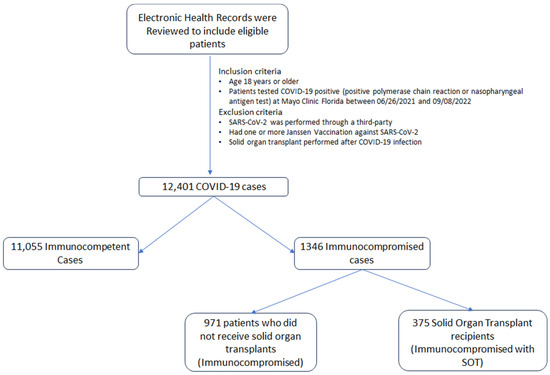
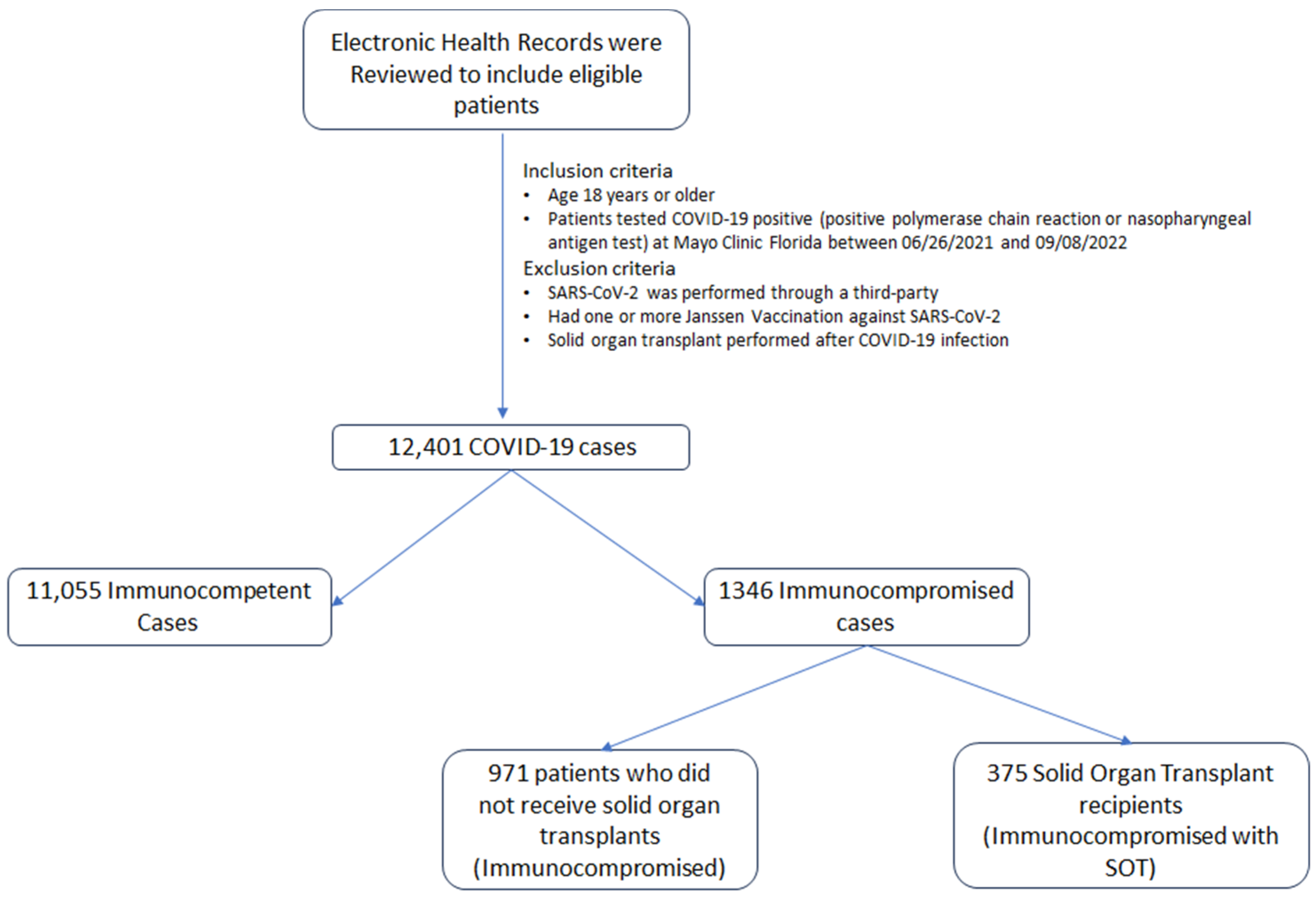
After obtaining approval from the Institutional Review Board, data was extracted from the Mayo Clinic, FL, USA electronic health record system. Inclusion criteria included adults 18 years of age or older with a positive polymerase chain reaction (PCR) or nasopharyngeal antigen test for SARS-CoV-2 between 26 June 2021 and 8 September 2022 at Mayo Clinic Florida. Patients were excluded if their SARS-CoV-2 test was performed under contract through a third party, had one or more Janssen vaccinations against SARS-CoV-2 (removed due to limited sample size and difficulty standardizing data to multi-shot vaccination series), or if the solid organ transplant was performed after the COVID-19 infection (Figure 1).
Figure 1.
Study flowchart describing inclusion and exclusion of patients.
The latency period between the Delta-predominant and Omicron-predominant waves of infection was defined as 18 October 2021 through 17 December 2021. Patients testing positive during this period were excluded to eliminate any ambiguity due to unavailability of genetic sequencing of variants. Eligible patients were identified as immunocompromised (as defined by CDC criteria [10]), immunocompromised SOT recipients, and immunocompetent (if they lacked the above two criteria). Data related to patient demographics, comorbidities, vaccination status, COVID-19 Risk Score, admission status, type of solid organ transplant, length of hospital stay, requirement of ICU care, mechanical ventilation requirements, status of COVID-19 related medications (I.e., Molnupiravir, Nirmatrelvir/ritonavir, Remdesivir), COVID-19 convalescent plasma, monoclonal antibodies (Bebtelovimab, Casirivimab and Imdevimab, Sotrovimab), and tixagevimab/cilgavimab was collected through automatic electronic data pool from patients’ medical records. Vaccination status was defined by the total number of COVID-19 vaccinations reported prior to infection.
2.2. Analysis
Patient demographics, comorbidities, and vaccination status, along with disease characteristics and treatment information, were analyzed using descriptive statistics. Comparisons of variables between immunocompromised and immunocompetent, as well as sub-analysis between immunocompromised and immunocompromised secondary to being a SOT recipient, were explored using Pearson χ2 test or Fisher’s exact test, as appropriate, when expected cell counts were <5. Unadjusted rates of 30-day hospital admission were calculated for each group overall, by wave, and by type of solid organ transplant. The unadjusted relative risk of admission for SOT patients by predominant variant wave was also estimated.
To estimate the relative risk for hospital admission in SOT recipients during various waves, we constructed a multivariable modified Poisson regression model with robust standard errors that included an interaction term between SOT status and predominant variant wave. Additionally, we conducted a Cochran–Mantel–Haenszel analysis comparing immunocompromised and SOT recipients with subgroups defined by the predominant variant wave. Covariates were selected a priori on clinical grounds and included type of SOT, age at positive SARS-CoV-2 test, sex, heart and lung conditions, calculated COVID-19 risk score [11], time from transplant to positive test, number of COVID-19 vaccinations, tixagevimab/cilgavimab use, COVID-19 treatments (e.g., monoclonal antibody treatments, COVID-19 convalescent plasma, molnupiravir, nirmatrelvir/ritonavir, and remdesivir), and predominant variant wave. Finally, to examine the relationship between SOT and hospital admission, a random forest analysis was constructed to allow for the inclusion of a larger number of covariates and potential interactions between these covariates.
To further explore the effects of different types of SOTs and time from transplant to COVID-19 diagnosis, we performed additional relative risk regression models within only the SOT subgroup. Outcomes for hospitalized patients were summarized. Lastly, we compared the marginal relative risk of admission between all immunocompromised patients and immunocompetent patients using the results from propensity score matching with subclassification methods. Patients were matched using age at positive SARS-CoV-2 test, sex, predominant variant wave, and number of COVID-19 vaccinations. Analyses were conducted using R version 4.0.3. Reported p-values were two-tailed. To reduce the chance of false-positive findings in exploratory comparisons, Benjamini–Hochberg false-discovery-rate correction was applied to secondary and subgroup analyses. Missing data was not imputed. Analyses were conducted using complete-case analysis, whereby observations with missing values for variables included in a given analysis were excluded from that specific analysis. The number of missing observations for each variable is reported in the tables as N-Miss. Missing values were handled by complete-case analysis for each variable, and the corresponding N-Miss counts are reported in the tables. All confidence intervals were calculated at the 95% confidence level. Unadjusted confidence intervals were calculated using binomial proportions.
3. Results
3.1. Patients
Out of the 12,401 patients who tested positive for COVID-19 during the study period, 11,055 were immunocompetent, and 1346 were immunocompromised. Of the immunocompromised cohort, 375 patients were SOT recipients (heart, kidney, liver, lung, pancreas, or multi-organ) (Figure 1).
3.2. Thirty-Day Hospitalization Rate and Hospital Resource Utilization in Immunocompetent vs. Immunocompromised Patients
Table 1 summarizes the comparison of baseline demographics, comorbidities, monoclonal antibody use, and hospital resource utilization between all immunocompromised versus immunocompetent patients. Immunocompromised patients had more comorbidities, a higher COVID-19 risk score (2 or greater), higher rates of 30-day admission (13.8% vs. 7.1%, p < 0.05), higher rates of monoclonal antibody infusions (19.6% vs. 7.0%, p < 0.05), and higher rates of tixagevimab/cilgavimab infusion (2.4% vs. 0%, p < 0.05) when compared to immunocompetent patients. No statistically significant differences were observed for mechanical ventilation needs, length of hospital stay, and ICU-level care between the two groups (Table 1).
Table 1.
Cohort stratified by immunocompromised and immunocompetent for all PCR-positive patients at Mayo Clinic Florida.
As demonstrated in Supplemental Tables S1.1 and S1.2, during both waves, immunocompromised patients had higher rates of comorbidities, COVID-19 risk score, 30-day hospitalization rate (Delta predominant wave: 21.2% vs. 13.4% [p < 0.001], Omicron predominant wave: 11.8% vs. 5.0% [p < 0.001]), and monoclonal antibody infusion rate (Delta predominant wave: 20.2% vs. 13.7% [p = 0.003], Omicron predominant wave 19.4% vs. 4.6% [p < 0.001]). The rates of mechanical ventilation and the need for ICU-level care were comparable between the immunocompromised and immunocompetent patients. However, during the Omicron predominant wave, the median length of hospital stay was higher in immunocompromised patients [5 days, IQR: 3.2–8.0 vs. 4 days, IQR: 2.0–6.0 (p = 0.029)] (Table S1.2).
Results of the marginal relative risk (RR) regression analysis of the propensity-matched cohort demonstrated that immunocompromised patients had a higher risk of hospitalization than immunocompetent patients (Marginal RR: 1.58 [1.24–2.01, p < 0.05]). Results of the relative risk regression model showed that immunocompromised patients had a higher adjusted relative risk for hospitalization during the Omicron-predominant wave compared to the Delta-predominant wave (RR = 1.50, 95% CI 1.10–2.03, p < 0.05) (Table 2).
Table 2.
Adjusted relative risk of hospitalization in immunocompromised patients during Omicron wave. *: Immunocompromised people in Omicron Wave.
3.3. Comparison of 30-Day Admission Rates After COVID-19 Diagnosis in Immunocompromised Patients During Delta Versus Omicron Waves
The crude 30-day admission rate in immunocompromised patients during the Omicron wave was much lower compared to the Delta wave (11.8% vs. 21.2%). However, the unadjusted relative risk point estimates for immunocompromised patients were higher during the Omicron wave (RR = 2.37, 95% CI 1.96–2.87, p < 0.05) than the Delta wave (RR = 1.58, 95% CI 1.24–2.01, p < 0.05) [Figure 2]. However, this is not contradictory: the relative risk compares the admission rate in immunocompromised patients with the contemporaneous immunocompetent reference group, so the ratio can increase even when the absolute admission rate falls. In other words, the Omicron-era decrease in absolute admissions was accompanied by an even lower reference rate in the comparator group, which increased the ratio. Accordingly, the relative risk for hospitalization among immunocompromised patients was greater during the Omicron wave than the Delta wave, even though the absolute admission rate was lower.
Figure 2.
Unadjusted relative risk in immunocompromised patients during Delta and Omicron waves.
3.4. Baseline Demographics and 30-Day Hospitalization Rate in SOT Recipients Versus Immunocompromised Without SOT
Solid organ transplant recipients had more comorbidities, a higher COVID-19 risk score (4 or greater), higher rates of 30-day admission (25.9% vs. 9.2%, p < 0.001), higher rates of monoclonal antibody infusions (23.7% vs. 18.0%, p = 0.018), and higher rates of tixagevimab/cilgavimab infusion (4.5% vs. 1.5%, p = 0.001) when compared to immunocompromised patients without SOT. No statistically significant differences were observed for COVID-19 vaccination dosages, mechanical ventilation, length of hospital stay, and ICU-level care between the two groups (Table 3).
Table 3.
Cohort stratified by SOT and immunocompromised.
During both waves, 30-day admission rates after COVID-19 diagnosis (Delta-predominant wave: 33.3% vs. 16.1% [p < 0.001], Omicron-predominant wave: 23.6% vs. 7.3% [p < 0.001]) were higher in SOT patients. No differences were noted in vaccination status, mechanical ventilation, length of stay, and ICU level of care status between the two cohorts. While no difference was evident for monoclonal antibody infusion rates between SOT patients and immunocompromised groups during the Delta wave, the monoclonal antibody infusion rate was higher during the Omicron wave in SOT patients (26.7% vs. 16.7%, p < 0.001) (Tables S2.1 and S2.2).
3.5. Comparison of 30-Day Admission Rates After COVID-19 Diagnosis in SOT During Delta Versus Omicron Waves
The crude 30-day admission rate in SOT patients during the Omicron wave was much lower compared to the Delta wave (23.6% vs. 33.3%). On the other hand, the unadjusted relative risk point estimates showing risk of hospitalization for SOT patients, compared to non-SOT immunocompromised patients, were higher during the Omicron wave (RR = 3.23, 95% CI 2.33–4.48, p < 0.05) than the Delta wave (RR = 2.07, 95% CI 1.35–3.19, p < 0.05). The 95% confidence intervals for these two relative risk estimates overlap; however, overlapping confidence intervals do not by themselves establish that the two relative risks are not significantly different from each other, so this overlap should not be interpreted as evidence of equivalence between the Delta- and Omicron-wave estimates (Figure 3).
Figure 3.
Unadjusted relative risk in SOT patients during Delta and Omicron waves.
A pooled estimate from all subgroups using the Cochran–Mantel–Haenszel technique showed an overall higher relative risk of admission in SOT patients compared to non-SOT immunocompromised patients [RR = 2.78 (95% CI: 2.14–3.60)]. Results of the relative risk regression model similarly showed an increased risk of admission for SOT patients, decreased risk during Omicron, and no significant SOT-by-wave interaction, indicating that the elevated SOT admission risk was present in both waves rather than being confined to one wave.
Based on the random forest model, the most important features (based on Gini-decrease) to predict 30-day admission were (1) age, (2) COVID-19 risk score, (3) number of vaccinations, (4) chronic respiratory disease, (5) monoclonal antibody infusion, (6) wave, and (7) absence of an SOT transplant (Figure S1). These predictors are clinically intuitive and suggest that baseline age and comorbidity burden were the dominant drivers of admission risk in this cohort, whereas transplant type and time from transplant appeared less influential. The random forest also indicated there were no meaningful interactions between solid transplant type and time from transplant to positive test.
Of the 186 hospitalized immunocompromised and SOT patients, only five patients died in the hospital (four immunocompromised and one SOT). Three deaths occurred during the Delta-predominant wave and two during the Omicron-predominant wave. Because the event count was very small, mortality analyses were descriptive only and should be interpreted cautiously. Our event rate was too small to estimate predictors of mortality.
3.6. Effect of Organ Transplant Type on 30-Day Admission Rate in the Delta Versus Omicron Waves
Most SOT recipients had received a kidney transplant (N = 137), followed by liver (N = 73), lung (N = 63), and heart (N = 58). The remaining 41 patients were classified as recipients of multi-organ transplants. Although a lower risk of admission was observed during the Omicron-predominant wave, no significant difference in risk of 30-day admission was observed across different transplant types (Figure S2).
4. Discussion
Since the emergence of the COVID-19 pandemic in 2019, SARS-CoV-2 variants have continued to evolve, which has affected the overall viral infectivity, virulence, and resistance to therapeutic interventions [3,4]. Efforts to combat the spread of SARS-CoV-2 have also evolved with the availability of vaccinations, prophylactic antibody infusions such as tixagevimab/cilgavimab, and treatment regimens for treatment of both outpatient and hospitalized patients. The aim of our study was to compare the more virulent Delta variant to the highly infectious but less virulent Omicron variant and determine its effects on 30-day hospitalization and hospital resource utilization in the immunocompromised versus immunocompetent populations in a tertiary care center with a large population of SOT recipients and immunocompromised patients without SOT.
In our study, we found that the hospital admission rate for COVID-19 was higher in immunocompromised patients compared to their immunocompetent counterparts during both the Delta and Omicron waves (Tables S1.1 and S1.2). These results were consistent with several other studies, including COVID-NET (US COVID-19 Associated Hospitalization Surveillance Network), that identified immunosuppression as an independent risk factor for hospitalization following SARS-CoV-2 infection [12,13]. The novel finding of our current study is the result of the regression model that demonstrated 50% higher rate of hospitalization during the Omicron-predominant wave than the Delta-predominant wave in the immunocompromised population (Table 2). Recent transplant-focused studies provide data-supported reasons for this finding: Omicron-era kidney and liver transplant cohorts still reported meaningful hospitalization rates, with admission risk concentrated among older patients, those with higher comorbidity burden, and those with weaker anti-spike antibody responses [14,15]. In addition, outpatient use of nirmatrelvir/ritonavir in SOT recipients remains constrained by clinically important drug–drug interactions with calcineurin inhibitors, which can delay or preclude treatment [16,17]. Taken together, these findings suggest that persistent host vulnerability and treatment constraints may help explain the higher adjusted hospitalization risk that we observed, even though the rates of mechanical ventilation and ICU-level care remained low.
Amidst a challenging need to confer an adequate immune response in the immunocompromised populations, Evusheld (a combination of two long-acting monoclonal antibodies—tixagevimab co-packaged with cilgavimab) received emergency use authorization by the US Food and Drug Administration (FDA) on 8 December 2021 [18]. The PROVENT trial and a cohort study by Jurdi et al. reported effective immune response and low adverse-effect risk with this agent in immunocompromised and SOT populations [19,20]. Since SOT recipients and immunocompromised patients without SOT in our cohort were both receiving tixagevimab/cilgavimab, unlike immunocompetent patients, we could not isolate its contribution to the sustained elevated admission risk we observed in either group. This exposure was effectively removed nationally when the FDA revised the EUA on 26 January 2023 because circulating variants had become largely non-susceptible [21], and our finding that admission risk remained elevated into the Omicron wave is consistent with reports that updated 2023–2024 vaccines provide only moderate protection against hospitalization in immunocompromised adults, underscoring the importance of keeping vaccination current [22].
A sub-analysis of our immunocompromised patients showed that patients who received SOT had a higher 30-day admission rate, but their post-hospitalization outcomes, such as mechanical ventilation, length of hospital stay, and need for ICU level of care, did not vary significantly between the two groups (Table 3). These findings were consistent with recent transplant cohorts, which also found that most Omicron-era SOT patients survived and that worse outcomes were concentrated in older, more comorbid recipients [14,15]. In our study cohort, since we had very few mortalities within the SOT group (one death during the Omicron wave) and non-SOT group (three deaths during the Delta wave and one during the Omicron wave), it did not allow us to make a statistical comparison of mortality rates.
Given that the mortality outcomes between SOT recipients and the general population were comparable despite a higher hospitalization rate in the SOT population, one possible explanation is a blunted hyperinflammatory response in some immunosuppressed patients. However, this mechanistic explanation remains speculative and does not exclude residual confounding, differential admission thresholds, or unmeasured access-to-care factors. This perspective was brought forward by some of the studies that reported comparable mortality, outcomes, and a faster decline in the severity of COVID-19 in SOT patients compared with the general population [23,24]. Cytokine storm in COVID-19 results from a hyperinflammatory state [25,26,27]. Cell-mediated immune system dysfunction due to pre-existing immunosuppression can potentially attenuate inflammation and disease severity in the SOT population and has been hypothesized as a potential reason for the differences in outcomes [28,29]. However, Maggiore et al. suggested that comparable in-hospital mortality percentages between SOT and the general population may not accurately reflect the true mortality in the SOT population being studied, as an increased hospitalization rate may indicate elevated absolute mortality in the SOT population [29]. Furthermore, Heldman et al. also highlighted that the majority of literature focuses on 28-day hospital mortality for COVID-19, but their registry-based study was able to demonstrate that delayed 29- to 90-day mortality among hospitalized SOT recipients with COVID-19 is 23%, in addition to the initial 20% within 28 days [30].
Past research has shown a diminished immune response in the form of lower anti-spike antibodies and breakthrough infection following COVID-19 vaccination in the immunosuppressed SOT population [31,32,33,34]. However, the mortality and morbidity outcomes associated with vaccination status in the SOT population are yet to be fully explored. A large-scale registry database-based retrospective study done by Ravanan et al. and another registry-based study done by Aslam et al. suggested a decline in mortality rates associated with vaccination in the SOT population, although their studies did not control for confounders [35,36]. Hailey et al. performed a single-center propensity-matched analysis on kidney transplant recipients based on historical data and found a five-fold risk of mortality in the unvaccinated cohort, although their results did not reach statistical significance [37]. For clinicians, these data support maintaining up-to-date vaccination, counseling patients that protection is incomplete, and arranging early testing and treatment pathways—particularly when calcineurin inhibitor interactions may complicate antiviral selection [17,22].
The varying trends with COVID-19-related outcomes in the SOT population over time have been reported by several studies, which have also explored the possible factors behind such differences. An improvement in resource utilization, vaccination, and fluctuating virulence of the variants of concern has contributed to some improvements in mortality and morbidity metrics [38]. However, limited literature is available comparing the Delta wave versus the Omicron wave in terms of outcome in the SOT population. In our cohort, outcomes in the SOT group and non-SOT group did not vary across the Delta wave and the Omicron wave, except that the hospitalized SOT group had a significantly higher rate of mechanical ventilation during the Delta wave, which was not noted in the Omicron wave, as well as in the full-cohort analysis. Consistent with the unadjusted estimates reported in Section 3.3 and Section 3.5, the adjusted relative risk of admission in the SOT group, derived from our modified Poisson regression model, was higher across the Delta wave [RR: 2.07 (1.35, 3.19)], the Omicron wave [RR: 3.23 (2.33, 4.48)], and the whole cohort [RR: 2.78 (2.14, 3.60)]; together, these estimates reinforce that SOT recipients carried a persistently elevated admission risk that did not abate as viral virulence changed. The random forest results were consistent with this interpretation: age and COVID-19 risk score were the strongest predictors of admission, whereas transplant subtype and time from transplant were less influential.
Infection with the Omicron variant has been associated with diminished morbidity and mortality for the general population, most likely due to vaccination coverage, and altered pathogenicity of the variant [9,39,40]. This has led to a loosening of certain public health measures all over the world and a general change in the attitude toward the pandemic. Earlier UNOS policy accommodations for the COVID-19-associated burden on the transplant waiting list and on caregivers have likewise been withdrawn [41]. Our finding that admission risk for immunocompromised and SOT patients remained elevated rather than declining as these protective measures were lifted suggests that this high-risk population warrants continued, rather than relaxed, clinical attention. Moreover, the increased virus circulation in the general population due to the inherent capacity of the virus and the aforementioned changes in public health policy amplifies the risk to the SOT population. This study also has important limitations: it is retrospective and single-center, variant assignment was based on calendar wave rather than sequencing, mortality events were sparse, and missing data were handled by complete-case analysis. We also did not capture neighborhood-level socioeconomic status, insurance, or access-to-care variables, so the race and ethnicity differences observed in the tables should be interpreted cautiously and may reflect structural rather than biological factors.
In conclusion, our analysis shows the increased risk of hospitalization in immunocompromised patients during the Omicron-dominant wave, with no major difference in hospitalization days, ICU days and mortality when compared to the Delta-predominant wave. Admission risk for SOT recipients remained consistently elevated relative to non-SOT immunocompromised patients across both waves, with no statistically significant change in that risk between Delta and Omicron. Given the 50% higher adjusted hospitalization risk we observed during the Omicron wave, preventative strategies such as safe distancing, quarantining sick contacts, masking, and booster-dose vaccination should be followed aggressively, particularly in light of the limited efficacy of tixagevimab/cilgavimab (no longer authorized) and the constraints on the current oral antiviral nirmatrelvir/ritonavir, whose ritonavir component has clinically important drug–drug interactions with calcineurin inhibitors that can delay or preclude its use in transplant recipients; molnupiravir, in contrast, has no significant interaction with calcineurin inhibitors and remains a viable oral option for this population. For clinicians, our findings support keeping vaccinations current, maintaining a low threshold for testing and early treatment, and reviewing drug–drug interactions specifically before prescribing nirmatrelvir/ritonavir, rather than oral antivirals as a class.
5. Conclusions
Our analyses show that, although crude hospitalization rates were lower during Omicron, immunocompromised patients had a higher adjusted relative risk of admission than during Delta, while post-hospital outcomes were similar. SOT recipients remained at elevated admission risk in both waves.
Supplementary Materials
The following supporting information can be downloaded at: https://www.mdpi.com/article/10.3390/covid6070111/s1, Figure S1. Based on the random forest model, description of the most important variables (based on Gini-decrease) to predict 30-day admission. Figure S2. Relative Risk Comparison based on the type of Organ Transplant. Table S1.1. Cohort stratified by immunocompromised and immunocompetent–Delta. Table S1.2. Cohort stratified by immunocompromised and immunocompetent–Omicron. Table S2.1. Cohort stratified by SOT and Immunocompromised–Delta. Table S2.2. Cohort stratified by SOT and Immunocompromised–Omicron.
Author Contributions
The following are the author contributions for each author: Conceptualization, S.Z.S., P.S., S.I., P.J., K.K., A.M.K., A.B., R.D.M., M.A.E., R.E.C., L.S., P.M.F., D.S. and H.M.W.; methodology, S.Z.S., P.S., S.I., P.J., K.K., A.M.K. and R.E.C.; investigation, S.Z.S., P.S., P.J., K.K., J.S., R.M.A., A.B., R.D.M., M.A.E., R.E.C., L.S., P.M.F., D.S. and H.M.W.; formal analysis, P.J. and K.K.; resources, S.Z.S., D.S. and H.M.W.; data curation, P.J., K.K. and R.E.C.; writing—original draft preparation, S.Z.S., P.S., S.I., P.J., K.K., A.M.K., J.S., R.M.A., A.B., R.D.M., M.A.E., R.E.C., L.S., P.M.F., D.S. and H.M.W.; writing—review and editing, S.Z.S., P.S., S.I., P.J., K.K., A.M.K., J.S., R.M.A., A.B., R.D.M., M.A.E., R.E.C., L.S., P.M.F., D.S. and H.M.W.; visualization, P.J., K.K. and R.E.C.; supervision, S.Z.S. All authors have read and agreed to the published version of the manuscript.
Funding
This research received no external funding.
Institutional Review Board Statement
The study was conducted in accordance with the Declaration of Helsinki and approved by the Institutional Review Board of Mayo Clinic Florida. The requirement for a protocol code and approval date was not applicable for this study.
Informed Consent Statement
Patient consent was waived due to the retrospective nature of the study and the use of de-identified electronic health record data.
Data Availability Statement
Access to the data used in this research is available upon request to the corresponding authors. Patients’ privacy concerns, HIPAA regulations, and institutional rules will be strictly considered while providing the data.
Conflicts of Interest
The authors declare no conflicts of interest.
Abbreviations
| COVID-19 | Coronavirus Disease 2019. |
| FDA | Food and Drug Administration. |
| ICU | Intensive Care Unit. |
| PCR | Polymerase Chain Reaction. |
| SARS-CoV-2 | Severe Acute Respiratory Syndrome Coronavirus 2. |
| SOT | Solid Organ Transplant. |
| WHO | World Health Organization. |
References
- Li, Q.; Guan, X.; Wu, P.; Wang, X.; Zhou, L.; Tong, Y.; Ren, R.; Leung, K.S.M.; Lau, E.H.Y.; Wong, J.Y.; et al. Early Transmission Dynamics in Wuhan, China, of Novel Coronavirus-Infected Pneumonia. N. Engl. J. Med. 2020, 382, 1199–1207. [Google Scholar] [CrossRef] [Scilit] [PubMed]
- CDC. Coronavirus Disease 2019 (COVID-19). Centers for Disease Control and Prevention. 2020. Available online: https://www.cdc.gov/coronavirus/2019-ncov/variants/variant-classifications.html (accessed on 10 March 2023).
- Tracking SARS-CoV-2 Variants. Available online: https://www.who.int/activities/tracking-SARS-CoV-2-variants (accessed on 10 March 2023).
- SeyedAlinaghi, S.; Mirzapour, P.; Dadras, O.; Pashaei, Z.; Karimi, A.; MohsseniPour, M.; Soleymanzadeh, M.; Barzegary, A.; Afsahi, A.M.; Vahedi, F.; et al. Characterization of SARS-CoV-2 different variants and related morbidity and mortality: A systematic review. Eur. J. Med. Res. 2021, 26, 51. [Google Scholar] [CrossRef] [Scilit] [PubMed]
- Pereira, M.R.; Mohan, S.; Cohen, D.J.; Husain, S.A.; Dube, G.K.; Ratner, L.E.; Arcasoy, S.; Aversa, M.M.; Benvenuto, L.J.; Dadhania, D.M.; et al. COVID-19 in solid organ transplant recipients: Initial report from the US epicenter. Am. J. Transplant. 2020, 20, 1800–1808. [Google Scholar] [CrossRef] [Scilit] [PubMed]
- Wei, C.; Shan, K.J.; Wang, W.; Zhang, S.; Huan, Q.; Qian, W. Evidence for a mouse origin of the SARS-CoV-2 Omicron variant. J. Genet. Genom. 2021, 48, 1111–1121. [Google Scholar] [CrossRef] [Scilit] [PubMed]
- Chen, J.; Wang, R.; Gilby, N.B.; Wei, G.W. Omicron (B.1.1.529): Infectivity, vaccine breakthrough, and antibody resistance. arXiv 2021, arXiv:2112.01318v1. [Google Scholar]
- Menni, C.; Valdes, A.M.; Polidori, L.; Antonelli, M.; Penamakuri, S.; Nogal, A.; Louca, P.; May, A.; Figueiredo, J.C.; Hu, C.; et al. Symptom prevalence, duration, and risk of hospital admission in individuals infected with SARS-CoV-2 during periods of omicron and delta variant dominance: A prospective observational study from the ZOE COVID Study. Lancet 2022, 399, 1618–1624. [Google Scholar] [CrossRef] [Scilit] [PubMed]
- Comparative Analysis of the Risks of Hospitalisation and Death Associated with SARS-CoV-2 Omicron (B.1.1.529) and Delta (B.1.617.2) Variants in England: A Cohort Study—ScienceDirect. Available online: https://www.sciencedirect.com/science/article/pii/S0140673622004627 (accessed on 10 March 2023).
- CDC. COVID-19 and Your Health. Centers for Disease Control and Prevention. 2020. Available online: https://www.cdc.gov/coronavirus/2019-ncov/need-extra-precautions/people-who-are-immunocompromised.html (accessed on 10 March 2023).
- Nyman, M.A.; Jose, T.; Croghan, I.T.; Parkulo, M.A.; Burger, C.D.; Schroeder, D.R.; Hurt, R.T.; O’hOro, J.C. Utilization of an Electronic Health Record Integrated Risk Score to Predict Hospitalization Among COVID-19 Patients. J. Prim. Care Community Health 2022, 13, 21501319211069748. [Google Scholar] [CrossRef] [Scilit] [PubMed]
- Kim, L.; Garg, S.; O’halloran, A.; Whitaker, M.; Pham, H.; Anderson, E.J.; Armistead, I.; Bennett, N.M.; Billing, L.; Como-Sabetti, K.; et al. Risk Factors for Intensive Care Unit Admission and In-hospital Mortality Among Hospitalized Adults Identified through the US Coronavirus Disease 2019 (COVID-19)-Associated Hospitalization Surveillance Network (COVID-NET). Clin. Infect. Dis. 2021, 72, e206–e214. [Google Scholar] [CrossRef] [Scilit] [PubMed]
- Li, J.; Huang, D.Q.; Zou, B.; Yang, H.; Hui, W.Z.; Rui, F.; Yee, N.T.S.; Liu, C.; Nerurkar, S.N.; Kai, J.C.Y.; et al. Epidemiology of COVID-19: A systematic review and meta-analysis of clinical characteristics, risk factors, and outcomes. J. Med. Virol. 2021, 93, 1449–1458. [Google Scholar] [CrossRef] [Scilit] [PubMed]
- Mikhailov, M.; Budde, K.; Halleck, F.; Eleftheriadis, G.; Naik, M.G.; Schrezenmeier, E.; Bachmann, F.; Choi, M.; Duettmann, W.; von Hoerschelmann, E.; et al. COVID-19 Outcomes in Kidney Transplant Recipients in a German Transplant Center. J. Clin. Med. 2023, 12, 6103. [Google Scholar] [CrossRef] [Scilit] [PubMed]
- Herting, A.; Jahnke-Triankowski, J.; Harberts, A.; Schaub, G.M.; Lütgehetmann, M.; Ruether, D.F.; Fischer, L.; Addo, M.M.; Lohse, A.W.; Wiesch, J.S.Z.; et al. Clinical Outcomes of SARS-CoV-2 Breakthrough Infections in Liver Transplant Recipients during the Omicron Wave. Viruses 2023, 15, 297. [Google Scholar] [CrossRef] [Scilit] [PubMed]
- Pinchera, B.; Buonomo, A.R.; Trucillo, E.; Susini, S.; D’agostino, A.; Di Filippo, I.; Tanzillo, A.; Villari, R.; Carrano, R.; Troisi, R.I.; et al. COVID-19 in solid organ transplant recipients after 2 years of pandemic: Outcome and impact of antiviral treatments in a single-center study. Front. Transplant. 2023, 2, 1095225. [Google Scholar] [CrossRef] [Scilit] [PubMed]
- Gerhart, J.; Cox, D.S.; Singh, R.S.P.; Chan, P.L.S.; Rao, R.; Allen, R.; Shi, H.; Masters, J.C.; Damle, B. A Comprehensive Review of the Clinical Pharmacokinetics, Pharmacodynamics, and Drug Interactions of Nirmatrelvir/Ritonavir. Clin. Pharmacokinet. 2024, 63, 27–42. [Google Scholar] [CrossRef] [Scilit] [PubMed]
- FDA. Coronavirus (COVID-19) Update: FDA Authorizes New Long-Acting Monoclonal Antibodies for Pre-Exposure Prevention of COVID-19 in Certain Individuals. 2021. Available online: https://www.fda.gov/news-events/press-announcements/coronavirus-covid-19-update-fda-authorizes-new-long-acting-monoclonal-antibodies-pre-exposure (accessed on 10 March 2023).
- Al Jurdi, A.; Morena, L.; Cote, M.; Bethea, E.; Azzi, J.; Riella, L.V. Tixagevimab/cilgavimab pre-exposure prophylaxis is associated with lower breakthrough infection risk in vaccinated solid organ transplant recipients during the omicron wave. Am. J. Transplant. 2022, 22, 3130–3136. [Google Scholar] [CrossRef] [Scilit] [PubMed]
- Levin, M.J.; Ustianowski, A.; De Wit, S.; Launay, O.; Avila, M.; Templeton, A.; Yuan, Y.; Seegobin, S.; Ellery, A.; Levinson, D.J.; et al. Intramuscular AZD7442 (Tixagevimab–Cilgavimab) for Prevention of COVID-19. N. Engl. J. Med. 2022, 386, 2188–2200. [Google Scholar] [CrossRef] [Scilit] [PubMed]
- Research C for DE and FDA Announces Evusheld Is Not Currently Authorized for Emergency Use in the U.S. FDA. 2023. Available online: https://www.fda.gov/ (accessed on 10 March 2023).
- Link-Gelles, R.; Rowley, E.A.K.; DeSilva, M.B.; Dascomb, K.; Irving, S.A.; Klein, N.P.; Grannis, S.J.; Ong, T.C.; Weber, Z.A.; Fleming-Dutra, K.E.; et al. Interim Effectiveness of Updated 2023-2024 (Monovalent XBB.1.5) COVID-19 Vaccines Against COVID-19-Associated Hospitalization Among Adults Aged ≥18 Years with Immunocompromising Conditions—VISION Network, September 2023–February 2024. MMWR Morb. Mortal. Wkly. Rep. 2024, 73, 271–276. [Google Scholar] [CrossRef] [Scilit] [PubMed]
- Rinaldi, M.; Bartoletti, M.; Bussini, L.; Pancaldi, L.; Pascale, R.; Comai, G.; Morelli, M.; Ravaioli, M.; Cescon, M.; Cristini, F.; et al. COVID-19 in solid organ transplant recipients: No difference in survival compared to general population. Transpl. Infect. Dis. 2021, 23, e13421. [Google Scholar] [CrossRef] [Scilit] [PubMed]
- Avery, R.K.; Chiang, T.P.-Y.; Marr, K.A.; Brennan, D.C.; Sait, A.S.; Garibaldi, B.T.; Shah, P.; Ostrander, D.; Steinke, S.M.; Permpalung, N.; et al. Inpatient COVID-19 outcomes in solid organ transplant recipients compared to non-solid organ transplant patients: A retrospective cohort. Am. J. Transplant. 2021, 21, 2498–2508. [Google Scholar] [CrossRef] [Scilit] [PubMed]
- Kalil, A.C.; Florescu, D.F. Mortality in solid organ transplant recipients hospitalized for COVID-19. Am. J. Transplant. 2022, 22, 12–13. [Google Scholar] [CrossRef] [Scilit] [PubMed]
- Kalil, A.C.; Syed, A.; Rupp, M.E.; Chambers, H.; Vargas, L.; Maskin, A.; Miles, C.D.; Langnas, A.; Florescu, D.F. Is bacteremic sepsis associated with higher mortality in transplant recipients than in nontransplant patients? A matched case-control propensity-adjusted study. Clin. Infect. Dis. 2015, 60, 216–222. [Google Scholar] [CrossRef] [Scilit] [PubMed]
- Donnelly, J.P.; Locke, J.E.; MacLennan, P.A.; McGwin, G.; Mannon, R.B.; Safford, M.M.; Baddley, J.W.; Muntner, P.; Wang, H.E. Inpatient Mortality Among Solid Organ Transplant Recipients Hospitalized for Sepsis and Severe Sepsis. Clin. Infect. Dis. 2016, 63, 186–194. [Google Scholar] [CrossRef] [Scilit] [PubMed]
- Choi, H.; Shin, E.C. Hyper-inflammatory responses in COVID-19 and anti-inflammatory therapeutic approaches. BMB Rep. 2022, 55, 11–19. [Google Scholar] [CrossRef] [Scilit] [PubMed]
- Maggiore, U.; Riella, L.V.; Azzi, J.; Cravedi, P. Mortality in solid organ transplant recipients with COVID-19: More than meets the eye. Am. J. Transplant. 2022, 22, 1496–1497. [Google Scholar] [CrossRef] [Scilit] [PubMed]
- Heldman, M.R.; Kates, O.S.; Safa, K.; Kotton, C.N.; Multani, A.; Georgia, S.J.; Steinbrink, J.M.; Alexander, B.D.; Blumberg, E.A.; Haydel, B.; et al. Delayed mortality among solid organ transplant recipients hospitalized for COVID-19. Clin. Infect. Dis. 2022, 78, 711–718. [Google Scholar] [CrossRef] [Scilit] [PubMed]
- Sanghavi, D.K.; Bhakta, S.; Wadei, H.M.; Bosch, W.; Cowart, J.B.; Carter, R.E.; Shah, S.Z.; Pollock, B.D.; Neville, M.R.; Oman, S.P.; et al. Low antispike antibody levels correlate with poor outcomes in COVID-19 breakthrough hospitalizations. J. Intern. Med. 2022, 292, 127–135. [Google Scholar] [CrossRef] [Scilit] [PubMed]
- Bosch, W.; Cowart, J.B.; Bhakta, S.; Carter, R.E.; Wadei, H.M.; Shah, S.Z.; Sanghavi, D.K.; Pollock, B.D.; Neville, M.R.; Oman, S.P.; et al. Coronavirus Disease 2019 Vaccine-Breakthrough Infections Requiring Hospitalization in Mayo Clinic Florida Through August 2021. Clin. Infect. Dis. 2022, 75, e892–e894. [Google Scholar] [CrossRef] [Scilit] [PubMed]
- Feikin, D.R.; Higdon, M.M.; Abu-Raddad, L.J.; Andrews, N.; Araos, R.; Goldberg, Y.; Groome, M.J.; Huppert, A.; O’Brien, K.L.; Smith, P.G.; et al. Duration of effectiveness of vaccines against SARS-CoV-2 infection and COVID-19 disease: Results of a systematic review and meta-regression. Lancet 2022, 399, 924–944. [Google Scholar] [CrossRef] [Scilit] [PubMed]
- Sanders, J.S.F.; Bemelman, F.J.; Messchendorp, A.L.; Baan, C.C.; van Baarle, D.; van Binnendijk, R.; Diavatopoulos, D.A.; Frölke, S.C.; Geers, D.; GeurtsvanKessel, C.H.; et al. The RECOVAC Immune-response Study: The Immunogenicity, Tolerability, and Safety of COVID-19 Vaccination in Patients with Chronic Kidney Disease, on Dialysis, or Living with a Kidney Transplant. Transplantation 2021, 106, 821–834. [Google Scholar] [CrossRef] [Scilit] [PubMed]
- Ravanan, R.; Mumford, L.; Ushiro-Lumb, I.; Callaghan, C.F.; Pettigrew, G.F.; Thorburn, D.F.; Gardiner, D.F.; Forsythe, J.F. Two Doses of SARS-CoV-2 Vaccines Reduce Risk of Death due to COVID-19 in Solid Organ Transplant Recipients: Preliminary Outcomes from a UK Registry Linkage Analysis. Transplantation 2021, 105, e263–e264. [Google Scholar] [CrossRef] [Scilit] [PubMed]
- Aslam, S.; Adler, E.; Mekeel, K.; Little, S.J. Clinical effectiveness of COVID-19 vaccination in solid organ transplant recipients. Transpl. Infect. Dis. 2021, 23, e13705. [Google Scholar] [CrossRef] [Scilit] [PubMed]
- Hardgrave, H.; Wells, A.; Nigh, J.; Klutts, G.; Krinock, D.; Osborn, T.; Bhusal, S.; Rude, M.K.; Burdine, L.; Giorgakis, E. COVID-19 Mortality in Vaccinated vs. Unvaccinated Liver & Kidney Transplant Recipients: A Single-Center United States Propensity Score Matching Study on Historical Data. Vaccines 2022, 10, 1921. [Google Scholar] [CrossRef] [Scilit] [PubMed]
- Heldman, M.R.; Kates, O.S.; Safa, K.; Kotton, C.N.; Georgia, S.J.; Steinbrink, J.M.; Alexander, B.D.; Hemmersbach-Miller, M.; Blumberg, E.A.; Multani, A.; et al. Changing trends in mortality among solid organ transplant recipients hospitalized for COVID-19 during the course of the pandemic. Am. J. Transplant. 2022, 22, 279–288. [Google Scholar] [CrossRef] [Scilit] [PubMed]
- Keeton, R.; Tincho, M.B.; Ngomti, A.; Baguma, R.; Benede, N.; Suzuki, A.; Khan, K.; Cele, S.; Bernstein, M.; Karim, F.; et al. T cell responses to SARS-CoV-2 spike cross-recognize Omicron. Nature 2022, 603, 488–492. [Google Scholar] [CrossRef] [Scilit] [PubMed]
- GeurtsvanKessel, C.H.; Geers, D.; Schmitz, K.S.; Mykytyn, A.Z.; Lamers, M.M.; Bogers, S.; Scherbeijn, S.; Gommers, L.; Sablerolles, R.S.G.; Nieuwkoop, N.N.; et al. Divergent SARS-CoV-2 Omicron-reactive T and B cell responses in COVID-19 vaccine recipients. Sci. Immunol. 2022, 7, eabo2202. [Google Scholar] [CrossRef] [Scilit] [PubMed]
- Reinstatement of Updates to Candidate Data During the COVID-19 Emergency—OPTN. 2023. Available online: https://optn.transplant.hrsa.gov/policies-bylaws/public-comment/reinstatement-of-updates-to-candidate-data-during-the-covid-19-emergency/ (accessed on 10 March 2023).





Disclaimer/Publisher’s Note: The statements, opinions and data contained in all publications are solely those of the individual author(s) and contributor(s) and not of MDPI and/or the editor(s). MDPI and/or the editor(s) disclaim responsibility for any injury to people or property resulting from any ideas, methods, instructions or products referred to in the content. |
© 2026 by the authors. Licensee MDPI, Basel, Switzerland. This article is an open access article distributed under the terms and conditions of the Creative Commons Attribution (CC BY) license.