


Abstract
This study investigated the synthesis and microstructural evolution of AlFeCoNi medium-entropy alloy powder processed by ball milling, conventional uniaxial pressing, and vacuum sintering at 900 °C for 1 h. The mechanically milled powder exhibited a refined, irregular particle morphology with a broad size distribution, indicating extensive fracture and cold-welding during milling. SEM (scanning electron microscopy) and EDS (energy-dispersive spectroscopy) observations showed effective elemental mixing of Al, Fe, Co, and Ni, with only limited evidence of large-scale segregation, suggesting that mechanical alloying promoted compositional homogenization. After compaction and sintering, the powder compact exhibited noticeable changes in microstructural continuity and pore morphology, indicating further microstructural evolution during thermal treatment. Overall, the results demonstrate the microstructural evolution of AlFeCoNi MEA during ball milling and subsequent conventional sintering, while further investigation involving quantitative densification measurements and optimization of sintering conditions is required to establish the consolidation behavior and microstructural uniformity of the alloy.
1. Introduction
In traditional metallurgy, it was believed that mixing many elements in an alloying system resulted in several compounds and complex microstructures. However, advanced metallurgy by Yeh et al. [1] suggested that maximizing the configuration entropy and stabilizing the solid solution phase reduces the development of intermetallic compounds. Moreover, to obtain a high configuration entropy, the system should contain five or more elements with a concentration in the range of 5–35% [2,3]. This kind of alloy is called a high entropy alloy (HEA) [4,5,6,7]. Based on the configurational entropy of mixing, ΔSmix = −RΣci ln ci, a nominally equiatomic quaternary alloy (e.g., AlFeCoNi) yields ΔSmix = R ln4 ≈ 11.53 J mol−1 K−1 (1.39R), which lies within the medium-entropy alloy (MEA) range (1R–1.5R) rather than the high-entropy alloy (HEA) range (>1.5R) [1]. The present quaternary system is therefore classified as an MEA, and this terminology is used consistently throughout the manuscript. Powder metallurgy is a unique method that controls various material properties [8,9]. Common technologies used in powder metallurgy mainly involve mechanical alloying and sintering to process the alloy [10,11,12,13]. This method, also called solid-state processing, is an inexpensive method compared to several others [14].
The extensive development of HEAs is attributed to the incorporation of transition metals like Cobalt (Co), Chromium (Cr), iron (Fe), and nickel (Ni). These elements contribute to improved microstructure and properties without excessive costs [15]. Consequently, AlCoCrFeNi HEAs have garnered significant attention due to their distinctive properties, featuring a BCC single-phase to mixed-phase based on compositional ranges [16,17,18]. Notably, the alloy exhibits a eutectic phase with a Ni content of approximately 1.2 at. %. Thus, the presence of a BCC phase significantly impacts the hardness properties of HEAs. BCC phases in HEAs contribute to enhanced mechanical strength and hardness due to their inherent structural stability and resistance to dislocation motion [19,20]. Extensive investigations on the inclusion of silicon have demonstrated its capability to further augment hardness [21]. HEAs, particularly when processed through spark plasma sintering (SPS), exhibit significantly lower density compared to steel. Moreover, these alloys boast high specific strength relative to conventional options like titanium alloys. SPS, a commonly employed advanced sintering technique, facilitates powder consolidation through simultaneous application of pressure and temperature [17,22,23,24]. Despite its effectiveness in achieving ultrafine grain structure and high density through short sintering cycles, the economic application of SPS is hindered by commercial considerations and the complexity of shaping processes [25].
Solid-state powder metallurgy avoids several problems inherent to melting-and-casting routes, such as macrosegregation, shrinkage porosity, and elemental volatilization; conversely, melting/casting routes avoid the contamination and residual-porosity issues characteristic of mechanical alloying and sintering [26,27]. However, mechanical alloying also has some disadvantages, mainly contamination due to the milling media. The contamination problems could be reduced to some extent by the appropriate selection of balls and vial materials, along with the use of highly pure inert gas. It was observed that the use of a process control agent (PCA) was also associated with unexpected contamination during the milling process. The reduced milling time can also help decrease contamination [28].
In previous studies, CoCrFeNi HEAs were subjected to analysis via pressureless sintering, with the sintering mechanism being accurately delineated. Findings revealed that annealed milled powder demonstrated a gradual densification rate and a greater sintering activation energy compared to milled powder [29]. Achieving high or near-full density through conventional or pressureless sintering remains challenging for most HEA/MEA powder systems, although near-full-density pressureless sintering of AlCoCrFeNi-based powders has been reported [30,31,32]. As a result, achieving full density via conventional or pressureless sintering remains challenging for most reported HEA/MEA powder systems, with only limited exceptions (e.g., near-full-density pressureless sintering of AlCoCrFeNi-based powders) reported to date [30]. Recent studies have demonstrated that the processing history, particularly mechanical alloying and subsequent thermal treatment, strongly influences the phase constitution, crystallite refinement, lattice strain, elemental distribution, and microstructural characteristics of Al-containing medium- and high-entropy alloys [33,34]. In particular, variations in alloy chemistry and processing conditions can modify the stability of BCC/B2 and other phases and consequently affect the resulting microstructure. However, the processing-induced microstructural evolution of the AlFeCoNi system during combined mechanical alloying and conventional sintering remains comparatively less explored. Therefore, the present study focuses on a nominally equiatomic, Si-free AlFeCoNi medium-entropy alloy to examine the changes in structural and microstructural characteristics produced by high-energy ball milling followed by conventional sintering. The absence of Si is considered a controlled compositional feature rather than the sole novelty of the study, allowing the processing-induced evolution of the AlFeCoNi matrix to be evaluated without additional effects associated with Si-containing phases. Thus, the present work contributes to understanding the relationship between mechanical alloying, subsequent thermal treatment, phase evolution, and microstructural development in the AlFeCoNi MEA system.
The scientific contribution of the present study is the systematic evaluation of the microstructural evolution of a nominally equiatomic AlFeCoNi MEA processed through mechanical alloying, uniaxial compaction, and conventional vacuum sintering. Compared with the authors’ previous conventionally sintered AlFeCoNiSi alloy [21], the present study examines the Si-free quaternary AlFeCoNi base composition and provides baseline processing–microstructure information without intentional Si addition; however, a direct quantitative evaluation of the Si effect is beyond the present scope because the two studies were not designed as matched comparative experiments. Unlike studies employing rapid or pressure-assisted consolidation methods, this work focuses on morphological, compositional, and densification-related changes occurring during a comparatively simple conventional powder-metallurgy route. Quantitative image analysis was used to evaluate particle-size and shape characteristics in the milled and sintered conditions, while X-ray diffraction analysis was employed to assess crystallite refinement, microstrain, lattice distortion, and phase constitution. The alloy was also classified using configurational entropy and valence electron concentration criteria. The present study therefore provides a processing–microstructure assessment of conventionally sintered AlFeCoNi MEA; however, final density, hardness, and mechanical properties were not measured and should be investigated in future work to establish processing–property relationships.
2. Materials and Methods
High-purity metal powder (Avention Korea® with purity exceeding 99.9%) was employed in the synthesis of AlFeCoNi MEA. Initially, the metal powder blend underwent milling using a high-energy ball mill (Retsch PM-400 MA, Haan, Germany) for 30 h under dry conditions, with stearic acid serving as a process control agent (PCA) at a concentration of 0.3 wt%, along with 20 mm steel balls [21]. The Ball-to-Powder Ratio (BPR) was maintained at a ratio of 10:1. X-ray diffraction (XRD) analysis of the mechanically alloyed metal powder was conducted using a Rigaku instrument with a Cu radiation target operating at 40 kV and 40 mA. Scanning was performed over a range of diffraction angles from 25° to 80° at a scan speed of 3°/min with increments of 0.02°. Additionally, the microstructure of MEA powder was examined using a SEM (Model: JSM-7100F Jeol, Tokyo, Japan). Image-based morphological analysis was performed using ImageJ 1.54 version. Each SEM micrograph was calibrated using its embedded scale bar, segmented using the Otsu automatic-thresholding method, and analyzed as binary objects. Connected regions were treated as single segmented features and may therefore represent either individually resolved particles or unresolved agglomerates. One representative micrograph was analyzed for each condition, yielding approximately 1150 objects for the ball-milled powder and 664 objects for the sintered condition. Because the minimum-object-size cutoff and edge-object exclusion settings were not documented, the results are interpreted as semi-quantitative two-dimensional segmented-feature statistics. The mechanically alloyed powder was compacted in a cylindrical die to produce green pellets with a diameter of 10 mm and a height of 15 mm. Compaction was performed at 20 MPa with a holding time of 1 min. Before heating, the furnace chamber was evacuated to a base pressure of approximately 10−5 Torr and subsequently backfilled with argon. The compacted specimens were heated at a rate of 10 °C/min to 900 °C, held at this temperature for 1 h, and then furnace-cooled to room temperature. The sintered specimens were subsequently examined using XRD and SEM.
3. Results
3.1. Characterization of Milled Powder
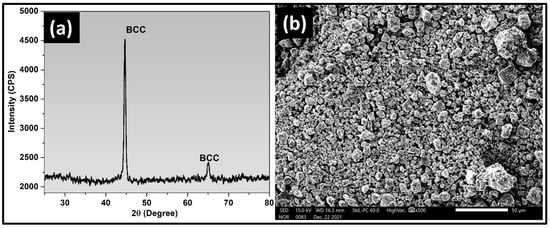
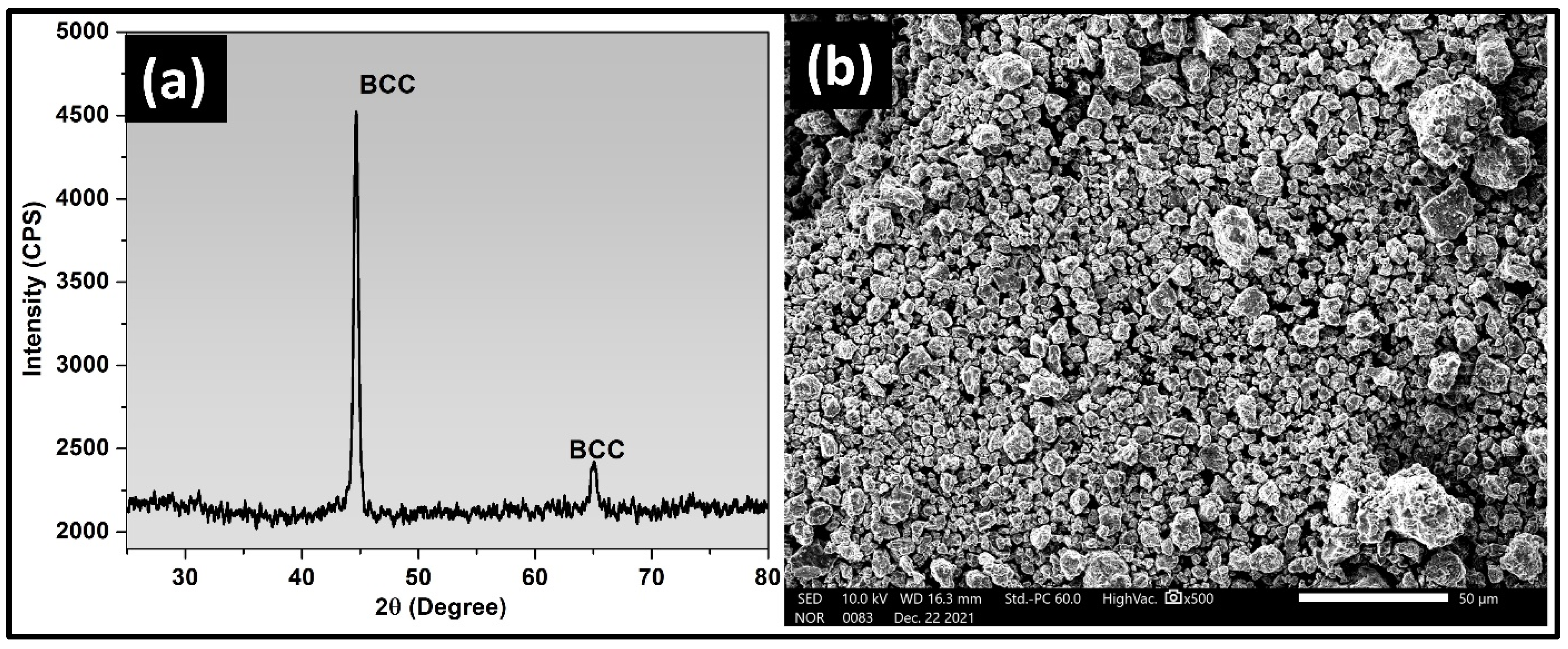
Figure 1a illustrates the milled powder following a 30 h process, revealing reduced particles of various irregular shapes. The powder particles appear separated, indicating the absence of agglomeration due to dry milling. XRD analysis revealed reflections that can be indexed to a BCC-type structure. Notably, the XRD pattern exhibits only two peaks (110) and (200) within the measurement range of 25 to 80°. However, the VEC criterion predicts a mixed BCC–FCC tendency for nominally equiatomic AlFeCoNi; therefore, the available diffraction data should not be interpreted as definitive evidence of an exclusively single-BCC phase. Furthermore, previous research on a similar synthesized HEA system utilizing the melting and casting route produced comparable crystal structures [33]. The valence electron concentration (VEC) was calculated as VEC = Σci·VECi using standard elemental valence electron counts (Al = 3, Fe = 8, Co = 9, and Ni = 10). For the nominally equiatomic composition, VEC ≈ 7.5. Per the empirical VEC phase-formation criterion (VEC < 6.87 favors BCC; 6.87 ≤ VEC < 8.0 favors mixed BCC + FCC; and VEC ≥ 8.0 favors FCC) [35], this composition falls within the mixed BCC + FCC regime rather than the single-BCC regime implied by the original text, and the XRD result should be interpreted accordingly. The two reflections indexed here are consistent with a BCC phase, but because only two reflections (110 and 200) were captured over the measured 2θ range, a minor FCC fraction cannot be excluded from the present data. An extended 2θ range and Rietveld-type refinement are recommended in future work to confirm single-phase BCC formation. Figure 1b depicts the elemental mapping of the powder milled for 30 h. The distribution of different elements suggests the absence of segregation post-milling, highlighting the uniform dispersion of Al, Fe, Co, and Ni throughout the investigated milled powder.
Figure 1.
(a) XRD pattern after 30 h milling, and (b) milled powder SEM morphology of AlFeCoNi MEA.
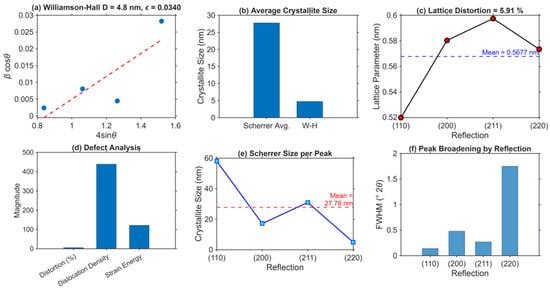
The XRD analysis of the mechanically alloyed AlFeCoNi MEA (Figure 2) indicates pronounced diffraction-peak broadening, which is consistent with crystallite refinement and defect accumulation during ball milling. The Williamson–Hall plot constructed using the four indexed reflections, (110), (200), (211), and (220), yielded an apparent crystallite size of approximately 4.8 nm and a microstrain of 0.034. However, the data points show noticeable deviation from ideal linear behavior. Therefore, these values should be regarded as approximate, semi-quantitative estimates rather than definitive measurements. The observed scatter may arise from reflection-dependent peak broadening, anisotropic strain, peak-fitting uncertainty, the limited number of indexed reflections, and the absence of instrumental-broadening correction. The larger average crystallite size estimated using the Scherrer equation, approximately 27.8 nm, further suggests that strain broadening contributes appreciably to the measured peak widths. Nevertheless, the Scherrer-derived value should also be interpreted cautiously because instrumental broadening was not independently evaluated.
Figure 2.
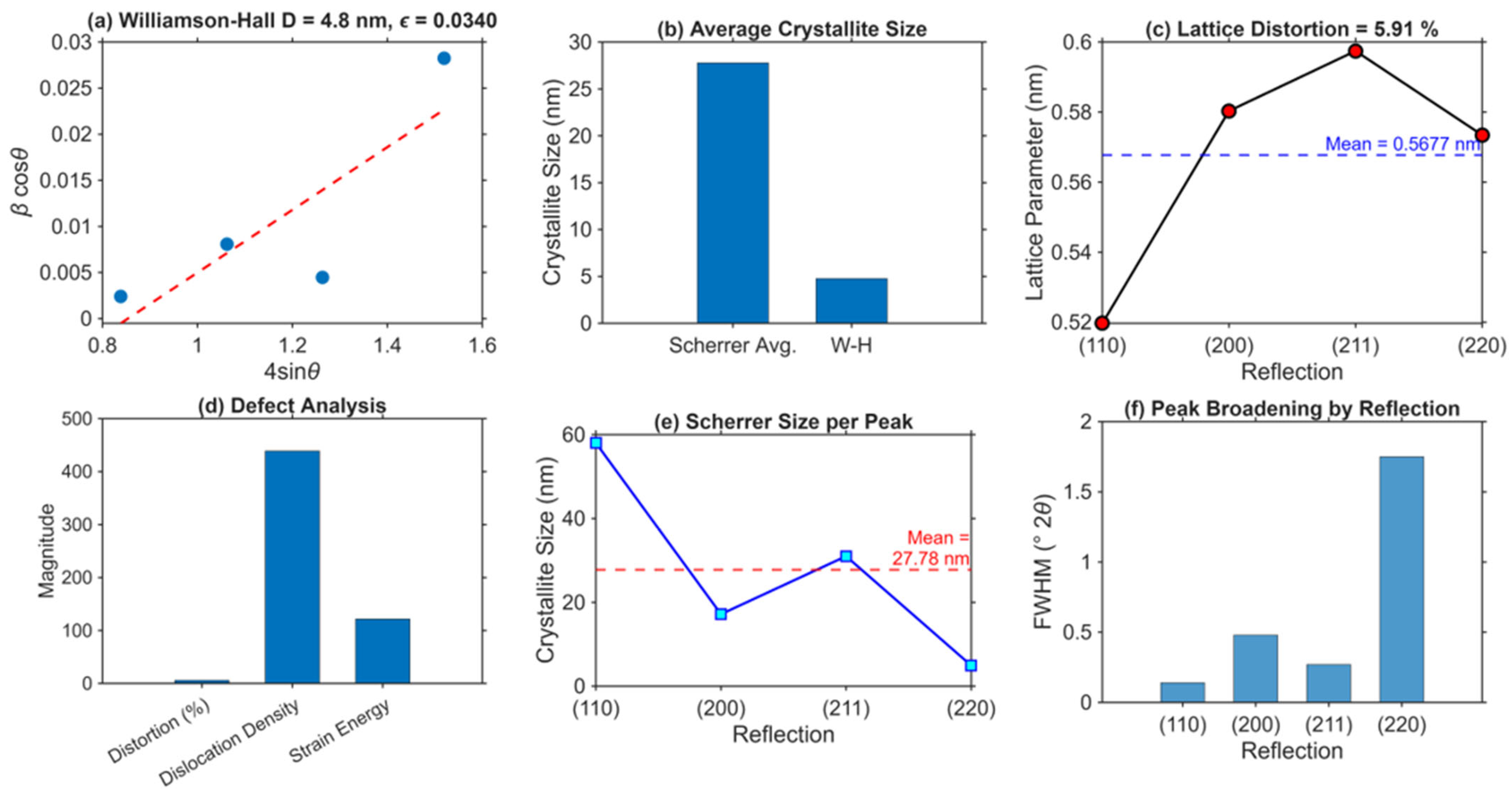
XRD-based analysis of the AlFeCoNi MEA: (a) Williamson–Hall plot in which red dotted line shows the fitting; (b) average crystallite size; (c) lattice-parameter variation and lattice distortion size in which blue dotted line shows the mean value; (d) defect-related parameters; (e) reflection-wise Scherrer crystallite size in which red dotted line shows the mean value; and (f) peak broadening. Williamson–Hall values are approximate owing to limited reflections, nonlinearity, and uncorrected instrumental broadening.
The lattice-parameter analysis shown in Figure 2c produced an average calculated value of approximately 0.5677 nm, together with an apparent lattice distortion of 5.91%. These calculated values indicate substantial reflection-dependent variation, which may be associated with atomic-size mismatch, residual strain, and uncertainty in peak-position determination. Accordingly, the lattice-distortion value is presented as an indicative estimate and requires verification through instrumental calibration and whole-pattern refinement. The defect-related parameters shown in Figure 2d, including the estimated dislocation density and residual strain energy, similarly indicate substantial deformation-induced defect accumulation within the mechanically alloyed powder; however, because these quantities were derived from line-broadening calculations, they should also be considered semi-quantitative. Such stored defects may provide additional diffusion pathways during subsequent sintering, although their direct contribution to densification was not independently measured in the present study. The reflection-dependent variations in the Scherrer crystallite size and FWHM shown in Figure 2e,f further suggest non-uniform peak broadening and possible anisotropic strain within the mechanically alloyed structure. Overall, the XRD results support the formation of a refined and highly strained AlFeCoNi alloy powder, while the quantitative line-profile parameters should be interpreted cautiously because of the limited number of reflections, deviation from Williamson–Hall linearity, and lack of instrumental-broadening correction.
The SEM micrograph of the ball-milled AlFeCoNi powder (Figure 3a) shows irregularly shaped fine particles together with larger connected clusters formed through repeated fracture, cold welding, and re-agglomeration during mechanical alloying. Image segmentation identified approximately 1150 two-dimensional objects within the analyzed field (Figure 3b). However, these segmented objects should not all be interpreted as discrete primary particles. Depending on particle contact and overlap, each detected region may represent either an individually resolved particle or an unresolved agglomerate. The color-coded map in Figure 3c therefore illustrates the distribution of segmented powder features rather than a map of exclusively separated particles. The segmented-object-size distribution shown in Figure 3d is strongly right-skewed. Most detected objects occur in the smaller-size range, whereas the extended right-hand tail is associated with larger connected clusters or agglomerates. Accordingly, this distribution represents two-dimensional projected feature sizes and should not be interpreted as the intrinsic primary-particle-size distribution of the powder. The shape analysis in Figure 3e shows a general relationship between the major and minor axes of the segmented objects, while the circularity values indicate substantial morphological variation. The metric spread in Figure 3f further demonstrates that object diameter varies more widely than aspect ratio and circularity. Overall, the SEM analysis indicates the coexistence of fine individually resolved particles and larger agglomerated features after mechanical alloying.
Figure 3.
SEM image analysis of ball-milled AlFeCoNi MEA powder: (a) original micrograph; (b) segmented-object overlay; (c) color-coded map of individually resolved particles and connected agglomerates; (d) segmented-object-size distribution; (e) shape analysis; and (f) metric spread.
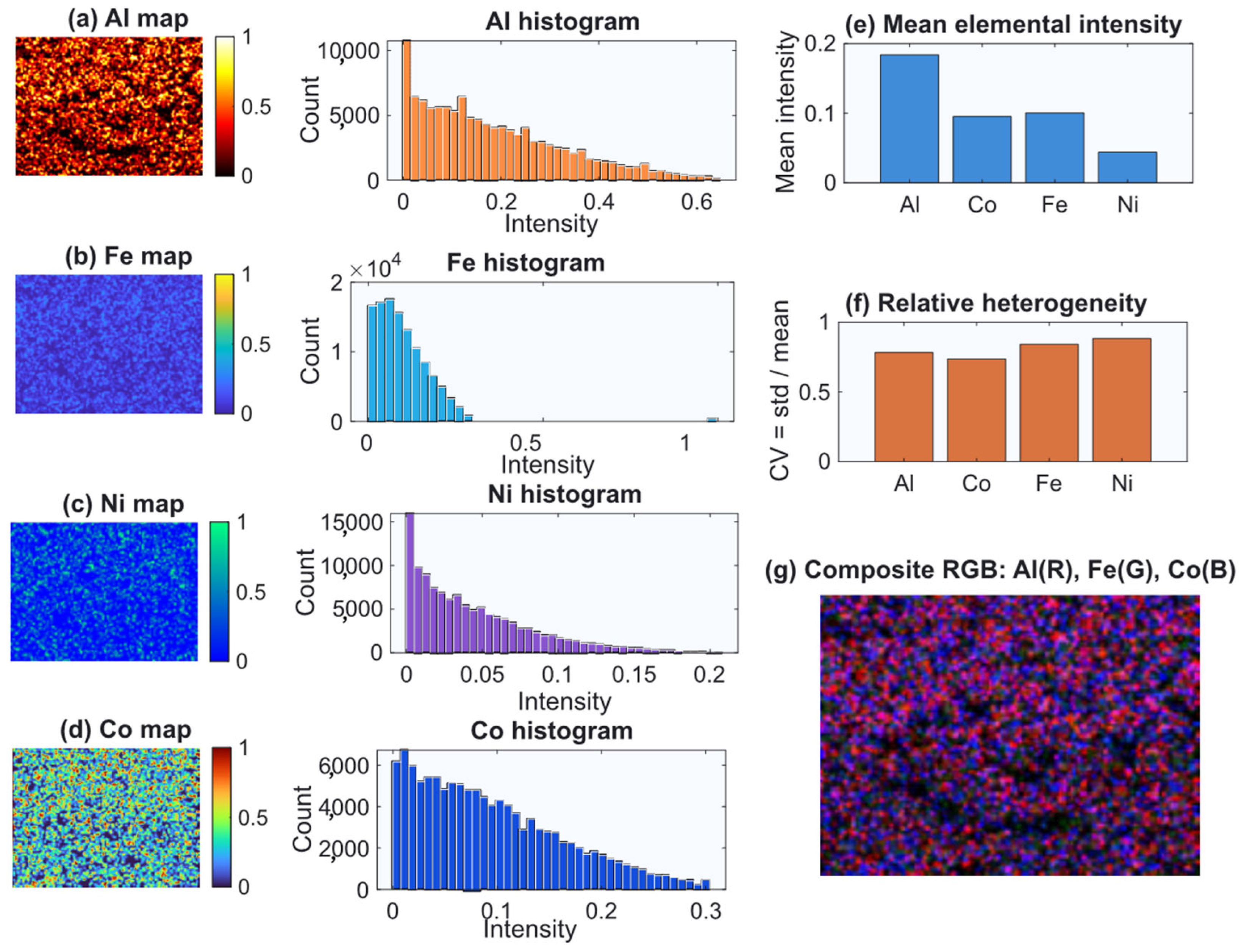
Figure 4 presents the compositional characterization of the ball-milled AlFeCoNi medium entropy alloy powder. The image shows a highly refined particulate structure with irregular, flattened, and agglomerated particles, which is typical of prolonged mechanical milling. The particle size distribution is strongly skewed toward fine particles, indicating substantial fragmentation during milling, while the shape analysis suggests a broad spread in major and minor axis lengths, reflecting the coexistence of equiaxed fines and larger fractured agglomerates. The circularity and aspect-ratio metrics further confirm that the powder is not fully spherical, which is expected for mechanically alloyed powders that undergo repeated cold welding and fracture. Overall, the image set indicates that ball milling successfully produced a fine, heterogeneous powder population with high surface area and a morphology favorable for subsequent compaction and sintering.
Figure 4.
(a–d) Compositional characterization (EDS mapping) of the ball-milled AlFeCoNi medium entropy alloy powder with their respected element histogram. (e) Mean elemental intensity, (f) relative heterogeneity and (g) Composite superimposed image of element Al, Fe, Co.
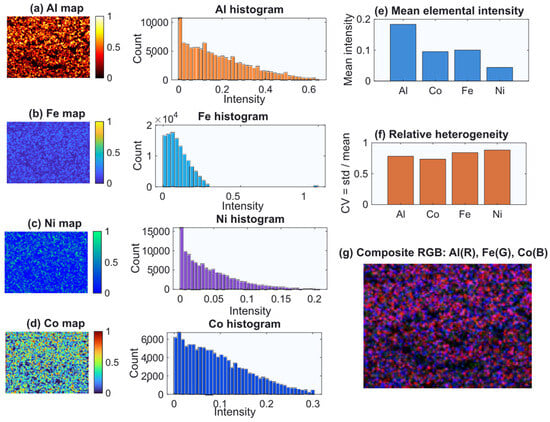
The EDS map set for the ball-milled powder indicates that Al, Fe, Co, and Ni are distributed throughout the particle field with no obvious large-scale elemental segregation. The elemental intensity histograms show broad distributions, which is consistent with local compositional fluctuations commonly observed after mechanical alloying. The elemental maps indicate that Al, Fe, Co, and Ni are distributed throughout the analyzed field without obvious large-scale segregation. Because the maps provide qualitative intensity information and quantitative EDS measurements from multiple regions were not performed, differences in elemental signal intensity should not be interpreted as differences in composition. The composite RGB map also shows a largely interwoven distribution of the constituent elements, implying that the milling step promoted significant elemental mixing rather than macroscopic-phase separation. Minor contrast variations across the maps likely reflect local enrichment regions, which are common in mechanically milled entropy alloys and may later influence diffusion, densification, and phase evolution during sintering.
3.2. Characterization of Compacted and Sintered Alloy
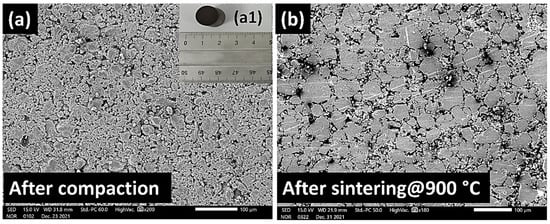
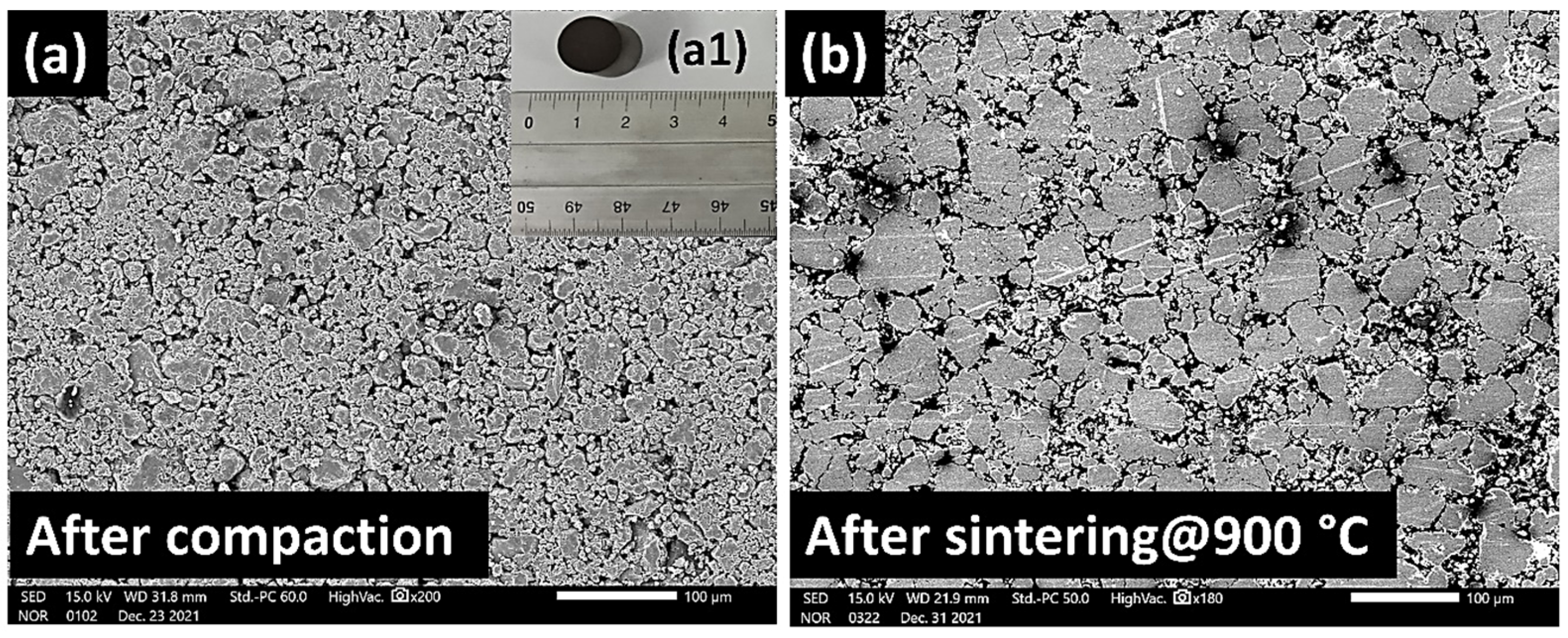
Figure 5a displays SEM images of the compacted and sintered alloy. Under low magnification, the alloys appear noticeably densified after compaction. Nevertheless, certain pores become noticeable, likely caused by either a reduced compacting pressure or a smaller holding time. Furthermore, several isolated particles remain unaffected by the compaction. Nevertheless, some particles exhibit initial deformation, as indicated in the image. In addition, the image of the compacted pellet has been shown in the insert as Figure 5(a1). Furthermore, Figure 5b vividly illustrates the impact of the sintering temperature at 900 °C. The particle edges exhibit a smoother appearance, accompanied by the emergence of additional connections, resulting in a visibly porous structure within the neck connections. Furthermore, several areas featuring fused particles are apparent, facilitating further progression in neck formation, as depicted in the images. Nonetheless, there is evidence of weak bonding between particles. Figure 5b describes the SEM response of the compacted and vacuum-sintered AlFeCoNi specimen prepared by conventional pressing followed by sintering at 900 °C for 1 h. The micrograph indicates a much more consolidated structure than the milled powder, with particle boundaries substantially reduced and neck growth between adjacent particles becoming evident. This behavior is consistent with solid-state sintering, where diffusion-driven mass transport leads to densification, pore shrinkage, and the gradual disappearance of the original powder morphology. Residual pores and some uneven contrast can still be seen, signifying that densification was noteworthy but not complete under the selected processing conditions. Such features are usually associated with limited diffusion at intermediate sintering temperatures, particularly in multicomponent alloys where element-specific diffusion rates can differ.
Figure 5.
(a) Compaction of 30 h milled powder; (a1) compacted pellet and (b) surface morphology of sintered AlFeCoNi MEA pellet.
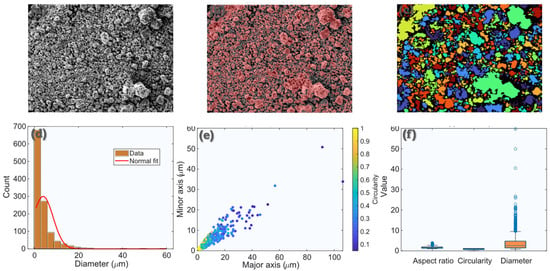
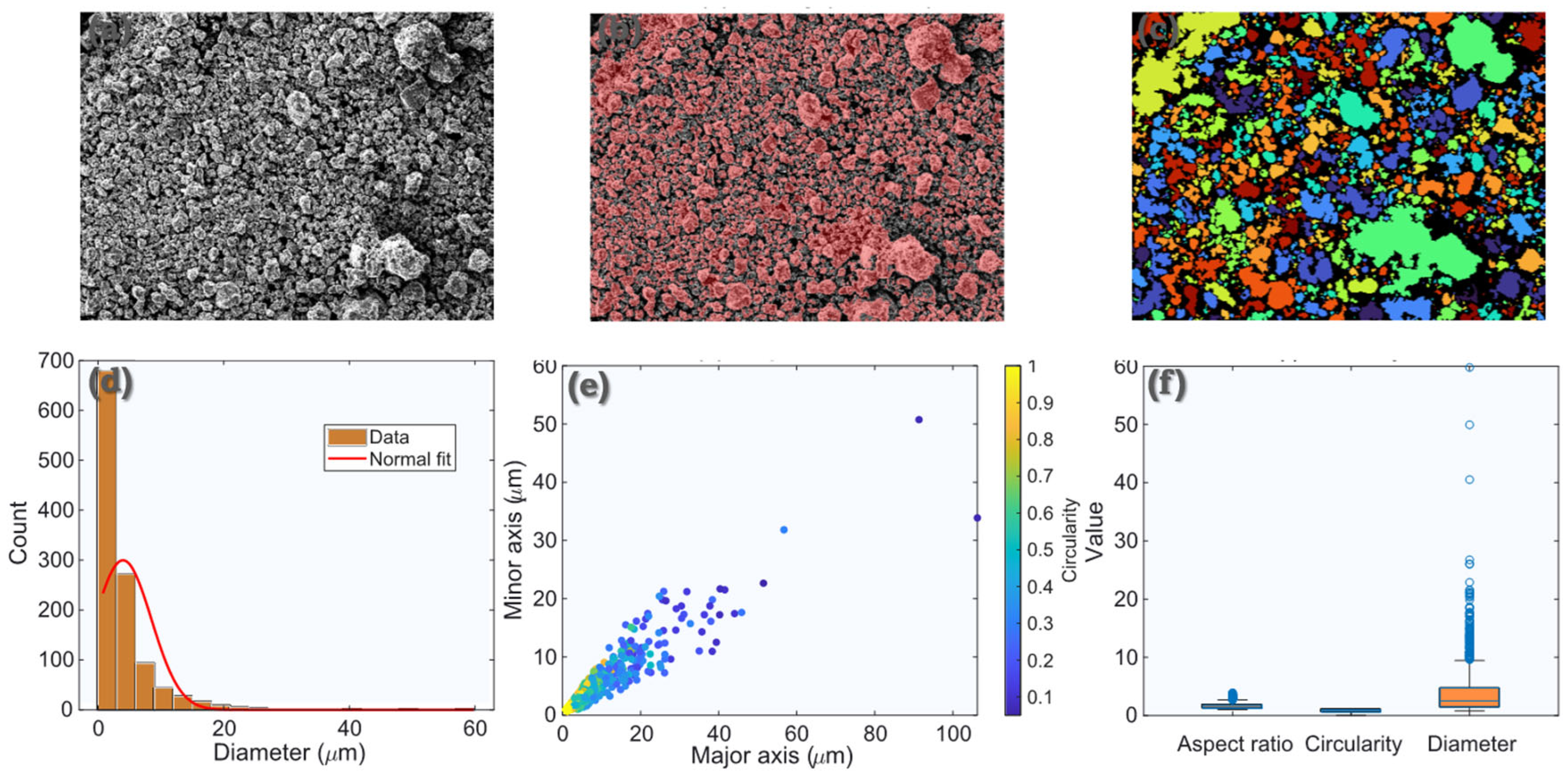
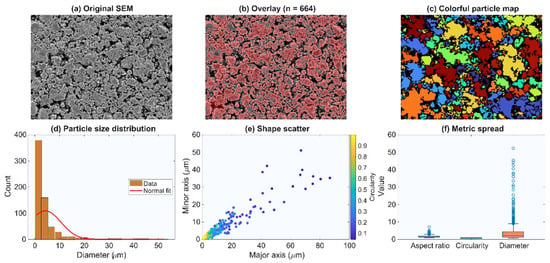
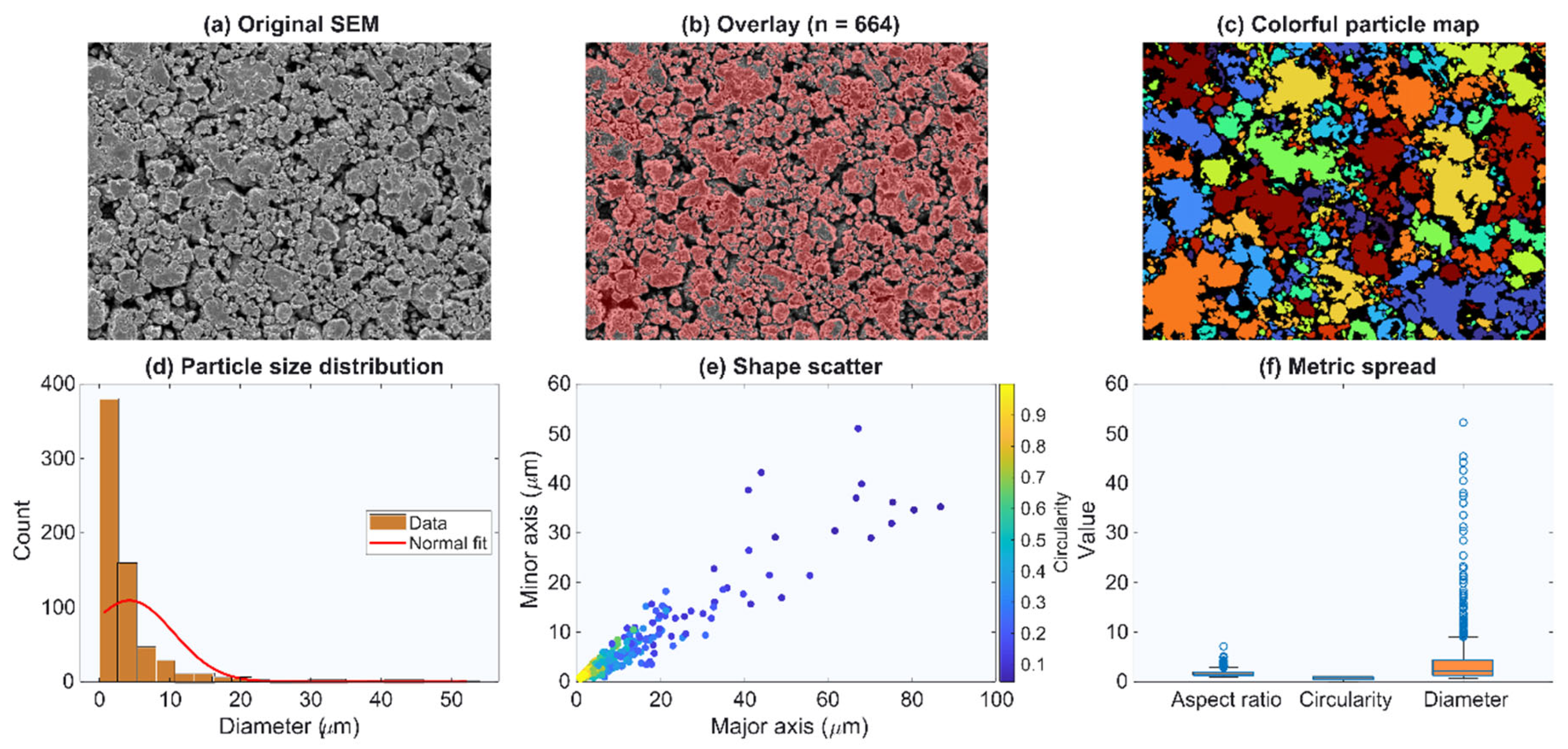
Taken together, the two images display the expected processing evolution from a mechanically milled powder state to a sintered bulk compact. Ball milling produced a fine, heterogeneous powder with strong mixing of the constituent elements, while pressing and sintering transformed this powder into a more coherent microstructure through densification and interparticle bonding. The retained porosity in the sintered sample suggests that longer dwell time, higher sintering temperature, or hot-pressing-assisted consolidation could further advance densification. These observations support the effectiveness of the processing route for producing AlFeCoNi MEA compacts, while also highlighting the necessity to optimize sintering parameters to minimize residual porosity and enhance structural uniformity. The SEM micrograph of the treated powder (Figure 6a) displays unevenly shaped particles with more surface roughness and partial agglomeration, representing mechanical treating affecting repeated deformation, fracture, and cold welding. The segmented overlay (Figure 6b) effectively resolves ~664 particles, even in clustered regions, representing effective image-based particle identification. The recreated particle map (Figure 6c) highlights coexistence of fine uneven particles and larger agglomerates, reflecting non-uniform breakup and re-agglomeration during processing. The particle size distribution (Figure 6d) is strongly right-skewed, controlled by fine particles with a minor fraction of coarse agglomerates, which normally advances powder packing. The shape analysis (Figure 6e) illustrates that particle size grows with elongation, while minor particles tend to be more circular and equiaxed. The metric study (Figure 6f) approves comparatively fine variation in aspect ratio and circularity, while particle diameter displays wide dispersion, demonstrating size as the key basis of heterogeneity. Generally, the powder is fine-particle conquered with modest agglomeration, which is probable to stimulus packing efficiency and densification behavior during consolidation. It should be emphasized that the observed reduction in visible particle boundaries, development of interparticle necks, and changes in pore connectivity provide only qualitative evidence of sintering-induced consolidation. Quantitative area-fraction porosity, pore-size distribution, and relative density were not measured in the present study. Therefore, no statistically supported claim regarding the magnitude of densification before and after sintering is made.
Figure 6.
SEM analysis of sintered AlFeCoNi (a) SEM micrograph, (b) quantitative image analysis, (c) particle map, (d) particle size distribution, (e) shape analysis, and (f) boxplot analysis.
4. Discussion
Mechanical alloying followed by vacuum sintering produced clear morphological and microstructural changes in the AlFeCoNi MEA. During 30 h of ball milling, repeated cold welding, deformation, fracture, and re-agglomeration generated irregular powder features with a broad projected-size distribution. Because connected regions were treated as single segmented objects, the image-analysis results represent both individually resolved particles and unresolved agglomerates rather than true primary-particle sizes. EDS mapping showed that Al, Fe, Co, and Ni were distributed throughout the analyzed powder field without obvious large-scale segregation, indicating improved microscale mixing during milling. However, EDS cannot confirm complete atomic-scale homogenization or exclude nanoscale compositional variations. The broadened XRD peaks further indicate crystallite refinement and defect accumulation. The difference between the Scherrer and Williamson–Hall crystallite sizes suggest a significant contribution from strain broadening. Nevertheless, the calculated crystallite size, microstrain, lattice distortion, dislocation density, and strain-energy values should be considered semi-quantitative because of the limited number of reflections, deviation from Williamson–Hall linearity, and absence of instrumental-broadening correction. After compaction and sintering at 900 °C for 1 h, interparticle necks, fused regions, and reduced visibility of some powder boundaries were observed, indicating the progression of solid-state sintering. Residual pores and incompletely bonded regions remained, demonstrating incomplete consolidation under the selected conditions. However, because green and sintered densities, pore-area fractions, pore-size distributions, and dimensional shrinkage were not measured, the extent of densification and the sizes of pores eliminated or retained cannot be quantified.
The formation of necks may involve surface, grain-boundary, and lattice diffusion, but the dominant diffusion mechanism cannot be identified from static SEM observations alone. Surface diffusion can promote neck growth without substantial shrinkage, whereas grain-boundary and lattice diffusion contribute more directly to pore elimination. The coexistence of neck formation and residual porosity therefore suggests that local interparticle bonding occurred, while mass transport remained insufficient for extensive pore closure. Confirmation would require dilatometry and activation-energy analysis, such as Young–Cutler or Master Sintering Curve modeling. The low compaction pressure of 20 MPa and the single-stage sintering schedule likely contributed to the retained porosity. Dewangan et al. [21] similarly reported improved but incomplete densification in conventionally sintered AlFeCoNiSi. Lee et al. [36] showed that a modulated heating schedule improved density and microstructural uniformity in metal-injection-molded CoCrFeMnNi, demonstrating that the complete thermal profile is important. Lassinantti Gualtieri et al. [37] obtained only approximately 88.4–91.0% relative density in CoCrFeNi despite substantially higher compaction pressure and sintering temperature, while Salifu and Olubambi [38] demonstrated improved densification using field-assisted sintering. These comparisons indicate that the residual porosity in the present AlFeCoNi compact is more likely associated with insufficient green density and a non-optimized sintering schedule than with an intrinsic limitation of the alloy system. Overall, the study demonstrates powder refinement, improved elemental mixing, neck formation, and partial consolidation during mechanical alloying and conventional sintering. Future work should include Archimedes density, quantitative pore analysis, dilatometry, and microhardness testing to establish reliable processing–microstructure–property relationships.
5. Conclusions
The present work confirms that ball milling is an effective route for producing fine, compositionally mixed AlFeCoNi medium-entropy alloy powder with irregular particle shapes and a broad particle size distribution. The EDS results indicate that the constituent elements are distributed relatively uniformly at the microscale after milling, with only minor local heterogeneity. Subsequent pressing and vacuum sintering at 900 °C for 1 h resulted in noticeable changes in the microstructural continuity and pore morphology of the powder compact, indicating further microstructural evolution during thermal treatment. The presence of pores after sintering also indicates that the applied sintering conditions did not eliminate the observed pore features.
In summary, the processing sequence of mechanical alloying, compaction, and vacuum sintering produced an AlFeCoNi MEA compact with distinct microstructural changes following thermal treatment. The study highlights the relationship between powder refinement, elemental mixing, and microstructural evolution during the processing of AlFeCoNi MEA. However, the present study is limited to processing and microstructural characterization because quantitative measurements of relative density, porosity, shrinkage, hardness, and mechanical properties were not performed. Therefore, the present observations should be considered qualitative, and systematic quantitative characterization of densification, porosity, and mechanical properties is required in future work to establish reliable processing–microstructure–property relationships.
Author Contributions
Conceptualization, R.J., S.J., R.K.P., and S.K.D.; methodology, R.J., S.J., and S.K.D.; validation, R.J., S.J., and S.K.D.; formal analysis, R.J., K.G.S.S., R.K., M.M., R.S., A.K.P., S.K.S., S.N.K., R.K.P., S.K.D., and S.J.; investigation, R.J., S.J., and S.K.D.; writing—original draft preparation R.J., S.J., and S.K.D.; writing—review and editing, R.J., K.G.S.S., R.K., M.M., R.S., A.K.P., S.K.S., S.N.K., R.K.P., S.K.D., and S.J. All authors have read and agreed to the published version of the manuscript.
Funding
This research received no external funding.
Institutional Review Board Statement
Not applicable.
Informed Consent Statement
Not applicable.
Data Availability Statement
The original contributions presented in this study are included in the article. Further inquiries can be directed to the corresponding authors.
Conflicts of Interest
The authors declare no conflicts of interest.
References
- Yeh, J.-W.; Chen, S.-K.; Lin, S.-J.; Gan, J.-Y.; Chin, T.-S.; Shun, T.-T.; Tsau, C.-H.; Chang, S.-Y. Nanostructured High-Entropy Alloys with Multiple Principal Elements: Novel Alloy Design Concepts and Outcomes. Adv. Eng. Mater. 2004, 6, 299–303. [Google Scholar] [CrossRef] [Scilit]
- Wang, X.; An, Z.; Cai, J.; Jiang, C.; Su, H.; Luo, X.; Li, Z.; Wu, S.; Yang, L.; Long, H.; et al. Design of novel AlCoFeNiV high-entropy alloys with high-strength and high-ductility. Mater. Charact. 2023, 203, 113059. [Google Scholar] [CrossRef] [Scilit]
- Jain, S.; Wagri, N.K.; Bhowmik, A.; Park, N. Machine Learning Approaches for Predicting Mechanical Performance and Reducing Experimentation in Refractory High-Entropy Alloys. Adv. Eng. Mater. 2025, 27, 202403052. [Google Scholar] [CrossRef] [Scilit]
- Dewangan, S.K.; Mangish, A.; Kumar, S.; Sharma, A.; Ahn, B.; Kumar, V. A review on High-Temperature Applicability: A milestone for high entropy alloys. Eng. Sci. Technol. Int. J. 2022, 35, 101211. [Google Scholar] [CrossRef] [Scilit]
- Maulik, O.; Kumar, D.; Kumar, S.; Dewangan, S.K.; Kumar, V. Structure and properties of lightweight high entropy alloys: A brief review. Mater. Res. Express 2018, 5, 052001. [Google Scholar] [CrossRef] [Scilit]
- Chen, J.; Zhou, X.; Wang, W.; Liu, B.; Lv, Y.; Yang, W.; Xu, D.; Liu, Y. A review on fundamental of high entropy alloys with promising high–temperature properties. J. Alloys Compd. 2018, 760, 15–30. [Google Scholar] [CrossRef] [Scilit]
- Jain, S.; Jain, R.; Rahul, M.R.; Samal, S.; Kumar, V. Phase Equilibria and Mechanical Properties in Multicomponent Al–Ni–X (X = Fe, Cr) Alloys. Trans. Indian Inst. Met. 2018, 71, 2819–2825. [Google Scholar] [CrossRef] [Scilit]
- Tabonah, T.M.K.; Akkaş, M.; Islak, S. Microstructure, Wear and Corrosion Properties of NiB-TiC Composite Materials Produced by Powder Metallurgy Method. Sci. Sinter. 2019, 51, 327–337. [Google Scholar] [CrossRef] [Scilit]
- Yirik, A.; Gündüz, S.; Taştemür, D.; Erden, M. Microstructural and mechanical properties of hot deformed AISI 4340 steel produced by powder metallurgy. Sci. Sinter. 2023, 55, 45–56. [Google Scholar] [CrossRef] [Scilit]
- Shin, M.W.; Jo, S.-J.; Soni, S.K.; Lee, J.-W.; Moon, J.; Kim, H.S.; Hong, S.-J. Engineering heterogeneous microstructure for enhancing mechanical properties of multicomponent alloys via powder metallurgy route. Mater. Sci. Eng. A 2025, 941, 148599. [Google Scholar] [CrossRef] [Scilit]
- Dewangan, S.K.; Kumar, D.; Samal, S.; Kumar, V. Microstructure and Mechanical Properties of Nanocrystalline AlCrFeMnNiWx (x = 0, 0.05, 0.1, 0.5) High-Entropy Alloys Prepared by Powder Metallurgy Route. J. Mater. Eng. Perform. 2021, 30, 4421–4431. [Google Scholar] [CrossRef] [Scilit]
- Kumar, A.; Kumar Dewangan, S.; Singh, S.; Chopkar, M.; Sreesha, R.B. Chapter 2 Classification of processing routes. In High-Entropy Alloys; De Gruyter: Berlin, Germany; Boston, MA, USA, 2023; pp. 31–40. [Google Scholar] [CrossRef] [Scilit]
- Khoshghadam-Pireyousefan, M.; Mohammadzadeh, A.; Heidarzadeh, A.; Brabazon, D. Fundamentals of Spark Plasma Sintering for Metallic, Ceramic, and Polymer Matrix Composites Production. In Encyclopedia of Materials: Composites; Elsevier: Amsterdam, The Netherlands, 2021; pp. 822–836. [Google Scholar] [CrossRef] [Scilit]
- Soni, S.K.; Nagarjuna, C.; Mohan, M.; Prakash, V.J.; Dewangan, S.K.; Sharma, S.K.; Thomas, S.B.; Sharma, V.K.; Thomas, B. Recent progress in metal matrix hybrid composites fabricated via liquid and solid-state processing: Fabrication techniques, characteristics and future prospects. J. Alloys Compd. 2025, 1032, 181064. [Google Scholar] [CrossRef] [Scilit]
- Chaudhary, V.; Soni, V.; Gwalani, B.; Ramanujan, R.V.; Banerjee, R. Influence of non-magnetic Cu on enhancing the low temperature magnetic properties and Curie temperature of FeCoNiCrCu(x) high entropy alloys. Scr. Mater. 2020, 182, 99–103. [Google Scholar] [CrossRef] [Scilit]
- Nagarjuna, C.; Soni, S.K.; Shyamal, S.; Ziqi, M.; Lim, K.S.; Lee, J.-H.; Lu, W.; He, B.; Hong, S.-J. Engineering hetero-lamellar structure in high-entropy alloys: Interface-driven strengthening and deformation behavior. J. Alloys Compd. 2026, 1079, 189883. [Google Scholar] [CrossRef] [Scilit]
- Zhang, A.; Han, J.; Meng, J.; Su, B.; Li, P. Rapid preparation of AlCoCrFeNi high entropy alloy by spark plasma sintering from elemental powder mixture. Mater. Lett. 2016, 181, 82–85. [Google Scholar] [CrossRef] [Scilit]
- Jain, R.; Jain, S.; Dewangan, S.K.; Naveen, L.; Patre, D.; Samal, S.; Kumar, V. Prediction of Hot Deformation Behavior in AlCoCrFeNi2.1 Eutectic High Entropy Alloy by Conventional and Artificial Neural Network Modeling. Trans. Indian Natl. Acad. Eng. 2024, 9, 709–724. [Google Scholar] [CrossRef] [Scilit]
- Ananiadis, E.; Lentzaris, K.; Georgatis, E.; Mathiou, C.; Poulia, A.; Karantzalis, A.E. AlNiCrFeMn Equiatomic High Entropy Alloy: A Further Insight in Its Microstructural Evolution, Mechanical and Surface Degradation Response. Met. Mater. Int. 2020, 26, 793–811. [Google Scholar] [CrossRef] [Scilit]
- Tung, C.-C.; Yeh, J.-W.; Shun, T.; Chen, S.-K.; Huang, Y.-S.; Chen, H.-C. On the elemental effect of AlCoCrCuFeNi high-entropy alloy system. Mater. Lett. 2007, 61, 1–5. [Google Scholar] [CrossRef] [Scilit]
- Dewangan, S.K.; Nagarjuna, C.; Lee, H.; Sharma, A.; Ahn, B. Surface morphology transformation and densification behaviour of conventionally sintered AlFeCoNiSi high entropy alloys. Powder Metall. 2023, 66, 650–661. [Google Scholar] [CrossRef] [Scilit]
- Sriharitha, R.; Murty, B.S.; Kottada, R.S. Alloying, thermal stability and strengthening in spark plasma sintered AlxCoCrCuFeNi high entropy alloys. J. Alloys Compd. 2014, 583, 419–426. [Google Scholar] [CrossRef] [Scilit]
- Ji, W.; Fu, Z.; Wang, W.; Wang, H.; Zhang, J.; Wang, Y.; Zhang, F. Mechanical alloying synthesis and spark plasma sintering consolidation of CoCrFeNiAl high-entropy alloy. J. Alloys Compd. 2014, 589, 61–66. [Google Scholar] [CrossRef] [Scilit]
- Kanyane, L.R.; Popoola, A.P.; Malatji, N. Development of spark plasma sintered TiAlSiMoW multicomponent alloy: Microstructural evolution, corrosion and oxidation resistance. Results Phys. 2019, 12, 1754–1761. [Google Scholar] [CrossRef] [Scilit]
- Alcalá, M.D.; Real, C.; Fombella, I.; Trigo, I.; Córdoba, J.M. Effects of milling time, sintering temperature, Al content on the chemical nature, microhardness and microstructure of mechanochemically synthesized FeCoNiCrMn high entropy alloy. J. Alloys Compd. 2018, 749, 834–843. [Google Scholar] [CrossRef] [Scilit]
- Jain, S.; Naveen, L.; Kumar, V.; Samal, S. Solidification Simulation and Experimental Validation of Single-Phase Fe–Co–Cr–Ni–V–Al High-Entropy Alloy. Trans. Indian Inst. Met. 2023, 76, 1719–1729. [Google Scholar] [CrossRef] [Scilit]
- Wang, L.; Yao, C.; Shen, J.; Zhang, Y.; Liu, G.; Wu, X.; Zhang, G. A new method to design eutectic high-entropy alloys by determining the formation of single-phase solid solution and calculating solidification paths. Mater. Sci. Eng. A 2022, 830, 142325. [Google Scholar] [CrossRef] [Scilit]
- Moravcik, I.; Kubicek, A.; Moravcikova-Gouvea, L.; Adam, O.; Kana, V.; Pouchly, V.; Zadera, A.; Dlouhy, I. The Origins of High-Entropy Alloy Contamination Induced by Mechanical Alloying and Sintering. Metals 2020, 10, 1186. [Google Scholar] [CrossRef] [Scilit]
- Mane, R.B.; Panigrahi, B.B. Sintering mechanisms of mechanically alloyed CoCrFeNi high-entropy alloy powders. J. Mater. Res. 2018, 33, 3321–3329. [Google Scholar] [CrossRef] [Scilit]
- Rohila, S.; Mane, R.B.; Ummethala, G.; Panigrahi, B.B. Nearly full-density pressureless sintering of AlCoCrFeNi-based high-entropy alloy powders. J. Mater. Res. 2019, 34, 777–786. [Google Scholar] [CrossRef] [Scilit]
- Han, J.; Su, B.; Lu, J.; Meng, J.; Zhang, A.; Wu, Y. Preparation of MoNbTaW refractory high entropy alloy powders by pressureless spark plasma sintering: Crystal structure and phase evolution. Intermetallics 2020, 123, 106832. [Google Scholar] [CrossRef] [Scilit]
- Cui, G.; Wei, X.; Olevsky, E.; German, R.; Chen, J. The Manufacturing of High Porosity Iron with an Ultra-Fine Microstructure via Free Pressureless Spark Plasma Sintering. Materials 2016, 9, 495. [Google Scholar] [CrossRef] [Scilit]
- Fan, J.T.; Zhang, L.J.; Yu, P.F.; Zhang, M.D.; Liu, D.J.; Zhou, Z.; Cui, P.; Ma, M.Z.; Jing, Q.; Li, G.; et al. Improved the microstructure and mechanical properties of AlFeCoNi high-entropy alloy by carbon addition. Mater. Sci. Eng. A 2018, 728, 30–39. [Google Scholar] [CrossRef] [Scilit]
- Zuo, T.T.; Li, R.B.; Ren, X.J.; Zhang, Y. Effects of Al and Si addition on the structure and properties of CoFeNi equal atomic ratio alloy. J. Magn. Magn. Mater. 2014, 371, 60–68. [Google Scholar] [CrossRef] [Scilit]
- Guo, S.; Liu, C.T. Phase stability in high entropy alloys: Formation of solid-solution phase or amorphous phase. Prog. Nat. Sci. Mater. Int. 2011, 21, 433–446. [Google Scholar] [CrossRef] [Scilit]
- Lee, D.W.; Shin, D.S.; Ha, H.; Park, S.J.; Lee, K.-A.; Kim, H.S. Modulated heating rate effect on optimizing sintered density and microstructure in CoCrFeMnNi high-entropy alloy fabricated through metal injection molding. Mater. Charact. 2024, 214, 114037. [Google Scholar] [CrossRef] [Scilit]
- Lassinantti Gualtieri, M.; Colombini, E.; Paradisi, E.; Mortalò, C.; Veronesi, P. Low-pressure forming and reactive sintering for the synthesis of equimolar CoCrFeNi bulk alloys. Int. J. Adv. Manuf. Technol. 2026, 144, 5169–5188. [Google Scholar] [CrossRef] [Scilit]
- Salifu, S.; Olubambi, P.A. Influence of Sintering Temperature on Densification and Nanomechanical Properties of High Entropy Alloy Consolidated via Field Assisted Sintering Technology. Eng. Rep. 2025, 7, 70519. [Google Scholar] [CrossRef] [Scilit]
Disclaimer/Publisher’s Note: The statements, opinions and data contained in all publications are solely those of the individual author(s) and contributor(s) and not of MDPI and/or the editor(s). MDPI and/or the editor(s) disclaim responsibility for any injury to people or property resulting from any ideas, methods, instructions or products referred to in the content. |
© 2026 by the authors. Licensee MDPI, Basel, Switzerland. This article is an open access article distributed under the terms and conditions of the Creative Commons Attribution (CC BY) license.