


Abstract
The controllable synthesis of nanofluids with tailored morphology and the elucidation of their true mass transfer enhancement mechanism remain critical challenges for efficient CO2 capture. A continuous microfluidic strategy using a spiral channel reactor is reported for the controlled synthesis of uniform anatase TiO2 nanoparticles with an average size of 67 nm and their application in CO2 absorption. The optimal synthesis conditions were established as 240 mmol·L−1NaOH, 60 mmol·L−1 TiCl4, and a precursor-to-alkali flow rate ratio of 1:3.5. A one-dimensional unsteady diffusion model was established to quantify the CO2 diffusion coefficient. The as-prepared TiO2 nanofluid exhibits excellent colloidal stability and achieves a 1.36-fold enhancement in CO2 absorption compared to deionized water. Systematic characterizations and quantitative analysis confirm that direct CO2 adsorption onto nanoparticles is negligible. At 298 K, the CO2 diffusion coefficient exhibited an 18% increase relative to pure water, with temperature dependence well described by the Arrhenius equation. Nanoparticle-induced micro-convection macroscopically increases the effective diffusion coefficient. This work provides a reliable route for the high-throughput controllable preparation of high-performance TiO2 nanofluids and clarifies the non-adsorption-based microscale mass transfer enhancement mechanism, offering valuable insights for the rational design of nanofluid-based CO2 capture systems.
1. Introduction
The escalating greenhouse effect driven primarily by anthropogenic carbon dioxide (CO2) emissions has become a pressing global concern [1]. Amine-based absorption, as the most mature technology for CO2 capture, is severely restricted by high energy consumption for solvent regeneration and potential solvent leakage [2]. Therefore, the development of more energy-efficient and environmentally friendly CO2 capture technologies is urgently needed.
Nanofluids, first proposed by Choi in 1995, have shown remarkable superiority in enhancing heat and mass transfer, making them promising candidates for CO2 capture [3,4,5]. Among various nanofluids, metal oxide nanofluids have attracted extensive attention. For example, Rashidi et al. [6] found that the addition of 0.025% v/v Al2O3 nanoparticles increased the CO2 absorption mass transfer coefficient of water-based nanofluids by 67.16% compared with pure water. Devakki et al. [7] reported that ZnO nanofluids exhibited 25.4% higher CO2 absorption efficiency than Al2O3 nanofluids due to better dispersion stability. The enhancement mechanisms are generally attributed to nanoparticle-induced micro-convection (e.g., Brownian motion), bubble break-up, and increased solid adsorption capacity, which synergistically optimize gas–liquid mass transfer [8].
Despite substantial progress, current studies still face two critical limitations that hinder the rational design and practical application of high-performance nanofluids. Firstly, most nanofluids are fabricated via conventional batch methods, typically the ultrasound-assisted two-step approach, which suffers from poor controllability over particle size distribution and morphology, leading to obvious batch-to-batch inconsistency and difficulty in tailoring nanofluid properties [9]. Secondly, the reported enhancement effects are highly dependent on reactor types and operating conditions, resulting in an unclear and even controversial understanding of the synergistic contribution of different intensification mechanisms. Consequently, the synergistic mass transfer mechanism involving both Brownian motion and adsorption effects remains poorly understood in existing studies.
To address the poor controllability in nanoparticle synthesis and dispersion, microfluidic technology has become a powerful platform with excellent heat and mass transfer performance [10]. Studies have confirmed that microfluidic routes enable continuous and controllable preparation of nanoparticles with narrower size distribution and more uniform morphology than traditional batch methods [11,12]. For instance, Kašpar et al. [13] verified that microfluidic-synthesized silver nanoparticles possessed more uniform size and morphology compared with those from conventional methods. Wang et al. [14] developed low-cost 3D microfluidic chips for the preparation of highly monodisperse gold nanoparticles. Shojaei et al. [15] successfully prepared spherical mesoporous silica nanoparticles with an average size of ~70 nm and high specific surface area via a microfluidic strategy. These studies fully demonstrate that microfluidics can provide a stable, homogeneous, and repeatable reaction environment, significantly improving mixing efficiency and product uniformity.
Among diverse metal oxides, titanium dioxide (TiO2) shows unique advantages for CO2 capture [16], including abundant surface hydroxyl groups [17], high chemical stability [18], low cost [19], and environmental friendliness [20]. Zare et al. [21] reported that TiO2 nanofluids increased CO2 absorption efficiency by 60% compared with distilled water. Yi et al. [22] further confirmed that TiO2 nanoparticles significantly promoted the mass transfer of toluene in deep eutectic solvents. However, a critical research gap still exists in that current microfluidic synthesis mainly focuses on noble metals and silica, while studies on microfluidic preparation of TiO2 nanofluids remain scarce. Furthermore, the application of microfluidic-synthesized TiO2 nanofluids in CO2 mass transfer enhancement, as well as the quantitative analysis of corresponding enhancement mechanisms, have rarely been reported.
In this work, a continuous and high-throughput microfluidic strategy using a spiral microchannel reactor is proposed for the controllable synthesis of TiO2 nanofluids toward efficient CO2 capture. The spiral structure ensures rapid mixing and uniform nucleation, producing TiO2 nanoparticles with high sphericity and narrow size distribution. The prepared TiO2 nanofluid is then applied to static CO2 absorption experiments. Furthermore, the effects of synthesis parameters on nanoparticle structure, dispersion stability, and CO2 absorption performance are investigated to obtain the optimal preparation conditions. Finally, a one-dimensional unsteady mass transfer model is established and combined with experimental data to quantify the diffusion coefficient of CO2 in the nanofluid. By excluding the contribution of adsorption, this study aims to reveal a microscale mass transfer enhancement mechanism that relies on particle morphology and colloidal stability. This study not only develops a controllable route for the continuous preparation of high-performance TiO2 nanofluids but also provides a quantitative benchmark for the diffusion coefficient.
2. Experimental Section
2.1. Materials and Equipment
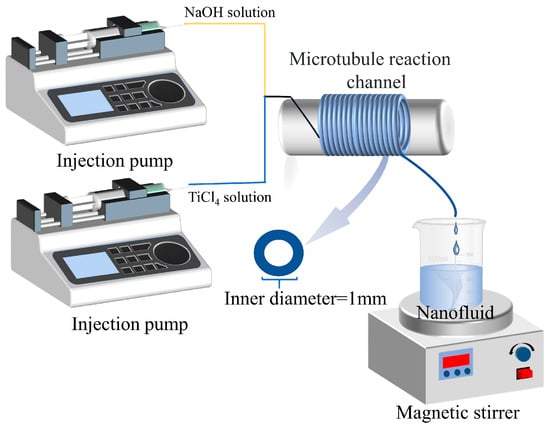
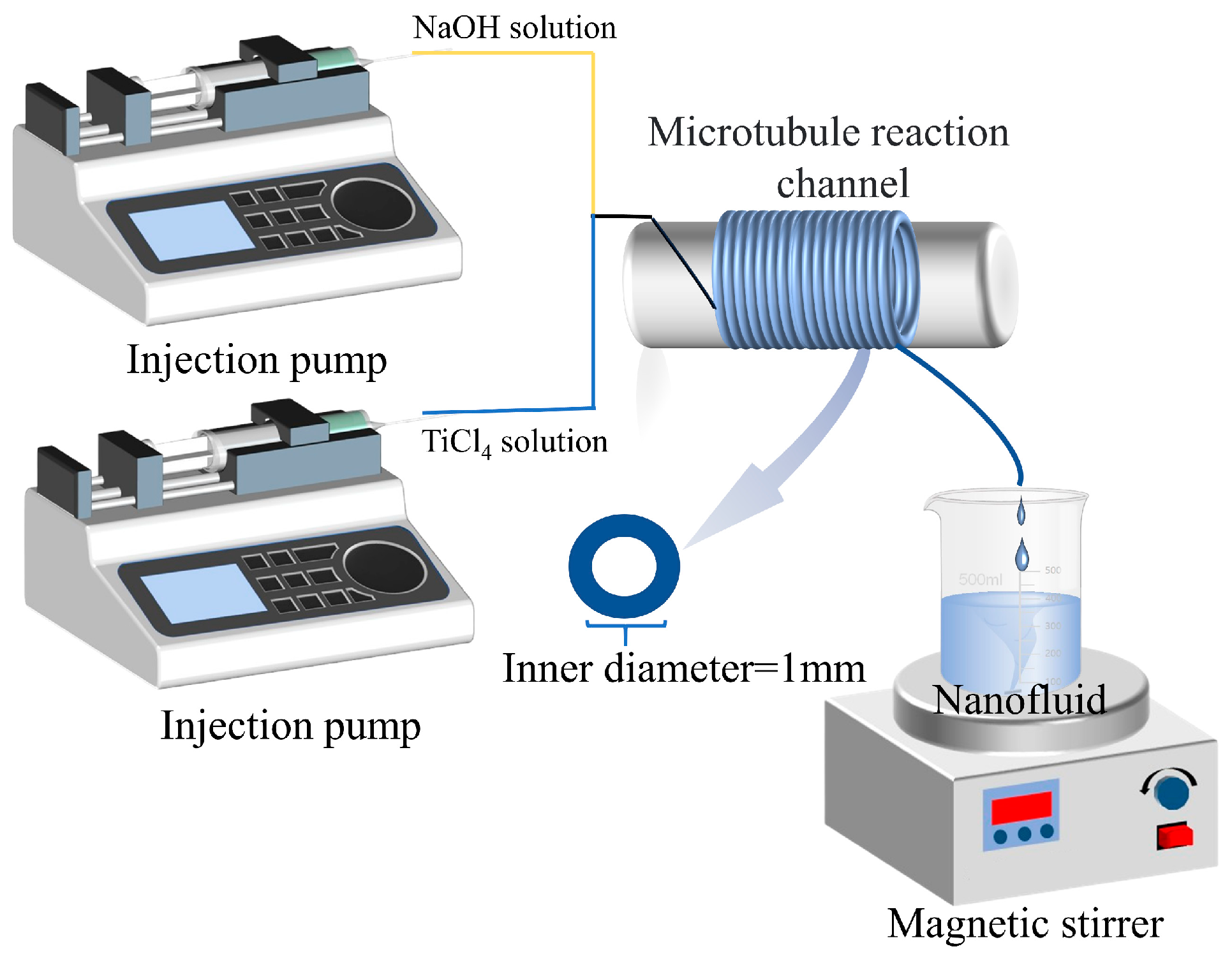
Titanium tetrachloride (AR, 99.0%) was procured from Aladdin Co., Ltd. (Shanghai, China), sodium hydroxide (AR, ≥96.0%) was sourced from Chengdu Jinshan Chemical Reagent Co., Ltd. (Chengdu, China), and polyethylene glycol (PEG 200) was obtained from Macklin Biochemical Co., Ltd. (Shanghai, China). The syringe pump (Model: TYD01) was purchased from Baoding Longer Precision Pump Co., Ltd. (Baoding, China). The experimental setup is schematically illustrated in Figure 1. The liquid–liquid two-phase reaction takes place within a spiral polytetrafluoroethylene (PTFE) microchannel. The inner diameter of the channel is 1.0 mm and its total length is 2.0 m. To enhance mixing efficiency, the microreactor is designed with a spiral configuration and comprises three main parts: the inlet section, the spiral reaction microchannel, and the outlet section. The two liquid phases are independently delivered by syringe pumps into the spiral reaction channel through their respective inlets. The two phases first react at a T-junction located at the channel entrance. The reacting mixture then flows through the entire length of the spiral channel, where the reaction proceeds to completion, before being collected in an outlet beaker.
Figure 1.
Schematic diagram of the reaction apparatus.
2.2. Synthesis and Characterization Methods
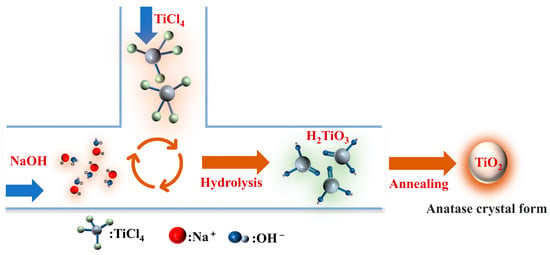
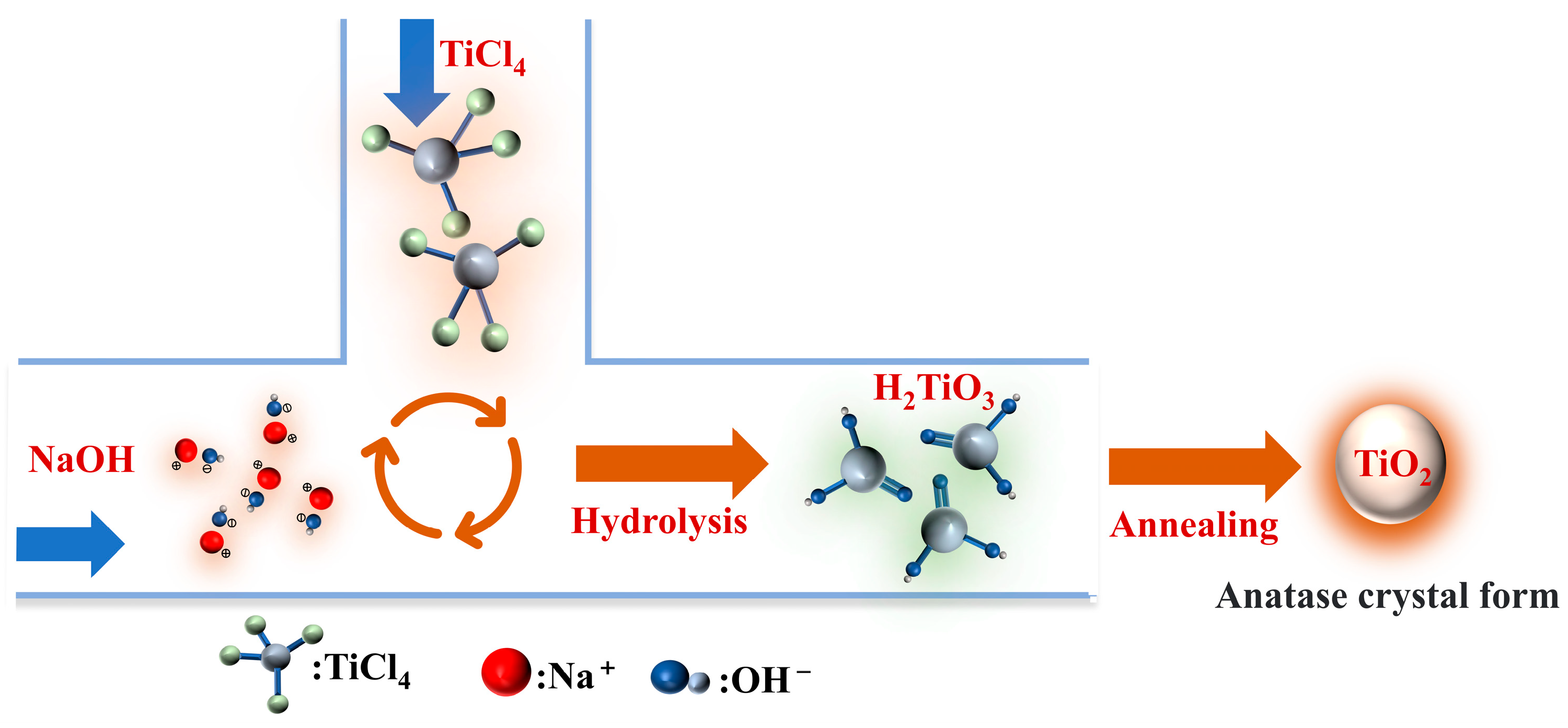
TiO2 nanoparticles were synthesized via a two-step process [23]. Firstly, the precursor solutions were prepared as follows: titanium tetrachloride (TiCl4) was dissolved in anhydrous ethanol, and sodium hydroxide (NaOH) was dissolved in deionized water. These solutions were loaded into separate syringes and delivered into the spiral microreactor via syringe pumps. The total flow rate was fixed at 4 mL· min−1 to ensure complete precipitation at room temperature. As shown in Figure 2, within the microreactor, TiCl4 undergoes hydrolysis under alkaline catalysis by NaOH, yielding titanium-containing monomeric species. The high surface-area-to-volume ratio of the spiral microchannel facilitates the continuous reaction of these monomers [24], forming amorphous TiO2 nanoparticles. The product was then dried, pulverized, and calcined at 723.15 K for 2 h to obtain crystalline TiO2 nano powder [25].
Figure 2.
Schematic diagram of the reaction.
To characterize the structure, morphology and crystalline phase of the synthesized materials, scanning electron microscopy (SEM) and X-ray diffraction (XRD) were employed. BET analysis and FT-IR spectroscopy were conducted to study the surface chemistry and structure of Sample C. To evaluate the stability of the prepared TiO2 nanofluids, the zeta potentials of Sample A, Sample C, and Sample D (the synthesis conditions are shown in Table 1) were measured [26], providing insight into their colloidal stability and agglomeration tendency.
Table 1.
Synthesis conditions of samples for experiments on NaOH concentration gradient, flow rate ratio and TiCl4 concentration gradient.
2.3. Mass Transfer Experiment
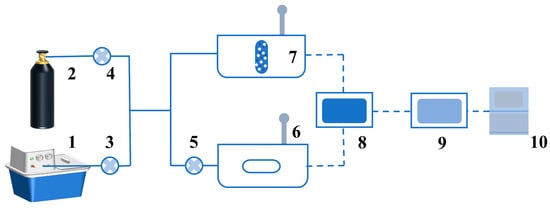
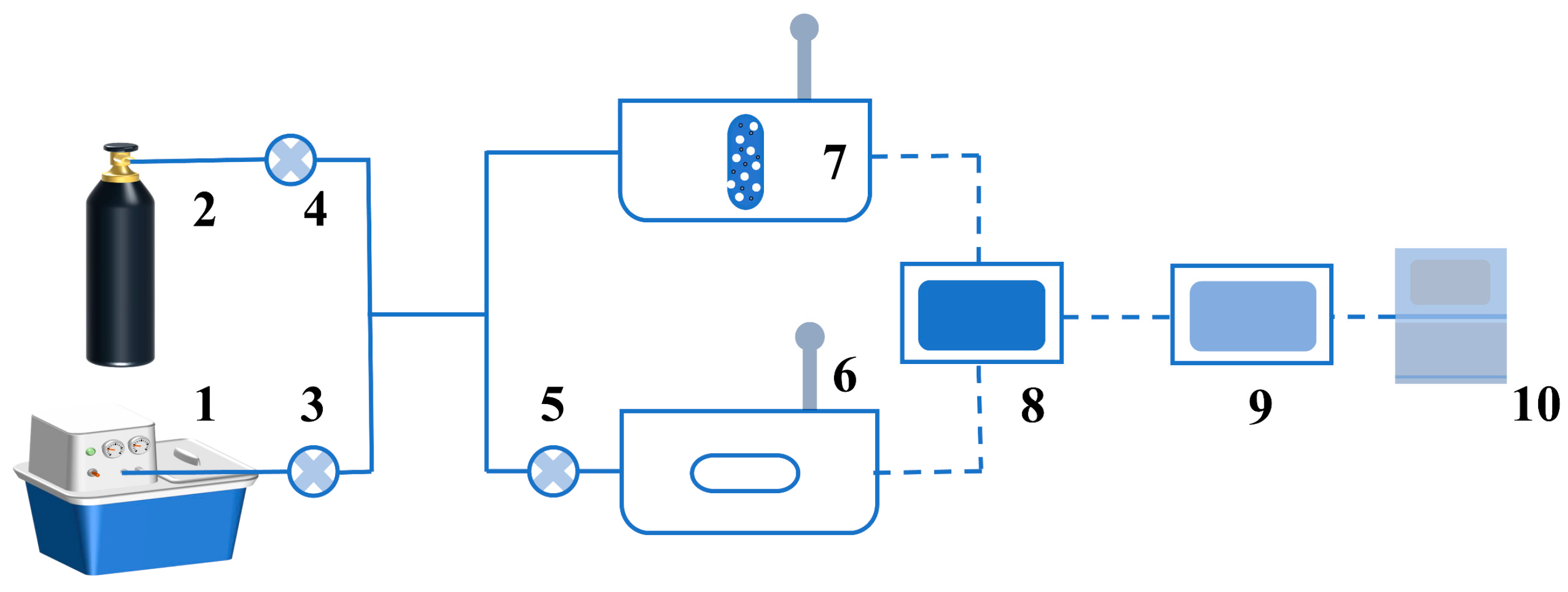
The apparatus used for measuring nanofluid gas absorption is schematically shown in Figure 3. It consists of two interconnected stainless tanks forming the core of the system. The key component is a detachable gas chamber (the reaction chamber in the figure), which is designed for loading the nanofluid sample. CO2 injection and vacuum operation are controlled by valves 1 and 2, while the reaction chamber and gas reservoir are isolated by valve 3. The experimental parameters were set as follows: reaction chamber volume of 5.46 × 10⁻⁵ m3, mass transfer area of 1.018 × 10⁻³ m2, and a sample layer depth of 5 × 10⁻³ m.
Figure 3.
A schematic diagram of the experimental setup. 1. Vacuum pump; 2. CO2 cylinder; 3–5. valves 1–3; 6. pressure sensor; 7. nanofluid reaction chamber; 8. differential pressure transmitter; 9. paperless recorder; 10. laptop.
System pressure was monitored using two high-precision transmitters. Signals were acquired in real time by a digital data acquisition system. The apparatus was pre-equilibrated in a constant-temperature water bath. The ultrasonically treated nanofluid was then loaded into the pre-dried reaction chamber, and the system was maintained at the target temperature for 30 min with all valves initially open. Prior to data collection, the gas was allowed to reach thermal equilibrium over a period of 15 min. The differential pressure transmitter has an accuracy of ±0.075%, and the pressure transmitter has an accuracy of ±0.2%.
To evaluate the CO2 capture performance and diffusion coefficients of the synthesized TiO2 nanoparticles, an enhancement ratio was defined to quantitatively evaluate the mass transfer intensification induced by nanofluids [27], calculated as follows:
where Er represents the relative enhancement ratio (hereinafter referred to as the enhancement ratio), p represents the pressure value, and t represents the absorption time. The numerator denotes the slope of the pressure difference transducer readings over time when using nanofluid as the absorbent, and the denominator corresponds to the slope of the pressure difference transducer readings near the baseline when using deionized water as the absorbent. To preliminarily verify the enhanced mass transfer effect of the fluid relative to water, a mass transfer experiment was conducted on sample B (the synthesis conditions are shown in Table 1). All experiments were performed in triplicate (n = 3), and the data are presented as error bar.
2.4. Model Derivation
To conduct an in-depth analysis of the promoting effect of nanofluids on diffusion mass transfer, a theoretical analysis was performed based on the one-dimensional diffusion in liquid.
In multicomponent heterogeneous systems, concentration gradients serve as the primary driving force for diffusion [28]. The following assumptions are made: (i) The gas–liquid interface reaches instantaneous phase equilibrium following Henry’s law. The nanoparticles present in the liquid phase enhance the mass transfer process, thereby effectively increasing the diffusion coefficient of CO2 in the nanofluid [29]. Although the chamber pressure decreases as CO2 is absorbed, the pressure drop is marginal; thus, a quasi-steady-state approximation is adopted, treating the interfacial equilibrium concentration c* as a constant. (ii) The liquid layer at the bottom of the chamber (x = δ) is impermeable, resulting in a zero-flux boundary. (iii) The initial concentration of CO2 in the liquid phase is zero.
Based on the law of mass conservation and Fick’s law of diffusion [30], the one-dimensional unsteady-state diffusion equation for CO2 in nanofluids can be derived as follows:
where c represents the molar concentration of CO2 in the liquid phase, c* represents the equilibrium solubility of CO2 corresponding to Henry’s Law [31], Deff denotes the effective diffusion coefficient, x is the spatial coordinate along the diffusion direction, and δ is the liquid film thickness (i.e., the height of the liquid phase in the diffusion direction).
To homogenize the non-homogeneous boundary condition at the interface, a dimensionless concentration difference is defined as θ(x, t) = c* − c(x, t). Equations (2)–(5) can then be rewritten as:
The method of separation of variables is employed by assuming θ(x, t) = X(x)T(t) [32]. Substituting this into Equation (6) yields two ordinary differential equations. Applying the homogeneous boundary conditions, the spatial eigenfunctions are obtained as Xn(x) = Bnsin(λnx), where the eigenvalues are λn = (2n + 1)π/2δ for n = 0,1,2,….. The time-dependent function is derived as Tn(t) = exp(−Deffλn2t).
By applying the superposition principle, the general solution is constructed as:
To determine the constant coefficient Bn, the initial condition (Equation (7)) is utilized. By expanding c* into a Fourier sine series over the interval [0, δ] utilizing the orthogonal property, Bn is calculated as:
Substituting Equation (11) back into Equation (10) and reverting to the original variable c(x, t) = c*−θ(x, t), the exact analytical solution for the spatial-temporal concentration distribution of CO2 in the liquid phase is obtained:
To link the diffusion model with the experimentally measured pressure data, the total amount of CO2 absorbed into the liquid phase at time t, denoted as N(t), is obtained by integrating Equation (12) over the liquid film thickness δ and multiplying by the mass transfer area A:
Simultaneously, according to the ideal gas law and mass conservation in the closed gas chamber, the reduction in gas-phase moles equals the amount absorbed by the liquid:
where Vgas is the volume of the gas chamber, R is the ideal gas constant, T is the absolute temperature, and p0 and p(t) are the initial and time-dependent gas pressures, respectively.
By combining Equations (13) and (14), the theoretical pressure evolution can be predicted. The effective diffusion coefficient Deff was determined through a least-squares fitting algorithm using Python 3.13 [33]. The initial guess for Deff was set to 1.5 × 10⁻⁹m2·s−1. A convergence study indicated that truncating the infinite series at n = 100 is sufficient, as further increasing n altered the calculated Deff by less than 0.01%. The model was first validated using pure water as the absorbent, which yielded a diffusion coefficient in excellent agreement with literature values, thereby confirming the reliability of the inverse modeling approach.
3. Results and Discussion
3.1. Characterization of TiO2 Nanoparticles
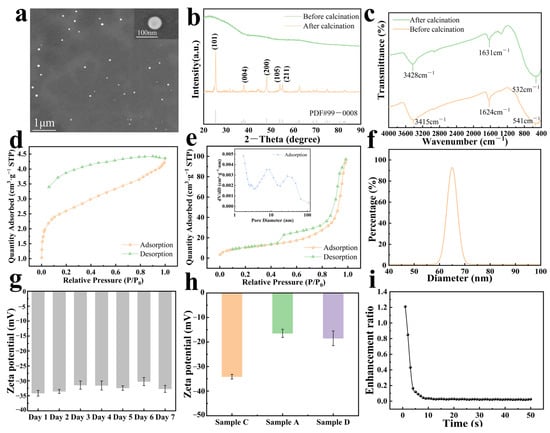
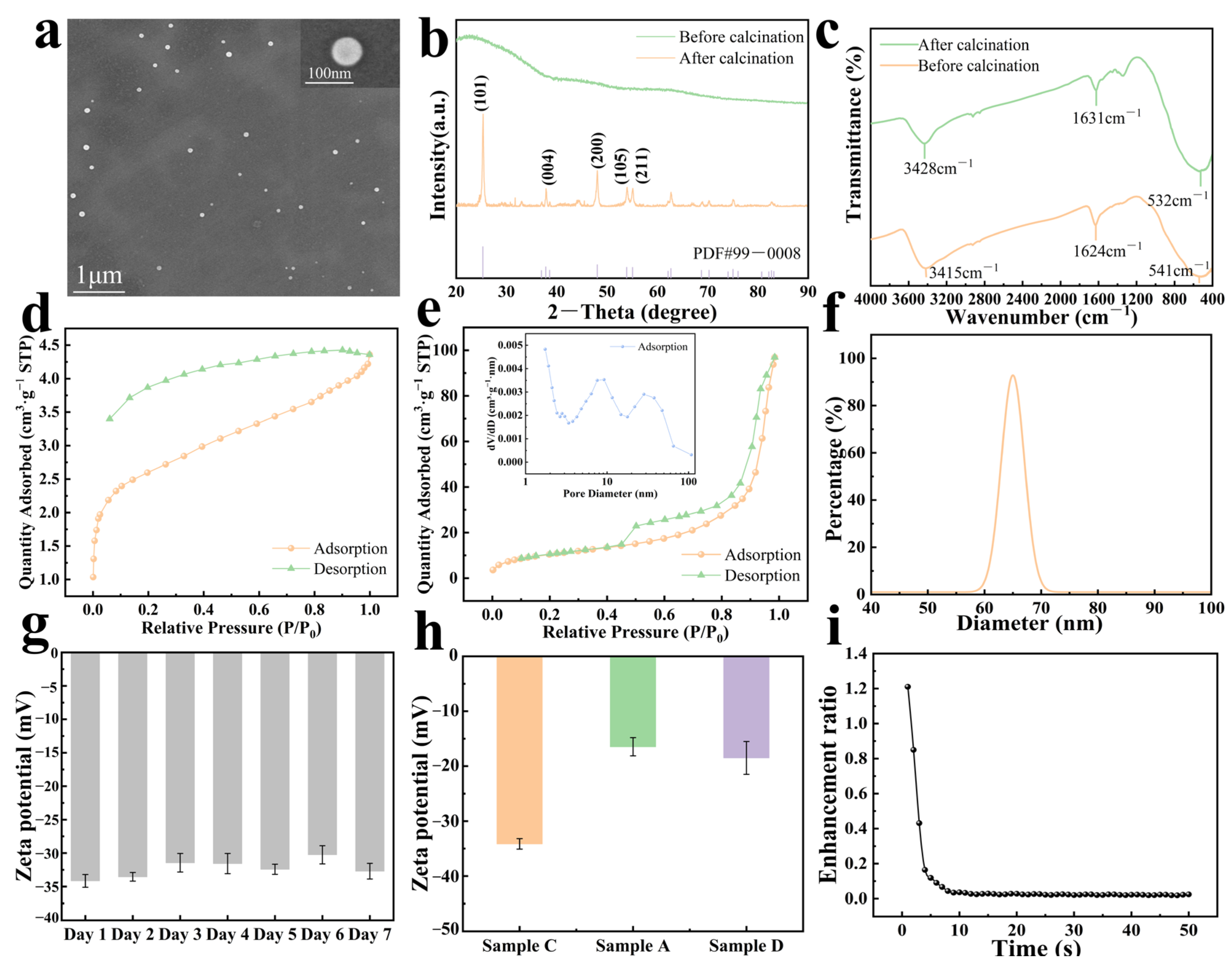
Figure 4b shows the XRD patterns of TiO2 before and after calcination. The as-synthesized sample presents a broad diffuse peak at 20–30°(2θ), indicating an amorphous structure. Upon calcination at 723.15 K for 2 h, the obtained product displays well-defined sharp diffraction peaks, which can be unambiguously indexed to the anatase phase of titanium dioxide (JCPDS No. 99-0008) [34]. The strong peak at 25.3°corresponds to the (101) crystal plane, and other characteristic peaks such as (004), (200) and (105) are also clearly observed, proving the formation of highly crystalline anatase TiO2 [35]. SEM images (Figure 4a) show that the calcined TiO2 nanoparticles are well dispersed. The particles are spherical with smooth surfaces, clear edges and no obvious defects. Particle size distribution (Figure 4f) shows a narrow range of 60–70 nm, with an average diameter of about 67 nm. Uniform morphology and particle size distribution enhance the stability of nanofluids and reduce mass transfer loss caused by particle agglomeration [36,37]. Strong FT-IR spectrum (Figure 4c) and broad absorption bands at 3400 cm−1 and 1640 cm−1, attributed to the stretching vibration of O-H bonds, confirm abundant surface hydroxyl groups (Ti-OH) and adsorbed water [38]. No obvious C-H stretching peaks are found at 2800–3000 cm−1, indicating no residual organic impurities. The broad band at 400–1000 cm−1 corresponds to Ti-O-Ti and Ti-O vibrations, verifying the complete TiO2 lattice [39]. Furthermore, no characteristic absorption bands of carbonate or bicarbonate were observed in the 1400–1500 cm−1 region of the spectrum, indicating that the presence of abundant Ti-OH groups on the sample surface does not translate into appreciable CO2 chemisorption, as evidenced by the absence of any detectable carbonate absorption bands [40]. The optimal TiO2 sample features a mesoporous structure (BET: 38.5 m2·g−1, ~16 nm), negligible solid-state CO2 adsorption (4.2 cm3·g−1), and high colloidal stability (Zeta potential: 34 mV). The above results confirm that the microfluidically prepared TiO2 is well-crystallized anatase, spherical, well-dispersed, and narrowly distributed, with a complete lattice and a hydroxyl-rich surface free of organic residues. Furthermore, the morphological and stability comparison between the microfluidic and conventional batch methods is provided in Figure S1 (Supplementary Materials).
Figure 4.
(a) SEM photographs of titanium dioxide nanoparticles. (b) XRD pattern of titanium dioxide nanoparticles. (c) FT-IR pattern of titanium dioxide nanoparticles. (d) Carbon dioxide desorption curve graph of titanium dioxide nanoparticles. (e) BET curve graph of titanium dioxide nanoparticles. (f) Particle size distribution diagram of titanium dioxide nanoparticles. (g) Zeta potential of titanium dioxide nanoparticles within 7 days. (h) Comparison chart of zeta potential of Sample A, Sample C and Sample D in the static state. (i) Enhancement ratio-time variation graph of Sample B.
3.2. Preliminary Mass Transfer Test
To preliminarily verify the mass transfer enhancement effect, Sample B was first tested. The time-dependent variation in the enhancement ratio (Er) is depicted in Figure 4i. The enhancement ratio shows a gradual decrease followed by stabilization. This trend suggests an initial enhancement that gradually attenuates. A preliminary explanation may involve nanoparticle-induced micro-convection in liquid phase, but the underlying mechanism will be examined in detail later.
3.3. Influence of Process Parameters
3.3.1. Effect of Alkali Concentration
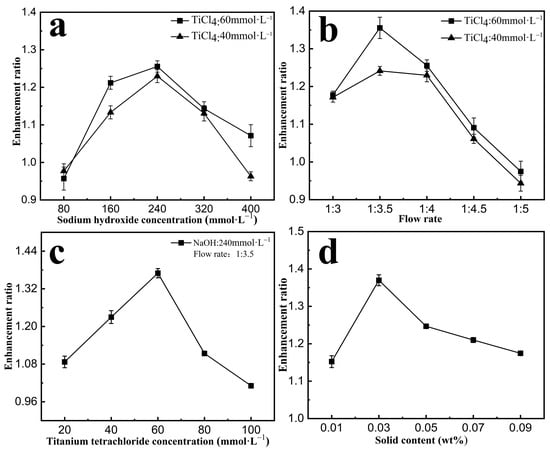
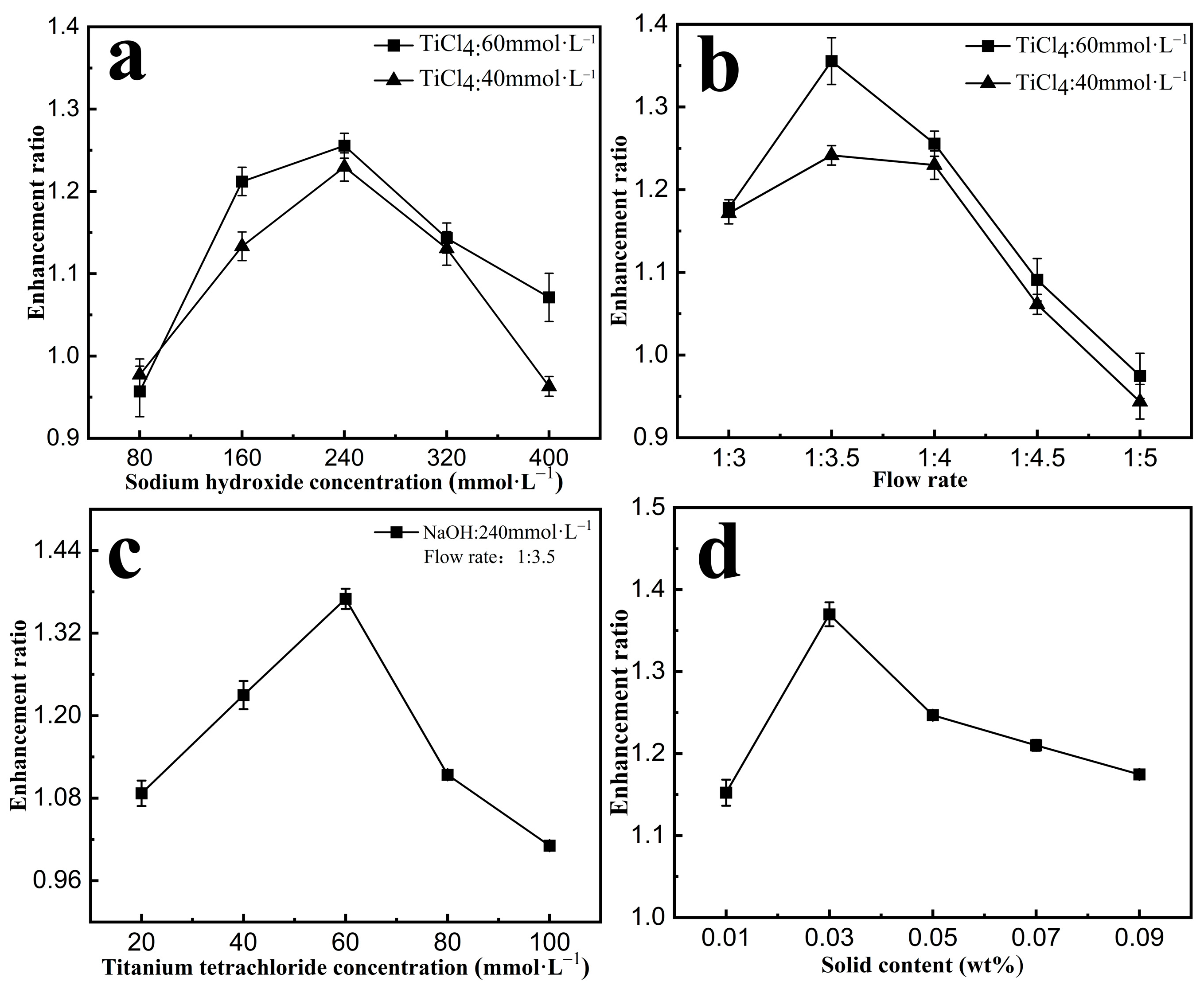
The influence of NaOH concentration on the synthesis of TiO2 nanoparticles is presented in Figure 5a. The synthesis conditions of the relevant samples are shown in Table 1. Under optimized flow conditions, the NaOH concentration significantly affects the hydrolysis kinetics of TiCl4 and the subsequent growth of TiO2 nanoparticles. As the NaOH concentration increases, the product yield progressively improves, reaching a maximum at 240 mmol·L−1. Below this optimal concentration, the low OH− concentration results in slow hydrolysis, extended particle growth time, and the formation of loosely aggregated, irregular structures [41]. Above 240 mmol·L−1, hydrolysis becomes excessively rapid, leading to the instantaneous generation of a large number of Ti(OH)4 nuclei [42]. Within the confined space of the microchannel, the abundant nuclei generated instantaneously at this high concentration cannot be adequately dispersed by the flow [43]. They undergo frequent collisions and agglomerate, thereby limiting the ordered growth of the nanoparticles. Therefore, an appropriate NaOH concentration is essential for balancing the hydrolysis rate and nucleation process, thereby enabling the controlled synthesis of TiO2 nanoparticles.
Figure 5.
The influence of different factor levels on Er: (a) sodium hydroxide concentration; (b) flow rate; (c) titanium tetrachloride; (d) solid content.
3.3.2. Effect of Flow Rate Ratio
Figure 5b illustrates the effect of the aqueous-to-organic phase flow rate ratio on TiO2 nanoparticle properties and the corresponding enhancement ratio. The synthesis conditions of the relevant samples are shown in Table 1. As the flow rate ratio increases, the enhancement ratio initially rises, reaching its maximum at an optimal ratio of 1:3.5 (Titanium source: Alkali source), after which the enhancement ratio declines. At excessively low ratios, localized accumulation of OH− ions at the mixing junction creates a sharp pH gradient, triggering instantaneous TiCl4 hydrolysis. This rapid nucleation leads to the formation of dense, irreversible hard agglomerates, compromising the nanoscale functionality. At excessively high flow rate ratios, the extreme dilution of the TiCl4 stream at the T-junction significantly reduces the local supersaturation of Ti4+. This leads to an insufficient nucleation rate and hinders the complete dehydration and crystallization of the Ti(OH)4 intermediates, ultimately increasing the amorphous content of the product. The result confirms that a flow rate ratio of 1:3.5 is optimal for maximizing the enhancement ratio.
3.3.3. Effect of Titanium Precursor Concentration
Figure 5c shows the effect of TiCl4 precursor concentration on the hydrolysis kinetics and subsequent crystal growth of TiO2 nanoparticles, among which the enhancement ratio of Sample C reaches 1.36. The synthesis conditions of the relevant samples are shown in Table 1. At low TiCl4 concentrations, crystallization is hindered, resulting in amorphous or poorly crystalline TiO2 with a low enhancement ratio. As the concentration increases, the enhancement ratio rises and peaks at 60 mmol·L−1, beyond which it gradually declines. The initial increase is attributed to sufficient precursor availability for controlled crystal growth [44]. However, at concentrations above 60 mmol·L−1, nucleation becomes dominant over particle growth. The abundant nuclei rapidly consume reactants, limiting the material available for further growth and resulting in smaller, irregular particles. This restricted growth environment also inhibits oriented attachment and proper crystal development, ultimately reducing the enhancement ratio. Experimental result confirms that the ideal synthesis conditions for maximizing the enhancement ratio are a NaOH concentration of 240 mmol·L−1, a TiCl4 concentration of 60 mmol·L−1, and a flow rate ratio (Ti precursor:alkali source) of 1:3.5. The optimal physicochemical properties of the product at 60 mmol·L−1 are directly responsible for the highest enhancement ratio observed in the experiments. To further evaluate the mass transfer performance of the as-prepared nanofluid, a comprehensive comparison between the current work and previously reported TiO2-based nanofluids is summarized in Table 2. The comparison focuses on the nanoparticle size, solid content, base fluid, and corresponding CO2 absorption enhancement ratio.
Table 2.
Comparison of CO2 absorption enhancement using nanofluids.
3.3.4. Effect of Titanium Solid Content
The synthesis parameters of each sample in the solid content gradient experiment are shown in Table 3. The solid content of nanoparticles is a key parameter governing nanofluid performance, directly influencing properties such as dispersion stability and thermal conductivity [51]. In gas–liquid mass transfer research, previous studies have often employed relatively coarse concentration gradients, typically on the order of 0.1 wt% or 1 wt% [52,53,54]. To pinpoint the optimal solid content with higher fidelity, the present study adopted a finer concentration gradient of 0.02 wt%. As shown in Figure 5d, the enhancement ratio increases markedly within the concentration range of 0.01–0.03 wt%. Beyond this optimum (0.03–0.09 wt%), the enhancement ratio gradually declines, although the value at 0.09 wt% remains slightly higher than that at 0.01 wt%. As nanoparticle concentration increases, the physicochemical properties of the fluid change, thereby affecting the mass transfer coefficient [55,56,57].
Table 3.
Preparation conditions and corresponding solid contents of each sample in the solid content gradient experiment.
3.4. Mechanism of Mass Transfer Enhancement
The superior performance of Sample C, synthesized under optimal conditions, can be attributed to the following synergistic factors: Firstly, the alkaline environment promotes the complete hydrolysis of Ti4+, facilitating the formation of a high-purity anatase phase while inhibiting local acidification. In addition, the optimized flow rate ratio generates strong shear forces at the T-junction inlet; combined with the confined micrometer-scale channel, this enables ultrafast mixing of the reactants, thereby enhancing mass transfer. Lastly, the moderate precursor concentration, together with the favorable mixing kinetics, induces a homogeneous nucleation mechanism. Under the optimal synthesis conditions, the moderate precursor concentration, flow rate ratio, and OH− concentration achieve a favorable balance between nucleation and growth. This results in the formation of nanofluid particles with small size, narrow size distribution, high uniformity, and enhanced stability.
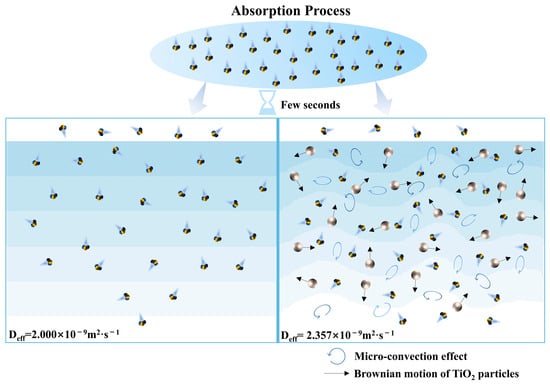
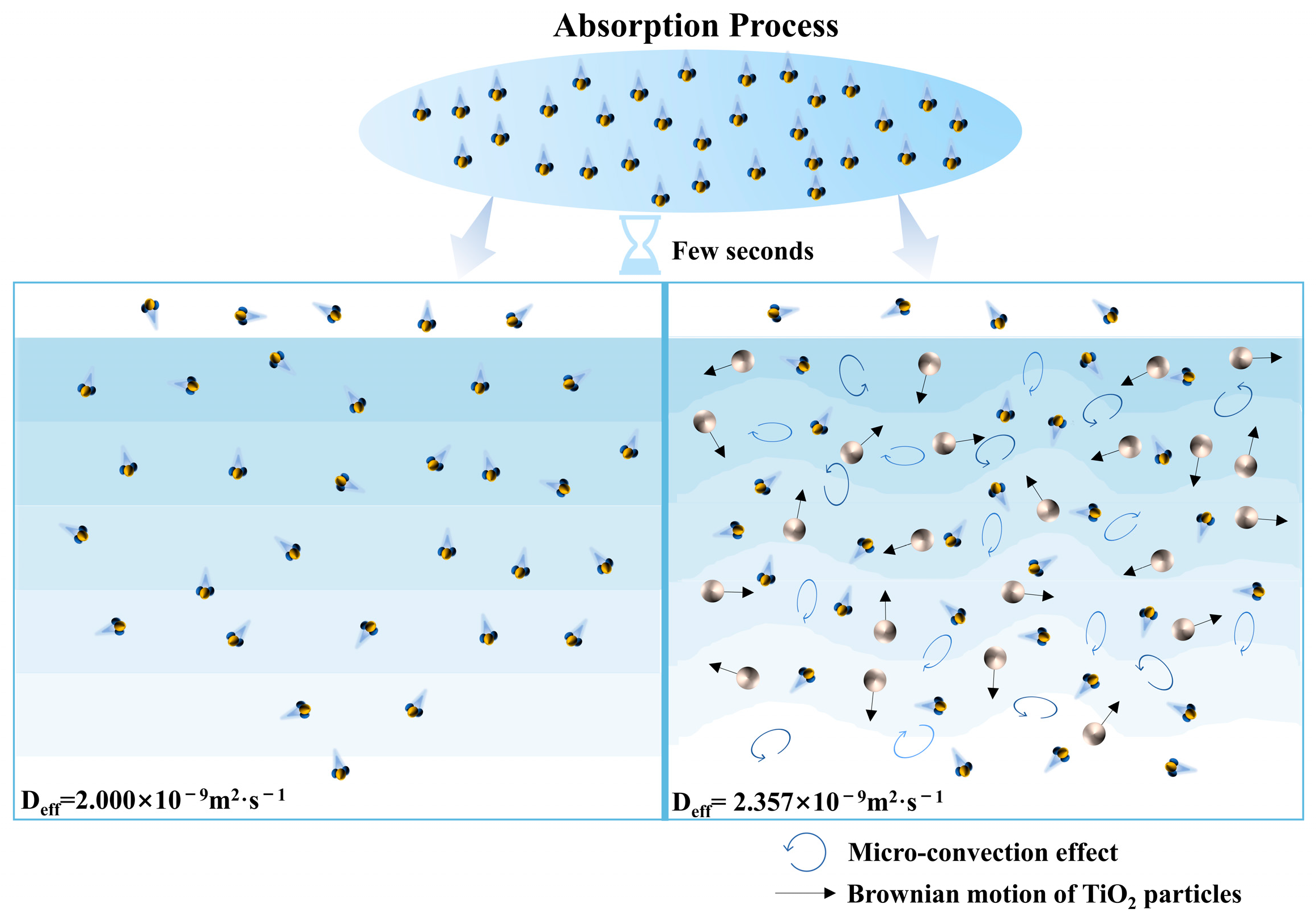
BET analysis (Figure 4e) reveals a moderate specific surface area of 38.5 m2·g−1 and a mesoporous structure with an average pore size of ~16 nm. The solid-state CO2 adsorption capacity is only 4.2 cm3·g−1 (Figure 4d), which is characteristic of weak physical adsorption, with no evidence of chemical interaction. Furthermore, the extremely low optimal solid content (0.03 wt%) provides a negligible number of adsorption sites, which cannot account for the observed 1.36-fold enhancement. Based on the optimal solid content, the BET specific surface area, and the solid-state CO2 adsorption capacity, the maximum possible contribution of particle adsorption to the total CO2 uptake is estimated to be on the order of 0.1% of the physical dissolution capacity. This value falls well within the experimental uncertainty range. Therefore, direct CO2 adsorption onto TiO2 nanoparticles can be confidently excluded as a non-negligible contributor to the observed mass transfer enhancement. FT-IR spectrum showed no characteristic bands of carbonate or bicarbonate, corroborating the absence of chemisorbed CO2 on particle surfaces. Zeta potential measurements (Figure 4g,h) show that the optimal sample exhibits a Zeta potential of 34 mV in absolute value, indicating excellent colloidal stability and resistance to agglomeration and sedimentation. Taking into account the uniform spherical morphology confirmed by SEM, the true enhancement mechanism can be summarized as follows: As shown in Figure 6, the uniform, spherical, highly dispersed and stable TiO2 nanoparticles continuously undergo Brownian motion in the liquid phase. This random movement causes micro-convection [58], rapidly transporting dissolved CO2 from the high-concentration area (near the interface) to the low-concentration area (deep within the bulk liquid). Macroscopically, this process is manifested as an increase in the effective diffusion coefficient of CO2 in nanofluids. At 298 K, through quantitative inversion using a one-dimensional unsteady diffusion model, the diffusion coefficient of CO2 in the optimal TiO2 nanofluid reached 2.357 × 10⁻⁹m2·s−1. This quantitative enhancement confirms that the micro-convection induced by Brownian motion, rather than interfacial disturbance or adsorption, is the core mass transfer intensification mechanism.
Figure 6.
Schematic diagram of micro-convection caused by Brownian motion.
3.5. Quantitative Modeling and Temperature Dependence
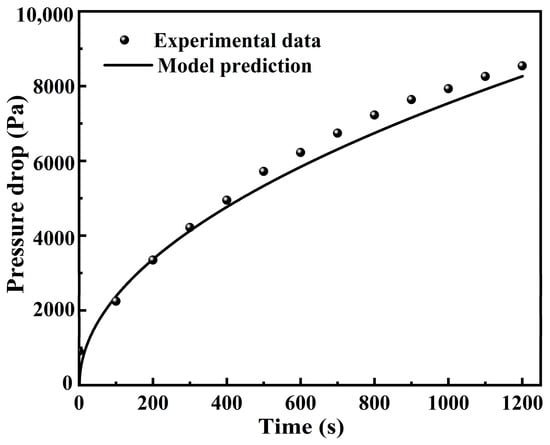
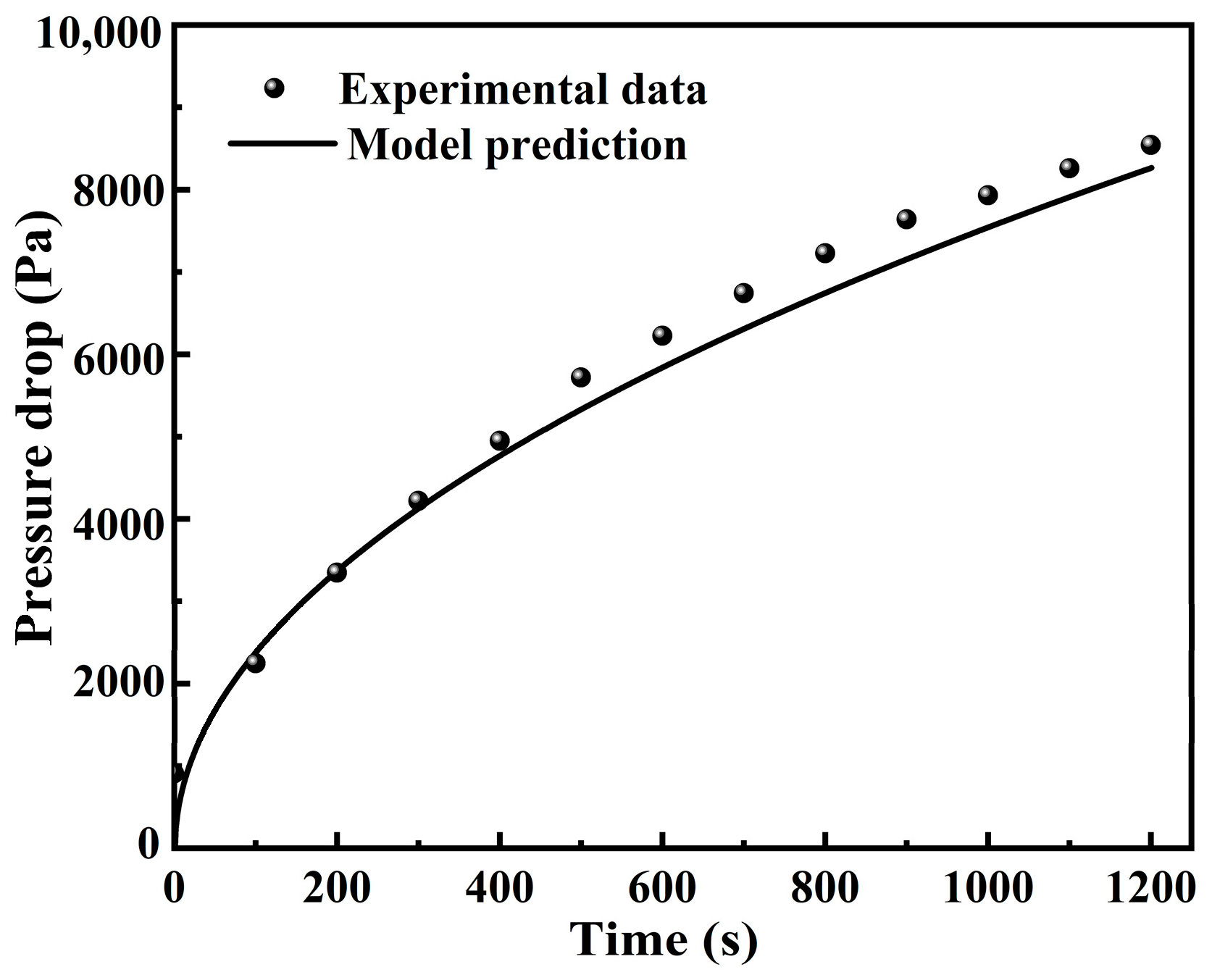
To quantitatively determine the diffusion coefficient of CO2 in the synthesized nanofluids, a mathematical model was fitted to the experimental pressure data. The diffusion coefficient’s accuracy, as indicated by Equation (12), improves with increasing n values. A least square fitting algorithm was applied to process the data, determine the feasible range of the diffusion coefficient (Deff), and calculate the corresponding theoretical pressure values at each time point. As illustrated in Figure 7, a blank experimental group was specially added to verify the applicability of the model. It tested the diffusion coefficient of CO2 in pure water at 298 K and generated model predictions based on the corresponding experimental data. To ensure the reliability of the model, the experiments for the pure water group were conducted in triplicate, and the mean value was taken as the final result. The resulting diffusion coefficient of pure water was determined to be 2.00 × 10⁻⁹m2·s−1, which shows a relative error of less than 1% compared to the reported literature value [59].
Figure 7.
The prediction graph of the model for pure water.
The temperature dependence of diffusion is significant: diffusion rates are low at low temperatures and increase markedly at elevated temperatures. This dependence is commonly described by the Arrhenius equation:
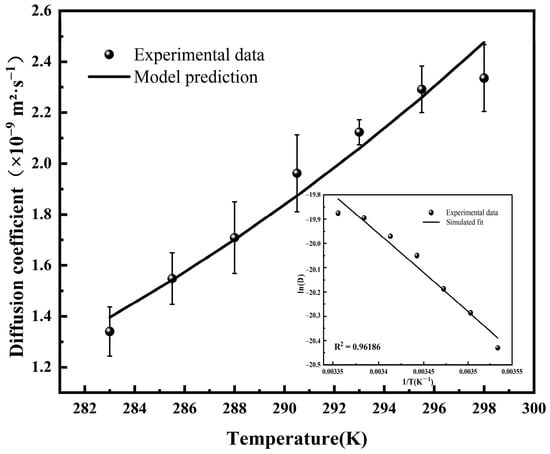
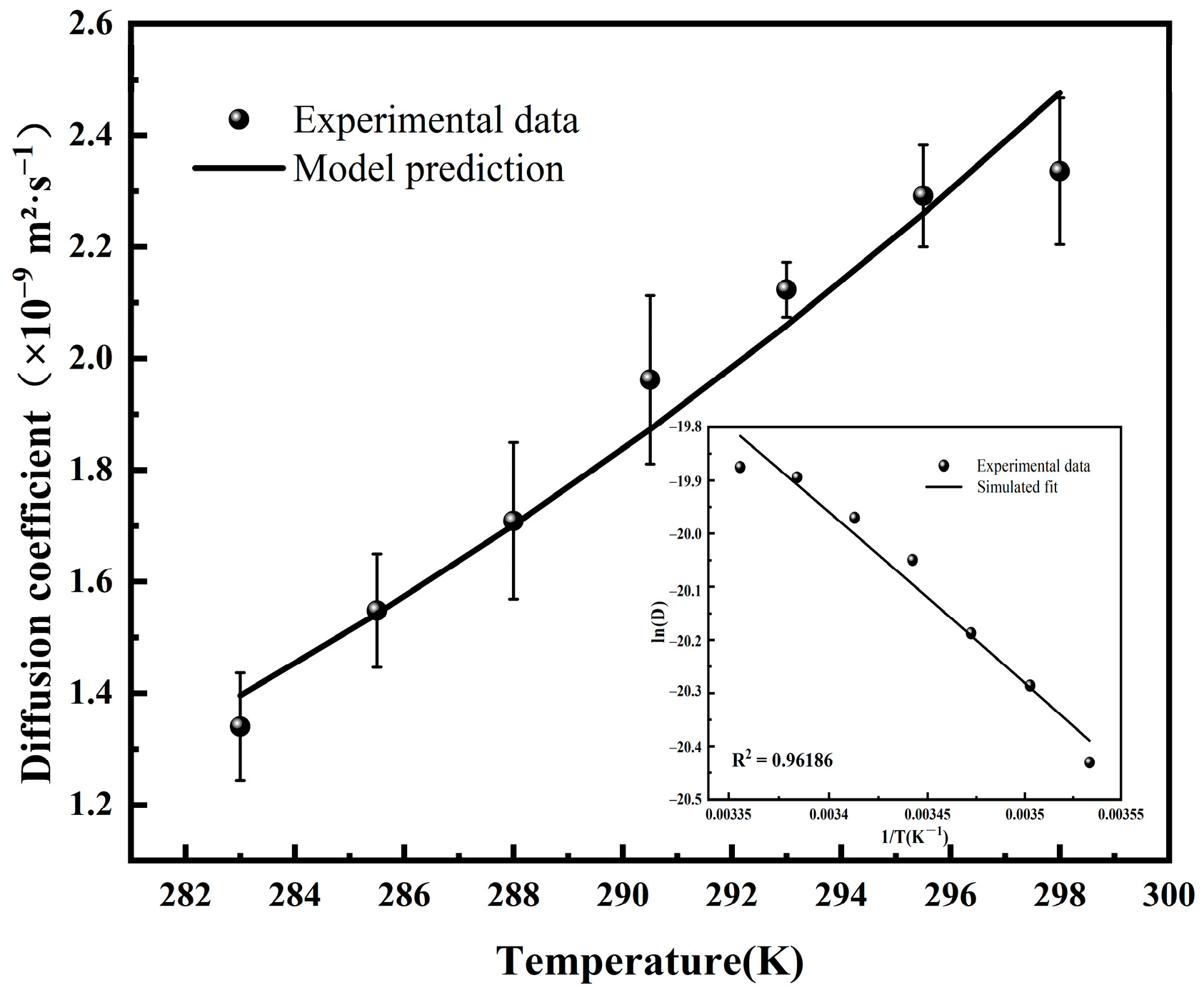
Here, D0 is the pre-exponential (or frequency) factor, Ea is the activation energy for diffusion, T is the absolute temperature (K), and R is the ideal gas constant (≈8.314 J·mol−1·K−1). Together, Ea and D0 are referred to as the activation parameters of diffusion. In an Arrhenius plot (ln D vs. T−1), the activation energy corresponds to the negative slope of the linear fit, while extrapolation of the line to T−1 → 0 yields the pre-exponential factor D0. To systematically validate the model predictions and investigate the temperature effect, experiments were conducted at temperatures ranging from 283 K to 298 K with an interval of 2.5 K. Figure 8 compares the experimental diffusion coefficients with model predictions over the temperature range of 283 K to 298 K. As the temperature increases from 283 K to 298 K, the experimental diffusion coefficient shows a clear upward trend, rising from 1.34 × 10⁻⁹ m2·s−1 to 2.357 × 10⁻⁹ m2·s−1. This behavior aligns with the theoretical expectation that higher temperatures enhance molecular motion and reduce solvent viscosity, thereby promoting solute transport. The simulation results indicate that the titanium dioxide nanoparticles exhibit Arrhenius-type behavior within this temperature range. The high coefficient of determination (R2 = 0.96186) between the experimental data and the fitted model confirms excellent agreement. The diffusion coefficient of the titanium dioxide sample with the most ideal morphology was determined to be 2.357 × 10⁻⁹ m2·s−1. Compared with the diffusion coefficient of CO2 in pure water, this corresponds to an enhancement of approximately 18% in diffusion coefficient.
Figure 8.
Prediction of the diffusion coefficient of the sample by the model.
4. Conclusions
In this work, a continuous microfluidic strategy was developed for the controllable synthesis of uniform anatase TiO2 nanoparticles with a size of 67 nm. The optimal conditions (240 mmol·L−1 NaOH, 60 mmol·L−1 TiCl4, flow rate ratio 1:3.5) yielded nanoparticles with excellent uniformity and colloidal stability. The as-prepared TiO2 nanofluid achieved a CO2 absorption enhancement ratio of 1.36 relative to deionized water. Systematic characterization rules out direct adsorption as the dominant contributor. The enhancement mechanism is attributed to Brownian-motion-induced micro-convection. This effect rapidly transports dissolved CO2 from high-concentration to low-concentration regions, leading to a directly quantifiable and significant increase in the effective diffusion coefficient of CO2. Quantitative modeling revealed a CO2 diffusion coefficient of 2.357 × 10⁻⁹ m2·s−1, representing an 18% increase over pure water at 298 K, with temperature dependence following the Arrhenius equation (R2 = 0.96186). This study provides a scalable route for high-performance TiO2 nanofluids and clarifies a non-adsorption-based mass transfer enhancement mechanism, offering guidance for rational nanofluid design in CO2 capture.
Supplementary Materials
The following supporting information can be downloaded at: https://www.mdpi.com/article/10.3390/micro6040101/s1, Figure S1: (a) SEM of the traditional batch method. (b) SEM of the microfluidic preparation method.; Figure S2: Particle size distribution map of samples prepared by the traditional batch method.
Author Contributions
Methodology, Y.L.; software, Y.Z.; validation, H.L.; formal analysis, H.Z.; investigation, Y.Z.; resources, H.L.; data curation, H.Z.; writing—original draft preparation, H.Z.; writing—review and editing, H.Z. and H.L.; visualization, H.Z.; supervision, Y.L. and J.Z.; project administration, Y.L.; funding acquisition, J.Z. All authors have read and agreed to the published version of the manuscript.
Funding
The authors thank the National Natural Science Foundation of China (Grant No. 22408028) and the Natural Science Foundation of Sichuan Province (Grant No. 2026NSFSC1998).
Institutional Review Board Statement
Not applicable.
Informed Consent Statement
Not applicable.
Data Availability Statement
The data that support the findings of this study are available from the corresponding author upon reasonable request.
Conflicts of Interest
The authors declare no conflicts of interest.
References
- Shamsi, M.; Naeiji, E.; Vaziri, M.; Moghaddas, S.; Elyasi Gomari, K.; Naseri, M.; Bonyadi, M. Optimization of energy requirements and 4E analysis for an integrated post-combustion CO2 capture utilizing MEA solvent from a cement plant flue gas. Environ. Dev. Sustain. 2025, 27, 9379–9405. [Google Scholar] [CrossRef] [Scilit]
- Fang, H.; Du, C.; Jin, D.; Tu, Y.; Liu, K.; Gao, F.; Zhou, Z.; Ren, Z. Energy-Efficient Amine-Based Deep Eutectic Solvents for CO2 Absorption. Ind. Eng. Chem. Res. 2025, 64, 6149–6157. [Google Scholar] [CrossRef] [Scilit]
- Lund, L.A.; Omar, Z.; Khan, I. Quadruple solutions of mixed convection flow of magnetohydrodynamic nanofluid over exponentially vertical shrinking and stretching surfaces: Stability analysis. Comput. Methods Programs Biomed. 2019, 182, 105044. [Google Scholar] [CrossRef] [Scilit] [PubMed]
- Mikkola, V.; Puupponen, S.; Saari, K.; Ala-Nissila, T.; Seppälä, A. Thermal properties and convective heat transfer of phase changing paraffin nanofluids. Int. J. Therm. Sci. 2017, 117, 163–171. [Google Scholar] [CrossRef] [Scilit]
- Yu, W.; Wang, T.; Park, A.-H.A.; Fang, M. Review of liquid nano-absorbents for enhanced CO2 capture. Nanoscale 2019, 11, 17137–17156. [Google Scholar] [CrossRef] [Scilit] [PubMed]
- Rashidi, H.; Mamivand, S. Experimental and numerical mass transfer study of carbon dioxide absorption using Al2O3/water nanofluid in wetted wall column. Energy 2022, 238, 121670. [Google Scholar] [CrossRef] [Scilit]
- Devakki, B.; Dandotiya, D. Absorption performance of Al2O3 and ZnO nanofluids for CO2 capture: Experimental study. Sādhanā 2025, 50, 331. [Google Scholar] [CrossRef] [Scilit]
- Zhu, J.; Zhang, H.; Li, T.; Deng, T.; Zou, H.; Li, Y.; Yang, D. Liquid CO2-Capture Technologies: A Review. Nanomaterials 2024, 14, 1910. [Google Scholar] [CrossRef] [Scilit] [PubMed]
- Ali, N.; Teixeira, J.A.; Addali, A. Aluminium Nanofluids Stability: A Comparison between the Conventional Two-Step Fabrication Approach and the Controlled Sonication Bath Temperature Method. J. Nanomater. 2019, 2019, 1–9. [Google Scholar] [CrossRef] [Scilit]
- Jahandar Lashaki, M.; Movahedirad, S.; Rahbar-Kelishami, A. A variational applied approach for Cr (III) removal by Y-Y shaped microchannel; Experimental and CFD simulation studies. Chem. Eng. Process.-Process Intensif. 2022, 181, 109151. [Google Scholar] [CrossRef] [Scilit]
- Boken, J.; Soni, S.K.; Kumar, D. Microfluidic Synthesis of Nanoparticles and their Biosensing Applications. Crit. Rev. Anal. Chem. 2016, 46, 538–561. [Google Scholar] [CrossRef] [Scilit] [PubMed]
- Kim, S.; Wang, H.; Yan, L.; Zhang, X.; Cheng, Y. Continuous preparation of itraconazole nanoparticles using droplet-based microreactor. Chem. Eng. J. 2020, 393, 124721. [Google Scholar] [CrossRef] [Scilit]
- Kašpar, O.; Koyuncu, A.H.; Pittermannová, A.; Ulbrich, P.; Tokárová, V. Governing factors for preparation of silver nanoparticles using droplet-based microfluidic device. Biomed. Microdevices 2019, 21, 88. [Google Scholar] [CrossRef] [Scilit] [PubMed]
- Wang, Y.; Seidel, M. Strategy for fast manufacturing of 3D hydrodynamic focusing multilayer microfluidic chips and its application for flow-based synthesis of gold nanoparticles. Microfluid. Nanofluid. 2021, 25, 64. [Google Scholar] [CrossRef] [Scilit]
- Shojaei, F.; Dini, G.; Vahabi, L.; Ghasemi, P. Microfluidic-assisted synthesis of mesoporous silica nanoparticles as drug carriers: Characterization and biocompatibility studies. J. Nanopart. Res. 2024, 26, 258. [Google Scholar] [CrossRef] [Scilit]
- Kapica-Kozar, J.; Kusiak-Nejman, E.; Wanag, A.; Kowalczyk, Ł.; Wrobel, R.J.; Mozia, S.; Morawski, A.W. Alkali-treated titanium dioxide as adsorbent for CO2 capture from air. Microporous Mesoporous Mater. 2015, 202, 241–249. [Google Scholar] [CrossRef] [Scilit]
- Tang, J.; Chen, Z.; Wang, M. Modulation of titanium dioxide surface hydroxyl groups for photocatalytic selective conversion of biopolyols. J. Energy Chem. 2026, 114, 370–376. [Google Scholar] [CrossRef] [Scilit]
- Mironyuk, I.; Kaglyan, A.; Vasylyeva, H.; Mykytyn, I.; Gudkov, D.; Turovska, L. Investigation of the chemical and radiation stability of titanium dioxide with surface arsenate groups during 90 Sr adsorption. J. Environ. Radioact. 2022, 251–252, 106974. [Google Scholar] [CrossRef] [Scilit] [PubMed]
- Scuderi, V.; Buccheri, M.A.; Impellizzeri, G.; Di Mauro, A.; Rappazzo, G.; Bergum, K.; Svensson, B.G.; Privitera, V. Photocatalytic and antibacterial properties of titanium dioxide flat film. Mater. Appl. Water Treat. Water Split. 2016, 42, 32–35. [Google Scholar] [CrossRef] [Scilit]
- Razzaq, Z.; Khalid, A.; Ahmad, P.; Farooq, M.; Khandaker, M.U.; Sulieman, A.; Rehman, I.U.; Shakeel, S.; Khan, A. Photocatalytic and Antibacterial Potency of Titanium Dioxide Nanoparticles: A Cost-Effective and Environmentally Friendly Media for Treatment of Air and Wastewater. Catalysts 2021, 11, 709. [Google Scholar] [CrossRef] [Scilit]
- Zare, P.; Keshavarz, P.; Mowla, D. Membrane Absorption Coupling Process for CO2 Capture: Application of Water-Based ZnO, TiO2, and Multi-Walled Carbon Nanotube Nanofluids. Energy Fuels 2019, 33, 1392–1403. [Google Scholar] [CrossRef] [Scilit]
- Yi, Q.; Meng, M.; Zhao, C.; Lv, C.; Wan, G.; Sun, L. Experimental and molecular dynamics simulation study of toluene absorption by nanofluids. Sep. Purif. Technol. 2023, 322, 124262. [Google Scholar] [CrossRef] [Scilit]
- Sarac, M.F.; Ozturk, K.; Yatmaz, H.C. A facile two-step fabrication of titanium dioxide coated copper oxide nanowires with enhanced photocatalytic performance. Mater. Charact. 2020, 159, 110042. [Google Scholar] [CrossRef] [Scilit]
- Zhao, L.; Gao, M.; Niu, Y.; Wang, J.; Shen, S. Flow-rate and particle-size insensitive inertial focusing in dimension-confined ultra-low aspect ratio spiral microchannel. Sens. Actuators B Chem. 2022, 369, 132284. [Google Scholar] [CrossRef] [Scilit]
- Jin, L.; Liu, B.; Louis, M.E.; Li, G.; He, J. Highly Crystalline Mesoporous Titania Loaded with Monodispersed Gold Nanoparticles: Controllable Metal–Support Interaction in Porous Materials. ACS Appl. Mater. Interfaces 2020, 12, 9617–9627. [Google Scholar] [CrossRef] [Scilit] [PubMed]
- Tuok, L.P.; Elkady, M.; Zkria, A.; Tsuyoshi, Y.; Abdelkader, S.A.; Seyam, D.F.; Eldemerdash, U.N. CuO/TiO2 nanofluids-based remediation of oil spills in aqueous environment: A promising approach to mitigate soil pollution. Nanotechnol. Environ. Eng. 2025, 10, 60. [Google Scholar] [CrossRef] [Scilit]
- Huang, M.; Zhu, C.; Fu, T.; Ma, Y. Enhancement of gas-liquid mass transfer by nanofluids ina microchannel under Taylor flow regime. Int. J. Heat Mass Transf. 2021, 176, 121435. [Google Scholar] [CrossRef] [Scilit]
- Miller, R.; Sefcik, J.; Lue, L. Modeling Diffusive Mixing in Antisolvent Crystallization. Cryst. Growth Des. 2022, 22, 2192–2207. [Google Scholar] [CrossRef] [Scilit] [PubMed]
- Kluytmans, J.H.J.; van Wachem, B.G.M.; Kuster, B.F.M.; Schouten, J.C. Mass transfer in sparged and stirred reactors: Influence of carbon particles and electrolyte. Chem. Eng. Sci. 2003, 58, 4719–4728. [Google Scholar] [CrossRef] [Scilit]
- Andreucci, D.; Cirillo, E.N.M.; Colangeli, M.; Gabrielli, D. Fick and Fokker–Planck Diffusion Law in Inhomogeneous Media. J. Stat. Phys. 2019, 174, 469–493. [Google Scholar] [CrossRef] [Scilit]
- Gui, X.; Wang, W.; Wang, C.; Zhang, L.; Yun, Z.; Tang, Z. Vapor–Liquid Phase Equilibrium Data of CO2 in Some Physical Solvents from 285.19 K to 313.26 K. J. Chem. Eng. Data 2014, 59, 844–849. [Google Scholar] [CrossRef] [Scilit]
- Asmar, N.H. Partial Differential Equations with Fourier Series and Boundary Value Problems; Courier Dover Publications: Garden City, NY, USA, 2016. [Google Scholar]
- Saeidi, M.; Ghaemi, A.; Tahvildari, K.; Derakhshi, P. Exploiting response surface methodology (RSM) as a novel approach for the optimization of carbon dioxide adsorption by dry sodium hydroxide. J. Chin. Chem. Soc. 2018, 65, 1465–1475. [Google Scholar] [CrossRef] [Scilit]
- Lv, P.; Chen, S.-C.; Huang, F. Controllable phase transformation of titanium dioxide for the high performance polymer solar cells. Sol. Energy Mater. Sol. Cells 2019, 192, 88–93. [Google Scholar] [CrossRef] [Scilit]
- Siwińska-Stefańska, K.; Zdarta, J.; Paukszta, D.; Jesionowski, T. The influence of addition of a catalyst and chelating agent on the properties of titanium dioxide synthesized via the sol–gel method. J. Sol.-Gel Sci. Technol. 2015, 75, 264–278. [Google Scholar] [CrossRef] [Scilit]
- Guo, Y.; Yang, X.; Li, G.; Yang, J.; Liu, L.; Chen, L.; Li, B. Shear turbulence controllable synthesis of aggregated nano-particles using a swirling vortex flow reactor assisted by ultrasound irradiation. Chem. Eng. J. 2021, 405, 126914. [Google Scholar] [CrossRef] [Scilit]
- Prasher, R.; Phelan, P.E.; Bhattacharya, P. Effect of Aggregation Kinetics on the Thermal Conductivity of Nanoscale Colloidal Solutions (Nanofluid). Nano Lett. 2006, 6, 1529–1534. [Google Scholar] [CrossRef] [Scilit] [PubMed]
- Souza, P.S.; Grisi, C.V.B.; Monço, E.C.; da Silva, M.V.S.; de Souza, A.L. Obtaining Microcellulose from Solid Agro-Waste by Ball Mill Assisted by Light Acid Hydrolysis Process. ACS Omega 2025, 10, 588–598. [Google Scholar] [CrossRef] [Scilit] [PubMed]
- Bukit, B.F.; Frida, E.; Humaidi, S.; Sinuhaji, P. Preparation and characterization of CTAB surfactant modified TiO2 nanoparticles as antibacterial fabric coating material. J. Phys. Conf. Ser. 2022, 2165, 012022. [Google Scholar] [CrossRef] [Scilit]
- Marcos, F.C.F.; Assaf, J.M.; Giudici, R.; Assaf, E.M. Surface interaction of CO2/H2 mixture on mesoporous ZrO2: Effect of crystalline polymorph phases. Appl. Surf. Sci. 2019, 496, 143671. [Google Scholar] [CrossRef] [Scilit]
- Tian, M.; Liu, Y.; Wang, W.; Zhao, W.; Chen, D.; Wang, L.; Zhao, H.; Meng, F.; Zhen, Y.; Hu, Z.; et al. Mechanism of synthesis of anatase TiO2 pigment from low concentration of titanyl sulfuric–chloric acid solution under hydrothermal hydrolysis. J. Chin. Chem. Soc. 2020, 67, 277–287. [Google Scholar] [CrossRef] [Scilit]
- Wei, J.; Ostadhossein, A.; Li, S.; Ihme, M. Kinetics for the hydrolysis of Ti(OC3H7)4: A molecular dynamics simulation study. Proc. Combust. Inst. 2021, 38, 1433–1440. [Google Scholar] [CrossRef] [Scilit]
- Kovalev, A.V.; Pervunin, K.S.; Bilsky, A.V.; Yagodnitsyna, A.A. Influence of dispersed phase flow-rate pulsations on the liquid–liquid parallel flow in a T-junction microchannel. Chem. Eng. J. 2024, 488, 150734. [Google Scholar] [CrossRef] [Scilit]
- Sun, P.; Wang, S.; Li, Y.; Zhang, T.; Wang, D.; Zhang, B.; Yang, J.; Xu, D. One-pot synthesis of nano titanium dioxide in supercritical water. Nanotechnol. Rev. 2020, 9, 410–417. [Google Scholar] [CrossRef] [Scilit]
- Yi, Q.; Zhao, C.; Lv, C.; Wan, G.; Meng, M.; Sun, L. CO2 absorption enhancement in low transition temperature mixtures-based nanofluids: Experiments and modeling. Sep. Purif. Technol. 2023, 325, 124584. [Google Scholar] [CrossRef] [Scilit]
- Pashaei, H.; Ghaemi, A. CO2 absorption into aqueous diethanolamine solution with nano heavy metal oxide particles using stirrer bubble column: Hydrodynamics and mass transfer. J. Environ. Chem. Eng. 2020, 8, 104110. [Google Scholar] [CrossRef] [Scilit]
- Zhang, Q.; Ning, Z.; Li, X.; Ning, X.; Wu, F.; Zhou, J. Experimental study of CO2 capture by nanoparticle-enhanced 2-amino-2-methyl-1-propanol aqueous solution. RSC Adv. 2023, 13, 33644–33653. [Google Scholar] [CrossRef] [Scilit] [PubMed]
- Heidari, S.; Esmaeilzadeh, F.; Rafati, R.; Haddad, A.S. Experimental and modeling of CO2 absorption in a bubble column using a water-based nanofluid containing co-doped SiO2 nanoparticles. Model. Earth Syst. Environ. 2024, 10, 3229–3241. [Google Scholar] [CrossRef] [Scilit]
- Yuan, B.; Zhan, G.; Xing, L.; Li, Y.; Huang, Z.; Chen, Z.; Wang, L.; Li, J. Boosting CO2 absorption and desorption of biphasic solvent by nanoparticles for efficient carbon dioxide capture. Sep. Purif. Technol. 2024, 329, 125108. [Google Scholar] [CrossRef] [Scilit]
- Rahmatmand, B.; Keshavarz, P.; Ayatollahi, S. Study of Absorption Enhancement of CO2 by SiO2, Al2O3, CNT, and Fe3O4 Nanoparticles in Water and Amine Solutions. J. Chem. Eng. Data 2016, 61, 1378–1387. [Google Scholar] [CrossRef] [Scilit]
- Yang, L.; Du, K.; Zhang, X. Influence factors on thermal conductivity of ammonia-water nanofluids. J. Cent. South Univ. Technol. 2012, 19, 1622–1628. [Google Scholar] [CrossRef] [Scilit]
- Cheng, S.; Qi, G.; Li, Y.; Yang, Y. Visual experimental study of nanofluids application to promote CO2 absorption in a bubble column. Chin. J. Chem. Eng. 2024, 67, 228–237. [Google Scholar] [CrossRef] [Scilit]
- Jiang, J.-Z.; Zhang, S.; Liu, L.; Sun, B.-M. A microscopic experimental study of nanoparticle motion for the enhancement of oxygen absorption in nanofluids. Nanotechnol. Rev. 2018, 7, 529–539. [Google Scholar] [CrossRef] [Scilit]
- Valeh-e-Sheyda, P.; Afshari, A. A detailed screening on the mass transfer modeling of the CO2 absorption utilizing silica nanofluid in a wetted wall column. Process Saf. Environ. Prot. 2019, 127, 125–132. [Google Scholar] [CrossRef] [Scilit]
- Wilk, J.; Grosicki, S. Limiting current technique in the research of mass/heat transfer in nanofluid. J. Phys. Conf. Ser. 2016, 745, 032084. [Google Scholar] [CrossRef] [Scilit]
- Apmann, K.; Fulmer, R.; Soto, A.; Vafaei, S. Thermal Conductivity and Viscosity: Review and Optimization of Effects of Nanoparticles. Materials 2021, 14, 1291. [Google Scholar] [CrossRef] [Scilit] [PubMed]
- Maheshwary, P.; Handa, C.C.; Nemade, K.R.; Gyanchandani, N.N. Experimental Investigation of Effect of Nanoparticle Concentration on Thermo-physical Properties of Nanofluids. In Lecture Notes in Mechanical Engineering; Springer Singapore: Singapore, 2020; pp. 735–742. [Google Scholar] [CrossRef] [Scilit]
- Ashrafmansouri, S.-S.; Willersinn, S.; Esfahany, M.N.; Bart, H.-J. Influence of silica nanoparticles on mass transfer in a membrane-based micro-contactor. RSC Adv. 2016, 6, 19089–19097. [Google Scholar] [CrossRef] [Scilit]
- Versteeg, G.F.; Van Swaaij, W.P.M. Solubility and diffusivity of acid gases (carbon dioxide, nitrous oxide) in aqueous alkanolamine solutions. J. Chem. Eng. Data 1988, 33, 29–34. [Google Scholar] [CrossRef] [Scilit]

Disclaimer/Publisher’s Note: The statements, opinions and data contained in all publications are solely those of the individual author(s) and contributor(s) and not of MDPI and/or the editor(s). MDPI and/or the editor(s) disclaim responsibility for any injury to people or property resulting from any ideas, methods, instructions or products referred to in the content. |
© 2026 by the authors. Licensee MDPI, Basel, Switzerland. This article is an open access article distributed under the terms and conditions of the Creative Commons Attribution (CC BY) license.