


Abstract
Entomopathogenic fungi have emerged as coinoculants to promote plant growth and mitigate the effects of water deficit. This study evaluated the physiological responses, grain yield, and irrigation water productivity (IWP) of soybean (Glycine max L.) coinoculated with entomopathogenic fungi under full and deficit irrigation. A split-plot experiment was conducted under a rain-out shelter in a randomized design with four replications. Main plots consisted of seven irrigation strategies: 100% of the reference irrigation to maintain soil moisture near field capacity (I100VR); 70% (I70VR) and 50% (I50VR) of the reference throughout the growing season; 70% (I70V) and 50% (I50V) during the vegetative stage; and 70% (I70R) and 50% (I50R) during the reproductive stage (R3-R6). Subplots consisted of three inoculation treatments: Bradyrhizobium japonicum (BJ), and coinoculation with Beauveria bassiana (BB) and Metarhizium anisopliae (MA). Fungal coinoculation (BB and MA) did not improve soybean performance relative to BJ. Plants inoculated with BJ showed higher grain yield (3314 kg ha−1) and IWP (0.68 kg m−3) than those coinoculated with MA (2605 kg ha−1 and 0.54 kg m−3), whereas BB showed intermediate values that did not differ significantly from BJ. Physiological responses to inoculants depended on the irrigation treatment. Among irrigation treatments, I50R reduced irrigation water by 31% without a significant yield reduction relative to full irrigation, resulting in the highest IWP (0.80 kg m−3). Given the single-season, rain-out shelter conditions, these results should be considered preliminary; nevertheless, our results indicate that coinoculation with entomopathogenic fungi did not enhance soybean yield or IWP under deficit irrigation.
1. Introduction
Soybean (Glycine max L.) was cultivated on approximately 143 million ha worldwide during the 2025 growing season, with a total production of 398 million Mg and an average yield of 2778 kg ha−1 [1]. This crop is cultivated across diverse regions worldwide under a wide range of edaphoclimatic conditions [2,3]. However, most production areas are rainfed and susceptible to water stress. The percentage of soybean yield gaps caused by water deficits in the United States [4], Brazil [5], and China [6] are around 30%, 42%, and 50%, respectively.
In Brazil, soybean cultivation reached approximately 49 million ha, with a total production of 181 million Mg and an average yield of 3712 kg ha−1 in the 2025/26 crop season [7]. To mitigate the impacts of rainfall variability, irrigation is estimated to be required in approximately 26% of soybean-growing areas in this country [8]. In São Paulo State, the temporal occurrence of water stress varies across soybean-producing regions, with some areas experiencing drought throughout the crop cycle, whereas others are more prone to water deficits during the reproductive stage [9]. This spatial and temporal variability reinforces the need for irrigation strategies that are tailored to local conditions. However, irrigation must be balanced against regional water availability and supported by soil conservation and careful scheduling to remain sustainable [10]. In this context, evaluating irrigation water productivity (IWP) is essential [11], particularly under declining water availability and uneven rainfall distribution. Irrigation water productivity is a key indicator of crop response to water availability [12]. Various irrigation strategies have been proposed to increase IWP, including deficit irrigation during less sensitive crop developmental stages [13,14] or throughout the growing season [15,16,17]. For example, maintaining irrigation deficit in soybean during the vegetative stage improved IWP by 2–28% [18,19], whereas during grain-filling, the increase was 5% [20]. Moreover, prolonged irrigation deficit at 50% increased IWP by 13% [16].
In addition to deficit irrigation strategies aimed at improving soybean water productivity, several agronomic practices have been explored to enhance crop tolerance to water stress. Seed treatment with micronutrients such as cobalt (Co) and molybdenum (Mo) has been shown to stimulate root development and improve plant performance under water deficit [21]. Likewise, foliar application of seaweed extract has been reported to mitigate drought stress, promoting physiological performance comparable to that achieved under full irrigation [22]. More recently, entomopathogenic fungi have emerged as a promising approach for enhancing soybean performance under abiotic stress conditions [23,24].
Entomopathogenic fungi, originally isolated from soil samples, have been widely studied and applied in the biological control of insect pests [25,26]. The symbiotic association between entomopathogenic fungi and plants can also enhance water uptake and tolerance to abiotic stresses, thereby promoting plant growth and development [27]. For instance, inoculation with Metarhizium anisopliae promoted greater vegetative growth, transpiration, and photosynthetic rates in soybean plants subjected to saline stress conditions [28]. Similarly, the beneficial endophytic association of Beauveria bassiana, mainly related to the activation of antioxidant enzymes, has been documented in several crop species, including maize, potato, cotton, and tomato [29,30,31].
In Brazil, inoculation with Bradyrhizobium spp. is a well-established practice to maximize biological nitrogen fixation in soybean, while coinoculation with additional plant growth-promoting microorganisms (mainly Azospirillum brasilense) has become an increasingly adopted strategy to further enhance root development, nutrient acquisition, and crop productivity under diverse environmental conditions [26,32]. It is estimated that 35% of Brazilian soybean farmers use the coinoculation of Azospirillum brasilense and Bradyrhizobium, which has increased soybean yield by an average of 8% [32]. In recent years, entomopathogenic fungi have emerged as promising coinoculants in in vitro studies. For instance, Metarhizium spp. have been reported to increase the abundance of Bradyrhizobium, a key group of nitrogen-fixing bacteria in the soybean rhizosphere [33]. Furthermore, the coinoculation of Bradyrhizobium with Metarhizium has resulted in improved nodulation and plant growth in soybeans [34]. In this context, integrating deficit irrigation strategies with entomopathogenic fungi may provide valuable insights into drought stress responses, physiological regulation, and crop resilience.
Therefore, this study aimed to quantify the physiological responses, yield, and IWP of soybean coinoculated with entomopathogenic fungi under full and deficit irrigation. Understanding whether these microbial associations can enhance soybean performance under contrasting water regimes is essential for developing integrated management strategies that combine irrigation optimization with biological inputs to improve crop resilience under increasing water limitations.
2. Materials and Methods
2.1. Characterization of the Experimental Area
A rain-out shelter experiment was carried out at the Biosystems Engineering Department, University of São Paulo (USP/ESALQ), Piracicaba, São Paulo, Brazil (22°46′39″ S, 47°17′45″ W), from October 2020 to February 2021. According to the Köppen classification, the predominant climatic type of the region is tropical, with a wet summer and dry winter (Aw) [35]. The shelter was 5.2 m high, with a transparent plastic cover (diffusing film) and black side screens that intercepted 30% of the incident radiation. Waterproofed concrete containers of 0.33 m3 (1.0 m length, 0.4 m width, and 0.8 m depth) were filled with sandy-loam soil (Oxisol Typic Ustox). This soil type is representative of major soybean-producing regions in Brazil [5]. Before soybean establishment, the experimental units remained fallow for 9 months after the completion of the previous experiment.
Solar radiation, minimum and maximum air temperatures, relative humidity, and wind speed were recorded at 10-min intervals using an automatic station installed inside the experimental area connected to a CR1000 data logger (Campbell Scientific, Logan, UT, USA). The Penman–Monteith method was used to estimate reference evapotranspiration (ETo) [36].
2.2. Preparation of Fungal Suspensions
Two fungal isolates, ESALQ E9 and ESALQ PL63, belonging to Metarhizium anisopliae and Beauveria bassiana, respectively, were obtained from the ‘Prof. Sérgio Batista Alves’ collection, housed at the Laboratory of Pathology and Microbial Control of Insects at the University of São Paulo (USP/ESALQ), Piracicaba, São Paulo, Brazil. The isolates were originally obtained from Mahanarva posticata in Boca da Mata, Alagoas, Brazil (ESALQ E9), and Atta sexdens in Piracicaba, São Paulo, Brazil (ESALQ PL63). ESALQ E9 is the fungal strain used in the commercial product Metarril, whereas ESALQ PL63 is used in Boveril; both products are manufactured by Koppert do Brasil (Piracicaba, São Paulo, Brazil). Both products have been registered in Brazil since 2022, and the isolates have been deposited in the ARSEF Collection (USDA). Isolate ESALQ E9 was identified as Metarhizium anisopliae based on sequencing of the 5′ portion of the gene-encoding translation elongation factor 1-alpha (tef1), followed by phylogenetic analysis. Isolate ESALQ PL63 was identified as Beauveria bassiana through amplification and sequencing of the Bloc intergenic region, followed by phylogenetic analysis. These strains were cultivated in Petri dishes (60 × 10 mm) containing Potato Dextrose Agar (PDA) at 25 ± 1 °C in the dark for 10 days. After 10 days of incubation, conidia were harvested from the plates using a sterile spatula and suspended in sterile distilled water containing 0.01% Tween 80 (polysorbate 80; Êxodo Científica, Indaiatuba, SP, Brazil) in sterile glass tubes. The conidial concentration was adjusted to 108 conidia mL−1, as determined by counting with a Neubauer hemocytometer (Merck, Darmstadt, Germany) under a light microscope.
Subsequently, 5 mL of the conidial suspension was removed to inoculate 100 g of pre-cooked parboiled rice, which had previously been sterilized in an autoclave at 120 °C for 30 min and cooled to 25 ± 1 °C. Inoculation of the rice in plastic bags was carried out in a laminar flow cabinet (VECO, Campinas, SP, Brazil) using a sterile 10 mL pipette. Each fungal isolate was inoculated into four plastic bags, which were then incubated in a BOD chamber for 4 days to allow conidial germination and mycelial growth. After the sporulation period, the rice grains were transferred to borosilicate glass flasks containing sterile distilled water supplemented with 0.05% Tween 80. The flasks were manually shaken to release the conidia, and the resulting suspensions were filtered through a stainless-steel sieve lined with sterile gauze to remove the rice grains. The fungal concentration was adjusted to a suspension of 108 conidia mL−1 [37]. Prior to seed application, conidial viability and suspension purity were assessed by plating a dilution at 105 conidia mL−1 onto potato dextrose agar (PDA) plates. Viability was determined after 24 h of incubation by counting germinated and non-germinated conidia. Suspension purity was evaluated using a separate set of plates incubated under the same conditions for 3 days. Conidial viability was 100%, and no contaminants were detected in the suspensions.
2.3. Planting and Experimental Management
The conventional soybean cultivar BRS 511 was used in this experiment. It has an indeterminate growth habit and is resistant to Asian rust and the soybean mosaic virus. This cultivar is suitable for altitudes of up to 700 m and has an average growth cycle of 110 to 134 days in the state of São Paulo [38].
Before planting, a chemical soil analysis was performed in the 0–0.20 and 0.20–0.40 m layers (Table 1). Soybean seeds were inoculated two hours before planting with the commercial peat-based inoculant Nitrobacter TF® (LaborAgro, Londrina, PR, Brazil; MAPA registration PR 002544-5.000004). According to the manufacturer, the product contains Bradyrhizobium japonicum strains SEMIA 5079 and SEMIA 5080. The inoculant was applied at 2.5 g kg−1 of seed to provide approximately 2.4 × 10⁶ cells seed−1, following the national technical recommendation [32]. In the BJ treatment, seeds received only the peat-based inoculant. In the co-inoculation treatments, seeds treated with the same inoculant also received 100 mL of a conidial suspension of Beauveria bassiana or Metarhizium anisopliae (108 conidia mL−1), applied directly onto the seeds in the sowing furrow before covering them with soil.
Table 1.
Result of the chemical analysis of the soil for macro and micronutrients.
Sowing was performed manually on 12 October 2020. Twenty seeds per linear meter were sown at 0.05 m spacing, with the soil near field capacity. After 15 days, thinning was carried out, leaving 15 plants per linear meter. Based on the soil analysis, nutrient management was performed according to Van Raij et al.’s [39] recommendations. Basal fertilization was applied at 200 kg ha−1 of P in the planting furrow. Topdressing fertilization was split into three applications at 10-day intervals starting from the V1 stage, with 100 kg ha−1 of K diluted in water. Integrated pest, diseases, and weed management were performed without the use of chemical control. Cultural and preventive controls were used, together with the application of neem extract (Azadirachta indica) at a rate of 5 mL L−1. The solution was prepared in tap water, shaken vigorously before and during application to ensure uniform dispersion of the oil-based formulation, and sprayed with a hand-held sprayer.
Irrigation water was provided through a drip irrigation system. A drip line of 1 m length was installed in each plot with six emitters, each with a flow rate of 0.6 L h−1 and spaced at 0.15 m, resulting in a total flow rate of 3.6 L h−1 per container (plot). All plots were controlled individually through micro-registers installed on a control panel.
During the first 17 days, all plants were irrigated based on daily evapotranspiration (Kc = 0.50) [36]. After that, irrigation scheduling was managed according to the average soil matric potential measured through tensiometry in the plots corresponding to the well-watered treatment. In each plot, a battery of two tensiometers installed at 0.1 and 0.3 m depths provided measurements of 0–0.2 and 0.2–0.4 m soil layers, respectively. Soil matric potential was monitored daily and converted to soil volumetric water (θ, cm3 cm−3) using the van Genuchten [40] model (Equation (1)):
where θ () is the current soil volumetric water content (cm3 cm−3); θr is the soil residual volumetric water content (cm3 cm−3); θs is the volumetric water content of the saturated soil (cm3 cm−3); m and n are the regression parameters of the equation (dimensionless), α is the parameter with dimensions equal to the inverse of the tension (cm−1); and is the function of the matric potential (kPa). The fitting parameters of the van Genuchten equation are shown in Table 2 [3,41].
Table 2.
Empiric parameters (α, m e n), soil residual and saturation water content (θr, θs) of the Van Genuchten model (1980), moisture at field capacity (θfc), moisture at the wilting point (θwp), and available water capacity (AWC).
Using the current soil moisture (θ) estimated with Equation (1) and the hydraulic properties of each soil layer (Table 2), the irrigation for the well-watered treatment (reference treatment) to restore soil moisture to field capacity (θfc) was calculated for each soil layer (Equation (2)):
where is the irrigation amount to be applied (mm) in a determined soil layer; is the soil volumetric water content at field capacity; is the soil volumetric water content observed before irrigation; and Z is the target root depth. For the irrigation deficit treatments, water depths were adjusted to represent fractions of the irrigation volume applied to the well-watered treatment. Irrigation was applied whenever the soil water potential in the top layer (0–0.20 m) reached approximately −30 kPa (Figure S1).
2.4. Experimental Design and Treatments
A split-plot design with main plots arranged in a completely randomized design was used, with seven irrigation strategies as main plots, three inoculation treatments as subplots and four replications, totaling 28 main plots and 84 subplots (Figure S2). Each main plot consisted of an irrigation strategy: I100VR, in which soil moisture was maintained close to field capacity throughout the growing season and considered the reference irrigation level (100%); I70VR, corresponding to 70% of the reference irrigation throughout the cycle; I50VR, corresponding to 50% of the reference irrigation throughout the cycle; I70V and I50V, corresponding to 70 and 50% of the reference irrigation applied during the vegetative stage, respectively; and I70R and I50R, corresponding to 70 and 50% of the reference irrigation applied during the reproductive stage (R3–R6), respectively. The periods of water deficit imposition were selected based on the predominant drought patterns previously described for soybean production in São Paulo State. The subplot consisted of three inoculation treatments: BJ (Bradyrhizobium japonicum which served as the base inoculant), BB (Beauveria bassiana + base inoculant), and MA (Metarhizium anisopliae + base inoculant).
2.5. Physiological Measurements
Physiological measurements were conducted at 41 days after sowing (DAS) (end of the vegetative deficit) and 95 DAS (R6 stage). Measurements were performed before the next irrigation event, when soil water depletion within the irrigation interval was highest. The gas exchange parameters were measured on fully expanded leaves from the top of the plant: net photosynthesis (A), stomatal conductance (gs), transpiration (E), and predawn leaf water potential (LWP). Gas exchange parameters were measured with a portable gas exchange system Li-6400 XT (IRGA/LiCOR-Inc, Lincoln, NE, USA), from 8:00 to 11:30 h, on one leaf per plot. To minimize the influence of diurnal environmental variation, the equipment was set to use concentrations of 400 μmol CO2 mol−1 in the leaf chamber, and the photon flux density photosynthetic active used was 1200 μmol [quanta] m−2 s−1.
Predawn LWP of soybean was measured with a pressure chamber model 3005 (Soil Moisture, Santa Barbara, CA, USA). One leaf per plot was sampled between 3:00 and 5:00 h, placed in appropriated containers on ice, and transported to the laboratory for immediate processing. Each leaf was placed in the chamber, which was slowly pressurized until a drop of xylem sap appeared on the cut surface of the petiole, and the corresponding pressure was recorded as the leaf water potential.
2.6. Growth and Yield Variables
The agronomic performance evaluations were conducted after the manual harvest of 10 central plants from each row of the experimental plots, when 95% of the pods exhibited the typical mature pod coloration [42], corresponding to a soybean growth cycle of 113 days. Growth parameters such as leaf area index, plant height, stem diameter and shoot biomass were evaluated. First, all leaves were collected from each container, including those that had fallen. Leaf area was determined with a leaf area meter LI-3000 C (LiCOR-Inc, Lincoln, NE, USA), and the leaf area index (LAI) was calculated by dividing the total leaf area by the sampling area. Then, all the shoot biomass was dried at 60 °C in an oven with forced air circulation for 72 hours to determine shoot dry biomass.
After manual threshing and pod cleaning, total number of pods per plant, 100-grain weight, and grain yield were obtained. Grain yield was obtained from the ten central plants of each container, corresponding to a harvest area of 0.267 m2, and converted to kg ha−1. Both grain yield and 100-grain weight were corrected to 13% moisture. Irrigation water productivity was calculated as the ratio between marketable grain yield and the total volume of water applied [11] (Equation (3)):
where irrigation water productivity is expressed in kg m−3, yield in kg ha−1, irrigation water applied in mm, and 10 is the conversion factor between units.
2.7. Statistical Analysis
All statistical analyses were conducted using R software v4.5.1 [43] using the ExpDes package v1.2.2 [44]. Data were analyzed according to a split-plot model with main plots in a completely randomized design:
where is the observed value for irrigation i (i = 1, …, 7), inoculant j (j = 1, 2, 3), and replicate k (k = 1, …, 4); is the overall mean; Ii is the effect of irrigation I; is the main plot error (error a); is the effect of inoculant j; is the irrigation × inoculant interaction; and is the subplot error (error b). The irrigation effect was tested against error a, alongside the inoculant effect and the interaction against error b. Physiological variables were analyzed separately for each measurement date (41 and 95 DAS). Shapiro–Wilk and Levene tests were used to estimate normality and homogeneity of variance. When the F-test was significant (p < 0.05), means were compared by Tukey’s test (p < 0.05).
3. Results
3.1. Micrometeorological Conditions and Water Consumption
Monthly mean values of air temperature, relative humidity, solar radiation, and reference evapotranspiration (Penman–Monteith) are presented in Table 3. During the experimental period, mean maximum and minimum air temperatures were 35.5 and 18.7 °C, respectively. Mean solar radiation was 10.9 MJ m−2 day−1, mean relative humidity was 67.9%, and mean reference evapotranspiration was 3.9 mm day−1.
Table 3.
Micrometeorological conditions throughout the growing season.
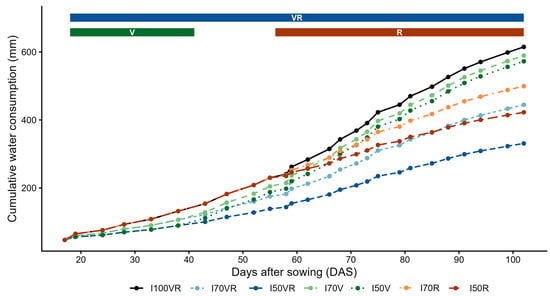
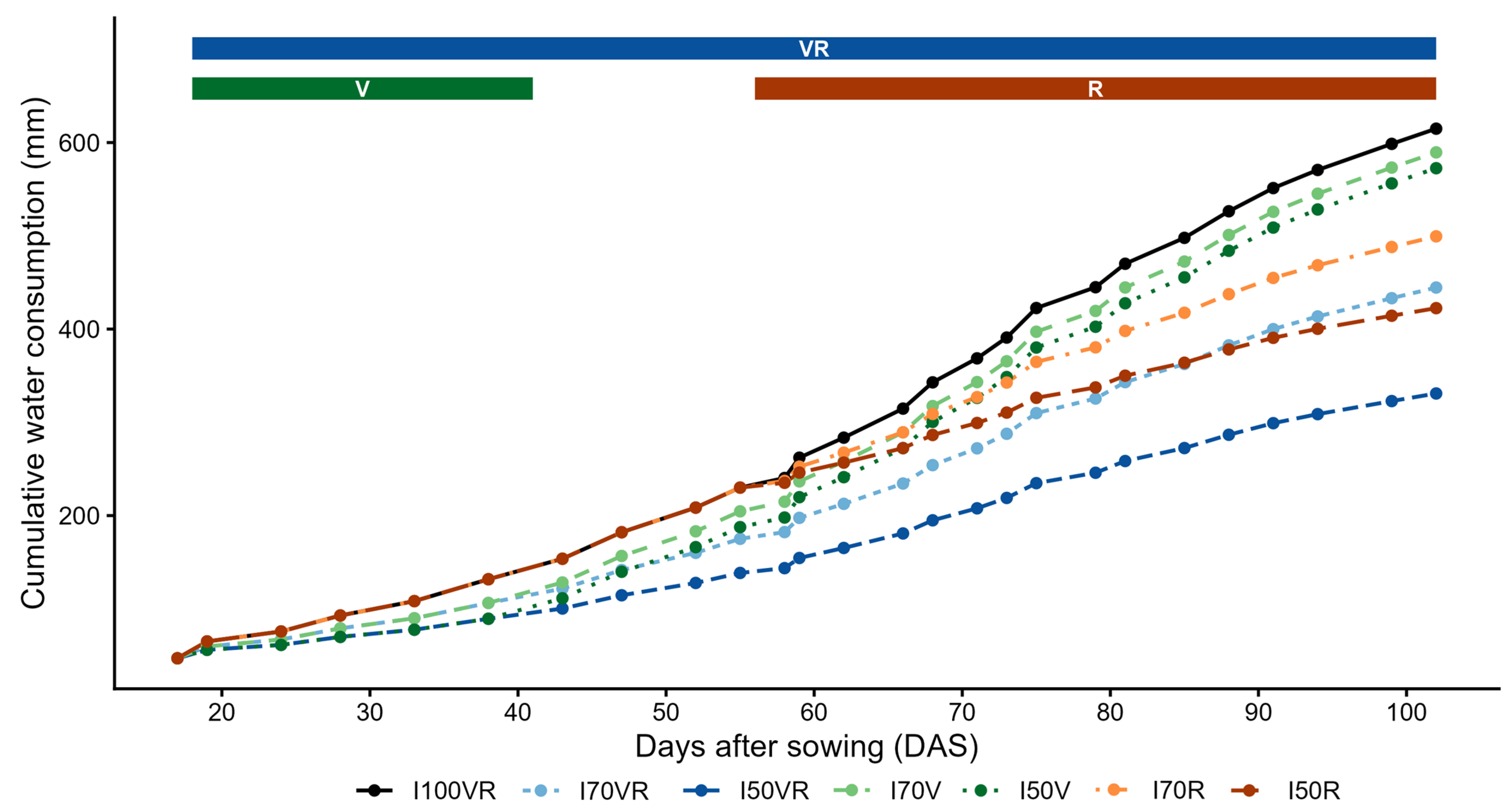
The water consumption under I100VR (full irrigation) was 615 mm. Reduced irrigation treatments received 444 mm (I70VR), 330 mm (I50VR), 589 mm (I70V), 572 mm (I50V), 499 mm (I70R), and 422 mm (I50R), corresponding to water reductions of 28, 46, 4, 7, 19, and 31%, respectively (Figure 1). Notably, I50R received slightly less water than I70VR, showing that a severe reproductive deficit removed a volume similar to that of a moderate deficit throughout the cycle. From 18 DAS until the end of the growing season, 25 irrigation events were performed, most of them during the reproductive stage (Figure S1).
Figure 1.
Cumulative water consumption of soybean under different irrigation strategies throughout the growing season. Horizontal bars indicate the periods of irrigation deficit. VR, throughout the growing season (18–102 DAS); V, vegetative stage (18–41 DAS); and R, pod formation and grain-filling (R3–R6; 56–102 DAS). I100VR: reference irrigation (100%); I70VR and I50VR: 70% and 50% of the reference irrigation throughout the season; I70V and I50V: 70% and 50% during the vegetative stage; I70R and I50R: 70% and 50% during the reproductive stage. DAS: days after sowing.
3.2. Physiological Responses
Irrigation affected all gas exchange variables and leaf water potential at the vegetative stage, and photosynthetic rate, stomatal conductance, and transpiration at the reproductive stage (Table S1). The individual effect of inoculant was significant only at the reproductive stage for photosynthetic rate and leaf water potential. The irrigation × inoculant interaction was significant for all variables, except stomatal conductance at the vegetative stage.
At the vegetative stage, stomatal conductance was highest under I100VR and I70R and lowest under I50V (Table 4). Under I50VR, BB-inoculated plants maintained higher photosynthetic rates than BJ and MA, whereas under I50V, BJ showed higher photosynthesis and transpiration than BB and MA. The most negative leaf water potentials were observed for BJ under I70VR and MA under I50VR.
Table 4.
Average values of photosynthetic rate, stomatal conductance, transpiration, and leaf water potential of soybean subjected to irrigation management and inoculants.
At the reproductive stage, I50R resulted in the lowest photosynthetic rate, stomatal conductance, and transpiration, with no differences among inoculants. Under I50VR and I70R, BJ maintained higher photosynthesis, stomatal conductance, and transpiration than BB and MA, whereas under I70VR and I70V, BJ showed lower values than the co-inoculated treatments. I70V and I50V (vegetative stage treatments) showed gas exchange values similar to or higher than I100VR. Leaf water potential was not affected by irrigation at this stage, and differences among inoculants were observed only under I70V, where BJ showed more negative values.
3.3. Growth, Yield Components and Irrigation Water Productivity
Irrigation significantly affected stem diameter, plant height, and leaf area index, whereas the inoculant affected only leaf area index. The irrigation × inoculant interaction was significant for leaf area index (Table S2). Stem diameter was lowest under I50VR and highest under I100VR, I70V, and I50V (Table 5). Plant height was reduced under continuous deficit, especially I50VR and I70VR, and under I50R, whereas the treatments imposed during the vegetative stage (I70V and I50V) and I70R reached heights similar or greater than I100VR, indicating full recovery of growth after vegetative-stage deficit. Leaf area index was highest under I50V and lowest under I50VR. Differences among inoculants occurred only under I100VR, where BJ showed higher LAI than BB and MA, and under I70VR, where MA showed higher LAI than BJ and BB.
Table 5.
Average values of stem diameter, plant height, shoot biomass, and leaf area index of soybean subjected to irrigation managements and inoculants.
Irrigation affected grain yield and yield components (Table S2). The individual effect of inoculant was significant for grain yield, number of pods per plant, and IWP, whereas the irrigation × inoculant interaction was significant only for the number of pods per plant.
Grain yield was highest under I100VR (3591 kg ha−1) and lowest under I50VR (2199 kg ha−1) (Table 6). Among inoculants, BJ produced higher yield than MA, with BB being intermediate. The number of pods per plant was highest under I50V and lowest under I50VR. Under I70V, BJ produced fewer pods than BB and MA, whereas under I70R, MA produced fewer pods than BJ and BB, and under I50R, BB and MA produced fewer pods than BJ. The 100-grain weight was highest under I50R and lowest under I50V. Irrigation water productivity was highest under I50R (0.80 kg m−3) and lowest under I70V and I50V (0.50 and 0.45 kg m−3). Among inoculants, IWP was higher for BJ than for MA.
Table 6.
Average values of grain yield, yield components, and irrigation water productivity of soybean subjected to irrigation managements and inoculants.
4. Discussion
4.1. Physiological Responses of Soybean to Irrigation Strategies and Inoculants
The present study showed that moderate and severe stress caused reductions in photosynthesis, stomatal conductance, transpiration, and leaf water potential. Reductions in these variables due to water stress have been widely reported in soybean [3,45,46]. Interestingly, inoculant-specific responses emerged under water deficit, suggesting differential modulation of soybean physiological performance according to fungal association.
At the vegetative stage, the lower photosynthetic rates under I50VR and I50V and the higher values under I100VR follow the established hierarchy of stomatal drought limitation in soybean [47]. Stomatal conductance was affected only by irrigation strategy, indicating that stomatal regulation at this stage is predominantly mediated by leaf water potential [48]. The narrow range of stomatal conductance across inoculants suggests that all treatments converged on similar stomatal aperture setpoints. The lowest leaf water potentials were observed for BJ under I70VR and MA under I50VR, indicating greater tissue dehydration in these combinations. Under I70VR, Bradyrhizobium japonicum-inoculated plants likely maintained higher transpiration than plants with the other inoculants, since greater gas exchange activity may lead to more negative leaf water potentials [49,50]. For MA under I50VR, the lower leaf water potential was accompanied by reduced photosynthetic rates, suggesting an overall weaker physiological performance under severe continuous stress rather than sustained transpiration.
At the reproductive stage, nitrogen demand from developing seeds reaches its peak, the canopy is fully developed, and the plant transitions from active photosynthate production to assimilate remobilization [51]. The highest gas exchange values observed at this stage under I70V and I50V suggest that vegetative-stage stress triggered compensatory canopy development (Table 4). Following full rewatering during the reproductive stage, such larger canopies can operate at optimal or superior gas exchange capacity [52,53]. Interestingly, I70R and I70V showed marked differences regarding inoculants. Under I70R, the well-watered vegetative stage likely allowed BJ to establish robust nodulation and nitrogen reserves [54], thereby sustaining photosynthetically activity during reproductive stage. Under I50R, plants were subjected to severe stress for the first time in the season. The imposition of this severe water restriction during active grain-filling triggers a rapid stomatal closure response [55]. The absence of inoculant differentiation under I50R suggests that due to severe stress at this critical stage none of the microbial inoculants can prevent the stomatal closure driven by hydraulic signals. This is consistent with the I50R yield findings discussed below where high 100-grain weight was achieved through assimilate concentration in fewer seeds.
Overall, the consistently lower performance of MA relative to the other inoculants should be interpreted with caution. First, competition between Metarhizium anisopliae and Bradyrhizobium japonicum for root colonization sites or resources should be considered [56]. Second, the association may have imposed an uncompensated carbon cost on the host. It was demonstrated that root-colonizing Metarhizium receives photosynthetically fixed carbon from its host even in the absence of insects, an exchange normally reciprocated by insect-derived nitrogen [57]. Without this nitrogen return, and with photosynthesis restricted by water stress, Metarhizium may have acted as an uncompensated carbon sink.
4.2. Impacts on Soybean Growth, Yield, and Irrigation Water Productivity
The growth variables indicate changes in plant development and canopy structure under the different irrigation and inoculation treatments. Stem diameter and plant height were reduced mainly when deficit irrigation was imposed throughout the growing season (I70VR and I50VR), and plant height was also reduced under I50R. This response may be associated with restricted cell elongation and turgor-driven growth, which are particularly vulnerable under prolonged water deficit [58]. In I70V and I50V treatments, irrigation restriction occurred while stem cells were actively expanding [59]; however, rewatering before flowering allowed cell expansion to resume and compensate for the earlier growth limitation, as plant height in these treatments did not differ significantly from I100VR [60,61].
The range of leaf area index across treatments (4.0–8.7) reveals the considerable plasticity of soybean canopy development under water deficit [62], reinforcing the importance of irrigation scheduling in this species [3,16]. The lowest LAI was observed under I50VR, as prolonged water deficit reduces leaf initiation, accelerates leaf senescence, and limits cell expansion in developing leaflets [63]. In contrast, the highest LAI under I50V suggests compensatory canopy growth after rewatering. Inoculant differences in LAI were less expressive. For example, BJ showed higher LAI than the co-inoculated treatments under I100VR, consistent with the contribution of biological nitrogen fixation to leaf growth, since leaf expansion is highly nitrogen-demanding [64,65], whereas MA showed higher LAI under I70VR.
Water deficit reduced grain yield, number of pods per plant, and 100-grain weight, with effects depending on the phenological stage and on the duration and intensity of the deficit [66,67]. The lowest yield was observed under I50VR, 39% lower than under I100VR, consistent with de Almeida [16], who reported yield reductions of up to 50% under a 40% water replacement level throughout the growing season. Pod number is particularly sensitive to water deficit because it is established at the sensitive R1–R6 stages [58]. Accordingly, deficit after flowering (I70R and I50R) reduced pod number, whereas deficit restricted to the vegetative stage did not. Pod number was the only yield component with a significant irrigation × inoculant interaction. Under reproductive-stage deficit, BB and MA treatments produced fewer pods than those inoculated with BJ, suggesting that fungal co-inoculation may have constrained, nitrogen fixation or assimilate supply during the critical pod-set window [68,69]. Bradyrhizobium japonicum inoculation has been shown to mitigate drought-induced losses in water status, nodulation, and yield [70,71] and to sustain biological nitrogen fixation under both well-watered and drought conditions [72]. The highest 100-grain weight under I50R reflects a compensatory mechanism, in which fewer pods concentrate assimilates in fewer seeds, increasing individual grain weight [58,73]. Conversely, I50V produced the largest number of pods, and assimilates were distributed among more seeds, resulting in the lowest 100-grain weight [74].
Irrigation water productivity is a key metric for evaluating deficit irrigation strategies [75]. The highest IWP was observed under I50R (0.80 kg m−3), consistent with Mathobo et al. [13], who reported increased IWP in common bean when water deficit was imposed during the reproductive stage. This result reflects a 31% reduction in irrigation water without a significant yield reduction relative to I100VR [76]. In contrast, the lowest IWP occurred under I70V and I50V treatments, which received full irrigation during the reproductive stage, when water demand is highest, without a corresponding increase in yield. Among inoculants, BJ showed higher IWP than MA, reflecting its higher mean yield, whereas BB showed intermediate values. Beauveria bassiana acting as an endophyte has been reported to enhance water uptake under water deficit [29].
4.3. Study Limitations and Prospects
This study was conducted over a single growing season at one location, in containers under a rain-out shelter. While appropriate as a proof of concept, this design does not capture the year-to-year and field-scale variability that strongly affects the performance of entomopathogenic fungi [77]. The results should therefore be regarded as preliminary. Nevertheless, they provide initial evidence of the potential of Beauveria bassiana and Metarhizium anisopliae as coinoculants with Bradyrhizobium under contrasting irrigation regimes. Multi-season, multi-site trials are needed to confirm these findings. In addition, root colonization and rhizosphere persistence were not assessed. Therefore, the results reflect the application of the inoculants rather than demonstrated effects of endophytic colonization and may also involve changes in the soil microbial community. Finally, gas exchange was measured in all experimental units on a single day, extending the measurement period over several hours. Despite standardized chamber conditions, diurnal changes in temperature, vapor pressure deficit, and plant water status may have influenced gas exchange traits.
The use of entomopathogenic fungi may provide benefits at different application timings in soybean, depending on the period of stress imposition and the irrigation strategies adopted. As a strategy to reproduce these responses under field conditions and improve inoculation logistics, one promising possibility would be the application of fungal inoculants in soybean systems under subsurface drip irrigation, which could enable inoculation at different stages of crop development, particularly prior to critical periods such as flowering and grain-filling.
Under rainfed conditions, daily water replenishment to field capacity throughout the growing season may not occur because of climatic dependence [78]. Consequently, maintaining conditions equivalent to the I100VR treatment is only feasible under fully irrigated drip systems [41]. In years with well-distributed and adequate rainfall, rainfed systems may experience conditions comparable to the I70VR treatment, whereas drier years will likely resemble the water regimes observed under I50VR. These scenarios highlight the importance of adopting new management strategies to improve soybean performance under rainfed conditions.
Therefore, the inoculation of entomopathogenic fungi in plants expands the possibilities for exploring their interactions, particularly when aiming to exploit the endophytic capacity of these fungi to mitigate abiotic stresses such as water stress. Nevertheless, further studies are still required involving different soybean cultivars, additional fungal isolates such as Isaria fumosorosea and Trichoderma sp., and varying concentrations of fungal inoculum. All these factors should be considered in the development and optimization of new cultivation strategies based on fungal inoculation.
5. Conclusions
Soybean inoculated with Bradyrhizobium japonicum showed higher grain yield and irrigation water productivity (IWP) than plants coinoculated with Metarhizium anisopliae, regardless of irrigation strategy. In contrast, coinoculation with Beauveria bassiana resulted in a grain yield and IWP that did not differ significantly from those of Bradyrhizobium japonicum and sustained higher photosynthetic rates than the other inoculants under severe continuous deficit (I50VR) at the vegetative stage. Among irrigation strategies, a 50% deficit applied during reproductive stage (I50R) reduced irrigation water by 31% without a statistically significant reduction in grain yield relative to full irrigation, resulting in the highest IWP.
These results were obtained in a single season under a rain-out shelter and should therefore be considered preliminary. Multi-season field studies including colonization assessment are needed to confirm the potential of Beauveria bassiana as a coinoculant and to clarify the lower performance of Metarhizium anisopliae in irrigated and rainfed soybean.
Supplementary Materials
The following supporting information can be downloaded at https://www.mdpi.com/article/10.3390/crops6060116/s1, Figure S1. Soil matric potential (kPa) of the reference treatment (I100VR) at depths of 0–0.20 and 0.20–0.40 m throughout the soybean growing season; Figure S2. Experimental design used in this study; Table S1. F-values and p-values from the analysis of variance for photosynthetic rate, stomatal conductance, transpiration, and leaf water potential of soybean at the vegetative (41 DAS) and reproductive (95 DAS) stages; Table S2. F-values and p-values from the analysis of variance for grain yield, number of pods per plant, 100-grain weight, irrigation water productivity, stem diameter, plant height, and leaf area index of soybean.
Author Contributions
Conceptualization, A.d.S.G., R.D.C. and Í.D.J.; methodology, A.d.S.G., R.D.C. and Í.D.J.; software, C.A.Q.-C.; validation, R.D.C., C.A.Q.-C., A.C.F.F., C.C.M. and J.d.O.C.; formal analysis, C.A.Q.-C.; investigation, A.d.S.G., C.A.Q.-C. and A.C.F.F.; resources, R.D.C. and Í.D.J.; data curation, A.d.S.G. and C.A.Q.-C.; writing—original draft preparation, A.d.S.G. and C.A.Q.-C.; writing—review and editing, R.D.C., Í.D.J., C.A.Q.-C., A.C.F.F., C.C.M. and J.d.O.C.; visualization, C.A.Q.-C. and J.d.O.C.; supervision, R.D.C. and Í.D.J.; project administration, R.D.C.; funding acquisition, R.D.C. All authors have read and agreed to the published version of the manuscript.
Funding
This study was funded in part by CAPES (Coordenação de Aperfeiçoamento de Pessoal de Nível Superior—Finance Code 001) and São Paulo Research Foundation (FAPESP) (Process 2018/02317-5) as part of the São Paulo Advanced Research Center for Biological Control (SPARCBio), hosted at the Luiz de Queiroz College of Agriculture (ESALQ) of the University of São Paulo (USP), sponsored by FAPESP, Koppert and USP. The funders had no role in the study design; in the collection, analysis, or interpretation of data; in the writing of the manuscript; or in the decision to publish the results.
Data Availability Statement
The raw data supporting the conclusions of this article will be made available by the authors on request.
Acknowledgments
The first author would like to thank the Coordenação de Aperfeiçoamento de Pessoal de Nível Superior for their support of this study through a MSc scholarship. All authors would like to thank Alice Horii Bernardino for her assistance with the laboratory work.
Conflicts of Interest
Author Jéfferson de Oliveira Costa is affiliated with Embrapa, a public research institution. The remaining authors declare that the research was conducted in the absence of any commercial or financial relationships that could be construed as a potential conflict of interest.
Abbreviations
The following abbreviations are used in this manuscript:
| 100GW | 100-grain weight |
| A | Photosynthetic rate |
| BB | Beauveria bassiana + Bradyrhizobium japonicum |
| BJ | Bradyrhizobium japonicum |
| E | Transpiration |
| gs | Stomatal conductance |
| GY | Grain yield |
| I100VR | 100% of reference irrigation applied throughout the entire crop cycle |
| I50R | 50% of reference irrigation applied during the reproductive stage (R4–R6) |
| I50V | 50% of reference irrigation applied during the vegetative stage |
| I50VR | 50% of reference irrigation applied throughout the entire crop cycle |
| I70R | 70% of reference irrigation applied during the reproductive stage (R4–R6) |
| I70V | 70% of reference irrigation applied during the vegetative stage |
| I70VR | 70% of reference irrigation applied throughout the entire crop cycle |
| IWP | Irrigation water productivity |
| LWP | Leaf water potential |
| MA | Metarhizium anisopliae + Bradyrhizobium japonicum |
| PP | Number of pods per plant |
References
- FAO. FAOSTAT: Crops and Livestock Products. Available online: https://www.fao.org/faostat/en/#data/QCL (accessed on 22 October 2026).
- Barbosa, J.Z.; Motta, A.C.V.; Poggere, G.; Prior, S.A. Winners of the Brazilian Soybean Yield Contest: Climatic, Soil, Management, and Economic Factors. Oil Crop Sci. 2025, 10, 294–302. [Google Scholar] [CrossRef] [Scilit]
- França, A.C.F.; Coelho, R.D.; da Silva Gundim, A.; de Oliveira Costa, J.; Quiloango-Chimarro, C.A. Effects of Different Irrigation Scheduling Methods on Physiology, Yield, and Irrigation Water Productivity of Soybean Varieties. Agric. Water Manag. 2024, 293, 108709. [Google Scholar] [CrossRef] [Scilit]
- Grassini, P.; Torrion, J.A.; Yang, H.S.; Rees, J.; Andersen, D.; Cassman, K.G.; Specht, J.E. Soybean Yield Gaps and Water Productivity in the Western US Corn Belt. Field Crop. Res. 2015, 179, 150–163. [Google Scholar] [CrossRef] [Scilit]
- Sentelhas, P.C.; Battisti, R.; Câmara, G.M.S.; Farias, J.R.B.; Hampf, A.C.; Nendel, C. The Soybean Yield Gap in Brazil—Magnitude, Causes and Possible Solutions for Sustainable Production. J. Agric. Sci. 2015, 153, 1394–1411. [Google Scholar] [CrossRef] [Scilit]
- Wang, X.; Wu, Z.; Zhou, Q.; Wang, X.; Song, S.; Dong, S. Physiological Response of Soybean Plants to Water Deficit. Front. Plant Sci. 2022, 12, 809692. [Google Scholar] [CrossRef] [Scilit]
- CONAB. Acompanhamento da Safra Brasileira de Grãos: Safra 2025/26; CONAB: Brasília, Brazil, 2026. [Google Scholar]
- da Silva, E.H.F.M.; Vieira, N.A.; Fattori, I.M.; Marin, F.R. Exploring Avenues for Tropical Soybean Intensification: How Much Water and Nutrients Are Demanded to Achieve Exploitable Yield? Sci. Agric. 2024, 81, e20230168. [Google Scholar] [CrossRef] [Scilit]
- Battisti, R.; Sentelhas, P.C. Characterizing Brazilian Soybean-Growing Regions by Water Deficit Patterns. Field Crop. Res. 2019, 240, 95–105. [Google Scholar] [CrossRef] [Scilit]
- Antolin, L.A.S.; da Silva, E.H.F.M.; Zanon, A.J.; Ribeiro, B.S.M.R.; Marin, F.R. How Much Would Irrigation Increase Maize Production in Brazil? Sci. Agric. 2025, 82, e20240083. [Google Scholar] [CrossRef] [Scilit]
- Fernández, J.E.; Alcon, F.; Diaz-Espejo, A.; Hernandez-Santana, V.; Cuevas, M. V Water Use Indicators and Economic Analysis for On-Farm Irrigation Decision: A Case Study of a Super High Density Olive Tree Orchard. Agric. Water Manag. 2020, 237, 106074. [Google Scholar] [CrossRef] [Scilit]
- Geerts, S.; Raes, D.; Garcia, M.; Vacher, J.; Mamani, R.; Mendoza, J.; Huanca, R.; Morales, B.; Miranda, R.; Cusicanqui, J.; et al. Introducing Deficit Irrigation to Stabilize Yields of Quinoa (Chenopodium quinoa Willd.). Eur. J. Agron. 2008, 28, 427–436. [Google Scholar] [CrossRef] [Scilit]
- Mathobo, R.; Marais, D.; Steyn, J.M. The Effect of Drought Stress on Yield, Leaf Gaseous Exchange and Chlorophyll Fluorescence of Dry Beans (Phaseolus vulgaris L.). Agric. Water Manag. 2017, 180, 118–125. [Google Scholar] [CrossRef] [Scilit]
- Alou, I.N.; Steyn, J.M.; Annandale, J.G.; van der Laan, M. Growth, Phenological, and Yield Response of Upland Rice (Oryza sativa L. cv. Nerica 4®) to Water Stress during Different Growth Stages. Agric. Water Manag. 2018, 198, 39–52. [Google Scholar] [CrossRef] [Scilit]
- Quiloango-Chimarro, C.A.; Coelho, R.D.; da Silva Gundim, A.; de Oliveira Costa, J.; da Rocha, T.F.; Heinemann, A.B. Irrigation Strategies for Upland Rice Cultivars in Brazil: Physiological Responses and Agronomic Performance. Agric. Water Manag. 2025, 321, 109914. [Google Scholar] [CrossRef] [Scilit]
- de Almeida, A.M.; Coelho, R.D.; da Silva Barros, T.H.; Quiloango-Chimarro, C.; Azevedo, A.T.; de Oliveira Costa, J. Water Use Efficiency and Canopy Temperature Response of Soybean Subjected to Deficit Irrigation. Ital. J. Agrometeorol. 2024, 1, 3–16. [Google Scholar] [CrossRef] [Scilit]
- Quiloango-Chimarro, C.A.; Coelho, R.D.; Gundim, A.d.S.; Costa, J.d.O. Water Use Efficiency and Yield Response Factor of Common Bean Subjected to Deficit Irrigation Strate-Gies: A Case Study in Brazil. Ital. J. Agrometeorol. 2025, 1, 43–50. [Google Scholar] [CrossRef] [Scilit]
- Candogan, B.N.; Sincik, M.; Buyukcangaz, H.; Demirtas, C.; Goksoy, A.T.; Yazgan, S. Yield, Quality and Crop Water Stress Index Relationships for Deficit-Irrigated Soybean [Glycine max (L.) Merr.] in Sub-Humid Climatic Conditions. Agric. Water Manag. 2013, 118, 113–121. [Google Scholar] [CrossRef] [Scilit]
- Silva, V.d.P.R.d.; e Silva, R.A.; Maciel, G.F.; Braga, C.C.; da Silva Júnior, J.L.C.; de Souza, E.P.; Almeida, R.S.R.; Silva, M.T.; de Holanda, R.M. Calibration and Validation of the AquaCrop Model for the Soybean Crop Grown under Different Levels of Irrigation in the Motopiba Region, Brazil. Ciênc. Rural 2017, 48, 1–8. [Google Scholar] [CrossRef] [Scilit]
- Montoya, F.; Otero, A. Is Irrigating Soybean Profitable in Uruguay? A Modeling Approach. Agron. J. 2019, 111, 749–763. [Google Scholar] [CrossRef] [Scilit]
- Abreu-Junior, C.H.; Gruberger, G.A.C.; Cardoso, P.H.S.; Gonçalves, P.W.B.; Nogueira, T.A.R.; Capra, G.F.; Jani, A.D. Soybean Seed Enrichment with Cobalt and Molybdenum as an Alternative to Conventional Seed Treatment. Plants 2023, 12, 1164. [Google Scholar] [CrossRef] [Scilit]
- Islam, M.R.; Abdullah, H.M.; Rahman, M.F.; Islam, M.; Tuhin, A.K.; Ashiquzzaman, M.; Islam, K.S.; Geisseler, D. Mitigation of Water-Deficit Stress in Soybean by Seaweed Extract: The Integrated Approaches of UAV-Based Remote Sensing and a Field Trial. Drones 2025, 9, 487. [Google Scholar] [CrossRef] [Scilit]
- Russo, M.L.; Pelizza, S.A.; Vianna, M.F.; Allegrucci, N.; Cabello, M.N.; Toledo, A.V.; Mourelos, C.; Scorsetti, A.C. Effect of Endophytic Entomopathogenic Fungi on Soybean Glycine max (L.) Merr. Growth and Yield. J. King Saud Univ. 2019, 31, 728–736. [Google Scholar] [CrossRef] [Scilit]
- Ayilara, M.S.; Adeleke, B.S.; Babalola, O.O. Bioprospecting and Challenges of Plant Microbiome Research for Sustainable Agriculture, a Review on Soybean Endophytic Bacteria. Microb. Ecol. 2023, 85, 1113–1135. [Google Scholar] [CrossRef] [Scilit]
- Santos, T.S.; de Almeida Santos, J.F.; Santos, E.L.T.; Santos, T.S.; Leite, J.L.S.; Blank, A.F.; Mendonça, M.d.C. Bioprospection of Entomopathogenic Fungi Natives of Brazilian Semi-Arid with Potential for Biological Control of Insect-Pests. World J. Microbiol. Biotechnol. 2026, 42, 217. [Google Scholar] [CrossRef] [Scilit]
- Bocatti, C.R.; Hungria, M.; Nogueira, M.A. Biological Inputs in Brazilian and Worldwide Agriculture. Agronomy 2026, 16, 2103. [Google Scholar] [CrossRef] [Scilit]
- Rajendran, Y.; Sankaran, S.P.; Marimuthu, M.; Butt, T.M.; Nandagopal, G.; Mellikeche, W.; Subramanian, J.; Rajasekaran, R.; Subramanian, M. Entomopathogenic Fungi as Orchestrators of Plant Defense, Growth, and Stress Tolerance—A Comprehensive Review. J. Basic Microbiol. 2026, 66, e70161. [Google Scholar] [CrossRef] [Scilit]
- Chaudhary, P.J.; Raghunandan, B.L.; Patel, H.K.; Mehta, P.V.; Patel, N.B.; Sonth, B.; Dave, A.; Bagul, S.Y.; Divya, M.; Jain, D.; et al. Plant Growth-Promoting Potential of Entomopathogenic Fungus Metarhizium pinghaense AAUBC-M26 under Elevated Salt Stress in Tomato. Agronomy 2023, 13, 1577. [Google Scholar] [CrossRef] [Scilit]
- Guo, W.; Lu, Y.; Du, S.; Li, Q.; Zou, X.; Zhang, Z.; Sui, L. Endophytic Colonization of Beauveria bassiana Enhances Drought Stress Tolerance in Tomato via “Water Spender” Pathway. Int. J. Mol. Sci. 2024, 25, 11949. [Google Scholar] [CrossRef] [Scilit]
- Tomilova, O.G.; Kryukova, N.A.; Efimova, M.V.; Kolomeichuk, L.V.; Kovtun, I.S.; Glupov, V.V. The Endophytic Entomopathogenic Fungus Beauveria bassiana Alleviates Adverse Effects of Salt Stress in Potato Plants. Horticulturae 2023, 9, 1140. [Google Scholar] [CrossRef] [Scilit]
- Papantzikos, V.; Mantzoukas, S.; Koutsompina, A.; Karali, E.M.; Eliopoulos, P.A.; Servis, D.; Bitivanos, S.; Patakioutas, G. Use of Beauveria bassiana and Bacillus amyloliquefaciens Strains as Gossypium hirsutum Seed Coatings: Evaluation of the Bioinsecticidal and Biostimulant Effects in Semi-Field Conditions. Agronomy 2024, 14, 2335. [Google Scholar] [CrossRef] [Scilit]
- Prando, A.M.; Barbosa, J.Z.; de Oliveira, A.B.; Nogueira, M.A.; Possamai, E.J.; Hungria, M. Benefits of Soybean Co-Inoculation with Bradyrhizobium spp. and Azospirillum brasilense: Large-Scale Validation with Farmers in Brazil. Eur. J. Agron. 2024, 155, 127112. [Google Scholar] [CrossRef] [Scilit]
- Barelli, L.; Waller, A.S.; Behie, S.W.; Bidochka, M.J. Plant Microbiome Analysis after Metarhizium Amendment Reveals Increases in Abundance of Plant Growth-Promoting Organisms and Maintenance of Disease-Suppressive Soil. PLoS ONE 2020, 15, e0231150. [Google Scholar] [CrossRef] [Scilit]
- Lopes, T.d.S.; Mesquita, E.; Matos, J.d.R.; Correa, T.A.; Castro, T.A.v.T.d.; Garcia, A.C.; Monteiro Neto, J.L.L.; Alves, G.C.; Zilli, J.É.; Angelo, I.d.C.; et al. Methodological Framework to Evaluate Entomopathogenic Fungi and Rhizobial Co-Inoculation Effects on Plant Growth and Root Morphology. Plants 2026, 15, 2141. [Google Scholar] [CrossRef] [Scilit]
- Alvares, C.A.; Stape, J.L.; Sentelhas, P.C.; Gonçalves, J.L.d.M.; Sparovek, G. Köppen’s Climate Classification Map for Brazil. Meteorol. Z. 2013, 22, 711–728. [Google Scholar] [CrossRef] [Scilit]
- Allen, R.G.; Pereira, L.S.; Raes, D.; Smith, M. Crop Evapotranspiration-Guidelines for Computing Crop Water Requirements; FAO Irrigation and Drainage Paper 56; FAO: Rome, Italy, 1998. [Google Scholar]
- Salazar-Mendoza, P.; Magalhães, D.M.; Pec, M.; Azevedo, K.E.X.; Delalibera, I., Jr.; Bento, J.M.S. Endophytic Entomopathogenic Fungus, Individually and in Combination with Rhizobacteria, Enhances Resistance in Wild and Cultivated Tomatoes to Tuta absoluta. J. Pest Sci. 2025, 98, 731–745. [Google Scholar] [CrossRef] [Scilit]
- de Melo, C.L.P.; Pipolo, A.E.; Arias, C.A.A.; de Oliveira, M.F.; Moreira, J.U.V.; Soares, R.M.; de Souza, M.G.; Dalbosco, M.; Dengler, R.U. BRS 511: Sua Nova Aliada no Manejo da Ferrugem. Available online: http://www.infoteca.cnptia.embrapa.br/infoteca/handle/doc/1076896 (accessed on 12 September 2025).
- van Raij, B.; Cantarella, H.; Quaggio, J.A.; Furlani, A.M.C. Recomendacoes da Adubacao e Calagem Para o Estado de Sao Paulo; Instituto Agronômico: Campinas, Brazil, 1997; pp. 1–88. [Google Scholar]
- van Genuchten, M.T. A Closed-Form Equation for Predicting the Hydraulic Conductivity of Unsaturated Soils. Soil Sci. Soc. Am. J. 1980, 44, 892–898. [Google Scholar] [CrossRef] [Scilit]
- Quiloango-Chimarro, C.A.; Coelho, R.D.; Heinemann, A.B.; Arrieta, R.G.; da Silva Gundim, A.; França, A.C.F. Physiology, Yield, and Water Use Efficiency of Drip-Irrigated Upland Rice Cultivars Subjected to Water Stress at and after Flowering. Exp. Agric. 2022, 58, e19. [Google Scholar] [CrossRef] [Scilit]
- Schuh, W. Effect of Pod Development Stage, Temperature, and Pod Wetness Duration on the Incidence of Purple Seed Stain of Soybeans. Phytopathology 1992, 82, 446–451. [Google Scholar] [CrossRef] [Scilit]
- R Core Team. R: A Language and Environment for Statistical Computing; R Core Team: Vienna, Austria, 2022; Available online: https://www.r-project.org (accessed on 17 February 2022).
- Ferreira, E.B.; Cavalcanti, P.P.; Nogueira, D.A. Experimental Designs Package; R Foundation for Statistical Computing: Vienna, Austria, 2013. [Google Scholar]
- Falcioni, R.; de Oliveira, C.A.; Vedana, N.G.; Mendonça, W.A.; Gonçalves, J.V.F.; da Silva Haubert, D.d.F.; de Matos, D.H.S.; Reis, A.S.; Antunes, W.C.; Crusiol, L.G.T.; et al. Progressive Water Deficit Impairs Soybean Growth, Alters Metabolic Profiles, and Decreases Photosynthetic Efficiency. Plants 2025, 14, 2615. [Google Scholar] [CrossRef] [Scilit]
- Tavares, C.J.; Ribeiro Junior, W.Q.; Ramos, M.L.G.; Pereira, L.F.; Casari, R.A.d.C.N.; Pereira, A.F.; de Sousa, C.A.F.; da Silva, A.R.; Neto, S.P.d.S.; Mertz-Henning, L.M. Water Stress Alters Morphophysiological, Grain Quality and Vegetation Indices of Soybean Cultivars. Plants 2022, 11, 559. [Google Scholar] [CrossRef] [Scilit]
- Flexas, J.; Medrano, H. Drought-inhibition of Photosynthesis in C3 Plants: Stomatal and Non-stomatal Limitations Revisited. Ann. Bot. 2002, 89, 183–189. [Google Scholar] [CrossRef] [Scilit]
- Rodrigues, M.L.; Santos, T.P.; Rodrigues, A.P.; de Souza, C.R.; Lopes, C.M.; Maroco, J.P.; Pereira, J.S.; Chaves, M.M. Hydraulic and Chemical Signalling in the Regulation of Stomatal Conductance and Plant Water Use in Field Grapevines Growing under Deficit Irrigation. Funct. Plant Biol. 2008, 35, 565–579. [Google Scholar] [CrossRef] [Scilit]
- Biju, S.; Fuentes, S.; Gupta, D. The Use of Infrared Thermal Imaging as a Non-Destructive Screening Tool for Identifying Drought-Tolerant Lentil Genotypes. Plant Physiol. Biochem. 2018, 127, 11–24. [Google Scholar] [CrossRef] [Scilit]
- Dong, S.; Jiang, Y.; Dong, Y.; Wang, L.; Wang, W.; Ma, Z.; Yan, C.; Ma, C.; Liu, L. A Study on Soybean Responses to Drought Stress and Rehydration. Saudi J. Biol. Sci. 2019, 26, 2006–2017. [Google Scholar] [CrossRef] [Scilit]
- Masclaux-Daubresse, C.; Reisdorf-Cren, M.; Orsel, M. Leaf Nitrogen Remobilisation for Plant Development and Grain Filling. Plant Biol. 2008, 10, 23–36. [Google Scholar] [CrossRef] [Scilit]
- Luo, H.H.; Zhang, Y.L.; Zhang, W.F. Effects of Water Stress and Rewatering on Photosynthesis, Root Activity, and Yield of Cotton with Drip Irrigation under Mulch. Photosynthetica 2016, 54, 65–73. [Google Scholar] [CrossRef] [Scilit]
- Wang, C.; Sun, A.; jie Zhu, L.; Liu, M.; Zhang, Q.; Wang, L.; Gao, X. Drought and Rewatering Effects on Soybean Photosynthesis, Physiology and Yield. PeerJ 2025, 13, e19658. [Google Scholar] [CrossRef] [Scilit]
- Sharaf, H.; Rodrigues, R.R.; Moon, J.; Zhang, B.; Mills, K.; Williams, M.A. Unprecedented Bacterial Community Richness in Soybean Nodules Vary with Cultivar and Water Status. Microbiome 2019, 7, 63. [Google Scholar] [CrossRef] [Scilit]
- Farooq, M.; Gogoi, N.; Barthakur, S.; Baroowa, B.; Bharadwaj, N.; Alghamdi, S.S.; Siddique, K.H.M. Drought Stress in Grain Legumes during Reproduction and Grain Filling. J. Agron. Crop Sci. 2017, 203, 81–102. [Google Scholar] [CrossRef] [Scilit]
- Iturralde, E.T.; Stocco, M.C.; Faura, A.; Mónaco, C.I.; Cordo, C.; Pérez-Giménez, J.; Lodeiro, A.R. Coinoculation of Soybean Plants with Bradyrhizobium japonicum and Trichoderma harzianum: Coexistence of Both Microbes and Relief of Nitrate Inhibition of Nodulation. Biotechnol. Rep. 2020, 26, e00461. [Google Scholar] [CrossRef] [Scilit]
- Behie, S.W.; Moreira, C.C.; Sementchoukova, I.; Barelli, L.; Zelisko, P.M.; Bidochka, M.J. Carbon Translocation from a Plant to an Insect-Pathogenic Endophytic Fungus. Nat. Commun. 2017, 8, 14245. [Google Scholar] [CrossRef] [Scilit]
- Poudel, S.; Vennam, R.R.; Shrestha, A.; Reddy, K.R.; Wijewardane, N.K.; Reddy, K.N.; Bheemanahalli, R. Resilience of Soybean Cultivars to Drought Stress during Flowering and Early-Seed Setting Stages. Sci. Rep. 2023, 13, 1277. [Google Scholar] [CrossRef] [Scilit]
- Bhattacharya, A. Effect of Soil Water Deficit on Growth and Development of Plants: A Review. In Soil Water Deficit and Physiological Issues in Plants; Springer: Singapore, 2021; pp. 393–488. [Google Scholar]
- Lechner, L.; Pereyra-Irujo, G.A.; Granier, C.; Aguirrezábal, L.A.N. Rewatering Plants after a Long Water-Deficit Treatment Reveals That Leaf Epidermal Cells Retain Their Ability to Expand after the Leaf Has Apparently Reached Its Final Size. Ann. Bot. 2008, 101, 1007–1015. [Google Scholar] [CrossRef] [Scilit]
- Gebre, M.G.; Rajcan, I.; Earl, H.J. Genetic Variation for Effects of Drought Stress on Yield Formation Traits among Commercial Soybean [Glycine max (L.) Merr.] Cultivars Adapted to Ontario, Canada. Front. Plant Sci. 2022, 13, 1020944. [Google Scholar] [CrossRef] [Scilit]
- He, S.; Li, X.; Chen, M.; Xu, X.; Zhang, W.; Chi, H.; Shao, P.; Tang, F.; Gong, T.; Guo, M.; et al. Excellent Canopy Structure in Soybeans Can Improve Their Photosynthetic Performance and Increase Yield. Agriculture 2024, 14, 1783. [Google Scholar] [CrossRef] [Scilit]
- El Amine, B.; Mosseddaq, F.; Ait Houssa, A.; Bouaziz, A.; Moughli, L.; Oukarroum, A. Physiological and Agronomic Effects of Regulated-Deficit Irrigation on Soybean Grown under Arid Climatic Conditions. Crop J. 2025, 13, 281–291. [Google Scholar] [CrossRef] [Scilit]
- Gulías, J.; Flexas, J.; Mus, M.; Cifre, J.; Lefi, E.; Medrano, H. Relationship between Maximum Leaf Photosynthesis, Nitrogen Content and Specific Leaf Area in Balearic Endemic and Non-endemic Mediterranean Species. Ann. Bot. 2003, 92, 215–222. [Google Scholar] [CrossRef] [Scilit]
- Landi, S.; Esposito, S. Nitrate Uptake Affects Cell Wall Synthesis and Modeling. Front. Plant Sci. 2017, 8, 1376. [Google Scholar] [CrossRef] [Scilit]
- Alves, E.S.; Rodrigues, L.N.; de Oliveira, R.A.; Lorena, D.R. Water Deficit on the Growth and Yield of Irrigated Soybean in the Brazilian Cerrado Region. Rev. Bras. Eng. Agríc. Ambient. 2021, 25, 750–757. [Google Scholar] [CrossRef] [Scilit]
- Anda, A.; Soós, G.; Menyhárt, L.; Kucserka, T.; Simon, B. Yield Features of Two Soybean Varieties under Different Water Supplies and Field Conditions. Field Crop. Res. 2020, 245, 107673. [Google Scholar] [CrossRef] [Scilit]
- Dong, S.; Zhou, X.; Qu, Z.; Wang, X. Effects of Drought Stress and Re-Watering on Nitrogen Content in Soybean at Different Growth Stages. Chil. J. Agric. Res. 2024, 84, 548–561. [Google Scholar]
- Han, Q.; Li, M.; Hong, Y.; Zhu, Y.; Liu, C.; Tang, X.; Zhang, Q.; Li, P. Effects of Rhizobial Inoculation on Soybean Nodulation and Rhizocompartment Bacterial Community under Different Soil Conditions. Oil Crop Sci. 2026, 11, 45–54. [Google Scholar] [CrossRef] [Scilit]
- Szczerba, A.; Płażek, A.; Kopeć, P.; Surówka, E.; Dubert, F. Mitigating Soil Drought Effects in Soybean with Bradyrhizobium japonicum Inoculants. BMC Plant Biol. 2025, 25, 1533. [Google Scholar] [CrossRef] [Scilit]
- Cerezini, P.; Kuwano, B.H.; Grunvald, A.K.; Hungria, M.; Nogueira, M.A. Soybean Tolerance to Drought Depends on the Associated Bradyrhizobium Strain. Braz. J. Microbiol. 2020, 51, 1977–1986. [Google Scholar] [CrossRef] [Scilit]
- Skipitytė, R.; Barisevičiūtė, R.; Toleikienė, M. Impact of Microbial Strain on the Nitrogen Fixation of Soybean Varieties of Different Maturity under Cool Climate Conditions of Northern Europe. Plants 2025, 14, 3097. [Google Scholar] [CrossRef] [Scilit]
- Zhang, H.; Flottmann, S. Source-Sink Manipulations Indicate Seed Yield in Canola Is Limited by Source Availability. Eur. J. Agron. 2018, 96, 70–76. [Google Scholar] [CrossRef] [Scilit]
- Schonbeck, M.W.; Hsu, F.C.; Carlsen, T.M. Effect of Pod Number on Dry Matter and Nitrogen Accumulation and Distribution in Soybean 1. Crop Sci. 1986, 26, 783–788. [Google Scholar] [CrossRef] [Scilit]
- Geerts, S.; Raes, D. Deficit Irrigation as an On-Farm Strategy to Maximize Crop Water Productivity in Dry Areas. Agric. Water Manag. 2009, 96, 1275–1284. [Google Scholar] [CrossRef] [Scilit]
- Barrera, W., Jr.; Morbidini, F.; Zammarchi, L.; Ghinassi, G.; Maucieri, C.; Borin, M.; Dalla Marta, A.; Verdi, L. Assessing the Impacts of Regulated Deficit Irrigation on Soybean Using AquaCrop. Ital. J. Agron. 2024, 19, 100023. [Google Scholar] [CrossRef] [Scilit]
- Fernández-Bravo, M.; Gschwend, F.; Mayerhofer, J.; Hug, A.; Widmer, F.; Enkerli, J. Land-Use Type Drives Soil Population Structures of the Entomopathogenic Fungal Genus Metarhizium. Microorganisms 2021, 9, 1380. [Google Scholar] [CrossRef] [Scilit]
- Heinemann, A.B.; Ramirez-Villegas, J.; Souza, T.L.P.O.; Didonet, A.D.; di Stefano, J.G.; Boote, K.J.; Jarvis, A. Drought Impact on Rainfed Common Bean Production Areas in Brazil. Agric. For. Meteorol. 2016, 225, 57–74. [Google Scholar] [CrossRef] [Scilit]

Disclaimer/Publisher’s Note: The statements, opinions and data contained in all publications are solely those of the individual author(s) and contributor(s) and not of MDPI and/or the editor(s). MDPI and/or the editor(s) disclaim responsibility for any injury to people or property resulting from any ideas, methods, instructions or products referred to in the content. |
© 2026 by the authors. Licensee MDPI, Basel, Switzerland. This article is an open access article distributed under the terms and conditions of the Creative Commons Attribution (CC BY) license.