


Abstract
Conventional propagation of yam (Dioscorea spp.) is constrained by low multiplication rates, pathogen accumulation, and vulnerability of field-maintained germplasm to biotic and abiotic losses. However, most studies emphasize survival, whereas fewer evaluate accession-specific growth performance alongside water-extractable phenolic content and antioxidant responses under the same conservation conditions. This study integrated morphological, biochemical, and post-conservation regrowth assessments to evaluate eight Ghanaian yam accessions maintained for 24 weeks on hormone-free complete Murashige and Skoog medium. The experiment followed a completely randomized design with three biological replications. All accessions maintained 100% survival without contamination throughout conservation, although substantial accession-dependent differences occurred in vegetative performance. At week 24, UWR produced 5.5 shoots/plant, 14 leaves/plant, and reached 8.5 cm height, while NKURAKAU produced 4.5 shoots plant−1 and reached 8.2 cm. In contrast, SO showed weaker growth, producing 2.8 shoots plant−1, 6 leaves plant−1, and 4.5 cm height. During four weeks of post-conservation recovery, NKURAKAU exhibited the strongest regrowth, producing 1.8 shoots plant−1, 4.2 leaves plant−1, and 5.0 cm high plantlets. Biochemical responses were also accession-specific. AMO exhibited the highest water-extractable TPC after 24 weeks of conservation (4.1 mg GAE/100 g dry weight), whereas UWR showed the lowest response (1.7 mg GAE/100 g dry weight). Conversely, SO and NKURAKAU exhibited comparatively strong DPPH radical-scavenging activity despite lower phenolic contents. No statistically detectable linear association between endpoint TPC and DPPH radical-scavenging activity was observed among the eight accessions (r = −0.24, p > 0.05). Exploratory hierarchical clustering of biochemical trait distinguished AMO as higher-TPC phenotype and SO/NKURAKAU as higher-DPPH phenotype. Overall, combining morphological traits, biochemical indicators, and post-conservation regrowth provides a more informative basis for accession-specific germplasm management than survival alone. NKURAKAU and UWR showed the most balanced performance, while AMO was notable for shoot multiplication and higher TPC.
1. Introduction
Yam (Dioscorea spp.) is one of the most important tropical root and tuber crops in West Africa and the wider sub-Saharan region, where it supports food security, income generation, and culturally important food systems [1,2,3]. In Ghana and other yam-producing countries, preferred accessions are commonly maintained and multiplied vegetatively through tubers or vine-derived materials. This preserves desirable traits, but it creates the existing conservation problem: low multiplication rate, seasonal field dependence, high land and labor demand, and accumulation of viruses, fungi, bacteria, nematodes, and other field-borne pathogens across propagation cycles [4,5]. These constraints reduce yield, weaken planting materials, increase postharvest losses, and accelerate germplasm erosion. Field conservation is also costly because it requires land, labor, seasonal maintenance, and repeated replanting, while drought, pests, diseases, and environmental stress may cause permanent loss of important accessions [2,6,7].
In vitro conservation provides a practical alternative for maintaining yam germplasm in a controlled, contamination-managed, and space-efficient system. By slowing plant growth while maintaining viability, in vitro culture may support longer maintenance intervals and requires validation through comparative studies, minimize contamination risk, and improve the availability of propagation materials [7]. Yam-specific studies have shown that Dioscorea alata germplasm maintained in vitro can retain high regeneration and multiplication capacity after storage [8]. Practically, accessions that remain vigorous in vitro can support planting-material supply, breeding, exchange, and restoration. Economically, such protocols may reduce field-genebank land requirements, labor input, pathogen losses, and replanting cost [7]. Nevertheless, an important research gap remains for yam. Existing literature describes micropropagation and slow-growth techniques for vegetatively propagated crops, including adjustments in temperature, light, sucrose concentration, mineral nutrients, osmotic agents, and growth regulators [7]. However, limited comparative information is available on how yam accessions differ morphologically and biochemically under the same in vitro conservation conditions. Most studies emphasize survival or shoot regeneration, whereas fewer integrate growth performance with total phenolic content and radical-scavenging activity. This gap matters because conservation stress may alter reactive oxygen species production, phenolic metabolism, and antioxidant defense, helping explain why some accessions remain vigorous while others show weak development [3,9].
The novelty of the present study is the combined evaluation of in vitro growth traits and antioxidant-related biochemical responses in yam accessions maintained under conserved culture. Rather than reporting survival alone, the study compares accession-specific survival, shoot development, leaf development, shoot height, total phenolic content, DPPH radical-scavenging activity, correlation structure, and biochemical clustering. This combined assessment provides a stronger basis for identifying accessions with high conservation survival, morphological vigor, and distinct biochemical responses, while supporting germplasm banks and tissue-culture laboratories seeking to reduce may support longer maintenance intervals and require validation through comparative studies.
The main objective of this study was to evaluate the growth performance, water-extractable total phenolic content, and antioxidant response of yam accessions under medium-term in vitro conservation. The specific objectives were to: (i) determine survival percentage and compare shoot development, leaf development, and shoot height; (ii) quantify total phenolic content and DPPH radical-scavenging activity; (iii) examine the relationship between phenolic content and antioxidant activity using correlation and clustering; and (iv) identify accessions with practical value for conservation and propagation. The hypotheses were: H1, accessions would maintain high survival; H2, they would differ in vigor and biochemical status; and H3, total phenolic content alone would not fully explain antioxidant performance. The expected agricultural benefit is a strategy with potential to reduce field-maintenance and propagation constraints.
2. Materials and Method
2.1. Study Location
The study was conducted in the Tissue Culture Laboratory of the Plant Genetic Conservation Section, CSIR-Plant Genetic Resources Research Institute, Bunso, Ghana.
2.2. Plant Material and Culture Establishment
In vitro multiplied cultures of eight yam accessions (UWR, OHE, AMO, BUNKURUWA, NKURAKAU, AGA, TA, and SO) with proliferating shoots were generated from material at the Tissue Culture Laboratory of the CSIR-Plant Genetic Resources Research Institute, Bunso. Six isolated explant cuttings of 1.5 cm with two nodes each were excised using sterile forceps and scalpel. Explants were cultured on complete MS basal salts with vitamins supplemented with 2 mg/L kinetin, 40 mg/L ascorbic acid, 30 g/L sucrose, and 0.8% purified Phytagel agar. The pH of the medium was adjusted to 5.7 ± 0.1 with 0.1 M NaOH or HCl before autoclaving at 121 °C and 1.06 kg cm2 for 15 min, followed by incubation at 23 ± 1 °C under a 16 h photoperiod and 3000 lux light intensity.
2.3. Sterilization Procedures for the Apparatus and Laminar Air Flow Chamber
The laminar air flow chamber was first switched on and cleaned with technical alcohol (70% ethanol) and then left for about 10–15 min before use. During this period, the following were arranged in the chamber; sterile distilled water, sterilized beaker, sterilized dissecting kits and vessels containing media as well as plant materials. Dissecting kits were placed in alcohol (70%) and flamed in spirit lamp to further sterilize them before being used for inoculation.
2.4. In Vitro Medium-Term Conservation
The yam accessions UWR, OHE, AMO, BUNKURUWA, NKURAKAU, AGA, TA, and SO were cultivated in the laboratory, and their cultures were developed as described in Section 2.2. After multiplication of kinetin-containing MS medium, healthy and actively growing shoots were selected for conservation establishment. Before transfer, shoots were separated from the multiplication clusters, and leaves and roots were removed. The explants were immediately transferred to hormone-free MS conservation medium. Following transfer, cultures were maintained under conservation conditions to allow physiological adjustment from cytokinin-induced multiplication conditions to hormone-free storage conditions. Growth measurements taken during the early weeks of conservation were therefore considered as part of the initial establishment and acclimation phase of explants under the new culture environment. The explants used were 0.8 cm long. The isolated explants were cultivated on a medium consisting of full Murashige and Skoog (MS) basal salts with vitamins, supplemented with 30 g/L sucrose and 0.8% purified PhytoBlend agar, without plant growth hormone for medium-term preservation. The culture jars used were Sigma-ware test tubes measuring 25 mm in diameter and 150 mm in length. The test tubes were covered with plastic caps and placed in an incubator at 20 ± 1 °C. The plants were exposed to a 12 h photoperiod with a light intensity of 3000 lux.
The eight accessions were replicated three times, with 15 plantlets per accession (3 biological replicates × 5 explants). After six months, the in vitro preserved cultures were relocated to the Central Chemistry Laboratory of the Kwame Nkrumah University of Science and Technology, Kumasi, to analyze phenolics and assess antioxidant activity using UV-vis spectrophotometry.
2.5. Growth and Survival Measurements
Shoot height was measured for each in vitro plantlet at 4, 8, 12, 16, 20, and 24 weeks after culture using a ruler. The number of shoots per culture and the number of leaves per plant were counted at the same intervals. Survival percentage as by Farkas et al. [10] was assessed at 4, 8, 12, 16, 20, and 24 weeks after culture establishment and expressed as the proportion of initially cultured plantlets that remained alive at each assessment point. Survival was assessed as: brown and dead shoots were classified as non-surviving, whereas green shoots with healthy leaves and active development were classified as surviving.
2.6. Total Phenolic Content and Antioxidant Activity
After six months of in vitro conservation, cultures were analyzed for total phenolic content (TPC) using the Folin–Ciocalteu method [11,12], with gallic acid as the standard and distilled hot water for extraction [13]. For biochemical analysis, independently conserved yam plantlets from each biological replicate were harvested after 24 weeks. The analyzed material consisted of above-ground tissues (shoots and leaves) from individual plantlets. For biochemical analysis, dried powdered samples (dried using oven (50 °C) to a moisture content of 8% weight-basis and sieved using mesh 40) were extracted using distilled hot water to evaluate water-extractable phenolic compounds and antioxidant activity under standardized conditions among accessions. The extraction method was selected to provide a consistent comparative assessment rather than complete recovery of all phenolic classes. Therefore, the obtained values represent extractable phenolic content and radical-scavenging activity under the applied aqueous extraction conditions.
After weighing, 0.5 g of sample was transferred into a 100 mL volumetric flask and extracted with distilled hot water under continuous mixing for 30 min at room temperature. The extract was then filtered, and a 2 mL aliquot of the filtrate was used for the subsequent Folin–Ciocalteu assay. Gallic acid was used as a standard. For standards and sample filtrates, 1 mL of 20% Na2CO3 was added, followed by 20 microL of Folin–Ciocalteu reagent. The reaction mixtures were incubated for 30 min at room temperature, and absorbance was measured at 760 nm using a UV-vis spectrophotometer. TPC was calculated from the calibration curve and expressed as mg gallic acid equivalent (GAE)/100 g dry weight.
DPPH radical-scavenging method described by Blois et al. [14] was used. The DPPH reagent was prepared using methanol at a final concentration of 0.004%. A 0.2 g powdered sample was extracted with 10 mL distilled hot water in a 15 mL centrifuge tube, agitated at 300 rpm on an orbital shaker for 1 h, and centrifuged at 10,000 rpm for 15 min. The supernatant was diluted at 1:10 (v/v) with distilled water. A 6.4 mL reaction mixture containing 0.2 mL sample dilution, 0.2 mL distilled water, and 6.0 mL of 0.004% DPPH solution was mixed by hand for 1 min and kept in the dark at room temperature for 30 min. Absorbance was measured at 517 nm. Radical-scavenging activity was calculated as
where As is the absorbance of the sample and A0 is the absorbance of the DPPH control without sample extract.
DPPH inhibition (%) = [1 − (As/A0)] × 100
2.7. Recovery Studies
Following 24-week conservation, surviving cultures were transferred to MS recovery medium under the same controlled conditions. Five explants were used in each of three biological batches per genotype were evaluated after four weeks for shoot number per plant, leaf number per plant, and plant height. Regrowth was used to assess physiological competence following conservation.
2.8. Experimental Design and Statistical Analysis
The experiment was arranged in a completely randomized design with three independent biological replicates. Each biological replicate represented an independent culture batch, while the five explants maintained within each replicate were considered nested subsamples rather than independent biological replicates. Therefore, the effective biological replication was based on three independent replicates per accession.
Growth traits (shoot number, number of leaves, and plant height) were measured repeatedly on the same plantlets at 4, 8, 12, 16, 20, and 24 weeks after culture establishment. Because repeated observations from the same plantlets are correlated and do not represent independent observations, linear mixed-effects models were used instead of conventional ANOVA.
For growth traits, accession, week, and accession × week interaction was treated as fixed effects, whereas biological replicate and individual plantlet identity were included as random effects to account for variation among replicate cultures and repeated measurements from the same plantlets.
Total phenolic content and DPPH radical-scavenging activity were analyzed using analysis of variance (ANOVA) with accession as the main factor. Estimated marginal means were compared using Tukey-adjusted pairwise comparisons. Accession means for TPC and DPPH were z-score standardized before hierarchical clustering using Euclidean distance and Ward’s linkage.
Survival percentage was evaluated descriptively because all cultures showed 100% survival throughout the 24-week conservation period, resulting in zero variance and making inferential ANOVA inappropriate.
All statistical analyses were performed using R software version 4.3.2 (R Core Team, 2023). Mixed-effects models were fitted using the lme4 package, while mean comparisons were performed using the emmeans package. Model assumptions were assessed using residual diagnostics, including evaluation of residual normality and variance homogeneity. Graphical representations were prepared using ggplot2. Error bars represent standard deviation among biological replicates unless otherwise stated.
3. Results
3.1. Survival Rate
Survival percentage was assessed at 4, 8, 12, 16, 20, and 24 weeks after culture establishment and expressed as the proportion of initially cultured plantlets that remained alive at each assessment point. All eight accessions UWR, OHE, AMO, BUNKURUWA, NKURAKAU, AGA, TA, and SO maintained 100% survival from week 4 through week 24, with no mortality recorded at any assessment period (Table 1). All accessions maintained 100% survival from week 4 to week 24, with no mortality recorded. Because survival showed no variation among treatments or time points, statistical comparison was not performed. Survival was therefore interpreted descriptively as an indicator of culture viability.
Table 1.
Survival rate of yam accession after 24 weeks of in vitro conservation on MS media.
The uniform 100% survival across all accessions is particularly important because it demonstrates that the conservation system was broadly compatible with the genetic materials evaluated. The MS medium, sterilization procedure, environmental conditions, and culture regime were therefore adequate to maintain viable plantlets over the 24-week period. More importantly, the results demonstrate that survival alone was not sufficiently discriminatory for evaluating the conservation response of the yam accessions. Although all genotypes remained alive, they subsequently differed considerably in shoot proliferation, leaf formation, plant height, biochemical accumulation, and post-conservation regrowth.
This distinction is important in assessing medium-term in vitro conservation. A genotype may remain alive while exhibiting reduced physiological activity or altered growth capacity. Thus, the 100% survival observed in the present study should not be interpreted as evidence that all accessions performed identically. Rather, it establishes a common baseline from which differences in growth vigor and biochemical responses can be evaluated. The subsequent variation in phenotypic traits therefore reflects genotype-dependent growth responses rather than differences in viability or culture failure.
3.2. Phenotypic Development
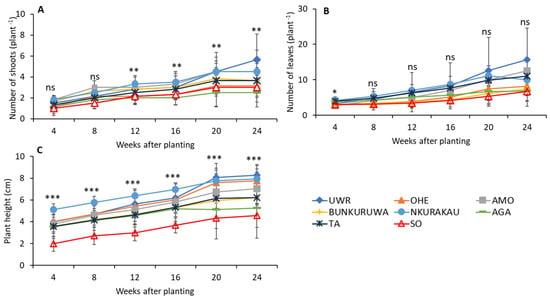
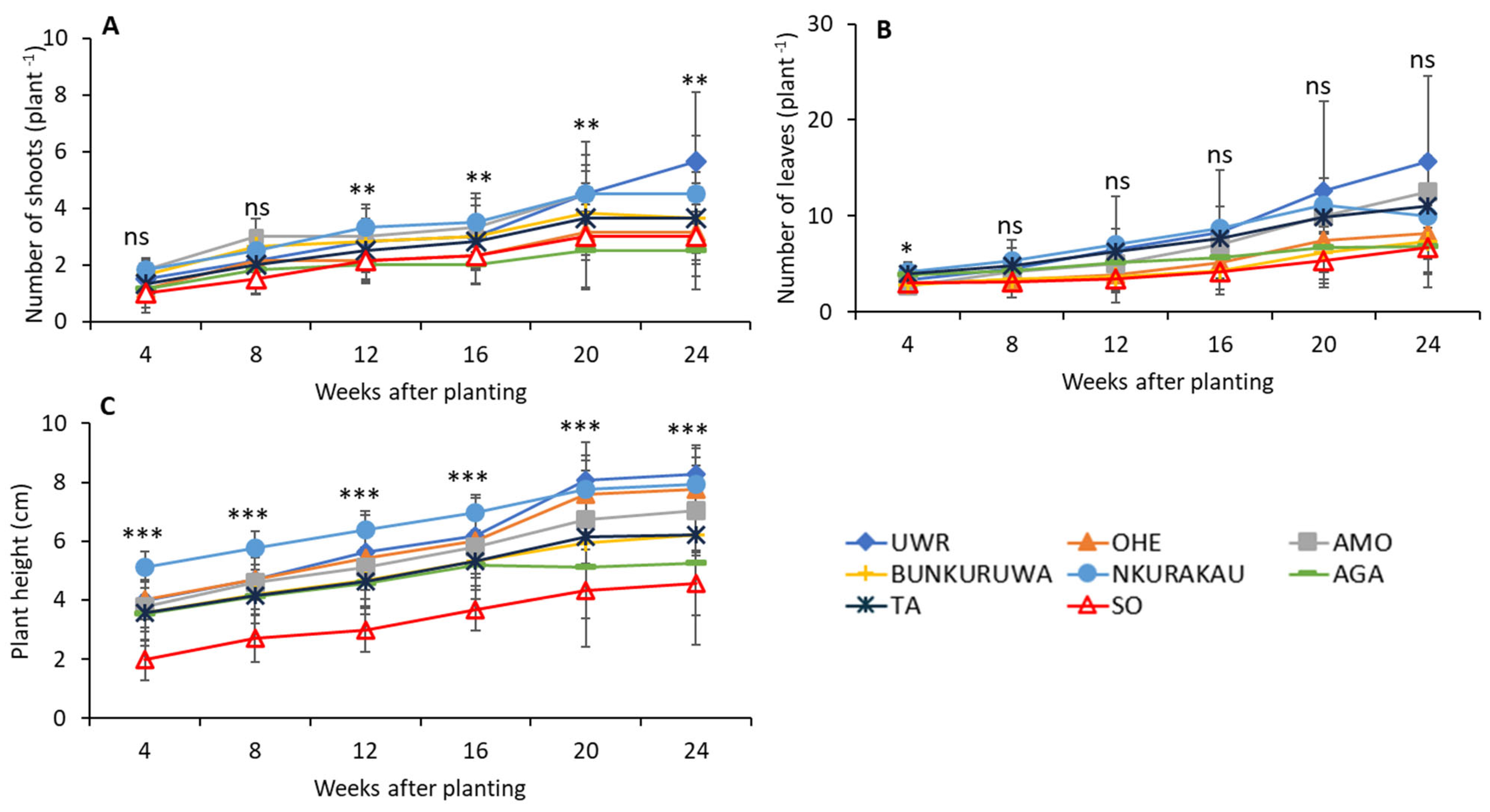
Despite the uniform 100% survival observed across accessions, substantial differences were evident in vegetative development during the 24-week conservation period. Shoot number, leaf number, and plant height (Figure 1A–C) increased progressively with conservation duration, confirming that the plantlets remained physiologically active rather than entering complete growth arrest. However, the magnitude of these responses differed significantly among accessions (p < 0.001), demonstrating strong genotype-dependent responses to the same in vitro environment.
Figure 1.
Growth parameters (A) number of shoots, (B) leaves per plant, and (C) plant height) of yam accessions after 24 weeks of in vitro conservation on MS media. Data represent measurements from 15 plantlets per accession (3 biological replicates × 5 explants). The bars represent the standard deviation of the means. Note, p < 0.001 ‘***’, highly significant; p < 0.01 ‘**’, significant; and ‘ns’, no significant differences among the genotypes.
The progressive increase in growth parameters also reveals an important feature of the conservation system: the protocol-maintained plant viability while permitting continued vegetative development. This is advantageous for subsequent recovery and multiplication but may require further optimization where stronger growth restriction is required for true slow-growth conservation.
3.2.1. Shoot Development
Shoot proliferation increased progressively from week 4 to week 24 in most accessions (Figure 1A). At week 4, shoot production was relatively low, ranging from 1.0 to 2.0 shoots plant−1, with limited separation among accessions, suggesting early establishment and adaptation to the culture environment. By weeks 8 and 12, accession differences became more apparent, with UWR, AMO, NKURAKAU, and BUNKURUWA showing stronger shoot proliferation compared with weaker-performing accessions.
The separation among genotypes increased with prolonged culture, indicating that differences in multiplication capacity became progressively expressed under identical conservation conditions. From week 16 onward, UWR, AMO, NKURAKAU, and TA maintained higher shoot production, whereas AGA and SO remained comparatively lower-performing accessions. By week 24, UWR showed the highest shoot number (5.5 shoots plant−1), followed by NKURAKAU (4.5 shoots plant−1) and AMO (4.0 shoots plant−1), while AGA and SO produced only 3.0 and 2.8 shoots plant−1, respectively. These differences correspond with the significant accession effects shown in Figure 1, indicating that shoot multiplication capacity is strongly genotype dependent.
The contrast among accessions is biologically meaningful. UWR appears to combine sustained multiplication with long-term culture adaptability, whereas AMO demonstrates strong shoot initiation and multiplication potential. Conversely, the lower shoot production of SO and AGA suggests reduced responsiveness to the conservation conditions. Therefore, shoot number provides greater discriminatory value than survival rate alone for evaluating accession performance.
3.2.2. Leaf Development
Leaf production also increased progressively throughout conservation, although its pattern was not completely identical to shoot proliferation (Figure 1B). This difference indicates that increased shoot formation does not necessarily result in proportional leaf development, suggesting that shoot initiation and vegetative expansion may be regulated independently among accessions.
At week 24, UWR produced the highest number of leaves (14 leaves plant−1), followed by NKURAKAU, TA, and AMO, whereas SO produced the fewest leaves (6 leaves plant−1). The differences among accessions were less pronounced than for shoot number, indicating that leaf development showed a more accession-specific response. AMO produced relatively high shoot numbers but did not show the highest leaf production, suggesting that its major advantage lies in multiplication rather than subsequent vegetative expansion. In contrast, UWR showed strong performance in both traits, representing a more balanced growth phenotype.
3.2.3. Plant Height
Plant height increased progressively from week 4 to week 24 across all accessions (Figure 1C), confirming continued shoot elongation during conservation. However, the extent of elongation differed significantly among genotypes (p < 0.001), demonstrating accession-dependent growth responses.
NKURAKAU showed strong elongation from early stages, whereas SO consistently produced the shortest plantlets. By week 24, UWR and NKURAKAU were among the tallest accessions, reaching 8.5 cm and 8.2 cm, respectively, followed by OHE and AMO, whereas SO remained shortest at 4.5 cm. These differences highlight that plant height reflects a distinct growth characteristic that does not completely correspond with shoot multiplication. For example, AMO produced many shoots but showed moderate elongation, indicating a genotype primarily responsive for multiplication rather than extension growth.
The combined evaluation of shoot number, leaf number, and plant height provides a stronger basis for accession comparison. UWR and NKURAKAU consistently performed well across all phenotypic traits, indicating superior overall vegetative vigor. AMO showed strong multiplication capacity but comparatively moderate leaf development and elongation, whereas SO and AGA demonstrated weaker overall growth performance.
3.3. Biochemical Responses and Exploratory Hierarchical Clustering
Differences in Extractable Phenolics and Chemical Antioxidant Potential Among Genotypes
The biochemical results revealed a different pattern from the phenotypic measurements. Unlike survival, which remained uniform across accessions, and vegetative growth, which was generally dominated by UWR and NKURAKAU, biochemical traits showed accession-specific variation in TPC and antioxidant activity. This indicates that successful in vitro conservation does not necessarily produce identical biochemical responses among genotypes.
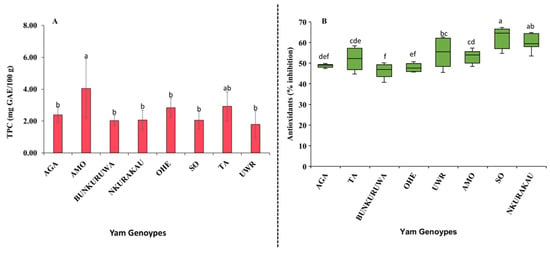
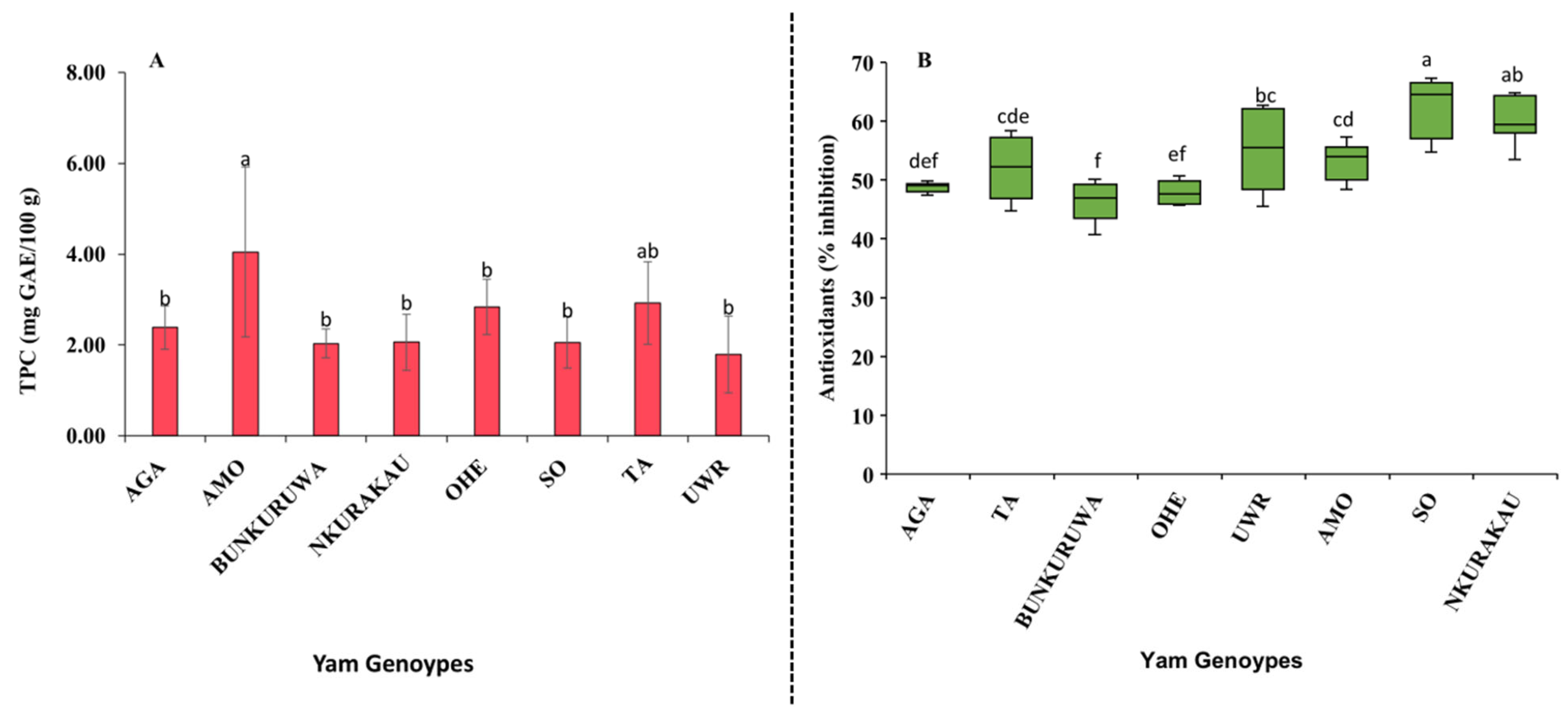
As shown in Figure 2A, AMO exhibited the highest total phenolic content (TPC), reaching approximately 4.1 mg GAE/100 g dry weight, followed by TA (3.0 mg GAE/100 g) and OHE (2.8 mg GAE/100 g). In contrast, UWR showed the lowest TPC (1.7 mg GAE/100 g), while BUNKURUWA, NKURAKAU, and SO displayed intermediate responses. Therefore, AMO demonstrated a greater capacity for TPC under the applied conservation conditions.
Figure 2.
(A) Total phenolic content and (B) DPPH radical-scavenging activity of yam accessions after 24 weeks of in vitro conservation. Data represents three independent biological samples per accession (n = 3), with each sample derived from an independent replicate. Bars or boxes with different letters are significantly different from each other.
However, the antioxidant activity pattern (Figure 2B) differed from the TPC ranking. SO and NKURAKAU showed the strongest DPPH radical-scavenging activity (65% and 62% inhibition, respectively), whereas AMO, despite having the highest TPC, showed only moderate antioxidant activity (55% inhibition). Similarly, UWR displayed relatively high antioxidant activity (58%) despite its lower phenolic concentration. This lack of direct correspondence between TPC and DPPH activity suggests that antioxidant capacity depends not only on total phenolic quantity but also on the specific composition and efficiency of individual antioxidant compounds.
The contrasting responses between AMO and SO/NKURAKAU highlight that TPC and antioxidant activity effectiveness represent distinct biochemical characteristics. Higher TPC does not necessarily translate into stronger radical-scavenging ability, as different phenolic profiles or contributions from other metabolites such as flavonoids, ascorbate, carotenoids, and enzymatic antioxidant systems may influence DPPH activity. However, these components were not directly quantified in this study; therefore, the enhanced DPPH response in SO and NKURAKAU should be interpreted as accession-specific antioxidant performance under the tested conditions rather than evidence of specific biochemical mechanisms.
Taken together, AMO showed the greatest TPC potential, whereas SO and NKURAKAU demonstrated superior chemical antioxidant activity. These differences emphasize the importance of combining multiple biochemical indicators when evaluating germplasm conservation responses.
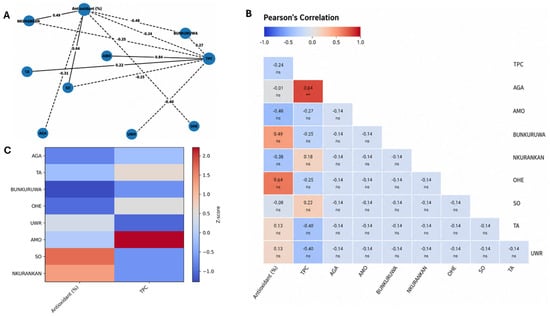
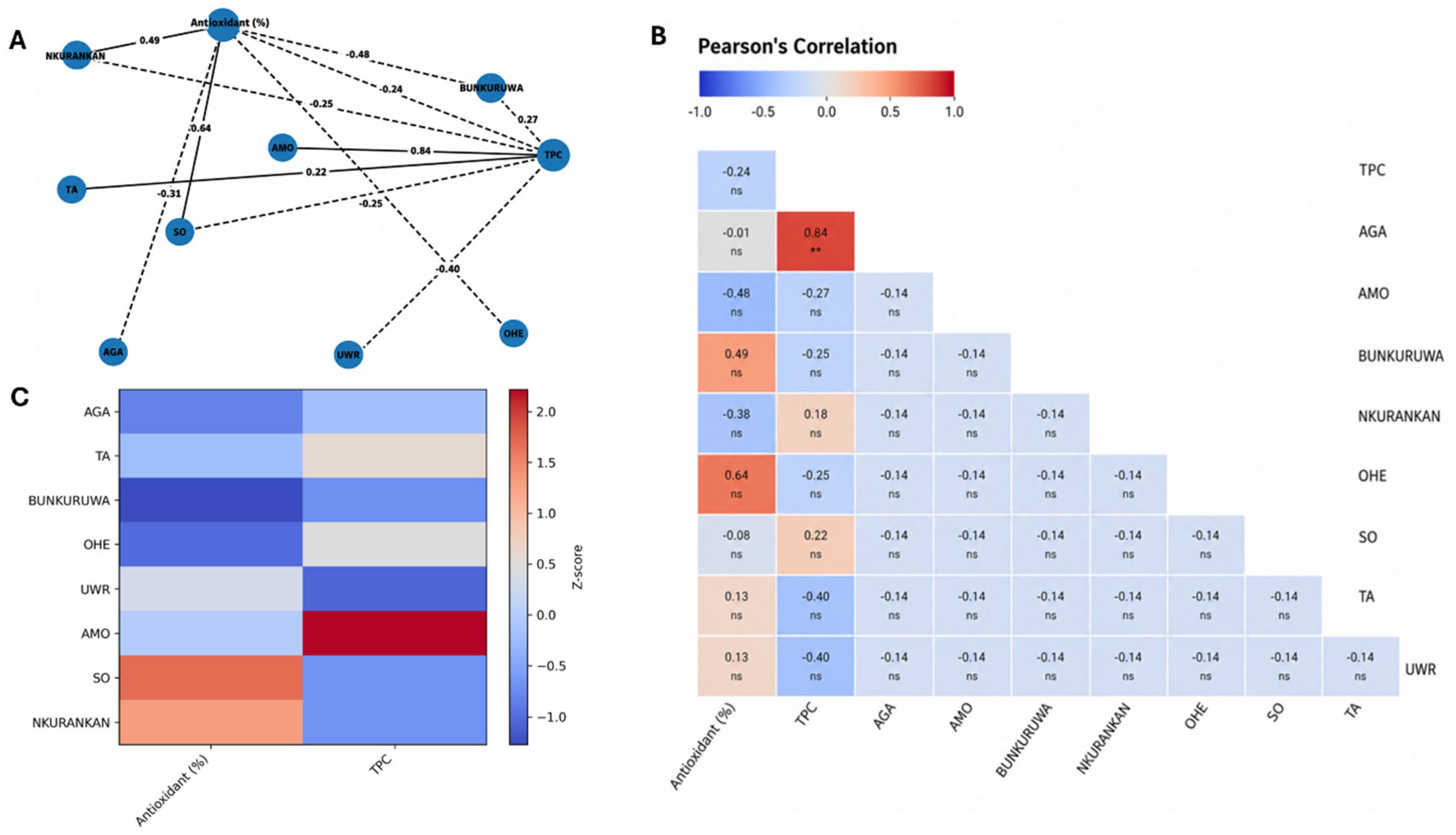
3.4. Correlation Network and Pearson Correlation Matrix
The correlation network and Pearson correlation matrix provided additional evidence that TPC and antioxidant activity were not strongly coupled across the yam accessions observed in Figure 3. The Pearson analysis showed a weak negative relationship between TPC and DPPH activity, indicating that increasing phenolic concentration was not necessarily associated with increasing antioxidant activity.
Figure 3.
(A) Correlation network among biochemical traits and yam accessions, (B) Correlation matrix showing the relationship among TPC, and antioxidant activities of yam accessions; **: significant at 0.05, ns: not significant. (C) Heatmap of two-way hierarchical cluster analysis of yam accessions based on TPC, and antioxidant activities traits.
This finding agrees with the individual biochemical results. AMO was strongly associated with TPC but did not exhibit the strongest antioxidant activity, whereas SO and NKURAKAU were more strongly associated with antioxidant activity despite their comparatively lower TPC. Thus, the correlation analysis reinforces rather than contradicts the trends observed in Figure 3.
The correlation network further demonstrated that the accessions occupied different biochemical positions. AMO showed a strong positive association with TPC, whereas SO and NKURAKAU were more closely associated with DPPH activity. BUNKURUWA, TA, OHE, and UWR occupied more intermediate positions.
Importantly, most relationships were not statistically significant, apart from the strong positive association between AMO and TPC. This lack of widespread significant correlations suggests that biochemical performance is multidimensional and cannot be explained by a single biochemical trait.
From a biological perspective, this means that the metabolic response of each genotype to in vitro conservation is likely controlled by several interacting biochemical pathways. Phenolic biosynthesis, antioxidant metabolism, stress responses, and secondary metabolite accumulation may therefore respond independently or semi-independently to the conservation environment.
Consequently, correlation analysis provides strong justification for combining TPC, antioxidant assays, and exploratory biochemical clustering analysis rather than relying on a single biochemical measurement for accession classification.
3.5. Heatmap and Hierarchical Clustering of Yam Accessions
The heatmap and hierarchical clustering analysis provided an integrated view of the biochemical similarities and differences among accessions. Unlike the survival data, where all accessions were identical, the clustering analysis clearly separated the genotypes according to their biochemical profiles. This provides further evidence that genotype-specific biochemical responses persisted despite exposure to the same conservation environment.
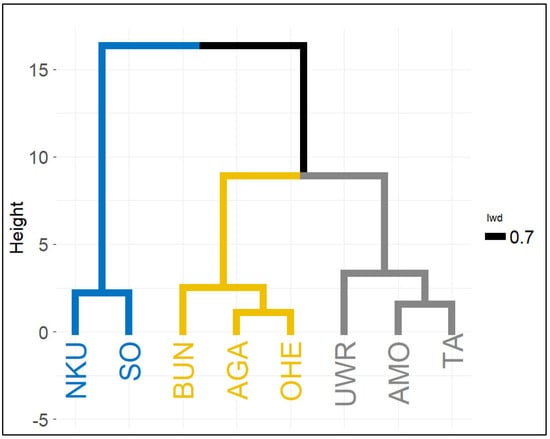
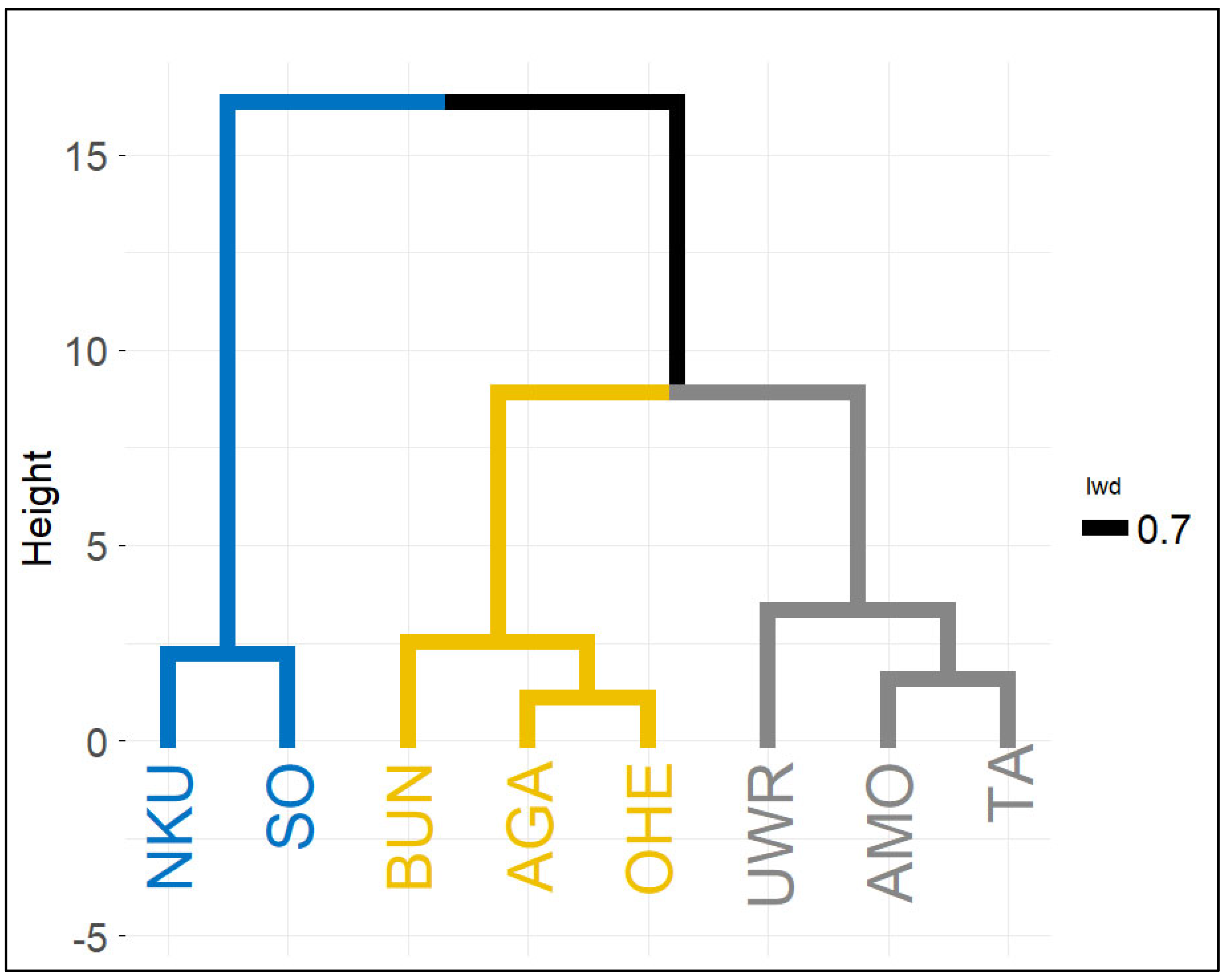
The SO and NKURAKAU clustered more closely (Figure 4) based on their relatively strong antioxidant activity, suggesting that these accessions share a similar biochemical phenotype. In contrast, AMO appeared more distinct because of its relatively high TPC, indicating that its metabolic response differed from that of the antioxidant-dominant accessions.
Figure 4.
Similarities among the genotypes based on the phenolic and the antioxidant contents, where NKU—NKURAKAU and BUN—BUNKURUWA.
BUNKURUWA, TA, and OHE occupied intermediate positions, reflecting biochemical profiles that were neither strongly phenolic-dominant nor strongly antioxidant-dominant. UWR also showed a relatively moderate biochemical profile despite its superior phenotypic performance.
This observation is particularly interesting because the accession that performed best phenotypically was not necessarily the accession that performed best biochemically. UWR displayed strong vegetative growth but only moderate biochemical responses, whereas SO showed weak vegetative growth but relatively strong antioxidant activity. This indicates that growth vigor and biochemical antioxidant potential represent different dimensions of accession performance.
The dendrogram therefore provides a useful classification of the germplasm based on biochemical similarity. Closely clustered accessions likely share similar metabolic responses to the conservation environment, whereas more distant accessions exhibit greater biochemical divergence.
Overall, the exploratory hierarchical clustering results demonstrate that AMO is phenolic-dominant, SO and NKURAKAU are antioxidant-dominant, and UWR is phenotypically vigorous but biochemically moderate. This multidimensional classification provides more information for germplasm management than ranking accessions according to a single trait.
3.6. Regrowth Performance
Regrowth after conservation provides an important practical measure of the recovery capacity of conserved germplasm. Although all accessions maintained 100% survival during the 24-week conservation period, their performance following transfer to recovery medium differed significantly among regrowth traits. This demonstrates that survival during conservation does not necessarily translate into equivalent regenerative capacity after conservation.
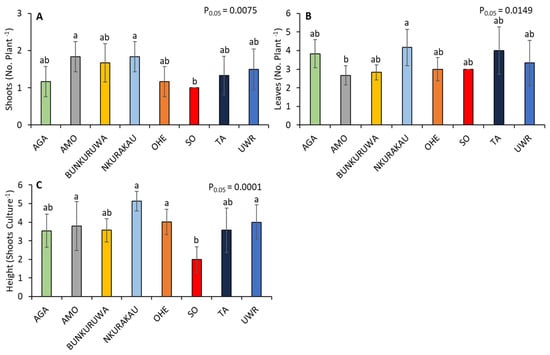
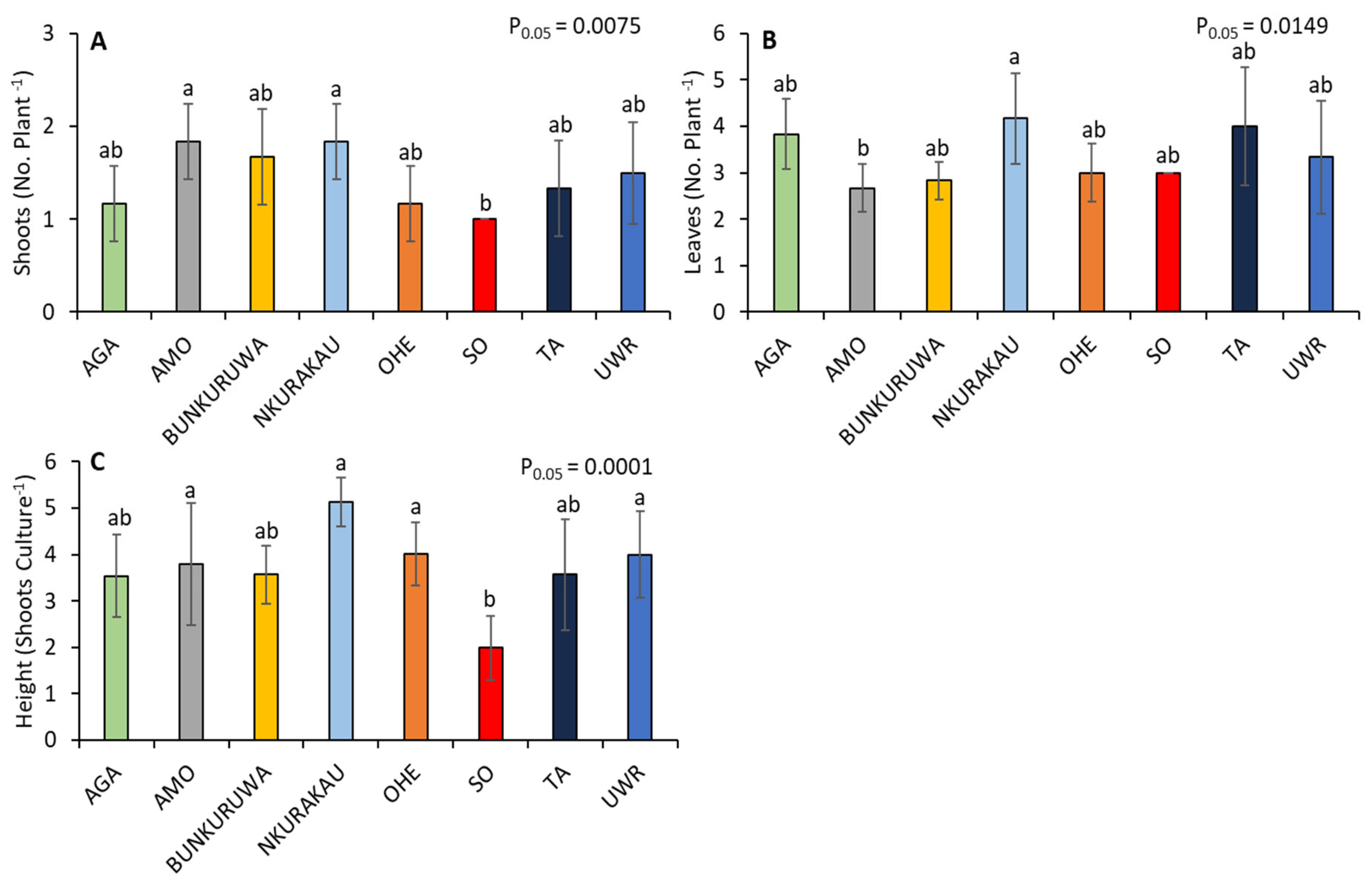
At week 4 of recovery, shoot production showed significant variation among accessions (p = 0.0075). NKURAKAU and AMO produced the highest shoot numbers (1.8 shoots plant−1), followed by BUNKURUWA (1.6 shoots plant−1) and UWR (1.4 shoots plant−1), whereas SO showed the lowest shoot production (1.0 shoot plant−1) as shown in Figure 5A. OHE and AGA showed intermediate responses. The significant differences in shoot multiplication indicate accession-specific variation in recovery potential after prolonged conservation.
Figure 5.
Regrowth parameters (A) shoot number, (B) leaves per plant, and (C) plant height) of yam accessions after four weeks of recovery following 24 weeks of conservation. Data represent measurements from 15 plantlets per accession (3 biological replicates × 5 explants). The bars with different letters are statistically different from each other.
The regrowth results therefore provide an important comparison with the 24-week conservation performance. AMO, which had already demonstrated strong shoot multiplication during conservation, retained its multiplication advantage during recovery. NKURAKAU also performed strongly, suggesting that its high multiplication capacity was maintained after prolonged conservation.
Leaf production showed a different pattern from shoot multiplication and also differed significantly among accessions (p = 0.0149). NKURAKAU produced the highest number of leaves (4.2 leaves plant−1), followed by TA (4.0 leaves plant−1) and AGA (3.8 leaves plant−1), whereas AMO produced fewer leaves (3.0 leaves plant−1) despite having strong shoot production as shown in Figure 5B. This indicates that shoot initiation and leaf development represent partially independent recovery characteristics.
Plant height further differentiated accession performance, showing the strongest statistical separation among measured traits (p = 0.0001). NKURAKAU produced the tallest plantlets (5.1 cm), followed by UWR and OHE (4.0 cm), whereas SO produced the shortest plantlets (2.0 cm) as shown in Figure 5C. These results demonstrate that NKURAKAU maintained superior post-conservation development, extending beyond shoot multiplication to subsequent plant growth.
When the combined regrowth parameters are considered, NKURAKAU exhibited the most favourable recovery performance, showing consistently high shoot production, the highest leaf number, and the greatest plant height. UWR and OHE demonstrated balanced recovery responses, whereas AMO showed strong multiplication capacity but comparatively weaker leaf development and height. TA and AGA showed stronger leaf production relative to shoot multiplication, while SO consistently exhibited poor performance across the major regrowth parameters.
When the 24-week conservation and week-4 regrowth results are considered together, NKURAKAU and UWR retained strong vegetative and early recovery competence following 24 weeks of conservation. NKURAKAU was particularly strong in plant height and regrowth, whereas UWR demonstrated consistently strong shoot, leaf, and height development throughout conservation. AMO is particularly valuable for multiplication because of its strong shoot-production capacity, while also exhibiting the highest TPC. However, its biochemical advantage did not translate into the highest antioxidant activity.
Conversely, SO represents an important example of why survival alone is insufficient as a conservation-performance criterion. Despite maintaining 100% survival for 24 weeks, SO consistently showed weak shoot proliferation, leaf development, plant height, and regrowth, yet exhibited relatively high antioxidant activity. This demonstrates that physiological survival, vegetative vigor, and biochemical performance can respond independently to the same conservation environment.
Therefore, the combined assessment of survival + shoot production + leaf development + plant height + biochemical traits + exploratory hierarchical clustering classification + regrowth provides a much more robust framework for evaluating yam germplasm conservation than any individual parameter. The results suggest that accession-specific responses should be considered when optimizing conservation and regeneration protocols.
4. Discussion
The present study shows that the MS-based hormone-free conservation medium was suitable for maintaining the viability of the Ghanaian yam accessions for 24 weeks, as all accessions remained alive and contamination-free throughout the storage period. However, the 100% survival response should not be interpreted as equal conservation performance. Survival confirms that the culture environment prevented mortality, but it does not capture differences in multiplication potential, vegetative vigor, or post-conservation recovery. Recent discussions of in vitro biotechnology for plant genetic resources similarly emphasize that conservation protocols should be evaluated not only by maintenance of living cultures, but also by their capacity to retain usable, recoverable, and physiologically competent germplasm for future multiplication and exchange [15]. Long-term germplasm studies also show that viability, regrowth, and biochemical/enzymatic stability should be considered together when deciding whether a conservation protocol is practically reliable [16].
The growth responses provided additional information on accession-specific physiological behavior but should not be interpreted as direct indicators of superior conservation efficiency. In medium-term in vitro conservation, controlled growth reduction is desirable because it minimizes nutrient depletion, vessel limitation, and frequent subculture requirements. Therefore, greater shoot production, leaf formation, or shoot elongation during storage may indicate stronger physiological activity or multiplication potential, but not necessarily improved storage suitability. In this study, these traits were considered together with survival and post-conservation regrowth performance to identify accessions that maintained viability while retaining recovery capacity. Shoot production, leaf formation, and shoot height increased from week 4 to week 24 in most accessions, indicating that the plantlets remained metabolically active rather than being completely growth-arrested. This response is useful for medium-term conservation because limited growth reduces the need for frequent subculture while preserving regeneration capacity. Nevertheless, the magnitude of growth differed strongly among accessions. UWR, AMO, and NKURAKAU exhibited distinct growth responses during conservation, with differences reflecting accession-specific physiological behavior rather than indicating that greater growth alone represents superior conservation performance. UWR and NKURAKAU demonstrated a balanced combination of survival, controlled vegetative development, and post-conservation recovery potential. In contrast, SO and AGA were consistently weaker, suggesting that a single conservation formulation may not be optimal for all genotypes.
The contrasting growth patterns also indicate that the three morphological traits represent different components of conservation quality. AMO produced relatively high shoot numbers but did not show the same superiority in leaf number and plant height, suggesting stronger multiplication capacity than whole-plant vigor. OHE showed comparatively better elongation than shoot proliferation, indicating a tendency toward vertical growth rather than multiplication. UWR and NKURAKAU were the most balanced accessions because they maintained favorable performance across shoot number, leaf production, and plant height. Such trait separation is important for germplasm managers because an accession selected only for shoot number may not necessarily be the best accession for acclimatization, recovery, or subsequent nursery establishment [17].
The week-4 regrowth assessment after transfer to MS recovery medium further strengthened this interpretation. Although all accessions resumed growth, the recovery response was accession-dependent. NKURAKAU showed the strongest early regrowth by combining high shoot production, the highest leaf number, and the tallest plantlets. UWR and OHE also showed balanced recovery, while SO remained the weakest accession, particularly in shoot number and plant height. This indicates that post-conservation regrowth testing is necessary before recommending a genotype for routine germplasm storage. For practical conservation, NKURAKAU, UWR, and AMO can be prioritized candidate accessions for further protocol optimization, whereas SO and AGA may require shorter storage cycles, adjusted mineral strength, modified carbohydrate supply, or genotype-specific growth-regulator regimes. Although the four-week regrowth assessment provided useful information regarding the early recovery capacity of conserved accessions, it does not fully represent long-term regeneration stability, acclimatization success, or subsequent greenhouse and field performance. Extended monitoring periods, including gradual acclimatization and field establishment assessments, will be necessary in future studies to confirm long-term recovery stability of conserved yam germplasm [18,19].
The inclusion of total phenolic content and DPPH radical-scavenging activity adds a biochemical dimension to the conservation assessment. These assays were not intended to represent direct measurements of physiological oxidative-stress regulation or antioxidant defense mechanisms; rather, they were used as comparative indicators of extractable phenolics and in vitro radical-scavenging capacity among conserved yam accessions. Further analyses involving ROS quantification, lipid-peroxidation markers, antioxidant enzyme activities, and metabolite profiling would be required to elucidate the underlying physiological mechanisms. In vitro storage can impose physiological stress through restricted nutrients, altered light and temperature conditions, and extended culture duration. Under such conditions, phenolic differences observed after conservation may reflect genotype-specific responses under the tested conditions and antioxidant activity may reflect how accessions regulate reactive oxygen species and maintain cellular stability. Recent studies on yam and other tuber crops have demonstrated considerable genotype-dependent variation in phenolic composition and antioxidant capacity. Phenolic compounds contribute significantly to radical-scavenging activity, nutritional quality, and stress-related biochemical responses in tuber crops. However, antioxidant potential is not always directly proportional to total phenolic content because different phenolic profiles and non-phenolic antioxidants may contribute to overall activity [20].
The biochemical results showed that growth vigor and antioxidant-related response were not always aligned. AMO recorded the highest total phenolic content, but it did not show the strongest DPPH radical-scavenging activity. Conversely, SO and NKURAKAU showed stronger DPPH activity despite lower phenolic content. This pattern indicates that antioxidant capacity was not determined by total phenolic quantity alone. The observed differences in DPPH activity may be associated with variation in phenolic composition and other extractable antioxidant compounds, although the contribution of specific metabolites or enzymatic antioxidant systems cannot be confirmed from the current dataset and requires further biochemical investigation. Therefore, the weak or negative association between TPC and DPPH activity should be interpreted as evidence of genotype-associated differences in endpoint biochemical characteristics rather than as a methodological inconsistency.
Similar observations have been reported in tuber crops where antioxidant activity was influenced not only by total phenolic concentration but also by phenolic composition, cultivar-specific metabolic profiles, and other antioxidant compounds [21]. Studies on sweet potato tubers have shown that differences in individual phenolic acids and polyphenolic profiles contribute to variations in antioxidant activity among genotypes. Therefore, the weak relationship observed between TPC and DPPH activity in the present study is consistent with previous findings that total phenolic content alone may not fully explain antioxidant potential [20].
The biochemical analyses in this study were based on aqueous extraction and should therefore be interpreted as comparative measurements of water-extractable phenolic compounds and antioxidant activity rather than a complete representation of the entire phenolic profile. Future studies employing organic solvent extraction combined with HPLC or LC-MS analysis would provide deeper insight into accession-specific phenolic composition and antioxidant mechanisms [20,22].
The correlation network, Pearson correlation matrix, heatmap, and dendrogram provide additional support for this accession-specific interpretation. AMO clustered as a phenolic-dominant accession, whereas SO and NKURAKAU were more closely associated with antioxidant activity. UWR, BUNKURUWA, TA, and OHE showed intermediate biochemical profiles. These groupings are useful because they separate accessions with high morphological performance from those with distinct biochemical behavior. For example, UWR and NKURAKAU are more suitable where vigorous recovery and multiplication are the primary objectives, while AMO may be valuable for phenolic-related screening. The results therefore support a combined morphological and biochemical screening framework rather than a survival-only approach.
From a practical and economic perspective, the findings are relevant to yam germplasm banks, tissue-culture laboratories, and propagation materials programs. Accessions that remain viable, vigorous, and recoverable after 24 weeks can reduce labor, medium consumption, contamination exposure, and land pressure associated with field genebanks [6]. They can also support improved exchange and management of planting material and reduce losses associated with field maintenance constraints [18,23]. However, accessions with poor growth or weak regrowth, such as SO, should not be managed using the same schedule without additional optimization. This genotype-specific recommendation makes the protocol more useful for real conservation programs than a general statement that all accessions survived.
The study is limited by the absence of direct comparisons with other slow-growth media, the lack of post-acclimatization field performance data, and the use of TPC and DPPH as broad biochemical indicators rather than compound-specific profiling tools. Future work should compare full-strength MS with reduced mineral formulations, osmotic agents, and alternative carbohydrate levels; verify genetic stability and virus status after storage; and test greenhouse and field recovery. HPLC or LC-MS profiling of individual phenolic acids, flavonoids, anthocyanins, and other antioxidant metabolites would also clarify why some accessions showed stronger DPPH activity despite lower total phenolic content. Integrating compound-level profiling with regrowth data would strengthen the mechanistic link between biochemical stability and conservation performance, while improving the applicability of the protocol for yam breeding, germplasm management, and economically sustainable in vitro-maintained planting-material systems [15,16].
5. Conclusions
All yam accessions survived after 24 weeks of in vitro conservation, indicating that the conservation condition was suitable for medium-term maintenance. However, accessions differed in shoot development, leaf development, and shoot height. NKURAKAU and UWR demonstrated stronger overall recovery potential after conservation due to balanced vegetative characteristics and post-storage regrowth, whereas AMO showed high multiplication capacity during culture but should be interpreted primarily as a propagation-responsive accession rather than automatically as a superior conservation genotype. The SO and AGA were comparatively weaker and may require further medium optimization or closer monitoring during conservation. The study therefore shows that survival percentage alone is not sufficient for selecting yam accessions for in vitro conservation. Growth traits together with phenolic content and DPPH radical-scavenging measurements should be considered as complementary biochemical indicators to support identification of accessions with desirable conservation and propagation characteristics. However, these assays alone do not establish physiological oxidative-stress tolerance and should be complemented with mechanistic biochemical analyses in future studies. The findings provide preliminary evidence that selected yam accessions can maintain viability and favorable growth characteristics under the tested in vitro conservation conditions, supporting further optimization and comparative evaluation of yam germplasm conservation strategies.
Author Contributions
Conceptualization, B.B.B. and M.D.Q.; methodology, B.B.B., I.D.B. and W.Z.; software, I.D.B., R.A.A. and E.O.M.; validation, I.D.B., M.D.Q., W.Z., R.A.A. and E.O.M.; formal analysis B.B.B., I.D.B., B.B.B., M.D.Q. and I.D.B.; resources, M.D.Q. and IDB.; data curation, B.B.B.; writing—original draft preparation, B.B.B. and I.D.B.; writing—review and editing, I.D.B., R.A.A. and E.O.M.; visualization, I.D.B., W.Z., M.D.Q., R.A.A. and E.O.M. All authors have read and agreed to the published version of the manuscript.
Funding
This research received no external funding.
Data Availability Statement
Data is available upon reasonable request from the corresponding author.
Conflicts of Interest
The authors declare no conflict of interest.
Abbreviations
DPPH, 2,2-diphenyl-1-picrylhydrazyl; GAE, gallic acid equivalent; MS, Murashige and Skoog; TPC, total phenolic content; UV-vis, ultraviolet–visible spectroscopy.
References
- Obidiegwu, J.E.; Lyons, J.B.; Chilaka, C.A. The Dioscorea genus (Yam)-An appraisal of nutritional and therapeutic potentials. Foods 2020, 9, 1304. [Google Scholar] [CrossRef] [Scilit]
- Danquah, E.O.; Danquah, F.O.; Frimpong, F.; Dankwa, K.O.; Weebadde, C.K.; Ennin, S.A.; Asante, M.O.O.; Brempong, M.B.; Dwamena, H.A.; Addo-Danso, A.; et al. Sustainable intensification and climate-smart yam production for improved food security in west africa: A review. Front. Agron. 2022, 4, 858114. [Google Scholar] [CrossRef] [Scilit]
- Adomėnienė, A.; Venskutonis, P.R. Dioscorea spp.: Comprehensive review of antioxidant properties and their relation to phytochemicals and health benefits. Molecules 2022, 27, 2530. [Google Scholar] [CrossRef] [Scilit]
- Umber, M.; Filloux, D.; Gélabale, S.; Gomez, R.-M.; Marais, A.; Gallet, S.; Gamiette, F.; Pavis, C.; Teycheney, P.-Y. Molecular viral diagnosis and sanitation of yam genetic resources: Implications for safe yam germplasm exchange. Viruses 2020, 12, 1101. [Google Scholar] [CrossRef] [Scilit]
- Luo, G.-F.; Podolyan, A.; Kidanemariam, D.B.; Pilotti, C.; Houliston, G.; Sukal, A.C. A review of viruses infecting yam (Dioscorea spp.). Viruses 2022, 14, 662. [Google Scholar] [CrossRef] [Scilit]
- Acedo, V.Z.; Arradaza, C.C. Development of in vitro slow growth culture for yam (Dioscorea alata L.). Ann. Trop. Res. 2012, 34, 79–95. [Google Scholar] [CrossRef] [Scilit]
- Benelli, C.; Tarraf, W.; Izgu, T.; De Carlo, A. In vitro conservation through slow growth storage technique of fruit species: An overview of the last 10 years. Plants 2022, 11, 3188. [Google Scholar] [CrossRef] [Scilit]
- Borges, M.; Ceiro, W.; Meneses, S.; Aguilera, N.; Vázquez, J.; Infante, Z.; Fonseca, M. Regeneration and multiplication of Dioscorea alata germplasm maintained in vitro. Plant Cell Tissue Organ Cult. 2004, 76, 87–90. [Google Scholar] [CrossRef] [Scilit]
- Rajput, V.D.; Harish; Singh, R.K.; Verma, K.K.; Sharma, L.; Quiroz-Figueroa, F.R.; Meena, M.; Gour, V.S.; Minkina, T.; Sushkova, S.; et al. Recent developments in enzymatic antioxidant defence mechanism in plants with special reference to abiotic stress. Biology 2021, 10, 267. [Google Scholar] [CrossRef] [Scilit]
- Farkas, D.; Csabai, J.; Kolesnyk, A.; Szarvas, P.; Dobránszki, J. In vitro micropropagation protocols for two endangered Dianthus species—Via in vitro culture for conservation and recultivation purposes. Plant Methods 2025, 21, 13. [Google Scholar] [CrossRef] [Scilit]
- Kujala, T.S.; Loponen, J.M.; Klika, K.D.; Pihlaja, K. Phenolics and betacyanins in red beetroot (Beta vulgaris) root: Distribution and effect of cold Storage on the content of total phenolics and three individual compounds. J. Agric. Food Chem. 2000, 48, 5338–5342. [Google Scholar] [CrossRef] [Scilit]
- Singleton, V.L.; Orthofer, R.; Lamuela-Raventós, R.M. [14] Analysis of total phenols and other oxidation substrates and antioxidants by means of folin-ciocalteu reagent. Methods Enzymol. 1999, 299, 152–178. [Google Scholar] [CrossRef] [Scilit]
- Dzah, C.S.; Duan, Y.; Zhang, H.; Authur, D.A.; Ma, H. Ultrasound-, subcritical water- and ultrasound assisted subcritical water-derived Tartary buckwheat polyphenols show superior antioxidant activity and cytotoxicity in human liver carcinoma cells. Food Res. Int. 2020, 137, 109598. [Google Scholar] [CrossRef] [Scilit]
- Blois, M.S. Antioxidant determinations by the use of a stable free radical. Nature 1958, 181, 1199–1200. [Google Scholar] [CrossRef] [Scilit]
- Tarraf, W.; De Carlo, A. In vitro biotechnology for conservation and sustainable use of plant genetic resources. Plants 2024, 13, 1897. [Google Scholar] [CrossRef] [Scilit]
- Benelli, C.; Tarraf, W.; İzgü, T.; Anichini, M.; Faraloni, C.; Salvatici, M.C.; Jouini, N.; Germanà, M.A.; Danti, R.; Lambardi, M. Long-term conservation for the safeguard of Abies nebrodensis: An endemic and endangered species of sicily. Plants 2024, 13, 1682. [Google Scholar] [CrossRef] [Scilit]
- Nurtaza, A.; Dyussembekova, D.; Islamova, S.; Samatova, I.; Zhanybekova, Z.; Umirzakova, A.; Magzumova, G.; Muranets, A.; Kakimzhanova, A. In Vitro conservation and genetic diversity analysis of rare species Ribes janczewskii. Sci. Rep. 2024, 14, 31117. [Google Scholar] [CrossRef] [Scilit]
- Villalba, A.; Martínez-Ispizua, E.; Morard, M.; Crespo-Sempere, A.; Albiach-Marti, M.R.; Calatayud, A.; Penella, C. Optimizing sweet potato production: Insights into the interplay of plant sanitation, virus influence, and cooking techniques for enhanced crop quality and food security. Front. Plant Sci. 2024, 15, 1357611. [Google Scholar] [CrossRef] [Scilit]
- Xu, Y.; Wang, L.-X.; Chen, C.; Ma, S.-S.; Zhou, R.; Xiong, A.-S. Virus-free sweet potato industry: Development status and production suggestions. Horticulturae 2024, 10, 979. [Google Scholar] [CrossRef] [Scilit]
- Musilová, J.; Franková, H.; Fedorková, S.; Lidiková, J.; Vollmannová, A.; Sulírová, K.; Árvay, J.; Kasal, P. Comparison of polyphenols, phenolic acids, and antioxidant activity in sweet potato (Ipomoea batatas L.) tubers after heat treatments. J. Agric. Food Res. 2024, 18, 101271. [Google Scholar] [CrossRef] [Scilit]
- Kim, Y.; Kim, Y.-J.; Shin, Y. Comparative analysis of polyphenol content and antioxidant activity of different parts of five onion cultivars harvested in korea. Antioxidants 2024, 13, 197. [Google Scholar] [CrossRef] [Scilit]
- Noreen, S.; Niazi, M.K.; Shehzadi, S.; Ikram, A.; Arshad, M.T.; Gnedeka, K.T. Extend the emphasis to encompass sweet potatoes health advantages, industrial applications, and nutritional qualities. CyTA J. Food 2024, 22, 2390994. [Google Scholar] [CrossRef] [Scilit]
- George, J.; Reddy, G.V.P.; Wadl, P.A.; Rutter, W.; Culbreath, J.; Lau, P.W.; Rashid, T.; Allan, M.C.; Johaningsmeier, S.D.; Nelson, A.M.; et al. Sustainable sweetpotato production in the United States: Current status, challenges, and opportunities. Agron. J. 2024, 116, 630–660. [Google Scholar] [CrossRef] [Scilit]

Disclaimer/Publisher’s Note: The statements, opinions and data contained in all publications are solely those of the individual author(s) and contributor(s) and not of MDPI and/or the editor(s). MDPI and/or the editor(s) disclaim responsibility for any injury to people or property resulting from any ideas, methods, instructions or products referred to in the content. |
© 2026 by the authors. Licensee MDPI, Basel, Switzerland. This article is an open access article distributed under the terms and conditions of the Creative Commons Attribution (CC BY) license.