


Abstract
Comparative evidence on the performance of urea and ammonium nitrate within integrated organo-mineral fertilization systems in acidic Luvisols under humid subtropical kiwifruit production remains limited. This study evaluated compost (30 t ha−1 + P150K120) combined with urea or ammonium nitrate (0, 90, 120, and 150 kg N ha−1) in non-degraded (ND) and moderately degraded (MD) acidic Luvisols during a three-year field experiment (2022–2024) arranged in a randomized complete block design (RCBD) with five fertilization treatments and four replications. Integrated fertilization significantly increased soil organic carbon (SOC), water-stable aggregates (WSA), and nutrient availability. Stepwise regression showed that NO3−–N explained 72.9% of yield variation, while inclusion of P2O5, SOC, and K2O increased explained variation to 93.8%. In ND soil, yield increased from 7004 to 20,139 kg ha−1 under Base + N150, but the increase over Base + N120 was small and non-significant. Urea generally resulted in higher yield and greater NUE than ammonium nitrate, whereas effects on fruit quality were less consistent. The highest NUE occurred under Base + N120 with urea (0.99) and declined at higher N rates. Overall, Base + N120, particularly with urea, provided the most favorable balance between soil improvement, kiwifruit productivity, and nitrogen use efficiency.
1. Introduction
The Lankaran–Astara region, located in the southeastern part of the Republic of Azerbaijan, lies within the country’s humid subtropical zone and is characterized by high agro-climatic potential and productive soils such as Luvisols [1,2,3]. Abundant precipitation, high relative humidity, and mild winters provide favorable conditions for the cultivation of subtropical fruit crops, particularly Actinidia deliciosa (kiwifruit). Due to its rich biochemical composition, high antioxidant capacity, and recognized nutritional value, kiwifruit is increasingly in demand in both local and international markets [4,5,6,7], making it a strategically important crop for economic development and food security.
However, long-term intensive cultivation of acidic Luvisols, especially under unbalanced fertilization practices, has resulted in progressive soil degradation [8,9]. Declining organic matter, nutrient leaching, and reduced microbial activity have weakened soil functions, negatively affecting crop productivity, fruit quality, and agroecosystem sustainability [4,10,11]. These challenges are not unique to Azerbaijan but are widely observed in intensively managed horticultural systems worldwide, emphasizing the global importance of sustainable soil fertility management. In this context, scientifically based fertilization strategies are required to restore soil productivity while maintaining environmental quality, minimizing greenhouse gas emissions, and reducing risks to surface and groundwater associated with nutrient leaching and runoff [12,13,14,15].
Integrated nutrient management, based on the combined application of organic and mineral fertilizers, is widely recognized as an effective approach for improving soil quality and productivity [16]. Such systems increase soil organic carbon (SOC), enhance aggregate stability, stimulate microbial activity, and improve nutrient cycling efficiency, thereby supporting long-term soil fertility and ecosystem functioning [14,15,16,17]. Organic amendments further improve soil aggregation, cation exchange capacity, and water retention, facilitating efficient nutrient uptake [18,19,20,21], while balanced fertilization ensures adequate nutrient availability and optimal plant physiological functioning [18,22,23]. In addition, long-term integrated fertilization stabilizes soil carbon dynamics, enhances enzymatic activity, and increases nutrient availability (NH4+–N, NO3−–N, P2O5, and K2O), thereby improving soil resilience and productivity [24,25]. These processes are particularly important in humid subtropical acidic soils, where structural stability and nutrient mobility are key constraints for sustainable crop and horticultural production [4]. At the same time, fertilizer efficiency and environmental outcomes are strongly influenced by site-specific factors such as soil fertility, texture, and resource availability, which regulate nutrient retention, transformation processes, and nutrient losses [9,13,14,15,16].
Fertilizer application rate is also a critical factor determining crop response and nutrient use efficiency. Increasing fertilizer inputs does not necessarily result in proportional increases in crop productivity, because yield responses may reach an optimum beyond which additional nutrient inputs provide limited agronomic benefits while increasing the risk of nutrient losses. In kiwifruit production, fertilizer requirements and crop responses vary with soil fertility, nutrient availability, and management conditions, emphasizing the importance of selecting appropriate application rates rather than maximizing fertilizer inputs [4,8,14]. Therefore, evaluating different nitrogen application rates is essential for identifying a fertilization level that maintains high productivity while improving nutrient use efficiency and limiting unnecessary nutrient inputs.
In addition to fertilizer application rate, the form of nitrogen applied plays a critical role in determining soil processes and crop response. Urea and ammonium nitrate differ in their transformation pathways and mobility in soil. Urea is hydrolyzed to ammonium (NH4+), which can be temporarily retained on soil exchange sites, whereas ammonium nitrate supplies both ammonium (NH4+) and nitrate (NO3−), the latter being more mobile and susceptible to leaching under humid conditions [13,15]. These differences influence nitrogen use efficiency, soil biochemical processes, and environmental losses, including impacts on water quality [12,14]. However, the comparative performance of these nitrogen sources within integrated fertilization systems under acidic Luvisols remains insufficiently explored [12,13,14,15].
Despite substantial advances in integrated fertilization research, region-specific evidence for humid subtropical Luvisols—particularly in the Lankaran–Astara region—remains limited. In particular, the relationships between soil organic carbon (SOC) and aggregate stability, and their implications for ecosystem services, as well as the identification of optimal nitrogen management strategies that balance productivity, resource efficiency, and environmental protection, require further investigation. It is hypothesized that the integrated application of organic and mineral fertilizers enhances soil structural and biochemical properties, particularly SOC and aggregate stability—thereby improving nutrient use efficiency, yield, and fruit quality compared with unfertilized and less intensive fertilization treatments. Furthermore, based on the expected diminishing response of kiwifruit to increasing nitrogen inputs, yield, fruit quality, and nutrient use efficiency were hypothesized to respond differently across the experimental nitrogen rates (90, 120, and 150 kg N ha−1), with limited additional agronomic benefit at the highest application rate (150 kg N ha−1) [8,14]. In addition, differences between nitrogen forms (urea and ammonium nitrate) were expected to be less pronounced under integrated fertilization conditions.
Therefore, the objectives of the study were: (1) to evaluate the effects of integrated organic and mineral fertilization on the agrophysical and fertility properties of acidic Luvisols, and to quantify the relationship between soil organic carbon (SOC) and aggregate stability; and (2) to identify the optimal nitrogen fertilization strategy in terms of nitrogen rate and fertilizer form (urea versus ammonium nitrate) for enhancing kiwifruit yield and fruit quality under humid subtropical conditions.
2. Materials and Methods
2.1. Experimental Design and Soil Properties
Field experiments were conducted from 2022 to 2024 on non-degraded Luvisols (yellow pseudo-podzolic gleyic soils) located in the foothill zone at 18 m above sea level (38°40′37.04″ N, 48°47′11.21″ E), as well as on a moderately degraded kiwifruit (Actinidia deliciosa) site situated on a gently sloping (3–4°), southwest-facing terrain at 24 m above sea level (38°40′35.63″ N, 48°47′11.21″ E). Soil degradation levels were defined before the establishment of the fertilization experiment based on the initial physicochemical properties of the soils (Table 1). Non-degraded (ND) soil was characterized by relatively higher soil organic matter, water-stable aggregate content, and nutrient status, whereas moderately degraded (MD) soil showed lower organic matter and nutrient contents, reduced aggregate stability, and slightly higher bulk density. These differences were used to distinguish the two soil degradation levels investigated in this study.
Table 1.
Selected baseline physicochemical properties of the experimental soils.
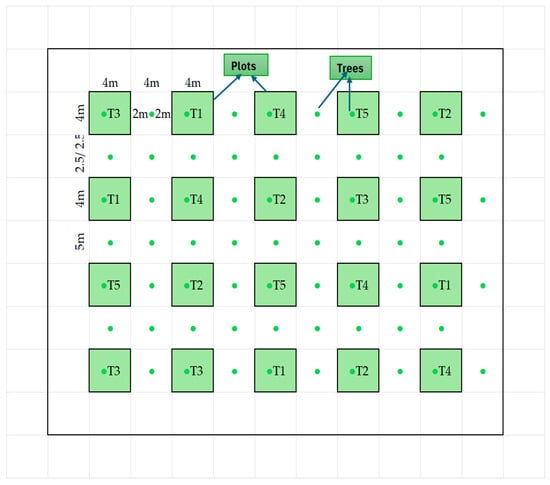
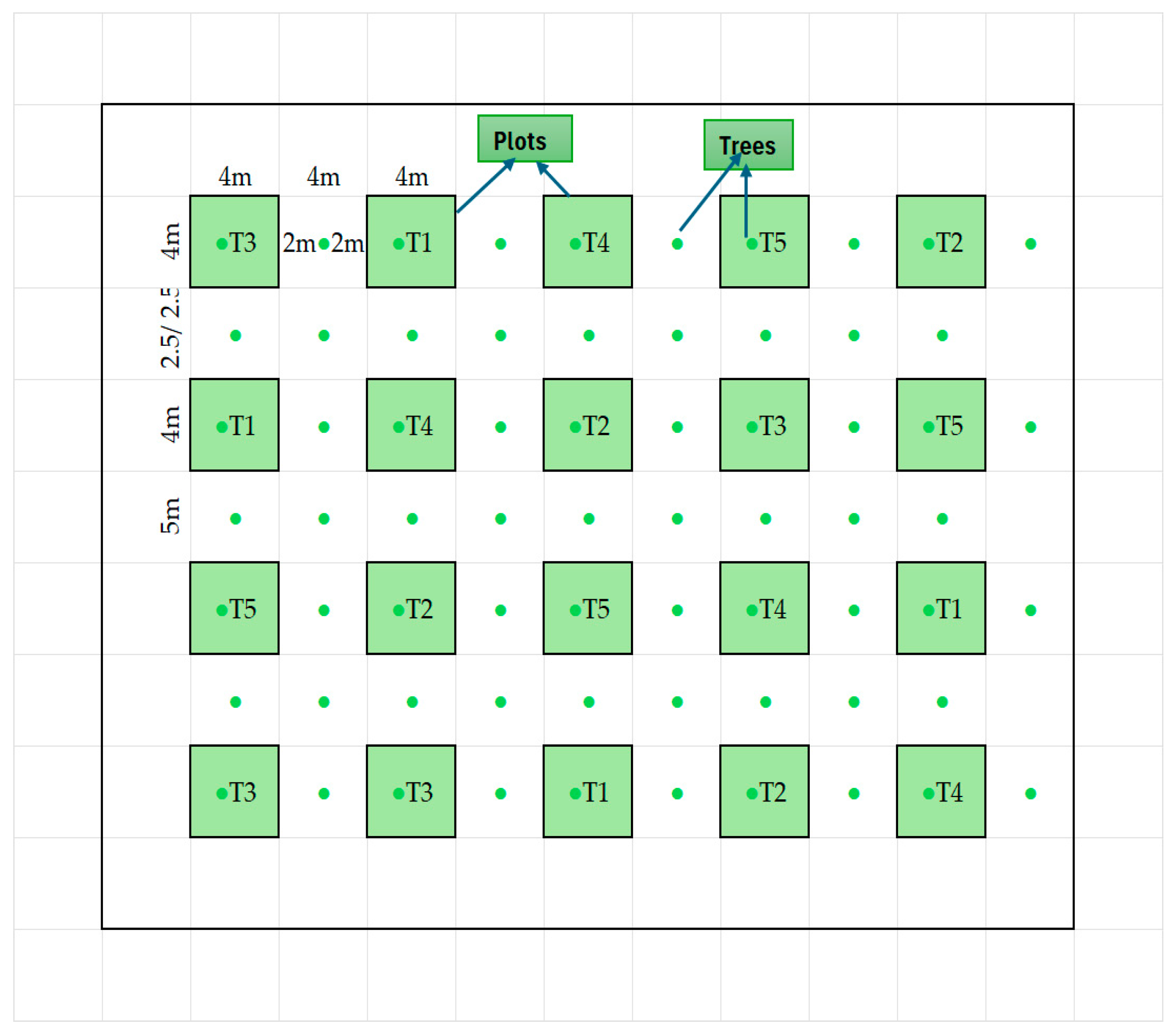
In both moderately degraded (MD) and non-degraded (ND) fields, and for the comparison of fertilizer types (urea versus ammonium nitrate), the experiment was arranged in a randomized complete block design (RCBD) with five fertilization treatments and four replications (Figure 1).
Figure 1.
Layout of the randomized complete block design (RCBD) showing the arrangement of treatments (T) in the non-degraded experimental unit. Independent randomization was also conducted for the moderately degraded experimental unit (soil area). The same plot size and experimental scheme were used for both fertilizer types; however, treatments were randomized separately within each fertilizer type.
The study was conducted in four experimental areas (~0.16 ha each), representing two soil degradation levels (non-degraded and moderately degraded) and two nitrogen fertilizer sources (urea and ammonium nitrate). Within each soil degradation category, separate treatment plots were established using either urea or ammonium nitrate as the nitrogen source. Detailed descriptions and abbreviations of all experimental units are provided in the caption of Figure 1. The orchard was established with a planting scheme of 4 m × 5 m (within-row × between-row spacing), corresponding to an average density of approximately 500 plants ha−1. Each individual tree was considered an experimental unit; thus, a total of 80 plants (5 fertilization treatments × 2 nitrogen forms × 4 replications × 2 soil conditions: non-degraded and moderately degraded) were used for monitoring, biometric measurements, and yield assessment. A buffer distance of 4 m was maintained between adjacent experimental units in both directions to minimize border effects (Figure 1). All agronomic practices, including irrigation, pruning, and pest and disease control, were applied uniformly across all treatments throughout the experimental period to ensure that observed differences could be attributed solely to fertilization treatments.
The soils at both experimental sites were classified as Luvisols, with their baseline physicochemical characteristics presented in Table 1.
2.2. Soil Sampling Design and Fertilization Treatments
Prior to fertilization, baseline soil samples were collected from genetic horizons to characterize the initial physicochemical properties of the experimental soils. The baseline assessment included bulk density (BD), water-stable aggregates (WSA), clay content, pH, soil organic matter (SOM), cation exchange capacity (CEC), total N, P, and K, available NH4+–N, P2O5, and K2O, and soluble NH4+–N and NO3−–N, as presented in Table 1.
During the experiment, soil samples were collected from the 0–20 and 20–40 cm depths at key phenological stages (bud, flowering, fruit set, and harvest) to assess treatment effects on SOC, WSA, and available nutrients. At each sampling depth, approximately 500 g of soil was collected as a composite sample prepared from three sampling points around each experimental tree. Soil sampling was conducted across five fertilization treatments, two nitrogen forms, four replications, two soil conditions, two sampling depths (0–20 and 20–40 cm), and four phenological stages (bud, flowering, fruit set, and harvest), resulting in a total of 640 composite soil samples during the experiment.
In this study, soil fertility was evaluated as a broader soil functional attribute based on SOC, soil pH, and the availability of major plant nutrients (N, P, and K), whereas N, P, and K were considered individual macronutrient indicators rather than a complete representation of soil fertility.
Compost was applied at 30 t ha−1 and combined with mineral phosphorus and potassium at rates of 150 kg P2O5 ha−1 and 120 kg K2O ha−1, respectively (Base treatment). Nitrogen was supplied either as urea or ammonium nitrate at rates of 90, 120, and 150 kg N ha−1. Accordingly, the fertilization treatments were Control (no fertilizer), Base (30 t ha−1 compost + P150K120), Base + N90, Base + N120, and Base + N150.
In this study, the medium-maturing kiwifruit (Actinidia deliciosa) cultivar ‘Bruno’ was selected as the experimental plant material. Five fertilization treatments were applied to evaluate the effects of compost and mineral fertilizers on soil quality (moisture content, soil organic carbon (SOC), and aggregate stability), soil fertility (NH4+, NO3−, P2O5, and K2O), as well as kiwifruit yield and fruit quality parameters (total sugars, titratable acidity, and vitamin C content). The experimental design included five fertilization treatments, two soil degradation levels, and two fertilizer nitrogen forms, resulting in 20 treatment combinations. The treatments were as follows:
- (1)
- Control (no compost and no NPK application);
- (2)
- Compost base: compost (30 t ha−1) + P150K120 (N0);
- (3)
- Compost base + N90 kg ha−1;
- (4)
- Compost base + N120 kg ha−1;
- (5)
- Compost base + N150 kg ha−1.
Nitrogen was supplied either as urea or ammonium nitrate at rates of 90, 120, and 150 kg N ha−1.
The “Lankaran” compost consisted of cattle manure (40%), tea and vegetable residues (30%), household organic waste (20%), and poultry manure (8%), supplemented with mineral additives (1–1.5% superphosphate and ammonium sulfate), ensuring a balanced C:N ratio and gradual nutrient mineralization. The compost was used as an organic baseline treatment to enhance soil organic carbon (SOC), microbial activity, and structural stability. On this background, nitrogen fertilizers were applied as ammonium nitrate (34.5% N) and urea (46% N) at rates of 90, 120, and 150 kg N ha−1 (active ingredient), while phosphorus and potassium were supplied as single superphosphate (18% P2O5) and potassium sulfate (48% K2O), respectively. Compost was applied at the full prescribed rate in autumn and incorporated into the soil to a depth of 20–25 cm. Nitrogen was applied in split doses (50% in early spring, 25% at pre-flowering, and 25% during fruit development). Phosphorus was applied at 80% in autumn and 20% during fruit development, whereas potassium was applied at 80% in early spring and 20% during fruit development.
2.3. Soil and Plant Analyses
Soil analyses (texture, CEC, pH, organic carbon (SOC), NH4+–N, NO3−–N, P2O5, and K2O) and plant measurements (phenological stages, including budburst, flowering, fruit development, and vegetation period; yield and nutrient use efficiency (NUE); and fruit quality attributes such as total sugars, titratable acidity, and ascorbic acid content) were conducted following standard procedures described in Soil and Plant Analysis [17] and Food Analysis [26].
Soil organic matter was determined by the Tyurin and Walkley–Black methods, soil pH using a HANNA pH meter (Hanna Instruments, Woonsocket, RI, USA), total nitrogen using an elemental analyzer, available phosphorus (P2O5) by the Olsen method, soil moisture by the gravimetric method at 105 °C, and electrical conductivity (Hanna Instruments, Woonsocket, RI, USA) in a 1:5 soil–water extract using a HANNA conductivity meter.
At harvest, five kiwifruits were collected from each replicate for fruit quality analysis. Fruits were sampled from different sides of the tree canopy to obtain representative samples. The collected fruits were analyzed for total sugars, titratable acidity, and ascorbic acid content. All fruit quality analyses were performed in triplicate.
Soluble dry matter was determined by refractometry according to GOST 28562-90, reducing sugars by the Bertrand method according to GOST 8756.134-87, total titratable acidity by titration according to ISO 750:2013, ascorbic acid (vitamin C) by the iodometric method according to GOST 24556-89, and total dry matter by gravimetric determination to constant mass according to GOST 33977-2016.
Phenological observations, including budburst, flowering, fruit development, and the vegetation period, were conducted at 15-day intervals.
The nutrient assessment in the present study focused on N, P, and K because these macronutrients were directly associated with the applied fertilization treatments and constituted the primary nutrient variables evaluated in the experiment.
2.4. Statistical Analysis
Statistical analysis including analysis of variance (ANOVA), Tukey’s HSD post hoc test for mean separation, correlation analysis, stepwise regression, and linear regression, was performed using JMP 19 software [27]. Stepwise multiple regression was used to identify the subset of measured soil variables that best explained variation in kiwifruit yield while avoiding the inclusion of redundant predictors. Statistical significance was assessed at p ≤ 0.05. When the soil degradation × treatment interaction was not significant (p > 0.05), only the main effects were presented, with values expressed as means ± standard deviation (SD) averaged across the levels of the other factor. When a significant soil degradation × treatment interaction was detected (p ≤ 0.05), results were presented and interpreted for each soil degradation–treatment combination.
3. Results
3.1. Soil Available Nutrient Dynamics Under Fertilization
The effects of soil degradation, fertilization treatment, phenological stage, and their interactions on soil available nutrients were evaluated by analysis of variance (Table 2).
Table 2.
Effects of soil degradation, fertilization treatment, and plant phenological stage on soil available nutrients.
Based on these effects, the variation in available nutrient concentrations across soil degradation levels, fertilization treatments, and phenological stages is presented in Table 3.
Table 3.
Variation in soil available nutrient content in the root zone (0–40 cm) of kiwifruit plants under non-degraded and moderately degraded soils (mean for three years ± one standard deviation) as affected by soil degradation (D), fertilization treatment (T), and plant phenological stage (S).
Soil available nutrients were significantly affected by soil degradation level, fertilization treatment, and kiwifruit phenological stage (Table 2 and Table 3). Overall, non-degraded (ND) soil maintained higher NH4+–N, NO3−–N, and P2O5 concentrations than moderately degraded (MD) soil. Fertilization generally increased nutrient availability, with the highest values occurring predominantly under Base + N120 and Base + N150 treatments. Nutrient concentrations were generally highest at the bud stage and declined toward the end of the growing season, particularly for mineral N (Table 3).
3.2. Effects of F Treatments on Soil Quality and Fertility, Plant Yield and Fruit Quality
3.2.1. Effects of Fertilization Treatments on Soil Quality and Fertility
Analysis of variance showed significant effects of soil degradation and fertilization treatment on most soil quality and fertility parameters, whereas the degradation × treatment interaction was significant only for NO3−–N (Table 4).
Table 4.
Effects of soil degradation and fertilization treatment on soil quality and fertility parameters.
The corresponding treatment means for soil quality and fertility parameters under non-degraded and moderately degraded conditions are presented in Table 5
Table 5.
Effects of fertilization treatments on soil quality and available nutrient content at the bud stage under non-degraded (ND) and moderately degraded (MD) soil conditions. Values followed by the same letter within each parameter are not significantly different at p < 0.05.
Soil quality and fertility indicators (mean for three years) were significantly affected by both soil degradation level and fertilization treatment (Table 5). Non-degraded (ND) soil consistently exhibited higher soil organic carbon (SOC), water-stable aggregates (WSA), and nutrient concentrations than moderately degraded (MD) soil. In ND soil, SOC increased from 1.54% in the control to 1.94% under Base + N150. Similarly, NH4+–N increased from 30 to 38 mg kg−1, NO3−–N from 6 to 8 mg kg−1, P2O5 from 60 to 75 mg kg−1, and K2O from 120 to 134 mg kg−1. Water-stable aggregates also improved under fertilization, reaching 81% under both Base + N120 and Base + N150. In MD soil, fertilization likewise improved soil quality indicators, although values remained consistently lower than in ND soil. SOC increased from 1.09% in the control to 1.61% under Base + N150, while WSA increased from 60% to 70% under Base + N120. NH4+–N increased from 25 to 33 mg kg−1, NO3−–N from 3 to 7 mg kg−1, and K2O from 115 to 129 mg kg−1. Available P2O5 showed only minor variation among treatments but remained generally lower than in ND soil (Table 5).
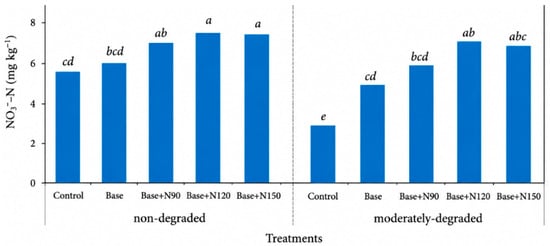
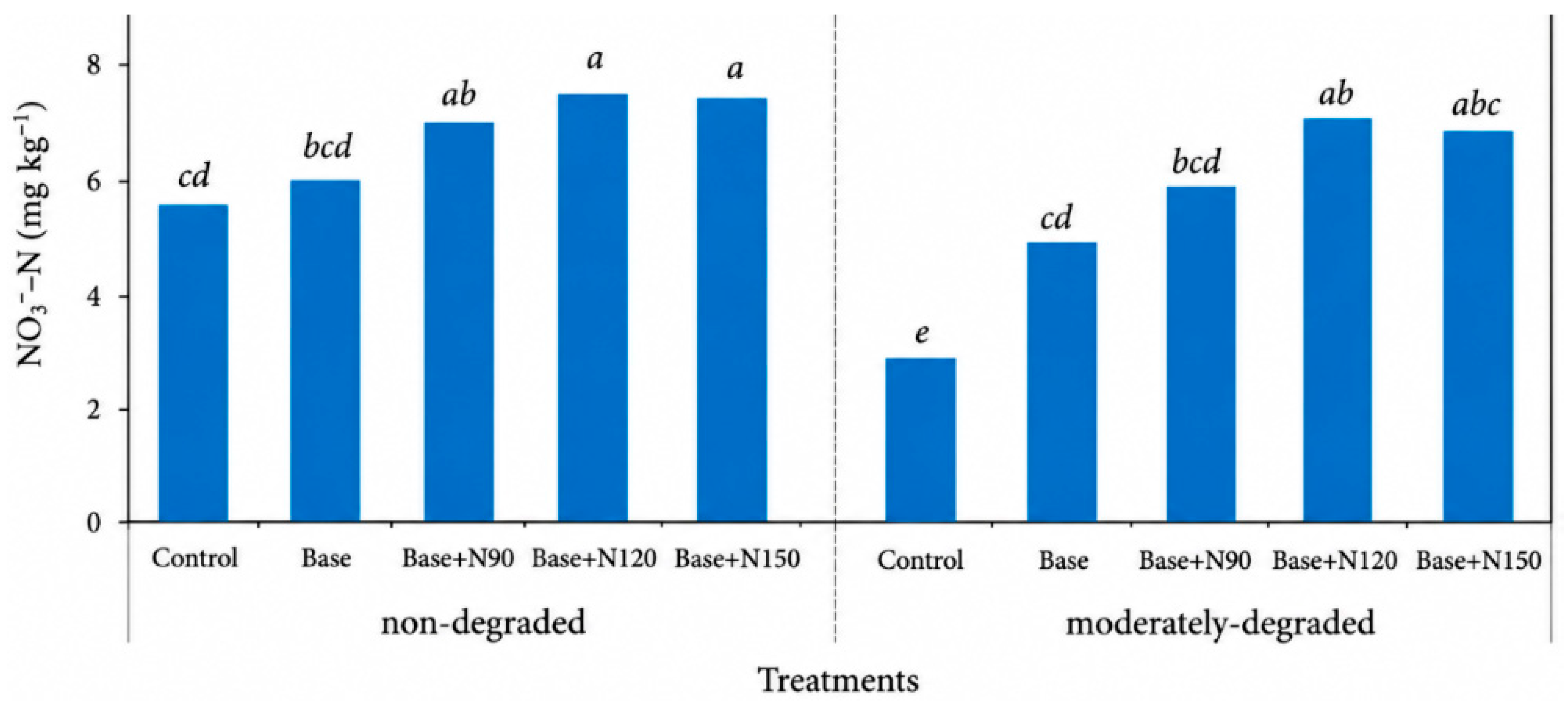
The degradation × treatment interaction for NO3−–N is illustrated in Figure 2, showing differences in treatment responses between non-degraded and moderately degraded soils.
Figure 2.
Effect of fertilization treatments on soil NO3−–N content (mg kg−1) in non-degraded and moderately degraded soils. Columns labeled with the same letter are not significantly different at p < 0.05.
Integrated fertilization improved soil quality and fertility in both soil types, with generally higher values observed in non-degraded soil Higher nitrogen rates generally increased nutrient concentrations and SOC; however, the differences between N120 and N150 were relatively small, suggesting limited additional benefit from excessive nitrogen application.
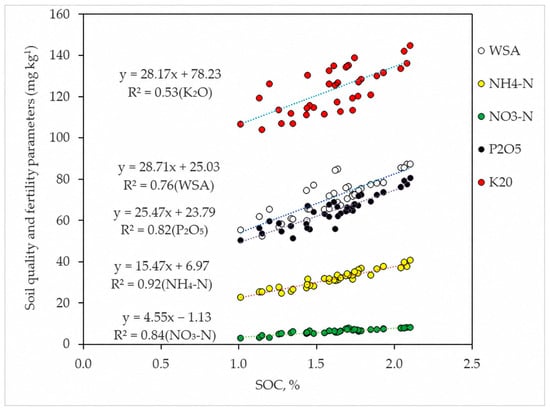
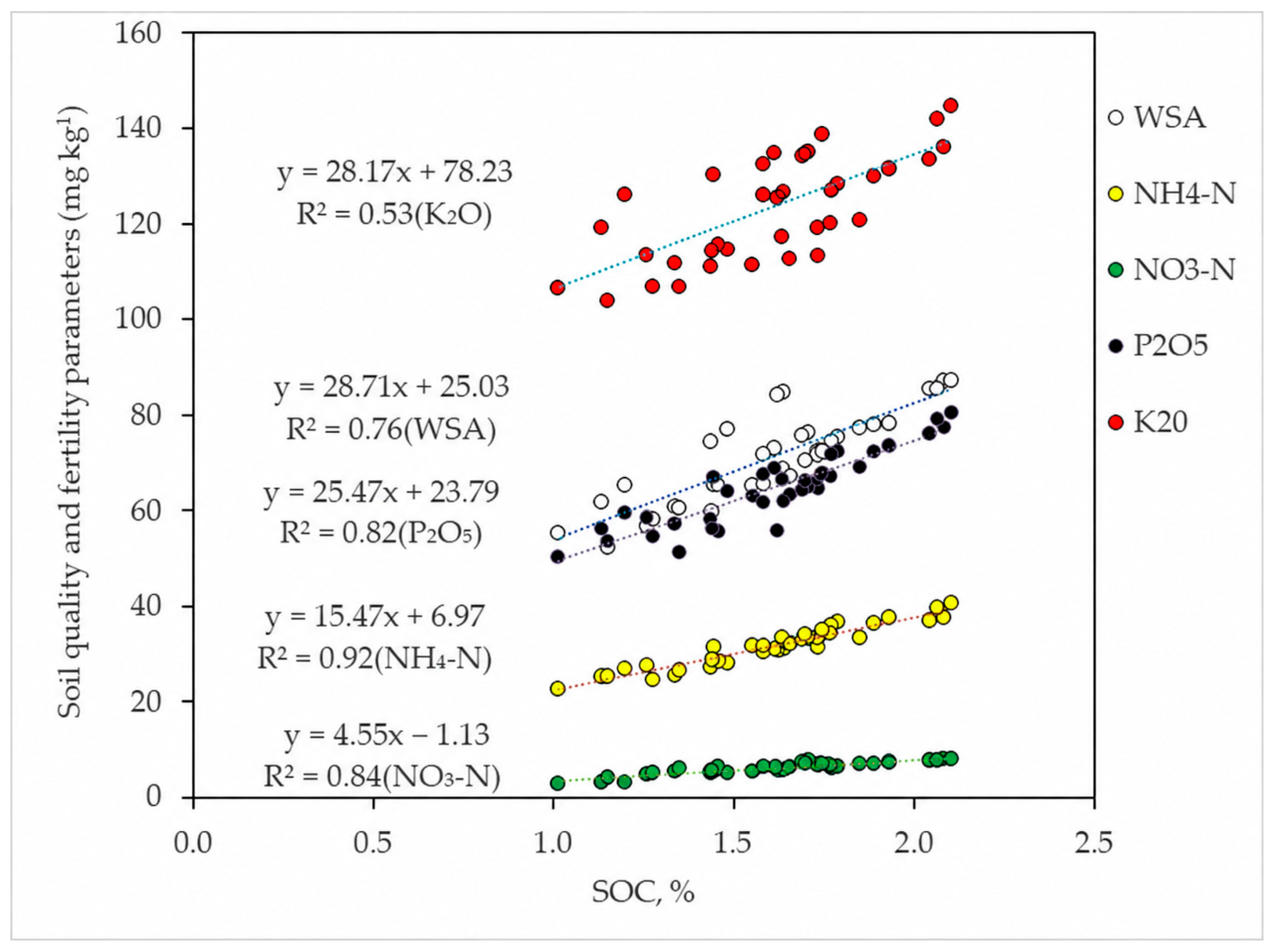
Significant positive relationships between soil organic carbon (SOC) and all soil fertility parameters were observed (Figure 3).
Figure 3.
Linear relationships between soil organic carbon (SOC) and WSA, NH4+–N, NO3−–N, P2O5, and K2O based on treatment-level observations under urea fertilization across non-degraded and moderately degraded soils.
SOC was positively related to all evaluated soil properties, with the strongest relationship observed for NH4+–N (R2 = 0.92), while positive relationships were also observed with NO3−–N, P2O5, WSA, and K2O (Figure 3).
3.2.2. Effects of Fertilization Treatments on Kiwifruit Yield and Fruit Quality
The effects of soil degradation and fertilization treatment on kiwifruit yield, fruit quality, and gross crop value were evaluated by analysis of variance (Table 6).
Table 6.
Effects of soil degradation and fertilization treatment on kiwifruit yield, fruit quality, and income.
Analysis of variance showed that soil degradation significantly affected kiwifruit yield, total sugars (TS), ascorbic acid (AA), and income, whereas its effect on titratable acidity (TA) was not significant (Table 6). Fertilization treatment significantly affected all measured parameters. The degradation × treatment interaction was significant for yield, TA, and income, but not for TS and AA, indicating that the responses of these parameters to fertilization differed between non-degraded and moderately degraded soils.
Kiwifruit yield, fruit quality, and economic return were significantly influenced by soil degradation and fertilization treatment (Table 7). In ND soil, yield increased from 7004 kg ha−1 in the control to 20,139 kg ha−1 under Base + N150. Total sugars increased from 7.0% to 10.9%, while ascorbic acid increased from 95.0 to 106.8 mg 100 g−1 fresh weight. Titratable acidity decreased from 1.8% in the control to 1.3% under Base + N120 and Base + N150. In MD soil, yield increased from 6267 kg ha−1 in the control to 13,777 kg ha−1 under Base + N150. Total sugars increased from 5.5% to 10.0%, and ascorbic acid increased from 85.0 to 99.5 mg 100 g−1 fresh weight.
Table 7.
Effects of fertilization treatments on kiwifruit yield, fruit quality, and income under urea fertilization in non-degraded (ND) and moderately degraded (MD) soils.
The effects of fertilization treatments on yield, fruit quality, and economic return under urea fertilization are presented separately for non-degraded and moderately degraded soils in Table 7.
Integrated fertilization substantially improved kiwifruit productivity, fruit quality, and economic return in both soils. The highest yield and income values were observed under Base + N150 in ND soil; however, differences between N120 and N150 were comparatively small, suggesting that N120 may provide a more efficient balance between productivity and fertilizer input (Table 7).
3.2.3. Relationships Between Kiwifruit Yield, Soil Quality, and Fertility
Correlation analysis revealed strong positive relationships among soil quality parameters, nutrient availability, kiwifruit yield, fruit quality, and income (Table 8).
Table 8.
Correlations among soil quality and fertility parameters, kiwifruit yield, fruit quality, and income based on treatment-level observations under urea fertilization across non-degraded and moderately degraded soil conditions.
Soil organic carbon (SOC) showed strong positive correlations with water-stable aggregates (WSA) (r = 0.87***), NH4+–N (r = 0.96***), NO3−–N (r = 0.92***), yield (r = 0.84**), total sugars (TS) (r = 0.88***), ascorbic acid (AA) (r = 0.89***), and income (r = 0.85***). NO3−–N was also strongly correlated with yield (r = 0.85***), TS (r = 0.95***), AA (r = 0.83***), and income (r = 0.84***), highlighting the important role of nitrate availability in supporting kiwifruit productivity and fruit quality. Yield further showed strong positive correlations with TS (r = 0.92***), AA (r = 0.74***), and income (r = 0.99***) (Table 8).
Stepwise regression analysis identified NO3−–N as the most influential predictor of the response variable, explaining 72.9% of the total variation (R2 = 0.73, p = 0.001). Inclusion of P2O5 in the second step substantially improved model performance, increasing the explained variance to 91.6% and reducing both AICc and BIC values. Subsequent addition of SOC and K2O further improved model fit, resulting in a final model with R2 = 0.938 and lower information criterion values, indicating enhanced model adequacy (Table 9).
Table 9.
Stepwise regression results for soil variables affecting kiwifruit yield showing p-values, coefficient of determination (R2), Akaike information criterion corrected (AICc), and Bayesian information criterion (BIC) across model steps. Lower AICc and BIC values indicate better model performance.
Although NH4+–N and WSA slightly increased the coefficient of determination to 0.940, their effects were not statistically significant (p = 0.250), while both AICc and BIC values increased compared with Step 4. This indicates that inclusion of these variables did not meaningfully improve model performance and may indicate model overparameterization. Therefore, the Step 4 model, which included NO3−–N, P2O5, SOC, and K2O, was considered optimal due to its high explanatory power and lower information criterion values (Table 9). The stepwise regression analysis indicated that kiwifruit yield was significantly associated with key soil fertility indicators, as described by the following regression model:
The regression model (1) developed through stepwise variable selection explained 93.8% of the total variation in kiwifruit yield (R2 = 0.938, p < 0.001). Stepwise regression identified NO3−–N (R2 = 0.729) as the primary predictor followed by P2O5, SOC, and K2O, which together substantially improved model performance. Among the evaluated variables, NO3−–N was identified as the primary predictor of yield, while P2O5, SOC, and K2O provided additional explanatory power (Table 9).
3.3. Effects of Nitrogen Fertilizer Form on Kiwifruit Yield, Nutrient Use Efficiency, and Fruit Quality
The effects of soil degradation, nitrogen fertilizer form, fertilization treatment, and their interactions on yield, NUE, and fruit quality parameters were evaluated by analysis of variance (Table 10).
Table 10.
Effects of soil degradation, fertilization treatment, and nitrogen fertilizer form on kiwifruit yield, nutrient use efficiency (NUE), and fruit quality parameters.
The corresponding treatment means for urea and ammonium nitrate under non-degraded and moderately degraded soil conditions are presented in Table 11.
Table 11.
Effects of nitrogen fertilizer form and fertilization treatment on fruit quality and nutrient use efficiency (NUE) under non-degraded and moderately degraded soil conditions.
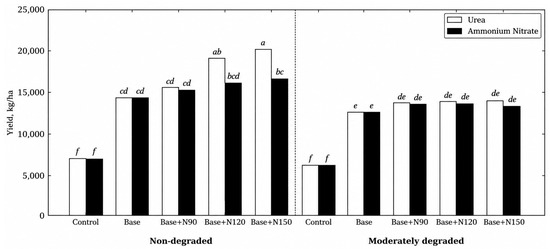
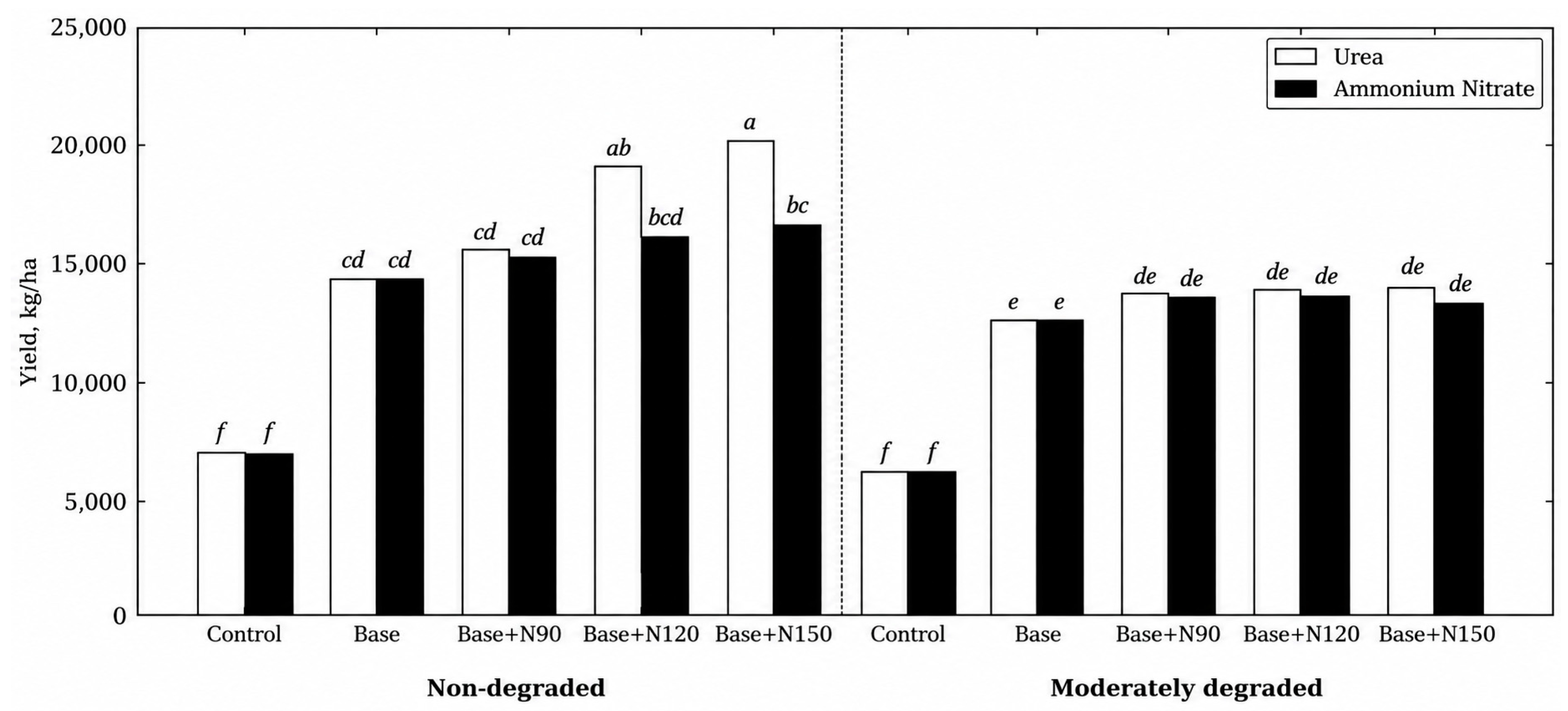
Nitrogen fertilizer form significantly affected kiwifruit yield, nutrient use efficiency (NUE), and several fruit quality parameters under both non-degraded (ND) and moderately degraded (MD) soils (Table 10). Analysis of variance showed that soil degradation (D), fertilizer form (F), and treatment (T) significantly affected yield and nutrient use efficiency (NUE) (Table 10). Soil degradation had significant effects on all measured variables, with highly significant influences on yield, NUE, total sugars (TS), and ascorbic acid (AA), whereas its effect on titratable acidity (TA) was weaker. Fertilizer form significantly affected yield, NUE, and TA, while its effects on TS and AA were not significant. Treatment effects were highly significant for all measured parameters. Significant D × T interactions for yield, NUE, and TA indicated that treatment responses differed between moderately degraded and non-degraded soils. The D×T×F interaction was significant for yield (Table 10). Higher-order interactions involving fertilizer form were generally not significant for fruit quality parameters; however, the F × T and D × T × F interactions were significant for yield (Table 10). The results indicated that urea fertilization generally provided greater improvements in yield, fruit quality, and NUE than ammonium nitrate, particularly under non-degraded soil conditions. However, NUE declined at the highest nitrogen application rates, indicating reduced fertilizer efficiency under excessive nitrogen inputs. Among the evaluated treatments, Base + N120, which was comparable with Base+ N150, appeared to provide the most balanced combination of high yield, improved fruit quality, and efficient nitrogen utilization (Table 11; Figure 4).
Figure 4.
Interactive effects of soil degradation level (D), nitrogen fertilizer form (F), and fertilization treatment (T) on kiwifruit yield. Bars with the same letter are not significantly different at p < 0.05. ND = non-degraded; MD = moderately degraded; AN = ammonium nitrate.
In general, urea applications resulted in higher yield, total sugars (TS), ascorbic acid (AA), and NUE values than ammonium nitrate (AN), particularly under ND soil conditions. In ND soil, yield increased progressively with increasing nitrogen application rates for both fertilizer forms. Under urea fertilization, yield increased from 7004 kg ha−1 in the control to 20,139 kg ha−1 under Base + N150, whereas AN fertilization produced 16,637 kg ha−1 at the same nitrogen rate. Total sugars increased from 7.0% in the control to 10.9% under urea Base + N150, while AA increased from 95.0 to 106.8 mg 100 g−1. Under AN fertilization, TS and AA reached 10.3% and 105.0 mg 100 g−1, respectively. Titratable acidity (TA) generally decreased with increasing nitrogen rates, declining from 1.8 in the control to 1.3 under higher nitrogen treatments (Table 11).
In MD soil, overall yield and fruit quality values were lower than in ND soil, indicating the negative impact of soil degradation on kiwifruit productivity. Nevertheless, fertilization substantially improved plant performance compared with the control. Under urea fertilization, yield increased from 6267 kg ha−1 in the control to 13,777 kg ha−1 under Base + N150, whereas AN fertilization produced a maximum yield of 13,577 kg ha−1 under Base + N120. Total sugars increased from 5.5% in the control to 10.0% under urea Base + N150, while AA increased from 85.0 to 99.5 mg 100 g−1 FW. Under AN fertilization, TS and AA reached 9.5% and 96.4 mg 100 g−1, respectively (Table 11; Figure 4).
Nutrient use efficiency differed markedly between fertilizer forms and nitrogen rates. In ND soil, the highest NUE under urea was observed at Base + N120 (0.99), followed by a decline at N150 (0.88), indicating reduced efficiency at excessive nitrogen input. Under AN fertilization, NUE values were consistently lower, decreasing from 0.91 at N90 to 0.64 at N150. Similar trends were observed in MD soil, where NUE declined with increasing nitrogen rates for both fertilizer forms. The highest NUE values in MD soil were recorded under Base + N90 for both urea (0.82) and AN (0.80), while the lowest values occurred under N150 (Table 11).
4. Discussion
The present study provides strong evidence that integrated organo-mineral fertilization significantly improves soil quality, nutrient availability, kiwifruit productivity, fruit quality, and gross crop value relative to fertilizer input costs in acidic Luvisols under humid subtropical conditions. The combined application of compost and mineral nitrogen enhanced soil organic carbon (SOC), water-stable aggregates (WSA), and nutrient availability, which were positively associated with higher yield and improved fruit quality. The results further demonstrated that soil degradation reduced nutrient retention, soil fertility, and productivity; however, integrated fertilization partially restored soil functionality and reduced the productivity gap between moderately degraded (MD) and non-degraded (ND) soils.
4.1. SOC and Aggregate Stability as Drivers of Soil Restoration
The present study demonstrated that integrated organo-mineral fertilization substantially improved soil quality in acidic Luvisols by increasing soil organic carbon (SOC) and enhancing water-stable aggregates (WSA). These improvements were observed in both non-degraded and moderately degraded soils, although the relative response was stronger under moderately degraded conditions, highlighting the important restorative role of integrated fertilization in structurally impaired soils. These findings support the concept that combined organic amendments and balanced mineral fertilization enhance soil resilience and improve long-term soil functioning in humid subtropical orchard systems [16,28,29,30].
The strong positive relationship between SOC and WSA indicates that SOC is closely associated with soil structural stability. Increased SOC likely stimulated microbial activity and promoted the formation of organo-mineral complexes and microbial binding agents, which contributed to aggregate formation and stabilization. Improved aggregation enhances pore continuity, water infiltration, aeration, and resistance to erosion, while simultaneously protecting organic matter from rapid mineralization [28,31]. These mechanisms are particularly important in acidic Luvisols, where structural degradation and organic matter depletion can rapidly reduce soil productivity under intensive cultivation.
The stronger relative improvement observed in moderately degraded soils suggests that integrated fertilization can partially reverse degradation-induced declines in soil functionality. Organic amendments likely compensated for reduced native organic matter by supplying carbon substrates that stimulated biological activity and improved soil physical properties. However, despite these improvements, moderately degraded soils still maintained lower SOC and WSA values than non-degraded soils, indicating that restoration of degraded Luvisols is a gradual process requiring continuous organic matter inputs and long-term management [32,33].
The concurrent increases in SOC and WSA observed under integrated fertilization can be explained by the complementary effects of organic carbon inputs and mineral nutrient supply on aggregate formation and stabilization. Compost-derived organic matter provides substrates for microbial activity and promotes the formation of organic binding agents and organo-mineral associations, while improved nutrient availability can stimulate plant growth and root-derived carbon inputs. These processes enhance the formation and stabilization of soil aggregates and physically protect organic matter within aggregates, creating a positive interaction between SOC accumulation and structural stability [20,28,31]. The persistence of lower SOC and WSA values in moderately degraded soil despite fertilization indicates that complete structural recovery was not achieved during the three-year experimental period.
4.2. Nutrient Dynamics and Soil Fertility Enhancement
Integrated fertilization significantly improved nutrient availability throughout the kiwifruit growing season, indicating enhanced soil fertility and nutrient cycling efficiency. The combined application of compost and mineral fertilizers increased the availability of NH4+–N, NO3−–N, P2O5, and K2O in both moderately degraded and non-degraded soils. These effects were closely associated with increased soil organic carbon (SOC), which likely improved nutrient retention, microbial activity, and nutrient transformation processes. The positive relationships observed between SOC and mineral nitrogen fractions indicate that organic matter played a central role in soil nitrogen availability. Compost addition likely enhanced microbial biomass and cation exchange capacity, thereby improving ammonium retention and supporting gradual nitrogen mineralization. Increased SOC may also have reduced nutrient losses through leaching by improving aggregate stability and soil water retention [33,34]. These mechanisms are particularly important under humid subtropical conditions, where intense rainfall can accelerate nutrient leaching and reduce fertilizer efficiency.
The positive relationships between SOC and available phosphorus and potassium further suggest that integrated fertilization improved soil buffering capacity and nutrient availability. Organic matter can reduce phosphorus fixation in acidic soils and enhance potassium retention through increased exchange capacity and aggregate formation [19,20]. Consequently, integrated fertilization likely promoted a more stable and balanced nutrient supply during the growing season. Seasonal nutrient dynamics also reflected changes associated with kiwifruit phenological stages. Mineral nitrogen concentrations declined progressively from the bud stage to harvest, consistent with increasing plant nutrient demand during vegetative growth and fruit development. In contrast, phosphorus and potassium showed comparatively smaller seasonal variation, suggesting greater stability within the soil system. These findings emphasize the importance of synchronizing nitrogen availability with crop demand to improve nutrient use efficiency and reduce losses.
Although increasing nitrogen rates generally enhanced nutrient availability, the relatively small differences between N120 and N150 treatments indicate that increasing nitrogen from N120 to N150 provided only limited additional improvement in nutrient availability. This pattern is consistent with the decline in nutrient use efficiency observed at the highest nitrogen rate and supports the concept that moderate nitrogen application provides a more balanced strategy for maintaining soil fertility while minimizing potential nutrient losses and environmental risks [14].
Although Mg, Fe, Ca, and other essential nutrients are also important for kiwifruit nutrition, they were outside the analytical scope of the present experiment. Future studies should include these macro- and micronutrients to provide a more comprehensive assessment of kiwifruit nutritional responses to integrated fertilization.
4.3. Fertilizer Effects on Yield, Fruit Quality, and Fertilizer Input-Based Economic Evaluation
Integrated fertilization substantially improved kiwifruit yield, fruit quality, and gross crop value relative to fertilizer input costs in both moderately degraded and non-degraded soils. Improved nutrient availability and enhanced soil physical conditions likely stimulated vegetative growth, root activity, and fruit development, thereby increasing productivity and fruit quality parameters such as total sugars and ascorbic acid content. The higher productivity observed in non-degraded soils highlights the importance of favorable soil structural conditions and nutrient retention capacity for efficient crop response. Nevertheless, the significant yield improvements observed in moderately degraded soils indicate that integrated fertilization can partially mitigate degradation effects and restore productive potential in acidic Luvisols.
The improvement in fruit quality under integrated fertilization may be associated with enhanced nutrient uptake and improved physiological functioning of kiwifruit plants. Adequate nitrogen supply supports chlorophyll formation and photosynthetic activity, while improved potassium availability contributes to sugar accumulation and overall fruit biochemical quality. Enhanced SOC and aggregate stability likely further supported nutrient uptake efficiency by improving root-zone conditions and soil moisture availability [6]. Although higher nitrogen rates generally increased productivity, the relatively small differences between N120 and N150 treatments indicate limited additional agronomic benefit from increasing the nitrogen rate beyond N120. Similar responses have been reported in kiwifruit orchards and other intensive fruit production systems, where excessive nitrogen inputs stimulate vegetative growth without proportionally increasing fruit yield or quality [8,14]. The results therefore suggest that N120 provided a more favorable balance between high productivity and efficient nitrogen use under the studied conditions.
The achieved yield levels are comparable to those reported for productive kiwifruit orchards in humid subtropical regions of China and New Zealand, where balanced nitrogen management and organic amendments substantially improved fruit production and quality [8,14]. The favorable response observed under N120 is also consistent with previous kiwifruit fertilization studies indicating that moderate nitrogen rates can maintain high productivity while improving nutrient use efficiency and limiting unnecessary nitrogen inputs.
This evaluation was limited to fertilizer input costs and gross crop value and therefore should not be interpreted as a comprehensive economic analysis. Other production costs, including labor, irrigation, machinery, plant protection, and management expenses, were not included. Consequently, net return and benefit–cost ratios were not estimated.
4.4. Urea Versus Ammonium Nitrate and Nutrient Use Efficiency
The comparison of nitrogen fertilizer forms demonstrated that urea generally resulted in higher yield and greater nutrient use efficiency (NUE) than ammonium nitrate, whereas the effects of fertilizer form on fruit quality were less consistent, particularly in non-degraded soils. These findings highlight the important role of nitrogen form in regulating nutrient dynamics, nitrogen retention, and overall fertilizer efficiency in acidic Luvisols under humid subtropical conditions. The superior performance of urea may be attributed to differences in nitrogen transformation processes and rhizosphere pH dynamics. During hydrolysis, urea temporarily increases rhizosphere pH through the formation of ammonium and hydroxyl ions prior to nitrification. In acidic Luvisols, this short-term buffering effect may improve nutrient availability, stimulate microbial activity, and create more favorable conditions for root growth. In contrast, ammonium nitrate contributes more directly to proton release during nitrification, which can intensify soil acidification in the root zone and subsequently reduce root development and nitrogen uptake efficiency [13,15]. Increased soil acidity may also suppress microbial activity and limit the availability of essential nutrients, thereby reducing fertilizer effectiveness.
Under humid subtropical climatic conditions, nitrate derived from ammonium nitrate is particularly vulnerable to leaching due to high rainfall and enhanced water movement through the soil profile. Because nitrate is highly mobile in soil solution, intense rainfall can accelerate its transport below the rooting zone, reducing nitrogen availability to plants and lowering fertilizer efficiency. In contrast, urea-derived ammonium can be temporarily retained on soil exchange sites prior to nitrification, potentially improving synchronization between nitrogen release and plant demand. Similar mechanisms were described by Lehmann and Kleber (2015) [34], who reported that organic amendments improve nutrient retention and reduce nitrogen losses in structurally degraded soils.
Integrated organo-mineral fertilization may improve nutrient retention and soil buffering capacity in acidic Luvisols. The combined application of compost and mineral nitrogen may help mitigate the acidifying effects commonly associated with mineral nitrogen fertilization. Long-term use of mineral nitrogen fertilizers, particularly ammonium-based sources, can accelerate soil acidification through nitrification processes that release hydrogen ions into the soil solution [35]. In contrast, compost addition supplies organic matter and basic cations that help stabilize soil pH and improve soil cation exchange capacity (CEC) [36].
The increase in soil organic carbon (SOC) and aggregate stability observed under compost-amended treatments may have contributed to improved nutrient conservation within the root zone. Improved soil aggregation can enhance nutrient retention and potentially reduce nutrient losses through leaching [37]. Under humid subtropical conditions, where intense rainfall frequently accelerates nutrient transport below the rooting zone, improved soil structure is especially important for maintaining nutrient availability and fertilizer efficiency.
Furthermore, compost application may improve soil water-holding capacity and reduce rapid percolation, thereby potentially limiting the downward movement of soluble nutrients. Reduced nitrate leaching could enhance nitrogen use efficiency and lower potential environmental risks associated with groundwater contamination [38]. Compost addition may also promote nitrogen retention through improved aggregation, microbial immobilization, and increased cation exchange capacity, all of which contribute to greater nutrient conservation within the soil profile [34]. Consequently, the combined application of compost and urea may represent an agronomically effective fertilization strategy for acidic Luvisols.
The decline in nutrient use efficiency (NUE) at higher nitrogen rates indicates that increasing nitrogen application reduced fertilizer efficiency, particularly at the highest rate. Similar reductions in NUE under high nitrogen inputs have been widely reported in orchard systems and are commonly associated with increased nutrient losses through leaching, volatilization, and gaseous emissions [14,39]. The highest NUE observed under the urea N120 treatment suggests that moderate nitrogen rates more effectively synchronized nutrient supply with crop demand. In contrast, excessive nitrogen application may exceed plant uptake capacity, thereby increasing the proportion of nitrogen potentially lost from the system.
Consequently, the combined application of compost and urea at moderate nitrogen rates may improve nitrogen retention and fertilizer use efficiency while potentially limiting nitrogen losses under humid subtropical conditions.
4.5. Implications for Sustainable Soil Management
From a practical management perspective, the limited yield advantage of N150 over N120, together with the decline in NUE at the highest nitrogen rate, indicates that maximizing nitrogen input is not an efficient strategy for kiwifruit production on these acidic Luvisols. The combination of compost (30 t ha−1) and the basal P150K120 application with N120, particularly as urea, provided a more favorable balance between soil improvement, crop productivity, and nitrogen use efficiency. This response is especially relevant under humid subtropical conditions, where high rainfall can increase the potential risk of nitrate leaching. Therefore, integrated fertilization based on organic amendments and moderate nitrogen inputs represents a more sustainable nutrient-management strategy than increasing mineral N application beyond the level required to achieve a substantial crop response [14,33,39].
5. Conclusions
Integrated organo-mineral fertilization improved soil quality, nutrient availability, kiwifruit productivity, and fruit quality in both non-degraded and moderately degraded acidic Luvisols. Compost combined with mineral fertilizers increased SOC, WSA, and available nutrients, while SOC was strongly associated with soil structural stability and nutrient availability. Stepwise regression identified NO3−–N, P2O5, SOC, and K2O as the main predictors of kiwifruit yield.
Fertilization substantially increased yield and fruit quality, but the additional yield benefit of N150 over N120 was limited and NUE declined at the highest nitrogen rate. Urea generally produced higher yield and NUE than ammonium nitrate, particularly in non-degraded soil. Overall, Base + N120 (compost 30 t ha−1 + P150K120 + N120), particularly with urea, provided the most favorable balance between soil improvement, kiwifruit productivity, and nitrogen use efficiency under the studied conditions.
Author Contributions
Conceptualization, C.G., B.S. and A.I.M.; Methodology, C.G., K.B., B.S., I.K., M.A., Z.M. and A.I.M.; Software, C.G. and A.I.M.; Validation, C.G., K.B., I.K. and A.I.M.; Formal analysis, C.G., B.S., M.A., Z.M. and A.I.M.; Investigation, C.G., K.B., B.S., I.K., M.A., Z.M. and A.I.M.; Resources, C.G., K.B., B.S., I.K., M.A. and A.I.M.; Data curation, C.G., B.S. and A.I.M.; Writing—original draft, C.G., K.B., B.S., I.K., M.A., Z.M. and A.I.M.; Writing—review and editing, C.G. and A.I.M.; Visualization, C.G., K.B. and I.K.; Supervision, B.S. and A.I.M.; Project administration, C.G. and A.I.M.; Funding acquisition, B.S., I.K., M.A. and Z.M. All authors have read and agreed to the published version of the manuscript.
Funding
This research received no external funding.
Data Availability Statement
The raw data supporting the conclusions of this article will be made available by the authors on request.
Acknowledgments
The authors gratefully to Lankaran State University for support throughout the study.
Conflicts of Interest
The authors declare no conflicts of interest.
Abbreviations
The following abbreviations are used in this manuscript:
| SOC | soil organic carbon |
| WSA | water-stable aggregates (aggregate stability); |
| CEC | cation exchange capacity; |
| NO3−–N | nitrate nitrogen; |
| P2O5 | available phosphorus; |
| K2O | exchangeable potassium. |
| ANOVA | analysis of variance |
| ND | non-degraded; |
| MD | moderately degraded; |
| AN | ammonium nitrate |
| T | treatment |
References
- Babayev, M.P.; Ismailov, A.I.; Guseynova, S.M. The place of gleyic yellow soils of Azerbaijan in the international WRB system. Soils Environ. 2020, 3, e112. [Google Scholar] [CrossRef] [Scilit]
- Babaev, K.Y. Agrochemical characteristics of yellow earth-pseudopodzolic soils of the Lankaran district of Azerbaijan. Bull. Sci. Pract. 2025, 11, 222–226. [Google Scholar] [CrossRef] [Scilit]
- Gulaliyev, C.; Kerimov, I.; Akperova, U. Analysis of yellow soils distributed in the Lankaran-Astara economic region according to granulometrical composition elements. Tech. Agrar. Sci. 2024, 4, 41–49. [Google Scholar] [CrossRef] [Scilit]
- Sharma, S.; Rana, V.S.; Rana, N.; Sharma, U.; Gudeta, K.; Alharbi, K.; Ameen, F.; Bhat, S.A. Effect of Organic Manures on Growth, Yield, Leaf Nutrient Uptake and Soil Properties of Kiwifruit (Actinidia deliciosa Chev.) cv. Allison. Plants 2022, 11, 3354. [Google Scholar] [CrossRef] [Scilit] [PubMed]
- Mammadzade, V.T. Microbiological state of natural biotopes of Lankaran mountain forest yellow-podzolic soils. Vestn. Kurgan. State Agric. Acad. 2024, 3, 12–18. [Google Scholar]
- Müller, K.; Holmes, A.; Deurer, M.; Clothier, B.E. Eco-efficiency as a sustainability measure for kiwifruit production in New Zealand. J. Clean. Prod. 2015, 106, 333–342. [Google Scholar] [CrossRef] [Scilit]
- Rahman, M.H.; Holmes, A.W.; McCurran, A.G.; Saunders, S.J. Impact of management systems on soil properties and their relationships to kiwifruit quality. Commun. Soil Sci. Plant Anal. 2011, 42, 332–357. [Google Scholar] [CrossRef] [Scilit]
- Parent, S.E.; Barlow, P.; Parent, L.E. Nutrient balances of New Zealand kiwifruit (Actinidia deliciosa cv. Hayward) at high yield level. Commun. Soil Sci. Plant Anal. 2015, 46, 256–271. [Google Scholar] [CrossRef] [Scilit]
- Peticilă, A.; Scăteanu, G.V.; Mădjar, R.; Stanică, F.; Aşaniţă, A. Fertilization effect on mineral nutrition of Actinidia deliciosa cultivated on different substrates. Agric. Agric. Sci. Procedia 2015, 6, 132–138. [Google Scholar] [CrossRef] [Scilit]
- Lehmann, J.; Bossio, D.A.; Kögel-Knabner, I.; Rillig, M.C. The concept and future prospects of soil health. Nat. Rev. Earth Environ. 2020, 1, 544–553. [Google Scholar] [CrossRef] [Scilit] [PubMed]
- Chen, M.; Zhang, S.; Liu, L.; Wu, L.; Ding, X. Combined organic amendments and mineral fertilizer application increase rice yield by improving soil structure, P availability and root growth in saline-alkaline soil. Soil Tillage Res. 2021, 212, 105060. [Google Scholar] [CrossRef] [Scilit]
- Tarakcioglu, C.; Askin, T.; Cangi, R.; Duran, C. Nutritional status in some kiwifruit (Actinidia deliciosa) orchards: A case survey from the Karadeniz region of Turkey. J. Plant Sci. 2007, 2, 187–194. [Google Scholar] [CrossRef] [Scilit]
- Ferguson, A.R.; Eiseman, J.A. Estimated annual removal of macronutrients in fruit and prunings from a kiwifruit orchard. N. Z. J. Agric. Res. 1983, 26, 115–117. [Google Scholar] [CrossRef] [Scilit]
- Zhao, Z.P.; Duan, M.; Yan, S.; Liu, Z.F.; Wang, Q.; Fu, J.; Tong, Y.A. Effects of different fertilizations on fruit quality, yield and soil fertility in field-grown kiwifruit orchards. Int. J. Agric. Biol. Eng. 2017, 10, 162–171. [Google Scholar] [CrossRef]
- Ahmed, W.; Liu, K.; Qaswar, M.; Huang, J.; Huang, Q.; Xu, Y.; Ali, S.; Mehmood, S.; Asghar, R.M.A.; Mahmood, S.; et al. Long-term mineral fertilization improved grain yield and phosphorus use efficiency by changing soil P fractions in Ferralic Cambisol. Agronomy 2019, 9, 784. [Google Scholar] [CrossRef] [Scilit]
- FAO. Soil Health and Integrated Nutrient Management in Horticulture; Food and Agriculture Organization of the United Nations: Rome, Italy, 2020. [Google Scholar]
- Jones, J.B. Laboratory Guide for Conducting Soil Tests and Plant Analysis; CRC Press: Boca Raton, FL, USA, 2001. [Google Scholar]
- Asher, C.J.; Smith, G.S.; Clark, C.J.; Brown, N.S. Manganese deficiency of kiwifruit (Actinidia chinensis Planch.). J. Plant Nutr. 1984, 7, 1497–1509. [Google Scholar] [CrossRef] [Scilit]
- Alley, M.M.; Vanlauwe, B. The Role of Fertilizers in Integrated Plant Nutrient Management; International Fertilizer Industry Association (IFA): Paris, France, 2009. [Google Scholar]
- Bronick, C.J.; Lal, R. Soil structure and management: A review. Geoderma 2005, 124, 3–22. [Google Scholar] [CrossRef] [Scilit]
- Mulualem, T.; Adgo, E.; Meshesha, D.T.; Tsunekawa, A.; Haregeweyn, N.; Tsubo, M.; Kebede, B.; Mamedov, A.I.; Masunaga, T.; Berihun, M.L. Examining the impact of polyacrylamide and other soil amendments on soil fertility and crop yield in contrasting agroecological environments. J. Soil Sci. Plant Nutr. 2021, 21, 1817–1830. [Google Scholar] [CrossRef] [Scilit]
- Boyd, L. Resource Allocation in Kiwifruit (Actinidia chinensis). Ph.D. Thesis, Massey University, Palmerston North, New Zealand, 2012. [Google Scholar]
- Kozlova, N.V.; Grebenyukov, S.N. Macroelement characteristics of Actinidia deliciosa fruits depending on mineral nutrition level and cultivar under cultivation in Russian subtropics. Bull. Agro-Ind. Complex Stavropol 2015, 1, 226–230. [Google Scholar]
- Li, X.H.; Han, X.Z.; Li, H.B.; Song, C.; Yan, J.; Liang, Y. Soil chemical and biological properties affected by 21-year application of composted manure with chemical fertilizers in a Chinese Mollisol. Can. J. Soil Sci. 2012, 92, 419–428. [Google Scholar] [CrossRef] [Scilit]
- Guarconi, L.; Ventura, F. Combined use of organic and chemical fertilizers improves soil microbial activity and ensures long-term productivity. Agric. Sci. 2019, 10, 107–115. [Google Scholar]
- Nielsen, S.S. Food Analysis, 5th ed.; Springer: Cham, Switzerland, 2017. [Google Scholar]
- JMP Statistical Discovery LLC. JMP® Student Edition, Version 19; JMP Statistical Discovery LLC: Cary, NC, USA, 2025. [Google Scholar]
- Six, J.; Conant, R.T.; Paul, E.A.; Paustian, K. Stabilization mechanisms of soil organic matter: Implications for C saturation of soils. Plant Soil 2002, 241, 155–176. [Google Scholar] [CrossRef] [Scilit]
- Mamedov, A.I.; Tsunekawa, A.; Tsubo, M.; Fujimaki, H.; Kawai, T.; Kebede, B.; Mulualem, T.; Abebe, G.; Wubet, A.; Levy, G.J. Soil structure stability under different land uses in association with polyacrylamide effects. Sustainability 2021, 13, 1407. [Google Scholar] [CrossRef] [Scilit]
- Mamedov, A.I.; Fujimaki, H.; Tsunekawa, A.; Tsubo, M.; Levy, G.J. Structure stability of acidic Luvisol: Effects of tillage type and exogenous additives. Soil Tillage Res. 2021, 206, 104832. [Google Scholar] [CrossRef] [Scilit]
- Cotrufo, M.F.; Ranalli, M.G.; Haddix, M.L.; Six, J.; Lugato, E. Soil carbon storage informed by particulate and mineral-associated organic matter. Nat. Geosci. 2019, 12, 989–994. [Google Scholar] [CrossRef] [Scilit]
- Lal, R. Restoring Soil Quality to Mitigate Soil Degradation. Sustainability 2015, 7, 5875–5895. [Google Scholar] [CrossRef] [Scilit]
- Bünemann, E.K.; Bongiorno, G.; Bai, Z.; Creamer, R.E.; De Deyn, G.; de Goede, R.; Fleskens, L.; Geissen, V.; Kuyper, T.W.; Mäder, P.; et al. Soil quality—A critical review. Soil Biol. Biochem. 2018, 120, 105–125. [Google Scholar] [CrossRef] [Scilit]
- Lehmann, J.; Kleber, M. The contentious nature of soil organic matter. Nature 2015, 528, 60–68. [Google Scholar] [CrossRef] [Scilit] [PubMed]
- Guo, J.H.; Liu, X.J.; Zhang, Y.; Shen, J.L.; Han, W.X.; Zhang, W.F.; Christie, P.; Goulding, K.W.T.; Vitousek, P.M.; Zhang, F.S. Significant acidification in major Chinese croplands. Science 2010, 327, 1008–1010. [Google Scholar] [CrossRef] [Scilit] [PubMed]
- Haynes, R.J.; Naidu, R. Influence of lime, fertilizer and manure applications on soil organic matter content and soil physical conditions: A review. Nutr. Cycl. Agroecosyst. 1998, 51, 123–137. [Google Scholar] [CrossRef] [Scilit]
- Blanco-Canqui, H.; Lal, R. Mechanisms of carbon sequestration in soil aggregates. Crit. Rev. Plant Sci. 2004, 23, 481–504. [Google Scholar] [CrossRef] [Scilit]
- Diacono, M.; Montemurro, F. Long-term effects of organic amendments on soil fertility. A review. Agron. Sustain. Dev. 2010, 30, 401–422. [Google Scholar] [CrossRef] [Scilit]
- Zhang, X.; Davidson, E.A.; Mauzerall, D.L.; Searchinger, T.D.; Dumas, P.; Shen, Y. Managing nitrogen for sustainable development. Nature 2015, 528, 51–59. [Google Scholar] [CrossRef] [Scilit] [PubMed]

Disclaimer/Publisher’s Note: The statements, opinions and data contained in all publications are solely those of the individual author(s) and contributor(s) and not of MDPI and/or the editor(s). MDPI and/or the editor(s) disclaim responsibility for any injury to people or property resulting from any ideas, methods, instructions or products referred to in the content. |
© 2026 by the authors. Licensee MDPI, Basel, Switzerland. This article is an open access article distributed under the terms and conditions of the Creative Commons Attribution (CC BY) license.