


Abstract
The performance of an early-stage metro network in developing countries depends heavily on the availability of competitive first-mile feeder options. This study examines metro user preferences for first-mile public bicycle sharing systems (PBSS) in Hanoi—a promising but poorly understood option. Drawing on a stated-choice survey of 1015 metro users, the study analyzed the impact of key factors influencing PBSS choices, including travel time, cost, cycling infrastructure, and socioeconomics, and computed the marginal effects for cyclists. Results show that PBSS can substitute for motorbikes on short- and medium-distance access stages, with travel time and dedicated cycling routes being the most influential factors. Additionally, behavioral differences emerge across age, gender, and income groups, varying by travel distance and trip purpose. These insights enhance the understanding of PBSS adoption in developing cities, where private vehicles dominate urban transportation.
1. Introduction
Urbanization and economic growth in developing countries, particularly in Southeast Asia, have led to a significant and rapid increase in private vehicle ownership, contributing to severe traffic congestion and escalating environmental pollution, threatening urban sustainability. Reliance on motorized transport has resulted in deteriorating air quality and rising carbon emissions, which seriously affect public health. These challenges necessitate urgent policy interventions to mitigate their impact.
Public transportation systems in many developed countries are pioneering models for sustainable urban mobility, particularly modern and efficient metro networks. A key component of their success lies in the integration of first- and last-mile connectivity options such as buses, ride-hailing services (RHS), and public bicycle sharing systems (PBSS), which enhance accessibility to metro stations and help reduce environmental impacts [1]. This integrated strategy is increasingly being adopted in developing cities, where rapid urbanization and fragmented transport systems challenge the transition toward sustainable transportation.
Hanoi represents a broader class of rapidly urbanizing cities in Southeast Asia and other emerging economies, where urban transport systems are dominated by private vehicles, particularly motorbikes, resulting in severe congestion and environmental pollution. In response, the city has prioritized urban rail as the backbone of its public transport system to raise the share of public transport modes and reduce reliance on private vehicles [2,3]. In line with this objective, the introduction of Urban Mass Rapid Transit (UMRT) was expected to shift a large share of motorcycle users to rail and reduce private vehicle travel and emissions in Hanoi based on stated-preference evidence collected before its launch [4]. The first metro line was launched in 2021, followed by the second in 2024, marking a shift toward mass transit. As metro ridership increases, effective first- and last-mile connectivity becomes crucial, making the PBSS an appealing, sustainable solution. Beyond bridging this access gap, PBSS also support transit-oriented development (TOD), enhances environmental benefits, and promotes public health [5].
In many developing countries, PBSS have been introduced as part of urban mobility strategies to improve first- and last-mile connectivity with public transport systems. Although these initiatives often generate a strong initial interest, their long-term adoption frequently faces several challenges. Numerous studies have identified key barriers, such as inadequate infrastructure, adverse weather, limited bicycle station coverage, and cultural resistance to non-motorized transport [6,7]. These challenges have resulted in a decline in ridership after an early surge in user adoption.
Hanoi’s experience with PBSS reflects similar trends. As the city accelerates the development of its urban railway network to address severe congestion and promote more sustainable mobility, Hanoi Metro Line No. 2A, Cat Linh–Ha Dong section (Line 2A), has emerged as an important public transport corridor connecting the southwestern districts to the city center through 12 stations along a 13 km route. Although several additional metro lines are currently planned or under construction, Line 2A serves as a pilot corridor for examining travel behavior, station accessibility, and the integration of first- and last-mile mobility services during the early development stage of Hanoi’s emerging urban rail network. As of August 2024, the second metro line (Line 3) had been in operation for only one month. Its ridership was still influenced by first-time visitors and short-term promotions, such as free-fare policies, making it difficult to identify regular users with established travel patterns. In contrast, Line 2A had been in operation since 2021, providing a more stable context for examining the travel behavior of regular metro users.
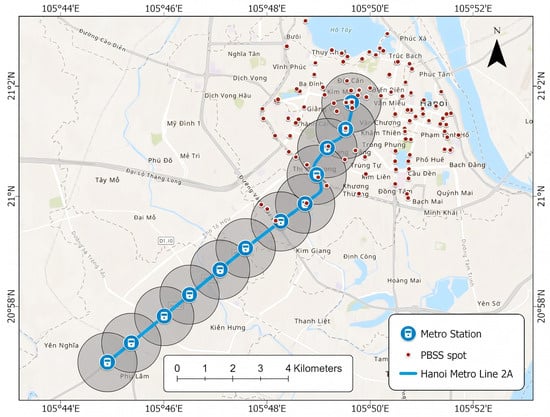
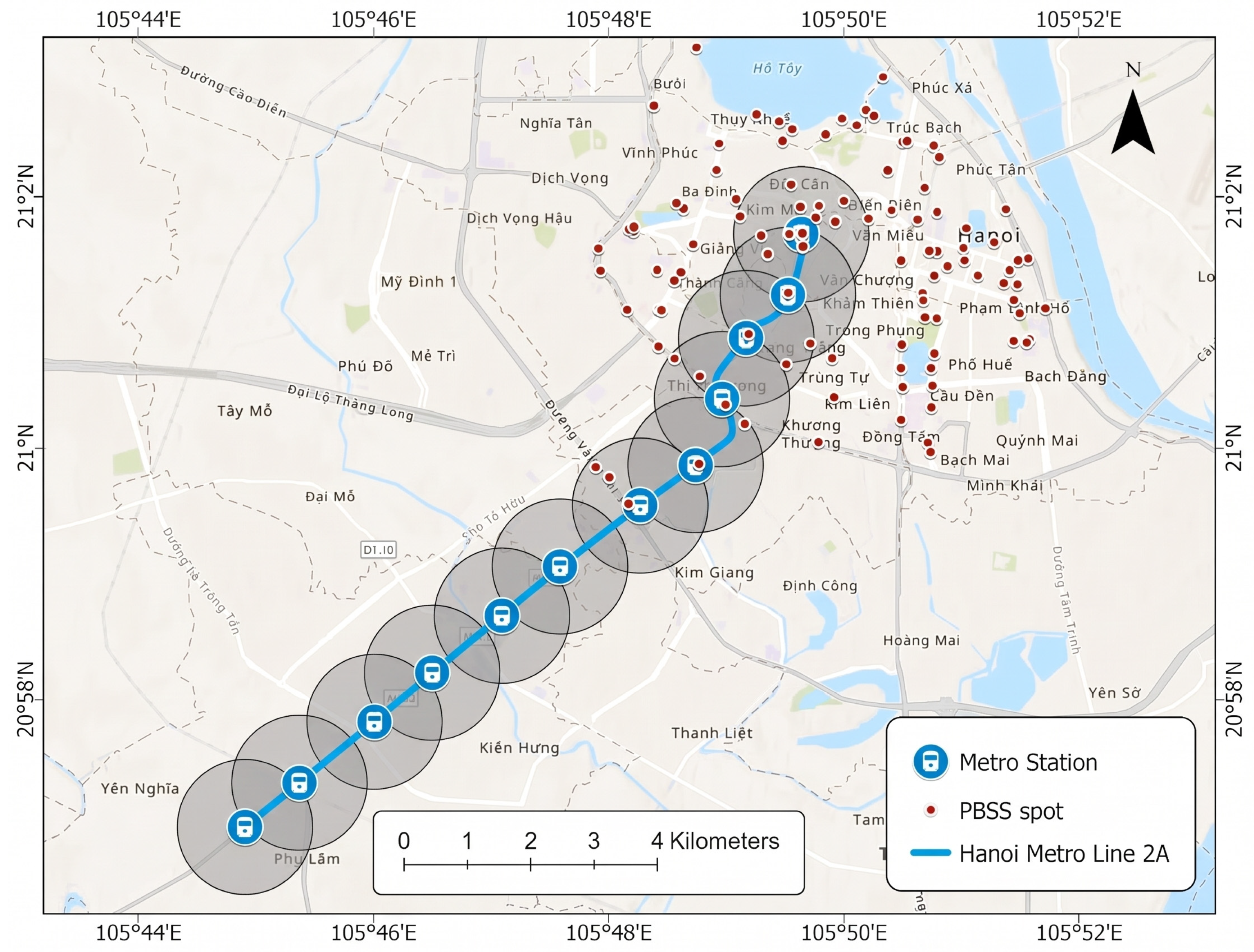
In this context, PBSS were introduced in August 2023 as a potential micromobility solution to enhance metro accessibility. However, their integration into the metro systems remains limited. As illustrated in Figure 1, the circles represent 1 km straight line buffers around each metro station, which indicate the approximate first-mile catchment of each station. PBSS spots were primarily concentrated in the inner city and areas within Ring Road 3, resulting in an uneven spatial coverage along the metro corridor. Consequently, only approximately half of the metro stations are currently integrated with nearby bicycle docking points, and the density of PBSS stations within these 1 km buffers remains sparse, particularly toward the southwestern segment of the line. Infrastructure conditions further constrain this potential. Cyclists must still share mixed-traffic lanes with motorbikes and cars, and the few protected cycle lanes that exist are poorly connected to metro stations, contributing little to first- and last-mile access. Survey evidence from Hanoi indicates that perceived slowness and safety concerns are the main deterrents to cycling, and a long-standing reliance on motorcycles further constrains the shift toward active modes [8]. Therefore, understanding these barriers and facilitators is critical for designing effective policies and interventions to enhance the role of PBSS as an efficient metro access mode.
Figure 1.
Spatial distribution of PBSS spots along Hanoi Metro Line 2A.
This study explores the key factors influencing the choice of PBSS as an access mode to metro stations in developing cities, focusing on Hanoi Metro Line 2A users. Specifically, it examines how urban mobility behavior in the context of a developing country shapes the adoption of cycling as a first-mile solution, identifying key enablers and barriers to its widespread use. By analyzing these determinants, this study contributes to policy discussions on integrating active mobility solutions with public transport networks, aiming to reduce private vehicle dependency and promote sustainable urban mobility.
The remainder of this paper is organized as follows. Section 2 provides a literature review of access mode choice models, particularly those that incorporate PBSS. Section 3 outlines the data collection methodology, including the survey design, stated choice (SC) experiment, and descriptive statistics. Section 4 describes the model specifications, including the model structure, final model estimation, and marginal effect calculations. Section 5 presents the results and key findings, and Section 6 concludes the paper.
2. Literature Review
Access mode choice is crucial in enhancing the efficiency of urban public transportation, especially in developing countries, where reliance on private vehicles remains prevalent. In recent years, a growing number of studies have examined the determinants of first- and last-mile travel behavior, focusing on the role of PBSS as a sustainable access option. Zhou et al. [9] classified the determinants of the metro access mode choice into six categories: urban form, mode-specific factors, personal attributes, trip characteristics, travel demand management (TDM) measures, and psychological factors. Numerous other studies have similarly emphasized the interplay between built environment characteristics, sociodemographic factors, travel attributes, and user perceptions in shaping metro access mode decisions [10,11].
Prior personal travel experience also significantly influences the mode choice. Muñoz et al. [12] conducted a study in Spain and found that people who habitually cycled for nonwork trips were more likely to commute by bicycle. Socioeconomic factors further influence first-mile mode choices by shaping travel preferences and constraints. Meena et al. [13] found that individuals in Mumbai with higher incomes and car ownership were more likely to rely on private vehicles for first-mile travel; those with lower incomes tended to use public transport, walking, cycling, or motorcycles.
The integration of bicycles into public transportation has been widely studied and implemented in cities with well-developed public transit systems and cycling cultures. Many metropolitan areas have linked PBSS to rail or metro networks, where shared bikes serve as the first- and last-mile modes that extend transit catchment areas [14]. A common aim of this integration is to make public transport more attractive, reducing reliance on private motorized transport. The key enablers of PBSS adoption include improved cycling infrastructure, seamless integration with public transport, and supportive policies [15,16]. These measures can significantly increase the attractiveness of cycling as a feeder mode to transit. Indeed, improvements in bike lane networks, station connectivity, and intermodal facilities can lead to higher adoption of cycling for first- and last-mile travel [6,7].
Despite its potential benefits, numerous barriers hinder the adoption of cycling as the first-mile mode. The lack of a well-connected bicycle network reduces transit accessibility for cyclists and undermines the effectiveness of bicycle-transit integration [17]. Adverse weather conditions also pose significant challenges to the first-mile cycling uptake. An Australian study [18], which combines revealed preference (RP) and stated preference (SP) survey data, reports that weather conditions and route quality, particularly the availability of weather protection, significantly influence decisions to cycle. Safety concerns and negative public perceptions are also major deterrents to cycling. Qualitative studies have identified fear of traffic accidents and related dangers, as well as the stigma associated with cycling, as factors that discourage potential users [19,20,21].
Studies have revealed complex dynamics in Southeast Asia, where sociocultural, climatic, and infrastructural conditions interact to shape the adoption of PBSS. In Singapore, Lee & Pojani [22] found that convenience and safety were more decisive factors in cycling adoption than climate conditions. In Kuala Lumpur, Wahab et al. [23] employed regression models and demonstrated that perceived convenience and safety were statistically significant predictors of PBSS usage intentions, whereas cost had a limited influence. Research on cycling–transit integration in this region remains considerably more limited, although the benefits of such integration are well documented elsewhere, where it has been shown to improve the performance of existing public transport systems by expanding catchment areas and enhancing accessibility [24]. The scarcity of regional evidence is partly a matter of timing. When Mateo-Babiano [25] reviewed bike-sharing across Asia in 2015, no Southeast Asian scheme could be included among the systems examined, as bike-sharing had not yet been implemented at scale in the region’s cities. Later studies were more diverse, yet they rarely examined mode choices at the individual level or accounted for user characteristics. Shen et al. [26] inferred bicycle–metro integration in Singapore from the spatial association between dockless bicycle usage and MRT stations, but did not examine actual metro access behavior or its sociodemographic differentiation by gender, age, or income. Rosnan and Abdullah [27] similarly frame bicycle sharing in Malaysia as a solution for accessing the public transit network, yet report general barriers to cycling, with no empirical analysis of access or egress use or of integration with the urban rail network. In Indonesia, Daniella and Dharma Wangsa [28] proposed a docked bike-sharing network to extend the walking catchment of Central Jakarta’s BRT system, but did not model travel behavior of users.
In Hanoi, motorcycles are often the only viable option on narrow streets, offering greater mobility and accessibility than an inadequate public transport system, and can shortcut through traffic when main roads are congested [29]. Recent trends have shown a shift toward private cars among households with school-aged children, especially in areas such as the Old Quarter, exacerbating traffic congestion and reducing the effectiveness of other public transport modes [30].
Since its launch, Hanoi’s PBSS have struggled with limited station coverage and poor cycling infrastructure. The city’s tropical climate, marked by heat, humidity, and frequent rain, further reduces the cycling appeal. Deep-rooted motorcycle reliance, driven by rapid economic growth and rising living standards that have brought a massive influx of motorbikes into Hanoi’s traditionally bicycle-dominated streets, has also hindered its adoption [31]. These challenges are intensified by the shared road spaces among bicycles, motorcycles, and cars, which discourage potential users.
Although extensive research has examined PBSS adoption and cycling behavior in various urban contexts, several gaps remain. First, many studies have focused on cities with established cycling cultures, whereas research on PBSS integration in motorcycle private vehicle-dominated cities such as Hanoi is limited. Second, quantitative analyses of the impact of key factors, such as travel time, infrastructure improvements, and user demographics, on PBSS when integrated with metro stations in developing cities remain limited. Third, existing studies on the metro access mode choice in Hanoi have mainly emphasized private vehicles and conventional public transport, overlooking the potential of bicycle sharing as a viable alternative if supported by adequate infrastructure.
To examine travel behaviors and preferences under varying conditions, many studies have employed SC experiments combined with discrete choice modeling. SC methods allow for the evaluation of hypothetical scenarios and capture potential responses to new or improved transport services and policies. Discrete choice models, such as the nested logit, multinomial logit (MNL), and mixed logit (MXL), are particularly suitable for analyzing SC data, as they allow researchers to estimate the influence of various attributes on individual choices [32,33]. This methodological approach is particularly appropriate in the context of cities in Vietnam, where the metro and PBSS remain in an early stage of development and travel behavior data are limited. D. C. Nguyen et al. [34] utilized a discrete choice experiment in Ho Chi Minh City to assess the mode choice behavior under a hypothetical metro system. The results indicated that travel time, transfer time, and cost significantly influenced the likelihood of metro adoption. Similarly, Vu Anh Tuan [35] designed SC experiments that incorporated four hypothetical scenarios involving improvements to Bus Rapid Transit (BRT)/Mass Rapid Transit (MRT) systems and increased parking fees in Hanoi. The analysis using MNL suggested that implementing the MRT in combination with private vehicle management measures was more effective in encouraging behavioral shifts than improving the BRT alone.
This study addresses these gaps in a Southeast Asian city characterized by motorcycle-dominated urban travel and a newly opened metro line. Specifically, it examines PBSS alongside walking, bus, ride-hailing, and private motorcycles as alternative modes of metro access, thereby capturing competition between active and motorized first-mile options. By employing an SC experiment based on realistic travel scenarios and analyzing the data through discrete choice modeling, this study identifies the influence of variables such as travel time, travel cost, user characteristics, and infrastructure factors on PBSS adoption. Drawing on these results, policy recommendations are derived from the key findings to support a modal shift toward active and sustainable transportation.
3. Data
3.1. Survey Design
The access mode choice model was developed using data collected from a survey conducted among the users of Hanoi Metro Line 2A between October and November 2024. The survey explored passenger preferences and behaviors regarding their choice of access mode to metro stations. The questionnaire comprised three main sections: (1) revealed preferences, (2) SC experiments, and (3) socioeconomic characteristics of metro users.
The questionnaire was developed as an online form. The first part of the survey collected data on users’ travel habits when accessing and egressing metro stations, such as usage frequency, trip purpose, first/last mile distance, and transportation modes used. These data were used to analyze the respondents’ revealed preferences.
The second part presented hypothetical scenarios involving travel purposes, distances, and key factors associated with each access mode, allowing metro users to make choices. The proposed access modes included public bicycles and other common options such as walking, ride-hailing, motorbikes, and buses.
The final section of the questionnaire gathered information on the respondents’ socioeconomic characteristics, such as age, gender, and income. These variables are crucial for assessing the impact of demographic factors on access mode choice decisions.
3.2. Design of Stated Choice Experiment
In this study, SC scenarios were designed to explore respondents’ access mode choices at home-end metro stations. Respondents were asked how they would travel from their trip origin to their boarding station. PBSS were presented as an access mode: a bicycle is collected from a rental spot near the origin, ridden to the station, and returned to a rental spot at the station. To ensure that PBSS were perceived as a viable and competitive alternative, a clearly defined hypothetical coverage scenario was introduced. This allowed for the evaluation of key factors, such as travel time and infrastructure, in mode choice. Specifically, the assumptions included the following: (i) A fully available PBSS network along Hanoi Metro Line 2A, with all metro stations integrated with nearby rental spots; (ii) PBSS rental spots are located approximately 300–400 m from respondents’ trip origin; (iii) Weather conditions: Sunny day with temperatures around 24–26 °C. These assumptions were presented at the beginning of the SC section to ensure a consistent perception of PBSS availability across all choice scenarios. It should be emphasized that these conditions were intentionally idealized and held constant so that variations in choices stem from the attributes manipulated in the experiment. Accordingly, the choice probabilities predicted should be interpreted as an upper bound on PBSS adoption.
The SC scenarios were categorized into two trip purposes: work trips—peak hours (including commuting for work and education) and nonwork trips—off-peak hours (including leisure, entertainment, shopping, dropping off/picking up children, and other personal trips).
Three first-mile distance levels were proposed for each trip purpose: 1, 2, and 4 km. Consequently, six SC experiments were designed, each offering a choice set that included PBSS, walking (a suitable choice for short-distance travel in Hanoi [36]), RHS, motorcycles, and buses (for 2 km and 4 km first-mile scenarios). The main attributes that vary across the access modes are as follows:
- Travel time to a metro station (two levels for each mode).
- Waiting time to access the RHS (for RHS and buses).
- Total travel cost estimated for each mode (including travel costs and parking fees for motorcycles).
- Walking time from parking spot to station (motorcycles).
- Availability of a separate cycling route (only for PBSS).
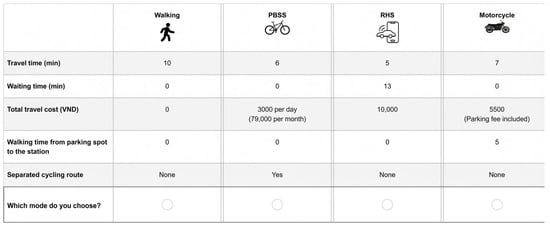
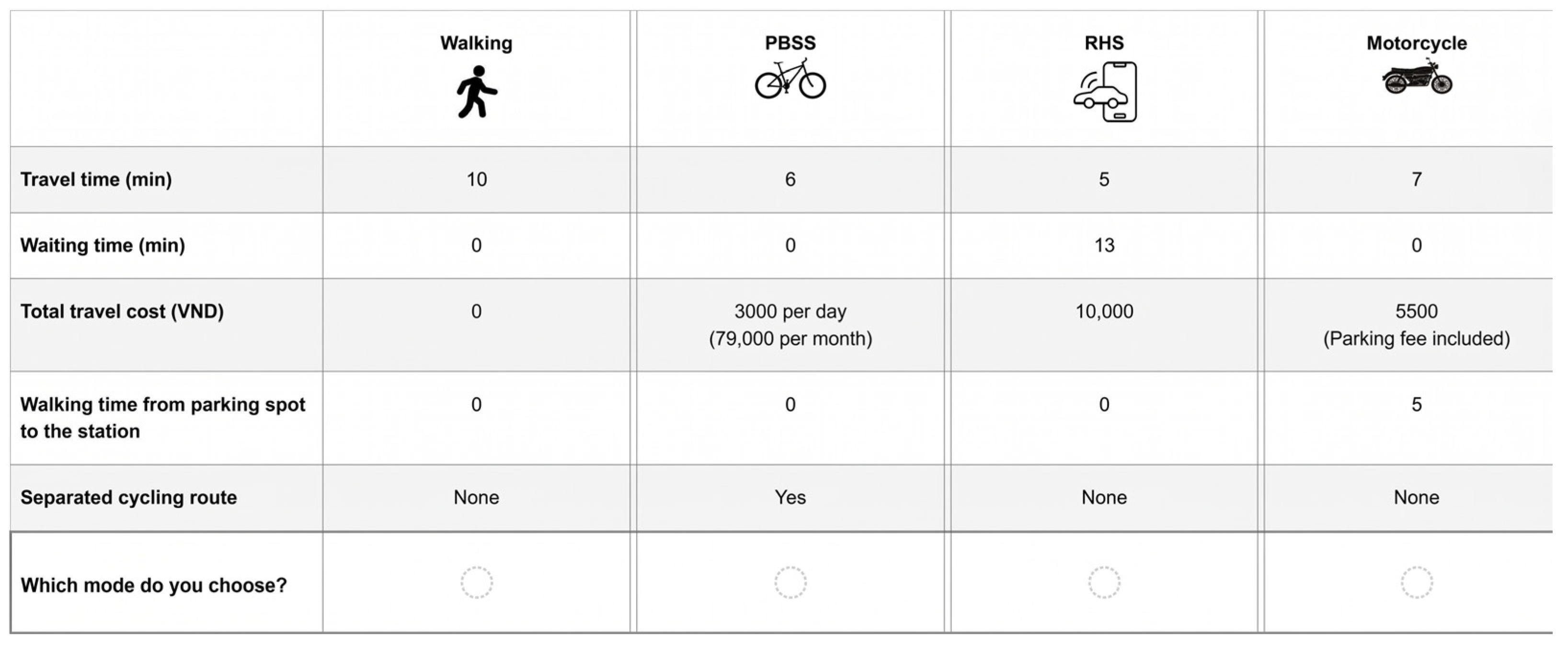
To mitigate potential hypothetical biases in the SC experimental scenarios, the survey was designed to target metro users with direct experience accessing stations. By focusing on respondents who are already familiar with the metro system, this study ensures that the choices are based on real-world travel behavior. Moreover, frequent metro users were prioritized in the analysis because their repeated exposure to various access modes and traffic conditions allowed for more realistic decision-making (e.g., the SC experiment for work trips–1 km first mile, as shown in Figure 2).
Figure 2.
Stated choice experiment for work trips—1 km first-mile.
Additionally, the attribute levels in the choice sets were carefully designed to reflect the actual variations in traffic conditions in Hanoi, such as traffic density and waiting times during traffic congestion. This realistic representation helps respondents relate scenarios to their daily experiences, reducing hypothetical bias. A simultaneous orthogonal design was used to ensure that the attribute variations were systematically balanced, preventing artificial correlations that could influence the responses. Table 1 summarizes the attribute levels in the SC scenarios for work trips and nonwork trips. For example, the PBSS travel time in the 1 km work-trip scenario was presented at two levels: 6 min or 8 min.
Table 1.
Attribute levels in stated choice scenarios for work trips and nonwork trips.
3.3. Survey Administration
An intercept survey was conducted with 1125 metro users aged 11 years and above. Respondents were approached inside the fare-gated area of the stations or onboard trains. The sample size was determined based on practical considerations, including time, budget, and field capacity, while ensuring a sufficient number of observations for robust statistical modeling. During thesurvey, respondents were required to provide information on their municipality of residence, sex, income, and other sociodemographic characteristics.
The survey team used tablet PC devices to access the online questionnaire and conducted face-to-face interviews, or guided metro users in completing it themselves. The average time taken by the respondents to complete the survey was approximately 10–12 min. Out of 1125 respondents, the study filtered and focused its analysis on 1015 respondents who used Hanoi Metro Line 2A at least one day per week. This selection aimed to focus on regular metro users, who are more familiar with access options, rather than non-regular users who selected “2–3 times a month”, “once a month”, or “rarely or occasionally” as their metro trip frequency in the survey. Additionally, each respondent participated in multiple SC scenarios (six choice tasks), combining three access distances (1, 2, and 4 km) for two travel purposes (work and nonwork).
3.4. Descriptive Statistics
Table 2 summarizes the sociodemographic characteristics of the 1015 respondents. Weekday trips accounted for 71% of total trips, whereas weekend trips accounted for the remaining 29%. A significant proportion of respondents used the metro frequently, with 70.44% commuting by metro for at least five days per week, indicating a high reliance on the system for daily travel.
Table 2.
Descriptive statistics of target metro users (n = 1015).
Regarding age distribution, younger individuals dominated metro usage, with the largest proportion in the 11–20 age group (26.01% female, 19.8% male), followed by the 21–30 age group (14.09% female, 12.51% male). Statistics show that students and young people are the primary users of metro systems.
The statistics reveal that a significant proportion of metro users belong to low- to middle-income groups, with 35.17% earning less than 1 million VND per month, 22.76% earning between 1 and 5 million VND per month, and only 10.25% of respondents being high-income earners with over 20 million VND per month. Although the sample is not intended to represent the entire population of Hanoi, it effectively captures the demographic characteristics of frequent metro users who tend to be younger and belong to lower-income groups. This composition reflects the demographic profile along the Line 2A corridor, which passes through numerous schools and universities, as well as commercial centers and office buildings. As respondents were recruited through on-site interviews with metro users rather than through targeted selection, the resulting sample profile was considered to broadly reflect the current ridership on this corridor. This profile aligns with the socioeconomic characteristics typically associated with public transit users in developing cities [37].
Regarding residential proximity to metro stations, among 1015 respondents, 35.96% live within 500 m of a metro station, and 29.85% live between 500 m and 1 km. These distances are suitable for active mobility, such as walking and cycling. Walking was the dominant access mode (58.52%), whereas only 4.93% chose to cycle to metro stations. Motorcycles remained a significant mode, with 16.95% driving and 6.5% being dropped off—many people rely on private vehicles for first-mile connectivity. The survey also recorded the number of motorcycles owned by each respondent’s household, with 95.9% of respondents living in households owning at least one motorcycle and 77.3% owning two or more, which justified retaining the motorcycle as an alternative in the SC design. Usage of PBSS (0.2%) and BRT (0.1%) was extremely low, suggesting that PBSS are not yet well integrated with metro access.
Table 3 presents the distribution of access modes across the first-mile distance bands. Only 29 of the 594 walking trips (4.9%) exceeded 1 km, with the majority falling within 500 m. Cycling extended considerably further, with 44.0% of bicycle trips exceeding 1 km. Motorized access accounted for most longer-distance observations, with 80.8% of motorcycle access and 60.6% of motorbike drop-off access exceeding 1 km. Bus access serves the longest distance, with 92.9% of bus trips exceeding 1 km. Conversely, PBSS use is currently negligible, with only two observations, reflecting the limited availability and low penetration of this emerging mode.
Table 3.
Access mode by first-mile distances (n = 1015).
Notably, walking is concentrated around 500 m, cycling is most common between 500 m and 2 km, and it overlaps substantially with motorcycle driving and drop-off over the 1–3 km range. This overlap also implies that cycling can replace motorized access at short to medium distances.
The figures below summarize the access mode choices of 1015 metro users in the SC experimental scenarios, illustrating how their travel behavior shifts in response to changes in distance and trip purpose.
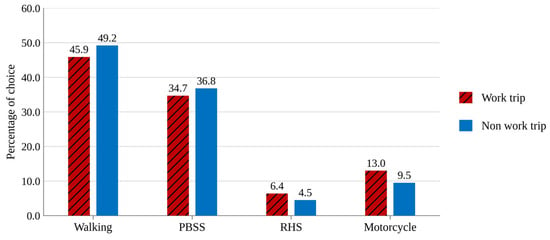
Figure 3 shows the percentage of access mode choices for a 1 km first mile. Walking dominates this distance, with the highest number of users choosing this mode for work and nonwork trips. As a new active mobility mode, PBSS are an ideal choice for short distances, with a relatively high choice percentage. RHS have low usage, with a slightly higher choice rate for work trips (6.4%) than for nonwork trips (4.5%). Motorcycles were used more for work trips (13.0%) than for nonwork trips (9.5%)—this mode remains a popular choice but does not dominate walking or PBSS for this distance.
Figure 3.
Access mode choice for 1 km scenario.
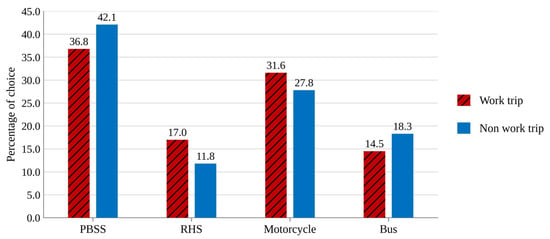
For medium distances (2 km), motorcycle usage increased, especially for work trips—people in Hanoi prefer motorized transport to the RHS or buses at this distance because of convenience and speed (Figure 4). RHS have also gained popularity, particularly for work trips, possibly because of the need for faster travel. Bus usage is notable, especially for nonwork trips—cost-conscious travelers prefer buses when the time pressure is lower. However, PBSS had the highest share of choices at this distance for both work and nonwork trips.
Figure 4.
Access mode choice for 2 km scenario.
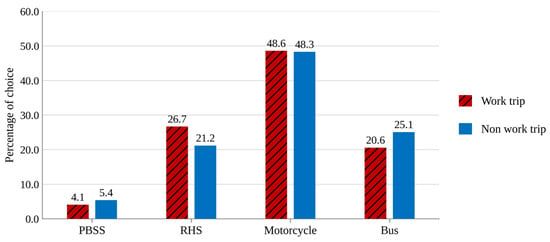
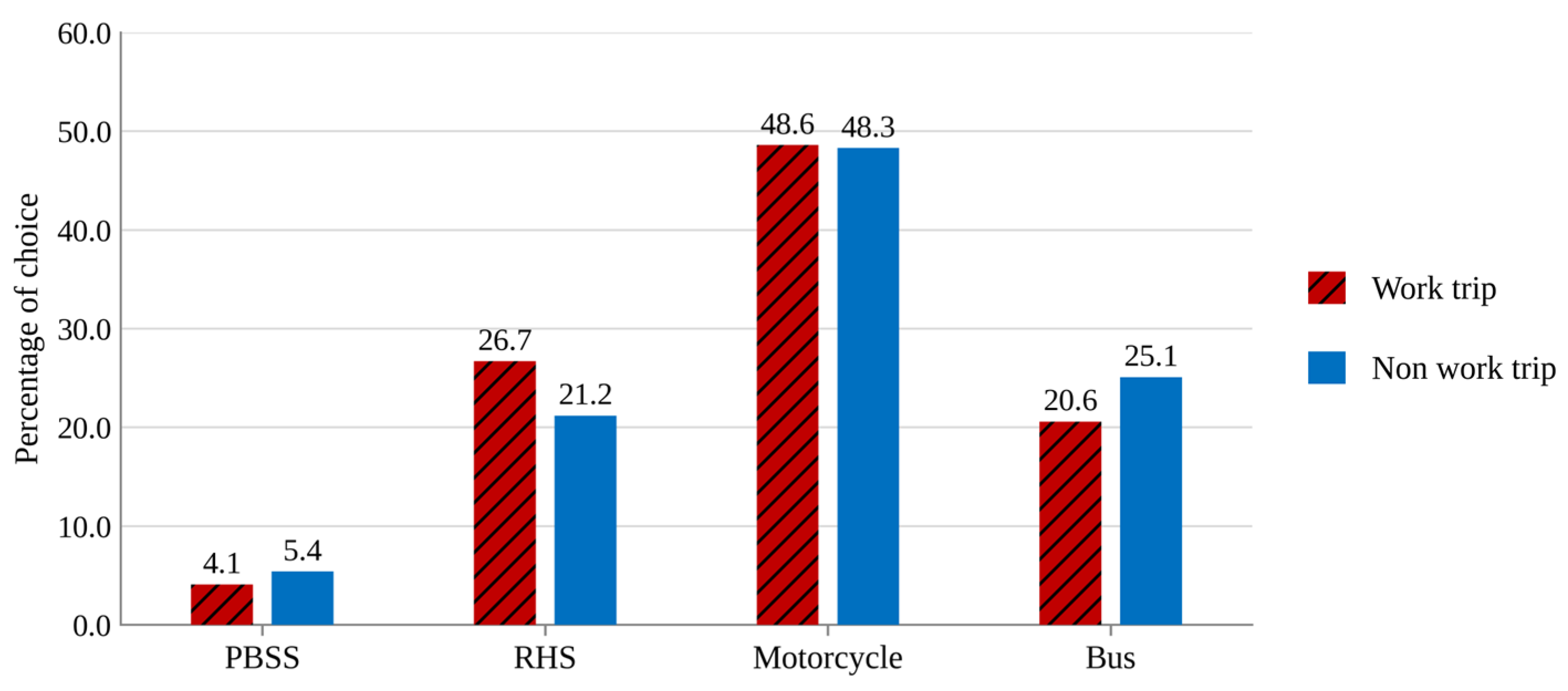
For longer distances (4 km), motorcycles were the dominant choice, showing a clear preference for motorized modes at this distance, as shown in Figure 5. This result is consistent with those of previous studies in Hanoi [38]. RHS remain significant, particularly for work trips, likely because of the need for convenience and speed. Bus usage is the highest at this distance—longer distances make public transit more appealing. Meanwhile, PBSSaccounted for the lowest share of choices at this distance among the available access modes.
Figure 5.
Access mode choice for 4 km scenario.
4. Model Specification
4.1. Model Structure
The Multinomial Logit (MNL) model provides a robust framework for modeling decisions among multiple discrete alternatives, making it an indispensable tool in the study of travel behavior and transportation planning. The results of the model estimations provide insights into user sensitivity to key attributes in decision-making.
The Mixed Logit (MXL) model overcomes the limitations of MNL by allowing parameter estimates to vary randomly among individuals, better capturing individual heterogeneity [39]. The MXL model is formulated as follows: for a metro user n, the utility of choosing access mode i in choice situation t is given by
where is a vector of attributes related to mode i (e.g., travel time, cost, waiting time, separate infrastructure, and demographic interactions); βn is a vector of corresponding parameters, and is the error term, assumed to follow an iid extreme value (Gumbel) distribution.
The logit probability of choosing an access mode (conditional on βn) is
where aj = 1 if mode j is available in each choice situation and zero otherwise. The parameters are allowed to vary across individuals with density f(β|θ) while remaining constant over choice situations for each individual [32]. In this study, f(β|θ) is specified as normal, where θ refers to the mean and standard deviation of β and needs to be estimated. The joint probability of making a sequence of k responses, i = {i1, …, ik} is represented as .
The MXL model was estimated using the Maximum Simulated Likelihood (MSL) approach [39]. The Apollo package [40] in R (version 4.4.0) was used for estimation using Sobol draws with 2000 replications to improve integration accuracy. The simulated log-likelihood function is , where P’n,i is the simulated probability for respondent n, and N is the total number of respondents. To account for the panel structure of the dataset, the standard errors of the parameter estimates were corrected by clustering the choices for the same individual.
4.2. Final Model Specification
In Hanoi, the acceptable walking distance to transit stops averages only about 400–500 m [36], whereas cycling can extend access well beyond walking, for example, roughly threefold in the U.S. [17], or with feeder public-bike legs in Beijing concentrated within approximately 1 km to 2 km [41]. These patterns suggest that PBSS is a viable first-mile feeder mainly within a 2 km catchment, motivating a modeling focus on distances within 2 km. This scope also aligns with the current travel behavior. Walking is concentrated within approximately 500 m, and cycling spans mainly the 0.5–2 km band (Table 3), with approximately 82% of users accessing stations within 2 km, PBSS shares decline at 4 km (Figure 5), supporting a modeling scope focused on distances of up to 2 km.
The model incorporates the key attributes mentioned in Section 3.2, along with several socioeconomic characteristics summarized in Table 2, including age, gender, and income. Specifically, the first-mile travel distances of 1 km and 2 km were categorized into two groups for analysis: work trips (peak hours) and nonwork trips (off-peak hours). Walking was used as the reference mode. Sociodemographic attributes were specified as dummy variables.
Age groups: 11–30 years old (group 1 = reference category), 31–60 years (group 2), and >60 years (group 3).
Sex: male (reference category) and female.
Income: under 1 million VND (group 1 = reference category), 1–10 million VND (group 2), and over 10 million VND (group 3).
The final model specification included variables that were statistically significant at the 10% level or lower based on robust t-statistics. However, all alternative-specific constants (ASCs) were retained in the model, although they were not statistically significant. The public bicycle ASC in the MXL model is specified as a random parameter to account for heterogeneity in individual preferences. Its distribution captures variation arising from factors that are not directly recorded in the survey.
4.3. Computation of Marginal Probability Effect
The Marginal Probability Effect (MPE) is a quantitative analysis method used to determine how a specific factor influences the probability of choosing a particular mode of transportation while keeping other factors constant [42]. More specifically, the MPE is applied to assess the sensitivity of bicycle choice to various factors, such as travel time, cost, presence of dedicated cycling lanes, waiting time, and demographic characteristics (age, income, and gender).
The MPE is calculated by modifying the value of a specific variable in MXL models, reducing travel time or increasing the number of cycling lanes and comparing the probability of choosing PBSS before and after the change (e.g., Schmid & Axhausen [43], Rossolov et al. [44]). The general formula for the MPE in this case is as follows:
Here, N is the total number of individuals, is the probability of choosing PBSS after the change in an explanatory variable, and is the baseline probability of choosing PBSS before the change.
When analyzing the effect of a continuous variable such as travel time, the MPE is computed by applying a percentage change in cycling time and observing how the probability of choosing a bicycle shifts.
However, the presence of a separate cycling route is a binary attribute (yes/no) defined for each choice scenario; therefore, a percentage change cannot be applied directly. Instead, the intervention is expressed as a change in the share of the first-mile trip stages served by a separate route, and the MPE is obtained through the following steps. First, the attribute is switched from “no” to “yes” for every scenario that currently lacks a separated cycling route, representing full coverage, and the PBSS choice probabilities are re-predicted under this condition. The difference between the predicted PBSS demand under full coverage and baseline demand provides the total effect of covering all currently uncovered stages. Finally, one-tenth of this difference was used to represent a 10% increase in coverage and was divided by the number of individuals, following Equation (3), to obtain the MPE.
In this study, the MPE was used to predict how the PBSS choice responds to two changes: a 10% reduction in cycling time and the provision of separate routes to 10% more trip stages that are currently lacking.
5. Results
5.1. Access Mode Choice Models Incorporating PBSS
Table 4 and Table 5 show the estimation results of the access mode choice models for work and nonwork trips at distances up to 2 km. Each model merges the 1 km and 2 km choice scenarios for a given trip purpose. As each of the 1015 respondents contributed one choice observation per distance, combining the two distances yielded 2030 observations per model. The 4 km models were estimated but are not the focus of the analysis, as explained in Section 4.2, since only a small share of respondents regularly access the metro from such distances. The result at this distance is reported separately. Statistically insignificant coefficients are indicated by “-“ in the tables.
Table 4.
Estimation results of access mode choice models for work trips (1 and 2 km).
Table 5.
Estimation results of access mode choice models for nonwork trips (1 and 2 km).
The standard deviation of the PBSS ASCs for work and nonwork trips are significant, suggesting a wide variation in cycling preferences among individuals. However, the mean PBSS value for nonwork trips was not significant. The rho-squared values, which measure the goodness of fit of discrete choice models, show that MXL models perform better than MNL models, and accounting for preference heterogeneity improves model fitness.
Travel time is one of the most significant factors influencing the choice of access mode for metro stations. The negative signs of the coefficients indicate that longer travel times reduce the likelihood of choosing a transportation mode. For work trips, the effect of travel time on cycling choice was weaker (−0.092 for MNL and −0.105 for MXL) than for nonwork trips, where the impact was stronger (−0.149 for MNL and −0.154 for MXL). These results emphasize that metro users are more sensitive to cycling time for nonwork trips than for work trips—if cycling takes longer, people may switch to other transport options more easily (motorbikes, rideshare, and buses).
When measuring the impact of the availability of dedicated cycling infrastructure, the positive and significant coefficients from all models confirm that the presence of separate cycling routes strongly increases the likelihood of choosing shared bicycles over walking to access metro stations. The impact was stronger for work trips (1.046 for MNL and 1.481 for MXL) than for nonwork trips (MNL: 0.483 and MXL: 0.709). Additionally, the MXL models show a larger coefficient for cycling infrastructure than the MNL models—after accounting for individual preference heterogeneity, the impact of dedicated cycling routes remains strong. These findings indicate that the presence of separate bicycle lanes significantly aids bicycling for transit [45].
The cost variable was not statistically significant in any case, but this should not be read as evidence that cost is unimportant for PBSS use. Cost was specified as a generic parameter, and the variation in cost across the choice tasks was limited, since the PBSS fare in the SC design corresponded to the rate currently charged in Hanoi and was held constant while the fares of the other alternatives varied with access distance. This limited variation may have affected the results. However, cost has a noticeable influence on mode choice among older adults (Group 3), who benefit from fare exemptions for buses and metros, along with other financial support policies. For short- and medium-distance trips, the cost parameter (cost_coef_age3) is significant in most cases—older individuals are more cost-sensitive than other groups, particularly for work trips. Even so, cost is not the primary reason for the low interest in public bicycles.
The models also revealed the effects of age, gender, and income on the access mode choices of metro users. When categorizing metro users into three age groups, the results indicate that, compared with younger individuals, the elderly exhibit a strong preference for RHS over other modes for work and nonwork trips; they also favor buses over walking for work trips. Middle-aged individuals (Group 2) demonstrated a clear preference for motorcycles for short- and medium-distance work trips. Nevertheless, there was no significant difference in PBSS preferences between younger and older individuals—age is not a major factor influencing the choice of public bicycles.
Females are more likely than males to choose the PBSS over walking for work trips; however, this preference declines as distance increases. The SC experiment data show that while females favor the PBSS for short access, they switch modes more as distances increase. The PBSS choice gap between females and males drops from 15.9 to −9.52 percentage points for work trips and from 9.62 to 1.82 percentage points for nonwork trips (Table 6).
Table 6.
PBSS selection ratio between male and female in SC experiments (n = 1015).
They also had a stronger tendency to use RHS and buses for work trips, although this effect was weaker in the MXL model. Additionally, females showed a clearer preference for RHS on nonwork trips than males.
A previous study by Truong et al. [46] reported that trip purpose and gender contributed little to predicting travel decisions in Hanoi. Their findings, however, were based on a 2016 survey of 311 respondents, before the metro and PBSS became available. In this study, drawing on a larger sample and a choice set that now includes these new modes, these factors are found to significantly influence mode choice, suggesting that their role becomes visible only when real alternatives to the motorcycle exist.
In terms of income influence, higher-income individuals are generally less likely to choose motorcycles or buses than are lower-income users for work trips (all negative signs of the parameters in the MNL model). High-income earners are particularly reluctant to use buses to access metro stations for nonwork trips (as shown in both the MNL and MXL models). The middle-income group demonstrated a lower tendency to use RHS than did the low-income group, with the effect being statistically significant, particularly for work trips.
Although models were estimated for all three first-mile distances, the 4 km results (Table 7) should be interpreted differently from those for the 1 km and 2 km scenarios. The focus on distances up to 2 km was motivated by the observed access patterns in the survey, as explained in Section 4.2. In addition, only 1.87% of respondents (19 of 1015) regularly accessed stations from 3 to 4 km. Therefore, the 1 km and 2 km scenarios provide the main basis for examining PBSS-metro integration within the distance range most relevant to current station access, whereas the 4 km results provide supplementary evidence.
Table 7.
Estimation results of access mode choice models for work and nonwork trips (4 km).
In the 4 km scenario for work trips, travel time and cycling infrastructure remain key factors influencing the access mode choice. Older adults are less likely to choose PBSS than younger respondents, while women are less likely to choose PBSS than men. In addition, older adults are less likely to choose motorized modes than younger respondents for both work trips and nonwork trips. Women also show a lower likelihood of choosing motorcycles for both purposes. The negative and significant coefficient for the highest income group in the bus alternative indicates a lower likelihood of choosing buses for work trips and nonwork trips. Overall, this scenario is associated with lower PBSS preference among older and female respondents, while cycling travel time and dedicated cycling infrastructure remain relevant to PBSS choice.
5.2. Marginal Probability Effect of Access Mode Demand
The MPE results (presented in Table 8) indicate that reducing cycling time has a positive effect on increasing PBSS usage for work and nonwork trips but with slightly different magnitudes. For work trips, a 10% reduction in cycling time resulted in a 1.57 percentage point increase in the PBSS probability. For nonwork trips, the same 10% travel time reduction leads to a 1.71 percentage point increase in probability—nonwork travelers are more sensitive to cycling time improvements than work commuters. A likely reason for this is that trips for leisure, shopping, or other personal purposes are more discretionary; therefore, travelers are more willing to shift modes if the travel time is reduced.
Table 8.
MPE of access mode demand with cycling time change in MXL model.
Expanding separate cycling routes also leads to an increase in shared-bike usage, but the effect is less significant than cycling time reductions. Serving an additional 10% of the first-mile trip stages that currently lack a separate route raises the PBSS probability by 1.16 percentage points for work trips but only 0.57 percentage points for nonwork trips. Work trips benefit more from dedicated infrastructure than nonwork trips, probably because work trips typically occur during peak hours, when safety and comfort are major concerns, whereas nonwork trips are more flexible in timing and routing, making separate routes less decisive for the choice.
These two interventions are not directly comparable elasticities: the −10% time scenario changes the level of a continuous attribute, whereas the +10% route scenario changes the coverage of a binary one. However, under this equal 10% increment, the time reduction has a larger marginal effect for both work and nonwork trips. For work trips, the effect of cycling time reduction (1.57 percentage points) was stronger than that of infrastructure improvements (1.16 percentage points)—workers prioritized faster travel over dedicated bicycle lanes. For nonwork trips, the difference is even more pronounced, with travel time reductions leading to a 1.71 percentage point increase in PBSS probability, whereas expanded coverage only results in a 0.57 percentage point increase. As the two interventions are expressed in different units, this comparison is indicative rather than a strict elasticity comparison; nonetheless, it implies that while separated cycling infrastructure is beneficial, it is not sufficient to shift travel behavior substantially.
6. Conclusions
This study filled critical research gaps by empirically examining the factors influencing PBSS adoption as a first-mile access mode in a motorcycle-dominated developing city where usage remains extremely limited despite recent policy initiatives. By applying an SC experiment designed for a motorcycle-dependent environment and analyzing data through discrete choice models, the study revealed that improvements in travel time efficiency and dedicated cycling infrastructure are more influential in shaping PBSS preferences than other commonly considered factors, such as cost and sociodemographic characteristics. These findings offer new empirical evidence on integrating active mobility into urban rail systems in the Global South, particularly in rapidly urbanizing motorcycle-dependent metropolitan contexts across Southeast Asia, where shared bicycles remain underutilized yet could compete with private vehicles as a first-mile feeder to urban railway stations.
Travel time strongly influences PBSS choice among metro users, with longer cycling times discouraging nonwork trips due to concerns over weather, comfort, and flexibility. However, work commuters are more willing to cycle for first-mile access when it offers time and cost advantages. This high sensitivity to cycling time suggests that modest improvements in cycling efficiency can induce meaningful shifts away from motorized first-mile trips, contributing to emission reductions in dense urban areas.
Dedicated cycling lanes significantly increased PBSS adoption, particularly within 2 km of metro stations. This result underscores the importance of a bicycle-friendly infrastructure to enhance the first- and last-mile connectivity between PBSS and metro systems while significantly promoting transit use, as noted by Mohanty et al. [45] and Zuo et al. [17].
The MPE results revealed that improving the bicycle infrastructure was more effective for work trips than for nonwork trips. Nevertheless, reducing travel time has a greater impact than expanding route coverage for both trip types, particularly for nonwork trips.
Demographic factors also influenced the adoption of PBSS. Women are more likely than men to choose PBSS for trips of approximately 2 km but are less inclined to use it for longer distances. Older individuals tend to prefer RHS to PBSS, highlighting the need for more convenient transport options tailored to their mobility needs. Additionally, the higher-income groups were generally less likely to use public transport.
The findings apply most directly to first-mile access distances of up to 2 km, which account for the large majority of observed station access behavior. The 4 km results provide supplementary evidence for a longer access distance than the current access behavior.
Based on these findings, several policy recommendations are proposed to enhance PBSS–metro integration for first- and last-mile connectivity in developing cities such as Hanoi and to support sustainable urban mobility. The findings primarily characterize existing metro users along the Line 2A corridor, rather than the broader motorized population. Therefore, the recommendations below are primarily directed toward improving accessibility and travel conditions for current metro passengers.
In the short term, policies should prioritize reducing cycling travel time around metro stations through targeted upgrades within a 1 km catchment area, including continuous cycling lanes and well-located PBSS docking stations. Shortening first-mile travel time also benefits both trip purposes, as the MPE results show similar effects for work and nonwork trips (1.57 and 1.71 percentage points). In the medium term, metro-oriented active mobility should be promoted by expanding PBSS coverage up to a 2 km radius, developing a weather-resilient cycling infrastructure, and introducing integrated fare incentives to improve first- and last-mile accessibility. Given the stronger effect among work trips (1.16 versus 0.57 percentage points), new cycling lanes should be prioritized along commuting corridors and at peak hours rather than spread evenly across the network. These measures are primarily intended to improve accessibility and travel conditions for current metro passengers. In the long term, these measures should be embedded within a broader strategy to reduce dependence on private motorized vehicles through complementary investments in electric feeder buses and park-and-ride facilities. Unlike the preceding measures, these interventions are oriented toward improving the attractiveness and accessibility of public transport for potential new transit users, including private motorcycle users. However, their effectiveness in inducing a shift from private motorcycles to metro services should be evaluated through further research.
While PBSS policies offer considerable potential, their implementation in Hanoi faces key challenges, including inadequate investment in safe cycling infrastructure, high capital and space requirements for bike-sharing station networks, and behavioral resistance linked to people’s strong motorcycle culture, where road space is limited and curbside management and enforcement have adapted to motorcycle dominance. In Hanoi, almost every household in our sample owns a motorcycle and the marginal cost of an additional trip is minimal, so PBSS does not compete with walking alone but with a mode that is already parked at the user’s door. This helps explain why observed public bicycle use for station access remains negligible (0.2%) despite a substantial share of respondents living within a distance that would generally be considered cyclable, and it implies that improvements confined to the PBSS service itself, such as denser docking stations or lower fares, may be insufficient without measures that alter the relative attractiveness of motorcycle use, such as parking pricing or controlled parking zonesaround stations. Addressing these issues requires coordinated investments, policy support, and public engagement.
This study has several limitations. The survey was designed to focus on observable level-of-service and infrastructure attributes, together with socio-demographic characteristics, the variables most directly relevant to policy intervention, rather than on attitudinal factors and perceptions related to safety and social norms. Measuring these factors in future surveys would allow their effects to be modeled explicitly.
Relatedly, the SC scenarios fix weather at a favorable level to isolate the confounding effects of other attributes, which tends to cause the estimates obtained to approach the ceiling for PBSS acceptance rates. Under Hanoi’s tropical conditions of intense heat, high humidity, and monsoon rains, the real-world adoption rates are likely to be lower. Additionally, the sample comprises current metro users, whose willingness to cycle may not represent that of the broader adult workforce. Together with the favorable weather assumption, this suggests that the estimated PBSS uptake should be regarded as an upper bound for a wider population.
The SC experiment in this study treated destinations and main modes as predetermined, and respondents were asked to choose their access modes. Thus, this analysis focuses specifically on the first-mile stage. Although this design is appropriate for examining first-mile access adoption, extending it to a main-mode choice framework is a promising direction for further work. Future research could also expand sample diversity across a broader range of age and income groups, use qualitative methods to explore behavioral motivations, and integrate SC experiments to assess policy impacts. Evaluating subsidies for e-bikes, first- and last-mile connectivity improvements, and low-emission zones can provide valuable insights into promoting sustainable transport.
Finally, although the data were collected on Line 2A, the findings may also be informative for Line 3 and the other metro lines planned in Hanoi, as well as for emerging metro systems in motorcycle-dominated Southeast Asian cities. As these lines reach stable operation, their regular users will emerge, and first- and last-mile modes will play an increasingly important role in shifting travel from private vehicles to public transport. However, access mode choices may vary with local conditions, and validation on these lines once ridership has stabilized is recommended.
Author Contributions
Conceptualization, methodology, investigation, formal analysis, data curation, writing—original draft, writing—review and editing, Q.A.V.; Conceptualization, methodology, writing—original draft, writing—review and editing, supervision, project administration, funding acquisition, R.A. All authors have read and agreed to the published version of the manuscript.
Funding
This research received no external funding.
Institutional Review Board Statement
This study was exempt from ethical review in accordance with the research ethics guidelines of Yokohama National University (2016; last revised 2023) and the Ethics Committee for Non-Medical and Non-Biological Research Involving Human Subjects.
Informed Consent Statement
Informed consent was obtained from all subjects involved in the study.
Data Availability Statement
The data presented in this study are available from the corresponding author upon request but are not publicly available due to privacy concerns.
Acknowledgments
The authors would like to thank Mihoko Matsuyuki, Shinji Tanaka, and Tran The Huy, who helped us improve the study. We also wish to thank Nguyen Minh Hieu, Ha Thanh Tung, and the survey team of the University of Transport and Communications (Vietnam) for their assistance during the field survey and data collection.
Conflicts of Interest
The authors declare no conflicts of interest.
Abbreviations
The following abbreviations are used in this manuscript:
| PBSS | Public bicycle sharing systems |
| RHS | Ride-hailing services |
| UMRT | Urban Mass Rapid Transit |
| TOD | Transit-oriented development |
| RP | Revealed preference |
| SC | Stated choice |
| SP | Stated preference |
| MNL | Multinomial logit |
| MXL | Mixed logit |
| BRT | Bus Rapid Transit |
| MRT | Mass Rapid Transit |
| MPE | Marginal probability effect |
References
- Ghosh, T.; Kanitkar, T.; Srikanth, R. Enhancing Inclusiveness and Sustainability: Impact of Accessibility and Affordability on Public Transportation in an Indian Megacity. Sustain. Transp. Livability 2025, 2, 1–31. [Google Scholar] [CrossRef] [Scilit]
- Decision No. 519/QĐ-TTg: Approving the Transport Master Plan for Hanoi Capital Through 2030, with a Vision Toward 2050; Prime Minister of Vietnam: Hanoi, Vietnam, 2016.
- Resolution No. 04/2017/NQ-HĐND: On the Scheme “Strengthening the Management of Road Vehicles to Reduce Traffic Congestion and Environmental Pollution in Hanoi City, Period 2017–2020 with a Vision to 2030”; Hanoi People’s Council: Hanoi, Vietnam, 2017.
- Hung, K.V.; Ngoc, A.M.; Thanh, H.H. Investigation of Modal Integration for Transit-Access Trips in Motorcycle Dependent Cities—The Case Study of Hanoi, Vietnam. J. Infrastruct. Policy Dev. 2024, 8, 5351. [Google Scholar] [CrossRef] [Scilit]
- Ko, J.; Lee, S.; Byun, M. Exploring Factors Associated with Commute Mode Choice: An Application of City-Level General Social Survey Data. Transp. Policy 2019, 75, 36–46. [Google Scholar] [CrossRef] [Scilit]
- Abolhassani, L.; Afghari, A.P.; Borzadaran, H.M. Public Preferences towards Bicycle Sharing System in Developing Countries: The Case of Mashhad, Iran. Sustain. Cities Soc. 2019, 44, 763–773. [Google Scholar] [CrossRef] [Scilit]
- Adsule, P.; Kadali, B.R. Analysis of Contributing Factors in Decision to Bicycle in Developing Countries Context. Transp. Policy 2024, 147, 50–58. [Google Scholar] [CrossRef] [Scilit]
- Kieu, M.; Wanjau, E.; Comber, A.; Bratkova, K.; Thuy, H.N.T.; Quang, T.B.; Huu, P.H.; Malleson, N. Factors Affecting Perceptions in Transport—A Deep Dive into the Motorbike Ban in Hanoi, Vietnam. Case Stud. Transp. Policy 2023, 11, 100958. [Google Scholar] [CrossRef] [Scilit]
- Zhou, J. Sustainable Commute in a Car-Dominant City: Factors Affecting Alternative Mode Choices among University Students. Transp. Res. Part A Policy Pract. 2012, 46, 1013–1029. [Google Scholar] [CrossRef] [Scilit]
- Tran, M.T.; Zhang, J.; Fujiwara, A. Can We Reduce the Access by Motorcycles to Mass Transit Systems in Future Hanoi? Procedia—Soc. Behav. Sci. 2014, 138, 623–631. [Google Scholar] [CrossRef] [Scilit]
- Zhao, P.; Yuan, D.; Zhang, Y. The Public Bicycle as a Feeder Mode for Metro Commuters in the Megacity Beijing: Travel Behavior, Route Environment, and Socioeconomic Factors. J. Urban Plan. Dev. 2022, 148, 04021064. [Google Scholar] [CrossRef] [Scilit]
- Muñoz, B.; Monzon, A.; López, E. Transition to a Cyclable City: Latent Variables Affecting Bicycle Commuting. Transp. Res. Part A Policy Pract. 2016, 84, 4–17. [Google Scholar] [CrossRef] [Scilit]
- Meena, S.; Patil, G.R.; Mondal, A. Understanding Mode Choice Decisions for Shopping Mall Trips in Metro Cities of Developing Countries. Transp. Res. Part F Traffic Psychol. Behav. 2019, 64, 133–146. [Google Scholar] [CrossRef] [Scilit]
- Ye, J.; Bai, J.; Hao, W. A Systematic Review of the Coopetition Relationship between Bike-Sharing and Public Transit. J. Adv. Transp. 2024, 2024, 6681895. [Google Scholar] [CrossRef] [Scilit]
- Assunçao-Denis, M.-È.; Tomalty, R. Increasing Cycling for Transportation in Canadian Communities: Understanding What Works. Transp. Res. Part A Policy Pract. 2019, 123, 288–304. [Google Scholar] [CrossRef] [Scilit]
- Scheepers, C.E.; Wendel-Vos, G.C.W.; Den Broeder, J.M.; Van Kempen, E.E.M.M.; Van Wesemael, P.J.V.; Schuit, A.J. Shifting from Car to Active Transport: A Systematic Review of the Effectiveness of Interventions. Transp. Res. Part A Policy Pract. 2014, 70, 264–280. [Google Scholar] [CrossRef] [Scilit]
- Zuo, T.; Wei, H.; Chen, N.; Zhang, C. First-and-Last Mile Solution via Bicycling to Improving Transit Accessibility and Advancing Transportation Equity. Cities 2020, 99, 102614. [Google Scholar] [CrossRef] [Scilit]
- Meng, L.; Taylor, M.A.P.; Scrafton, D. An Empirical Study of Railway Station Access Mode Choice. In Proceedings of the Australasian Transport Research Forum 2017 Proceedings, Auckland, New Zealand, 27–29 November 2017. [Google Scholar]
- Fishman, E.; Washington, S.; Haworth, N. Barriers and Facilitators to Public Bicycle Scheme Use: A Qualitative Approach. Transp. Res. Part F Traffic Psychol. Behav. 2012, 15, 686–698. [Google Scholar] [CrossRef] [Scilit]
- Iwińska, K.; Blicharska, M.; Pierotti, L.; Tainio, M.; De Nazelle, A. Cycling in Warsaw, Poland—Perceived Enablers and Barriers According to Cyclists and Non-Cyclists. Transp. Res. Part A Policy Pract. 2018, 113, 291–301. [Google Scholar] [CrossRef] [Scilit] [PubMed]
- Marquart, H.; Schlink, U.; Ueberham, M. The Planned and the Perceived City: A Comparison of Cyclists’ and Decision-Makers’ Views on Cycling Quality. J. Transp. Geogr. 2020, 82, 102602. [Google Scholar] [CrossRef] [Scilit]
- Lee, Q.Y.; Pojani, D. Making Cycling Irresistible in Tropical Climates? Views from Singapore. Policy Des. Pract. 2019, 2, 359–369. [Google Scholar] [CrossRef] [Scilit]
- Wahab, S.N.; Hamzah, M.I.; Ye, X.; Hareeah, V. Bike-Sharing Acceptance through the Lens of the Theory of Routine Mode Choice Decisions. Int. J. Sustain. Dev. 2020, 23, 25. [Google Scholar] [CrossRef] [Scilit]
- Kosmidis, I.; Müller-Eie, D. The Synergy of Bicycles and Public Transport: A Systematic Literature Review. Transp. Rev. 2024, 44, 34–68. [Google Scholar] [CrossRef] [Scilit]
- Iderlina, M.-B. Public Bicycle Sharing in Asian Cities. J. East. Asia Soc. Transp. Stud. 2015, 11, 60–74. [Google Scholar]
- Shen, Y.; Zhang, X.; Zhao, J. Understanding the Usage of Dockless Bike Sharing in Singapore. Int. J. Sustain. Transp. 2018, 12, 686–700. [Google Scholar] [CrossRef] [Scilit]
- Rosnan, H.; Abdullah, N.C. An Exploratory Study of Bicycle Sharing in Malaysia. J. Asian Behav. Stud. 2018, 4, 25–36. [Google Scholar] [CrossRef] [Scilit]
- Daniella, D.; Dharma Wangsa, A.A. Leveraging Integrated Bike-Sharing with Existing Bus Rapid Transit (BRT) to Reduce Motor Vehicle in Central Jakarta Municipal. Geoplanning J. Geomat. Plan. 2019, 6, 13. [Google Scholar] [CrossRef] [Scilit]
- Morichi, S.; Acharya, S.R. Specialties of Asian Megacities. In Transport Development in Asian Megacities: A New Perspective; Springer: Berlin/Heidelberg, Germany, 2012. [Google Scholar]
- Thi, H.V.; Thanh, C.N.; Trong, T.V. Analysis of Factors Affecting Vehicle Choice Behavior in Hanoi City. Tạp Chí Khoa Học Giao Thông Vận Tải 2024, 75, 1125–1139. [Google Scholar] [CrossRef] [Scilit]
- Hansen, A. Sustainable Urbanisation in Vietnam: Can Hanoi Bring Back the Bicycle? Tvergastein 2016, 7, 34–41. [Google Scholar]
- Abe, R. Preferences of Urban Rail Users for First- and Last-Mile Autonomous Vehicles: Price and Service Elasticities of Demand in a Multimodal Environment. Transp. Res. Part C Emerg. Technol. 2021, 126, 103105. [Google Scholar] [CrossRef] [Scilit]
- Torabi, K.F.; Araghi, Y.; Van Oort, N.; Hoogendoorn, S. Passengers Preferences for Using Emerging Modes as First/Last Mile Transport to and from a Multimodal Hub Case Study Delft Campus Railway Station. Case Stud. Transp. Policy 2022, 10, 300–314. [Google Scholar] [CrossRef] [Scilit]
- Nguyen, D.C.; Hoang, H.D.; Hoang, H.T.; Bui, Q.T.; Nguyen, L.P. Modal Preference in Ho Chi Minh City, Vietnam: An Experiment with New Modes of Transport. Sage Open 2019, 9, 2158244019841928. [Google Scholar] [CrossRef] [Scilit]
- Tuan, V.A. Examining Modal Shift to Public Transport in Developing Asian Cities: A Case Study in Hanoi City, Vietnam. J. Traffic Transp. Eng. 2023, 11, 179–191. [Google Scholar] [CrossRef] [Scilit]
- Hoang-Tung, N.; Kato, H.; Huy, T.; Le Binh, P.; Duy, L. Impacts of the Introduction of Bus Rapid Transit on Travel Behaviors of Commuters in Hanoi, Vietnam: A Quasi-Experimental Approach. Case Stud. Transp. Policy 2021, 9, 95–102. [Google Scholar] [CrossRef] [Scilit]
- Srinivasan, K.K.; Pradhan, G.N.; Naidu, G.M. Commute Mode Choice in a Developing Country: Role of Subjective Factors and Variations in Responsiveness across Captive, Semicaptive, and Choice Segments. Transp. Res. Rec. J. Transp. Res. Board 2007, 2038, 53–61. [Google Scholar] [CrossRef] [Scilit]
- Nguyen, H.T.A.; Chikaraishi, M.; Fujiwara, A.; Zhang, J. Mediation Effects of Income on Travel Mode Choice: Analysis of Short-Distance Trips Based on Path Analysis with Multiple Discrete Outcomes. Transp. Res. Rec. J. Transp. Res. Board 2017, 2664, 23–30. [Google Scholar] [CrossRef] [Scilit]
- Train, K. Discrete Choice Methods with Simulation, 2nd ed.; Cambridge University Press: Cambridge, UK; New York, NY, USA, 2009. [Google Scholar]
- Hess, S.; Palma, D. Apollo: A Flexible, Powerful and Customisable Freeware Package for Choice Model Estimation and Application. J. Choice Model. 2019, 32, 100170. [Google Scholar] [CrossRef] [Scilit]
- Sun, G.; Zacharias, J. Can Bicycle Relieve Overcrowded Metro? Managing Short-Distance Travel in Beijing. Sustain. Cities Soc. 2017, 35, 323–330. [Google Scholar] [CrossRef] [Scilit]
- Winkelmann, R.; Boes, S. Analysis of Microdata, 2nd ed.; [softcover version of orig. hardcover ed. 2009]; Springer: Berlin/Heidelberg, Germany, 2010. [Google Scholar]
- Schmid, B.; Axhausen, K.W. In-Store or Online Shopping of Search and Experience Goods: A Hybrid Choice Approach. J. Choice Model. 2019, 31, 156–180. [Google Scholar] [CrossRef] [Scilit]
- Rossolov, A.; Rossolova, H.; Holguín-Veras, J. Online and In-Store Purchase Behavior: Shopping Channel Choice in a Developing Economy. Transportation 2021, 48, 3143–3179. [Google Scholar] [CrossRef] [Scilit]
- Mohanty, S.; Bansal, S.; Bairwa, K. Effect of Integration of Bicyclists and Pedestrians with Transit in New Delhi. Transp. Policy 2017, 57, 31–40. [Google Scholar] [CrossRef] [Scilit]
- Truong, T.M.T.; Ly, H.-B.; Lee, D.; Pham, B.T.; Derrible, S. Analyzing Travel Behavior in Hanoi Using Support Vector Machine. Transp. Plan. Technol. 2021, 44, 843–859. [Google Scholar] [CrossRef] [Scilit]

Disclaimer/Publisher’s Note: The statements, opinions and data contained in all publications are solely those of the individual author(s) and contributor(s) and not of MDPI and/or the editor(s). MDPI and/or the editor(s) disclaim responsibility for any injury to people or property resulting from any ideas, methods, instructions or products referred to in the content. |
© 2026 by the authors. Licensee MDPI, Basel, Switzerland. This article is an open access article distributed under the terms and conditions of the Creative Commons Attribution (CC BY) license.