


Simple Summary
The gut contains many bacteria that help support the immune system and protect against infection. Cancer treatments and stem cell transplantation can disrupt these bacteria, which may contribute to complications and affect how well treatment works. Researchers are therefore studying ways to restore a healthier gut microbiome using stool-based treatments and specially prepared bacterial products. Early clinical studies have shown encouraging results, particularly in patients with severe complications after stem cell transplantation and in some patients receiving cancer immunotherapy. One advanced microbiome product, MaaT013, showed encouraging results in a phase III study; however, European regulators issued a negative opinion on its conditional marketing authorization application in June 2026 because important uncertainties remained about the evidence, and the application is currently being re-examined. Most microbiome-based approaches therefore remain experimental, and larger controlled studies are needed before they can become part of routine cancer care.
Abstract
The intestinal microbiome has emerged as a clinically significant modulator of outcomes across multiple domains of cancer care. In hematopoietic stem cell transplantation (HSCT), loss of microbial diversity and depletion of short-chain fatty acid-producing commensals are independently associated with graft-versus-host disease (GvHD), bloodstream infections, transplant-related mortality, and overall survival. Mechanistic studies have identified interconnected pathways—including butyrate-mediated epithelial protection, tryptophan-derived aryl hydrocarbon receptor signaling, bile acid metabolism, and Paneth cell–intestinal stem cell interactions—through which microbial communities regulate intestinal barrier integrity and immune homeostasis. These insights have provided the biological rationale for therapeutic strategies aimed at restoring microbial ecology. Fecal microbiota transplantation (FMT) has demonstrated promising clinical activity in steroid-refractory acute GvHD, with one meta-analysis reporting a pooled clinical remission rate of 64% (95% CI, 51–77%) across prospective single-arm studies, and proprietary live biotherapeutic products (LBPs) such as MaaT013 met the primary endpoint of the single-arm phase III ARES trial, achieving a day-28 gastrointestinal overall response rate of 62%; however, the CHMP adopted a negative opinion on its conditional marketing authorization application in June 2026, citing limitations of the single-arm design, and a re-examination is pending. In parallel, gut microbiome composition has been associated with immune checkpoint inhibitor (ICI) response, and early-phase FMT studies suggest that microbiome modulation may restore sensitivity to anti-PD-1 therapy in some patients with refractory melanoma and may enhance treatment responses in first-line ICI settings; however, these findings derive primarily from small, uncontrolled or early-phase studies. Defined single-strain approaches, notably Clostridium butyricum MIYAIRI 588 (CBM588), have shown encouraging secondary clinical efficacy signals in two small, randomized phase I trials in metastatic renal cell carcinoma, including significantly prolonged progression-free survival in one trial and a higher objective response rate in another; however, neither trial met its prespecified primary microbiome endpoint of increased Bifidobacterium spp. abundance. Emerging evidence further links antibiotic-induced dysbiosis to impaired chimeric antigen receptor T-cell (CAR-T) therapy outcomes, while short-chain fatty acids have been identified as direct enhancers of CAR-T cell effector function. This review synthesizes the current evidence for microbiome-based therapeutics across HSCT, GvHD, ICI therapy, CAR-T cell therapy, and infection prevention, and addresses cross-cutting translational challenges including antibiotic stewardship, donor selection, safety in immunocompromised populations, and pharmacomicrobiomics. While randomized controlled trial data remain limited and many approaches are investigational, the convergence of mechanistic, observational, and early interventional evidence positions microbiome restoration as a promising frontier in precision oncology.
1. Introduction
The human intestinal microbiome has emerged as a critical regulator of host immunity, metabolism, and epithelial homeostasis. Advances in microbial systems biology have transformed understanding of the gut microbiota from a collection of commensal organisms to a dynamic ecosystem that influences health and disease across multiple organ systems [1,2]. Within oncology, growing evidence suggests that interactions between the microbiome and the immune system play important roles in cancer progression, treatment response, infectious complications, and treatment-related toxicities [3]. Consequently, the intestinal microbiome has become an area of intense interest as both a biomarker and a therapeutic target in cancer care.
The translation of microbiome science into clinical practice was accelerated by the success of microbiota-based therapies for recurrent Clostridioides difficile infection (rCDI). Fecal microbiota transplantation (FMT) demonstrated high efficacy in restoring microbial diversity and preventing recurrent disease, providing some of the earliest clinical evidence that manipulation of the gut microbiome could produce meaningful therapeutic benefit [4]. Building upon this experience, the U.S. Food and Drug Administration (FDA) approved the first microbiota-based live biotherapeutic products (LBPs): REBYOTA (fecal microbiota, live-jslm) in 2022 and VOWST (fecal microbiota spores, live-brpk) in 2023 [5,6,7]. These approvals represent a major milestone in microbiome medicine, establishing a regulatory pathway for microbiome-based interventions and validating microbial ecosystem restoration as a therapeutic strategy.
Although the terms FMT and microbiome therapeutics are often used interchangeably, important distinctions exist between conventional FMT and LBPs. FMT involves transfer of minimally processed donor stool with the goal of restoring microbial diversity and function. In contrast, LBPs are manufactured biological products that undergo the full Biologics License Application (BLA) pathway, with standardized production processes, defined quality controls, and regulatory oversight. Compositionally, LBPs may contain defined microbial consortia or specific spore preparations, as with VOWST, rather than transferring the complete, undefined donor ecosystem as in conventional FMT. LBPs are designed to address several limitations of traditional FMT, including manufacturing inconsistency, donor variability, and concerns regarding pathogen transmission, while preserving the beneficial effects of microbiome restoration [7]. These differences are particularly relevant in immunocompromised populations, where safety, reproducibility, and product standardization are essential considerations.
Among oncology populations, the question arises of whether these microbiome restoration strategies can be extended to populations with more complex immune dysregulation. Recipients of hematopoietic stem cell transplantation (HSCT) represent one of the most compelling settings for such interventions. HSCT is associated with profound disruption of intestinal microbial communities resulting from conditioning regimens, mucosal injury, prolonged hospitalization, dietary changes, and extensive antibiotic use [8,9,10]. These factors collectively lead to loss of microbial diversity, depletion of beneficial commensal organisms, and expansion of opportunistic pathogens [8,9,10]. Over the past decade, numerous studies have demonstrated that microbiome composition is associated with clinically important transplant outcomes, including graft-versus-host disease (GvHD), bloodstream infections, treatment-related mortality, and overall survival. A landmark multicenter study involving 1362 allogeneic HSCT recipients established intestinal microbiota diversity as an independent predictor of survival, providing strong evidence that microbial ecology is clinically relevant rather than simply a consequence of illness [11]. Additional studies have linked depletion of specific commensal taxa, such as Blautia, to increased GvHD-related mortality [12], while antibiotic-induced disruption of the microbiome has been associated with worse transplant outcomes [13].
Mechanistic studies have further strengthened this hypothesis. Microbial metabolites, including short-chain fatty acids (SCFAs), contribute to epithelial barrier maintenance, regulatory T-cell differentiation, and immune homeostasis [14,15]. Dysbiosis may therefore promote inflammatory signaling, impair immune tolerance, and increase susceptibility to GvHD and infectious complications. Importantly, these microbiome-immune interactions extend beyond transplantation: in solid tumors, multiple studies have demonstrated associations between gut microbiome composition and response to immune checkpoint inhibitors (ICIs) [16,17,18], while emerging evidence suggests that microbiome characteristics may also influence outcomes following chimeric antigen receptor T-cell (CAR-T) therapy [19,20].
Several microbiome-modulating strategies are currently under investigation in oncology. FMT has demonstrated promising clinical activity in steroid-refractory acute GvHD [21,22,23], although the evidence is derived largely from small, uncontrolled studies. In addition, the proprietary LBPs such as MaaT013 have met the primary endpoint in the pivotal single-arm phase III ARES trial in this population [24]. In parallel, microbiome manipulation has shown potential for overcoming resistance to ICIs, enhancing cellular therapy outcomes, and reducing intestinal domination and multidrug-resistant organism colonization in high-risk transplant recipients [25]. Although many of these approaches remain investigational, they collectively support the concept that restoration of microbial ecology may become an important component of future cancer care.
This review summarizes current evidence supporting microbiome-based therapeutics across major domains of oncology, with particular emphasis on HSCT, GvHD, immune checkpoint blockade, CAR-T cell therapy, and infection prevention. The biological mechanisms linking intestinal dysbiosis to immune dysfunction are reviewed, emerging therapeutic strategies including FMT and LBPs are discussed, and ongoing challenges related to safety, donor selection, product standardization, and regulatory oversight are examined. Finally, ongoing clinical trials and future directions that may shape the development of precision microbiome medicine in oncology are highlighted.
Methodology
This narrative review was informed by searches of PubMed and Google Scholar for literature published from January 2000 through 30 June 2026, with the final literature search conducted on 30 June 2026. Search terms included combinations of intestinal microbiome, gut microbiota, dysbiosis, fecal microbiota transplantation, live biotherapeutic products, hematopoietic stem cell transplantation, graft-versus-host disease, immune checkpoint inhibitors, CAR-T cell therapy, cancer, and oncology. ClinicalTrials.gov was searched to identify registered and ongoing clinical trials, and conference proceedings from ASCO, ASH, ESMO, AACR, ACG, and IDSA were also reviewed. Clinical-trial registry information presented in the tables was subsequently re-verified on 12 August 2026.
Studies were considered for inclusion if they addressed the relationship between the intestinal microbiome and clinical outcomes, biological mechanisms, or microbiome-directed therapeutic interventions relevant to cancer, hematopoietic stem cell transplantation, graft-versus-host disease, immune checkpoint inhibition, CAR-T cell therapy, or infection prevention in immunocompromised oncology populations. Both clinical and mechanistic studies were considered when relevant to the scope of the review. Studies were excluded when they were unrelated to oncology or transplantation, did not provide information relevant to the topics covered in this review, or represented duplicate reports without additional clinically relevant data. When multiple publications described overlapping or sequentially expanded cohorts, the most recent or most complete report was prioritized, while earlier reports were retained when they provided distinct outcomes or mechanistic information.
The review was restricted to English-language publications. Searches were supplemented by review of reference lists from relevant publications and by additional studies identified during manuscript preparation. Peer-reviewed studies were prioritized; however, conference abstracts, preprints, trial protocols, and ongoing or unpublished clinical trials were included when they provided relevant emerging evidence, particularly when peer-reviewed data were not yet available. Preliminary or non-peer-reviewed findings were identified as such and interpreted cautiously rather than being considered equivalent to mature peer-reviewed evidence.
As this was a narrative review, no formal systematic-review screening, study-quality scoring, or risk-of-bias assessment was performed. Literature screening and data extraction were performed by A.A.-O., with A.K. and L.M. independently verifying key quantitative data and trial characteristics reported in the text and tables. Disagreements were resolved by consensus. Given the substantial heterogeneity of the included interventional studies in patient populations, therapeutic products, delivery protocols, and outcome definitions, we did not perform a de novo quantitative meta-analysis; where available, published systematic reviews and meta-analyses were summarized and interpreted alongside the primary studies.
Accordingly, this review should be interpreted within the inherent boundaries of a narrative synthesis. Although the literature search was structured, it was not conducted under a formal systematic-review protocol and should not be considered exhaustive. Publication bias, particularly preferential reporting of small positive studies, may influence the available evidence. In addition, microbiome therapeutics is a rapidly evolving field; therefore, the evidence summarized here reflects literature available through 30 June 2026, with clinical-trial registry information re-verified on 12 August 2026. Subsequent publications or changes in trial status may therefore not be captured.
Generative artificial intelligence ChatGPT (GPT-5.6 Sol; OpenAI, San Francisco, CA, USA) was used to assist in the production of Figure 1 and Figure 2 based on conceptual frameworks, scientific content, and specifications developed by the authors. The generated visual content was subsequently reviewed and edited by the authors for scientific accuracy, consistency with the cited literature, and clarity.
2. The Intestinal Microbiome in Hematopoietic Stem Cell Transplantation: Foundational Science
Over the past decade, advances in 16S rRNA gene sequencing and metagenomic technologies have revealed that microbiome disruption during HSCT is not merely a consequence of transplantation but is closely linked to clinical outcomes including GvHD, bloodstream infections, treatment-related mortality, and overall survival. These observations have transformed the microbiome from an observational biomarker into a potential therapeutic target in transplant medicine. This section reviews the patterns of dysbiosis that characterize the transplant course, the prognostic significance of microbiome composition, and the mechanistic framework linking microbial ecology to immune function.
2.1. Patterns of Dysbiosis After HSCT
The healthy intestinal microbiome is characterized by high taxonomic diversity and functional redundancy, properties that confer resilience against perturbation. Obligate anaerobic bacteria from the Bacillota (formerly Firmicutes) and Bacteroidota (formerly Bacteroidetes) phyla dominate the ecosystem, with key families including Lachnospiraceae and Ruminococcaceae contributing to nutrient metabolism, epithelial barrier maintenance, colonization resistance, and immune homeostasis [26].
Following HSCT, this ecological balance is profoundly disrupted. Microbiome injury often begins before transplantation, as many patients with hematologic malignancies have already been exposed to repeated courses of chemotherapy and antibiotics. Peled et al. demonstrated that, by the day of cell infusion, many patients already harbored an intestinal community that differed markedly from that of healthy volunteers, characterized by loss of diversity and domination by single taxa [11]. Nevertheless, the most dramatic changes occur during conditioning and the early post-transplant period. Multiple longitudinal 16S rRNA gene sequencing and metagenomic studies have demonstrated a rapid decline in intestinal microbial diversity beginning during conditioning therapy and reaching its nadir approximately 7–12 days after transplantation [11,27]. In a prospective multicenter study of 95 patients, mean alpha diversity declined from 19.46 ± 12.73 at baseline to 8.69 ± 6.78 at day +14, 10.34 ± 6.97 at day +30, and 13.64 ± 8.48 at day +60 [28]. This decline is characterized by depletion of obligate anaerobic commensals, including members of the Eubacteriales (formerly Clostridiales) order and short-chain fatty acid (SCFA)-producing organisms such as Blautia, Faecalibacterium, and Roseburia species, as well as broader depletion at the family level within Lachnospiraceae and Ruminococcaceae [29,30].
Concurrently, the post-transplant microbiome frequently undergoes a shift toward domination by a limited number of bacterial taxa. The concept of intestinal domination, defined as expansion of a single bacterial taxon to greater than 30% of the gut microbial community, was introduced from longitudinally collected fecal specimens from 94 patients undergoing allo-HSCT, from before transplant until 35 days after transplant [8]. Intestinal domination occurred in approximately 65% of patients, most commonly driven by Enterococcus faecium [8]. Domination events peak approximately one week after transplantation and decrease moderately thereafter, with Enterococcus and Streptococcus representing the most frequently dominating genera across geographically diverse transplant centers. Other commonly encountered dominating organisms include members of the Enterobacterales order, including Escherichia coli and Klebsiella species. Loss of microbial diversity and colonization resistance permits expansion of these organisms within the inflamed intestinal environment, increasing the risk of bloodstream infection originating from the gastrointestinal tract: enterococcal domination increases the risk of vancomycin-resistant Enterococcus (VRE) bacteremia 9-fold, and proteobacterial domination increases the risk of Gram-negative rod bacteremia 5-fold [8].
The role of antibiotics in driving dysbiosis deserves particular emphasis, as antibiotic exposure, rather than alloreactivity, conditioning intensity, or immunosuppression, has been identified as the major driver of post-transplant microbiome changes [31]. Importantly, not all antibiotics exert equivalent effects on the microbiome. Agents with significant anaerobic activity, including piperacillin-tazobactam and carbapenems (imipenem-cilastatin, meropenem), cause the most severe declines among obligate anaerobes and have been associated with increased GvHD-related mortality [13]. In contrast, antibiotics with limited anaerobic coverage, such as cefepime and aztreonam, were not associated with increased GvHD-related mortality in a retrospective analysis of 857 allo-HSCT recipients [13]. Other studies confirmed that antibiotics with anaerobic coverage were significantly associated with higher acute GvHD incidence compared to those with limited anaerobic coverage. Rifaximin, a non-absorbable antibiotic, has shown a favorable microbiome-sparing profile, maintaining higher Shannon diversity indices, higher Clostridium cluster XIVa abundance, and higher urinary 3-indoxyl sulfate levels compared to systemic antibiotic regimens [32]. These differential antibiotic effects have important implications for antimicrobial stewardship strategies in the transplant setting, a topic discussed further in Section 7.1.
Importantly, dysbiosis is not a transient phenomenon. Although some patients experience partial microbial recovery following engraftment, with diversity generally returning toward baseline by approximately day +100 in some cohorts, restoration of pre-transplant microbial diversity is often incomplete [33]. Hino et al. analyzed the gut microbiota of 59 patients who survived 1 to 21.7 years (median 6.4 years) after allo-HSCT and found that long-term survivors continued to exhibit lower gut microbial diversity than age- and sex-matched healthy controls, with reduced abundance of butyrate-producing bacteria [34]. This represents the first demonstration that microbial dysbiosis can persist over a decade after transplantation, suggesting that HSCT can induce durable changes in microbial ecology with potential implications for late complications including chronic GvHD and secondary malignancies [34].
Collectively, these findings support a model in which HSCT creates a predictable ecological bottleneck characterized by diversity loss, depletion of beneficial commensals (particularly SCFA-producing organisms), and expansion of pathobionts; a pattern that has been described as comprising three major “microbiota fingerprints”: decreased diversity, reduced SCFA-producing bacteria, and Enterococcus domination [35].
2.2. Microbiota as a Prognostic Biomarker
The patterns of dysbiosis described above are not merely epiphenomena of transplant-related illness; rather, they carry independent prognostic significance. Over the past decade, a growing body of evidence has established intestinal microbiota composition as a clinically meaningful biomarker of transplant outcomes, with associations demonstrated across overall survival, transplant-related mortality, GvHD, bloodstream infections, and disease relapse.
2.2.1. Diversity and Overall Survival
The landmark study establishing this association was a multicenter analysis in 2020, which profiled 8767 fecal samples from 1362 allogeneic HSCT recipients across four international centers (Memorial Sloan Kettering, Duke University, University of Regensburg, and Hokkaido University). Higher intestinal microbiota diversity (>2.64), compared with lower diversity (≤2.64; reference), during the peri-engraftment period (days 7–21) was independently associated with lower mortality in both the primary cohort (adjusted HR for higher vs. lower diversity, 0.71; 95% CI, 0.55–0.92) and the independent validation cohort (adjusted HR, 0.49; 95% CI, 0.27–0.90). Critically, this survival benefit was driven by reduced transplant-related mortality rather than reduced relapse, suggesting that the microbiome–survival relationship is mediated through immune and inflammatory mechanisms rather than direct anti-tumor effects. Subgroup analyses further demonstrated that the association between lower diversity and higher mortality was most pronounced for GvHD-related death, particularly among recipients of T-cell-replete grafts [11].
These findings have been confirmed in meta-analytic data. A systematic review and meta-analysis of 17 studies in 2023 demonstrated that compared with lower intestinal microbiota diversity, higher diversity was associated with improved overall survival (HR for higher vs. lower diversity, 0.66; 95% CI, 0.55–0.78), decreased transplant-related mortality (HR, 0.56; 95% CI, 0.41–0.76), and a lower incidence of grade II–IV acute GvHD (HR, 0.41; 95% CI, 0.27–0.63) [36]. These associations were observed during both the pre-transplant and post-transplant periods, indicating that microbiome assessment at multiple time points may carry prognostic value.
The prognostic significance of microbiota diversity extends to pediatric populations. In a multicenter cohort of 90 pediatric allo-HSCT recipients, higher pre-transplant microbial diversity was independently associated with superior overall survival (adjusted HR, 0.26; 95% CI, 0.09–0.75), with estimated 52-month overall survival of 88.9% versus 62.7% in the higher- and lower-diversity groups, respectively [37]. Network analysis identified SCFA producers Blautia, Faecalibacterium, Roseburia, and Bacteroides as keystone taxa in the higher-diversity group, while Enterococcus and Escherichia-Shigella dominated the lower-diversity group [37]. These findings demonstrate that the diversity–outcome association is generalizable across age groups and transplant practices.
2.2.2. Taxon-Specific Prognostic Associations
Beyond aggregate diversity, specific bacterial taxa have emerged as individual prognostic biomarkers. The genus Blautia has been the most extensively studied. The first report, from 2015, showed that increased abundance of Blautia was associated with reduced GvHD-related mortality and improved overall survival [12]. This finding has been replicated in multiple subsequent cohorts: González-Rico et al. reported lower Blautia abundance among patients who developed gastrointestinal GvHD, bacteremia, or died after allo-HSCT [28]. Rashidi et al. further demonstrated a protective effect of Blautia against neutropenic fever in a large database of 12,546 stool samples from 1278 HSCT recipients, with mechanistic data suggesting that Blautia improves intestinal health through increased citrulline production, a biomarker of enterocyte mass [38]. Skaarud et al. similarly found that the relative abundance of Blautia at 3 weeks post-HSCT was higher in survivors than non-survivors [39].
Eubacterium limosum has been associated with reduced relapse risk. A 2017 study of 541 patients found that a higher abundance of a bacterial group composed mostly of E. limosum was associated with a decreased risk of relapse or disease progression (HR 0.82 per 10-fold increase in abundance; 95% CI, 0.71–0.95; p = 0.009) [40]. The 2-year cumulative incidence of relapse was 19.8% in patients harboring this bacterial group versus 33.8% in those without, and the association was strongest among recipients of T-cell-replete allografts. E. limosum is a butyrate-producing organism, suggesting an immunomodulatory mechanism underlying this observation [40,41].
Conversely, specific taxa have been identified as adverse prognostic markers. For example, a meta-analysis demonstrated that higher versus lower abundance of Enterococcus (HR 2.03; 95% CI, 1.55–2.65), γ-Proteobacteria (HR 2.82; 95% CI, 1.53–5.20), and Candida (HR 3.80; 95% CI, 1.32–10.94) was associated with inferior overall survival [36]. Enterococcus domination has been particularly well characterized, as described in Section 2.1, and it increases the risk of VRE bacteremia 9-fold and has been linked to increased GvHD incidence across multiple cohorts [8].
2.2.3. Butyrate-Producing Bacteria and GvHD
The prognostic significance of butyrate-producing bacteria deserves particular emphasis, as it bridges the biomarker and mechanistic domains. A prospective study of 201 patients after allo-HSCT measured the abundance and butyrogenic capacity of butyrate-producing bacteria (using the butyryl-CoA:acetate CoA-transferase [BCoAT] gene as a marker) and demonstrated strong and prolonged suppression of butyrogenic bacteria early in the transplant course, with early broad-spectrum antibiotic use identified as an independent factor associated with low BCoAT copy numbers (OR 0.370; 95% CI, 0.175–0.783; p = 0.009). Low BCoAT copy numbers at GvHD onset were associated with greater GI-GvHD severity, and in multivariable analysis, absence of BCoAT at day 30 or GvHD onset was associated with increased transplantation-related mortality (HR, 4.46; 95% CI, 1.02–19.53; p = 0.047) [42]. Similarly, another study found that Clostridial and butyrate-producer abundance, as well as the strict-to-facultative anaerobe ratio, were predictors of longer overall survival and decreased risk of GvHD-related death in 266 allo-HSCT recipients [43].
2.2.4. Microbiome and Chronic GvHD
Although most microbiome–outcome data pertain to acute GvHD, emerging evidence suggests that the microbiome also influences chronic GvHD risk. One study found that patients who subsequently developed chronic GvHD exhibited distinct baseline microbiome profiles, with differential abundance of multiple taxa including the Actinobacteria phylum and Clostridium genus [44]. Longitudinal analysis revealed a greater loss of alpha diversity from baseline to post-engraftment in patients who developed chronic GvHD, and metabolic pathway analysis showed enrichment of SCFA metabolism pathways in the chronic GvHD group [44]. These findings suggest that microbiome-mediated immune modulation may influence both acute and chronic alloreactivity.
2.3. Mechanistic Framework
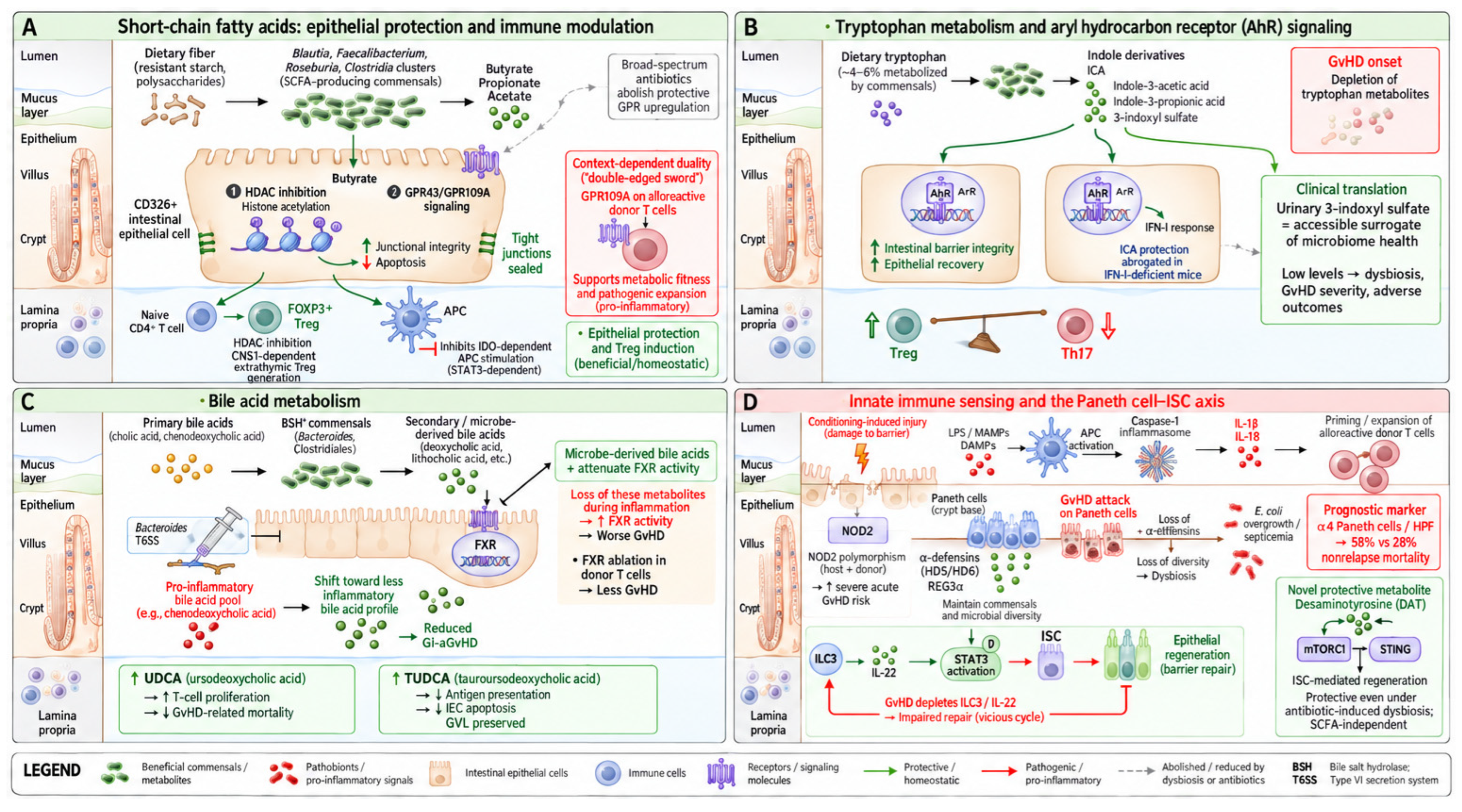
The prognostic associations described in Section 2.2 raise a fundamental question: is the microbiome merely a biomarker of host physiologic stress, or does it actively shape transplant outcomes through causal mechanisms? A growing body of preclinical and translational evidence supports the latter interpretation, identifying multiple mechanistic pathways through which microbial communities and their metabolites regulate intestinal barrier integrity, immune homeostasis, and alloreactivity. These pathways can be organized into four interconnected domains: (1) short-chain fatty acid signaling, (2) tryptophan metabolism and aryl hydrocarbon receptor activation, (3) bile acid metabolism, and (4) innate immune sensing and Paneth cell–intestinal stem cell interactions (Figure 1).
Figure 1.
Microbial communities and their metabolites regulate intestinal homeostasis and alloreactivity through four interconnected domains. (A) Short-chain fatty acids, principally butyrate, protect the epithelium via HDAC inhibition and G protein-coupled receptor (GPR43/GPR109A) signaling and promote regulatory T-cell (Treg) differentiation, while GPR109A on alloreactive donor T cells paradoxically supports their pathogenic expansion. (B) Commensal-derived indole ligands activate the aryl hydrocarbon receptor to reinforce barrier integrity and shift the Treg—Th17 balance toward tolerance; urinary 3-indoxyl sulfate serves as a surrogate marker of microbiome health. (C) Bacterial bile salt hydrolase activity and Bacteroides type VI secretion generate secondary bile acids that modulate farnesoid X receptor (FXR) signaling and attenuate GvHD, with UDCA and TUDCA showing protective effects without impairing graft-versus-leukemia responses. (D) Barrier injury permits translocation of microbial products that activate innate sensing (TLR/NOD2, inflammasome) and prime alloreactive T cells; Paneth cell antimicrobial peptides, the ILC3—IL-22-intestinal stem cell axis, and the metabolite desaminotyrosine maintain and regenerate the epithelium. Green denotes protective/homeostatic elements, red denotes pathogenic/pro-inflammatory elements, solid arrows denote active directional relationships, and dashed arrows denote pathways abolished by dysbiosis or broad-spectrum antibiotics. Abbreviations: AhR, aryl hydrocarbon receptor; AMP, antimicrobial peptide; APC, antigen-presenting cell; BSH, bile salt hydrolase; DAMP, damage-associated molecular pattern; DAT, desaminotyrosine; FXR, farnesoid X receptor; GVL, graft-versus-leukemia; HDAC, histone deacetylase; ICA, indole-3-carboxaldehyde; IEC, intestinal epithelial cell; ILC3, type 3 innate lymphoid cell; ISC, intestinal stem cell; LPS, lipopolysaccharide; MAMP, microbial-associated molecular pattern; SCFA, short-chain fatty acid; TUDCA, tauroursodeoxycholic acid; UDCA, ursodeoxycholic acid.
2.3.1. Short-Chain Fatty Acids: Epithelial Protection and Immune Modulation
Short-chain fatty acids (SCFAs), principally butyrate, propionate, and acetate, are produced by bacterial fermentation of dietary fiber and represent the most extensively studied class of microbiota-derived metabolites in the HSCT setting [45,46]. Butyrate exerts its effects through two principal mechanisms: inhibition of histone deacetylases (HDACs) and signaling through G protein-coupled receptors (GPR43 and GPR109A) [46,47].
In a landmark preclinical study, butyrate was the only SCFA significantly reduced in intestinal tissue after allogeneic bone marrow transplantation [48]. Reduced butyrate in CD326+ intestinal epithelial cells (IECs) led to decreased histone acetylation, which was restored by exogenous butyrate administration. Butyrate restoration improved IEC junctional integrity, decreased apoptosis, and mitigated GvHD severity [48]. Critically, this epithelial-protective effect was Treg-independent, operating through direct enhancement of barrier function rather than through adaptive immune modulation [47,48]. In parallel, alteration of the indigenous microbiota with 17 rationally selected strains of high butyrate-producing Clostridia also decreased GvHD severity, providing proof of concept for microbiota-based therapeutic intervention [48].
Beyond epithelial protection, butyrate modulates adaptive immunity through multiple pathways. As an HDAC inhibitor, butyrate promotes histone H3 acetylation, upregulates FOXP3 expression, and facilitates the differentiation and functional enhancement of regulatory T cells (Tregs) [15,47]. Studies demonstrated that butyrate and propionate potentiate extrathymic Treg generation through a mechanism dependent on the intronic enhancer CNS1, essential for peripheral but not thymic Treg differentiation [15]. Butyrate also reduces GvHD by inhibiting IDO-dependent innate immune and allostimulatory antigen-presenting cell (APC) functions in a STAT-3-dependent manner [47,49].
The role of butyrate signaling through GPR109A adds further complexity. In mouse models, alloreactive T cells deficient in GPR109A, the main butyrate receptor, induced significantly less GvHD [50]. GPR109A-deficient T cells exhibited increased apoptosis and impaired mitochondrial oxidative phosphorylation following alloactivation, indicating that GPR109A expression is essential for the metabolic homeostasis and expansion of alloreactive T cells [50]. Conversely, in intestinal tissue, GPR expression is upregulated during GvHD and correlates with FOXP3 and NLRP3 expression, suggesting a protective, regenerative immunomodulatory response; one that is abolished by broad-spectrum antibiotics [51]. These findings illustrate the dual and context-dependent nature of SCFA signaling: butyrate protects the epithelium and promotes Tregs, but its receptor on alloreactive T cells paradoxically supports their pathogenic expansion.
2.3.2. Tryptophan Metabolism and Aryl Hydrocarbon Receptor Signaling
Commensal bacteria metabolize approximately 4–6% of available tryptophan into indole and indole derivatives, including indole-3-carboxaldehyde (ICA), indole-3-acetic acid, and indole-3-propionic acid [47]. These metabolites serve as ligands for the aryl hydrocarbon receptor (AhR), a transcription factor widely expressed in immune and epithelial cells that promotes intestinal barrier integrity, epithelial cell recovery, and immune homeostasis [47].
Swimm et al. demonstrated that the indole derivative ICA limited gut epithelial damage, reduced transepithelial bacterial translocation, and decreased inflammatory cytokine production in murine GvHD models, thereby reducing GvHD pathology and mortality without compromising graft-versus-leukemia (GVL) responses [52]. Mechanistically, ICA upregulated genes associated with the type I interferon (IFN1) response, and its protective effects were abrogated in mice lacking IFN1 signaling [52]. Indole derivatives also regulate the balance between Treg and Th17 cell differentiation, inhibiting Th17 cells while promoting Treg differentiation [47].
In human studies, high-throughput metabolomics was used to demonstrate that at the onset of acute GvHD, tryptophan metabolites, including 3-indoxyl sulfate, indole acetate, indole acetylglutamine, and indole propionate, were all significantly reduced [53]. The decreased production of AhR ligands may limit IDO induction and thereby influence allogeneic T-cell reactivity [47,53]. Urinary 3-indoxyl sulfate (3-IS) has emerged as a clinically accessible surrogate marker of microbiome health, with lower levels correlating with dysbiosis, GvHD severity, and adverse outcomes [47,54].
2.3.3. Bile Acid Metabolism
Bile acids represent a third class of microbiota-modulated metabolites with emerging relevance to GvHD pathogenesis. Commensal bacteria, particularly those expressing bile salt hydrolase (BSH) genes, deconjugate primary bile acids into secondary bile acids that exert immunomodulatory effects [55]. One study demonstrated that T cell-driven inflammation during GvHD decreased the abundance of microbiome-encoded BSH genes and reduced levels of unconjugated and microbe-derived bile acids [55]. Several microbe-derived bile acids attenuated farnesoid X receptor (FXR) activation, and loss of these metabolites during inflammation increased FXR activity and exacerbated disease [55]. Pharmacological activation of FXR increased mortality, while genetic ablation of FXR in donor T cells decreased it [55]. Notably, the FXR antagonist ursodeoxycholic acid (UDCA) reduced human T-cell proliferation and was associated with lower GvHD-related mortality in patients [55].
Complementary data demonstrated that commensal Bacteroides species, through their type VI secretion system (T6SS), regulate bile acid metabolism and reduce GI-aGvHD incidence [56]. Accumulation of primary bile acids such as chenodeoxycholic acid exacerbated GvHD by enhancing T-cell activation, while T6SS-mediated modulation of the microbiota shifted the bile acid profile toward a less inflammatory state [56]. Other data further showed that systemic administration of tauroursodeoxycholic acid (TUDCA) reduced GvHD severity in three murine transplantation models by decreasing antigen presentation machinery activity and preventing IEC apoptosis, without impairing GVL effects [57].
2.3.4. Innate Immune Sensing and the Paneth Cell–Intestinal Stem Cell Axis
The innate immune system provides a critical interface between the microbiome and adaptive alloreactivity. Pattern-recognition receptors (PRRs), including Toll-like receptors (TLRs) and nucleotide-binding oligomerization domain (NOD)-like receptors, sense microbial-associated molecular patterns (MAMPs) and damage-associated molecular patterns (DAMPs) released during conditioning-induced tissue injury [49,58,59]. Translocation of bacterial components such as lipopolysaccharide (LPS) through a damaged intestinal barrier activates APCs, upregulates costimulatory molecules, and triggers pro-inflammatory cytokine cascades, including caspase-1-mediated cleavage of IL-1β and IL-18, that prime and expand alloreactive donor T cells [49].
NOD2 polymorphisms have been identified as independent risk factors for GvHD. In experimental models, NOD2 deficiency in host hematopoietic cells exacerbated GvHD through enhanced proliferation and activation of donor T cells, indicating that NOD2 regulates GvHD through its inhibitory effect on host APC function [60]. Clinical studies have confirmed that NOD2 mutations influence GvHD incidence, with mutations on both patient and donor sides associated with increased risk of severe acute GvHD [61].
Paneth cells, specialized secretory epithelial cells at the base of intestinal crypts, represent a critical node in this framework. Through secretion of antimicrobial peptides (AMPs), particularly α-defensins (HD5, HD6) and REG3α, Paneth cells actively regulate the composition of the intestinal microbiota, selectively eliminating non-commensals while preserving beneficial organisms [54,62]. GvHD targets Paneth cells, resulting in marked reduction in α-defensin expression, loss of microbial diversity, and overwhelming expansion of pathogenic Escherichia coli causing septicemia [62]. Low Paneth cell numbers at GvHD onset identify patients at high risk for nonrelapse mortality: patients with fewer than 4 Paneth cells per high-power field had a nonrelapse mortality of 56%, compared with 28% among patients with ≥4 Paneth cells per high-power field [63].
The Paneth cell–intestinal stem cell (ISC) axis is further regulated by type 3 innate lymphoid cells (ILC3s), which are radioresistant tissue-resident immune cells that produce IL-22 in response to IL-23 stimulation [64,65]. One study demonstrated that recipient-derived IL-22 deficiency increased GvHD tissue damage and mortality, and that ISCs were eliminated during GvHD [65]. IL-22 directly targets ISCs, inducing STAT3 phosphorylation and activating pro-survival and proliferative programs [64]. Another study showed that IL-22 treatment in vivo after allogeneic bone marrow transplantation enhanced ISC recovery, increased epithelial regeneration, and reduced intestinal pathology and mortality from GvHD [64]. However, ILC3 frequency and IL-22 production are themselves decreased by GvHD, creating a vicious cycle in which alloreactive tissue damage depletes the very cells responsible for epithelial repair [65].
A recently identified microbial metabolite, desaminotyrosine (DAT), a product of bacterial flavonoid metabolism, has been shown to protect against GvHD by promoting intestinal regeneration through mTORC1-dependent activation of ISCs, with concomitant engagement of the innate immune receptor STING [66]. DAT correlated with improved overall survival and reduced relapse rates in patients receiving allo-HSCT, and its beneficial effects remained effective despite antibiotic-induced dysbiosis [66]. This finding illustrates how individual microbial metabolites can exert tissue-protective effects through novel pathways independent of the canonical SCFA–Treg axis.
2.4. Summary
Collectively, these mechanistic data reveal a complex, multi-layered system in which the intestinal microbiome regulates transplant outcomes through interconnected metabolic, epithelial, and immunologic pathways. The central theme is one of bidirectional feedback: dysbiosis depletes protective metabolites (SCFAs, indoles, secondary bile acids) and disrupts Paneth cell function, leading to barrier breakdown, bacterial translocation, and amplification of innate and adaptive alloreactivity. GvHD itself further damages the epithelium and Paneth cells, perpetuating dysbiosis and creating a self-reinforcing cycle of inflammation and tissue injury. This mechanistic framework provides the biological rationale for therapeutic strategies aimed at restoring microbial ecology.
3. Microbiome Therapies for Graft-Versus-Host Disease
The mechanistic framework described in Section 2.3 provides a strong biological rationale for therapeutic strategies aimed at restoring microbial ecology in the setting of GvHD. Over the past decade, clinical investigation has progressed from initial case reports to prospective cohort studies, meta-analyses, and proprietary live biotherapeutic product (LBP) development. This section reviews the current evidence for microbiome-based therapies across the spectrum of GvHD, from treatment of steroid-refractory acute disease, to chronic GvHD, to proprietary LBPs, and finally to the emerging concept of GvHD prevention through peri-transplant microbiome restoration.
3.1. FMT for Steroid-Refractory Acute GvHD
Steroid-refractory acute GvHD (SR-aGvHD) remains a major cause of post-transplant mortality. Ruxolitinib is established as the standard second-line treatment for SR-aGvHD and is strongly recommended by the 2024 EBMT consensus on the basis of moderate-quality evidence [67]. In the REACH2 trial, ruxolitinib achieved an overall response rate of 62% at day 28 [68]. However, patients who fail ruxolitinib face a dismal prognosis, with median survival as low as 21 days in some retrospective series and an ORR to subsequent therapy of only 36% [69,70]. This unmet need has driven interest in FMT as a therapeutic strategy for SR-aGvHD, particularly for gastrointestinal involvement.
The first clinical report of FMT for SR-aGvHD was published in 2016. Four patients with steroid-resistant (n = 3) or steroid-dependent (n = 1) gut aGvHD were treated using FMT from related donors delivered via nasoduodenal tube [71]. All patients responded (3 CR, 1 PR), with no severe adverse events. Notably, temporal dynamics of microbiota appeared linked to clinical symptoms, and peripheral effector regulatory T cells increased during response [71].
Subsequent prospective studies expanded these findings. In 2020, a prospective, single-center, single-arm study evaluated FMT in 15 patients with steroid-refractory (n = 6) or steroid-dependent (n = 9) intestinal aGvHD [72]. Complete clinical response was observed in 10 of 15 patients (67%) within 1 month, accompanied by increased gut microbial alpha-diversity, partial engraftment of donor bacterial species, and increased abundance of butyrate-producing bacteria including Eubacteriales and Blautia species [72]. In 6 of 10 responders, immunosuppressant therapy was successfully tapered. Durable remission was associated with improved survival at 24 weeks (p = 0.0068 vs. non-responders) [33,72].
In 2021, the largest prospective multicenter FMT study at that time reported treating 14 patients with aGvHD and 2 with chronic GvHD, many of whom were also colonized with antibiotic-resistant bacteria (ARB) [22,47]. Among aGvHD patients, the ORR was 57% (8/14), including 42% (6/14) achieving CR. Median OS was 332 days among responders versus 66 days among non-responders (HR for responders vs. non-responders, 0.18; 95% CI, 0.03–0.93; p < 0.005), and 11 of 14 patients achieved ARB decolonization or partial decolonization after FMT [22,47].
Response to the first FMT procedure was a powerful predictor of long-term survival. The FMT2017002 trial (NCT03148743) provided the first controlled data, although the study was non-randomized and open-label. Of 55 patients initially enrolled, 8 were excluded before cohort allocation, leaving 47 patients in the treatment cohorts (26 FMT and 21 control). Six additional patients were excluded from the final statistical analysis because of disease below grade IV or loss to follow-up, leaving 41 patients with grade IV SR-GI-aGvHD in the final analysis: 23 in the FMT group and 18 in the control group [73]. Clinical remission was significantly greater in the FMT group at days 14 and 21. At the end of follow-up, median survival was >539 days in the FMT group versus 107 days in controls; using the FMT group as the reference, the reported hazard of death was higher in the control group (HR, 3.51; 95% CI, 1.21–10.17; p = 0.021). Similarly, the reported HR for overall survival across the follow-up period corresponded to a higher hazard in controls relative to FMT recipients (HR, 4.40; 95% CI, 1.50–13.04; p = 0.008), as did overall mortality (HR, 3.97; 95% CI, 1.34–11.75; p = 0.013) [73]. A subsequent 5-year retrospective analysis of 22 FMT-treated and 20 control patients with refractory GI-aGvHD reported higher CR (31.8% vs. 5.0%; RR, 6.36; 95% CI, 0.86–47.30; p = 0.047) and ORR (59.1% vs. 25.0%; RR, 2.36; 95% CI, 1.03–5.45; p = 0.033) in the FMT group, with 1-year OS of 50% versus 10% [74].
Meta-analytic data have synthesized these findings. A meta-analysis included 23 studies encompassing 242 patients with steroid-refractory or steroid-dependent GvHD treated with FMT [75]. The pooled clinical remission rate was 64% (95% CI, 51–77%) in prospective single-arm studies, with an odds ratio of 5.51 (95% CI, 1.49–20.35) for clinical remission in cohort studies [75]. FMT-related infection events occurred in only 5 patients (2.1%), all of whom recovered [75]. A more recent systematic review, analyzing 20 studies through October 2025, reported median CR and ORR ranging from 50% to 55% in steroid-refractory cases, with FMT well tolerated and serious adverse events infrequent and mostly disease-related [76].
Importantly, beneficial systemic effects of FMT beyond the GI tract have been described, including improvement in skin and liver aGvHD manifestations, suggesting that microbiome restoration may exert immunomodulatory effects that extend beyond the intestinal compartment [70]. However, infectious safety concerns remain, particularly the potential for donor-derived pathogen transmission; these risks and the resulting donor-screening safeguards are discussed in Section 7.3.
Despite these promising results, as of 30 June 2026, no published randomized controlled trial has evaluated conventional FMT as treatment for established steroid-refractory acute GvHD. Evidence for conventional FMT in this setting therefore remains derived from single-arm studies, non-randomized comparisons, and retrospective analyses [77]. This should be distinguished from the single-arm, non-randomized phase III ARES trial of the standardized pooled microbiota product MaaT013 [24], and from the randomized FMT trials summarized in Table 1, which evaluate peri-transplant microbiome restoration or prevention of acute GvHD rather than treatment of established disease. The methodological limitations that constrain interpretation across this field are appraised in Section 7.6. Reflecting this uncertainty, the EBMT 2024 updated consensus included FMT among treatment options for SR-aGvHD beyond ruxolitinib while acknowledging the low quality of evidence and recommending enrollment in clinical trials [67].
Table 1.
Ongoing Clinical Trials Investigating Fecal Microbiota Transplantation for Graft Versus Host Disease in Hematopoietic Stem Cell Transplantation.
3.2. FMT for Chronic GvHD
Chronic GvHD (cGvHD) affects 30–70% of long-term allo-HSCT survivors and is the leading cause of late non-relapse mortality [78]. Although multiple FDA-approved agents are now available for refractory cGvHD, including ibrutinib, belumosudil, and axatilimab, many patients remain refractory to available therapies.
The role of the microbiome in cGvHD pathogenesis is less well characterized than in acute disease, but emerging evidence suggests that dysbiosis may contribute to chronic alloreactivity through persistent depletion of SCFA-producing bacteria and impaired immune tolerance.
In 2025, the first dedicated pilot study of FMT for refractory cGvHD evaluated twelve patients with refractory cGvHD who received FMT via colonoscopy, with response evaluated at 12 weeks. One patient achieved CR and 5 achieved PR, yielding an ORR of 50% [78]. Mechanistic analyses revealed that FMT increased gut microbial diversity, increased the abundance of SCFA-producing bacteria, decreased Escherichia-Shigella and Enterobacteriaceae, and increased fecal SCFA levels in responders [78]. Critically, FMT promoted expansion of peripheral CD4 + CD127- regulatory T (Treg) cells, and colon pathological examination demonstrated decreased CD4+ T and CD19+ B cell infiltration with increased CD4+ Treg infiltration after FMT [78]. These immunologic changes are consistent with the mechanistic framework described in Section 2.3, in which SCFA restoration promotes Treg differentiation and suppresses alloreactive inflammation.
Earlier data from 2024 included 2 patients with cGvHD who received FMT, and both showed stabilization or improvement in organ disease and were alive at final follow-up [47]. While these numbers are too small to draw definitive conclusions, the consistency of the immunologic findings, particularly Treg expansion and SCFA restoration, across both acute and chronic GvHD settings, supports the biological plausibility of microbiome-based therapy for cGvHD. Larger prospective studies are needed to define the optimal patient population, timing, and delivery method for FMT in this setting.
3.3. Proprietary LBPs: MaaT013
The limitations of conventional FMT, including donor variability, manufacturing inconsistency, and safety concerns, have motivated the development of standardized microbiome therapeutics. MaaT013 is a pooled allogeneic fecal microbiota product derived from 3 to 8 highly screened donors, delivered as a rectal enema [79]. Compared with single-donor FMT, MaaT013 is characterized by higher microbial richness and reduced batch-to-batch variability, addressing a key limitation of conventional FMT [79].
The HERACLES study (NCT03359980) was a prospective, international, single-arm, phase 2a trial that treated 24 patients with grade III–IV SR-GI-aGvHD at 26 European sites [79]. At day 28, the GI-ORR was 38%, including 5 CR, 2 VGPR, and 2 PR. The 12-month OS was 25%. Shotgun metagenomic sequencing revealed that responding patients exhibited higher microbiota richness at day 28 and increased levels of beneficial bacteria, particularly butyrate producers, along with increased SCFA and bile acid levels. Non-responders displayed increased levels of pathogenic pro-inflammatory bacteria and elevated systemic inflammatory parameters. Five infectious complications, including 3 sepsis events, could not be excluded from being related to the study procedure, although shotgun sequencing of the identified strains suggested that none were found in MaaT013 [79].
An expanded access program (EAP) treated an additional 52 patients with SR or SD-GI-aGvHD, of whom 40 had previously received and failed ruxolitinib (median 3 prior lines of therapy) [79]. The day 28 GI-ORR was 58% (17 CR, 9 VGPR, 4 PR), with 100% response in the 9 patients with steroid-dependent disease. Among the 40 ruxolitinib-pretreated patients, the GI-ORR was 58%. The 6-month and 12-month OS rates were 49% and 38%, respectively. Eleven bacteremia/sepsis events were reported among 52 treated patients in the EAP; however, the overall incidence of bacteremia remained lower than the 63% cumulative incidence at day 100 reported in a historical cohort of 127 SR-aGvHD patients treated with monoclonal antibodies, suggesting that MaaT013 may have a protective effect against bacterial translocation [79].
Subsequent reports represented expansion of the European Early Access Program rather than pooling of the HERACLES and EAP cohorts. In the most recent analysis presented at ASH 2024, 154 patients with steroid-refractory or steroid-dependent GI-GvHD treated with MaaT013 through the EAP in France, Germany, Spain, Italy, and Austria were evaluated. The day-28 GI-ORR was 51% (30% CR, 15% VGPR, 6% PR), and overall survival was 47% at 12 months. Survival remained strongly associated with day-28 gastrointestinal response, with 12-month OS of 68% among responders versus 24% among non-responders (p < 0.0001) [80].
The ARES trial (NCT04769895) is a single-arm, non-randomized phase III clinical trial evaluating MaaT013 in patients with SR or SD-aGvHD who are refractory or intolerant to ruxolitinib [79]. This trial addresses a critical unmet need, as the CHRONOS retrospective study demonstrated that third-line therapy for aGvHD with GI involvement after steroid and ruxolitinib failure yields an ORR of only 36% at day 28, with median OS of 86 days and 41 of 59 patients dying during follow-up, predominantly from aGvHD progression [69]. Final results of the ARES trial have been reported in 66 treated patients: day-28 GI-ORR was 62% (41/66; CR 38%, VGPR 20%); GI-ORR was 47% at day 56 and 44% at 3 months, and 12-month OS was 54%, with median OS not reached. OS differed markedly according to day-28 GI response (68% vs. 28%; p < 0.0001), demonstrating clinical activity in this heavily pretreated population [24].
3.4. FMT for GvHD Prevention
Perhaps the most transformative application of microbiome-based therapy in transplantation would be the prevention of GvHD rather than its treatment. The rationale is that if dysbiosis contributes to GvHD pathogenesis, then early restoration of microbial ecology might reduce GvHD incidence and severity.
The results of a phase 2 randomized controlled trial of autologous FMT versus no intervention after allo-HSCT were reported [33]. Stools were collected before conditioning and stored frozen. Among the first 25 patients (14 autologous FMT, 11 controls), autologous FMT boosted microbial diversity and re-established the pre-transplant intestinal microbiota composition. Autologous FMT was also associated with increased neutrophil, lymphocyte, and monocyte counts compared with controls [33]. While this study was not powered to assess GvHD outcomes, it established the feasibility and safety of peri-transplant microbiome restoration.
A post hoc analysis was subsequently performed using data from a randomized phase II trial of oral, encapsulated, third-party FMT versus placebo administered at the time of neutrophil recovery after allo-HSCT [81]. Importantly, in the randomized comparison, grade II–IV acute GvHD was numerically more frequent in the FMT arm than in the placebo arm (29.8% vs. 8.3%), although interpretation was complicated by an imbalance in GvHD prophylaxis, with greater use of post-transplant cyclophosphamide in the placebo arm. The subsequent association between greater donor microbiota engraftment and lower GvHD incidence was a post hoc, hypothesis-generating analysis within FMT recipients and should not be interpreted as evidence that FMT itself prevents acute GvHD. In the post hoc analysis, donor microbiota engraftment, quantified as the donor microbiota fraction (dMf), was significantly higher in patients who later developed grade I or no aGvHD (median dMf 33.9%) compared with those who developed grade II–IV aGvHD (median 25.3%; p = 0.006). The cumulative incidence of grade II–IV aGvHD by day 180 was dramatically lower in the group with greater-than-median dMf (14.3%; 95% CI, 2.1–37.5) compared with the group with less-than-median dMf (76.9%; 95% CI, 39.7–92.8; p = 0.008) [81]. The only determinant of dMf was the patient’s pre-FMT microbiota diversity, suggesting that FMT modulates the microbiota more potently in patients with greater baseline dysbiosis; whether this translates into clinical benefit remains untested [81].
The Donor Effect
Building on these findings, a pre-planned interim analysis of a randomized, double-blind, placebo-controlled trial (NCT06026371) designed to test whether healthy-donor FMT early after allo-HSCT reduces the incidence of severe aGvHD was reported in 2025 [82]. In the single-arm run-in phase, 20 patients received FMT from one of 3 different stool donors. Microbiota engraftment varied significantly by donor: Donor 3 yielded a median engraftment rate of 66%, significantly higher than Donors 1 (p = 0.02) and 2 (p = 0.03) [82]. Critically, all 3 patients who developed severe aGvHD had received FMT from Donor 1, while no patients receiving FMT from Donor 3 developed severe aGvHD [82]. Donor 3 was selected as the sole donor for the randomized phase. These findings demonstrate a clinically relevant donor effect and establish the feasibility of evidence-based donor selection for FMT, a concept that parallels donor selection in hematopoietic stem cell transplantation itself [82].
Preliminary data have also emerged for frontline FMT therapy combined with systemic corticosteroids. In one recent report, 9 treatment-naive patients with GI aGvHD received FMT with a lower GI CR rate of 70% at day 28, with initial response noted within 1 week and improvements in GI microbial diversity [83]. According to its published study protocol, the FMT-Allo study (NCT04935684) is a prospective, open-label, multicenter, randomized phase II trial designed to assess the effect of FMT on GvHD-free relapse-free survival at 1 year after myeloablative allo-HSCT, with planned enrollment of 150 patients [84].
Collectively, the prevention data suggest that the timing of microbiome intervention may be as important as the intervention itself. Early restoration of microbial diversity, before the establishment of alloreactive immune responses, may offer a window of opportunity to modulate transplant outcomes. The ongoing randomized trials will be critical in determining whether this approach can be translated into standard clinical practice (Table 1).
4. Microbiome Therapies and Immune Checkpoint Inhibitor Efficacy
The relationship between the intestinal microbiome and immune checkpoint inhibitor (ICI) efficacy represents one of the most rapidly evolving areas in cancer immunology. Over the past decade, observational studies have established that gut microbiome composition is associated with ICI response across multiple tumor types, and interventional trials have begun to demonstrate that microbiome modulation can enhance, or even restore, sensitivity to checkpoint blockade. This section reviews the progression from observational associations to therapeutic interventions, including FMT in both ICI-refractory and first-line settings, defined single-strain approaches, and the emerging relevance of these findings to the HSCT population.
4.1. Observational Evidence Linking Microbiome to ICI Response
Three landmark studies published simultaneously in Science in January 2018 established the clinical relevance of the gut microbiome to ICI outcomes. The first demonstrated that melanoma patients responding to anti-PD-1 therapy harbored a distinct gut microbiome enriched in Ruminococcaceae and Faecalibacterium, with higher alpha diversity and enhanced systemic and anti-tumor immune responses [16]. The second study showed that antibiotic use around the time of ICI initiation was associated with shorter overall survival and progression-free survival in patients with NSCLC and RCC, and identified Akkermansia muciniphila as a key species associated with favorable ICI response [17]. The third study identified Bifidobacterium longum, Collinsella aerofaciens, and Enterococcus faecium enriched among melanoma responders [18]. Importantly, all three groups demonstrated that FMT from responding patients into germ-free mice recapitulated the clinical phenotype, providing causal evidence that the microbiome modulates antitumor immunity.
The mechanistic evidence underlying these taxonomic associations differs in strength across individual organisms. In the study by Routy et al., oral supplementation with Akkermansia muciniphila after transfer of microbiota from ICI nonresponders restored the efficacy of PD-1 blockade in mice through an interleukin-12-dependent mechanism and increased recruitment of CCR9 + CXCR3 + CD4+ T cells into tumor beds, providing direct species-level evidence of immune modulation [17]. In contrast, Faecalibacterium-enriched microbiomes in patients with melanoma were associated with greater intratumoral CD8+ T-cell infiltration, higher circulating effector CD4+ and CD8+ T-cell frequencies, preserved cytokine responses, and increased markers of antigen processing and presentation [16]. Responder-derived FMT reproduced enhanced antitumor immunity in germ-free mice; however, these experiments did not establish Faecalibacterium prausnitzii alone as the causal organism. Its association may instead reflect a broader Ruminococcaceae-rich, metabolically favorable microbial community. These findings therefore illustrate the importance of distinguishing species-specific causal mechanisms from taxonomic associations and community- or metabolite-mediated immune effects.
Subsequent cross-cohort analyses have refined but also complicated these findings. Metagenomic sequencing of 312 pre-treatment stool samples from patients with advanced melanoma across seven cohorts found that while the gut microbiome was associated with ICI response, no single species served as a fully consistent biomarker across studies [85]. A panel of species including Bifidobacterium pseudocatenulatum, Roseburia spp., and Akkermansia muciniphila was associated with response, but the associations were cohort-dependent [85]. Further analysis and profiling demonstrated that diet-driven microbial ecology underpins these associations, with response rates higher in Ruminococcaceae-dominated microbiomes and poor response associated with lower fiber and omega-3 fatty acid consumption [86].
The deleterious impact of antibiotics on ICI efficacy has been consistently demonstrated. A JAMA review in 2025 summarized a systematic review and meta-analysis of 41,663 patients from 123 observational cohorts, showing that antibiotic exposure around the time of ICI treatment, compared with no antibiotic exposure, was associated with significantly shorter overall survival (HR for antibiotic-exposed vs. unexposed patients, 1.61; 95% CI, 1.47–1.76) and progression-free survival (HR, 1.45; 95% CI, 1.32–1.60) [87].
Efforts to translate microbiome profiling into clinically applicable biomarkers are advancing with the development of TOPOSCORE, an ecological dysbiosis metric derived from species-interacting groups associated with ICI resistance (SIG1) and response (SIG2), combined with Akkermansia abundance. In the peer-reviewed study by Derosa et al., TOPOSCORE was developed using metagenomic data from 245 patients with NSCLC and subsequently validated in an additional 254 patients with NSCLC and 216 patients with genitourinary cancers receiving ICI therapy [88]. The metagenomics-based score was further translated into a 21-bacterial-probe qPCR assay that can be performed within 48 h and was prospectively validated in NSCLC as well as colorectal cancer and melanoma cohorts [88]. These findings support TOPOSCORE as a promising approach for identifying ICI-associated intestinal dysbiosis, although its clinical utility requires further prospective evaluation.
4.2. FMT in ICI-Refractory Disease
Two phase I trials published in 2021 provided early clinical evidence that FMT combined with anti-PD-1 reinduction may restore treatment sensitivity in a subset of patients with anti-PD-1-refractory melanoma. One trial treated 15 patients with anti-PD-1-refractory metastatic melanoma using responder-derived FMT combined with anti-PD-1 reinduction [89]. Clinical benefit was observed in 6 of 15 patients (40%), including 3 objective responses. Responders exhibited increased abundance of taxa previously associated with anti-PD-1 response, increased CD8+ T cell activation, and decreased frequency of interleukin-8-expressing myeloid cells [89]. The second trial treated 10 patients with anti-PD-1-refractory melanoma with FMT from complete responders and observed clinical responses in 3 patients (2 PR, 1 CR) [90]. FMT was associated with favorable changes in immune cell infiltrates and gene expression profiles in both the gut lamina propria and the tumor microenvironment [90].
A subsequent trial in 2024 extended these findings beyond melanoma, treating 13 patients with anti-PD-1-refractory advanced solid cancers (including gastrointestinal tumors) with responder-derived FMT plus anti-PD-1 [91]. Clinical benefit was observed in 6 of 13 patients (disease control rate 46.2%), and the investigators isolated Prevotella merdae Immunoactis from a responder, which stimulated T cell activity and suppressed tumor growth in mice [91].
A strain-resolved metagenomic meta-analysis across three independent FMT plus anti-PD-1 melanoma trials (n = 41) in 2026 demonstrated that therapeutic benefit was linked to successful integration of donor microbiota rather than engraftment of specific species [92]. Responders acquired more donor-derived strains, exhibited greater post-FMT similarity to their donor, and maintained a more stable microbiome, while non-responders showed greater taxonomic instability and increased abundance of pathogen-associated secretion system genes [92].
4.3. FMT in the First-Line ICI Setting
The MIMic trial (NCT03772899) was the first to evaluate FMT in treatment-naive patients. The phase I results of healthy donor FMT combined with anti-PD-1 in 20 previously untreated patients with advanced melanoma were first reported in 2023 [93]. No grade 3 adverse events were attributed to FMT alone. The ORR was 65% (13/20), including 4 CR [93]. Longitudinal microbiome profiling revealed that all patients engrafted donor strains, but acquired donor–patient similarity increased over time only in responders, who exhibited enrichment of immunogenic bacteria and loss of deleterious taxa [93]. Updated survival data from the MIMic trial in 2025, with over 3 years of follow-up, demonstrated a median PFS of 29.6 months and median OS of 52.8 months, with 1-, 2-, and 3-year OS rates of 95%, 74%, and 53%, respectively [94]. These results compare favorably with historical data from randomized ICI trials, though the small sample size (n = 20) limits definitive conclusions [94].
The FMT-LUMINate trial (NCT04951583) expanded this approach to NSCLC and dual ICI in melanoma. Results were reported in early 2026 from this multicenter, open-label, phase 2 trial assessing healthy donor FMT (single dose via oral capsules prior to ICI initiation) plus anti-PD-1 in NSCLC (n = 20) or anti-PD-1 plus anti-CTLA-4 in melanoma (n = 20) [95]. In NSCLC, the ORR was 80% (16/20), meeting the primary endpoint. In melanoma, the ORR was 75% (15/20) [95]. Because FMT-LUMINate was an open-label, uncontrolled phase 2 study, these response rates cannot establish the incremental efficacy attributable to FMT and should be interpreted as hypothesis-generating pending randomized confirmation. FMT was deemed safe by the independent data and safety monitoring committee; no grade ≥3 adverse events occurred in the NSCLC cohort, whereas 13 of 20 melanoma patients (65%) experienced grade ≥3 events, predominantly attributable to dual checkpoint blockade rather than FMT. Critically, the mechanistic analysis revealed a novel paradigm: responders exhibited significantly greater loss of baseline bacterial species compared to non-responders, with frequent depletion of Enterocloster citroniae, E. lavalensis, and Clostridium innocuum [95]. This finding was reproduced across three published FMT oncology trials, and reintroduction of these lost species in tumor-bearing mice abrogated the antitumor effect of ICI, suggesting that elimination of deleterious taxa, rather than engraftment of beneficial species, may be the primary mechanism of FMT-mediated therapeutic benefit [95].
4.4. Defined Consortia and Single-Strain Approaches
While FMT represents a complex, undefined intervention, defined single-strain approaches offer the advantage of standardized manufacturing, reproducibility, and mechanistic clarity. The most advanced single-strain program in oncology is CBM588 (Clostridium butyricum MIYAIRI 588), a bifidogenic live bacterial product that promotes the growth or activity of Bifidobacterium species that naturally inhabit the human gut.
The first randomized trial of CBM588 in oncology (NCT03829111) was conducted in 2022, randomizing 30 treatment-naïve patients with intermediate/poor-risk metastatic RCC 2:1 to nivolumab–ipilimumab with or without daily oral CBM588. One patient assigned to the CBM588 arm was deemed ineligible after treatment initiation when tissue-based next-generation sequencing revealed genomic alterations pathognomonic for sarcoma, leaving 29 patients in the published final analysis (19 CBM588 and 10 control) [96]. The prespecified primary microbiome endpoint—change in Bifidobacterium spp. abundance—was not met. Among secondary clinical endpoints, PFS was significantly longer with CBM588 plus nivolumab–ipilimumab than with nivolumab–ipilimumab alone (12.7 vs. 2.5 months; HR for CBM588-containing therapy vs. control, 0.15; 95% CI, 0.05–0.47; p = 0.001), while ORR was numerically higher (58% vs. 20%; p = 0.06) [96].
The second randomized phase I trial (NCT05122546) randomized 30 patients with mRCC 2:1 to cabozantinib–nivolumab with or without CBM588 (20 CBM588 and 10 control), although ClinicalTrials.gov subsequently listed an actual enrollment of 31. One patient in the CBM588 arm withdrew before the first objective-response assessment; consequently, the published ORR and PFS analyses included 29 efficacy-evaluable patients (19 CBM588 and 10 control). ORR was 74% (14/19) with CBM588 versus 20% (2/10) with control (p = 0.01), and 6-month PFS was 84% (16/19) versus 60% (6/10), respectively [97]. These findings therefore provide an encouraging but preliminary clinical efficacy signal that requires confirmation in larger trials.
A subsequent exploratory pooled analysis presented at the 2026 ASCO GU Symposium included 59 patients from the two trials: 39 treated with SOC plus CBM588 and 20 with SOC alone [98]. Reconciliation of these arm totals indicates contributions of 29 patients from NCT03829111 (19 CBM588, 10 control) and 30 from NCT05122546 (20 CBM588, 10 control). Thus, the pooled analysis included all 30 randomized patients from the second trial, whereas the original publication’s ORR and PFS analyses were based on 29 efficacy-evaluable patients. The pooled abstract did not further specify the reason for this difference in analytic populations. With extended follow-up (median 43.9 months), pooled ORR was 66.7% with SOC plus CBM588 versus 20% with SOC alone (p = 0.001), median PFS was 32.0 versus 3.7 months (HR for SOC + CBM588 vs. SOC alone, 0.36; 95% CI, 0.19–0.67; p = 0.001), and median OS was 52.7 versus 45.7 months (HR, 0.69; 95% CI, 0.32–1.47; p = 0.33) [98]. Another abstract with exploratory TOPOSCORE analysis demonstrated that CBM588 conferred disproportionately greater benefit in patients with a dysbiotic stool phenotype (PFS 24.9 vs. 2.8 months; HR, 0.19; 95% CI, 0.07–0.53; p < 0.001), suggesting that baseline microbiome profiling may identify patients most likely to benefit from microbial supplementation [99].
In NSCLC, retrospective data demonstrated that CBM588 significantly extended overall survival in patients receiving ICI monotherapy and chemoimmunotherapy combinations, with particular benefit in patients receiving concomitant proton pump inhibitors or antibiotics—exposures known to induce dysbiosis [100,101]. Mechanistic studies suggest that CBM588 enhances antitumor immunity through activation of Vγ9Vδ2 T cells with intrinsic anticancer properties and modulation of RORγt+ regulatory T cells in tumor-draining lymph nodes [102,103]. These findings have supported the ongoing phase III SWOG BIOFRONT trial (S2419; NCT07383441), which is evaluating CBM588/MO-03 versus placebo in combination with frontline ICI-based therapy in advanced clear-cell RCC [99].
4.5. Relevance to the HSCT Population
The intersection of ICI therapy and HSCT represents a unique clinical challenge. Post-transplant relapse remains the leading cause of treatment failure after allo-HSCT, and immune checkpoint blockade has been explored as a strategy to reinvigorate the graft-versus-leukemia (GVL) effect. Davids et al. demonstrated in a phase 1/1b trial that ipilimumab at 10 mg/kg produced complete responses in 5 of 22 patients (23%) with relapsed hematologic cancers after allo-HSCT, with 4 patients achieving durable responses lasting more than 1 year [104]. However, GvHD that precluded further ipilimumab occurred in 14% of patients, and one treatment-related death was reported [104].
The microbiome dimension of post-transplant ICI therapy remains largely unexplored but is biologically compelling. HSCT recipients are among the most dysbiotic patient populations in oncology, and the evidence reviewed in Section 2 and Section 3 demonstrates that dysbiosis is associated with both GvHD risk and impaired immune reconstitution. Given the strong association between gut microbiome composition and ICI efficacy in the solid tumor setting, it is plausible that the profound dysbiosis characteristic of the post-transplant period may contribute to suboptimal ICI responses and heightened GvHD risk in this population. Microbiome restoration prior to or concurrent with post-transplant ICI administration represents a rational but untested strategy that warrants prospective investigation. Such an approach could theoretically enhance the GVL effect while mitigating GvHD risk through SCFA-mediated Treg expansion, though this hypothesis remains speculative and requires dedicated clinical trials.
5. Microbiome and CAR-T Cell Therapy Outcomes
Interest in the microbiome as a determinant of chimeric antigen receptor T-cell (CAR-T) outcomes has grown from the recognition that the same antibiotic-induced dysbiosis and short-chain fatty acid (SCFA) depletion implicated in HSCT and immune checkpoint inhibitor (ICI) therapy may also shape CAR-T efficacy and toxicity. The evidence base, however, is younger and weaker than in the other domains: it derives almost entirely from retrospective cohorts and small prospective correlative studies; effect estimates are frequently unadjusted; and definitions of antibiotic exposure vary across studies. These caveats should be borne in mind throughout this section and are summarized in Table 2.
5.1. Antibiotic-Induced Dysbiosis and CAR-T Outcomes
The observation that antibiotic exposure precedes worse CAR-T outcomes was first made by Smith et al. in a multicenter retrospective cohort of 228 patients with non-Hodgkin lymphoma (NHL) or acute lymphoblastic leukemia (ALL) [105]. Exposure to broad-spectrum, anaerobe-targeting antibiotics—piperacillin-tazobactam, meropenem, and imipenem-cilastatin (the “P-I-M” group)—in the 4 weeks before CAR-T infusion, compared with no P-I-M exposure, was associated with worse overall survival (HR for P-I-M-exposed vs. non-exposed patients, 2.58; 95% CI, 1.68–3.98; p < 0.001). When P-I-M exposure was compared specifically with exposure to non-P-I-M antibiotics, P-I-M remained associated with worse overall survival (HR for P-I-M vs. non-P-I-M antibiotic exposure, 2.19; 95% CI, 1.07–4.47; p = 0.029) [105]. In an accompanying prospective cohort (n = 48), the baseline fecal microbiome was already altered relative to healthy controls, and having a higher relative abundance of species within the class Clostridia, which are obligate anaerobes, was associated with day-100 complete response [105].
Bullegas et al. retrospectively evaluated 140 patients with diffuse large B-cell lymphoma (DLBCL), of whom 67 received infection-related antibiotic therapy within the 6 months preceding CAR-T infusion, and 73 did not [106]. Compared with patients without antibiotic exposure, antibiotic-exposed patients had significantly worse progression-free survival (adjusted HR for exposed vs. unexposed, 1.67; 95% CI, 1.07–2.60; p = 0.023) and overall survival (adjusted HR, 2.14; 95% CI, 1.29–3.55; p = 0.003). Multiple antibiotic courses and shorter intervals between the last antibiotic exposure and CAR-T infusion were also associated with poorer outcomes, although the retrospective design limits causal inference. Regarding neurotoxicity, no significant difference was identified between the two cohorts. However, a trend toward higher rates of CRS and ICANS was observed in the antibiotic-exposed cohort [106].
In contrast, Yin et al. retrospectively studied 199 patients with relapsed/refractory Multiple Myeloma who received CAR-T cell therapy [107]. Patients exposed to antibiotics had shorter median PFS (6.7 vs. 13.9 months) and OS (21.9 vs. 36.1 months) than patients without antibiotic exposure. In univariate analyses, antibiotic exposure versus no exposure was associated with worse PFS (HR 1.53; 95% CI, 1.12–2.09; p = 0.007) and OS (HR 1.76; 95% CI, 1.20–2.60; p = 0.004) [107]. However, antibiotic exposure was not independently associated with either PFS (p = 0.275) or OS (p = 0.145) after multivariable adjustment [107]. Although the authors acknowledged that these results differ from prior studies involving lymphoma and could be related to the profoundly different nature of Multiple Myeloma compared to lymphoma, this dissociation between striking univariate differences and null adjusted estimates illustrates the central methodological limitation of this literature: antibiotic exposure is a marker of higher tumor burden, systemic inflammation, and clinical instability, any of which may drive the outcome independently.
The mechanisms through which gut microbiota alterations may modulate CAR-T efficacy remain incompletely defined but may involve depletion of beneficial bacterial metabolites, including molecules that enter the systemic circulation and influence immune function [108]. To further illustrate this difference, Prasad et al. highlighted in a large cohort of large B-cell lymphoma recipients (N = 422) that pre-CAR-T exposure to P-I-M antibiotics, compared with no or low-risk antibiotic exposure, was associated with worse progression-free survival (HR 3.12; 95% CI, 2.12–4.60; p < 0.001), and linked this to a depleted gut and blood metabolome, including reduced SCFAs [109]. The proposed mechanism is loss of beneficial bacterial metabolites, particularly SCFAs, that diffuse systemically to modulate T-cell function. Prasad et al. demonstrated reductions in butyric, propionic, valeric, and isovaleric acid in stool from antibiotic-exposed patients, and recapitulated reduced CAR-T efficacy in a meropenem-treated immunocompetent mouse model [109]. Because SCFAs contribute to T-cell differentiation, proliferation, and metabolic fitness, their depletion offers a biologically coherent explanation for antibiotic-associated CAR-T failure [110,111].
5.2. Favorable Microbiome Signatures and Predictive Biomarkers
Beyond the association between antibiotic exposure and adverse CAR-T outcomes, Stein-Thoeringer et al. evaluated whether a non-antibiotic-disrupted baseline microbiome could identify features associated with treatment response. The study included 172 patients with B-cell lymphoma receiving CD19-directed CAR-T therapy across five centers [112]. Exposure to high-risk broad-spectrum antibiotics (meropenem, piperacillin–tazobactam, cefepime, or ceftazidime) within the 3 weeks before CAR-T infusion was associated with inferior PFS (HR for exposed vs. unexposed, 3.05; 95% CI, 1.96–4.75; p < 0.0001) and OS (HR, 2.99; 95% CI, 1.69–5.29; p = 0.0003), although the authors noted substantial confounding by greater pretreatment tumor burden and systemic inflammation in antibiotic-exposed patients. In microbiome analyses, Bifidobacterium longum, Eubacterium eligens, and Parabacteroides merdae were more abundant in patients alive at 6 months when all baseline samples were considered; after exclusion of samples affected by high-risk antibiotic exposure, B. longum remained associated with 6-month survival. In the antibiotic-nondisrupted subgroup, pre-CAR-T microbiome features including Bacteroides, Ruminococcus, Eubacterium, and Akkermansia contributed to a cross-cohort machine-learning model of CAR-T response [112].
Another study explored whether gut microbiome signatures could serve as biomarkers of CAR-T response [19]. Of the 47 enrolled patients with relapsed/refractory diffuse large B-cell lymphoma, stool was analyzed at both apheresis and one month after infusion in 32 patients by whole-genome metagenomics. Responders had a higher abundance of Bacteroides fragilis, while enrichment of inosine-biosynthesis pathways and elevated serum inosine showed an exploratory association with improved progression-free survival. Additionally, distinct microbial taxa and serum fatty acid profiles were also linked to CAR T-cell–related adverse events, including CRS and ICANS, with higher acetate and butyrate levels in patients without adverse events and increased isovalerate in those with adverse events [19]. Notably, non-responders in this cohort had higher Faecalibacterium prausnitzii [19]. This directly conflicts with the ICI literature reviewed in Section 4.1, where Faecalibacterium is consistently a favorable, response-associated taxon. This apparent discordance—a taxon associated with favorable outcomes during checkpoint blockade yet with non-response in one small CAR-T cohort—should not be over-interpreted: the findings are exploratory, derive from a small single-institution cohort, and may reflect cohort-specific ecology, differences in the relevant immune compartment (systemic antitumor immunity for ICI versus engineered-cell fitness for CAR-T), or residual confounding. It nonetheless underscores that microbiome signatures are not portable across therapeutic contexts and that no single taxon yet functions as a validated cross-indication biomarker.
5.3. SCFAs as Direct Enhancers of CAR-T Cell Function
Whereas Section 5.1 and Section 5.2 concern the endogenous gut microbiome, a complementary strategy bypasses the microbiome entirely by conditioning CAR-T cells with SCFAs ex vivo. In a landmark study, Luu et al. pre-conditioned CAR-T cells with butyrate and pentanoate—the latter a rare bacterial metabolite not produced by dominant commensals—and demonstrated enhanced CAR-T function through metabolic and epigenetic reprogramming [113]. Both metabolites exhibited intracellular class I histone deacetylase (HDAC)-inhibitory activity, consistent with prior evidence that microbial metabolites can exert HDAC inhibition [113,114], and activated the mTOR pathway to support the metabolic demands of stimulated CAR-T cells. Treated cells upregulated CD25 and effector cytokines, including interferon-γ and tumor necrosis factor-α, and demonstrated enhanced proliferation and cytolytic activity in vivo [113]. Importantly, the HDAC effect was intracellular rather than receptor-mediated, suggesting that it may be less dependent on variability in surface-receptor expression across CAR-T products [113]. These findings identified butyrate and pentanoate as potential direct enhancers of CAR-T cell function.
5.4. The Microbiome and CAR-T Toxicities
CAR-T therapy has transformed the treatment landscape for relapsed/refractory B-cell malignancies but is accompanied by potentially severe toxicities, particularly cytokine release syndrome (CRS) and immune effector cell-associated neurotoxicity syndrome (ICANS) [115,116]. CRS is more commonly encountered and occurs due to the release of pro-inflammatory cytokines after CAR-T cell recognition of the target antigen, resulting in macrophage and monocyte activation [115]. ICANS is less well understood but is associated with blood–brain barrier dysfunction and frequently occurs following CRS [115].
To examine the relationship between the microbiome and these toxicities, Hu et al. performed longitudinal microbiome profiling across CAR-T therapeutic phases in hematologic malignancy patients and found that severe CRS was associated with distinct compositional shifts, reproduced in an independent multiple myeloma cohort [117]. Patients who developed severe CRS exhibited reduced microbial diversity, characterized by the depletion of beneficial taxa such as Bifidobacterium and increased abundance of potentially pro-inflammatory taxa including Enterococcus and Actinomyces [117]. These findings suggest that disruption of the intestinal microbiota may predispose patients to exaggerated systemic inflammatory responses following CAR-T infusion. Post-antibiotic domination by taxa such as Enterococcus may primarily reflect loss of beneficial obligate anaerobes and other SCFA-producing bacteria rather than representing an independent pathogenic driver. This dysbiotic state has been associated with heightened inflammatory signaling, impaired CAR-T efficacy, and increased treatment-related toxicities, including ICANS [118] (Table 2).
Collectively, these studies support the concept that maintenance of microbial diversity before CAR-T therapy may be critical for limiting excessive immune activation while preserving anti-tumor efficacy—a hypothesis that remains to be tested prospectively (Table 3).
Table 2.
Studies of the gut microbiome and CAR-T cell therapy outcomes.
Table 3.
Selected Ongoing and Completed Clinical Trials Investigating Fecal Microbiota Transplantation for Other Indications in Oncology Patients and Immunotherapy Recipients.
6. Infection Prevention and MDRO Decolonization in the Peri-Transplant Setting
The observational evidence linking post-transplant intestinal dysbiosis, microbial domination, and loss of diversity to bloodstream infection and adverse outcomes after HSCT—including the prospective longitudinal cohort of Taur et al. and the multicenter study by Peled et al.—is reviewed in Section 2.1 and Section 2.2 [8,11]. This section focuses specifically on the interventional evidence for microbiome-directed infection prevention and multidrug-resistant organism (MDRO) decolonization, including FMT, autologous microbiota restoration, defined bacterial consortia, and related preventive strategies.
6.1. FMT for MDRO Decolonization
Because the gut serves as an important reservoir for MDROs that may subsequently cause invasive infection, reducing intestinal MDRO carriage is a logical prevention strategy. FMT has been the most extensively studied microbiome-directed approach, particularly after prior attempts using oral non-absorbable antibiotics demonstrated limited decolonization efficacy [119].
In a prospective single-center study of patients with blood disorders (40% neutropenic), 25 FMT procedures were performed in 20 patients colonized with antibiotic-resistant bacteria (ARB), including extended-spectrum β-lactamase (ESBL) positive Klebsiella pneumoniae, metallo-β-lactamase (MBL) Pseudomonas aeruginosa, carbapenem-resistant Pseudomonas aeruginosa, vancomycin-resistant Enterococci (VRE), and carbapenem-resistant Enterobacter cloacae. All 25 FMT procedures had 1 month of follow-up, and 14 had 6 months of follow-up. Complete decolonization was achieved in 15/25 procedures (60%) at 1 month and in 13/14 procedures (93%) at 6 months. Partial decolonization was achieved in 20/25 (80%) cases at 1 month and in 13/14 (93%) cases at 6 months [120]. Notably, success was markedly higher when no antibiotics were given around the procedure (79% vs. 36%; p < 0.05), underscoring that concurrent antibiotic pressure undermines engraftment [120]. During the follow-up period, 1 previously decolonized patient experienced sepsis as a result of a persistent skin infection caused by P. aeruginosa MBL+. Another participant with severe chronic graft-versus-host disease died within the first month post-FMT as a result of septic shock caused by E. coli OXA-48+, which had previously been eliminated from the GI tract. In 2 participants, recolonization with the same strain of ARB was observed at about 1 and 6 months after decolonization, respectively. In 1 patient, K. pneumoniae MBL+ was decolonized, but a new species (Pseudomonas rhodesiae) that exhibited the same resistance mechanism colonized the gut [120].
Battipaglia et al. reported complete decolonization in 7 of 10 patients undergoing FMT before (n = 4) or after (n = 6) allo-HSCT for carbapenemase-producing organisms or VRE over a median follow-up of 13 months, again with an acceptable safety profile [121].
Across the broader (largely non-transplant) literature, decolonization rates are heterogeneous. Systematic reviews report eradication ranging from roughly 20% to 90% [122], with rates slightly higher for carbapenem-resistant Enterobacteriaceae than for VRE, and, importantly, several cohorts observed a reduction in MDRO urinary infections even when decolonization was incomplete [123].
Randomized data remain limited and conflicting. A randomized, double-blind, sham-controlled trial showed no difference in MDRO decolonization following a session of FMT (18 patients [31.0%] in the FMT group vs. 17 patients [30.4%] in the sham group; absolute difference, 0.6% [95% CI, −16.2% to 17.6%]; p = 0.94) [124]. Additionally, spontaneous decolonization, variable dosing, route, and detection methods confound interpretation. However, the consistent signal toward fewer invasive MDRO infections is clinically relevant for the transplant population and worth further study.
6.2. FMT to Mitigate the Clinical Consequences of MDRO Colonization
Beyond microbiological clearance, pre-transplant FMT may improve clinical outcomes in colonized patients independent of decolonization. In a retrospective comparison, MDRO-colonized patients who received FMT before allo-HSCT had significantly higher 12-month survival than colonized patients who did not (70% vs. 36%; p = 0.044). Post-HSCT, FMT recipients had fewer intensive-care admissions than patients who did not receive FMT (0% versus 46%, p = 0.045) and fewer febrile days (0.11 versus 0.29 days, p = 0.027); matched-pair analysis showed that the excess mortality otherwise associated with MDRO colonization was abrogated by FMT even though intestinal decolonization occurred in only 25% of FMT recipients [125].
This suggests that the benefit of microbiome restoration in this setting may derive from restored colonization resistance and barrier function rather than from eradication of the resistant strain per se.
6.3. Autologous FMT and Defined Consortia for Infection Prevention
Preventive strategies that restore diversity without introducing donor-derived pathogens are attractive in immunocompromised hosts. Autologous FMT (re-infusion of the patient’s own pre-conditioning stool at neutrophil recovery) was associated with restoration of pre-transplant microbial diversity and composition and with increased neutrophil, lymphocyte, and monocyte counts in an early randomized comparison (Section 3.4) [33]. However, in a subsequent double-blind phase II trial that randomized allo-HSCT recipients and patients with AML receiving induction chemotherapy to third-party encapsulated FMT or placebo, the primary endpoint, 4-month all-cause infection rate, was not met, with no difference between arms [126]. This is the highest-quality infection-prevention evidence to date and tempers the observational optimism above.
Defined bacterial consortia offer standardized composition without whole-stool transfer. In results reported in abstract form from the randomized, double-blind, placebo-controlled Cohort 2 of a phase 1b study, SER-155—an oral, investigational 16-strain live biotherapeutic—was evaluated in adults undergoing allo-HSCT and was associated with a lower incidence of bloodstream infection, a secondary endpoint, than placebo (10% vs. 42.9%; OR, 0.15; 95% CI, 0.01–1.13; p = 0.04), although the 95% confidence interval for the odds ratio crossed unity [127]. Febrile neutropenia was also numerically lower with SER-155 than placebo (65% vs. 78.6%; OR, 0.51; 95% CI, 0.07–2.99; p = 0.47) [127]. These preliminary findings directly address the infection-prevention aim of this section but await confirmation in a full peer-reviewed report.
6.4. Probiotics and Broader Stewardship
Simpler probiotic approaches have yielded mixed results and are addressed only briefly. A Cochrane review found that probiotics reduced Clostridioides difficile-associated diarrhea [128], whereas the PROSPECT trial in critically ill patients showed no reduction in ventilator-associated pneumonia, bacteremia, or mortality [129]. Additionally, a retrospective observational cohort study noted that probiotic administration was associated with bloodstream infection caused by the administered probiotic organism in ICU patients with central venous catheters in place, resulting in significantly increased mortality (OR 2.23; 95% CI, 1.30–3.71; p < 0.01) [130]. These inconsistent data, combined with rare probiotic bacteremia in immunocompromised hosts, argue against routine probiotic use for infection prevention in transplant recipients and favor a more comprehensive strategy for reducing MDRO burden, including antibiotic stewardship (Section 7.1), preservation of microbial diversity, and targeted microbiome restoration. Dietary and prebiotic approaches are addressed in Section 7.5.
7. Cross-Cutting Themes and Translational Considerations
The preceding sections have reviewed the evidence for microbiome-based therapeutics across GvHD, immune checkpoint inhibitor therapy, CAR-T cell therapy, and infection prevention. Several cross-cutting themes relevant to clinical translation emerge from this evidence, including antibiotic stewardship, donor selection and product standardization, safety, pharmacomicrobiomics, dietary and prebiotic strategies, limitations of the current evidence base, manufacturing, cost, access, and established microbiome-based therapy for recurrent CDI.
7.1. Antibiotic Stewardship as a Microbiome-Preserving Intervention
A consistent finding across the therapeutic domains reviewed in this article is that broad-spectrum antibiotic exposure is associated with worse outcomes, whether measured as GvHD incidence, ICI response, CAR-T efficacy, or bloodstream infection risk. In the HSCT setting, antibiotic exposure has been identified as the major driver of post-transplant microbiome changes, exceeding the contributions of alloreactivity, conditioning intensity, or immunosuppression [31]. In the ICI setting, a meta-analysis of 41,663 patients demonstrated that antibiotic exposure around the time of ICI treatment, compared with no antibiotic exposure, was associated with significantly shorter overall survival (HR for antibiotic-exposed vs. unexposed patients, 1.61; 95% CI, 1.47–1.76) and progression-free survival (HR, 1.45; 95% CI, 1.32–1.60) [87]. In CAR-T therapy, broad-spectrum antibiotic use up to 4 weeks prior to treatment has been associated with increased cytokine release syndrome and neurotoxicity [105].
These observations have motivated interest in antibiotic stewardship as a microbiome-preserving intervention. Switching from a permissive antibiotic strategy (initiating antibiotics for all neutropenic fevers) to a restrictive strategy (withholding antibiotics when fever was attributable to cytokine release syndrome after ATG therapy) postponed antibiotic initiation and reduced antibiotic duration by 5.8 days without increasing infectious complications [131]. The restrictive strategy was associated with significantly higher microbiome diversity at day +7 post-transplant and a trend toward reduced severe GI GvHD (p = 0.1) [131].
The choice of antibiotic agent also matters. Rifaximin, a non-absorbable antibiotic, has been shown to preserve intestinal microbiota diversity, including Clostridium cluster XIVa abundance and urinary 3-indoxyl sulfate levels, even in the presence of systemic broad-spectrum antibiotics, and its use was associated with lower transplant-related mortality and higher overall survival compared with ciprofloxacin/metronidazole-based prophylaxis [32,132]. However, the evidence is not uniformly favorable: one study reported an increased frequency of invasive candidiasis with rifaximin prophylaxis, and a randomized comparison reported higher 1-year treatment-related mortality with rifaximin than with ciprofloxacin (27.8% vs. 10.2%) and lower 1-year overall survival (74.6% vs. 88.9%) [133,134]. These conflicting results underscore the need for larger, prospective trials to define the optimal antibiotic prophylaxis strategy that balances infection prevention with microbiome preservation.
Emerging consensus supports a risk-adaptive, personalized approach to antimicrobial stewardship in HSCT recipients, incorporating patient risk stratification, early de-escalation, and avoidance of anaerobe-targeting agents when clinically feasible [135,136]. The published protocol for the prospective multicenter OptimBioma study (NCT03727113) describes a comparison of optimized versus permissive antibiotic strategies in HSCT recipients to determine whether antibiotic optimization preserves intestinal microbiota composition and reduces GvHD incidence [137].
7.2. Donor Selection and Product Standardization
A fundamental challenge in microbiome therapeutics is the variability inherent in donor-derived products. As reviewed in Section 3.4, the randomized trial by Reddi et al. demonstrated a clinically significant donor effect, with one donor yielding a median engraftment rate of 66% compared with significantly lower rates from two other donors, and all cases of severe aGvHD occurring in recipients of FMT from the lowest-engrafting donor. Similarly, in the ICI setting, the FMT-LUMINate trial demonstrated that therapeutic benefit was linked to successful integration of donor microbiota rather than engraftment of specific species.
The spectrum of microbiome-based products ranges from conventional single-donor FMT to pooled multi-donor products, defined bacterial consortia, and single-strain approaches, each with distinct advantages and limitations. Single-donor FMT offers the full complexity of a natural microbial ecosystem but is subject to substantial inter-donor and inter-batch variability. Pooled multi-donor products, such as MaaT013, address this limitation by combining stool from 3 to 8 screened donors, resulting in higher microbial richness and reduced batch-to-batch variability [138]. A meta-analysis in ulcerative colitis demonstrated that multi-donor products were superior to single-donor products in treatment response (RR, 2.81; 95% CI, 1.38–6.10; p = 0.005), with similar safety profiles [139,140].
Defined bacterial consortia represent a further step toward standardization, sourcing bacterial strains from clonal cell banks with fully characterized composition and reproducible manufacturing. The most mature example is VE303, an orally administered consortium of eight nonpathogenic, nontoxigenic, commensal Clostridia strains (five from cluster XIVa, two from cluster IV, and one from cluster XVII) manufactured from clonal cell banks rather than donor stool [141]. In the randomized, double-blind, placebo-controlled phase 2 CONSORTIUM trial in 79 adults at high risk for recurrent Clostridioides difficile infection, high-dose VE303 reduced 8-week CDI recurrence to 13.8% versus 45.5% with placebo (absolute risk reduction, 30.5%; 90% CI, 11–52%; p = 0.006), whereas low-dose VE303 was no better than placebo—the first placebo-controlled demonstration of efficacy for a defined bacterial consortium in any indication [141]. Multi-omic analysis linked benefit to robust strain colonization and early recovery of short-chain fatty acids, secondary bile acids, and bile salt hydrolase genes [142]. These data establish proof of concept that a fully defined, donor-independent consortium can restore colonization resistance; importantly, however, VE303 has been evaluated only in recurrent CDI in a general high-risk population and has not yet been studied in HSCT or other oncology settings, where the depth of dysbiosis and degree of immunosuppression may alter both colonization and efficacy.
Single-strain approaches such as CBM588 offer the highest degree of standardization and mechanistic clarity but sacrifice the ecological complexity that may be important for engraftment and colonization resistance. The optimal product type likely depends on the clinical indication: complex ecosystem restoration (e.g., GvHD prevention, MDRO decolonization) may require the diversity of FMT or pooled products, while targeted immune modulation (e.g., ICI enhancement) may be achievable with defined consortia or single strains.
7.3. Safety Considerations
Safety is a paramount concern for microbiome-based therapies in immunocompromised oncology populations. Rigorous donor-screening strategies, including periodic screening of donor stool and quarantine of collected material until repeat testing is completed, are important measures to minimize the risk of transmitting multidrug-resistant organisms (MDROs) [143]. The clinical importance of this risk was highlighted in 2019, when two immunocompromised patients developed extended-spectrum β-lactamase (ESBL)-producing Escherichia coli bacteremia after receiving FMT derived from the same stool donor; genomic sequencing linked the bloodstream isolates to the donor material, and one patient died [144]. These cases underscored the critical importance of comprehensive MDRO screening in FMT donor programs.
Infectious risk is not limited to antibiotic-resistant bacteria. Donor-derived microbiome products may theoretically transmit viral, parasitic, or other emerging infectious agents, including organisms carried asymptomatically by otherwise healthy donors. This concern is amplified in profoundly immunocompromised recipients, in whom ordinarily low-virulence or occult pathogens may cause severe disease. Contemporary risk-mitigation strategies therefore extend beyond MDRO screening and incorporate donor medical and exposure histories, repeated donor testing, pathogen-directed blood and stool assays, quarantine of collected material, and downstream manufacturing and quality controls [145,146]. Immune-mediated adverse events also warrant prospective surveillance because microbiome manipulation can alter systemic and mucosal immune signaling. In a randomized study of third-party FMT after allo-HSCT, grade II–IV acute GvHD was numerically more frequent in FMT recipients than in placebo recipients (29.8% vs. 8.3%), although an imbalance in GvHD prophylaxis precluded causal attribution to FMT [81]. In CAR-T populations, microbiome composition and antibiotic exposure have also been associated with CRS and ICANS [19,105,117,118], but current data do not establish that microbiome-directed therapy itself induces these toxicities. Future interventional trials should therefore prospectively capture GvHD worsening, CRS, ICANS, and other immune-mediated adverse events in addition to infectious complications.
The AGA Clinical Practice Guideline (2024) conditionally advises against fecal microbiota-based therapies after completion of standard-of-care antibiotics in severely immunocompromised adults with recurrent CDI, based on very low-certainty evidence [147]. In contrast, the guideline conditionally suggests conventional FMT in mildly or moderately immunocompromised adults with recurrent CDI, also based on very low-certainty evidence [147]. These recommendations highlight that the safety–benefit balance of microbiota-based therapy varies substantially according to the degree of immunocompromise and should not be generalized across all immunocompromised populations. These risk-stratified recommendations reflect the tension between the potential therapeutic benefit of microbiome restoration and the heightened infection risk in immunocompromised hosts.
The transatlantic regulatory landscape for donor-derived microbiome products is notably divergent, a distinction that has become clinically consequential with the maturation of pooled products such as MaaT013. In the United States, the FDA regulates fecal microbiota as both a biologic and a drug under the Center for Biologics Evaluation and Research, requiring an Investigational New Drug (IND) application for all indications other than recurrent CDI, for which enforcement discretion is exercised; updated guidance has narrowed this discretion such that stool banks must now maintain an IND to supply FMT material [145]. FDA-approved LBPs (REBYOTA and VOWST) undergo standardized manufacturing with defined quality controls, donor screening programs, and downstream manufacturing controls designed to minimize transmission risk, representing a significant safety advantage over conventional FMT [146]. The European framework differs both in structure and in classification. There is no harmonized EU approach to conventional FMT, which is regulated as a human tissue in EU member states, as a medicinal product in the United Kingdom, and remains unregulated in several other jurisdictions. However, under Directive 2001/83/EC, any product intended to prevent or treat disease is defined as a medicinal product requiring a centralized marketing authorization, which is the route pursued by standardized, GMP-manufactured live biotherapeutic products [148].
MaaT013 was developed under this medicinal-product pathway and, following the positive ARES phase III efficacy results, entered centralized European Medicines Agency (EMA) review. On 25 June 2026, however, the Committee for Medicinal Products for Human Use (CHMP) adopted a negative opinion on the conditional marketing authorization application. The CHMP concluded that the benefit–risk balance could not yet be established, citing limitations of the single-arm pivotal study design, the use of concomitant therapies that complicated attribution of the observed clinical effects to MaaT013, and uncertainty in distinguishing treatment-related infections from those related to the underlying disease. MaaT Pharma subsequently requested re-examination of the opinion on 29 June 2026. As of 4 September 2026, the re-examination remained pending. MaaT Pharma announced that it would request a Scientific Advisory Group (SAG) hearing with hematology experts as part of the re-examination process and, based on then-current EMA procedural timelines, anticipated a second CHMP opinion during the September 14–17, 2026 CHMP session [149,150]. In contrast, MaaT013 remains investigational in the United States, where microbiome products intended for indications beyond recurrent CDI are generally developed under an Investigational New Drug framework. This transatlantic divergence illustrates how differences in regulatory classification and evidentiary requirements may influence the timing and availability of microbiome-based therapies across jurisdictions [151].
Beyond infectious risks, long-term safety data remain limited. The potential for transfer of metabolically active microbial communities that could influence carcinogenesis, metabolic function, or neuropsychiatric health over years to decades is largely unknown. Ongoing registries and long-term follow-up studies will be essential to characterize the full safety profile of microbiome-based therapies.
7.4. Pharmacomicrobiomics
An emerging dimension of microbiome-drug interactions in transplantation is pharmacomicrobiomics, the study of how the gut microbiome influences drug pharmacokinetics and pharmacodynamics [152,153]. This concept may be relevant to HSCT recipients, who receive multiple immunomodulatory drugs during periods of profound intestinal dysbiosis. However, direct pharmacomicrobiomic evidence in HSCT remains limited, and much of the available clinical evidence has been derived from solid-organ transplant populations. Accordingly, extrapolation of these findings to GvHD prophylaxis and other HSCT-specific applications should be considered hypothesis-generating.
The most extensively studied interaction involves tacrolimus. One study demonstrated that commensal gut bacteria, particularly Faecalibacterium prausnitzii and other Eubacteriales species, convert tacrolimus to a C-9 keto-reduction metabolite (M1) that is 15-fold less potent as an immunosuppressant [154]. This gut bacterial metabolism represents a previously unrecognized elimination route that may contribute to the well-known variability in oral tacrolimus exposure. Clinical studies have confirmed that gut microbiome composition correlates with tacrolimus pharmacokinetic parameters, with specific bacterial taxa associated with faster or slower drug metabolism [155,156]. Importantly, these clinical studies were conducted in liver and kidney transplant recipients rather than HSCT recipients [155,156]. Whether analogous microbiome-dependent variation in tacrolimus exposure occurs during GvHD prophylaxis after HSCT has not been established.
Mycophenolate mofetil (MMF) provides another clinically relevant example. The active moiety, mycophenolic acid (MPA), undergoes enterohepatic recirculation via glucuronide conjugation and subsequent deconjugation by bacterial β-glucuronidase enzymes. The microbiome-derived reactivation rate of MPA–glucuronide strongly correlated with the degree of enterohepatic recirculation in vivo, with Faecalibacterium prausnitzii-associated β-glucuronidase gene variants playing a central role [157]. These clinical observations were derived from kidney transplant recipients [157]. Whether microbiome-dependent variation in MPA enterohepatic recirculation occurs to a similar extent after HSCT or meaningfully affects the efficacy of MMF-based GvHD prophylaxis remains unknown.
Cyclophosphamide provides a mechanistically intriguing but more indirect example. In preclinical cancer models, cyclophosphamide induced translocation of Gram-positive bacteria, including Enterococcus hirae and Lactobacillus johnsonii, into secondary lymphoid organs, promoting Th17 and memory Th1 responses that contributed to its antitumor immune effects [158]. Germ-free or antibiotic-treated mice exhibited attenuated immune responses and reduced antitumor activity [158]. Subsequent work identified Enterococcus hirae and Barnesiella intestinihominis as bacterial species capable of facilitating cyclophosphamide-associated therapeutic immunomodulation, with E. hirae-specific memory Th1 responses associated with longer progression-free survival in patients with advanced lung and ovarian cancers [159]. However, these studies evaluated antitumor immunity in preclinical cancer models and solid-tumor populations rather than cyclophosphamide used for HSCT conditioning or as post-transplant cyclophosphamide for GvHD prophylaxis. Whether analogous microbiome-dependent mechanisms influence conditioning effects, alloreactivity, or the clinical efficacy of post-transplant cyclophosphamide therefore remains unknown.
Collectively, these findings establish biologically plausible microbiome–drug interactions, but their clinical relevance to HSCT remains largely extrapolative. The profound dysbiosis characteristic of the peri-transplant period could plausibly modify the pharmacokinetics or pharmacodynamics of multiple drugs simultaneously, but these effects have not yet been adequately characterized in prospective HSCT cohorts.
7.5. Dietary and Prebiotic Strategies
If depletion of short-chain fatty acid (SCFA)-producing commensals is central to the dysbiosis–outcome axis described in Section 2, then providing the fermentable substrates that fuel these organisms represents a low-cost, non-donor-dependent complement to FMT and LBPs. Prebiotics—principally resistant starches, fructo-oligosaccharides (FOS, including inulin), and galacto-oligosaccharides—resist host digestion but are fermented by beneficial gut bacteria to generate SCFAs that support epithelial barrier integrity and regulatory T-cell homeostasis [41,160].
Early clinical data in the HSCT setting are encouraging but preliminary. In a prospective study, administration of resistant starch and a commercial prebiotic mixture from conditioning through day 28 mitigated mucosal injury, reduced the incidence of acute GvHD, including grade 2–4 disease (multivariable HR, 0.495; 95% CI, 0.293–0.836; p = 0.009), markedly decreased skin GvHD, and preserved gut microbial diversity, butyrate-producing populations, and fecal butyrate concentrations [161].
A phase I dose-escalation trial in 15 reduced-intensity allo-HSCT recipients found FOS to be well tolerated at a maximum tolerated dose of 10 g/day for 21 days. FOS produced a transient alteration in gut microbial composition at transplantation that was not sustained thereafter, without significant changes in stool short-chain fatty acids; peripheral CTLA4+ CD4+ T cells increased significantly, while FOXP3+ regulatory T cells showed a non-significant trend toward higher concentrations. No significant differences in acute GvHD, infections, or mortality were observed compared with concurrent controls [162].
A prospective feasibility study in 10 allo-HSCT recipients found that resistant potato starch (RPS), administered from day −7 through day +100, was feasible, with adherence meeting the prespecified endpoint. Fecal butyrate concentrations were higher while participants were receiving RPS than when they were not (median, 10.76 mmol/kg [IQR, 7.62–19.05] vs. 3.06 mmol/kg [IQR, 2.32–6.21]; p < 0.0001), supporting subsequent evaluation of RPS as a strategy for GvHD prevention [163]. In contrast, a pilot comparison of prebiotic-fiber-enriched versus standard enteral nutrition increased daily fiber intake to approximately 22 g/day but produced no significant differences in clinical outcomes or overall microbial diversity. The intervention instead induced modest taxonomic shifts, including increased Lactobacillus rhamnosus and decreased Faecalicatena gnavus, and was associated with reduced expression of antibiotic-resistance genes, suggesting microbiome and resistome effects without demonstrable clinical benefit [164].
These signals must be weighed against safety data specific to the neutropenic host. A large randomized noninferiority trial of a liberalized fresh-food diet versus a neutropenic diet was halted at interim analysis because the liberalized arm had a higher major infection rate (31.4% vs. 20.2%) without improvement in caloric intake, symptoms, quality of life, or survival [165]. Consistent with this, the 2026 ASTCT nutritional-care guideline advises against routine dietary supplements during HSCT while acknowledging emerging evidence for prebiotics in GvHD prevention; the distinct risks of live probiotic supplementation in this population are discussed in Section 6.4 [166].
A 2025 systematic review of fiber supplementation in adults with hematologic malignancies undergoing HSCT identified only three eligible intervention studies, encompassing FOS, resistant starch, and a glutamine–fiber–oligosaccharide (GFO) formulation. Despite signals of improved microbial diversity, short-chain fatty acid production, and reduced acute GvHD, substantial heterogeneity in interventions and outcomes, together with the limited number and quality of studies, precluded definitive conclusions regarding the optimal fiber type, dose, or clinical efficacy [167]. Thus, while the biological rationale is compelling and early GvHD signals are provocative, dietary and prebiotic strategies remain investigational; the randomized FMT ± dietary-fibre trial (NCT05067595, Table 1) reflects ongoing efforts to define their role, and adequately powered trials with standardized formulations and clinical endpoints are needed.
7.6. Strength and Quality of the Evidence Base
The enthusiasm generated by the studies reviewed above must be tempered by a frank appraisal of their methodological limitations that are shared across nearly every therapeutic domain in this field and collectively place the current evidence at a low level of certainty.
Study design and blinding: With few exceptions, the clinical data derive from small, single-center, single-arm, open-label series without concurrent controls. Response in these studies is assessed by unblinded investigators, and—critically in steroid-refractory GvHD—is rarely disentangled from the effects of concomitant immunosuppression tapering or the natural fluctuation of GvHD activity. Because response and its assessment are not blinded and co-interventions are not standardized, apparent activity cannot be confidently attributed to microbiome restoration itself.
Heterogeneity of the intervention: “FMT” is not a uniform intervention. Studies differ substantially in donor selection and screening, fresh versus frozen versus lyophilized/encapsulated preparation, dose, route (nasoduodenal, colonoscopic, enema, oral capsule), and number of administrations, as well as in the timing of treatment relative to GvHD onset and steroid exposure. This heterogeneity precludes meaningful pooling and makes it difficult to identify which product or protocol characteristics drive outcomes.
Recipient and ecological heterogeneity: An additional challenge is the substantial interpatient variability in the baseline intestinal microbiome and in the ecological conditions that determine whether a microbiome-directed intervention successfully engrafts. Baseline microbial composition may differ according to geography, diet, underlying disease, prior anticancer therapy, and institutional practices, while recent exposure to antibiotics, proton-pump inhibitors, and other microbiome-disrupting medications may further modify the recipient ecosystem [11,85,86,100,101]. These factors may influence both the apparent association between microbiome features and clinical outcomes and the ability of administered organisms to establish within the recipient microbiota. Indeed, clinical studies have demonstrated marked variability in donor-strain engraftment and have linked successful microbiota integration with therapeutic response in some settings [92]. Future trials should therefore prospectively characterize relevant baseline exposures and microbiome features, incorporate center or geographic effects where appropriate, and distinguish biological engraftment from clinically meaningful therapeutic benefit.
Microbiome measurement heterogeneity: Cross-study comparison is further complicated by differences in biospecimen collection and microbiome-profiling methodology. Studies have used 16S rRNA gene sequencing, shotgun or whole-genome metagenomics, and increasingly multi-omic approaches, which differ in taxonomic resolution and their ability to characterize microbial functional pathways [11,16,19,85,112]. Pre-analytic and analytic factors, including sample collection and storage, DNA extraction, sequencing depth, and bioinformatic pipelines, may further influence measured diversity and taxonomic abundance. Most clinical studies rely on fecal samples, which predominantly characterize luminal communities and may not fully reflect mucosa-associated organisms at sites of epithelial or immune injury. These methodological differences likely contribute to inconsistent taxonomic signatures across cohorts and limit direct pooling and cross-study biomarker validation [35,85,87].
Outcome definitions: Standardized frameworks for acute GvHD staging/grading (MAGIC criteria) and for response (day-28 overall response rate; consensus definitions of steroid-refractory, steroid-dependent, and steroid-sensitive disease) now exist and are endorsed for trials. However, many cited series predate these conventions or apply idiosyncratic response definitions and timepoints, further limiting cross-study comparability.
Publication and responder bias: The literature is dominated by small positive series, and publication bias favoring positive small studies is likely; negative or neutral experiences are underrepresented. This is illustrated by the divergence between uncontrolled treatment cohorts, which report high response rates, and the few controlled analyses—for example, a 2026 meta-analysis found no significant reduction in aGvHD incidence with prophylactic FMT (OR, 1.30; 95% CI, 0.10–16.72; p = 0.84), despite large apparent effects on response in treatment cohorts [168]. Finally, the frequently cited association between clinical response and improved survival in steroid-refractory GvHD is subject to responder bias (and related guarantee-time bias): patients who survive long enough to be scored as responders are inherently a better-prognosis group, so response-stratified survival differences cannot be interpreted as proof of a treatment effect on survival.
Taken together, these limitations mean that current data establish feasibility and biological plausibility, and generate hypotheses, but do not establish efficacy.
7.7. Cost, Manufacturing Scale, Access, and Reimbursement
Beyond efficacy and safety, the clinical translation of microbiome therapeutics will be governed by manufacturing feasibility, cost, and reimbursement—dimensions that remain underdeveloped in oncology but are already shaping practice in the recurrent CDI setting that anchors this field.
The two product paradigms face opposite constraints. Donor-derived FMT and pooled products (e.g., MaaT013) are limited by donor availability and screening yield—stringent screening advances only a small minority of candidate donors (as low as ~3%)—as well as by inherent donor-to-donor and batch-to-batch variability that complicates standardization. Defined consortia and single-strain products (e.g., VE303, SER-155, CBM588) trade this ecological variability for reproducible, donor-independent manufacturing from clonal cell banks, but at the cost of substantially greater manufacturing complexity, which has historically limited the number of LBP clinical trials. Both paradigms require chemistry, manufacturing, and control standards atypical for biologics—including viability/potency (colony-forming unit) assays, whole-genome characterization for virulence and antibiotic-resistance genes, and end-to-end donor-screening plus downstream manufacturing controls to mitigate transmission risk. Formulation advances (lyophilized, enteric-coated oral capsules with preserved viability and extended cold-chain stability) are improving scalability and patient acceptability relative to enema- or endoscopy-delivered products.
Economic data exist almost exclusively for CDI. The two FDA-approved LBPs are priced at roughly $9000 per course; at that price, budget-impact and Markov analyses from a US payer perspective found REBYOTA cost-saving or cost-effective versus standard of care (e.g., ICER~$18,700/QALY) [169], with greater value when used earlier (at first recurrence). However, when donor-derived FMT is available, traditional FMT by colonoscopy remains the dominant cost-effective strategy (ICER~$44,000/QALY) [170], and commercial LBPs were not cost-effective under most assumptions at current pricing, illustrating a persistent access-versus-standardization tension. The global LBP market, currently valued in the tens to low hundreds of millions of US dollars, is projected to grow by approximately 13–25% annually, but reimbursement pathways, manufacturing cost, and access remain widely cited barriers to broader adoption [151].
Implications for oncology and HSCT. None of the products profiled in this review for GvHD, ICI enhancement, CAR-T support, or MDRO decolonization has established pricing, health-technology-assessment, or reimbursement precedent in oncology. The regulatory divergence discussed in Section 7.3—centralized EMA review of pooled products such as MaaT013 versus the US IND/enforcement-discretion framework—will directly determine manufacturing scale and market access, and cost-effectiveness in these indications will hinge on whether microbiome therapeutics reduce downstream costs (transplant-related mortality, prolonged hospitalization, MDRO bloodstream infections, ICI/CAR-T failure) rather than on drug-acquisition cost alone. Prospective collection of health-economic endpoints alongside efficacy in ongoing trials will be essential to support reimbursement in these higher-cost, higher-acuity populations.
7.8. Clostridioides difficile Infection in Oncology and HSCT Populations
Although this review focuses primarily on applications of microbiome therapeutics beyond recurrent Clostridioides difficile infection (rCDI), CDI remains the clinical proof-of-concept that established microbiome restoration as a viable therapeutic strategy and is particularly relevant to oncology and hematopoietic stem cell transplantation (HSCT). Repeated broad-spectrum antibiotic exposure, prolonged hospitalization, chemotherapy- and conditioning-associated mucosal injury, and immunosuppression create a high-risk environment for CDI and recurrence. In a prospective multinational study of 132 solid-organ or hematopoietic stem cell transplant recipients with CDI, including 51 HSCT recipients (32 allogeneic), CDI occurred a median of 20 days after transplantation and 95.5% of patients had received antibiotics within the preceding 6 weeks. Overall, 83% achieved clinical cure, 18% developed recurrent CDI, and two deaths were attributed to CDI [171].
Direct evidence for microbiota restoration in patients with cancer remains limited but encouraging. In a retrospective series from a tertiary cancer center, 19 patients with rCDI—including 12 with solid tumors and 7 with hematologic malignancies—underwent FMT; 84% responded, with no serious adverse events or mortality attributed to FMT within 30 days. Importantly, subsequent non-CDI antibiotic exposure was more frequent among patients who failed to maintain remission, reinforcing the vulnerability of microbiome restoration to continued antimicrobial disruption [172]. In a separate prospective observational study of 10 patients with solid tumors who had received chemotherapy within the preceding 6 months, 8 of 10 (80%) were cured after a single FMT; no FMT-associated infectious complications were observed, and all eight successfully resumed oncologic therapy at a mean of 32.5 days after FMT [173].
These findings suggest that FMT for rCDI can be feasible and effective in carefully selected patients with cancer; however, the available evidence derives from small, nonrandomized cohorts and should not be extrapolated uncritically to profoundly immunocompromised, severely neutropenic, or early post-HSCT populations. The infectious risks and guideline considerations surrounding microbiota-based therapies in severely immunocompromised hosts are discussed in Section 7.3. Thus, rCDI provides the established clinical benchmark for microbiome restoration, while the applications reviewed elsewhere in this article represent attempts to extend this therapeutic principle beyond CDI into GvHD, cancer immunotherapy, cellular therapy, and infection prevention.
8. Future Directions and Conclusions
8.1. Emerging Therapeutic and Regulatory Landscape
The history of transplant medicine offers a hopeful lens through which to view the current state of microbiome science. T lymphocytes were not identified until the early 1970s, yet their discovery ultimately transformed the conceptual foundation of adaptive immunity and transplant immunology. Similarly, post-transplant cyclophosphamide (a decades-old alkylating agent with no inherent novelty) fundamentally expanded the donor pool for allogeneic HSCT simply through the insight that its timing of administration could selectively eliminate alloreactive T cells while preserving regulatory and memory populations to enable haploidentical transplantation on a global scale. These precedents illustrate a recurring principle in medicine: sometimes our major advances arise not from the discovery of new agents but from deeper understanding of biological systems that were always present but incompletely understood. We have only begun to translate intestinal microbiome science into clinical practice. The commensal bacteria reviewed here (Blautia, Faecalibacterium, Akkermansia, Bifidobacterium, and others) are not novel organisms; they have coevolved with the human host over millennia, maintaining epithelial integrity, producing immunomodulatory metabolites, and shaping immune development long before their clinical significance was recognized. What is new is the capacity to measure, characterize, and deliberately manipulate these microbial communities in the service of cancer care. From the well-described dysbiosis–outcome axis in HSCT to the emerging role of the microbiome in modulating ICI and CAR-T efficacy, a consistent theme emerges: disruption of a healthy commensal community (whether through conditioning regimens, broad-spectrum antibiotics, or disease-related factors) impairs immune homeostasis and worsens clinical outcomes. Beyond whole-community microbiota transfer, the therapeutic landscape is expanding toward increasingly defined and mechanistically targeted approaches. Rationally selected bacterial consortia and single-strain LBPs may improve manufacturing reproducibility, while engineered microbial therapeutics represent a future strategy for delivering specific immunomodulatory functions. Postbiotic or metabolite-based approaches offer another donor-independent paradigm by using microbial products or metabolites rather than viable organisms; the SCFA, indole, bile-acid, and other metabolite pathways reviewed above provide the mechanistic basis for such strategies [45,46,47,48,49,50,51,52,53,54,55,56,57,66,113]. Integration of metagenomic, metabolomic, and other multi-omic data may ultimately enable selection of patients, microbial products, or functional pathways according to an individual’s baseline ecological and metabolic state [88,112,142]. However, these personalized approaches remain investigational in oncology and will require prospective validation before they can guide routine treatment. The progression from conventional FMT to standardized LBPs and defined bacterial consortia reflects a maturing field that is beginning to address the challenges of donor variability, product standardization, and safety concerns that have historically limited clinical translation in oncology. The current landscape of microbiome-directed therapeutic development across major indications is summarized in Figure 2, while selected ongoing and completed clinical trials are detailed in Table 4.
Table 4.
Clinical Trials of Live Biotherapeutic Products and Defined Consortia in HSCT and Oncology.
Figure 2.
Landscape of microbiome-directed therapeutics across oncology indications and stages of clinical development. The figure illustrates the progression of microbiome-directed interventions from mechanistic and observational evidence through early clinical studies, randomized trials, and late-stage development or regulatory approval across recurrent Clostridioides difficile infection, GvHD, peri-transplant microbiome restoration and infection prevention, immune checkpoint inhibitor therapy, CAR-T cell therapy, and adjunct dietary or ecological strategies. Representative interventions are shown according to therapeutic modality and approximate stage of clinical development. Abbreviations: allo-HSCT, allogeneic hematopoietic stem cell transplantation; CAR-T, chimeric antigen receptor T-cell therapy; FMT, fecal microbiota transplantation; GI, gastrointestinal; GI-ORR, gastrointestinal overall response rate; GvHD, graft-versus-host disease; ICI, immune checkpoint inhibitor; mRCC, metastatic renal cell carcinoma; rCDI, recurrent Clostridioides difficile infection; SCFA, short-chain fatty acid.
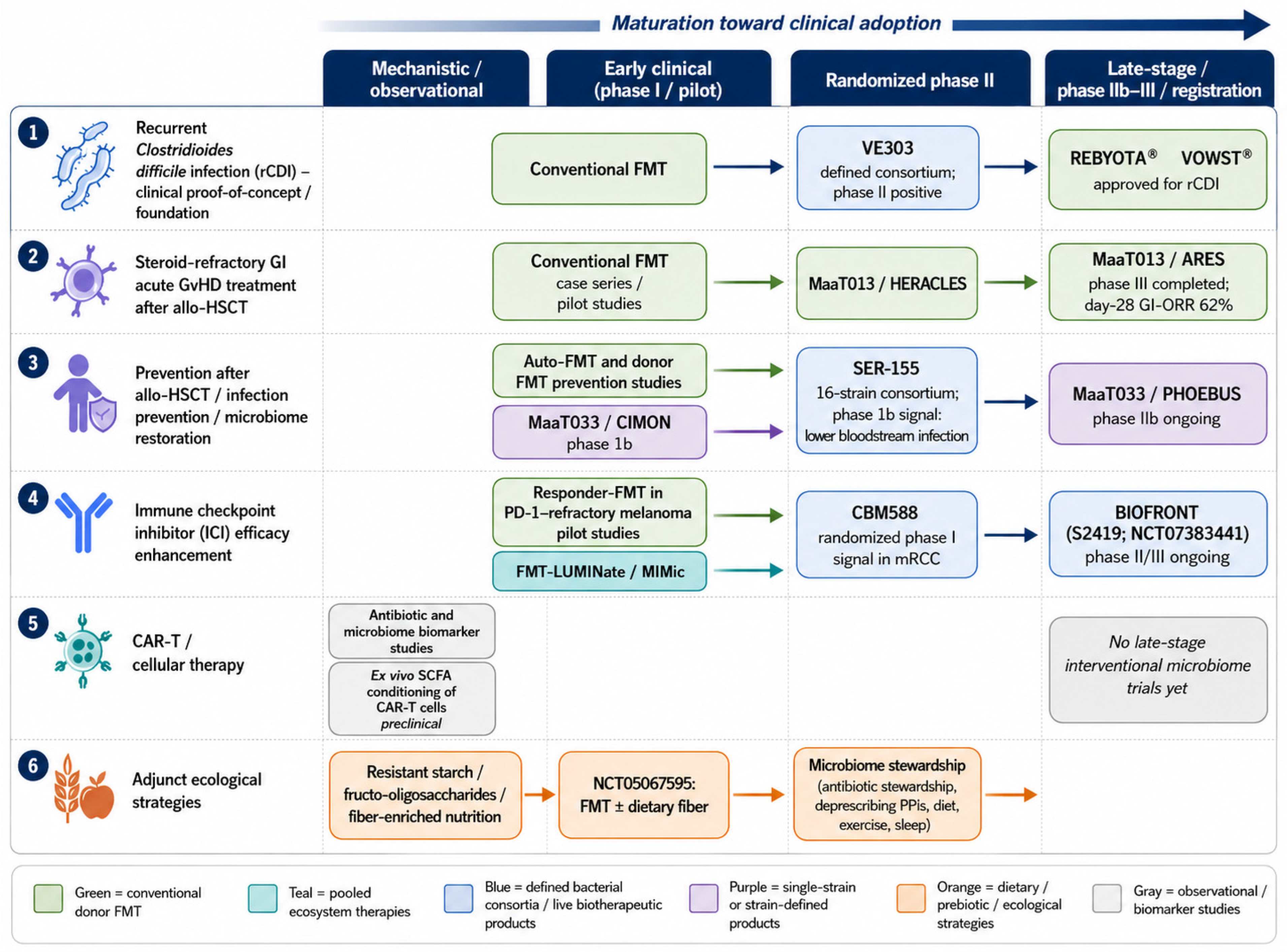
This trajectory has now reached an inflection point. For the first time, a standardized microbiome therapeutic has generated positive registration-intent phase III evidence: the pivotal ARES trial (NCT04769895) of MaaT013. The trial met its primary endpoint, with a day-28 GI-ORR of 62%, and response was strongly associated with survival, with 12-month overall survival of 68% among day-28 responders versus 28% among non-responders (p < 0.0001) [24]. These findings represent the strongest prospective clinical evidence to date supporting microbiome restoration in a defined transplant indication. However, interpretation remains limited by the single-arm study design and the use of concomitant therapies, which complicate definitive attribution of the observed clinical benefit to MaaT013 alone. Nevertheless, the ARES results establish an important evidentiary benchmark for future microbiome-based therapeutics and highlight the need for confirmatory randomized studies.
Realizing this potential at the bedside will depend as much on regulatory and access frameworks as on the science. Following the positive ARES phase III efficacy results, MaaT013 (Xervyteg®) entered centralized European Medicines Agency review. On 25 June 2026, the CHMP adopted a negative opinion on the conditional marketing authorization application, citing limitations of the single-arm pivotal study and uncertainty regarding attribution of efficacy and safety in the setting of concomitant therapies. MaaT Pharma subsequently requested re-examination of the opinion on 29 June 2026. As of 4 September 2026, the re-examination remained pending; the company announced that it would request a Scientific Advisory Group hearing and, based on then-current EMA procedural timelines, anticipated a second CHMP opinion during the September 14–17, 2026 CHMP session [149,150]. MaaT013 remains investigational in the United States, underscoring the regulatory divergence between European and US pathways for donor-derived microbiome therapeutics discussed in Section 7.3. Future priorities include randomized and confirmatory studies across GvHD treatment lines and other indications, biomarker-guided patient selection, harmonized manufacturing and donor-sourcing standards, and prospective long-term safety surveillance in immunocompromised hosts.
Two standardized products now advancing in the prophylactic setting illustrate this trajectory beyond the treatment of established GvHD. MaaT033 is an oral, lyophilized, delayed-release capsule formulation of the same pooled, standardized, multi-donor microbiota platform as the enema-delivered MaaT013. In the first-in-human phase 1b dose-ranging CIMON trial (NCT04150393), 21 patients with acute myeloid leukemia who had received intensive induction chemotherapy and broad-spectrum antibiotics received MaaT033; the product was safe and restored gut microbiome diversity toward the composition of the drug product, with adequate engraftment at 3 capsules per day, declines in C-reactive protein and interleukin-6, and increases in short-chain fatty acids over time [174]. On the basis of these data, the randomized, double-blind, placebo-controlled phase 2b PHOEBUS trial (NCT05762211; planned enrollment 387), described in an ASH 2023 abstract, is evaluating oral MaaT033 to prevent complications after allo-HSCT, with overall survival as the primary endpoint [175]. SER-155 represents the defined-consortium end of the spectrum: a 16-strain, cultivated, fermentation-derived bacterial consortium rationally designed to promote colonization resistance against gut-derived pathogens and to modulate epithelial and immune function. In results reported in abstract form from the randomized, double-blind, placebo-controlled phase 1b study (NCT04995653; 60 patients), SER-155 was associated with a lower bloodstream-infection incidence than placebo; these preliminary infection-prevention data are discussed in Section 6 [127].
Together, MaaT033 and SER-155 extend microbiome-directed therapy from salvage treatment of steroid-refractory GvHD toward the prevention of transplant complications, and their randomized, placebo-controlled designs address a central methodological limitation of the earlier single-arm literature.
8.2. Evidentiary Requirements for Clinical Adoption
Before microbiome-directed therapies can be incorporated routinely into oncology or transplant practice, the evidentiary threshold must extend beyond biological plausibility and response signals from small uncontrolled studies. Practice-changing evidence will require adequately powered randomized controlled trials using standardized and reproducible microbiome products, prespecified treatment schedules, contemporary and uniform response criteria, and appropriate standard-of-care control groups. Trial design should also account prospectively for major sources of baseline ecological heterogeneity, including recent antibiotic or proton-pump inhibitor exposure, diet, baseline microbiome composition, and center- or geography-related differences.
Clinical implementation will also require indication-specific strategies for patient selection, product choice, dosing, administration, and integration with standard anticancer or transplant therapy. At present, no validated criteria exist for selecting an optimal FMT donor or determining the optimal administration route, dose, or number of treatments across oncology indications, and donor effects and variable engraftment suggest that these parameters cannot be assumed to be interchangeable [82,92,138]. Patient selection may ultimately incorporate baseline microbiome composition, recent microbiome-disrupting exposures, degree of immunosuppression, and validated ecological or metabolomic biomarkers; however, currently proposed signatures, including ICI-associated ecological scores and CAR-T predictive models, require prospective external validation before clinical use [85,88,112]. Microbiome-directed therapies should therefore be evaluated as indication-specific adjuncts to established oncology or transplant treatment rather than as substitutes for standard care. Trials should prespecify their timing relative to chemotherapy, ICIs, CAR-T infusion, conditioning, immunosuppression, and antimicrobial therapy so that efficacy, safety, and clinically relevant drug–microbiome interactions can be interpreted within the context in which these interventions would ultimately be used.
In GvHD studies, concomitant immunosuppression and steroid tapering should be protocolized or prospectively accounted for, and response assessment should ideally incorporate blinded independent adjudication. Trials should evaluate clinically meaningful and durable endpoints—including sustained response, non-relapse mortality, overall survival, infection-related outcomes, and treatment-emergent adverse events—rather than microbiome engraftment or short-term response alone. Replication across independent multicenter populations, together with standardized manufacturing and long-term safety surveillance in immunocompromised hosts, would provide the level of evidence necessary to support routine clinical adoption.
8.3. Conclusions
As this review has summarized, the evidence linking intestinal microbial ecology to outcomes across HSCT, GvHD, immune checkpoint blockade, and CAR-T cell therapy is now substantial, spanning mechanistic, observational, and early interventional data. Yet by any measure, microbiome science in oncology remains in its infancy. Randomized controlled trial data are limited, optimal therapeutic products and delivery strategies are undefined, and the long-term consequences of microbial manipulation in immunocompromised hosts are unknown. The continued maturation of this field, from associative science toward precision microbiome medicine, will require the same cycle of biological insight, clinical observation, and rigorous trial design that transformed post-transplant cyclophosphamide from an empiric intervention into a pillar of modern transplantation. If the trajectory of discovery follows historical precedent, these ancient commensal organisms may ultimately prove to be as consequential to the future of cancer care as the T cell has been to its past.
Author Contributions
Conceptualization, L.M. and A.A.-O.; methodology, A.A.-O., A.K. and L.M.; writing—original draft preparation, A.A.-O., A.K., P.M. and K.D.; writing—review and editing, A.A.-O., K.D. and L.M.; supervision, L.M. All authors have read and agreed to the published version of the manuscript.
Funding
This research received no external funding.
Institutional Review Board Statement
Not applicable. This study is a narrative review of previously published literature and did not involve human subjects, animal research, or the collection of new data.
Informed Consent Statement
Not applicable.
Data Availability Statement
No new data was created or analyzed in this study. Data sharing is not applicable to this article.
Acknowledgments
During the preparation of this manuscript, the authors used ChatGPT (GPT-5.6 Sol; OpenAI, San Francisco, CA, USA for assistance in generating Figure 1 and Figure 2 from conceptual frameworks and specifications developed by the authors. The authors reviewed and edited the resulting figures and take full responsibility for their scientific content and accuracy.
Conflicts of Interest
The authors declare no conflicts of interest.
References
- Lynch, S.V.; Pedersen, O. The human intestinal microbiome in health and disease. N. Engl. J. Med. 2016, 375, 2369–2379. [Google Scholar] [CrossRef] [Scilit] [PubMed]
- Gilbert, J.A.; Blaser, M.J.; Caporaso, J.G.; Jansson, J.K.; Lynch, S.V.; Knight, R. Current understanding of the human microbiome. Nat. Med. 2018, 24, 392–400. [Google Scholar] [CrossRef] [Scilit] [PubMed]
- Zitvogel, L.; Ma, Y.; Raoult, D.; Kroemer, G.; Gajewski, T.F. The microbiome in cancer immunotherapy: Diagnostic tools and therapeutic strategies. Science 2018, 359, 1366–1370. [Google Scholar] [CrossRef] [Scilit] [PubMed]
- Van Nood, E.; Vrieze, A.; Nieuwdorp, M.; Fuentes, S.; Zoetendal, E.G.; De Vos, W.M.; Visser, C.E.; Kuijper, E.J.; Bartelsman, J.F.W.M.; Tijssen, J.G.P.; et al. Duodenal infusion of donor feces for recurrent Clostridium difficile. N. Engl. J. Med. 2013, 368, 407–415. [Google Scholar] [CrossRef] [Scilit] [PubMed]
- U.S. Food and Drug Administration. REBYOTA (Fecal Microbiota, Live-jslm) Prescribing Information; U.S. Food and Drug Administration: Silver Spring, MD, USA, 2022. Available online: https://www.fda.gov/media/163587/download (accessed on 7 September 2026).
- U.S. Food and Drug Administration. VOWST (Fecal Microbiota Spores, Live-brpk) Prescribing Information; U.S. Food and Drug Administration: Silver Spring, MD, USA, 2023. Available online: https://www.fda.gov/files/vaccines%2C%20blood%20%26%20biologics/published/Package-Insert-VOWST.pdf (accessed on 7 September 2026).
- Monday, L.; Tillotson, G.; Chopra, T. Microbiota-based live biotherapeutic products for Clostridioides difficile infection—The devil is in the details. Infect. Drug Resist. 2024, 17, 623–639. [Google Scholar] [CrossRef] [Scilit] [PubMed]
- Taur, Y.; Xavier, J.B.; Lipuma, L.; Ubeda, C.; Goldberg, J.; Gobourne, A.; Lee, Y.J.; Dubin, K.A.; Socci, N.D.; Viale, A.; et al. Intestinal domination and the risk of bacteremia in allogeneic hematopoietic stem cell transplantation. Clin. Infect. Dis. 2012, 55, 905–914. [Google Scholar] [CrossRef] [Scilit] [PubMed]
- Holler, E.; Butzhammer, P.; Schmid, K.; Hundsrucker, C.; Koestler, J.; Peter, K.; Zhu, W.; Sporrer, D.; Hehlgans, T.; Kreutz, M.; et al. Metagenomic analysis of the stool microbiome in patients receiving allogeneic stem cell transplantation. Biol. Blood Marrow Transplant. 2014, 20, 640–645. [Google Scholar] [CrossRef] [Scilit] [PubMed]
- Taur, Y.; Jenq, R.R.; Perales, M.-A.; Littmann, E.R.; Morjaria, S.; Ling, L.; No, D.; Gobourne, A.; Viale, A.; Dahi, P.B.; et al. The effects of intestinal tract bacterial diversity on mortality following allogeneic hematopoietic stem cell transplantation. Blood 2014, 124, 1174–1182. [Google Scholar] [CrossRef] [Scilit] [PubMed]
- Peled, J.U.; Gomes, A.L.; Devlin, S.M.; Littmann, E.R.; Taur, Y.; Sung, A.D.; Weber, D.; Hashimoto, D.; Slingerland, A.E.; Slingerland, J.B.; et al. Microbiota as predictor of mortality in allogeneic hematopoietic cell transplantation. N. Engl. J. Med. 2020, 382, 822–834. [Google Scholar] [CrossRef] [Scilit] [PubMed]
- Jenq, R.R.; Taur, Y.; Devlin, S.M.; Ponce, D.M.; Goldberg, J.D.; Ahr, K.F.; Littmann, E.R.; Ling, L.; Gobourne, A.C.; Miller, L.C.; et al. Intestinal Blautia is associated with reduced death from graft-versus-host disease. Biol. Blood Marrow Transplant. 2015, 21, 1373–1383. [Google Scholar] [CrossRef] [Scilit] [PubMed]
- Shono, Y.; Docampo, M.D.; Peled, J.U.; Perobelli, S.M.; Velardi, E.; Tsai, J.J.; Slingerland, A.E.; Smith, O.M.; Young, L.F.; Gupta, J.; et al. Increased GVHD-related mortality with broad-spectrum antibiotic use after allogeneic hematopoietic stem cell transplantation in human patients and mice. Sci. Transl. Med. 2016, 8, 339ra71. [Google Scholar] [CrossRef] [Scilit] [PubMed]
- Furusawa, Y.; Obata, Y.; Fukuda, S.; Endo, T.A.; Nakato, G.; Takahashi, D.; Nakanishi, Y.; Uetake, C.; Kato, K.; Kato, T.; et al. Commensal microbe-derived butyrate induces the differentiation of colonic regulatory T cells. Nature 2013, 504, 446–450. [Google Scholar] [CrossRef] [Scilit] [PubMed]
- Arpaia, N.; Campbell, C.; Fan, X.; Dikiy, S.; Van Der Veeken, J.; DeRoos, P.; Liu, H.; Cross, J.R.; Pfeffer, K.; Coffer, P.J.; et al. Metabolites produced by commensal bacteria promote peripheral regulatory T-cell generation. Nature 2013, 504, 451–455. [Google Scholar] [CrossRef] [Scilit] [PubMed]
- Gopalakrishnan, V.; Spencer, C.N.; Nezi, L.; Reuben, A.; Andrews, M.C.; Karpinets, T.V.; Prieto, P.A.; Vicente, D.; Hoffman, K.; Wei, S.C.; et al. Gut microbiome modulates response to anti–PD-1 immunotherapy in melanoma patients. Science 2018, 359, 97–103. [Google Scholar] [CrossRef] [Scilit] [PubMed]
- Routy, B.; le Chatelier, E.; DeRosa, L.; Duong, C.P.M.; Alou, M.T.; Daillère, R.; Fluckiger, A.; Messaoudene, M.; Rauber, C.; Roberti, M.P.; et al. Gut microbiome influences efficacy of PD-1–based immunotherapy against epithelial tumors. Science 2018, 359, 91–97. [Google Scholar] [CrossRef] [Scilit] [PubMed]
- Matson, V.; Fessler, J.; Bao, R.; Chongsuwat, T.; Zha, Y.; Alegre, M.-L.; Luke, J.J.; Gajewski, T.F. The commensal microbiome is associated with anti–PD-1 efficacy in metastatic melanoma patients. Science 2018, 359, 104–108. [Google Scholar] [CrossRef] [Scilit] [PubMed]
- Yoon, S.E.; Kang, W.; Cho, J.; Cho, H.J.; Chalita, M.; Oh, H.-S.; Hyun, D.-W.; Han, S.; Kim, H.; Sung, H.; et al. Microbiome and metabolite biomarkers of CAR T-cell therapy outcomes in relapsed/refractory diffuse large B-cell lymphoma. Blood Adv. 2026, 10, 1634–1645. [Google Scholar] [CrossRef] [Scilit] [PubMed]
- Abid, M.B.; Shah, N.N.; Maatman, T.C.; Hari, P.N. Gut microbiome and CAR-T therapy. Exp. Hematol. Oncol. 2019, 8, 31. [Google Scholar] [CrossRef] [Scilit] [PubMed]
- Kim, H.M.; Lee, J.; Kim, S.; Lee, J.W.; Kim, H.-J.; Cho, Y.-S. Fecal microbiota transplantation for steroid-refractory gastrointestinal graft-versus-host disease. Blood Res. 2023, 58, 145–148. [Google Scholar] [CrossRef] [Scilit] [PubMed]
- Bilinski, J.; Lis, K.; Tomaszewska, A.; Grzesiowski, P.; Dzieciatkowski, T.; Tyszka, M.; Karakulska-Prystupiuk, E.; Boguradzki, P.; Tormanowska, M.; Halaburda, K.; et al. Fecal microbiota transplantation in patients with acute and chronic graft-versus-host disease—Spectrum of responses and safety profile: Results from a prospective, multicenter study. Am. J. Hematol. 2021, 96, E88–E91. [Google Scholar] [CrossRef] [Scilit] [PubMed]
- Alabdaljabar, M.S.; Aslam, H.M.; Veeraballi, S.; Faizee, F.A.; Husain, B.H.; Iqbal, S.M.; Hashmi, S.K. Restoration of the original inhabitants: A systematic review on fecal microbiota transplantation for graft-versus-host disease. Cureus 2022, 14, e23873. [Google Scholar] [CrossRef] [Scilit] [PubMed]
- Malard, F.; Sanz, J.; Mediavilla, C.; Lopez-Corral, L.; Schauwvlieghe, A.; Bernard, M.; Loschi, M.; François, S.; Bonifazi, F.; Heidenreich, D.; et al. MaaT013 for ruxolitinib-refractory acute graft-versus-host disease with gastrointestinal involvement: Results from the ARES phase III trial. Blood 2025, 146, 817. [Google Scholar] [CrossRef] [Scilit]
- Alagna, L.; Palomba, E.; Mangioni, D.; Bozzi, G.; Lombardi, A.; Ungaro, R.; Castelli, V.; Prati, D.; Vecchi, M.; Muscatello, A.; et al. Multidrug-resistant Gram-negative bacteria decolonization in immunocompromised patients: A focus on fecal microbiota transplantation. Int. J. Mol. Sci. 2020, 21, 5619. [Google Scholar] [CrossRef] [Scilit] [PubMed]
- Rinninella, E.; Raoul, P.; Cintoni, M.; Franceschi, F.; Miggiano, G.A.D.; Gasbarrini, A.; Mele, M.C. What is the healthy gut microbiota composition? A changing ecosystem across age, environment, diet, and diseases. Microorganisms 2019, 7, 14. [Google Scholar] [CrossRef] [Scilit] [PubMed]
- Gu, Z.; Xiong, Q.; Wang, L.; Wang, L.; Li, F.; Hou, C.; Dou, L.; Zhu, B.; Liu, D. The impact of intestinal microbiota in antithymocyte globulin-based myeloablative allogeneic hematopoietic cell transplantation. Cancer 2022, 128, 1402–1410. [Google Scholar] [CrossRef] [Scilit] [PubMed]
- González-Rico, C.; Hernández, M.; Rodríguez-Grande, J.; Fernández-Luis, S.; Rodríguez, A.B.; González-Huerta, A.J.; Velasco, E.L.; López, L.V.; García, I.G.; Revillas, F.A.d.L.; et al. Changes in the bacterial profile and diversity of the gut microbiota in allogeneic hematopoietic stem cell transplant recipients. Int. J. Infect. Dis. 2025, 161, 108117. [Google Scholar] [CrossRef] [Scilit] [PubMed]
- Artacho, A.; González-Torres, C.; Gómez-Cebrián, N.; Moles-Poveda, P.; Pons, J.; Jiménez, N.; Casanova, M.J.; Montoro, J.; Balaguer, A.; Villalba, M.; et al. Multimodal analysis identifies microbiome changes linked to stem cell transplantation-associated diseases. Microbiome 2024, 12, 229. [Google Scholar] [CrossRef] [Scilit] [PubMed]
- Chi, M.; Jiang, T.; He, X.; Peng, H.; Li, Y.; Zhang, J.; Wang, L.; Nian, Q.; Ma, K.; Liu, C. Role of gut microbiota and oxidative stress in the progression of transplant-related complications following hematopoietic stem cell transplantation. Oxid. Med. Cell. Longev. 2023, 2023, 3532756. [Google Scholar] [CrossRef] [Scilit] [PubMed]
- Bansal, R.; Park, H.; Taborda, C.C.; Gordillo, C.; Mapara, M.Y.; Assal, A.; Uhlemann, A.-C.; Reshef, R. Antibiotic exposure, not alloreactivity, is the major driver of microbiome changes in hematopoietic cell transplantation. Transplant. Cell Ther. 2022, 28, 135–144. [Google Scholar] [CrossRef] [Scilit] [PubMed]
- Weber, D.; Oefner, P.J.; Dettmer, K.; Hiergeist, A.; Koestler, J.; Gessner, A.; Weber, M.; Stämmler, F.; Hahn, J.; Wolff, D.; et al. Rifaximin preserves intestinal microbiota balance in patients undergoing allogeneic stem cell transplantation. Bone Marrow Transplant. 2016, 51, 1087–1092. [Google Scholar] [CrossRef] [Scilit] [PubMed]
- Malard, F.; Gaugler, B.; Mohty, M. Faecal microbiota transplantation in patients with haematological malignancies undergoing cellular therapies: From translational research to routine clinical practice. Lancet Haematol. 2022, 9, e776–e785. [Google Scholar] [CrossRef] [Scilit] [PubMed]
- Hino, A.; Fukushima, K.; Kusakabe, S.; Ueda, T.; Sudo, T.; Fujita, J.; Motooka, D.; Takeda, A.K.; Shinozaki, N.O.; Watanabe, S.; et al. Prolonged gut microbial alterations in post-transplant survivors of allogeneic haematopoietic stem cell transplantation. Br. J. Haematol. 2023, 201, 725–737. [Google Scholar] [CrossRef] [Scilit] [PubMed]
- Júnior, A.S.F.; da Silva, B.F.R.; da Silva, J.L.; da Silva, M.T.; Feliciano, J.V.P.; Colturato, I.; Barros, G.M.N.; Scheinberg, P.; Chao, N.J.A.; de Oliveira, G.L.V. Unraveling the intestinal microbiota conundrum in allogeneic hematopoietic stem cell transplantation: Fingerprints, clinical implications and future directions. J. Clin. Med. 2025, 14, 6874. [Google Scholar] [CrossRef] [Scilit] [PubMed]
- Wang, S.; Yue, X.; Zhou, H.; Chen, X.; Chen, H.; Hu, L.; Pan, W.; Zhao, X.; Xiao, H. The association of intestinal microbiota diversity and outcomes of allogeneic hematopoietic cell transplantation: A systematic review and meta-analysis. Ann. Hematol. 2023, 102, 3555–3566. [Google Scholar] [CrossRef] [Scilit] [PubMed]
- Masetti, R.; Leardini, D.; Muratore, E.; Fabbrini, M.; D’amico, F.; Zama, D.; Baccelli, F.; Gottardi, F.; Belotti, T.; Ussowicz, M.; et al. Gut microbiota diversity before allogeneic hematopoietic stem cell transplantation as a predictor of mortality in children. Blood 2023, 142, 1387–1398. [Google Scholar] [CrossRef] [Scilit] [PubMed]
- Rashidi, A.; Peled, J.U.; Ebadi, M.; Rehman, T.U.; Elhusseini, H.; Marcello, L.T.; Halaweish, H.; Kaiser, T.; Holtan, S.G.; Khoruts, A.; et al. Protective effect of intestinal Blautia against neutropenic fever in allogeneic transplant recipients. Clin. Infect. Dis. 2022, 75, 1912–1920. [Google Scholar] [CrossRef] [Scilit] [PubMed]
- Skaarud, K.J.; Hov, J.R.; Hansen, S.H.; Kummen, M.; Valeur, J.; Seljeflot, I.; Bye, A.; Paulsen, V.; Lundin, K.E.A.; Trøseid, M.; et al. Mortality and microbial diversity after allogeneic hematopoietic stem cell transplantation: Secondary analysis of a randomized nutritional intervention trial. Sci. Rep. 2021, 11, 11593. [Google Scholar] [CrossRef] [Scilit] [PubMed]
- Peled, J.U.; Devlin, S.M.; Staffas, A.; Lumish, M.; Khanin, R.; Littmann, E.R.; Ling, L.; Kosuri, S.; Maloy, M.; Slingerland, J.B.; et al. Intestinal microbiota and relapse after hematopoietic-cell transplantation. J. Clin. Oncol. 2017, 35, 1650–1659. [Google Scholar] [CrossRef] [Scilit] [PubMed]
- Shallis, R.M.; Terry, C.M.; Lim, S.H. Changes in intestinal microbiota and their effects on allogeneic stem cell transplantation. Am. J. Hematol. 2018, 93, 122–128. [Google Scholar] [CrossRef] [Scilit] [PubMed]
- Meedt, E.; Hiergeist, A.; Gessner, A.; Dettmer, K.; Liebisch, G.; Ghimire, S.; Poeck, H.; Edinger, M.; Wolff, D.; Herr, W.; et al. Prolonged suppression of butyrate-producing bacteria is associated with acute gastrointestinal graft-vs-host disease and transplantation-related mortality after allogeneic stem cell transplantation. Clin. Infect. Dis. 2022, 74, 614–621. [Google Scholar] [CrossRef] [Scilit] [PubMed]
- da Silva, M.B.; Ponce, D.M.; Dai, A.; Devlin, S.M.; Gomes, A.L.C.; Moore, G.; Slingerland, J.; Shouval, R.; Armijo, G.K.; DeWolf, S.; et al. Preservation of the fecal microbiome is associated with reduced severity of graft-versus-host disease. Blood 2022, 140, 2385–2397. [Google Scholar] [CrossRef] [Scilit] [PubMed]
- El Jurdi, N.; Holtan, S.G.; Hoeschen, A.; Velguth, J.; Hillmann, B.; Betts, B.C.; MacMillan, M.L.; Weisdorf, D.J.; Khoruts, A.; Rashidi, A.; et al. Pre-transplant and longitudinal changes in faecal microbiome characteristics are associated with subsequent development of chronic graft-versus-host disease. Br. J. Haematol. 2023, 203, 288–294. [Google Scholar] [CrossRef] [Scilit] [PubMed]
- Hajjar, C.; Kuijper, E.J.; Butel, M.-J.; Khoury, G.; Mallah, M.; Sarkis, D.K.; Lesnik, P.; Le Goff, W.; Bazarbachi, A.; Abifadel, M. Microbiota-derived short-chain fatty acids in hematopoietic stem cell transplantation: Immunomodulation at the host-microbiota interface. Front. Microbiol. 2026, 17, 1754099. [Google Scholar] [CrossRef] [Scilit] [PubMed]
- Mann, E.R.; Lam, Y.K.; Uhlig, H.H. Short-chain fatty acids: Linking diet, the microbiome and immunity. Nat. Rev. Immunol. 2024, 24, 577–595. [Google Scholar] [CrossRef] [Scilit] [PubMed]
- Yue, X.; Zhou, H.; Wang, S.; Chen, X.; Xiao, H. Gut microbiota, microbiota-derived metabolites, and graft-versus-host disease. Cancer Med. 2024, 13, e6799. [Google Scholar] [CrossRef] [Scilit] [PubMed]
- Mathewson, N.D.; Jenq, R.; Mathew, A.V.; Koenigsknecht, M.; Hanash, A.; Toubai, T.; Oravecz-Wilson, K.; Wu, S.-R.; Sun, Y.; Rossi, C.; et al. Gut microbiome–derived metabolites modulate intestinal epithelial cell damage and mitigate graft-versus-host disease. Nat. Immunol. 2016, 17, 505–513. [Google Scholar] [CrossRef] [Scilit] [PubMed]
- Zeiser, R.; Blazar, B.R. Acute graft-versus-host disease—Biologic process, prevention, and therapy. N. Engl. J. Med. 2017, 377, 2167–2179. [Google Scholar] [CrossRef] [Scilit] [PubMed]
- Docampo, M.D.; da Silva, M.B.; Lazrak, A.; Nichols, K.B.; Lieberman, S.R.; Slingerland, A.E.; Armijo, G.K.; Shono, Y.; Nguyen, C.; Monette, S.; et al. Alloreactive T cells deficient of the short-chain fatty acid receptor GPR109A induce less graft-versus-host disease. Blood 2022, 139, 2392–2405. [Google Scholar] [CrossRef] [Scilit] [PubMed]
- Ghimire, S.; Weber, D.; Hippe, K.; Meedt, E.; Hoepting, M.; Kattner, A.-S.; Hiergeist, A.; Gessner, A.; Matos, C.; Ghimire, S.; et al. GPR expression in intestinal biopsies from SCT patients is upregulated in GvHD and is suppressed by broad-spectrum antibiotics. Front. Immunol. 2021, 12, 753287. [Google Scholar] [CrossRef] [Scilit] [PubMed]
- Swimm, A.; Giver, C.R.; DeFilipp, Z.; Rangaraju, S.; Sharma, A.; Antonova, A.U.; Sonowal, R.; Capaldo, C.; Powell, D.; Qayed, M.; et al. Indoles derived from intestinal microbiota act via type I interferon signaling to limit graft-versus-host disease. Blood 2018, 132, 2506–2519. [Google Scholar] [CrossRef] [Scilit] [PubMed]
- Michonneau, D.; Latis, E.; Curis, E.; Dubouchet, L.; Ramamoorthy, S.; Ingram, B.; de Latour, R.P.; Robin, M.; de Fontbrune, F.S.; Chevret, S.; et al. Metabolomics analysis of human acute graft-versus-host disease reveals changes in host and microbiota-derived metabolites. Nat. Commun. 2019, 10, 5695. [Google Scholar] [CrossRef] [Scilit] [PubMed]
- Weber, D.; Frauenschläger, K.; Ghimire, S.; Peter, K.; Panzer, I.; Hiergeist, A.; Weber, M.; Kutny, D.; Wolff, D.; Grube, M.; et al. The association between acute graft-versus-host disease and antimicrobial peptide expression in the gastrointestinal tract after allogeneic stem cell transplantation. PLoS ONE 2017, 12, e0185265. [Google Scholar] [CrossRef] [Scilit] [PubMed]
- Lindner, S.; Miltiadous, O.; Ramos, R.J.F.; Paredes, J.; Kousa, A.I.; Dai, A.; Fei, T.; Lauder, E.; Frame, J.; Waters, N.R.; et al. Altered microbial bile acid metabolism exacerbates T cell-driven inflammation during graft-versus-host disease. Nat. Microbiol. 2024, 9, 614–630. [Google Scholar] [CrossRef] [Scilit] [PubMed]
- Li, P.; Lei, Q.; Yu, X.; Shen, Y.; Chen, Y.; Hou, C.; Hu, B.; Cui, Y.; Liu, Z.; Qin, Y.; et al. Commensal Bacteroides T6SS alleviate GI-aGVHD via mediating gut microbiota composition and bile acids metabolism. Gut 2025, 74, 1847–1858. [Google Scholar] [CrossRef] [Scilit] [PubMed]
- Haring, E.; Uhl, F.M.; Andrieux, G.; Proietti, M.; Bulashevska, A.; Sauer, B.; Braun, L.M.; Gomez, E.d.V.; Esser, P.R.; Martin, S.F.; et al. Bile acids regulate intestinal antigen presentation and reduce graft-versus-host disease without impairing the graft-versus-leukemia effect. Haematologica 2021, 106, 2131–2146. [Google Scholar] [CrossRef] [Scilit] [PubMed]
- Penack, O.; Holler, E.; Brink, M.R.M.v.D. Graft-versus-host disease: Regulation by microbe-associated molecules and innate immune receptors. Blood 2010, 115, 1865–1872. [Google Scholar] [CrossRef] [Scilit] [PubMed]
- Heidegger, S.; Brink, M.R.M.v.D.; Haas, T.; Poeck, H. The role of pattern-recognition receptors in graft-versus-host disease and graft-versus-leukemia after allogeneic stem cell transplantation. Front. Immunol. 2014, 5, 337. [Google Scholar] [CrossRef] [Scilit] [PubMed]
- Penack, O.; Smith, O.M.; Cunningham-Bussel, A.; Liu, X.; Rao, U.; Yim, N.; Na, I.-K.; Holland, A.M.; Ghosh, A.; Lu, S.X.; et al. NOD2 regulates hematopoietic cell function during graft-versus-host disease. J. Exp. Med. 2009, 206, 2101–2110. [Google Scholar] [CrossRef] [Scilit] [PubMed]
- Elmaagacli, A.H.; Koldehoff, M.; Hindahl, H.; Steckel, N.K.; Trenschel, R.; Peceny, R.; Ottinger, H.; Rath, P.-M.; Ross, R.S.; Roggendorf, M.; et al. Mutations in innate immune system NOD2/CARD 15 and TLR-4 (Thr399Ile) genes influence the risk for severe acute graft-versus-host disease. Transplantation 2006, 81, 247–254. [Google Scholar] [CrossRef] [Scilit] [PubMed]
- Eriguchi, Y.; Takashima, S.; Oka, H.; Shimoji, S.; Nakamura, K.; Uryu, H.; Shimoda, S.; Iwasaki, H.; Shimono, N.; Ayabe, T.; et al. Graft-versus-host disease disrupts intestinal microbial ecology by inhibiting Paneth cell production of α-defensins. Blood 2012, 120, 223–231. [Google Scholar] [CrossRef] [Scilit] [PubMed]
- Levine, J.E.; Huber, E.; Hammer, S.T.G.; Harris, A.C.; Greenson, J.K.; Braun, T.M.; Ferrara, J.L.M.; Holler, E. Low Paneth cell numbers at onset of gastrointestinal graft-versus-host disease identify patients at high risk for nonrelapse mortality. Blood 2013, 122, 1505–1509. [Google Scholar] [CrossRef] [Scilit] [PubMed]
- Lindemans, C.A.; Calafiore, M.; Mertelsmann, A.M.; O’connor, M.H.; Dudakov, J.A.; Jenq, R.R.; Velardi, E.; Young, L.F.; Smith, O.M.; Lawrence, G.; et al. Interleukin-22 promotes intestinal-stem-cell-mediated epithelial regeneration. Nature 2015, 528, 560–564. [Google Scholar] [CrossRef] [Scilit] [PubMed]
- Hanash, A.M.; Dudakov, J.A.; Hua, G.; O’connor, M.H.; Young, L.F.; Singer, N.V.; West, M.L.; Jenq, R.R.; Holland, A.M.; Kappel, L.W.; et al. Interleukin-22 protects intestinal stem cells from immune-mediated tissue damage and regulates sensitivity to graft versus host disease. Immunity 2012, 37, 339–350. [Google Scholar] [CrossRef] [Scilit] [PubMed]
- Göttert, S.; Thiele Orberg, E.; Fan, K.; Heinrich, P.; Matthe, D.M.; Khalid, O.; Klostermeier, L.; Suriano, C.; Strieder, N.; Gebhard, C.; et al. The microbial metabolite desaminotyrosine protects against graft-versus-host disease via mTORC1 and STING-dependent intestinal regeneration. Nat. Commun. 2025, 16, 9282. [Google Scholar] [CrossRef] [Scilit] [PubMed]
- Penack, O.; Marchetti, M.; Aljurf, M.; Arat, M.; Bonifazi, F.; Duarte, R.F.; Giebel, S.; Greinix, H.; Hazenberg, M.D.; Kröger, N.; et al. Prophylaxis and management of graft-versus-host disease after stem-cell transplantation for haematological malignancies: Updated consensus recommendations of the European Society for Blood and Marrow Transplantation. Lancet Haematol. 2024, 11, e147–e159. [Google Scholar] [CrossRef] [Scilit] [PubMed]
- Zeiser, R.; von Bubnoff, N.; Butler, J.; Mohty, M.; Niederwieser, D.; Or, R.; Szer, J.; Wagner, E.M.; Zuckerman, T.; Mahuzier, B.; et al. Ruxolitinib for glucocorticoid-refractory acute graft-versus-host disease. N. Engl. J. Med. 2020, 382, 1800–1810. [Google Scholar] [CrossRef] [Scilit] [PubMed]
- Clausen, J.; Pérez Simón, J.A.; Carré, M.; Castilla-Llorente, C.; Michonneau, D.; Schauwvlieghe, A.; Cantó, P.A.; François, S.; Gabellier, L.; Corral, L.L.; et al. Clinical outcomes of third-line therapy for aGvHD with gastrointestinal involvement after steroids and ruxolitinib failure. Bone Marrow Transplant. 2026, 61, 577–583. [Google Scholar] [CrossRef] [Scilit] [PubMed]
- Smallbone, P.; Mehta, R.S.; Alousi, A. Steroid refractory acute GVHD: The hope for a better tomorrow. Am. J. Hematol. 2025, 100, 14–29. [Google Scholar] [CrossRef] [Scilit] [PubMed]
- Kakihana, K.; Fujioka, Y.; Suda, W.; Najima, Y.; Kuwata, G.; Sasajima, S.; Mimura, I.; Morita, H.; Sugiyama, D.; Nishikawa, H.; et al. Fecal microbiota transplantation for patients with steroid-resistant acute graft-versus-host disease of the gut. Blood 2016, 128, 2083–2088. [Google Scholar] [CrossRef] [Scilit] [PubMed]
- van Lier, Y.F.; Davids, M.; Haverkate, N.J.E.; de Groot, P.F.; Donker, M.L.; Meijer, E.; Heubel-Moenen, F.C.J.I.; Nur, E.; Zeerleder, S.S.; Nieuwdorp, M.; et al. Donor fecal microbiota transplantation ameliorates intestinal graft-versus-host disease in allogeneic hematopoietic cell transplant recipients. Sci. Transl. Med. 2020, 12, eaaz8926. [Google Scholar] [CrossRef] [Scilit] [PubMed]
- Zhao, Y.; Li, X.; Zhou, Y.; Gao, J.; Jiao, Y.; Zhu, B.; Wu, D.; Qi, X. Safety and efficacy of fecal microbiota transplantation for grade IV steroid-refractory GI-GvHD patients: Interim results from FMT2017002 trial. Front. Immunol. 2021, 12, 678476. [Google Scholar] [CrossRef] [Scilit] [PubMed]
- Li, M.; Yuan, F.; Li, G.; Fu, Y.; Wei, X. Clinical analysis of fecal microbiota transplantation for refractory acute gastrointestinal graft-versus-host disease after allogeneic hematopoietic stem cell transplantation: A five-year retrospective study. Cytotherapy 2026, 28, 102043. [Google Scholar] [CrossRef] [Scilit] [PubMed]
- Qiao, X.; Biliński, J.; Wang, L.; Yang, T.; Luo, R.; Fu, Y.; Yang, G. Safety and efficacy of fecal microbiota transplantation in the treatment of graft-versus-host disease. Bone Marrow Transplant. 2023, 58, 10–19. [Google Scholar] [CrossRef] [Scilit] [PubMed]
- Liu, S.; Huang, Z.; Guo, Z. Fecal microbiota transplantation for gastrointestinal complications after allogeneic hematopoietic cell transplantation: A systematic review and narrative synthesis. Transplant. Cell. Ther. 2026, 32, 909–923. [Google Scholar] [CrossRef] [Scilit] [PubMed]
- Newman, K.L.; Allegretti, J.R. Emerging noninfectious indications for live biotherapeutic products in gastroenterology. Am. J. Gastroenterol. 2024, 119, S30–S35. [Google Scholar] [CrossRef] [Scilit] [PubMed]
- Yang, K.; Du, J.; Huang, F.; Si, Y.; Gu, Y.; Xu, N.; Fan, Z.; Xue, R.; Wang, P.; Yao, X.; et al. Fecal microbiota transplantation for refractory chronic graft-versus-host disease after allogeneic hematopoietic cell transplantation: A pilot open-label, non-placebo-controlled study. BMC Med. 2025, 23, 498. [Google Scholar] [CrossRef] [Scilit] [PubMed]
- Malard, F.; Loschi, M.; Huynh, A.; Cluzeau, T.; Guenounou, S.; Legrand, F.; Magro, L.; Orvain, C.; Charbonnier, A.; Panz-Klapuch, M.; et al. Pooled allogeneic faecal microbiota MaaT013 for steroid-resistant gastrointestinal acute graft-versus-host disease: A single-arm, multicentre phase 2 trial. eClinicalMedicine 2023, 62, 102111. [Google Scholar] [CrossRef] [Scilit] [PubMed]
- Malard, F.; Loschi, M.; Cluzeau, T.; Devillier, R.; Legrand, F.; Charbonnier, A.; Lebon, D.; Huynh, A.; Borel, C.; Méar, J.-B.; et al. Pooled fecal allogenic microbiotherapy for refractory gastrointestinal acute graft-versus-host disease: Results from early access program in Europe. Blood 2024, 144, 4903. [Google Scholar] [CrossRef] [Scilit]
- Rashidi, A.; Ebadi, M.; Rehman, T.U.; Elhusseini, H.; Kazadi, D.; Halaweish, H.; Khan, M.H.; Hoeschen, A.; Cao, Q.; Luo, X.; et al. Potential of fecal microbiota transplantation to prevent acute GVHD: Analysis from a phase II trial. Clin. Cancer Res. 2023, 29, 4920–4929. [Google Scholar] [CrossRef] [Scilit] [PubMed]
- Reddi, S.; Senyshyn, L.; Ebadi, M.; Podlesny, D.; Minot, S.S.; Gooley, T.; Kabage, A.J.; Hill, G.R.; Lee, S.J.; Khoruts, A.; et al. Fecal microbiota transplantation to prevent acute graft-versus-host disease: Pre-planned interim analysis of donor effect. Nat. Commun. 2025, 16, 1034. [Google Scholar] [CrossRef] [Scilit] [PubMed]
- Mehta, A.K.; Koreth, J. Toward improving initial therapy of acute graft versus host disease. Am. J. Hematol. 2025, 100, 40–54. [Google Scholar] [CrossRef] [Scilit] [PubMed]
- Dougé, A.; Ravinet, A.; Corriger, A.; Cabrespine, A.; Wasiak, M.; Pereira, B.; Sokol, H.; Nguyen, S.; Bay, J.-O. Faecal microbiota transplantation to prevent complications after allogeneic stem cell transplantation for haematological malignancies: A study protocol for a randomised controlled phase-II trial (the FMT-allo study). BMJ Open 2023, 13, e068480. [Google Scholar] [CrossRef] [Scilit] [PubMed]
- Lee, K.A.; Thomas, A.M.; Bolte, L.A.; Björk, J.R.; de Ruijter, L.K.; Armanini, F.; Asnicar, F.; Blanco-Miguez, A.; Board, R.; Calbet-Llopart, N.; et al. Cross-cohort gut microbiome associations with immune checkpoint inhibitor response in advanced melanoma. Nat. Med. 2022, 28, 535–544. [Google Scholar] [CrossRef] [Scilit] [PubMed]
- Simpson, R.C.; Shanahan, E.R.; Batten, M.; Reijers, I.L.M.; Read, M.; Silva, I.P.; Versluis, J.M.; Ribeiro, R.; Angelatos, A.S.; Tan, J.; et al. Diet-driven microbial ecology underpins associations between cancer immunotherapy outcomes and the gut microbiome. Nat. Med. 2022, 28, 2344–2352. [Google Scholar] [CrossRef] [Scilit] [PubMed]
- Fernandez, E.; Wargo, J.A.; Helmink, B.A. The microbiome and cancer: A translational science review. JAMA 2025, 333, 2188–2196. [Google Scholar] [CrossRef] [Scilit] [PubMed]
- Derosa, L.; Iebba, V.; Silva, C.A.C.; Piccinno, G.; Wu, G.; Lordello, L.; Routy, B.; Zhao, N.; Thelemaque, C.; Birebent, R.; et al. Custom scoring based on ecological topology of gut microbiota associated with cancer immunotherapy outcome. Cell 2024, 187, 3373–3389.e16. [Google Scholar] [CrossRef] [Scilit] [PubMed]
- Davar, D.; Dzutsev, A.K.; McCulloch, J.A.; Rodrigues, R.R.; Chauvin, J.-M.; Morrison, R.M.; Deblasio, R.N.; Menna, C.; Ding, Q.; Pagliano, O.; et al. Fecal microbiota transplant overcomes resistance to anti–PD-1 therapy in melanoma patients. Science 2021, 371, 595–602. [Google Scholar] [CrossRef] [Scilit] [PubMed]
- Baruch, E.N.; Youngster, I.; Ben-Betzalel, G.; Ortenberg, R.; Lahat, A.; Katz, L.; Adler, K.; Dick-Necula, D.; Raskin, S.; Bloch, N.; et al. Fecal microbiota transplant promotes response in immunotherapy-refractory melanoma patients. Science 2021, 371, 602–609. [Google Scholar] [CrossRef] [Scilit] [PubMed]
- Kim, Y.; Kim, G.; Kim, S.; Cho, B.; Kim, S.-Y.; Do, E.-J.; Bae, D.-J.; Kim, S.; Kweon, M.-N.; Song, J.S.; et al. Fecal microbiota transplantation improves anti-PD-1 inhibitor efficacy in unresectable or metastatic solid cancers refractory to anti-PD-1 inhibitor. Cell Host Microbe 2024, 32, 1380–1393.e9. [Google Scholar] [CrossRef] [Scilit] [PubMed]
- Fessler, J.L.; Olm, M.R.; Engleman, E.G.; Sonnenburg, J.L. Integration of donor microbiota following FMT correlates with anti-PD-1 response in melanoma. Nat. Commun. 2026, 32, 1380–1393.e9. [Google Scholar] [CrossRef] [Scilit] [PubMed]
- Routy, B.; Lenehan, J.G.; Miller, W.H.; Jamal, R.; Messaoudene, M.; Daisley, B.A.; Hes, C.; Al, K.F.; Martinez-Gili, L.; Punčochář, M.; et al. Fecal microbiota transplantation plus anti-PD-1 immunotherapy in advanced melanoma: A phase I trial. Nat. Med. 2023, 29, 2121–2132. [Google Scholar] [CrossRef] [Scilit] [PubMed]
- Hadi, D.K.; Baines, K.J.; Jabbarizadeh, B.; Miller, W.H.; Jamal, R.; Ernst, S.; Logan, D.; Belanger, K.; Esfahani, K.; Elkrief, A.; et al. Improved survival in advanced melanoma patients treated with fecal microbiota transplantation using healthy donor stool in combination with anti-PD1: Final results of the MIMic phase 1 trial. J. Immunother. Cancer 2025, 13, e012659. [Google Scholar] [CrossRef] [Scilit] [PubMed]
- Duttagupta, S.; Messaoudene, M.; Hunter, S.; Desilets, A.; Jamal, R.; Mihalcioiu, C.; Belkaid, W.; Marcoux, N.; Fidelle, M.; Suissa, D.; et al. Fecal microbiota transplantation plus immunotherapy in non-small cell lung cancer and melanoma: The phase 2 FMT-LUMINate trial. Nat. Med. 2026, 32, 1337–1350. [Google Scholar] [CrossRef] [Scilit] [PubMed]
- Dizman, N.; Meza, L.; Bergerot, P.; Alcantara, M.; Dorff, T.; Lyou, Y.; Frankel, P.; Cui, Y.; Mira, V.; Llamas, M.; et al. Nivolumab plus ipilimumab with or without live bacterial supplementation in metastatic renal cell carcinoma: A randomized phase 1 trial. Nat. Med. 2022, 28, 704–712. [Google Scholar] [CrossRef] [Scilit] [PubMed]
- Ebrahimi, H.; Dizman, N.; Meza, L.; Malhotra, J.; Li, X.; Dorff, T.; Frankel, P.; Llamas-Quitiquit, M.; Hsu, J.; Zengin, Z.B.; et al. Cabozantinib and nivolumab with or without live bacterial supplementation in metastatic renal cell carcinoma: A randomized phase 1 trial. Nat. Med. 2024, 30, 2576–2585. [Google Scholar] [CrossRef] [Scilit] [PubMed]
- Moradi, A.; Dizman, N.; Ebrahimi, H.; Qi, X.; Gomes, A.C.; Zugman, M.; Jaime-Casas, S.; de Goes, V.A.; Li, X.; Dorff, T.B.; et al. Long-term clinical outcomes with Clostridium butyricum MIYAIRI 588 (CBM588) and TOPOSCORE assessment in patients receiving immune checkpoint inhibitor (ICI)-based combinations for metastatic renal cell carcinoma (mRCC) [abstract 507]. J. Clin. Oncol. 2026, 44, 507. [Google Scholar] [CrossRef] [Scilit]
- Winayak, R.; Qi, X.; Moradi, A.; Ebrahimi, H.; Gomes, A.C.; Zugman, M.; Jaime-Casas, S.; Li, X.; Dorff, T.B.; Hsu, J.; et al. Microbial dysbiosis as predictor of benefit from CBM588 as an adjunct to immune checkpoint blockade (ICB)-based first-line therapies in metastatic renal cell carcinoma (mRCC) [abstract 4519]. J. Clin. Oncol. 2026, 44, 4519. [Google Scholar] [CrossRef] [Scilit]
- Tomita, Y.; Sakata, S.; Imamura, K.; Iyama, S.; Jodai, T.; Saruwatari, K.; Hamada, S.; Akaike, K.; Anai, M.; Fukusima, K.; et al. Association of Clostridium butyricum therapy using the live bacterial product CBM588 with the survival of patients with lung cancer receiving chemoimmunotherapy combinations. Cancers 2023, 16, 47. [Google Scholar] [CrossRef] [Scilit] [PubMed]
- Tomita, Y.; Goto, Y.; Sakata, S.; Imamura, K.; Minemura, A.; Oka, K.; Hayashi, A.; Jodai, T.; Akaike, K.; Anai, M.; et al. Clostridium butyricum therapy restores the decreased efficacy of immune checkpoint blockade in lung cancer patients receiving proton pump inhibitors. Oncoimmunology 2022, 11, 2081010. [Google Scholar] [CrossRef] [Scilit] [PubMed]
- Goto, Y.; Dolton, G.; Thomas, H.; Morin, T.; Tajima, Y.; Imamura, K.; Sakata, S.; Oka, K.; Hayashi, A.; Takahashi, M.; et al. A probiotic bacterium modulates antitumour γδ T-cell responses in lung cancer. Front. Immunol. 2026, 17, 1750569. [Google Scholar] [CrossRef] [Scilit] [PubMed]
- Paz Del Socorro, T.; Oka, K.; Boulard, O.; Takahashi, M.; Poulin, L.F.; Hayashi, A.; Chamaillard, M. The biotherapeutic Clostridium butyricum MIYAIRI 588 strain potentiates enterotropism of Rorγt+Treg and PD-1 blockade efficacy. Gut Microbes 2024, 16, 2315631. [Google Scholar] [CrossRef] [Scilit] [PubMed]
- Davids, M.S.; Kim, H.T.; Bachireddy, P.; Costello, C.; Liguori, R.; Savell, A.; Lukez, A.P.; Avigan, D.; Chen, Y.-B.; McSweeney, P.; et al. Ipilimumab for patients with relapse after allogeneic transplantation. N. Engl. J. Med. 2016, 375, 143–153. [Google Scholar] [CrossRef] [Scilit] [PubMed]
- Smith, M.; Dai, A.; Ghilardi, G.; Amelsberg, K.V.; Devlin, S.M.; Pajarillo, R.; Slingerland, J.B.; Beghi, S.; Herrera, P.S.; Giardina, P.; et al. Gut microbiome correlates of response and toxicity following anti-CD19 CAR T cell therapy. Nat. Med. 2022, 28, 713–723. [Google Scholar] [CrossRef] [Scilit] [PubMed]
- Bullegas, A.; Shaforostova, I.; Seipel, K.; Kronig, M.-N.; Nilius, H.; Bacher, U.; Pabst, T. Antibiotic use before CAR-T treatment is associated with inferior outcomes in DLBCL lymphoma patients. Biomedicines 2026, 14, 298. [Google Scholar] [CrossRef] [Scilit] [PubMed]
- Yin, L.; Lv, B.; Ge, J.; Qi, Y.; Xia, J.; Ma, S.; Wang, Y.; Liu, Y.; Zhou, D.; Cao, J.; et al. The impact of antibiotic use on outcomes of relapsed/refractory multiple myeloma patients treated with CAR-T therapy. Front. Immunol. 2025, 16, 1566016. [Google Scholar] [CrossRef] [Scilit] [PubMed]
- Krautkramer, K.A.; Fan, J.; Bäckhed, F. Gut microbial metabolites as multi-kingdom intermediates. Nat. Rev. Microbiol. 2021, 19, 77–94. [Google Scholar] [CrossRef] [Scilit] [PubMed]
- Prasad, R.; Rehman, A.; Rehman, L.; Darbaniyan, F.; Blumenberg, V.; Schubert, M.-L.; Mor, U.; Zamir, E.; Schmidt, S.; Hayase, T.; et al. Antibiotic-induced loss of gut microbiome metabolic output correlates with clinical responses to CAR T-cell therapy. Blood 2025, 145, 823–839. [Google Scholar] [CrossRef] [Scilit] [PubMed]
- Lei, W.; Zhou, K.; Lei, Y.; Li, Q.; Zhu, H. Gut microbiota shapes cancer immunotherapy responses. npj Biofilms Microbiomes 2025, 11, 143. [Google Scholar] [CrossRef] [Scilit] [PubMed]
- Rangan, P.; Mondino, A. Microbial short-chain fatty acids: A strategy to tune adoptive T cell therapy. J. Immunother. Cancer 2022, 10, e004147. [Google Scholar] [CrossRef] [Scilit] [PubMed]
- Stein-Thoeringer, C.K.; Saini, N.Y.; Zamir, E.; Blumenberg, V.; Schubert, M.-L.; Mor, U.; Fante, M.A.; Schmidt, S.; Hayase, E.; Hayase, T.; et al. A non-antibiotic-disrupted gut microbiome is associated with clinical responses to CD19-CAR-T cell cancer immunotherapy. Nat. Med. 2023, 29, 906–916. [Google Scholar] [CrossRef] [Scilit] [PubMed]
- Luu, M.; Riester, Z.; Baldrich, A.; Reichardt, N.; Yuille, S.; Busetti, A.; Klein, M.; Wempe, A.; Leister, H.; Raifer, H.; et al. Microbial short-chain fatty acids modulate CD8+ T cell responses and improve adoptive immunotherapy for cancer. Nat. Commun. 2021, 12, 4077. [Google Scholar] [CrossRef] [Scilit] [PubMed]
- Yuille, S.; Reichardt, N.; Panda, S.; Dunbar, H.; Mulder, I.E. Human gut bacteria as potent class I histone deacetylase inhibitors in vitro through production of butyric acid and valeric acid. PLoS ONE 2018, 13, e0201073. [Google Scholar] [CrossRef] [Scilit] [PubMed]
- Santomasso, B.; Bachier, C.; Westin, J.; Rezvani, K.; Shpall, E.J. The Other Side of CAR T-Cell Therapy: Cytokine Release Syndrome, Neurologic Toxicity, and Financial Burden. Am. Soc. Clin. Oncol. Educ. Book 2019, 39, 433–444. [Google Scholar] [CrossRef] [Scilit] [PubMed]
- Chong, E.A.; Ruella, M.; Schuster, S.J.; Lymphoma Program Investigators at the University of Pennsylvania. Five-year outcomes for refractory B-cell lymphomas with CAR T-cell therapy. N. Engl. J. Med. 2021, 384, 673–674. [Google Scholar] [CrossRef] [Scilit] [PubMed]
- Hu, Y.; Li, J.; Ni, F.; Yang, Z.; Gui, X.; Bao, Z.; Zhao, H.; Wei, G.; Wang, Y.; Zhang, M.; et al. CAR-T cell therapy-related cytokine release syndrome and therapeutic response is modulated by the gut microbiome in hematologic malignancies. Nat. Commun. 2022, 13, 5313. [Google Scholar] [CrossRef] [Scilit] [PubMed]
- Saha, S.; Rehman, L.; Rehman, A.; Darbaniyan, F.; Weber, D.M.; Becnel, M.; Gaballa, M.; Thomas, S.K.; Lee, H.C.; Chang, C.-C.; et al. Longitudinal analysis of gut microbiome and metabolome correlates of response and toxicity with idecabtagene vicleucel. Blood Adv. 2025, 9, 3429–3440. [Google Scholar] [CrossRef] [Scilit] [PubMed]
- Rieg, S.; Küpper, M.F.; de With, K.; Serr, A.; Bohnert, J.A.; Kern, W.V. Intestinal decolonization of Enterobacteriaceae producing extended-spectrum β-lactamases (ESBL): A retrospective observational study in patients at risk for infection and a brief review of the literature. BMC Infect. Dis. 2015, 15, 475. [Google Scholar] [CrossRef] [Scilit] [PubMed]
- Bilinski, J.; Grzesiowski, P.; Sorensen, N.; Madry, K.; Muszynski, J.; Robak, K.; Wroblewska, M.; Dzieciatkowski, T.; Dulny, G.; Dwilewicz-Trojaczek, J.; et al. Fecal microbiota transplantation in patients with blood disorders inhibits gut colonization with antibiotic-resistant bacteria: Results of a prospective, single-center study. Clin. Infect. Dis. 2017, 65, 364–370. [Google Scholar] [CrossRef] [Scilit] [PubMed]
- Battipaglia, G.; Malard, F.; Rubio, M.T.; Ruggeri, A.; Mamez, A.C.; Brissot, E.; Giannotti, F.; Dulery, R.; Joly, A.C.; Baylatry, M.T.; et al. Fecal microbiota transplantation before or after allogeneic hematopoietic transplantation in patients with hematologic malignancies carrying multidrug-resistance bacteria. Haematologica 2019, 104, 1682–1688. [Google Scholar] [CrossRef] [Scilit] [PubMed]
- Bilsen, M.P.; Lambregts, M.M.; van Prehn, J.; Kuijper, E.J. Faecal microbiota replacement to eradicate antimicrobial resistant bacteria in the intestinal tract—A systematic review. Curr. Opin. Gastroenterol. 2022, 38, 15–25. [Google Scholar] [CrossRef] [Scilit] [PubMed]
- Tariq, R.; Pardi, D.S.; Tosh, P.K.; Walker, R.C.; Razonable, R.R.; Khanna, S. Fecal microbiota transplantation for recurrent Clostridium difficile infection reduces recurrent urinary tract infection frequency. Clin. Infect. Dis. 2017, 65, 1745–1747. [Google Scholar] [CrossRef] [Scilit] [PubMed]
- Narang, H.; Talukdar, D.; Kumar, B.; Mathur, P.; Ningombam, A.; Singh, M.; Bajaj, A.; Markandey, M.; Kalaivani, M.; Verma, M.; et al. Fecal microbiota transplant and multidrug-resistant organism decolonization in gastrointestinal disease: A randomized clinical trial. JAMA Intern. Med. 2026, 186, 657–666. [Google Scholar] [CrossRef] [Scilit] [PubMed]
- Innes, A.J.; Mullish, B.H.; Ghani, R.; Szydlo, R.M.; Apperley, J.F.; Olavarria, E.; Palanicawandar, R.; Kanfer, E.J.; Milojkovic, D.; McDonald, J.A.K.; et al. Fecal microbiota transplant mitigates adverse outcomes seen in patients colonized with multidrug-resistant organisms undergoing allogeneic hematopoietic cell transplantation. Front. Cell. Infect. Microbiol. 2021, 11, 684659. [Google Scholar] [CrossRef] [Scilit] [PubMed]
- Rashidi, A.; Ebadi, M.; Rehman, T.U.; Elhusseini, H.; Kazadi, D.; Halaweish, H.; Khan, M.H.; Hoeschen, A.; Cao, Q.; Luo, X.; et al. Randomized double-blind phase II trial of fecal microbiota transplantation versus placebo in allogeneic hematopoietic cell transplantation and AML. J. Clin. Oncol. 2023, 41, 5306–5319. [Google Scholar] [CrossRef] [Scilit] [PubMed]
- Ponce, D.M.; Kosuri, S.; Khera, N.; Murthy, H.S.; Fredricks, D.N.; Sandhu, K.S.; Nath, R.; Farhadfar, N.; Al-Mansour, Z.; Hogan, W.J.; et al. Safety and efficacy results from a randomized, double-blind, placebo-controlled cohort 2 of a phase 1b study of an investigational live biotherapeutic, SER-155, in adults undergoing allo-HCT. Transplant. Cell Ther. 2025, 31, S86. [Google Scholar] [CrossRef] [Scilit]
- Esmaeilinezhad, Z.; Ghosh, N.R.; Walsh, C.M.; Steen, J.P.; Burgman, A.M.; Mertz, D.; Johnston, B.C. Probiotics for the prevention of Clostridioides difficile-associated diarrhea in adults and children. Cochrane Database Syst. Rev. 2025, CD006095. [Google Scholar] [CrossRef] [Scilit] [PubMed]
- Johnstone, J.; Meade, M.; Lauzier, F.; Marshall, J.; Duan, E.; Dionne, J.; Arabi, Y.M.; Heels-Ansdell, D.; Thabane, L.; Lamarche, D.; et al. Effect of probiotics on incident ventilator-associated pneumonia in critically ill patients: A randomized clinical trial. JAMA 2021, 326, 1024–1033. [Google Scholar] [CrossRef] [Scilit] [PubMed]
- Mayer, S.; Bonhag, C.D.; Jenkins, P.; Cornett, B.; Watts, P.D.; Scherbak, D.D. Probiotic-associated central venous catheter bloodstream infections lead to increased mortality in the ICU. Crit. Care Med. 2023, 51, 1469–1478. [Google Scholar] [CrossRef] [Scilit] [PubMed]
- Weber, D.; Hiergeist, A.; Weber, M.; Ghimire, S.; Salzberger, B.; Wolff, D.; Poeck, H.; Gessner, A.; Edinger, M.; Herr, W.; et al. Restrictive versus permissive use of broad-spectrum antibiotics in patients receiving allogeneic stem cell transplantation and with early fever due to cytokine release syndrome: Evidence for beneficial microbiota protection without increase in infectious complications. Clin. Infect. Dis. 2023, 77, 1432–1439. [Google Scholar] [CrossRef] [Scilit] [PubMed]
- Weber, D.; Hiergeist, A.; Weber, M.; Dettmer, K.; Wolff, D.; Hahn, J.; Herr, W.; Gessner, A.; Holler, E. Detrimental effect of broad-spectrum antibiotics on intestinal microbiome diversity in patients after allogeneic stem cell transplantation: Lack of commensal sparing antibiotics. Clin. Infect. Dis. 2019, 68, 1303–1310. [Google Scholar] [CrossRef] [Scilit] [PubMed]
- Marzuttini, F.; Mancusi, A.; Bonato, S.; Griselli, M.; Tricarico, S.; Casarola, G.; Paradiso, M.; Ruggeri, L.; Terenzi, A.; Merluzzi, M.; et al. Rifaximin use favoured micafungin-resistant Candida spp. infections in recipients of allogeneic hematopoietic cell transplantation. Ann. Hematol. 2021, 100, 2375–2380. [Google Scholar] [CrossRef] [Scilit] [PubMed]
- Gavriilaki, E.; Mallouri, D.; Laspa, E.; Papakonstantinou, A.; Lazaridou, A.; Varelas, C.; Baldoumi, E.; Giannakopoulou, A.; Demosthenous, C.; Vardi, A.; et al. Open-label randomized controlled study of ciprofloxacin vs rifaximin as neutropenia prophylaxis in allogeneic hematopoietic stem cell transplantation. Transplant. Proc. 2024, 56, 380–385. [Google Scholar] [CrossRef] [Scilit] [PubMed]
- Nakagaki, M.; Hajkowicz, K.; Roberts, J.A.; Henden, A.S. Cause and effect? A review of the impact of antibiotics on the gut microbiome in patients undergoing hematopoietic stem cell transplantation. Expert Rev. Anti-Infect. Ther. 2025, 23, 863–876. [Google Scholar] [CrossRef] [Scilit] [PubMed]
- Weber, D.; Tariq, M.; Hazenberg, M.; Poeck, H.; Malard, F. Microbiome, GvHD, and immune reconstitution in allogeneic hematopoietic cell transplantation. Bone Marrow Transplant. 2026, 61, 385–394. [Google Scholar] [CrossRef] [Scilit] [PubMed]
- Jiménez-Jorge, S.; Labrador-Herrera, G.; Rosso-Fernández, C.M.; Rodríguez-Torres, N.; Pachón-Ibáñez, M.E.; Smani, Y.; Márquez-Malaver, F.J.; Ramos, C.L.; Solano, C.; Vázquez-López, L.; et al. Assessing the impact on intestinal microbiome and clinical outcomes of antibiotic optimisation strategies in haematopoietic stem cell transplant recipients: Study protocol for the prospective multicentre OptimBioma study. BMJ Open 2020, 10, e034570. [Google Scholar] [CrossRef] [Scilit] [PubMed]
- Reygner, J.; Delannoy, J.; Barba-Goudiaby, M.-T.; Gasc, C.; Levast, B.; Gaschet, E.; Ferraris, L.; Paul, S.; Kapel, N.; Waligora-Dupriet, A.-J.; et al. Reduction of product composition variability using pooled microbiome ecosystem therapy and consequence in two infectious murine models. Appl. Environ. Microbiol. 2024, 90, e0001624. [Google Scholar] [CrossRef] [Scilit] [PubMed]
- Levast, B.; Fontaine, M.; Nancey, S.; Dechelotte, P.; Doré, J.; Lehert, P. Single-donor and pooling strategies for fecal microbiota transfer product preparation in ulcerative colitis: A systematic review and meta-analysis. Clin. Transl. Gastroenterol. 2023, 14, e00568. [Google Scholar] [CrossRef] [Scilit] [PubMed]
- Laperrousaz, B.; Levast, B.; Fontaine, M.; Nancey, S.; Dechelotte, P.; Doré, J.; Lehert, P. Safety comparison of single-donor and pooled fecal microbiota transfer product preparation in ulcerative colitis: Systematic review and meta-analysis. BMC Gastroenterol. 2024, 24, 402. [Google Scholar] [CrossRef] [Scilit] [PubMed]
- Louie, T.; Golan, Y.; Khanna, S.; Bobilev, D.; Erpelding, N.; Fratazzi, C.; Carini, M.; Menon, R.; Ruisi, M.; Norman, J.M.; et al. VE303, a Defined Bacterial Consortium, for Prevention of Recurrent Clostridioides difficile Infection: A Randomized Clinical Trial. JAMA 2023, 329, 1356–1366. [Google Scholar] [CrossRef] [Scilit] [PubMed]
- Menon, R.; Bhattarai, S.K.; Crossette, E.; Prince, A.L.; Olle, B.; Silber, J.L.; Bucci, V.; Faith, J.; Norman, J.M. Multi-omic profiling a defined bacterial consortium for treatment of recurrent Clostridioides difficile infection. Nat. Med. 2025, 31, 223–234. [Google Scholar] [CrossRef] [Scilit] [PubMed]
- Vendrik, K.E.W.; Terveer, E.M.; Kuijper, E.J.; Nooij, S.; Boeije-Koppenol, E.; Sanders, I.M.J.G.; van Lingen, E.; Verspaget, H.W.; Berssenbrugge, E.K.L.; Keller, J.J.; et al. Periodic screening of donor faeces with a quarantine period to prevent transmission of multidrug-resistant organisms during faecal microbiota transplantation: A retrospective cohort study. Lancet Infect. Dis. 2021, 21, 711–721. [Google Scholar] [CrossRef] [Scilit] [PubMed]
- DeFilipp, Z.; Bloom, P.P.; Torres Soto, M.; Mansour, M.K.; Sater, M.R.A.; Huntley, M.H.; Turbett, S.; Chung, R.T.; Chen, Y.-B.; Hohmann, E.L. Drug-resistant E. coli bacteremia transmitted by fecal microbiota transplant. N. Engl. J. Med. 2019, 381, 2043–2050. [Google Scholar] [CrossRef] [Scilit] [PubMed]
- U.S. Food and Drug Administration. Enforcement Policy Regarding Investigational New Drug Requirements for Use of Fecal Microbiota for Transplantation to Treat Clostridioides difficile Infection Not Responsive to Standard Therapies: Guidance for Industry; U.S. Food and Drug Administration: Silver Spring, MD, USA, 2022. [Google Scholar]
- Goldsmith, J.; Tomkovich, S.; Auniņš, J.G.; McGovern, B.H.; Mahoney, J.C.; Hasson, B.R.; McChalicher, C.W.J.; Ege, D.S. End-to-end donor screening and manufacturing controls: Complementary quality-based strategies to minimize patient risk for donor-derived microbiome therapeutics. Gut Microbes 2024, 16, 2402550. [Google Scholar] [CrossRef] [Scilit] [PubMed]
- Peery, A.F.; Kelly, C.R.; Kao, D.; Vaughn, B.P.; Lebwohl, B.; Singh, S.; Imdad, A.; Altayar, O. AGA clinical practice guideline on fecal microbiota-based therapies for select gastrointestinal diseases. Gastroenterology 2024, 166, 409–434. [Google Scholar] [CrossRef] [Scilit] [PubMed]
- Rouanet, A.; Bolca, S.; Bru, A.; Claes, I.; Cvejic, H.; Girgis, H.; Harper, A.; Lavergne, S.N.; Mathys, S.; Pane, M.; et al. Live biotherapeutic products, a road map for safety assessment. Front. Med. 2020, 7, 237. [Google Scholar] [CrossRef] [Scilit] [PubMed]
- European Medicines Agency. Xervyteg (Allogeneic Faecal Microbiota, Pooled): Questions and Answers on the Refusal of the Marketing Authorisation; Reference No. EMA/143268/2026; European Medicines Agency: Amsterdam, The Netherlands, 2026; Available online: https://www.ema.europa.eu/en/medicines/human/EPAR/xervyteg (accessed on 7 September 2026).
- MaaT Pharma. MaaT Pharma Announces Plan to Request Re-Examination Following Negative CHMP Opinion for MaaT013 for the Treatment of Acute Graft-Versus-Host Disease. 26 June 2026. Available online: https://www.maatpharma.com/june-26-2026-maat-pharma-announces-plan-to-request-re-examination-following-negative-chmp-opinion-for-maat013-for-the-treatment-of-acute-graft-versus-host-disease (accessed on 7 September 2026).
- Das, B. Live biotherapeutics in the clinic: Regulatory pathways, market dynamics, and future trends. Prog. Mol. Biol. Transl. Sci. 2026, 220, 405–416. [Google Scholar] [CrossRef] [Scilit] [PubMed]
- Mohamed, M.E.; Saqr, A.; Staley, C.; Onyeaghala, G.; Teigen, L.P.; Dorr, C.R.; Remmel, R.P.; Guan, W.; Oetting, W.S.; Matas, A.J.; et al. Pharmacomicrobiomics: Immunosuppressive Drugs and Microbiome Interactions in Transplantation. Transplantation 2024, 108, 1895–1910. [Google Scholar] [CrossRef] [Scilit] [PubMed]
- Bolte, L.A.; Björk, J.R.; Gacesa, R.; Weersma, R.K. Pharmacomicrobiomics: The role of the gut microbiome in immunomodulation and cancer therapy. Gastroenterology 2025, 169, 813–827. [Google Scholar] [CrossRef] [Scilit] [PubMed]
- Guo, Y.; Crnkovic, C.M.; Won, K.-J.; Yang, X.; Lee, J.R.; Orjala, J.; Lee, H.; Jeong, H. Commensal gut bacteria convert the immunosuppressant tacrolimus to less potent metabolites. Drug Metab. Dispos. 2019, 47, 194–202. [Google Scholar] [CrossRef] [Scilit] [PubMed]
- Wang, Y.; Bai, Z.; Liu, Y.; Xu, J.; Lai, Z. Influence of the gut microbiota on the pharmacokinetics of tacrolimus in liver transplant recipients: Insights from microbiome analysis. Front. Microbiol. 2025, 16, 1616985. [Google Scholar] [CrossRef] [Scilit] [PubMed]
- Dukaew, N.; Noppakun, K.; Thongkumkoon, P.; Takuathung, M.; Inpan, R.; Kongta, N.; Suyayai, N.; Manoree, C.; Koonrungsesomboon, N. Associations between the gut microbiota and the metabolism rate of tacrolimus in kidney transplant recipients during the early posttransplant period. Arch. Pharm. Res. 2025, 48, 549–562. [Google Scholar] [CrossRef] [Scilit] [PubMed]
- Drevland, O.M.; de Muinck, E.J.; Trosvik, P.; Hammerstad, M.; Kvitne, K.E.; Midtvedt, K.; Åsberg, A.; Robertsen, I. Microbiome-derived reactivation of mycophenolate explains variations in enterohepatic recirculation in kidney transplant recipients. Microbiome 2025, 13, 169. [Google Scholar] [CrossRef] [Scilit] [PubMed]
- Viaud, S.; Saccheri, F.; Mignot, G.; Yamazaki, T.; Daillère, R.; Hannani, D.; Enot, D.P.; Pfirschke, C.; Engblom, C.; Pittet, M.J.; et al. The intestinal microbiota modulates the anticancer immune effects of cyclophosphamide. Science 2013, 342, 971–976. [Google Scholar] [CrossRef] [Scilit] [PubMed]
- Daillère, R.; Vétizou, M.; Waldschmitt, N.; Yamazaki, T.; Isnard, C.; Poirier-Colame, V.; Duong, C.P.M.; Flament, C.; Lepage, P.; Roberti, M.P.; et al. Enterococcus hirae and Barnesiella intestinihominis facilitate cyclophosphamide-induced therapeutic immunomodulatory effects. Immunity 2016, 45, 931–943. [Google Scholar] [CrossRef] [Scilit] [PubMed]
- Hao, W.; Stocker, N.; Gaugler, B.; Mohty, M.; Malard, F. The role of the gut microbiota in allogeneic hematopoietic cell transplantation. Am. J. Hematol. 2026, 101, 1980–1996. [Google Scholar] [CrossRef] [Scilit] [PubMed]
- Yoshifuji, K.; Inamoto, K.; Kiridoshi, Y.; Takeshita, K.; Sasajima, S.; Shiraishi, Y.; Yamashita, Y.; Nisaka, Y.; Ogura, Y.; Takeuchi, R.; et al. Prebiotics protect against acute graft-versus-host disease and preserve the gut microbiota in stem cell transplantation. Blood Adv. 2020, 4, 4607–4617. [Google Scholar] [CrossRef] [Scilit] [PubMed]
- Andermann, T.M.; Fouladi, F.; Tamburini, F.B.; Sahaf, B.; Tkachenko, E.; Greene, C.; Buckley, M.T.; Brooks, E.F.; Hedlin, H.; Arai, S.; et al. A Fructo-Oligosaccharide Prebiotic Is Well Tolerated in Adults Undergoing Allogeneic Hematopoietic Stem Cell Transplantation: A Phase I Dose-Escalation Trial. Transplant. Cell. Ther. 2021, 27, 932.e1–932.e11. [Google Scholar] [CrossRef] [Scilit] [PubMed]
- Riwes, M.M.; Golob, J.L.; Magenau, J.; Shan, M.; Dick, G.; Braun, T.; Schmidt, T.M.; Pawarode, A.; Anand, S.; Ghosh, M.; et al. Feasibility of a dietary intervention to modify gut microbial metabolism in patients with hematopoietic stem cell transplantation. Nat. Med. 2023, 29, 2805–2813. [Google Scholar] [CrossRef] [Scilit] [PubMed]
- Andersen, S.; Kennedy, G.; Banks, M.; Flanagan, B.; Henden, A. Prebiotic fiber enteral supplementation after allogeneic transplantation: Feasibility and impact on the microbiome. Blood Adv. 2025, 9, 4167–4179. [Google Scholar] [CrossRef] [Scilit] [PubMed]
- Wingard, J.R.; Lee, J.-H.; Li, D.; Al-Mansour, Z.; Farhadfar, N.; Hsu, J.; Hiemenz, J.; Dean, E.A.; Brown, R.; Trikha, G.; et al. Randomized Noninferiority Trial of a Liberalized Diet Versus the Neutropenic Diet in Hematopoietic Stem-Cell Transplant Patients and Patients With Acute Leukemia. J. Clin. Oncol. 2026, 44, 300–310. [Google Scholar] [CrossRef] [Scilit] [PubMed]
- Harper, K.; Adintori, P.A.; Heimgartner, J.; Schmidt, E.; Carpenter, P.A.; Ullrich, C. Best practice considerations in nutritional care for adult patients undergoing hematopoietic cell transplantation. Transplant. Cell. Ther. 2026, 32, 234–249. [Google Scholar] [CrossRef] [Scilit] [PubMed]
- Gardiner, B.; Wardill, H.R.; O’Connor, G.; Hargrave, D.; Lett, A.M. The impact of fibre and prebiotic interventions on outcomes in cancer and haematopoietic stem cell transplantation: A systematic review. Clin. Nutr. 2025, 44, 86–100. [Google Scholar] [CrossRef] [Scilit] [PubMed]
- Zhang, L.; Lin, S.; Zu, B.; Chen, Z.; Li, S.; Lin, W.; Dong, T.; Chen, Z. Safety and efficacy of fecal microbial transplantation for the prevention and treatment of acute graft-versus-host disease: A meta-analysis. Front. Microbiol. 2026, 17, 1802260. [Google Scholar] [CrossRef] [Scilit] [PubMed]
- Lodise, T.; Guo, A.; Yang, M.; Cook, E.E.; Song, W.; Yang, D.; Wang, Q.; Zhao, A.; Bochan, M. Cost-Effectiveness Analysis of REBYOTA™ (Fecal Microbiota, Live-jslm [FMBL]) Versus Standard of Care for the Prevention of Recurrent Clostridioides difficile Infection in the USA. Adv. Ther. 2023, 40, 2784–2800. [Google Scholar] [CrossRef] [Scilit] [PubMed]
- Hirsch, W.; Enns, E.A.; Khoruts, A.; Rajasingham, R.; Vaughn, B.P. Cost-effectiveness of commercial or traditional fecal microbiota transplantation for recurrent Clostridioides difficile infection. Clin. Infect. Dis. 2026, ciag263. [Google Scholar] [CrossRef] [Scilit] [PubMed]
- Blumberg, E.A.; Collins, G.; Young, J.H.; Nguyen, M.H.; Michonneau, D.; Temesgen, Z.; Origȕen, J.; Barcan, L.; Obeid, K.M.; Belloso, W.H.; et al. Clostridioides difficile infection in solid organ and hematopoietic stem cell transplant recipients: A prospective multinational study. Transpl. Infect. Dis. 2022, 24, e13770. [Google Scholar] [CrossRef] [Scilit] [PubMed]
- Ali, H.; Khurana, S.; Ma, W.; Peng, Y.; Jiang, Z.-D.; DuPont, H.; Zhang, H.C.; Thomas, A.S.; Okhuysen, P.; Wang, Y. Safety and efficacy of fecal microbiota transplantation to treat and prevent recurrent Clostridioides difficile in cancer patients. J. Cancer 2021, 12, 6498–6506. [Google Scholar] [CrossRef] [Scilit] [PubMed]
- Mendelsohn, R.B.; Kaltsas, A.; King, S.; Hwang, C.; Kassam, Z.; Abend, A.M.; Kramer, E.; Kamboj, M. Fecal microbiota transplantation is safe for Clostridioides difficile infection in patients with solid tumors undergoing chemotherapy. Dig. Dis. Sci. 2022, 67, 2503–2509. [Google Scholar] [CrossRef] [Scilit] [PubMed]
- Malard, F.; Thepot, S.; Cluzeau, T.; Carré, M.; Lebon, D.; Bories, P.; Legrand, O.; Schwarz, M.; Loschi, M.; Meunier, M.; et al. Gut microbiota restoration with oral pooled fecal microbiotherapy after intensive chemotherapy: The phase 1b CIMON trial. Blood Adv. 2025, 9, 3739–3749. [Google Scholar] [CrossRef] [Scilit] [PubMed]
- Malard, F.; Labopin, M.; Holler, E.; Doré, J.; Plantamura, E.; Mohty, M. A multicentre, randomized, double-blinded, phase 2b study evaluating the efficacy and safety of MaaT033, an oral, pooled microbiome ecosystem therapy in patients undergoing allogenic hematopoietic cell transplantation to improve overall survival: The Phoebus trial. Blood 2023, 142, 4947. [Google Scholar] [CrossRef] [Scilit]

Disclaimer/Publisher’s Note: The statements, opinions and data contained in all publications are solely those of the individual author(s) and contributor(s) and not of MDPI and/or the editor(s). MDPI and/or the editor(s) disclaim responsibility for any injury to people or property resulting from any ideas, methods, instructions or products referred to in the content. |
© 2026 by the authors. Licensee MDPI, Basel, Switzerland. This article is an open access article distributed under the terms and conditions of the Creative Commons Attribution (CC BY) license.