

Communication Challenges for People with Chronic Aphasia: A Systematic Qualitative Review of Barriers and Facilitators in Local Services
 and
and 
Abstract
1. Introduction
2. Methods
2.1. Search Process
2.2. Data Extraction and Analysis
3. Results
3.1. Study Selection
3.2. Study Characteristics
3.3. Methodological Quality Ratings
3.4. Reported Barriers and Facilitators
4. Discussion
4.1. Barriers and Facilitators
4.2. What Can Be Done to Catalyze the Communicational Participation of People with Aphasia?
5. Conclusions
Limitations
Author Contributions
Funding
Institutional Review Board Statement
Informed Consent Statement
Data Availability Statement
Conflicts of Interest
Appendix A

| No. | Item | Guide and Description | Location (Lines) |
|---|---|---|---|
| 1 | Aim | State the research question the synthesis addresses. | 100 |
| 2 | Synthesis methodology | Identify the synthesis methodology or theoretical framework that underpins the synthesis, and describe the rationale for the choice of methodology. | 140–151 |
| 3 | Approach to searching | Indicate whether the search was pre-planned or iterative. | 109 |
| 4 | Inclusion criteria | Specify the inclusion/exclusion criteria. | 109–115 |
| 5 | Data sources | Describe the informational sources used, grey literature databases, relevant organisational websites, experts, information specialists, generic web searches, hand searching, reference lists) and when the searches were conducted; provide the rationale for using the data sources. | 105–108 |
| 6 | Electronic search strategy | Describe the literature search. | 116–118 Appendix B |
| 7 | Study screening methods | Describe the process of study screening and sifting. | 118–123 |
| 8 | Study characteristics | Present the characteristics of the included studies. | 166–174 Table 2 |
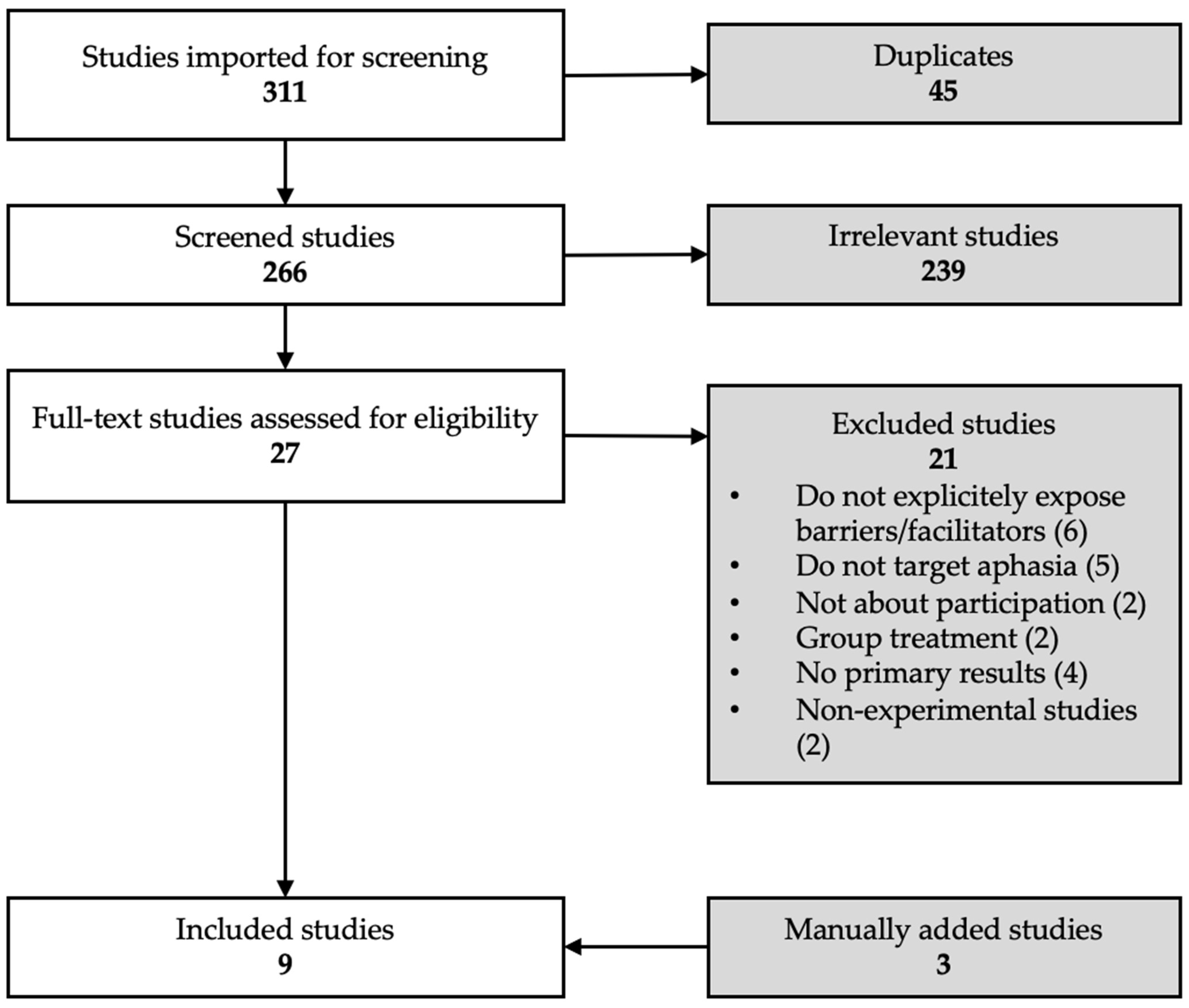
| 9 | Study selection results | Identify the number of studies screened and provide reasons for study exclusion. | 158–161 Figure 1 |
| 10 | Rationale for appraisal | Describe the rationale and approach used to appraise the included studies or selected findings. | 123–126 |
| 11 | Appraisal items | State the tools, frameworks, and criteria used to appraise the studies or selected findings. | 124–129 Appendix C |
| 12 | Appraisal process | Indicate whether the appraisal was conducted independently by more than one reviewer and if consensus was required. | 127–129 |
| 13 | Appraisal results | Present the results of the quality assessment and indicate which articles, if any, were weighted/excluded based on the assessment and give the rationale. | 176–180, Table 2 Appendix C |
| 14 | Data extraction | Indicate which sections of the primary studies were analyzed and how the data were extracted from the primary studies. | 131–139 |
| 15 | Software | State the computer software used, if any. | No software used for analysis |
| 16 | Number of reviewers | Identify who was involved in coding and analysis. | 132–133 |
| 17 | Coding | Describe the process of the coding of data. | 140–151 |
| 18 | Study comparison | Describe how comparisons were made within and across studies. | 140–151 |
| 19 | Derivation of themes | Explain whether the process of deriving the themes or constructs was inductive or deductive. | 140–151 |
| 20 | Quotations | Provide quotations from the primary studies to illustrate themes/constructs and identify whether the quotations were participant quotations or the author’s interpretation. | Table 3 and Table 4 |
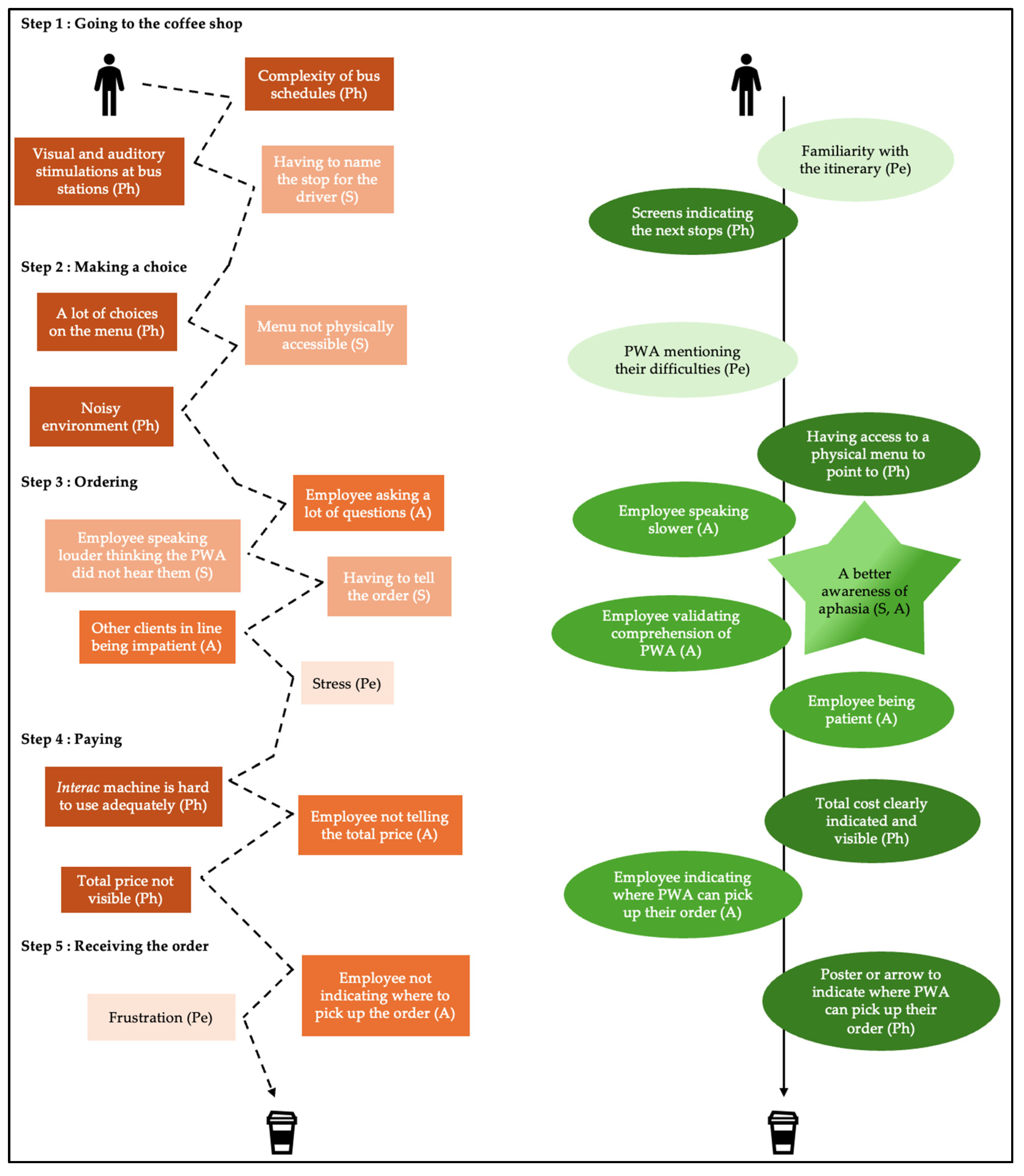
| 21 | Synthesis output | Present rich, compelling, and useful results that go beyond a summary of the primary studies. | Table 3 and Table 4, Figure 2 |
Appendix B
| Database | Keywords | Results | |
|---|---|---|---|
| Google Scholar | aphasi *|”aphasic person”|”language disorder”|”communication disorder”|”communication impairment” accessib *|”accessible communication”|”communication access”|”access program”|”access measure”|”universal access”|”universal design *”|”assistive technolog *”|”architectur * access *”|adapt *|signage|”social participation”|accommodat *|independen *|”inclusive society”|inclusi *|barriers|facilitators “public facilit *”|”public space *”|”financial institution *”|store *|shop *|museum *|transportation|restaurant * | 200 first results | |
| CINAHL | In title and in abstract: (aphasi * OR (“language disorders” or “language impairment” or “specific language disorder”) OR “communicati * impairment” OR “acquired language disorder”) AND (accessib * OR communicati * N3 access * OR access * N3 program OR access * N3 measure OR universal access OR universal design OR assistive technolog * OR accomodations OR (barriers or obstacles or challenges) OR facilitators) AND (public facilit * OR public space OR communit * N3 participation OR social N3 participation) Criteria: All adults | 21 | |
| MEDLINE | Searched via Ovid | In title and abstract: (aphasi * or language disorders or language impairment or specific language disorder or communicati * impairment or acquired language disorder) AND (accessib * or (communicati * adj3 access *) or (access * adj3 program) or (access * adj3 measure) or accomodations or barriers or obstacles or facilitators) AND (public facilit * or public space or (communit * adj3 participation) or (social adj3 participation)) | 10 |
| PsycINFO | 22 | ||
| ERIC | 1 | ||
| Web of Science | (aphasi * OR “language disorders” OR “language impairment” OR “specific language disorder” OR “acquired language disorder” OR “communicati * impairment”) AND (accessib * OR “communicati * access *” OR “access * program” OR “access * measure” OR “universal access” OR “universal design” OR “assistive technolog *” OR accomodations OR barriers or obstacles or challenges OR facilitators) AND (“public facilit *” OR “public space” OR “communit * participation” OR “social participation”) Document types: Articles | 57 | |
| Manually added references | 3 | ||
| Total number of references | 314 | ||
| Number of screened references (duplicates removed) | 269 | ||
Appendix C
| Criterion | Ref. No. | ||||||||
|---|---|---|---|---|---|---|---|---|---|
| [20] | [21] | [22] | [9] | [23] | [24] | [25] | [26] | [27] | |
| Question/objective sufficiently described? | 2 | 2 | 2 | 2 | 2 | 2 | 2 | 2 | 2 |
| Study design evident and appropriate? | 2 | 2 | 2 | 2 | 2 | 2 | 1 | 2 | 2 |
| Context for the study clear? | 2 | 2 | 2 | 2 | 2 | 2 | 1 | 2 | 2 |
| Connection to a theoretical framework/wider body of knowledge? | 1 | 2 | 2 | 2 | 0 | 2 | 0 | 1 | 2 |
| Described sampling strategy relevant and justified? | 1 | 2 | 2 | 2 | 2 | 1 | 2 | 2 | 2 |
| Data collection methods clearly described and systematic? | 2 | 2 | 2 | 2 | 2 | 2 | 2 | 2 | 2 |
| Data analysis clearly described and systematic? | 2 | 2 | 2 | 2 | 2 | 2 | 2 | 2 | 2 |
| Use of verification procedure(s) to establish credibility? | 2 | 2 | 2 | 2 | 2 | 2 | 2 | 2 | 2 |
| Conclusion supported by the results? | 2 | 2 | 2 | 2 | 2 | 2 | 1 | 2 | 2 |
| Reflexivity of the account? | 2 | 2 | 2 | 2 | 2 | 0 | 2 | 2 | 2 |
References
- Dickey, L.; Kagan, A.; Lindsay, M.P.; Fang, J.; Rowland, A.; Black, S. Incidence and Profile of Inpatient Stroke-Induced Aphasia in Ontario, Canada. Arch. Phys. Med. Rehabil. 2010, 91, 196–202. [Google Scholar] [CrossRef]
- American Speech-Language-Hearing Association Aphasia. Available online: https://www.asha.org/public/speech/disorders/aphasia/ (accessed on 10 June 2024).
- World Health Organization International Classification of Functioning, Disability and Health: ICF. Available online: https://www.who.int/standards/classifications/international-classification-of-functioning-disability-and-health (accessed on 10 June 2024).
- Hall, M.J.; Levant, S.; DeFrances, C.J. NCHS Data Brief No. 95, May 2012. 95. 2012. Available online: https://www.scirp.org/reference/referencespapers?referenceid=2334094 (accessed on 10 June 2024).
- Graham, J.R.; Pereira, S.; Teasell, R. Aphasia and Return to Work in Younger Stroke Survivors. Aphasiology 2011, 25, 952–960. [Google Scholar] [CrossRef]
- Roth, E.J.; Lovell, L. Community Skill Performance and Its Association with the Ability to Perform Everyday Tasks by Stroke Survivors One Year Following Rehabilitation Discharge. Top. Stroke Rehabil. 2007, 14, 48–56. [Google Scholar] [CrossRef] [PubMed]
- Hilari, K.; Needle, J.J.; Harrison, K.L. What Are the Important Factors in Health-Related Quality of Life for People with Aphasia? A Systematic Review. Arch. Phys. Med. Rehabil. 2012, 93, S86–S95.e4. [Google Scholar] [CrossRef]
- Alary Gauvreau, C.; Le Dorze, G. Participant Reported Outcomes of a Community of Practice about Social Participation for Speech-Language Pathologists in Aphasia Rehabilitation. Disabil. Rehabil. 2022, 44, 231–242. [Google Scholar] [CrossRef] [PubMed]
- Howe, T.J.; Worrall, L.E.; Hickson, L.M.H. Interviews with People with Aphasia: Environmental Factors That Influence Their Community Participation. Aphasiology 2008, 22, 1092–1120. [Google Scholar] [CrossRef]
- U.S. Department of Justice Civil Rights Division Americans with Disabilities Act. Available online: https://www.ada.gov/ (accessed on 10 June 2024).
- Disability Discrimination Act; 1992. Available online: https://www.legislation.gov.au/C2004A04426/2018-04-12/text (accessed on 10 June 2024).
- An Act to Ensure a Barrier-Free Canada of 2019; 2019; Bill C-81. Available online: https://www.justice.gc.ca/eng/csj-sjc/pl/charter-charte/c81.html (accessed on 10 June 2024).
- Law, J.; van der Gaag, A.; Hardcastle, W.J.; Beckett, D.J.; MacGregor, A.; Plunkett, C. Communication Support Needs: A Review of the Literature; Scottish Executive Social Research, 2007. Available online: https://eresearch.qmu.ac.uk/bitstream/handle/20.500.12289/2013/communication_support_needs_lit_review_2007.pdf?sequence=1&isAllowed=y (accessed on 10 June 2024).
- Orchardson, R. Aphasia—The Hidden Disability. Dent. Update 2012, 39, 168–174. [Google Scholar] [CrossRef]
- Tierney-Hendricks, C.; Schliep, M.E.; Vallila-Rohter, S. Using an Implementation Framework to Survey Outcome Measurement and Treatment Practices in Aphasia. Am. J. Speech Lang. Pathol. 2022, 31, 1133–1162. [Google Scholar] [CrossRef]
- Tong, A.; Flemming, K.; McInnes, E.; Oliver, S.; Craig, J. Enhancing Transparency in Reporting the Synthesis of Qualitative Research: ENTREQ. BMC Med. Res. Methodol. 2012, 12, 181. [Google Scholar] [CrossRef]
- Haddaway, N.R.; Collins, A.M.; Coughlin, D.; Kirk, S. The Role of Google Scholar in Evidence Reviews and Its Applicability to Grey Literature Searching. PLoS ONE 2015, 10, e0138237. [Google Scholar] [CrossRef]
- Covidence Systematic Review Software 2024. Available online: https://www.covidence.org/ (accessed on 10 June 2024).
- Kmet, L.M.; Lee, R.C.; Cook, L.S. Standard Quality Assessment Criteria for Evaluating Primary Research Papers from a Variety of Fields. 2004. Available online: https://www.ihe.ca/advanced-search/standard-quality-assessment-criteria-for-evaluating-primary-research-papers-from-a-variety-of-fields (accessed on 10 June 2024).
- Kim, E.S.; Mauriks, K.; Wilson, C.; Auch, L.; Koo, H.; Swensrude, D.; Laccett, J.; Ruelling, A. Barriers and Facilitators to Communication Accessibility as Perceived by People with Aphasia. Top. Lang. Disord. 2023, 43, 76–90. [Google Scholar] [CrossRef]
- Taylor, S.; Wilson, E.; Murfitt, K.; Balandin, S. Communication Access in the Retail Environment for People with Complex Communication Needs. Disabil. Rehabil. 2021, 43, 3189–3198. [Google Scholar] [CrossRef]
- Dalemans, R.J.P.; De Witte, L.; Wade, D.; Van Den Heuvel, W. Social Participation through the Eyes of People with Aphasia. Int. J. Lang. Commun. Disord. 2010, 45, 537–550. [Google Scholar] [CrossRef]
- Blonski, D.C.; Covert, M.; Gauthier, R.; Monas, A.; Murray, D.; O’Brien, K.K.; Mendelson, A.D.; Huijbregts, M. Barriers to and Facilitators of Access and Participation in Community-Based Exercise Programmes from the Perspective of Adults with Post-Stroke Aphasia. Physiother. Can. 2014, 66, 367–375. [Google Scholar] [CrossRef] [PubMed]
- Ashton, C.; Aziz, N.A.; Barwood, C.; French, R.; Savina, E.; Worrall, L. Communicatively Accessible Public Transport for People with Aphasia: A Pilot Study. Aphasiology 2008, 22, 305–320. [Google Scholar] [CrossRef]
- Anglade, C.; Le Dorze, G.; Croteau, C. Service Encounter Interactions of People Living with Moderate-to-Severe Post-Stroke Aphasia in Their Community. Aphasiology 2019, 33, 1061–1082. [Google Scholar] [CrossRef]
- Howe, T.J.; Worrall, L.E.; Hickson, L.M.H. Observing People with Aphasia: Environmental Factors That Influence Their Community Participation. Aphasiology 2008, 22, 618–643. [Google Scholar] [CrossRef]
- Le Dorze, G.; Salois-Bellerose, É.; Alepins, M.; Croteau, C.; Hallé, M.-C. A Description of the Personal and Environmental Determinants of Participation Several Years Post-Stroke According to the Views of People Who Have Aphasia. Aphasiology 2014, 28, 421–439. [Google Scholar] [CrossRef]
- Baylor, C.; Burns, M.; Eadie, T.; Britton, D.; Yorkston, K. A Qualitative Study of Interference with Communicative Participation Across Communication Disorders in Adults. Am. J. Speech Lang. Pathol. 2011, 20, 269–287. [Google Scholar] [CrossRef]
- Nunn, K.; Tilton-Bolowsky, V.; Kershenbaum, A.M. Moving Toward Anti-Ableist Practices in Aphasia Rehabilitation and Research: A Viewpoint. Am. J. Speech Lang. Pathol. 2024, 1–11. [Google Scholar] [CrossRef]
- Hagan, T.; Rosenzweig, M.; Zorn, K.; Van Londen, G.J.; Donovan, H. Perspectives on Self-Advocacy: Comparing Perceived Uses, Benefits, and Drawbacks Among Survivors and Providers. Oncol. Nurs. Forum 2017, 44, 52–59. [Google Scholar] [CrossRef]
- Howe, T.; McCarron, E.; Rowe, J. What Helps Confidence in Communication—Perspectives of Adults with Aphasia: “Get Maze…not Stay out It”. J. Commun. Disord. 2023, 103, 106334. [Google Scholar] [CrossRef] [PubMed]
- Howe, T. Found Opportunities for Social Participation: Facilitating Inclusion of Adults with Aphasia. Top. Lang. Disord. 2017, 37, 38–51. [Google Scholar] [CrossRef]
- Miller, E.L. Negotiating Communicative Access in Practice: A Study of a Memoir Group for People with Aphasia. Writ. Commun. 2019, 36, 197–230. [Google Scholar] [CrossRef]
- Bennington, C.; Shiggins, C.; Isaksen, J.; Beesley, E.; Beesley, K.; Wallace, S.J. What Does It Mean to Be Aphasia Aware? An International Survey of Stakeholder Perspectives and Experiences of Aphasia Awareness. Aphasiology 2024, 1–24. [Google Scholar] [CrossRef]
- Aphasia Institute Programs & Services. Available online: https://www.aphasia.ca/programs-services/ (accessed on 10 June 2024).
- Stroke Association Aphasia Awareness and the Communications Access Symbol. Available online: https://www.stroke.org.uk/stroke/effects/aphasia/aphasia-awareness (accessed on 10 June 2024).
- Simmons-Mackie, N.; Worrall, L.; Shiggins, C.; Isaksen, J.; McMenamin, R.; Rose, T.; Guo, Y.E.; Wallace, S.J. Beyond the Statistics: A Research Agenda in Aphasia Awareness. Aphasiology 2020, 34, 458–471. [Google Scholar] [CrossRef]
- Government of Canada Accessibility Standards Canada. Available online: https://accessible.canada.ca/about-us (accessed on 10 June 2024).

| Contextual Factors | Contextual Factor Category | Factor Subtype |
|---|---|---|
| Environmental factors | Societal factors | Societal knowledge |
| Services | ||
| Policies (e.g., municipal, governmental) | ||
| Procedures | ||
| Task characteristics (e.g., requiring writing) | ||
| Financial matters | ||
| Transportation | ||
| Service characteristics | ||
| Attitudinal factors | Other people’s actions | |
| Other people’s attitudes | ||
| Other people’s knowledge | ||
| Other people’s characteristics | ||
| Other people’s roles (e.g., caregiver) | ||
| Animals (i.e., presence of animals in the immediate environment) | ||
| Physical factors | Objects’ characteristics | |
| Objects (e.g., phones) | ||
| Acoustic characteristics | ||
| Visual characteristics | ||
| Spatial characteristics | ||
| Physical environment characteristics (e.g., familiarity of the environment) | ||
| Personal factors | Undefined | Undefined |
| Ref. No. | Authors (Year) | Country | Accessibility Context | People with Aphasia | Data Collection Strategy | Methodological Quality [19] |
|---|---|---|---|---|---|---|
| [20] | Kim et al. (2023) | Canada | Local businesses | 9 | Interviews | 18/20 |
| [21] | Taylor et al. (2021) | Australia | Local businesses | 1 | Interview | 20/20 |
| [22] | Dalemans et al. (2010) | Netherlands | Local businesses | 13 | Interviews | 20/20 |
| [9] | Howe et al. (2008a) | Australia | Local businesses, public transportation | 25 | Interviews | 20/20 |
| [23] | Blonski et al. (2014) | Canada | Community centre with exercise programs | 10 | Interviews | 18/20 |
| [24] | Ashton et al. (2008) | Australia | Public transportation | 7 | Interviews and, observation | 17/20 |
| [25] | Anglade et al. (2019) | Canada | Local businesses | 6 | Observation | 15/20 |
| [26] | Howe et al. (2008b) | Australia | Local businesses | 10 | Observation | 19/20 |
| [27] | Le Dorze et al. (2014) | Canada | Local businesses | 17 | Discussion groups | 20/20 |
| Category of Contextual Factors | Factor Subtype | Barriers | Facilitators |
|---|---|---|---|
| Societal factors | Societal knowledge |
| “Understanding… Education about aphasia is the most important one.” [9] |
| Services |
| ||
| Policies |
|
| |
| Procedures |
| ||
| Task characteristics |
| ||
| Financial matters |
| ||
| Transportation | |||
| Attitudinal factors | Other people’s actions |
| |
| Other people’s attitudes |
|
| |
| Other people’s knowledge |
|
| |
| Other people’s characteristics |
|
| |
| Other people’s roles |
| ||
| Animals |
| ||
| Physical factors | Objects’ characteristics |
| |
| Objects |
|
| |
| Acoustic characteristics |
|
| |
| Visual characteristics |
| ||
| Spatial characteristics |
| ||
| Physical environment characteristics |
| Type of Personal Factors | Barriers | Facilitators |
|---|---|---|
| Motivation |
|
|
| Physical and psychological conditions |
|
Disclaimer/Publisher’s Note: The statements, opinions and data contained in all publications are solely those of the individual author(s) and contributor(s) and not of MDPI and/or the editor(s). MDPI and/or the editor(s) disclaim responsibility for any injury to people or property resulting from any ideas, methods, instructions or products referred to in the content. |
© 2024 by the authors. Licensee MDPI, Basel, Switzerland. This article is an open access article distributed under the terms and conditions of the Creative Commons Attribution (CC BY) license (https://creativecommons.org/licenses/by/4.0/).
Share and Cite
Poirier, S.-È.; Voyer, L.-A.; Poulin, V.; Lamontagne, M.-E.; Monetta, L. Communication Challenges for People with Chronic Aphasia: A Systematic Qualitative Review of Barriers and Facilitators in Local Services. Disabilities 2024, 4, 616-631. https://doi.org/10.3390/disabilities4030038
Poirier S-È, Voyer L-A, Poulin V, Lamontagne M-E, Monetta L. Communication Challenges for People with Chronic Aphasia: A Systematic Qualitative Review of Barriers and Facilitators in Local Services. Disabilities. 2024; 4(3):616-631. https://doi.org/10.3390/disabilities4030038
Chicago/Turabian StylePoirier, Sarah-Ève, Laurie-Anne Voyer, Valérie Poulin, Marie-Eve Lamontagne, and Laura Monetta. 2024. "Communication Challenges for People with Chronic Aphasia: A Systematic Qualitative Review of Barriers and Facilitators in Local Services" Disabilities 4, no. 3: 616-631. https://doi.org/10.3390/disabilities4030038
APA StylePoirier, S.-È., Voyer, L.-A., Poulin, V., Lamontagne, M.-E., & Monetta, L. (2024). Communication Challenges for People with Chronic Aphasia: A Systematic Qualitative Review of Barriers and Facilitators in Local Services. Disabilities, 4(3), 616-631. https://doi.org/10.3390/disabilities4030038