


Abstract
Post-consumer clothing waste is a growing problem that contributes to environmental and resource management issues. The second-hand market redirects these garments away from landfills, but a large portion still ends up as waste. These waste clothes mainly originate from developed countries and are then exported to developing countries, but almost half of the garments imported are not sold due to poor quality. This leads to the generation of more textile waste and environmental pollution. These challenges highlight need for sustainable solutions that enhance social, environmental, and economic benefits in the developing countries to which clothing waste is exported to. Encouraging methods that extend garment lifespan, promote reuse and support the principles of the circular economy creates a cleaner environment and enables more efficient use of resources. This study aimed to investigate how design can be used to catalyse change, using a co-design approach with senior female citizens from a non-governmental organization (NGO) in Cape Town, South Africa. The participants transformed second-hand clothes from the second-hand market into valuable products for reuse. The fieldwork was conducted between 23 May and 24 October 2024 to explore the role of design in enhancing sustainability, prolonging garment lifespan, and supporting local entrepreneurship. The data collection methods for this qualitative study included observational fieldwork, interactive co-design workshops, and semi-structured interviews. Analysis of the empirical data underscores the transformative potential of the intervention. Initially, the results showed that participants used intuitive sewing and unsystematic garment modification and were creative yet unaware of a structured design process and sustainability principles. Following the expert-led co-design workshops, participants’ intuitive redesign practices developed into a hybrid process combining garment assessment, design planning, reconstruction, and finishing. The project produced 37 documented outputs across clothing, footwear-related samples, and accessories, showing how selected post-consumer garments acquired renewed utility through redesign. Participants reported increased confidence, a stronger sense of purpose, and a willingness to share their upcycling skills within their communities. These findings informed a Community-Based Upcycling Framework linking garment recovery and redesign with community learning, environmental stewardship, and potential livelihood pathways.
1. Introduction
The global fashion industry, characterised by fast fashion, has precipitated an exponential surge in production, consumption, and generation of clothing waste. This intensification has resulted in considerable depletion of resources and pollution of the environment. About 92 million tons of textile waste are generated every year, and this is projected to rise to 150 million tons by 2050 [1]. About 85% of discarded textiles are disposed of in landfills or burned, causing pollution and waste management problems around the globe [2,3]. In South Africa, waste prevention and waste minimisation are the most preferred forms of waste management, followed by reuse, recycling, and recovery of the waste, and finally disposal as the least preferred [4]. For clothing, direct reuse, repair, and upcycling are related but distinct strategies. Direct reuse keeps a garment in circulation with little or no alteration, repair restores a damaged garment to use, and upcycling redesigns a garment or its usable components to create renewed function or value [5,6]. Upcycling may help slow material flows when it retains usable fabric, and the resulting product remains in use. In this respect, it aligns with slow fashion, which challenges the rapid production, consumption, and disposal cycles associated with fast fashion by emphasising longevity, care, local production, and skilled making [7,8,9]. These benefits, however, should not be assumed. In some cases, direct reuse, repair, or resale may preserve more of a garment’s existing value, while the environmental performance of upcycling depends on material lost during cutting, additional resource inputs, and the durability and subsequent use of the redesigned product.
Policy and regulation provide an important but uneven context for textile circularity. In South Africa, the National Environmental Management: Waste Act 59 of 2008 and the National Waste Management Strategy 2020 established the overarching legal and policy basis for waste prevention, reuse, recycling, recovery, and environmentally responsible disposal [10,11]. The national Extended Producer Responsibility (EPR) regulations imposed post-consumer obligations only for products formally identified under Section 18 of the regulation [10,11]. The 2020–2021 notices concerning electrical and electronic equipment, lighting, and paper, packaging, and certain single-use products did not establish a textile-specific EPR scheme [11,12]. In contrast, the EU’s amended Waste Framework Directive calls for the creation of textile EPR schemes in member states, as textile end-of-life management is gaining greater importance on the international regulatory agenda [13]. In the South African context, community upcycling activity should thus be seen as a voluntary complement to formal waste management systems, and not as a replacement for the responsibility of the producer or the municipality. This can result in the retention of textile materials in use while providing opportunities for learning, skills development, and livelihood support.
Within the clothing sector, small social enterprises play a vital role in promoting waste reduction, upcycling, and sustainable and ethical fashion products, contributing to the circular economy [14]. In this sphere, models that enable the creation of localised, community-based collaborative networks like Small, Local, Open, and Connected (SLOC) are central to co-creating sustainable solutions. By championing collaborative and relational design methods, these organisations foster participatory social dynamics that empower designers. Furthermore, their promotion of co-creation frameworks emphasises craftsmanship and encourages more environmentally friendly methods in the fashion industry [8]. Through grassroots initiatives, these enterprises raise consumer awareness of sustainable fashion, inspiring socially and environmentally responsible purchasing behaviours. Such efforts can directly support broader structural shifts toward a circular fashion business model [15]. While existing scholarship frequently evaluates these enterprises as discrete case studies, their collective capacity to inspire collaborative craft and drive circular economies is foundational. Consequently, they serve as crucial informational bridges, educating consumers on product life cycles and fostering sustainable actions [8,16].
Small social enterprises encounter many financial, technological, and social challenges, delaying the implementation of circular economy practices and perpetuating an unsustainable reliance on linear production models, despite advancements in sustainable fashion [17,18]. Consequently, cross-sectoral collaboration and strategic partnerships are crucial for building their capacity and maximising their impact on circular fashion efforts. Sandvik and Stubbs [19] stress the value of circular fashion supply chains, especially textile-to-textile recycling, as well as the importance of sustainable supply chain practices and strong partnerships. There is, however, a lack of effective collaboration between key stakeholders to date, including second-hand clothing small social enterprises, which slows the realisation of full circularity, as noted by Haeggblom and Budde [20].
C2C offers a prescriptive design approach for evaluating how discarded materials can retain value through conscious redesign [18]. Social entrepreneurship provides a theoretical basis for how organisations achieve social objectives through entrepreneurial, revenue-generating pursuits. This research examines material recovery, community benefits, and economic viability within Grandmothers Against Poverty and AIDS (GAPA), a community-based NGO in Cape Town that operates through a social enterprise framework [21].
The design thinking framework includes the Double Diamond model, which has gained recognition and adoption across diverse disciplines; however, its application within clothing and textile studies remains limited. In clothing and textile upcycling, effective redesign depends on successful problem exploration and solution development, which is where the Double Diamond model can play a significant role [22]. Moreover, upcycling requires the designer to first evaluate the state of the waste garment, including wear and tear as well as practical and aesthetic constraints [23]. This evaluation is consistent with the Discover stage of the Double Diamond model, which consists of exploration and the identification of intervention opportunities [24].
Existing research has approached circular fashion from several perspectives. Paço et al. (2021) and Syahrivar et al. (2023) examined consumer behaviour [3,25]; Sandberg (2023) considered retailer-led coordination of used clothing supply chains [26]; D’Adamo et al. (2022) explored the second-hand market in relation to business and consumer expectations [14]; and Hirscher et al. (2019) demonstrated how participatory making can create value within local communities [8]. Together, these studies offer limited process-level insight into how a resource-constrained South African community organisation develops, structures, and adapts upcycling practices through co-design over time.
This study addresses that gap through a qualitative case study of the upcycling initiative at GAPA in Cape Town. GAPA is classified as a social enterprise in this study because it sells crafted products to raise funds for its social programmes and enables participating seniors to sell their products for personal income [21,27]. The unit of analysis is the development of upcycling practices within the participating GAPA sewing cohort during fieldwork conducted between May and October 2024. Taking Care of Business (TCB), a nonprofit social enterprise, provided external training and the setting for the co-design workshops [28]. The study documents the evolution of design practice across three phases: initial intuitive upcycling at GAPA, structured co-design workshops at TCB, and post-workshop adaptation at GAPA. The findings inform a context-specific Community-Based Upcycling Framework. Accordingly, they are not presented as representative of small social enterprises generally.
Integrated Conceptual Framework and Analytical Roles
This study uses five complementary elements with distinct roles: Cradle to Cradle (C2C) as a normative design framework [29], social entrepreneurship as a theoretical perspective [27], SLOC as a contextual framework [30], co-design as a participatory approach [31], and the Double Diamond as a design process model and analytical heuristic [22]. These elements were selected to address, respectively, material circularity, social and economic value, community context, participant agency, and the garment redesign process. Table 1 summarises their relationship to the research questions, evidence, and analysis.
Table 1.
Mapping of the conceptual elements to the research questions, evidence, and analysis.
These elements operate at different but connected analytical levels rather than as one explanatory theory. C2C addresses the material level; social entrepreneurship and SLOC address organisational and community value; co-design addresses participation; and the Double Diamond addresses the design process. The three project phases, initial intuitive upcycling at GAPA, structured co-design workshops at TCB, and post-workshop application at GAPA, represent the chronology of the fieldwork. By contrast, Discover, Define, Develop, and Deliver are used to interpret design activities occurring within and across those phases. Participants were not assumed to have followed all four stages sequentially or to the same extent.
The three project phases describe the chronology of the fieldwork, whereas the Double Diamond provides a process structure for examining how design activities developed within and across those phases. Together, the five elements connect material circularity, social enterprise value, community networks, participant participation, and the garment redesign process within an integrated conceptual framework.
2. Research Methodology and Design
2.1. Research Design
2.1.1. Qualitative Methodology
A qualitative research methodology was employed to provide in-depth insights into participants’ design activities, motivations, and experiences. This method is suitable for complex socio-cultural issues such as the role of design, sustainability, and community empowerment [32].
2.1.2. Exploratory Case Study
The research was conducted through an exploratory case study design, which was used to study the upcycling practices of GAPA grandmothers. This approach enabled an in-depth investigation of the phenomenon within its real-life context and provided a detailed explanation of the processes and interactions. This approach captured the context-specific processes of the community-based upcycling initiative.
2.1.3. Co-Design Approach Within the Small, Local, Open, and Connected (SLOC) Context
A co-design approach guided by the SLOC framework supported participatory, context-specific design activities aligned with circular economy principles.
- Small: Working with a small group enabled meaningful participation and kept interventions manageable and focused [31].
- Local: The design activities were rooted in the local Cape Town context, drawing on community resources and local knowledge [33].
- Open: The co-design process was open to incorporating participants’ ideas, fostering innovation and creativity [30].
- Connected: The project connected local practices to broader networks and discourses on sustainability and the circular economy [34].
2.2. Participants and Sampling
Purposive sampling was used to recruit ten GAPA members (n = 10, aged 58–74 years) in Cape Town. All had completed a prior 12-week sewing programme, providing foundational sewing experience. All ten participants took part in the three-phase upcycling project. Eight participants (P1, P2, P4, P5, P7, P8, P9, and P10) subsequently completed individual semi-structured interviews; P3 and P6 were unavailable for interviews.
The bounded ten-participant cohort enabled repeated observation of upcycling practices across the three project phases, while interviews with eight participants provided detailed accounts of their design motivations. Together, these data supported an in-depth examination of how upcycling practices developed within GAPA’s organisational and community context, with potential relevance to comparable community-based initiatives.
2.3. Data Collection Methods
Multiple data collection resources were utilised to address the research questions. Co-design informed participation in the workshops, while the remaining conceptual elements were used analytically, as specified in the section “Integrated Conceptual Framework and Analytical Roles”.
2.3.1. Co-Design Workshops
Co-design workshops were central to the data collection, embodying the SLOC principles:
- Type One Upcycling: Participants individually selected clothing items from second-hand shops and began upcycling intuitively, relying on their creativity and local knowledge. Facilitators assisted as needed.
- Type Two Upcycling: An upcycling design expert conducted workshops introducing a structured, step-by-step method, including disassembling, sketching, fitting, and construction.
2.3.2. Business Skills Training
A TCB trainer conducted workshops to assist participants in developing successful upcycling businesses. This component aligned with the Connected aspect of the SLOC framework, linking local initiatives to broader economic opportunities.
2.3.3. Participant Observations and Semi-Structured Interviews
Fieldwork was conducted between 23 May and 24 October 2024 across three phases: initial intuitive upcycling at GAPA, structured co-design and skills development supported by TCB, and post-workshop application at GAPA. Ten GAPA participants took part in the upcycling sessions and provided written informed consent. The TCB sessions were facilitated by an external upcycling specialist, while the researcher documented the activities through observations, photographs, videos, and records of the garments produced.
At the end of the project, eight of the ten participants (P1, P2, P4, P5, P7, P8, P9, and P10) completed individual semi-structured interviews. The interview guide addressed participants’ sewing backgrounds, workshop experiences, design decisions, motivations, perceptions of the environmental, social, and economic value of upcycling, and future aspirations. The interview interactions involved isiXhosa, isiZulu, and English code switching to accommodate all participants. They were digitally recorded and lasted approximately 24–45 min. The English–isiZulu interview guide is provided in Supplementary File S1.
2.3.4. Artefact Analysis and Documentation Review
Upcycled clothing items were analysed for design features, functionality, and craftsmanship quality, and relevant documents such as literature and training materials were also reviewed.
2.4. Data Collection Aligned with Objectives
Data collection and analysis were guided by three research questions, namely, RQ1, RQ2, and RQ3, as defined below.
- RQ1. What key design activities can social enterprises in communities use to develop effective upcycling processes for post-consumer clothing waste?
- RQ2. How do these design activities contribute to the circular economy, and how may they be further developed to equip these social enterprises for the realisation of sustainable business?
- RQ3. Why do participating designers choose particular designs or techniques when upcycling post-consumer clothing waste, and how can this knowledge be used to improve the effectiveness of upcycling processes and their contribution to the circular economy?
Data collection was guided by the corresponding objectives to ensure a comprehensive and efficient response to the research questions.
Objective 1: Determine Design Activities
- Data Sources: Data included observations of design processes, documentation of procedural steps, and participants’ reflections.
Objective 2: Assess Effects on Circular Economy
- Data Sources: The analysis included the evaluation of upcycled products, observations of resource efficiency, and the assessment of participants’ understanding of circular economy principles.
Objective 3: Evaluate Motivations for Design Choice
- Data Sources: In-depth interviews were conducted to explore participants’ personal and community motivations, as well as their reflections on cultural, economic, and environmental influences.
2.5. Data Analysis
The data sources were analysed in relation to the three research questions. For RQ1, observation records and dated photographic and video documentation were compared across the three fieldwork phases to identify recurring design activities and changes in participants’ practices. For RQ2, garment artefacts and their process records were examined in relation to material reuse, structural transformation, functionality, and finishing. The eight interviews addressing RQ3 were analysed using Braun and Clarke’s six-phase approach to reflexive thematic analysis [35,36]. The audio recordings were transcribed, checked against the recordings, corrected where necessary, and translated into English. All reported quotations were verified against the recordings, while final coding, theme development, and interpretation remained the researcher’s responsibility. Analysis moved recursively through familiarisation, initial coding, theme development, theme review, theme definition, and reporting. All quotations included in the article were verified against the recordings.
The credibility of the findings was supported by comparing interview accounts with observations, dated photographs, and garment specimens related to the same activity or event. The researcher maintained a complete documentary audit trail of the fieldwork programme, including attendance records, photographs, videos, interviews, transcripts (corrected where necessary), and analysis records.
2.6. Ethical Considerations
The Faculty of Informatics and Design at the Cape Peninsula University of Technology granted ethical approval (Reference no: 22323645/2023/30). GAPA approval to conduct the research within the institution was granted, followed by the collection of written informed consent from all ten participants who took part in the research. The names of the participants were replaced with codes in the analysis and when reporting the research findings.
3. Results and Discussion
This section presents the study’s findings on how design, acting as a catalyst for change, influences the redesign of post-consumer clothing waste through partnerships with local second-hand shops and social enterprises. It demonstrates participants’ garment redesign activities, the products created, the potential value of upcycling practices, and the motivations behind their design choices. Co-design frames the analysis of participation and shared design decisions; Cradle to Cradle supports the interpretation of material value retention; social entrepreneurship addresses the relationship between GAPA’s social mission and income-generating activity; SLOC situates these practices within local community networks; and the Double Diamond maps the design process.
3.1. Key Design Activities (RQ1)
To address RQ1, participants’ practices were compared across three project phases: initial intuitive upcycling at GAPA, structured co-design workshops at TCB, and post-workshop application at GAPA. Three interconnected activities were identified: (A) intake triage and routing, (B) pattern drafting and manual cutting, and (C) garment construction and finishing. The following subsections examine how each activity changed across the three phases and how participants adapted the introduced practices to their local working conditions.
3.1.1. Activity A: Intake Triage and Routing
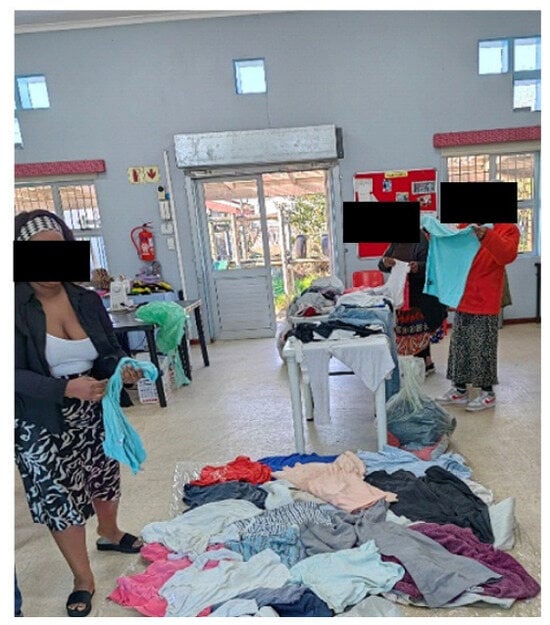
Activity A involved assessing the condition and redesign potential of post-consumer garments before cutting or construction. During Phase 1, participants relied mainly on rapid visual inspection and immediate judgement when selecting garments. Observations showed that they considered visible wear, staining, pilling, and seam condition when deciding whether a garment could be redesigned or used as a source of fabric panels. This represented an intuitive but relatively compressed assessment process (Figure 1).
Figure 1.
Participants visually assessing post-consumer garments and considering their suitability for redesign. Source: Authors’ fieldwork photographs (2024).
Selections were based on perceived redesign potential rather than formal fabric quality testing. Participants inspected garments for visible wear, staining, seam integrity, and pilling. Suitable garments were then routed either toward whole-garment redesign or toward using their fabric panels in another product.
Activity A was not performed during Phase 2 because the garments used in the structured co-design workshops had been pre-selected. However, the workshops introduced participants to panel identification, seamline disassembly, and whole-garment examination before cutting.
During Phase 3, participants examined major seams and usable fabric panels more deliberately before beginning transformation. Within the Double Diamond, this assessment was interpreted as part of the Discover stage, during which the available material and its possible uses were explored before selecting a design direction [22]. From a C2C perspective, recognising suitable garments as resources for further use reflects attention to their remaining material value [29]. This is consistent with circular and material-driven design approaches in which the condition and properties of available materials influence subsequent design possibilities [20,23].
3.1.2. Activity B: Pattern Drafting and Manual Cutting
In Phase 1, decision-making on pattern drafting and intuitive cutting was rapid and experiential. Participants typically:
- Placed the garment flat or held it against the body (improvising due to the lack of equipment such as mannequins).
- Folded fabric or pinched portions to visually evaluate the intended transformation.
- Used hand gestures to indicate the anticipated alterations.
- Cut directly into the garment, often without marking or disassembly.
This intuitive approach demonstrated participants’ embodied sewing knowledge. However, most design decisions were made during the cutting process of the garments, leaving limited opportunities to test alternative forms before the garment was upcycled. Consequently, this limited the circulation of material from waste to valuable product, as per the C2C “waste to food” principle. In practice, the participants skipped the Define stage and went directly to the Develop stage, in this case cutting. Thereby, the range of design options considered before cutting was restricted.
The Phase 2 co-design workshop provided a step-by-step and structured approach to garment transformation and facilitated an understanding of garment structure before cutting. This approach supported more deliberate technical planning, allowing participants to collaborate actively during the Define stage and develop design ideas using shared visual tools [30].
The process was planned and divided into a set of steps to help with garment transformation:
- Identification of major garment panels: The participants identified the main parts of garments such as front and back panels, sleeves, waistbands, and other major areas, to find the usable fabric areas and understand the garment’s structure.
- Garment Disassembly: Garments were cut along major seamlines after evaluation, which revealed the structure beneath the garment, as shown in Figure 2. Rather than working in isolation, participants collaboratively navigated the Define stage, using shared visual tools to negotiate their ideas.Figure 2. Separation of primary garment panels along existing seamlines during the structured co-design workshops. Source: Authors’ fieldwork photographs (2024).
- Sketching design ideas: This served as a visual tool to conceptualise the possible redesign concepts. The introduction of sketching externalised the design process, making it visible and open to reflection. It made design ideas available for discussion, comparison, and revision during the co-design activities.
- Draping: Fabric panels were arranged, folded, and pinned on mannequins to examine proportion, placement, and possible fit. Draping provided a physical means of testing design ideas before construction. This stage allowed fit assessment and adjustment in three-dimensional space. Like sketching, draping made the design process visible, allowing time for reflection.
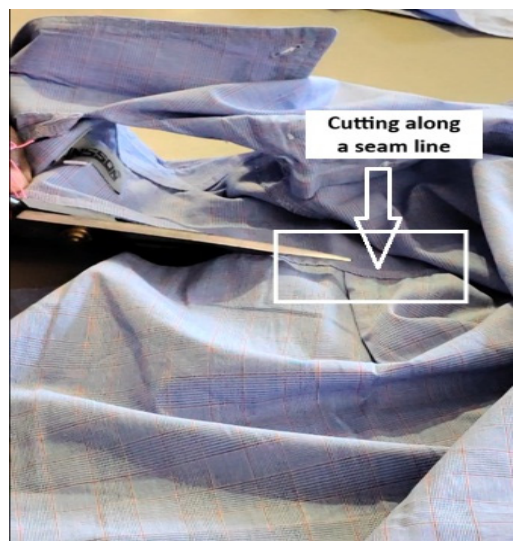
This systematic approach shifted the focus from immediate cutting to understanding the garment structure and exploring possible transformations before committing to a design.
Post-co-design sessions reflected the hybridisation of intuitive and structured practices. The observations showed that when laying the garment on the working table, the major seams were identified during a brief scan, i.e., a whole-material examination before cutting and ideation, indicating the influence of the structured upcycling practices acquired from the co-design sessions. Additionally, the fabric panels were further evaluated, visually measured, stretched, and folded to assess the folding area for size adjustments. In several instances, participants cut close to existing seamlines, thereby retaining larger usable panels [9].
3.1.3. Activity C: Garment Construction and Finishing
This section presents the final activity of the upcycling process: garment construction and the assembly of the redesigned garment. The concepts created through pattern drafting and cutting were transformed into new artefacts. While earlier activities such as waste evaluation and pattern drafting focused on exploration and planning, this stage required precision, coordination, and execution to deliver the established design decisions. Viewed through the Double Diamond lens, this stage corresponds to the Deliver phase of the model, where concepts are translated into tangible outputs. During the first upcycling phase at GAPA, participants relied on their intuition to make most of their decisions. Whether their intuition was based on lived experience was not fully established; however, at this stage, assembling and sewing skills were required; hence, decision-making can be attributed to the skills obtained or refined at the NGO. Participants worked mainly independently to complete the task, except for those with limitations such as visual impairment and hand tremor due to old age. The results showed the following activities as the major activities during this first phase of garment construction:
- Aligning and joining fabric pieces using stitches, dominated by plain seams.
- Assembling the garments, including the sub-assembly of small sections such as collars and pockets, and the main assembly, involving the joining of the main panels (front and back).
- Trimming and adjusting edges during the process to achieve the desired shape or length.
- Frequent heat pressing throughout the assembly process to maintain seam integrity and garment shape.
- Finishing with inspection, minor amendments, and thread trimming.
These activities demonstrated a strong foundation in embodied skills and knowledge of the sewing process, with decisions guided by experience rather than a standard procedure. Participants used flexible stitching techniques, including hand-stitching, to construct garments without a formal quality framework. However, they were able to turn design concepts into products through their sewing ability, showing adaptability, competence, and responsiveness to the materials available. The same core sewing techniques were used across phases, but the structured workshops made the preparation and assembly sequence more explicit.
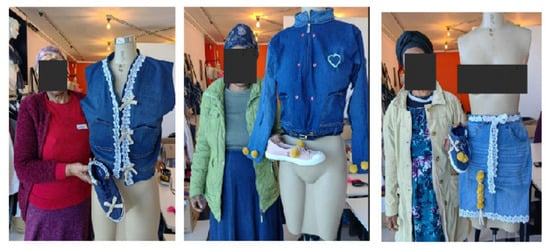
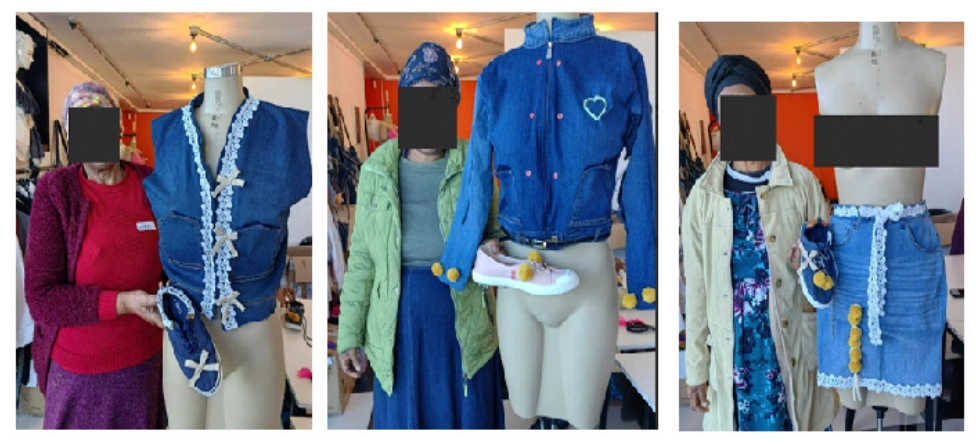
Post-workshop making remained collaborative. Participants assisted one another with activities such as threading and complex stitching, demonstrating peer-supported problem-solving during construction [30]. The collaborative approach enabled skill-sharing during the Deliver phase, and participants finished their work successfully with greater creativity, as shown by the number of embellishments they used (Figure 3).
Figure 3.
Examples of finishing and decorative details incorporated into the upcycled products, including appliqué, lace, fabric edging and shaped decorative elements. Source: Authors’ fieldwork photographs (2024).
Aside from assembly and finishing, the upcycling process also involved decorative methods to improve aesthetics. These included appliqué, beadwork, lace insertion, tassels, buttons, metal heart-shaped pieces, and fabric edging along the way [30].
The post-co-design garment making was similar to Phase 1 but also included aspects of structured upcycling. Fabric pieces were aligned and joined primarily with plain seams, including pockets, straps, and facings before incorporating them into the main parts of the garment.
Draping prior to sewing dominated this stage, a technique adopted from the structured upcycling method. This was also where the improvisation of fit and proportion using chairs and peers, in the absence of mannequins, was demonstrated.
While sketching was not consistently observed at this stage, construction decisions were increasingly informed by prior panel planning and physical prototyping. In addition to structural assembly, participants integrated embellishments into the construction process. Compared to Phase 1, the finishing included embellishments adopted from structured upcycling, which enhanced aesthetics. By elevating the final garment’s aesthetic appeal through appliqués and beadwork, the participants ensured that the redesigned textiles retained functional value. Ultimately, structuring these design activities through the Double Diamond model, mediated by a co-design ethos and informed by C2C material logic, provides social enterprises with a potentially scalable upcycling model, as participants share knowledge in their local groups [29].
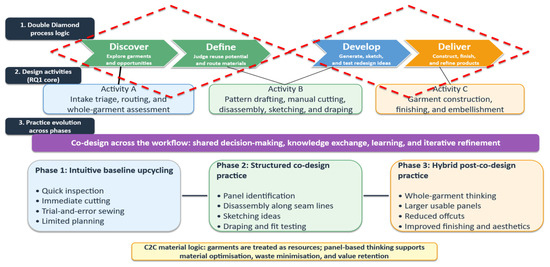
Figure 4 shows the three activities as an integrated garment redesign process. Activity A is garment assessment and routing, Activity B is design development, panel preparation, and cutting, and Activity C is construction and finishing. These activities are interpreted through the Double Diamond process.
Figure 4.
Upcycling framework for design activities (RQ1): Alignment of the Double Diamond process, Activities A–C, and practice evolution across the three project phases. Source: Authors’ own illustration informed by the Double Diamond [22].
Co-design happens throughout the entire workflow when people exchange ideas, practical knowledge, and design decisions. C2C is used more specifically as a treatment for post-consumer garments as materials with remaining use potential. Figure 4 thus reflects an analytical synthesis of observed activities, and does not claim that all participants adhered to an identical or linear procedure.
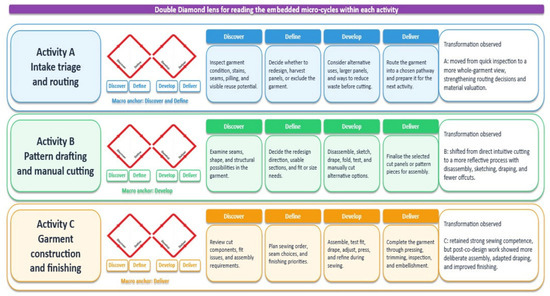
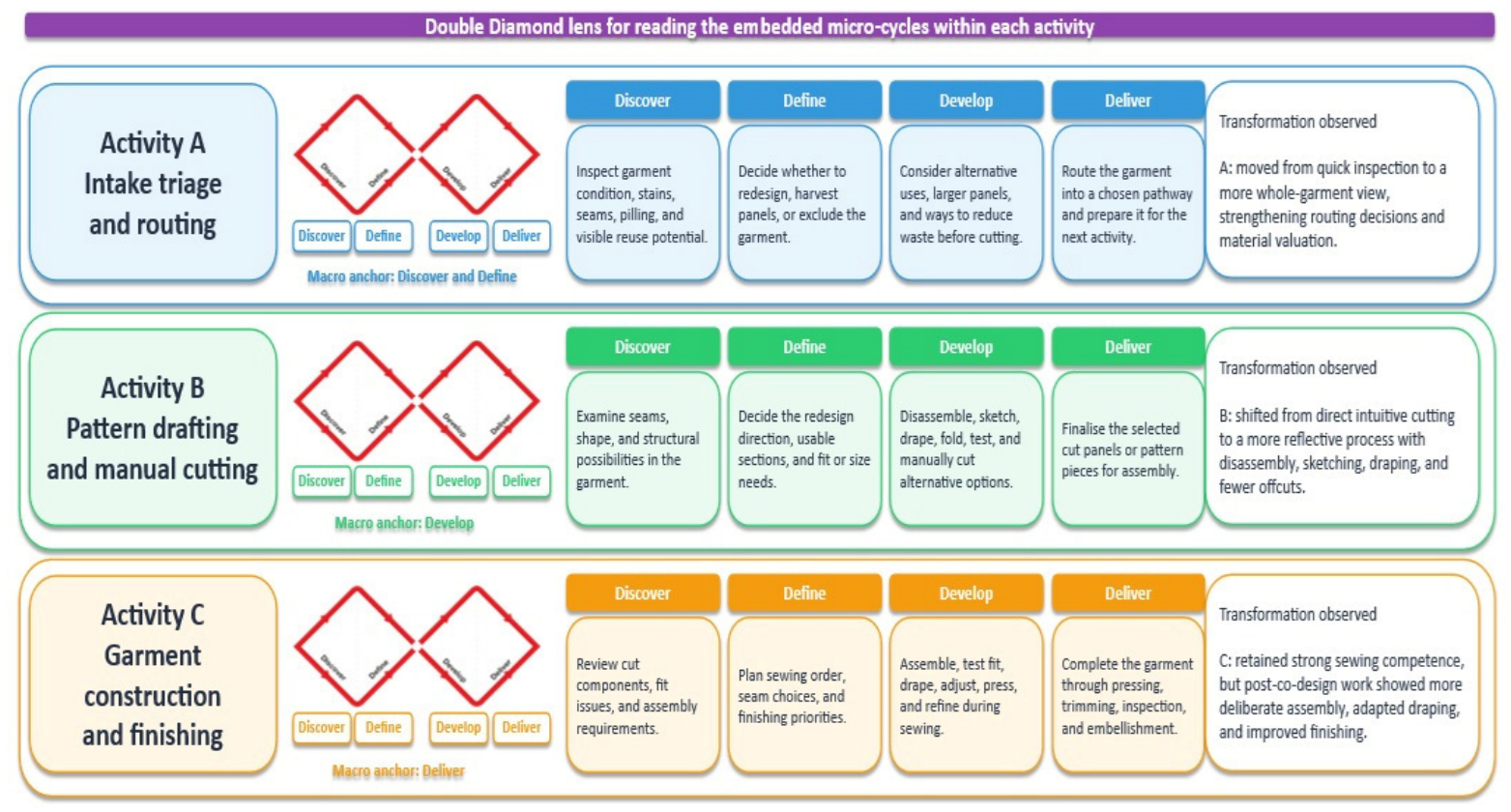
The upcycling framework presented in Figure 4 lays out the macro-level upcycling framework throughout the three project phases, but Figure 5 extends this synthesis by mapping the developmental micro-cycles for each core design activity. Specifically, Figure 5 illustrates how Activity A, Activity B, and Activity C developed from compressed, baseline practices to expanded, structured practices supported by experts, and then to highly adapted, hybrid post-co-design practices.
Figure 5.
Double Diamond lens for interpreting the transformation of Activities A–C across the three project phases: From intuitive upcycling to expert-supported structured upcycling, to hybrid post-co-design upcycling. Source: Authors’ illustration informed by the Double Diamond [22].
This is important as the findings show that structured upcycling did not replace participants’ existing knowledge. Rather, the structured upcycling introduced during the co-design phase expanded, reorganised, and made visible practices that were already present in intuitive form. In Phase 1, participants demonstrated practical sewing knowledge and resourcefulness, but their design process was often compressed: they moved quickly from garment selection to cutting and construction with limited visible planning. In Phase 2, structured upcycling introduced more stages, i.e., garment examination, panel identification, disassembly, sketching, draping, and testing. In Phase 3, without the expert present, participants did not simply reproduce the structured process exactly. Instead, they adapted and internalised selected elements, producing a hybrid practice that combined existing skills with more reflective and material-sensitive decision-making [33].
Figure 5 shows that the structured workshops expanded rather than replaced participants’ existing knowledge. The post-workshop phase was characterised by selective adaptation: whole-garment examination and physical draping were retained, while formal sketching was used less consistently and available objects, including chairs and participants’ bodies, substituted for mannequins.
The Community-Based Upcycling Framework synthesises the activities and adaptations observed across the three project phases. Activities A–C and the changes in participants’ practices derive from the fieldwork, whereas their mapping to the Double Diamond and formal integration into the framework constitute the authors’ analytical interpretation of those findings.
3.2. Effects and Value Created (RQ2)
This section examines the forms of value associated with the upcycling activities identified in RQ1. Garment recovery and renewed utility are interpreted through Cradle to Cradle; product development and livelihood potential through social entrepreneurship; and skills development, wellbeing, and community connection through co-design and SLOC.
3.2.1. Framing Value Creation in the Upcycling Process
The value discussed in this section emerged directly from the design activities identified in RQ1. Intake triage and routing identified garments with redesign potential. Pattern drafting and manual cutting redirected usable fabric panels into new forms. Garment construction and finishing transformed the recovered materials into usable completed artefacts while supporting participant learning and confidence. These relationships connect the process evidence reported under RQ1 with the material, livelihood, and social dimensions considered under RQ2.
3.2.2. Environmental Value: Material Recovery Potential and Value Retention
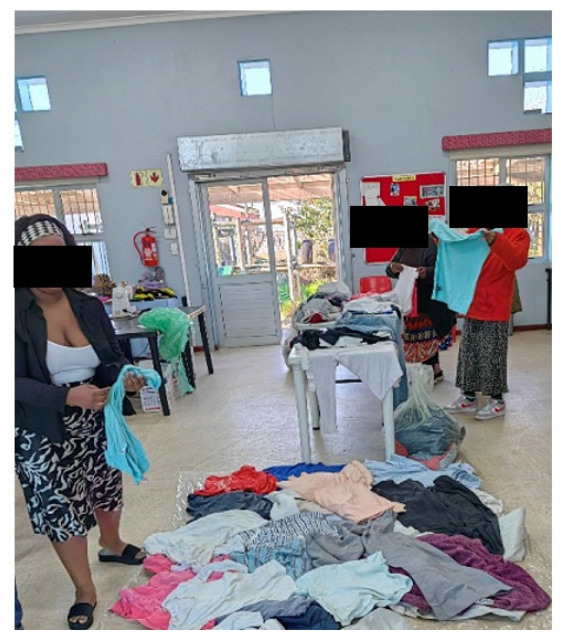
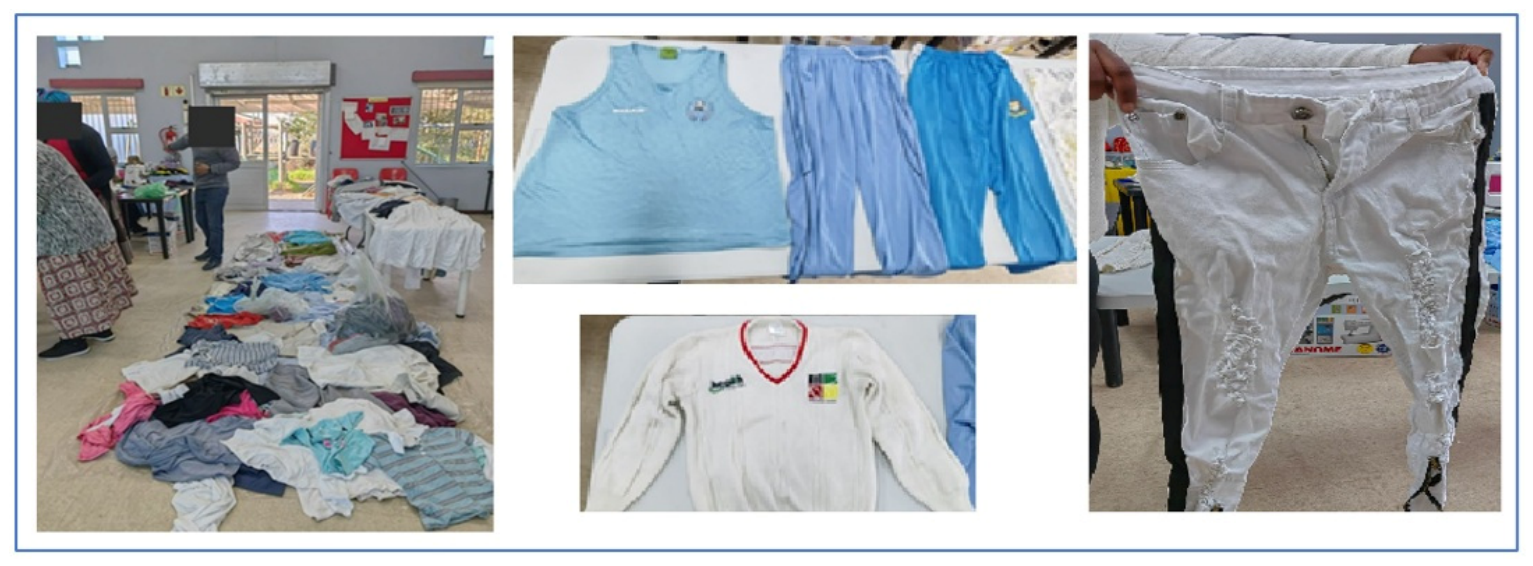
Across the three collection batches, 193 post-consumer garments were assessed. Of these, 168 (87.0%) met the selection criteria described in Activity A, while 25 (13.0%) were rejected. Here, a garment refers to one clothing item assessed at intake, while acceptance indicates suitability for possible upcycling rather than actual use.
Selection from the accepted garments occurred iteratively throughout production. For each product, participants chose the source garment or garments suited to their immediate design and returned to the accepted stock when beginning the next product. Because the project period was limited, some accepted garments remained unused at the end of the fieldwork. Accordingly, the documented outputs represent the products completed during the fieldwork period rather than the full pool of garments accepted at intake (Figure 6).
Figure 6.
Examples of post-consumer garments collected and assessed for possible upcycling. Source: Authors’ fieldwork photographs (2024).
Viewed through C2C, the intake assessment and redesign activities recognised the remaining use potential of suitable post-consumer garments. The documented products show how selected garments acquired renewed utility through redesign and reconstruction. The material contribution observed in this case therefore concerned garment recovery, value retention, and extended use. This material-led approach is consistent with circular design research in which the condition and properties of available materials shape subsequent design decisions.
3.2.3. Economic Value: Product Creation, Usability and Livelihood Potential
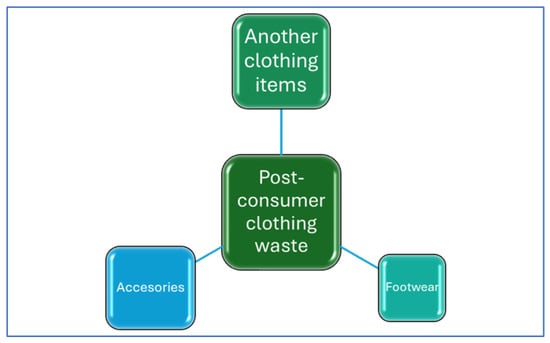
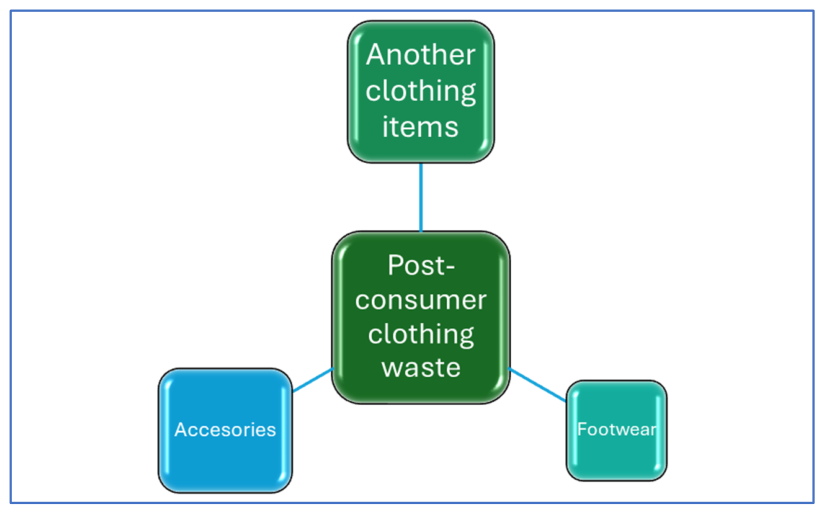
The potential economic value of the upcycling activities became visible when selected post-consumer garments were transformed into usable products with possible market applications. The completed products fell into three categories: clothing, footwear-related samples, and accessories (Figure 7).
Figure 7.
Product categories developed through the upcycling activities. Source: Authors’ illustration.
For the output audit, “product” and “output” were used interchangeably to mean one distinct completed item documented in the photographic record. Repeated photographs of the same item were counted once, while separate completed items shown in the same photograph were counted individually. Each completed footwear sample was counted as one output. A design referred to the redesign configuration applied to a product and was not counted as a separate output. The audit identified 37 completed outputs: 25 clothing items, seven footwear-related samples, and five accessories (Table 2).
Table 2.
Completed product outputs identified through the photographic audit.
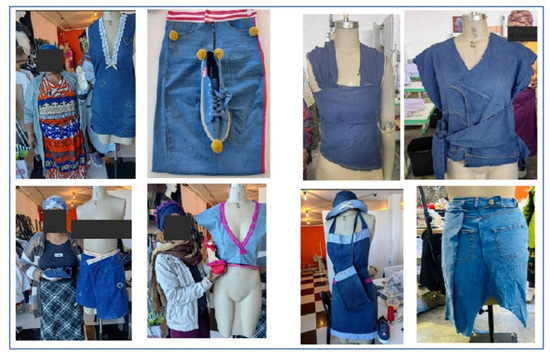
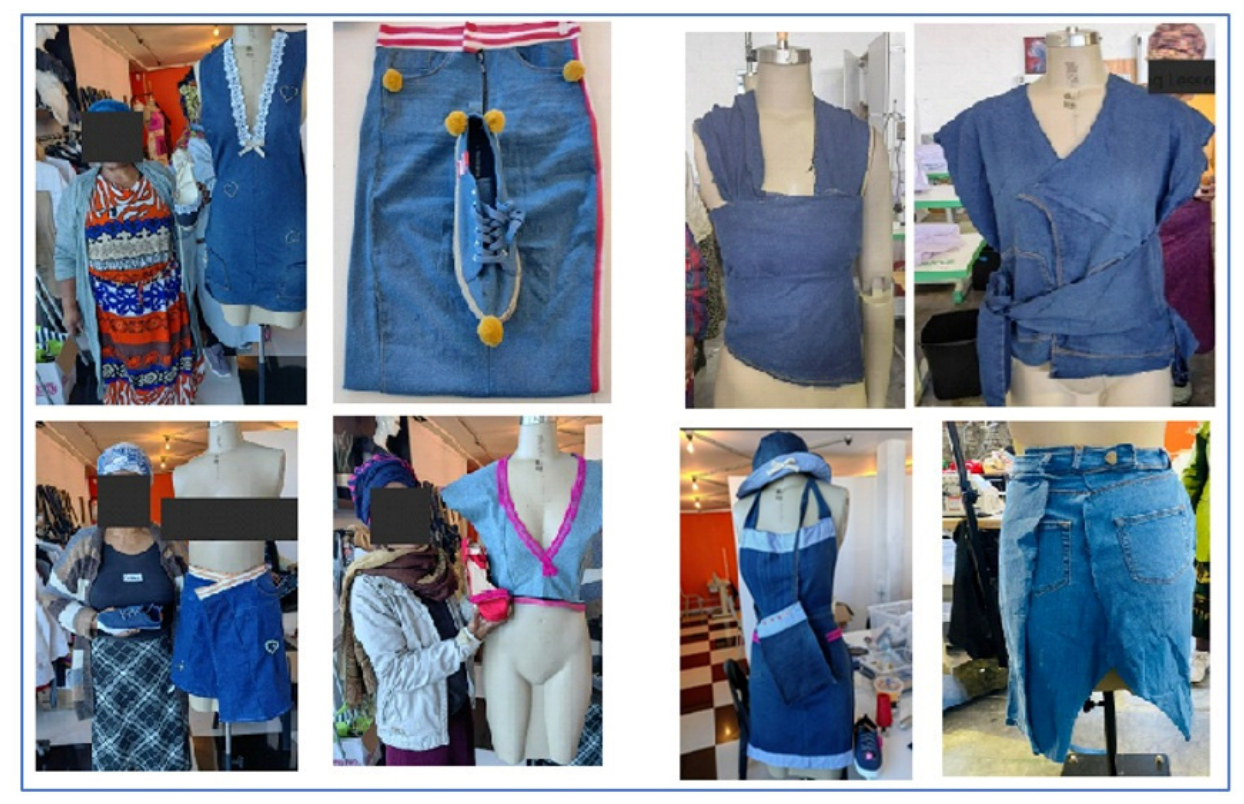
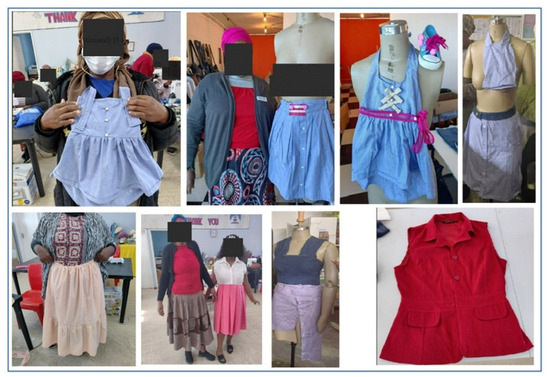
The intake and output figures therefore describe different stages and units: 168 garments met the criteria for possible upcycling, whereas 37 completed products were documented during the time-limited making period. Figure 8 and Figure 9 illustrate examples of the resulting product range.
Figure 8.
Examples of completed denim clothing and footwear-related outputs. Source: Authors’ fieldwork photographs (2024).
Figure 9.
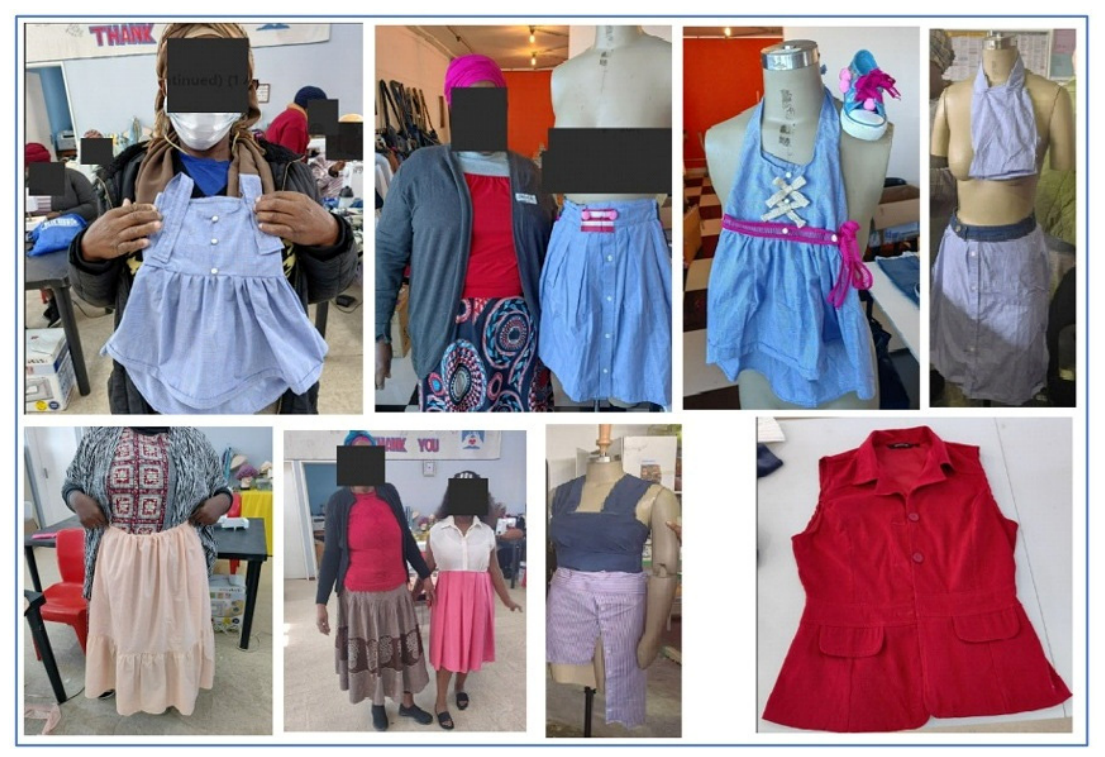
Examples of upcycled clothing products made primarily from woven garments. Source: Authors’ fieldwork photographs (2024).
Figure 9 presents representative clothing outputs made primarily from woven garments, including dresses, skirts, coordinated two-piece outfits, and a sleeveless jacket. The examples show how existing fabric panels and garment features, such as button plackets, were retained, repositioned, or combined through cutting, joining, and finishing to create new wearable forms.
Viewed through social entrepreneurship, the 37 documented products illustrate product development capacity and possible pathways for income generation [27]. Their production relied on manual garment preparation, panel selection, cutting, reconstruction, and finishing. Consequently, the income-generating potential of this approach is closely connected to production time, consistent finishing, and access to appropriate sales channels. The following subsection considers the social value associated with skills development, confidence, and collaborative making.
3.2.4. Social Value: Skills, Confidence, Wellbeing and Knowledge Sharing
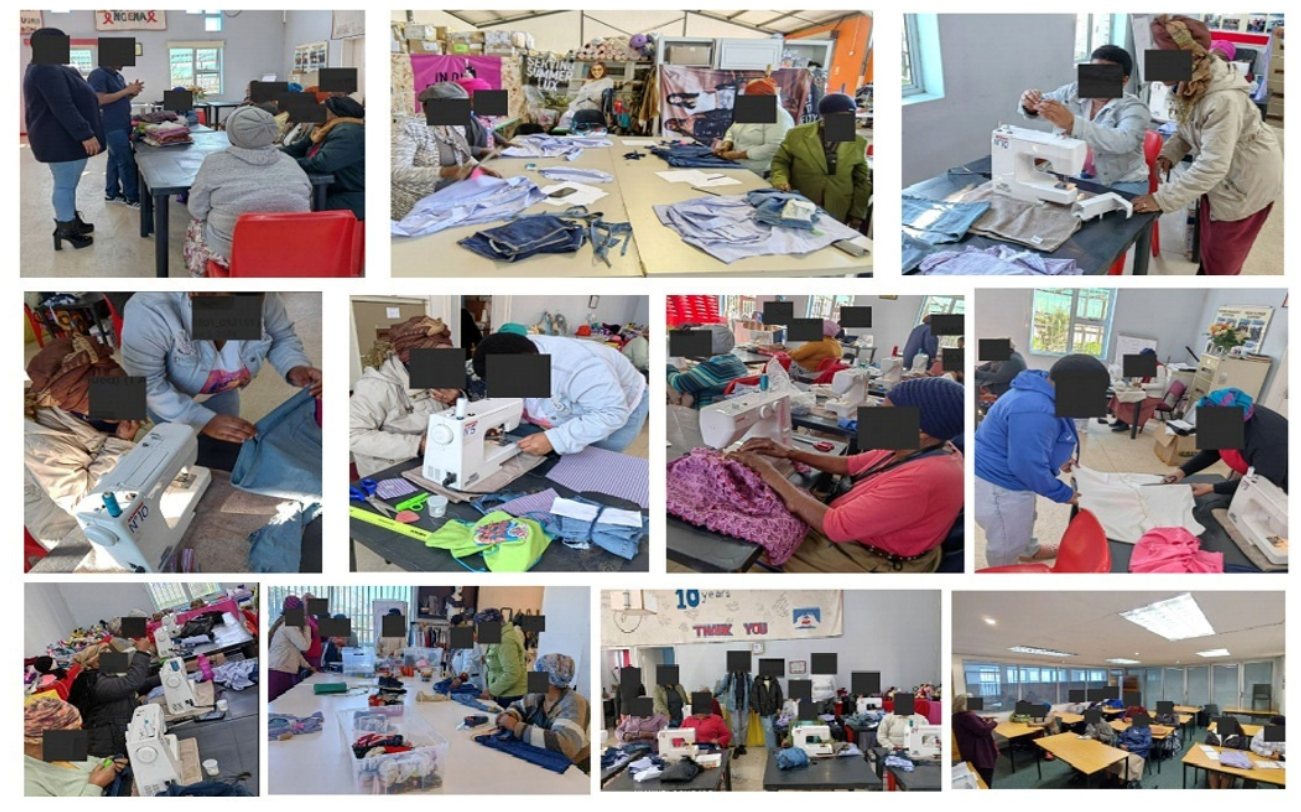
Social value was realised through hands-on learning, mentoring, and collective making throughout the project phases. The participants brought with them an existing background in sewing skills, and the project introduced them to new skills in the form of structured learning sessions for composing, decomposing, planning, and reconstructing post-consumer garments. Figure 10 documents the briefing, technical guidance, and shared making that occurred during the project, including skills support provided through TCB.
Figure 10.
Practical guidance, collaborative making and knowledge exchange during the upcycling activities. Source: Authors’ fieldwork photographs (2024).
Observations showed that participants learned through demonstration, practical experimentation, and assistance from peers and facilitators. Interview accounts complemented these observations by associating participation with increased confidence, an interest in sharing the acquired skills, and wellbeing. P4 connected confidence with peer teaching, stating: “Yes now, we have confidence… we can teach other grandmothers who want to learn” (P4). P7 described the personal value of sewing by explaining, “That is where the stress ends… I sew and feel happy doing what I love” (P7). These accounts show that participants experienced wellbeing through enjoyment, stress relief and social connection.
From a co-design perspective, participants were active contributors whose existing sewing knowledge formed part of the learning process rather than passive recipients of instruction [31]. SLOC places this learning in a small, locally embedded, and connected community where knowledge can be shared and circulated in the context of peer relationships and pre-existing GAPA groups [30]. This is in line with studies that have demonstrated how the social value of participatory clothing making can be created through shared practice and the sharing of local knowledge [8].
3.3. Motivations Shaping Design Choices (RQ3)
The objective of this section is to address RQ3 by exploring the motivations behind the specific design and technique choices made by participants during the upcycling of post-consumer clothing waste. The findings were derived from qualitative, multilingual interviews conducted with elderly participants in the upcycling social enterprise. The section further details how this knowledge can be used to improve upcycling processes to better support the circular economy. Interview data were analysed using reflexive thematic analysis to identify recurring patterns in participants’ motivations for their design choices. Analysis focused on participants’ expressed reasoning during upcycling activities, allowing themes to emerge inductively from the data. The resulting themes represent the recurring intrinsic and extrinsic motivations shaping the participants’ design choices and capture the lived realities of the community designers. In the following discussion, the eight interviewees are identified using their original project codes: P1, P2, P4, P5, P7, P8, P9, and P10.
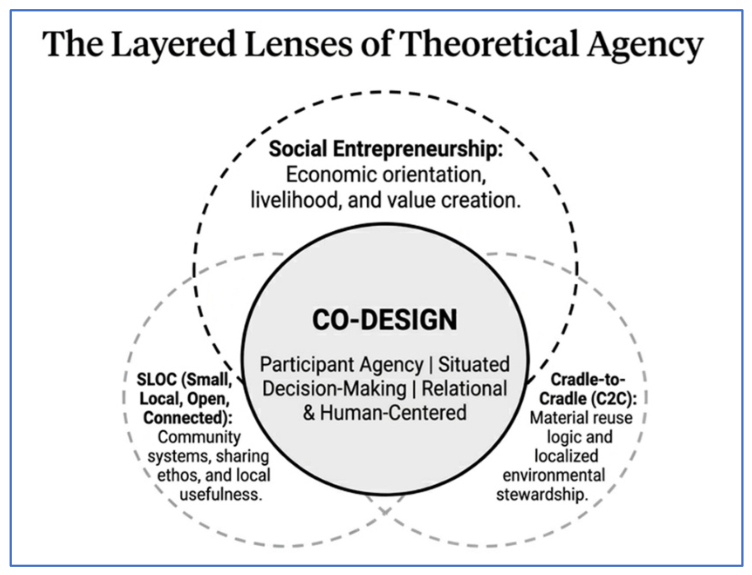
Co-design was used to interpret participants’ agency and situated design decisions. Social entrepreneurship, SLOC, and C2C were selectively applied to motivations concerning livelihood, community relationships, and material value, respectively. The Double Diamond remained within the analysis of the RQ1 garment redesign process.
Design Decision Drivers
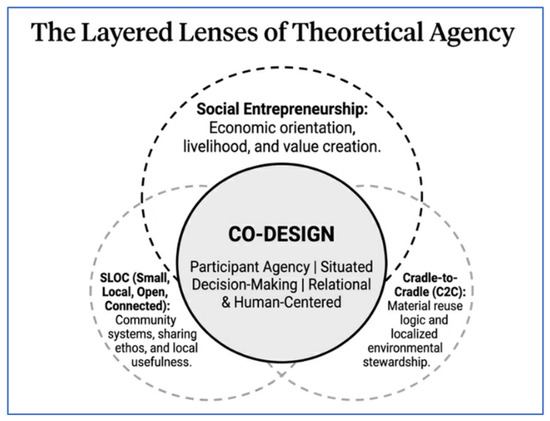
The analysis generated the following dominant themes, which explain why specific upcycling materials, techniques, and product forms were selected. Since Figure 11 has already established the theoretical hierarchy, the discussion below applies the theories selectively; co-design is used mainly to interpret participants’ active design decision-making, while social entrepreneurship, SLOC, and C2C are drawn on where they clarify livelihood, community, or environmental meanings [31,34].
Figure 11.
Conceptual roles used to interpret motivations shaping design choice in RQ3. Source: Authors’ illustration.
- I.
- Materiality and aesthetics: Participants cited tactile characteristics as key influencers; texture and perceived durability were primary drivers in three of eight interviews. Shiny textures, distinct colourways, and the perceived durability of denim sparked design ideas. Participant 2 said, “I was drawn to the shiny material… I loved it,” a response echoed by others, indicating the broader theme of aesthetically driven selection. The inherent characteristics of the textiles, such as durability, shine, or pattern, acted as primary catalysts for ideation. They shaped final design decisions and suggested the designers’ priorities: durable, aesthetically appealing textiles. Participants’ design decisions began with direct engagement with the available garments; therefore, this theme is interpreted primarily through co-design. Some attributes were used as cues for envisioning the transformation of discarded clothing, including texture, colour, shine, pattern, and perceived durability. This reflects a spontaneous recognition of material potential, in line with the C2C principle, favouring attractive, long-lasting, value-added fabrics.
- II.
- Relational design and care: Design decisions were frequently guided by care for specific individuals, particularly family members, and by consideration of their daily needs. Participant 9 repurposed denim into a skirt for her one-year-old grandson, emphasising practical everyday use by noting that it would be suitable for play activities such as soccer. Similarly, P4 deliberately upcycled distressed jeans into a contemporary style because she “thought of a younger person… young people like clothes that are torn/distressed”. Participants routinely asked themselves, “Who is this for?” Design choices thus functioned as acts of familial care, ensuring that garments were immediately useful and likely to be worn for much longer. Family needs, for example, dressing grandchildren, motivated participants to see discarded adult garments as resources for children’s clothes rather than waste. Participants frequently chose large adult garments (for example, shirts) to transform into dresses, pullovers, and skirts for babies and young children, as observed in seven of the eight cases. Co-design provides the strongest lens for interpreting this theme because design decisions were shaped by participants’ understanding of users and relationships. Participants were often designing for a specific person, age group, or family need rather than for an abstract market. SLOC further supports this interpretation since the designs were embedded in household and local realities, where upcycling became a way of extending care through useful objects [27].
- III.
- Pragmatism and skill alignment: Participants balanced ambition with capacity, selecting designs they could effectively and confidently produce, depending on their technical skills. Participants 4 and 7 decided to make skirts; Participant 7 said skirts were easier and quicker to construct, whereas Participant 4 stated that making a skirt was beginner-friendly. This hands-on approach was seen in the sewing stage, when, if the sewing machine was difficult to use, the participant switched to hand-sewing to finish garments. For example, Participant 5 said, “I did that quickly by hand… sewing machine would not have been possible”. Participants’ technical skills and the aim to minimise frustration, to some extent, influenced the design idea.
This suggests that the design of community upcycling is a process of balancing creative intent with practical feasibility, where participants chose methods they were able to perform with confidence and efficiency, and these were used to facilitate gradual skills development. This also indicates that elderly novice designers’ involvement in CE activities is preserved if the design tasks are easy to handle and within their technical competence.
Participants were cautious in their design decisions because of fear that they might damage the materials. For instance, one participant (P4) was concerned about the complicated cutting process and opted for a simpler design for the skirt. When design choices were made in accordance with the participant’s ability, there was a decrease in anxiety and an increase in success in task completion; the participant later reported that the task was not as difficult as had been anticipated. The results show that matching tasks to participants’ confidence levels reduces fear of failure and facilitates the reuse of waste materials. This pragmatic approach to decision-making results in finished, tangible outcomes instead of unfinished products. Theoretically, this theme shows that technical accessibility is an important factor in participants’ engagement within the co-design process. Through a social entrepreneurship lens, products need to be achievable before they are commercially viable. This means upcycling workshops should begin with simpler, skill-appropriate designs and progress to more advanced and complex cutting, fitting, and finishing [27].
- IV.
- Functional utility and cultural identity: Practical requirements and individual expression alike influenced design decisions, as participants fashioned objects like cooking aprons and heat-retaining “hot boxes,” and adorned them with buttons and belts, symbols of contemporary youth trends and cultural identity. Some clothing was specifically created to meet practical, everyday needs and capture the participants’ lived environments. Participant 8 repurposed old fabrics to make an apron, saying, “I work with oil”, and describing how the apron keeps her clothing safe when she does housework. Participant 2 also chose an apron-type design and emphasised functionality. She connected her design to her role as a homemaker, saying, “A mother is always in an apron”. Participant 10 also chose a functionality-based apron design due to its clear and immediate usefulness. A related subtheme, climatic adaptability, emerged when participants designed garments explicitly for winter or summer (to help children stay cool). For example, Participant 5 made a warm jersey to combat the cold and a breathable garment for her grandchild so he could “cool down nicely”. Participant 9 demonstrated the same climatic pragmatism, designing a dress specifically because it served as an item that could help the wearer cool off. Consequently, designers prioritised everyday usefulness, making protective cooking gear or seasonally appropriate clothes, so upcycled items were immediately valuable in their households. This pragmatic approach suggests upcycled garments can deliver immediate, high-value utility within households, as indicated by participants’ reported daily use and functional motivations. This theme is interpreted through co-design because participants’ choices were guided by lived use rather than abstract product categories. Aprons, children’s garments, and seasonally appropriate clothing show that participants evaluated design success according to whether the item could function in everyday life. SLOC is also relevant because these products responded to household labour, childcare, local dress preferences, and seasonal conditions. From a social entrepreneurship perspective, designing upcycled garments to address everyday domestic needs enhances their local marketability and supports livelihood creation and enterprise value.
3.4. Study Limitations
This bounded case study examined one GAPA cohort over a limited fieldwork period. It documented redesign practices, completed outputs, and participant accounts but did not evaluate long-term product use, durability, sales, income, or environmental impacts. The findings therefore provide context-specific, process-level insights, while the proposed framework requires evaluation in other community settings.
4. Conclusions
This paper has examined and explained the role that design could play as a catalyst for change in community-based organisations that work with the upcycling of post-consumer clothing waste. This community upcycling is not only a technical sewing act, but also an interdependent system that is structured by the Double Diamond model of garment transformation and supported by a structured but flexible co-design model.
The study’s results show that three interdependent factors are required for effective community-based upcycling. First, there is a clear operational process that starts with intake triage and routing (Activity A), followed by pattern drafting and manual cutting (Activity B), and garment construction and finishing (Activity C), outlining the pathway of the garments from waste to reuse. Second, material recovery, completed product development, and collaborative learning emerged through material triage, the redesign of selected garments, and peer support. Third, motivations of participants serve as actionable design knowledge, directly influencing product selections and construction methods and aligning with local demands.
The conceptual contribution lies in the coordinated use of five distinct elements. C2C interprets material value retention, whereas social entrepreneurship interprets the relationship between social purpose and livelihood potential. SLOC, on the other hand, situates the activities within local community and support networks; co-design explains participant agency and shared learning; and the Double Diamond maps the garment redesign process. Their integration informs the Community-Based Upcycling Framework without treating them as a single theory.
Practically, the Community-Based Upcycling Framework is a flexible yet structured approach that small social enterprises can follow to engage with post-consumer clothing waste under low-resource conditions, playing a meaningful role in circular textile practice. Within this project, community-based upcycling enabled selected garments to be redesigned into usable products while supporting learning, creativity, confidence, and community connection.
Future research can build on these findings by testing the proposed Community-Based Upcycling Framework in other contexts, with different participant groups, different materials, and longer timeframes. Future research can investigate the economic viability of upcycled products in more detail. Consumer response to upcycled products is one of the critical issues that still need to be investigated, along with product quality and durability. Future research could compare different training approaches, such as facilitator-led training, peer-led training, co-design workshops, short courses, or longer mentoring programmes.
Supplementary Materials
The following supporting information can be downloaded at: https://www.mdpi.com/article/10.3390/textiles6040118/s1.
Author Contributions
Conceptualization, M.K. and S.P.; Methodology, M.K. and S.P.; Validation, M.K. and A.P.; Formal analysis, M.K. and B.S.; Investigation, M.K.; Resources, S.P.; Data curation, M.K.; Writing—original draft, M.K.; Writing—review & editing, S.P., B.S. and A.P.; Visualization, B.S. and A.P.; Supervision, S.P., B.S. and A.P.; Project administration, S.P. and A.P. All authors have read and agreed to the published version of the manuscript.
Funding
The article processing charge (APC) has been paid by the CPUT Technology Station: Clothing and Textiles, Cape Town, South Africa.
Institutional Review Board Statement
The study received ethical approval from the Faculty of Informatics and Design Research Ethics Committee at the Cape Peninsula University of Technology (CPUT), under Reference No. 22323645/2023/30 (11 December 2023).
Informed Consent Statement
Informed consent was obtained from all subjects involved in the study.
Data Availability Statement
De-identified material available from the corresponding authors on reasonable request, subject to ethical, institutional and participant-confidentiality requirements.
Acknowledgments
The authors gratefully acknowledge the voluntary participation of Grandmothers Against Poverty and AIDS (GAPA) and Taking Care of Business (TCB), Cape Town, South Africa, in this project. The authors also acknowledged valuable input provided by Alettia Chisin from the Cape Peninsula University of Technology in the initial phase of this project. The authors also acknowledged CPUT Technology Station: Clothing and Textiles, Cape Town, South Africa for covering the journal APC.
Conflicts of Interest
The authors declare no conflicts of interest.
Abbreviations
The following abbreviations are used in this manuscript:
| NGO | Non-governmental organisation |
| SLOC | Small, Local, Open, and Connected |
| C2C | Cradle to Cradle |
| GAPA | Grandmothers Against Poverty and AIDS |
| TCB | Taking Care of Business |
References
- Ruiz, A. 17 Most Worrying Textile Waste Statistics and Facts. 2024. Available online: https://theroundup.org/textile-waste-statistics (accessed on 9 June 2026).
- James, A.S.J.; Kent, A. Clothing sustainability and upcycling in Ghana. Fash. Pract. 2019, 11, 375–396. [Google Scholar] [CrossRef] [Scilit]
- Syahrivar, J.; Kusuma, K.; Pahlevi, R.A.; Wei, Y.; Chairy, C.; Genoveva, G. No longer look down: Investigating second-hand clothing purchase in Indonesia. Int. Rev. Public Nonprofit Mark. 2023, 20, 319–339. [Google Scholar] [CrossRef] [Scilit]
- Department of Forestry, Fisheries and the Environment. National Waste Management Strategy 2026; Draft 4.0; Department of Forestry, Fisheries and the Environment: Pretoria, South Africa, 2025. Available online: https://www.gov.za/documents/notices/national-environmental-management-waste-act-national-waste-management-strategy-2 (accessed on 9 September 2026).
- Ellen MacArthur Foundation. Vision of a Circular Economy for Fashion. 27 October 2020. Available online: https://www.ellenmacarthurfoundation.org (accessed on 9 September 2026).
- Harmsen, P.; Scheffer, M.; Bos, H. Textiles for circular fashion: The logic behind recycling options. Sustainability 2021, 13, 9714. [Google Scholar] [CrossRef] [Scilit]
- Fletcher, K. Slow Fashion: An Invitation for systems change. Fash. Pract. 2010, 2, 259–265. [Google Scholar] [CrossRef] [Scilit]
- Hirscher, A.L.; Mazzarella, F.; Fuad-Luke, A. Socializing value creation through practices of making clothing differently: A case study of a makershop with diverse locals. Fash. Pract. 2019, 11, 53–80. [Google Scholar] [CrossRef] [Scilit]
- Moorhouse, D. Making fashion sustainable: Waste and collective responsibility. One Earth 2020, 3, 17–19. [Google Scholar] [CrossRef] [Scilit] [PubMed]
- National Environmental Management: Waste Act, 2008 (Act No. 59 of 2008). Government Gazette No. 32000, Government Notice No. 278, 10 March 2009, Republic of South Africa. Available online: https://www.dffe.gov.za/sites/default/files/legislations/nema_amendment_act59.pdf (accessed on 9 September 2026).
- Department of Environment, Forestry and Fisheries. National Waste Management Strategy 2020. Government Gazette No. 44116, Government Notice No. 56, 28 January 2021, Republic of South Africa. Available online: https://www.gov.za/sites/default/files/gcis_document/202101/44116gon56.pdf (accessed on 9 September 2026).
- Department of Forestry, Fisheries and the Environment. Amendments to the Regulations and Notices Regarding Extended Producer Responsibility, 2020. Government Notice No. 400, Government Gazette No. 44539, 5 May 2021, Republic of South Africa. Available online: https://www.gov.za/sites/default/files/gcis_document/202105/44539gon400.pdf (accessed on 9 September 2026).
- European Parliament; Council of the European Union. Directive 2025/1892 of the European Parliament and of the Council of 10 September 2025 Amending Directive 2008/98/EC on Waste. Off. J. Eur. Union 2025, L 2025/1892. 26 September 2025. Available online: https://data.europa.eu/eli/dir/2025/1892/oj (accessed on 4 September 2026).
- D’adamo, I.; Lupi, G.; Morone, P.; Settembre-Blundo, D. Towards the circular economy in the fashion industry: The second-hand market as a best practice of sustainable responsibility for businesses and consumers. Environ. Sci. Pollut. Res. 2022, 29, 46620–46633. [Google Scholar] [CrossRef] [Scilit] [PubMed]
- Wójcik-Karpacz, A.; Karpacz, J.; Brzeziński, P.; Pietruszka-Ortyl, A.; Ziębicki, B. Barriers and drivers for changes in circular business models in a textile recycling sector: Results of qualitative empirical research. Energies 2023, 16, 490. [Google Scholar] [CrossRef] [Scilit]
- Sumo, P.D.; Arhin, I.; Danquah, R.; Nelson, S.K.; Achaa, L.O.; Nweze, C.N.; Cai, L.; Ji, X. An assessment of Africa’s second-hand clothing value chain: A systematic review and research opportunities. Text. Res. J. 2023, 93, 4701–4719. [Google Scholar] [CrossRef] [Scilit]
- Staicu, D. Characteristics of textile and clothing sector social entrepreneurs in the transition to the circular economy. Ind. Textila 2021, 72, 81–88. [Google Scholar] [CrossRef] [Scilit]
- Palombi, G.; Schiaroli, V.; Fraccascia, L.; Nonino, F. Identifying barriers and good practices for implementing circular economy principles in small and medium enterprises. Bus. Strategy Environ. 2024, 33, 6773–6794. [Google Scholar] [CrossRef] [Scilit]
- Sandvik, I.M.; Stubbs, W. Circular fashion supply chain through textile-to-textile recycling. J. Fash. Mark. Manag. 2019, 23, 366–381. [Google Scholar] [CrossRef] [Scilit]
- Haeggblom, J.; Budde, I. Circular design as a key driver for sustainability in fashion and textiles. In Sustainable Textile and Fashion Value Chains; Matthes, A., Beyer, K., Cebulla, H., Arnold, M.G., Schumann, A., Eds.; Springer: Cham, Switzerland, 2021; pp. 35–45. [Google Scholar]
- Grandmothers Against Poverty and Aids (GAPA). Senior Programmes at GAPA: Self-Help Groups, Health Club and Activities. 2022. Available online: https://gapa.org.za/senior-programmes-at-gapa (accessed on 15 June 2026).
- Shen, Y.; Bosch, G.; Pino, L.; Gopalan, V. Use of the ‘double diamond’ design framework to nurture creativity in life sciences research. Trends Biochem. Sci. 2024, 49, 654–657. [Google Scholar] [CrossRef] [Scilit] [PubMed]
- Ribul, M.; Goldsworthy, K.; Collet, C. Material-driven textile design (mdtd): A methodology for designing circular material-driven fabrication and finishing processes in the materials science laboratory. Sustainability 2021, 13, 1268. [Google Scholar] [CrossRef] [Scilit]
- Monga, S.; Ranade, P.; Verma, I.K. A user-centric approach to revolutionising wardrobe management: Integrating connected sensors and AI-driven outfit suggestions. In Proceedings of the International Conference on Information Technology and Artificial Intelligence, Singapore; Kumar, S., Bye, R.T., Prasad, M., Eds.; Springer Nature: Singapore, 2026; pp. 573–586. [Google Scholar]
- Paço, A.; Leal Filho, W.; Ávila, L.V.; Dennis, K. Fostering sustainable consumer behavior regarding clothing: Assessing trends on purchases, recycling and disposal. Text. Res. J. 2021, 91, 373–384. [Google Scholar] [CrossRef] [Scilit]
- Sandberg, E. Orchestration capabilities in circular supply chains of post-consumer used clothes—A case study of a Swedish fashion retailer. J. Clean. Prod. 2023, 387, 135935. [Google Scholar] [CrossRef] [Scilit]
- Thompson, J.; Alvy, G.; Lees, A. Social entrepreneurship—A new look at the people and the potential. Manag. Decis. 2000, 38, 328–338. [Google Scholar] [CrossRef] [Scilit]
- Taking Care of Business (TCB). Help Families Escape the CYCLE of Poverty Through the Circular Economy. 2024. Available online: https://www.tcb.org.za (accessed on 14 May 2026).
- Hansen, E.G.; Schmitt, J.C. Orchestrating cradle-to-cradle innovation across the value chain: Overcoming barriers through innovation communities, collaboration mechanisms, and intermediation. J. Ind. Ecol. 2021, 25, 627–647. [Google Scholar] [CrossRef] [Scilit]
- Manzini, E.; Rizzo, F. Small projects/large changes: Participatory design as an open participated process. CoDesign 2011, 7, 199–215. [Google Scholar] [CrossRef] [Scilit]
- Sanders, E.B.N.; Stappers, P.J. Probes, toolkits and prototypes: Three approaches to making in codesigning. CoDesign 2014, 10, 5–14. [Google Scholar] [CrossRef] [Scilit]
- Merriam, S.B.; Tisdell, E.J. Qualitative Research: A Guide to Design and Implementation, 4th ed.; Wiley: San Francisco, CA, USA, 2016. [Google Scholar]
- Chick, A.; Micklethwaite, P. Design for Sustainable Change: How Design and Designers Can Drive the Sustainability Agenda; AVA Publishing: Lausanne, Switzerland, 2011. [Google Scholar]
- Murray, A.; Skene, K.; Haynes, K. The circular economy: An interdisciplinary exploration of the concept and application in a global context. J. Bus. Ethics 2017, 140, 369–380. [Google Scholar] [CrossRef] [Scilit]
- Braun, V.; Clarke, V. Reflecting on reflexive thematic analysis. Qual. Res. Sport Exerc. Health 2019, 11, 589–597. [Google Scholar] [CrossRef] [Scilit]
- Braun, V.; Clarke, V. Using thematic analysis in psychology. Qual. Res. Psychol. 2006, 3, 77–101. [Google Scholar] [CrossRef] [Scilit]

Disclaimer/Publisher’s Note: The statements, opinions and data contained in all publications are solely those of the individual author(s) and contributor(s) and not of MDPI and/or the editor(s). MDPI and/or the editor(s) disclaim responsibility for any injury to people or property resulting from any ideas, methods, instructions or products referred to in the content. |
© 2026 by the authors. Licensee MDPI, Basel, Switzerland. This article is an open access article distributed under the terms and conditions of the Creative Commons Attribution (CC BY) license.