


Abstract
Traditional membrane separation techniques mostly rely on static size-exclusion filtration mechanisms, where a trade-off between permeability and selectivity is intrinsic, and considerable operational performance loss owing to fouling is inevitable. To overcome these passive barriers, stimuli-responsive polymer membranes have emerged as a transformative class of adaptable materials that can dynamically tune their pore structure, surface charge, and interfacial wettability in response to environmental triggers. This paper offers a detailed summary of current developments in the design, fabrication, and environmental applications of next-generation SRMs for adaptive wastewater decontamination. We discuss molecular actuation processes of thermo-, pH/ionic-, photo-, electro-, and magneto-responsive polymer systems, emphasizing the role of conformational transitions in enabling real-time control of gating and transport. In addition, we explore advanced synthetic and surface engineering methodologies, such as precision brush grafting, block copolymer self-assembly, and hybrid nanocomposite integration, to achieve robust stimuli reactivity while maintaining mechanical integrity. Particular emphasis is placed on high-impact applications such as triggerable self-cleaning/anti-fouling surfaces, switchable oil–water emulsion separation, and selective target capture of emerging micropollutants such as PFAS and pharmaceuticals. Finally, we critically discuss the main technical bottlenecks limiting large-scale implementation, in particular response kinetics, cyclic fatigue and actuation energy costs, and highlight emerging opportunities in multi-stimuli responsiveness, computational molecular design, and industrial module translation. SRMs provide a promising route towards durable, low-energy water purification infrastructure by replacing the filtering paradigm of static barriers with intelligent, active interfaces.
1. Introduction
Recent progress in stimuli-responsive polymer membranes has driven the evolution of membrane technology from passive separation systems to adaptive platforms that may dynamically tune their physicochemical properties in response to external environmental inputs. Key technological advances include the development of functional polymers, smart hydrogels, nanostructured materials, and responsive inorganic–organic hybrid components for programmable changes in membrane pore size, surface charge, hydrophilicity, and molecular transport. Thermo-responsive membranes, for example, those using poly(N-isopropylacrylamide) (PNIPAM), have been shown to exhibit temperature-dependent changes in polymer conformation and membrane permeability. pH-responsive systems with functional groups, such as carboxyl, amino and sulfonic acid groups, can allow reversible changes in surface charge and swelling behavior. In addition, photoresponsive membranes containing photoactive chemicals and nanoparticles have been developed, offering light-triggered control over surface characteristics and separation behavior. Recent advances in electrically and magnetically responsive membranes have also opened up new opportunities for externally controlled separation, fouling mitigation and pollutant recovery. Multi-functional and dual-responsive membrane systems are of particular significance, as they integrate two or more responsive processes to offer higher adaptability in difficult wastewater situations. Despite these gains, significant obstacles to practical application persist, such as long-term stability, reversibility of the reaction, energy requirements, scalability, and performance under real wastewater circumstances [1]. Although the interest in stimuli-responsive polymer membranes is expanding, their research and practical application for wastewater treatment are still connected with a number of scientific and technological hurdles. While many studies have demonstrated the potential of thermo-, pH-, ionic-, photo-, electro-, and magneto-responsive systems, the progress reported has varied in terms of membrane fabrication strategies, responsiveness, separation efficiency, anti-fouling performance, and operational stability. For example, advancements in membrane permeability, pollutant rejection, and fouling resistance are not always achieved concurrently, highlighting the ongoing challenge of balancing permeability and selectivity while maintaining reliable long-term performance. Moreover, several reported studies are still limited to laboratory-scale trials with synthetic wastewater and are not properly evaluated under complex real wastewater conditions, many stimulus-response cycles, and long-term filtration operation. Other major problems are the reversibility of the responsive behavior, energy requirements for stimulus activation, mechanical and chemical stability, potential leaching of materials, and scalability and economic feasibility of membrane manufacture. Therefore, it is important to critically assess the experimental successes and shortcomings presented in each study in an effort to distinguish between potentially useful technology and conceptual progress, and to pinpoint areas of research that must be addressed before these adaptive membrane systems can be practically employed [2,3,4]. Fouling, concentration polarization, and wetness are still important issues in the literature. Guo et al. [5], Tijing et al. [6], and Jiang et al. [7] have all shown that flux decline and long-term instability are still the main bottlenecks from different application perspectives, which means that membrane performance cannot be evaluated in a meaningful way without considering the interfacial interactions, hydrodynamics, and cleaning or control strategies. The projected benefit of using new separation modules included in a porous membrane is enhanced device performance, and the principles by which the different ways are treated are detailed so that readers can apply the knowledge to their own requirements. The same reasoning is observed in membrane separation, where Osuofa and Husson [8] discussed the need to consider membrane development, configuration design, and process conditions together. More recent studies suggest that the field is growing in both material extent and methodological sophistication.
Winarta et al. [9] reported the fast-emerging metal–organic framework mixed-matrix membranes for gas separations, while Hong et al. [10] reviewed MXene-based membranes for ion-selective separations. The classic polymer–physics framework of Oh et al. [11] still offers a useful understanding of upper-bound behavior and the structural origins of transport trade-offs. The artificial intelligence-enabled methodologies summarized by Ignacs et al. [12] show that membrane research is heading towards a more data-enabled and multiscale era, where molecular design, transport modeling and process optimization are increasingly interwoven. Stimuli-responsive membranes are a new category of adaptive filtration materials that can change their pore size, surface charge, wettability, or permeability in response to external or internal stimuli. The triggerable polymer topologies provide the possibility of modulating membrane performance in real-time, thus enhancing selectivity, anti-fouling behavior, permeability and contaminant removal efficiency under changing operating conditions through the synergy of smart design principles and responsive polymers. This paper highlights the current development of triggerable polymer structures, their response mechanisms, production processes, and applications in wastewater treatment. This review also critically discusses present problems, new design concepts, and future potential to bridge the gap between lab-scale research on adaptive membrane technologies and their implementation in actual water purification systems. Emerging applications such as industrial separations, water purification, energy harvesting and storage, healthcare, biomimetic membranes, etc., require enhanced and innovative membrane functions. Considerable progress has been made in the development of stimuli-responsive polymer membranes for wastewater treatment. However, there are some problems that need to be critically considered further. Thermo-, pH/ionic-, photo-, electro-, and magneto-responsive systems offer promising opportunities for controlling membrane permeability, selectivity, and anti-fouling behavior, but their practical effectiveness relies on the operating conditions, response reversibility, and membrane stability. The improved responsiveness and separation performance should also be balanced against energy consumption, complexity of manufacture, material stability, and leaching of functional components. Moreover, most of the described studies are still restricted to laboratory-scale tests with synthetic wastewater, which limits the evaluation of their long-term performance in actual treatment circumstances. Therefore, future studies should not only emphasize the improvement of the membrane performance, but also the comparison of different responsive mechanisms, long-term operational stability, regeneration efficiency, and scalability to determine their practical potential for sustainable wastewater treatment [13,14,15].
Thus, this study offers an in-depth and critical overview of recent advances in stimuli-sensitive polymer membranes for wastewater decontamination, highlighting the link between responsive mechanisms, membrane design and separation performance. The topic covers the basic principles and preparation strategies of several stimuli-responsive systems, including thermo-, pH/ionic-, photo-, electro-, and magneto-responsive membranes. In addition to the description of the working mechanisms, special emphasis is paid to the evaluation of experimentally proven improvements in permeability, pollutant rejection, anti-fouling behavior and self-cleaning capabilities. The review also compares the technical achievements and limitations of various systems, discusses their applicability in real-world wastewater treatment settings, and highlights the major challenges and future research directions needed to advance these technologies toward practical, sustainable applications. Finally, obstacles, the prospective design of multi-functional membranes, and future research objectives are discussed that are likely to accelerate the transition of adaptive membrane technologies from laboratory-scale investigations to practical and sustainable water treatment applications.
2. Fundamentals of Stimuli-Responsive Polymer Membranes
Stimuli-responsive polymer membranes are a new type of adaptive separation materials that offer opportunities to overcome some constraints of conventional membranes with relatively fixed physicochemical properties. Unlike traditional polymeric membranes, which usually have stable pore structure, wettability and surface charge during operation, stimuli-responsive membranes can reversibly change their structure and interfacial properties in response to external or internal environmental stimuli such as pH, temperature, light, electric field, magnetic field, and specific chemical species. Changes of this kind are generally controlled by molecular processes at the polymer chain level, such as swelling and shrinking, conformational reorganization, ionization, phase transitions, and reversible bonding interactions that can tune membrane permeability, selectivity, and anti-fouling behavior. Stimuli-responsive membranes have the potential to alleviate the typical permeability–selectivity trade-off by tuning the transport characteristics according to the operating conditions rather than eliminating this limitation completely. The development has evolved from conventional polymer membranes to surface-modified and nanocomposite structures, and recently to adaptive platforms with self-regulation, self-cleaning, and selective pollutant identification capabilities. The incorporation of responsive polymers, functional nanomaterials, and dynamic networks offers promising opportunities for wastewater treatment, with the potential to improve separation efficiency, reduce fouling, and ensure operational stability under complex and dynamic wastewater conditions. The fundamental problem of conventional membrane separation is the permeability–selectivity trade-off, where increased permeability of the membrane usually leads to lower separation efficiency. Stimuli-responsive polymer membranes provide a promising method to overcome this constraint by dynamically changing their structural and physicochemical properties in response to external stimuli. For example, temperature-induced polymer swelling or changes in chain conformation can modulate membrane pore size and water flow. At the same time, pH-sensitive functional groups can vary surface charge and pore access, impacting permeability and solute rejection. Similarly, light- and electrically responsive membranes can exhibit reversible changes in wettability, surface charge, or polymer structure, affording additional control over separation performance. Experimental studies have shown that some responsive membranes can attain relatively high water permeability with significant pollutant rejection efficiency. However, these benefits are highly reliant on the membrane composition, stimulus intensity, operational conditions and pollutant characteristics. Thus, stimuli-responsive membranes are viable techniques for the mitigation, not the complete elimination, of the permeability–selectivity trade-off. More systematic studies under similar operating conditions are needed to determine their long-term effectiveness and practical merits [16,17]. The comparative analysis shown in Table 1 illustrates the differences in the operational features and performance of the various stimuli-responsive membrane systems. These membranes show promise for the control of permeability, wettability, and anti-fouling properties, but their performance varies greatly depending on the responsive polymer, membrane architecture, stimulus intensity, and operating conditions. In particular, response time and switching reversibility are essential markers of operational flexibility, while flux recovery and cycle stability provide further information on their capacity for recurrent use. However, direct comparison is challenging due to the scarce and uneven reporting of these data in the literature. Hence, standardized evaluation methodologies and long-term performance assessments are needed to establish accurate benchmarks and ease the practical application of these technologies.
Table 1.
Comprehensive comparison of stimuli-responsive polymer membrane systems.
3. Fouling Mechanisms and Smart Anti-Fouling Strategies
The working principle of stimuli-responsive polymer membranes is the reversible physicochemical changes in some functional groups or embedded responsive materials in response to external stimuli. These alterations can change polymer chain conformation, intermolecular interactions, swelling behavior, surface charge, hydrophilicity, and effective pore diameters, thereby controlling membrane permeability and pollutant rejection. For example, thermo-responsive membranes show temperature-triggered conformational shifts, while pH/ionic-responsive systems show changes in ionization, electrostatic interactions and polymer swelling. Photoresponsive membranes are based on light-induced molecular transformations, while electro-responsive systems are based on changes in electrical potential, surface charge or electrochemical interactions. In magneto-responsive membranes, the behavior or distribution of integrated magnetic components can be influenced by externally applied magnetic fields, potentially changing membrane performance. Although the methods are different, they all have in common the idea of converting an external stimulus into regulated changes in the physicochemical properties of the membrane. The knowledge of these mechanisms is very important for optimizing the separation efficiency, anti-fouling performance, response reversibility and operational stability in wastewater treatment applications [26,27]. Traditional anti-fouling strategies mainly depend on passive modification methods, such as enhanced hydrophilicity, incorporation of charged or zwitterionic groups, and addition of nanomaterials. However, wastewater strategies usually result in fixed surface properties without the ability to adapt to different compositions of wastewater. This limitation is overcome by smart anti-fouling membranes that integrate stimuli-responsive materials that can dynamically regulate surface wettability, pore architecture and interfacial interactions in response to external stimuli such as pH, temperature, light, electric fields or magnetic fields. For example, temperature-responsive polymers such as poly(N-isopropylacrylamide) (PNIPAM) can reversibly switch between hydrated and collapsed states, enabling controlled foulant release and pore regulation. pH-responsive or zwitterionic systems alter surface charge or hydration layers to minimize pollutant adhesion [28]. In addition, photocatalytic and electrically sensitive membranes can actively break down or remove deposited pollutants, thereby being self-cleaning and improving flux recovery. However, the key hurdles for their industrial implementation still remain the problems of response speed, mechanical durability, large-scale fabrication, long-term stability, and cost-effectiveness. Hence, future work must target the design of multi-functional smart membranes with adaptive anti-fouling behavior, high permeability, selective separation, and sustainable production pathways for practical wastewater application. Membrane fouling is still one of the key problems limiting the practical application and long-term performance of polymeric membranes in wastewater treatment. It is often caused by aggregation and deposition of organic compounds, inorganic precipitates, suspended particles, colloidal materials, and microorganisms on the surface of the membrane or in its porous structure. Fouling may cause pore blocking, cake-layer formation, concentration polarization, and biofilm development depending on the nature of the foulants and their interactions with membrane materials. Fouling leads to decreased permeate flux, increased hydraulic resistance, and increased operational and cleaning costs. To alleviate these effects, several conventional anti-fouling techniques have been developed, including membrane hydrophilization, surface charge alteration, polymer grafting, surface coating, and physical or chemical cleaning. However, many typical techniques give relatively static surface qualities and may not be sufficient to address changing wastewater contents or operational conditions. Stimuli-responsive polymer membranes have emerged as viable alternatives in this context, since their surface characteristics and interfacial interactions can be dynamically modulated by external triggers, including temperature, pH, ionic strength, light, electrical fields, and magnetic fields. Such adaptive reactions may aid fouling detachment, boost self-cleaning behavior, and enhance membrane performance under suitable operating conditions [29].
4. Fabrication Techniques and Surface Engineering Strategies
The existing membrane materials and fabrication processes are empirical and lack molecular-level design. Thus, the control of the structure in the selective layer of the membrane is limited, which reduces the performance of the membrane and increases the cost of water purification and desalination. Recent progress in water purification membranes has been limited by fundamental material limitations such as the permeability–selectivity trade-off, which limits the possible water–solute selectivity and high fouling propensity. To overcome these restrictions and to achieve significant progress in water purification and desalination technologies, new materials and scalable, molecular-level design techniques for membrane production are necessary [30]. Precise spatial and structural control is required to translate smart polymers from functional chemical additives to robust, high-performance separation platforms. The main challenge of the design of stimuli-sensitive polymer membranes is to introduce responsive moieties without compromising the mechanical strength, intrinsic porosity or hydraulic permeability of the underlying support. Generally, modern synthetic techniques can be classified into three major methodologies: controlled/living radical polymerization brush grafting (i.e., “grafting-from” vs. “grafting-to”), bulk matrix alteration through block copolymer self-assembly and hybrid nanocomposite integration [31].
4.1. Controlled Surface Grafting: ATRP vs. RAFT
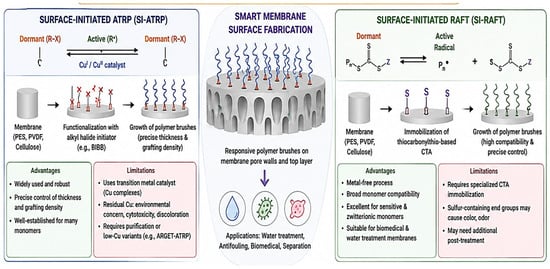
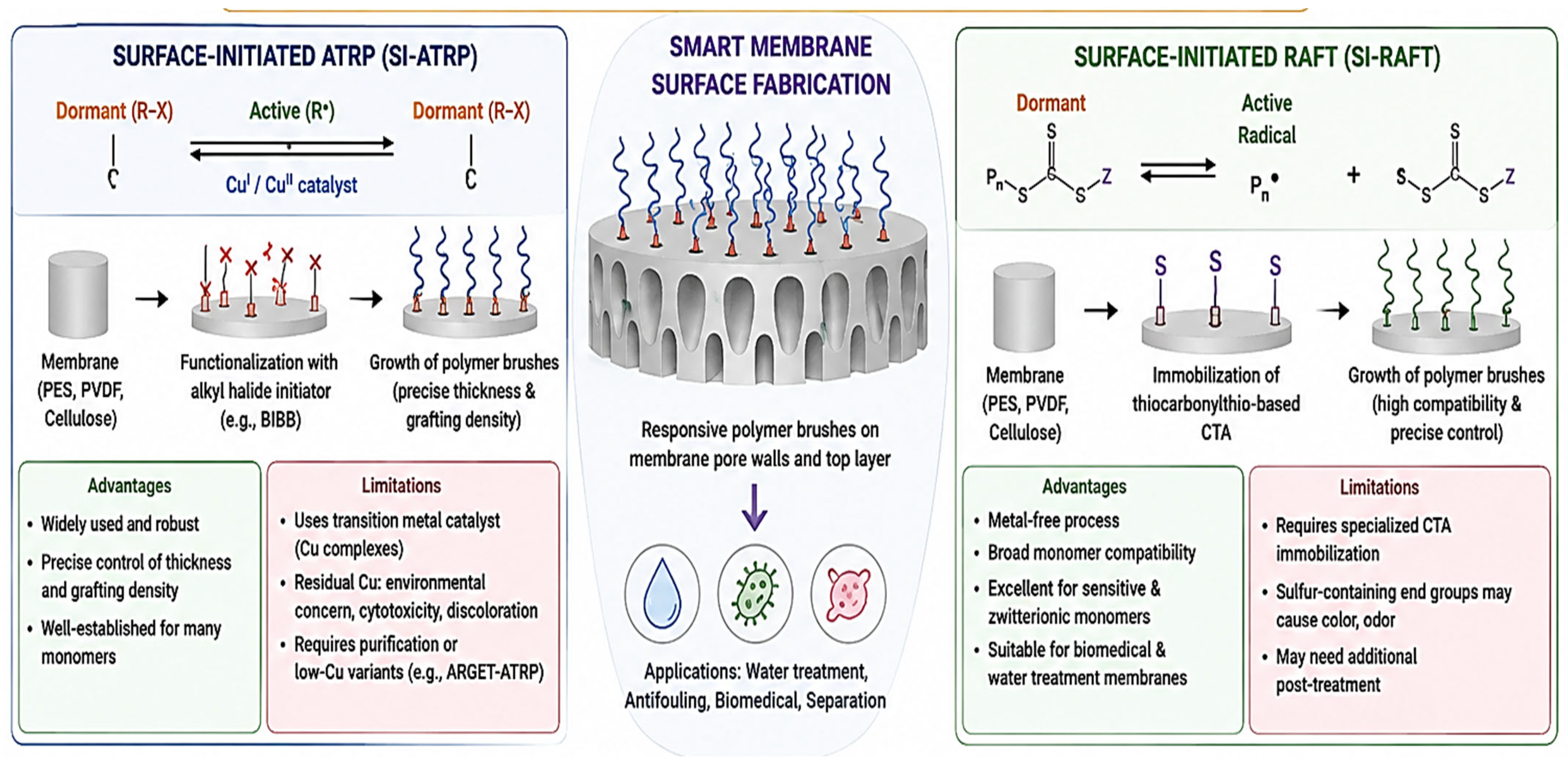
RAFT (reversible addition–fragmentation chain-transfer polymerization) and ATRP (atom transfer radical polymerization) are generally chosen depending on the researchers’ preferences or knowledge rather than their performance. Both techniques have some basic similarities as controlled radical polymerization methods. Figure 1 illustrates RAFT- and ATRP-controlled radical polymerization. Free-radical polymerization (FRP) is commonly employed to polymerize vinyl and substituted alkene monomers. The process involves the use of suitable radical initiators and carefully controlled reaction conditions to regulate polymer formation and properties. Depending on the nature of the monomers and the targeted polymer characteristics, polymerization can be conducted in bulk or solution systems. In contrast to FRP, RAFT and ATRP exhibit a balance between dormant and active polymer chains, which leads to controlled chain growth, higher polymer homogeneity, and fewer effects of termination and chain-transfer reactions. Irreversible termination still happens, but the concentration of living polymer chains is substantially higher than that of dead chains to manage polymerization effectively. Surface-initiated regulated reversible-deactivation radical polymerization (RDRP) approaches permit researchers to precisely adjust the brush density, chain length, and architecture of responsive polymers covalently linked to membrane pore walls and top selective layers [32,33]. SI-ATRP (surface-initiated ATRP) is a widely used method to prepare smart membrane surfaces. It establishes a reversible equilibrium between active and dormant polymer chains using transition metal catalysts, most commonly copper complexes. Controlled growth of responsive polymer brushes with accurate control over the thickness and grafting density is achieved using functionalized membrane substrates (PES, PVDF, and regenerated cellulose) with alkyl halide initiators (e.g., BIBB). However, residual copper catalysts may lead to environmental issues, cytotoxicity, and membrane discoloration, requiring extra purification or low-catalyst versions such as ARGET-ATRP. SI-RAFT is a metal-free variant of Reversible Addition–Fragmentation Chain Transfer (RAFT) Polymerization, in which polymer formation is mediated by thiocarbonyl Thio-based chain transfer agents (CTAs). It has good broad monomer compatibility, especially with sensitive and zwitterionic monomers, which makes it suitable for biomedical and water treatment membranes. However, RAFT involves specialized immobilization of CTA and may lead to sulphur-containing end groups, which contribute to color, odor, or other post-treatment requirements [34].
Figure 1.
RAFT- and ATRP-controlled radical polymerization. Figure partially generated using a Gemini 4 Neon AI-assisted tool.
4.2. Matrix Blending and Block Copolymer Self-Assembly
Surface grafting changes the interfacial chemistry of pre-formed membranes, whereas the direct mixing of responsive block copolymers into the dope solution reduces the fabrication process to a single-step casting. In the case of Non-Solvent Induced Phase Separation (NIPS), the sensitive segments spontaneously separate towards the hydrophilic pore–water interface during coagulation when combined with amphiphilic block copolymers (e.g., PS-b-PNIPAM or PS-b-P4VP). This self-assembly strategy leads to dense arrays of responsive polymer chains decorating the inner pore walls across the whole active skin layer. Bulk blending is more easily scalable to commercial levels than grafting after fabrication, although care must be taken to minimize leaching of the responsive polymer during long-term hydraulic operation [35]. Apart from the usual membrane preparation, the combination of surface coating with sophisticated procedures allows the generation of membranes with new pore architectures. Double-layer isopodous hollow fiber membranes can be prepared by dip-coating combined with SNIPS, where a BCP solution is coated onto a durable hollow fiber support, followed by the SNIPS process [36]. Thus, an isopodous hollow fiber membrane with an asymmetric structure was constructed, and an isopodous thin layer was formed on the surface [37]. Also, composite isoporous membranes were created by combining cast coating with SNIPS, where the block copolymer solutions were supported by PAN [38]. The integration of surface coating and SNIPS can lower the production costs and improve the mechanical strength and permeability of isopodous membranes, which facilitates their large-scale deployment. However, typical dip- and cast/roller-coating techniques rely on the use of homogeneous coating solutions that eventually permeate the porous support, improving the adhesion between layers but also increasing flow resistance [39]. The coating qualities, such as viscosity, concentration, solvent properties and coating quantity, can be optimized to obtain stable and highly permeable layers. Additionally, the pore size and porosity of the support membrane are important elements in the formation of strong and defect-free surface coatings.
4.3. Hybrid Nanocomposite Membranes
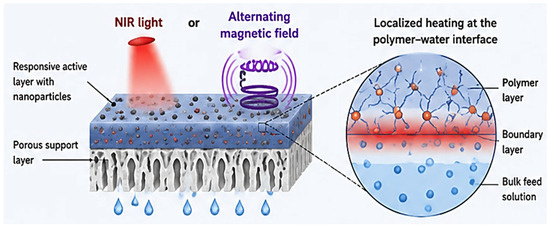
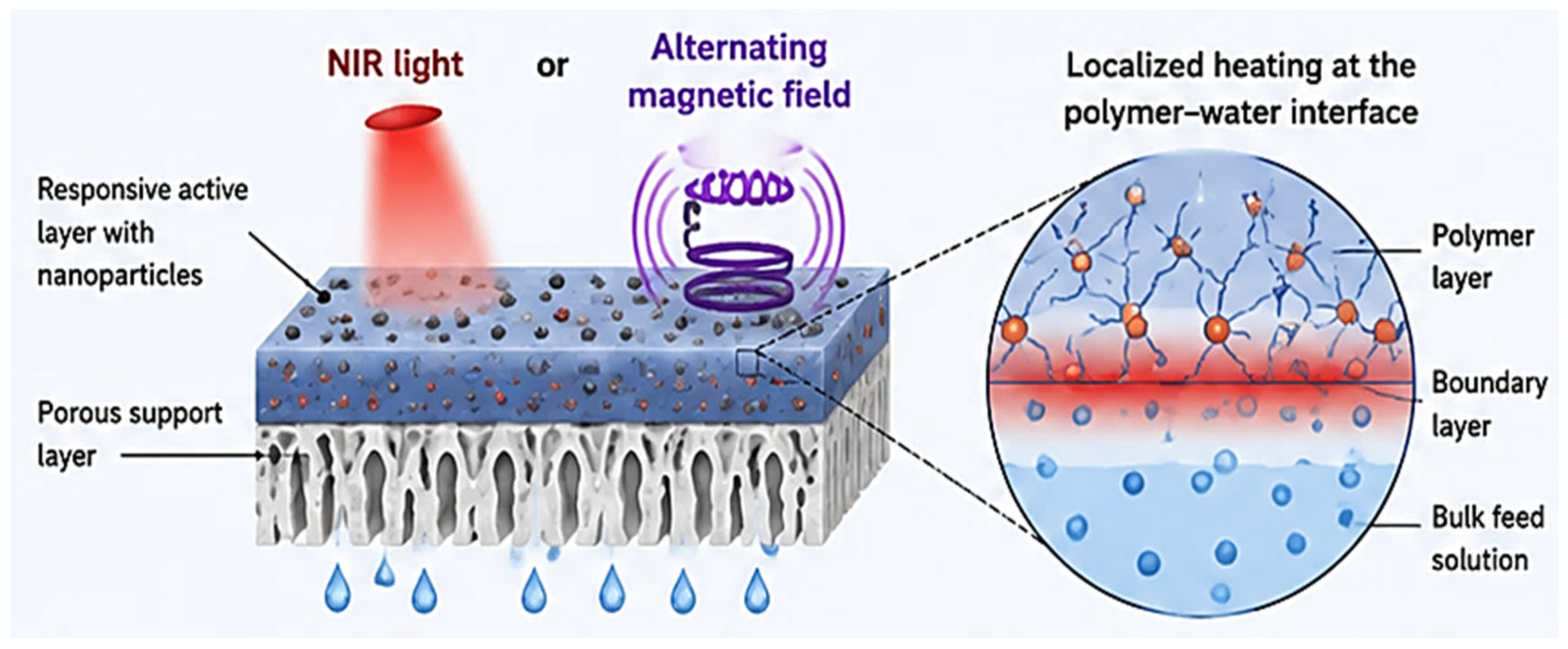
Recent research aims to combine sensitive polymers with inorganic and carbon-based nanomaterials to overcome the mechanical fragility of soft polymer brushes under high hydraulic pressures. These hybrid nanocomposite SRMs merge the mechanical stability and high surface area of inorganic scaffolds with the dynamic gating capabilities of smart polymers. Dual-stage selective barriers are constructed by incorporating thermo- or pH-responsive polymer chains within the porous channels of MOFs (e.g., UiO-66, ZIF-8). The stiff crystalline matrix provides sharp size exclusion, and the collapsed/swollen polymer brushes in the channels serve as smart valves to fine-tune transport rates. Responsive polymer brushes can be directly intercalated between nanosheets in 2D layered membranes. The d-spacing was dynamically swollen or contracted by the environmental triggers, thereby permitting the reversible switching between high-water-flux nanofiltration and high-rejection desalination modes [40]. Responsive polymer brushes can be intercalated directly between nanosheets in 2D layered membranes. Dynamic swelling or contraction of interlayer spacing (d-spacing) by environmental stimuli enables reversible switching between high-water-flux nanofiltration and high-rejection desalination modes. Alternatively, the introduction of gold nanorods, polydopamine nanoparticles, or iron oxide core–shell structures can generate physically remote-actuated membranes. These nanoparticles generate heat at specific locations when they are exposed to near-infrared (NIR) light or an alternating magnetic field (AMF). The thermal pulse quickly results in a coil-to-globule transition in adjacent thermo-responsive polymers (e.g., PNIPAM), thus causing a localized pore opening or foulant detachment in the absence of bulk input stream heating [41].
5. Target Applications in Wastewater Decontamination
The structural flexibility and stimulus responsiveness of SRMs transfer directly into superior performance qualities for complex water purification difficulties. Targeted solutions for dynamic anti-fouling, complicated oil–water emulsion treatment and selective removal of persistent micropollutants are delivered using active chemical interfaces rather than passive physical sieves.
5.1. In Situ Self-Cleaning and Dynamic Anti-Fouling
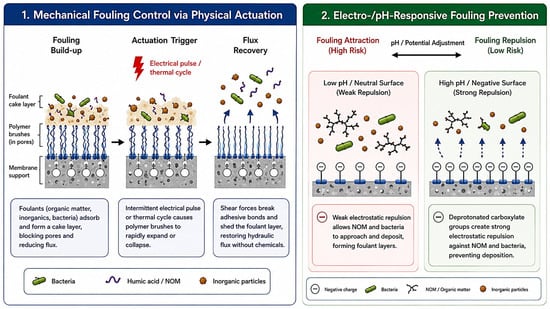
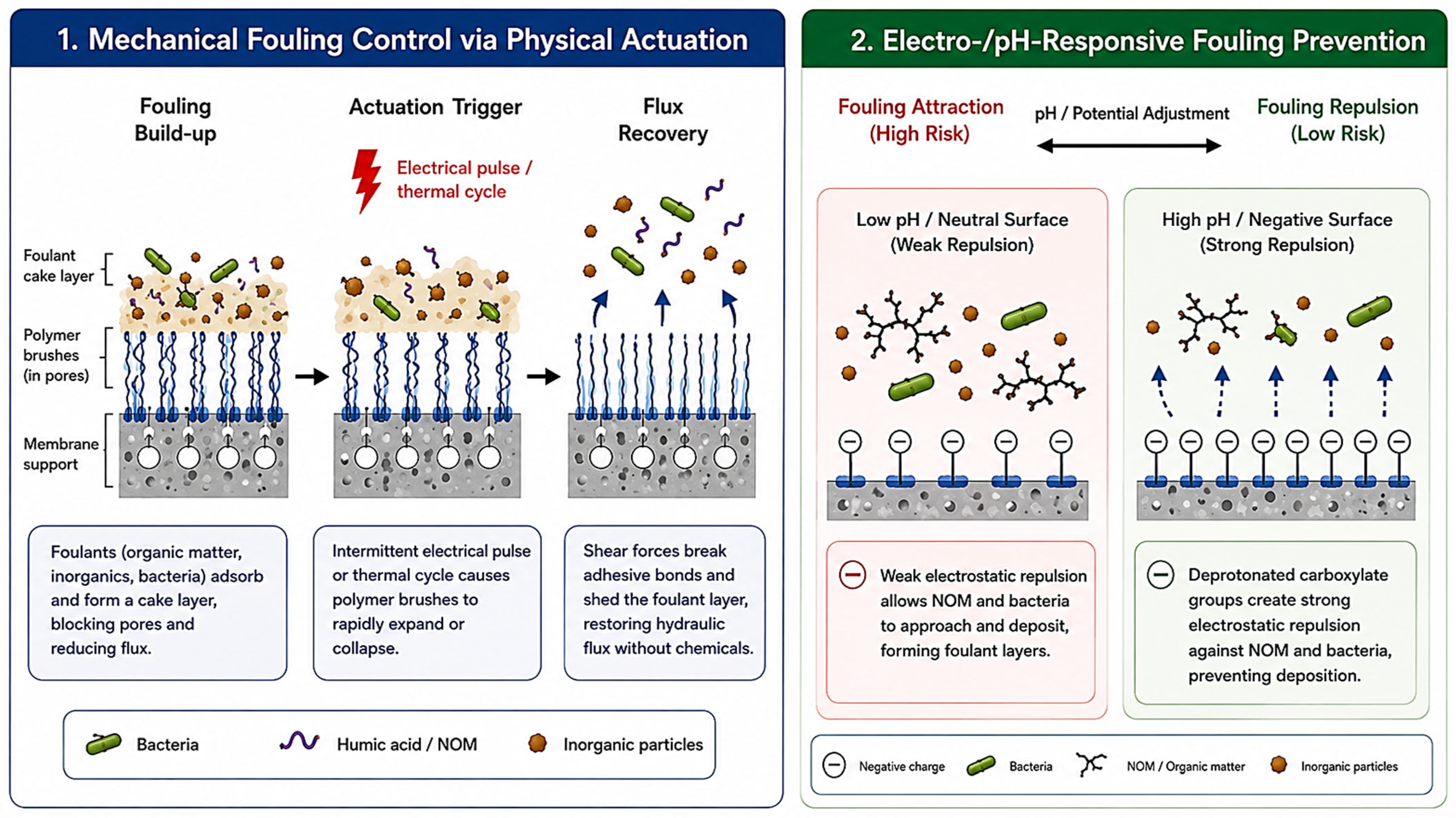
Membrane fouling caused by organic materials (e.g., humic acid, bovine serum albumin), inorganic scaling and bacterial biofilms is the main cause of operational efficiency decline in industrial water reclamation. Most traditional anti-fouling techniques depend on static hydrophilic coatings that just postpone the accretion of foulants or aggressive chemical backwashing regimes that erode the polymer matrix over time. SRMs convert the anti-fouling feature from a passive trait to an active one, turning it into an on-demand self-cleaning process. As shown in Figure 2, this is achieved by two main operational modes, which are: Physical-action mechanical foulant shedding: Localized physical shear stresses at the membrane interface originate from rapid phase transitions of polymer brushes grafted inside membrane pores, e.g., the thermal coil-to-globule collapse of PNIPAM or charge-driven swelling of poly (acrylic acid) (PAA). When the polymer chain architecture stretches or shrinks, it disrupts the adhesive bonds that hold foulant cake layers to pore walls. The above technique demonstrates how the application of an intermittent electrical pulse or heat cycle leads to instantaneous foulant detachment, but the hydraulic flux is restored without the need for chemical cleansers.
Figure 2.
Smart responsive membrane (SRMS) and active on-demand self-cleaning. Figure partially generated using a Gemini 4 Neon AI-assisted tool.
Electrostatic repulsion being switchable: For pH- and electro-responsive membranes, the electrostatic interactions can be modulated by operators through switching the surface charge density. Application of negative bias or pH adjustment to fully deprotonate functional carboxylate groups (COO−) causes considerable electrostatic repulsion with negatively charged natural organic matter (NOM) and bacterial cell walls, actively avoiding surface deposition during high-risk feed conditions [42].
5.2. Switchable Surface Wettability for Complex Oil–Water Separation
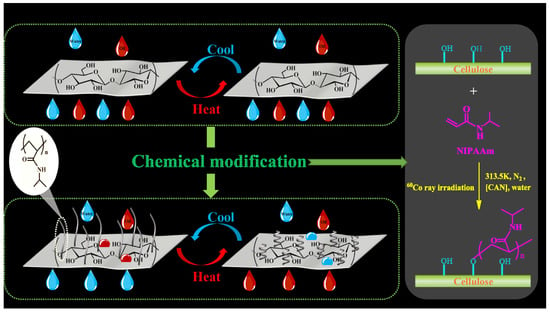
Industrial oily wastewater, including petrochemical effluents and metalworking fluids, often contains surfactant-stabilized micro- and nano-emulsions that overwhelm conventional gravity separators and rapidly clog typical ultrafiltration membranes. Stimuli-responsive polymer membranes (Figure 3) can be engineered with tunable surface wettability, allowing their surfaces to switch between superhydrophilic/underwater superoleophobic and superhydrophobic/superoleophilic states. This reversible wettability transition enables selective separation of different liquid mixtures, particularly oil–water systems, under controlled external stimuli. Switchable surface wettability allows for on-demand and adaptive oil–water separation by switching between hydrophilic/underwater oleophobic and hydrophobic/underoil oleophobic states in response to environmental triggers. These smart materials transcend the limits of conventional fixed-wettability membranes to selectively separate both water-in-oil and oil-in-water mixtures with efficiencies > 99% [43,44]. Chen, W. et al. [45] produced a smart porous membrane with switchable wettability by developing a hydrophilic–hydrophobic physically interlocked network via a one-step emulsion-templated technique. The surface of the membrane could be switched between underwater superoleophobicity and under-oil superhydrophobicity reversibly by simply prewetting the membrane with the necessary continuous phase, such that the selective separation of both oil-in-water (O/W) and water-in-oil (W/O) emulsions could be achieved, as shown in Figure 2. The membrane showed high separation efficiencies (>98.7%) and large permeation fluxes (>5100 L m−2 h−1 bar−1) with outstanding thermal, chemical, and mechanical stability. This work demonstrates the effectiveness of switchable wettability as an effective technique to construct adaptive smart membranes for the treatment of complicated oily wastewater with variable compositions, overcoming the constraint of traditional membranes with constant surface wettability.
Figure 3.
Switchable membrane surface wettability for oil–water separation, adapted with permission from Ref. [45]. under the Creative Commons Attribution (CC BY 4.0) license.
5.3. Selective Removal and Capture of Emerging Micropollutants
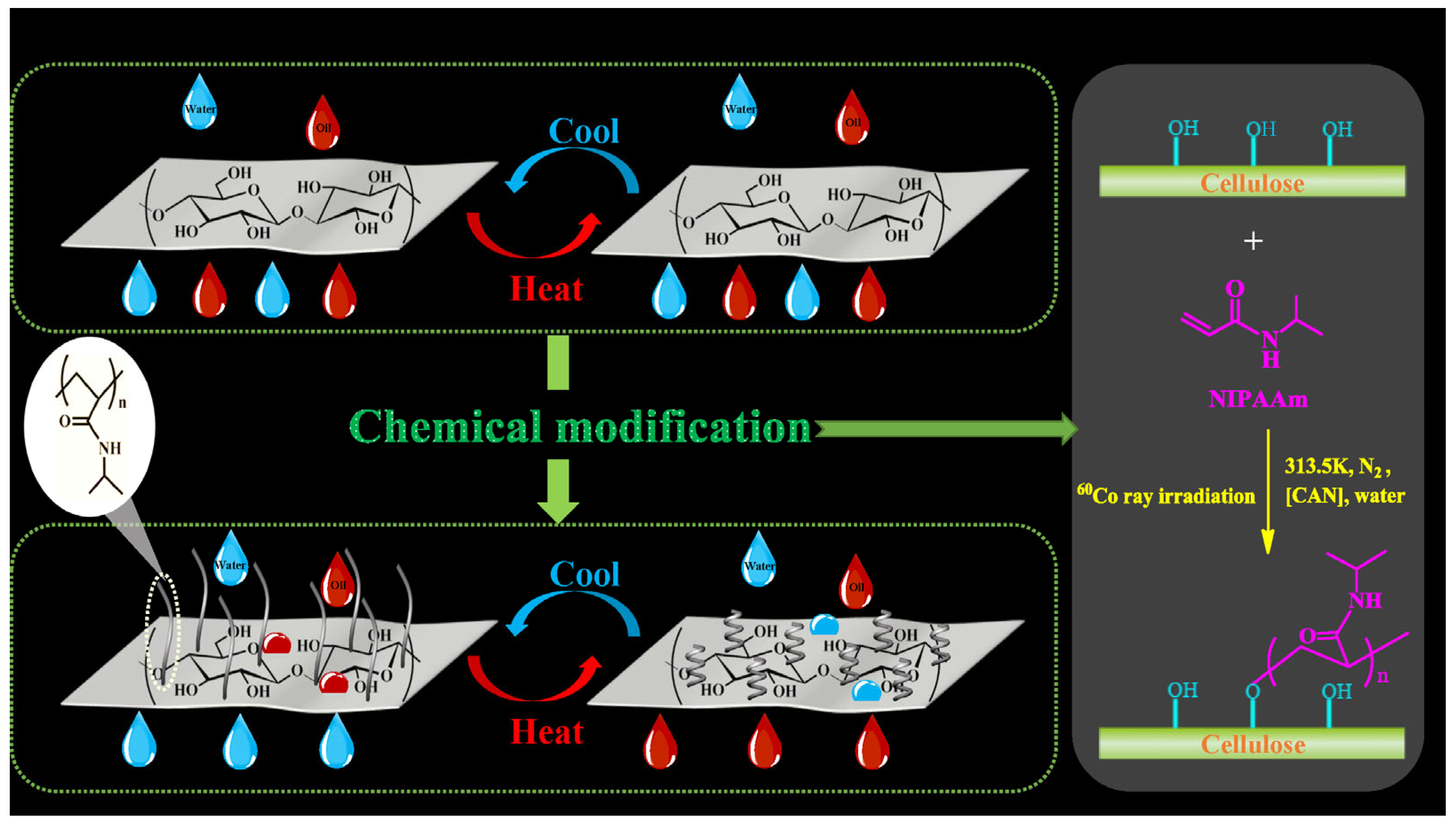
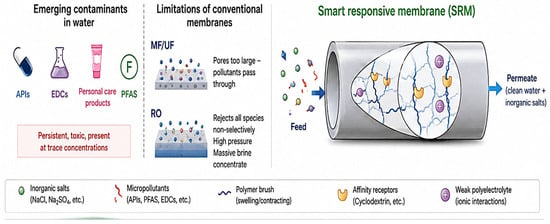
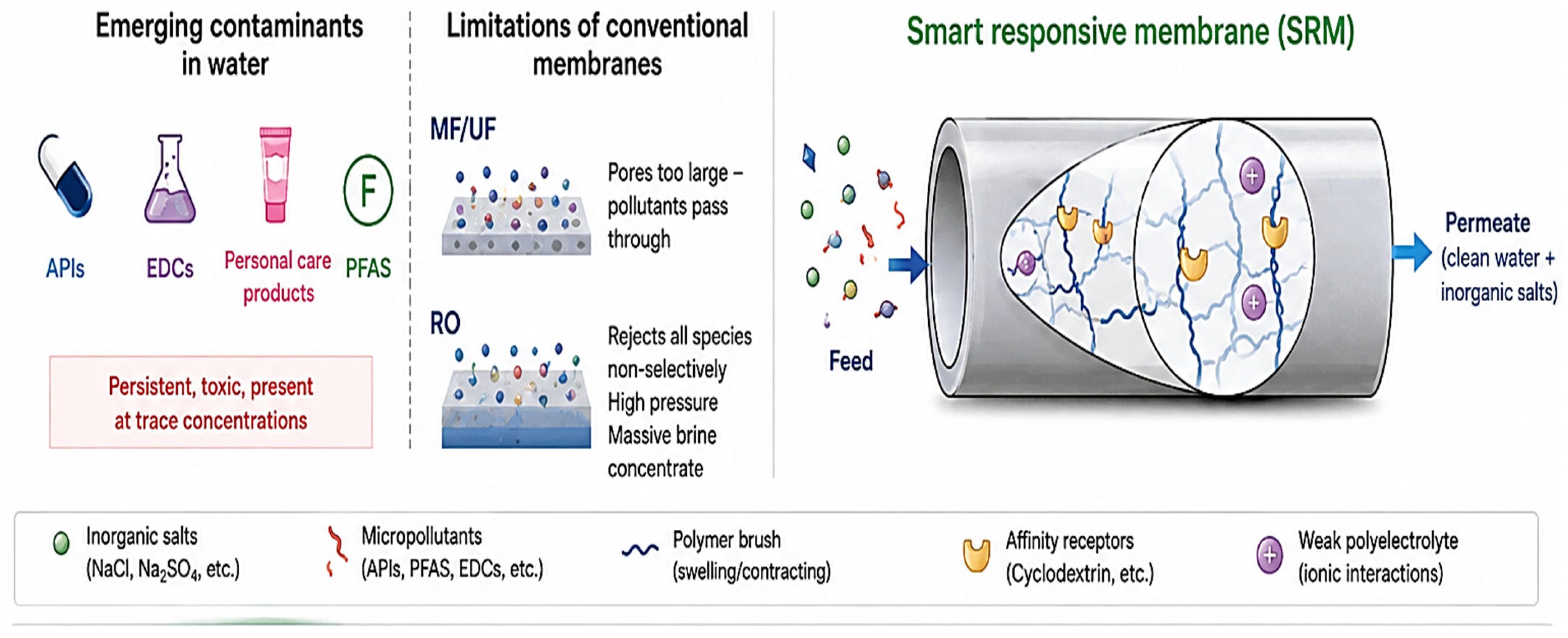
Emerging pollutants such as active pharmaceutical ingredients (APIs), endocrine-disrupting chemicals (EDCs), personal care products, and per- and polyfluoroalkyl substances (PFAS) are persistent and harmful in trace amounts and are a considerable environmental health concern. Here, passive membranes fall short: micro- and ultrafiltration pores are too wide for tiny molecules, and high-pressure reverse osmosis throws out everything indiscriminately, leaving huge, messy brine concentrations. The effective pore diameter can be continually tuned by varying the swelling ratio of polymer brushes inside selective pore networks. It allows for precise size-exclusion separation of benign background inorganic salts (such as NaCl and Na2SO4) from target micropollutants, thus decreasing energy expenditures and osmotic pressure requirements [46,47]. Smart membranes with weak polyelectrolytes or host–guest supramolecular receptors (e.g., cyclodextrin derivatives) selectively bind target micropollutants via hydrophobic, ionic, or fluorophilic interactions during normal operation. Upon reaching saturation, a modest environmental trigger (localized pH decrease or a pulse of NIR light) changes the charge or spatial conformation of the polymer, breaking affinity connections and releasing the bound pollutants into a tiny waste stream, as shown in Figure 4, the selective removal of membranes, and capture of emerging micropollutants. It regenerates the membrane’s adsorption capacity in situ without the need for harsh chemical wash processes [48].
Figure 4.
Membrane-selective removal and capture of emerging micropollutants. Figure partially generated using a Gemini 4 Neon AI-assisted tool.
6. Translation to Scale: Bottlenecks and Critical Trade-Offs
Stimuli-responsive polymer membranes perform well at bench scale under controlled laboratory conditions, but their industrial uptake remains limited. However, scaling up from flat-sheet coupon testing (<50 cm2) to commercial spiral-wound or hollow-fiber modules (>30 m2) is fraught with harsh chemical, mechanical and economic problems. The resolution of these translation obstacles necessitates a pragmatic consideration of three interconnected engineering parameters: actuation kinetics, cyclic fatigue, and the energetic costs associated with stimulus delivery [49].
6.1. Response Kinetics and Actuation Lag
In tabletop experiments, the delivery of the stimulus is generally assumed to be instantaneous, e.g., exchanging a feed solution with a pre-heated beaker or quickly dosing strong acid. However, responsive membranes have a large actuation lag in industrial water treatment systems under continuous cross-flow conditions. On the thermal and mass transport limited by diffusion, the ion transport kinetics in the constrained pore geometry and thermal diffusion control the rate of conformational changes in the polymer chains. In thermo-responsive membranes, it takes time to heat a significant volume of fluid, which leads to a delay between the trigger and mechanical opening/closing of the pore [50].
6.2. Cyclic Mechanical Fatigue and Chemical Degradation
For an SRM to be economically viable in municipal or industrial treatment facilities, it must maintain responsiveness over tens of thousands of actuation cycles during an expected operational lifetime of 3–5 years. The repeated swelling and collapse cycles cause mechanical strains on the interface of the stiff membrane matrix (e.g., PES, PVDF) and the soft responsive polymer brushes. Over time, these interfacial shear pressures may cause polymer chain scission or complete delamination of the grafted layer, leading to permanent loss of responsive gating. Industrial effluents contain powerful oxidants (e.g., sodium hypochlorite, used to reduce biofouling), dramatic pH swings, and harsh organic solvents. Many smart polymer chemistries have vulnerable functional groups (e.g., ester linkages in DMAEMA or amide bonds in NIPAM) that hydrolyze slowly or degrade oxidatively, gradually reducing the membrane’s stimulus sensitivity over time [51]. The hydrolytic stability of poly(2-(dimethylamino) ethyl methacrylate) was studied and compared with the stability of its monomer 2-(dimethylamino) ethyl methacrylate (DMAEMA), with 2-(dimethylamino) ethyl isobutyrate (DMAEIB) by P. van de Wetering [40], which is the repeating unit in the polymer, and with the related 3-(dimethylamino) propyl methacrylate (DMAPMA) (H0/pH range −0.5 to +12, at 37 °C, in aqueous solution) [41]. At pH < 3, the unsaturated DMAEMA and DMAPMA were more stable than the saturated DMAEIB. DMAEMA and DMAEIB had similar stability at pH 4−8 but were less stable than that of DMAPMA. This was explained by a coordination of the protonated dimethylamino group and the ester carbonyl, making the ester more prone to nucleophilic attack by a hydroxyl ion. No variations in stability were seen for the compounds at alkaline pH (>pKa). P(DMAEMA) either in free form or complexed to DNA was far more stable to hydrolytic degradation than DMAEMA and DMAEIB. Fluorescence experiments with a copolymer of DMAEMA and dansyl ethyl methacrylamide indicated that the dielectric constant encountered in the surroundings of the polymer backbone was low (around 7). This microenvironment may be the explanation for the hydrolytic stability of the polymer. The overcoming energy barriers for membrane sustainable wastewater treatment are shown in Figure 5.
Figure 5.
Overcoming energy barriers for membrane sustainable wastewater treatment. Figure partially generated using a Gemini 4 Neon AI-assisted tool.
6.3. Trigger Energy Efficiency and Thermodynamic Realities
Energy consumption associated with operating stimuli-responsive membranes represents a significant challenge to their practical implementation and large-scale commercialization. In traditional membrane separation processes, only hydraulic pressure is used as the driving force. SRMs require additional energy to initiate surface or structure changes. A key problem with commercial applications of responsive membranes is often the energy needed to activate them. Unlike traditional membrane separation processes, which use only hydraulic pressure, stimuli-responsive polymer membranes require additional energy input to trigger surface or structural transitions. With respect to thermal and chemical limitations, there is a large energy need for heating streams of bulk water, since water has a high heat capacity. Therefore, bulk thermal actuation cannot be used for high-volume treatment. Likewise, pH- or ionic-triggered systems involve continuous chemical dosing, thus increasing the operational expense (OPEX), the total dissolved solids (TDS) in the effluent, and secondary chemical waste. Remote and localized actuation represent important strategies for improving the operational efficiency of stimuli-responsive membranes. Accordingly, recent research has increasingly emphasized contactless and spatially controlled activation approaches to deliver external stimuli selectively to targeted membrane regions, thereby reducing energy losses and improving overall process efficiency. The energy can be delivered directly to the polymer–water interface using near-infrared (NIR) light or alternating magnetic fields (AMFs) by embedding photothermal or ferromagnetic nanoparticles in the active layer of the membrane. Localized heating only heats the interfacial boundary layer and so eliminates energy costs of heating the bulk feed solution [52,53].
7. Grand Challenges, Emerging Horizons and Future Perspectives
Over the next 20 years, smart polymer membranes are predicted to evolve from passive filtration materials to intelligent, autonomous separation platforms that are capable of continuously sensing, adapting and optimizing performance for inherent wastewater characteristics. To realize this vision, a paradigm shift in membrane design is needed, from single-function membranes to integrated and multi-functional membranes, which can simultaneously manipulate wettability, pore structure, surface charge, permeability, selectivity and anti-fouling properties through cooperative response to multiple external and internal stimuli. The greatest scientific challenge is to understand and regulate dynamic structure–property performance interactions at the molecular, nano-scale and process levels, thus enabling predictive rather than empirical membrane design. Future research should be focused on the development of robust computational frameworks to integrate molecular simulations, multiscale modeling, machine learning, and artificial intelligence with high-throughput experimentation to accelerate the discovery of new materials, optimize the fabrication pathways, and predict the long-term performance of membranes under realistic operating conditions [54,55]. Another frontier for transformation is the merging of smart membranes and digital technology. By combining embedded sensors, wireless monitoring, internet of things (IoT) connectivity, digital twins, and autonomous process control, self-diagnosing and self-optimizing membrane systems can detect fouling, recognize changes in contaminants, initiate in situ cleaning, and adapt operating parameters without human intervention. These cyber–physical membrane platforms could transform water treatment facilities into intelligent infrastructures that optimize resource efficiency while reducing operational costs, energy consumption and chemical use. The next generation of smart membranes should be designed based on circular-economy principles from a sustainability point of view, focusing on renewable feedstocks, biodegradable and recyclable polymers, green solvents, solvent-free fabrication technologies, low-carbon manufacturing and end-of-life material recovery. Future membranes could be designed to treat a wide range of wastewater streams. Such multi-functional recovery systems will increasingly contribute to addressing global concerns such as water shortages, resource depletion and climate change, while enabling the transition to a circular water economy [56,57]. Perhaps the greatest task for the future decades will be to bridge the gap between laboratory invention and industrial execution. Most smart membranes are still at low technical readiness levels, and there is minimal validation in realistic wastewater matrices with changing pH, salinity, organic loading, surfactants, microbes and mixed pollutants. Therefore, future research should focus on pilot-scale demonstration, long-term continuous operation, standardized performance measures, techno-economic analysis, life-cycle assessment, environmental risk evaluation, and regulatory compliance. The development of uniform testing methodologies and durability standards will be important to enabling meaningful comparisons between various membrane technologies and expediting commercialization. The future of smart polymer membranes will ultimately require not only advances in materials chemistry but also interdisciplinary convergence of membrane science, polymer engineering, nanotechnology, biotechnology, computational science, robotics, environmental engineering, systems engineering, and data science. Intelligent membrane systems that enable autonomous decision-making, adaptive operation, predictive maintenance, and integrated resource recovery are likely to transform wastewater treatment from an energy-intensive separation process to a resilient, digitally connected, and resource-generating infrastructure. Such a transformation would make smart polymer membranes a key technology for achieving global water security, carbon-neutral industrial processes, and the broader sustainability goals envisioned for the next generation of environmental technologies. Although stimuli-responsive polymer membranes have shown promising performance in lab-scale wastewater treatment, its usefulness in realistic operating settings needs to be further considered. Real municipal and industrial wastewater streams comprise complex mixes of organic and inorganic contaminants, dissolved salts, suspended particles and competing pollutants that affect membrane selectivity, permeability and response to external stimuli. For instance, the pH, ionic strength, and organic content of dye-containing wastewater are highly variable, which may influence the swelling behavior, surface charge, and pore shape of pH-responsive membranes. Similarly, wastewater containing heavy metals and mixed organic pollutants may bring in the competition effect that changes the transport and retention of contaminants. Natural organic matter and suspended particles can also lead to faster membrane fouling and lower long-term separation performance. Therefore, future studies should focus on examining the performance of stimuli-responsive membranes in real wastewater samples, under variable operating conditions, and evaluating the long-term stability, regeneration efficiency and reusability. Such studies are needed to bridge the gap between laboratory demonstrations and real-world wastewater treatment applications [58,59,60,61,62,63].
8. Comparison of Membrane Performance
Table 2 summarizes the quantitative comparison of representative stimuli-sensitive polymer membranes produced for water and wastewater treatment in terms of responsive mechanisms, membrane compositions, permeability, and pollutant rejection efficiency. The given results show that different responsive systems can present a high separation performance, with certain membranes exhibiting rejection efficiencies over 99% and high-water permeability. In particular, thermo-responsive membranes are promising for controlling water transport and enabling foulant removal through temperature-dependent changes in membrane characteristics. Similarly, pH-responsive membranes have tunable separation properties depending on the environmental conditions of the fluid. However, the comparison shows that the performance of membranes is greatly dependent on the material composition, operating conditions and target pollutants. Thus, further research with standardized anti-fouling measurements and long-term filtration performance is needed to demonstrate the practical benefits of these membranes for wastewater treatment.
Table 2.
Comparison of membrane performance for permeability, rejection efficiency, and anti-fouling properties.
9. Conclusions
Stimuli-responsive polymer membranes are a promising class of adaptive separation materials that can dynamically change their physicochemical properties in response to environmental stimuli. Among such systems, temperature-, pH-, and pollutant type-responsive membranes have received much attention owing to their reversible switching nature, comparatively simple actuation, and compatibility with pressure-driven membrane processes. They offer the possibility to controllably tune pore size, wettability, surface charge, and permeability, which can be used as a strategy to tackle the persistent challenges of traditional membrane technologies, such as membrane fouling, low selectivity, and the intrinsic trade-off between permeate flux and contaminant rejection. In addition, ionic-, photo-, electro- and magneto-responsive polymer membranes provide further prospects for the development of adaptive wastewater treatment systems. Ionic-responsive membranes can alter their surface charge, swelling behavior, and separation performance with changes in ionic strength. Photoresponsive systems rely on light-induced changes in the wettability and surface properties of the membrane. Similarly, electro-responsive membranes allow for the management of surface charge and pollutant–membrane interactions, whereas magneto-responsive membranes use magnetic materials to provide controlled separation, pollutant removal, and possible membrane regeneration. In this review, we have covered the basic concepts of stimuli-responsive membrane function, molecular processes of stimulus-driven changes, and recent developments in polymer design, membrane preparation, and functionalization techniques of the membrane surface. These membranes have significant potential in wastewater treatment due to their adaptive separation of contaminants, better anti-fouling and self-cleaning capabilities, and increased operating efficiency for removing oils, dyes, heavy metals, pharmaceuticals, and new contaminants. However, most documented studies are limited to laboratory-scale experiments under simplified operating conditions, and comparatively few detailed studies address real wastewater streams, continuous operation, reversibility, and long-term stability. Other obstacles include material durability, response efficiency, energy consumption, and large-scale implementation. Therefore, future studies should aim at rational molecular engineering of multi-functional and multi-responsive polymer networks with increased durability, fast actuation, and lower energy demands. Advanced nanomaterials, dynamic covalent chemistries, bio-inspired surface architectures and environmentally friendly polymers provide great potential to produce the next generation of adaptable membranes. Moreover, the introduction of computer modeling, machine learning and artificial intelligence has the promise to speed up the identification of new materials, optimize membrane design and anticipate long-term performance under realistic operating conditions. Finally, pilot-scale demonstrations, techno-economic assessments, life-cycle analyses and studies on membrane recyclability and environmental sustainability will be vital for confirming the practical feasibility and commercial viability of these developing technologies.
Author Contributions
Conceptualization, Z.A.J. and K.T.R.; resources, K.T.R., M.A.S., M.H.H.A., H.H.M., M.A., A.A.A., and G.S.; writing—original draft preparation, Z.A.J., K.T.R., M.A.S., and M.H.H.A.; writing—review and editing, K.T.R., M.A.S., M.H.H.A., H.H.M., M.A., A.A.A., and G.S.; supervision, K.T.R. All authors have read and agreed to the published version of the manuscript.
Funding
This research received no external funding.
Data Availability Statement
No new data were created or analyzed in this study. Data sharing is not applicable to this article.
Acknowledgments
During the preparation of this manuscript, the authors used Gemini 4 Neon AI tool for the purposes of improving figures’ visibility. The authors have reviewed and edited the output and take full responsibility for the content of this publication.
Conflicts of Interest
The authors declare no conflict of interest.
References
- Al-Shaeli, M.; Benkhaya, S.; Al-Juboori, R.A.; Koyuncu, I.; Vatanpour, V. PH-responsive membranes: Mechanisms, fabrications, and applications. Sci. Total Environ. 2024, 946, 173865. [Google Scholar] [CrossRef] [Scilit]
- Rashid, K.T.; Alayan, H.M.; Mahdi, A.E.; AL-Baiati, M.N.; Majdi, H.S.; Salih, I.K.; Ali, J.M.; Alsalhy, Q.F. Novel Water-Soluble Poly (terephthalic-co-glycerol-g-fumaric acid) Copolymer Nanoparticles Harnessed as Pore Formers for Polyethersulfone Membrane Modification: Permeability–Selectivity Trade-off Manipulation. Water 2022, 14, 1507. [Google Scholar] [CrossRef] [Scilit]
- Yahia, Y.; Rashid, K.T.; Shehab, M.A.; Abdul Razak, A.A.; Ghadhban, M.Y.; Al-lami, M.; Al-Mayyahi, M.A.T.; Salih, M.A.; Mohammed, H.H.; Mahmood, A. Treating wastewater contaminated with congo red (CR) dye using an optimized polyethersulfone/propolis (bee glue) PES/PRS ultrafiltration membrane. RSC Adv. 2025, 15, 23174–23186. [Google Scholar] [CrossRef] [Scilit]
- Ho, C.-D. Membrane Separation Techniques: Advances, Challenges, and Future Avenues. Membranes 2026, 16, 112. [Google Scholar] [CrossRef] [Scilit]
- Guo, W.; Ngo, H.-H.; Li, J. A mini-review on membrane fouling. Bioresour. Technol. 2012, 122, 27–34. [Google Scholar] [CrossRef] [Scilit]
- Tijing, L.D.; Woo, Y.C.; Choi, J.-S.; Lee, S.; Kim, S.-H.; Shon, H.K. Fouling and its control in membrane distillation A review. J. Membr. Sci. 2015, 475, 215–244. [Google Scholar] [CrossRef] [Scilit]
- Jiang, S.; Li, Y.; Ladewig, B.P. A review of reverse osmosis membrane fouling and control strategies. Sci. Total Environ. 2017, 595, 567–583. [Google Scholar] [CrossRef] [Scilit]
- Osuofa, J.; Husson, S.M. Comparative Evaluation of Commercial Protein A Membranes for the Rapid Purification of Antibodies. Membranes 2023, 13, 511. [Google Scholar] [CrossRef] [Scilit]
- Winarta, J.; Meshram, A.; Zhu, F.; Li, R.; Jafar, H.; Parmar, K.; Liu, J.; Mu, B. Metal–organic framework-based mixed-matrix membranes for gas separation: An overview. J. Polym. Sci. 2020, 58, 2518–2546. [Google Scholar] [CrossRef] [Scilit]
- Hong, S.; Al Marzooqi, F.; El-Demellawi, J.K.; Al Marzooqi, N.; Arafat, H.A.; Alshareef, H.N. Ion-Selective Separation Using MXene-Based Membranes: A Review. ACS Mater. Lett. 2023, 5, 341–356. [Google Scholar] [CrossRef] [Scilit]
- Oh, H.J.; Phillip, W.A. Polymer Physics of Separation Membranes. Macromolecules 2024, 57, 9489–9497. [Google Scholar] [CrossRef] [Scilit]
- Ignacz, G.; Bader, L.; Beke, A.K.; Ghunaim, Y.; Shastry, T.; Vovusha, H.; Carbone, M.R.; Ghanem, B.; Szekely, G. Machine learning for the advancement of membrane science and technology: A critical review. J. Membr. Sci. 2025, 713, 123256. [Google Scholar] [CrossRef] [Scilit]
- Osman, A.I.; Chen, Z.; Elgarahy, A.M.; Farghali, M.; Mohamed, I.M.A.; Priya, A.K.; Hawash, H.B.; Yap, P.-S. Membrane Technology for Energy Saving: Principles, Techniques, Applications, Challenges, and Prospects. Adv. Energy Sustain. Res. 2024, 5, 2400011. [Google Scholar] [CrossRef] [Scilit]
- Liu, X.; Neoh, K.G.; Kang, E.T. Redox-Sensitive Microporous Membranes Prepared from Poly (vinylidene fluoride) Grafted with Viologen-Containing Polymer Side Chains. Macromolecules 2003, 36, 8361–8367. [Google Scholar] [CrossRef] [Scilit]
- Matesun, J.; Petrik, L.; Musvoto, E.; Ayinde, W.; Ikumi, D. Limitations of wastewater treatment plants in removing trace anthropogenic biomarkers and future directions: A review. Ecotoxicol. Environ. Saf. 2024, 281, 116610. [Google Scholar] [CrossRef] [Scilit]
- Mumtaz, F.; Faraz, M.; Balakrishnan, H.K.; Nair, R.; Dumée, L.F. Stimuli-responsive membranes mechanisms, materials and future directions. npj Clean Water 2026, 9, 1. [Google Scholar] [CrossRef] [Scilit]
- Moffa, S.; Pilato, S.; Ciulla, M.; Di Profio, P.; Fontana, A.; Masciulli, F.; Siani, G. Recent Advances in Stimuli-Responsive Membranes: From Supramolecular Design to Controlled Permeability. Membranes 2026, 16, 89. [Google Scholar] [CrossRef] [Scilit]
- De Lima, M.S.P.; Freire, M.S.; Fonseca, J.L.C.; Pereira, M.R. Chitosan membranes modified by contact with poly (acrylic acid). Carbohydr. Res. 2009, 344, 1709–1715. [Google Scholar] [CrossRef] [Scilit]
- Suvarna, P.; Likhith, K.; Nison, M.; Datta, D.; Pai, V.R.; Chidananda, C.; Thakur, G. Responsive to revolutionary: Thermoresponsive hydrogels pioneering drug delivery and tissue engineering. Mater. Des. 2026, 266, 115973. [Google Scholar] [CrossRef] [Scilit]
- Cazeca, M.J.; Li, L.; Yan, F.; Samuelson, L.A.; Kumar, J. Fabrication of TiO2 grating with composites of azobenzene polymer and TiO2 nanoparticles. J. Macromol. Sci. Part A 2007, 44, 1329–1332. [Google Scholar] [CrossRef] [Scilit]
- Zhao, Z.; Wang, H.; Huang, H.; Li, L.; Yu, X. Graphene oxide/polypyrrole/polyaniline composite hydrogel synthesized by vapor-liquid interfacial method for supercapacitors. Colloids Surf. A Physicochem. Eng. Asp. 2021, 626, 127125. [Google Scholar] [CrossRef] [Scilit]
- Hassan, H.M.A.; Alsohaimi, I.H.; Mohamed, R.M.K.; Algamdi, M.S.; Alhumaimess, M.S.; Alanazi, A.H.; Kumar, M. Eco-friendly polysulfone magnetic spent coffee activated Carbon@Amino composite UF membrane with enhanced anti-fouling resistance. J. Environ. Chem. Eng. 2026, 14, 121891. [Google Scholar] [CrossRef] [Scilit]
- Pietschnig, R. Polymers with pendant ferrocenes. Chem. Soc. Rev. 2016, 45, 5216–5231. [Google Scholar] [CrossRef] [Scilit]
- Smook, L.A.; Dahlin, A.; Schroën, K.; de Beer, S. Responsive Polyelectrolyte Brushes in Applications: Functions, Stimuli, and Design Considerations. Adv. Mater. 2025, 37, e09580. [Google Scholar] [CrossRef] [Scilit]
- Chen, S.Q.; Li, J.M.; Pan, T.T.; Li, P.Y.; He, W.D. Comb-Type Grafted Hydrogels of PNIPAM and PDMAEMA with Reversed Network-Graft Architectures from Controlled Radical Polymerizations. Polymers 2016, 8, 38. [Google Scholar] [CrossRef] [Scilit]
- Zhang, R.; Liu, Y.; He, M.; Su, Y.; Zhao, X.; Elimelech, M.; Jiang, Z. Anti-fouling membranes for sustainable water purification: Strategies and mechanisms. Chem. Soc. Rev. 2016, 45, 5888–5924. [Google Scholar] [CrossRef] [Scilit]
- Wu, Y.; Wang, Z.; Zhou, J.; Gu, Q.; Zhong, Z. Stimulus-Responsive Membranes: A Mini Review on Principles, Preparation Methods, and Emerging Applications. Separations 2025, 12, 219. [Google Scholar] [CrossRef] [Scilit]
- Phillip, N.; Muleja, A.A.; Motsa, M.M.; Mamba, B.B.; Nkambule, T.T.I.; Tshangana, C.S. Membrane Biofouling: Current Understanding and Future Perspectives- An Overview. Curr. Microbiol. 2026, 83, 299. [Google Scholar] [CrossRef] [Scilit]
- Rehman, A.; Sohail, M.; Baig, N.; Yuan, K.; Abdala, A.; Wahab, M.A. Next-generation stimuli-responsive smart membranes: Developments in oil/water separation. Adv. Colloid Interface Sci. 2025, 341, 103487. [Google Scholar] [CrossRef] [Scilit]
- Gin, D.L.; Noble, R.D. Designing the Next Generation of Chemical Separation Membranes. Science 2011, 332, 674–676. [Google Scholar] [CrossRef] [Scilit]
- Werber, J.; Osuji, C.; Elimelech, M. Materials for next-generation desalination and water purification membranes. Nat. Rev. Mater. 2016, 1, 16018, Erratum in Nat. Rev. Mater. 2016, 1, 16037. https://doi.org/10.1038/natrevmats.2016.37. [Google Scholar] [CrossRef] [Scilit]
- Sumerlin, B.S. Proteins as Initiators of Controlled Radical Polymerization: Grafting-from via ATRP and RAFT. ACS Macro Lett. 2012, 1, 141–145. [Google Scholar] [CrossRef] [Scilit]
- Truong, N.P.; Jones, G.R.; Bradford, K.G.E.; Konkolewicz, D.; Anastasaki, A. A comparison of RAFT and ATRP methods for controlled radical polymerization. Nat. Rev. Chem. 2021, 5, 859–869. [Google Scholar] [CrossRef] [Scilit]
- Janoschka, T.; Teichler, A.; Krieg, A.; Hager, M.D.; Schubert, U.S. Polymerization of free secondary amine bearing monomers by RAFT polymerization and other controlled radical techniques. J. Polym. Sci. A Polym. Chem. 2012, 50, 1394–1407. [Google Scholar] [CrossRef] [Scilit]
- Yi, Z.; Zhu, L.; Xiong, R.; Fang, C.; Zhu, B.; Zhu, L.; Zeng, H. Advanced functional membranes based on amphiphilic copolymers. Prog. Polym. Sci. 2024, 159, 101907. [Google Scholar] [CrossRef] [Scilit]
- Wojciechowski, C.; Wasyłeczko, M.; Lewińska, D.; Chwojnowski, A. A Comprehensive Review of Hollow-Fiber Membrane Fabrication Methods across Biomedical, Biotechnological, and Environmental Domains. Molecules 2024, 29, 2637. [Google Scholar] [CrossRef] [Scilit]
- Sankhala, K.; Koll, J.; Abetz, V. Setting the Stage for Fabrication of Self-Assembled Structures in Compact Geometries: Inside-Out Isoporous Hollow Fiber Membranes. ACS Macro Lett. 2018, 7, 840–845. [Google Scholar] [CrossRef] [Scilit]
- Hahn, J.; Clodt, J.I.; Abetz, C.; Filiz, V.; Abetz, V. Thin Isoporous Block Copolymer Membranes: It Is All about the Process. ACS Appl. Mater. Interfaces 2015, 7, 21130–21137. [Google Scholar] [CrossRef] [Scilit]
- Hampu, N.; Werber, J.R.; Chan, W.Y.; Feinberg, E.C.; Hillmyer, M.A. Next-Generation Ultrafiltration Membranes Enabled by Block Polymers. ACS Nano 2020, 14, 16446–16471. [Google Scholar] [CrossRef] [Scilit]
- Homocianu, M. Polymer-inorganic hybrid materials: Challenges and optimization strategies for high-performance applications. Polym. Polym. Compos. 2026, 34. [Google Scholar] [CrossRef] [Scilit]
- Liu, Z.; Zhai, Y.; Zhou, K.-G.; Chu, L.-Y. Advanced membranes with responsive two-dimensional nanochannels. Adv. Membr. 2021, 1, 100012. [Google Scholar] [CrossRef] [Scilit]
- Yu, T.; Li, X.; Li, S.; Wang, Z. Microbubble-assisted double-defense design of anti-fouling superhydrophilic membrane for sustainable emulsion separation and synergistic pollutant degradation. J. Membr. Sci. 2025, 734, 124474. [Google Scholar] [CrossRef] [Scilit]
- Ritsema van Eck, G.C.; Chiappisi, L.; de Beer, S. Fundamentals and Applications of Polymer Brushes in Air. ACS Appl. Polym. Mater. 2022, 4, 3062–3087. [Google Scholar] [CrossRef] [Scilit]
- Thevi Guntnur, R.; Muzzio, N.; Morales, M.; Romero, G. Phase transition characterization of poly(oligo(ethylene glycol)methyl ether methacrylate) brushes using the quartz crystal microbalance with dissipation. Soft Matter 2021, 17, 2530–2538. [Google Scholar] [CrossRef] [Scilit]
- Chen, W.; He, H.; Zhu, H.; Cheng, M.; Li, Y.; Wang, S. Thermo-Responsive Cellulose-Based Material with Switchable Wettability for Controllable Oil/Water Separation. Polymers 2018, 10, 592. [Google Scholar] [CrossRef] [Scilit]
- Zhang, Y.; Gong, X. Smart and durable pH-responsive superhydrophobic fabrics with switchable surface wettability for high-efficiency and complex oil/water separation. Giant 2023, 14, 100157. [Google Scholar] [CrossRef] [Scilit]
- Huang, H.; Cai, Y.; Zhao, C.; Wang, Z.; Su, X.; Zhang, B.; Cheng, J.-B.; Li, H.; Xiang, D.; Wu, Y. Design of Porous Materials with Switchable Wettability for On-Demand Separation of Oil–Water Emulsions. ACS Appl. Polym. Mater. 2025, 7, 10789–10801. [Google Scholar] [CrossRef] [Scilit]
- Lounder, S.J.; Asatekin, A. Zwitterionic Ion-Selective Membranes with Tunable Subnanometer Pores and Excellent Fouling Resistance. Chem. Mater. 2021, 33, 4408–4416. [Google Scholar] [CrossRef] [Scilit]
- Jonkers, W.A.; Maan, A.M.; Bonekamp, R.; Pieters, L.; Brinke, E.T.; de Vos, W.M. From brush to barrier: Fine-tuning Donnan exclusion in polyelectrolyte multilayer membranes with polymer brushes. ACS Appl. Polym. Mater. 2024, 6, 9806–9816. [Google Scholar] [CrossRef] [Scilit]
- Lu, D.; Zhao, Z.; Xiang, X.; Li, T.; Geng, Y.; Wu, M.; Li, Y.; Xu, S.; Zhang, C.; Gao, Z.; et al. A smart framework to design membranes for organic micropollutants removal. Nat. Sustain. 2025, 8, 1177–1189. [Google Scholar] [CrossRef] [Scilit]
- Huang, Y.; Yan, Q.; Yuan, H.; Wu, T.; Zhang, J.; Jiang, Z.; Yang, H. Stimulus-responsive covalent organic framework membranes for advanced separation and sensing. Coord. Chem. Rev. 2026, 562, 217973. [Google Scholar] [CrossRef] [Scilit]
- Speyer, K.; Pastorino, C. Brushes of semiflexible polymers in equilibrium and under flow in a super-hydrophobic regime. Soft Matter 2015, 11, 5473–5484. [Google Scholar] [CrossRef] [Scilit]
- Sun, B.; Wang, H.; Liu, Y.; Lv, W.; Li, Y.; Ma, S.; Wang, X.; Cao, H. Shear-Induced Degradation and Rheological Behavior of Polymer-Flooding Waste Liquids: Experimental and Numerical Analysis. Processes 2025, 13, 2677, Correction in Processes 2025, 13, 4020. https://doi.org/10.3390/pr13124020. [Google Scholar] [CrossRef] [Scilit]
- Nazari, S.; Abdelrasoul, A. Advancements and Applications of Artificial Intelligence and Machine Learning in Material Science and Membrane Technology: A Comprehensive Review. Membranes 2025, 15, 353. [Google Scholar] [CrossRef] [Scilit]
- Alli, Y.A.; Mustapha, L.S.; Mekunye, F.; Adeleke, O.J.; Igba, T.; Etafo, N.O.; Aderibigbe, V.; Dey, S.; Yayoh, H.K.; Obayomi, K.S.; et al. Artificial intelligence-driven nanomaterial design and applications: Advances, challenges, and future directions. New J. Chem. 2026, 50, 15177–15207. [Google Scholar] [CrossRef] [Scilit]
- Diao, S.; Meng, L.; Pelicano, C.M.; Huang, J.; Tian, Z.; Lai, F.; Liu, T.; Cao, S. Rapid Photothermal-Responsive Soft Hydrogel Actuator Contained Ti3C2Tx MXene and Laponite Clay with Enhanced Mechanical Properties. ACS Appl. Mater. Interfaces 2024, 16, 44067–44076. [Google Scholar] [CrossRef] [Scilit]
- Hai, A.; Rambabu, K.; Govindan, B.; Banat, F.; Naushad, M. Chapter Fourteen—Smart polymeric composite membranes for wastewater treatment. In Smart Polymer Nanocomposites; Bhawani, S.A., Khan, A., Jawaid, M., Eds.; Woodhead Publishing Series in Composites Science and Engineering; Woodhead Publishing: Cambridge, UK, 2021; pp. 313–350. [Google Scholar] [CrossRef] [Scilit]
- Cairone, S.; Hasan, S.W.; Choo, K.-H.; Li, C.-W.; Zarra, T.; Belgiorno, V.; Naddeo, V. Integrating artificial intelligence modeling and membrane technologies for advanced wastewater treatment: Research progress and future perspectives. Sci. Total Environ. 2024, 944, 173999. [Google Scholar] [CrossRef] [Scilit]
- Wang, A.-J.; Li, H.; He, Z.; Tao, Y.; Wang, H.; Yang, M.; Savic, D.; Daigger, G.T.; Ren, N. Digital Twins for Wastewater Treatment: A Technical Review. Engineering 2024, 36, 21–35. [Google Scholar] [CrossRef] [Scilit]
- Sahu, A.; Dosi, R.; Kwiatkowski, C.; Schmal, S.; Poler, J.C. Advanced Polymeric Nanocomposite Membranes for Water and Wastewater Treatment: A Comprehensive Review. Polymers 2023, 15, 540. [Google Scholar] [CrossRef] [Scilit]
- Al-Rashed, W.S. Wastewater Membrane Bioreactors: A Comprehensive Review of Explainable Artificial Intelligence and Digital Twin Applications. Membranes 2026, 16, 181. [Google Scholar] [CrossRef] [Scilit]
- Lai, S.O.; Bashir, M.J.K.; Ng, C.A.; Chong, K.C.; Kam, H.K.; Gumaling, R.P.; Wang, L.-C. Membrane Technologies for Microplastics Removal from Wastewater: Recent Progress, Fouling Mechanisms, and Future Perspectives. Membranes 2026, 16, 190. [Google Scholar] [CrossRef] [Scilit]
- Sisay, E.J.; Al-Tayawi, A.N.; László, Z.; Kertész, S. Recent Advances in Organic Fouling Control and Mitigation Strategies in Membrane Separation Processes: A Review. Sustainability 2023, 15, 13389. [Google Scholar] [CrossRef] [Scilit]
- Wang, L.; Gao, N.; Zhang, Y.; Li, B.; Liao, Y. Modified ceramic membrane with temperature responsiveness and self-cleaning property for efficient separation and catalysis. Sep. Purif. Technol. 2024, 349, 127935. [Google Scholar] [CrossRef] [Scilit]
- Cao, X.; He, Z.; Dai, H.; Jiang, L. Advanced Ceramics with Extraordinary Wettability: From Fundamental Research to Industrial Engineering. Adv. Eng. Mater. 2025, 27, 2500585. [Google Scholar] [CrossRef] [Scilit]
- Kalita, V.; Bhattacharyya, J.; Bora, S.J.; Kalita, R.; Dutta, P.P. Fractionation and separation of bioactive peptides using natural polymeric membrane. Braz. J. Pharm. Sci. 2025, 61, e24081. [Google Scholar] [CrossRef] [Scilit]
- Cheng, B.; Li, Z.; Li, Q.; Ju, J.; Kang, W.; Naebe, M. Development of smart poly(vinylidene fluoride)-graft poly(acrylic acid) tree-like nanofiber membrane for pH-responsive oil/water separation. J. Membr. Sci. 2017, 534, 1–8. [Google Scholar] [CrossRef] [Scilit]
- Yi, G.; Fan, X.; Quan, X.; Zhang, H.; Chen, S.; Yu, H. A pH-responsive PAA-grafted-CNT intercalated RGO membrane with steady separation efficiency for charged contaminants over a wide pH range. Sep. Purif. Technol. 2019, 215, 422–429. [Google Scholar] [CrossRef] [Scilit]
- Yi, M.; Nguyen, T.D.; Liu, H.; Liu, Y.; Xiong, S.; Wang, Y. A Boronate Ester Driven Rechargeable Antibacterial Membrane for Fast Molecular Sieving. Adv. Funct. Mater. 2023, 33, 2213471. [Google Scholar] [CrossRef] [Scilit]

Disclaimer/Publisher’s Note: The statements, opinions and data contained in all publications are solely those of the individual author(s) and contributor(s) and not of MDPI and/or the editor(s). MDPI and/or the editor(s) disclaim responsibility for any injury to people or property resulting from any ideas, methods, instructions or products referred to in the content. |
© 2026 by the authors. Licensee MDPI, Basel, Switzerland. This article is an open access article distributed under the terms and conditions of the Creative Commons Attribution (CC BY) license.