


Abstract
Soil–structure interface shear behavior plays a fundamental role in the mechanical stability and hydraulic integrity of geotechnical systems, particularly in expansive soils susceptible to desiccation cracking, curling, and permeability changes during seasonal drying. Direct shear testing is widely used to characterize interface behavior; however, conventional configurations often fail to reproduce the coupled hydro-mechanical and thermal conditions associated with drying and restrained shrinkage. This review critically examines advances in modified direct shear apparatuses for investigating soil–structure interfaces, including suction-control techniques based on axis translation and vapor equilibrium, surface-roughness modifications using smooth, grooved, and textured plates, dual-sided configurations, environmental controls, and thermo-hydro-mechanical (THM) adaptations. Experimental findings from natural and artificial soils are synthesized to assess the effects of roughness, drainage, water content, normal stress, matric suction, and temperature on interface shear resistance. Particular attention is given to reported links between peak interface shear resistance and crack initiation in thin-layer desiccation tests, as well as the role of soil–water retention curves in interpreting suction-dependent behavior. Crack initiation mechanisms and THM studies on energy geostructures are discussed. Research gaps include multiscale coupling, testing standardization, and field validation. The review highlights the potential of accessible apparatus modifications to improve interface characterization and predictive modeling under variable climatic conditions.
1. Introduction
Soil–structure interfaces are zones of intense mechanical interaction that often govern the stability, serviceability, and long-term durability of diverse geotechnical systems [1]. These include shallow and deep foundations, retaining walls, earth dams, landfill liners, reinforced soil structures, and rapidly expanding energy geostructures such as thermally active piles and borehole heat exchangers. At these boundaries, mobilized shear strength is typically lower than that of the parent soil mass because of reduced particle interlocking, preferential alignment of platy particles parallel to the interface, and strain localization [2]. In expansive (shrink-swell) soils, prevalent in arid and semi-arid regions, these challenges intensify markedly under seasonal wetting–drying cycles. Desiccation triggers cracking, curling deformations, increased hydraulic conductivity, and differential settlement, compromising infrastructure integrity and contributing to significant economic losses amid increasing climate variability and drought frequency [3].
Early studies, such as Potyondy [4], established baseline friction angles using conventional direct shear devices. Subsequent research using direct shear, ring shear, and simple shear apparatuses systematically examined the effects of surface roughness, stress history, particle characteristics, and saturation states [5,6,7,8,9]. More recent efforts have incorporated unsaturated soil mechanics principles, demonstrating the critical role of matric suction in enhancing apparent cohesion and the pronounced sensitivity of expansive clays to hydro-mechanical paths [10,11]. Advances in suction-controlled testing, including axis-translation and negative-water-column techniques, have improved the characterization of unsaturated soil behavior [12]. However, much of the existing work remains fragmented: many studies rely on artificial soil mixtures rather than natural expansive soils, lack standardized roughness quantification, and provide limited field validation. Moreover, while sophisticated laboratory setups have generated valuable data, their high cost and complexity restrict widespread adoption, creating a gap between advanced research and practical engineering applications in resource-constrained settings. This review addresses these limitations by synthesizing developments across mechanical, hydraulic, and thermal domains, with particular emphasis on accessible, practical modifications, such as dual-sided grooved-plate systems, that can help link interface shear parameters to desiccation cracking and restrained shrinkage phenomena.
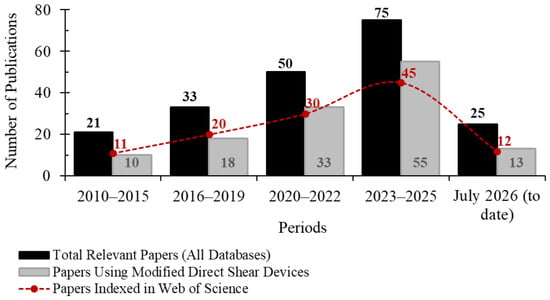
Publication trends clearly reflect the growing research interest in soil–structure interface behavior under drying conditions. The publication counts shown in Figure 1 were obtained through a systematic search of the Web of Science Core Collection, Scopus, and Google Scholar. The search string combined the terms (“direct shear” OR “modified direct shear”) AND (“soil-structure interface” OR “soil-structure contact”) AND (“desiccation” OR “drying” OR “unsaturated” OR “matric suction” OR “expansive soil”). Document types were limited to peer-reviewed articles, reviews, and conference proceedings papers published in English. Searches were performed in July 2026 and covered the period from January 2010 to 31 July 2026. Duplicate records across the three databases were identified and removed using a combination of DOI matching, title + first-author matching, and manual screening. The final dataset therefore represents unique publications only. The 2026 bin covers only the first seven months of the year (January–July).
Figure 1.
Number of studies on direct shear testing of soil–structure interfaces under desiccation conditions, grouped by publication period (2010–July 2026). Data were collected by the authors from Web of Science Core Collection, Scopus, and Google Scholar; document types were limited to articles, reviews, and proceedings papers in English. The 2026 data cover January–July only.
Accurate determination of interface shear strength parameters, adhesion (ca) and interface friction angle (δ), is essential for constitutive modeling, numerical simulation, and performance-based design across saturated, unsaturated, and drying regimes. The direct shear test remains a primary laboratory technique because of its operational simplicity, cost-effectiveness, and the imposition of a predetermined failure plane [13]. Conventional direct shear devices have critical limitations when applied to unsaturated soils or to dynamic drying conditions in expansive materials [14]. Key deficiencies include the inability to independently control or measure matric and osmotic suction, poor replication of realistic boundary restraint in thin soil layers typical of field applications, inadequate monitoring of volume changes and fabric evolution during desiccation, and challenges in systematically evaluating interface roughness under coupled hydro-thermal states. These shortcomings have spurred two decades of innovations in modified direct shear apparatuses, including suction-control techniques (axis-translation and vapor equilibrium methods), surface roughness modifications (smooth, grooved, and textured plates), dual-sided configurations, environmental chambers, and full thermo-hydro-mechanical (THM) adaptations.
This comprehensive review synthesizes the state of the art in modified direct shear testing for soil–structure interfaces, with an emphasis on applications to unsaturated and drying expansive soils. It critically examines fundamental principles of interface shear and unsaturated soil mechanics; the evolution and performance of apparatus modifications; key experimental findings from artificial and natural soils; thermal and THM coupling effects; real-world applications; integration of numerical modeling; emerging data-driven (machine learning) approaches; persistent research gaps; and future directions. Attention is devoted to practical, accessible modifications, such as dual-sided grooved-plate systems, that bridge laboratory insights and field-scale phenomena such as restrained shrinkage and desiccation cracking. Insights from influential works [10,15,16] and recent THM studies [11,17,18] are brought together to support improved modeling and design under climate-driven stresses. Complementary suction-controlled resonant-column and bender-element testing has provided information on the stiffness of unsaturated soils [19]. Advances in direct shear equipment also include stress- and temperature-controlled apparatuses for soil–geosynthetic interfaces [20]. Desiccation-induced cracking and curling mechanisms in clay soils have also been reviewed [21], while the influence of surface roughness on interface shear strength in sandy soils has been investigated experimentally [22]. Machine-learning techniques have also been applied to assess factors influencing shear strength in soil–rock mixtures [23]. Table 1 presents a comparative overview of conventional versus modified direct shear approaches.
Table 1.
Comparative overview of direct shear approaches for interface testing in drying conditions.
2. Fundamental Principles of Soil–Structure Interface Shear and Unsaturated Soil Behavior
Soil–structure interface shear strength is governed by a combination of mechanical interlocking, frictional resistance, and adhesive forces that develop along the contact plane [26]. The mobilized shear stress is commonly expressed within an effective-stress framework using a modified Mohr–Coulomb failure criterion:
where ca is the interface adhesion, is the effective normal stress, and δ is the interface friction angle, which is generally lower than the internal friction angle (φ) of the soil mass [4,5,27]. This reduction can be attributed to the relative smoothness of the structural surface, which limits particle rearrangement and promotes alignment of platy particles parallel to the interface [7,9]. Interface behavior is highly sensitive to several interrelated factors.
Under unsaturated conditions, the effective normal stress σ′ in Equation (1) is interpreted within the framework of net normal stress and matric suction. In most of the experimental studies reviewed here, the net normal stress (σ − ua) is used together with an apparent adhesion term that incorporates the contribution of matric suction (ua − uw). Some authors adopt Bishop-type effective stress formulations of the form:
where X is a parameter related to the degree of saturation. Because the value of X is rarely measured in interface tests, the majority of the reviewed studies report results in terms of net normal stress and treat the suction contribution empirically through an increased apparent adhesion ca. Equation (1) is therefore applied in this operational sense throughout the present review.
Related experimental developments include specialized shear apparatuses for rock testing under true triaxial stresses and high temperatures [28]. Investigations of unsaturated silty sand have examined the effects of wetting and drying on shear strength under low suction [29]. Complementary image-based approaches have been developed to detect and measure ground-crack propagation [30]. Laboratory investigations of thin clay layers have characterized shrinkage and desiccation cracking [31]. Studies on expansive soil mixtures have also examined the influence of drying and soil–base interface conditions on soil behavior [32].
Table 2 summarizes the primary influencing parameters reported across the literature.
Table 2.
Factors influencing soil–structure interface shear strength.
Surface roughness plays a dominant role [32]. Smooth interfaces tend to promote sliding with minimal dilation, whereas rough or grooved surfaces can induce greater dilation, particle crushing, and higher peak shear resistance through enhanced interlocking [8,22]. Soil properties such as mineralogy, particle size distribution, and initial fabric further modulate the response, with expansive clays exhibiting pronounced sensitivity to changes in moisture and suction [16,29].
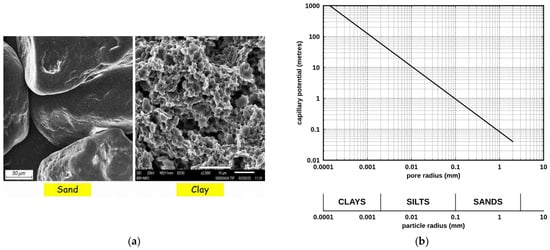
In unsaturated conditions, hydro-mechanical coupling is critical. Total suction (Ψ), which comprises matric suction (Ψm = ua − uw) and osmotic suction (Ψo), influences water retention and volume-change behavior, whereas matric suction is particularly important for the mechanical response [33,34]. Figure 2 compares particle morphologies in sand and clay and illustrates the relationship between capillary potential and pore radius.
Figure 2.
Soil particle morphology and capillary effects (adapted from [16]); (a) SEM micrographs of sand and clay; (b) relationship between capillary potential and pore radius.
The soil–water retention curve (SWRC) describes the nonlinear, hysteretic relationship between suction and degree of saturation and is commonly modeled with equations such as those proposed in [35,36]. The air-entry value (AEV) marks the onset of air entry into the pore network during drying [35]. During drying, the progressive increase in suction can generate tensile stresses within the soil matrix. When a structural interface or base boundary restrains shrinkage, these stresses can exceed the soil’s tensile strength, leading to desiccation cracking [31,37,38]. Table 3 summarizes major hypotheses on crack development.
Table 3.
Common hypotheses for desiccation crack development.
Total suction can be measured using a WP4-T dew-point potentiometer, whereas pressure plate apparatuses are commonly used to determine matric suction at lower suction levels [54,55]. Experimental interface parameters derived from modified direct shear tests have been widely incorporated into numerical models [56]. Experimental and numerical investigations have examined desiccation cracking, curling, and interface restraint in drying soils [16,50,57]. Discrete element method (DEM) simulations have provided insights into particle-scale shear behavior and strain localization in granular soils [58,59]. These modeling efforts highlight the importance of appropriate constitutive models for representing drying-induced deformation and curling [50]. The complex interplay between mechanical interface properties and unsaturated soil behavior underscores the need for advanced testing methodologies [60]. Conventional direct shear devices often cannot adequately replicate coupled hydro-mechanical conditions during drying.
Interface behavior spans multiple scales, from particle-level interlocking and fabric rearrangement (observed via DEM and micro-CT) to macro-scale shear strength and cracking [61]. During drying, suction-induced fabric changes, such as particle reorientation, aggregation breakdown, and meniscus formation, alter shear zone thickness and dilation characteristics. Recent studies have examined related processes, including crack detection, granular shear localization, and soil–structure interface behavior [30,58,59,62]. Integrating multiscale observations (via DIC/PIV and SEM) with modified direct shear data remains limited but is essential for linking micro-mechanisms to continuum modeling. This gap underscores the need for coupled hydro-mechanical testing with fabric characterization in future modified apparatuses.
3. Conventional Direct Shear Testing and Limitations
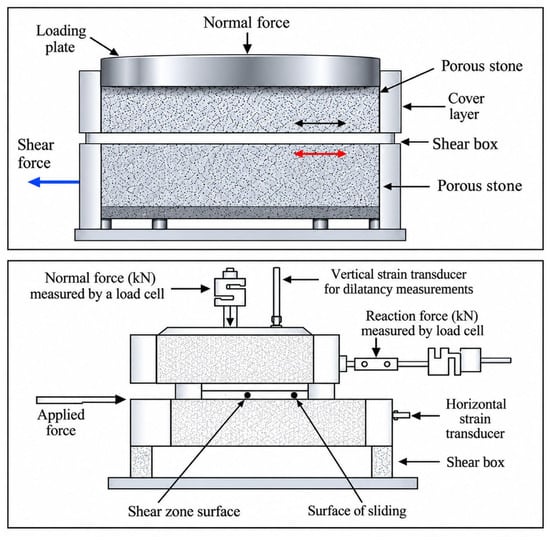
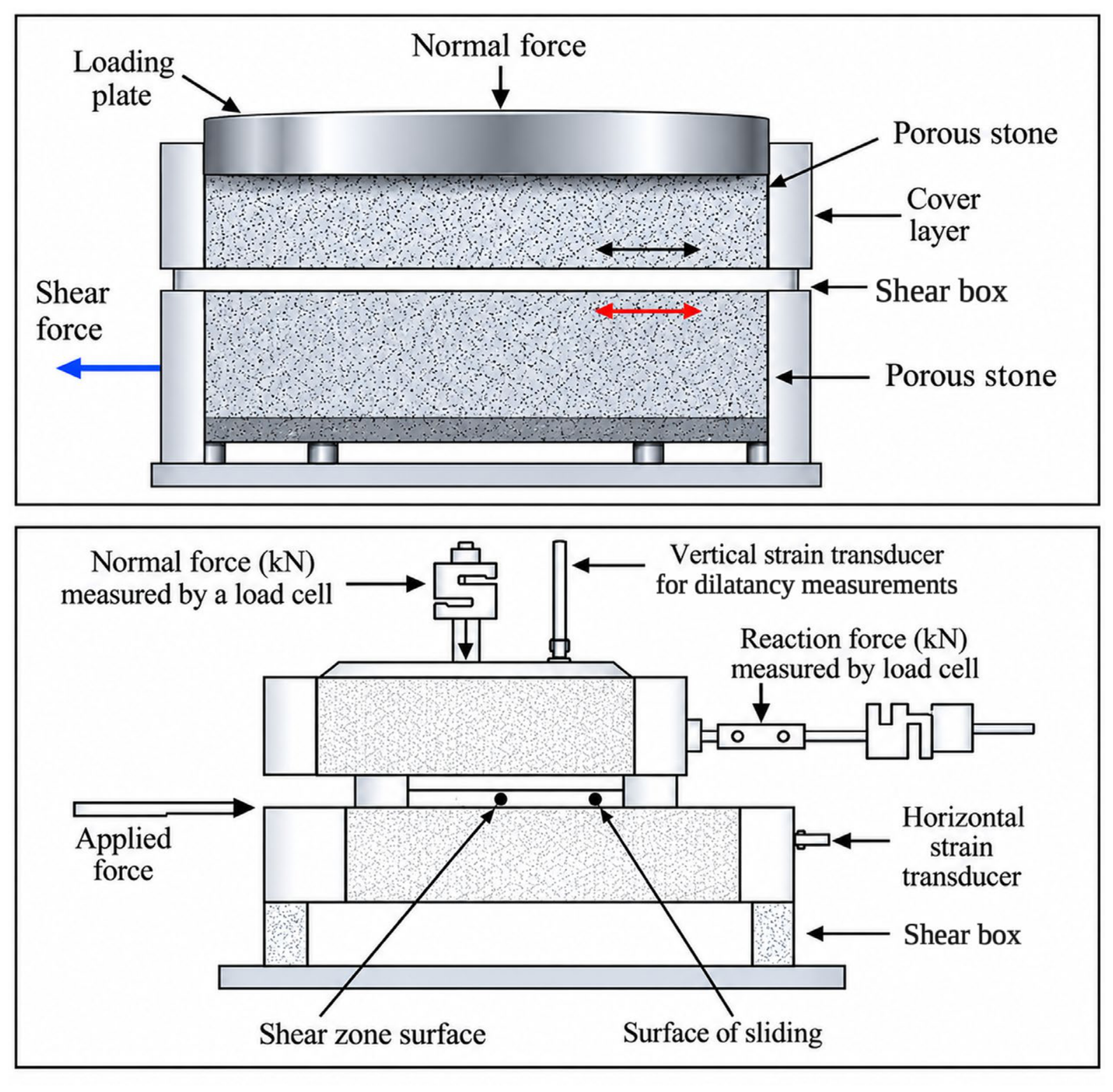
The conventional direct shear apparatus (Figure 3), commonly used for soil testing in accordance with ASTM D3080 [13], has long been a fundamental tool in geotechnical engineering for determining shear strength parameters of soils and soil–structure interfaces. Its popularity stems from its operational simplicity, relatively low cost, and the ability to impose a well-defined horizontal failure plane [4,5,13]. In a typical test, a soil specimen is placed in a split box, subjected to a specified normal load, and sheared horizontally while shear force and displacement are recorded. For interface testing, one half of the shear box can accommodate a structural specimen or plate, such as steel, concrete, or acrylic, in contact with the soil [9,22].
Figure 3.
Conventional direct shear boxes [16]. The blue arrow: applied shear force; black/red arrows: relative displacement of the upper and lower halves.
Early work by Potyondy [4] established baseline interface friction angles for various soil–structure combinations. Subsequent studies using conventional devices examined the effects of surface roughness [27], overconsolidation ratio [8], particle-size distribution [7], and drainage conditions [9]. These investigations reported interface friction angles ranging from 12° to 35° and adhesion values from 0 to 30 kPa, depending on surface texture and soil type.
Despite its widespread use, the conventional direct shear apparatus exhibits significant limitations when applied to unsaturated soils and drying expansive soils. In its standard configuration, it cannot independently control or measure matric and osmotic suction during shearing, limiting its ability to investigate hydro-mechanical coupling during desiccation [15,19,29]. The rigid boundaries and predefined shear plane do not fully reproduce the gradual development of tensile stresses and realistic base restraint that occur in thin soil layers during drying, which may limit the direct applicability of test results to desiccation cracking and curling behavior [16,31,41].
Additional drawbacks include pronounced boundary effects, sidewall friction, and progressive failure along the shear plane, which can lead to non-uniform stress distributions and complicate the interpretation of post-peak strength measurements [9,27]. Although vertical displacement can be monitored, direct determination of the specimen’s overall volume change remains difficult. These issues are particularly problematic for expansive soils, where drying-induced suction and restrained shrinkage play dominant roles [33,34]. Table 4 summarizes the comparative performance and limitations of conventional direct shear testing relative to modified systems. While the conventional direct shear test remains valuable for preliminary saturated interface characterization and comparative studies, its inherent limitations restrict its suitability for investigating coupled unsaturated and drying processes without appropriate modifications [63]. These shortcomings have directly motivated the development of various modifications discussed in subsequent sections, ranging from simple dual-sided plate systems to sophisticated suction- and temperature-controlled devices. The contrast between conventional and modified approaches underscores the need for continued innovation to better simulate real-world conditions in expansive soils [64].
Table 4.
Comparative analysis of conventional vs. modified direct shear testing for unsaturated and drying interface studies.
4. Evolution of Modifications to Direct Shear Apparatus for Soil–Structure Interface Testing
The conventional direct shear apparatus, although widely adopted for its simplicity and ability to impose a predetermined failure plane [4,13], presents notable limitations when applied to unsaturated soils and dynamic drying processes. These limitations include difficulties in independently controlling matric suction, replicating realistic boundary restraint conditions typical of thin soil layers in the field, accurately measuring volume changes during desiccation, and systematically isolating the effects of interface roughness under varying hydraulic states [10,15,19,34].
To address these shortcomings, the geotechnical community has developed a diverse array of modifications over the past two decades. One of the most significant advancements has been the integration of suction control systems. Miller and Hamid [15] established a suction-controlled direct shear apparatus utilizing the axis-translation technique, which allows independent regulation of matric suction and net normal stress. This device facilitated comprehensive testing of both soil-soil and soil-stainless-steel interfaces under controlled unsaturated conditions, yielding extended Mohr–Coulomb failure envelopes. Related developments in unsaturated soil testing have included high-capacity tensiometers, vapor-equilibrium methods, and osmotic techniques for suction measurement or control [19,33,55].
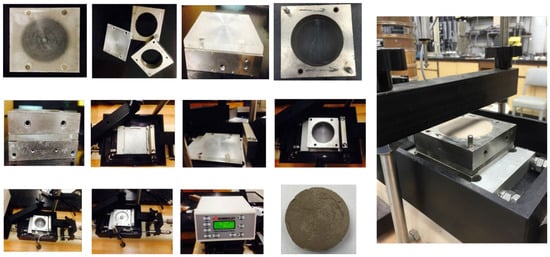
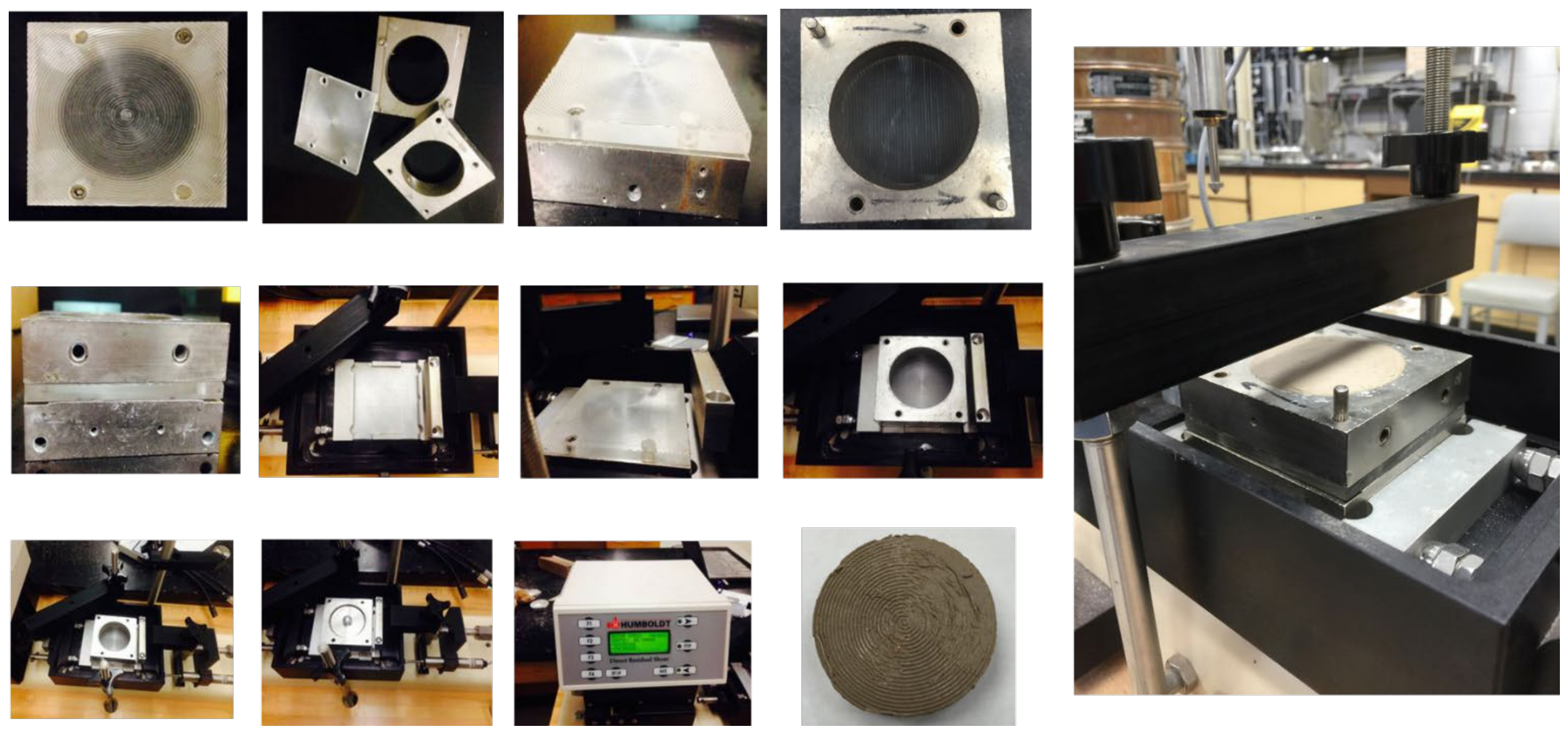
Surface roughness and interface texture modifications constitute another major development [65]. Researchers have employed interchangeable or dual-sided plates with controlled roughness profiles, ranging from smooth surfaces to systematically grooved, saw-tooth, or randomly textured patterns, to quantify the influence of interface geometry on shear strength mobilization [8,9,22,27]. A particularly practical innovation involves dual-sided interface plates, where one face is smooth and the opposite face features machined grooves (such as spiral or parallel patterns), as illustrated in Figure 4. This configuration enables direct comparison of smooth and rough interface responses under comparable soil preparation and loading conditions, without requiring separate testing apparatuses [16].
Figure 4.
Dual-sided interface plates and associated direct shear testing equipment (adapted from [16]).
Environmental and cyclic-loading adaptations have further expanded the range of conditions investigated in geotechnical testing. Experimental adaptations include temperature-control systems, relative humidity chambers, and specialized setups or procedures for investigating wetting–drying cycles and environmentally induced changes in soil and interface behavior [10,20,24,66]. For instance, Momeni et al. [10] investigated the effects of wetting–drying cycles and desiccation cracking on the mechanical behavior of an unsaturated clay using unconfined compression tests. More sophisticated THM (thermo-hydro-mechanical) testing approaches have been developed to investigate coupled thermal, hydraulic, and mechanical effects on soil–structure interfaces [20,24].
Recent advancements have led to the development of multifunctional direct shear apparatuses capable of high-stress testing (up to 4 MPa) temperature control from −30 °C to 70 °C, monotonic and cyclic shearing, and digital image correlation (DIC) monitoring [67]. Related developments include multifunctional shear apparatuses for rock testing [28], dual-function pullout and direct shear apparatuses incorporating vibrational loading [68], and bender-element techniques for determining shear-wave velocity [69]. These developments expand the available experimental capabilities for investigating soil and soil–structure interface behavior under different loading and environmental conditions, addressing previous trade-offs between practicality and sophistication [17,67]. These innovations build on earlier suction-controlled and dual-sided designs, offering new opportunities for standardized THM-drying protocols in expansive soil research. Table 5 summarizes the major categories of modifications to the direct shear apparatus for soil–structure interface testing.
Table 5.
Major categories of modifications to direct shear apparatus for interface testing.
These modifications have collectively broadened the applicability of direct shear testing to complex unsaturated and drying scenarios. However, many advanced systems remain costly and technically demanding [70]. Practical, low-cost modifications, such as dual-sided grooved-plate systems, offer an accessible balance of simplicity and scientific rigor, particularly for studies linking interface mechanics to thin-layer desiccation behavior [16].
The reliability and applicability of interface shear parameters obtained from modified direct shear tests depend strongly on the apparatus configuration and the variables that can be independently controlled. Conventional direct shear devices provide a practical means of determining interface strength under relatively simple loading conditions; however, the absence of active suction control limits their ability to distinguish the effects of matric suction from changes in water content during drying. Suction-controlled systems provide a more systematic assessment of suction-dependent apparent cohesion and frictional behavior, although their accuracy depends on adequate hydraulic equilibration and the selected suction-control technique. In contrast, dual-sided or interchangeable roughness plates facilitate comparisons between smooth and rough interfaces under comparable testing conditions, but basic configurations cannot independently characterize the effects of suction and temperature. More advanced thermo-hydro-mechanical (THM) systems allow the interaction of environmental and mechanical variables to be investigated, although their technical complexity, cost, and longer testing procedures may restrict routine application. Furthermore, all direct shear configurations require consideration of boundary effects, non-uniform stress distribution, and progressive failure when interpreting peak and post-peak parameters. Consequently, interface shear parameters obtained using different apparatuses should not be considered directly interchangeable unless differences in soil preparation, stress conditions, drainage, suction history, interface roughness, and testing procedures are taken into account.
5. Experimental Findings and Synthesis
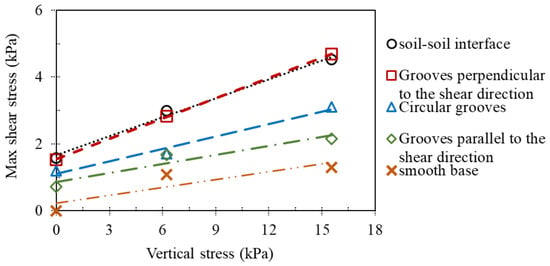
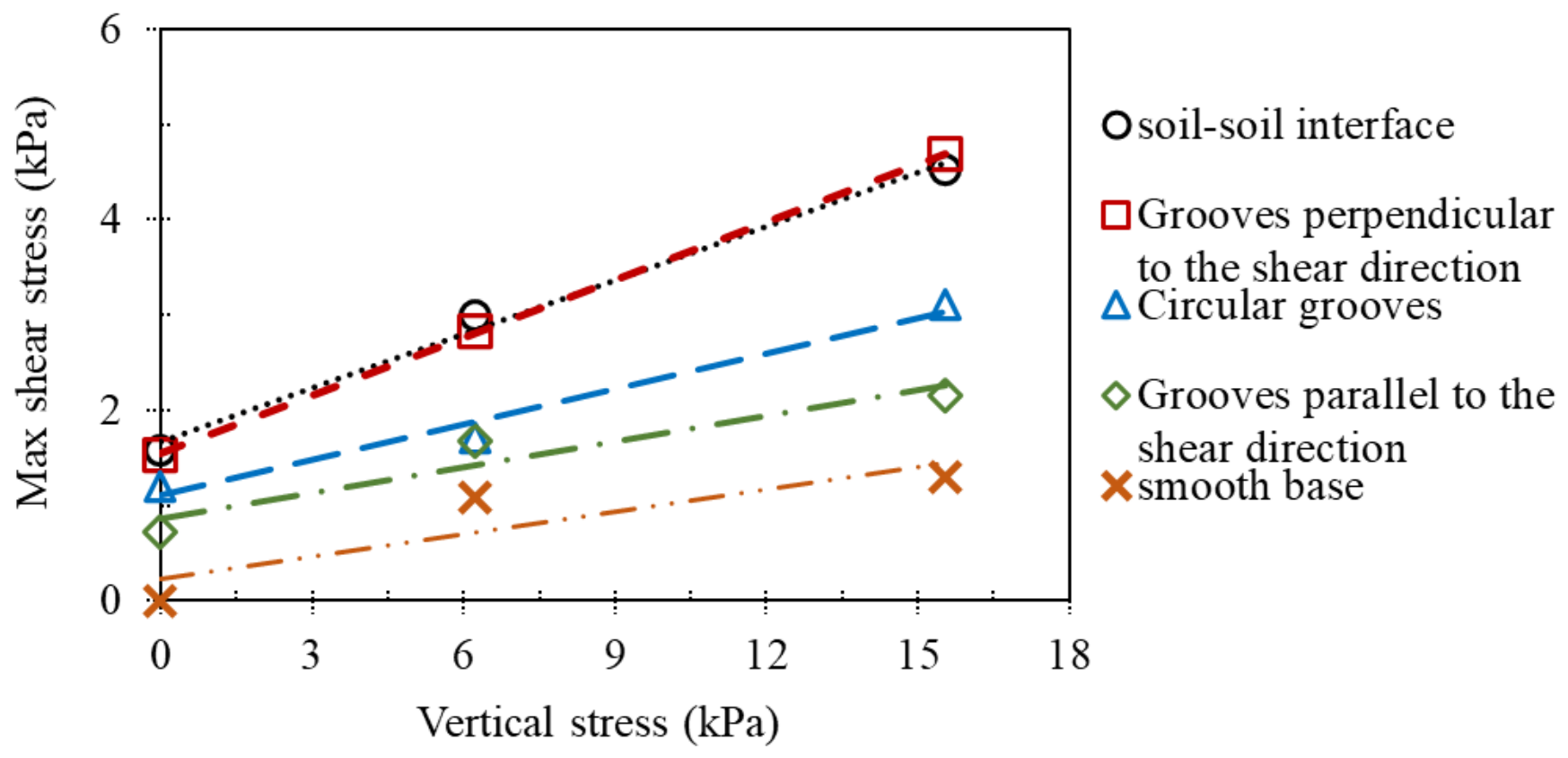
Modified direct shear testing has generated a rich and diverse body of experimental evidence on soil–structure interface behavior under unsaturated and drying conditions [32]. Results from numerous studies over the past two decades reveal consistent patterns while also highlighting important soil-specific and condition-dependent variations. Figure 5 presents maximum shear stress as a function of applied normal stress for fully saturated samples under different interface conditions [32]. Complementary numerical and image-based investigations have examined desiccation cracking, curling, and related deformation mechanisms [48,50,57].
Figure 5.
Maximum shear stress versus applied normal stress for fully saturated specimens under different soil-based interface conditions (adapted from [32]). Symbols denote measured values; lines represent linear best-fit trends for each interface condition.
The interaction between interface shear resistance and desiccation cracking can be understood in terms of mechanical restraint during soil shrinkage [71]. As an expansive soil dries, water loss induces shrinkage strains. When the soil layer is attached to or in contact with a relatively rigid base, friction and mechanical interlocking at the interface may restrict relative movement and partially restrain this shrinkage [8,9,16,22,23,27,28]. The resulting incompatibility between free shrinkage and restrained deformation can generate tensile stresses within the soil layer, potentially leading to crack initiation when the local tensile stress exceeds the soil’s tensile strength. Interface shear resistance therefore represents one component of the mechanical restraint that may influence stress development during drying [72]. In the dual-sided plate study, Al-Jeznawi [16] observed that grooved interfaces mobilized higher peak shear stresses than smooth interfaces, and that peak interface resistance frequently occurred immediately before visible crack initiation in parallel thin-layer desiccation tests. This temporal association is consistent with a possible link between interface restraint and tensile stress development; however, it does not independently establish that peak interface shear resistance directly causes crack initiation. The relationship should therefore be interpreted as an experimentally observed correlation supported by a plausible mechanical explanation.
Drainage conditions influence interface shear behavior through their effects on pore-water pressure, effective stress, and deformation during shearing. Uner drained conditions, pore-water pressures have sufficient time to dissipate, allowing the shear response to be governed primarily by the applied effective stress and the soil’s tendency to contract or dilate. Under undrained conditions, restricted drainage may result in the development of excess pore-water pressures, which can either reduce or increase effective stress depending on the soil’s initial state, density or consistency, stress history, and contractive or dilative tendency [15,21,30]. Consequently, drained conditions do not necessarily produce higher peak interface strength in every soil or testing configuration. The measured difference depends on soil type and fabric, initial water content and saturation, normal stress, stress path, drainage boundary conditions, shearing rate, and pore-pressure evolution. The reported 15–35% increase in drained peak strength should therefore be regarded as a range observed in particular experimental studies rather than a general relationship applicable to all soil–structure interfaces.
Drainage conditions may also influence strain localization and the progression of failure. Under undrained loading, localized deformation can develop where stress concentrations or material heterogeneities promote non-uniform straining. Progressive shear-band formation may then occur before macroscopic failure, with the associated redistribution of stress and pore-water pressure influencing the subsequent deformation response. For example, Wu et al. [73] used in situ CT observations during undrained triaxial testing of hydrate-bearing clayey silt to demonstrate the development of localized internal shearing and progressive shear bands. Although their material and testing conditions differ from those of conventional soil–structure interface tests, their findings provide complementary insight into how undrained deformation and strain localization can contribute to progressive failure. These mechanisms highlight the importance of considering drainage conditions, soil state, and stress path together when interpreting measured interface strength and post-peak behavior.
Water content, suction, and wetting–drying cycles introduce strong path dependence [74]. As soils dry and matric suction increases, interface shear strength often rises because suction contributes to effective stress. However, this increase is nonlinear and tends to diminish or reverse at very high suctions due to cracking and fabric degradation [10,34,46]. Related investigations under varying mechanical, thermal, and environmental conditions have also highlighted the sensitivity of interface behavior to material properties and loading conditions [20,23,24,28,66]. High initial water contents in expansive mixtures can influence soil fabric and particle arrangement, which subsequently influence both the SWRC and the long-term interface response [16,32]. Table 6 provides a comprehensive synthesis of key findings from several experimental studies.
Table 6.
Summary of findings from modified direct shear interface tests.
Several experimental studies have reported higher peak shear resistance for rough or grooved interfaces than for smooth interfaces. In selected studies, peak shear stress increases of approximately 20–50% and interface friction-angle increases of 5–15° have been reported [16,22,23]. These values represent ranges reported under different experimental conditions rather than results from a standardized or pooled comparison. For example, Al-Jeznawi [16] investigated smooth and grooved interfaces using a kaolinite-bentonite mixture under normal stresses of 0–15.5 kPa and varying initial water contents during drying. Differences in soil type, interface geometry, normal stress, and moisture condition should therefore be considered when comparing the reported improvements. The influence of drainage on peak interface strength is more variable: although some studies report higher peak strength under drained conditions, the magnitude and even the direction of the difference depend on soil type, initial state, stress path, and pore-pressure response [16,19,30]. Accordingly, the reported 15–35% increase should be interpreted as specific to the testing conditions of the studies concerned rather than as a general trend. The contribution of suction to apparent cohesion also varies nonlinearly with suction and degree of saturation [10,11,15]. The effects of environmental cycling on interface adhesion also depend on soil and interface characteristics [20,23,28]. The findings of Al-Jeznawi [16] and Hajjat et al. [32] suggest that interface characteristics and mechanical restraint can influence desiccation-induced cracking patterns in thin soil layers. However, the observed relationship between peak interface shear resistance and crack initiation should not be interpreted as a universal causal relationship. Its applicability is likely to depend on soil mineralogy and fabric, initial water content, shrinkage potential, interface roughness, normal stress, layer thickness, and the degree of restraint provided by the underlying surface. In particular, the evidence from thin-layer desiccation tests highlights the potential importance of interface restraint under laboratory conditions, while further controlled experiments are required to establish the contribution of interface shear resistance to tensile stress development and crack initiation under different soil and field conditions. Table 6 summarizes key experimental findings from modified direct shear tests on soil–structure interfaces.
6. Thermal and Thermo-Hydro-Mechanical (THM) Effects on Interface Shear Behavior
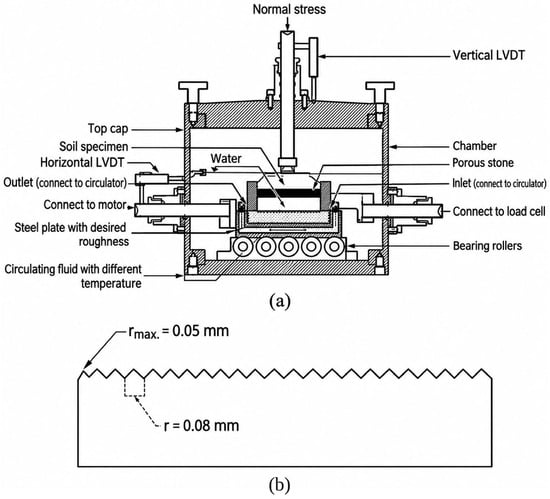
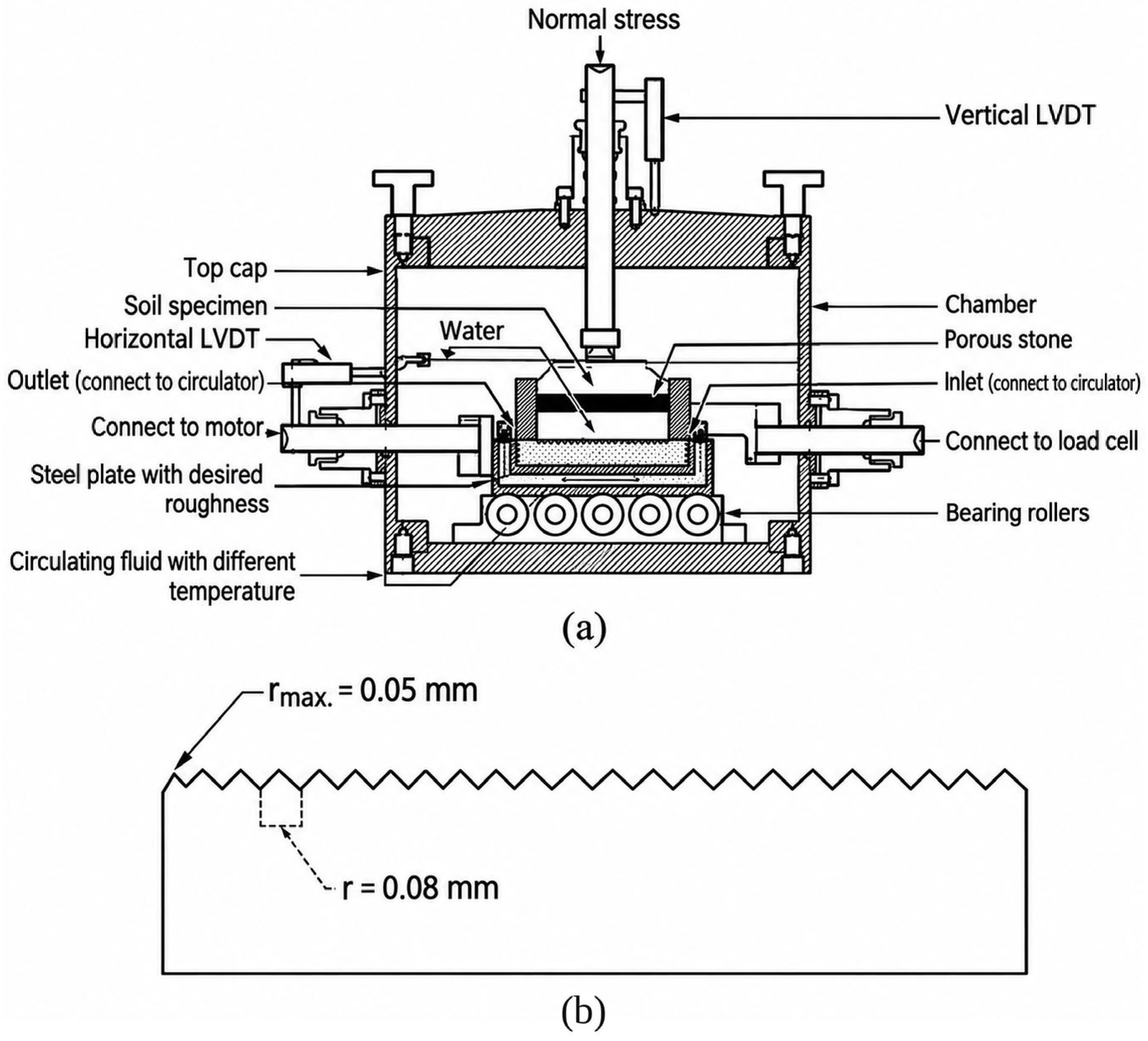
Thermal effects on soil–structure interface shear behavior have become a critical research area due to the rapid development of energy geostructures (thermally active piles) and the increasing impact of climate-driven temperature fluctuations on expansive soils [75]. Temperature variations influence interface response through multiple mechanisms, including changes in water viscosity, surface tension, soil fabric rearrangement, particle crushing, thermal expansion/contraction, and suction evolution [11,17,18,24,76]. Figure 6 shows the temperature-controlled direct shear apparatus developed by Cui et al. [18].
Figure 6.
(a) Schematic diagram of the temperature-controlled direct shear apparatus; (b) surface profile of the roughened interface plate (adapted from [18], published under a CC BY 4.0 licence).
In saturated conditions, heating can lead to a modest reduction in shear strength. Cui et al. [18] conducted temperature-controlled direct shear tests on clayey sand–structure interfaces at 8 °C, 20 °C, and 42 °C and reported a decrease in shear strength (approximately 10–15%) with increasing temperature. This reduction was attributed to decreased interface roughness and slight increases in void ratio within the shear zone. The approximately 10–15% reduction reported by Cui et al. [18] is specific to their saturated clayey sand–structure interface tests over the investigated temperature range of 8–42 °C. It should not be interpreted as a general reduction applicable to all soil–structure interfaces, since the thermal response may vary with soil type, stress level, interface characteristics, and hydraulic condition.
Under unsaturated conditions, temperature effects are more complex because matric suction contributes to the effective stress and shear resistance at the soil–structure interface. Temperature may influence this contribution by changing the surface tension of pore water and the soil–water retention relationship. These changes can affect the curvature and behavior of water menisci, and consequently the suction-dependent component of interface strength. Temperature may also cause changes in soil fabric and interfacial contact conditions, which can influence shear resistance independently of the suction contribution. The magnitude and direction of these effects depend on the soil type, degree of saturation, normal stress, and hydraulic boundary conditions.
The distinction between saturated and unsaturated behavior is therefore important. In saturated soil, the contribution of matric suction is absent, whereas in unsaturated soil, changes in suction and water retention can modify the shear response in addition to temperature-related changes in soil fabric and interface contact. The measured response may also depend on whether suction, water content, or another hydraulic variable is controlled during testing. Accordingly, temperature effects should not be interpreted independently of the hydraulic conditions imposed in each experiment.
Cui et al. [11] observed that heating at low normal stresses (approximately 50 kPa) reduced the incremental rate of strength gain with suction, which they associated with decreased surface tension and thermally induced changes in soil fabric. At higher normal stresses (approximately 150 kPa), heating could enhance interface strength. This stress-dependent response indicates that the thermal influence on suction-related strength is not uniform. Related experiments on sandy silt have also demonstrated temperature-dependent changes in compressibility and preconsolidation pressure [77]. Furthermore, cyclic thermal loading can produce cumulative irreversible displacements and changes in interface stiffness, depending on interface characteristics and loading conditions [17,78,79]. These findings demonstrate the coupled nature of thermal, hydraulic, and mechanical effects, although the individual contribution of each mechanism remains difficult to separate from the available experimental evidence.
Thermal effects have also been investigated in relation to restrained shrinkage [80]. Combined thermo-hydro-mechanical (THM) loading may alter interface behavior through changes in suction, deformation, and mechanical restraint [17]. The practical dual-sided plate modification (smooth versus grooved surfaces) developed by Al-Jeznawi [16] offers a particularly promising and accessible platform for future THM-drying investigations. With appropriate thermal and suction-control adaptations, this approach could enable direct side-by-side comparison of smooth and rough interface responses under simultaneous temperature and drying conditions, addressing a key gap in linking mechanical restraint with desiccation cracking and curling phenomena. Table 7 summarizes recent experimental findings on the thermal effects on soil–structure interface shear strength.
Table 7.
Summary of thermal effects on soil–structure interface shear strength.
Li et al. [81] investigated thermally induced displacements and subsequent shear behavior of sand–structure interfaces under cyclic thermal loading, considering interface roughness and vertical loading conditions. Although many studies focus on saturated interfaces or energy pile applications, a clear need remains for additional research using practical modifications (such as dual-sided plates) under coupled THM-drying conditions to better simulate real-world behavior in expansive soils [82].
7. Real-World Cases and Numerical Modeling Studies
Modified direct shear testing has contributed to the characterization of interfaces relevant to geotechnical engineering applications, including geogrid-reinforced materials [83]. Experimental investigations have also demonstrated the influence of groove geometry on the shear behavior of steel–sand interfaces [84]. For expansive soils, laboratory studies have provided insights into the effects of soil–base restraint and surface roughness on desiccation cracking and deformation, with potential implications for foundation design, as investigated by Al-Jeznawi [16] and Hajjat et al. [32]. Related research has examined the stabilization of expansive subgrades under wetting–drying conditions (Faizi et al. 2025) [85]. Complementary developments in transport infrastructure include automated technologies for asphalt pavement inspection [86]. Momeni et al. [10] investigated how wetting–drying cycles and desiccation cracks affect the mechanical behavior of unsaturated soils, providing relevant information for assessing drying-sensitive earth structures.
Thermal effects on soil–structure interfaces are particularly relevant to energy geostructures. Faizal et al. [87] investigated the axial and radial thermal responses of a field-scale energy pile subjected to monotonic and cyclic temperature changes. Complementary experimental and numerical research has examined the shear failure mechanisms of silty clay–structure interfaces [56]. Studies by Di Donna et al. [24] and Hashemi and Sutman [17] have further contributed to understanding temperature-dependent interface behavior and developing experimental approaches for THM investigations. Chao and Fowmes [20] developed a modified direct shear apparatus incorporating stress and temperature control for soil–geosynthetic interfaces, offering additional experimental capabilities for investigating environmentally dependent interface behavior.
In geoenvironmental engineering, complementary studies have addressed the mechanical characterization of landfill materials and geosynthetic interfaces. Machine-learning approaches have been investigated for predicting the shear modulus of landfill components [88]. Direct shear testing has also been used to evaluate the interface strength between geocomposite drains and HDPE geomembranes under different hydraulic conditions [89]. These investigations are relevant to the mechanical assessment of landfill systems, although their direct applicability to drying expansive soils requires further evaluation. Related studies of wetting–drying effects provide additional information on changes in unsaturated soil behavior [10].
Experimental characterization and numerical modeling have increasingly been combined to investigate soil deformation and interface behavior [90]. Experimental, analytical, and numerical studies have addressed desiccation cracking and curling deformation in drying soils [48,50,57]. Maedo et al. [50] investigated soil drying using a constitutive model incorporating curling deformation. Other complementary approaches include deep-learning techniques for detecting ground crack propagation and discrete element simulations for investigating shear localization in granular materials [30,58,59]. Table 8 summarizes selected studies relevant to interface characterization, drying-induced deformation, and potential engineering applications.
Table 8.
Selected experimental and numerical studies relevant to soil–structure interface behavior and engineering applications.
Collectively, these studies demonstrate the potential of combining experimental characterization, numerical modeling, and data-driven methods to improve the assessment of soil–structure interface behavior. Nevertheless, further field validation is needed to establish the benefits of modified direct shear parameters for predicting long-term infrastructure performance under drying and thermal loading conditions.
8. Machine Learning Applications in Soil–Structure Interface Modeling
Machine learning (ML) methods have increasingly been explored in geotechnical engineering for predicting soil and interface behavior, analyzing deformation, and characterizing cracking processes. However, the available studies differ considerably in their materials, experimental configurations, prediction targets, and validation procedures. For example, Huang et al. [23] applied ML to evaluate shear-strength factors in soil–rock mixtures for mountain substation fills, rather than specifically predicting soil–structure interface shear strength. Zhang et al. [91], in contrast, applied a least squares support vector machine (LS-SVM) to predict soil–concrete interface shear strength from modified direct shear test data. Liu et al. [92] developed a bidirectional LSTM-based model for cyclic shear behavior of soil–rock mixture-concrete interfaces. Other studies have applied deep learning to detect desiccation cracks [30,93] or applied physics-informed neural networks to coupled THM processes in porous media [94], an approach that has not yet been extended to soil–structure interfaces. These applications demonstrate the potential of data-driven methods in geotechnical engineering, but their prediction metrics should be interpreted in the context of their respective datasets and objectives. In particular, results from general soil–strength prediction or image-based crack classification should not be treated as direct evidence of predictive accuracy for modified direct shear interface tests.
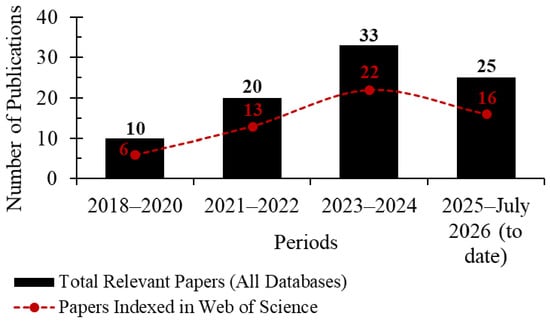
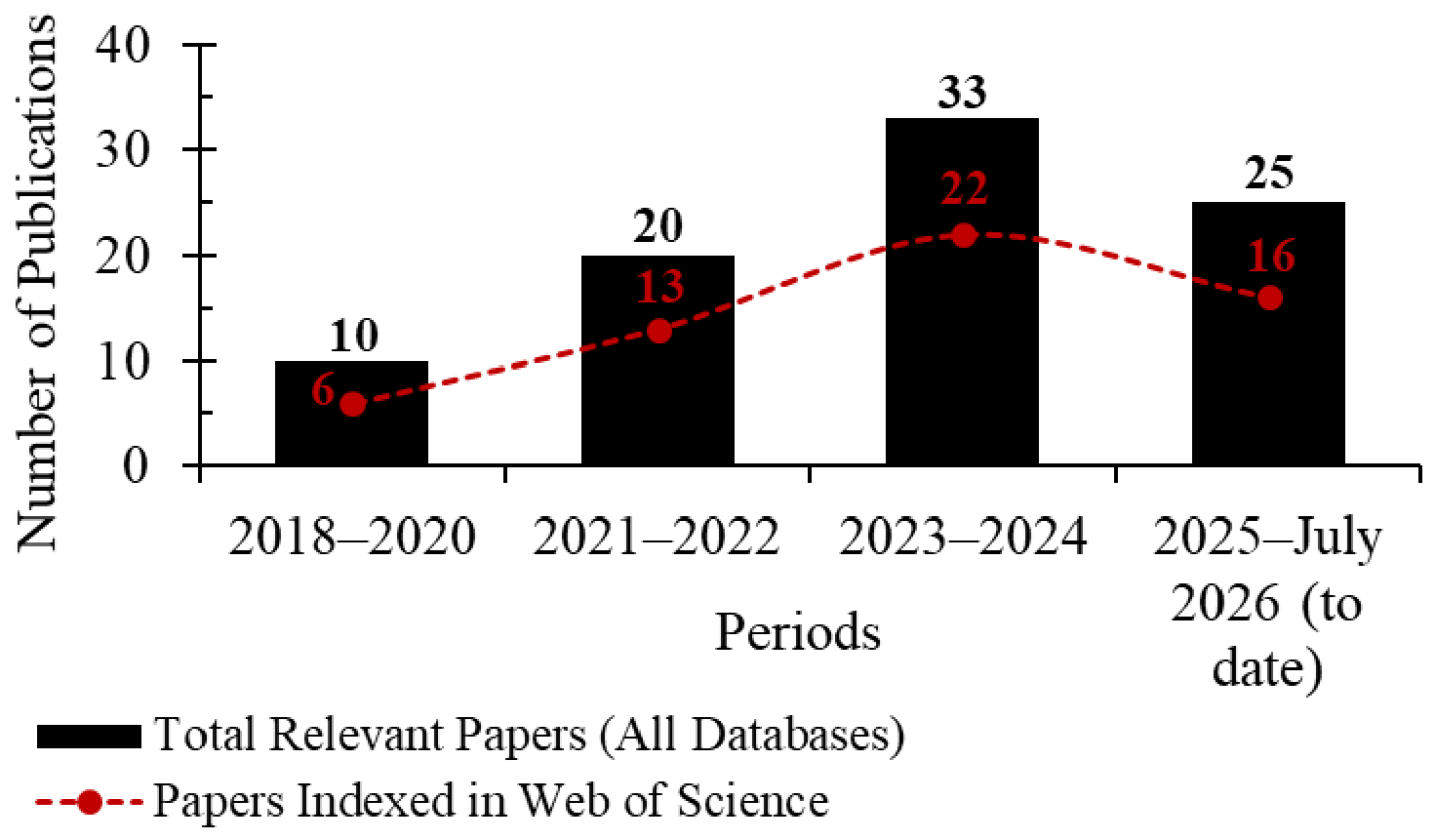
The application of machine learning to soil–structure interface modeling has attracted increasing research interest. As shown in Figure 7, the number of identified publications increased from 2018–2020 to 2023–2024. The 2025-July 2026 period contains fewer publications, but direct comparison is limited by the unequal durations of the reporting periods and the incomplete coverage of 2026. Machine learning approaches can handle high-dimensional, nonlinear datasets and offer opportunities for efficient prediction and parametric analysis. However, their reliability depends strongly on the availability, representativeness, and quality of training data, particularly when extrapolating from laboratory-scale tests to field conditions. A trade-off also exists between predictive accuracy and physical interpretability. Table 9 summarizes selected machine learning techniques and their potential applicability to modified direct shear test data.
Figure 7.
Number of publications on machine learning applications in soil–structure interface modeling (2018–July 2026). Absolute counts are shown; reporting periods are of unequal length (2026 data cover January–July only).
Table 9.
Selected machine-learning applications in geotechnical and soil–structure interface modeling.
9. Critical Analysis of Existing Literature
The literature demonstrates the value of existing investigations in examining key variables. Suction-controlled and other instrumented testing approaches [15,19,20] have provided complementary data on interface shear strength, soil stiffness, and temperature-dependent behavior, contributing to the development and evaluation of constitutive models. Practical innovations, such as dual-sided grooved-plate systems [16], offer an accessible means of investigating the effects of interface roughness and its relationship with desiccation cracking and curling. Recent experimental and numerical investigations, including image-based crack characterization, have improved understanding of desiccation cracking and curling deformation [30,48,50]. To better contextualize the role of modified direct shear devices, Table 10 provides a critical comparison of the selected interface shear testing methods.
Table 10.
Comparative analysis of common interface shear testing methods.
Despite these contributions, several limitations persist. Results obtained using specialized apparatuses designed for different materials and loading conditions may not be directly transferable to natural expansive soil interfaces or field applications [28]. The inherent boundary effects and potential for progressive failure in the direct shear configuration can lead to non-uniform stress distributions and raise concerns about scale representativeness [9,27]. Advanced suction- and temperature-controlled devices may involve technical challenges, extended equilibration times, and relatively high operating costs [15,20]. Furthermore, differences in how surface roughness is characterized can hinder direct comparisons across studies [22,23]. Future research should prioritize hybrid devices, multi-scale validation, standardization of protocols, and stronger links between laboratory data and field performance to enhance the practical impact of modified direct shear testing.
10. Future Directions and Recommendations
The synthesis presented in this review reveals substantial progress in modified direct shear testing yet also underscores critical gaps that limit the translation of laboratory insights into robust engineering practice. Addressing these gaps is essential for advancing predictive capabilities in expansive soil systems under variable climatic conditions. Future research should prioritize developing standardized protocols for surface roughness characterization (including clearly defined, normalized roughness parameters) and THM-drying testing procedures. Differences in roughness metrics and suction-equilibration procedures hinder direct comparison across studies and may delay wider adoption. Another key direction involves designing hybrid, accessible devices that combine practical dual-sided grooved/smooth plate configurations with affordable suction and thermal control systems. Such innovations could help bridge the gap between high-end THM apparatuses and routine laboratory capabilities, enabling wider use in resource-constrained settings.
Multiscale investigations combining microstructural observations (SEM and micro-CT), particle-scale simulations (DEM), and macroscale shear measurements are also needed. Understanding fabric evolution, strain localization thickness, and anisotropy at the interface during coupled THM-drying is crucial for upscaling laboratory results. Expanded field validation and long-term monitoring campaigns in drought-affected regions should be pursued, with field measurements from instrumented foundations and energy geostructures correlated with laboratory modified direct shear data to evaluate model predictions under actual climatic cycles.
Beyond these technological limitations, several fundamental questions concerning soil–structure interface behavior remain unresolved. First, it is still unclear how matric suction, water-content history, temperature, and surface roughness interact to control interfacial adhesion, friction, and post-peak response during repeated drying and wetting. Second, the relationship between microscale fabric changes, particle rearrangement, and the development of localized shear zones at the interface requires further investigation. Third, the extent to which interface restraint contributes to desiccation crack initiation and propagation in thin expansive soil layers has not yet been sufficiently quantified. These questions require carefully controlled experiments in which suction, temperature, normal stress, and roughness are varied independently and subsequently in combination. Simultaneous measurements of shear stress, displacement, volume change, suction, and image-based deformation would help distinguish individual mechanisms from coupled effects. Complementary SEM or micro-CT observations and DEM simulations could then link microscale fabric evolution to measured macroscopic interface response.
These fundamental questions should be distinguished from technological limitations of existing testing systems. The latter include difficulties in maintaining uniform suction and temperature, independently controlling coupled hydraulic and thermal conditions, minimizing sidewall friction and boundary effects, and accurately monitoring volume changes and local deformation during shearing. Such limitations can be addressed through improved instrumentation, modular environmental-control systems, low-friction boundary designs, and synchronized displacement, suction, temperature, and imaging measurements. In contrast, resolving the fundamental mechanisms requires systematic experimental programmes and multiscale interpretation rather than apparatus development alone.
Creating open, high-quality databases that compile standardized, modified direct shear results (including raw stress-displacement curves, SWRC data, and DIC imagery) would accelerate the development and validation of physics-informed machine learning models. In addition, stronger integration with performance-based design frameworks under climate change scenarios is required. Incorporating suction- and temperature-dependent interface parameters into probabilistic and serviceability-based design approaches could improve the assessment of the resilience of foundations, retaining structures, and energy geostructures.
Recommendations include considering dual-sided plate modifications in routine laboratory testing programs as a potentially cost-effective approach for comparing smooth and rough interfaces under comparable testing conditions. Numerical modelers should incorporate experimentally supported suction- and temperature-dependent interface parameters, where relevant, when simulating energy geostructures and expansive soil foundations. Table 11 outlines priority research directions for modified direct shear testing of soil–structure interfaces. Funding agencies and standards bodies should support collaborative initiatives to develop databases and standardize protocols.
Table 11.
Priority research directions in modified direct shear testing for soil–structure interfaces.
11. Conclusions
This review synthesizes major advances in modified direct shear testing for soil–structure interfaces, with an emphasis on applications to unsaturated and drying expansive soils. Modifications incorporating suction control, dual-sided roughness plates, environmental chambers, and THM capabilities have expanded the experimental characterization of interface shear behavior under complex hydro-mechanical and thermal conditions. Experimental evidence indicates that surface roughness, drainage, matric suction, and temperature can substantially influence adhesion and friction angle, depending on soil type and testing conditions. Practical dual-sided systems provide an accessible means of investigating the relationship between interface restraint, desiccation cracking, and restrained shrinkage. These developments have also contributed to numerical investigations and offer potential benefits for energy geostructures, foundations, and infrastructure in drought-prone regions. Still, limitations persist, including the frequent use of artificial soil mixtures, lack of standardization, boundary effects, and insufficient field validation.
Future research should address both technological limitations and fundamental knowledge gaps. From an experimental perspective, priority should be given to standardized roughness characterization, reliable suction and temperature control, improved boundary conditions, and synchronized monitoring of shear response, volume change, and local deformation. From a scientific perspective, further studies are needed to clarify the coupled effects of suction, temperature, surface roughness, and hydraulic history on interface strength and deformation, as well as the mechanisms linking microscale fabric evolution to shear localization and desiccation cracking. Combining multiscale characterization with controlled THM-drying experiments would support the development of more representative constitutive models. Finally, field monitoring of foundations and energy geostructures in climate-affected regions is needed to assess whether laboratory-derived interface parameters can reliably predict long-term field behavior. These efforts would improve the reproducibility, physical interpretation, and practical application of modified direct shear testing.
Author Contributions
Conceptualization, D.A.-J. and M.A.Q.A.-J.; methodology, N.N.N.D., E.J.J. and L.F.A.B.; investigation, L.F.A.B. and D.A.-J.; resources, M.A.Q.A.-J. and N.N.N.D.; writing—original draft preparation, D.A.-J. and M.A.Q.A.-J.; writing—review and editing, N.N.N.D., E.J.J. and L.F.A.B. All authors have read and agreed to the published version of the manuscript.
Funding
This research received no external funding.
Institutional Review Board Statement
Not applicable.
Informed Consent Statement
Not applicable.
Data Availability Statement
The authors declare that the data supporting the findings of this study are available within the paper.
Conflicts of Interest
The authors declare no conflicts of interest.
References
- Zohra, B.F.; Fouad, B.A.; Mohamed, C. Soil-structure interaction interfaces: Literature review. Arab. J. Geosci. 2022, 15, 1130. [Google Scholar] [CrossRef] [Scilit]
- Mesri, G.; Shahien, M. Residual shear strength mobilized in first-time slope failures. J. Geotech. Geoenviron. Eng. 2003, 129, 12–31. [Google Scholar] [CrossRef] [Scilit]
- Luo, Y.; Zhang, J.; Tang, C.-S.; Jiang, G.; Bogaard, T. Impact of dynamic desiccation cracks on hydrological processes and stability in expansive clay slopes: A coupled dual-permeability modeling approach. Eng. Geol. 2025, 357, 108377. [Google Scholar] [CrossRef] [Scilit]
- Potyondy, J.G. Skin friction between various soils and construction materials. Géotechnique 1961, 11, 339–353. [Google Scholar] [CrossRef] [Scilit]
- Uesugi, M.; Kishida, H.; Tsubakihara, Y. Friction between sand and steel under repeated loading. Soils Found. 1989, 29, 127–137. [Google Scholar] [CrossRef] [Scilit] [PubMed]
- Fakharian, K.; Evgin, E. The relationship of the unsaturated soil shear strength to the soil-water characteristic curve. Can. Geotech. J. 1996, 33, 435–445. [Google Scholar] [CrossRef] [Scilit]
- Fakharian, K.; Evgin, E. Cyclic simple-shear behavior of sand–steel interfaces under constant normal stiffness condition. J. Geotech. Geoenviron. Eng. 1997, 123, 1096–1105. [Google Scholar] [CrossRef] [Scilit]
- Subba Rao, K.S.; Allam, M.M.; Robinson, R.G. Drained shear strength of fine-grained soil-solid surface interfaces. Proc. Inst. Civ. Eng. Geotech. Eng. 2000, 143, 75–81. [Google Scholar] [CrossRef] [Scilit]
- Hamid, T.B.; Miller, G.A. Shear strength of unsaturated soil interfaces. Can. Geotech. J. 2009, 46, 595–606. [Google Scholar] [CrossRef] [Scilit]
- Momeni, E.; He, B.; Abdi, Y.; Jahed Armaghani, D. Novel Hybrid XGBoost Model to Forecast Soil Shear Strength Based on Some Soil Index Tests. Comput. Model. Eng. Sci. 2023, 136, 2527–2550. [Google Scholar] [CrossRef] [Scilit]
- Cui, S.-Q.; Zhou, C.; Mu, Q.-Y.; Pei, H.-F.; Yin, J.-H. Coupled effects of temperature and suction on the shear behaviour of saturated and unsaturated clayey sand–structure interfaces. Géotechnique 2025, 75, 278–290. [Google Scholar] [CrossRef] [Scilit]
- Vanapalli, S.K.; Nicotera, M.V.; Sharma, R.S. Axis translation and negative water column techniques for suction control. Geotech. Geol. Eng. 2008, 26, 645–660. [Google Scholar] [CrossRef] [Scilit]
- ASTM D3080/D3080M-11; Standard Test Method for Direct Shear Test of Soils Under Consolidated Drained Conditions. ASTM International: West Conshohocken, PA, USA, 2011. [Google Scholar] [CrossRef] [Scilit]
- Gallage, C.; Uchimura, T. Direct shear testing on unsaturated silty soils to investigate the effects of drying and wetting on shear strength parameters at low suction. J. Geotech. Geoenviron. Eng. 2016, 142, 04015096. [Google Scholar] [CrossRef] [Scilit]
- Miller, G.A.; Hamid, T.B. Interface direct shear testing of unsaturated soils. Geotech. Test. J. 2007, 30, 182–191. [Google Scholar] [CrossRef] [Scilit]
- Al-Jeznawi, D. Experimental Studies of Soil Behavior Subjected to Drying. Master’s Thesis, Texas A&M University, College Station, TX, USA, 2015. [Google Scholar]
- Hashemi, A.; Sutman, M. A direct shear setup for studying the THM shear response of the soil-structure interface in the context of energy geostructures. In Proceedings of the Symposium on Energy Geotechnics 2023; Delft University of Technology: Delft, The Netherlands, 2023. [Google Scholar] [CrossRef] [Scilit]
- Cui, S.-Q.; Zhou, C.; Sadeghi, H. Investigation of thermal effects on the saturated shear behaviour of a clayey sand–structure interface. E3S Web Conf. 2024, 544, 12002. [Google Scholar] [CrossRef] [Scilit]
- Hoyos, L.R.; Suescún-Florez, E.A.; Puppala, A.J. Stiffness of intermediate unsaturated soil from simultaneous suction-controlled resonant column and bender element testing. Eng. Geol. 2015, 188, 10–28. [Google Scholar] [CrossRef] [Scilit]
- Chao, Z.; Fowmes, G.J. Modified stress- and temperature-controlled direct shear apparatus on soil–geosynthetics interfaces. Geotext. Geomembr. 2021, 49, 825–841. [Google Scholar] [CrossRef] [Scilit]
- Al-Jeznawi, D.; Al-Janabi, M.A.Q.; Bernardo, L.F.A.; Abbas, H.A. Modeling and mechanisms of desiccation-induced cracking and curling in clay soils: A state-of-the-art review. Geotech. Geol. Eng. 2025, 43, 342. [Google Scholar] [CrossRef] [Scilit]
- Kadhim, H.; Alyounis, M. Effect of surface roughness on interface shear strength parameters of sandy soils. Open Eng. 2024, 14, 20240018. [Google Scholar] [CrossRef] [Scilit]
- Huang, X.; Liao, J.; Ke, H.; Peng, Q.; Ma, Z.; Chen, J.; Liu, Z.; Zhou, C. Machine Learning-Based Evaluation of Shear Strength Factors in Soil-Rock Mixtures for Mountain Substation Fills. Sci. Rep. 2026, 16, 5775. [Google Scholar] [CrossRef] [Scilit] [PubMed]
- Di Donna, A.; Ferrari, A.; Laloui, L. Experimental investigations of the soil–concrete interface: Physical mechanisms, cyclic mobilization, and behaviour at different temperatures. Can. Geotech. J. 2016, 53, 659–672. [Google Scholar] [CrossRef] [Scilit]
- Stark, T.D.; Contreras, I.A. Constant volume ring shear apparatus. Geotech. Test. J. 1996, 19, 3–11. [Google Scholar] [CrossRef] [Scilit]
- Li, D.; Shi, C.; Ruan, H.; Li, B. Shear characteristics of soil—Concrete structure interaction interfaces. Appl. Sci. 2022, 12, 9145. [Google Scholar] [CrossRef] [Scilit]
- Uesugi, M.; Kishida, H. Influential factors of friction between steel and dry sands. Soils Found. 1986, 26, 33–46. [Google Scholar] [CrossRef] [Scilit] [PubMed]
- Zhao, J.; Feng, X.-T.; Wang, J.-R.; Hu, L.; Guo, Y. A multifunctional shear apparatus for rocks subjected to true triaxial stress and high temperature in real-time. J. Rock Mech. Geotech. Eng. 2024, 16, 3524–3543. [Google Scholar] [CrossRef] [Scilit]
- Gallage, C.P.K.; Uchimura, T. Effects of wetting and drying on the unsaturated shear strength of a silty sand under low suction. In Unsaturated Soils: Proceedings of the Fourth International Conference on Unsaturated Soils; American Society of Civil Engineers: Reston, VA, USA, 2012; pp. 821–826. [Google Scholar] [CrossRef] [Scilit]
- Pham, M.-V.; Ha, Y.-S.; Kim, Y.-T. Automatic detection and measurement of ground crack propagation using deep learning networks and an image processing technique. Measurement 2023, 215, 112832. [Google Scholar] [CrossRef] [Scilit]
- Tang, C.-S.; Shi, B.; Liu, C.; Suo, W.; Gao, L. Experimental characterization of shrinkage and desiccation cracking in thin clay layer. Appl. Clay Sci. 2011, 52, 69–77. [Google Scholar] [CrossRef] [Scilit]
- Hajjat, J.; Al-Jeznawi, D.; Sánchez, M.; Al-Mahbashi, A. Effects of drying and soil-base interface on the behavior of an expansive soil mixture. Geotech. Geol. Eng. 2020, 38, 4637–4649. [Google Scholar] [CrossRef] [Scilit]
- Fredlund, D.G.; Rahardjo, H. Soil Mechanics for Unsaturated Soils; John Wiley & Sons: New York, NY, USA, 1993. [Google Scholar]
- Lu, N.; Likos, W.J. Suction stress characteristic curve for unsaturated soil. J. Geotech. Geoenviron. Eng. 2006, 132, 131–142. [Google Scholar] [CrossRef] [Scilit]
- van Genuchten, M.T. A closed-form equation for predicting the hydraulic conductivity of unsaturated soils. Soil Sci. Soc. Am. J. 1980, 44, 892–898. [Google Scholar] [CrossRef] [Scilit]
- Fredlund, D.G.; Xing, A. Equations for the soil-water characteristic curve. Can. Geotech. J. 1994, 31, 521–532. [Google Scholar] [CrossRef] [Scilit]
- Morris, P.H.; Graham, J.; Williams, D.J. Cracking in drying soils. Can. Geotech. J. 1992, 29, 263–277. [Google Scholar] [CrossRef] [Scilit]
- Nahlawi, H.; Kodikara, J.K. Laboratory experiments on desiccation cracking of thin soil layers. Geotech. Geol. Eng. 2006, 24, 1641–1664. [Google Scholar] [CrossRef] [Scilit]
- Lachenbruch, A.H. Mechanics of Thermal Contraction Cracks and Ice-Wedge Polygons in Permafrost; Geological Society of America Special Paper 70; Geological Society of America: Boulder, CO, USA, 1962. [Google Scholar] [CrossRef] [Scilit]
- Rawat, A.; Lang, L.; Baille, W.; Dieudonné, A.-C.; Collin, F. Coupled hydro-mechanical analysis of expansive soils: Parametric identification and calibration. J. Rock Mech. Geotech. Eng. 2020, 12, 620–629. [Google Scholar] [CrossRef] [Scilit]
- Wei, X.; Gao, C.; Liu, K. A review of cracking behavior and mechanism in clayey soils related to desiccation. Adv. Civ. Eng. 2020, 2020, 8880873. [Google Scholar] [CrossRef] [Scilit]
- Levatti, H.U.; Prat, P.C.; Ledesma, A. Numerical and experimental study of initiation and propagation of desiccation cracks in clayey soils. Comput. Geotech. 2019, 105, 155–167. [Google Scholar] [CrossRef] [Scilit]
- Childs, E.C. An Introduction to the Physical Basis of Soil Water Phenomena; John Wiley & Sons: New York, NY, USA, 1969. [Google Scholar]
- Brinker, C.J.; Scherer, G.W. Sol-Gel Science: The Physics and Chemistry of Sol-Gel Processing; Academic Press: San Diego, CA, USA, 1990. [Google Scholar]
- Shin, H.; Santamarina, J.C. Desiccation cracks in saturated fine-grained soils: Particle-level phenomena and effective-stress analysis. Géotechnique 2011, 61, 961–972. [Google Scholar] [CrossRef] [Scilit]
- Cheng, W.; Bian, H.; Shi, H.; Xun, F. Experimental and numerical modelling of desiccation shrinkage process of kaolin clays. Sci. Rep. 2025, 15, 20905. [Google Scholar] [CrossRef] [Scilit] [PubMed]
- Zhang, F.; Xu, Z.; Zhao, L.; Pan, J.; Cao, C.; Chai, J.; Zhao, J. Experimental study on crack propagation and changes in micropores of clay under dry-wet cycles. Appl. Sci. 2026, 16, 1695. [Google Scholar] [CrossRef] [Scilit]
- Cordero, J.A.; Useche, G.; Prat, P.C.; Ledesma, A.; Santamarina, J.C. Soil desiccation cracks as a suction-contraction process. Géotech. Lett. 2017, 7, 279–285. [Google Scholar] [CrossRef] [Scilit]
- Scherer, G.W. Theory of drying. J. Am. Ceram. Soc. 1990, 73, 3–14. [Google Scholar] [CrossRef] [Scilit]
- Maedo, M.; Sánchez, M.; Al-Jeznawi, D.; Manzoli, O.; Guimarães, L.J.N.; Cleto, P.R. Analysis of soil drying incorporating a constitutive model for curling. Acta Geotech. 2020, 15, 2619–2635. [Google Scholar] [CrossRef] [Scilit]
- Ciamarra, M.P.; Coniglio, A. Random very loose packings. Phys. Rev. Lett. 2008, 101, 128001. [Google Scholar] [CrossRef] [Scilit] [PubMed]
- Cheng, Q.; Tang, C.-S.; Chen, Z.-G.; El-Maarry, M.R.; Zeng, H.; Shi, B. Tensile behavior of clayey soils during desiccation cracking process. Eng. Geol. 2020, 279, 105909. [Google Scholar] [CrossRef] [Scilit]
- Konrad, J.-M.; Ayad, R. An idealized framework for the analysis of cohesive soils undergoing desiccation. Can. Geotech. J. 1997, 34, 477–488. [Google Scholar] [CrossRef]
- ASTM D6836-16; Standard Test Methods for Determination of the Soil Water Characteristic Curve for Desorption Using Hanging Column, Pressure Extractor, Chilled Mirror Hygrometer, or Centrifuge. ASTM International: West Conshohocken, PA, USA, 2016. [Google Scholar] [CrossRef] [Scilit]
- Leong, E.C.; Rahardjo, H. Review of soil-water characteristic curve equations. J. Geotech. Geoenviron. Eng. 1997, 123, 1106–1117. [Google Scholar] [CrossRef] [Scilit]
- Wang, B.; Wang, Z.; Zhang, W.; Pan, J.; Liu, J.; Wang, Q. Experimental and numerical simulation for shear failure mechanism of silty clay-structure interface. Soils Found. 2025, 65, 101683. [Google Scholar] [CrossRef] [Scilit]
- Vo, T.D.; Pouya, A.; Hemmati, S.; Tang, A.M. Numerical modelling of desiccation cracking of clayey soil using a cohesive fracture method. Comput. Geotech. 2017, 85, 15–27. [Google Scholar] [CrossRef] [Scilit]
- Kim, H.; Park, S.-W. DEM simulation for shear behavior in unsaturated granular materials at low-stress state. Comput. Geotech. 2020, 122, 103551. [Google Scholar] [CrossRef] [Scilit]
- Hazeghian, M. Investigation of the dense granular soil behaviour inside and outside the shear band: A three-dimensional DEM-FDM study. Eur. J. Environ. Civ. Eng. 2024, 28, 3435–3458. [Google Scholar] [CrossRef] [Scilit]
- Pham, T.A.; Nadimi, S.; Sutman, M. Critical review of physical-mechanical principles in geostructure-soil interface mechanics. Geotech. Geol. Eng. 2024, 42, 6757–6808. [Google Scholar] [CrossRef] [Scilit]
- Khan, R.; Gali, M.L. Multi-scale understanding of sand-geosynthetic interface shear response through Micro-CT and shear band analysis. Geotext. Geomembr. 2023, 51, 437–453. [Google Scholar] [CrossRef] [Scilit]
- Zhou, W.H.; Yin, Z.Y. Overview of experimental granular soil-structure interface behavior. In Practice of Discrete Element Method in Soil-Structure Interface Modelling; Springer: Singapore, 2023. [Google Scholar] [CrossRef] [Scilit]
- Xiao, S.; Damians, I.P.; Hu, W. A review of the soil-geosynthetic interface direct shear test and numerical modelling. Buildings 2026, 16, 43. [Google Scholar] [CrossRef] [Scilit]
- Raj, N.; Selvakumar, S.; Muthukkumaran, K. A review of bio-based stabilization methods for expansive soils. Biogeotechnics 2026, 100229. [Google Scholar] [CrossRef] [Scilit]
- Ruzova, T.A.; Haddadi, B. Surface roughness and its measurement methods—Analytical review. Results Surf. Interfaces 2025, 19, 100441. [Google Scholar] [CrossRef] [Scilit]
- Yavari, N.; Tang, A.M.; Pereira, J.-M.; Hassen, G. Effect of temperature on the shear strength of soils and soil-structure interface. Can. Geotech. J. 2016, 53, 1186–1194. [Google Scholar] [CrossRef] [Scilit]
- Sun, Y.-H.; Zhang, X.-H.; Long, M.-C.; Wang, H.-L. A novel multifunctional direct shear apparatus: Development, validation and application. Measurement 2025, 253, 117455. [Google Scholar] [CrossRef] [Scilit]
- Taziba, K.; Mohamed, M.; Patel, R.; El-Kezza, O.; Sheehan, T.; Akhtar, S. Development and evaluation of a dual-function pullout and direct shear testing apparatus with vibrational loading: State of the art. Measurement 2026, 282, 121863. [Google Scholar] [CrossRef] [Scilit]
- Gao, Y.; Zheng, X.; Wang, H.; Luo, W. Effect of wave attenuation on shear wave velocity determination using bender element tests. Sensors 2022, 22, 1263. [Google Scholar] [CrossRef] [Scilit] [PubMed]
- Nawaz, M.N.; Lee, S.-H.; Chong, S.-H.; Kim, J.-H. Modification of direct shear apparatus for soil-soil and soil-solid interface testing. Geomech. Eng. 2023, 35, 325–332. [Google Scholar] [CrossRef]
- Wang, R.; Ong, D.E.L.; Peerun, M.I.; Jeng, D.-S. Influence of surface roughness and particle characteristics on soil-structure interactions: A state-of-the-art review. Geosciences 2022, 12, 145. [Google Scholar] [CrossRef] [Scilit]
- Jeong, S.-W.; Park, S.-S. Effect of the surface roughness on the shear strength of granular materials in ring shear tests. Appl. Sci. 2019, 9, 2977. [Google Scholar] [CrossRef] [Scilit]
- Wu, P.; Liu, S.; Pinkert, S.; Wang, Y.; Huang, L.; Song, Y.; Li, Y. Undrained deformation of hydrate-bearing clayey silt could generate submarine landslides. J. Ocean Eng. Sci. 2026, 12, 100667. [Google Scholar] [CrossRef] [Scilit]
- Liu, G.; Toll, D.G.; Kong, L.; Asquith, J.D. Matric suction and volume characteristics of compacted clay soil under drying and wetting cycles. Geotech. Test. J. 2020, 43, 464–479. [Google Scholar] [CrossRef] [Scilit]
- Maghsoodi, S.; Cuisinier, O.; Masrouri, F. Thermal effects on mechanical behaviour of soil-structure interface. Can. Geotech. J. 2019, 56, 396–407. [Google Scholar] [CrossRef] [Scilit]
- Yazdani, S.; Helwany, S.; Olgun, G. Influence of temperature on soil-pile interface shear strength. Geomech. Energy Environ. 2019, 18, 69–78. [Google Scholar] [CrossRef] [Scilit]
- Salager, S.; François, B.; El Youssoufi, M.S.; Laloui, L.; Saix, C. Experimental investigations of temperature and suction effects on compressibility and pre-consolidation pressure of a sandy silt. Soils Found. 2008, 48, 453–466. [Google Scholar] [CrossRef] [Scilit]
- Xiao, S.; Suleiman, M.T.; Elzeiny, R.; Xie, H.; Al-Khawaja, M. Soil-Concrete Interface Properties Subjected to Temperature Changes and Cycles Using Direct Shear Tests. In Geotechnical Frontiers 2017: Geotechnical Special Publication 280; American Society of Civil Engineers: Reston, VA, USA, 2017; pp. 175–183. [Google Scholar] [CrossRef] [Scilit]
- Guo, Y.; Golchin, A.; Hicks, M.A.; Liu, S.; Zhang, G.; Vardon, P.J. Experimental investigation of soil–structure interface behaviour under monotonic and cyclic thermal loading. Acta Geotech. 2023, 18, 3585–3608. [Google Scholar] [CrossRef] [Scilit]
- Briffaut, M.; Benboudjema, F.; Torrenti, J.-M.; Nahas, G. A thermal active restrained shrinkage ring test to study the early age concrete behaviour of massive structures. Cem. Concr. Res. 2011, 41, 56–63. [Google Scholar] [CrossRef] [Scilit]
- Li, C.; Cao, S.; Liu, Z.; Hao, Y. Thermally induced displacements and post-thermal shear behavior of soil-structure interfaces using a modified triaxial apparatus. Case Stud. Therm. Eng. 2025, 73, 106454. [Google Scholar] [CrossRef] [Scilit]
- Cui, C.; Liu, Z.; Liu, J.; You, Y. Thermo-mechanical coupling model for energy piles: Dynamic interface behavior and sustainable design implications. Buildings 2025, 15, 3984. [Google Scholar] [CrossRef] [Scilit]
- Maghool, F.; Arulrajah, A.; Mirzababaei, M.; Suksiripattanapong, C.; Horpibulsuk, S. Interface shear strength properties of geogrid-reinforced steel slags using a large-scale direct shear testing apparatus. Geotext. Geomembr. 2020, 48, 625–633. [Google Scholar] [CrossRef] [Scilit]
- Guo, J.; Wang, X.; Lei, S.; Wang, R.; Kou, H.; Wei, D. Effects of groove feature on shear behavior of steel–sand interface. Adv. Civ. Eng. 2020, 2020, 9593187. [Google Scholar] [CrossRef] [Scilit]
- Faizi, H.; Airey, D.W.; El-Zein, A.H. Stabilising expansive subgrades with agro-industrial waste: An experimental investigation. Transp. Geotech. 2025, 55, 101729. [Google Scholar] [CrossRef] [Scilit]
- Da, Y.; Gao, Y.; Li, Y.; Ren, D.; Liu, K.; Bras, A.; Shaw, A. Advances in smart technologies and materials for automated asphalt pavement inspection: Toward transport infrastructure digitalisation. Autom. Constr. 2025, 180, 106523. [Google Scholar] [CrossRef] [Scilit]
- Faizal, M.; Bouazza, A.; Haberfield, C.; McCartney, J.S. Axial and radial thermal responses of a field-scale energy pile under monotonic and cyclic temperature changes. J. Geotech. Geoenviron. Eng. 2018, 144, 04018069. [Google Scholar] [CrossRef] [Scilit]
- Moghaddam, M.H.; Keramati, M.; Fahimifar, A.; Ebadi, T.; Siddiqua, S.; Ghanizadeh, A.R.; Tavana Amlashi, A.; Dessouky, S. Shear modulus prediction of landfill components using novel machine learners hybridized with forensic-based investigation optimization. Constr. Build. Mater. 2024, 411, 134443. [Google Scholar] [CrossRef] [Scilit]
- Chihi, F.; Varga, G. Evaluating the interface shear strength of geocomposite drain and HDPE geomembrane layers in landfill cover systems. In Geotechnical Engineering Challenges to Meet Current and Emerging Needs of Society; CRC Press: Boca Raton, FL, USA, 2024. [Google Scholar]
- Ho, C.Y.R. Soil-Structure Interface Shear Behaviour: Development of a Modified Triaxial Test and Data-Driven Predictive Models. Ph.D. Thesis, University of New South Wales, Sydney, Australia, 2026. [Google Scholar] [CrossRef]
- Zhang, C.; Ji, J.; Gui, Y.; Kodikara, J.; Yang, S.-Q.; He, L. Evaluation of soil-concrete interface shear strength based on LS-SVM. Geomech. Eng. 2016, 11, 361–372. [Google Scholar] [CrossRef] [Scilit]
- Liu, F.; Gao, C.; Xu, J.; Yang, J. Cyclic Shear Behavior and BoBiLSTM-Based Model for Soil-Rock Mixture-Concrete Interfaces. Constr. Build. Mater. 2024, 426, 136031. [Google Scholar] [CrossRef] [Scilit]
- Han, X.-L.; Jiang, N.-J.; Yang, Y.-F.; Choi, J.; Singh, D.N.; Beta, P.; Du, Y.-J.; Wang, Y.-J. Deep learning based approach for the instance segmentation of clayey soil desiccation cracks. Comput. Geotech. 2022, 146, 104733. [Google Scholar] [CrossRef] [Scilit]
- Amini, D.; Haghighat, E.; Juanes, R. Physics-informed neural network solution of thermo–hydro–mechanical processes in porous media. J. Eng. Mech. 2022, 148, 04022070. [Google Scholar] [CrossRef] [Scilit]

Disclaimer/Publisher’s Note: The statements, opinions and data contained in all publications are solely those of the individual author(s) and contributor(s) and not of MDPI and/or the editor(s). MDPI and/or the editor(s) disclaim responsibility for any injury to people or property resulting from any ideas, methods, instructions or products referred to in the content. |
© 2026 by the authors. Licensee MDPI, Basel, Switzerland. This article is an open access article distributed under the terms and conditions of the Creative Commons Attribution (CC BY) license.