


Abstract
Background/Objectives: Maintaining a stationary manual wheelchair wheelie is a highly demanding dynamic postural control task that can be biomechanically modeled as an inverted pendulum. Although skilled wheelchair users employ a Proactive Balance Strategy (PBS) characterized by small rhythmic wheel movements, its underlying biomechanical control mechanism remains incompletely understood. This study investigated whether the PBS serves as a functional analogue of the human standing ankle strategy by examining the dynamic relationships among wheelchair orientation, center of pressure, and center of mass dynamics. Methods: Forty healthy adults with prior wheelchair wheelie training performed stationary wheelie trials on a force platform while three-dimensional kinematic and kinetic data were collected simultaneously. Results: Cross-correlation analysis demonstrated a strong inverse relationship between wheelchair pitch angle and rear-wheel displacement (r = −0.73, phase lag = 0.032 s). A moderate inverse relationship was also observed between the horizontal center of pressure (COPx) and horizontal center-of-mass acceleration (COMaccx) (r = −0.61) with a near-zero mean phase lag (−0.003 s). Conclusions: These findings support a functional biomechanical analogy between PBS and the ankle strategy during standing balance. The coordinated kinematic and kinetic relationships indicate that stationary wheelie balance is maintained through continuous regulation of rear-wheel position, which changes the wheel–ground contact point and thereby modulates the COP and whole-body dynamics. The observed biomechanical coupling is compatible with the proactive characteristics proposed for PBS. Although this study involved healthy adults with prior wheelie experience rather than daily wheelchair users, the findings provide a quantitative biomechanical framework for understanding stationary wheelchair wheelie balance and may inform future wheelchair skills training and rehabilitation strategies.
1. Introduction
The manual wheelchair wheelie is widely recognized as one of the most essential advanced mobility skills for individuals who rely on manual wheelchairs for daily mobility. Beyond being an advanced maneuver, the ability to elevate the front casters and balance on the rear wheels enables users to negotiate environmental barriers such as curbs, uneven terrain, gravel, and steep inclines, thereby promoting functional independence and community participation [1,2]. Maintaining a wheelie position also provides secondary clinical benefits, including pressure redistribution for pressure injury prevention and improved upward visual orientation without excessive cervical extension [3,4]. Despite these functional advantages, successful wheelie performance remains uncommon among daily wheelchair users because of the fear of backward falls and the lack of standardized, evidence-based training protocols [1].
From a biomechanical perspective, manual wheelchair movement can be understood as an integrated mechanical interaction between the wheelchair and the user. Previous biomechanical research has demonstrated that wheelchair configuration and mechanical characteristics influence the mechanical work and efficiency required for wheelchair propulsion [5]. Three-dimensional motion analysis has also shown that changes in the body center of mass during wheelchair propulsion contribute negligibly to mechanical work because of the relatively small vertical and translational changes in body center of mass [5]. These findings highlight the importance of considering wheelchair movement in terms of the mechanical behavior of the combined wheelchair–user system. The wheelchair wheelie represents a distinct mechanical state within this system and consists of three sequential phases: takeoff, balance, and landing [1]. Among these phases, the balance phase presents the greatest motor control challenge because the wheelchair–user system must maintain a metastable equilibrium while support is confined primarily to the rear wheels.
Unlike conventional wheelchair propulsion or static sitting, a stationary wheelie is characterized by an extremely small base of support (BOS), consisting primarily of the narrow contact region between the rear wheels and the ground [1,6]. Consequently, maintaining the wheelie requires continuous regulation of the wheelchair–user system’s center of mass (COM) relative to the rear-wheel BOS rather than maintaining a truly static posture. From an inverted-pendulum perspective, the wheelchair and occupant can be considered as a mechanically coupled system in which the whole-body COM is dynamically related to the rear-wheel contact point [6]. Small fore–aft movements of the rear wheels can shift the wheel–ground contact point and consequently alter the ground-reaction forces acting on the system. These adjustments provide a potential mechanical means of regulating whole-body COM dynamics and maintaining the wheelie within a metastable equilibrium. Therefore, stationary wheelchair wheelie balance should be regarded as a dynamic postural control task rather than a static balancing task.
Previous studies have described two distinct strategies for maintaining wheelie balance: the Reactive Balance Strategy (RBS) and the Proactive Balance Strategy (PBS) [1,7,8]. The RBS is characterized by larger corrective wheel movements that occur in response to substantial balance errors, whereas PBS is characterized by continuous small-amplitude forward and backward wheel movements [7,8,9]. These oscillatory adjustments effectively enlarge the functional operating range of the wheelchair–user system and reduce the likelihood of balance loss.
Although PBS has been described in previous studies, its underlying biomechanical mechanism remains incompletely understood. Existing evidence has primarily focused on a characteristic kinematic feature of skilled wheelie performance—an inverse relationship between wheelchair pitch angle and horizontal wheel displacement [7,8]. Specifically, backward rotation of the wheelchair–user system during a stationary wheelie is accompanied by forward rolling of the rear wheels, whereas forward rotation is accompanied by backward rolling of the rear wheels. This coordinated inverse relationship enables continuous regulation of the system’s center of mass while maintaining dynamic equilibrium.
In human upright standing, postural stability is commonly maintained via the ankle strategy, wherein coordinated ankle torque generation modulates COP within a relatively fixed BOS to regulate whole-body COM motion [10]. Importantly, the biomechanical contribution of ankle mechanics is not limited to quiet standing. Recent evidence from dynamic landing tasks has shown associations between ankle mobility, foot stability, and stabilometric measures of dynamic balance, suggesting that ankle-related mechanical regulation also contributes to postural control during more dynamic tasks [11].
Building on these postural control mechanisms, a functional analogue can be identified between standing balance and wheelchair wheelie balance, as both systems rely on the regulation of whole-body COM dynamics through coordinated interactions between COP regulation and BOS configuration. According to inverted-pendulum mechanics, COPx is mechanically coupled to COMaccx such that COMaccx is governed by the instantaneous spatial offset between COPx and the COM projection [12,13,14]. However, the mechanical mechanisms underlying this COPx–COMaccx relationship differ substantially between quiet standing and stationary wheelchair wheelies. In quiet standing, COPx displacement occurs primarily within a relatively fixed BOS defined by the feet. In a stationary wheelchair wheelie, by contrast, the rear-wheel contact point itself translates fore–aft as the wheels roll forward and backward, thereby continuously repositioning the BOS and changing the COP of the combined wheelchair–user system. Nonetheless, the same inverted-pendulum principle provides a mechanical basis for the observed COPx–COMaccx relationship during wheelchair wheelie balance. Therefore, the proposed functional analogue refers specifically to this shared inverted-pendulum-based control goal—regulating COMaccx via coupled COPx modulation—rather than implying structural or mechanical identity in how the BOS itself is regulated.
Therefore, the primary purpose of this study was to characterize the biomechanical relationships underlying PBS during stationary wheelchair wheelie balance and to evaluate its functional analogy to the standing ankle strategy. Specifically, we first examined whether wheelchair wheelie performance demonstrated the previously reported inverse relationship between wheelchair pitch angle and rear-wheel displacement. We then examined the temporal relationship between horizontal COPx and horizontal COMaccx using cross-correlation analysis. We hypothesized that stationary wheelchair wheelie balance under the PBS would exhibit: (1) a strong, phase-locked inverse relationship between wheelchair pitch angle and rear-wheel displacement, with negligible phase lag, reflecting continuous kinematic micro-adjustments, and (2) a tight, time-synchronized inverse coupling between COPx and COMaccx during these small-amplitude oscillations, indicating that dynamic equilibrium is maintained through immediate ground-reaction-force regulation via rear-wheel translation. Confirmation of these coordinated kinematic and kinetic relationships, occurring with minimal temporal latency, would provide quantitative biomechanical evidence consistent with a functional, non-anatomical analogy between PBS and the standing ankle strategy. Specifically, PBS and the standing ankle strategy would be shown to share a common control goal—modulating COM dynamics through phase-locked COP regulation—despite PBS operating via a translation-based rather than a fixed base of support.
2. Materials and Methods
2.1. Participants
Healthy young adults with prior wheelchair wheelie experience were recruited for this cross-sectional laboratory study. Participants were eligible if they (1) were at least 20 years of age; (2) fit comfortably within a wheelchair seat width of 40.6 cm (16 in.); (3) had no history of upper-extremity pain or musculoskeletal disorders that could interfere with wheelchair wheelie performance; and (4) were able to independently perform and maintain a stationary wheelie for at least 15 s within a 90 cm × 90 cm area.
A total of 40 participants (20 males and 20 females) completed the study. Participant demographic characteristics were 23.81 ± 4.01 years of age, with a height of 166.79 ± 7.28 cm and a body mass of 61.96 ± 8.94 kg. The mean time since first acquiring wheelchair wheelie proficiency was 1.67± 1.61 years. The study protocol was approved by the Institutional Review Board of Kaohsiung Medical University Chung-Ho Memorial Hospital (KMUHIRBE(II)20170080), and written informed consent was obtained from all participants before testing.
2.2. Experimental Wheelchair
All participants performed the experiment using the same lightweight manual wheelchair (KM-8520, Karma Medical Products Co., Ltd., Chiayi, Taiwan) to eliminate variability associated with wheelchair configuration. The wheelchair was equipped with 61-cm solid rear wheels and 12-cm front casters. The rear axle remained in the manufacturer’s default posterior position, with an axle height of 30.5 cm and a seat-to-backrest angle of 95°. The seat measured 41 cm in width, 43 cm in depth, and 48 cm in height without a seat cushion. The wheelchair center of mass (COMw) was determined using a previously established suspension method [15], locating it 14.12 cm anterior and 5.75 cm superior to the rear axle’s midpoint.
2.3. Experimental Protocol
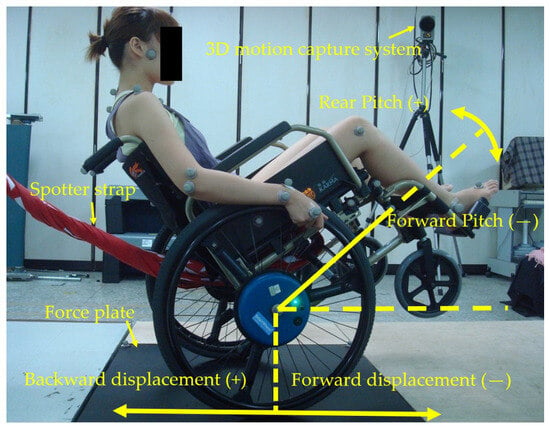
Three successful wheelie trials were collected per participant. During each 30 s trial (Figure 1), participants were instructed to maintain a stationary wheelchair wheelie while ensuring their position remained entirely within a custom 90 cm × 90 cm force platform (M9090, Chun-Chi Electric & Engineering Co. Ltd., Kaohsiung, Taiwan). The platform was designed to accommodate the full width of the wheelchair, which exceeded the dimensions of commercially available force plates. According to the manufacturer’s technical specifications, the custom force platform demonstrated excellent linearity (R2 > 0.99) and high measurement accuracy (±1.0%) for both force and moment channels. These specifications supported its use for COP estimation in the present study. The force-platform analog signals were continuously acquired through the Qualisys DAQ system (Qualisys AB, Gothenburg, Sweden) simultaneously with the optical motion-capture data at a sampling frequency of 120 Hz. Participants were asked to perform 30-s trials, with a trial deemed successful if stationary wheelie balance was maintained continuously for a minimum of 15 s. Unsuccessful trials were discarded and re-administered until three valid trials were collected per participant. For safety, a spotter strap attached to the wheelchair rear frame was continuously held by an investigator standing off the force platform. The strap remained completely slack throughout all successful trials, indicating that no external forces were applied to the wheelchair or recorded by the force plate.
Figure 1.
Experimental setup and directional conventions for wheelchair pitch angle and rear-wheel displacement. Positive values indicate rearward pitch and backward rear-wheel displacement, whereas negative values indicate forward pitch and forward rear-wheel displacement.
2.4. Motion Capture
Three-dimensional kinematic data were collected using a six-camera motion capture system (Qualisys AB, Gothenburg, Sweden) operating at a sampling frequency of 120 Hz (Figure 1). Retroreflective markers were placed bilaterally on anatomical landmarks including the temporomandibular joint, acromion, medial and lateral humeral epicondyles, radial and ulnar styloid processes, medial and lateral femoral epicondyles, medial and lateral malleoli, and the base of the second metatarsal. Two additional markers were attached to the wheelchair side guards adjacent to the hip joints, as previously described [16]. Ten supplementary markers were placed on the wheelchair frame and rear-wheel hubs to determine wheelchair orientation and rear-wheel displacement.
A twelve-segment rigid-body model consisting of the head, trunk, bilateral upper arms, forearms/hands, thighs, shanks, and feet was used to estimate the participant’s center of mass (COMo) using Dempster’s anthropometric coefficients [17].
where mi and ci are the mass and position of the COM of the ith body segment. Afterward, the whole wheelchair–user system COM was subsequently calculated as
where BM is the mass of the occupant, and WM and COMw are the mass and COM of the wheelchair frame without rear wheels, respectively [1,5,18].
2.5. Kinetic Data Measurements
The kinetic data obtained from the force plates were used to compute COPx. The horizontal COPx was calculated using the standard force-platform relationship [17]:
where My is the total pitching moment about the mediolateral axis of the force platform, and Fz represents the total vertical ground reaction force acting on the wheelchair–user system. Because the contact area between the rear tires and the rigid force-platform surface was extremely small, COPx primarily reflected the instantaneous spatial position of the rear-wheel contact point relative to the force platform. Thus, COPx was interpreted as a representation of the COP associated with rear-wheel contact-point displacement rather than as an independently controlled COP location within a broad, fixed BOS.
All kinematic and kinetic signals were time-synchronized. Marker trajectories and force-platform signals were low-pass-filtered using a fourth-order zero-phase Butterworth filter with a cutoff frequency of 10 Hz [17]. Zero-phase filtering was used to avoid introducing a systematic phase shift between paired signals used in subsequent cross-correlation analyses.
2.6. Identification of PBS
For each successful 30-s trial, the complete trial was first screened to determine the stable wheelie period. Following caster lift-off, transient PBS- or RBS-like movements could occur before participants established a stable wheelie state. Therefore, at least 3 s of continuous wheelie balance was required before the participant was considered to have reached a stable balance state, consistent with the criterion reported in previous research [1]. Data obtained after this stabilization point were then screened using a predefined MATLAB algorithm (MathWorks, Natick, MA, USA) to identify candidate PBS and RBS periods from the COPx trajectory. Based on operational criteria reported in previous studies [7,8], episodes containing non-rhythmic COPx excursions exceeding 20 cm within a 2-s interval were classified as RBS and excluded from the primary PBS analysis. PBS episodes were defined as periods containing at least five consecutive rhythmic forward-and-backward COPx oscillations within a maximum spatial excursion of 15 cm. The algorithm automatically identified candidate periods that met these criteria and marked them graphically on the COPx trajectory. Each candidate period was then visually inspected by a researcher who was not involved in subsequent statistical analysis to confirm the presence of a continuous, rhythmic oscillatory pattern consistent with PBS and the absence of RBS episodes. To minimize potential selection bias, visual inspection was used solely as a secondary verification step for candidate periods identified by the predefined MATLAB algorithm, rather than as the primary method for period selection. The same predefined criteria and verification procedure were applied consistently across all participants and trials.
For analysis, an eligible PBS period was required to contain at least 10 s of continuous PBS without RBS episodes after the 3-s stabilization point. When an eligible period was identified, the first continuous 10-s segment was extracted for further kinematic and kinetic analyses. All three successful trials from each of the 40 participants contained an eligible PBS period, resulting in 120 analyzed 10-s PBS segments (40 participants × 3 trials), with no trial excluded at this stage. The corresponding outcome measures from the three selected PBS segments were then averaged for each participant before group-level statistical analysis.
2.7. Data Analysis
Wheelchair pitch angle was defined as the angular displacement of a line connecting two markers on the wheelchair frame relative to its resting orientation [7] (Figure 1), with rearward pitch defined as positive and forward pitch as negative. Rear-wheel displacement was calculated as the anteroposterior displacement of the rear hub, with backward and forward movements assigned positive and negative values, respectively, in accordance with the coordinate convention described in the previous study [7] (Figure 1). The RMS and maximum excursion of both variables were then calculated.
Horizontal COMaccx was derived from the horizontal COM position of the whole wheelchair–user system. The COMx trajectory was low-pass-filtered using a fourth-order zero-phase Butterworth filter with a cutoff frequency of 10 Hz [17]. Horizontal COM velocity was then calculated from the filtered COMx trajectory using MATLAB’s gradient function with a sampling interval of 1/120 s. COMaccx was subsequently obtained by applying the gradient function to the COM velocity using the same sampling interval. No additional filtering or smoothing was applied after numerical differentiation. COPx was obtained from the force-platform measurements as described above. Because COPx and COMaccx represent mechanically related variables within the wheelchair–user system, their cross-correlation was interpreted as evidence of biomechanical association rather than as independent evidence of a specific motor-control mechanism.
2.8. Cross-Correlation Analysis
To quantify the dynamic coordination underlying the PBS, cross-correlation analyses were performed to quantify the temporal relationships between two pairs of biomechanical variables during the selected PBS balance period: (1) wheelchair pitch angle versus rear-wheel displacement to characterize kinematic coordination and (2) horizontal COPx versus horizontal COMaccx to characterize kinetic coupling.
Before cross-correlation analysis, each signal was linearly detrended and subsequently demeaned by subtracting its mean value. Normalized cross-correlation coefficients were calculated using MATLAB version R2024a (MathWorks, Natick, MA, USA) with xcorr function and the ‘coeff’ option. Cross-correlation was then calculated within a symmetric lag window of ±0.20 s, corresponding to ±24 samples at the 120-Hz sampling frequency. This window was selected based on previous cross-correlation analysis of wheelchair wheelies [7], in which the cross-correlation was evaluated across a wider range of ±20 samples at 60 Hz (±0.333 s). In that study, the maximum correlation occurred at zero lag in most trials, while in five trials, the maximum correlation occurred at positive lags of 1/60 to 5/60 s (0.017–0.083 s), indicating that the observed temporal shifts were generally short. The predefined ±0.20-s window was therefore selected to provide sufficient coverage of these short-latency temporal relationships while limiting the analysis to a relatively short temporal range during continuous balance. Because an inverse relationship was hypothesized for both variable pairs, the peak negative cross-correlation coefficient (r) and its corresponding phase lag were identified within this window. The lag index was converted to seconds by dividing by the sampling frequency.
Cross-correlation coefficients and corresponding phase lags were calculated separately for each of the three successful trials. To account for the repeated-trial structure, correlation coefficients were Fisher z-transformed before averaging across trials within each participant. Participant-level estimates were then averaged at the group level on the Fisher z scale and back-transformed to the correlation scale. In contrast, phase lags were averaged directly across the three trials within each participant and subsequently across participants. This approach provided participant-level estimates while preserving the appropriate treatment of correlation coefficients for averaging. Overall, the cross-correlation analysis was intended to characterize the temporal association and biomechanical coupling between the paired signals rather than to establish causal relationships or distinguish feedforward from feedback neural control.
2.9. Statistical Analysis
An a priori power analysis was conducted using G*Power (version 3.1.9.7) based on an expected correlation coefficient of 0.45, with a one-tailed α of 0.05. The resulting sample size of 40 participants was used as the target sample size. Because the present analysis used participant-level estimates derived from three repeated trials, the a priori calculation was used to guide the required number of participants rather than to determine the statistical power of the within-trial time-series cross-correlation. All variables are presented as mean ± SD. Correlation strength was interpreted according to previously reported criteria [19], with coefficients of 0.70–1.00, 0.40–0.69, and 0.10–0.39 indicating strong, moderate, and weak relationships, respectively. Statistical analyses were performed using SPSS version 21.0 (IBM Corp., Armonk, NY, USA), with statistical significance set at p < 0.05.
3. Results
3.1. Wheelchair Wheelie Performance
During the analyzed wheelie balance period, participants maintained stationary wheelchair wheelies using only small-amplitude oscillatory movements. As shown in Table 1, rear-wheel displacement remained within a limited range throughout the analyzed balance period, with a mean RMS displacement of 1.28 cm and a maximum excursion of 3.13 cm. Similarly, wheelchair pitch exhibited minimal oscillation, with an RMS of 0.63° and a maximum excursion of 1.74°. These findings characterize the analyzed PBS periods as stable balance maintained through small-amplitude oscillatory movements rather than large corrective movements.
Table 1.
Participant wheelchair wheelie performance.
3.2. Kinematic Analysis
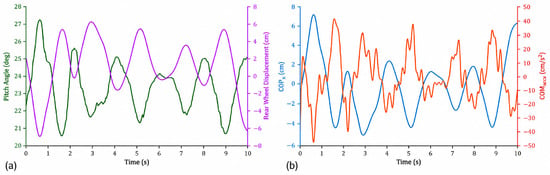
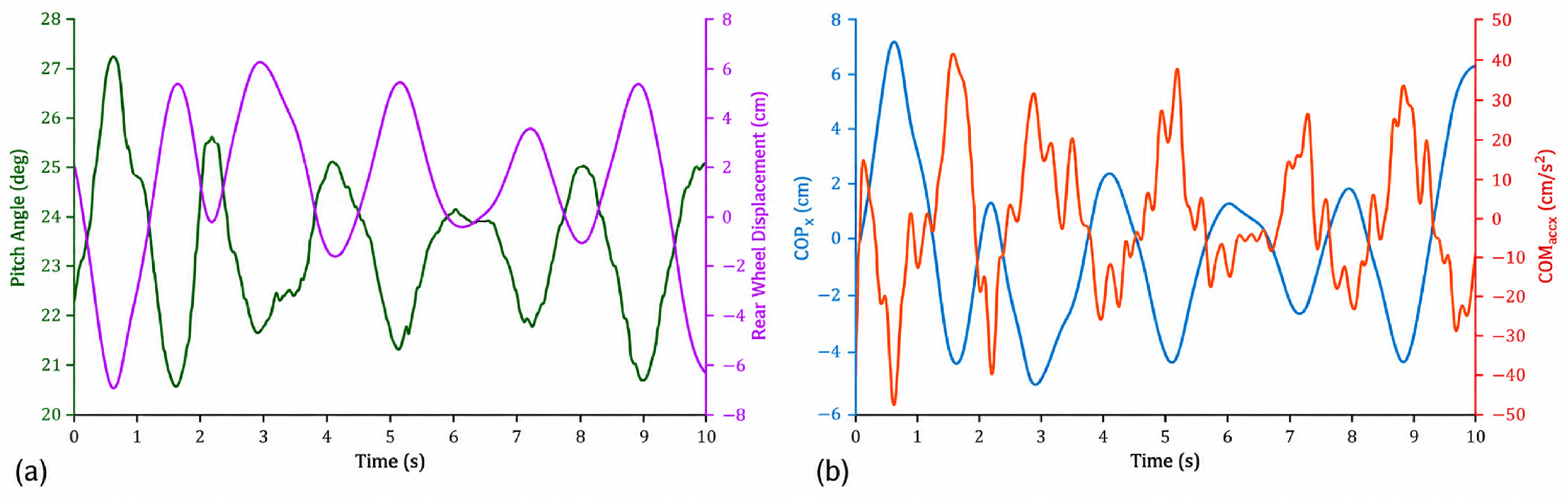
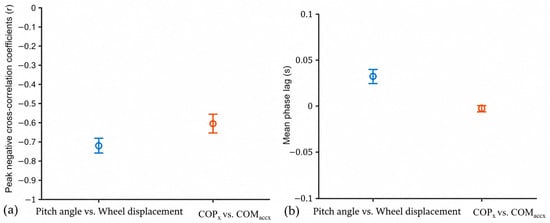
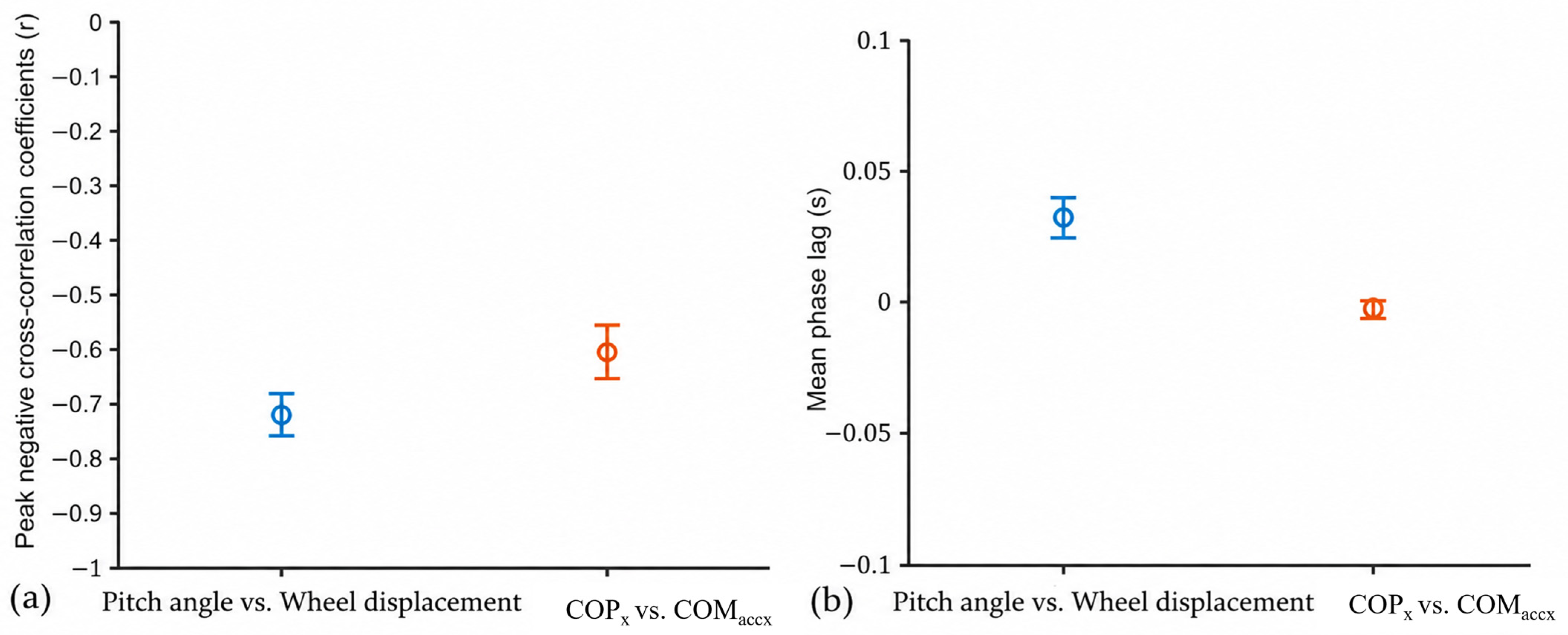
Figure 2a illustrates the temporal relationship between wheelchair pitch angle and rear-wheel displacement during a representative 10-s wheelie balance trial of a participant. As shown in Table 2, cross-correlation analysis demonstrated a strong inverse relationship between wheelchair pitch angle and rear-wheel displacement (mean r = −0.73; 95% CI: −0.75 to −0.69) (Table 2; Figure 3a). The corresponding mean phase lag was only 0.032 ± 0.023 s (95% CI: 0.024 to 0.039 s), indicating near-synchronous oscillations between the two signals (Table 2; Figure 3b). These findings indicate that backward wheelchair rotation was accompanied by forward rear-wheel translation, whereas forward wheelchair rotation was accompanied by backward rear-wheel displacement and vice versa.
Figure 2.
Representative time-series waveforms from one participant during stationary wheelchair wheelie balance. (a) Wheelchair pitch angle (green) and rear-wheel horizontal displacement (purple). (b) Horizontal COPx (blue) and horizontal COMaccx (orange).
Table 2.
Cross-correlation analysis of kinematic and kinetic variables.
Figure 3.
Group-level cross-correlation results. Values are presented as mean ± 95% confidence interval. (a) Peak negative cross-correlation coefficients between wheelchair pitch angle and rear-wheel displacement, and between COPx and COMaccx. Negative coefficients indicate stronger inverse temporal relationships between the paired variables. (b) Mean phase lags associated with the peak cross-correlation coefficients. Phase lags close to zero indicate minimal temporal offset between the paired variables.
3.3. Kinetic Analysis
Figure 2b shows the relation between COPx and COMaccx during 10 s wheelies of a representative participant. As shown in Table 2, cross-correlation analysis also demonstrated a moderate inverse relationship between COPx and COMaccx (r = −0.61) (Figure 3a), with a group mean phase lag of −0.003 ± 0.011 s (95% CI: −0.007 to 0.000 s) (Figure 3b).
4. Discussion
4.1. Kinematic Validation of the Proactive Balance Strategy
The present kinematic findings provide strong biomechanical support for the PBS by demonstrating a highly synchronized inverse relationship between wheelchair pitch angle and rear-wheel displacement during stationary wheelie balance. Cross-correlation analysis revealed a strong negative correlation (mean r = −0.73, 95% CI: −0.75 to −0.69) with a minimal mean phase lag of only 0.032 ± 0.023 s (95% CI: 0.024 to 0.039). This quantitative evidence supports the characteristic movement pattern described in the previous studies [7,8], in which backward wheelchair rotation is tightly coupled with immediate forward rear-wheel displacement, and vice versa.
Rather than maintaining static stability by remaining motionless, trained participants achieved dynamic equilibrium through continuous, small-amplitude oscillations. During the steady-state balance period, the rear wheels exhibited an exceptionally small RMS displacement of 1.28 ± 0.53 cm (maximum excursion: 3.13 ± 1.15 cm), while wheelchair pitch oscillated within an RMS of 0.63° ± 0.28° (maximum excursion: 1.74° ± 0.64°). These small corrective movements indicate that successful wheelie balance was achieved through continuous regulation rather than large corrective movements.
4.2. Biomechanical Interpretation of the COPx and COMaccx Relationship
The kinetic findings provide further evidence of the temporal coupling underlying PBS. The moderate inverse relationship between COPx and COMaccx, together with a phase lag close to zero, suggests a strong temporal coupling between the two variables during stationary wheelie balance. At a sampling frequency of 120 Hz, each participant trial-level lag estimate was inherently discretized to multiples of the 8.33 ms sampling interval (1/120 s). The reported group mean lag of −0.003 s therefore does not represent a single hardware-resolved delay smaller than this interval; rather, it reflects the arithmetic average of many discretized, trial-level estimates across trials and participants, whose distribution can yield a mean finer than the underlying sampling resolution. Accordingly, a group mean phase lag near zero should be interpreted as evidence of tight temporal synchronization between the paired variables during stationary wheelie balance, rather than as a physiologically or mechanically resolved sub-8.33 ms delay.
From the perspective of inverted-pendulum mechanics, horizontal COM acceleration is related to the relative position of the COP and COM according to [12,14,17,20]
where g represents gravitational acceleration, and h represents the vertical height of the COM above the ground. Recent biomechanical studies have further emphasized the complementary roles of COM and COP in the regulation and assessment of postural stability [21], with the COP mechanism representing an important pathway for controlling COM acceleration through shifts in the ground reaction force [22,23]. Accordingly, changes in COPx are mechanically associated with corresponding changes in horizontal COM acceleration. The inverse COPx–COMaccx relationship observed in the present study is therefore consistent with the mechanical coupling expected in an inverted-pendulum system.
This finding provides insight into the functional analogy between PBS and the ankle strategy. In standing balance, ankle plantarflexor and dorsiflexor activity regulates the COP within a relatively fixed base of support provided by the feet. However, recent evidence further supports the broader relevance of ankle mechanics to dynamic postural regulation beyond quiet standing. A recent study reported associations among ankle mobility, foot stability, and stabilometric characteristics during jumping and landing tasks, suggesting that ankle-related mechanical properties contribute to dynamic postural stability [11]. Although the task demands and mechanical context differ substantially from wheelchair wheelie balance, these findings provide contemporary support for regarding ankle mechanics as a functionally relevant component of dynamic postural regulation more broadly. During a stationary wheelchair wheelie, the rear-wheel contact region is extremely narrow, and the rear-wheel contact point translates along the fore–aft direction with rear-wheel motion, thereby providing a distinct biomechanical means of regulating whole-body dynamics.
In addition, another randomized controlled trial reported that alterations in ankle dorsiflexion characteristics following a five-week intervention were accompanied by corresponding changes in ankle angular velocity and countermovement-jump performance [24]. This latter study did not directly examine wheelchair wheelie balance or PBS; nevertheless, it demonstrates that ankle mechanical properties are modifiable and may be relevant to functional movement performance more broadly. Collectively, these studies provide broader context for interpreting the present findings within a functional biomechanical framework.
In the standing ankle strategy, postural equilibrium is maintained by modulating sagittal ankle joint torques (plantarflexor/dorsiflexor activity) within a fixed BOS defined by the foot–ground contact area. These muscular torques shift the local COPx along the fore–aft direction within the stationary boundary of the feet to counteract COM excursions. By contrast, during PBS, the wheelchair–user system cannot generate substantial COPx shifts within the rear-wheel contact region because the available BOS is extremely narrow. Instead, COPx modulation is achieved only by translating this narrow BOS in the fore–aft direction: as the rear wheels roll through small micro-displacements, the physical location of the BOS is repositioned in space, thereby contributing to the observed COPx–COMaccx coupling and the regulation of whole-body dynamics.
Recognizing this biomechanical distinction is essential for defining the scope of the proposed analogy. The functional resemblance between PBS and the ankle strategy lies in their shared dynamic objective: maintaining dynamic equilibrium around a metastable set point through continuous, phase-locked COPx micro-adjustments that prevent large balance errors. The near-zero average phase lag observed in the present study indicates tight, uninterrupted temporal synchronization between COPx and COMaccx. This tight coupling suggests that small rear-wheel oscillations may serve a function analogous to ankle torque modulation during stationary wheelie balance. However, this analogy remains purely functional and biomechanical; it describes a shared dynamic control principle rather than implying equivalent neural control loops or structural identity.
Although the present study did not directly measure electromyography or responses to experimentally imposed perturbations, the coordinated kinematic and kinetic relationships observed here are compatible with the proactive characteristics previously proposed for PBS. It is important to emphasize that “proactive” in the present context describes the continuous, phase-locked, small-amplitude mechanical adjustments executed by the user to prevent balance loss, rather than a definitively proven feedforward neural control architecture. While these findings cannot isolate specific feedforward from feedback neural pathways, they demonstrate that PBS functions as a highly synchronized biomechanical controller—modulating rear-wheel displacement, COP, and COM dynamics in a manner functionally analogous to the standing ankle strategy.
4.3. Clinical Implications for Wheelchair Wheelie Training
The present findings offer several clinically relevant implications for wheelchair wheelie training. Traditional wheelie instruction often emphasizes minimizing body movement, with large corrective wheel motions introduced only after balance has been noticeably disturbed. In contrast, the present results indicate that proficient wheelie balance is characterized by continuous, small-amplitude oscillations of wheelchair pitch and rear-wheel displacement, together with coordinated regulation of COPx and COMaccx. Rather than instructing users to remain completely motionless, clinicians and rehabilitation practitioners may consider emphasizing rhythmic micro-adjustments immediately following caster lift-off, encouraging learners to recognize and regulate small forward and backward movements while maintaining an appropriate pitch orientation. Such an approach may facilitate the development of continuous balance regulation, thereby reducing reliance on large reactive corrections that frequently exacerbate instability and increase the risk of tipping backward.
The quantitative characteristics observed in the present laboratory setting could provide a biomechanical reference for understanding how controlled, continuous adjustments emerge during the learning of wheelchair wheelie skills. However, the specific displacement and pitch values reported here should be regarded as laboratory reference values rather than prescribed targets for wheelie skill acquisition, as their applicability to daily wheelchair users and clinical populations requires further validation.
Environmental design may further facilitate acquisition of this skill. Previous studies have shown that high-rolling-resistance surfaces [25] and ramp-assisted training methods [26] can improve safety during early wheelie practice. Such training environments may help constrain excessive wheelchair movement and reduce the risk of backward falls, allowing learners to progressively practice the small-amplitude fore–aft adjustments and pitch control associated with stable wheelie balance.
4.4. Limitations
The present study has several limitations. First, participants were healthy young adults who acquired wheelchair wheelie skills through practice rather than experienced daily manual wheelchair users. This population may differ from individuals with spinal cord injury or other neuromuscular conditions in trunk, hip, and upper-extremity motor control and movement strategies. Therefore, the biomechanical relationships identified in the present study should not be assumed to generalize directly to clinical wheelchair users. Although studying healthy young adults reduced variability associated with neurological impairments and allowed examination of the fundamental biomechanical characteristics of PBS under controlled conditions, future studies should determine whether these findings generalize to experienced wheelchair users and clinical populations.
Second, the analysis was limited to sagittal-plane mechanics because stationary wheelchair wheelie balance is primarily governed by anteroposterior regulation of the center of mass relative to the rear-wheel base of support. Although minor yaw adjustments may occur due to asymmetric handrim inputs, their contribution to balance control was beyond the scope of the present study. Future three-dimensional analyses may further characterize these additional control strategies.
Third, although whole-body COM was calculated using a 12-segment rigid-body model, trunk kinematics were not specifically quantified in the present analysis. Therefore, potential contributions of trunk and other segmental postural adjustments to whole-body COM regulation and PBS cannot be excluded. In addition, the present findings should not be assumed to generalize directly to individuals with spinal cord injury or other neuromuscular conditions, who may rely on different trunk, hip, or head movement strategies to regulate whole-body balance. Future studies should incorporate full-body kinematics and segmental coordination to further characterize how potential head-based compensatory movements, trunk motion, rear-wheel displacement, and whole-body COM dynamics interact during wheelchair wheelie initiation and stationary balance.
Fourth, the experiments were conducted under standardized laboratory conditions using a single wheelchair configuration with a fixed rear-axle position and standardized geometry. Therefore, the reported quantitative values should be interpreted as reference values specific to this controlled wheelchair configuration rather than universal thresholds or clinical training targets. Wheelie balance characteristics may vary with wheelchair configuration, including rear-axle position, seat geometry, and other mechanical properties, as well as with individual user characteristics. Future studies should examine whether the proposed functional ankle-strategy analogy and its associated biomechanical characteristics are preserved across different wheelchair configurations, environments, and user populations.
Finally, the cross-correlation analysis has methodological limitations. Peak cross-correlation coefficients may be influenced by the autocorrelation and shared oscillatory structure of the biomechanical signals. In addition, although the first eligible 10-s PBS segment was selected according to predefined criteria, analysis of uninterrupted PBS segments may preferentially characterize relatively regular periods of wheelie balance. Therefore, the observed correlations should be interpreted descriptively as biomechanical associations rather than as definitive evidence of a specific control mechanism. Future studies could examine the robustness of these findings using all eligible PBS segments and surrogate or phase-randomized analyses.
5. Conclusions
This study provides biomechanical evidence supporting a functional analogy between PBS and the standing ankle strategy during stationary manual wheelchair wheelie balance. Cross-correlation analyses revealed a strong inverse relationship between wheelchair pitch angle and rear-wheel displacement and a moderate inverse relationship between COPx and COMaccx, both with minimal temporal offset. These findings suggest that stationary wheelie balance is maintained through continuous, small-amplitude rear-wheel adjustments that reposition the wheel–ground contact point and contribute to the regulation of whole-body COM dynamics. However, this analogy is functional rather than structural: whereas the ankle strategy modulates COP within a relatively fixed BOS, PBS achieves a similar control function by translating the BOS through rear-wheel displacement. The near-zero phase lag between COPx and COMaccx further indicates tight temporal coupling consistent with inverted-pendulum dynamics, although the underlying neural control mechanisms remain to be established.
These findings provide a quantitative biomechanical framework for characterizing PBS and may contribute to understanding wheelchair wheelie skill learning. Because the present sample comprised trained but non-daily wheelchair users, the observed control pattern should be interpreted as a biomechanical reference rather than a prescribed learning strategy. Nevertheless, the findings suggest that early, rhythmic rear-wheel micro-adjustments following caster lift-off may be an important feature of dynamic wheelie balance and may warrant further investigation during wheelchair wheelie skill acquisition and rehabilitation.
Author Contributions
Conceptualization, W.-C.F., Y.-C.T. and Y.-S.Y.; methodology, W.-C.F., C.-R.C. and Y.-S.Y.; software, C.-R.C. and Y.-S.Y.; validation, W.-C.F., C.-R.C. and Y.-C.T.; formal analysis, W.-C.F., C.-R.C. and Y.-S.Y.; investigation, W.-C.F., C.-R.C. and Y.-C.T.; data curation, C.-R.C. and Y.-C.T.; writing—original draft preparation, W.-C.F.; writing—review and editing, Y.-S.Y.; visualization, C.-R.C.; supervision, Y.-S.Y.; project administration, Y.-C.T.; funding acquisition, Y.-C.T. All authors have read and agreed to the published version of the manuscript.
Funding
This study was supported by a grant from the Kaohsiung Medical University Hospital, Grant No. KMUH104-M413.
Institutional Review Board Statement
The study was conducted in accordance with the Declaration of Helsinki and approved by the Institutional Review Board of Kaohsiung Medical University Chung-Ho Memorial Hospital (approval code: KMUHIRB-E(II)-20170080; date of approval: 27 March 2017).
Informed Consent Statement
Informed consent was obtained from all subjects involved in the study.
Data Availability Statement
The data presented in this study are available on request from the corresponding author due to ethical and privacy considerations as mandated by the Institutional Review Board of Kaohsiung Medical University Chung-Ho Memorial Hospital.
Conflicts of Interest
The authors declare no conflicts of interest.
Abbreviations
The following abbreviations are used in this manuscript:
| BOS | Base of support |
| COM | Center of mass |
| COMaccx | Horizontal acceleration of the center of mass |
| COP | Center of pressure |
| COPx | Horizontal position of the center of pressure |
| PBS | Proactive Balance Strategy |
| RBS | Reactive Balance Strategy |
References
- Kirby, R.L.; Kirby, R.L.; Smith, C.; Seaman, R.; Macleod, D.A.; Parker, K. The manual wheelchair wheelie: A review of our current understanding of an important motor skill. Disabil. Rehabil. Assist. Technol. 2006, 1, 119–127. [Google Scholar] [CrossRef] [Scilit]
- Hosseini, S.M.; Oyster, M.L.; Kirby, R.L.; Harrington, A.L.; Boninger, M.L. Manual wheelchair skills capacity predicts quality of life and community integration in persons with spinal cord injury. Arch. Phys. Med. Rehabil. 2012, 93, 2237–2243. [Google Scholar] [CrossRef] [Scilit]
- Kirby, R.L.; Fahie, C.L.; Smith, C.; Chester, E.L.; Macleod, D.A. Neck discomfort of wheelchair users: Effect of neck position. Disabil. Rehabl. 2004, 26, 9–15. [Google Scholar] [CrossRef] [Scilit]
- MacDonald, B.; Kirby, R.L.; Smith, C.; MacLeod, D.A.; Webber, A. Sitting pressure in the tilted position: Manual tilt-in-space wheelchair vs. manual wheelchair with a new rear antitip device. Am. J. Phys. Med. Rehabil. 2009, 88, 61–65. [Google Scholar]
- Ardigo’, L.P.; Goosey-Tolfrey, V.L.; Minetti, A.E. Biomechanics and energetics of basketball wheelchairs evolution. Int. J. Sports Med. 2005, 26, 388–396. [Google Scholar] [CrossRef] [Scilit]
- Kauzlarich, J.J.; Thacker, J.G. A theory of wheelchair wheelie performance. J. Rehabil. Res. Dev. 1987, 24, 67–80. [Google Scholar]
- Bonaparte, J.P.; Kirby, R.L.; Macleod, D.A. Proactive balance strategy while maintaining a stationary wheelie. Arch. Phys. Med. Rehabil. 2001, 82, 475–479. [Google Scholar] [CrossRef] [Scilit]
- Bonaparte, J.P.; Kirby, R.L.; Macleod, D.A. Learning to perform wheelchair wheelies: Comparison of 2 training strategies. Arch. Phys. Med. Rehabil. 2004, 85, 785–793. [Google Scholar] [CrossRef] [Scilit]
- McInnes, M.D.; Kirby, R.L.; MacLeod, D.A. The contribution of vision to wheelie balance. Arch. Phys. Med. Rehabil. 2000, 81, 1081–1084. [Google Scholar] [CrossRef] [Scilit]
- Morasso, P. Integrating ankle and hip strategies for the stabilization of upright standing: An intermittent control model. Front. Comput. Neurosci. 2022, 16, 956932. [Google Scholar] [CrossRef] [Scilit]
- Patti, A.; Gervasi, M.; Giustino, V.; Figlioli, F.; Canzone, A.; Drid, P.; Thomas, E.; Messina, G.; Vicari, D.S.S.; Palma, A.; et al. The Influence of Ankle Mobility and Foot Stability on Jumping Ability and Landing Mechanics: A Cross-Sectional Study. J. Funct. Morphol. Kinesiol. 2024, 9, 160. [Google Scholar] [CrossRef] [Scilit]
- Gage, W.H.; Winter, D.A.; Frank, J.S.; Adkin, A.L. Kinematic and kinetic validity of the inverted pendulum model in quiet standing. Gait Posture 2004, 19, 124–132. [Google Scholar] [CrossRef] [Scilit]
- Hof, A.L. The equations of motion for a standing human reveal three mechanisms for balance. J. Biomech. 2007, 40, 451–457. [Google Scholar] [CrossRef] [Scilit]
- Sonobe, M.; Inoue, Y. Center of Mass Estimation Using a Force Platform and Inertial Sensors for Balance Evaluation in Quiet Standing. Sensors 2023, 23, 4933. [Google Scholar] [CrossRef] [Scilit]
- Fang, W.C.; Chen, C.R.; Tsaic, Y.C.; Chang, J.J.; Yang, Y.S. The Three-Dimensional Measurement of Center of Gravity Among Lightweight Wheelchairs and Reclining Wheelchairs. J. Taiwan Occup. Ther. Assoc. 2011, 29, 64–78. [Google Scholar]
- Sekiya, N.; Yamazaki, H. Biomechanics and motor control of normal young adults performing a wheelchair wheelie balance task. Percept. Mot. Ski. 2010, 110, 825–839. [Google Scholar] [CrossRef] [Scilit]
- Winter, D.A. Biomechanics and Motor Control of Human Movement, 3rd ed.; John Wiley & Sons: Hoboken, NJ, USA, 2005. [Google Scholar]
- Chénier, F.; Marquis, E.; Fleury-Rousseau, M. Tracking the whole-body centre of mass of humans seated in a wheelchair using motion capture. J. Biomech. 2023, 156, 111675. [Google Scholar] [CrossRef] [Scilit]
- Dancey, C.P.; Reidy, J. Statistics Without Maths for Psychology: Using Spss for Windows; Prentice Hall: New York, NY, USA, 2004. [Google Scholar]
- Ellsworth, G.J.; Klisch, S.M.; Berg-Johansen, B.; Ocegueda, E. Validation of Smartphones in Arbitrary Positions Against Force Plate Standard for Balance Assessment. Sensors 2025, 25, 2639. [Google Scholar] [CrossRef] [Scilit]
- Richmond, S.B.; Fling, B.W.; Lee, H.; Peterson, D.S. The assessment of center of mass and center of pressure during quiet stance: Current applications and future directions. J. Biomech. 2021, 123, 110485. [Google Scholar] [CrossRef] [Scilit]
- van den Bogaart, M.; Bruijn, S.M.; Spildooren, J.; van Dieën, J.H.; Meyns, P. Effects of age and surface instability on the control of the center of mass. Hum. Mov. Sci. 2022, 82, 102930. [Google Scholar] [CrossRef] [Scilit]
- Tisserand, R.; Plard, J.; Robert, T. Relative contributions of postural balance mechanisms reveal studying the CoP displacement alone may be incomplete for analysis of challenging standing postures. Gait Posture 2023, 101, 134–137. [Google Scholar] [CrossRef] [Scilit]
- Patti, A.; Thomas, E.; Giustino, V.; Rossi, C.; Paoli, A.; Drid, P.; Palma, A.; Bianco, A. Effects of foam rolling and static stretching on ankle dorsiflexion and jumping ability: A randomized controlled trial. Biol. Sport 2025, 42, 163–170. [Google Scholar] [CrossRef] [Scilit]
- Kirby, R.L.; Gillis, D.J.; Boudreau, A.L.; Smith, C.; Rushton, P.; Clark-Gallant, L.; Parker, K.E.; Webber, A. Effect of a high-rolling-resistance training method on the success rate and time required to learn the wheelchair wheelie skill: A randomized controlled trial. Am. J. Phys. Med. Rehabil. 2008, 87, 204–211. [Google Scholar] [CrossRef] [Scilit]
- Yang, Y.S.; Koontz, A.M.; Chen, C.R.; Fang, W.C.; Chang, J.J. Effect of a Wheelie Training Method With the Front Wheels on a Ramp in Novice Able-Bodied Participants: A Randomized Controlled Trial. Assist. Technol. 2015, 27, 121–127. [Google Scholar] [CrossRef] [Scilit]

Disclaimer/Publisher’s Note: The statements, opinions and data contained in all publications are solely those of the individual author(s) and contributor(s) and not of MDPI and/or the editor(s). MDPI and/or the editor(s) disclaim responsibility for any injury to people or property resulting from any ideas, methods, instructions or products referred to in the content. |
© 2026 by the authors. Licensee MDPI, Basel, Switzerland. This article is an open access article distributed under the terms and conditions of the Creative Commons Attribution (CC BY) license.